

Importance of human resource development; Recruitment, training, career advancement, position classification, discipline, performance appraisal, promotion, pay and service conditions; employer-employee relations, grievance redressal mechanism; Code of conduct; Administrative ethics.
This article: Importance of human resource development; recruitment; training; career advancement; position classification; promotion; pay and service conditions.
Official Syllabus: Paper I · Unit 1-09 Personnel Administration
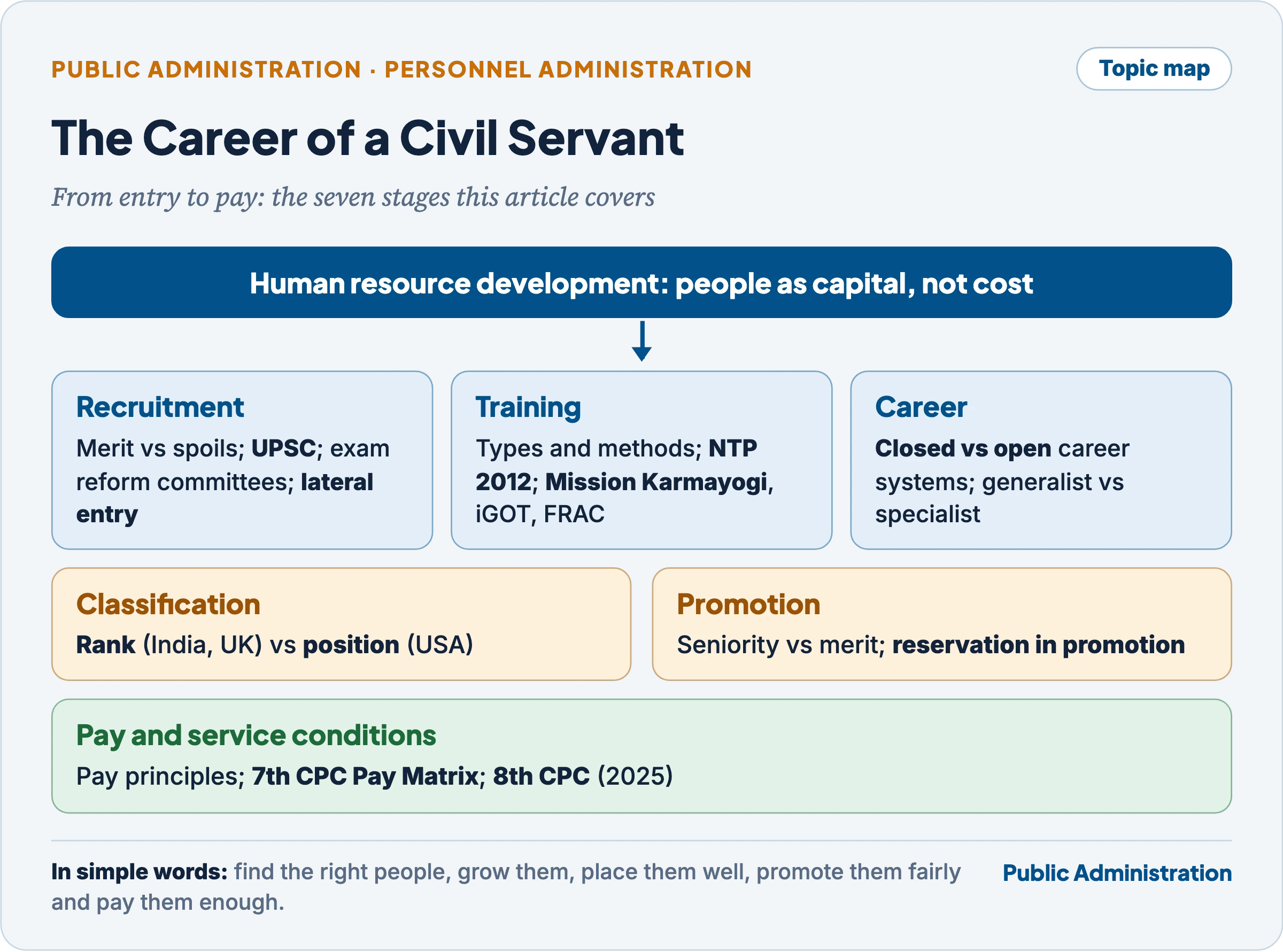
Personnel administration is the part of public administration that deals with the people who run the government: how they are found, selected, trained, classified, promoted and paid. Every policy, budget and law ends up in the hands of a public servant, so the quality of the state depends on the quality of its personnel system. A faulty recruitment rule or a stagnant promotion ladder weakens administration for decades, because a civil servant recruited at 25 may serve until 60.
In simple words
Think of a cricket team. You must pick good players (recruitment), coach them (training), decide who bats where (classification), promote the best to captaincy (promotion) and pay them enough that they do not leave for a league abroad (pay). Get any one wrong and the team loses, however good the others are.
1. Human Resource Development: Importance and Evolution
In simple words
Old government offices treated staff like furniture: count them, file their leave and punish mistakes. Modern thinking treats staff like seeds: the more you invest in them, the more the organisation grows.
1.1 Meaning of HRD
- Human resource development (HRD) is the framework that helps employees develop their personal and organisational skills, knowledge and abilities so that both they and the organisation reach their goals.
- It covers training and development, career development and organisation development (team building, job enrichment, quality of work life, management by objectives).
- Its premise is that employees are a resource with potential, not merely a factor of production or a line in the wage bill.
- Features of HRD:
- employees are human resources whose potential must be developed for their own and the organisation’s benefit;
- the work environment should let workers identify with the organisation’s objectives;
- it builds pride in membership of the group and the image of the organisation;
- it seeks the best fit of the individual to the job, the greatest involvement of the employee and the greatest concern for enhancing individual capability.
- The HRD process runs as a cycle:
- needs assessment and planning;
- programme design, development and evaluation;
- training and development to build skills, knowledge and behaviour;
- organisation development (change management, restructuring, participative management, job redesign);
- career development that empowers employees;
- research and evaluation of policies, so the organisation reacts proactively to change.
1.2 Why HRD matters in public administration
- The state depends on its people. Developing countries face the double task of building physical and human infrastructure; both depend on the capability, motivation and performance of public employees.
- Merit protects integrity. A competent and politically neutral civil service was a major reason Western Europe recovered smoothly after the Second World War. Where merit is absent, recruitment becomes patronage and the government becomes more partisan and more corrupt, because officials owe their jobs to politicians rather than to the law.
- Complexity of tasks. Climate finance, cyber security, artificial intelligence regulation and public health need skills that a once-in-a-career examination cannot guarantee. HRD keeps skills current.
- Manpower planning. Personnel needs should be part of development planning: increase the supply of qualified people, recruit them on merit, build capability through training and motivate them through pay, service conditions and career prospects.
- The environment shapes HRD. Government HRD practices differ from private ones because of the constitutional and legal framework (Articles 309–311, reservation, service rules), political control, fiscal limits (pay set by commissions, not markets), unionisation rules, public scrutiny (RTI, courts) and technology. A practice that works in a firm, such as instant hiring and firing, may be illegal or unwise in a ministry.
- Components are interrelated. Recruitment decides who can be trained; classification decides what pay a post carries; appraisal decides promotion; pay decides whether talent stays. A reform in one component fails if the others stay unchanged, which is why modern systems treat human resource management (HRM) as one integrated system.
1.3 From personnel administration to HRM to HRD
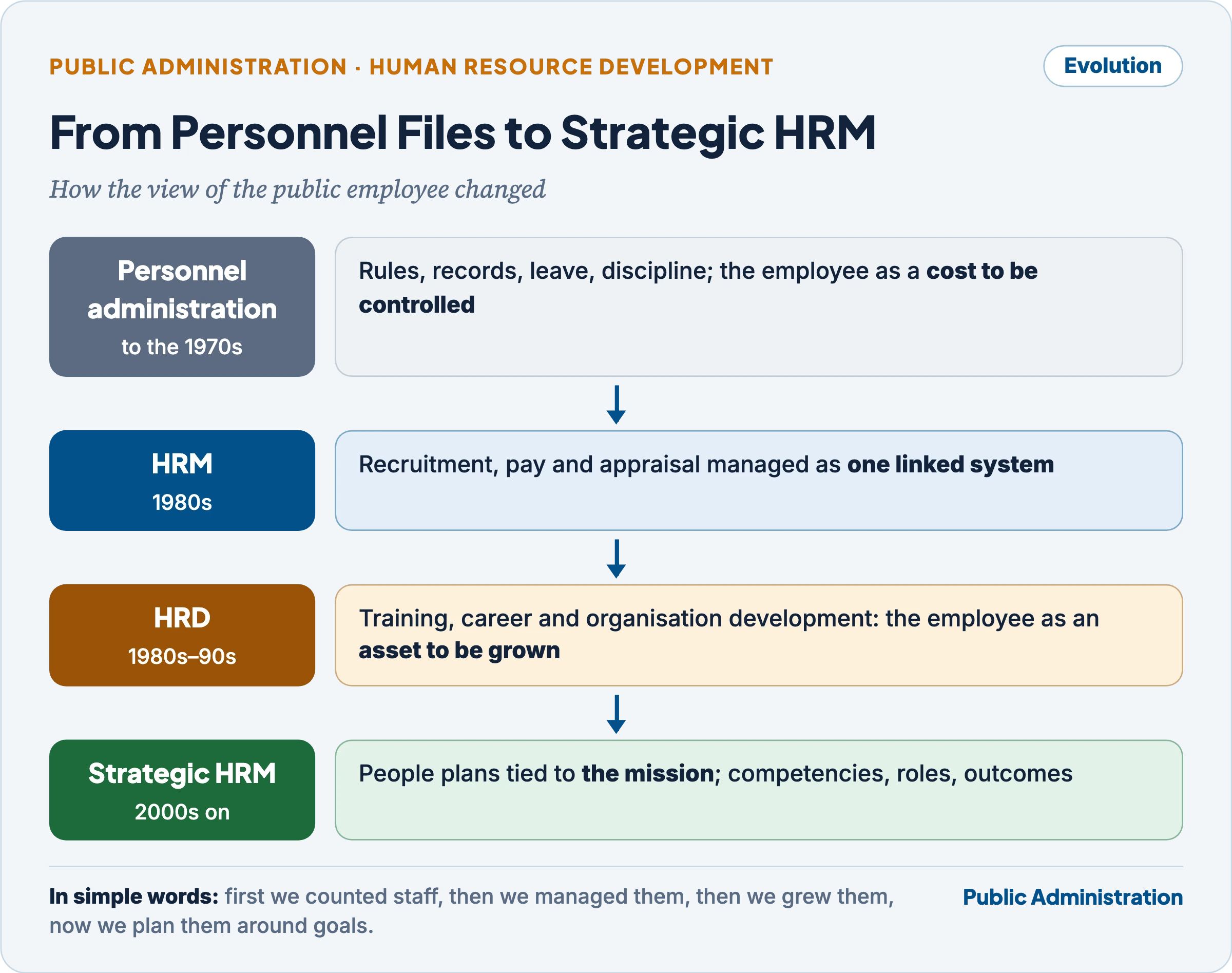
- Personnel administration (to the 1970s): procedural and rule-bound; files, leave registers, discipline; the employee seen as a cost to be controlled. This is the world of Theory X (Douglas McGregor’s label for the belief that workers dislike work and must be controlled).
- Human resource management (1980s): recruitment, appraisal, pay and welfare managed as one connected system; borrowed heavily from business.
- Human resource development (1980s–1990s): the employee as an asset to be grown; continuous learning, career planning and organisation development; closer to Theory Y (workers seek responsibility if conditions are right).
- Strategic HRM (2000s onwards): people plans aligned with the organisation’s mission and strategy; competency frameworks, workforce planning, performance linked to outcomes.
The intellectual roots run back through administrative thought:
- Frederick Taylor, the American engineer of The Principles of Scientific Management (1911), first treated the worker’s efficient use as a management problem, though he saw the worker narrowly as a unit of output.
- The Human Relations school (Elton Mayo and the Hawthorne studies, 1924–32) added social and psychological needs.
- Behavioural thinkers (Maslow, Herzberg, McGregor, Argyris) placed the individual at the centre of the organisation.
- New Public Management in the 1980s–90s imported private HR tools: contracts, performance pay, lateral hiring.
- Information technology gave HRD its current form: online learning, competency databases and data-driven workforce planning.
1.4 Strategic HRM
- Strategic human resource management (SHRM) links every personnel decision to the organisation’s long-term goals.
- Workforce planning: forecasting what skills will be needed and where.
- Competency mapping: listing the knowledge, skills and behaviours each post needs, and assessing each employee against them.
- Integration: recruitment, training, posting and promotion all use the same competency language.
- Competency mapping and career incentives. When each post has a defined competency profile and officers are posted and promoted according to proven competencies, training stops being a holiday and becomes a career investment. This can raise commitment to service delivery, provided postings follow competency rather than patronage and appraisal is honest.
- Limits in government: strategy is set politically and changes with elections; pay cannot be varied freely; transfers are often political; and measuring outcomes in public services (justice, policing) is hard.
Indian Connect — Strategic HRM in India
- 2nd Administrative Reforms Commission, 10th Report, Refurbishing of Personnel Administration (2008): recommended domain assignment of officers after about 13 years of service, performance agreements, mid-career reviews and a stronger link between training, posting and promotion.
- Mission Karmayogi (2020) is India’s clearest strategic HRM programme: it moves from rules-based to roles-based management by mapping every post to a Framework of Roles, Activities and Competencies (FRAC).
- From the 2025-26 reporting year, completion of prescribed iGOT courses is captured in the Annual Performance Appraisal Report (APAR) of central employees and All India Services officers, linking learning to career records.
1.5 Resistance to HR reform
- Gerald Caiden, the scholar of administrative reform, defined it as the artificial inducement of administrative transformation against resistance. Personnel reform is the hardest kind, because it touches people’s jobs, status and pay.
- Sources of resistance:
- vested interests of existing cadres (for example, generalist services resisting lateral entry or domain specialisation);
- unions and associations defending seniority and job security;
- political interests that gain from control over transfers and postings;
- legal rigidity: service rules, court rulings on seniority, reservation law;
- inertia and fear of the unknown among employees.
- Inducements to overcome it: political will at the top; consultation with staff bodies; phased pilots; protecting the security of existing staff while changing rules for new entrants; incentives (training linked to promotion); and communication that shows gains to employees, not only to the government.
2. Recruitment
In simple words
Recruitment is the front door of the government. If the door lets in the wrong people, no amount of training, rules or pay can fix the house later.
2.1 Meaning and importance
- Recruitment is the process of attracting, screening and selecting qualified people for posts in an organisation.
- It is the cornerstone of the whole public personnel structure: a faulty recruitment policy inflicts a permanent weakness on administration, filling it with the dull and incompetent for a whole career.
- The idea of a career civil service assumes recruitment on merit and equal opportunity for all.
- Essential elements of a good recruitment system:
- an independent recruiting agency with constitutional or statutory protection;
- open competition and wide publicity;
- objective tests that measure what the job needs (knowledge, aptitude, personality);
- clear qualifications and fair age limits;
- speed and transparency: published syllabi, results, answer keys;
- representativeness (affirmative action) without losing quality;
- probation to confirm the fit after selection.
2.2 Spoils system and merit system
- Spoils system: public jobs are given as rewards to political supporters. In the United States, President Andrew Jackson (from 1829) defended rotation in office as democratic; the phrase “to the victor belong the spoils” is attributed to Senator William Marcy (1832).
- Defence: keeps the bureaucracy responsive to the elected government; rotates power.
- Costs: incompetence, corruption, insecurity of tenure and loss of continuity.
- Merit system: appointment by open competitive examination, with security of tenure and political neutrality.
- China used competitive examinations for state service from the Han dynasty onwards, the oldest example in history.
- Prussia was the first modern state to replace patronage with trained, examined officials (eighteenth century).
- Britain: the Northcote–Trevelyan Report (1854) recommended open competition; it became general by an Order in Council of 1870.
- India: the Charter Act of 1853 opened the Indian Civil Service to competition; the Macaulay Committee (1854) designed it; the first examination was held in 1855.
- United States: the Pendleton Civil Service Reform Act (1883) created the merit system after President James Garfield was assassinated (1881) by a disappointed office-seeker.
- Negative vs positive recruitment:
- Negative recruitment aimed only to “keep the rascals out” of the service. It kept out partisans, but also many able people, and created mass competition without a search for the best.
- Positive recruitment actively searches for the best qualified candidates, defines the job’s needs, targets promising sources and works with the operating departments.
Common confusion
Does the merit system mean there is no political role in recruitment? No. Merit decides who is selected; elected governments still decide how many posts exist, the rules of eligibility (age, attempts, reservation) and, under Article 309, the service rules. The merit system removes politics from the choice of individuals, not from personnel policy.
2.3 Systems and methods of recruitment
- Three broad systems:
- Cadet system: recruitment at a young age, followed by long institutional training (military academies, the old French and German models).
- General mental ability system: graduates recruited on general ability for a career service (India, UK and much of Europe).
- Expertise system: recruitment of people with specific qualifications or experience for particular posts, at any level (United States: “one may enter the American public service at almost any level and almost at any stage”).
- Direct recruitment vs recruitment from within:
| Point | Recruitment from within (promotion, transfer) | Direct recruitment from outside |
|---|---|---|
| Morale | Raises morale; rewards experience | Can demoralise insiders passed over |
| Knowledge of candidate | Employer knows the employee’s record | Relies on tests and interviews |
| Cost and speed | Cheaper, quicker | Costlier, slower |
| Field of choice | Narrow; risk of inbreeding | Wide; brings new blood |
| Risk | Stagnation and conservatism | Lack of institutional knowledge |
In practice every system combines both: lower posts are mostly filled by direct recruitment, middle and higher posts largely by promotion, because experience matters more as responsibility grows.
- Stages of recruitment: requisition of posts → fixing qualifications and conditions → application design → advertisement → scrutiny → examination → certification (sending eligible names to the appointing authority) → selection → appointment → placement.
- Qualifications:
- general: citizenship, domicile, age, sometimes gender;
- special: education, experience, technical knowledge, personal qualities.
- Tests: written examination, oral examination (interview), performance test, and evaluation of education and experience.
- The selection model of recruitment assumes that the organisation’s needs come first: it fills a defined post with the candidate who best fits it. Critics note that it neglects the applicant’s career needs and the wider goal of a representative service; the career model looks instead at the candidate’s long-term development.
2.4 Open and closed career systems
- Closed career system: entry only at the bottom, young; advancement within the service; lifetime career (India’s All India Services, UK, France).
- Strengths: loyalty, esprit de corps, institutional memory, neutrality.
- Weaknesses: insularity, weak specialism, slow response to new skills.
- Open career system: entry at any level; posts filled from inside or outside by competition (USA).
- Strengths: fresh talent and expertise; mobility between government and private sector.
- Weaknesses: weaker commitment; risk of patronage; less continuity.
- Co-existence is the modern trend: a closed core for continuity and neutrality, with open windows (lateral entry, deputation, contract posts) for expertise. This is the logic of India’s lateral entry experiment.
2.5 The recruiting agency: UPSC and Article 315
- Location of the recruiting agency is a central problem. Under the spoils system the ruler appointed at will; democracies place recruitment with an independent public service commission with constitutional backing.
- Indian constitutional provisions (Part XIV, Chapter II):
- Article 315: a Public Service Commission for the Union and one for each State; two or more States may share a Joint Commission created by Parliament.
- Article 316: appointment by the President (Governor for a State Commission); term of six years or until age 65 (62 for State Commissions).
- Article 317: removal only by the President on grounds of misbehaviour after an inquiry by the Supreme Court, or for insolvency, outside employment or infirmity.
- Article 318: conditions of service cannot be varied to a member’s disadvantage after appointment.
- Article 319: limits on later employment of chairpersons and members.
- Article 320: functions: conducting examinations; advice on methods of recruitment, principles of appointment, promotion and transfer, and disciplinary matters.
- Article 322: expenses charged on the Consolidated Fund.
- Article 323: annual report to the President, laid before Parliament with reasons for any non-acceptance of advice.
- Autonomy and its limits:
- security of tenure, removal through the Supreme Court and charged expenses give real independence;
- but UPSC’s advice is not binding; Article 320(3) lets regulations exclude matters from its purview; and posts such as lateral entry depend on the government’s requisition, as the 2024 withdrawal showed.
Indian Connect — UPSC today
- Dr Ajay Kumar, a former Defence Secretary, became UPSC Chairman on 15 May 2025 (Article 316(1)), succeeding Preeti Sudan.
- The Civil Services Examination follows the three-stage design (preliminary, main, personality test) first recommended by the Kothari Committee.
- State Public Service Commissions face recurring paper leaks and litigation; the Public Examinations (Prevention of Unfair Means) Act, 2024 created central penalties for leaks in examinations conducted by UPSC, SSC and other central bodies.
2.6 Committees on the Civil Services Examination
| Committee | Year | Chair | Key recommendation |
|---|---|---|---|
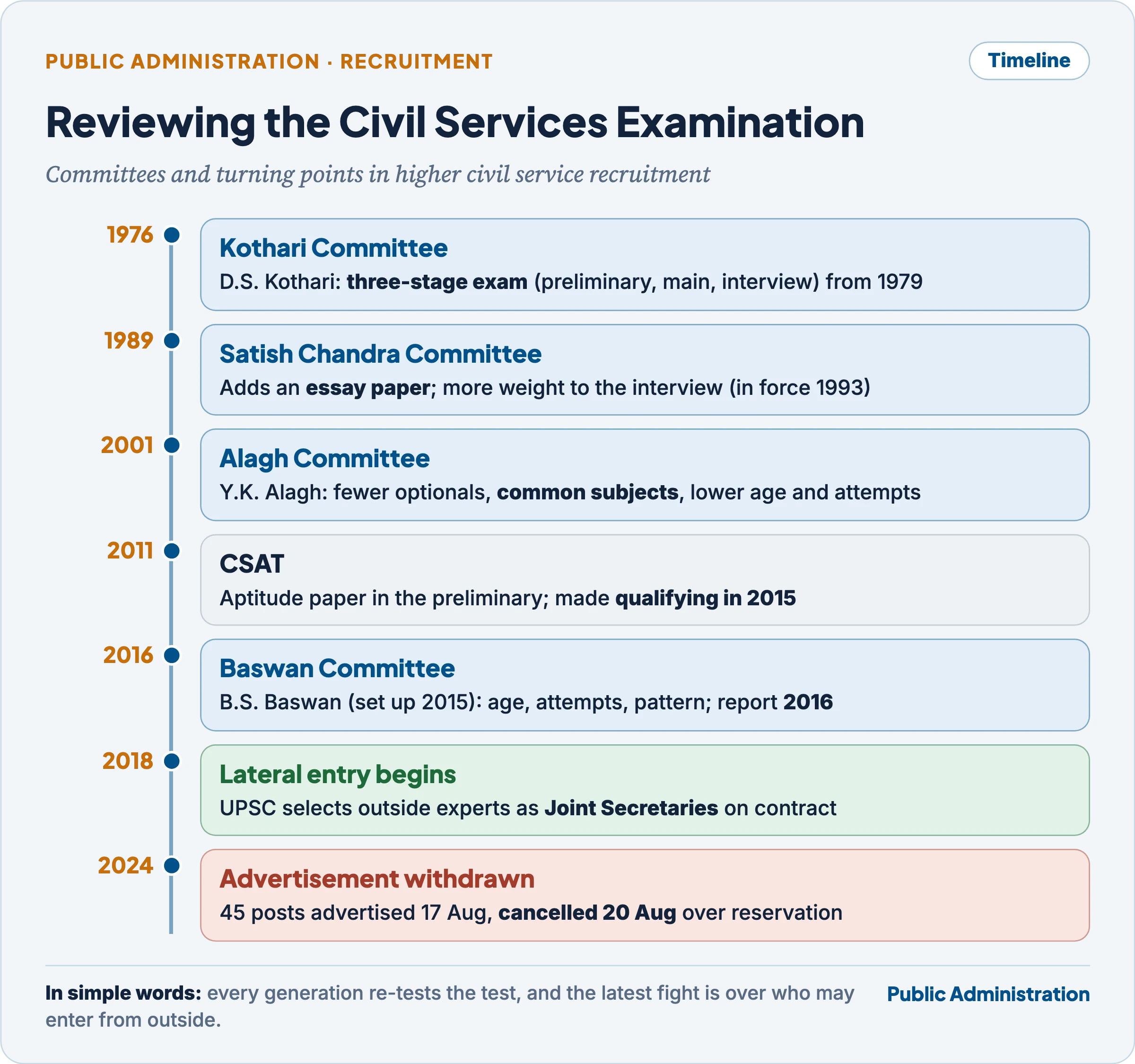
| Kothari Committee | 1976 | D.S. Kothari | Three-stage examination (preliminary, main, interview), adopted from 1979; common examination for all higher services |
| Satish Chandra Committee | 1989 | Satish Chandra | Introduce an essay paper; raise the weight of the personality test; implemented in 1993 |
| Alagh Committee | 2001 | Y.K. Alagh | Reduce optionals, more common compulsory subjects; lower upper age limit and attempts; test aptitude and values |
| Hota Committee | 2004 | P.C. Hota | Lower entry age; performance-linked careers; better training |
| Nigvekar Committee | 2012 | Arun Nigvekar | Changes to the main examination pattern (introduced 2013) |
| Baswan Committee | 2016 | B.S. Baswan | Set up August 2015, reported 2016: age limits, attempts and pattern; most proposals not implemented |
The table reads as a recurring argument. Each committee tried to balance breadth vs depth (common subjects vs optionals), youth vs maturity (age limits) and fairness to rural and vernacular candidates vs testing aptitude. The CSAT paper, added to the preliminary in 2011, was made qualifying (33 per cent) in 2015 after protests that it favoured English-medium and science graduates.
2.7 Lateral entry
- Meaning: recruitment of experienced professionals from outside the career services (private sector, academia, think tanks, state governments, PSUs) to middle and senior posts, usually on contract.
- History in India: ad hoc entry of experts existed for decades (Manmohan Singh as Chief Economic Adviser, Nandan Nilekani at UIDAI, Montek Singh Ahluwalia). The 2nd ARC (10th Report, 2008) and NITI Aayog’s Strategy for New India @75 (2018) backed an institutional route.
- The scheme from 2018: the government advertised Joint Secretary posts for domain experts; UPSC ran the selection; appointment on contract for 3 years, extendable to 5. Later rounds added Director and Deputy Secretary posts.
- The 2024 withdrawal:
- On 17 August 2024 UPSC advertised 45 posts (10 Joint Secretaries, 35 Directors/Deputy Secretaries) in 24 ministries, the largest round since 2018.
- Because each post was treated as a single-cadre post, no reservation applied. Opposition parties and NDA allies objected.
- On 20 August 2024 DoPT Minister Jitendra Singh wrote to UPSC asking it to cancel the advertisement so that the process could be aligned with social justice and reservation; UPSC cancelled it the same day.
Criticism — Lateral entry: the case against
- Accountability: contract officers may lack long-term responsibility and can leave for the private sector, carrying inside knowledge (revolving door, conflict of interest).
- Politicisation: without strong safeguards, entry can become a backdoor for ideologically chosen appointees.
- Social justice: single-post appointments bypass Article 16(4) reservation.
- Morale: career officers who waited 17–20 years for Joint Secretary rank feel superseded.
- Small scale: a few dozen entrants cannot change a service of thousands; many lack knowledge of government procedure and leave early.
Defence — Lateral entry: the case for
- Expertise: modern regulation (finance, energy, digital) needs deep domain knowledge that rotating generalists lack.
- Antidote to complacency: competition from outside challenges the security of a closed service and brings new methods.
- Global practice: the US, UK, Australia and New Zealand mix career and open entry.
- Safeguards exist: selection through UPSC, fixed contracts and conduct rules keep the process merit-based and accountable.
- Reform the design, not the idea: pooling posts into a cadre would allow reservation, as the 2024 letter itself proposed.
- Why lateral entry has not moved as intended: small numbers; contract terms unattractive to senior private professionals; weak induction into government procedure; resistance from career services; and the reservation question, which the government has not yet resolved by pooling posts.
2.8 Affirmative action in recruitment: global context
- India: Article 16(4) permits reservation for backward classes inadequately represented; 16(4A) in promotion for SCs and STs; 16(6) (103rd Amendment, 2019) for economically weaker sections, upheld in Janhit Abhiyan (2022). The ceiling of 50 per cent comes from Indra Sawhney (1992).
- United States: affirmative action in federal employment through Equal Employment Opportunity law; quotas are barred, and Students for Fair Admissions v. Harvard (2023) ended race-conscious university admissions, shifting the debate to outreach and diversity programmes.
- Other models: South Africa’s employment equity targets; Malaysia’s preferences for Bumiputera; the UK’s positive action (encouragement, not quotas) under the Equality Act 2010.
- The idea of representative bureaucracy (J. Donald Kingsley, 1944) holds that a service mirroring society’s composition is more legitimate and more responsive. Critics fear a trade-off with merit; defenders answer that merit itself is shaped by unequal opportunity.
3. Training
In simple words
Recruitment picks a promising player; training turns potential into performance. Without training, a new officer learns only by trial and error, and the citizens pay for the errors.
3.1 Meaning and objectives
- Training is a conscious, planned and continuing process of imparting knowledge, skills and attitudes to employees for better performance in present and future jobs.
- In the public service it aims not only at skills but at attitudes and values: impartiality, empathy for citizens, integrity.
- It is a step-by-step process: needs analysis → design → delivery → application on the job → evaluation, repeated across a career. A single foundation course cannot do this.
- When training is needed: poor job performance, falling productivity, job redesign, technological change, new laws and new duties.
- Objectives:
- improve efficiency and effectiveness;
- give new entrants basic knowledge and skills;
- keep serving employees up to date;
- build a second line of competent officers for higher posts;
- broaden the vision of officers and correct narrow outlooks from over-specialisation;
- make officers people-oriented and develop a sense of public service.
- Herbert Simon stressed why training is urgent in developing countries: the need for administrative innovation, the rapid multiplication of government tasks and the acute shortage of skilled manpower.
3.2 Types of training
| Type | Meaning | Example |
|---|---|---|
| Formal | Planned, by an institute, under expert guidance | Foundation course at LBSNAA |
| Informal | Learning by doing, from seniors and mistakes | A probationer learning under the Collector |
| Pre-entry | Education that prepares for service | University courses in public policy |
| Orientation / induction | Introduction to the department and its environment | Joining-time briefings |
| In-service / post-entry | Training after joining, at intervals | Mid-career training programmes |
| Short-term vs long-term | A few weeks vs a year or more | Refresher course vs study leave |
| Centralised vs decentralised | National institute vs department or State ATIs | LBSNAA vs State administrative training institutes |
Informal training was the British-Indian norm: the new ICS officer learned in the district under a senior. It still matters, but it depends wholly on the senior’s quality and interest, which is why formal training has grown.
3.3 Methods of training
- On-the-job methods:
- on-the-job training for most new employees;
- vestibule training, which recreates work conditions in a training room;
- demonstration and apprenticeship (for crafts and technical work, often several years).
- Institutional (off-the-job) methods:
- lecture, the oldest and most common, but passive;
- group discussion and conference method, where a leader draws out trainees’ participation;
- case study, in which trainees analyse real situations independently;
- incident method, a problem-solving exercise that builds decision-making from a single incident.
- Three methods often compared:
| Method | How it works | What it develops |
|---|---|---|
| Syndicate method | Small groups (syndicates) study a problem under a guide and present solutions to the whole class | Analysis, teamwork, policy thinking |
| Role playing | Trainees act out roles in a realistic situation (a grievance hearing, a negotiation) | Empathy, communication, handling people |
| T-group (sensitivity) training | Unstructured group sessions in which members give and receive feedback on behaviour; developed from Kurt Lewin’s group dynamics work (late 1940s) | Self-awareness, sensitivity to others, attitude change |
The syndicate method works on the problem, role play on the situation and the T-group on the self. Attitude change, the hardest goal of public service training, is attempted mainly through the last two.
3.4 Training and capacity building
- Training is about the individual and specific skills, usually through courses.
- Capacity building is wider: it develops the individual, the institution and the system, including processes, technology, organisational culture and the enabling environment. A trained officer in a dysfunctional office still fails.
- This is why performance problems are rarely caused only by a lack of training: poor job design, weak incentives, missing resources, unclear goals and bad leadership also cause them. Training is necessary but not sufficient.
3.5 Critiques of civil service training in India
- “Paid holiday”: many officials see training as a break from work, a sign of a crisis of motivation among trainers and trainees.
- Too pedagogic, too casual, too generalist: a long-standing charge that higher civil service training was lecture-heavy rather than result-oriented, not linked to promotion, and not professionally relevant.
- Efficiency over attitude: training has focused on rules and skills, with little lasting effect on attitudes, behaviour and values.
- Unlinked to personnel policy: training rarely fed into placement, promotion or career planning, so it carried no reward.
- Suggested remedies: behavioural and attitudinal training (field immersion, citizen interaction, ethics case work), module-based mid-career programmes tied to promotion (in place since 2007 for the IAS), feedback-based evaluation and competency-linked training (FRAC).
3.6 The National Training Policy, 2012
- Issued by DoPT in 2012, revising the first National Training Policy of 1996.
- Aim: “training for all”, so that every civil servant, from the cutting edge to the top, has the competencies to meet citizens’ needs.
- Key features:
- competency-based training, defined through competency frameworks for each post;
- training linked to career progression;
- a training plan and a training manager in every department;
- attention to the cutting-edge level, where citizens meet the state;
- use of e-learning and distance methods;
- evaluation of training impact.
- Why capacity issues persisted: departments lacked training budgets and plans, training was not tied to posting, institutions were isolated, and competency frameworks remained on paper. Mission Karmayogi was designed to fix these gaps.
3.7 Mission Karmayogi (2020)
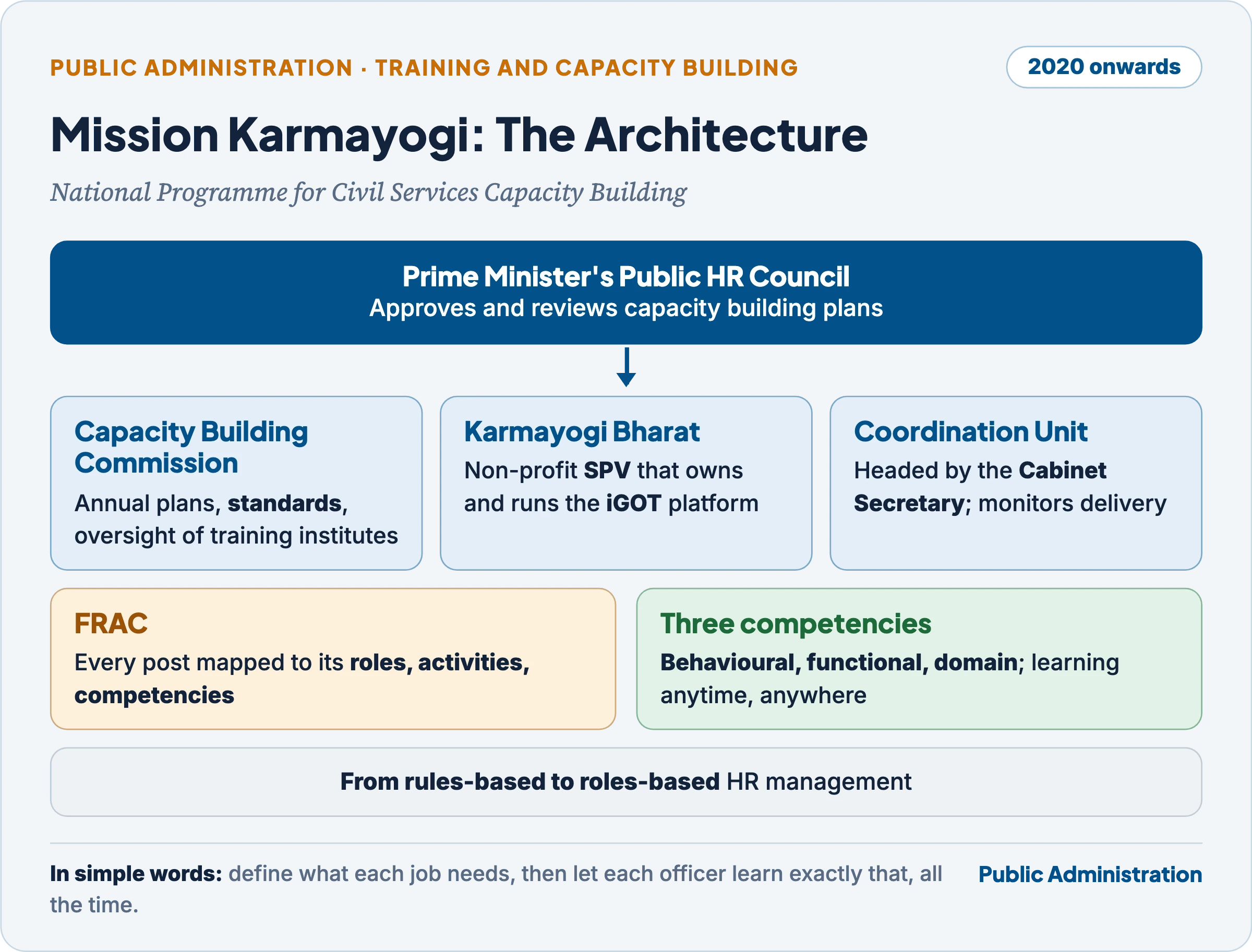
- Approved by the Union Cabinet on 2 September 2020 as the National Programme for Civil Services Capacity Building (NPCSCB).
- Guiding principles:
- from rules-based to roles-based HR management: match each officer’s competencies to the post’s requirements;
- on-site learning to complement off-site training;
- a shared ecosystem of training infrastructure, content and faculty;
- calibrate every post to a Framework of Roles, Activities and Competencies (FRAC);
- continuous building of behavioural, functional and domain competencies.
- Institutional framework:
- Prime Minister’s Public Human Resources Council: approves and reviews capacity building plans;
- Capacity Building Commission (CBC): prepares annual capacity building plans with departments, sets standards, exercises functional supervision over central training institutions, creates shared faculty and resources and recommends HR policy;
- Karmayogi Bharat, a wholly owned not-for-profit special purpose vehicle, which owns and runs the iGOT (Integrated Government Online Training) Karmayogi platform;
- a Coordination Unit headed by the Cabinet Secretary for monitoring.
- Scale: the iGOT platform crossed 1 crore registered users in May 2025; a 2026 Lok Sabha reply reported over 1.7 crore users and over 5,600 courses in 23 languages.
- Karmayogi Saptah, the first National Learning Week, ran from 19 to 27 October 2024.
Indian Connect — Capacity Building Commission in practice
- The CBC has signed tripartite MoUs with Karmayogi Bharat and 30 States and UTs for State-level implementation.
- It works with ministries on annual capacity building plans and accredits training institutes through national standards.
- Assessment: the CBC has made learning measurable and mass-scale; critics note that online course completions do not prove behaviour change, that FRAC mapping of posts is incomplete, and that capacity limits caused by understaffing, transfers and political pressure lie outside training. Mission Karmayogi can supplement but not solve the capacity problem without reforms in posting, tenure and appraisal.
4. Career Advancement and the Generalist–Specialist Debate
In simple words
A career system is a ladder. Some ladders start at the ground and can only be climbed from below; others have doors at every floor. Each shape decides who rises, how fast, and with what skills.
4.1 Career systems vs position systems
- Career system: the employee joins a service for life, moves through ranks and many posts, and the organisation plans his or her career (India, UK, France, Japan).
- Position system (programme or job system): the employee is hired for a particular job; advancement means applying for another post, inside or outside government (United States, much of the private sector).
- Career advancement tools: promotion, career planning (planned postings to build experience), mid-career training, deputation, domain assignment, central empanelment for senior posts, and non-functional upgradation to relieve stagnation.
4.2 Career development for All India and State services
- All India Services (IAS, IPS, IFoS): recruited by UPSC under Article 312 and the All India Services Act, 1951; serve the States and the Centre.
- Careers combine district, State secretariat and central deputation; central empanelment for Joint Secretary and above uses a multi-source (360-degree) feedback exercise alongside APARs.
- Mid-career training programmes (phases III to V for the IAS) are linked to promotion.
- State services: officers of State civil services enter the IAS by promotion (up to about one-third of senior posts under the promotion quota), but often late in their careers, a long-standing source of grievance.
- Problems: stagnation in some batches and services; frequent transfers that cut short tenure; late promotion of State officers; weak specialisation.
4.3 Generalist vs specialist
- The generalist rationale came from the British idea that an able, broadly educated “layman” can run any department, while experts advise. The administrator, in this view, has about him “something of the qualities of a layman”, which lets him weigh expert advice against public opinion.
- For the generalist:
- broad vision and coordination across departments;
- political sensitivity and field experience (district postings);
- neutrality from professional tunnel vision;
- mobility and flexibility in a rank system.
- For the specialist:
- modern governance is technical: finance, health, climate, digital systems;
- frequent rotation of generalists produces shallow policy and dependence on consultants;
- specialists resent their exclusion from top policy posts (in India, the Secretariat–Directorate divide).
- The middle way: domain assignment for generalists after mid-career (2nd ARC), lateral entry of specialists, opening senior posts to all services through central staffing, competency mapping so that the right person fills the right post, and multidisciplinary teams in which technical experts, programme managers and policymakers work together, as e-government projects require.
5. Position Classification
In simple words
Before paying people fairly, you must know what each job is. Classification sorts jobs (or people) into groups so that similar work gets similar treatment.
5.1 Meaning and building blocks
- Classification groups posts or personnel into categories for recruitment, pay, promotion and transfer.
- Building blocks in position classification:
- Position: the lowest unit; a set of duties and responsibilities assigned to one employee. A position exists apart from its occupant.
- Class: a group of positions similar enough in duties, difficulty and qualifications to be treated alike (same title, same test, same pay range). Hence the saying that if positions are the raw material of classification, the class is the operating unit: recruitment, pay and promotion are run class by class.
- Grade: classes of similar difficulty across different occupations, for pay purposes.
- Service / occupational group: related classes grouped together (engineering, health, accounts).
- The triangular relationship: position classification ties together three things for every class: duties and responsibilities, working conditions and qualification requirements. Once the duties are defined, the qualifications needed and the pay deserved follow from them.
5.2 Rank vs position classification
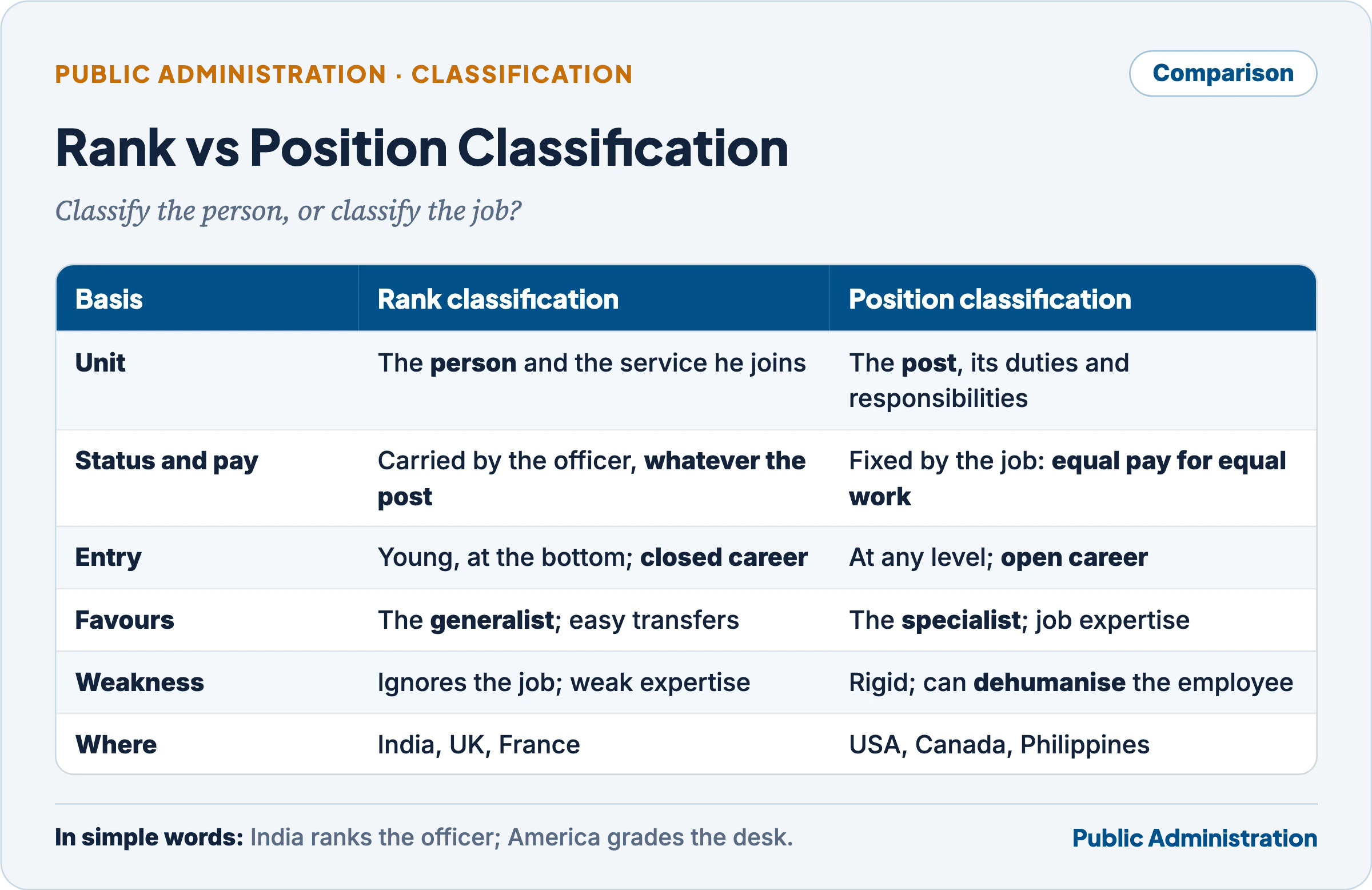
- Rank classification: status and pay belong to the person, according to the service he joined and his rank in it, whatever post he holds (India, UK, France, Pakistan).
- Merits: simple to run; job security; career prospects; flexible postings; attracts able young people; suits the generalist.
- Demerits: breaks equal pay for equal work; ignores the content of jobs; weak link between expertise and post.
- Position classification: status and pay belong to the post; a person’s rank is a function of the position he fills (United States, Canada, the Philippines).
- Steps: job analysis and description → grouping positions into classes → writing class specifications (character, boundaries, allocation guidance) → installation (allocating each position to its class) → maintenance as jobs change.
- Merits: clear responsibilities; objective basis for recruitment tests and appraisal; equal pay for equal work; helps organisational analysis; allows lateral entry; uniform job titles.
- Demerits: rigid; costly and technical; duties change faster than descriptions; fragments the service into thousands of narrow classes; and dehumanises the employee by treating a person as an interchangeable occupant of a desk description.
- United States: the Classification Act of 1923 and the Classification Act of 1949 (the General Schedule, GS-1 to GS-15) built the system; the Civil Service Reform Act of 1978 created the Senior Executive Service, a rank-like corps above it.
- Why position classification still has supporters despite its problems: it is the only system that ties pay and tests to the actual work, supports transparency and equal-pay claims in court, and suits a mobile, specialist labour market. Its problems lie in rigid practice, which broad-banding (wide pay bands with fewer classes) and competency frameworks have eased.
Indian Connect — India’s mixed system
- India uses rank classification for services (IAS, IPS, Central Services Group A, B, C) under Article 309 rules.
- But elements of position classification have entered: the 7th CPC Pay Matrix ties pay to a level of post; FRAC under Mission Karmayogi describes each post’s roles and competencies; and job evaluation was used by the 3rd Pay Commission.
- Specialist services long pressed for position classification; generalist services resisted it because it would weaken their claim to top posts.
5.3 Job evaluation methods
- Ranking: whole jobs are compared and ranked, sometimes by paired comparison; simple but subjective.
- Job classification (grading): jobs are fitted into predefined grades by written class standards.
- Factor comparison: jobs are measured on a few compensable factors (mental and physical requirements, skill, responsibility, working conditions) against key jobs whose wages are known from a wage survey.
- Point system: factors are broken into degrees with points; each job earns points, and pay follows total points. Unlike factor comparison, jobs are rated against a scale, not against each other.
6. Promotion
In simple words
A pyramid has fewer seats at each level. Promotion decides who climbs, and nothing kills morale faster than a feeling that the climb is rigged.
6.1 Meaning and importance
- Promotion is advancement from a lower grade or class to a higher one with greater duties and responsibilities, usually with higher pay.
- An annual increment within the same scale is not promotion; the essence is higher responsibility.
- From the employer’s side, promotion fills higher posts with the fittest people from within.
- Kinds: within a class (grade to grade) and inter-class (for example, Group B to Group A), the latter needing special selection and often Public Service Commission advice.
- Lines of promotion usually run within the department, service, class and grade. Pooling schemes (a central pool of officers eligible for any department) reduce unequal chances between departments; the IAS itself works as such a pool.
- The basic dilemma: Leonard D. White, the American author of the first textbook of public administration (1926), described the irreconcilable conflict between many ambitious employees and a few higher posts that fall vacant irregularly. No system satisfies everyone, so promotion must at least follow a recognised principle, since nothing destroys morale more than promotions that look capricious.
6.2 Seniority vs merit
| Point | Seniority | Merit |
|---|---|---|
| Basis | Length of service decides precedence | Fitness and ability decide selection |
| Strength | Objective; little room for favouritism; predictable; respects experience | Selects the best person; rewards effort; suits higher posts |
| Weakness | Assumes all are fit; experience does not grow indefinitely (“twenty years’ experience may be one year repeated twenty times”); stagnation | Hard to measure; subjective; risk of favouritism and politicisation |
| Favoured by | Staff associations; senior selectors | Reformers; management |
- The accepted compromise:
- in lower posts, seniority carries weight (with fast-track for exceptional merit);
- in middle posts, merit-cum-seniority (merit decisive, seniority secondary);
- in higher posts, merit alone (selection).
- Methods of testing merit: written promotion examinations (objective but irksome for older staff); the head of department’s judgment (simple but subjective); service records and efficiency ratings (most common in large organisations).
- British practice from 1921 rated officers on ten qualities; American systems used graphic rating scales, Probst checklists and other devices. None removed subjectivity; ratings aid judgment but cannot replace it.
- India: promotion is decided by Departmental Promotion Committees (DPCs), using APAR grading against benchmarks (for example “very good”), with UPSC on the DPC for Group A posts.
- The Peter Principle: Laurence J. Peter and Raymond Hull, in The Peter Principle (1969), argued that in a hierarchy every employee tends to rise to his level of incompetence, because people are promoted for doing their current job well, not for proven ability in the next. Remedies: promotion based on competency for the next role, assessment centres, trial postings and dual career ladders.
Common confusion
Is “merit-cum-seniority” the same as “seniority-cum-merit”? No. In merit-cum-seniority, merit decides and seniority breaks ties among equally meritorious officers. In seniority-cum-merit, the senior officer is promoted provided he meets a minimum standard of fitness. The order of words reverses which principle dominates.
6.3 Reservation in promotion: the judgments
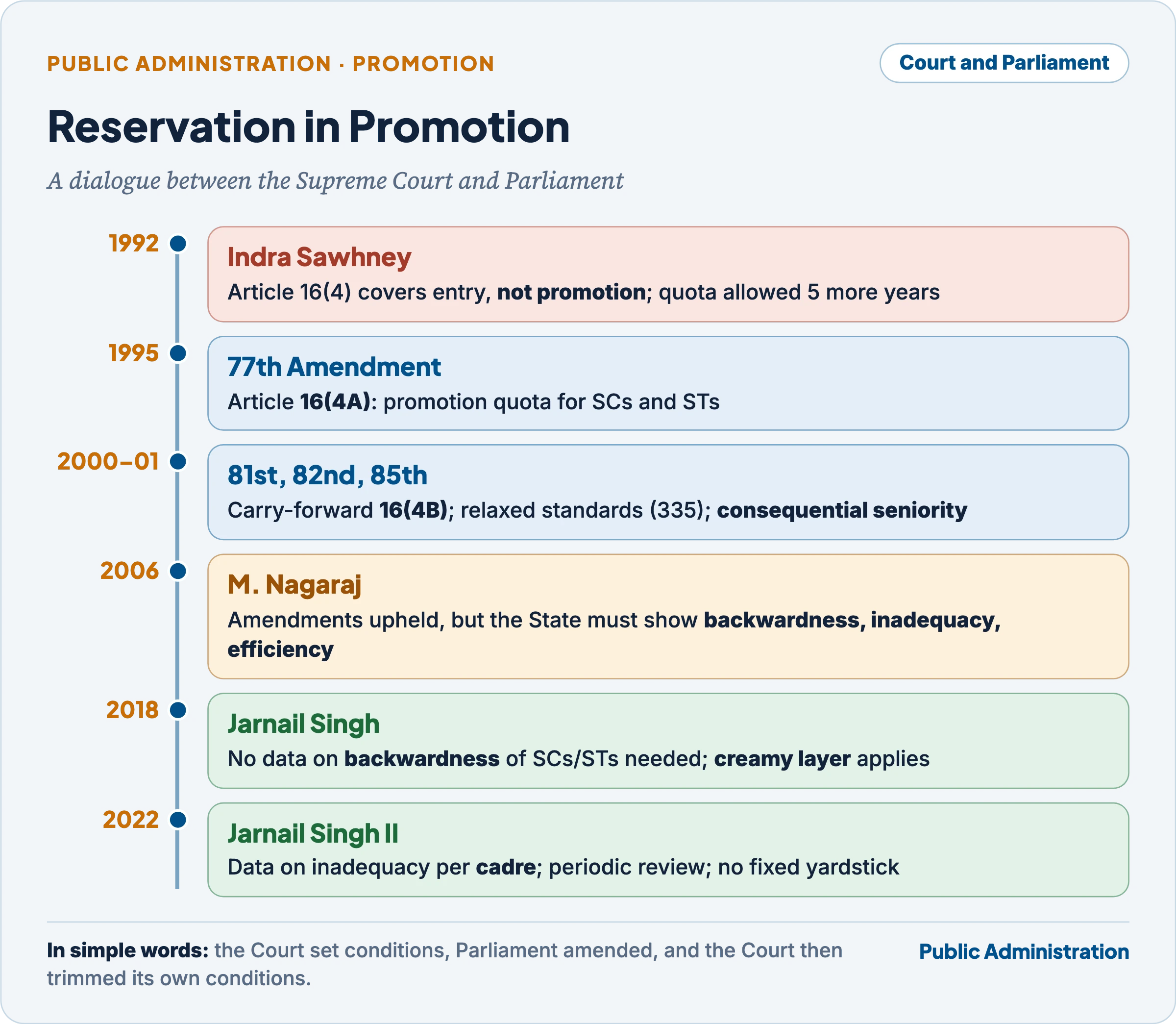
- Indra Sawhney v. Union of India (1992): a nine-judge bench held that Article 16(4) allows reservation in initial appointment, not promotion; it let existing promotion quotas run for five more years, and fixed the 50 per cent ceiling and the creamy layer for OBCs.
- Parliament’s response:
- 77th Amendment (1995): Article 16(4A) allows reservation in promotion for SCs and STs not adequately represented.
- 81st Amendment (2000): Article 16(4B): unfilled reserved vacancies carried forward as a separate class, outside the 50 per cent ceiling.
- 82nd Amendment (2000): proviso to Article 335 allows relaxed qualifying marks and standards in promotion for SCs and STs.
- 85th Amendment (2001): consequential seniority for SC/ST officers promoted through reservation.
- M. Nagaraj v. Union of India (2006): a five-judge bench upheld the amendments, but required the State, before giving reservation in promotion, to show quantifiable data on backwardness of the class, inadequacy of representation, and that overall administrative efficiency (Article 335) is not harmed; and the 50 per cent ceiling and creamy layer limits applied.
- Jarnail Singh v. Lachhmi Narain Gupta (26 September 2018): a five-judge bench refused to send Nagaraj to a larger bench, but held that the requirement of quantifiable data on backwardness of SCs and STs was contrary to Indra Sawhney and invalid, since SCs and STs are presumed backward. It also held that the creamy layer principle applies to SCs and STs in promotion, as it flows from Articles 14 and 16(1).
- Jarnail Singh (II) (28 January 2022): a three-judge bench held that data on inadequacy of representation must be collected cadre-wise (not for a whole class or group of posts), reviewed periodically, and declined to lay down a yardstick for adequacy, leaving it to the States.
Common confusion
After Jarnail Singh (2018), does the State still need data before reserving promotions? Yes, partly. It no longer needs data on the backwardness of SCs and STs, but it must still show inadequacy of representation (cadre-wise, after 2022) and protect efficiency under Article 335. The creamy layer filter also applies.
7. Pay and Service Conditions
In simple words
Pay is the most sensitive part of public service. Too little and talent leaves or turns corrupt; too much and civil servants become a privileged class paid for by poorer taxpayers.
7.1 Principles of pay determination
- Comparability with private employment: public pay should match comparable private jobs. Difficulty: many public posts (police, judges) have no private equivalent, and public jobs carry security and pensions.
- The state as a model employer: government should be a good, even leading, employer. The British Tomlin Commission (1931) found three meanings: ahead of other employers, among the front rank, or simply mindful of its responsibility to staff.
- Recruit and retain: pay what is needed to attract and keep an efficient staff (the Anderson Committee, 1923); sound but vague in practice.
- Cost of living: pay linked to prices, in India through Dearness Allowance, revised twice a year.
- Capacity of the economy: pay related to national income; India’s early post-independence ceilings on top salaries reflected this.
- Equity and compression: narrowing the gap between highest and lowest pay; the 1st Central Pay Commission (1946–47) and later commissions weighed it.
- Equal pay for equal work: a directive principle in Article 39(d); also the logic of position classification.
- The British synthesis (Tomlin Commission evidence): pay is one part of a package that includes security, promotion prospects, leave and pension; it should compare well with good outside employers, be neither too low nor so high as to create a privileged class, and stay stable over time.
- The need-based minimum: the Aykroyd formula (nutrition-based minimum need), first used by the 15th Indian Labour Conference (1957), still anchors the minimum pay set by Indian pay commissions.
7.2 Issues in pay policy
- Public–private gap: senior government pay lags far behind the private sector, while lower-level government pay often exceeds private pay for similar work. This affects motivation and retention at the top and creates queues for jobs at the bottom.
- Constraints on upper civil service pay: fiscal limits, public opinion and the political ceiling (officials cannot easily earn more than ministers).
- Incentive pay: performance-related pay is hard to design in government, where outputs are hard to measure; India has tested it in limited ways.
- All India Services pay: officers serving across States and the Centre, with transferable liability and higher responsibility, are generally paid on a higher scale than services recruited for one State, to attract talent and keep national standards.
7.3 Central Pay Commissions
- India has had eight Central Pay Commissions (CPCs), roughly once a decade since 1946. They recommend pay, allowances and pensions for central employees; most States adopt them with changes.
- 7th CPC:
- Chair: Justice A.K. Mathur; report submitted November 2015; effective 1 January 2016.
- Pay Matrix: pay bands and grade pay were abolished; status is now determined by a Level in the matrix, with cells for annual increments of 3 per cent.
- Fitment factor of 2.57 applied uniformly; minimum pay Rs 18,000 and maximum Rs 2,50,000 a month (Cabinet Secretary level).
- Proposed a performance-related pay scheme and stricter benchmarks (“very good”) for increments and promotion.
- Critique: large fiscal cost; the link between pay and accountability or reform remained weak, since increments stayed largely automatic.
- 8th CPC:
- Announced in January 2025; terms of reference approved by the Cabinet on 28 October 2025.
- Constituted by resolution of 3 November 2025: Chairperson Justice Ranjana Prakash Desai (former Supreme Court judge), Prof. Pulak Ghosh (Member, part-time) and Pankaj Jain (Member-Secretary).
- Report due within 18 months of constitution; interim reports permitted.
- Terms of reference include an emolument structure that attracts talent and promotes efficiency, accountability and responsibility; a performance-linked incentive scheme; rationalisation of allowances; and review of gratuity and pension under the National Pension System (including the Unified Pension Scheme) and outside it. It must weigh fiscal prudence, resources for development, the unfunded cost of non-contributory pensions, the impact on State finances, and pay in CPSUs and the private sector.
- As of August 2026 it had not yet reported.
Indian Connect — Service conditions in the Constitution
- Article 309: Parliament and State legislatures regulate recruitment and conditions of service; until then the President or Governor makes rules.
- Article 310: civil servants hold office during the pleasure of the President or Governor.
- Article 311: no dismissal or removal by an authority subordinate to the appointing one, and only after an inquiry with a reasonable opportunity to be heard (with exceptions in 311(2)).
- Article 312: creation of All India Services by Rajya Sabha resolution and parliamentary law.
Key Terms
| Term | Meaning in simple words |
|---|---|
| Human resource development | Growing employees’ skills, knowledge and abilities for their and the organisation’s benefit |
| Strategic HRM | Linking every personnel decision to the organisation’s long-term goals |
| Competency mapping | Listing what each post needs and assessing each employee against it |
| Spoils system | Public jobs given as rewards to political supporters |
| Merit system | Appointment by open competition, with tenure and neutrality |
| Positive recruitment | Actively searching for the best candidates, not just excluding the unfit |
| Lateral entry | Recruiting outside experts to middle and senior posts, usually on contract |
| Closed career system | Entry only at the bottom; advancement within the service |
| Open career system | Entry at any level by competition |
| Representative bureaucracy | A service whose make-up mirrors society’s |
| Capacity building | Developing individuals, institutions and systems, not only skills |
| Syndicate method | Small groups study a problem and present solutions |
| T-group training | Unstructured group feedback sessions to build self-awareness |
| FRAC | Framework of Roles, Activities and Competencies for each post |
| iGOT Karmayogi | Government’s online learning platform under Mission Karmayogi |
| Rank classification | Status and pay belong to the person and his service |
| Position classification | Status and pay belong to the post and its duties |
| Class | A group of similar positions treated alike for tests and pay |
| Job evaluation | Measuring the relative worth of jobs to fix pay |
| Merit-cum-seniority | Merit decides; seniority breaks ties |
| Peter Principle | People rise to their level of incompetence |
| Consequential seniority | Seniority kept by officers promoted through reservation |
| Creamy layer | The better-off within a reserved group, excluded from benefits |
| Pay Matrix | 7th CPC table of pay Levels and annual increment cells |
| Fitment factor | Multiplier converting old basic pay to new pay |
Commissions, Committees and Judgments
| Body / case | Year | Key point |
|---|---|---|
| Northcote–Trevelyan Report | 1854 | Open competition and a unified civil service in Britain |
| Macaulay Committee | 1854 | Design of ICS competitive examination |
| Pendleton Act (USA) | 1883 | Merit system replaces spoils |
| Classification Acts (USA) | 1923, 1949 | Position classification; General Schedule |
| Kothari Committee | 1976 | Three-stage Civil Services Examination |
| Satish Chandra Committee | 1989 | Essay paper; more weight to interview |
| Alagh Committee | 2001 | Common subjects, lower age and attempts |
| 2nd ARC, 10th Report | 2008 | Domain assignment, lateral entry, performance management |
| Baswan Committee | 2015–16 | Review of CSE age, attempts and pattern |
| National Training Policy | 2012 | Competency-based “training for all” |
| Mission Karmayogi | 2020 | Roles-based HR; CBC; iGOT; FRAC |
| Indra Sawhney | 1992 | No reservation in promotion under 16(4); 50 per cent ceiling |
| M. Nagaraj | 2006 | Amendments upheld with data conditions |
| Jarnail Singh | 2018 | No backwardness data for SC/ST; creamy layer applies |
| Jarnail Singh (II) | 2022 | Cadre-wise data on inadequacy; periodic review |
| 7th CPC (Justice A.K. Mathur) | 2015 | Pay Matrix; fitment 2.57; minimum Rs 18,000 |
| 8th CPC (Justice Ranjana Prakash Desai) | 2025 | Constituted 3 Nov 2025; report in 18 months |
Contemporary Developments
- August 2024: UPSC advertised 45 lateral entry posts on 17 August and cancelled them on 20 August at DoPT’s request, pending a way to apply reservation.
- October 2024: the first Karmayogi Saptah (National Learning Week), 19–27 October, recorded over 32 lakh course completions.
- May 2025: iGOT Karmayogi crossed 1 crore registered users; by 2026 the platform reported over 1.7 crore users and 5,600 courses.
- 15 May 2025: Dr Ajay Kumar took charge as Chairman, UPSC.
- 3 November 2025: the 8th Central Pay Commission was constituted under Justice Ranjana Prakash Desai, with a mandate covering performance-linked pay and NPS/UPS pensions.
- Reporting year 2025-26: completion of prescribed iGOT courses is captured in APARs of central employees and All India Services officers.
- March 2026 (USA): the Office of Personnel Management’s rule creating Schedule Policy/Career took effect on 9 March 2026, making policy-influencing career posts at-will, a major shift in the American merit system that critics see as a step back towards spoils.
Revision Grid
| Thinker / body | Work or report (year) | Key idea |
|---|---|---|
| Frederick Taylor | The Principles of Scientific Management (1911) | Efficient use of workers as a management task |
| Elton Mayo | Hawthorne studies (1924–32) | Social needs of workers |
| Douglas McGregor | The Human Side of Enterprise (1960) | Theory X and Theory Y |
| Leonard D. White | Introduction to the Study of Public Administration (1926) | The promotion dilemma |
| J. Donald Kingsley | Representative Bureaucracy (1944) | Service should mirror society |
| Kurt Lewin | Group dynamics (1940s) | Basis of T-group training |
| Laurence J. Peter | The Peter Principle (1969) | Rise to the level of incompetence |
| Gerald Caiden | Administrative Reform (1969) | Reform as transformation against resistance |
| Kothari / Satish Chandra / Alagh / Baswan | 1976 / 1989 / 2001 / 2016 | Reviews of the Civil Services Examination |
| 2nd ARC | 10th Report (2008) | Domain assignment, lateral entry |
| DoPT | National Training Policy (2012) | Competency-based training for all |
| Cabinet | Mission Karmayogi (2020) | Rules-based to roles-based HR |
| 7th CPC | Report (2015) | Pay Matrix |
| 8th CPC | Resolution (2025) | Pay with efficiency and accountability |
The companion articles on this unit cover discipline, performance appraisal, employer–employee relations, grievance redressal and the code of conduct, and administrative ethics; see those articles for the APAR, Whitleyism and the Nolan principles.
Previous Year Questions
- 2025Can competency mapping linked to career development incentivise civil servants commitment to effective service delivery? Elaborate.
- 2025Affirmative action for equal opportunity is a corner-stone in recruitment to public services. Discuss it in global context.
- 2023“Training is not a short affair, rather it is a step-by-step process of developing skills, habits, knowledge and aptitude.” Elucidate.
- 2022The environment and situational conditions under which the government operates have an important bearing on its human resource development practices. Examine.
- 2022Performance problems are rarely caused simply by lack of training and rarely can performance be improved by training alone. Critically analyse the statement.
- 2020Administrative reform is “an artificial inducement of administrative transformation against resistance.” (Gerald Caiden). Identify the nature of resistance and inducements required to overcome it.
- 2019In the absence of a merit-based, fair and objective civil service a more partisan and corrupt government will emerge. Is the statement justified? Give reasons.
- 2018“Lateral entry is an antidote to the complacency in civil service.” Discuss.
- 2018Currently, administrative training focuses more on improving efficiency than on transforming the attitudes and behaviour of civil servants. What type of training will you suggest to fill this gap? Elaborate.
- 2017“Various components of Human Resources Management are inter-related.” Discuss.
- 2017Lateral entry of competent experts into the government will promote freshness and innovation, but it can create problems of accountability.”
- 2016“Training is considered as paid holidays.” Comment.
- 2015“The position-classification attempts to establish a triangular relationship between duties and responsibilities, working conditions and qualification requirements.” Elucidate.
- 2012The ‘selection model of recruitment rests on the assumption that the primary needs to be met are those of the organization.’ Examine.
- 2011‘Position Classification can be problematic. A serious complaint in its practice is that it dehumanises the employee.’ Discuss.
- 2010Distinguish fully between the syndicate method, role playing method, and T-Group training method in personnel management.
- 2010Discuss in this connection the case for and against promotion based on seniority.
- 2010Explain the ‘Peter Principle’ in respect of promotion policy in a hierarchical organisation.
- 2009It is said that ‘position classification’, as originally conceived is sound in terms of its operational characteristics, but complicated and unresponsive in practice. Why is it still considered better than other models of civil service classification?
- 2008“To talk of administrative modernization and still continue with the conventional practice of public personnel administration is a gross incongruity.” Offer suggestions to initiate radical reforms in Human Resource Management of public administrative systems.
- 2008“Training has proved its incapacity to change the attitudes, behaviour and values of civil servants.” Do you agree with this statement?
- 2007“Training is essential not only for efficiency and effectiveness but also for broadening the vision of the employees.” Substantiate.
- 2007“The widening gap in emoluments of government employees versus the public sector corporations and private sector employees has a strong bearing on the motivation and ability to work.” Comment.
- 2005“If positions are the raw material of classification, class is the operating unit.” Discuss.
- 2004Recruitment is the backbone of Public Administration. Explain.
- 2003“Training is practical education in any profession, not only to improve skills but also to develop attitudes and scheme of values necessary for effective performance.” Elaborate.
- 2000What opportunities are available to All India Services and state services in career development? Do you agree that days of generalists in modern administrative state are numbered?
- 1999“The Generalist will always have an edge over the specialist.” Substantiate the view.
- 1998“Public Personnel Administration is concerned with a number of functions.” Elaborate. Why are PROCUREMENT and DEVELOPMENT functions important?
- 1996“It is said that the generalist rationale was part of a revealed truth. All of us should have known better, for in a world of increasing scientific and technical complexity, it has compelling inadequacies.” Discuss.
- 1995“Be it an occupation or a profession, Public Personnel has certainly developed a series of subspecialists and techniques that, over the years, have combined to produce an organisational subsystem that must be staffed by experts if it is to meet the standards set by Public Personnel Administration.” Explain.
- 1994“The administrator is a layman rather than a specialist; or at least he has about him something of the qualities of a layman.” Comment.
- 1992Differentiate between the open and closed career systems. Do you favour the coexistence of both the systems for a balanced career development?
- 1990‘Government has been slow in using modern methods for discovering executive talent.’ Examine the validity of the statement with reference to recruitment to higher civil service in India, USA and France.
- 2026Lateral Entry in Government of India has not moved in the intended direction. Explain the reasons.
- 2026Civil services is grappling with severe capacity issues and which is a major bottleneck in implementing ambitious programmes across sectors. Mission Karmayogi can only supplement but not solve the entire capacity constraint. Give your opinion.
- 2025Training and capacity building represent different scope and objectives. Explain the key differences.
- 2024The constitutional stature provided to the Public Service Commissions accord them the autonomy to work towards fair recruitments. Comment.
- 2024What aims and objectives was the Capacity Building Commission established for? Evaluate how far it has come in realising the goals.
- 2022Examine the lateral entry recruitment in government in the context of Part XIV of the Indian Constitution.
- 2022“The objective of Mission Karmyogi is to enhance capacity building of Indian Civil Servants and improve governance.” Discuss.
- 2021Recruitment is the cornerstone of the whole public personnel structure and it revolves around the problem of attracting the best. Discuss the essential elements of a good recruitment system.
- 2021Well planned and goal oriented training programmes are the backbone of the civil service system in India. Examine the statement.
- 2019Capacity issues relating to employees have hampered the implementation of several government programmes. Trace the reasons in the context of the provisions of the National Training Policy, 2012.
- 2018It is apprehended that lateral entry will lead to politicisation of bureaucracy. Do you agree? Justify
- 2018“Competency mapping is important for effective allocation of responsibilities to administrators.” Do you think that a generalist administrator can handle all issues as effectively as a specialist Discuss.
- 2017“The idea of lateral entry into the Civil Services would energise Indian administration.” What are its possible advantages and limitations?
- 2016Do you agree that the Seventh Pay Commission’s recommendations do not reflect and correlate the need for civil service reforms and accountability with pay increase? Justify your answer.
- 2006“The generalist character of I.A.S. is its chief characteristic as well as its chief criticism.” Comment.
- 2000“A middle way should be worked out to utilize the services of both generalists and specialists for the national development.” Comment.
- 1999“The All-India Services have, naturally to be remunerated on a higher level than services recruited purely on a local basis.” Comment.
- 1992‘Reservation Policy in Public Services as a mandate from the Constitution has been conducive to the promotion of Social Justice.’ Discuss and illustrate.
- 1990‘Training is viewed as a paid holiday by a large number of public officials in India. It essentially betrays a crisis of motivation: in the process of administration, and on the part of both the trainers and trainees.’ Comment.
- 1988“Higher Civil Service Training in India is too pedagogic to be result-oriented, too Casual to be promotion-linked and too generalistic to be professionally relevant.” Discuss.