

Religion and Morality: Religion and Morality.
Official Syllabus: Paper II, Section B, Unit 8
The Western debate on religion and morality grew up around a commanding God: is right right because God commands it? Indian thought starts from a different place. Its central idea is not a divine command but a cosmic and moral order — first Ṛta, then Dharma, sustained by the law of Karma. In most Indian schools this order is eternal and impersonal; God, where accepted at all, is its guardian, administrator or upholder, not its arbitrary author. Several great Indian traditions — Pūrva Mīmāṃsā, Buddhism and Jainism — have a rich, demanding morality with no creator God at all. This article traces the Indian understanding of religion and morality from the Vedic Ṛta to the Gītā and Advaita, examines the doctrine of karma as an essential postulate of Hinduism (asked in 2021), and answers the question whether Dharma is independent of Īśvara.
In simple words
Think of the rules of arithmetic. Two and two make four for everyone — a king cannot change it by decree, and a teacher only explains it. In Indian thought, the moral order (dharma) and its law of consequences (karma) are rather like this: they are part of how reality works. Gods, sages and scriptures may reveal, teach or guard this order, but no one invents it by an act of will. That is why the Euthyphro dilemma, so troubling in the West, has much less grip in India.
Context & Problem
One Word for Religion and Morality
- Indian languages have no exact word for “religion” separate from morality. The word dharma covers both — religious duty, moral duty, law, custom, and even the nature of a thing (the dharma of fire is to burn).
- So the Western question “how is religion related to morality?” is, in Indian terms, a question inside dharma: how is ritual duty related to ethical duty, how is duty related to liberation, and how is all of this related to God?
The Four Goals of Life (Puruṣārthas)
- Dharma — righteousness, duty, moral and religious order.
- Artha — wealth, power, material well-being.
- Kāma — pleasure, desire, aesthetic and emotional fulfilment.
- Mokṣa — liberation from the cycle of birth and death.
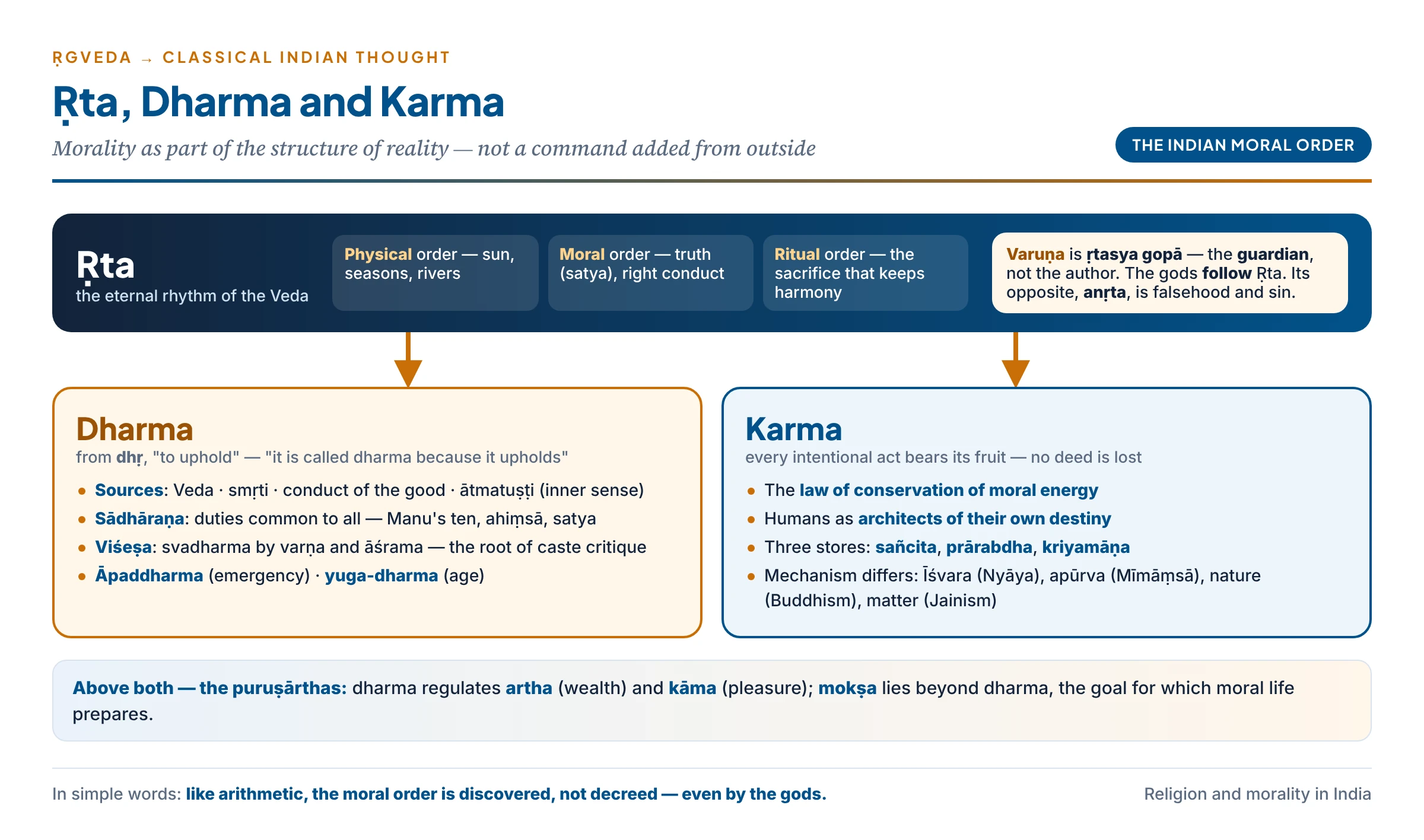
- Dharma regulates artha and kāma: wealth and pleasure are legitimate when pursued within dharma. Mokṣa lies beyond dharma — the final goal for which moral life is a preparation.
Core Doctrine
1. Ṛta — The Cosmic and Moral Order of the Veda
- In the Ṛgveda, Ṛta is the eternal rhythm that governs the whole universe — at once:
- Physical order — the regular course of the sun, moon, seasons and rivers;
- Moral order — truth, right conduct, the keeping of promises;
- Ritual order — the correct performance of sacrifice, which keeps the world in harmony.
- The gods are not its authors. Even Varuṇa, the greatest moral god of the Veda, is not the creator of Ṛta but its guardian and witness — ṛtasya gopā. The gods themselves follow Ṛta.
- Ṛta and satya. Ṛta is closely linked with satya (truth); its opposite anṛta (falsehood, disorder) is sin.
- The later development. Ṛta evolves into two great ideas of classical Indian thought:
- Dharma — the order of duties that upholds the world and society;
- Karma — the law by which every action bears its fruit.
- Significance. From the start, Indian thought sees morality as part of the structure of reality, not as a set of commands added from outside. This is why Ṛta unites “is” and “ought” (Article 5).
2. Dharma — What Upholds
- Meaning. The word comes from the root dhṛ, “to hold, support, sustain”. The Mahābhārata says: “It is called dharma because it upholds (dhāraṇāt); dharma upholds all creatures.”
- Sources of dharma (Manu): the Veda; the smṛti (remembered tradition); the conduct of the good (sadācāra); and what is pleasing to one’s own self (ātmatuṣṭi) — the inner moral sense.
- Kinds of dharma:
- Sādhāraṇa dharma — duties common to all human beings. Manu lists ten: firmness (dhṛti), forgiveness (kṣamā), self-control (dama), non-stealing (asteya), purity (śauca), control of the senses (indriya-nigraha), wisdom (dhī), learning (vidyā), truthfulness (satya) and freedom from anger (akrodha). Other lists put ahiṃsā first.
- Viśeṣa dharma — special duties according to one’s varṇa (social order) and āśrama (stage of life): svadharma, one’s own duty.
- Āpaddharma — duties in emergency, when ordinary rules cannot be followed.
- Yuga-dharma — duties suited to the age; the rules change from age to age while principles remain (Article 6).
- The critique. The varṇa form of dharma became the basis of caste hierarchy and untouchability, defended by appeal to scripture. Ambedkar made this the heart of his critique of Hinduism, and Gandhi and the reformers tried to separate the sādhāraṇa core from the hierarchical viśeṣa rules.
3. Karma — The Law of Moral Causation
- The doctrine. Every intentional action (karma) produces a result (phala) — pleasure or pain, a higher or lower birth — in this life or a future one. “As you sow, so shall you reap.” No deed, good or bad, is lost.
- A moral law of nature. Karma is often called the law of conservation of moral energy: just as physical energy is never destroyed, moral energy is never wasted. It makes human beings the architects of their own destiny.
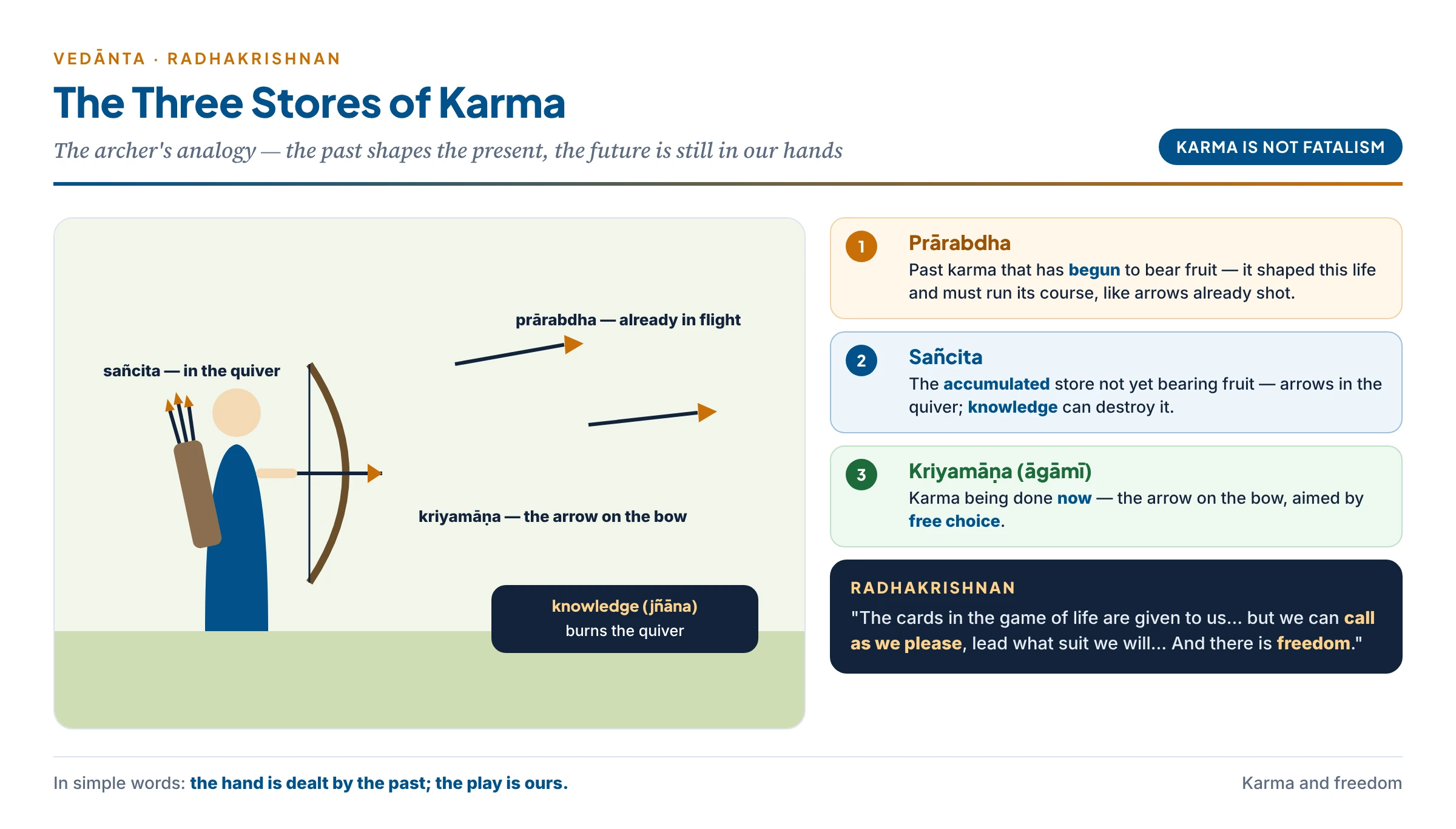
- The three stores of karma (a Vedānta classification):
- Sañcita — the accumulated stock of past karma not yet bearing fruit;
- Prārabdha — the portion that has begun to bear fruit and has shaped the present life;
- Kriyamāṇa (or āgāmī) — karma being performed now, which will bear fruit in future.
- The archer’s analogy. The arrows already shot (prārabdha) cannot be called back; the arrows in the quiver (sañcita) are still with us; the arrow on the bow (kriyamāṇa) can be aimed as we choose. Knowledge (jñāna) burns the quiver; the shot arrows must run their course.
- Karma and freedom. Karma is not fatalism. S. Radhakrishnan put it vividly: “The cards in the game of life are given to us. We do not select them. They are traced to our past karma, but we can call as we please, lead what suit we will, and as we play, we gain or lose. And there is freedom.”
In simple words
A farmer’s present harvest depends on seeds sown last season — he cannot change that now (prārabdha). His granary still holds seeds not yet planted (sañcita). And today he chooses what to sow next (kriyamāṇa). Karma says our life is like this farm: the past shapes the present, but the future is still in our hands.
4. Pūrva Mīmāṃsā — Duty without God
- Dharma defined. The first sūtras of Jaimini define dharma as “that good which is marked by injunction” (codanā-lakṣaṇo’rtho dharmaḥ). Dharma is known only through the Vedic command (vidhi); it is beyond perception and inference.
- The Veda is authorless (apauruṣeya) and eternal. Since there is no author, there is no arbitrary will behind it — and no need for God.
- Mīmāṃsā rejects a creator God. The world has always existed; there is no need for a creator, and a God could not even be proved.
- Kinds of duties:
- Nitya — obligatory daily duties (e.g. daily rites);
- Naimittika — occasional duties on special occasions;
- Kāmya — optional rites performed for a desired result (heaven, sons, rain);
- Niṣiddha — prohibited acts;
- Prāyaścitta — expiatory rites for wrongs done.
- Duty for duty’s sake. For Prabhākara, the Vedic injunction itself (niyoga) is the motive: one performs nitya duties because they ought to be done (kārya), not for any reward — a strikingly Kantian deontology. Kumārila allowed that duties are also performed with a view to their good results.
- Apūrva. How does a ritual performed today produce heaven after death? Mīmāṃsā posits apūrva — an unseen potency generated by the act that later yields its fruit. Results thus follow automatically and impersonally, with no God needed to distribute them.
In simple words
Think of a seed. You plant it today; months later it becomes a tree and bears fruit. No gardener needs to “deliver” the fruit to you — the seed’s own hidden power, working through soil and season, brings it. Mīmāṃsā’s apūrva is like that hidden power in the seed: the ritual act today leaves an unseen potency that, in time, ripens into its result — without any God handing out rewards.
Indian Connect — Kant and Mīmāṃsā
- Both hold a deontological ethics of unconditional command: duty is to be done because it is duty.
- But Kant places the command in reason and needs God to match virtue and happiness; Mīmāṃsā places the command in the authorless Veda and needs no God even for results — apūrva does that work.
- Mīmāṃsā is thus the clearest proof that a religious morality need not be a theistic one.
5. Nyāya–Vaiśeṣika — God as the Dispenser of Karma
- Karma is unconscious. Merit and demerit (dharma–adharma, together called adṛṣṭa, “the unseen”) are non-intelligent (jaḍa). By themselves they cannot know whom to reward, when and how.
- So an intelligent dispenser is needed — Īśvara, the supreme administrator of karma (karmādhyakṣa), who oversees the distribution of fruits according to each soul’s deeds. This is one of Udayana‘s arguments for God — the argument from adṛṣṭa.
- God is not arbitrary. Īśvara acts in accordance with the law of karma; He cannot arbitrarily save a sinner or condemn the innocent. He administers the moral order; He does not invent it.
In simple words
A bank keeps millions of accounts. Each deposit and withdrawal is recorded, but the money itself does not know whose account it belongs to — a manager is needed to credit the right person at the right time. Nyāya says karma is like the deposits: real but unconscious. Īśvara is the manager who sees that each soul receives exactly what its own deeds have earned — no more, no less, and never by favour.
Indian Connect — Nyāya and Kant on God’s moral role
- Both make God the guarantor that virtue and happiness correspond: for Kant, God ensures the highest good in a future life; for Nyāya, Īśvara distributes the fruits of karma across lives.
- The difference: Kant reaches God as a postulate of practical reason; Nyāya offers it as an inference from the unconscious nature of karma. And for Nyāya, the moral law (dharma–adharma) is prior to God’s administration — Nyāya takes the second horn of Euthyphro.
6. Buddhism — Morality without God or Self
- Śīla, samādhi, prajñā. The path has three parts: moral discipline (śīla), concentration (samādhi) and wisdom (prajñā). Morality is the essential prerequisite of enlightenment.
- Karma is intention. The Buddha said: “It is intention (cetanā), monks, that I call karma; having intended, one acts by body, speech and mind.” Karma is not ritual action but willed action.
- Karma as natural law. Karma works through dependent origination (pratītyasamutpāda) — not as an externally imposed law, but because actions have their natural consequences.
- No God. The Buddha’s concern was the removal of suffering in Nirvāṇa; God has no place in its attainment.
- Pratītyasamutpāda (dependent origination) needs no God to guide the causal process, and itself negates an uncaused cause.
- Kṣaṇikavāda (momentariness) excludes an unchanging eternal God.
- Aśvaghoṣa’s arguments against a creator (in the Buddhist tradition):
- If both virtue and vice come from God, there is no real distinction between merit and demerit — and no morality at all.
- A perfect God can have no motive for creation: if creation is purposeless, God is unintelligent; if it is for the good of beings, it is self-contradictory, since those beings are themselves the result of creation.
- If God is creator and omnipotent, why are there atheists? If He is one, why polytheists?
- An omnipotent God cannot be bound by karma; and since karma works autonomously through dependent origination, there is no need for God — so the moral argument for God fails.
- The puzzle of no-self. If there is no permanent self (anattā) and everything is momentary, who acts and who reaps? Buddhism replies that a continuity (santāna) of causally linked moments carries responsibility, as a flame passes from candle to candle.
7. Jainism — Karma as Matter, Ahiṃsā as Supreme
- Karma is a subtle form of matter (pudgala) that flows into the soul (āsrava) through activity and sticks to it (bandha) because of the passions (kaṣāya) — anger, pride, deceit, greed.
- Liberation requires stopping the inflow (saṃvara) and wearing off the accumulated karma (nirjarā) by right conduct and austerity.
- The three jewels (triratna): right faith (samyag-darśana), right knowledge (samyag-jñāna), right conduct (samyak-cāritra).
- Five vows: ahiṃsā, satya, asteya, brahmacarya, aparigraha — mahāvratas (great vows) for monks, aṇuvratas (small vows) for householders. Ahiṃsā is supreme.
- No creator God. The tīrthaṅkaras are perfected humans and moral exemplars, not creators or judges. Liberation is by self-effort, not grace.
8. The Bhagavad Gītā — Duty, Detachment and God
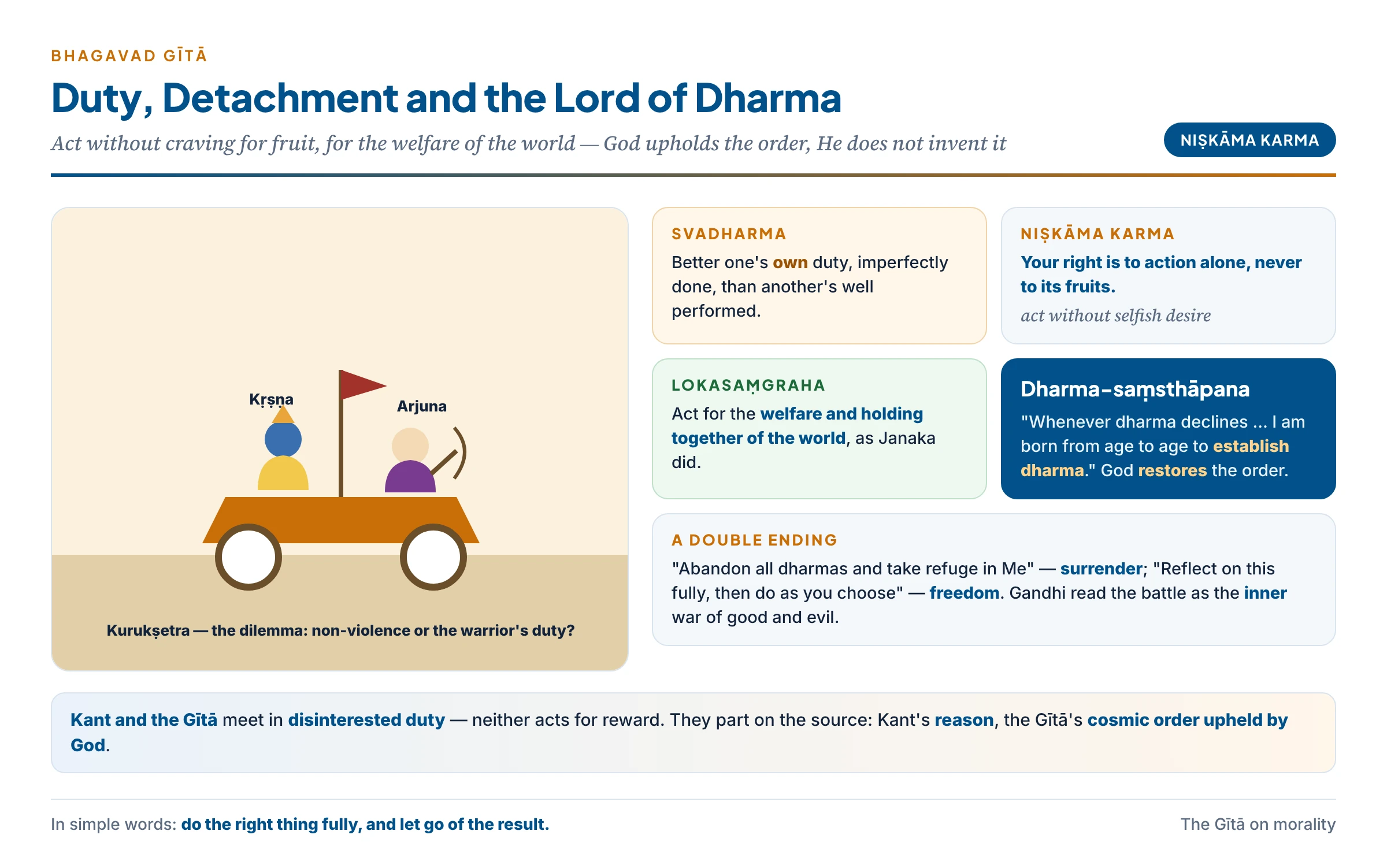
- Svadharma. “Better one’s own dharma, though imperfectly done, than the dharma of another well performed.”
- Niṣkāma karma. “Your right is to action alone, never to its fruits; let not the fruits of action be your motive, nor let your attachment be to inaction.” Act without selfish desire for results.
- Lokasaṃgraha. The wise act for the welfare and holding together of the world, setting an example — as did King Janaka.
- God as upholder of dharma. “Whenever dharma declines and adharma rises, I manifest myself … for the establishment of dharma (dharma-saṃsthāpanārthāya) I am born from age to age.” God protects and restores dharma; He does not invent it.
- Freedom and surrender. The Gītā ends both with “abandon all dharmas and take refuge in me alone” and with “reflect on this fully, then do as you choose” — total surrender and full moral freedom stand side by side.
- Arjuna’s dilemma. The Gītā opens with a moral dilemma — the duty of non-violence and family loyalty against the warrior’s duty to fight injustice. Gandhi read the battle allegorically, as the inner struggle between good and evil, and drew from the Gītā his ethic of non-violent action without attachment to fruits.
9. Advaita Vedānta — Morality as Preparation, Knowledge as Liberation
- Morality is real at the empirical level (vyāvahārika). There, duties and virtues are binding, and their chief function is to purify the mind (cittaśuddhi).
- The fourfold preparation (sādhana-catuṣṭaya) for the seeker of Brahman is largely moral:
- Viveka — discrimination between the eternal and the non-eternal;
- Vairāgya — detachment from the fruits of action here and hereafter;
- The six virtues (ṣaṭ-sampatti) — calmness (śama), self-control (dama), withdrawal (uparati), endurance (titikṣā), faith (śraddhā) and concentration (samādhāna);
- Mumukṣutva — intense longing for liberation.
- Knowledge, not action, liberates. Action (even good action) belongs to the world of duality; only knowledge (jñāna) of the non-dual Brahman removes ignorance. At the ultimate level (pāramārthika), doer, deed and receiver vanish; the jīvanmukta is beyond good and evil — though virtues continue in him naturally (Article 2).
- Does Advaita devalue morality? Critics such as Albert Schweitzer charged that Indian thought is “world- and life-negating“. Vivekananda and Radhakrishnan replied that Advaita gives morality its deepest ground: I should love my neighbour as myself because, in truth, my neighbour is myself.
Common confusion
Many notes say that in Indian philosophy morality is “only a means” to liberation and so has no value of its own. Is that right? Only partly. It is true that in Advaita and most liberation-oriented schools, morality is a preparation (cittaśuddhi) for knowledge or Nirvāṇa. But it does not follow that morality is merely instrumental. Mīmāṃsā treats duty as binding for its own sake; the Gītā demands action without concern for fruits; Buddhism and Jainism make śīla and ahiṃsā the substance of the spiritual life; and in the liberated person virtue becomes natural. Morality is both the road and, in its perfected form, part of the destination.
10. Karma as an “Essential Postulate” of Hinduism
Why karma is called essential:
- Almost universal acceptance. Except the Cārvāka, all Indian schools — orthodox and heterodox — accept karma; the Hindu schools treat it as presupposed by rebirth, dharma and mokṣa.
- Moral justice. It ensures that virtue and vice are rewarded without arbitrariness — answering the problem of the virtuous suffering and the wicked flourishing (Kant’s problem) without an afterlife court.
- Explanation of inequality. It explains why people are born in different conditions — the Indian answer to the problem of evil (Unit 03).
- Responsibility. It makes each person the author of his destiny — a strong basis for moral effort.
- Moral seriousness. Since no deed is lost, every act matters.
Criticisms:
- Fatalism. Popularly, karma becomes resignation — “it is my fate”. (Reply: prārabdha shapes the hand, not the play; kriyamāṇa is free.)
- Justifying injustice. Karma has been used to say the poor, the disabled and the “low-born” deserve their lot — sanctifying caste. Ambedkar and others attacked this use.
- Unverifiable. Past lives and future fruits cannot be observed; the theory cannot be tested.
- Infinite regress. If every condition is due to earlier karma, there is no first karma; the series is beginningless (anādi) — which some find unsatisfying.
- Memory and justice. Punishment for deeds one cannot remember seems unjust and cannot reform.
- Mechanism. Who or what distributes the fruits? Indian schools disagree — Īśvara (Nyāya), apūrva (Mīmāṃsā), the natural causal process (Buddhism), karmic matter (Jainism).
- Grace. Bhakti teaches that God’s grace can cancel karma — which seems to suspend the law.
Evaluation. Karma is indeed a foundational postulate of Hinduism and of Indian religion generally — the moral backbone that links dharma, rebirth and liberation. Its strength is its picture of an impersonal, non-arbitrary moral order in which persons are responsible. Its weaknesses lie in its unverifiability and its historical misuse to justify social inequality. Interpreted as a law of moral growth and freedom (Radhakrishnan, Vivekananda), rather than of fate, it remains a profound moral idea.
11. Is Dharma Independent of Īśvara?
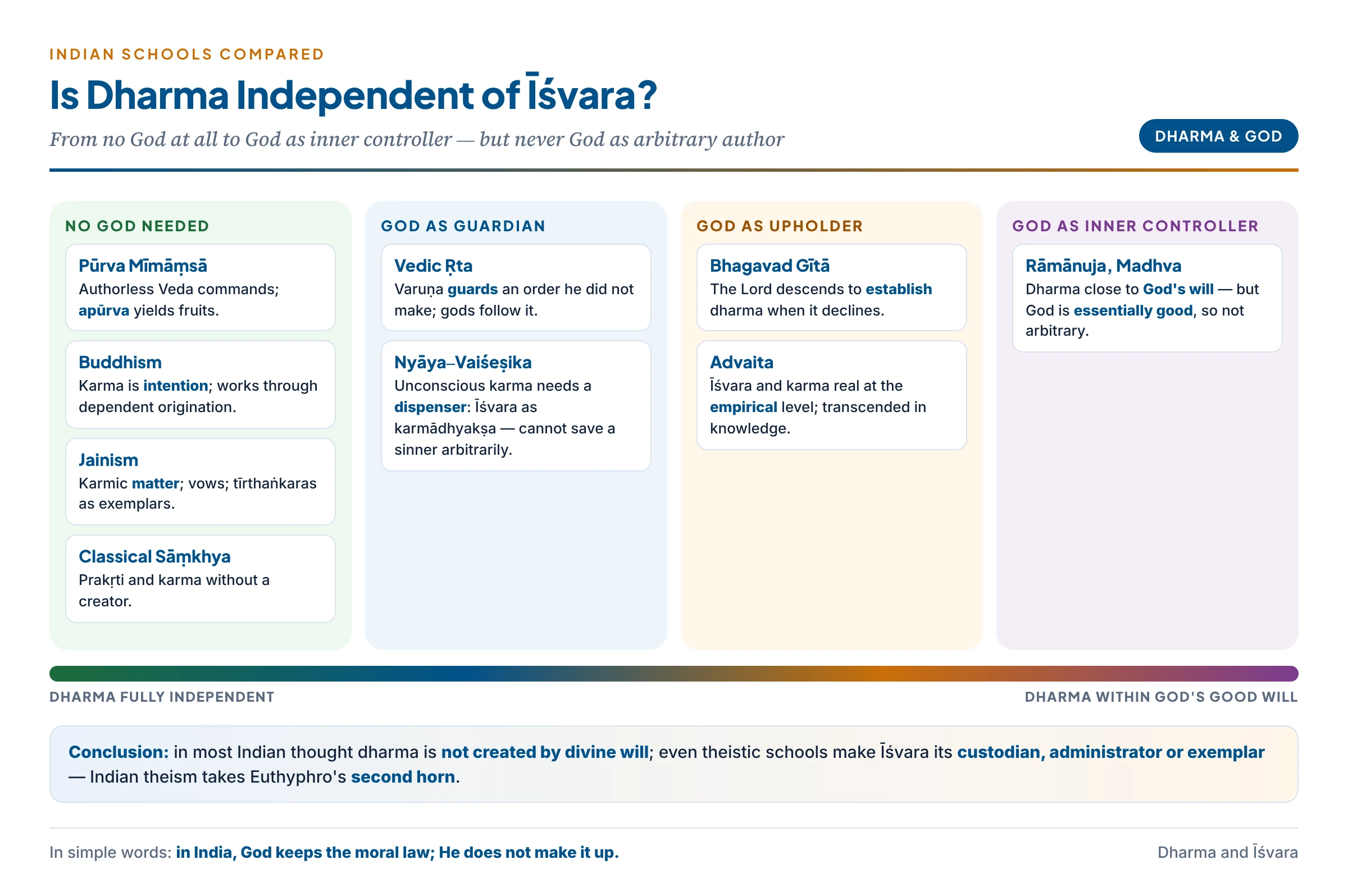
| School | God? | How the moral order works | Dharma’s relation to God |
|---|---|---|---|
| Vedic Ṛta | Gods, e.g. Varuṇa | Cosmic, moral and ritual order | Gods are guardians, not authors |
| Pūrva Mīmāṃsā | No creator God | Vedic injunction; apūrva brings fruits | Fully independent |
| Buddhism | No God | Cetanā and dependent origination | Fully independent |
| Jainism | No creator God | Karmic matter; vows; self-effort | Fully independent |
| Sāṃkhya (classical) | No God | Prakṛti and karma | Independent |
| Nyāya–Vaiśeṣika | Īśvara | Īśvara dispenses fruits of adṛṣṭa | God administers, does not create |
| Bhagavad Gītā | Kṛṣṇa as Lord | God upholds and restores dharma | God as protector of an order |
| Advaita | Īśvara (empirical) | Karma at vyāvahārika level | Dharma valid within māyā; transcended in jñāna |
| Viśiṣṭādvaita, Dvaita | Personal God | God as inner controller and judge | Dharma as God’s will, but God is essentially good |
Conclusion. In most of classical Indian thought, Dharma is independent of Īśvara in the sense that it is not created by divine will. Even in the theistic schools, Īśvara is the custodian, administrator or exemplar of dharma — never its arbitrary author. Only in the strongly theistic Vedānta of Rāmānuja and Madhva does dharma come close to God’s will — and there God’s will is understood as essentially good, avoiding the voluntarist horn.
Critical Evaluation
Strengths of the Indian Approach
- No Euthyphro problem. Since dharma is an eternal order, morality is neither arbitrary nor dependent on a doubtful divine will.
- Morality without God. Mīmāṃsā, Buddhism and Jainism show that religious morality can be fully non-theistic.
- Inner and outer. Morality is both social duty and inner purification, leading to liberation.
- Responsibility. Karma makes persons the authors of their destiny.
Weaknesses
- Caste. Viśeṣa dharma and karma were used to sanctify social hierarchy.
- Otherworldliness. The focus on liberation may weaken concern for this-worldly justice (Schweitzer’s charge).
- Unverifiability of karma and rebirth.
- Ritualism — at times ritual dharma overshadowed ethical dharma (Article 2).
Critics and Defenders
Criticism — Critics of the Indian moral order
- Ambedkar: varṇa dharma and karma sanctified caste and untouchability.
- Schweitzer: Indian thought is world- and life-negating.
- Cārvāka: karma, heaven and rebirth are priestly fictions.
- Rationalists: karma is unverifiable and breeds fatalism.
- Bhakti tension: if grace cancels karma, is the moral law really a law?
Defence — Defenders of the Indian moral order
- Mīmāṃsā, Buddhism, Jainism: rich morality without an arbitrary God.
- Radhakrishnan: karma is freedom within limits — the dealt hand, the free play.
- Vivekananda: Advaita grounds love — the neighbour is oneself.
- Gītā: disinterested duty for the welfare of the world.
- Reformers: the sādhāraṇa core of dharma can be separated from caste rules.
Cross-Tradition Comparison
| Issue | Western Divine Command Theory | Indian Karma–Dharma |
|---|---|---|
| Source of the moral law | God’s will | An eternal, impersonal order (Ṛta, dharma) |
| Role of God | Lawgiver and judge | None (Mīmāṃsā, Buddhism, Jainism) or dispenser/upholder (Nyāya, Gītā) |
| Arbitrariness | Euthyphro danger | Avoided — the law binds even the gods |
| Justice for the virtuous | Heaven, last judgement; Kant’s postulate | Karma across lives; apūrva or Īśvara |
| Human role | Obedience | Architect of one’s own destiny |
| Goal | Salvation | Mokṣa — beyond merit and demerit |
Indian Connect — Takeaways
- The Indian answer to “does morality depend on religion?” is distinctive: morality depends on a religious-metaphysical order (dharma, karma), but not on God’s command. Indian thought is thus at once religious and autonomous in its ethics.
- This is why Indian philosophers could combine deep piety with the conviction — shared with Kant — that duty must be done for its own sake (Mīmāṃsā’s kārya, the Gītā’s niṣkāma karma).
Synthesis (Siddhānta)
- Indian thought grounds morality in order, not command. From Ṛta to dharma and karma, the moral law is part of the structure of reality; gods guard it, sages reveal it, but no one creates it by fiat.
- Dharma is independent of Īśvara in nearly all schools; where God enters, He administers (Nyāya) or upholds (Gītā) a moral order that is essentially good and non-arbitrary.
- Karma is the essential moral postulate of Indian religion — powerful as a theory of responsibility and justice, but needing to be freed from fatalistic and caste-justifying misreadings.
- Contemporary relevance. The Indian model offers a way out of the modern deadlock between divine-command ethics and secular ethics: a morality that is objective and spiritual without being theocratic, and that can be shared — in its sādhāraṇa core of truth, non-violence and self-control — by believers and non-believers alike.
“The cards in the game of life are given to us. We do not select them… but we can call as we please, lead what suit we will, and as we play, we gain or lose. And there is freedom.” — S. Radhakrishnan
Previous Year Questions
- 2026How does the issue of moral autonomy conflict with conception of religion as a source of morality? Critically discuss.
- 2026How does the Buddhist theory of momentariness problematize the issue of human action and responsibility?
- 2025Is it necessary for the normative principles to bear reference to God in order to produce a feeling of obligation in a moral agent? Critically discuss.
- 2021Discuss and evaluate the doctrine of Karma as an essential postulate of Hinduism.
- 2017What will be the authority and acceptance of the absolute ethical values in the non-theological system of social practices? Discuss.
- 2015Is morality necessarily based on religion? Discuss.