

Religion and Morality: Religion and Morality.
Official Syllabus: Paper II, Section B, Unit 8
Modern Indian thought produced some of the most original answers to the question of religion and morality. The most famous is Mahatma Gandhi‘s shift from saying “God is Truth” to saying “Truth is God” — a change of only two words that, as the 2026 paper recognised with a 20-mark question, transforms the relation between religion and morality. For Gandhi, “true religion and true morality are inseparably bound up“; by making Truth itself divine, he made the moral search for truth the very substance of religion, and opened religion even to the atheist. Around Gandhi stand other modern Indian thinkers — Vivekananda, Tagore, Radhakrishnan, Aurobindo, Ambedkar and the atheist Gora — each of whom reworked the relation in his own way. This article examines Gandhi’s shift, its reasons and its critics, surveys these thinkers, and closes with a synthesis for the whole unit.
In simple words
Compare two sentences: “My mother is kind” and “Kindness is my mother.” The first describes a person by one of her qualities. The second says that wherever you meet kindness, you meet your mother. Gandhi’s change from “God is Truth” to “Truth is God” is like this. The first describes God by one quality among many. The second says that wherever there is truth — in a scientist’s honesty, an atheist’s sincerity, a satyāgrahi’s courage — there God is.
Context & Problem
Gandhi’s View of Religion
- Gandhi meant by religion not any formal or sectarian religion but “the religion which underlies all religions” — the soul’s search for Truth.
- Religion and morality are inseparable. “There is no such thing as religion overriding morality. Man, for instance, cannot be untruthful, cruel or incontinent and claim to have God on his side.” A religion that permits untouchability is no true religion.
- Ethical Religion. In 1907 Gandhi published Nīti Dharma (Ethical Religion), adapted from the American ethical-culture writer W.M. Salter, arguing that morality is the foundation of religion and that true religion is ethical.
- Religion and politics. For Gandhi, religion in this ethical sense must govern all of life, including politics; “those who say religion has nothing to do with politics do not know what religion means”.
The Problem the Shift Answers
- If God is the source of morality, what of the atheist who lives truthfully? What of the many religions with different gods? And what of the atrocities committed in God’s name?
- Gandhi needed a conception of the divine that would be universal, ethical and inclusive — and that could not be used to justify cruelty.
Core Doctrine
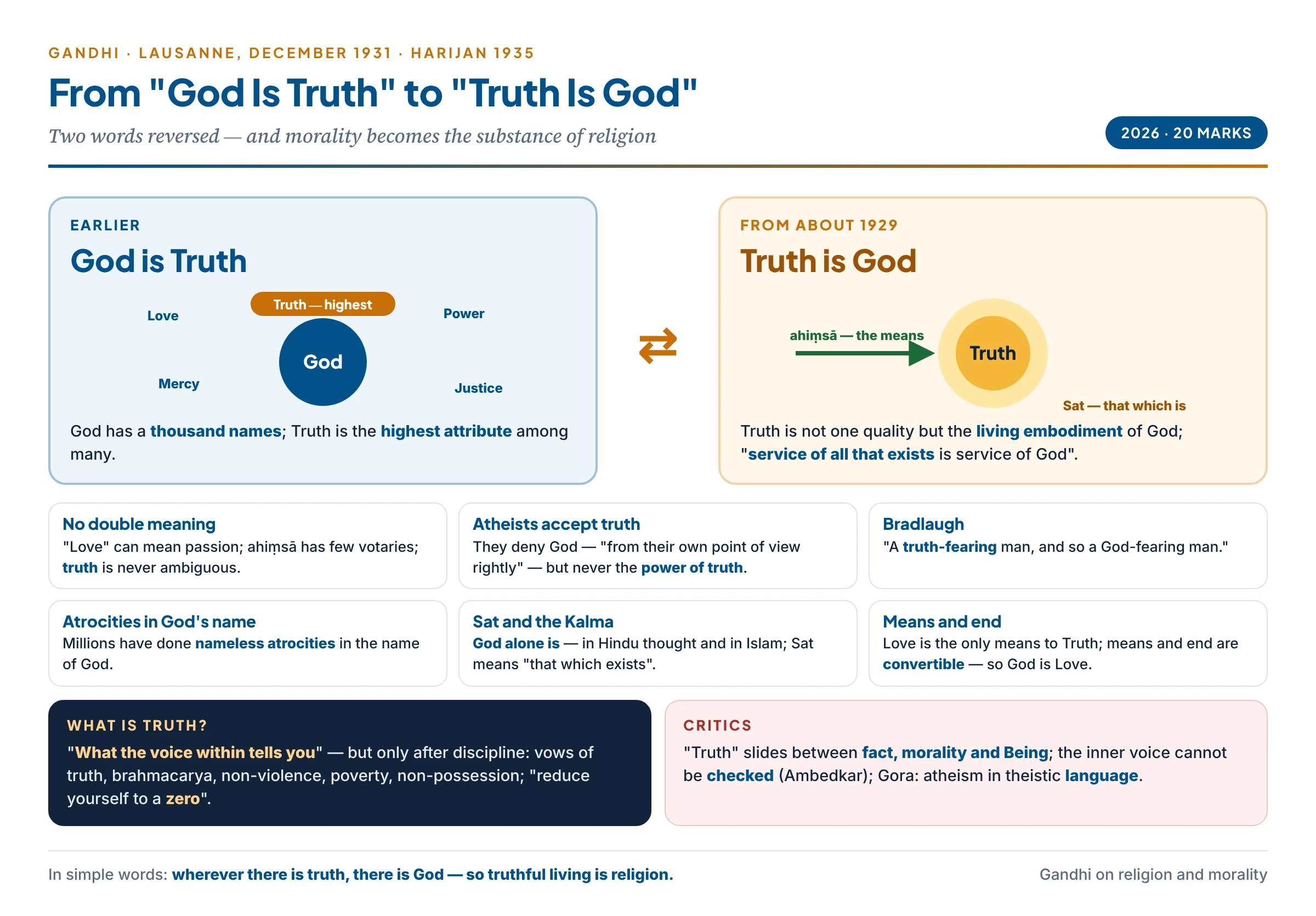
1. “God Is Truth” — the Earlier Position
- God has countless names and attributes — Gandhi recalled being taught the thousand names of God in Hindu scripture, and found that Islam too has many names for God.
- Among all these, Gandhi chose Truth as the highest: “though God may be Love, God is Truth, above all“. If any human description of God is fullest, it is “God is Truth”.
- Here Truth is still one attribute (the supreme one) of a God who has many.
2. “Truth Is God” — the Shift
- In a meeting at Lausanne (December 1931), on his way back from the Round Table Conference, Gandhi explained: “Two years ago I went a step further and said that Truth is God. You will see the fine distinction between the two statements.” The new formula appears in his From Yeravda Mandir (1930) and was repeated for the rest of his life.
- In Harijan (1935) he added: “God is Truth, but God is many other things also. That is why I say Truth is God. Only remember that Truth is not one of the many qualities that we name. It is the living embodiment of God, it is the only Life… and service of all that exists — Truth — is service of God.”
3. The Reasons for the Shift (in Gandhi’s Own Explanation)
- The search itself. He reached the new formula “after a continuous and relentless search after Truth which began nearly fifty years ago”.
- Love is ambiguous; truth is not. He had found that the nearest approach to Truth is through love — but “love” has many meanings, and human love as passion can be degrading; love in the sense of ahiṃsā has few votaries. “I never found a double meaning in connection with truth.”
- Even atheists accept truth. “Even atheists had not demurred to the necessity or power of truth. But in their passion for discovering truth, the atheists have not hesitated to deny the very existence of God — from their own point of view rightly.” To say “Truth is God” includes them.
- Bradlaugh. Of the famous English atheist Charles Bradlaugh, Gandhi said he would never regard him as an atheist: “Mr Bradlaugh, you are a truth-fearing man, and so a God-fearing man.” Saying “Truth is God” disarms the atheist’s criticism.
- Atrocities in God’s name. “Millions have taken the name of God and in His name committed nameless atrocities.” No one can commit atrocities in the name of Truth without contradicting himself (though Gandhi admitted that cruelty, such as vivisection, is also done “in the name of truth and science”).
- Sat — that which is. “The Sanskrit word for Truth is a word which literally means that which exists — Sat.” Hindu philosophy says “God alone is and nothing else exists”, and the same truth is found in the Kalma of Islam. So Truth is the most exact name of the one Reality.
- Means and end. “When you want to find Truth as God, the only inevitable means is Love, i.e. non-violence, and since I believe that ultimately the means and the end are convertible terms, I should not hesitate to say that God is Love.”
In simple words
“God is Truth” is like saying “the king is just” — justice is one quality of a king who has many others. “Truth is God” is like saying “justice is the real king” — wherever justice rules, the true ruler is present, whether or not anyone wears a crown. That is why even an honest atheist stands inside Gandhi’s religion.
4. What Is Truth? The Inner Voice and Its Discipline
- “A difficult question, but I have solved it for myself by saying that it is what the voice within tells you.”
- But not anyone’s whim. Since different people hear different “truths”, Gandhi insisted on discipline: just as scientific experiments require training, “strict preliminary discipline is necessary to qualify a person to make experiments in the spiritual realm”.
- The vows. Those who would search for Truth as God must take vows — of truth, brahmacarya (purity), non-violence, poverty and non-possession.
- Humility. “Truth is not to be found by anybody who has not got an abundant sense of humility. If you would swim on the bosom of the ocean of Truth you must reduce yourself to a zero.”
- Relative and absolute truth. Human beings know only relative truths; the absolute Truth is God. Hence no one may impose his partial truth on others by force — the root of non-violence and tolerance.
In simple words
Two pilgrims set out to find the same mountain shrine. One says, “I am going to meet the Lord of the mountain, who among other things is truthful.” The other says, “I am going wherever truth leads; I believe that is where the Lord lives.” The first must first believe in the Lord; the second need only be honest at every step. Gandhi chose the second path — and found that atheists, scientists and believers of every religion could walk it with him.
5. What the Shift Means for Religion and Morality
- Morality becomes the essence of religion. If Truth is God, then truthful, non-violent living is itself the worship of God. Religion is not belief or ritual but the moral search for Truth — “experiments with Truth”.
- Religion becomes universal and inclusive. Hindus, Muslims, Christians, Buddhists and atheists can all serve Truth. This grounds Gandhi’s sarva-dharma-samabhāva (equal respect for all religions).
- God cannot be used to justify immorality. Since God is Truth (and is reached only through ahiṃsā), anything done through untruth or violence is, by definition, not done in God’s name. This is Gandhi’s answer to the Euthyphro dilemma: goodness is not an arbitrary command of God, because God is Truth itself.
- Service is worship. “Service of all that exists is service of God” — so constructive work, the removal of untouchability, and care for the poor (Daridra-Nārāyaṇa) become religious duties.
- Ends and means united. Truth is the end, non-violence the means, and the two are “convertible” — the moral means already contain the religious end.
- Politics spiritualised. Satyāgraha — “truth-force” — is religion in action in public life.
Indian Connect — Gandhi’s formula and the Indian tradition
- Sat in the Upaniṣads is Being itself — “In the beginning this was Being alone, one only without a second”. Gandhi joins this metaphysical Truth with the ethical satya of the Yoga yamas and the Jaina mahāvratas.
- The idea that God is reached through right conduct echoes the Gītā’s karma-yoga and the bhakti saints’ contempt for ritual without love. Gandhi’s shift is thus not a break with Indian religion but a concentration of its ethical core.
6. Critical Evaluation of Gandhi’s Shift
Strengths:
- Inclusiveness. It includes atheists and all religions in the moral-religious quest.
- Ethical purification of religion. It makes it impossible to justify cruelty in the name of the divine.
- Non-dogmatism. Truth is a search, never a finished possession; hence humility and tolerance.
- Unity of theory and practice. It explains how Gandhi’s religion, morality and politics formed a single life.
Criticisms:
- Ambiguity of “Truth”. Gandhi uses “Truth” in at least three senses — factual truth (telling the truth), moral truth (right conduct) and metaphysical Truth (Sat, Being). Critics charge that the shift slides between these meanings.
- Subjectivity of the inner voice. If Truth is “what the voice within tells you”, how can it be checked? Ambedkar and rationalists objected that Gandhi’s “inner voice” often amounted to his personal judgement, beyond argument. Gandhi’s safeguard — vows and discipline — places authority in the disciplined few.
- Relativism. Gandhi admitted that “what may be truth for one may be untruth for another” — which seems to sit uneasily with absolute Truth.
- God loses personality. For theists, a God who is Truth may seem too abstract to be loved and worshipped; Gandhi himself kept praying to Rāma — but said his Rāma was not the historical son of Daśaratha but the eternal Truth.
- Atheism by another name? The atheist Gora argued that “Truth is God” is atheistic in principle — insistence on truthfulness needs no God; Gandhi merely kept the language of theism for ease of communication with the people.
- Social conservatism. Ambedkar argued that Gandhi’s religion of Truth still defended varṇa for many years, so the ethical shift did not go far enough in social practice.
Assessment. The shift does not abolish religion in favour of morality; it identifies the highest object of religion with the highest object of morality. It is Gandhi’s version of the interdependence thesis — religion without morality is empty; morality pursued to its depth is religion.
7. Other Modern Indian Thinkers on Religion and Morality
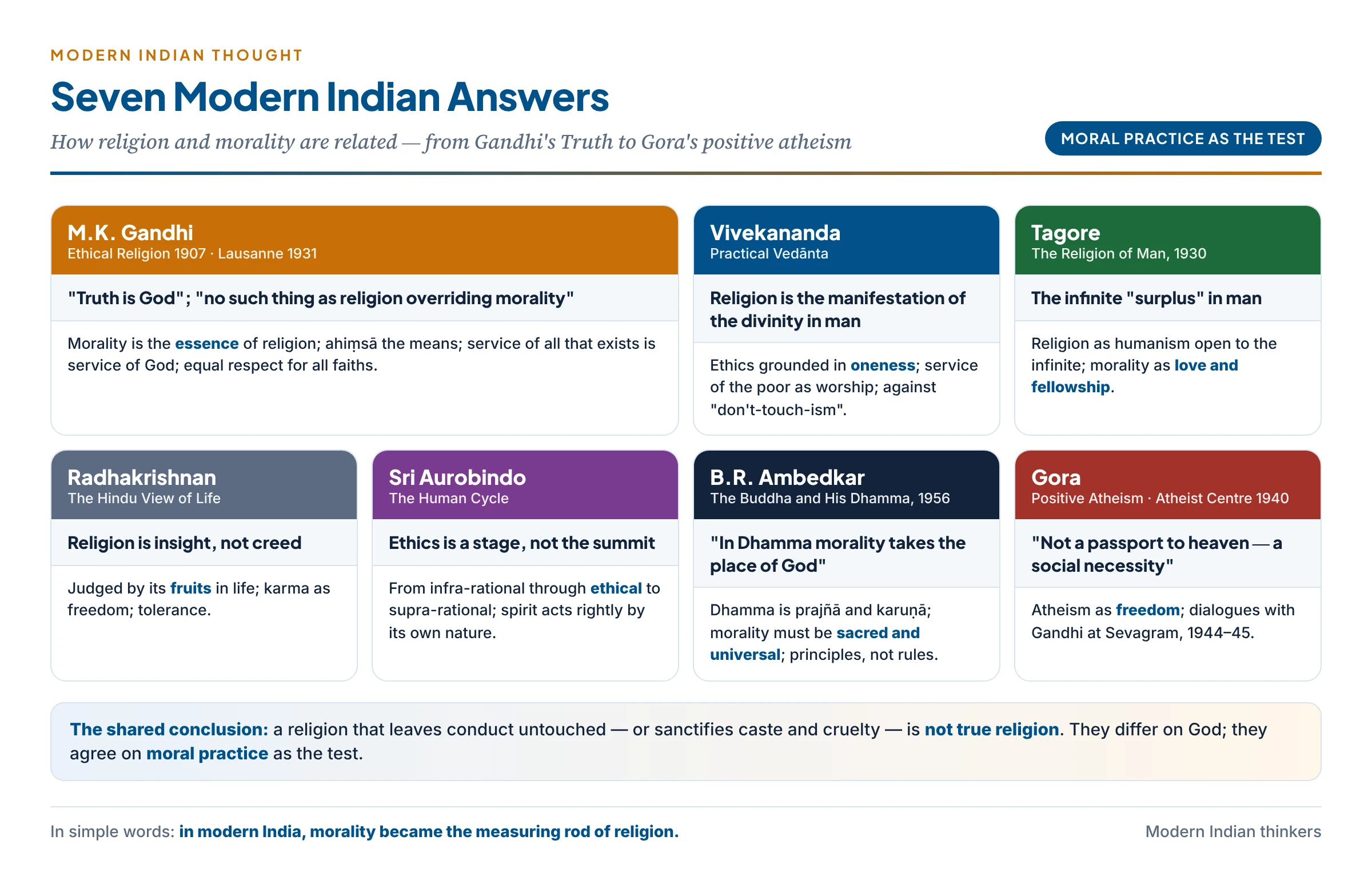
(a) Swami Vivekananda — Practical Vedānta
- Religion is “the manifestation of the divinity already in man.” Morality is its expression in conduct.
- Oneness as the ground of ethics. Why should I be good to others? Because, in truth, you and I are one — the same Self in all. Unselfishness is the test of religion; selfishness is the root of all sin.
- Service as worship. Serving the poor and suffering is worship of God in them; Vivekananda founded the Ramakrishna Mission (1897) on this principle.
- Against “don’t-touch-ism.” He condemned caste exclusion as a betrayal of the Upaniṣads. And: “It is a sin to call a man a sinner” — every person is divine.
(b) Rabindranath Tagore — The Religion of Man
- In his Hibbert Lectures, The Religion of Man (Oxford, 1930), Tagore described religion as the realisation of the infinite in man — the “surplus” in human nature that goes beyond mere survival into love, art and creativity.
- Morality is the expression of this surplus in love and fellowship; religion is humanism opened to the infinite.
(c) S. Radhakrishnan — Religion as Experience
- Religion is not creed or code but insight into Reality — an experience that must transform life.
- Karma is not fate but freedom within limits (Article 8); tolerance follows from the many-sidedness of religious truth.
- A religion is to be judged by its fruits in character and conduct.
(d) Sri Aurobindo — Beyond Ethics, into the Divine
- Human development passes from the infra-rational (instinct) through the rational and ethical to the supra-rational (spiritual).
- Ethics is a stage, not the summit. The spiritual person goes beyond the struggle between good and evil — not into evil, but into a divine nature in which right action flows spontaneously from the spirit. This is a modern version of the “beyond good and evil” of Article 2.
(e) B.R. Ambedkar — Dhamma as Morality
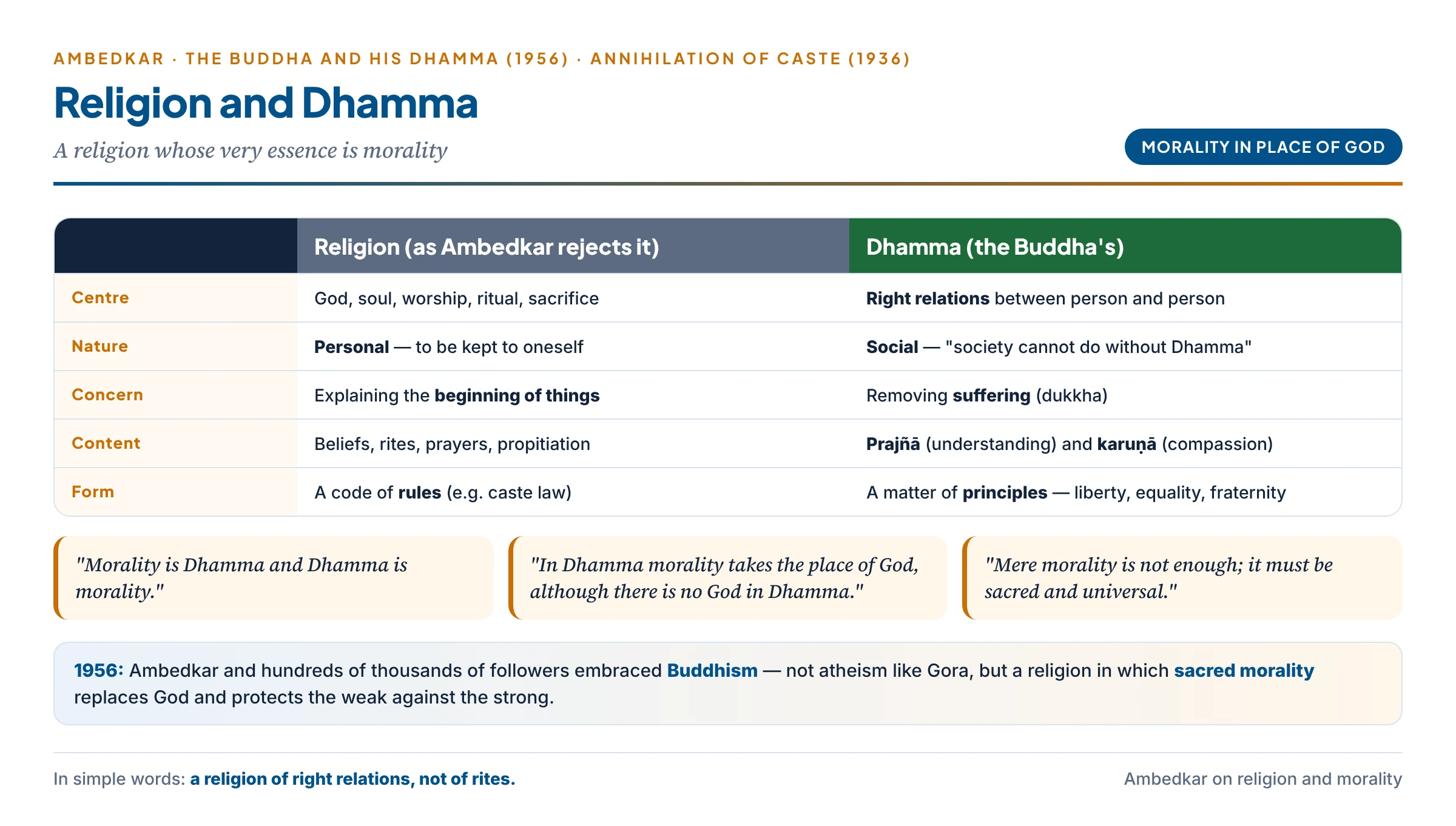
- In The Buddha and His Dhamma (1956), Ambedkar distinguished religion from Dhamma:
- Religion (in the sense he rejects) is concerned with God, the soul, worship, ritual and the beginning of things; it is personal, to be kept to oneself.
- Dhamma is social — “righteousness, which means right relations between man and man in all spheres of life”. It consists of prajñā (understanding, leaving no room for superstition) and karuṇā (compassion, without which society can neither live nor grow).
- Morality is Dhamma. “What is the place of morality in Dhamma? The simple answer is: Morality is Dhamma and Dhamma is morality. In other words, in Dhamma morality takes the place of God, although there is no God in Dhamma.” And: “Morality is the essence of Dhamma. Without it there is no Dhamma.“
- But morality must be sacred. Ambedkar adds that “mere morality is not enough; it must be sacred and universal” — morality needs the sacredness that religion gives, to protect the weak against the strong.
- Principles, not rules. In Annihilation of Caste (1936) he argued that a true religion must be a matter of principles, not a code of rules; Hindu law-books, being rules that sanctify caste, could not be the basis of a just society. Religion must be tested by liberty, equality and fraternity.
- In 1956, Ambedkar and hundreds of thousands of followers embraced Buddhism — a religion without God whose centre is morality.
In simple words
A city may have two kinds of guards. One kind protects only the king’s palace and the rituals inside it. The other kind patrols every street, protecting the weakest citizen from the strongest. Ambedkar said much religion had been like the first guard; the Buddha’s Dhamma is like the second — its whole job is right relations between people, and it protects them because it treats morality as sacred.
(f) Gora — Positive Atheism
- Goparaju Ramachandra Rao (“Gora”, 1902–1975), founder of the Atheist Centre (1940), distinguished mere godlessness (negative denial) from atheism, which is positive: “It asserts the condition that results from the denial of God.”
- Belief in God, he held, expresses a “slave mind” that subordinates man; atheism expresses freedom, and “freedom, equality and morality go together”.
- “Moral conduct is not a passport to heaven; it is a social necessity.“
- Gora and Gandhi held a series of discussions at Sevagram (1944–45), published as An Atheist with Gandhi. Gandhi supported his campaign against untouchability; Gora, for his part, saw in Gandhi’s “Truth is God” the shift from belief in God to the practice of truth.
Common confusion
Was Ambedkar an atheist who rejected religion, like Gora? No. Ambedkar rejected God-centred, ritual and caste-sanctioning religion, but he held that society needs religion in the sense of a sacred morality — “mere morality is not enough; it must be sacred and universal”. His answer was conversion to Buddhism, a religion in which “morality takes the place of God”. Gora, by contrast, rejected religion altogether in favour of positive atheism. Both were close to Gandhi on the evil of untouchability, but they stood at very different points on the question of religion.
Critical Evaluation
Critics and Defenders
Criticism — Critics of the modern Indian reconciliations
- Ambedkar on Gandhi: the inner voice is personal authority; varṇa survived his religion of Truth.
- Gora on Gandhi: “Truth is God” is atheism in theistic language.
- Theists: Truth as God is too abstract for devotion; the personal God disappears.
- Rationalists: the inner voice and karma cannot be publicly tested.
- Secularists: grounding public morality in any religion, even a reformed one, risks exclusion.
Defence — Defenders of the modern Indian synthesis
- Gandhi: Truth unites all faiths and none; ahiṃsā keeps religion moral.
- Vivekananda: oneness gives morality its deepest reason.
- Ambedkar: Dhamma shows a religion whose essence is morality.
- Radhakrishnan, Tagore: religion is judged by its fruits in life and love.
- Aurobindo: the spiritual fulfils ethics rather than denying it.
Cross-Tradition Comparison
| Thinker | Formula | Western parallel |
|---|---|---|
| Gandhi | Truth is God; ahiṃsā the means | Tillich’s God as Being-itself; Quaker inner light |
| Vivekananda | Divinity in man; oneness grounds ethics | Spinoza’s unity; love of neighbour as oneself |
| Tagore | The religion of man | Dewey’s A Common Faith; Feuerbach (without the reduction) |
| Radhakrishnan | Religion as experience, judged by fruits | William James’s “fruits not roots” |
| Aurobindo | Ethics as a stage towards the divine | Kierkegaard’s stages (aesthetic, ethical, religious) |
| Ambedkar | Dhamma is morality; morality must be sacred | Arnold’s “morality touched by emotion”; Durkheim’s sacred |
| Gora | Positive atheism; morality as social necessity | Secular humanism; Bayle’s virtuous atheist |
Indian Connect — Takeaways
- Modern Indian thought answers the unit’s question with a striking consensus: morality is the heart of religion. Gandhi, Vivekananda, Radhakrishnan, Ambedkar and even the atheist Gora agree that a religion which leaves conduct untouched — or sanctifies caste and cruelty — is not true religion.
- They differ on God: Gandhi identifies God with Truth, Vivekananda with the Self in all, Ambedkar replaces God with morality, Gora rejects God for freedom. Yet each makes moral practice the test.
Synthesis (Siddhānta) — Gandhi and the Whole Unit
On Gandhi’s shift (the 2026 question):
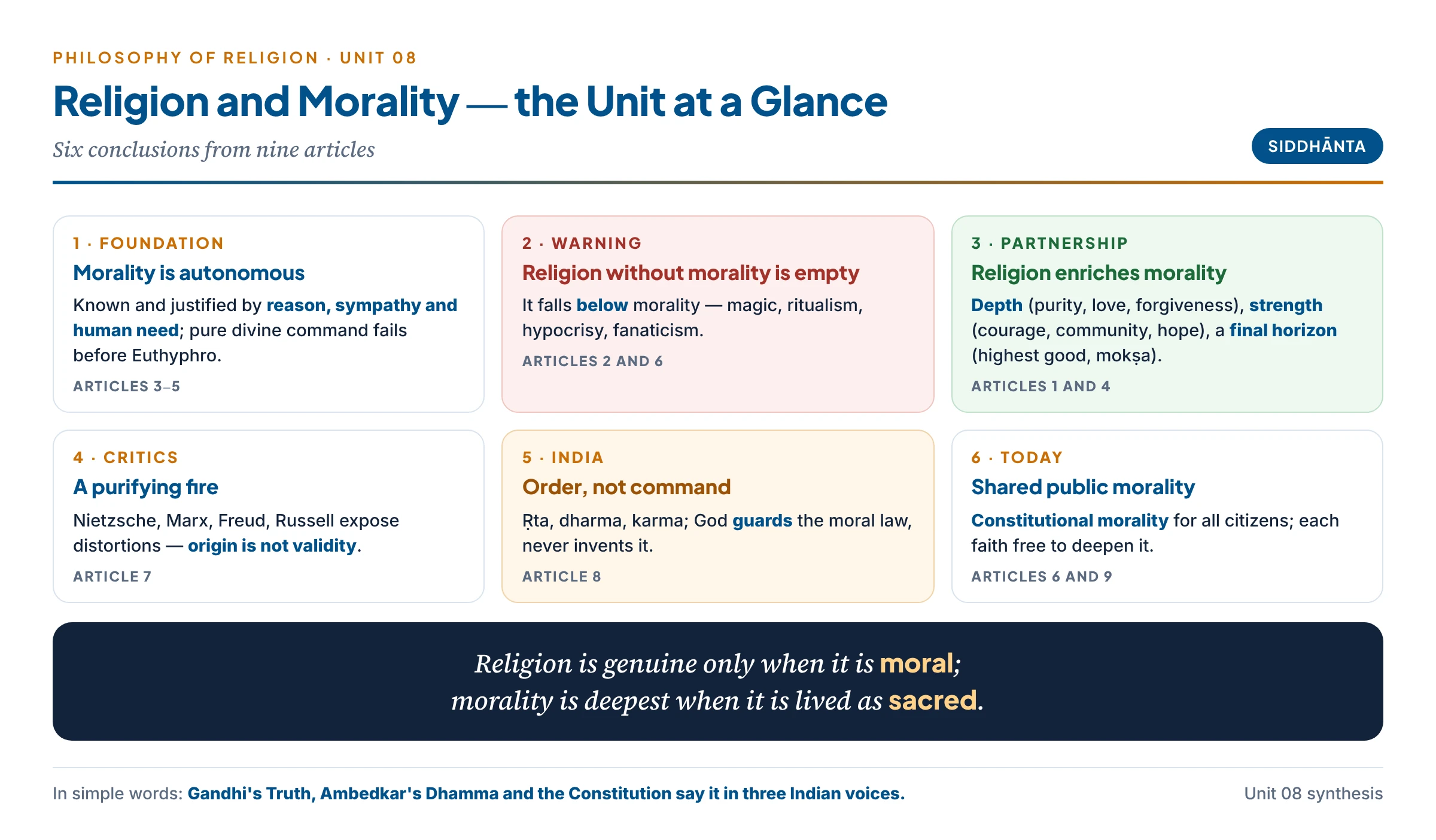
- The shift from “God is Truth” to “Truth is God” moves the centre of religion from belief to truthful living. It makes morality the essence of religion, includes atheists and all faiths, and blocks the use of God’s name for cruelty — while leaving open real difficulties about the meaning of Truth and the checkability of the inner voice.
On the unit as a whole — the relation of religion and morality:
- Foundation. Morality is autonomous in its foundation: its basic principles can be known and justified by reason, sympathy and human need, by believers and non-believers alike (Articles 3–5). Pure divine command theory fails before the Euthyphro dilemma.
- Religion cannot do without morality. A religion without morality is empty and dangerous — it falls below morality into magic, ritualism, hypocrisy and fanaticism (Articles 2 and 6).
- Religion can enrich morality. It can give morality depth (interior purity, love beyond duty, forgiveness), strength (courage, community, hope) and a final horizon (the highest good, mokṣa, Nirvāṇa) — the interdependence thesis in its qualified form (Article 1).
- The critics purify religion. Nietzsche, Marx, Freud and Russell expose real distortions; they do not refute religious morality as such (Article 7).
- India’s distinctive answer. Morality rests on an eternal order (Ṛta, dharma, karma), not on arbitrary command; God, where accepted, guards rather than invents it; and modern Indian thinkers make moral practice the test of all religion (Articles 8–9).
- Contemporary relevance. In a plural democracy, public morality must rest on reasons all can share — dignity, equality, liberty, fraternity — while each religion remains free to ground and deepen that morality in its own way. Gandhi’s “Truth is God”, Ambedkar’s “Dhamma is morality” and the constitutional idea of constitutional morality are three Indian forms of the same insight: religion is genuine only when it is moral, and morality is deepest when it is lived as sacred.
“Truth is God… the only inevitable means is Love, i.e. non-violence, and since I believe that ultimately the means and the end are convertible terms, I should not hesitate to say that God is Love.” — M.K. Gandhi
Previous Year Questions
- 2026Critically evaluate the shift in Gandhi’s view from ‘God is Truth’ to ‘Truth is God’, in the context of interrelation between religion and morality.
- 2023Does religion influence the moral behaviour? Explain the interactive relation between religion and morality.
- 2022“One can have morality without religion but not religion without morality.” Discuss.
- 2021Do you consider that religion and morality are inseparable? Give reasons for your answer.
- 2015“An atheist may be a better man than a religious person bereft of moral values.” Discuss.
- 2012“I can be moral without being religious, but I cannot be religious without being moral.” Do you agree? Give reasons for your answer.