

Religion and Morality: Religion and Morality.
Official Syllabus: Paper II, Section B, Unit 8
Not everyone has thought that religion supports morality. A line of powerful critics has argued that religion distorts, weakens or corrupts morality — or that the morality religion preaches is itself a disguised expression of something else: resentment, class interest, childish wishes or fear. The French philosopher Paul Ricoeur called Marx, Nietzsche and Freud the “masters of suspicion“, because each taught us to suspect that the real reason for our beliefs and values lies hidden beneath the reasons we give. Before them Feuerbach had argued that God is a projection of human nature; after them Bertrand Russell traced religion to fear; and in India the Cārvākas in ancient times and Periyar in modern times attacked religion as a cover for priestly and caste interests. This article sets out these critiques — above all Nietzsche’s criticism of religion and morality, asked in 2025 — and the replies that defenders of religion have made.
In simple words
A child is told, “Don’t eat the sweets in the cupboard — God is watching.” Years later the child discovers that the rule was invented by an elder brother who wanted the sweets for himself. The critics in this article are like that discovery: they ask who benefits from a religious morality, and what feeling or interest it really expresses. Nietzsche says “the weak”; Marx says “the ruling class”; Freud says “our childish wish for a father”. Their question is always: what is the hidden author of this morality?
Context & Problem
From Defending Religion to Suspecting It
- Earlier debates asked whether religion’s moral teaching is true or well-founded (Articles 3–5). The critics in this article ask a different question: where does religious morality come from, and whose interests does it serve?
- Their method is genealogical or psychological: trace a belief or value back to its origin in human needs, feelings or social structures, and you may unmask it.
- The danger of the method is the “genetic fallacy“: showing where an idea came from does not by itself show that the idea is false or bad. Much of the debate turns on this point.
Core Doctrine
1. Feuerbach: God as Projection
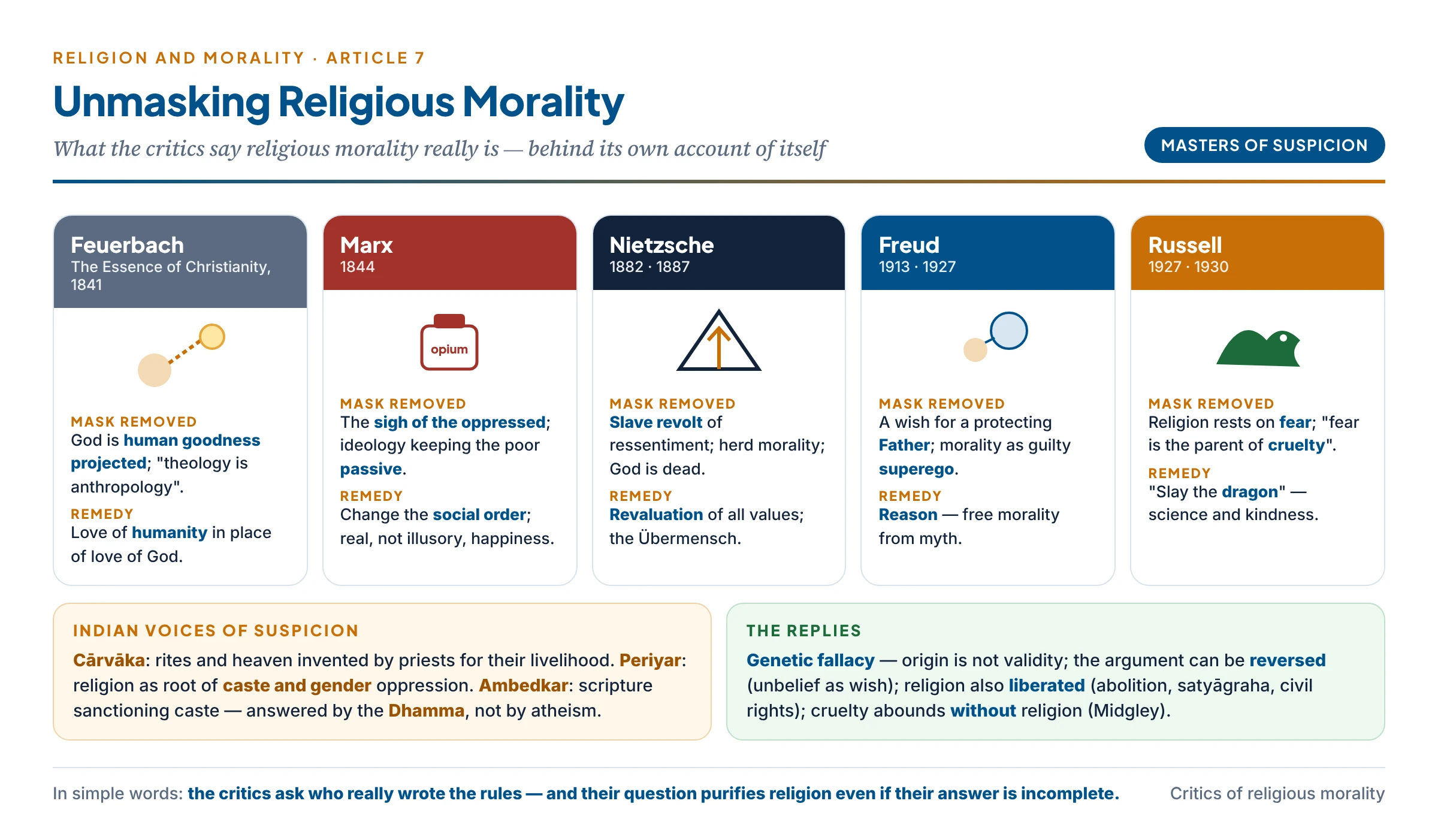
- Ludwig Feuerbach (The Essence of Christianity, 1841) argued that God is the projection of the human essence. Human beings take their own best qualities — reason, will, love — imagine them infinitely perfected, and place them outside themselves in a being called God.
- “Theology is anthropology.” What we say about God is really what we say about humanity; the secret of theology is the human being.
- Moral consequence — alienation. By giving his best qualities to God, man impoverishes himself: the more God is rich, the more man is poor. Religious morality makes human beings worship their own goodness instead of living it.
- His remedy: replace love of God with love of humanity; the true ethic is “man is God to man“. Feuerbach’s critique deeply influenced Marx.
In simple words
A child who draws a perfect superhero gives him everything the child wishes to be — strong, brave, kind. Feuerbach says God is that drawing on a cosmic scale: our own best qualities, magnified and placed outside us. The danger is that we admire the drawing and forget to become what it shows.
2. Marx: The Opium of the People
- Karl Marx began from Feuerbach but asked why human beings project their essence into heaven. His answer: because their earthly life is miserable and unjust.
- The famous passage (1844): “Religious suffering is at one and the same time the expression of real suffering and a protest against real suffering. Religion is the sigh of the oppressed creature, the heart of a heartless world, and the soul of soulless conditions. It is the opium of the people.“
- Religion and morality as ideology. Religion and morality belong to the superstructure of society, shaped by the economic base. The ruling ideas of every age are the ideas of its ruling class. Religious morality preaches humility, obedience, patience and contentment with one’s lot, promising reward in heaven — and so keeps the oppressed passive on earth.
- “The criticism of religion is the premise of all criticism.” To abolish religion as the illusory happiness of the people is to demand their real happiness — to call on them to give up a condition that needs illusions.
- Morality itself has no eternal content for Marx; each class has its own morality, and a truly human morality becomes possible only in a classless society.
Indian Connect — Ambedkar and Periyar — the Indian suspicion
- Ambedkar showed how the Manusmṛti and related texts gave caste inequality a religious sanction; a religion that denies the equal worth of human beings was, for him, no true religion at all. Unlike Marx, he did not reject religion as such: he turned to the Buddha’s Dhamma, in which “morality takes the place of God” (Article 9).
- E.V. Ramasamy “Periyar” led the Self-Respect Movement (from 1925) against religion as the root of caste and gender oppression, publicly attacking the scriptures that sanctioned them.
- India thus produced its own “masters of suspicion” — critics who asked whose interests religious morality served — but with the anti-caste struggle at the centre.
3. Nietzsche’s Criticism of Religion and Morality
Friedrich Nietzsche (1844–1900) is the most radical critic of Christian morality. His critique has several connected parts.
(a) “God is dead”
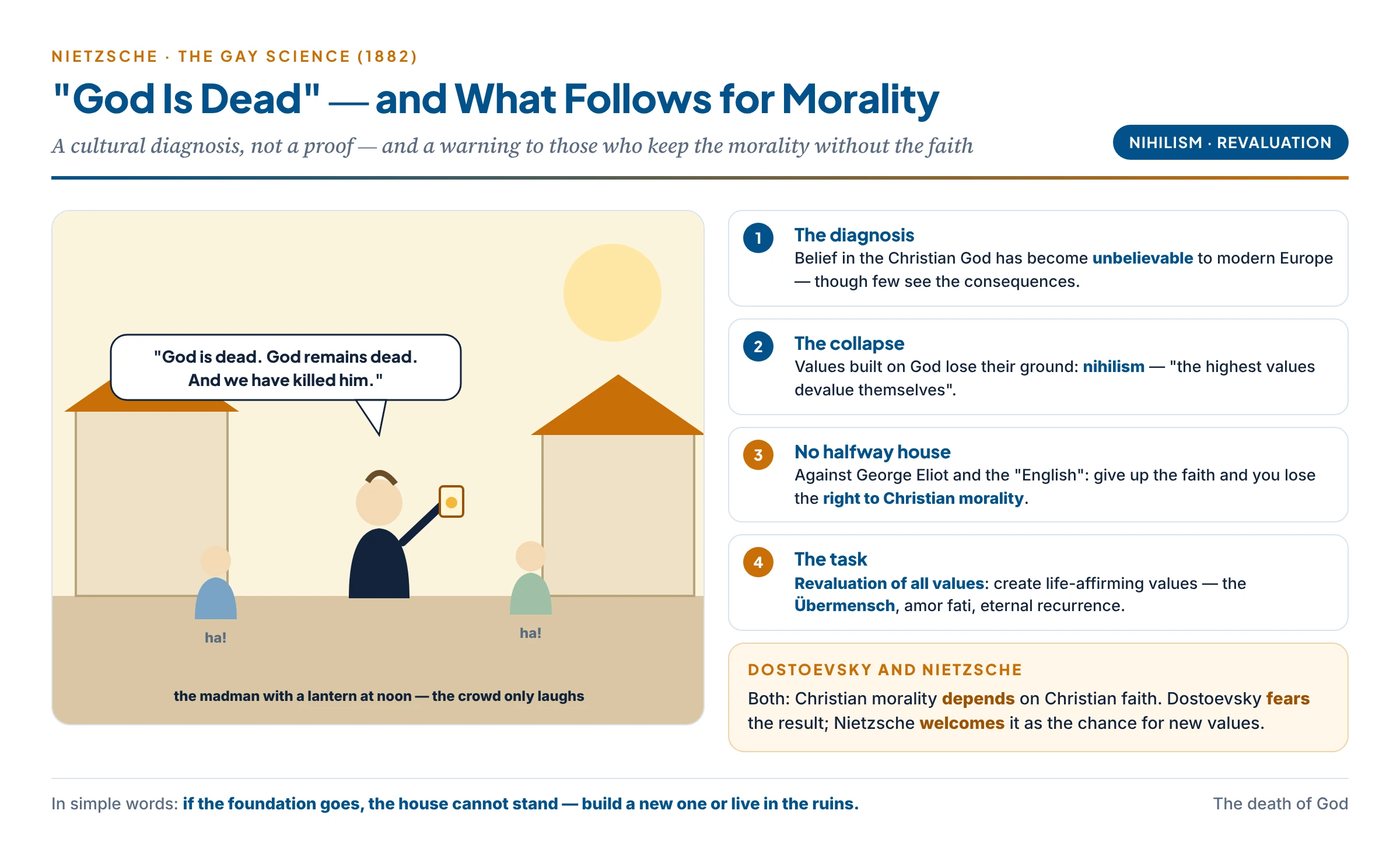
- In The Gay Science (1882) a madman runs into the marketplace with a lantern in broad daylight, crying “I seek God!” — and then: “God is dead. God remains dead. And we have killed him.” The townspeople, unbelievers already, merely laugh.
- Meaning: not a metaphysical proof that God does not exist, but a cultural diagnosis: belief in the Christian God has become unbelievable for modern Europe — science, history and critical thought have destroyed it — though people have not yet grasped the consequences.
- The consequence — nihilism. All the values built on God — the meaning of life, the moral law, the worth of the soul — lose their foundation. Europe faces nihilism: “the highest values devalue themselves”.
- Against the “English” moralists. Nietzsche mocks those (he names George Eliot) who give up the Christian God but keep Christian morality: “When one gives up the Christian faith, one pulls the right to Christian morality out from under one’s feet.” Morality and religion stand or fall together.
Common confusion
Did Nietzsche agree with Dostoevsky that without God everything is permitted? In one sense, yes — both hold that Christian morality depends on Christian faith, so the “death of God” removes its foundation. But they draw opposite conclusions. Dostoevsky’s novel warns of the moral catastrophe that follows unbelief; Nietzsche welcomes the end of Christian morality as an opportunity for a revaluation of all values — not “everything permitted” in the sense of chaos, but the creation of new, life-affirming values by those strong enough to create them.
(b) Master morality and slave morality
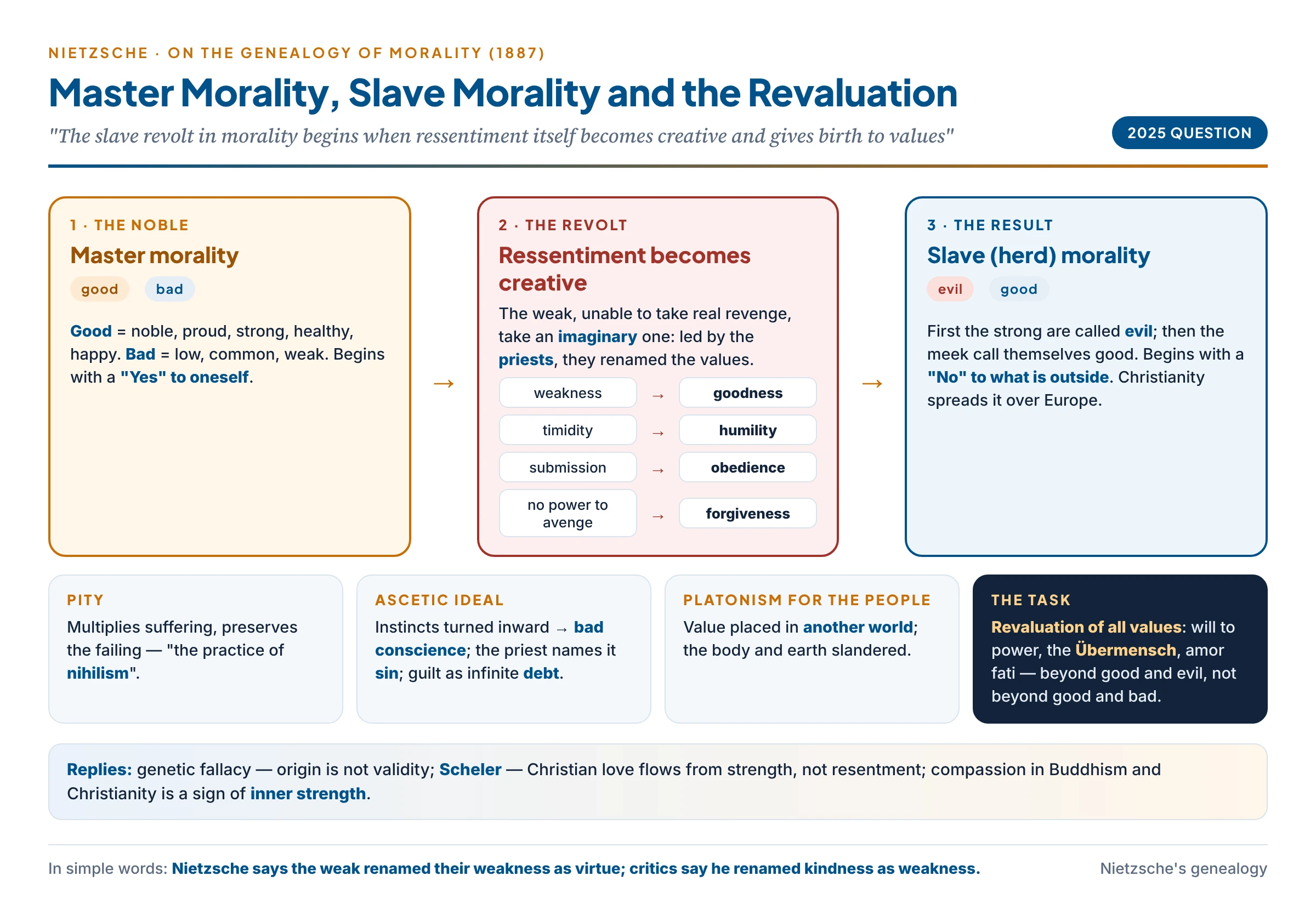
- In On the Genealogy of Morality (1887), Nietzsche traces moral values to their origins:
- Master morality — the morality of the noble, strong and healthy. Its basic contrast is good and bad: “good” means noble, proud, powerful, beautiful, happy; “bad” means low, common, weak. It begins with a “Yes” to oneself.
- Slave morality — the morality of the weak and oppressed. Its basic contrast is good and evil: it first calls the powerful “evil“, and only then calls itself, the meek, “good”. It begins with a “No” to what is outside.
- The slave revolt in morality. “The slave revolt in morality begins when ressentiment itself becomes creative and gives birth to values” — the resentment of those who cannot take real revenge and so take an imaginary one. Unable to defeat the masters, the weak redefine values so that their weakness becomes virtue:
- impotence becomes goodness;
- timidity becomes humility;
- submission to those they hate becomes obedience;
- inability to take revenge becomes forgiveness and patience.
- Nietzsche holds that the priestly class — Jewish and then Christian — led this revolt, and that Christianity made slave morality the morality of all Europe.
- Ressentiment (French, “resentment”): the festering, impotent hatred of the weak against the strong, which seeks revenge by moral condemnation.
(c) Herd morality and the morality of pity
- Christian morality is the morality of the herd — it values conformity, safety, equality and pity, and distrusts the exceptional individual.
- Pity (compassion), the central Christian virtue, multiplies suffering and preserves what is weak and failing; it is “the practice of nihilism”.
- “Christianity is Platonism for the people” (Beyond Good and Evil, 1886): like Plato’s world of Forms, Christianity places true value in another world, and so slanders this one — the body, the senses, the earth.
(d) The ascetic ideal, guilt and bad conscience
- The ascetic ideal — self-denial, chastity, poverty, humility — turns the instincts against themselves.
- Bad conscience arises when aggressive instincts that cannot be discharged outward are turned inward; the priest then interprets this inner pain as guilt and sin against God.
- Guilt as debt. The German word Schuld means both guilt and debt; Nietzsche traces moral guilt to the ancient relation of creditor and debtor, and Christianity to an infinite debt to God that can never be repaid.
- The priest is a “physician” who soothes suffering by giving it a meaning (sin) — but makes the patient sicker. Yet the ascetic ideal shows something deep: “man would rather will nothingness than not will.”
(e) Beyond good and evil — the revaluation of all values
- Nietzsche calls for a revaluation of all values (Umwertung aller Werte) — not a return to brute force, but the creation of life-affirming values.
- Will to power — the basic drive of life to grow, overcome and create, which Nietzsche sees at work even in the slave revolt (as a covert will to power).
- The Übermensch (“overman”) — the higher human who creates his own values, affirms life and the earth, and makes his life a work of art.
- Eternal recurrence and amor fati (love of fate) — the test of affirmation: could you will your life to return eternally, exactly as it was?
- “Beyond good and evil” means beyond the slave contrast of good and evil — but not beyond the noble contrast of good and bad.
In simple words
Imagine a classroom where the strongest students always win the races. The weaker ones, unable to win, start saying, “Running fast is arrogant; the truly good student walks humbly.” Soon the whole school praises walking and blames running. Nietzsche says Christian morality arose in this way — weakness renamed as virtue — and that a healthy culture must again honour strength, excellence and joy. His critics reply that he mistakes kindness for weakness.
(f) Assessing Nietzsche Insights:
- A brilliant psychology of resentment, hypocrisy and self-righteousness — moral condemnation can indeed be disguised envy or revenge.
- A real criticism of life-denying religion — contempt for the body, the earth and joy.
- The recognition that morality has a history — values are not simply given.
Criticisms:
- Genetic fallacy. Even if some moral values arose from resentment, it does not follow that they are false or bad. Compassion may be right whatever its origin.
- Christian love is not ressentiment. The German philosopher Max Scheler replied that genuine Christian love springs from strength and overflowing fullness, not from weakness; it is modern “humanitarian” sentiment that is often resentment in disguise.
- Elitism and danger. Nietzsche’s contempt for the “herd” and praise of the strong have been misused — his writings were distorted by his sister and by the Nazis, though he himself despised anti-Semitism and German nationalism.
- Compassion is not weakness. Buddhism (which Nietzsche respected as more realistic than Christianity) and Christianity both treat compassion as the fruit of great inner strength.
- Historical doubt. His story of “masters” and “slaves” is a philosophical myth rather than proven history.
- Davies’ observation. Seeds of the view that morality is pointless without religion can be traced in the Genealogy — yet Nietzsche’s own aim was to create values without God, not to abandon value.
Indian Connect — Nietzsche and India
- Nietzsche contrasted Christianity unfavourably with Buddhism, which he called far more realistic — a religion without God, without moral “sin”, aiming at freedom from suffering — though he still saw it as a religion of the exhausted.
- In The Antichrist he even praised the Law of Manu above the New Testament, admiring its “aristocratic” ordering of society. Ambedkar later saw in the Manusmṛti precisely the kind of graded inequality that Nietzsche’s “superman” ideal implied — and rejected both in the name of liberty, equality and fraternity.
- The Gītā’s call to act without ressentiment — equal-minded in victory and defeat, hating no creature — offers a third model: neither the master’s pride nor the slave’s resentment, but detached strength.
4. Freud: Religion as Illusion
- Origins. In Totem and Taboo (1913) Sigmund Freud traced religion and morality to the guilt of a primal crime — the sons’ killing of the tyrannical father of the horde — and the taboos that followed (against murder and incest). Morality began as guilt.
- Religion as illusion. In The Future of an Illusion (1927) Freud argued that religious beliefs are illusions — beliefs held because they fulfil wishes, not because of evidence:
- Faced with the terrors of nature, death and the cruelty of fate, adults long for the protecting father they had as children; God is this father projected onto the universe.
- Religion is “the universal obsessional neurosis of humanity” — rituals like a neurotic’s compulsions, born of the Oedipal relation to the father.
- Morality and the superego. Conscience is the superego — the internalised voice of parental and social authority, which punishes the ego with guilt. Religion reinforces this by making the father divine.
- Why morality must be freed from religion. Freud admitted that religion had rendered great services to civilisation — man has given up many cruel and aggressive impulses “in the name of God”. But religion is largely mythological, and myths are bound to disappear “in the white light of science”. If morality is kept tied to religion, then when religion disappears, morality will be endangered too. Morality must therefore be given a rational basis — “our god Logos” (reason).
In simple words
A child afraid of the dark calls for a parent and feels safe once she hears a voice. Freud says humanity, frightened by storms, disease and death, did the same: it called for a heavenly Father and felt safe. The comfort is real — but, Freud warns, a grown-up who still needs the voice in the dark has not learned to face the night with reason. And if goodness depends on believing in the voice, goodness may vanish when the belief does.
5. Russell: Religion and Fear
- In Why I Am Not a Christian (1927), Bertrand Russell argued that “religion is based, I think, primarily and mainly upon fear” — fear of the mysterious, fear of defeat, fear of death — and “fear is the parent of cruelty“.
- He criticised even the morality of the Gospels — above all the doctrine of eternal punishment in hell, which he thought no truly kind person could teach.
- In “Has Religion Made Useful Contributions to Civilization?” (1930) he wrote: “Religion prevents our children from having a rational education; religion prevents us from removing the fundamental causes of war; religion prevents us from teaching the ethic of scientific co-operation in place of the old fierce doctrines of sin and punishment. It is possible that mankind is on the threshold of a golden age; but if so, it will be necessary first to slay the dragon that guards the door, and this dragon is religion.”
- Long before, the Roman poet Lucretius had written: “So much evil could religion provoke” (Tantum religio potuit suadere malorum) — referring to Agamemnon’s sacrifice of his daughter Iphigenia.
6. An Ancient Indian Critique: The Cārvākas
- The materialist Cārvāka (Lokāyata) school rejected God, the soul surviving death, heaven, hell and karma.
- They held that the Vedic rituals and the promises of heaven were invented by priests for their livelihood; a well-known Cārvāka verse says the authors of the Vedas were “buffoons, knaves and demons“.
- Their ethics was frankly hedonistic — pleasure is the goal of life — but later Cārvākas distinguished refined from crude pleasures and did not deny social virtues.
- The Cārvāka critique shows that the suspicion of religious morality as priestly interest is not only a modern Western idea.
Critical Evaluation
The Replies of the Defenders
- The genetic fallacy. All five critics explain where religious morality came from. But the origin of a value does not settle its validity: chemistry grew out of alchemy, yet chemistry is true. Even if compassion arose from weakness or from a wish for a father, compassion may still be good.
- The argument can be reversed. If belief in God can be a wish for a protecting father, unbelief can be a wish to be free of a judging one. Psychological explanations cut both ways.
- Religion has also been liberating. Against Marx: religion inspired the abolition of slavery, Gandhi’s satyāgraha, Martin Luther King’s civil-rights movement and Latin American liberation theology — the “protest against real suffering” that Marx himself noticed.
- Atrocity without religion. As the philosopher Mary Midgley observed, moral atrocities abound where religion has no influence — in the twentieth-century regimes of Stalin and others. What is needed is a hard psychological inquiry into human cruelty, not “a ritual warfare about the existence of God”.
- Russell’s values are shared by believers. Many Christians argue on theological grounds for open and pluralistic education, for pacifism and for scientific co-operation — the very values Russell defended.
- “Religion” is too varied to condemn wholesale. Religion cannot even be defined by a neat formula; it is a family of traditions with many features in different combinations. Sweeping statements that religion and morality are necessarily opposed are therefore suspect.
- What the critics get right. Religion can be used as opium, as a mask for resentment, as a projection, as an instrument of fear and of caste. The critics are valuable as a purifying fire — they force religion to separate its ethical core from its distortions.
Critics and Defenders
Criticism — The critics of religious morality
- Feuerbach: God is projected human goodness; worship alienates man from himself.
- Marx: religion is the opium of the oppressed and the ideology of the rulers.
- Nietzsche: Christian morality is slave morality born of ressentiment; God is dead.
- Freud: religion is a wish-fulfilling illusion; morality must be freed from it.
- Russell, Lucretius, Cārvāka, Periyar: religion rests on fear and priestly interest and breeds cruelty.
Defence — The defenders’ replies
- Genetic fallacy: origin does not decide validity.
- Scheler: true Christian love comes from strength, not resentment.
- History: religion inspired abolition, satyāgraha and civil rights.
- Midgley: cruelty flourishes without religion too; the problem is human nature.
- Purified religion (Ambedkar’s Dhamma, Gandhi’s Truth) answers the critics by making morality its core.
Cross-Tradition Comparison
| Critic | What religious morality really is | Remedy | Indian parallel |
|---|---|---|---|
| Feuerbach | Projection of human goodness onto God | Love of humanity | Gora’s positive atheism; humanism |
| Marx | Opium; ideology of the ruling class | Change the social order | Ambedkar on caste and scripture; Periyar |
| Nietzsche | Slave revolt of ressentiment; herd morality | Revaluation of values; the Übermensch | Cārvāka’s rejection of otherworldly values |
| Freud | Wish for a father; guilty superego | Reason (Logos) | Cārvāka: heaven and hell as fictions |
| Russell | Fear; doctrines of sin and punishment | Science and kindness | Rationalist and atheist movements in India |
Indian Connect — Takeaways
- India’s own tradition of suspicion runs from the Cārvākas (priestly fraud) to Periyar and Ambedkar (religion as sanction for caste).
- But India’s dominant answer to such criticism has been reform rather than rejection — Buddhism’s ethical revolt within Vedic culture, the bhakti saints’ attack on ritual and caste, Ambedkar’s turn to the Dhamma, and Gandhi’s identification of God with Truth (Article 9).
Synthesis (Siddhānta)
- The critics expose real distortions. Religious morality has sometimes been resentment in disguise (Nietzsche), an instrument of class or caste domination (Marx, Ambedkar, Periyar), a projection of childish wishes and a source of neurotic guilt (Freud), and a breeding ground of fear and cruelty (Russell).
- But they do not refute religious morality as such. Their explanations of origins do not decide validity, their arguments can often be reversed, and history shows religion also as a source of liberation and compassion.
- Nietzsche’s challenge is the deepest: if Christian morality rests on Christian faith, can it survive the “death of God”? The answer of this unit has been that morality has its own foundations (Articles 4–5) — so it need not die with any particular theology — while religion, at its best, can still give it depth and hope.
- Contemporary relevance. Debates about religion’s role in public life — from caste to gender to fundamentalism — still draw on these critics. Their lasting value is to make every religion ask whether its morality expresses love and justice or something it would rather not admit.
“Religion is the sigh of the oppressed creature, the heart of a heartless world, and the soul of soulless conditions. It is the opium of the people.” — Karl Marx
Previous Year Questions
- 2025Present an account of Nietzsche’s criticism of religion and morality.
- 2018Can one claim that there is an inter-relatedness between ‘religiosity’ and ‘immorality’? Discuss.
- 2016“Moral principles function better when they remain independent and unconnected with religion.” Discuss.