

Religion and Morality: Religion and Morality.
Official Syllabus: Paper II, Section B, Unit 8
The earlier articles asked whether morality depends on religion. This article asks a more practical set of questions that UPSC has set again and again since 2013: how does religion actually behave in society? Is there a link between religiosity and immorality? Are some religious beliefs and practices incompatible with moral behaviour? Does a devoted religious life lead a person away from social morality? Can religious morality make room for individual freedom? May a believer take an elastic view of ideals that are supposed to be eternal — and will that make religion progressive or destroy its authority? How should a plural democracy such as India handle conflicts between religious practice and constitutional morality? And does religious pluralism lead to moral relativism? These questions bring the philosophy of religion into contact with law, social reform and current events.
In simple words
A river can irrigate fields or flood them. Religion is like that in society. The same faith that builds hospitals, feeds the hungry in a langar and inspires a Gandhi can also be used to keep people out of temples, to justify violence or to deny women their rights. The questions of this article are about how to keep the river in its banks — without drying it up.
Context & Problem
Social Morality and Critical Morality
- Social (positive) morality is the set of moral rules actually accepted in a society at a given time — its customs, expectations and shared standards of conduct.
- Critical morality is the morality by which we judge social morality — reason, conscience, human dignity, justice. Social morality can be wrong: societies once accepted slavery, untouchability and sati.
- This distinction is essential. When a religious person goes “against social morality”, he may be falling below it (a fanatic) or rising above it (a prophet or reformer).
Religion’s Two Faces in Society
- Religion as social cement. Durkheim saw religion as what unites a society into one moral community; the sacred expresses the authority of the group. Religion supplies shared rituals, values and solidarity.
- Religion as legitimiser of injustice. Marx saw religion as the “opium of the people“, consoling the oppressed and sanctifying the existing order; Ambedkar showed how Hindu scriptures were used to legitimise caste.
- Religion as prophetic critic. The Hebrew prophets, the Buddha, Kabir, Basava, Guru Nanak and Gandhi used religion to criticise the social morality of their time.
- So the relation of religion to social morality is neither simply positive nor simply negative; it depends on how religion is understood and lived.
Core Doctrine
1. Is There an Inter-relation between Religiosity and Immorality?
Religiosity means the degree of a person’s religious involvement — belief, worship, ritual observance and identification with a religious group. The 2018 question asks whether it is linked to immorality.
Ways in which religiosity can coexist with or produce immorality:
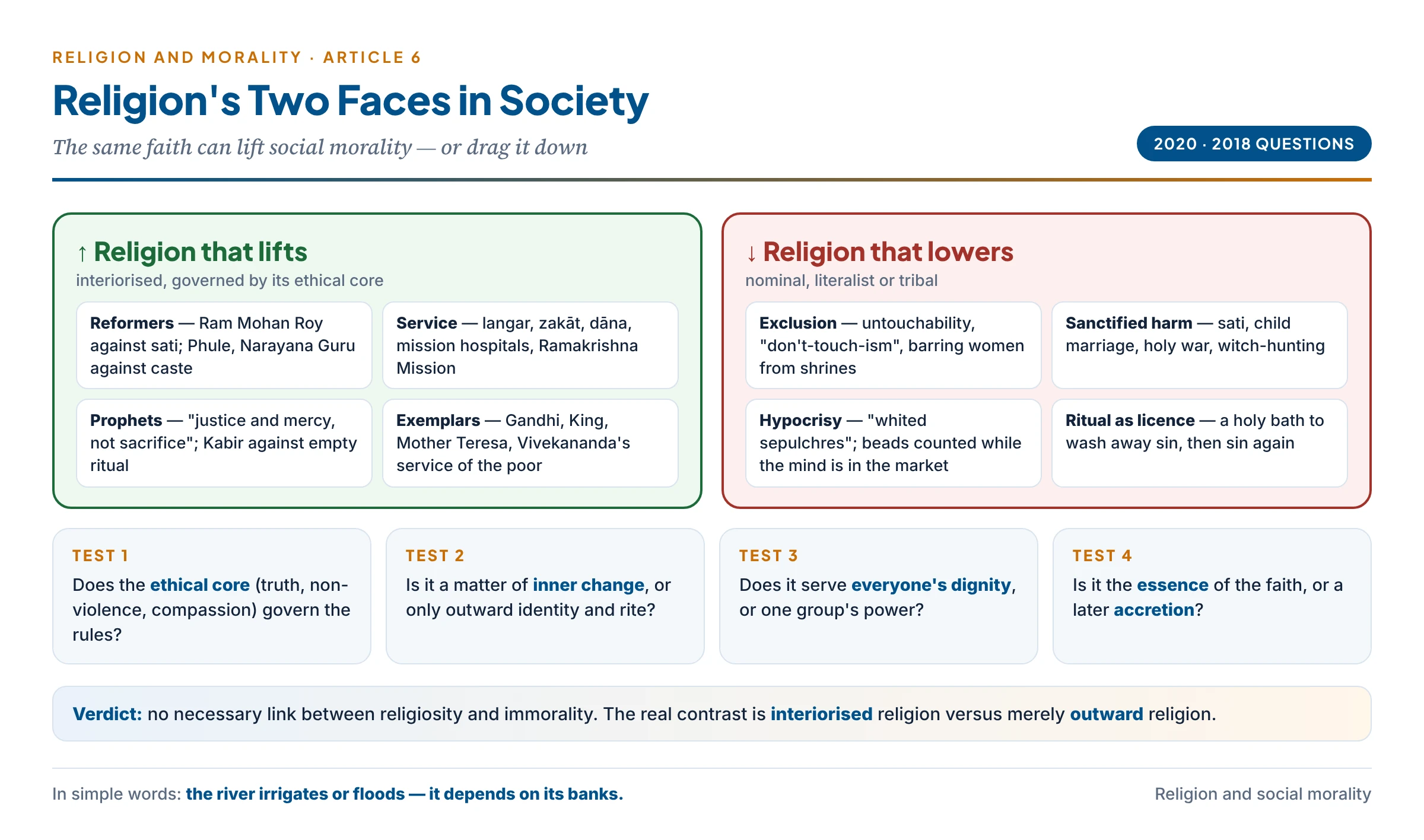
- Hypocrisy. Outward piety can hide inner vice — the devout trader who cheats, the pilgrim who exploits workers. Kabir mocked those who count their beads while the mind wanders in the market. Jesus condemned the “whited sepulchres” — beautiful outside, full of corruption within.
- Ritual substitutes for ethics. When rites are thought to cancel sins (a bath in a holy river, a donation to a shrine), people may feel licensed to sin again.
- Group loyalty over universal ethics. Strong religious identity can create in-group love and out-group hostility — kindness to “our own”, cruelty to “others”.
- Sanctified wrong. Some immoral practices have been defended in religion’s name — untouchability, sati, persecution of heretics, holy war. “So much evil could religion provoke,” wrote the Roman poet Lucretius.
- Fanaticism. Certainty of possessing divine truth can make people ruthless towards those who disagree.
Ways in which religiosity restrains immorality:
- Religion interiorises morality and gives powerful motives — love of God, fear of sin, hope of liberation (Article 1).
- Religious communities organise charity on a vast scale — dāna, zakāt, tithes, sewa, langar, mission hospitals and schools.
- Religious exemplars inspire selfless service.
Assessment. There is no necessary link in either direction. Genuine religiosity — the inner turning of the self towards the sacred — tends towards moral goodness; nominal or tribal religiosity — ritual and identity without inner change — can coexist with, and even shelter, immorality. The real contrast is not religious vs non-religious but interiorised vs merely outward religion.
2. Are Religious Beliefs and Practices Incompatible with Moral Behaviour?
Examples of conflict:
- Caste and untouchability — exclusion from temples, wells and schools defended by appeal to scripture and purity.
- Sati, child marriage, the devadāsī system — once defended as religious duty.
- Instant triple talaq — unilateral divorce harming women’s dignity (struck down in 2017).
- Female genital cutting among some communities; exclusion of women from shrines.
- Blasphemy violence, witch-hunting, persecution of converts or apostates.
- Refusal of medical care on religious grounds.
- Holy war and terrorism justified in God’s name.
Examples of harmony:
- The ethical core of every religion — truth, non-violence, compassion, justice — is the core of morality itself (Article 1).
- Social service motivated by religion — the Ramakrishna Mission, the langar of the gurdwara, Mother Teresa‘s work, zakāt for the poor.
- Religious reformers who fought immoral practices from within — Raja Ram Mohan Roy against sati, Jyotiba Phule and Sree Narayana Guru against caste, Vivekananda against what he called “don’t-touch-ism” — a religion that had retreated “into the kitchen”.
Assessment. The conflict is usually not between religion as such and morality but between morality and:
- Literalism — reading ancient rules as if they were timeless.
- Accretions — customs that grew around the faith but are not its essence.
- Group interest and power — religion used to protect privilege.
Religious beliefs and practices are compatible with moral behaviour when their ethical core governs their rules — and incompatible when rules, rituals or group interests override that core.
3. Does a Devoted Religious Life Lead Away from Social Morality?
The 2019 and 2017 questions ask whether a committed religious person goes against social morality.
Cases where devotion seems to conflict with social duties:
- Abraham (Article 2) — faith requires what ethics forbids.
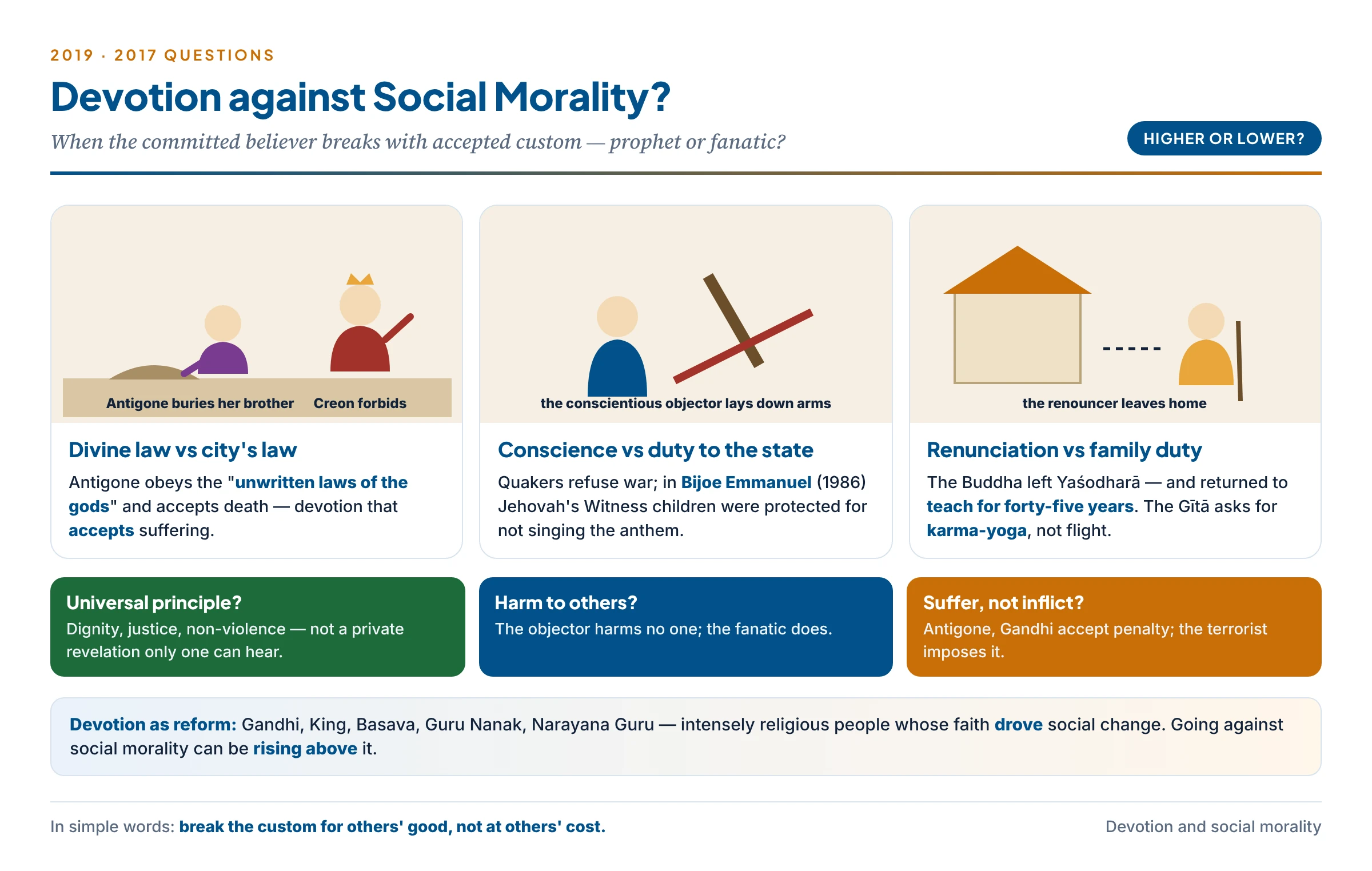
- Antigone — in Sophocles’ play, Antigone buries her brother against the king Creon‘s decree, obeying the “unwritten and unfailing laws of the gods” over the law of the city. She is punished with death.
- Renunciation — the Buddha left his wife Yaśodharā and infant son; the saṃnyāsin leaves family duties. Critics (and the Gītā itself, against Arjuna’s wish to withdraw) ask whether such renunciation abandons social responsibility.
- Conscientious objection — Quakers refusing to bear arms; Jehovah’s Witnesses refusing blood transfusions or to sing the national anthem. In Bijoe Emmanuel v. State of Kerala (1986), India’s Supreme Court protected three Jehovah’s Witness children who stood respectfully but did not sing the anthem, holding that their expulsion from school violated their freedom of conscience.
- Separatism and fanaticism — groups that withdraw from or attack wider society in the name of purity.
Cases where devotion strengthens or reforms social morality:
- Gandhi, Martin Luther King, Vivekananda, Basava, Guru Nanak, Sree Narayana Guru — intensely religious people whose devotion drove social reform.
- Karma-yoga in the Gītā and lokasaṃgraha (the welfare of the world) make social duty itself a form of worship.
- Practical Vedānta (Vivekananda): service of man is service of God — Daridra-Nārāyaṇa, God in the poor.
How to judge? Going against social morality is:
- Higher morality if it rests on universal principles — dignity, justice, non-violence — and is willing to accept suffering rather than inflict it (Antigone, Gandhi, conscientious objectors).
- Lower than morality if it rests on private revelation, harms others, or serves the group’s power (fanatics, terrorists).
- Withdrawal (renunciation) is legitimate if it does not abandon real dependants and aims at a good that benefits others too — as the Buddha’s return to teach for forty-five years did.
In simple words
A doctor who refuses to perform an operation she thinks is harmful, even when the hospital insists, goes against the “rules” — but for the patient’s sake. Another doctor refuses to treat a patient because of his caste, claiming his religion forbids it. Both go “against” accepted practice. The first rises above it; the second sinks below it. The test is not whether a person breaks social rules, but why and at whose cost.
4. Can Religious Morality Incorporate Individual Freedom?
The tension:
- Religious morality is often a given code, received rather than chosen.
- Its ideal virtue may be obedience — “Islam” means submission; “Thy will be done” is the Christian prayer.
- It may regulate private life — diet, dress, sexuality, marriage, inheritance — and punish apostasy or blasphemy.
- The atheist Gora saw theism as the expression of a “slave mind” that subordinates man to a higher will, and atheism as the expression of freedom.
How religious morality incorporates freedom:
- Free will is its presupposition. Sin and merit, heaven and liberation make sense only if human beings are free to choose (Augustine; Plantinga’s free will defence). Religion needs freedom.
- Freedom to choose the path. At the end of the Gītā Kṛṣṇa says: “Reflect on this fully, and then do as you choose.” The Buddha told his disciples to be “lamps unto yourselves“.
- No compulsion in faith. The Qur’ān declares, “There is no compulsion in religion“; Christian thinkers from Tertullian onwards held that forced worship is no worship.
- Conscience. Luther at the Diet of Worms (“Here I stand; I can do no other“) made individual conscience central to Protestant ethics.
- Tolerance of many views. Jaina anekāntavāda (many-sidedness of reality) teaches respect for other standpoints.
- Religious freedom is itself a liberty — the freedom to believe and practise is among the oldest of individual rights.
In simple words
Joining a music school means accepting its discipline — regular practice, the teacher’s corrections, the rules of the rāga. A student who chose to join does not feel these rules as chains; they are the path to the freedom of playing well. But if someone were forced into the school as a child and forbidden ever to leave, the same rules would feel like a prison. Religious morality and freedom fit together in the same way — when the commitment is freely chosen and free to be left.
Limits:
- Religious morality incorporates freedom of conscience and choice of path more easily than freedom from its core demands once a person has committed to it.
- In a liberal society, religion is a matter of choice while a core of morality is not: one can opt out of a religion, but not out of morality. Religious morality can incorporate individual freedom fully only when membership in the religion is itself voluntary.
- Mill’s harm principle gives the outer limit: individuals may live by their religious morality in matters that concern themselves, but not impose it where it harms others.
5. The “Elastic View” of Eternal Ideals
The 2017 question asks whether a religious person can take an elastic view of ideals, principles and practices that are supposed to be eternal — and whether this makes religion progressive or demolishes its authority.
Distinguish two levels:
- Eternal principles — truth, non-violence, compassion, justice, love of God (sanātana dharma, sādhāraṇa dharma).
- Changing rules — the specific codes of diet, ritual, dress and social order through which those principles were applied in a particular age.
Resources for elasticity within religions:
- Hindu tradition: dharma varies with the age (yuga-dharma) — the smṛtis themselves say different codes suit different ages; āpaddharma permits exceptions in emergencies; deśācāra (local custom) is recognised. Modern reformers — Ram Mohan Roy (Brahmo Samaj), Dayananda (Arya Samaj), Vivekananda, Narayana Guru — reinterpreted tradition.
- Christianity: Jesus “fulfilled” rather than abolished the Law; the Second Vatican Council (1962–65) renewed Catholic practice.
- Islam: ijtihād — independent reasoning to apply principles to new situations.
- Buddhism: “skilful means” to adapt the teaching to each culture.
- Gandhi: “I decline to be bound by any interpretation, however learned it may be, if it is repugnant to reason or moral sense.“
Two responses of religious people in secular societies:
- Define by difference — emphasise what distinguishes the religion from secular society, holding the rules firm.
- Compromise or reinterpret — bring rules into line with the prevailing lifestyle; but then members of the same religion in different societies start to disagree about their ethics.
Progressive or destructive?
- Progressive if elasticity is applied to rules in the light of the religion’s own principles — reform from within, which keeps religion alive and morally credible. A religion that never changes its rules becomes a museum — or a source of injustice.
- Destructive if elasticity reaches the principles themselves, so that anything goes; then religion loses its identity and authority and becomes merely a mirror of fashion.
- Synthesis: firm in principles, flexible in practice. Authority comes not from immobility but from fidelity to the core.
Indian Connect — Sanātana and yuga — the Indian formula for elasticity
- Indian tradition distinguishes the eternal dharma (truth, non-violence, purity, self-control — duties common to all) from dharma suited to the age and to the person. The great texts expect rules to change while principles stay.
- Vivekananda: the essentials of religion are eternal; its non-essentials — customs about eating and touching — must change with time. “Don’t-touch-ism,” he insisted, is not the religion of the Upaniṣads.
In simple words
A family recipe handed down for generations may say “cook on a wood fire for three hours”. The grandchild with a gas stove and a pressure cooker changes the method but keeps the taste — the spices, the balance, the love in it. If she changed the taste itself, it would no longer be the family dish. Religious elasticity is like this: change the method (rules), keep the taste (principles).
6. Religious Values in Plural, Secular Societies
- Mixed societies are now the rule. Few societies have a single religious and cultural matrix; most contain many religious and ethnic groups. Members of one religion, living in different societies, are divided by different lifestyles and expectations.
- Self-understanding. A person must weigh: am I basically a member of a religion who happens to live in a secular society, a secular person living in a religious society, or a member of this society who finds a religion’s teaching helpful? The answer shapes how one balances religious and secular moral arguments.
- Same values, different authority. Sometimes a faith community’s moral principles coincide with secular society’s, while the authority behind them and the way they are justified remain different.
- Culture-carrying and culture-adapting religions. Judaism, Islam, Sikhism and Hinduism tend to promote their own culture and are less shaped by their surroundings (Ramzan is observed the same way everywhere). Buddhism and Christianity have tended to adapt to the cultures they enter, so they show greater internal variety on moral questions.
- Established and minority religions. Where a religion is the historical norm (Christianity in Europe, Buddhism in Thailand), it is hard to tell what is religious and what is merely cultural; minority religions stand out against the background and their ethics are often more sharply defined.
- Deadlocks. Secular moralists and religious thinkers often share most criteria of moral judgement, yet reach deadlock where one side claims revealed teaching (for example on divorce) and the other does not. Until they agree on revelation, the final disagreement cannot be settled — which is why public law must rest on shared reasons.
- Is “religion versus morality” even a clear thesis? “Morality” means different things to different people, and “religion” resists definition — one character in Fielding’s Tom Jones says, “When I mention religion I mean the Christian religion; and not only the Christian religion but the Protestant religion; and not only the Protestant religion, but the Church of England.” Sweeping claims that religion and morality are necessarily opposed (or necessarily united) should be regarded with suspicion; each case must be examined.
7. Should Religious Freedom Be Restricted? — India’s Constitutional Answer
The dilemma. Religious beliefs sometimes lead to actions against the prevailing norms of society. Is it right, in the name of one set of moral values, to deprive an individual or group of the freedom to live by different values? Does the value of religious freedom outweigh the potential harm? Which is better — freedom, with the risk that minorities do what the majority thinks wrong, or an enforced moral code?
The Indian framework:
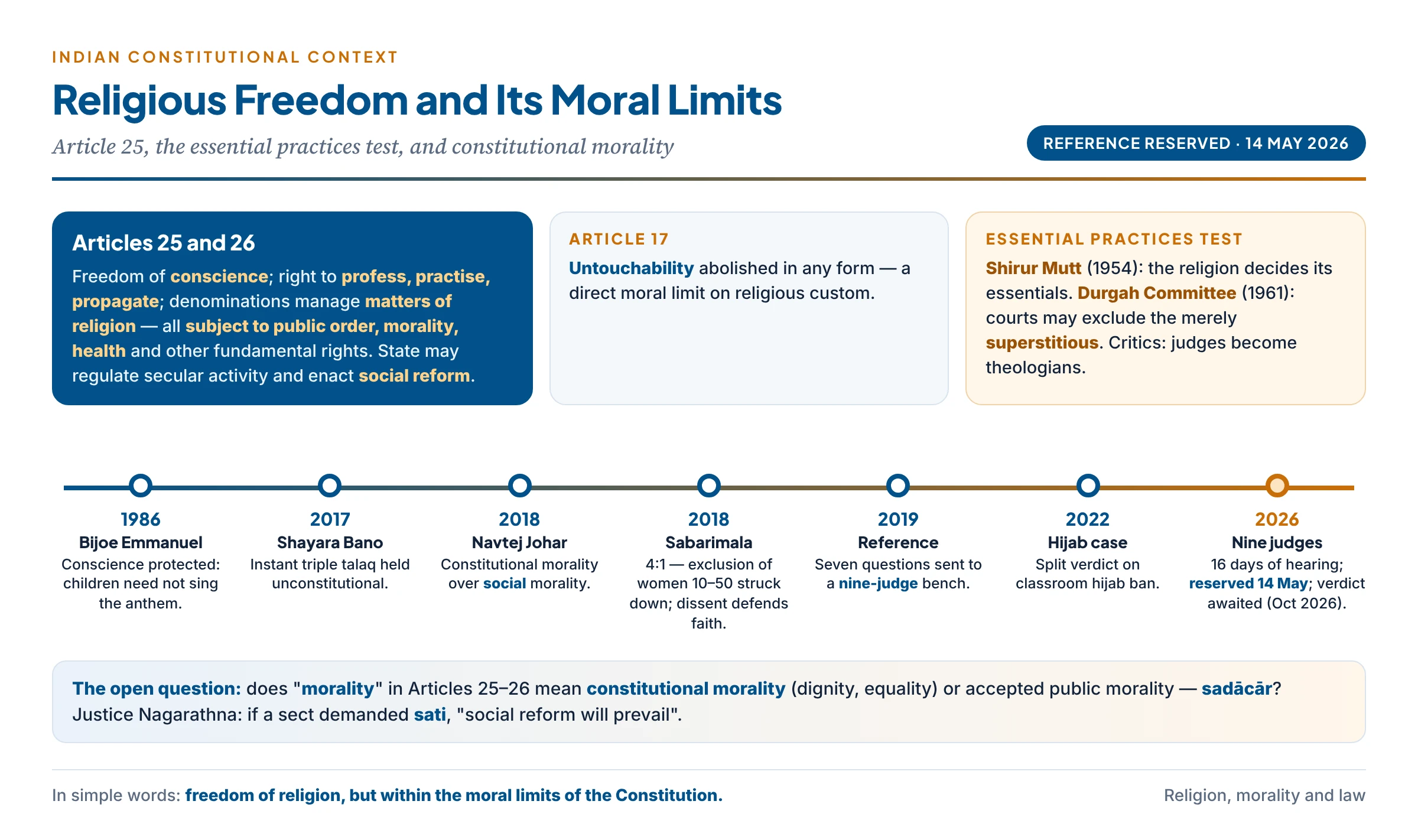
- Article 25 — all persons are equally entitled to freedom of conscience and the right freely to profess, practise and propagate religion, subject to public order, morality and health and to the other fundamental rights. The State may regulate secular activities associated with religion and provide for social welfare and reform, including throwing open Hindu religious institutions of a public character to all classes and sections of Hindus.
- Article 26 — religious denominations may manage their own affairs in matters of religion, again subject to public order, morality and health.
- Article 17 abolishes untouchability in any form — a direct moral limit on religious custom.
The “essential religious practices” test:
- In the Shirur Mutt case (1954) the Supreme Court held that what is essential to a religion is to be determined by the religion itself.
- In the Durgah Committee case (1961) the Court took on the power to exclude practices that are merely superstitious or non-essential. Since then courts have asked whether a practice is “essential” before protecting it — a test criticised as making judges into theologians.
Constitutional morality vs social (religious) morality:
- Ambedkar used “constitutional morality” in the Constituent Assembly (4 November 1948) for respect for the forms and spirit of the Constitution. Courts have since used it to mean the Constitution’s core values — dignity, equality, liberty, fraternity — which may override popular or religious morality.
- Navtej Singh Johar (2018): constitutional morality must prevail over social morality.
- Sabarimala (Indian Young Lawyers Association v. State of Kerala, 2018): by 4:1, the Court held the exclusion of women aged 10–50 from the Sabarimala temple unconstitutional; the lone dissent (Justice Indu Malhotra) warned that courts should not impose their notions of rationality on matters of faith.
- Shayara Bano (2017): instant triple talaq declared unconstitutional.
- Hijab case (2022): a two-judge bench delivered a split verdict on the ban on hijabs in Karnataka classrooms.
The 2026 nine-judge reference:
- Review petitions against the 2018 Sabarimala judgment led the Court (2019) to refer seven larger questions to a nine-judge bench, including the scope of Article 25, the interplay of Articles 25 and 26, and whether “morality” in Articles 25 and 26 includes constitutional morality.
- The bench, headed by Chief Justice Surya Kant, heard arguments for 16 days (April–May 2026) and reserved judgment on 14 May 2026; the verdict was awaited as of October 2026.
- Arguments heard: the Union argued that constitutional morality concerns governance, not religious practice, and that the Hindi text of “morality” in Articles 25–26 is sadācār (accepted good conduct); several counsel criticised the essential religious practices test as lacking textual basis and as “elitist“, privileging some practices over others. Others argued that practices based on “purity and pollution” cannot escape scrutiny by invoking faith. During the hearing Justice B.V. Nagarathna observed that if a denomination claimed a widow must commit sati, abolishing it could not be called an invasion of religion — “social reform will prevail“.
- Philosophical significance: the case is the living form of this unit’s question — whether morality in public life is defined by religion and custom or by reason and dignity, and how far courts may judge religious practice by moral standards.
Common confusion
Does “morality” in Article 25 simply mean religious morality, or “constitutional morality”? This is exactly the open question before the nine-judge bench. The 2018 Sabarimala majority read it as constitutional morality (dignity, equality); critics — including the Union in 2026 — argue it means public, accepted morality (sadācār) and that constitutional morality should be only a guiding principle, not an independent ground to strike down practices. Until the verdict, notes should present both readings rather than treat either as settled law.
8. Does Religious Pluralism Entail Moral Relativism?
The 2026 paper asks this question (Unit 09 treats pluralism in full).
- Religious pluralism (in John Hick‘s sense) holds that the great religions are different responses to one ultimate Reality, none uniquely true.
- Moral relativism holds that there is no universal moral standard; right and wrong are relative to culture or religion.
Why pluralism may seem to entail relativism:
- If all religions are equally valid paths, their moral codes might seem equally valid too — including rules on caste, gender or punishment.
- Pluralism discourages judging other traditions; relativism is the easiest way not to judge.
Why it need not:
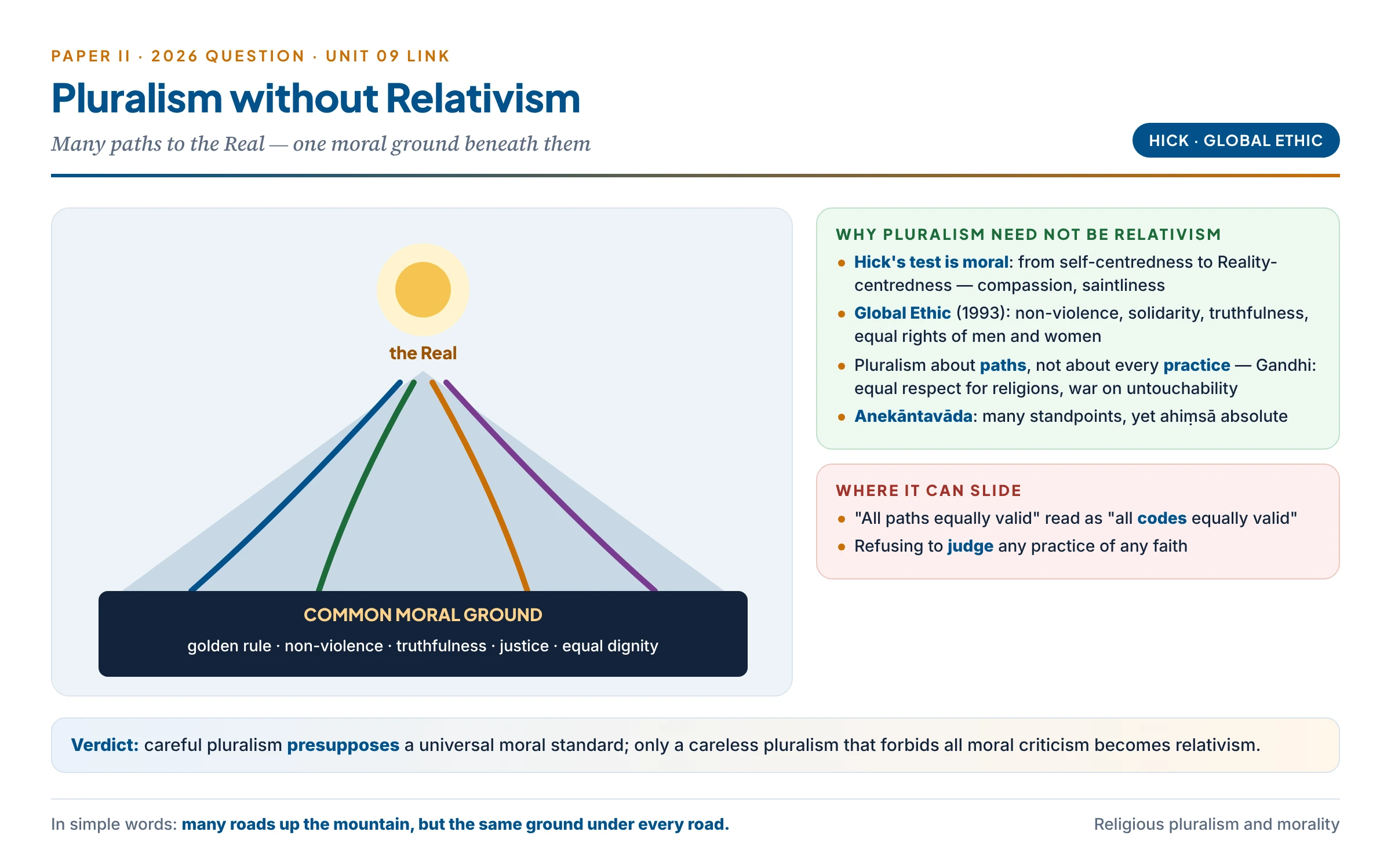
- Hick’s own criterion is moral. He judges religions by whether they produce the transformation from self-centredness to Reality-centredness, shown in compassion, love and saintliness. Pluralism thus presupposes a universal moral standard by which all religions are assessed.
- A shared moral core. The Golden Rule and prohibitions of murder, theft and lying appear in all major traditions. The Declaration Toward a Global Ethic (Parliament of the World’s Religions, 1993) affirmed common commitments to non-violence and respect for life, solidarity and a just economic order, tolerance and truthfulness, and equal rights and partnership between men and women.
- Pluralism about paths, not about every practice. One may hold that many religions lead to the Real while condemning particular practices within each — as Gandhi combined sarva-dharma-samabhāva (equal respect for all religions) with relentless criticism of untouchability in his own.
- Many-sidedness without relativism. Jaina anekāntavāda holds that reality has many aspects and each view is true from a standpoint — yet it keeps ahiṃsā as an absolute value.
Verdict. Religious pluralism does not necessarily entail moral relativism; the most careful forms of pluralism rest on a universal moral standard. But a careless pluralism that refuses all moral criticism of religious practice can slide into relativism.
Critical Evaluation
Critics and Defenders
Criticism — Religion as a threat to social morality and freedom
- Lucretius, Russell: religion has provoked great evils.
- Marx, Ambedkar: religion sanctifies unjust social orders such as caste.
- Gora: theism expresses a slave mind; atheism expresses freedom.
- Liberals: religious codes intrude on private life and punish dissent.
- Critics of the ERP test: courts become theologians, or religions shield exclusion.
Defence — Religion as support and reformer of social morality
- Durkheim: religion builds moral community and solidarity.
- Reformers within religion: Roy, Phule, Narayana Guru, Vivekananda, Gandhi, King.
- Freedom inside religion: the Gītā’s “do as you choose”, “no compulsion in religion”, Luther’s conscience, anekāntavāda.
- Pluralists: Hick’s moral criterion and the Global Ethic show a universal moral core.
- Firm principles, flexible rules: yuga-dharma, ijtihād, skilful means allow moral growth.
Cross-Tradition Comparison
| Issue | Western examples | Indian examples |
|---|---|---|
| Faith against the city’s law | Antigone; conscientious objectors | Bijoe Emmanuel case; satyāgraha |
| Renunciation and duty | Monastic withdrawal | Saṃnyāsa; the Buddha’s departure; Gītā’s karma-yoga |
| Reform from within | Prophets; Reformation; Vatican II; King | Roy, Phule, Narayana Guru, Vivekananda, Gandhi |
| Elasticity of rules | Ijtihād (Islam); Jesus “fulfilling” the Law | Yuga-dharma, āpaddharma, deśācāra |
| Freedom and religion | “No compulsion in religion”; Luther’s conscience | “Do as you choose” (Gītā); “be lamps unto yourselves” (Buddha) |
| Pluralism and morality | Hick; Global Ethic 1993 | Sarva-dharma-samabhāva; anekāntavāda |
Indian Connect — Takeaways
- India’s own history shows religion acting on both sides: legitimising caste and sati, and inspiring the reformers who abolished them. The Constitution (Articles 17, 25, 26) builds this lesson into law — religious freedom within moral limits.
- The pending Sabarimala reference is a national debate on this unit’s central question: whether public morality is to be read through faith and custom or through dignity and equality.
Synthesis (Siddhānta)
- Religion’s moral effect in society depends on its form. Interiorised religion, governed by its ethical core, raises social morality; nominal, tribal or literalist religion can lower it. The question is never “religion or morality?” but “which religion, lived how?”
- Going against social morality can be prophetic or fanatical; the test is universal principle, non-harm and willingness to suffer rather than to inflict suffering.
- Religious morality can incorporate individual freedom — free will, choice of path, conscience and tolerance are within the great traditions — provided membership is voluntary and the harm principle is respected.
- Elasticity in rules with firmness in principles keeps religion both progressive and authoritative.
- Contemporary relevance. India’s constitutional settlement — freedom of religion subject to public order, morality, health and fundamental rights — is a practical answer to the philosophical problem; how the nine-judge bench reads “morality” will shape the relation of religion and morality in Indian public life for decades.
“I decline to be bound by any interpretation, however learned it may be, if it is repugnant to reason or moral sense.” — M.K. Gandhi
Previous Year Questions
- 2026Does the idea of Religious Pluralism necessarily entail moral relativism? Critically discuss.
- 2020Are religious beliefs and practices incompatible with moral behaviour? Discuss.
- 2019Does a devoted commitment to a religious way of life make man go astray from social morality? Examine.
- 2018Can one claim that there is an inter-relatedness between ‘religiosity’ and ‘immorality’? Discuss.
- 2017Does a committed religious person go against social morality? Discuss from moral perspective.
- 2017Can a religious person take an elastic view about religious ideals, principles and practices, etc. which are supposed to be eternal? Will it make religion progressive or will it demolish its authority? Discuss critically.
- 2014How far can religious morality incorporate individual freedom?
- 2013Is religious morality consistent with individual freedom?