

Quine and Strawson: Critique of Empiricism; Theory of Basic Particulars and Persons.
Official Syllabus: Paper I, Section A, Unit 11
The second dogma Quine attacks in “Two Dogmas of Empiricism” is reductionism: the belief that every meaningful statement can be translated, one by one, into statements about immediate sense experience, so that each statement has its own set of experiences that would confirm or refute it. This belief lies behind the logical positivists’ verification theory of meaning. Quine rejects it and puts forward confirmation holism: “our statements about the external world face the tribunal of sense experience not individually but only as a corporate body.” Knowledge is a web of belief, touching experience only at its edges; when experience goes against us we may revise any part of the web, and we may keep any statement if we adjust enough elsewhere. From this follow Quine’s radical empiricism, his treatment of physical objects as posits, the indeterminacy of translation, and naturalized epistemology — an “empiricism without the dogmas”.
In simple words
Your scooter won’t start. Is the battery dead? Is there no petrol? Is the spark plug dirty? Or is the fuel gauge lying to you? The failure tells you only that something in the whole system is wrong — not which part. You can’t test the battery “on its own” while everything else is assumed to work. Quine says every scientific test is like this: experience never checks one sentence by itself, but a whole bundle of beliefs together.
Context & Problem
What the Second Dogma Says
“The other dogma is reductionism: the belief that each meaningful statement is equivalent to some logical construct upon terms which refer to immediate experience.” — Quine
- Radical reductionism. “Every meaningful statement is held to be translatable into a statement (true or false) about immediate experience.” A statement about a table, an electron or the French Revolution is, at bottom, a complicated statement about what one would see, hear and feel.
- Reductionism in plain words. Complex statements and complex facts can be broken down into simple ones, and the simple ones can be checked by experience, one at a time.
- An everyday example. “Water boils at 100°C” is meaningful, on this view, because we can say exactly which observations would verify it — heating water, watching the thermometer, seeing bubbles.
- The assumption Quine targets. That each statement has its own, separately specifiable set of confirming and disconfirming experiences.
A Short History of Reductionism
- Locke and Hume — term-by-term empiricism. Every idea must either come directly from sense experience or be compounded of such ideas. Translated into talk about words: every meaningful term must name a sense-datum or be built from such names. For Hume, an object is nothing but a bundle of impressions.
- Frege and Russell — the statement as the unit. Russell’s method of “definition in use” (as in his theory of descriptions) showed that a word need not stand for anything by itself; it gets its meaning from the whole statement in which it occurs. Quine praises this as an advance: the statement, not the single word, became the unit to be tested by experience.
- Russell and the early Wittgenstein — atomic propositions. For Russell, molecular propositions are logical constructions out of atomic propositions, and atomic propositions report simple facts; for the early Wittgenstein, complex propositions are truth-functions of elementary ones. Knowledge is built up from independent atoms.
- The logical positivists — objects as logical constructions of sense-data. Statements about material objects can be reduced to statements about actual and possible sense-data.
- Carnap’s Aufbau (The Logical Structure of the World, 1928). Carnap was “the first empiricist who, not content with asserting the reducibility of science to terms of immediate experience, took serious steps toward carrying out the reduction“. He tried to build the whole of our knowledge of the world, step by step, from a minimal base of experiences plus logic.
Common confusion
Is the “second dogma” simply the verification principle? Not exactly. Reductionism is older and wider — it goes back to Locke and Hume. The verification theory of meaning (“the meaning of a statement is the method of its verification”) is the twentieth-century form that reductionism took. In its “subtler” version, reductionism survives even after people give up full translation into sense-data: it is the idea that each statement, taken alone, has its own range of experiences that would make it more or less likely. Quine attacks this subtler idea most of all.
How the Two Dogmas Hold Each Other Up
- From reductionism to analyticity. If it makes sense to say that each statement is confirmed or disconfirmed by its own experiences, then it makes sense to speak of a limiting case: a statement that is confirmed by any experience whatever — “vacuously confirmed, ipso facto, come what may“. Such a statement would be analytic.
- The verification theory’s offer. The positivists hoped to rescue analyticity this way: two statements are synonymous if they have the same method of verification, and a statement is analytic if it is synonymous with a logical truth. So if the verification theory worked, the first dogma would be saved.
- Quine’s diagnosis. “The two dogmas are, indeed, at root identical.” Both assume that the truth of a statement can be split into a linguistic part and a factual part, and that the factual part can be isolated statement by statement. Remove the second dogma and the first loses its last support.
Core Doctrine
1. Why Radical Reductionism Failed
- Carnap’s construction stopped short. Even granting Carnap’s starting point, “the construction of even the simplest statements about the physical world was left in a sketchy state“. He could not show how a statement such as “There is a table in the next room” could be translated into statements about sensations.
- The sticking point. Carnap’s method assigned qualities to places and times in a constructed space, adjusting the assignments to make the overall picture as simple as possible. But this gives no translation of a statement into experience; it gives at most a way of adjusting a whole picture to experience — which already points toward holism.
- Carnap gave up. “In his later writings he abandoned all notion of the translatability of statements about the physical world into statements about immediate experience.“
- Objects are not bundles of sense-data. Our sense-data and impressions are of objects; they do not exist on their own, cut loose from the things we perceive. So an object cannot be reduced to a mere collection of ideas or sense-data — the reduction gets the order of dependence backwards.
2. Quine’s Objections to the Verification Theory of Meaning
The verification theory says: the meaning of a statement is the method of empirically confirming or disconfirming it. Quine’s objections:
- No statement has a method of its own. A single statement does not have its own private stock of confirming experiences. “It is misleading to speak of the empirical content of an individual statement.” The test always involves many statements together.
- Translation into experience is impossible. The project of translating statements, one by one, into sense-experience language was attempted seriously (by Carnap) and failed.
- It rests on the first dogma. The theory explains synonymy as “likeness of method of confirmation” — but since statements have no individual methods of confirmation, there is nothing to compare. So the verification theory cannot rescue analyticity.
- The unit of meaning is too small. Russell moved the unit from the word to the statement. Quine says this was not enough: “The unit of empirical significance is the whole of science.“
- It cannot sort statements into “meaningful” and “meaningless” one by one. If only whole theories face experience, a statement cannot be declared meaningless simply because it alone implies no observation; highly theoretical statements of physics imply no observation on their own either, yet they are meaningful as parts of the theory.
- It makes some statements immune to experience. By setting aside a class of statements confirmed “no matter what”, the theory exempts logic and mathematics from experience — which Quine, as a thoroughgoing empiricist, refuses.
3. Confirmation Holism: the “Corporate Body”
“My countersuggestion … is that our statements about the external world face the tribunal of sense experience not individually but only as a corporate body.” — Quine
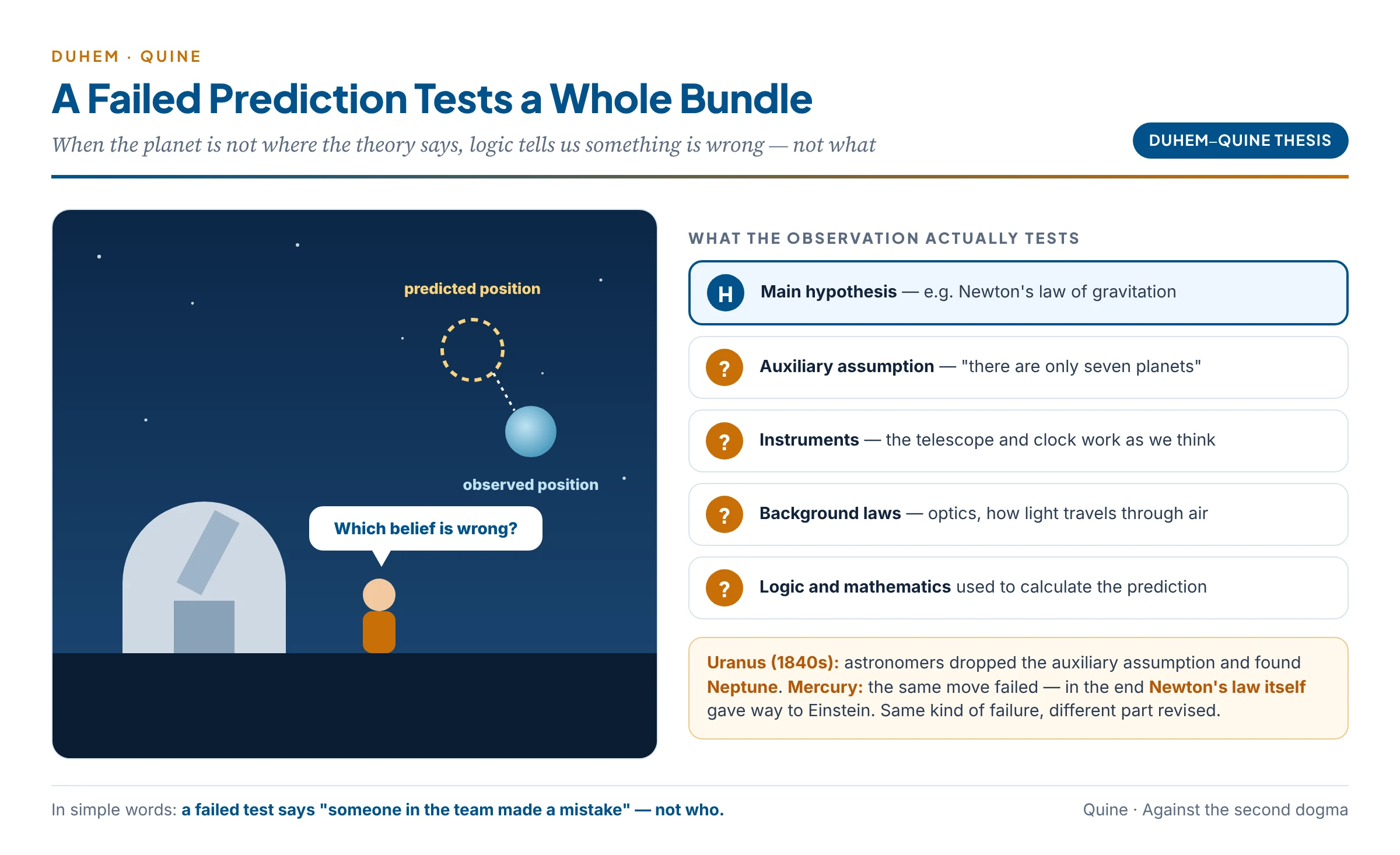
- The Duhem thesis. The French physicist Pierre Duhem had argued that a physicist can never test a single hypothesis in isolation. Every experiment tests a bundle: the main hypothesis + auxiliary hypotheses + theories about the instruments + background laws + logic and mathematics used in the calculation. When a prediction fails, logic tells us only that at least one member of the bundle is false — not which one. Quine extends this from physics to the whole of knowledge; the combined view is often called the Duhem–Quine thesis.
- An astronomical example. In the nineteenth century the planet Uranus did not move as Newton’s laws predicted. Astronomers did not reject Newton; they revised an auxiliary assumption — “there are only seven planets” — and predicted a new planet, which was found (Neptune). Later, Mercury’s orbit also misbehaved; a similar “missing planet” was proposed and never found — and in the end it was Newton’s theory itself that gave way to Einstein’s. The same kind of failure led to revising different parts of the system.
- Meaning goes with confirmation. If statements are confirmed only together, their meaning too is not self-contained. A statement means what it does because of its connections with other statements, theories and observations. The meaning of a word or sentence cannot be isolated from the whole system in which it is embedded.
- Coherence rather than one-to-one correspondence. In checking a statement we do not hold it up against one matching fact. We ask whether it fits — is coherent with — the rest of our accepted beliefs, and whether the whole system still squares with experience. What is being “verified” is, in the end, the language and theory as a whole.
4. The Web of Belief
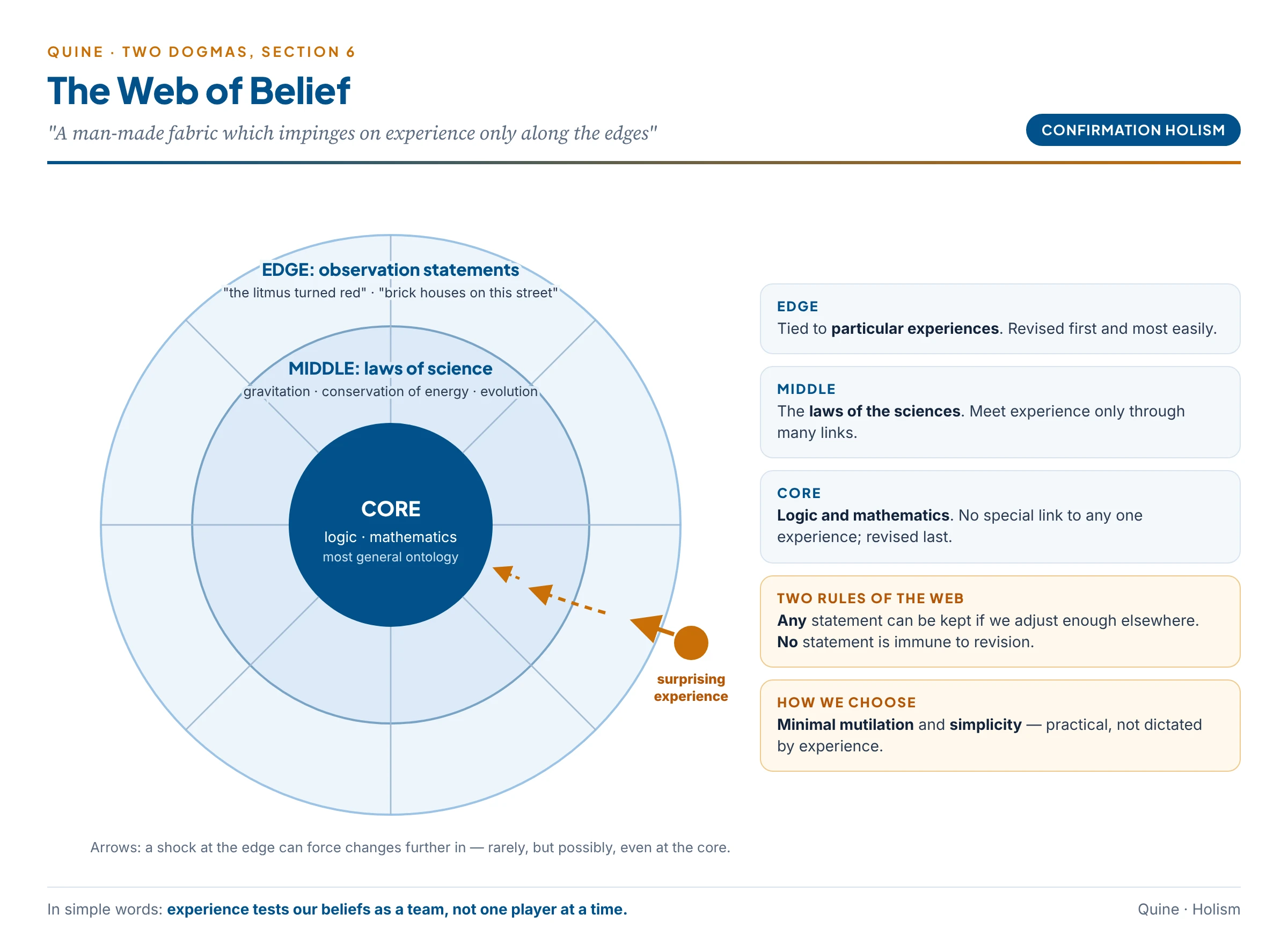
“The totality of our so-called knowledge or beliefs, from the most casual matters of geography and history to the profoundest laws of atomic physics or even of pure mathematics and logic, is a man-made fabric which impinges on experience only along the edges.” — Quine
The three zones of the web:
- The edge (periphery). Statements closely tied to particular experiences: “There are brick houses on this street“, “There are no centaurs“, “The litmus paper turned red“, “The thermometer reads 37.2 degrees“. They are revised readily when experience goes against them.
- The middle. Laws of the natural sciences — physics, chemistry, biology, geology. They meet experience only through many links.
- The centre (core). Logic and pure mathematics — “the law of non-contradiction”, “2 + 2 = 4” — and the most general statements of ontology. They have no special link with any particular experience and are the last we would revise.
A second picture — the field of force. Quine also describes total science as “a field of force whose boundary conditions are experience“. A conflict with experience at the boundary forces readjustments in the interior. Truth values (which statements we count as true) have to be redistributed; re-evaluating one statement forces us to re-evaluate others connected with it — including the logical laws that connect them, which are themselves just further statements in the field.
- “Distance from the edge” is not a fixed property. Quine stresses that “near the periphery” means only that we are in practice more likely to revise such a statement when trouble strikes. It reflects our habits of revision, not a built-in difference of kind.
- Latitude of choice. “The total field is so underdetermined by its boundary conditions, experience, that there is much latitude of choice as to what statements to re-evaluate in the light of any single contrary experience.” Experience never forces one unique set of revisions — this is the seed of Quine’s later thesis of the underdetermination of theory by evidence.
In simple words
Think of the web as a spider’s web fixed to a wall at its edges. A gust of wind (a surprising experience) hits the outer threads first, and usually only they need retying. But every thread is connected; a strong enough gust can shake the centre too. And there is often more than one way to retie the web so that it holds again.
5. “Anything Can Be Held True; Nothing Is Immune”
UPSC quoted Quine’s own words in 2025: “We can affirm the truth of any sentence in our total system, in the face of whatever experience, just so long as we are prepared to make adjustments elsewhere.” This expresses two twin consequences of holism.
(a) Any statement can be held true come what may.
“Any statement can be held true come what may, if we make drastic enough adjustments elsewhere in the system. Even a statement very close to the periphery can be held true in the face of recalcitrant experience by pleading hallucination or by amending certain statements of the kind called logical laws.” — Quine
- Example. I firmly believe “My keys are on the table“. I look and see no keys. I can keep my belief by saying “I am hallucinating“, “the light is bad”, “my eyes are deceiving me”, or even by changing my logic. Each move is wildly implausible — but possible. The experience does not by itself force me to drop the statement.
- Why it matters. It shows that experience never refutes a single statement on its own. What it refutes is a combination — and we choose which member to drop.
(b) No statement is immune to revision.
“Conversely, by the same token, no statement is immune to revision. Revision even of the logical law of the excluded middle has been proposed as a means of simplifying quantum mechanics; and what difference is there in principle between such a shift and the shift whereby Kepler superseded Ptolemy, or Einstein Newton, or Darwin Aristotle?” — Quine
- The examples. Kepler replaced Ptolemy’s earth-centred system; Einstein replaced Newton’s absolute space and time; Darwin replaced Aristotle’s fixed species. Each overturned a belief once thought certain. Quine sees no difference in principle between these and a possible revision of logic.
- Even “All swans are white” gave way to black swans; even Euclidean geometry gave way in physics.
Putting the two together. If any statement can be kept, and any statement can be given up, then there is no class of statements that must be kept “come what may” because of their meaning — and so no analytic–synthetic line. Holism is the deeper reason why the first dogma fails.
6. How We Decide What to Revise: Pragmatism
If experience does not dictate the revision, what does?
- Minimal mutilation (conservatism). “Our natural tendency to disturb the total system as little as possible” leads us to change statements near the edge first. We would sooner say the thermometer was faulty than rewrite physics.
- Simplicity. We prefer the revision that keeps the whole system simplest and most economical for predicting future experience.
- Pragmatic choice. These are practical considerations, not discoveries of meaning or fact. “Each man is given a scientific heritage plus a continuing barrage of sensory stimulation; and the considerations which guide him in warping his scientific heritage to fit his continuing sensory promptings are, where rational, pragmatic.“
- A more thorough pragmatism. Carnap and C. I. Lewis were pragmatists about choosing a language or framework, but their pragmatism stopped at the supposed line between analytic and synthetic. Quine says: “In repudiating such a boundary I espouse a more thorough pragmatism.” Pragmatic choice runs through the whole of knowledge.
- The role of experience remains. Experience is still the tribunal: it is what the web must fit. Quine does not deny that experience shapes belief and meaning; he denies that it does so statement by statement, or in a way that is free of interpretation — every experience is taken up through the existing web of beliefs.
7. Physical Objects as “Posits” — and the Gods of Homer
“Physical objects are conceptually imported into the situation as convenient intermediaries — not by definition in terms of experience, but simply as irreducible posits comparable, epistemologically, to the gods of Homer. Let me interject that for my part I do, qua lay physicist, believe in physical objects and not in Homer’s gods; and I consider it a scientific error to believe otherwise. But in point of epistemological footing the physical objects and the gods differ only in degree and not in kind. Both sorts of entities enter our conception only as cultural posits.” — Quine
- What a “posit” is. An entity we assume because assuming it makes our whole system work better — not because it can be defined out of sense experience.
- Why physical objects win. “The myth of physical objects is epistemologically superior to most in that it has proved more efficacious than other myths as a device for working a manageable structure into the flux of experience.” Tables and atoms beat gods and spirits because they make prediction simpler and more successful.
- Quine’s analogy from mathematics. Imagine we cared only about ordinary fractions. We find our algebra much simpler if we also “pretend” there are numbers like the square root of two, which no fraction equals. These extra numbers are posits that simplify our dealings with fractions. Likewise, physical objects are posits that simplify our dealings with experience — and atoms and electrons are posits that simplify the laws of ordinary objects.
- Material objects are not secondary. Against the sense-data empiricists, who treated objects as constructions and sense-data as primary, Quine treats physical objects as basic and indispensable to any workable account of experience — not reducible to sensations, and posited from the very beginning of language, since language is social and depends on talking about shared, public things.
- Ontology becomes part of science. Questions about what exists — physical objects, atoms, numbers, classes — are settled the way scientific questions are: by asking which posits make our total theory simplest and most successful. “Ontological questions … are on a par with questions of natural science.”
In simple words
The lines of latitude and longitude are not painted on the earth — nobody has ever tripped over the equator. They are posited because they make navigation and map-making far simpler. Yet no sailor would call them useless “myths”. Quine sees tables, atoms and electrons in a similar light: we do not find them ready-made in our sensations; we posit them because, with them, our experience becomes orderly and predictable.
Common confusion
Does Quine say physical objects are myths like Homer’s gods, so we should not believe in them? No. He says the opposite: he believes in physical objects and calls belief in Homer’s gods a scientific error. His point is about epistemological status — how we come to know them. Both are posits introduced to organise experience, so they differ “in degree and not in kind“. Physical objects are far better posits because they work far better. The word “myth” signals that no posit is read off from experience; it does not mean “false”.
8. Meaning Holism and the Indeterminacy of Translation
In Word and Object (1960) Quine pushed holism into the theory of meaning.
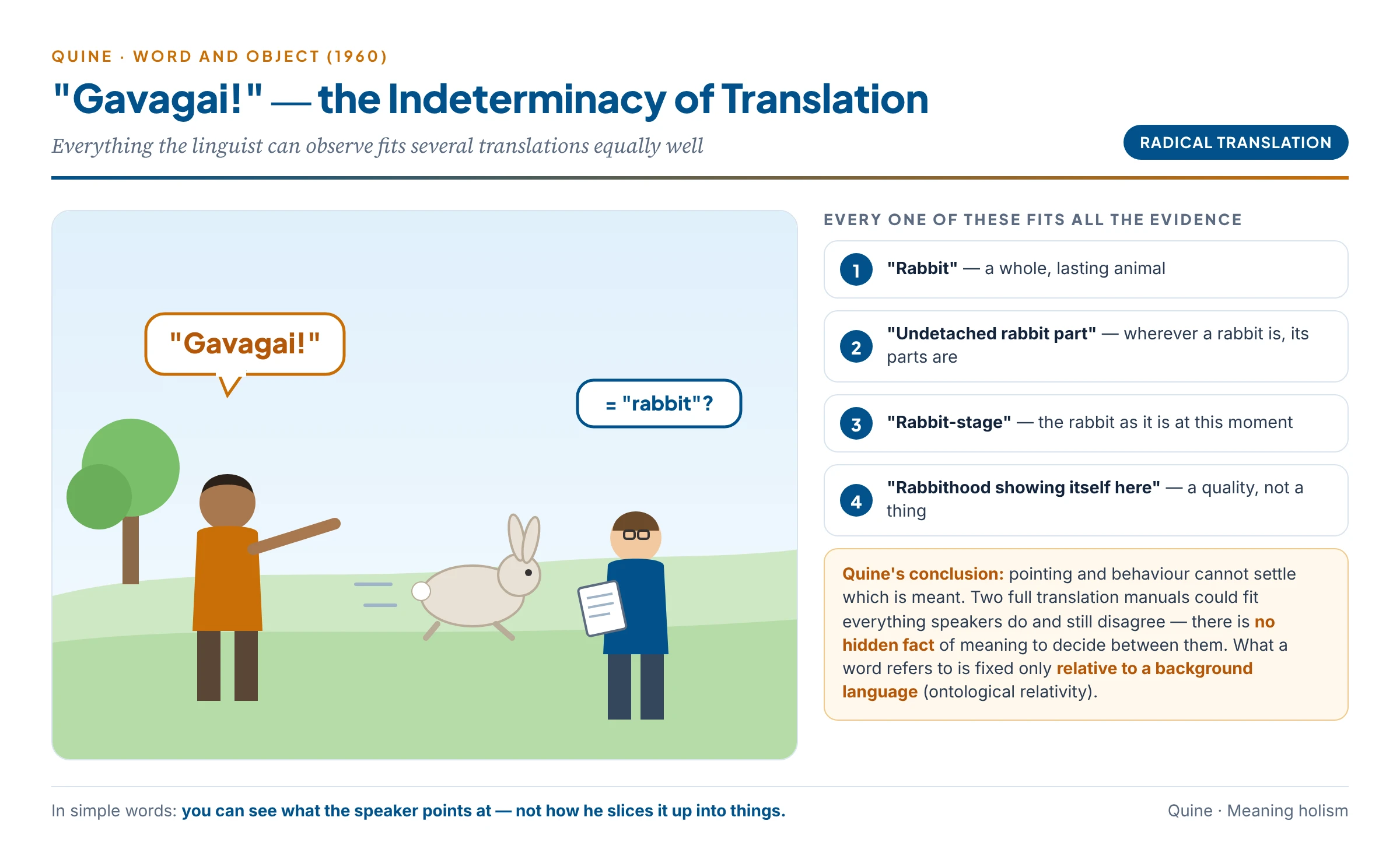
- The “Gavagai” thought experiment. A field linguist meets a tribe whose language nobody knows. A rabbit runs past and a native says “Gavagai!” The linguist writes: “Gavagai = rabbit.” But could “gavagai” mean “undetached part of a rabbit“, “a rabbit-stage” (a rabbit-at-this-moment), or “rabbithood showing itself“? Every time a rabbit is present, a rabbit-part and a rabbit-stage are present too. No pointing and no observed behaviour can decide between the rival translations.
- Indeterminacy of translation. Two complete translation manuals could both fit all the observable behaviour of the speakers and yet disagree with each other. There is, Quine concludes, no fact of the matter about which is “really” correct — meaning is not a hidden, determinate thing in the speaker’s head.
- Inscrutability of reference. Even what a word refers to (rabbits or rabbit-parts) cannot be fixed absolutely, only relative to a background language or theory. This is ontological relativity: what a theory is about can be specified only from within another theory.
- Why this follows from holism. If sentences face experience as a body, then the meaning of each sentence depends on its place in the whole. Different wholes can fit the same behaviour; so the meaning of any one sentence is not uniquely fixed.
- Meaning is not separable from the physical world. Quine rejects a separate mental realm of meanings that could be studied apart from behaviour. Meaning is rooted in how speakers respond to the world and to one another — it is public and behavioural, neither purely subjective nor purely objective.
- Quine and the later Wittgenstein. Both tie meaning to use and reject private inner meanings. But for Wittgenstein a word may be used in many contexts, and within a given context its meaning is settled by the practice; for Quine there is uncertainty in meaning even within the same context, since the same behaviour fits rival translations.
In simple words
A tourist in a foreign market points at a mango and the seller says a word. Does it mean “mango”, “fruit”, “ripe”, “this one”, or “fifty rupees”? Pointing alone cannot tell. You narrow it down only by guessing a lot of other words and how they hang together — and someone else could make a different set of guesses that fits everything the seller does just as well. That, for Quine, is the situation of all translation, even between two speakers of the same language.
9. “To Be Is to Be the Value of a Variable”: What a Theory Says There Is
- The question. How do we tell what a theory commits us to believing in?
- Quine’s criterion (1948). Look at what the theory says “there is“. If our best physics says “there are electrons with such-and-such charge”, then we are committed to electrons. If our mathematics says “there is a prime number greater than a hundred”, we are committed to numbers. Quine summed this up in the slogan “To be is to be the value of a variable” — in plain words, to exist is to be one of the things our best theory, stated clearly, says there are.
- What it rules out. Merely using a name does not commit us to anything. Saying “Pegasus does not exist” does not commit us to a strange “non-existent Pegasus”, because the sentence, properly paraphrased, does not say “there is” anything at all (here Quine follows Russell’s theory of descriptions).
- Link to holism. We decide what exists by deciding which theory as a whole is best. So metaphysics — the study of what there is — becomes continuous with science: “metaphysics is science generalised“, a systematised common sense. Scientists and philosophers share the same aims and differ only in their degree of generality and method.
10. Naturalized Epistemology: No “First Philosophy”
In “Epistemology Naturalized” (1969) Quine drew the final consequence.
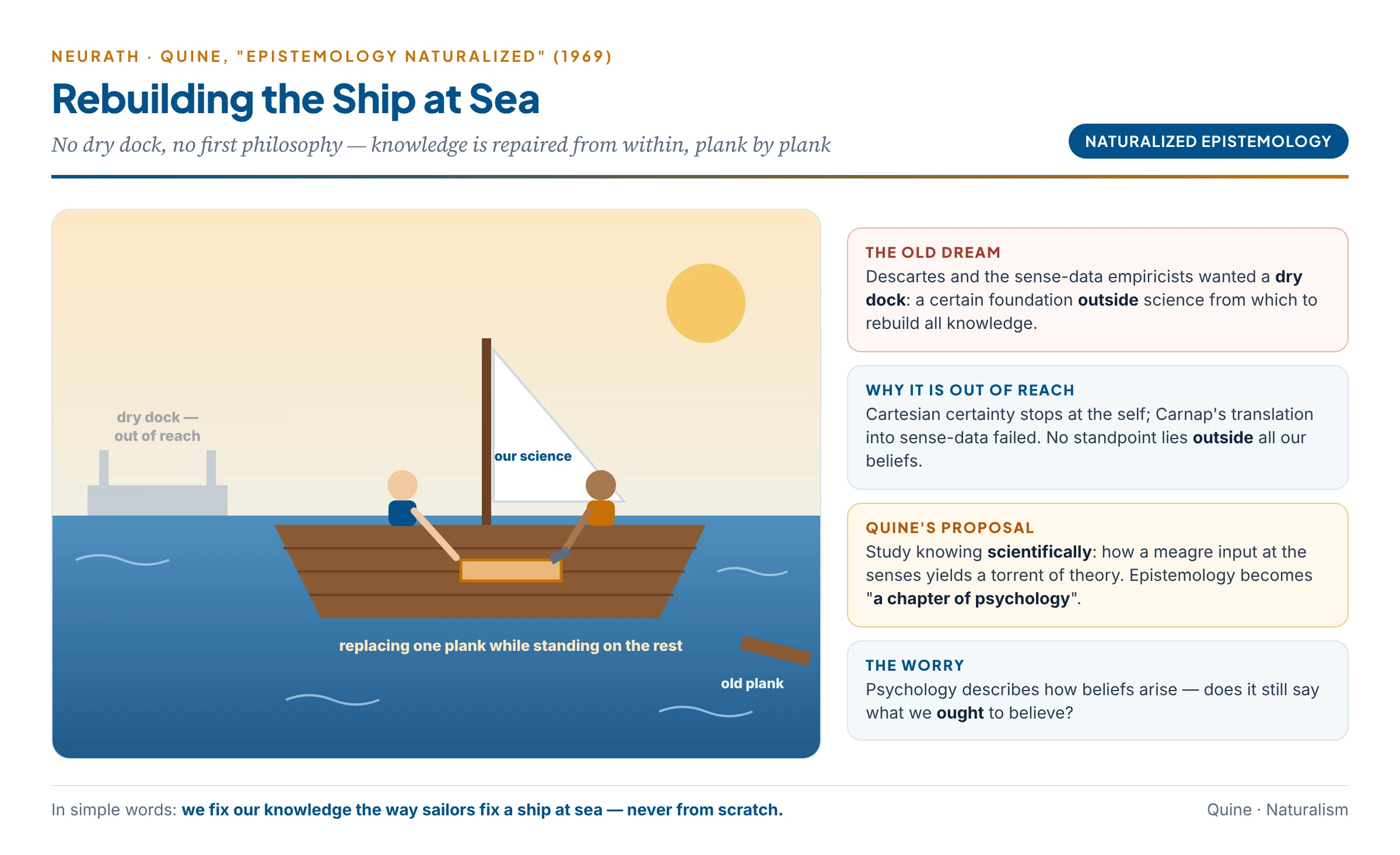
- The old project. Descartes and the empiricists wanted a foundation for science: to justify all knowledge from some certain starting point (clear and distinct ideas, or sense-data) before and outside science — a “first philosophy“.
- Why it fails. Descartes’ certainty does not reach the external world; the empiricists’ attempt to translate science into sense-data (Carnap’s Aufbau) failed. There is no standpoint outside all our beliefs from which to justify them.
- Quine’s proposal. Give up the search for a foundation and study knowledge as a natural phenomenon. “Epistemology … simply falls into place as a chapter of psychology and hence of natural science.” It asks: how does a human being, receiving a meagre input of stimulation at the sense organs, produce a torrential output of theory about the world? This is a question for psychology, linguistics and neuroscience.
- Neurath’s boat. Quine liked the image of the philosopher Otto Neurath: “We are like sailors who have to rebuild their ship on the open sea.” We can replace any plank, but we must stand on the others while doing it; we can never pull the ship into dry dock and rebuild it from scratch. Philosophy repairs our knowledge from within, using the best science we have.
- No circularity worry. Using science to study how science is possible is not viciously circular once we stop demanding a foundation outside science; it is simply the boat being repaired at sea.
11. In What Sense Is Quine Still an Empiricist?
Quine attacks two dogmas of empiricism, but he remains — he insists — an empiricist, indeed a more radical one.
Two cardinal principles he keeps:
- All evidence for science is, in the end, sensory. “Whatever evidence there is for science is sensory evidence.”
- All learning of meaning rests, in the end, on sensory evidence. We learn words through their links with observable situations.
Radical empiricism — the aspects summed up:
- Verification only through sense-experience. Every proposition is accountable, in the end, to experience; but it is the whole system that faces experience, not each proposition separately.
- Analytic as a limiting case. “Analytic” statements are not a separate kind; they are the limiting case of synthetic statements — the most entrenched, least likely to be revised.
- Factual and verbal elements. Using a distinction made by Carnap, every statement has a factual and a verbal element in varying proportions; statements with little factual element are called analytic, those with much are called synthetic. So both kinds can be explained within the limits of empiricism.
- Even logic and mathematics are, in principle, answerable to experience — the empiricism the positivists stopped short of.
- A blend of four doctrines. Quine’s philosophy combines holism (knowledge faces experience as a whole), methodological monism (one method of inquiry for science and philosophy), naturalism (no first philosophy; knowledge studied by science) and pragmatism (revisions guided by simplicity and success).
- Against dogma and superstition. In exalting the natural sciences, Quine’s radical empiricism sets itself against dogmatism, superstition and irrational beliefs — on these grounds above all it can be defended.
Critical Evaluation
Objections and Replies
- Holism is overstated.
- Objection. In practice scientists do test hypotheses individually through controlled experiments, holding other factors fixed. Not every belief is relevant to every test; the web is not that tightly knit.
- Reply. Controlled experiments work only because scientists assume the background (instruments, other laws) is in order — which is exactly Quine’s point: the test is of the hypothesis plus these assumptions. Quine himself later spoke of a “moderate holism“: the unit of testing is usually a sizeable chunk of science, not literally all of it.
- Naturalized epistemology loses the “ought”.
- Objection. Traditional epistemology asked what we ought to believe — when belief is justified. Psychology only describes how beliefs are caused. Jaegwon Kim argued that if epistemology becomes psychology, the normative question of justification simply disappears.
- Reply. Quine answered that normative epistemology becomes a branch of engineering: the study of which methods of belief-formation succeed in predicting experience. Norms are kept, but as means to the goal of truth and prediction.
- The indeterminacy of translation is too radical.
- Objection. Successful communication and translation happen every day. Language seems to presuppose enough shared meaning to make translation reasonably determinate; Quine’s thesis looks like scepticism about meaning.
- Reply. Quine does not deny that translations are useful or that some are better; he denies that there is a further hidden fact of meaning beyond everything behaviour can show.
- Neglect of mind, intention and meaning. Quine’s behaviourist approach to language is criticised for ignoring mental content, intentions and the inner side of understanding, which most philosophers of language now take seriously.
- Scientific ontology is too narrow. Letting physics decide what exists may leave no room for moral values, aesthetic qualities, social realities (money, law, nations) and other legitimate domains of discourse.
- The history of science is ignored. Critics say Quine’s single static web neglects the historical development of the sciences and the subtle interactions between them. Thinkers like Thomas Kuhn later showed that theory change involves whole paradigms, with social and historical factors that Quine’s simple picture of “minimal revision” does not capture.
- Hume’s scepticism revived. If every belief is revisable and all knowledge rests on habits of revision, some see a return of Hume’s scepticism in a new form.
- Is holism itself revisable? If no statement is immune, the thesis of holism — and the claim that evidence is sensory — must be revisable too. Quine accepts this: his own philosophy sits inside the web, not above it. Critics find this either admirably consistent or self-undermining.
- Grice and Strawson’s reply. Even granting that we can “give up” any statement, Grice and Strawson argue that giving up an analytic statement means changing the meaning of a word, while giving up a synthetic one means discovering a fact — so holism does not by itself abolish the distinction.
Critics and Defenders
Criticism — Critics
- Experimental scientists: hypotheses are often tested one at a time by controlled experiments.
- Jaegwon Kim: naturalized epistemology loses the normative question of justification.
- Defenders of meaning: indeterminacy of translation is excessively sceptical; communication works.
- Philosophers of mind: behaviourism ignores intention and mental content.
- Defenders of ethics, art and social reality: a purely scientific ontology is too restrictive.
- Historians of science (Kuhn’s line): theory change is historical and social, not just minimal revision.
- Grice and Strawson: holism does not erase the difference between changing meanings and changing beliefs.
Defence — Defenders and strengths
- Matches real science: Duhem’s point about auxiliary hypotheses is now widely accepted.
- Explains the failure of verificationism and of Carnap’s reduction programme.
- Unifies knowledge: logic, mathematics and science in one revisable system.
- Makes empiricism consistent: no belief is exempt from experience, not even logic.
- Ends the search for a first philosophy: Neurath’s boat — repair from within.
- Fruitful legacy: underdetermination, ontological commitment, naturalism in epistemology and cognitive science.
Cross-Tradition Comparison
Holism of Meaning and Knowledge in Indian Thought
| Indian view | Its claim | Relation to Quine |
|---|---|---|
| Prābhākara Mīmāṃsā — anvitābhidhāna-vāda | Words convey meaning only as already related to other words in a sentence; a word on its own does not express a complete meaning | Like Quine’s meaning holism: the sentence (and its context) is the unit |
| Bhāṭṭa Mīmāṃsā — abhihitānvaya-vāda | Words first express their separate meanings, which are then combined | Closer to the atomism Quine rejects |
| Bhartṛhari — vākya-sphoṭa | The sentence is an indivisible unit of meaning; words are abstractions from it | A strong sentence-holism, though Bhartṛhari’s sphoṭa is a non-empirical entity Quine would reject |
| Nyāya — parataḥ-prāmāṇya | The validity of a cognition is established by other cognitions — coherence (saṃvāda) and successful action (pravṛtti-sāmarthya) | Confirmation by the system and by practical success |
| Jaina anekāntavāda and naya | Every judgment is partial, true from a standpoint; truth is many-sided | Quine’s latitude of choice: experience allows several adjustments |
| Buddhist pratītyasamutpāda | Nothing exists independently; everything arises in dependence on other things | An ontological parallel to the interdependence of beliefs |
| Cārvāka | Perception is the only valid means of knowledge | Shares Quine’s empiricism but rejects inference beyond perception, which Quine’s posits (atoms, electrons) require |
Indian Connect — Key takeaways
- Prābhākara’s “words mean only in a related whole” and Bhartṛhari’s indivisible sentence anticipate Quine’s move from the word to the sentence — and Quine goes one step further, to the whole of science.
- Nyāya’s extrinsic validity — checked by coherence with other knowledge and by successful action — is close to Quine’s pragmatic, system-wide confirmation.
- The Cārvāka comparison is often made because both stress sense experience; but Quine’s posits (atoms, numbers) go far beyond perception, and he accepts inference as part of the web, which the Cārvāka rejects.
- Jaina many-sidedness echoes the underdetermination of theory: the same evidence can be organised from different standpoints.
Quine and Other Philosophers of Science
| Question | Logical positivists | Duhem | Popper | Quine | Kuhn |
|---|---|---|---|---|---|
| Unit of testing | Single statement | Group of hypotheses in physics | Single bold hypothesis (falsification) | The whole web (or a large chunk) | Whole paradigm |
| Is logic/maths revisable? | No (analytic) | Not addressed | No | Yes, in principle | — |
| What fails when a prediction fails? | The statement tested | Something in the group | The hypothesis (unless saved ad hoc) | Something; we choose what | Anomalies pile up until crisis |
| Role of philosophy | Logical analysis of science | — | Logic of discovery and refutation | Continuous with science | Historical study |
- Popper vs Quine. Popper held that a single falsifying observation can refute a hypothesis. Quine (with Duhem) replies that the hypothesis can always be saved by revising something else — Popper himself had to forbid “ad hoc” rescues by a methodological rule.
Synthesis (Siddhānta)
- The second dogma. Reductionism — the idea that each statement has its own experiential content — fails: Carnap’s reduction could not be carried out, and confirmation attaches to groups of statements, not to statements one by one.
- The positive view. Our beliefs form a web that meets experience at its edges; when experience goes against us, we redistribute truth values with much latitude of choice, guided by minimal mutilation and simplicity. Hence any statement can be held true come what may, and no statement, not even logic, is immune to revision.
- Why both dogmas fall together. The analytic was the “limiting case” of statement-by-statement confirmation; without such confirmation there is no such limiting case — and no sharp analytic–synthetic line.
- The wider consequences. Physical objects are posits (better ones than Homer’s gods); what exists is what our best theory says there is; translation and reference are indeterminate; and epistemology becomes a chapter of natural science — Neurath’s boat repaired at sea.
- The balance. Critics rightly note that holism can be overstated, that normativity and meaning need more than behaviour, and that the history of science is richer than “minimal revision”. Even so, Quine’s main lessons — that hypotheses are tested together, that no belief is beyond the reach of experience, and that philosophy is continuous with science — reshaped twentieth-century philosophy.
- Contemporary relevance. Holism explains why a single surprising result (a “faster-than-light neutrino” reading, later traced to a loose cable) rarely overturns a theory at once; why medical diagnosis weighs symptoms together rather than one by one; and why modern machine-learning systems, which learn word meanings from patterns across whole bodies of text, illustrate Quine’s claim that meaning lives in a web of connections rather than in isolated definitions.
“The unit of empirical significance is the whole of science.” — Quine
Previous Year Questions
- 2025“We can affirm the truth of any sentence in our total system, in the face of whatever experience, just so long as we are prepared to make adjustments elsewhere.” Discuss this statement in the light of Quine’s ‘Two Dogmas of Empiricism‘.
- 2024Explain the nature of the two dogmas that Quine refers to in his paper ‘Two Dogmas of Empiricism‘.
- 2021Critically examine Quine’s postulate of empiricism without the dogmas with reference to his ‘Two Dogmas of Empiricism‘.
- 2017What are the two dogmas of empiricism that Quine attacks? What are his arguments against what he calls the second dogma?
- 2014How far are Quine’s arguments in ‘Two Dogmas of Empiricism‘ justified? Discuss.
- 2012Explain critically Quine’s rejection of the analytic-synthetic distinction and his subsequent philosophical arguments.
- 2009What are Quine’s objections with regards to the verification theory of meaning?