

Quine and Strawson: Critique of Empiricism; Theory of Basic Particulars and Persons.
Official Syllabus: Paper I, Section A, Unit 11
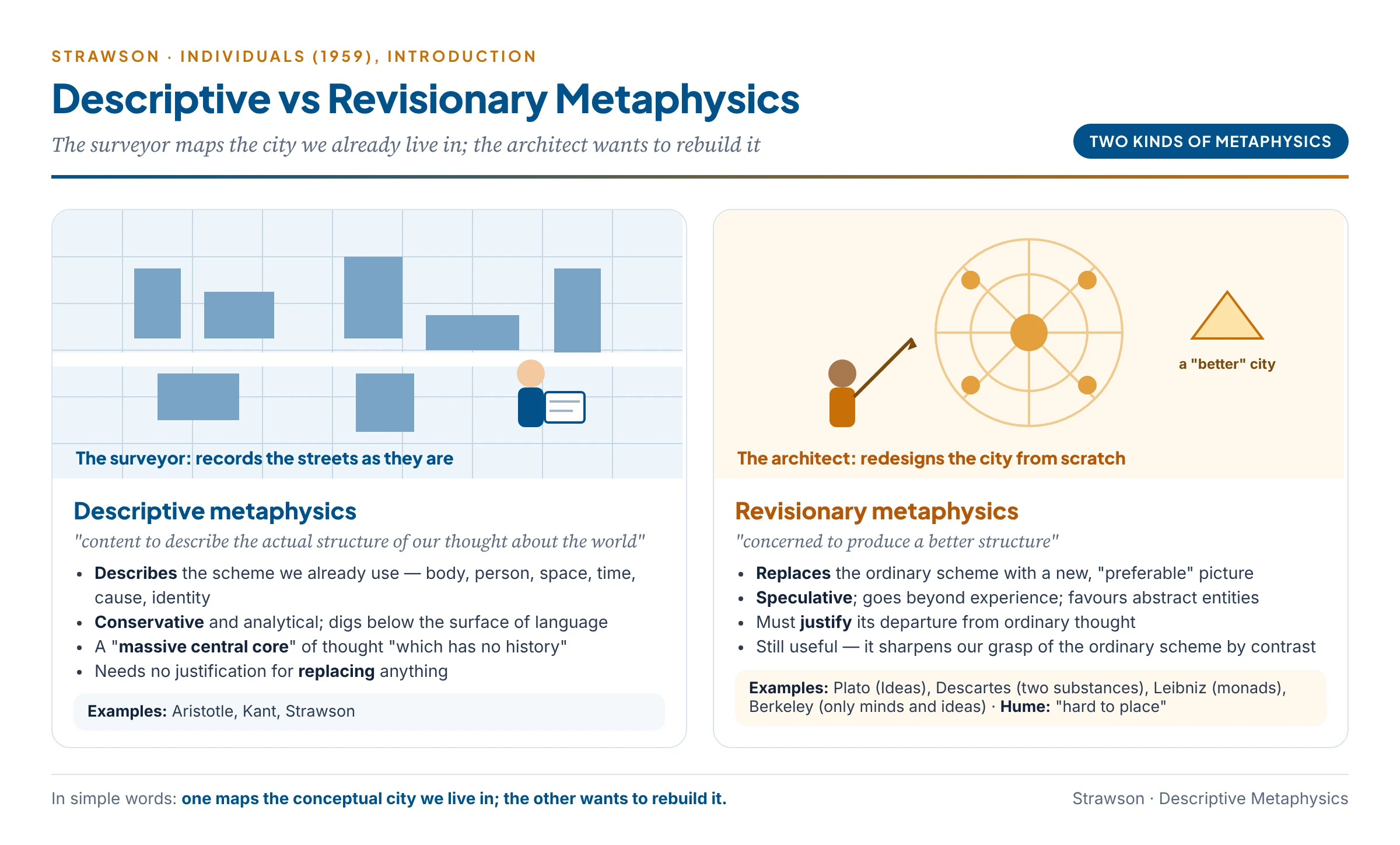
The logical positivists had declared metaphysics meaningless. In his book Individuals: An Essay in Descriptive Metaphysics (1959), the Oxford philosopher P. F. Strawson (1919–2006) brought it back — not as speculation about a world beyond experience, but as the careful description of the actual structure of our thought about the world. He called this descriptive metaphysics, and contrasted it with the revisionary metaphysics of Descartes, Leibniz and Berkeley, which tries to replace our ordinary picture with a “better” one. At the heart of our ordinary scheme, Strawson argued, is the ability to identify and re-identify individual things (particulars) within one unified framework of space and time. The particulars that make this possible — the ones we can identify without first identifying anything else — are the basic particulars: material bodies and, as he goes on to show, persons. Everything else we talk about — events, processes, sensations, theoretical entities — is identified through them.
In simple words
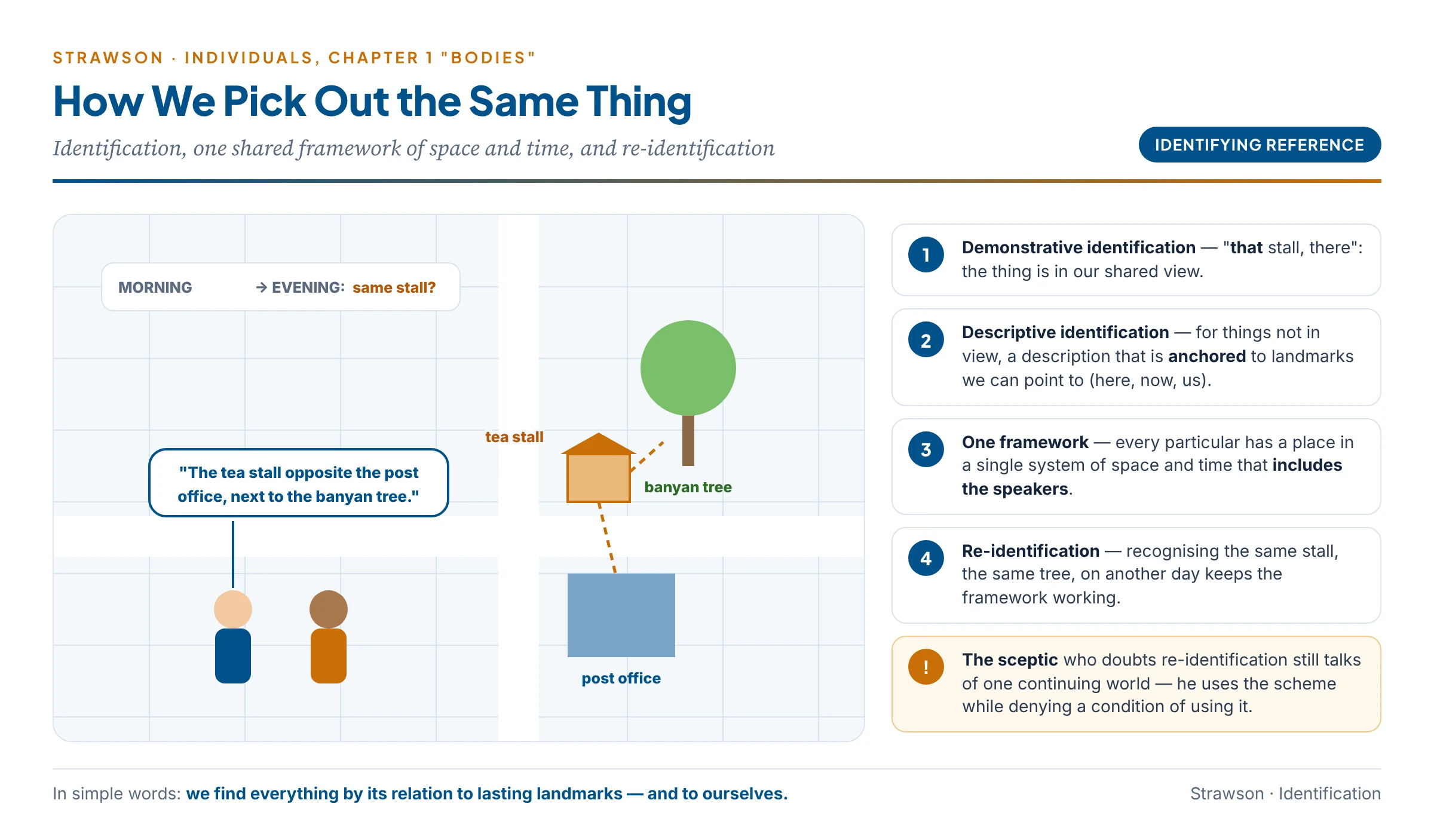
How do you tell a friend where a small tea stall is? “It’s opposite the post office, next to the big banyan tree.” You fix the stall’s place by landmarks — solid, lasting, visible things everyone can find. You could not do it the other way round, fixing the post office by the tea stall’s smell. Strawson says our whole way of talking about the world works like this: material bodies are the landmarks through which we locate everything else.
Context & Problem
Who Was Strawson?
- Life. P. F. Strawson studied at St John’s College, Oxford, and spent most of his career at Oxford, where he became Waynflete Professor of Metaphysical Philosophy. He was knighted in 1977.
- Ordinary language philosophy. He belonged to the post-war Oxford movement that studied how language is actually used in everyday life (with Ryle, Austin and Grice), rather than building ideal logical languages.
- Kant’s heir. He was deeply influenced by Immanuel Kant and tried to clarify, as Kant had, the conceptual framework through which human beings understand and experience the world.
- Main works. “On Referring” (1950) — his critique of Russell’s theory of descriptions; Introduction to Logical Theory (1952); Individuals (1959); “Freedom and Resentment” (1962); The Bounds of Sense (1966) — on Kant; Skepticism and Naturalism (1985).
- Popular line. “The concept of a person is logically primitive.“
- Syllabus focus. Theory of Basic Particulars and Persons — both from Individuals. This article covers basic particulars; the next covers persons.
Metaphysics on Trial in the Twentieth Century
- Speculative metaphysics under fire. Plato’s transcendent world of Ideas and similar systems explained this world by appeal to a realm beyond experience. Such theories offered hypotheses no experience could test. As science made huge progress in the twentieth century, philosophers demanded that philosophy complement science rather than compete with it.
- Moore’s common sense. G. E. Moore defended the common-sense view of the world against idealist speculation.
- The positivists’ elimination. The logical positivists declared all metaphysics meaningless — neither analytic nor verifiable.
- Attempts at a new metaphysics. Russell’s logical atomism tried a metaphysics built on logic; it collapsed under the later Wittgenstein’s language-games. Heidegger attempted a different route through his inquiry into Being.
- Strawson’s answer. Metaphysics is meaningful and necessary if it describes the conceptual framework that actually governs our thought, instead of inventing a new one. His theory of basic particulars and persons is his main contribution to this programme.
Core Doctrine
1. Descriptive versus Revisionary Metaphysics
“Descriptive metaphysics is content to describe the actual structure of our thought about the world, revisionary metaphysics is concerned to produce a better structure.” — Strawson
Revisionary metaphysics:
- Aims to replace or significantly modify our ordinary conceptual scheme with a new theoretical picture that the philosopher thinks intellectually (and sometimes morally) preferable.
- Method: speculative; builds a well-organised system that goes beyond the world of ordinary experience, often dealing with abstract entities.
- Needs justification: since it departs from how we ordinarily think, it must give reasons why its new picture is better.
- Examples: Descartes (two substances, mind and matter), Leibniz (windowless monads), Berkeley (only minds and ideas), and, earlier, Plato (a transcendent world of Ideas).
Descriptive metaphysics:
- Aims to describe and analyse the scheme we actually use — not to change it.
- Method: conservative and analytical; it makes explicit the assumptions already implicit in ordinary thought and talk.
- Needs no special justification of its scheme, since it only lays bare what we already think — though it must show how the scheme hangs together and why some concepts are more fundamental than others.
- Examples: Aristotle (categories drawn from ordinary experience; the individual thing as primary substance) and Kant (the conditions of possible experience).
- A hard case: “Hume, the ironist of philosophy, is more difficult to place” — his sceptical arguments look revisionary, yet he ends by describing the beliefs nature forces on us.
- No pure cases. Strawson admits that no actual philosopher has been wholly one or the other, in both intention and effect; the contrast marks two tendencies.
Common confusion
Does “descriptive” mean that Strawson only reports what words people use — a kind of dictionary study? No. Strawson says the reliance on close examination of the actual use of words is the best and only sure way in philosophy, but it is not enough for metaphysics. The general structure of our thought “does not readily display itself on the surface of language, but lies submerged“. Descriptive metaphysics must dig below ordinary usage to the most general concepts and their connections. And it is not merely about “our” habits: through transcendental arguments Strawson claims to show that any scheme like ours must have certain features.
2. What Descriptive Metaphysics Studies: Our Conceptual Scheme
- A massive central core. “There is a massive central core of human thinking which has no history” — categories and concepts which, in their most fundamental character, change not at all. They are not the technical concepts of the special sciences but the “commonplaces of the least refined thinking“.
- Its contents. Concepts of objects, persons, space, time, causation and identity — the indispensable core of any human being’s understanding of the world.
- The aim of philosophical analysis. Not to build a new theory of reality but to clarify how these concepts are logically related, which depend on which, and how they make meaningful thought, language and experience possible. Philosophy becomes conceptual clarification, not the construction of speculative systems.
- Common-sense realism. Strawson is an ordinary language philosopher and a common-sense realist: the words of our shared linguistic enterprise correspond to reality and let us know the real situation. That such a vast linguistic enterprise has survived for ages, serving countless purposes, is itself evidence that its basic framework is sound.
- Metaphysics restored. Against the positivists, Strawson shows that metaphysical inquiry is meaningful — indeed indispensable — when it examines the framework embedded in ordinary experience.
3. Particulars and Universals
The most basic division in our scheme is between particulars and universals.
- Particulars are individual things, located in space and time, that can be picked out as distinct objects: this tree, that table, Ravi, the Battle of Panipat, my headache.
- Universals are general properties, qualities or relations that can be shared by many particulars: redness, beauty, tallness, being a mango.
- How they work together. In “The apple is red“, the apple is a particular — what we are talking about (the subject) — and redness is a universal — what we say about it (the predicate). Meaningful description needs both: particulars as subjects of reference, universals as predicates.
- Strawson’s question. Among the many kinds of particulars, are some more fundamental than others in our scheme? To answer, he looks at how particulars are identified.
4. Identifying Reference: How a Speaker and a Hearer Pick Out the Same Thing
- The problem. Conversation constantly requires that when I speak about a particular, you know which one I mean. Strawson calls this identifying reference: the speaker refers to a particular, and the hearer identifies it — picks out the same item — on the strength of what the speaker says.
- Demonstrative identification. The simplest case: the item is in our shared field of perception. “That man in the blue shirt“, “this cup“. The hearer can see what I mean.
- Descriptive identification. Most things we talk about are not present: Napoleon, the Taj Mahal, yesterday’s accident. We identify them by descriptions — “the emperor defeated at Waterloo”, “the tomb built by Shah Jahan at Agra”.
- Descriptions must be anchored. A description identifies uniquely only if it relates the item, in the end, to things we can demonstratively identify — here, now, us. “The house two streets north of this one“, “the man who lived here a hundred years ago“. Without such anchoring, a description, however long, could in principle fit more than one thing.
- A shared map. So all identification depends on a single system of relations linking every particular to every other — and to us.
5. One Unified Framework of Space and Time
- The framework. We think of the world as one single picture — a unified spatio-temporal system in which every particular has a place, and which contains ourselves. When I tell you about Napoleon, I am placing him in the same system of space and time in which you and I now stand.
- Why space and time? Only spatio-temporal relations provide a framework that is comprehensive (everything has a position in it), continuous and unique (each position belongs to one item at a time). Through it, any particular can be related to any other.
- Who keeps the framework going? We can use one framework over time only if we can recognise the same places and the same things on different occasions — the same street today as yesterday. So the framework depends on re-identification.
6. Re-identification and the Sceptic
- Re-identification. Recognising a particular as the same one we met before: “this is the same bicycle I parked here this morning”.
- The sceptic’s challenge. We never observe a thing continuously; we see the bicycle, look away, see it again. How can we know it is the same bicycle and not an exact copy? Perhaps we are never entitled to re-identify anything.
- Strawson’s reply. The sceptic uses our conceptual scheme — of one world of enduring things in space and time — while rejecting one of the conditions of using it. The very idea of a single, continuing spatio-temporal framework depends on our accepting re-identifications on the basis of ordinary criteria (same place, continuity, sameness of features). So it is incoherent to doubt the procedures of re-identification while still thinking in terms of the spatio-temporal framework itself. In Strawson’s words, the sceptic “pretends to accept a conceptual scheme, but at the same time quietly rejects one of the conditions of its employment”.
- A transcendental argument. This form of reasoning — showing that what the sceptic doubts is a precondition of the very thought or experience he takes for granted — is Strawson’s version of Kant’s method.
In simple words
A cricket fan who says “I can never be sure the Virat Kohli batting today is the same Kohli who batted yesterday” still talks about Kohli’s career, his scores this season, his record. All that talk only makes sense if we can re-identify him from match to match. The doubter is sawing off the branch he is sitting on.
7. Basic Particulars: the Idea of Identifiability-Dependence
- Definition. A type of particulars is basic if particulars of that type can be identified (and re-identified) without reference to particulars of another type, while particulars of other types cannot generally be identified without reference to them.
- A one-way dependence. If identifying items of kind B requires referring to items of kind A, but not vice versa, then A is prior to B in our scheme. Strawson calls this ontological priority in the sense of identifiability: not that A “exists more”, but that our scheme is so built that we reach B through A.
- The question restated. Which kind of particulars can serve as the independent anchors — the ones through which the spatio-temporal framework itself is built and maintained?
8. Why Material Bodies Are Basic
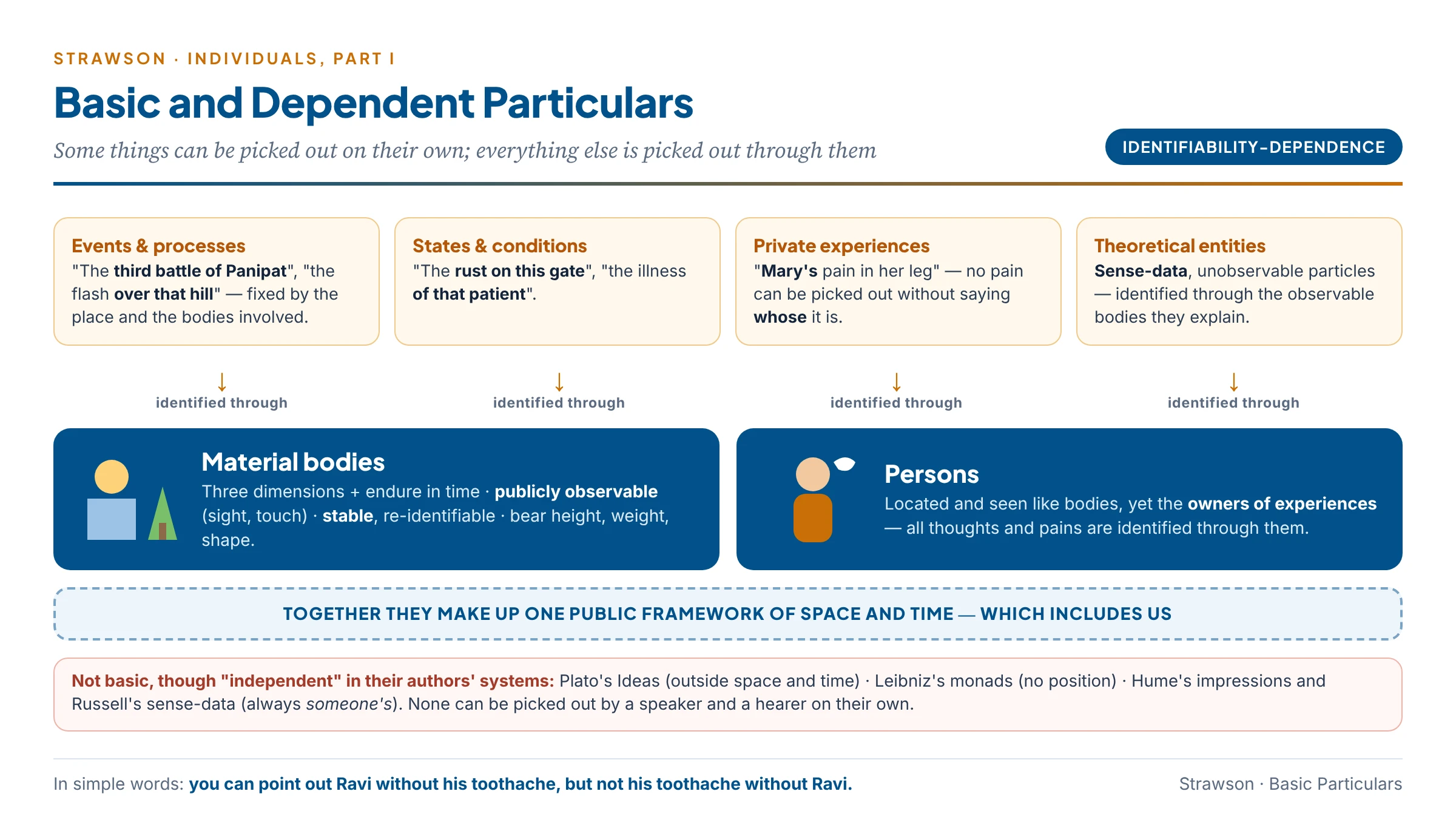
Strawson’s answer: material bodies — in a broad sense, enduring physical things like stones, trees, tables, mountains, animals, human bodies.
Features that qualify them:
- Three dimensions in space and duration in time. They have size and shape and persist; so they can occupy and mark positions in the framework.
- Publicly observable. They are accessible to ordinary means of observation — sight and especially touch — and to everyone, not just to one person.
- Stable and enduring. They have enough stability and continuity to be re-identified across time, so they can hold the framework steady.
- Bearers of material predicates. Qualities such as height, weight, solidity and figure belong to them; they need no speculation or imagination to be known.
- They alone can constitute the framework. To identify any entity is, in the end, to locate it in space and time — and material bodies are the only entities that can make up the space-time system. Places themselves are identified by the bodies at or near them.
What this excludes:
- Gases, light rays and atoms do not serve as basic particulars in our ordinary scheme: gases and light rays lack stable outlines and are not readily touched or re-identified, and atoms are not accessible to ordinary observation — we identify them only through the instruments and bodies they affect.
- Theoretical constructs (sense-data, electrons) depend on observable bodies for their identification.
A refinement. Strawson argues that, among bodies, those that are identifiable in the most independent way are the relatively enduring, observable ones — and that even events and processes that are physically important (a flood, a war) are picked out by reference to them.
9. Particulars That Depend on Bodies
Kinds of non-basic particulars:
- Events and processes — a birth, a death, a battle, a flash of lightning, a concert. We identify “the battle” as the one between these armies at that place; “the flash” as the one over that hill.
- States and conditions — the rust on this gate, the illness of that patient.
- Private experiences — sensations, thoughts, images. “Mary’s pain in her leg” is identified only by identifying Mary. Nobody can pick out a pain as “this pain” without first picking out whose pain it is.
- Theoretical or constructed entities — sense-data, and the unobservable entities of science, identified through the observable bodies they help explain.
Why the dependence is one-way:
- We can identify Ravi without mentioning his toothache; we cannot identify the toothache without identifying Ravi.
- We can identify Panipat without mentioning the battles fought there; to identify “the third battle of Panipat” we need Panipat and the armies.
- Events happen to bodies or involve them; mental states are attributed to persons who are themselves embodied. Thus all other kinds of particulars are parasitic upon material bodies for their identification.
Why the philosophers’ favourite “ultimate realities” fail the test:
- Plato’s Ideas, Leibniz’s monads, Hume’s impressions and Russell’s sense-data were each offered as the fundamental units of reality. They may possess a kind of independence in their authors’ systems — but not identifiability. None of them can be picked out and re-identified by a speaker and a hearer without first locating something in the public spatio-temporal world (Plato’s Idea is not in space and time at all; an impression or a sense-datum is identified only as someone’s; a monad has no position). So none can be a basic particular in Strawson’s sense.
In simple words
On a railway platform, the announcement says: “The delay of the Rajdhani Express at Kanpur.” You can identify the train and the station without mentioning any delay. But you cannot identify the delay without the train and the station. Events, moods and pains are like delays — real, but always somebody’s or something’s; bodies are like trains and stations — you can point to them on their own.
10. Persons Also Are Basic
- Two kinds of basic particulars. Material bodies are not the only basic particulars. Persons — beings to whom we ascribe both states of consciousness and physical characteristics — are equally basic. In Strawson’s ontology of particulars, material bodies and persons share equal status; persons are “a fundamental and irreducible kind of being”.
- Why persons are basic. A person is identified like a body — by location, appearance, movement — and yet everything mental (a thought, a pain, a belief) is identified through the person whose it is. Persons therefore anchor the whole realm of experiences, as bodies anchor the realm of events.
- Why not “minds” instead? A pure Cartesian mind could not be identified at all, since it has no position in space; the identification of experiences must go through persons, who do.
- The detailed theory — persons as a primitive concept, M- and P-predicates, the critique of Cartesian dualism and of the no-ownership theory — is the subject of the next article.
11. Spatio-Temporal Thinking and Objective Thought: the “Sounds” World
UPSC has asked about the role of spatio-temporal thinking in objective thinking. Strawson tests his thesis with a thought experiment in the chapter “Sounds“.
- The question. Is thought about an objective world — a world of particulars that exist whether or not they are perceived and can be re-identified — possible only for a being who thinks spatially?
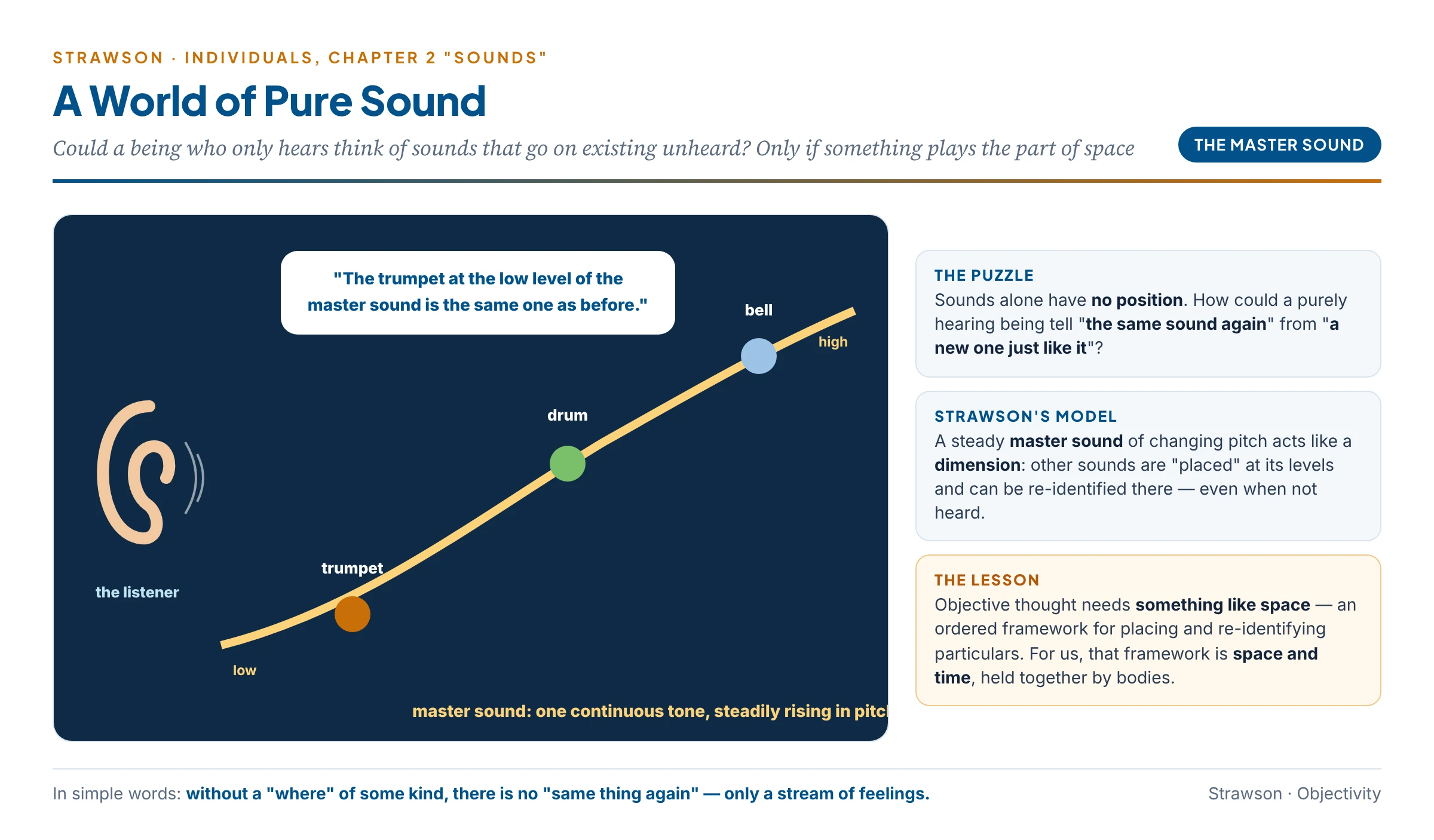
- The no-space world. Imagine a being whose experience is purely auditory: only sounds, no sight, no touch, no bodily sense of position. Sounds, taken by themselves, have no spatial features (we “place” sounds only by using sight and the body). Could such a being distinguish between “the same sound again” and “a new sound just like it“? Could it think of a sound as continuing to exist unheard?
- The “master sound”. Strawson suggests one way it might: suppose a continuous background sound of steadily varying pitch were always heard — the master sound. Other sounds could then be “located” by the pitch of the master sound at which they are heard, much as we locate things by position. A being could say “the trumpet note heard at this pitch-level of the master sound is the same one heard there before”, and could think of sounds as existing at “levels” it is not now hearing.
- The conclusion. Strawson’s verdict is careful:
- Objective thought does not strictly require literal space. A non-spatial world might allow objective particulars.
- But it requires an analogue of space. There must be something in the subject’s experience that does the work space does for us — a continuous, ordered dimension in which particulars can be placed, distinguished and re-identified.
- For us, space-time is that dimension. In our actual scheme, objective thinking is spatio-temporal thinking, and the spatio-temporal framework is held together by material bodies.
- Why it matters. It shows that space and time are not just two facts among others but the structure that makes objectivity possible — the distinction between how things are and how they seem to me now. Without a framework for re-identification, there could be no idea of a world that persists independently of my experiences — only a stream of impressions.
Common confusion
Does Strawson prove that only spatial beings can think objectively? No. That is a common overstatement. In the “Sounds” chapter he concludes that objective thought might be possible without literal space — but only if something in experience plays a role analogous to space (like the master sound). His firm claim is about our scheme: for us, objective thinking is spatio-temporal, and it rests on identifying and re-identifying material bodies.
12. Leibniz’s Monads: Can a Monad Be a Basic Particular?
UPSC asked in 2008 whether Leibniz’s monad can be regarded as a basic particular in the Strawsonian sense. Strawson discusses Leibniz in the chapter “Monads” as the great example of a philosopher who tried to identify particulars without a spatio-temporal framework.
Leibniz’s monad in brief:
- A simple, unextended, mind-like substance with no parts and no position in real space; “windowless” — nothing enters or leaves it.
- Each monad mirrors the whole universe from its own point of view; space and bodies are only how monads appear, not ultimate realities.
- Monads are distinguished by their inner qualities alone. By the identity of indiscernibles, no two monads are exactly alike, so each could in principle be identified by a complete general description of its qualities.
Strawson’s assessment:
- Identification by pure description fails. Leibniz must identify each monad by a description of its qualities alone, with no reference to here, now or us. But a general description, however detailed, gives no guarantee that it fits only one item; uniqueness is secured only by tying the description to the spatio-temporal framework we occupy. Leibniz secures it by the principle of the identity of indiscernibles — which Strawson regards as a metaphysical stipulation, not something our identifying practice can use.
- No position, no identification. A monad has no location in public space and time, so neither a speaker nor a hearer can point to it, locate it, or re-identify it. It can be identified only through the body or person whose “soul” it is.
- Monads are pure consciousnesses. A monad is, in effect, a pure individual consciousness — exactly the kind of entity Strawson argues cannot be primary in our scheme (see the next article). States of consciousness are identified through persons, not persons through monads.
- Revisionary, not descriptive. The monadology inverts our scheme: it makes the unobservable and non-spatial basic and bodies derivative. It is a paradigm of revisionary metaphysics.
- Verdict. A monad may be independent in Leibniz’s system (it depends on nothing but God) but it is not independently identifiable. So, in Strawson’s sense, a monad is not a basic particular; in our conceptual scheme it would at best be a dependent one, picked out through persons.
In simple words
Try finding someone in Mumbai from a description alone: “a tall man with a grey moustache who loves cricket and drinks tea at four”. However long the list, it might fit many people — or nobody. Add “who lives at flat 12, Shanti Niwas, Dadar” and the search is over. A place in the shared map does what no list of qualities can. Leibniz tries to identify monads by qualities alone; Strawson says that only an address in space and time does the job.
| Feature | Leibniz’s monad | Strawson’s basic particular |
|---|---|---|
| Position in space and time | None (space is mere appearance) | Has a definite position |
| How identified | By a complete description of inner qualities | By locating it in the public framework, ultimately demonstratively |
| Observable by others? | No — windowless, unextended | Yes — bodies and persons are publicly observable |
| Re-identifiable? | Only in God’s eye | Yes, by ordinary criteria |
| Kind of metaphysics | Revisionary | Descriptive |
13. Language without Particulars, and Particulars as Logical Subjects
In Part II of Individuals, Strawson asks why particulars are the paradigm subjects of our sentences.
- Subjects and predicates. In “The apple is red”, the subject term introduces a particular, the predicate a universal. Particulars are the typical logical subjects: we talk about them and say things of them.
- Feature-placing sentences. Some sentences mention no particular at all: “It is raining“, “Snow is falling“, “There is water here“. They simply mark the presence of a feature at a place and time.
- The lesson. Feature-placing language is more primitive than talk of particulars. To introduce particulars, we need criteria of distinctness and re-identification — “the same puddle”, “another snowman”. Particulars thus belong to a more developed stage of the scheme, which rests on space and time.
14. Strawson and Kant
- Kant as descriptive metaphysician. Strawson counts Kant among the descriptive metaphysicians: Kant tried to set out the necessary conditions of any experience we could have — space, time, substance, causality — which is Strawson’s own project.
- The Bounds of Sense (1966). Strawson reconstructed Kant’s Critique of Pure Reason. He kept Kant’s central insight — that self-consciousness requires experience of an objective world ordered by concepts — but rejected what he called Kant’s “transcendental psychology” (the story of the mind’s hidden activity of synthesising) and Kant’s transcendental idealism (the claim that space and time belong only to our way of perceiving, not to things themselves).
- Space and time. Like Russell, Strawson criticised Kant for treating space and time as transcendentally ideal; for Strawson they are the real framework in which bodies and persons exist, and we cannot even imagine space and time without objects to mark positions.
- Transcendental arguments. What Strawson took from Kant is the method: arguing from the fact of our experience to its necessary conditions — the method of his reply to the sceptic about re-identification and of his theory of persons.
Critical Evaluation
Objections and Replies
- Over-dependence on ordinary language.
- Objection. Ordinary language contains ambiguities and confusions; describing it need not reveal the true structure of reality.
- Reply. Strawson does not treat ordinary language as infallible; he digs beneath usage to the general structure, and supports it with transcendental arguments.
- Too conservative.
- Objection. By merely describing the existing scheme, descriptive metaphysics may block philosophical creativity and prevent better, more accurate theories. Revisionary metaphysics has sometimes led the way to science (atomism, the heliocentric picture).
- Reply. Strawson grants revisionary metaphysics its value — it is “at the service of descriptive metaphysics”, sharpening our grasp of the scheme by contrast. He only denies that it can replace the core scheme.
- Limited scope.
- Objection. Restricting metaphysics to conceptual clarification avoids the deeper question of what reality is in itself; scientific realists want metaphysics to engage with physics.
- Reply. The core scheme is presupposed even by scientists, who identify their instruments, laboratories and colleagues as bodies and persons.
- Neglect of science. Strawson’s ordinary framework may ignore how scientific theories reshape our picture — fields, particles, curved space-time.
- Lack of formal precision. Critics in the tradition of Russell and Quine say his approach lacks the formal rigour of logical analysis.
- Is the core really unchanging? Anthropologists and historians may doubt that any conceptual core “has no history”; different cultures and periods organise experience differently.
- Back-door dualism. Some critics note that by recognising two kinds of basic particulars — bodies and persons — Strawson lets a version of dualism back in as fundamental units of the universe.
- Transcendental arguments are weak. At most they show what we must believe or think, not what must be true — the sceptic may grant that we must think in terms of enduring objects and still doubt that there are any.
Critics and Defenders
Criticism — Critics
- Ordinary-language sceptics: everyday language is confused; describing it reveals our habits, not reality.
- Scientific realists: metaphysics must follow physics, not common sense.
- Defenders of revisionary metaphysics: conservatism blocks better pictures of the world.
- Formal logicians (Russell–Quine line): lacks precision.
- Historicists: no conceptual core is free of history.
- Critics of transcendental arguments: they reveal how we must think, not how things are.
Defence — Defenders and strengths
- Restores metaphysics after the positivists, without speculation beyond experience.
- Explains identification: shows how speaker and hearer manage to talk about the same thing.
- Answers the sceptic about re-identification by showing the doubt to be self-undermining.
- Clarifies priority: events, experiences and theoretical entities depend on bodies and persons for identification.
- The “Sounds” chapter shows why space and time are the backbone of objective thought.
- Shaped later philosophy of reference, identity and the self.
Cross-Tradition Comparison
Descriptive and Revisionary Metaphysics in Indian Thought
| Indian view | Descriptive or revisionary? | Point of contact with Strawson |
|---|---|---|
| Nyāya–Vaiśeṣika categories (padārtha) | Descriptive | Whatever is existent, knowable and nameable (astitva, jñeyatva, abhidheyatva) is a category; substance (dravya), quality (guṇa), action (karma), universal (sāmānya) follow the structure of ordinary experience and language |
| Nyāya on recognition (pratyabhijñā) | Descriptive | “This is that Devadatta” (so’yaṃ devadattaḥ) — recognition of the same enduring thing is a valid cognition; used against the Buddhist theory of momentariness, as Strawson defends re-identification against the sceptic |
| Buddhist momentariness (kṣaṇikavāda) | Revisionary | Enduring things are constructions from momentary events; recognition is an error — a close parallel to the sceptic about re-identification |
| Advaita Vedānta | Two levels | The empirical level (vyāvahārika) of persons and things is accepted for practical life (descriptive); at the absolute level (pāramārthika) only Brahman is real (revisionary) |
| Jaina realism | Largely descriptive | Real, enduring substances (dravya) with changing modes (paryāya) — permanence and change together |
| Sāṃkhya | Revisionary | Ordinary things are evolutes of prakṛti under the presence of puruṣa |
Indian Connect — Key takeaways
- Nyāya–Vaiśeṣika is India’s great descriptive metaphysics: like Strawson, it reads its categories off ordinary experience and language, treats substances as the bearers of qualities and actions, and gives enduring physical things (dravya) a primary place.
- The Nyāya–Buddhist debate on recognition is the Indian form of Strawson’s debate with the sceptic: Nyāya argues that “this is that same pot” is genuine knowledge and that denying it makes memory, inference and moral responsibility impossible.
- Advaita’s two levels show how a revisionary system can preserve the descriptive scheme for practical life (vyavahāra) while denying its ultimate truth — a strategy Strawson would call revisionary in intention.
Western Positions Compared
| Thinker | What is basic? | How is it identified? | Type of metaphysics |
|---|---|---|---|
| Plato | Eternal Ideas | By the intellect, outside space and time | Revisionary |
| Aristotle | Individual substances (this man, this horse) | As concrete things in the world | Descriptive |
| Descartes | Mind and matter as two substances | By clear and distinct ideas | Revisionary |
| Leibniz | Monads | By complete description of qualities | Revisionary |
| Hume | Impressions | By introspection | Hard to place |
| Kant | Phenomena in space and time under categories | By intuition and concepts | Descriptive |
| Russell | Sense-data and logical atoms | By acquaintance | Revisionary |
| Strawson | Material bodies and persons | By location in one public spatio-temporal framework | Descriptive |
Synthesis (Siddhānta)
- The project. Descriptive metaphysics lays bare “the actual structure of our thought about the world” — the unchanging core of concepts (body, person, space, time, cause, identity) that any human being uses — while revisionary metaphysics proposes a new structure.
- The central argument. Talk about particulars requires identification; identification requires a single spatio-temporal framework; the framework requires re-identification; and the particulars that can be identified independently and hold the framework together are material bodies (and persons). Events, processes, states, experiences and theoretical entities are identified through them.
- Against the sceptic. Doubting re-identification while using the framework is incoherent — the transcendental argument Strawson learned from Kant.
- Objectivity and space. The “Sounds” chapter shows that objective thought needs something like space; for us, that is the spatio-temporal order of bodies.
- Against the great system-builders. Plato’s Ideas, Leibniz’s monads, Hume’s impressions and Russell’s sense-data are independent in their systems but not independently identifiable, so none is a basic particular.
- Balanced verdict. Critics rightly ask whether a common-sense scheme can settle what reality is, and whether any scheme “has no history”. But Strawson’s account of identification and of the priority of bodies and persons remains the most influential defence of the ordinary world — and of metaphysics itself — in analytic philosophy.
- Contemporary relevance. Every address system, GPS coordinate and land record works the way Strawson describes — fixing places through enduring physical landmarks; digital databases face his problem of re-identification when deciding whether two records concern the same person; and artificial-intelligence systems that must track objects across camera frames are solving, in engineering form, his problem of identifying and re-identifying bodies in space and time.
“There is a massive central core of human thinking which has no history.” — Strawson
Previous Year Questions
- 2021What according to Strawson are basic particulars? What reasons does Strawson offer to believe that ‘material bodies‘ and ‘persons‘ are basic particulars? Critically discuss.
- 2020Evaluate the role of spatio-temporal thinking in objective thinking with reference to Strawson’s theory of basic particulars.
- 2008Explain Leibnitz’s notion of monad. Can monad be regarded as a basic particular in the Strawsonian sense?