

Quine and Strawson: Critique of Empiricism; Theory of Basic Particulars and Persons.
Official Syllabus: Paper I, Section A, Unit 11
For two hundred years empiricists had rested on one comfortable division: some truths are true by meaning alone (“All bachelors are unmarried”), and all other truths are true because of facts (“The book is on the table”). The first kind needs no experience; the second needs experience. In his essay “Two Dogmas of Empiricism” (1951), the American logician W. V. O. Quine (1908–2000) argued that this division — the analytic–synthetic distinction — has never been properly drawn. Every attempt to explain “true by meaning” uses ideas (synonymy, definition, necessity) that already assume it, so the explanation runs in a circle. Quine’s conclusion was blunt: the belief that there is such a line is “an unempirical dogma of empiricists, a metaphysical article of faith“. With the line gone, Kant’s synthetic a priori, the positivists’ linguistic theory of necessary truth, and the idea that any truth is immune to experience all fall with it.
In simple words
A school declares: “Some students are toppers by birth — they never need to sit an exam.” Asked how to recognise them, the principal says, “They are the ones who are naturally brilliant.” Asked what “naturally brilliant” means, he says, “It means they are toppers by birth.” The explanation goes round and round and never tells you how to pick out such a student. Quine says the empiricists’ “truths by meaning alone” are like these born toppers: every explanation of them quietly uses the idea it was supposed to explain.
Context & Problem
Who Was Quine?
- Life. Willard Van Orman Quine was born in Akron, Ohio, studied mathematics and philosophy at Oberlin College, and wrote his doctorate at Harvard under Alfred North Whitehead, co-author with Russell of Principia Mathematica. He taught at Harvard for most of his life and was one of the most influential philosophers of the twentieth century.
- Formation in logic. Through Whitehead he absorbed symbolic logic — the conviction that philosophical problems should be handled with the precision of a logician.
- Meeting the Vienna Circle. On a European tour in the early 1930s he met Rudolf Carnap and the members of the Vienna Circle, and admired their scientific empiricism and their logical analysis of language. Carnap remained his friend and his main opponent.
- From disciple to critic. Quine began inside the analytic tradition of Russell, Wittgenstein and Carnap — and stayed inside it, keeping its commitment to clarity, logic and science. But he came to reject two of its central assumptions. He reformed empiricism from within; he did not abandon it.
- Main works. “On What There Is” (1948), “Two Dogmas of Empiricism” (1951, reprinted in From a Logical Point of View, 1953), Word and Object (1960), “Ontological Relativity” and “Epistemology Naturalized” (1969).
- Popular line. “The unit of empirical significance is the whole of science.“
What Quine Means by “Empiricism” and Its “Two Dogmas”
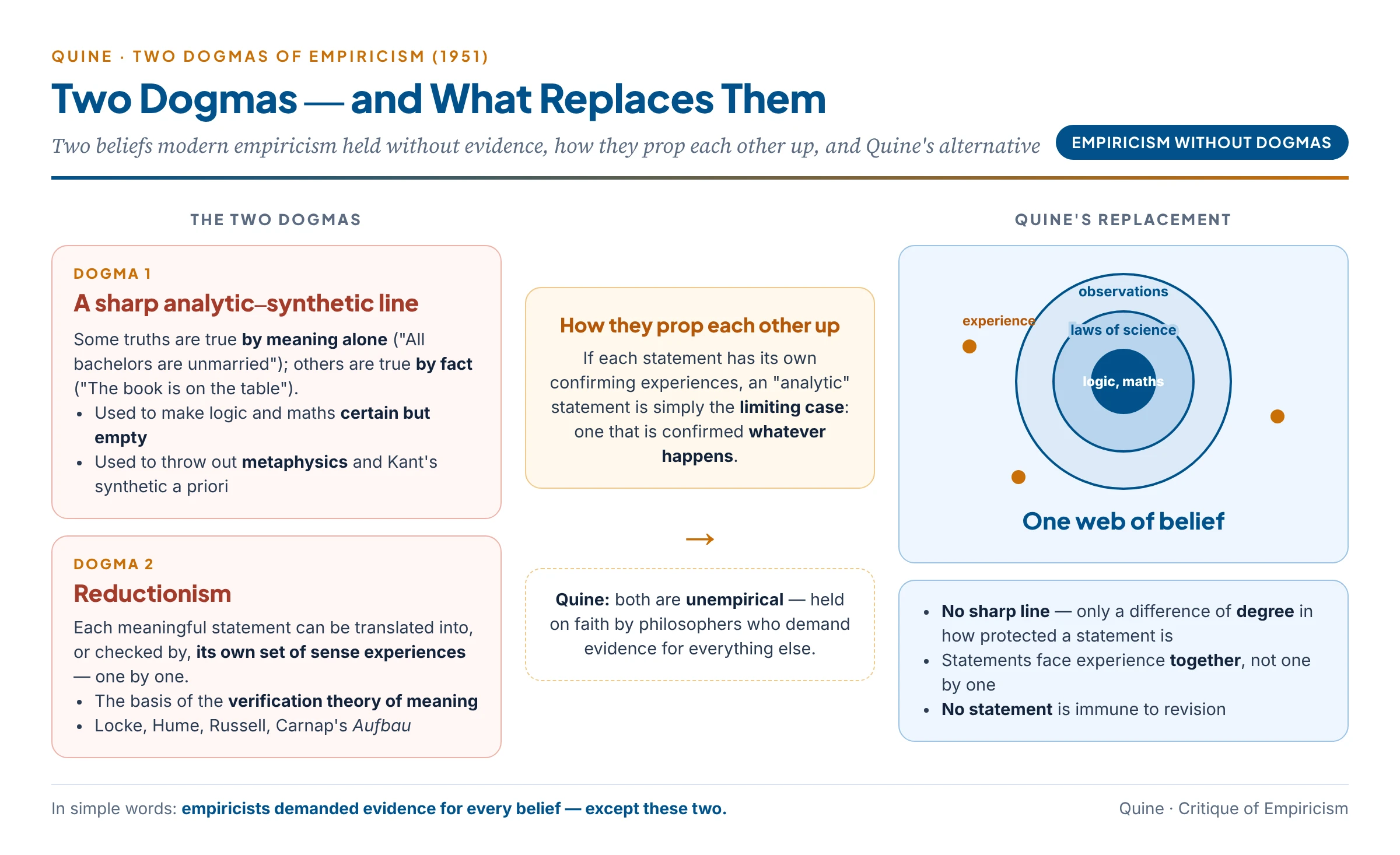
By “empiricism” Quine means modern empiricism — above all the logical positivists (Schlick, Carnap, Ayer) and those who followed Russell. He opens the essay with the charge:
“Modern empiricism has been conditioned in large part by two dogmas. One is a belief in some fundamental cleavage between truths which are analytic, or grounded in meanings independently of matters of fact, and truths which are synthetic, or grounded in fact. The other dogma is reductionism: the belief that each meaningful statement is equivalent to some logical construct upon terms which refer to immediate experience. Both dogmas, I shall argue, are ill-founded.” — Quine
- Dogma 1 — the analytic–synthetic distinction. There is a sharp, fundamental line between statements true by meaning and statements true by fact.
- Dogma 2 — reductionism. Every meaningful statement can be translated into, or checked against, its own set of statements about immediate sense experience. This is the root of the positivists’ verification theory of meaning (taken up in the next article).
- Why “dogmas”? A dogma is a belief held without evidence. Quine’s charge is ironic: empiricists insist that every belief be backed by experience, yet these two beliefs are not based on any empirical evidence at all.
- What follows from dropping them. Quine says that giving them up has two effects: the supposed boundary between speculative metaphysics and natural science becomes blurred, and philosophy shifts toward pragmatism.
- Quine’s own aim. To refute both dogmas and put forward a more thoroughgoing, radical empiricism — an empiricism without dogmas.
A Short History of the Distinction
The line Quine attacks has a long pedigree. Every great empiricist and rationalist drew some version of it.
| Thinker | The two kinds of truth | Example |
|---|---|---|
| Leibniz | Truths of reason (necessary; their denial is a contradiction) vs truths of fact (contingent) | “A triangle has three sides” vs “Caesar crossed the Rubicon” |
| Hume | Relations of ideas (certain, known by thought alone) vs matters of fact (known by experience) | “Three times five is half of thirty” vs “The sun will rise tomorrow” |
| Kant | Analytic judgments (predicate contained in the subject) vs synthetic judgments (predicate adds something new) | “All bodies are extended” vs “All bodies are heavy” |
| Frege, Russell, early Wittgenstein | Logical truths / tautologies (denial leads to contradiction) vs empirical propositions | “It is raining or it is not raining” vs “It is raining” |
| Logical positivists | Analytic = only linguistic content, true by the rules of language, says nothing about the world; synthetic = only factual content, verifiable by experience | “All bachelors are unmarried” vs “Material objects are heavy” |
- The standard picture. An analytic statement is true by virtue of the meanings of its words; experience can neither confirm nor refute it. A synthetic statement is true by virtue of facts; experience decides it. “Bachelor is an unmarried male” is analytic — you need only know English. “Material objects are heavy” is synthetic — you must lift them.
Why the Positivists Needed the Line
- To keep logic and mathematics without rationalism. Old empiricists (like J. S. Mill) said “2 + 2 = 4” is a very well-confirmed generalisation from experience. Positivists found this implausible — no experience could refute arithmetic. Their solution: logic and mathematics are analytic — true by the conventions of our language, saying nothing about the world. So they could be certain without any rationalist faculty of “pure reason”.
- To exclude metaphysics. With only two boxes — analytic (empty but certain) and synthetic (verifiable) — a sentence like “The Absolute enters into evolution” fits neither and is declared meaningless.
- To reject Kant. Kant’s synthetic a priori (truths that are informative and knowable without experience) has no box. The positivists said the alleged examples are either analytic or empirical.
- The stakes. If the analytic–synthetic line fails, the whole positivist programme — its account of logic, its rejection of metaphysics, its picture of philosophy as the analysis of meaning — loses its foundation.
Core Doctrine
1. Meaning Is Not the Same as Naming
Quine begins by clearing away a confusion. “True by meaning” cannot mean “true by what the words name“, because two words can name the same thing and still differ in meaning.
- Evening Star and Morning Star (Frege’s example). Both name the planet Venus. Yet “The Evening Star is the Morning Star” was a discovery of astronomy, not of dictionary study. If the two names had the same meaning, the statement would be analytic — and it is not.
- Scott and “the author of Waverley“ (Russell’s example). The same man, but King George IV could not learn that Scott wrote Waverley just by analysing words.
- “9” and “the number of the planets” (in Quine’s day). The same number, but observation was needed to find out.
- “Creature with a heart” and “creature with kidneys”. As far as we know, every creature that has a heart has kidneys and vice versa — the two phrases pick out exactly the same creatures (they have the same extension). Yet they obviously differ in meaning.
- The lesson. Meaning is something other than the object named or the class picked out. So to explain analyticity we must explain meaning — and meanings, Quine says, are obscure intermediary entities that philosophers postulate without being able to say when two words “have the same one”.
In simple words
Two roads both reach the same temple — one via the river, one via the market. Arriving at the same place does not make them the same road. Likewise, two expressions can pick out the same thing (Venus, the same creatures) while carrying different meanings. “Same thing named” is not “same meaning”.
2. Two Kinds of “Analytic” Statement
Quine divides the statements philosophers call analytic into two classes.
- Logical truths. “No unmarried man is married.” This stays true however we reinterpret its non-logical words: replace “man” and “married” with any other words and the result is still true (“No uncooked rice is cooked”). Its truth depends only on the logical words (“no”, “un-“, “is”). Quine raises no special objection to this class here.
- Statements that become logical truths by swapping synonyms. “No bachelor is married.” This is not a logical truth as it stands — swap “bachelor” for “farmer” and it turns false. It becomes one only if we replace “bachelor” by its synonym “unmarried man“.
- Where the problem lies. The whole weight of the second class rests on the idea of synonymy — two words having the same meaning. So the question becomes: what makes two expressions synonymous? Quine examines every available answer and finds each one circular.
- Even “analyticity as logical truth” needs synonymy. Someone may say: analytic statements are just those reducible to logical truths. But the reduction works only by replacing synonyms with synonyms — so this account presupposes synonymy and cannot be the final explanation.
3. First Attempt: Analyticity Through Definition
“Bachelor” and “unmarried man” are synonymous, it is said, because “bachelor” is defined as “unmarried man”. Quine asks: who made the definition, and on what basis?
- Dictionary definitions report usage. We may consult the dictionary — but the lexicographer is “an empirical scientist, whose business is the recording of antecedent facts“. If he writes “bachelor: unmarried man”, it is because he believes the two are already synonymous in general usage. His definition presupposes synonymy; it does not create or explain it.
- Philosophers’ definitions (explication). Philosophers like Carnap “define” a vague term by replacing it with a sharper one (this is explication). But explication too must stay faithful to the term’s existing use — it rests on prior synonymies of the contexts in which the term is used.
- The one honest case: a brand-new abbreviation. When a scientist or mathematician invents a new symbol and declares it shall mean exactly what a longer expression means, the two are synonymous simply because we decided so. Here definition really does create synonymy. But this is a special, artificial case — it cannot explain the synonymy of ordinary words like “bachelor”, which nobody ever legislated.
- Quine’s verdict. “Definition rests on synonymy rather than explaining it.” The word “definition” has “a dangerously reassuring sound”.
The linguistic-behaviour point (a simpler way of putting it):
- “Bachelor means unmarried male” is not something we know by pure thought. We learn it by observing how people use the words — it requires experience of linguistic behaviour.
- And usage can change. As linguistic behaviour changes, the relation between words and meanings changes too. So a “definition” is a report of a contingent fact about a community’s speech — not a truth that holds independently of all experience.
4. Second Attempt: Synonymy as Interchangeability
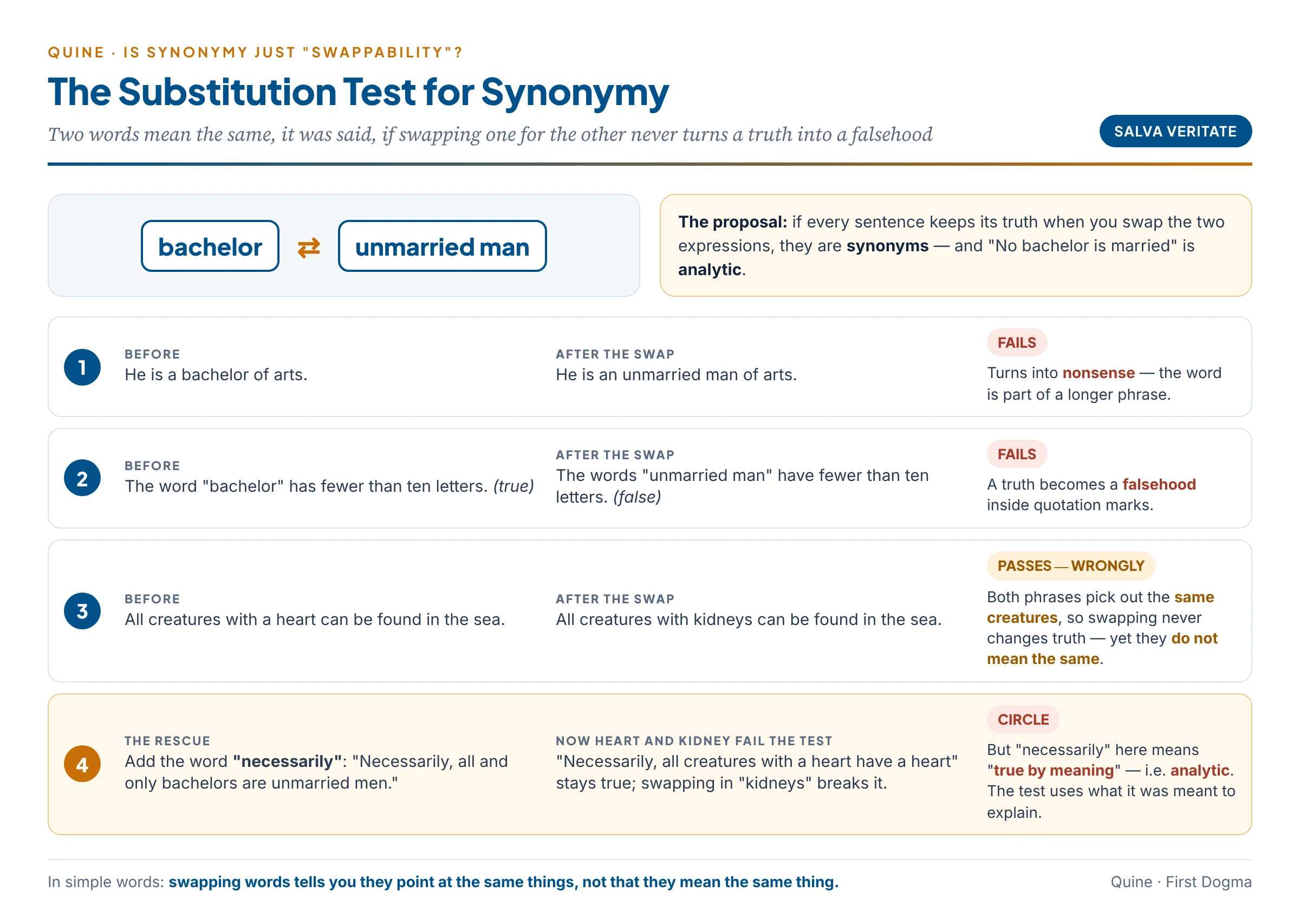
Perhaps two words are cognitively synonymous (same meaning for purposes of truth, ignoring poetic colour) when they can be swapped in every sentence without changing its truth or falsity — interchangeability salva veritate (“saving the truth”).
The test meets trouble at once:
- Inside longer words and quotations. “Bachelor of arts” and “bachelor’s buttons” (a flower) turn false or nonsensical when “unmarried man” is swapped in. And “‘Bachelor’ has less than ten letters” is true, while “‘Unmarried man’ has less than ten letters” is false. Quine allows that these cases could be set aside by treating “bachelor of arts” or a quoted word as a single unit.
- The deeper trouble: swapping is too easy in a plain language. Imagine a language that only talks about which things have which properties — no talk of “necessarily” or “possibly”. In such a language “creature with a heart” and “creature with kidneys” can be swapped in every sentence without changing truth, since they pick out the same creatures. Yet they are not synonymous. So in such a language interchangeability shows only that two words happen to apply to the same things — perhaps by an accident of nature — not that they mean the same.
- The rescue — and the trap. To exclude the heart–kidney case we must enrich the language with the word “necessarily“. Then we can test with the sentence “Necessarily, all and only bachelors are unmarried men“. Swapping “creature with kidneys” into “Necessarily, all and only creatures with a heart are creatures with a heart” would now turn a truth into a falsehood — so the test works.
- But what does “necessarily” mean here? It means: true by virtue of meaning — analytic. We can understand “necessarily” in this sense only if we already understand “analytic”. The test for synonymy has smuggled in the very notion it was meant to define.
In simple words
To check if two keys are really copies of the same key, you try them in every lock in the building. Both open every lock. Are they copies? Not necessarily — perhaps the building just happens to have only simple locks that any key of that size opens. To rule that out you would need a “master lock” that only a true copy can open. Quine’s point: the only master lock available is the word “necessarily” — and that lock was built out of the idea of analyticity itself.
The same point in simpler steps:
- Empiricists say “bachelor” and “unmarried male” are cognitive synonyms, so “Bachelor is unmarried male” is analytic.
- But whether the two terms apply to the same state of man is something we learn by observing the social set-up — it is factual, hence contingent, not necessary.
- And the reasoning is circular: “All bachelors are unmarried” is called analytic because “bachelor” and “unmarried” are interchangeable; they are interchangeable because they are cognitively synonymous; and they are synonymous because the statement linking them is analytic. Analyticity is explained by synonymy and synonymy by analyticity.
5. Third Attempt: Carnap’s Semantical Rules
Carnap’s suggestion was to define analyticity precisely for an artificial language by laying down explicit semantical rules — a list saying “the following statements are analytic in this language”.
- It defines “analytic-in-language-L”, not “analytic”. A rule might say: “A statement is analytic in L if and only if it is on this list.” But this explains the phrase “analytic in L” for each language separately; it does not tell us what analytic means in general — what the statements on the list have in common that makes them belong there.
- Why these rules and not others? Any set of true statements could be labelled “semantical rules”. Calling some statements “rules of meaning” rather than “truths about the world” presupposes that we already know the difference — the very difference in question. A heading “semantical rules” is just an unexplained label.
- Rules presuppose meaning. To lay down a rule fixing the meaning of a word we already need the notion of meaning — which brings back the circle.
- Moving the problem, not solving it. Artificial languages may help with the analytic–synthetic question only if we already understand analyticity in ordinary languages, which is exactly what is lacking.
6. The Circle of Analyticity
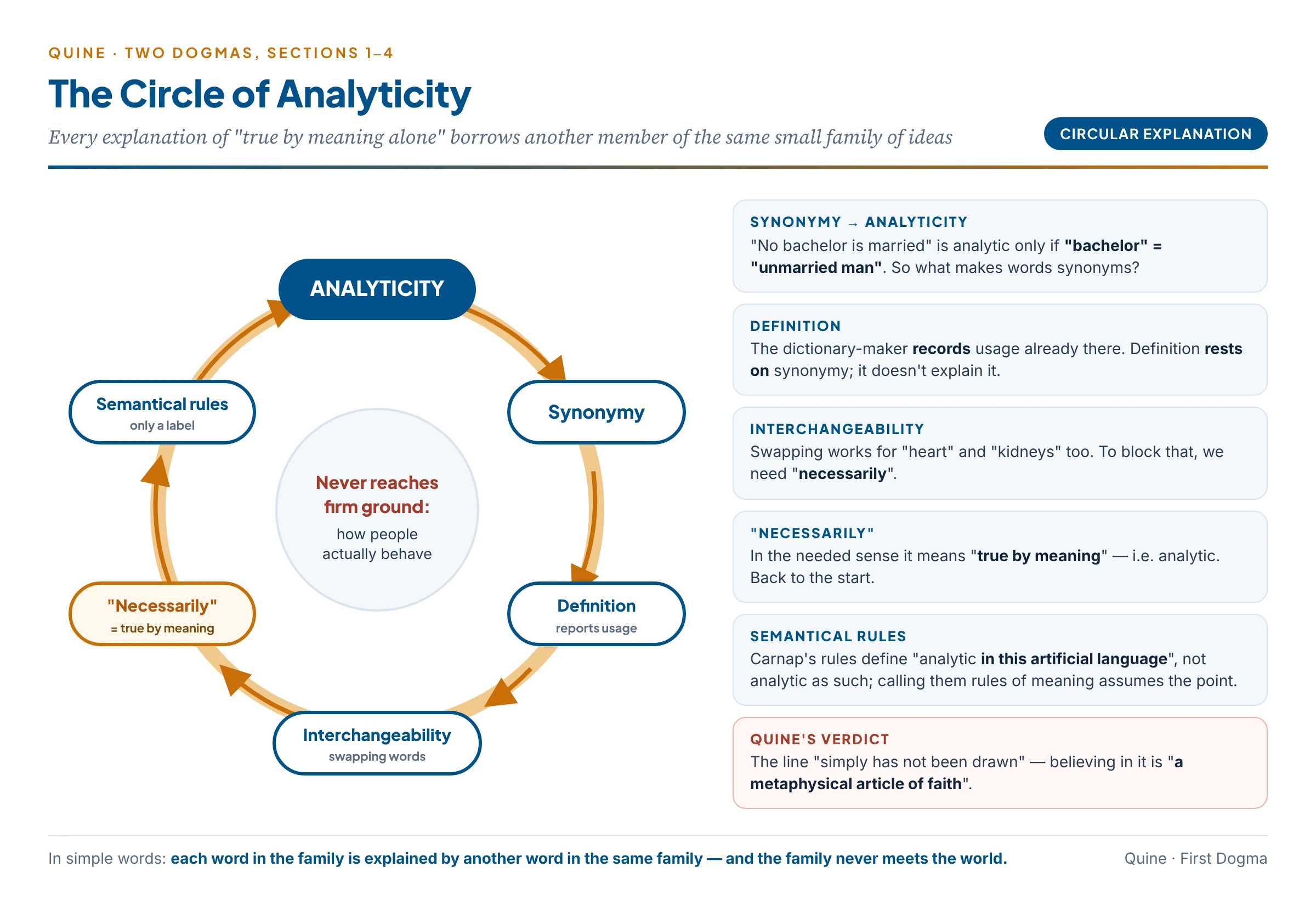
Put together, the attempts form a closed ring. Each notion is explained by another member of the same small “family” of ideas, and the ring never touches the ground of observable behaviour.
- Analyticity is explained by synonymy.
- Synonymy is explained by definition — but definitions report pre-existing synonymy.
- Synonymy is explained by interchangeability — but interchangeability works only with “necessarily“.
- “Necessarily” (in the required sense) is explained by analyticity.
- Semantical rules explain only “analytic in L”, and presuppose meaning.
- Meaning itself is explained by synonymy (“same meaning”).
“In the course of these somber reflections we have taken a dim view first of the notion of meaning, then of the notion of cognitive synonymy, and finally of the notion of analyticity.” — Quine
Common confusion
Does Quine say that “All bachelors are unmarried” is false, or that the word “analytic” is meaningless gibberish? No. He does not doubt that bachelors are unmarried, and he does not deny that people use the word “analytic”. His claim is that nobody has given a clear, non-circular criterion for which statements are analytic — so the supposed sharp, fundamental line between truths of meaning and truths of fact has never been drawn. What he rejects is the dogma that such a line exists and can bear the weight the positivists put on it (certainty of logic, rejection of metaphysics). It is also wrong to say Quine objects to logical truths like “No unmarried man is married” — his target is the second class, which depends on synonymy.
7. “Everything Green Is Extended” — the Trouble Lies with “Analytic”
Quine gives a revealing test case. Is “Everything green is extended” (everything green takes up space) analytic?
- We hesitate. It seems we cannot imagine green without extension. But is that because of the meanings of “green” and “extended”, or because of a very general fact about colour and space?
- Quine’s diagnosis. “The trouble is not with ‘green’ or ‘extended’, but with ‘analytic’.” We understand “green” and “extended” perfectly well. What we do not understand is what further fact would make the statement analytic rather than synthetic.
- A link with the positivists. The positivists treated “Whatever is coloured is extended” as analytic; Kant-inspired critics called it synthetic a priori. Quine’s point is that the dispute cannot be settled, because there is no clear criterion to settle it with.
8. The Verdict: a Metaphysical Article of Faith
“But, for all its a priori reasonableness, a boundary between analytic and synthetic statements simply has not been drawn. That there is such a distinction to be drawn at all is an unempirical dogma of empiricists, a metaphysical article of faith.” — Quine
- “Unempirical.” No observation of language users has ever shown where the line falls.
- “Dogma of empiricists.” The very people who demand evidence for every belief hold this one on faith.
- “Metaphysical article of faith.” The irony is sharp: the positivists used the distinction to banish metaphysics, but the distinction is itself a piece of metaphysics — a claim about a hidden realm of “meanings” that no experience can test.
- Conclusion. The analytic–synthetic distinction is not a genuine, sharply drawn division but a philosophical myth.
9. A Difference of Degree, Not of Kind
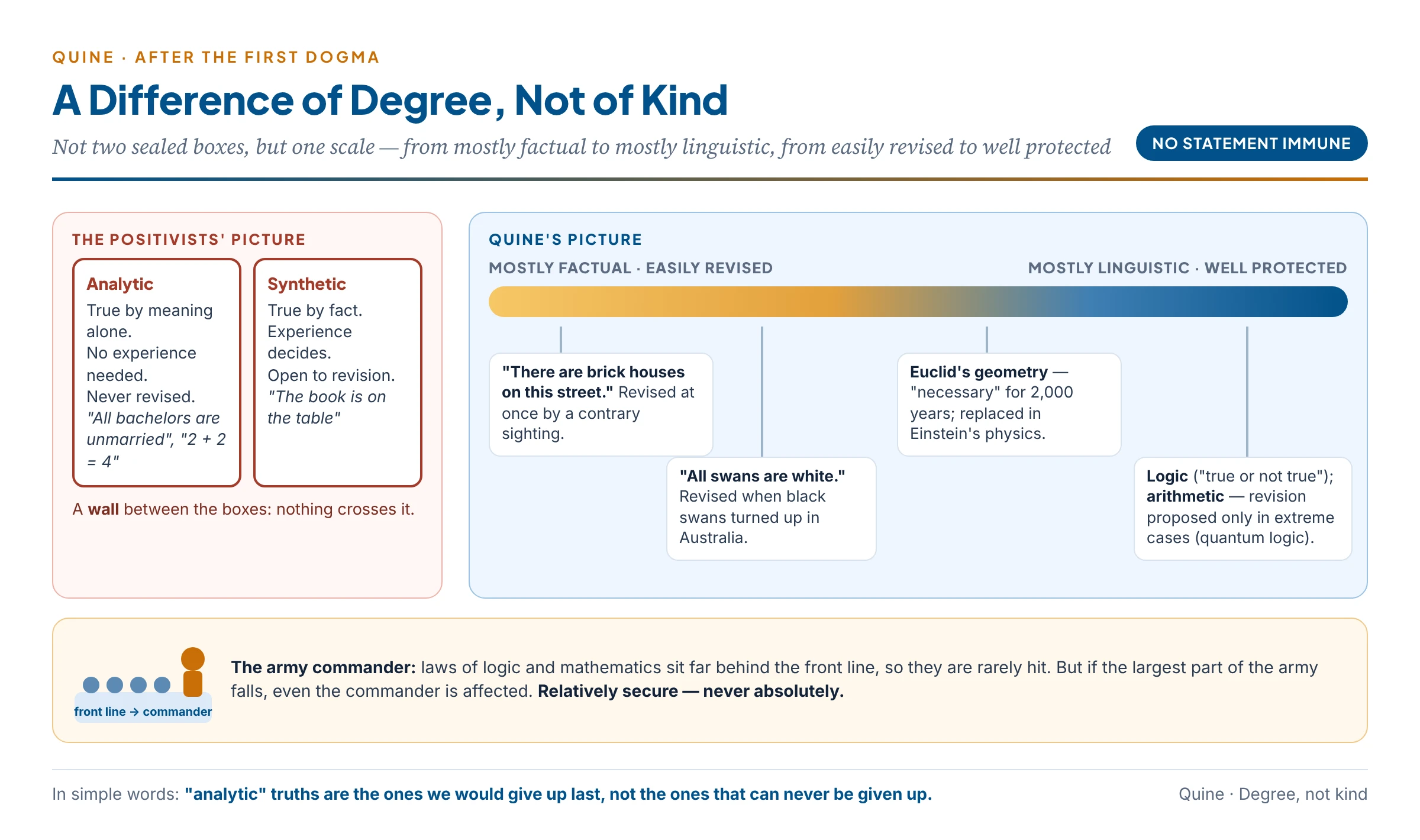
What does Quine put in place of the sharp line? Not “all statements are the same”, but a gradual difference.
- Every statement has both elements. Following a suggestion in Carnap, every statement has a linguistic (verbal, formal) component and a factual component, in varying proportions. Where the linguistic element is very large and the factual element tiny, we call the statement “analytic”; where the factual element dominates, we call it “synthetic”. The difference is one of degree, a matter of quantity, not of quality.
- Analytic statements are the limiting case. An “analytic” statement is simply the extreme end of the synthetic range — a statement we hold onto whatever happens.
- Relatively secure, not absolutely secure. So-called analytic truths are relatively safe from revision, but not immune. In a radical upheaval of knowledge even they may be revised.
Examples of “untouchable” truths that were revised or questioned:
- “For any two quantities, the order of multiplication does not matter.” True of ordinary numbers — but in the multiplication of vectors used in physics (the “cross product”), changing the order reverses the result. A “law of arithmetic” turned out to hold only for some kinds of quantity.
- The law of excluded middle (“Either a statement is true or it is not”). Some proposals in quantum mechanics suggested revising it to simplify the theory.
- Euclidean geometry. For two thousand years “the angles of a triangle add up to two right angles” seemed necessary. Einstein’s physics uses non-Euclidean geometry, in which it fails for large regions of space.
- “All swans are white.” Once treated as almost definitional of swans — until black swans were found in Australia.
In simple words
In an army, a commander sits far behind the front line and is rarely hit. Ordinary soldiers at the front fall all the time. But if the largest part of the army is destroyed, even the commander is affected. The laws of logic and mathematics are like the commander: well protected, seldom touched — but not beyond the reach of a big enough defeat.
10. Kant’s Synthetic a priori as a “Metaphysical Article of Faith”
UPSC has asked how Quine shows that Kant’s synthetic a priori judgment is a metaphysical article of faith. The answer combines Quine’s attack on the analytic with his attack on the a priori.
- Kant’s definition of “analytic” is only a metaphor. Kant called a judgment analytic when the predicate is “contained in” the subject (“All bodies are extended”). Quine notes two faults: the idea of “containment” is a metaphor (concepts are not boxes), and it applies only to subject–predicate statements, ignoring all other forms. Kant himself also explained analytic truths as those whose denial is self-contradictory — but “self-contradiction” needs the same unexplained notion of meaning.
- No clear analytic, no clear synthetic. “Synthetic” is defined as “not analytic“. If “analytic” has never been properly drawn, “synthetic” has no fixed edge either.
- No a priori, either. Kant’s grid needs truths knowable independently of all experience. For Quine every statement — even of geometry, arithmetic and logic — belongs to the one system that faces experience and could, in principle, be revised. So there is no class of statements guaranteed in advance against experience.
- The collapse of the grid. Kant’s famous fourfold table (analytic/synthetic × a priori/a posteriori) depends on both distinctions. Remove them, and the special box of the synthetic a priori — informative truths known independently of experience — has no ground to stand on.
- Kant’s examples revised. Kant’s best example, Euclidean geometry, as the “a priori form” of outer intuition, was abandoned by physics. Causality (“every event has a cause”) has been questioned in quantum theory. What Kant took as fixed conditions of all experience turned out to be central but revisable parts of our theory.
- Why “article of faith”. Kant presented the synthetic a priori as a necessary truth about the structure of the mind. Quine says that no experience could ever support such a claim; holding it is an act of faith, not knowledge — exactly what he says of the analytic–synthetic line in general.
Common confusion
Did the positivists agree with Kant, and did Quine merely side with them against him? No. The positivists rejected Kant’s synthetic a priori too — but by putting all necessary truths into the analytic box. Quine goes further and attacks the box itself. He rejects Kant and the positivists: there is no synthetic a priori, but also no sharply defined analytic a priori. Logic and mathematics are neither Kant’s fixed forms of the mind nor the positivists’ empty conventions, but the most central and best-protected parts of one empirical system.
11. The Linguistic Theory of a priori Propositions and “Truth by Convention”
The positivists’ linguistic theory of necessary (a priori) propositions says: logic and mathematics are necessary because they are true by the conventions of our language — “they record our determination to use words in a certain fashion” (Ayer). Quine attacks this theory in two ways.
- “Truth by Convention” (1936). Long before “Two Dogmas”, Quine argued that logic cannot be true by convention. There are infinitely many logical truths, so conventions must be general rules (“every statement of such-and-such form is to be true”). But to apply a general rule to a particular case we must reason logically (“this statement has that form; so it is true”). Logic is needed to get logic out of the conventions — an endless regress. So conventions cannot be the source of logical truth.
- “Two Dogmas” (1951). Even apart from the regress, the theory needs a clear notion of a sentence true by meaning alone. Since analyticity has never been defined non-circularly, the linguistic theory rests on the very dogma Quine rejects.
- Quine’s alternative. Logic and mathematics are not empty conventions but parts of our total theory of the world, held true because they are deeply woven into everything else we believe. They are “necessary” only in the sense that we would be least willing to give them up.
Critical Evaluation
Grice and Strawson: “In Defense of a Dogma” (1956)
The most famous reply came from H. P. Grice and P. F. Strawson of Oxford.
- A distinction used with agreement is real. Philosophers and ordinary speakers apply “analytic” and “synthetic” with remarkable agreement to new cases — they sort “All bachelors are unmarried” and “All bachelors are lonely” the same way. A distinction that people can apply consistently cannot simply be “non-existent”, even if no one has yet defined it satisfactorily.
- Quine’s standard is too high. Quine demands that analyticity be defined without using any member of its “family” (meaning, synonymy, necessity). Almost no important philosophical concept could meet that demand. We explain “red” only by relating it to other colours, and “cause” only through related notions; that does not make those concepts empty.
- The two kinds of rejection. Compare:
- “My neighbour’s three-year-old child understands Russell’s theory of types.” We say: that is not true — we do not believe it, but we can imagine evidence that would convince us (an infant prodigy).
- “My neighbour’s three-year-old child is an adult.” Here we do not say “not true”; we say we do not understand what is meant — it is conceptually absurd.
- The first is rejected on factual grounds, the second on grounds of meaning. This difference in how we reject sentences shows that the analytic–synthetic distinction is built into our actual thought and language.
- If synonymy goes, meaning goes. If it is meaningless to ask whether two expressions are synonymous, it must be meaningless to ask what any expression means — since “what does it mean?” asks for a synonym. But that is absurd: we ask and answer “what does it mean?” every day.
- Revision can be explained. Grice and Strawson accept that we may “give up” a so-called analytic statement. But when we do, they say, we have changed the meaning of a word — which is different from discovering that a factual statement was false. So Quine’s holism does not by itself erase the distinction.
- Informal distinction suffices. Even if we cannot distinguish analytic from synthetic formally, we must accept the distinction informally, because both thought and knowledge need it; without it, they argue, we slide toward scepticism.
In simple words
A teacher grading papers can tell a wrong fact (“Delhi is the capital of Pakistan”) from a confused use of words (“Delhi is a city that is not a city”) — even though she could not write a perfect textbook definition of the difference. Grice and Strawson say: failing to define a distinction neatly does not show there is no distinction. Most of our best concepts work this way.
Other Objections to Quine
- Pure vs applied mathematics. Critics say Quine blurs pure mathematics, which needs no experience (“2 + 2 = 4”), with applied mathematics, which does (“two drops of water and two drops of water make one big drop”). The drops show something about water, not a failure of arithmetic.
- Contrary to ordinary language and common sense. In everyday speech we constantly distinguish “true by definition” from “true as a matter of fact”. A philosophy that denies this, critics say, goes against common sense and could hamper practical life.
- Hume’s scepticism revived. Some say that by making even logic and mathematics revisable, Quine revives the old, discredited scepticism of Hume in a new form — nothing is certain.
- The distinction survives in modified forms. Later philosophers argued that some distinction between truths of meaning and truths of fact survives Quine’s attack. Hilary Putnam held that a few words (like “bachelor”) are “one-criterion” words, defined by a single test, so that statements like “All bachelors are unmarried” really are analytic, even if most scientific statements are not. Saul Kripke separated “necessary” (true in every possible situation), “a priori” (known without experience) and “analytic“, showing that these do not always coincide — some truths are necessary yet discovered by experience (“Water is made of hydrogen and oxygen” is the usual example: if true, it could not have been otherwise, yet chemists had to discover it).
- Revisability is a matter of degree — so is the distinction. If Quine admits that some statements are far harder to revise than others, critics say he has kept the distinction as one of degree, and that is all most defenders ever wanted.
- Origin vs validation (Ayer against Mill). Quine’s view resembles J. S. Mill’s claim that experience accounts even for mathematical truths. Ayer had answered Mill by separating the origin of knowledge from its validation: all knowledge originates in experience, but some statements (analytic) need no experience to validate them, while others (synthetic) do. Critics apply the same reply to Quine.
Replies on Quine’s Behalf
- On agreement in use. Quine can grant that speakers agree in classifying familiar cases and still say this agreement reflects how central and unquestioned some beliefs are — not a hidden realm of meanings. Agreement about easy cases does not give a criterion for hard ones (“Everything green is extended”).
- On the high standard. Quine is not asking for a definition of every word; he asks that a notion meant to carry huge philosophical weight — the certainty of logic, the rejection of metaphysics — be clear enough to do that work.
- On the neighbour’s child. The difference between “not true” and “unintelligible” may be a difference in how deeply a belief is embedded in our system: rejecting “a three-year-old is an adult” would force huge revisions in our concepts of age and growth, so we treat it as “absurd”.
- On meaning change. Saying “we changed the meaning” in a revision presupposes that there is a clear fact about sameness of meaning — which is again the point at issue.
- What Quine achieved. Even many critics agree that he showed the distinction cannot bear the weight the positivists gave it. He did not so much disprove it as strip it of its explanatory work.
Critics and Defenders
Criticism — Critics of Quine
- Grice and Strawson: the distinction is used with agreement; the demand for a non-circular definition is unreasonably high; “not true” differs from “unintelligible”.
- Ordinary-language critics: denying the distinction goes against common sense and everyday speech.
- Pure-mathematics objection: “2 + 2 = 4” needs no experience; only its application does.
- Putnam and Kripke: a modified distinction (one-criterion words; necessary vs a priori) survives.
- Ayer’s line: experience is the origin, not the validation, of necessary truths.
- Charge of scepticism: Hume’s doubts revived in a new form.
Defence — Defenders and strengths
- Exposes a hidden circle: every explanation of “analytic” uses a member of the same family of notions.
- Turns the positivists’ weapon on themselves: the distinction is itself an “unempirical dogma”.
- Fits the history of science: geometry, logic and “certain” laws have been revised.
- Removes the synthetic a priori and the linguistic theory together, leaving one unified, revisable body of knowledge.
- Explains apparent necessity as centrality in our system, not as a mysterious realm of meanings.
- Opens the way to naturalism: philosophy continuous with science.
Cross-Tradition Comparison
Necessary Truth and Revisability in Indian Thought
Indian philosophy did not frame an “analytic–synthetic” debate in these words, but its theories of valid knowledge (pramāṇa) and definition (lakṣaṇa) raise closely related questions.
| Indian view | Its position | Closer to |
|---|---|---|
| Nyāya on universal truths | Even universal connections (vyāpti, “wherever there is smoke there is fire”) are grounded in perception and repeated observation, with no exception found; there is no special class of truths known by meaning alone | Quine and Mill |
| Nyāya on validity | Validity is extrinsic (parataḥ-prāmāṇya): a cognition is confirmed by coherence with other cognitions and successful action (saṃvāda, pravṛtti-sāmarthya) | Quine’s pragmatic, system-wide testing |
| Nyāya on definition | A good definition (lakṣaṇa) must avoid being too narrow (avyāpti), too wide (ativyāpti) or impossible (asambhava) — it is tested against actual cases | Quine’s lexicographer: definitions answer to usage |
| Mīmāṃsā | Every cognition is intrinsically valid (svataḥ-prāmāṇya) until defeated by a contrary cognition (bādhaka) | Fallibilism: no belief is beyond possible defeat |
| Buddhist logic (Dharmakīrti) | Necessary inference rests either on identity of nature (svabhāva: “this is a tree because it is a śiṃśapā”) or on causation (kārya: smoke from fire) | A distinction between conceptual and causal necessity — nearer Grice and Strawson |
| Jaina syādvāda | Every statement is true only “in some respect” (syāt), relative to a standpoint | Revisability and the partiality of every statement |
| Cārvāka | Perception is the only valid means of knowledge; no truths beyond experience | Radical empiricism (without Quine’s holism) |
Indian Connect — Key takeaways
- Nyāya’s empiricism about universals — vyāpti is learned from observation, not from the meanings of words — anticipates Quine’s refusal to set aside a class of “truths by meaning alone”.
- Extrinsic validity (parataḥ-prāmāṇya), with its tests of coherence and successful action, resembles Quine’s picture of beliefs confirmed by how well the whole system works.
- Mīmāṃsā’s defeasibility (valid until defeated) parallels Quine’s “no statement is immune to revision” — though Mīmāṃsā exempts the Veda, while Quine exempts nothing.
- Dharmakīrti’s separation of identity-based from causal inference shows that a version of the conceptual–factual distinction was also drawn in India — which supports Grice and Strawson’s claim that the distinction is natural to thought.
Western Positions Compared
| Thinker | Is there a sharp analytic–synthetic line? | Status of logic and mathematics | Synthetic a priori? |
|---|---|---|---|
| Leibniz | Yes: truths of reason vs truths of fact | Necessary truths of reason | Not in Kant’s sense |
| Hume | Yes: relations of ideas vs matters of fact | Certain but uninformative | No |
| Kant | Yes: containment vs ampliation | Mathematics is synthetic a priori | Yes |
| J. S. Mill | Weak: even maths is generalised experience | Very well-confirmed generalisations | No |
| Logical positivists | Yes — the foundation of their system | Analytic, true by linguistic convention | No |
| Quine | No — only a difference of degree | Central, revisable parts of one web | No (nor a sharp analytic a priori) |
| Grice and Strawson | Yes, informally, as used in thought and language | Analytic | No |
Synthesis (Siddhānta)
- The argument in one line. Every attempt to explain “true by meaning alone” — through definition, synonymy, interchangeability or semantical rules — assumes some other member of the same family of notions, so the explanation is circular, and the sharp analytic–synthetic line “simply has not been drawn“.
- What Quine does and does not claim. He does not say bachelors might be married, nor that “analytic” is a meaningless noise. He says that no clear criterion exists, so the sharp, fundamental distinction is a dogma — a “metaphysical article of faith” held by philosophers who claim to have no metaphysics.
- What falls with it. The synthetic a priori of Kant (no clear analytic, no a priori), the positivists’ linguistic theory of necessary truth (no truth by convention), and the idea that logic and mathematics are empty of content.
- What replaces it. A difference of degree: statements are more or less linguistic, more or less factual, more or less protected from revision. Logic and mathematics are the most protected — the commander behind the lines — but not untouchable.
- The strongest reply. Grice and Strawson show that we do sort statements reliably and that the demand for a non-circular definition is too strong; Putnam and Kripke show that refined versions of the distinction survive.
- Balanced verdict. Quine did not abolish the distinction from everyday use, but he showed it cannot carry the foundational weight empiricism placed on it. The next step — his attack on reductionism and his picture of the web of belief — explains why the line could not be drawn: statements do not face experience one by one.
- Contemporary relevance. The debate shapes how we think about definitions in law (a “definition clause” fixes usage but can be revised when facts change), about scientific revolutions (non-Euclidean geometry, quantum logic) and about artificial intelligence, where systems learn word meanings statistically from usage rather than from fixed definitions — much as Quine’s lexicographer records usage rather than legislating meaning.
“The trouble is not with ‘green’ or ‘extended’, but with ‘analytic’.” — Quine
Previous Year Questions
- 2024Explain the nature of the two dogmas that Quine refers to in his paper ‘Two Dogmas of Empiricism‘.
- 2019Explain Quine’s arguments against the synthetic-analytic distinction.
- 2018How does Quine show that the notion of synthetic a priori judgement as discussed by Kant is a metaphysical article of faith? Give reasons for your answer.
- 2016Discuss Quine’s attack on the analytic-synthetic distinction.
- 2015Elucidate Quine’s arguments to show that analyticity is not synonymity.
- 2014How far are Quine’s arguments in ‘Two Dogmas of Empiricism‘ justified? Discuss.
- 2012Explain critically Quine’s rejection of the analytic-synthetic distinction and his subsequent philosophical arguments.
- 2005Quine’s criticism of analytic-synthetic distinction.
- 2002Quine’s attack on Analytic-Synthetic Distinction.
- 2001Examine Quine’s critique of the linguistic theory of a priori propositions.