

3 Economic organization: Meaning, scope and relevance of economic anthropology; Formalist and Substantivist debate; Principles governing production, distribution and exchange (reciprocity, redistribution and market), in communities, subsisting on hunting and gathering, fishing, swiddening, pastoralism, horticulture, and agriculture; globalization and indigenous economic systems.
Official Syllabus: Paper I, Unit 3 (production, distribution and exchange; globalisation)
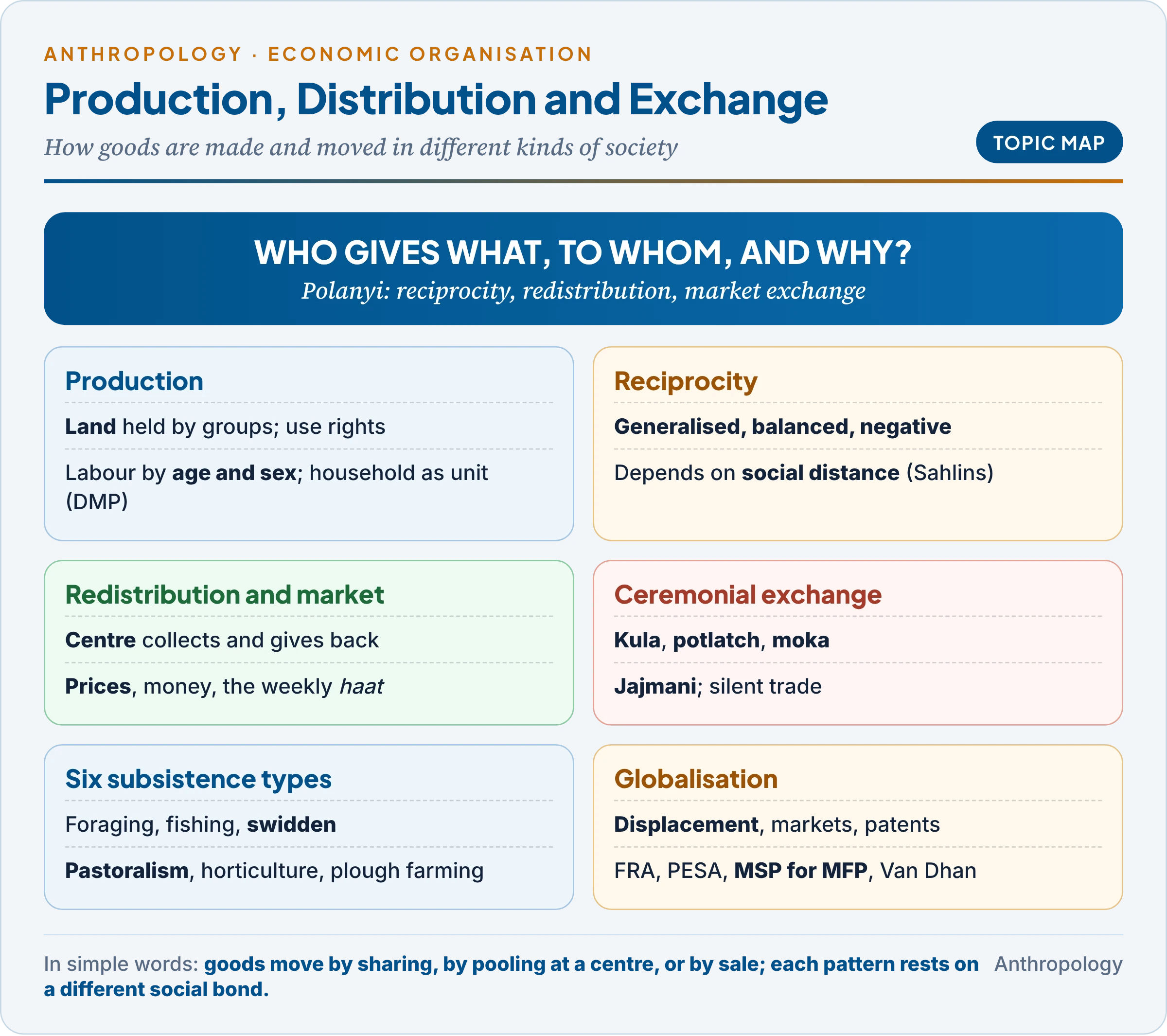
This article covers the second half of the syllabus line. Unit 3a explained what economic anthropology is and the formalist–substantivist debate: formalists hold that the logic of choice under scarcity applies everywhere, while substantivists, led by Karl Polanyi, hold that in non-market societies the economy is embedded in kinship, politics and religion. Here we use Polanyi’s three forms of integration to see how goods are actually produced and moved in different kinds of society.
1. Principles of Production
In simple words
Every society must decide who works, with what tools, on whose land, and who gets the result. In small-scale societies these decisions are made mostly by kinship, age and sex, not by wages and prices. The household is usually the main unit that both produces and consumes.
Example first. Among the Birhor (Jharkhand), a small forest people studied by the pioneering Indian anthropologist S.C. Roy (The Birhors, 1925), men net monkeys and small game and both sexes make rope from forest creepers. The rope is not used up at home: it is carried to neighbouring villages and exchanged for rice. Production, here, depends on free access to the forest, on family labour and on a steady exchange partner, the settled farmer. These three elements, resources, labour and exchange, are the starting points of any economy.
1.1 Factors of production
- Land and resources. In most tribal societies land is held by a group (band, lineage, clan or village), while individuals hold use rights (usufruct: the right to use, not to sell).
- Among the Munda of Chotanagpur, the descendants of the lineage that first cleared a village hold its land as khuntkatti (land of the original clearers), a corporate right later recognised by the Chotanagpur Tenancy Act, 1908.
- Hunting and gathering grounds are marked by convention: a !Kung camp exploits the area within a day’s walk of its water hole.
- Labour. Work is organised by age, sex and kinship, not wages: men usually hunt, herd and plough; women gather, garden and process food. Full-time specialists (smiths, potters, priests) appear only where there is a surplus.
- Capital and technology. Capital is small (digging sticks, nets, boats, herds), and surplus goes into feasts and gifts, which act as levelling mechanisms that stop wealth building up in a few hands.
1.2 The domestic mode of production
Marshall Sahlins, the American anthropologist whose Stone Age Economics (1972) shaped this field, argued that small-scale economies are organised around the domestic mode of production (DMP): each household produces mainly for its own needs and stops when they are met.
- Under-production is normal: land and labour are rarely used to the full, because there is no incentive to produce for a market.
- Chayanov’s rule. The Russian agrarian economist A.V. Chayanov (1925) observed that a peasant household works harder when it has more consumers per worker (many children, old parents) and less hard when it has more workers. Production follows family needs, not profit.
- Why it matters: the DMP explains why chiefs and big men, who need a surplus for feasts, must pull households into producing more, which is one root of political power (Unit 4a).
2. Distribution and Exchange: Polanyi’s Three Forms
In simple words
Goods move between people in three main ways. They are shared or swapped between two parties (reciprocity), collected by a centre and handed out again (redistribution), or bought and sold at prices set by supply and demand (market exchange). Most societies use all three, but one usually dominates.
Distribution is the way goods are divided among members of a society; exchange is a transfer that creates an obligation to give something back. Polanyi’s three forms of integration are a way of classifying them:
| Form | Pattern of movement | Social basis | Typical setting |
|---|---|---|---|
| Reciprocity | Between two parties, back and forth | Symmetry of kin, friends, partners | Bands, tribes, households everywhere |
| Redistribution | To a centre and back out | A chief, temple or state | Chiefdoms, early states, welfare states |
| Market exchange | Between buyer and seller at prices set by supply and demand | Impersonal transactions, money | Peasant and industrial societies |
Each form needs a different social structure: reciprocity needs only two parties, redistribution a centre with authority, and market exchange money and impersonal rules. So the dominant form changes as societies grow complex, while older forms survive inside newer ones (gifts in families, taxes in states).
2.1 Reciprocity and Sahlins’ continuum
Example first. When an Aboriginal hunting party in Australia kills a kangaroo, the meat is not shared equally. Custom fixes the shares by kinship: the hind leg to the hunter’s brother, the tail to his father’s brother’s son, the loins and fat to his father-in-law, the ribs to his mother-in-law, the head to his wife, while the hunter keeps the least desirable parts. Among the Maler of the Rajmahal hills, a hunt is first offered to the forest deity, one leg goes to the sacred headman, another to the man who made the kill, and the rest is shared among the party, including families too ill to join. Reciprocity follows the map of kinship.
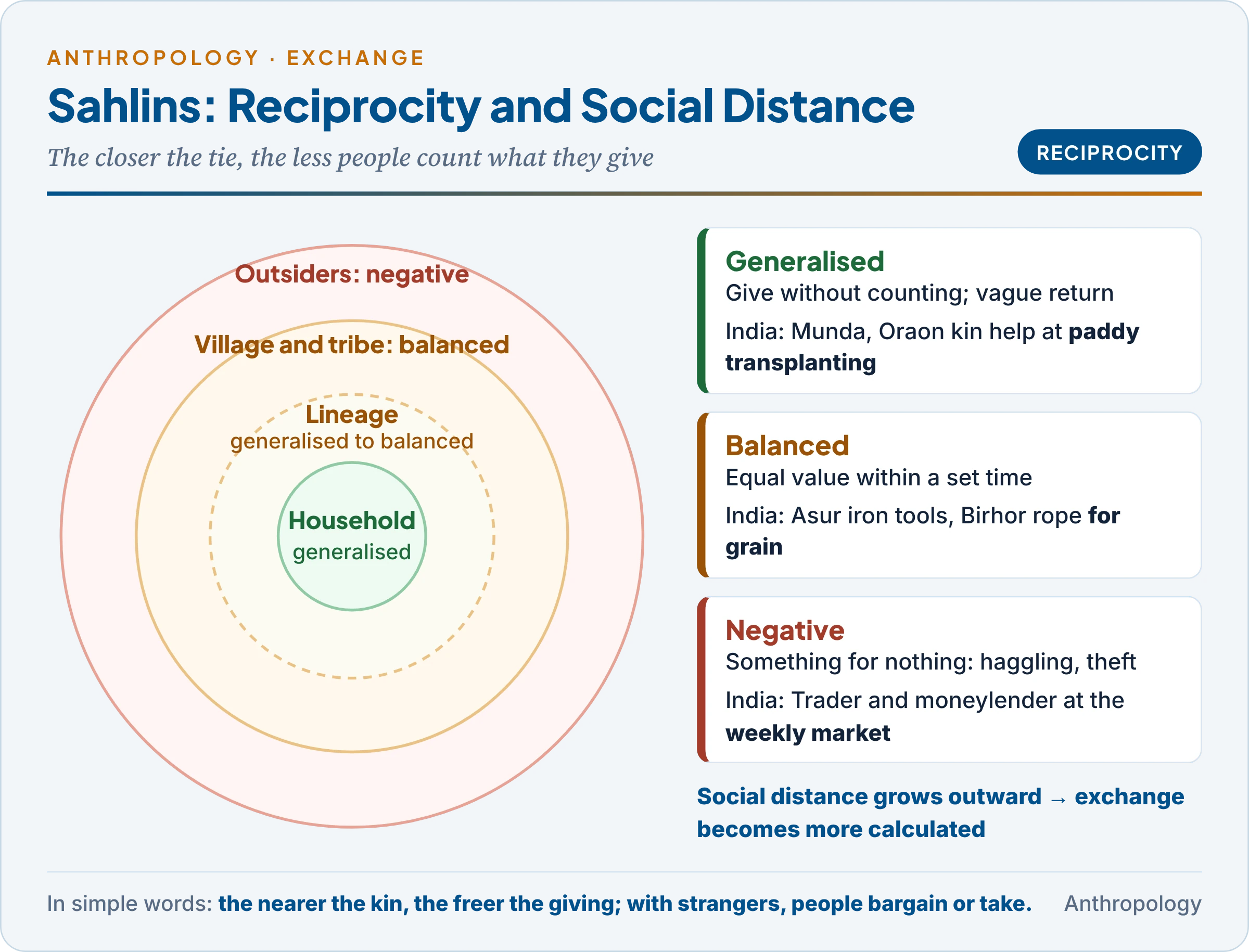
Sahlins (1965; Stone Age Economics, 1972) arranged reciprocity on a continuum of three types:
- Generalised reciprocity: giving without counting, with a vague obligation to return “when one can”. Examples: parents feeding children; food-sharing in a band.
- How it works: the return is not specified in time, quantity or quality, and failure to return does not stop the giving. Material value matters less than the relationship.
- Demand sharing. Among foragers, sharing is often initiated by the receiver: the anthropologist Nicolas Peterson (1993) showed that Australian Aboriginal people openly ask for, and are seldom refused, what others hold.
- Balanced reciprocity: a return of equivalent value within a definite time. Examples: exchange of gifts between two families at a marriage, trade partnerships, barter.
- How it works: both sides keep track of value, and a one-way flow is not tolerated. It is more economic and less personal than generalised reciprocity, and it is the standard way of making peace, alliances and marriages between groups.
- Negative reciprocity: trying to get something for nothing: haggling, cheating, theft, raiding.
- How it works: the two sides are opposed; the material gain is everything. It is practised mostly with strangers and enemies.
The key idea: social distance. Sahlins showed that the type of reciprocity depends on how close the parties are. Within the household it is generalised, within the village it tends to be balanced, and with outsiders it can turn negative. He drew this as concentric sectors: household, lineage, village, tribe, outsiders. Other factors shift the balance: rank (Polynesian chiefs must be generous, “to be noble is to be generous”), wealth (the rich are expected to give; Inuit hunters were known to give away so much that their own families went short) and scarcity (in a famine, sharing may contract to the household).
Indian illustrations:
- Generalised: among agricultural tribes such as the Munda, Oraon and Gond, near and distant kin help each other at paddy transplantation, and are rewarded only with food and rice beer (described by L.P. Vidyarthi, the Indian anthropologist of Chotanagpur, with B.K. Rai). The Oraon youth dormitory, the dhumkuria, works in villagers’ fields for token gifts.
- Balanced: in Chotanagpur, craft communities supply farming tribes: the Asur iron tools, the Birhor rope, the Mahli baskets, the Chik Baraik cloth, each in return for grain.
- Negative: at weekly markets, outside traders and moneylenders often bargain hard with tribal sellers, a relation of negative reciprocity that does not occur in exchanges between tribes.
Common confusion
Is reciprocity always an exchange of equal values? No. Only balanced reciprocity aims at equal value. Generalised reciprocity is giving with an open, uncounted obligation, as within a family, and negative reciprocity aims at getting more than one gives. Reciprocity names the two-way, person-to-person form of exchange, not equality.
2.2 Redistribution
Redistribution is the movement of goods to a central point (a chief, temple or government) and then back out to the members of the group.
- How it works: it needs a centre with authority to collect, and a surplus large enough to be worth collecting. This is why it is rare among foragers and common in chiefdoms and states. The centre may collect physical goods (grain stores) or only allocate rights (who harvests which field).
- Why it matters: it evens out shortages between regions and seasons, finances public works and ritual, and builds the power of the redistributor, because people come to depend on him.
- Examples:
- Trobriand chiefs received harvest gifts of yams (urigubu) from the brothers of their many wives, filled their yam houses and redistributed food at feasts.
- The Inca state of Peru collected labour tribute (mit’a) and goods, kept storehouses for famine, and built roads and terraces.
- In India, temples and the village grain heap of the jajmani system (§3.4) were redistributive centres; today the Public Distribution System under the National Food Security Act, 2013 is a state-scale form, as are progressive taxes and welfare in any modern state.
- Levelling mechanisms. In Mesoamerican peasant villages, the cargo system obliges wealthier men to sponsor costly saints’ fiestas; prestige is gained, but wealth is spent (Frank Cancian, Economics and Prestige in a Maya Community, 1965, on Zinacantan, Mexico).
2.3 Market exchange, money and tribal markets
Market exchange is buying and selling at prices that rise and fall with supply and demand. Each party tries to gain at the other’s expense, so the relationship is impersonal; for the same reason markets allow exchange between strangers.
Market-place and market principle. Paul Bohannan and George Dalton (Markets in Africa, 1962) separated the market-place (a physical site) from the market principle (price-setting by supply and demand) and identified three kinds of society:
| Type | Market-place | Market principle | Example |
|---|---|---|---|
| Marketless | Absent | Absent | Foraging bands |
| Peripheral markets | Present | Affects only a few goods; land and labour are not sold | Most tribal and peasant economies |
| Market-dominated | Present or not | Governs land, labour and most goods | Industrial economies |
A weekly tribal market is therefore not a “small capitalism”: goods are sold there, but land, labour and livelihood are still secured through kinship and custom. Peasant economies differ from tribal ones in being more deeply drawn into markets, money and the demands of a state.
Money. Money performs three functions: medium of exchange, standard of value and means of payment. General-purpose money (the rupee) does all three for everything; special-purpose money (cowries, cattle, shell valuables) serves only some functions for some transactions.
- Spheres of exchange. Bohannan found among the Tiv of Nigeria (1955; 1959) three ranked spheres: subsistence goods (food, tools), prestige goods (cattle, brass rods, a special white cloth) and rights in people (above all, women in marriage). Goods were not supposed to cross between spheres. When colonial general-purpose money arrived, it allowed food to be sold for cash and cash to buy prestige goods and brides, and the barriers between spheres broke down, which the Tiv experienced as moral disorder.
Tribal markets in India. The weekly haat is the centre of tribal exchange.
- Features: small lots, many sellers, much barter alongside cash, sellers who are also producers, and most produce never reaching the market at all.
- Social functions: the haat is also a place to meet kin, arrange marriages, settle disputes and court. The British anthropologist Alfred Gell, in “The Market Wheel” (Man, 1982), showed that the weekly market at Dhorai in Bastar was spatially ordered by caste and tribe, its layout mirroring rank, with higher-status traders towards the centre and tribal sellers towards the edge: the market was a map of the social hierarchy.
- Exploitation: middlemen and moneylenders buy forest produce cheaply and sell salt and cloth dear, which is the background to state schemes of fair-price procurement (§5).
Barter and silent trade. Barter is the direct exchange of goods without money. Silent trade (dumb barter) is barter without speech or face-to-face contact, used between groups who are wary or hostile.
- How it works: one party leaves goods at a recognised place and withdraws; the other inspects them, leaves goods in return and withdraws; if the first party accepts the amount, it takes the goods, otherwise it waits for more.
- Cases: Herodotus (5th century BCE) described Carthaginians trading for gold this way on the West African coast; the Veddas of Sri Lanka were reported to leave honey and meat in exchange for iron arrowheads.
3. Classic Systems of Ceremonial Exchange
In simple words
In many societies the most important exchanges are not about useful goods at all. People give shell necklaces, blankets or pigs to win fame, make allies and confirm rank. These ceremonial exchanges show that exchange is a way of building relationships and power.
3.1 The Kula ring
Bronislaw Malinowski, the Polish-born British pioneer of fieldwork, described the Kula in Argonauts of the Western Pacific (1922) from the Trobriand Islands (Massim region, off eastern New Guinea).
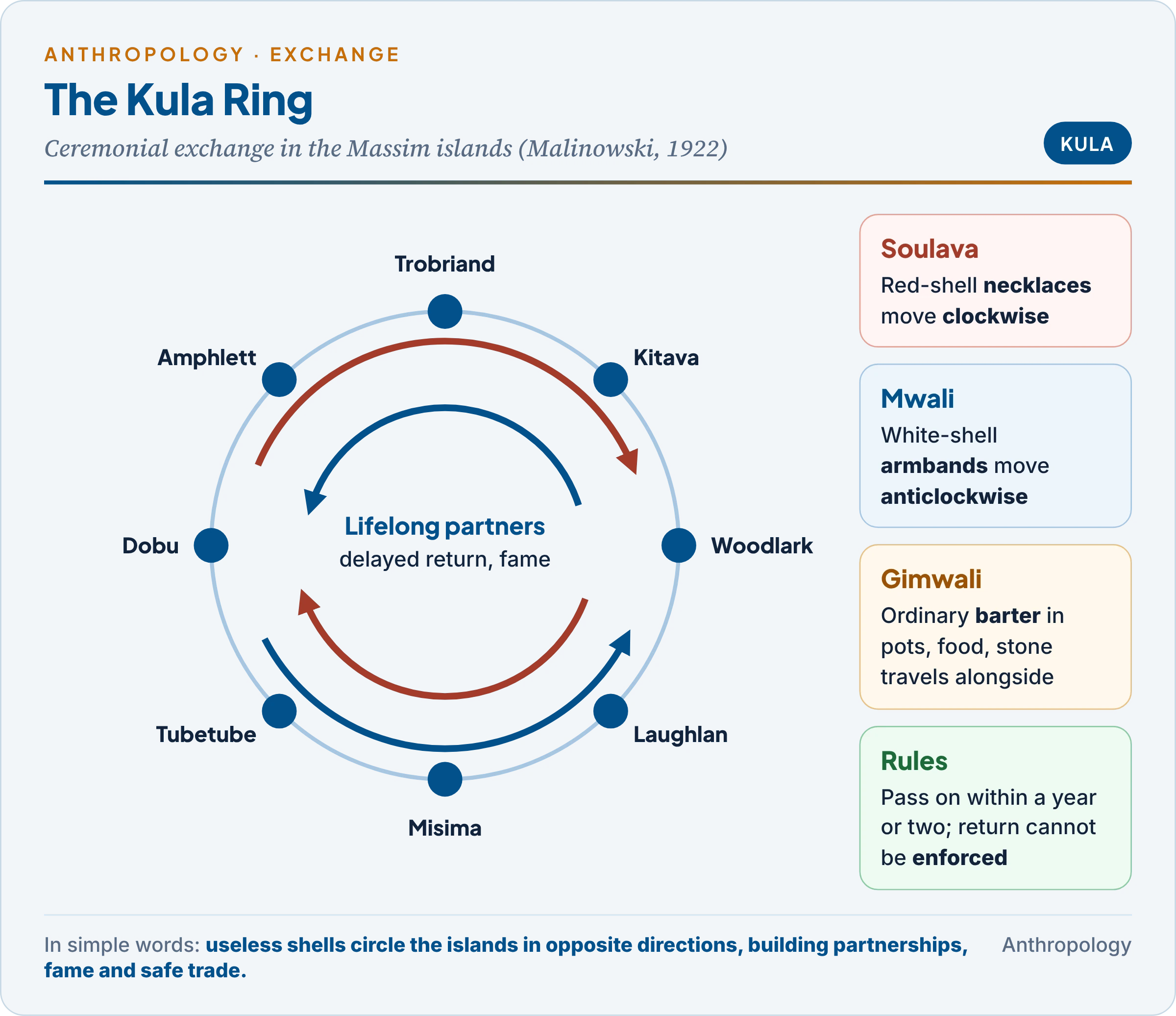
- What moves: two kinds of shell valuables (vaygu’a) with no practical use: long red-shell necklaces (soulava) travel clockwise round a ring of islands, and white-shell armbands (mwali) travel anticlockwise.
- Rules:
- Each man exchanges with lifelong partners: a necklace given now is answered later by an armband of matching value. “Once in the Kula, always in the Kula.“
- Valuables must be passed on within a year or two; a man who holds them too long is called “slow” and “hard”.
- The return cannot be enforced: it rests on honour and trust, so the Kula is a form of delayed balanced reciprocity.
- Chiefs have hundreds of partners, commoners only a few, so the network maps rank.
- What travels with it: voyages of 50 miles or more carry ordinary trade (gimwali, haggling barter) in pots, food and stone, which the Kula partnership makes safe. Kula is surrounded by myth and magic (canoe magic, beauty magic to make a partner generous).
Interpretations of the Kula (2022, 2024 questions):
| Scholar | Reading | What it adds |
|---|---|---|
| Malinowski (1922) | Functional: Kula meets social and psychological needs; a “total” institution tying trade, magic, myth and rank | Refuted “primitive economic man” (Unit 3a) |
| Marcel Mauss, French sociologist, The Gift (1925) | Kula is an agonistic total prestation: gifts carry obligations to give, receive and return | Gift as the basis of social contract |
| J.P. Singh Uberoi, Indian anthropologist, Politics of the Kula Ring (1962) | Political: in islands without a state, the Kula creates alliances, peace and leadership across communities | Exchange as a substitute for government |
| Annette Weiner, American anthropologist (1976; 1992) | Malinowski missed women’s wealth (banana-leaf bundles) and the logic of “keeping-while-giving”: some valuables are kept to anchor identity | Gender and inalienable possessions |
| Nancy Munn, The Fame of Gawa (1986) | Value is created as fame that spreads a person’s name across space and time | Exchange as creation of value and identity |
| C.A. Gregory, Gifts and Commodities (1982) | Kula is a gift economy: it creates relations between persons, whereas commodities create relations between things | Gift–commodity contrast |
Each reading adds a layer (obligation, politics, gender, value) that a purely economic account misses: the Kula is not mainly economic. Its cultural relevance lies here: it still runs today, with money moving alongside, because it remains the way people make names and alliances.
3.2 The potlatch
The potlatch (Chinook trade jargon: “to give”) was the great feast of the Northwest Coast peoples of North America, best known among the Kwakiutl (Kwakwaka’wakw) of British Columbia and also held by the Haida and Tlingit, studied by Franz Boas from the 1880s.
- What happened: a chief, backed by his kin group (numaym), invited rival groups, recited his genealogy and his claim to a name, title or privilege, and gave away blankets, food, canoes and coppers (engraved copper shields, each with a name and value). Each guest received gifts according to rank, and by accepting them witnessed and validated the claim.
- Rivalry potlatches: in the late 19th century rivals tried to outgive each other and even destroyed coppers and blankets to shame an opponent, who had to return more or lose face.
- Ban: Canada banned the potlatch from 1885 to 1951 as wasteful; it has since revived.
Interpretations:
- Ruth Benedict, Patterns of Culture (1934): a “Dionysian”, megalomaniac culture obsessed with rank (psychological reading).
- Helen Codere, Fighting with Property (1950): the destructive potlatch was a colonial product; trade wealth inflated, and rivalry in gifts replaced warfare, which colonial rule had suppressed.
- Ecological reading: Wayne Suttles (1960), Stuart Piddocke (1965) and Marvin Harris (1974) argued that salmon runs and harvests varied sharply between villages; the potlatch moved food from places of plenty to places of shortage and converted temporary surplus into lasting prestige. Piddocke argued that it arose from scarcity, not surplus, as a survival mechanism.
The potlatch is therefore redistribution and reciprocity at once: goods flow from a centre (the host chief), but guests must return the gift at a later potlatch. It also shows how conspicuous consumption, a term of the American economist Thorstein Veblen (1899) for spending to display status, turns wealth into power, a theme continued in Unit 4a.
3.3 The moka
The moka is the competitive exchange of the Melpa of Mount Hagen, Papua New Guinea, described by the British anthropologist Andrew Strathern in The Rope of Moka (1971).
- How it works: a man gives pigs (and later shells, money and even trucks) to a partner, who must later return more than he received. The “increment” is what makes the giver famous.
- Who leads it: big men, who build up wealth through their wives’ pig-rearing and their followers’ contributions, and win followers by generous giving.
- What it proves: in societies without chiefs, exchange creates leadership: a big man’s power lasts only as long as his gifts. This is the base of Sahlins’ contrast between big men and chiefs (Unit 4a).
3.4 The jajmani system
The jajmani system was the hereditary exchange of services for a share of the harvest between landowning patron castes (jajman) and service castes (kamin: barber, washerman, potter, carpenter, priest) in Indian villages. It was named and first described by the American missionary-sociologist W.H. Wiser in The Hindu Jajmani System (1936), from Karimpur in Uttar Pradesh.
- Features:
- The tie is hereditary and permanent: rights to serve a family pass from father to son and can be divided among heirs.
- Payment is in kind: fixed shares of grain at harvest, food and clothing at festivals and life-cycle rites.
- It is multi-stranded: economic, ritual and political at once, with the kamin often treated as part of the patron’s household.
- Readings:
- Integrative: Wiser and later functionalists saw mutual interdependence and security for all.
- Exploitative: T.O. Beidelman, A Comparative Analysis of the Jajmani System (1959), argued it was a feudal, coercive system that benefited landowners.
- Ritual: Louis Dumont related it to purity and pollution, since service castes removed impurity for the higher castes.
- Critical: C.J. Fuller (“Misconceiving the grain heap”, 1989) argued that “jajmani” was an anthropologists’ model: real villages mixed customary shares, wages and market exchange.
- Decline: cash wages, markets and migration eroded it from the mid-20th century, as studies by Oscar Lewis, Pauline Kolenda and S.C. Dube (Indian Village, 1955) traced.
The four exchange systems are compared below; read across each row to see what moves, who leads, and what the exchange achieves.
| System | People and place | What moves | Form | What it achieves |
|---|---|---|---|---|
| Kula | Trobriand and Massim islands (Malinowski) | Shell necklaces and armbands | Delayed balanced reciprocity | Partnerships, fame, safe trade |
| Potlatch | Kwakiutl, Northwest Coast (Boas) | Blankets, coppers, food | Redistribution + competitive reciprocity | Validates rank and titles |
| Moka | Melpa, Mount Hagen (Strathern) | Pigs, shells, money | Competitive reciprocity with increment | Makes big men |
| Jajmani | North Indian villages (Wiser) | Services for grain shares | Redistribution within caste hierarchy | Hereditary interdependence |
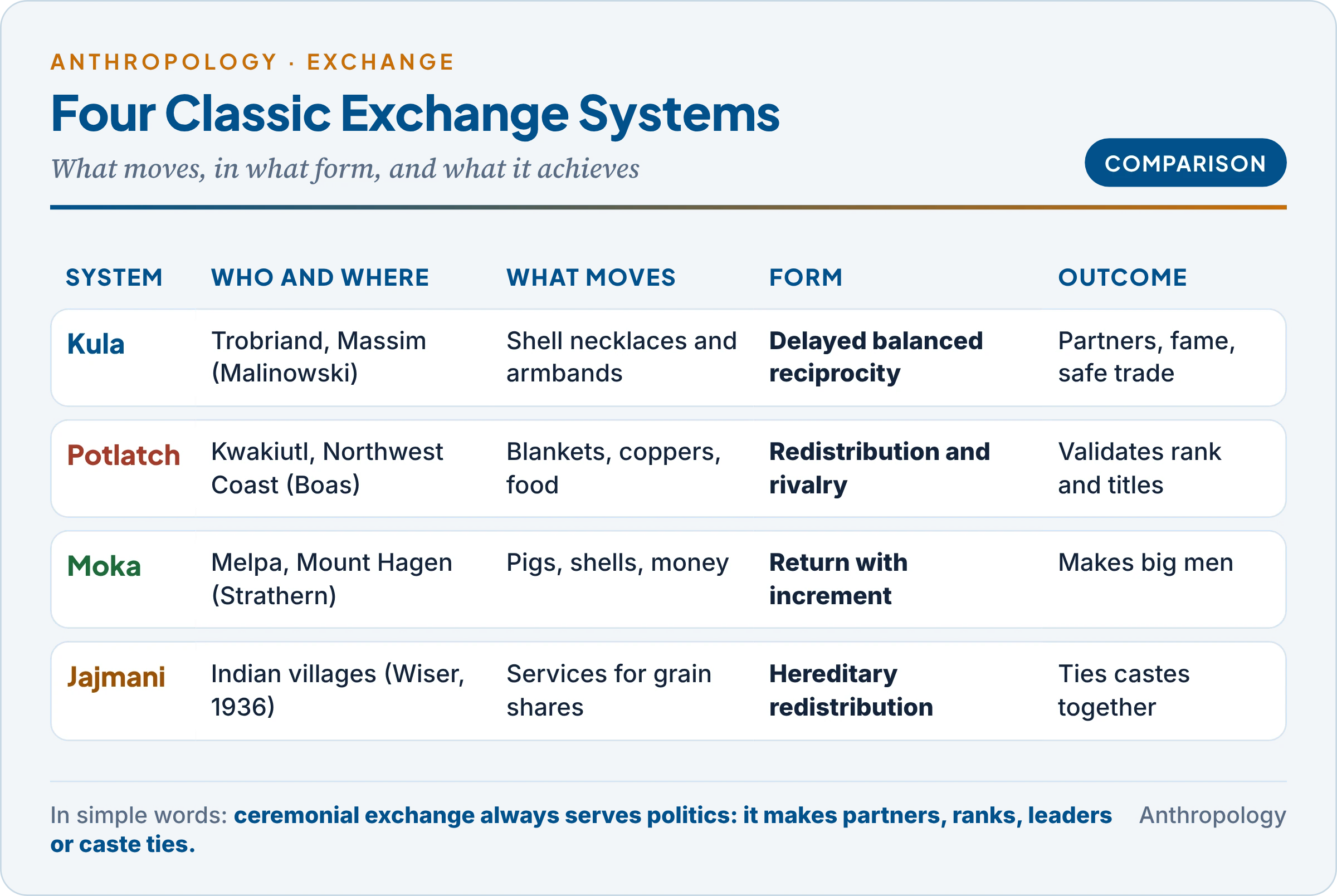
The table shows that ceremonial exchange always serves politics: it creates partners (Kula), ranks (potlatch), leaders (moka) or a hierarchy of castes (jajmani). Its “economic” side is real, but secondary.
4. Production and Exchange in Six Subsistence Types
In simple words
How people get their food shapes almost everything else: how often they move, how big their groups are, whether they store surplus, and how they share. Foragers share widely, herders and farmers store and trade, and plough farmers create the largest surpluses and the sharpest inequality.
Anthropologists group subsistence into food-collecting (hunting-gathering, fishing) and food-producing (swidden and horticulture, pastoralism, plough agriculture) economies. Food production began about 10,000 years ago in several regions; before that all humans were foragers. The sequence is not a ladder that every society climbed: many peoples combine modes (Munda and Oraon farmers still hunt and gather; herders trade with farmers).
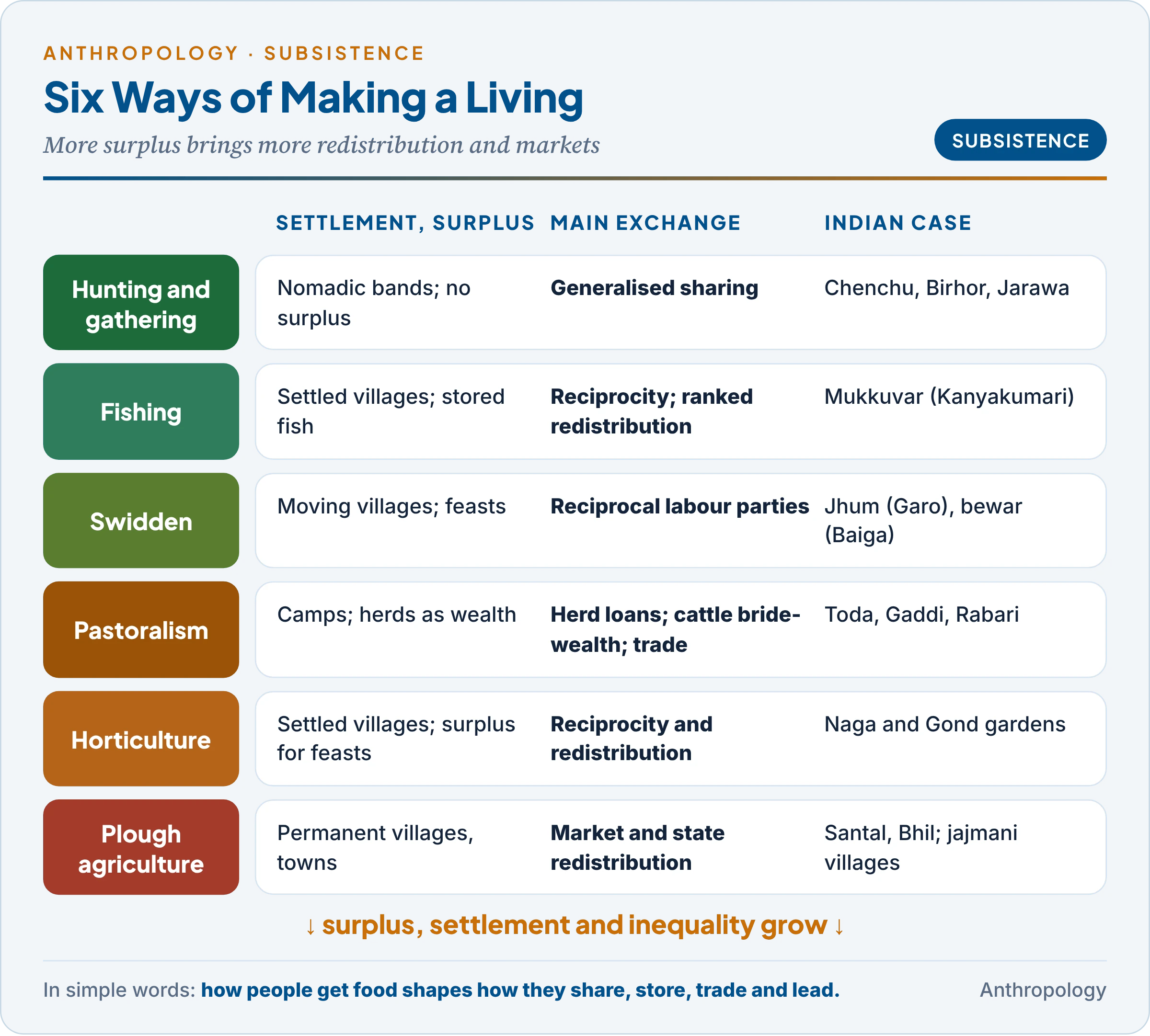
The table summarises the principles; the sub-sections explain each type with a case.
| Type | Settlement and group size | Surplus and trade | Dominant exchange | Leadership |
|---|---|---|---|---|
| Hunting and gathering | Nomadic bands of 25–50 | Little storage, little trade | Generalised reciprocity | Informal, by skill |
| Fishing | Often sedentary villages | Stored fish; trade | Reciprocity and ranked redistribution | Formal on rich coasts |
| Swidden (shifting) | Villages that move every few years | Modest; feasts | Reciprocal labour exchange | Headmen, councils |
| Pastoralism | Nomadic or transhumant camps | Livestock as wealth; trade with farmers | Herd loans; bride-wealth in cattle | Lineage elders; chiefs in war |
| Horticulture | Settled villages | Surplus for feasts | Reciprocity and redistribution | Big men, chiefs |
| Plough agriculture | Permanent villages, towns | Large surplus; markets | Market and state redistribution | Landlords, states |
Read down the columns: as surplus and settlement grow, exchange moves from sharing to redistribution and markets, and leadership from informal to formal, the economic basis of the band–tribe–chiefdom–state sequence (Unit 4a).
4.1 Hunting and gathering
- Principles:
- Nomadism within a known territory, low density, small bands.
- Collective ownership of land and free access to resources; individual ownership of tools.
- Division of labour by sex and age only.
- Generalised reciprocity: food, especially meat, is shared across the band. Sharing is insurance: a hunter who is lucky today will be unlucky tomorrow, so sharing pools risk.
- No surplus and little storage; egalitarian politics.
- The “original affluent society”. Data from the Canadian anthropologist Richard Lee on the !Kung San (Ju/’hoansi) of the Kalahari (1968) showed adults spending only about two and a half days a week on getting food, for an intake of about 2,140 kcal per person per day, much of it from mongongo nuts. Sahlins (1966; 1972) concluded that foragers were “affluent” because their wants were few and easily met. Critics noted that Lee’s figures left out food processing, and that the !Kung had long traded with herders.
- Indian cases: the Chenchu of the Nallamalai hills (studied by Christoph von Fürer-Haimendorf, Austrian ethnographer of Indian tribes, The Chenchus, 1943), the Birhor, Kadar, Paliyan, Nayaka, and the Jarawa, Onge and Sentinelese of the Andaman Islands. Most combine foraging with trade in forest produce (honey, resin, rope) and wage work.
4.2 Fishing
- Principles:
- Rich waters allow permanent settlements and higher densities; on the Northwest Coast, villages reached hundreds or more.
- Technology is elaborate (boats, nets, harpoons, weirs) and specialisation grows: boat-builders, net-makers.
- Dried and smoked fish can be stored and traded, so fishing peoples can accumulate surplus and rank, as the potlatch (§3.2) shows.
- Cases:
- The Trobriand coastal villages exchanged fish for inland yams in a regular partnership (wasi), each side bound to supply the other.
- Mukkuvar fishers of the Kanyakumari coast (Tamil Nadu), studied by Kalpana Ram (Mukkuvar Women, 1991): men fish, while women manage marketing, credit and the household economy, a case where fishing reshapes gender roles.
4.3 Swidden (shifting cultivation)
Swiddening (slash-and-burn) means clearing a patch of forest, burning the dried vegetation so the ash fertilises the soil, cropping it for one to three years, and leaving it fallow for many years while the forest regrows.
- Principles:
- Land belongs to the village or clan; plots are allotted each year by the council or headman.
- Clearing and harvest need reciprocal work parties: households help each other in turn and are fed with food and beer.
- Ritual marks each stage (choosing the site, burning, sowing, harvest), so production, religion and politics are fused.
- Is it wasteful? The American anthropologist Harold Conklin, in his study of the Hanunóo of the Philippines (1957), showed that swidden is a sophisticated, ecologically sound system when fallows are long (often over 10 years). It degrades the land only when population pressure or loss of forest shortens the fallow.
- Indian cases: jhum in the north-east (Garo, Naga, Mizo), podu in Odisha and Andhra (Saora, Juang, Kondh), bewar among the Baiga of central India, who held (as Verrier Elwin recorded in The Baiga, 1939) that ploughing would scratch the breast of Mother Earth. Forest laws from the colonial period onwards restricted it.
4.4 Pastoralism
Pastoralism is a livelihood based on herding domesticated animals, in lands too dry, cold or steep for farming.
- Where: Central Asia (Kazakh, Kirghiz, Mongol horse and sheep herders), the Tibetan plateau (yak), the Arctic (Chukchi and Saami reindeer herders) and East Africa (Nuer, Dinka, Maasai cattle-keepers).
- Forms: nomadism (whole households move with the herds, as among the Basseri of southern Iran, studied by Fredrik Barth, Nomads of South Persia, 1961) and transhumance (herders move seasonally between fixed pastures while the home village stays put).
- Principles:
- Livestock are wealth, money and social bonds. Among the Nuer of Sudan, described by E.E. Evans-Pritchard (The Nuer, 1940), cattle are given as bride-wealth and blood-compensation and supply personal names and sacrifices: social life is lived “through cattle“.
- Rights to pasture and water are held by lineages or tribes and negotiated along migration routes.
- Risk-spreading: herders lend animals to friends and kin, so that a disease or raid does not wipe out a household’s herd.
- Dependence on farmers: herders exchange animals, milk, wool and dung for grain; most pastoral societies are tied to farmers by trade.
- Indian cases (2019 question):
- The Toda of the Nilgiris (W.H.R. Rivers, The Todas, 1906) built their economy and ritual round buffaloes, with a ranked system of sacred dairies.
- The Nilgiri interdependence, studied by the American anthropologist David Mandelbaum (1941), linked four peoples: Toda (ghee, buffaloes), Badaga (grain), Kota (music, iron tools, pottery) and Kurumba (forest produce, and protection by sorcery). Toda–Kota ties were friendly, Kota–Badaga ties competitive, and the feared Kurumba took more than they gave: all three forms of reciprocity in one region.
- Gaddi shepherds of Himachal Pradesh move sheep and goats between winter pastures and the high Dhauladhar meadows; Bakarwal and Gujjar herders of Jammu and Kashmir, Rabari (Raika) camel herders of Rajasthan and Gujarat, and Van Gujjar buffalo herders of Uttarakhand follow similar circuits.
- Pressures: shrinking common grazing, forest closures, and the expansion of farming. The Forest Rights Act, 2006 recognises seasonal grazing rights of pastoral communities.
4.5 Horticulture
Horticulture is cultivation with hand tools (digging stick, hoe) without the plough or irrigation, in gardens that may be permanent or shifting. Swidden is its extensive form.
- Principles:
- Settlements are more permanent and larger than foragers’; land is held by lineages or villages.
- Women often supply most of the farm labour.
- Gardens yield a surplus that is spent on feasts, pigs and ceremonial exchange, so horticulture supports big men and chiefs.
- Cases:
- Trobriand yam gardens: a man grows his finest yams for his sister’s husband (urigubu), displaying them in yam houses; chiefs, with many wives, receive the most and redistribute it.
- Tsembaga Maring of New Guinea: the American anthropologist Roy Rappaport (Pigs for the Ancestors, 1968) showed that the kaiko pig festival, held when pig herds grew too large for the gardens, regulated the balance between people, pigs and land, a ritual cycle doing ecological work.
- India: many Naga and Gond communities combine hoe gardening with swidden.
4.6 Plough agriculture and peasant economy
Agriculture in the narrow sense uses the plough, draught animals, irrigation and manure to farm the same land year after year.
- Principles:
- Sedentary, dense populations; villages and towns.
- Private or family ownership of land, which can be inherited, mortgaged and sold.
- High specialisation: artisans, traders, priests, all fed from the surplus.
- Market exchange and state taxation become central; the producer is a peasant.
- Inequality in land and wealth grows, and wealth follows power.
- The peasant. Eric Wolf, the Austrian-born American anthropologist, Peasants (1966), defined peasants as rural cultivators whose surplus is transferred to a dominant group of rulers. A peasant household must set aside a replacement fund (seed, tools), a ceremonial fund (weddings, festivals) and a fund of rent (taxes, rent, interest).
- Moral economy versus rational peasant. The American political scientist James C. Scott (The Moral Economy of the Peasant, 1976) argued that peasants follow a “safety-first” principle and defend a right to subsistence, rebelling when it is violated. Samuel Popkin (The Rational Peasant, 1979) replied that peasants are calculating investors. This repeats the substantivist–formalist split (Unit 3a) at village level.
- Indian cases: Santal, Munda, Oraon, Ho, Bhil and Gond plough farmers who still gather forest produce; caste villages organised by jajmani (§3.4).
5. Globalisation and Indigenous Economic Systems
In simple words
Globalisation links every local economy to world markets, companies and laws. For indigenous peoples it brings new incomes and new allies, but also loss of land, forests and control over their own resources. The outcome depends on whether communities have rights and a voice.
Example first. In the 2000s the London-listed company Vedanta planned to mine bauxite on the Niyamgiri hills of Odisha, which the Dongria Kondh worship as the seat of their god Niyam Raja and use for shifting cultivation and fruit gardens. On 18 April 2013, in Orissa Mining Corporation v. Ministry of Environment and Forests, the Supreme Court held that the gram sabhas (village assemblies) must decide whether mining would harm their religious and forest rights. All twelve gram sabhas consulted that year rejected the mine. A global commodity chain had met an indigenous economy embedded in religion, and the law gave the local community the decisive voice.
How globalisation affects indigenous economies:
- Loss of land and resources. Mines, dams and industries are concentrated in forest and tribal regions. The Indian sociologist Walter Fernandes estimated that about 40% of the people displaced by development projects in India were tribals, though they are under a tenth of the population. Displacement destroys the land and forest base of reciprocity.
- Monetisation and individualisation. Cash, wage work and individual land titles replace common property and reciprocal labour; elites within the community may appropriate land, and Fernandes noted a decline in tribal women’s status as women lose control over common resources.
- Commodification of knowledge. Global patent rules let companies claim traditional knowledge of plants. A counter-case: the Kani of Kerala shared knowledge of the arogyapacha plant used in the drug Jeevani, and a Kani trust received a share of the licence fees (late 1990s), an early benefit-sharing model.
- Migration to plantations and cities brings remittances but weakens village labour exchange; consumerism spreads, and many tribal movements answer with a “cultural revival” of their values of sharing and equity (Fernandes).
Not only victims. Indigenous peoples are not passive. Sahlins (“Cosmologies of Capitalism”, 1988) showed how peoples indigenise the world system, using trade goods and cash for their own ends, as the Melpa used money in the moka. Indigenous groups also use global networks (the UN Declaration on the Rights of Indigenous Peoples, 2007; fair-trade and organic markets) to defend their rights.
Indian policy responses that try to let tribal economies benefit from markets on fair terms:
- Forest Rights Act, 2006: recognises the right of ownership, access to collect, use and dispose of minor forest produce (MFP), and community forest resource rights. Mendha-Lekha in Gadchiroli (Maharashtra) was among the first villages to receive community forest rights and, in 2011, the first to harvest and sell its own bamboo.
- PESA, 1996: gives gram sabhas in Fifth Schedule areas ownership of minor forest produce.
- MSP for MFP (from 2013–14): the state buys MFP at a minimum support price, now notified for 87 items; about 2.68 lakh tonnes worth Rs 694 crore had been procured by 2026 (PIB, August 2026).
- Pradhan Mantri Van Dhan Yojana (launched 14 April 2018 at Bijapur, Chhattisgarh): community-owned Van Dhan Vikas Kendras process and market forest produce; 4,172 kendras covering about 12.48 lakh tribal members had been sanctioned by August 2026. These two schemes now run under the Pradhan Mantri Janjatiya Vikas Mission.
Evaluation. These measures try to replace negative reciprocity at the haat with fair prices and restore community control, but FRA claims are often rejected or delayed and procurement covers only part of what is collected.
Key Terms
| Term | Meaning in simple words |
|---|---|
| Forms of integration | Polanyi’s three ways goods move: reciprocity, redistribution, market |
| Generalised reciprocity | Giving without counting, with a vague duty to return |
| Balanced reciprocity | Exchange of equal value within a set time |
| Negative reciprocity | Trying to get something for nothing |
| Redistribution | Goods collected by a centre and handed out again |
| Market principle | Prices set by supply and demand |
| Special-purpose money | Money used only for some kinds of exchange |
| Spheres of exchange | Ranked classes of goods that should not be exchanged for each other |
| Silent trade | Barter without speech or meeting face to face |
| Kula | Trobriand ring exchange of shell necklaces and armbands |
| Potlatch | Northwest Coast feast that gives away wealth to validate rank |
| Moka | Melpa competitive pig exchange that makes big men |
| Jajmani | Hereditary exchange of caste services for grain shares |
| Domestic mode of production | Household production aimed at its own needs |
| Swidden | Slash-and-burn cultivation with long fallows |
| Transhumance | Seasonal movement of herds between fixed pastures |
| Minor forest produce | Non-timber forest products such as honey, lac, tendu leaves |
Contemporary Developments
- Van Dhan and MSP for MFP: by August 2026, 4,172 Van Dhan Vikas Kendras had been sanctioned and MSP notified for 87 minor forest products, both under the Pradhan Mantri Janjatiya Vikas Mission; PIB notes that many tribal households earn 20–40% of their annual income from MFP.
- Gram sabha consent: the Niyamgiri judgment (2013) remains the leading precedent that forest-dwelling communities must be consulted on projects affecting their religious and economic life.
- Community forest rights: villages such as Mendha-Lekha show the FRA turning collectors into managers and sellers of forest produce.
- Pastoral rights: the FRA’s recognition of seasonal grazing rights is used by Gaddi, Van Gujjar and Rabari herders against forest closures.
Diagrams to Master
- Topic map of the article.
- Reciprocity continuum (§2.1): draw concentric sectors (household, lineage, village, tribe, outsiders) and label generalised, balanced and negative reciprocity.
- Kula ring (§3.1): a circle of islands; label soulava clockwise, mwali anticlockwise, and gimwali barter alongside.
- Ceremonial exchange compared (§3.4): Kula, potlatch, moka, jajmani by goods, form and outcome.
- Subsistence and exchange matrix (§4): six types with surplus, dominant exchange and an Indian case.
Revision Grid
| Scholar | Work (year) | Key idea |
|---|---|---|
| Malinowski | Argonauts of the Western Pacific (1922) | Kula ring; exchange embedded in magic and rank |
| Mauss | The Gift (1925) | Obligation to give, receive, return |
| Wiser | The Hindu Jajmani System (1936) | Hereditary service for grain shares |
| Evans-Pritchard | The Nuer (1940) | Cattle as wealth and social bond |
| Codere | Fighting with Property (1950) | Potlatch as rivalry replacing war |
| Bohannan | 1955; 1959 | Tiv spheres of exchange broken by money |
| Conklin | 1957 | Swidden as sound ecology |
| Beidelman | 1959 | Jajmani as feudal exploitation |
| Bohannan and Dalton | Markets in Africa (1962) | Marketless, peripheral, market-dominated |
| Uberoi | Politics of the Kula Ring (1962) | Kula as political system |
| Piddocke | 1965 | Potlatch as survival under scarcity |
| Wolf | Peasants (1966) | Replacement, ceremonial and rent funds |
| Lee | 1968 | !Kung work little, eat well |
| Rappaport | Pigs for the Ancestors (1968) | Ritual regulates ecology |
| Strathern | The Rope of Moka (1971) | Competitive exchange makes big men |
| Sahlins | Stone Age Economics (1972) | Reciprocity continuum; DMP; affluent foragers |
| Scott; Popkin | 1976; 1979 | Moral economy versus rational peasant |
| Weiner | 1976; 1992 | Women’s wealth; keeping-while-giving |
| Gell | “The Market Wheel” (1982) | Tribal market as social map |
| Gregory | Gifts and Commodities (1982) | Gift economy versus commodity economy |
| Munn | The Fame of Gawa (1986) | Exchange creates fame and value |
| Fuller | 1989 | Jajmani as a misleading model |
Previous Year Questions
Unit 3: Production, distribution and exchange; subsistence types; globalisation
- 2024Write notes on: Cultural relevance of the Kula.
- 2023Discuss the impact of globalization on the economic systems of indigenous communities.
- 2022Critically examine various anthropological interpretations about the Kula Ring.
- 2021Write notes on : Modes of Subsistence.(in about 150 words).
- 2019Write a note in 150 words on Pastoralism in India.
- 2019Discuss how indigenous people encounter globalization.
- 2018Write the characteristics of hunting and gathering economy.
- 2017With the help of appropriate examples,explain the various forms of exchange system.
- 2016Discuss the principles governing production, distribution and exchange in simple societies.
- 2015Write a note in 150 words on Horticulture.
- 2013Discuss the impact of globalization on tribal economy. (350 words).
- 2005Write a note on Trade and Barter.
- 2004Write a note on Ceremonial Exchange.
- 2003Write a note on Kula Ring.
- 2003“Primitive economic organization has several peculiar features relating to the production, consumption, distribution and exchange.” Discuss the above statement by providing appropriate illustrations.
- 1997Delineate the meaning and scope of economic anthropology and discuss the principle that govern production, distribution and consumption in hunting and gathering communities.
- 1994Describe the economic organization of gathering hunting tribes..Illustrate your answer from that of Indian situation.
- 1992Define market. Discuss the nature and role of market in tribal Countries.
- 1988Write a note on Tribal Markets.
- 1988Discuss the role of reciprocity and redistribution in tribal economy with examples.
- 1987Discuss the meaning and scope of economic anthropology. Explain the method of exchange in the context of simple societies.
- 1985Social processes function to coordinate economic exchange and redistribution.Discuss.
- 1982Distinguish the modes of exchange in primitive society from those of the peasant society.
Related questions from other units
- 2025Unit 1.8: What are the major theories proposed in support of the origin of food production? How the change in subsistence economy brought revolution during this period?
- 2023Unit 6: Critically examine Arjun Appadurai’s conceptualization of global cultural economy.
- 2022Unit 6: Discuss the approaches of Leslie White, Julian Steward and Marshall Sahlins in the light of cultural evolution.
- 2020Unit 4: How is the construct of power linked to the notion of conspicuous consumption and its impact on distributive justice?
- 2016Unit 6: How do the concepts of binary opposites and exchange figure in Levi-Strauss’ structural analysis of kinship?
- 2011Unit 2.2: Discuss different modes of exchange in simple societies with suitable examples.
- 1983Unit 13: Reciprocity and redistribution inhibit social conflict in primitive society. Discuss.
- 1981Unit 2.3: “Marriage payments are an example of reciprocity between two social groups.” Elaborate. (200 words).