

4 Political organization and Social Control: Band, tribe, chiefdom, kingdom and state; concepts of power, authority and legitimacy; social control, law and justice in simple societies.
Official Syllabus: Paper I, Unit 4 (band, tribe, chiefdom, kingdom and state; power, authority and legitimacy)
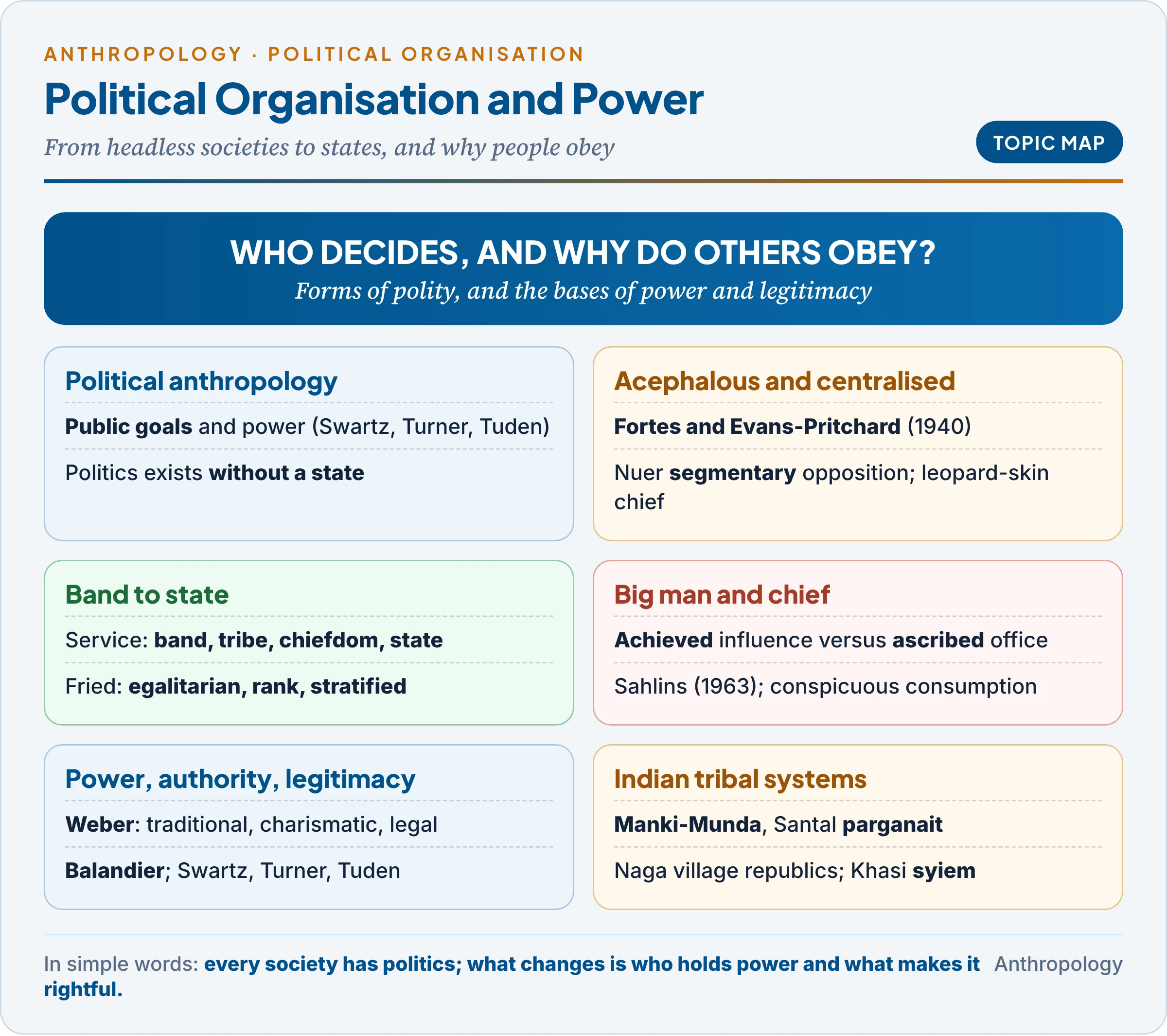
This article covers the first two items of the syllabus line: the forms of political organisation and the concepts of power, authority and legitimacy. Social control, law and justice in simple societies follow in Unit 4b.
1. Political Anthropology: Meaning and Scope
In simple words
Every society has to decide things for the group, settle quarrels and deal with outsiders, so every society has politics, even one with no chief or government. Political anthropology studies how this is done, from small bands that decide by talking it out to large states with armies and courts.
Example first. The Nuer of southern Sudan, some 200,000 cattle-herders in the 1930s, had no chief, court, police or army. Yet feuds were settled, raids organised and the peace mostly kept. How? That question, posed by the British anthropologist E.E. Evans-Pritchard in The Nuer (1940), shows the starting point of political anthropology: order without a state is possible, and politics must be looked for outside formal government.
- Definition. Marc Swartz, Victor Turner and Arthur Tuden (Political Anthropology, 1966) defined the field as “the study of the processes involved in determining and implementing public goals and in the differential achievement and use of power by the members of the group concerned with those goals”. Politics on this view has three marks:
- it is public, not private;
- it concerns goals for which there is competition;
- it involves differences of power.
- Polity. A polity (from Greek polis) is a political community: a group with a territory, an organisation of sub-units, leaders, rules for making decisions, and relations with other polities.
- Development of the field:
- 1940: Meyer Fortes and Evans-Pritchard, African Political Systems, founded the comparative study of political systems (§2).
- 1950s–60s: Edmund Leach, Political Systems of Highland Burma (1954), showed systems changing; Max Gluckman and the Manchester school studied conflict; F.G. Bailey (Stratagems and Spoils, 1969) studied politicians as players of a game.
- 1960s: neo-evolutionists (Service, Fried) classified political types (§3); Georges Balandier made power the core of a dynamic political anthropology (§5).
- 1970s onwards: Clifford Geertz‘s Negara: The Theatre State in Nineteenth-Century Bali (1980) studied the symbolism of power; later work drew on Foucault (power in everyday life) and Gramsci (hegemony).
2. Acephalous and Centralised Political Systems
In simple words
Some societies have a central ruler with officials and courts. Others have no ruler at all, and order comes from the balance between groups of kin. Anthropologists call the first kind centralised and the second kind acephalous, which means headless.
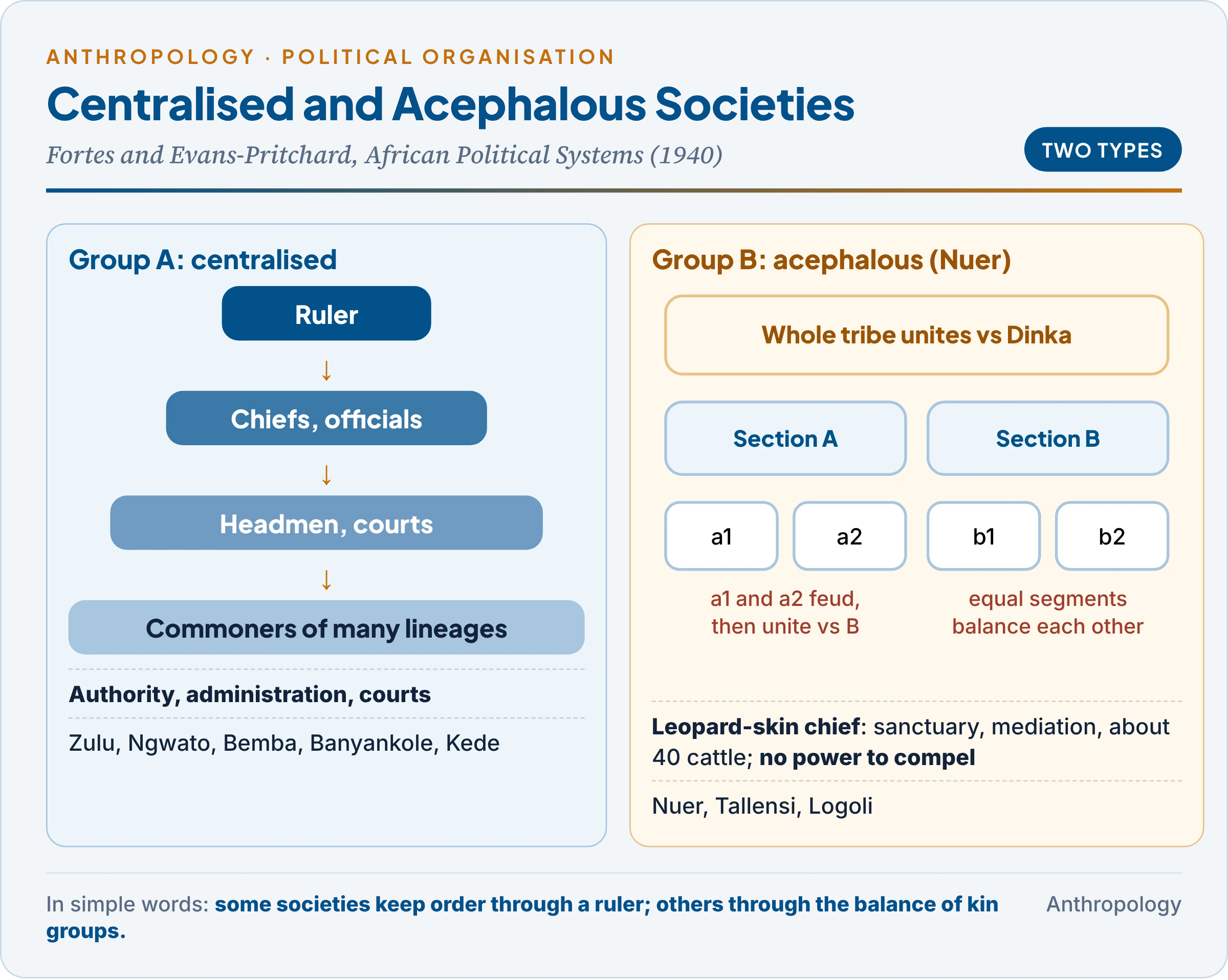
Fortes and Evans-Pritchard (1940) compared eight African societies and divided them into two groups:
| Group A: centralised (primitive states) | Group B: stateless (acephalous) | |
|---|---|---|
| Authority | Central authority, administrative machinery, judicial institutions | No central authority, administration or courts |
| Basis of order | Government; wealth, privilege and status match the distribution of power | Balance between segmentary lineages |
| Role of lineage | Lineages exist but are not the political framework | The lineage system is the political framework |
| Examples | Zulu, Ngwato, Bemba, Banyankole, Kede | Nuer, Tallensi, Logoli |
They also noted a third type: very small societies (bands) in which the political unit is the kin group itself. The key insight of the table is that kinship can do the work of government: where there is no state, descent groups organise defence, revenge and peace.
2.1 The segmentary lineage system: the Nuer
How it works. The Nuer are divided into patrilineal clans, each split into maximal, major, minor and minimal lineages, which are tied to territorial sections of a tribe (Unit 2.5a explains lineage and clan).
- Complementary (balanced) opposition: two minimal segments may feud, but unite as one minor segment against another minor segment; minor segments unite against an equivalent segment; and the whole tribe unites against another tribe or the Dinka. Groups fuse and divide according to who opposes whom.
- Why there is order: because every segment is balanced by an equal one, no group can dominate, and kin on both sides of a quarrel press for a settlement. Evans-Pritchard called this “ordered anarchy“.
- The leopard-skin chief (kuaar twac) is a ritual expert, not a ruler. A killer takes sanctuary in his homestead; he cuts the killer’s arm to release the dead man’s blood, and mediates the payment of blood-wealth (around 40 head of cattle). He has no power to compel: his influence rests on his sacred status and on both sides’ wish to end the feud.
- Similar systems: the Tiv of Nigeria (Paul and Laura Bohannan) and the Tallensi of Ghana (Fortes).
Criticisms:
- Leach showed among the Kachin of Burma that a society can oscillate between an egalitarian (gumlao) and a hierarchical (gumsa) form, so “types” are phases, not fixed states.
- Aidan Southall (Alur Society, 1956) found a segmentary state, in which a ritual centre is recognised widely but real power fades towards the edges, a form between the two groups; historians later applied the idea to the Chola state of South India (Burton Stein, 1980).
- Later research showed that the Nuer model was partly an ideal: real Nuer politics involved prophets, colonial chiefs and shifting alliances.
2.2 State and stateless systems compared
The table compares the two systems on the points that matter most: where authority sits, what backs it, and what it does.
| Point | Stateless (acephalous) | State (centralised) |
|---|---|---|
| Locus of authority | Spread among elders, lineage heads, ritual experts; shifts with the situation | Concentrated in a ruler and officials with fixed offices |
| Basis of power | Consensus, kinship, generosity, sacred status | Monopoly of legitimate force, law, taxation |
| Decision-making | Public discussion until agreement | Commands through a chain of officials |
| Settling disputes | Mediation, compensation, feud, ridicule, ordeal | Courts and judges with power to enforce |
| Membership | By kinship and residence | By territory and citizenship |
| Functions | Keep balance between groups, defend, make peace | Defend, tax, legislate, redistribute, run public works |
The deepest difference is in the source of compliance: in stateless systems people comply because kin and neighbours press them and because breaking ties is costly; in states they comply because officials can compel them, though they usually comply out of belief in the state’s legitimacy (§5).
Can a stateless system function in modern society? Not as a complete alternative, because modern economies need territorial law, money and courts. But stateless principles survive inside states: Somali clan elders still mediate blood-compensation (diya) alongside courts, as I.M. Lewis described in A Pastoral Democracy (1961); Naga village councils and Santal village councils settle most local disputes; and gram sabhas under PESA are meant to work by consensus. Stateless forms thus continue as local self-government within the state.
3. Evolutionary Types: Band, Tribe, Chiefdom, Kingdom and State
In simple words
Anthropologists often arrange political systems from the smallest and most equal to the largest and most unequal: band, tribe, chiefdom and state. As societies produce more surplus and grow larger, leadership becomes permanent, inherited and backed by force.
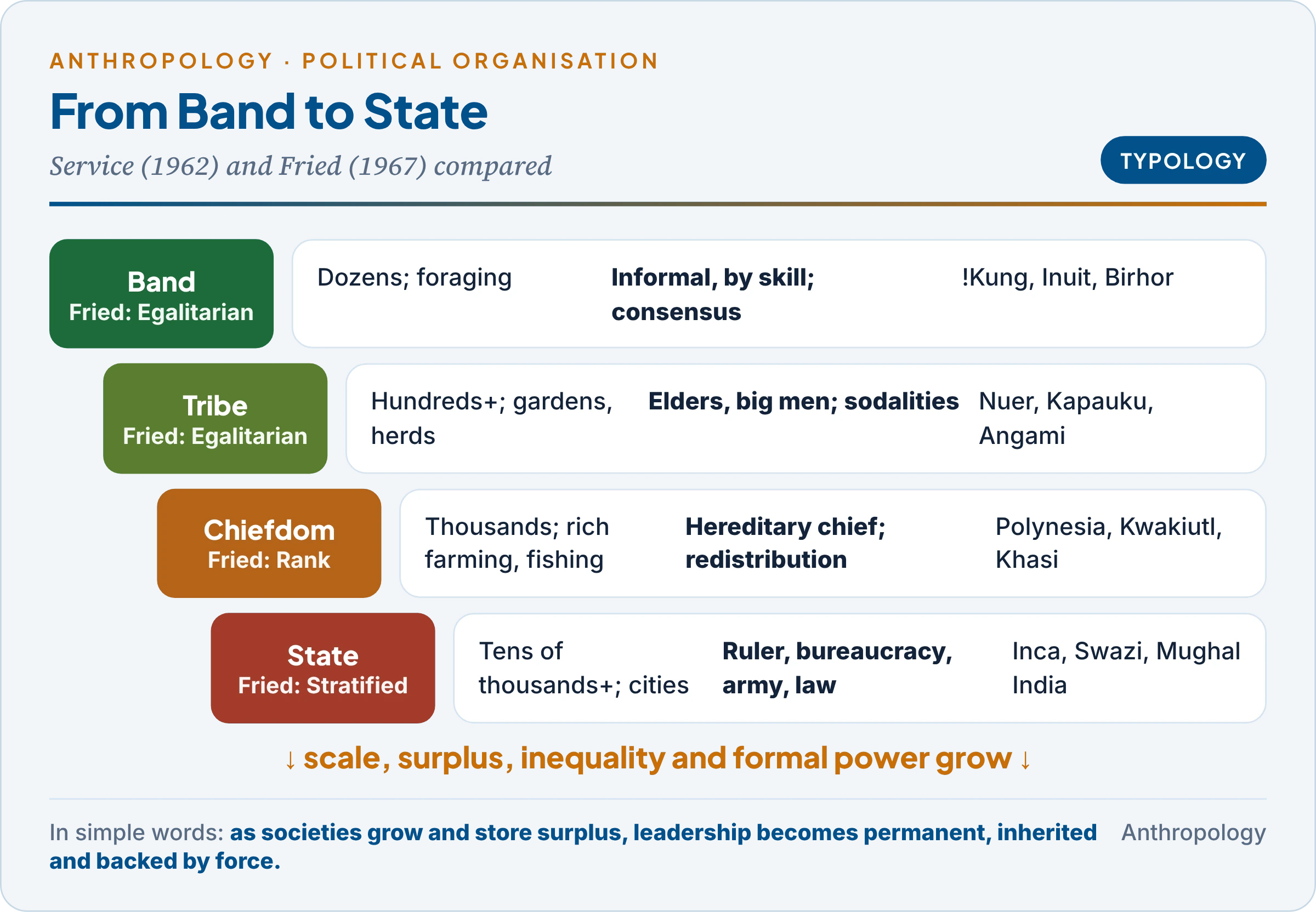
Two American neo-evolutionists gave the best-known schemes. Elman Service (Primitive Social Organization, 1962) classified societies by their form of integration: band, tribe, chiefdom, state. Morton Fried (The Evolution of Political Society, 1967) classified them by access to resources and status: egalitarian, rank, stratified, state.
| Service | Fried | Scale and economy | Leadership | Exchange | Example |
|---|---|---|---|---|---|
| Band | Egalitarian | Dozens; foraging | Informal, by skill | Generalised reciprocity | !Kung, Inuit, Birhor |
| Tribe | Egalitarian | Hundreds to thousands; horticulture, herding | Headmen, elders, big men | Balanced reciprocity | Nuer, Kapauku, Angami Naga |
| Chiefdom | Rank | Thousands; intensive farming or rich fishing | Hereditary chief, ranked kin | Redistribution | Polynesia, Kwakiutl, Khasi |
| State | Stratified → state | Tens of thousands upward; agriculture, cities | Ruler, bureaucracy, army, law | Market, tax, tribute | Inca, Swazi, Mughal India |
Read the two schemes together. Service asks how society is held together; Fried asks who has access to resources and positions. A rank society has more positions of prestige than people able to fill them, but no unequal access to basic resources; a stratified society denies some people equal access to land and water, and Fried argued that the state arises to protect that inequality.
3.1 Band
- Features: small (often 25–50, sometimes up to a few hundred), nomadic foragers; members related by blood or marriage; egalitarian; decisions by consensus of adults.
- Leadership is situational: a skilled hunter leads the hunt, an experienced elder guides a move; no one can command.
- Conflict is handled by gossip, ridicule, fission (one party moves away) or contests: the Inuit song duel, in which two rivals insult each other in song and the audience decides the winner.
- Indian cases: the Birhor tanda (camp), the Chenchu and the Andamanese. Among the Birhor, the camp headman (naya) also acts as priest and magician, so secular and sacred leadership are fused.
3.2 Tribe
- Features: larger, settled or semi-settled; horticulture or herding; still egalitarian, without full-time leaders.
- Pan-tribal sodalities (groups that cut across villages) hold the tribe together:
- Segmentary lineages and clans (Nuer, Tiv). Among the Winnebago of North America, each of twelve clans held a political office: the chief from the Thunderbird clan, the police from the Bear clan.
- Age-sets: among the Kipsigis and Tiriki of Kenya and the Maasai, men pass together through grades of warriors and elders; warriors defend, elders judge.
- Associations: the Cheyenne military societies policed the communal buffalo hunt, punishing anyone who scattered the herd, then took the offender back (Llewellyn and Hoebel, The Cheyenne Way, 1941).
- Big men (§4).
- Indian cases: the Angami Naga village, governed by elders and clan representatives without a hereditary chief, was described by the British administrator-ethnographer J.H. Hutton (The Angami Nagas, 1921) as a kind of village republic.
3.3 Chiefdom
- Features:
- Ranked society: every lineage and person has a place according to genealogical closeness to the chief or founding ancestor.
- Permanent, often hereditary office, with sub-chiefs over villages or sections, forming a chain of authority.
- The chief controls production and redistribution: he collects surplus, feeds feasts and labour, and keeps a share.
- Chiefs often have sacred status (Polynesian mana and tapu).
- Cases: Polynesian chiefdoms (Tikopia, Hawaii); the Trobriand paramount chief; the Northwest Coast potlatch chiefs; the Luapula of Zambia (Ian Cunnison), where a paramount chief, territorial chiefs and village headmen form a hierarchy and a headman chosen by his matrilineage cannot take office without the chief’s approval.
- Indian cases: the Khasi syiem (§6) and the hereditary chiefs of the Konyak and Sema Nagas.
- How it differs from a state: a chiefdom is still kin-based and its generosity is the source of prestige: much of what the chief receives flows back. In a state, classes rather than kin groups divide society, and redistribution favours the elite.
3.4 Kingdom
A kingdom is a centralised polity headed by a hereditary monarch, usually larger than a chiefdom, with a royal court, officials, tribute and often an army; most kingdoms are early states.
- Divine kingship: among the Shilluk of Sudan, the king (reth) embodied the culture hero Nyikang, and his health was tied to the land’s fertility (Evans-Pritchard, The Divine Kingship of the Shilluk, 1948). Kingship rests on sacred as well as military power.
- Dual monarchy: among the Swazi (Hilda Kuper, An African Aristocracy, 1947), the king and the queen mother shared rule, allocated land, presided over courts, controlled national age regiments and led the annual incwala kingship ritual.
- Theatre state: in 19th-century Bali, Geertz argued, the court’s spectacle and ritual were not decoration of power: “power served pomp, not pomp power“.
- Indian tribal kingdoms: Gond kingdoms of Garha-Mandla and Chanda and the Nagvanshi rulers of Chotanagpur rose from tribal roots. The Indian anthropologist Surajit Sinha (“State formation and Rajput myth in tribal central India”, 1962) showed how such ruling lineages claimed Rajput (Kshatriya) descent to legitimise their rule, a process that also drew tribes into caste society.
3.5 State
The state is an autonomous political unit with a centralised government that collects taxes, conscripts labour and soldiers, and makes and enforces laws over a territory with many communities.
- Features: a monopoly of legitimate force, a bureaucracy, a territory, class stratification, cities and specialists, and an ideology that justifies rule.
- Theories of origin:
- Integration (voluntaristic): Service argued that states arose because a central authority benefited everyone by organising redistribution, defence and public works.
- Conflict: Fried, following Marx and Engels, argued that states arose to protect the privileges of those who controlled scarce resources.
- Hydraulic hypothesis: Karl Wittfogel (Oriental Despotism, 1957) linked early states to the management of large irrigation works.
- Circumscription: Robert Carneiro (“A Theory of the Origin of the State”, Science, 1970) argued that where farming land is hemmed in by mountains, deserts or sea, as in coastal Peru, growing populations cannot move away, so warfare leads the winners to conquer and rule the losers.
- Case: the Hehe of Tanzania were welded into a state in the 19th century; the chief had judicial, legislative, military and economic powers, a council, sub-chiefs and a monopoly of the ivory trade, and he used his stores of cattle and grain for famine relief and rewards, with rituals of royal ancestors supporting his authority.
Evaluation of the typology:
- Useful as a set of ideal types for comparison, linking politics to economy, population and exchange (Unit 3b).
- Unilinear risk: it can imply that every society must climb the same ladder; Leach’s Kachin and modern “tribes” inside states show movement both ways and coexistence.
- “Tribe” as a colonial category: Fried (The Notion of Tribe, 1975) argued that many tribes were created by contact with states, which needed bounded units to administer. In India, too, the “tribe” was partly a colonial administrative category.
4. Big Men and Chiefs
In simple words
In some societies a man becomes a leader by being generous and persuasive; in others a man is born into the office of chief. The first kind of power must be earned again and again; the second is attached to the office and passes to an heir.
Example first. Among the Kapauku of West New Guinea, studied by the Czech-American anthropologist Leopold Pospisil (1958), a leader is called tonowi (“rich one”). A man becomes tonowi by raising pigs (through his wives’ labour), making loans, paying bride-wealth for young men and sponsoring feasts. Everyone he helps becomes his debtor and follower. But if he stops giving, or demands too much, followers drift away, and his son inherits nothing.
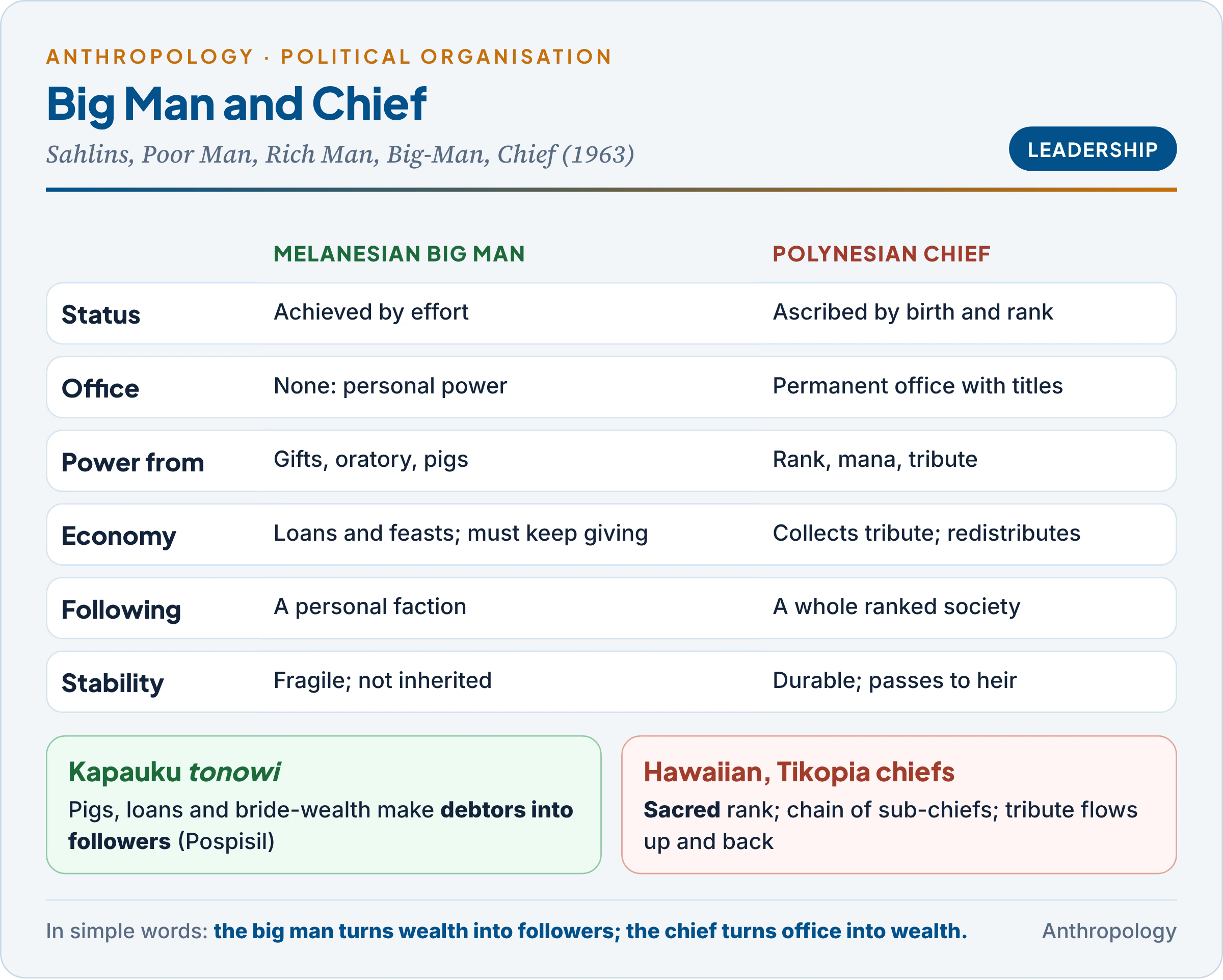
Marshall Sahlins, in “Poor Man, Rich Man, Big-Man, Chief: Political Types in Melanesia and Polynesia” (1963), contrasted the two leaders:
| Point | Melanesian big man | Polynesian chief |
|---|---|---|
| Status | Achieved by personal effort | Ascribed by birth and genealogical rank |
| Office | No office: power is personal | A permanent office with titles |
| Basis of power | Generosity, oratory, wealth in pigs and shells | Rank, sacredness (mana), tribute |
| Following | A faction of personal followers | A whole ranked society of districts and sub-chiefs |
| Economy | Builds a fund by loans and gifts; must keep giving | Collects tribute and redistributes through a chain of officials |
| Stability | Fragile: rises and falls with the man; not inherited | Durable: passes to heirs |
| Limit | Followers desert if pushed too hard | Chiefs may over-extract, provoking rebellion |
The table shows two routes to power. The big man turns wealth into followers by giving it away; the chief turns office into wealth by collecting it. Both depend on redistribution, but the chief’s power survives his death while the big man’s dies with him. Among the Melpa of Mount Hagen, big men compete through the moka exchange (Unit 3b).
Power, conspicuous consumption and distributive justice (2020 question). Conspicuous consumption, a term of the American economist Thorstein Veblen (The Theory of the Leisure Class, 1899), means spending or destroying wealth publicly to display status.
- In the potlatch and the moka, leaders gain power by giving away or destroying wealth: the display converts goods into prestige and obligation.
- This has a levelling side: wealth is spread to followers and guests, which is a form of distributive justice.
- But it also legitimises inequality: the giver becomes a creditor and superior, and the poor become dependants. The French anthropologist Pierre Clastres (Society Against the State, 1974) noted that among Amazonian peoples the chief must be generous, eloquent and peace-making, yet has no power to command: the society uses the duty of generosity to prevent the chief from becoming a ruler.
Common confusion
Is a big man just a small chief? No. A chief holds an office: the position exists before and after him, and authority comes with it. A big man holds no office: his influence exists only as long as he keeps followers through gifts and persuasion. The difference is between ascribed authority and achieved influence, not just size.
5. Power, Authority and Legitimacy
In simple words
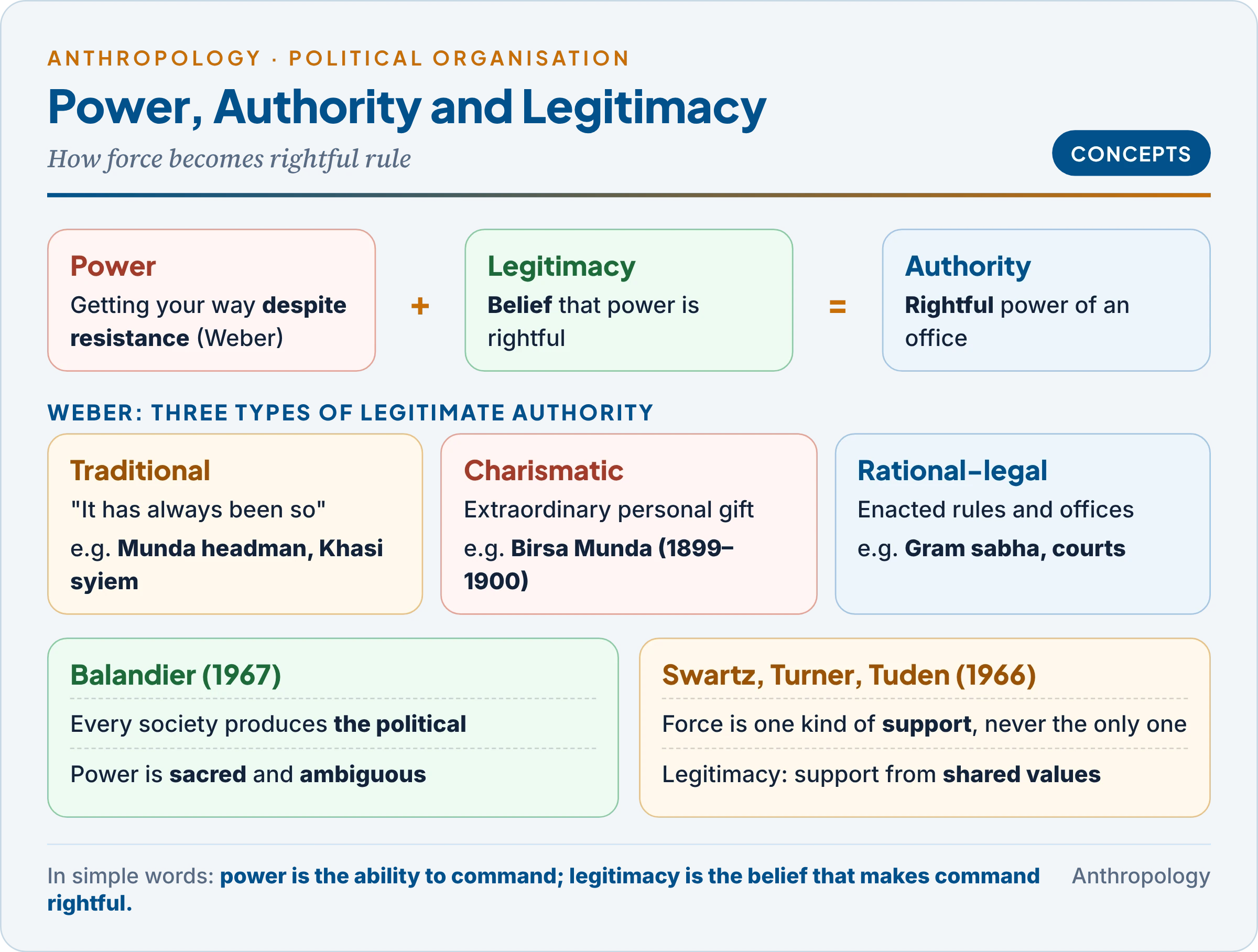
Power is the ability to make others do what you want, even against their will. Authority is power that people accept as rightful. Legitimacy is the belief that makes them accept it. A robber has power over you; a judge has authority, because you believe the court has the right to decide.
Example first. In 1899–1900 the Munda of Chotanagpur rose in the ulgulan (great tumult) under Birsa Munda, a young man who claimed visions, healed the sick and was called Dharti Aba (father of the earth). He had no office, yet thousands obeyed him, because they believed in his personal gift. Against him stood the village Munda and Manki (traditional authority) and the colonial state (legal authority backed by force). Three kinds of authority met in one conflict.
5.1 Power
- Max Weber, the German sociologist: power (Macht) is “the probability that one actor within a social relationship will be in a position to carry out his own will despite resistance, regardless of the basis on which this probability rests”.
- Other definitions stress control of alternatives: power is the capacity to limit or regulate what others can choose to do (G.A. Lundberg), or to modify their conduct as one wishes (R.H. Tawney).
- Types of power:
- Positional (from one’s place in the structure, which becomes authority) and personal (from one’s own qualities).
- The American sociologist Amitai Etzioni (1961) classified power by its means: coercive (force or threat), remunerative or utilitarian (material reward) and normative or identitive (symbols and shared values).
- By form: force, domination (orders, as of parents) and manipulation (influence without stating intent, as in propaganda).
- Power is fluid: anyone may compete for more of it, so power structures are harder to see than formal authority. It is the fuel of political action.
5.2 Authority
Authority is legitimate, institutionalised power: the recognised right to take decisions and issue commands. A leader of a military coup may have power without authority; an elected leader has authority and usually power too. The political scientist Robert Dahl put it simply: legitimate power is authority. The anthropologist M.G. Smith (1968) added that power is competitive and segmentary (anyone may seek more of it), while authority is hierarchical and institutionalised in offices.
Weber’s three types of legitimate authority:
- Traditional: obeyed because “it has always been so”: hereditary chiefs, kings, village headmen. Example: the Munda village headman and the Khasi syiem.
- Charismatic: obeyed because of the leader’s extraordinary personal qualities: prophets, heroes. Example: Birsa Munda; the Nuer prophets who rose under colonial rule.
- Charisma is unstable: on the leader’s death it must be routinised, turned into traditional or legal forms (a sect, a dynasty, a party).
- Rational-legal: obeyed because the rules are legally enacted and the office-holder is chosen by those rules: bureaucracy, courts, elected governments. Example: the gram sabha under PESA, the District Collector.
These are ideal types: real authority usually mixes them. A tribal headman may be traditional in origin, charismatic in person and legally recognised by the state.
5.3 Legitimacy
Legitimacy is the belief among the governed that a ruler’s power is rightful, which turns power into authority.
- S.M. Lipset, American political sociologist (Political Man, 1960): legitimacy is “the capacity of the system to engender and maintain the belief that the existing political institutions are the most appropriate ones for the society”.
- David Easton (1965) distinguished ideological legitimacy (belief in the regime’s values), structural legitimacy (belief in its rules and procedures) and personal legitimacy (trust in the leaders themselves).
- Swartz, Turner and Tuden (1966) treated politics as a process in a field of competing actors. Anything that helps leaders reach their goals is support. Force is one kind of support but never the only one, because it is crude and costly; legitimacy is “a type of support that derives not from force or its threat but from the values held by” the people. It rests on an expectation: the legitimate leader or court will meet its obligations, as a legitimate court is expected to give a just verdict.
- Georges Balandier, French anthropologist (Anthropologie politique, 1967; Political Anthropology, 1970):
- All societies produce the political: political theory must not be confused with the theory of the state.
- Power arises from inequality and from the need to defend society against internal disorder and external threat.
- Power always has a sacred side: chiefs and kings are surrounded by ritual and taboo, which makes their power legitimate.
- Power is ambiguous: it is both accepted and resisted, revered and feared, and political systems are always changing. This dynamic view opposed the static models of British structural-functionalism.
How the three link. Power without legitimacy must rely on constant force, which is costly and unstable; legitimacy lets rulers govern with few resources because people comply willingly. Those who do not accept a decision are brought into line by coercion, which is where power and legitimacy meet.
The table sets the three concepts side by side.
| Power | Authority | Legitimacy | |
|---|---|---|---|
| What it is | Capacity to make others act | Rightful power, attached to a role | The belief that power is rightful |
| Basis | Force, reward, persuasion | Tradition, charisma, law | Shared values and expectations |
| Example | A strongman, a moneylender | A chief, a judge | People’s faith in the chief’s descent or in elections |
How simple societies establish power, authority and legitimacy (2021, 2026 questions):
- Bands: influence through skill, age and generosity; legitimacy by consensus; no coercion.
- Tribes: authority of elders and lineage heads; big men’s power through gifts; legitimacy through kinship and custom; ritual mediators (leopard-skin chief).
- Chiefdoms and kingdoms: hereditary office legitimised by genealogy, myth and sacredness (mana, divine kingship, Rajput origin myths), and by redistribution.
- States: legal-rational authority backed by a monopoly of force, legitimised by law, elections or ideology.
As political organisation grows more complex, legitimacy shifts from kinship and personal qualities towards office, law and force, and social control shifts from informal pressure towards courts and police (Unit 4b).
6. Indian Tribal Political Systems
In simple words
Indian tribes had their own systems of village headmen, councils and federations of villages long before modern panchayats. Some were democratic councils of elders, others had hereditary chiefs, and a few grew into kingdoms. Many still work alongside the state’s own institutions.
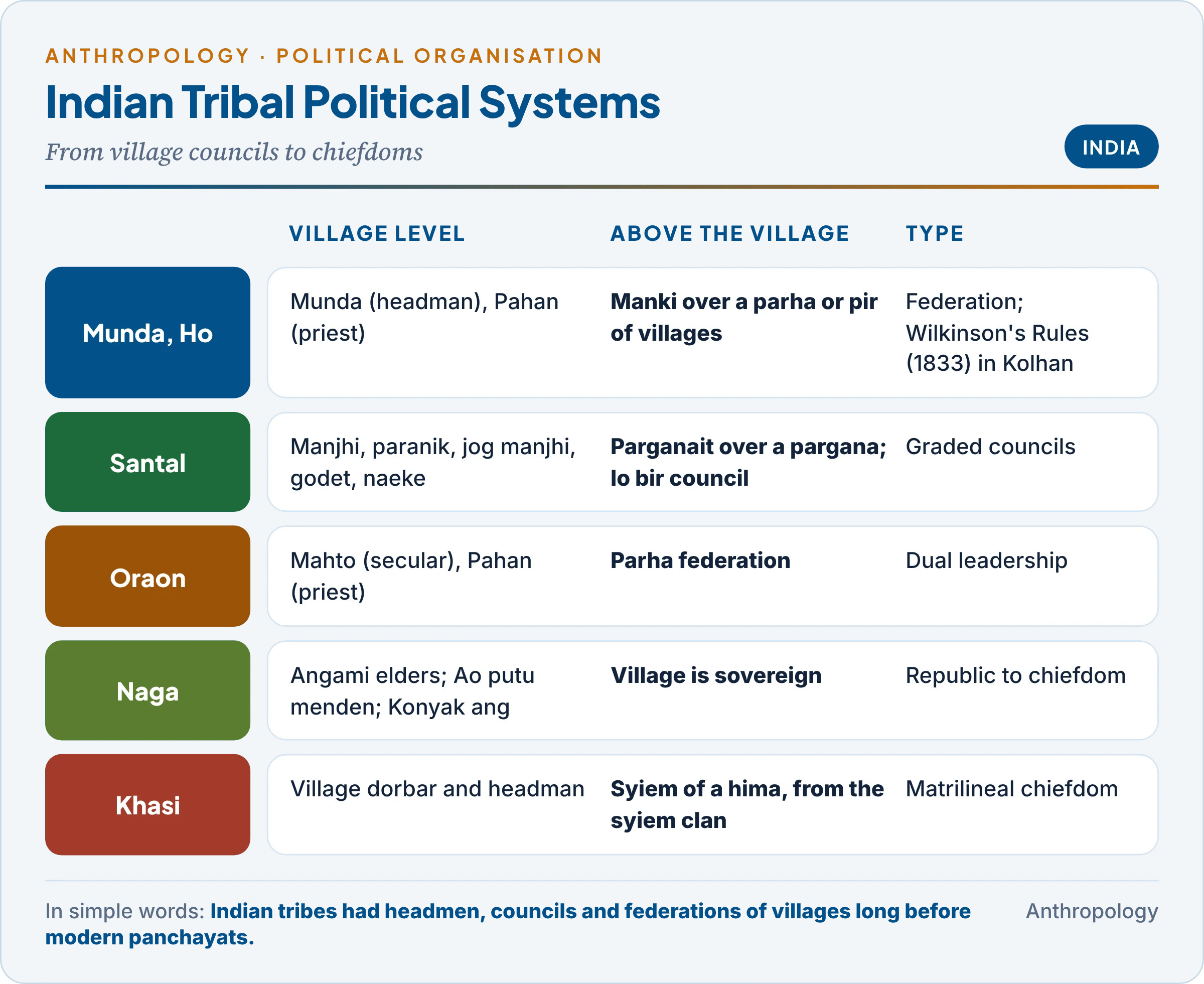
The table summarises verified cases from the main tribal regions.
| Community (region) | Village level | Above the village | Type |
|---|---|---|---|
| Munda (Jharkhand) | Munda (secular headman), Pahan (priest) | Parha (federation of villages) under a Manki or parha raja | Hereditary headmen; federation (S.C. Roy, The Mundas and Their Country, 1912) |
| Ho (Kolhan, Jharkhand) | Munda headman | Manki over a pir of about 8–15 villages; codified by Wilkinson’s Rules (1833) | Customary system incorporated by colonial rule |
| Santal (Jharkhand, Bengal, Odisha) | Manjhi (headman) with paranik, jog manjhi, godet (messenger), naeke (priest) | Pargana of villages under a parganait; the hunt council (lo bir) as the highest forum | Graded councils (baisi) |
| Oraon (Jharkhand) | Mahto (secular) and Pahan (priest) | Parha federation | Dual secular-sacred leadership |
| Naga (Nagaland) | Angami: elders and clan heads; Ao: council of age-groups (putu menden); Konyak: sacred hereditary chief (ang); Sema: hereditary chiefs | Village is sovereign | From village republic to chiefdom |
| Khasi (Meghalaya) | Village headman and council (dorbar) | Hima (state) under a syiem chosen from the royal syiem clan, with the council of ministers | Matrilineal chiefdom-kingdom |
The table shows the full range of the syllabus types within India: councils of elders (Angami, Ao), federations of villages (Munda parha, Santal pargana), chiefdoms (Konyak, Sema, Khasi) and kingdoms that grew from tribal roots (Gond). It also shows a common Indian feature: the separation of secular and sacred leadership (Munda and Pahan, Mahto and Pahan).
Key cases explained:
- Khasi syiemship. The Khasi are matrilineal, so a syiem is succeeded not by his son but usually by a sister’s son or another member of the syiem clan, chosen by a dorbar of clan elders and ministers. The syiem is a constitutional ruler: he acts with the dorbar, and the myntri (ministers) represent the founding clans.
- Naga village republics. Among the Angami, every adult man could speak in the village assembly and leaders were chosen for ability; among the Konyak, the ang was sacred, received tribute and could not be approached freely. The contrast inside one people shows that political type depends on history and ecology, not on “race”.
- Sacred and secular leaders. Among small forest peoples, one person often holds both roles: the Birhor naya and the Maler village headman (manjhiye) are also priests and healers, and the Maler headman receives a leg of every hunted animal. Among the Kuvi Kondh of Koraput, bride-price passes through the village priest (jani) and the secular headman before reaching the bride’s father, which shows the priest’s ritual authority inside economic transactions. Among the settled Munda and Oraon, the old priest-headman delegated secular work to a Munda or Mahto, giving the dual system.
- The Mizo (Lushai) had powerful hereditary chiefs (lal), whose rights were abolished by the Assam-Lushai Hills District (Acquisition of Chiefs’ Rights) Act, 1954, a deliberate shift from traditional to legal authority.
Change and the state:
- Colonial incorporation: the British turned many headmen into revenue collectors and police (Manki-Munda under Wilkinson’s Rules), which gave them state backing but weakened their legitimacy among the people.
- Constitutional recognition: the Sixth Schedule (autonomous district councils in the north-east), Article 371A (Nagaland’s customary law and procedure), the Nagaland Village and Area Councils Act, 1978, and PESA, 1996, which asks states to respect customary law, social and religious practices and traditional management of community resources in Fifth Schedule areas.
- Legitimacy contests: in the Pathalgadi movement (2017–18) in Khunti and nearby districts of Jharkhand, Munda villages erected stone slabs declaring the gram sabha sovereign under the Fifth Schedule, denying entry to outsiders and officials; the state answered with criminal cases, many of which the new state government decided to withdraw in December 2019. In 2025, Ho villagers in Kolhan protested against administrative interventions in the Manki-Munda system. Both show traditional and legal authority competing for legitimacy.
Key Terms
| Term | Meaning in simple words |
|---|---|
| Political anthropology | Study of how societies make public decisions and use power |
| Polity | A political community with territory, leaders and rules |
| Acephalous | “Headless”: without a central ruler |
| Segmentary lineage | Descent groups nested inside larger ones, which unite against equal rivals |
| Complementary opposition | Groups fusing or splitting according to who opposes whom |
| Leopard-skin chief | Nuer ritual mediator without power to command |
| Band | Small, mobile, egalitarian group of foragers |
| Tribe | Larger egalitarian society held together by clans, age-sets or associations |
| Chiefdom | Ranked society under a permanent, often hereditary chief |
| State | Centralised government with a monopoly of legitimate force |
| Rank society | Unequal prestige but equal access to basic resources |
| Stratified society | Unequal access to land and other basic resources |
| Big man | Leader whose influence comes from generosity, not office |
| Power | Ability to get one’s way despite resistance |
| Authority | Power accepted as rightful |
| Legitimacy | Belief that a ruler’s power is rightful |
| Charisma | Extraordinary personal quality that attracts devoted followers |
| Syiem | Khasi chief of a hima, chosen from the royal clan |
Contemporary Developments
- Kolhan, 2025: protests by Ho villagers over administrative interventions in the Manki-Munda system show customary authority defending its legitimacy against the district administration.
- Pathalgadi: the 2017–18 assertion of gram sabha sovereignty in Munda villages, and the 2019 decision to withdraw cases, remain the clearest Indian case of a clash between traditional and legal authority.
- PESA implementation: states have framed PESA rules only gradually (Chhattisgarh in 2022, Maharashtra and others earlier), so the gram sabha’s customary powers depend on state action.
- Sixth Schedule councils in Meghalaya continue to recognise the syiem and dorbar shnong (village councils), even as debates continue over women’s participation in these councils.
Diagrams to Master
- Topic map of the article.
- Acephalous and centralised (§2): the two groups of Fortes and Evans-Pritchard, with Nuer segments fusing against a common enemy and the leopard-skin chief.
- Band to state (§3): Service’s four types set against Fried’s three, with scale, leadership and exchange.
- Big man and chief (§4): achieved versus ascribed, gift versus tribute, fragile versus durable.
- Power, authority, legitimacy (§5): power plus legitimacy gives authority; Weber’s three types.
- Indian tribal systems (§6): Munda-Manki, Santal-Parganait, Naga, Khasi.
Revision Grid
| Scholar | Work (year) | Key idea |
|---|---|---|
| Veblen | The Theory of the Leisure Class (1899) | Conspicuous consumption |
| Weber | Economy and Society (1922) | Power; traditional, charismatic, rational-legal authority |
| S.C. Roy | The Mundas and Their Country (1912) | Munda, Pahan, Manki, parha |
| Hutton | The Angami Nagas (1921) | Village republic |
| Fortes and Evans-Pritchard | African Political Systems (1940) | Centralised versus acephalous |
| Evans-Pritchard | The Nuer (1940) | Segmentary opposition; ordered anarchy |
| Kuper | An African Aristocracy (1947) | Swazi dual monarchy |
| Leach | Political Systems of Highland Burma (1954) | Gumsa–gumlao oscillation |
| Southall | Alur Society (1956) | Segmentary state |
| Wittfogel | Oriental Despotism (1957) | Hydraulic origin of the state |
| Pospisil | 1958 | Kapauku tonowi |
| Lipset | Political Man (1960) | Legitimacy as belief in institutions |
| Service | Primitive Social Organization (1962) | Band, tribe, chiefdom, state |
| Surajit Sinha | 1962 | Rajput myth legitimises tribal kingship |
| Sahlins | 1963 | Big man versus chief |
| Easton | 1965 | Ideological, structural, personal legitimacy |
| Swartz, Turner, Tuden | Political Anthropology (1966) | Politics as process; legitimacy as support from values |
| Fried | The Evolution of Political Society (1967) | Egalitarian, rank, stratified, state |
| Balandier | Anthropologie politique (1967) | Power in all societies; sacred and ambiguous |
| Carneiro | 1970 | Circumscription theory |
| Clastres | Society Against the State (1974) | Chief without power |
| Geertz | Negara (1980) | Theatre state |
Previous Year Questions
Unit 4: Political organisation; power, authority and legitimacy
- 2026How do the concepts of power, authority, legitimacy and social control change with changing political organization? Discuss in detail giving suitable examples.
- 2024Write notes on: Authority and forms of political organization.
- 2022Discuss the mechanism of social control in different kinds of political systems.
- 2021How do political organizations of simple societies establish power, authority and legitimacy ?
- 2020How is the construct of power linked to the notion of conspicuous consumption and its impact on distributive justice?
- 2017Mention the characteristic features of band with suitable examples.
- 2014Differentiate between State and Stateless Societies.
- 2012Write a note in 150 words on Band and Tribal societies.
- 2009Write a note on Chiefdom in tribal society.
- 2006Describe the evolution of political systems.
- 1996Differentiate between centralized political systems and stateless political systems, and state how law and justice are administered in stateless societies.
- 1994Differentiate between state and stateless political systems. Do you think that a stateless political system can function in modern societies ?
- 1991Explain the meaning and scope of political anthropology. Describe how law and justice are maintained in simpler societies.
- 1990Write a note on Band and tribe.
- 1989Explain the meaning and scope of Political Anthropology. Describe how law and order are being maintained in the so called preliterate societies.
- 1984Describe a stateless political system.
- 1981Differentiate between the State and Stateless political systems with regard to locus, power and functions of the legitimate authority.
Related questions from other units
- 2015Unit 6: How did Morgan explain the evolution of marriage, family and Socio-Political organization and how did other evolutionists disagree with his explanation ?
- 2010Unit 2.5: Write a note in 150 words on. Segmentary lineage and territoriality.
- 2009Unit 6: Explain the theory of Neo-evolutionism’
- 2002Unit 14: Write a note on Nation State.
- 1993Unit 14: Write a note on Nation building processes in new states.
- 1983Unit 13: Reciprocity and redistribution inhibit social conflict in primitive society. Discuss.
- 1982Unit 2.5: The modern State has taken over many functions of the family and kin groups. Discuss.
- 1981Unit 2.5: “Unilineal kinship is more characteristic of segmentary society than bilateral kinship.” Discuss.