

3 Economic organization: Meaning, scope and relevance of economic anthropology; Formalist and Substantivist debate; Principles governing production, distribution and exchange (reciprocity, redistribution and market), in communities, subsisting on hunting and gathering, fishing, swiddening, pastoralism, horticulture, and agriculture; globalization and indigenous economic systems.
Official Syllabus: Paper I, Unit 3 (meaning, scope, relevance; formalist and substantivist debate)
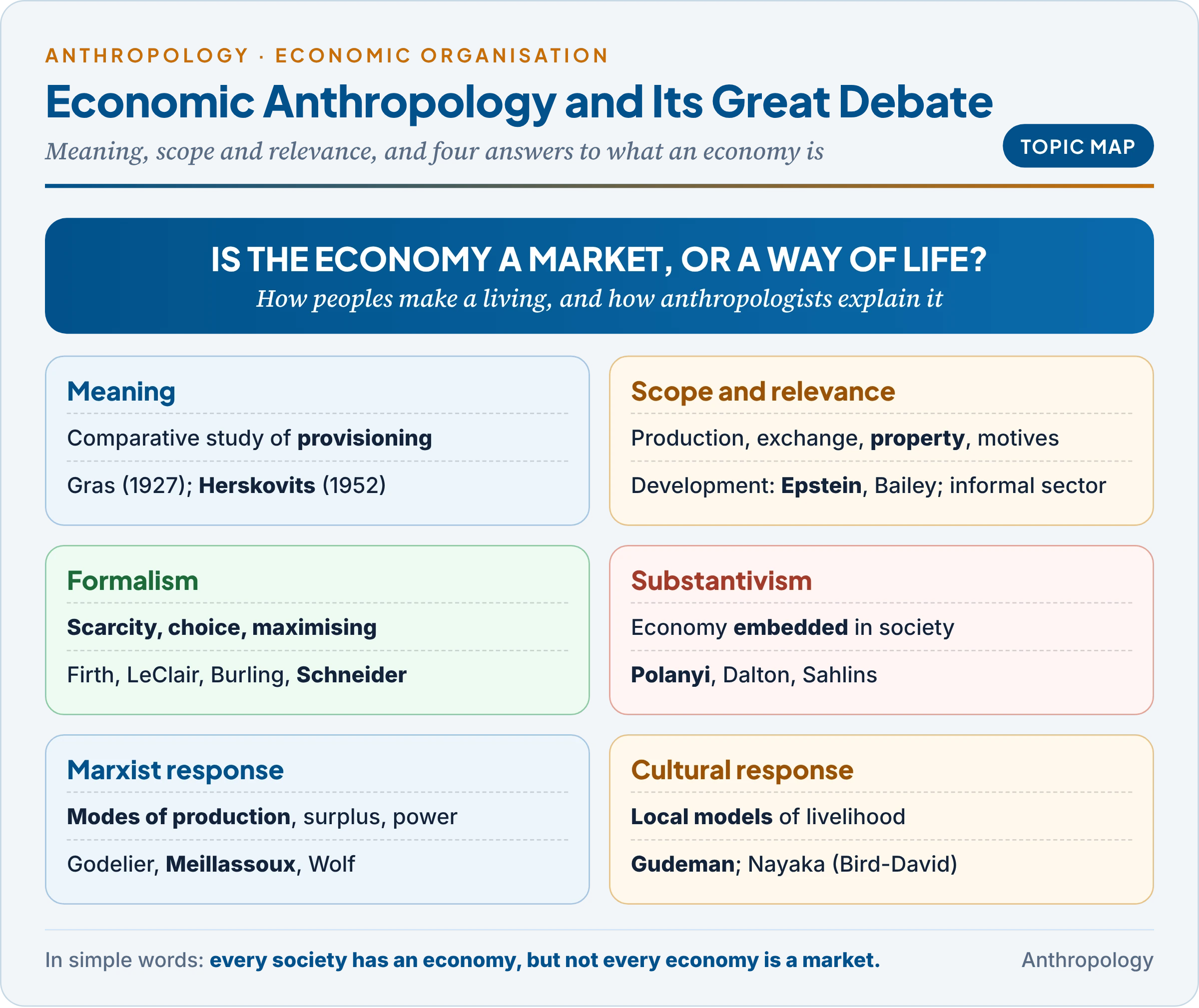
This article covers the first two items of the syllabus line: what economic anthropology is and why it matters, and the theoretical debate over whether economic theory applies to all societies. Production, distribution and exchange in different subsistence types (reciprocity, redistribution, the market, the Kula and the potlatch) and globalisation follow in Unit 3b.
1. Meaning of Economic Anthropology
In simple words
Every society has to feed, clothe and house its people, so every society has an economy. Economic anthropology studies how different peoples organise this work, and it insists on seeing the economy as part of a whole way of life, tied to family, religion and politics.
Example first. In a tribal village, a woman sells a basket of mahua flowers to a trader at the weekly market, and on the same day gives an identical basket to her brother’s household for a festival. An economist sees one sale and one “transfer”. An anthropologist asks more: who may sell to whom, why the gift is not paid for, what the brother owes in return and when, and why the trader, an outsider, gets a different deal from kin. The same goods move under different social rules, and the rules, not the goods, are the subject of economic anthropology.
1.1 Definitions
Economic anthropology is the comparative, cross-cultural study of how human groups provide for their material needs, treating the economy as a subsystem of society and culture.
| Scholar | Definition (in brief) | What it stresses |
|---|---|---|
| N.S.B. Gras (1927), economic historian | Coined the term: “a synthesis of anthropological and economic studies”, the study of “the ways in which primitive peoples obtained a living” | Getting a living |
| Raymond Firth, New Zealand-born British anthropologist | Economic organisation is a type of social action that combines human services and goods to serve given ends | Economy as social action |
| Ralph Piddington | The system that satisfies material wants, organises production, controls distribution and fixes rights of ownership | Institutions of the economy |
| D.N. Majumdar and T.N. Madan | The ordering of human relations and efforts to obtain the necessities of life with the least effort and the most satisfaction | Economising |
| George Dalton (1971), American economist-anthropologist | All societies have structured arrangements to provide the material means of life; these rules are the economic system | Rules and structures |
The definitions divide along a line that runs through the whole subject. Majumdar and Madan define the economy by economising (getting the most from limited means), while Firth, Piddington and Dalton define it by social arrangements. This is the formalist–substantivist split in miniature (§4).
1.2 Economics and economic anthropology
The table contrasts the two disciplines; read each row as a difference of assumption or method.
| Point | Economics | Economic anthropology |
|---|---|---|
| Core subject | Markets, prices and the allocation of scarce resources | All ways of provisioning: gift, sharing, tribute, barter, market |
| Basic assumption | Individuals are rational utility-maximisers (Homo economicus) | Motives are culturally shaped: prestige, kinship duty, religious merit, as well as gain |
| Unit | The individual, the firm, the national economy | The household, kin group and community within a culture |
| Method | Deductive models, statistics, “other things being equal” (ceteris paribus) | Inductive fieldwork, participant observation, case studies |
| Context | Treated as constant or external | Is the subject: kinship, ritual and power shape every transaction |
The contrast is one of emphasis, not a wall. Economists supply tools such as supply-and-demand analysis and ways of measuring transactions; anthropologists supply the social context that economists hold “constant”. Alfred Marshall, the British economist, called economics “a study of mankind in the ordinary business of life”, a definition broad enough to include both.
1.3 How the field developed
Economic anthropology grew in five phases; the timeline shows who moved it forward and why.
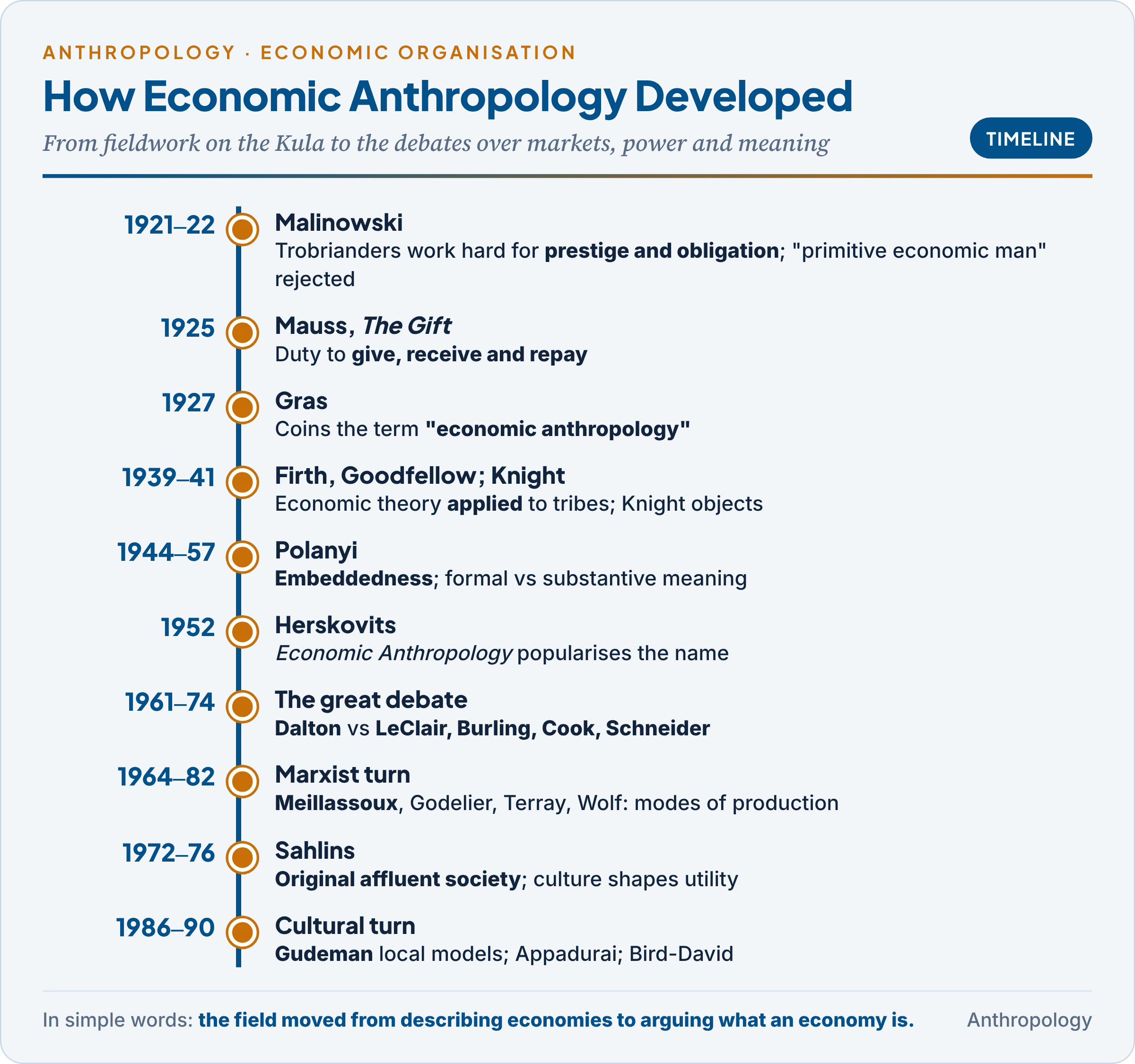
- Before 1920: “primitive economics”. Early writers imagined “savages” as either lazy and improvident or as miniature profit-seekers. Neither view rested on fieldwork.
- 1920s: fieldwork destroys “primitive economic man”.
- Bronislaw Malinowski, the Polish-born British pioneer of fieldwork, in “The Primitive Economics of the Trobriand Islanders” (1921) and Argonauts of the Western Pacific (1922), showed that Trobrianders worked hard and skilfully, but for prestige, display and obligation, not individual gain.
- Marcel Mauss, the French sociologist, The Gift (1925), showed that gifts create obligations to give, receive and repay.
- Richard Thurnwald, Economics in Primitive Communities (1932), added comparative material.
- 1939–52: borrowing economic theory.
- Raymond Firth, Primitive Polynesian Economy (1939), and D.M. Goodfellow, Principles of Economic Sociology (1939), on the Bantu, applied economic concepts to small-scale societies; Goodfellow held that economic theory has universal validity.
- Melville Herskovits, the American Africanist, The Economic Life of Primitive Peoples (1940), revised as Economic Anthropology (1952), popularised Gras’s name for the field. The economist Frank Knight (1941) replied that economics is deductive and anthropology empirical, so the two could not simply merge.
- 1957–75: the formalist–substantivist debate (§4).
- 1970s onwards: Marxist and cultural turns (§5), then the study of globalisation, informal economies, money and value.
2. Scope of Economic Anthropology
In simple words
Economic anthropology covers everything people do to make a living: producing, sharing, trading, owning and consuming. It also asks why people do these things the way they do, which means looking at their values and social ties, not only at goods.
2.1 What economic anthropology studies
Economic anthropologists ask two basic questions: how are production, distribution and consumption organised in a society (a question about systems), and what motivates people to produce, exchange and consume as they do (a question about individuals and values).
The scope covers:
- Production: land and resource use, technology, division of labour by age and sex, the household as a unit of production (Sahlins‘ domestic mode of production, Unit 3b).
- Distribution and exchange: gift and reciprocity, redistribution through chiefs and temples, barter, markets and money (Unit 3b).
- Consumption: what counts as need and luxury; display and destruction of wealth for prestige.
- Property: individual and collective ownership, rights in land, forests and livestock, inheritance.
- Economic values and motives: profit, prestige, piety, kin duty.
- Change: monetisation, development projects, peasantisation, migration, informal work and globalisation.
Methods. The methods are those of social anthropology: participant observation, genealogies to trace who works and shares with whom, and case studies of disputes over land or debt. To these, economic anthropologists add quantitative tools: household budgets, time-allocation studies (how many hours go to farming, foraging, ritual), and records of every gift and sale over a season. Combining the two lets the researcher check what people say about sharing against what they do.
Who is studied today. The early focus was tribal and peasant economies. The scope now includes urban informal workers, corporations and financial markets (Karen Ho’s ethnography of Wall Street, Liquidated, 2009) and digital economies: the method, not the type of society, defines the field.
2.2 Characteristics of small-scale economies
Older textbooks listed the features of the “primitive economy”. The two best-known lists are summarised below.
George Dalton named three features:
- Small scale: most transactions occur within a community of hundreds or thousands, and one or two staples dominate production.
- Simple technology: tools are made by the user or a local craftsman.
- Relative isolation, geographical or cultural.
Majumdar and Madan listed further traits from tribal India and elsewhere:
| Trait | What it means |
|---|---|
| Simple technology, little surplus | Production meets bare needs; little is stored |
| Barter and exchange | Money is used mainly with outsiders |
| Weak profit motive | Mutual obligation, sharing and solidarity drive effort |
| Cooperation | Collective work in hunting, house-building, harvest |
| Slow innovation | Change is gradual |
| No regular market | The weekly market (haat) and festival fairs come nearest |
| Consumption goods, not capital goods | Little investment in tools of production |
| No specialisation except by age and sex | Every household does most tasks |
| Property for display | Wealth is shown and given away rather than accumulated |
L.P. Vidyarthi, the Indian anthropologist of tribal Bihar, added that the first feature of tribal economies is their close tie to the habitat, usually the forest. His study of the Maler of the Rajmahal hills (1963) showed an economy built round hill shifting cultivation and forest produce. The Birhor, Chenchu and Kadar depend on forest foods, while the Gaddi pastoralists of Himachal depend on forest pastures.
Why such lists need care. They describe an ideal type, not real societies. Many tribal economies have long had markets, money and trade with plains peoples (tribal haats of central India), and the “absence of the profit motive” was partly a projection of romantic images. The lists are useful as a contrast with industrial economies, but every trait varies.
Common confusion
Does “primitive economy” mean a backward or irrational economy? No. The word is an older label for small-scale, non-industrial economies. Fieldwork from Malinowski onwards showed that such economies are complex and orderly, with their own logic of sharing, prestige and risk. Modern writers prefer “small-scale“, “subsistence” or “non-market” economy.
3. Relevance of Economic Anthropology
In simple words
Economic anthropology matters because economies everywhere are shaped by culture, including our own. Knowing this helps planners avoid failed projects, helps explain why people do not always act as textbooks predict, and protects communities whose ways of life differ from the market model.
- It corrects ethnocentrism in economics. By showing economies run on gift, sharing and redistribution, it shows that the market is one institution among many, not a law of nature. This is the substantivist lesson (§4.3).
- It explains behaviour that looks “irrational”. A peasant who refuses a higher-yielding crop may be minimising risk to subsistence, not ignoring profit. Anthropologists show the local rationality behind such choices.
- It improves development. Projects that ignore land tenure, kin obligations and gender roles often fail. In India:
- T. Scarlett Epstein, Economic Development and Social Change in South India (1962), compared two Mysore villages. Wangala, which received canal irrigation, intensified farming and kept its old social order; Dalena, left dry, diversified into urban trade and services, and its social relations changed more. Same region, different economic opportunities, different social outcomes.
- F.G. Bailey, Caste and the Economic Frontier (1957), showed how new trade in highland Odisha let the Boad Distillers of Bisipara gain wealth and buy land, upsetting the link between caste rank and economic position.
- It informs tribal policy. Recognising community rights over land and forests, as the Forest Rights Act, 2006 does for minor forest produce, rests on the anthropological point that tribal property is often collective and embedded in kinship and ritual.
- It studies new economies. The British anthropologist Keith Hart coined the term “informal sector” (1973) from fieldwork in Accra, Ghana; the idea now frames policy for the large unregistered workforce of countries such as India.
- It feeds back into economics. Behavioural economics and experiments in small-scale societies (Contemporary Developments) confirm that fairness and reciprocity shape economic choices, a point anthropologists made first.
4. The Formalist–Substantivist Debate
In simple words
In the 1960s economic anthropologists argued about one question: can the economics invented to study modern markets also explain tribal and peasant economies? Formalists said yes, because everyone everywhere makes choices with limited means. Substantivists said no, because in many societies the economy is part of kinship and religion and does not work like a market.
Example first. When steel axes reached the Siane of the New Guinea Highlands from the 1930s, men needed far less time to clear gardens. Richard Salisbury, From Stone to Steel (1962), found that they did not use the saved time to grow more food. They spent it on ceremonies, politics and warfare, the activities that brought prestige. A formalist reads this as rational choice: the Siane maximised what they valued, prestige, under a new time budget. A substantivist reads it as proof that their economy was embedded in a status system, so “economic” gains were turned into social ones. One case, two readings: that is the debate.
4.1 The issue
- Economics after Lionel Robbins (1932) defined itself by a method: “the science which studies human behaviour as a relationship between ends and scarce means which have alternative uses”.
- If economics is the logic of choice under scarcity, it should apply to any society. If it is the study of how a society provides for itself, its market-based theory may fit only market societies.
- Karl Polanyi named these two meanings the formal and the substantive meaning of “economic” (1957); the two schools took their names from them.
4.2 Formalism
Formalism holds that the concepts of neoclassical economics (scarcity, choice, maximisation, marginal utility) apply to all societies, once the ends people pursue are defined by their culture.
Assumptions (in plain terms):
- Scarcity: wants are unlimited, means are limited, so every society must economise.
- Choice: people choose among alternative uses of their time, labour and goods.
- Maximisation: they choose to get the most satisfaction (utility), which may be wealth, but also prestige, leisure or solidarity.
- Rationality: they weigh costs and benefits with the information they have.
- Diminishing marginal utility: each extra unit of a good gives less satisfaction than the last, which is why people spread effort across many ends.
Herskovits in between. Herskovits accepted that every society economises its resources, but held that the values guiding choice differ by culture. He thus kept the formalist tool (choice) while insisting on cultural variation, a halfway position that, as later critics noted, set the stage for the 1960s quarrel.
Main formalists:
- Raymond Firth applied economic concepts to the Maori (1929) and Tikopia (1939).
- Edward LeClair, “Economic Theory and Economic Anthropology” (1962), argued that a general economic theory could cover all societies.
- Robbins Burling, “Maximization Theories and the Study of Economic Anthropology” (1962), went furthest: every choice is “economic”, whether of food, friends or power.
- Scott Cook, “The Obsolete ‘Anti-Market’ Mentality” (1966), attacked substantivism as romantic.
- Harold Schneider, Economic Man (1974), restated the formalist case using East African cattle-keepers.
- Sol Tax, Penny Capitalism (1953), described Maya Indians of Panajachel, Guatemala, as small-scale competitive entrepreneurs, each household a firm.
How formalism works. The anthropologist identifies what people value, then shows how they allocate scarce means to reach it. A Kwakiutl chief giving away blankets is “maximising” rank; a Nuer man investing in cattle is “maximising” marriage and security.
4.3 Substantivism
Substantivism holds that the economy is simply how a society provides for its material needs, and that in non-market societies this process is embedded in kinship, politics and religion, so market theory does not apply.
- Karl Polanyi (1886–1964), the Hungarian economic historian:
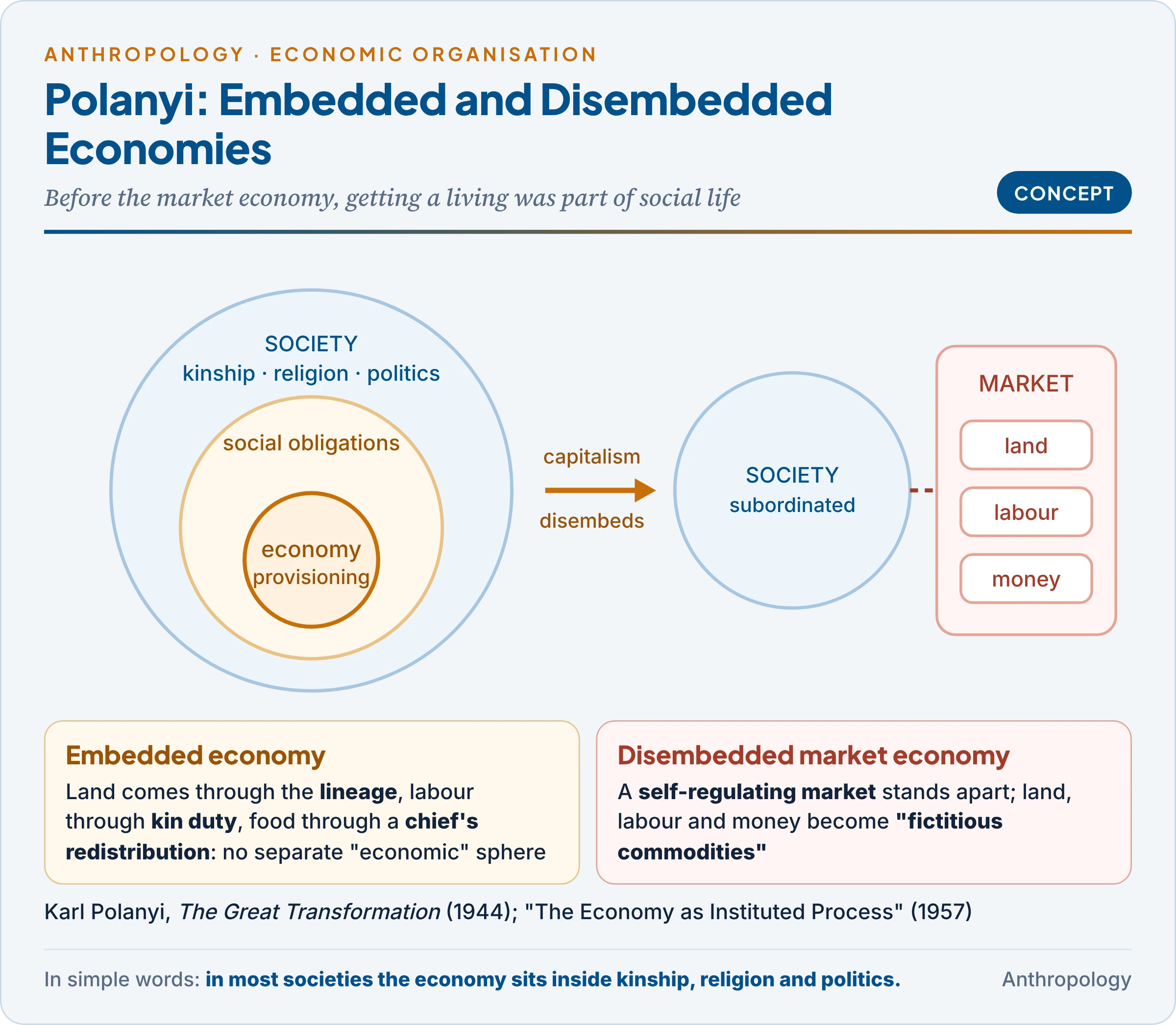
- The Great Transformation (1944) argued that a self-regulating market is a recent creation of 19th-century Europe. Before it, the economy was embedded in society; capitalism disembedded it and turned land, labour and money into “fictitious commodities“, with destructive social results.
- “The Economy as Instituted Process” (1957), in Trade and Market in the Early Empires, defined the substantive economy as “an instituted process of interaction between man and his environment, which results in a continuous supply of want satisfying material means”.
- He identified three forms of integration: reciprocity (between symmetrical groups), redistribution (to and from a centre) and market exchange (price-making markets). Unit 3b treats them in detail.
- George Dalton, “Economic Theory and Primitive Society” (1961), argued that formal theory fits only market-integrated economies. In the small-scale economy, land and labour are allocated by kinship and status, not by price.
- Paul Bohannan showed among the Tiv of Nigeria separate spheres of exchange that money later broke down (Unit 3b).
- Marshall Sahlins, Stone Age Economics (1972), argued that hunter-gatherers were the “original affluent society“, with few wants easily met, and that households practised under-production; scarcity is not universal but produced by market society.
- Malinowski is the precursor: the Kula showed exchange driven by prestige and partnership.
How embeddedness works. Where a man gets land because he is a lineage member, labour because his in-laws owe him help, and food because a chief redistributes the harvest, no separate “economic” sphere exists to be analysed with prices. Understanding the economy means studying the kin group, the chiefship and the ritual calendar. The Indian jajmani system, in which service castes were rewarded with shares of the harvest fixed by custom (W.H. Wiser, 1936), is a classic case of an economy embedded in caste (Unit 3b).
4.4 An Indian illustration: shifting cultivation read both ways
Shifting cultivation (jhum in the north-east, podu in Odisha and Andhra, bewar among the Baiga) shows how the two schools reach different conclusions from the same facts.
- A formalist reading: where land is plentiful and people are few, slash-and-burn gives more food per hour of work than ploughing. The Danish economist Ester Boserup, The Conditions of Agricultural Growth (1965), argued that farmers intensify only when population pressure makes it worth the extra labour. On this view, jhum is a rational, labour-saving choice, and its decline follows from shrinking land per head.
- A substantivist reading: the jhum plot is allotted by the village council or clan, cleared by reciprocal work parties, and begun and ended with rituals to village deities. Labour is drawn by kin obligation, not wages, and the harvest feeds feasts that renew social ties. On this view, jhum cannot be understood as a crop choice alone: it is part of a land-tenure, kinship and ritual system.
- Why it matters: policies that treated jhum only as “inefficient farming” and pushed settled cultivation often failed, because they ignored the institutions in which it was embedded. Policies that treated it only as “tradition” ignored real pressures of population and markets. Both readings are needed.
4.5 The debate point by point
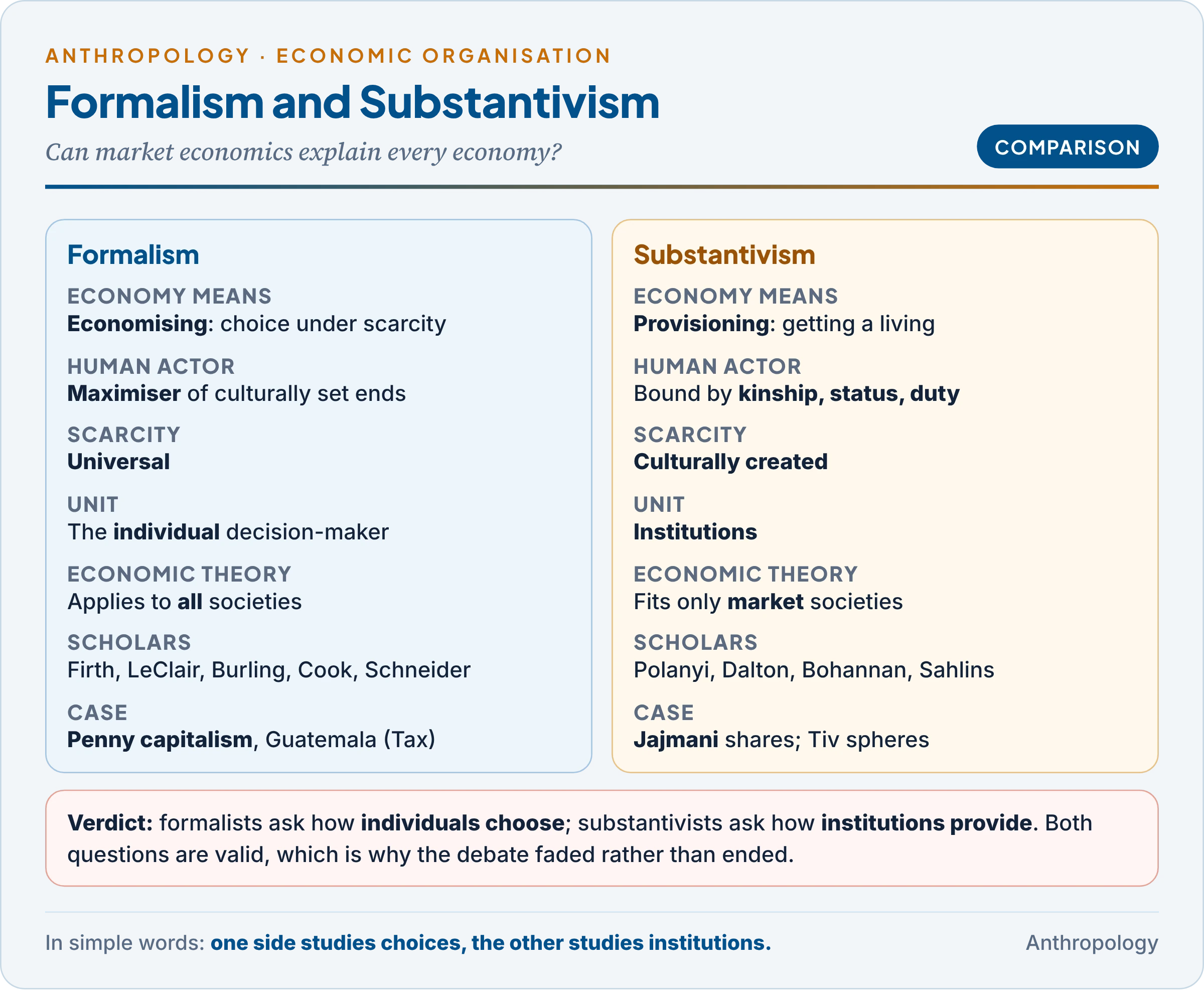
The table sets the two schools against each other; read each row as a separate disagreement.
| Point | Formalists | Substantivists |
|---|---|---|
| Meaning of “economic” | Formal: economising, choosing under scarcity | Substantive: providing material livelihood |
| Scarcity | Universal | Culturally created; many societies have few wants |
| Human nature | Everyone is a maximiser of culturally defined ends | Motives are social: obligation, status, redistribution |
| Economy and society | Economy is an analytic aspect of all behaviour | Economy is embedded in kinship, politics, religion |
| Applicability of economic theory | Universal, with modification | Only to market societies |
| Unit of analysis | The individual decision-maker | Institutions |
| Key scholars | Firth, LeClair, Burling, Cook, Schneider | Polanyi, Dalton, Bohannan, Sahlins |
The table shows that the two schools often talked past each other: formalists asked how individuals choose, substantivists asked how institutions organise provisioning. Both questions are legitimate, which is one reason the debate never ended in victory.
Criticisms of formalism:
- Tautology: if any action, even self-sacrifice, can be called “maximising” some value, the theory cannot be wrong and therefore explains nothing. J.I. Prattis (1982) pressed this point.
- Ethnocentrism: it projects the Western market actor onto all peoples. Stephen Gudeman noted that formalists will always “find” rational maximisers because their model looks only for them.
- Neglect of institutions: it isolates the individual from the social relations that define choices. The sociologist Mark Granovetter (1985) captured the alternative: actors “do not behave or decide as atoms outside a social context”, but are embedded in ongoing systems of social relations.
Criticisms of substantivism:
- Romanticism and false dichotomy: it sharply separates “primitive” from “modern” economies, though non-maximising and maximising behaviour occur in both. Prattis (1982) argued that the variation is situational, not a matter of two kinds of society.
- Empirical counter-cases: penny capitalism in Guatemala, active trading in tribal markets and calculated bride-wealth investments show calculation in non-market settings.
- Redistribution in modern states: welfare states such as Sweden, Germany and France redistribute heavily, so modern economies are not purely market economies either (Stuart Plattner, 1989).
- Neglect of individual agency: by focusing on institutions, it underplays choice, conflict and change. Even under central planning, people bargained with officials and farmed private plots to improve their lot.
Evaluation.
- By the mid-1970s most anthropologists judged the debate exhausted. Formal tools are useful for choice under constraint, and substantive analysis is essential for institutions and meanings.
- Later work dissolved the opposition:
- New economic sociology (Granovetter) kept rational action but placed it inside networks.
- Behavioural economics showed that even market actors follow norms of fairness.
- Field experiments found that the degree of market integration itself shapes how “economic” people behave.
- The lasting gain is the idea of embeddedness, and the recognition that “economic man” is a cultural product, not a universal starting point.
5. Beyond the Debate: Marxist and Cultural Responses
In simple words
Two further schools said that both sides missed something. Marxists said the real question is who controls land, labour and the surplus, that is, power. Culturalists said that every people has its own ideas of what wealth, exchange and profit mean, and these ideas must be studied in their own terms.
5.1 The Marxist response
Example first. Among the Guro of Côte d’Ivoire, land was plentiful, yet young men worked for their elders for years. The French anthropologist Claude Meillassoux (Anthropologie économique des Gouro, 1964; Maidens, Meal and Money, 1975) explained why: elders controlled the bride-wealth goods needed for marriage, so they controlled access to wives, and through that, the labour of the young. Power over reproduction, not over land, ran the economy.
- Core claim: both formalists and substantivists ignored relations of production: who owns or controls the means of production, who works, and who appropriates the surplus. The mode of production (forces plus relations of production) is the proper unit of analysis.
- Maurice Godelier, the French structural Marxist, Rationality and Irrationality in Economics (1966), argued that kinship can itself function as relations of production: in many tribal societies it organises work and the flow of goods, so it is part of the economic “base”.
- Emmanuel Terray (1969) re-read Morgan and Meillassoux in Marxist terms.
- Eric Wolf, the Austrian-born American anthropologist, Europe and the People Without History (1982), proposed three modes: kin-ordered, tributary and capitalist. He showed that “isolated” tribal economies had long been drawn into world trade and colonial power.
- Indian echo: in the 1970s Indian scholars debated the “mode of production in Indian agriculture”, asking whether sharecropping, debt bondage and landlordism made rural India semi-feudal or capitalist.
- Strength: it brings power, inequality and history into economic anthropology. Weakness: it can force diverse societies into Marxist categories and treat culture as a mere reflection of the base.
5.2 Sahlins: from substance to culture
Marshall Sahlins, the American anthropologist, moved from substantivism towards a cultural view:
- Stone Age Economics (1972): the domestic mode of production aims at household sufficiency, not surplus; hunter-gatherers are “affluent” because their wants are few. Unit 3b gives the details.
- Culture and Practical Reason (1976): utility itself is cultural. Americans do not eat dogs or horses, though both are edible and cheap, because of the symbolic place of these animals in American culture. Economic choices therefore follow a cultural logic, not a universal “practical reason”.
5.3 Culturalism
Culturalism argues that the very categories of economics (wealth, exchange, profit, money) are cultural constructions, so each economy must be understood through its own local model.
- Stephen Gudeman, Economics as Culture: Models and Metaphors of Livelihood (1986):
- Every community has its own model of livelihood, built from local metaphors.
- In rural Panama (The Demise of a Rural Economy, 1978), peasants saw exchange as an “exchange of equivalents“, with value set by the cost of production. They could not understand how outside merchants made profits.
- In Colombia (with Alberto Rivera, 1990), peasants modelled their economy on the house, whose “base” must be kept intact.
- Gudeman rejected all universal models, formalist, substantivist and Marxist alike, as ethnocentric.
- Nurit Bird-David, “The Giving Environment” (Current Anthropology, 1990), showed that the Nayaka, forest gatherers of the Nilgiri region of South India, treat the forest as a parent who gives, and so share among themselves as children of one parent. Neighbouring cultivators instead model nature and people as partners in reciprocal exchange. The Indian case shows two cultural models of economy side by side.
- Related work:
- Arjun Appadurai, The Social Life of Things (1986): an object can move in and out of the commodity state during its life.
- Jonathan Parry and Maurice Bloch, Money and the Morality of Exchange (1989): money carries different moral meanings in different societies.
- Parry (1986) on the Hindu dan, a gift that must not be returned and carries the donor’s sin to the recipient: an exception to Mauss’s rule of reciprocity.
Criticisms of culturalism:
- Idealism: Marxists say it attends to meanings but neglects material constraints such as land shortage, debt and markets.
- Relativism: if local models cannot be judged against any standard, they cannot be exposed as ideologies that serve the powerful.
- Globalisation: few communities now lie outside the capitalist economy, and local and global models mix, so universal models remain useful to study how communities are drawn in.
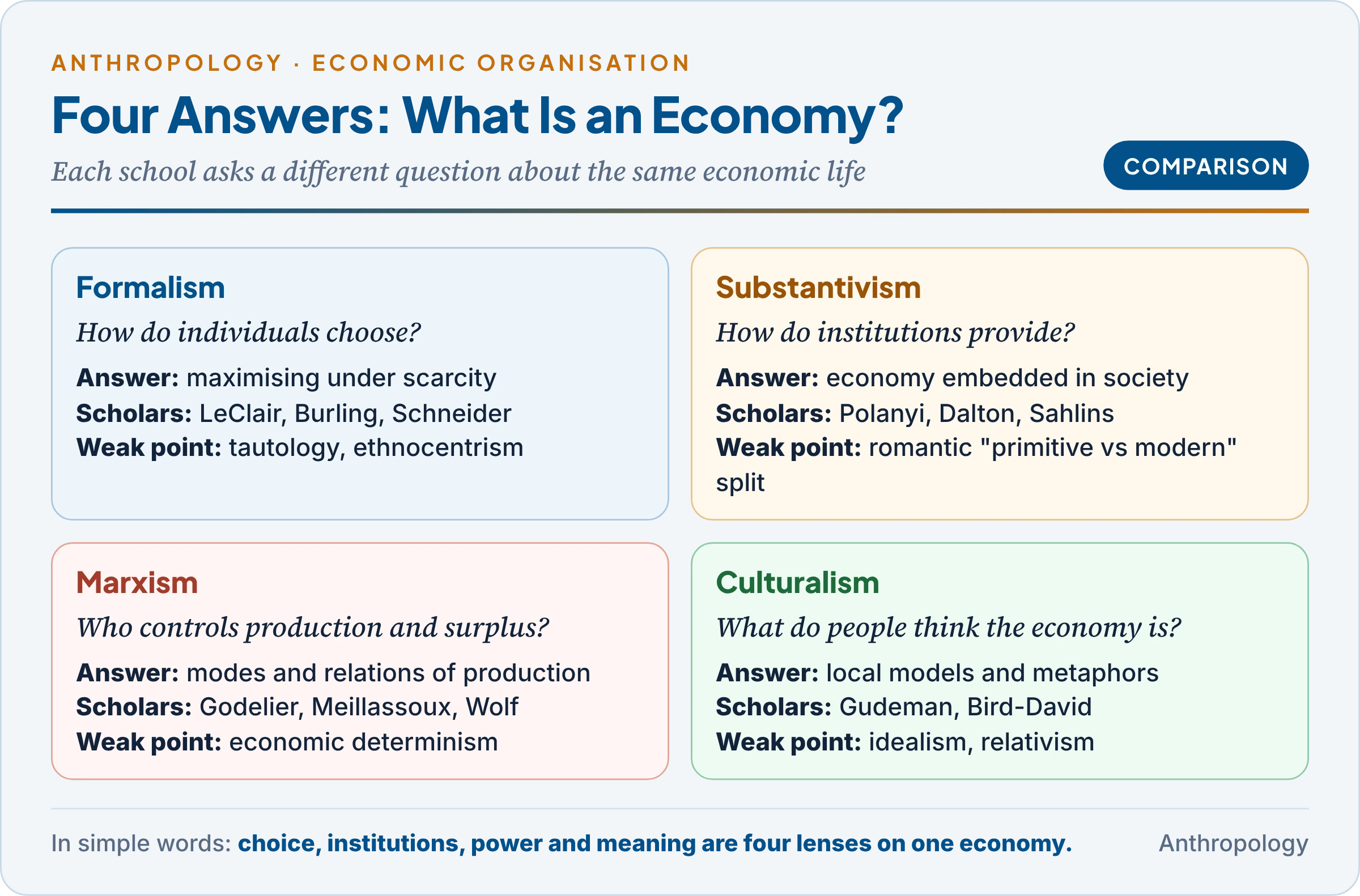
The four schools are summarised below; read across each row for the school’s question, its answer and its weak point.
| School | Key question | Answer | Main criticism |
|---|---|---|---|
| Formalism | How do individuals choose? | Maximising under scarcity | Tautology, ethnocentrism |
| Substantivism | How do institutions provide? | Economy embedded in society | Romantic dichotomy |
| Marxism | Who controls production and surplus? | Modes and relations of production | Economic determinism |
| Culturalism | What do people think the economy is? | Local models and metaphors | Idealism, relativism |
Common confusion
Is substantivism the same as culturalism? No, though both reject the formalist “economic man”. Substantivists (Polanyi, Dalton) still build a universal scheme: every economy is integrated by reciprocity, redistribution or exchange, studied through institutions. Culturalists (Gudeman) reject universal schemes altogether and study each community’s own model of its economy. Culturalism is often called a radical extension of substantivism.
Key Terms
| Term | Meaning in simple words |
|---|---|
| Economic anthropology | The comparative study of how societies provide for their material needs |
| Homo economicus | The imagined human who always calculates for personal gain |
| Formalism | The view that market economics applies to all societies |
| Substantivism | The view that the economy is embedded in society and market theory fits only markets |
| Formal meaning of “economic” | Choosing the best use of scarce means |
| Substantive meaning of “economic” | Providing a society’s material livelihood |
| Scarcity | Wants greater than the means to satisfy them |
| Maximisation | Choosing the option that gives the most of what one values |
| Marginal utility | The extra satisfaction from one more unit of a good |
| Embeddedness | The economy being part of kinship, politics and religion |
| Disembedding | The market separating from social control, as under capitalism |
| Fictitious commodities | Land, labour and money treated as goods for sale (Polanyi) |
| Forms of integration | Reciprocity, redistribution and market exchange |
| Mode of production | The tools and the social relations of work and ownership together |
| Relations of production | Who controls resources and labour, and who takes the surplus |
| Culturalism | The study of each people’s own model of its economy |
| Local model | A community’s own idea of how its livelihood works |
| Informal sector | Unregistered, small-scale work outside formal contracts |
Contemporary Developments
- Homo economicus tested in the field: behavioural experiments in 15 small-scale societies (Henrich et al., American Economic Review, 2001) found that no group behaved as the pure self-interest model predicts. In the ultimatum game, mean offers ranged from 26% (Machiguenga of Peru) to 58% (Lamalera whale-hunters of Indonesia). The Au and Gnau of Papua New Guinea often rejected over-generous offers, as gifts create unwanted obligations. Offers rose with market integration and the payoffs to cooperation, a result that supports both the substantivist emphasis on institutions and a cultural reading of “rationality”.
- Economics catches up: Nobel prizes to Daniel Kahneman (2002) and Richard Thaler (2017) recognised behavioural economics, and the 2024 prize went to Acemoglu, Johnson and Robinson for showing how institutions shape prosperity. Both themes echo substantivist arguments.
- Debt and the gift revisited: David Graeber, Debt: The First 5,000 Years (2011), used anthropological evidence to argue that credit and obligation came before barter and coins, challenging the economists’ textbook story of the origin of money.
- The informal economy: Keith Hart’s concept now frames policy for countries such as India, where most workers are outside formal contracts. Ethnographies of street vendors, gig workers and digital payments carry economic anthropology into the city.
Diagrams to Master
- Topic map of the article’s five themes.
- Timeline of economic anthropology (§1.3): label Malinowski 1922, Mauss 1925, Herskovits 1952, Polanyi 1944/1957, the debate, Marxist and cultural turns.
- Embedded versus disembedded economy (§4.3): nest the economy inside kinship, politics and religion; then draw the market standing apart with land, labour and money as commodities.
- Formalist versus substantivist (§4.5): two columns with assumption, unit of analysis, scholars and one case each.
- Four paradigms (§5.3): formalism, substantivism, Marxism, culturalism, each with its question and one criticism.
Revision Grid
| Scholar | Work (year) | Key idea |
|---|---|---|
| Malinowski | 1921; Argonauts (1922) | Rejects “primitive economic man”; Kula |
| Mauss | The Gift (1925) | Obligation to give, receive, repay |
| Gras | 1927 | Coins “economic anthropology” |
| Robbins | 1932 | Economics as ends and scarce means |
| Firth | Primitive Polynesian Economy (1939) | Economic concepts applied to Tikopia |
| Goodfellow | Principles of Economic Sociology (1939) | Universal validity of economic theory |
| Herskovits | 1940; Economic Anthropology (1952) | Names and shapes the field |
| Knight | 1941 | Economics deductive, anthropology empirical |
| Polanyi | The Great Transformation (1944); 1957 | Embeddedness; formal vs substantive; forms of integration |
| Sol Tax | Penny Capitalism (1953) | Guatemalan Indians as small entrepreneurs |
| Dalton | 1961; 1971 | Economic theory fits only market economies |
| LeClair; Burling | 1962 | General theory; maximisation |
| Salisbury | From Stone to Steel (1962) | Siane: saved time spent on prestige |
| Epstein | 1962 | Wangala and Dalena: irrigation and social change |
| Cook | 1966 | Attacks the “anti-market” mentality |
| Godelier | 1966 | Kinship as relations of production |
| Sahlins | Stone Age Economics (1972); 1976 | Original affluent society; culture shapes utility |
| Schneider | Economic Man (1974) | Formalist restatement |
| Meillassoux | 1964; 1975 | Elders control bride-wealth and labour |
| Wolf | Europe and the People Without History (1982) | Kin-ordered, tributary, capitalist modes |
| Granovetter | 1985 | Action embedded in social networks |
| Gudeman | Economics as Culture (1986) | Local models; culturalism |
| Bird-David | 1990 | Nayaka giving environment |
Previous Year Questions
Unit 3: Economic anthropology (meaning, scope, relevance; formalist and substantivist debate)
- 2022Write notes on: Debate between formalist and substantivist approaches.
- 2015Critically examine the Formalists and Substantivists’ views on the applicability of economic laws in the study of primitive societies.
- 2011Critically examine the debate between Formalists and Substantivists.
- 2005Critically discuss the formalist and substantivist approaches in the context of economic anthropology.
- 2003“Primitive economic organization has several peculiar features relating to the production, consumption, distribution and exchange.” Discuss the above statement by providing appropriate illustrations.
- 1997Delineate the meaning and scope of economic anthropology and discuss the principle that govern production, distribution and consumption in hunting and gathering communities.
- 1993Critically examine the view of formal and substantive schools of thought in Economic Anthropology.
- 1990Discuss the meaning and scope of economic anthropology.
- 1987Discuss the meaning and scope of economic anthropology. Explain the method of exchange in the context of simple societies.
- 1981“Economics relations are an aspect of social relations.” Justify. (200 words).
Related questions from other units
- 2025Unit 1.4: How political economy is integrated with ecological and adaptability perspectives in bio-cultural anthropology?
- 2023Unit 6: Critically examine Arjun Appadurai’s conceptualization of global cultural economy.
- 2022Unit 6: Discuss the approaches of Leslie White, Julian Steward and Marshall Sahlins in the light of cultural evolution.
- 2013Unit 1.2: Differentiate between Economics and Economic Anthropology. (150 words).