

2.5 Kinship: Consanguinity and Affinity; Principles and types of descent (Unilineal, Double, Bilateral, Ambilineal); Forms of descent groups (lineage, clan, phratry, moiety and kindred); Kinship terminology (descriptive and classificatory); Descent, Filiation and Complimentary Filiation; Descent and Alliance.
Official Syllabus: Paper I, Unit 2.5 (kinship terminology, filiation, descent and alliance)
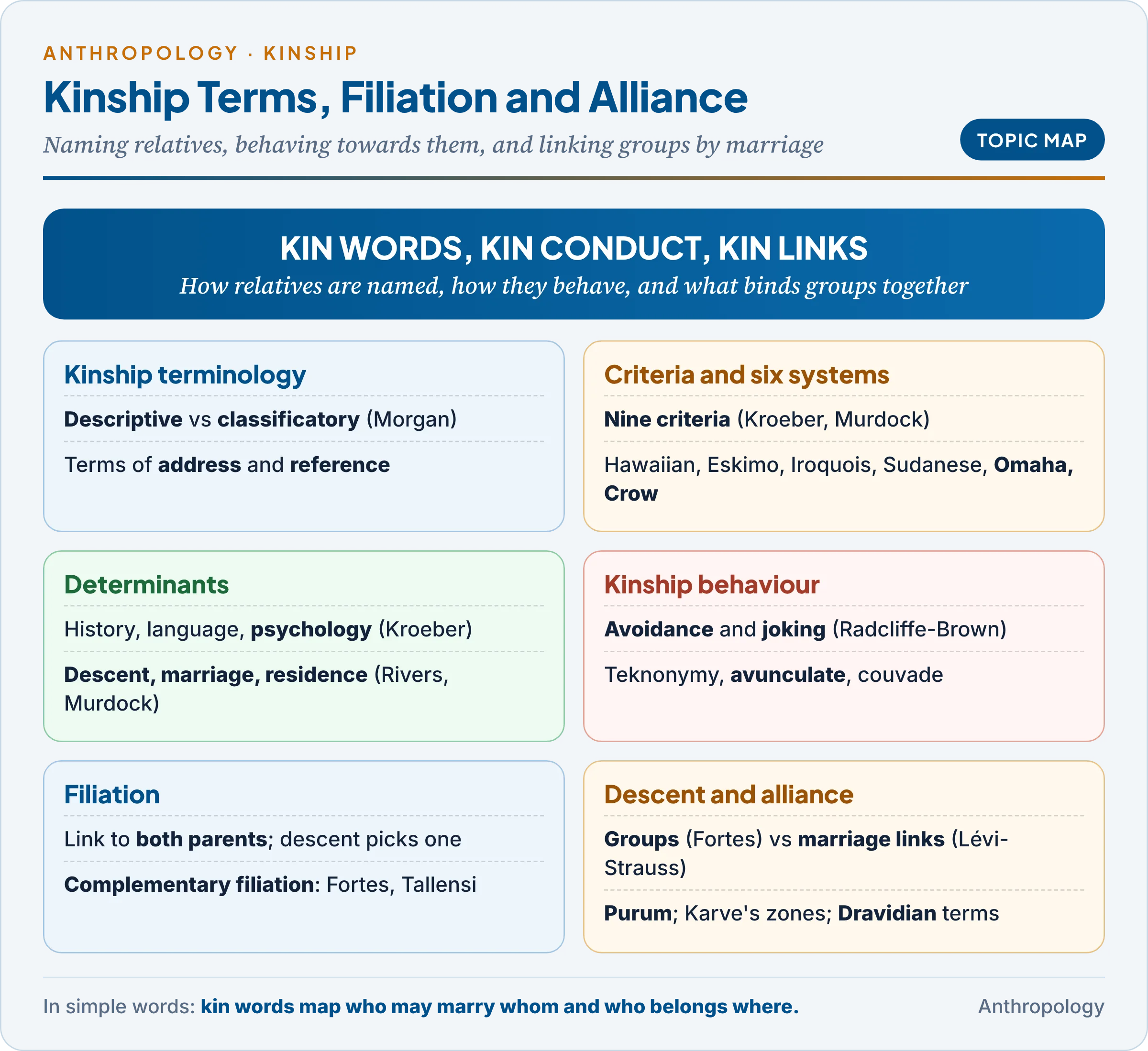
Recap of Unit 2.5a. Kinship links people by birth (consanguinity) and marriage (affinity). A descent rule (patrilineal, matrilineal, double, bilateral or ambilineal) assigns each person to ancestors, and unilineal rules build lineages, clans, phratries and moieties, while bilateral reckoning gives only an ego-centred kindred; matrilineal systems such as the Nayar face the “matrilineal puzzle” (Audrey Richards, Robin Fox). This article takes the remaining three items of the syllabus line: what relatives are called, how a child is linked to both parents within a descent system, and the debate over whether descent or marriage alliance is the backbone of social structure.
1. Kinship Terminology: Meaning and Classification of Terms
In simple words
Every language has words for relatives, such as “father”, “uncle” or “cousin”. These words are not random labels: they group some relatives together and keep others apart, and the grouping shows how a society expects people to behave towards each other and whom they may marry.
Example first. A Hindi speaker has separate words for the father’s elder brother (tau), father’s younger brother (chacha), mother’s brother (mama), father’s sister (bua) and mother’s sister (mausi), where English has only “uncle” and “aunt”. Yet the same speaker calls every cousin bhai (brother) or behen (sister), adding only a qualifier such as chachera bhai (FBS) or mamera bhai (MBS). The word “brother” signals that no cousin is marriageable in north Indian custom. A Tamil speaker, by contrast, calls the mother’s brother māmā, the same word as father-in-law, because the mother’s brother’s daughter is a preferred bride. The words encode the marriage rules.
1.1 What a kinship term is
- A kinship term is the word used for a relative in a given language. The whole set is a kinship terminology: a vocabulary that classifies relatives.
- Lewis Henry Morgan, the American lawyer-anthropologist who studied the Seneca Iroquois, made terminology a field of study in Systems of Consanguinity and Affinity of the Human Family (1871), comparing schedules of kin terms collected from across the world.
- Every terminology does two jobs at once: it merges some kin under one term and separates others. Kin are usually merged when they hold a similar status towards Ego (the reference person), for example a father and his brother who belong to the same lineage and share authority over Ego.
- Why it matters: terms are a quick window into descent groups, marriage rules and expected behaviour. A fieldworker who records terms by the genealogical method (W.H.R. Rivers, 1910) gets a map of the social structure in a few days.
1.2 Ways of classifying kinship terms
Kinship terms can be sorted in three ways; read the last column for the classic example of each.
| Basis | Types | Meaning | Example |
|---|---|---|---|
| Mode of use | Term of address / term of reference | Word used speaking to the relative / speaking about the relative | Telugu speakers address a father’s sister as atta but refer to her as menatta |
| Linguistic structure | Elementary | A single word that cannot be broken into kin parts | English father |
| Derivative | An elementary term plus a non-kin element | grandfather, sister-in-law, stepson | |
| Descriptive | Two or more elementary terms combined | Swedish farbror (“father-brother”, FB) | |
| Range of application | Denotative | Applies to one kin type only | father, mother, husband |
| Classificatory | Applies to two or more kin types | uncle (FB, MB, FZH, MZH), cousin |
The third row is the one Morgan’s distinction grew from. A terminology with mostly denotative terms is called narrow-range; one with mostly classificatory terms is broad-range. People often address unrelated elders by kin words (fictive kinship) while referring to true kin precisely.
1.3 Morgan’s descriptive and classificatory systems
- Morgan’s dichotomy (1871):
- Descriptive systems describe each collateral relative by combining primary terms and keep lineal kin apart from collateral kin. He found them among the “Aryan, Semitic and Uralian” families of languages.
- Classificatory systems merge lineal and collateral kin (FB called “father”, MZ called “mother”, parallel cousins called “brother” and “sister”). He found them among the “Turanian” (including Tamil and Telugu), “Ganowanian” (Native American) and “Malayan” (Hawaiian) peoples.
- Morgan’s explanation: terms are fossils of earlier marriage forms. The Hawaiian practice of calling all men of the parental generation “father” was, he argued, a survival of a stage of group marriage in which a child could not know its father. This was the basis of his evolutionary sequence of family forms (Unit 6, classical evolutionism).
- Criticism:
- J.F. McLennan, the Scottish evolutionist, dismissed classificatory terms as mere terms of address and courtesy, with no link to marriage.
- A.L. Kroeber (1909) showed that every system classifies: English “cousin” lumps eight kin types and both sexes, so the dichotomy is a matter of degree, not of kind (§3.2).
- The group-marriage inference is unsupported: no society with group marriage as its norm has been found.
- What survives: terminologies are systematic and correlate with social structure, a reading W.H.R. Rivers (1914) defended against Kroeber.
Common confusion
Is a “classificatory” system a sign of a primitive society? No. Classificatory simply means that one term covers more than one kin type. English “uncle” and “cousin” are classificatory, and Hindi, a language of a complex literate civilisation, is largely descriptive for the parental generation. The labels describe how relatives are grouped, not a society’s level of development.
2. Analysing Terminologies: Criteria and the Six Systems
In simple words
To compare the world’s kinship words, anthropologists ask which differences between relatives a language bothers to mark: generation, sex, age, the side of the family, and so on. The answers fall into a few recurring patterns, each named after a people who use it.
2.1 The criteria for distinguishing relatives
A.L. Kroeber, the American anthropologist of Native California, listed eight categories of distinction in “Classificatory Systems of Relationship” (1909). G.P. Murdock, the American comparativist, built on Kroeber and Robert Lowie to set out nine criteria in Social Structure (1949). Each criterion can be recognised (two kin get different terms) or ignored (they are merged).
| Criterion | What it distinguishes | Example |
|---|---|---|
| Generation | Kin of different generations | Ignored for some kin in Omaha and Crow systems (§2.4) |
| Sex | Male and female kin | Ignored in English cousin |
| Affinity | Blood kin from in-laws | Ignored in Dravidian terms: MB = wife’s father (§7.2) |
| Collaterality | Lineal from collateral kin | Ignored when F = FB (“merging“) |
| Bifurcation | Sex of the connecting relative | Hindi dada (FF) vs nana (MF); English grandfather ignores it |
| Polarity | Separate terms for each party in a pair | father/son recognises it; cousin/cousin ignores it |
| Relative age | Elder and younger kin of one generation | Telugu anna (elder brother) vs tammudu (younger) |
| Speaker’s sex | The term depends on whether a man or woman speaks | Lau Fijian weka, “opposite-sex sibling” |
| Decedence | Whether the connecting relative is alive or dead | Some Native Californian peoples (Kroeber) |
The table shows why terminologies differ: each language recognises a different combination of the same few criteria. A system that recognises collaterality but ignores bifurcation produces “uncle”; one that recognises bifurcation but ignores collaterality produces F = FB and a separate term for MB.
2.2 Classifying by the parental generation
Robert Lowie (1928) and Paul Kirchhoff (1932) grouped terminologies by how they treat F, FB and MB (and likewise M, MZ, FZ):
- Lineal: F is distinct; FB = MB (“uncle”). English; ties with the independent nuclear family.
- Generational: F = FB = MB, all “father”. Hawaiian; ties with cognatic descent.
- Bifurcate merging: F = FB, but MB is distinct. Iroquois, Omaha, Crow; ties with unilineal descent, because F and FB belong to the same patrilineage while MB belongs to another.
- Bifurcate collateral: F, FB and MB all distinct. Sudanese and Hindi (pita, chacha, mama).
2.3 Murdock’s six cousin terminologies
Murdock (1949), following Leslie Spier (1925), named six types after the way cousins are classified, since the cousin generation is where systems differ most. Each type is explained below with its social correlate.
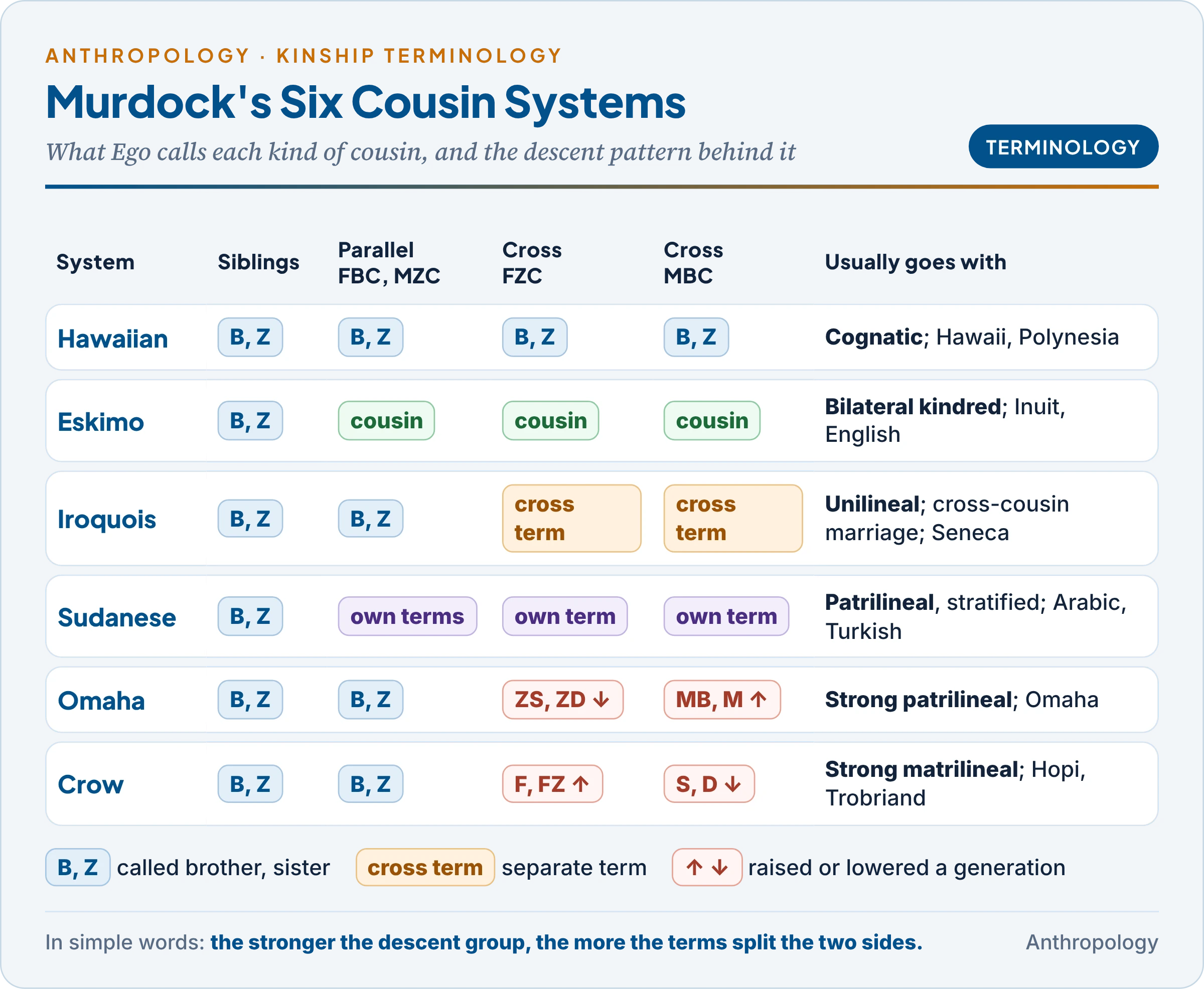
- Hawaiian (generational): all cousins are called brother and sister; in the parental generation, all men are “father” and all women “mother”. It is the most classificatory system, using the fewest terms. It goes with ambilineal or bilateral descent: where Ego may join either parent’s group, relatives on both sides stand in the same relation to Ego, and no cousin is a possible spouse. Found in Hawaii and much of Polynesia.
- Eskimo (lineal): siblings get their own terms, and all cousins share one term, regardless of side or sex. It goes with the bilateral kindred and an independent nuclear family, where the household stands apart and other kin matter mainly on ceremonial occasions. Used by the Inuit and in English and most Western languages.
- Iroquois (bifurcate merging): parallel cousins (FBC, MZC) are called brother and sister; cross cousins (FZC, MBC) share a separate term. It goes with unilineal descent groups and often with cross-cousin marriage, because cross cousins belong to other lineages and are potential spouses. Morgan documented it among the Seneca; it is very widespread.
- Sudanese (descriptive): every cousin type has its own term, and none is equated with a sibling. It is the most descriptive system. It goes with patrilineal descent in fairly stratified societies: Arabic (ibn ‘amm, FBS, distinct from ibn khāl, MBS), Turkish and classical Latin.
- Omaha: like Iroquois for parallel cousins, but cross cousins are placed in different generations (§2.4). It goes with strong patrilineal descent. Named after the Omaha of Nebraska.
- Crow: the mirror image of Omaha, with cross cousins skewed the other way. It goes with strong matrilineal descent: the Crow of Montana, the Hopi and the Trobriand Islanders.
The pattern across the six: the stronger and more corporate the descent group, the more the terminology separates one side of the family from the other. Bilateral societies use Eskimo or Hawaiian terms; unilineal ones use Iroquois, Omaha, Crow or Sudanese.
2.4 Omaha and Crow: when generation is ignored
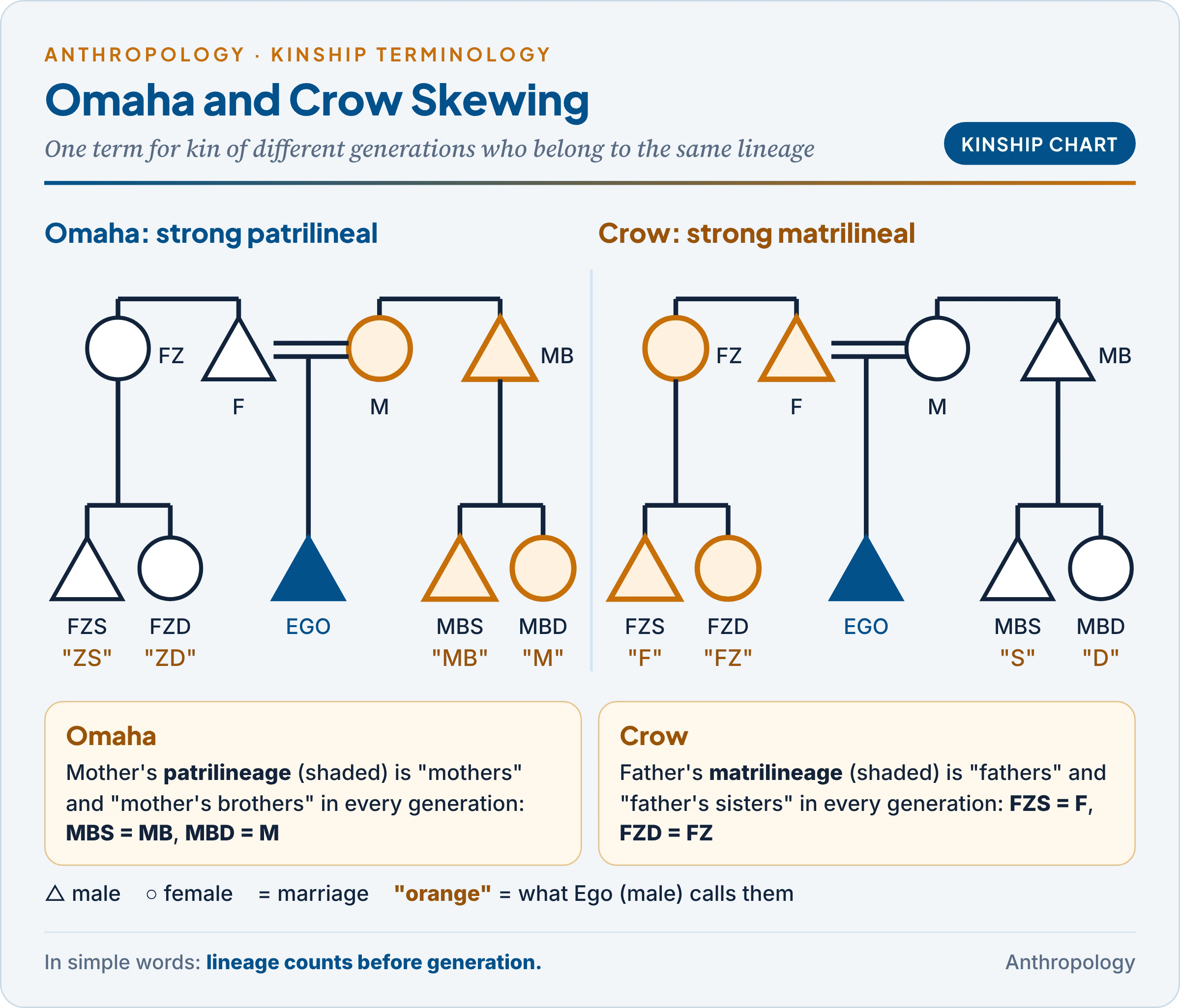
Omaha and Crow terms puzzle beginners because they give one term to relatives of different generations. The logic is the lineage: Ego treats a whole lineage of the other side as a single unit.
- Omaha (patrilineal):
- All men of mother’s patrilineage are “mother’s brother“, whatever their generation: MB, MBS, MBSS. Its women are “mother“: M, MZ, MBD.
- Ego’s mother’s lineage is the group that “gave” Ego his mother, so Ego treats it as a lineage of mothers and mother’s brothers in every generation.
- The children of father’s sister (FZS, FZD) are lowered to “sister’s son” and “sister’s daughter“, because Ego’s own lineage stands in the same “giving” position towards them.
- Crow (matrilineal):
- All men of father’s matrilineage are “father“: F, FB, FZS. Its women are “father’s sister“: FZ, FZD, FZDD.
- The children of mother’s brother (MBS, MBD) are lowered to “son” and “daughter” for a male Ego.
- Why it matters: these systems show the unity of the lineage group, Radcliffe-Brown‘s principle (§3.1). A person is identified first by lineage membership, and only secondly by generation.
3. Determinants of Kinship Terminology
In simple words
Why does one language merge relatives that another separates? Some scholars say the reasons lie in history and language, some in the human mind, and others in social facts such as descent groups and marriage rules. Most now accept that several causes work together.
Example first. Where the levirate is practised (a widow marries her dead husband’s brother), the father’s brother is a potential stepfather, and the mother’s sister, under the sororate, a potential stepmother. It is then natural to call FB “father” and MZ “mother”. The American linguist Edward Sapir (1916) offered this as one source of bifurcate merging.
3.1 The main theories
The table lists the proposed determinants, from the least to the most sociological.
| Determinant | Scholar | Argument |
|---|---|---|
| Historical accident | Kroeber | Terms change through borrowing and local history; they must be read historically |
| Language | E.W. Gifford; Kroeber | Kinship systems are linguistic phenomena first and social phenomena only second; terms obey the grammar of their language |
| Psychology | Kroeber (1909) | Terms reflect how people perceive likeness between kin, not social rules |
| Sociological principles | Radcliffe-Brown; Sapir | Terms express unity of the sibling group (FB like F) and unity of the lineage (Omaha, Crow) |
| Marriage rules | Rivers; Sapir | Cross-cousin marriage equates MB with WF; levirate and sororate give bifurcate merging |
| Kin groups and residence | Murdock (1949) | Exogamous lineages, clans and moieties produce bifurcate merging; terminology changes last |
How the sociological view works. Murdock tested his ideas statistically on 250 societies. He argued that change begins with residence, which alters who lives together; descent follows; and terminology adjusts last, so terms often lag behind social change. This lag explains why a society may use Crow terms after its matrilineal groups have weakened.
Evaluation. The sociological view explains the correlations in §2.3, but the fit is loose: a 2023 study of Bantu languages found no co-evolution of cross-cousin marriage and bifurcate-merging terms (Contemporary Developments), supporting Kroeber’s point that history and language also shape terms.
3.2 Kroeber’s contribution to kinship studies
A.L. Kroeber (1876–1960), Boas’s first PhD student and the leading figure of Californian anthropology, shaped kinship studies in four ways:
- A logical method: his eight categories (1909), developed into Murdock’s nine criteria, turned terms into components that could be compared across cultures. This is the root of componential analysis, the method by which Ward Goodenough and Floyd Lounsbury (1956) broke kin terms into features such as generation, sex and lineality.
- The attack on Morgan: he showed that the descriptive-classificatory split is one of degree and that terms are not survivals of group marriage.
- Terms as psychology and language: he argued that terms “reflect psychology, not sociology”, that is, they follow ways of perceiving and naming, not institutions. This drew Rivers‘ reply (1914) that terms are shaped by marriage and social organisation.
- Clan and kinship are separable: in Zuni Kin and Clan (1917), he showed that the Zuni clans and kin terms did not fit each other neatly, a warning against reading a social group from every term.
Critique and legacy: Kroeber overstated the independence of terms from social structure, as Murdock’s statistics later showed, and he himself later conceded that social factors matter. His lasting gift is the insistence that terms be analysed formally and historically before being explained.
4. Kinship Behaviour: The Usages that Accompany Terms
In simple words
Relatives are not only named; each name carries a way of behaving. Some relatives must be avoided, some may be teased freely, and some have special authority. These fixed patterns are called kinship usages.
Example first. In many north Indian households, a young wife veils her face and does not speak directly to her husband’s elder brother (jeth), yet she may joke and tease freely with his younger brother (devar). The two men are brothers of the same husband; the difference in behaviour follows the difference in status and potential relationship. Radcliffe-Brown, the British structural-functionalist, called such patterned conduct kinship usages and argued that terms and behaviour form one system.
4.1 Avoidance
Avoidance is a rule that forbids or restricts seeing, touching, speaking to or naming a particular relative, most often an in-law.
Theories of avoidance, each with its reasoning:
| Theory | Scholar | Reasoning |
|---|---|---|
| Residence | E.B. Tylor (1889) | Mother-in-law avoidance goes with matrilocal residence: the husband enters as a stranger and is kept at a distance |
| Incest prevention | J.G. Frazer; Sigmund Freud, Totem and Taboo (1913) | Avoidance guards against sexual attraction between kin who must not mate |
| Cultural defence | Robert Lowie | The in-marrying spouse comes from an alien group; avoidance limits outside influence |
| Conflict prevention | Radcliffe-Brown (1940); Chapple and Coon | Affines are linked by marriage but belong to separate groups with rival interests; extreme respect prevents open conflict |
4.2 Joking relationship
A joking relationship is the opposite of avoidance: a relationship in which one party is permitted, and sometimes expected, to tease, insult or make sexual jokes at the other, who must not take offence. Radcliffe-Brown called it “permitted disrespect“.
- Symmetrical joking: both parties tease each other, as between a man and his wife’s younger sister (sali) or a woman and her husband’s younger brother (devar). These are often potential spouses under the sororate and levirate, so the joking expresses a recognised closeness.
- Asymmetrical joking: only one side has the licence. Among the Tsonga (Thonga) of southern Africa, the sister’s son may take his mother’s brother‘s food and property without rebuke.
- Grandparent–grandchild joking: alternate generations are equals in many systems. S.C. Roy reported joking leading to mock and occasional real marriage between grandparents and grandchildren among the Oraon, and Verrier Elwin among the Baiga.
Radcliffe-Brown’s theory (“On Joking Relationships”, 1940). Joking and avoidance solve the same problem. Some relationships combine conjunction (shared interest, as between in-laws joined by a marriage) with disjunction (separate group loyalties). Such a relationship can be stabilised either by extreme respect (avoidance) or by mock hostility (joking): both prevent real conflict.
Critical perspective:
- Circular and static: the functional explanation says the usage exists because it maintains order, but it cannot say why one society chooses joking and another avoidance for the same relationship.
- Meaning over function: Mary Douglas (1968) read the joke as an “anti-rite” that plays with the social order where that order itself is ambiguous, so joking reveals structural tension rather than simply relieving it.
- Power and gender: avoidance norms such as veiling and name taboos fall mostly on young wives, which functionalist accounts treated as neutral “respect”. Feminist scholars read them as part of patriarchal control.
4.3 Other usages
- Teknonymy (term coined by Tylor, 1889): addressing a person as the parent of a child instead of by name (“Ramu-ki-maa“, Ramu’s mother). In India a wife often avoids her husband’s name; among the Santal the taboo on the husband’s name is strict. Tylor linked it to matrilocal residence, where a husband is recognised through his child; it is better seen as a mark of respect and avoidance.
- Avunculate: a special bond between mother’s brother and sister’s son (avunculate also covers the MB’s authority, called avuncupotestal, and avunculocal residence with the MB). In matrilineal societies (Trobriand) the MB holds authority and the ZS is his heir. In patrilineal ones it is warm and indulgent: H.A. Junod read the Tsonga case as a survival of an earlier matrilineal stage, while Radcliffe-Brown, “The Mother’s Brother in South Africa” (1924), explained it by extension of sentiment: the MB is treated as a “male mother“, indulgent where the father is strict. Radcliffe-Brown’s view prevailed.
- Amitate: the parallel bond with the father’s sister, the “female father“, who in patrilineal systems commands respect and may have authority over her brother’s children.
- Couvade (term from Tylor, 1865): the husband imitates a woman in childbirth, lying in, fasting and observing taboos, around the time of his wife’s delivery. Explanations: a public claim to paternity in a shift from mother-right to father-right (Bachofen), strengthening of the conjugal bond (Malinowski) and psychological identification with the wife. Among the Toda of the Nilgiris, the bow-and-arrow rite pursütpimi fixes social paternity, not biological fatherhood (Rivers, 1906).
5. Descent, Filiation and Complementary Filiation
In simple words
Descent links a person to a line of ancestors and a group. Filiation is simpler: it is just the link between a child and its own parents, and every child has a link to both. Even where the group follows only one parent, the link to the other parent still matters, and that second link is called complementary filiation.
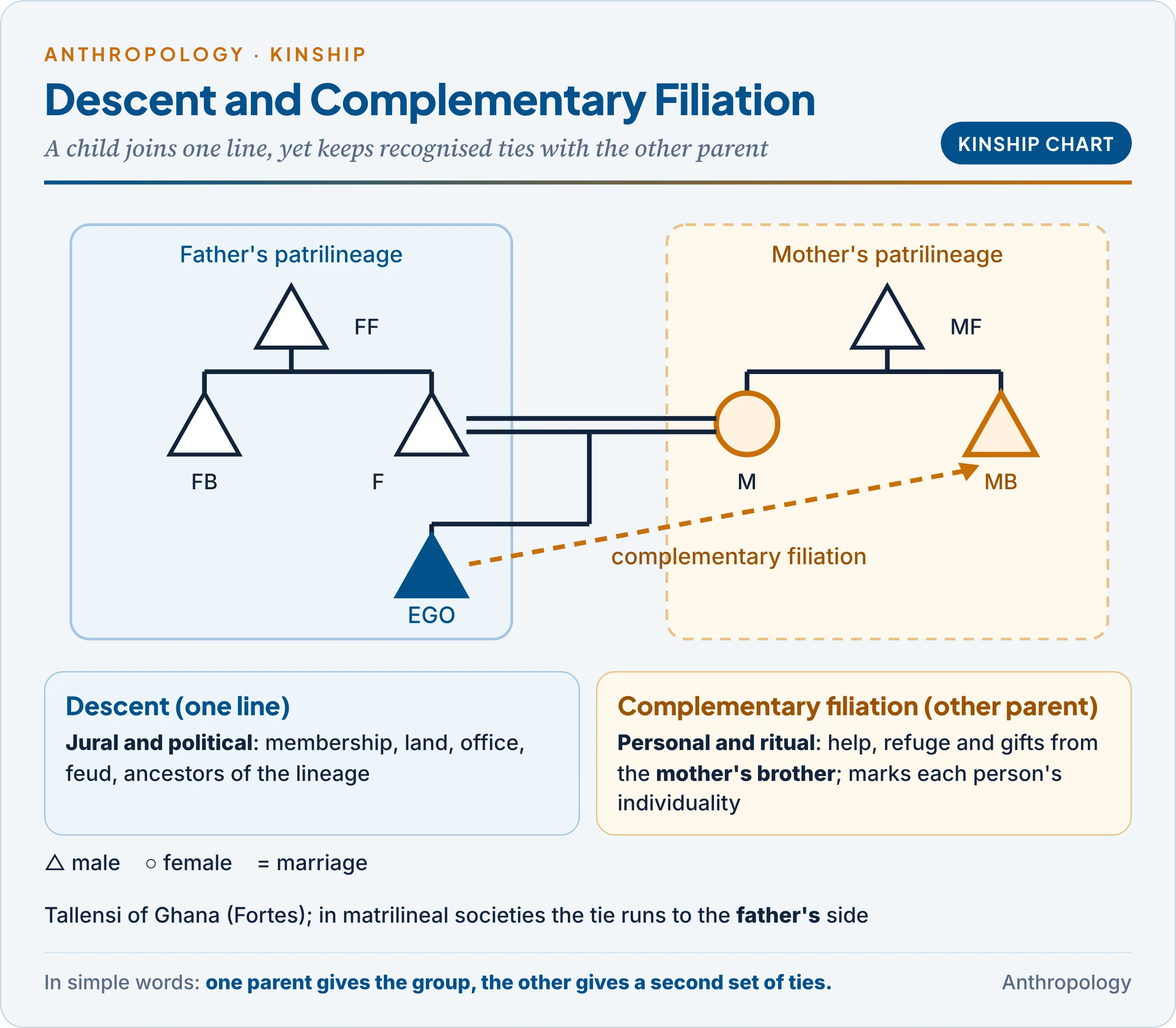
Example first. A Tallensi man of northern Ghana belongs to his father’s patrilineage, which gives him land, a voice in lineage councils and duties to its ancestors. Yet his mother’s patrilineage is not a stranger to him: he can seek help and refuge there, has ritual ties to its ancestors through his mother, and may not marry into it. Meyer Fortes, the South African-born British anthropologist, studied the Tallensi in The Web of Kinship among the Tallensi (1949) and called this second tie complementary filiation.
5.1 Filiation and descent
- Filiation is the relationship between a child and its parents. Fortes held that filiation is universally bilateral: every legitimate child is filiated to both father and mother.
- Descent is filiation extended over generations: a recognised link between a person and an ancestor, used to give membership of a group. Fortes and Leach both confined the term “descent” to unilineal rules that form corporate groups.
- How they fit: a unilineal society selects one line of filiation, the father’s or the mother’s, for jural and political purposes such as land, office and feud. The other line is not erased: it survives as complementary filiation in the domestic, moral and ritual sphere.
5.2 Complementary filiation
Fortes introduced the term in “The Structure of Unilineal Descent Groups” (1953). It refers to the socially recognised ties with the parent who does not pass on group membership:
- In patrilineal societies: ties with the mother’s side, especially the mother’s brother and maternal grandparents.
- In matrilineal societies: ties with the father’s side, as with the Trobriand father, who loves and helps his sons although they are heirs of their mother’s brother.
What complementary filiation does:
- Individualises. All members of one lineage share the same descent, but each has a different mother’s lineage. Complementary filiation therefore marks a person’s individuality within the descent group; lineage ties are political and hierarchical, while complementary ties are personal and emotional.
- Links lineages. Every person ties two lineages together, so a society of separate descent groups becomes a network.
- Channels property and ritual. Jack Goody, Death, Property and the Ancestors (1962), showed among the LoDagaa of Ghana that some property and status pass along the line of complementary filiation. Fortes (1961) also traced the idea into ancestor worship.
- Indian echo: in patrilineal north India the mother’s brother (mama) brings gifts at his sister’s children’s weddings (the bhat or mayra in Rajasthan and Haryana) and has ritual roles at life-cycle rites, although he belongs to another lineage.
5.3 Leach’s critique and the 1959–61 debate
- Edmund Leach, the British anthropologist of Highland Burma, objected (1957; Rethinking Anthropology, 1961) that Fortes “disguises” affinity under the expression complementary filiation. Ego’s mother’s brother is, first of all, his father’s brother-in-law: the tie between the two lineages is created by a marriage, so it is an alliance, not a kind of descent.
- Fortes replied in “Descent, Filiation and Affinity: A Rejoinder to Dr Leach” (1959): the tie is lived as a kin tie by the people themselves, and in Africa marriages do not form lasting alliances between groups.
- Louis Dumont (1961) sided with the alliance view for South India (§7.2).
6. Descent and Alliance
In simple words
There were two big answers to the question “what holds a kinship-based society together?” One said: groups of people descended from common ancestors. The other said: the marriages that link those groups, renewed generation after generation. The debate between them shaped kinship studies for thirty years.
Example first. Among the Kachin of Highland Burma, studied by Leach, a lineage takes wives from fixed wife-giving lineages (mayu) and gives its daughters to fixed wife-taking lineages (dama), generation after generation. Ask a Kachin about another lineage, and the first thing he states is whether it is mayu or dama: the marriage relationship between groups, not common descent, organises rank, politics and gift exchange.
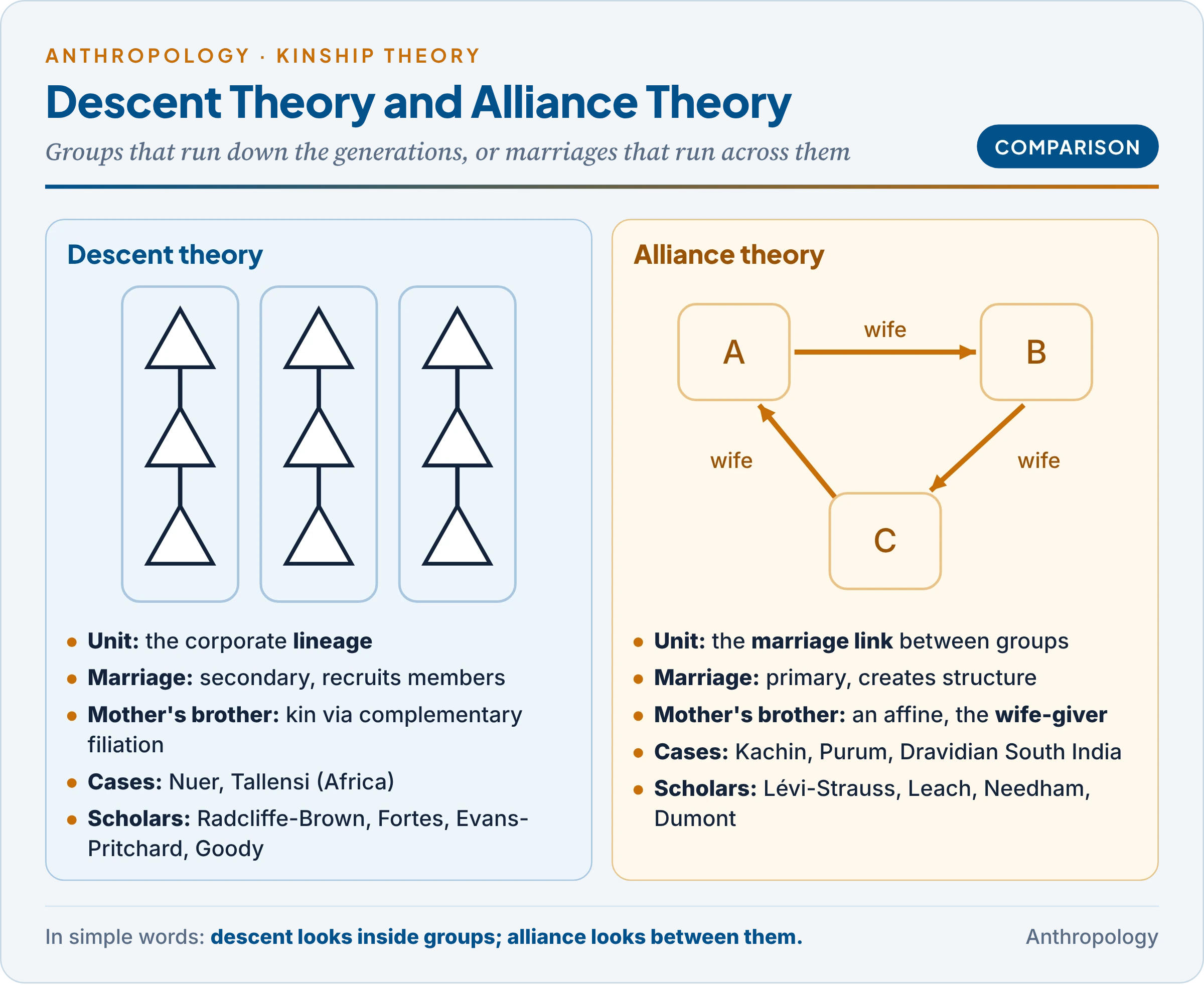
6.1 Descent theory
Descent theory was built by Radcliffe-Brown, Meyer Fortes, E.E. Evans-Pritchard, Jack Goody and Max Gluckman, mainly from African data.
- The building block is the corporate unilineal descent group (Unit 2.5a): it holds property, settles disputes and acts politically.
- Social structure is the arrangement of these groups, as in the Nuer segmentary lineage system.
- Marriage is secondary: it recruits members and links groups through complementary filiation, but it does not create lasting structures.
- Strength: explains stateless societies run by lineages. Weakness: fits poorly where descent groups are weak (Southeast Asia, Oceania) and underplays marriage.
6.2 Alliance theory
Alliance theory comes from Claude Lévi-Strauss, the French structuralist, in The Elementary Structures of Kinship (1949), and was developed by Leach, Rodney Needham and Louis Dumont.
- Starting point: the incest taboo forbids marriage within the group, so every group must exchange women with others; the exchange creates alliance. Lévi-Strauss called the taboo the passage from nature to culture (Unit 2.3).
- The building block is the relationship between groups created by marriage, and the key relative is the mother’s brother as wife-giver.
- Types of structure:
- Elementary structures have a positive marriage rule: the terminology itself marks a class of kin as marriageable (the “closed” system).
- Complex structures only forbid some kin and leave the choice of spouse to other mechanisms, such as wealth or love (the “open” system, modern societies).
- Semi-complex structures (Lévi-Strauss, Huxley Lecture, 1965): Crow-Omaha systems, which forbid marriage into many lineages but prescribe none.
- Forms of exchange (summary of Unit 2.3): bilateral cross-cousin marriage gives restricted exchange between two groups (A ⇄ B); matrilateral (MBD) marriage gives generalised exchange round a circle (A → B → C → A) and integrates many groups in lasting solidarity; patrilateral (FZD) marriage gives discontinuous exchange that reverses every generation.
- Variants within the school:
- Leach (1951; Political Systems of Highland Burma, 1954) studied alliance empirically, as a matter of bride-wealth, rank and politics, not mental structure. Among the Kachin, wife-givers rank above wife-takers.
- Needham (Structure and Sentiment, 1962) separated prescriptive systems (a category defined by terminology) from preferential ones (a statistical tendency). He rebutted Homans and Schneider (1955), who explained the MBD preference by sentiment towards the mother’s side.
6.3 Comparing the two theories
The table sets the two theories side by side; read each row as a point of disagreement.
| Point | Descent theory | Alliance theory |
|---|---|---|
| Key scholars | Radcliffe-Brown, Fortes, Evans-Pritchard, Goody | Lévi-Strauss, Leach, Needham, Dumont |
| Basic unit | The descent group | The relationship between groups |
| Marriage | Secondary; recruits members | Primary; creates structure |
| Mother’s brother | A consanguine via complementary filiation | An affine, the wife-giver |
| Key data | Africa (Nuer, Tallensi) | Australia, Southeast Asia, South India |
| Method | Jural and empirical | Structural models, often from terminology |
The core difference is the direction of view: descent theory looks inside groups at how membership and rights pass down generations, while alliance theory looks between groups at how marriages link them. Dumont, Introduction to Two Theories of Social Anthropology (1971), concluded that the two highlight different aspects and suit different kinds of society, and most anthropologists now treat descent and alliance as complementary dimensions.
6.4 The Purum case
The Purum, a small Old Kuki tribe of Manipur, became a test case for alliance theory.
- The ethnography: T.C. Das, The Purums: An Old Kuki Tribe of Manipur (1945), described five exogamous patrilineal sibs (clans) divided into some fourteen lineages, with a stated preference for the mother’s brother’s daughter.
- Needham’s analysis (“A Structural Analysis of Purum Society”, 1958): he read Purum as a prescriptive matrilateral alliance system, with lineages arranged as wife-givers and wife-takers in cycles of generalised exchange, matched by a symbolic classification (wife-givers superior, even in the layout of the house).
- The critique: Charles Ackerman (1964) counted the recorded marriages and found that only about half were with women of the mother’s brother’s sib, and that several lineages exchanged wives in both directions. A “prescription” so often broken, he argued, was not a rule.
- The defence: Needham and his supporters replied that prescription is a matter of categories and terminology, not of statistics; a model describes a system’s logic, not every marriage.
Theoretical significance:
- It made an Indian tribe the best-known test of generalised exchange outside Burma.
- It sharpened the distinction between prescription and preference.
- It exposed the gap between structural models and statistical behaviour (Lévi-Strauss’s “mechanical” and “statistical” models).
- It showed alliance as a total system linking marriage, rank and symbolism.
7. Indian Kinship: Karve’s Zones and Dravidian Terminology
In simple words
India has several kinship patterns, not one. In the north a bride usually comes from a distant, unrelated family; in the south she often marries a cousin or her mother’s brother and stays among her own relatives. The kinship words in each region match these marriage rules.
7.1 Karve’s kinship zones
Irawati Karve, the Pune anthropologist, mapped kinship onto language areas in Kinship Organisation in India (1953), a landmark all-India comparative study of kinship.
| Zone | Language area | Main features |
|---|---|---|
| Northern | Indo-Aryan (Sanskritic) north | Gotra and village exogamy; avoidance of several gotras; no cousin marriage; hypergamy; bride from a distant, unknown family; sharp separation of consanguines and affines |
| Central | Transitional belt (e.g. Rajasthan, Gujarat, Maharashtra, Odisha) | Mixed: some castes allow MBD marriage as in the south, others follow northern rules |
| Southern | Dravidian | Cross-cousin and elder sister’s daughter marriage; marriage among close kin; terms divide kin into marriageable and non-marriageable |
| Eastern | Austro-Asiatic (Munda, Khasi) and Tibeto-Burman | Tribal patterns: Munda totemic patriclans, Khasi and Garo matriliny |
The contrast Karve drew between north and south is the key: in the north a girl is sent to live among strangers, while in the south she remains among her relatives after marriage. Later scholars refined the zones. Patricia Uberoi‘s readers on family and kinship in India are the standard modern guide, and caste, religion and region cut across the language boundaries.
7.2 Dravidian terminology and alliance
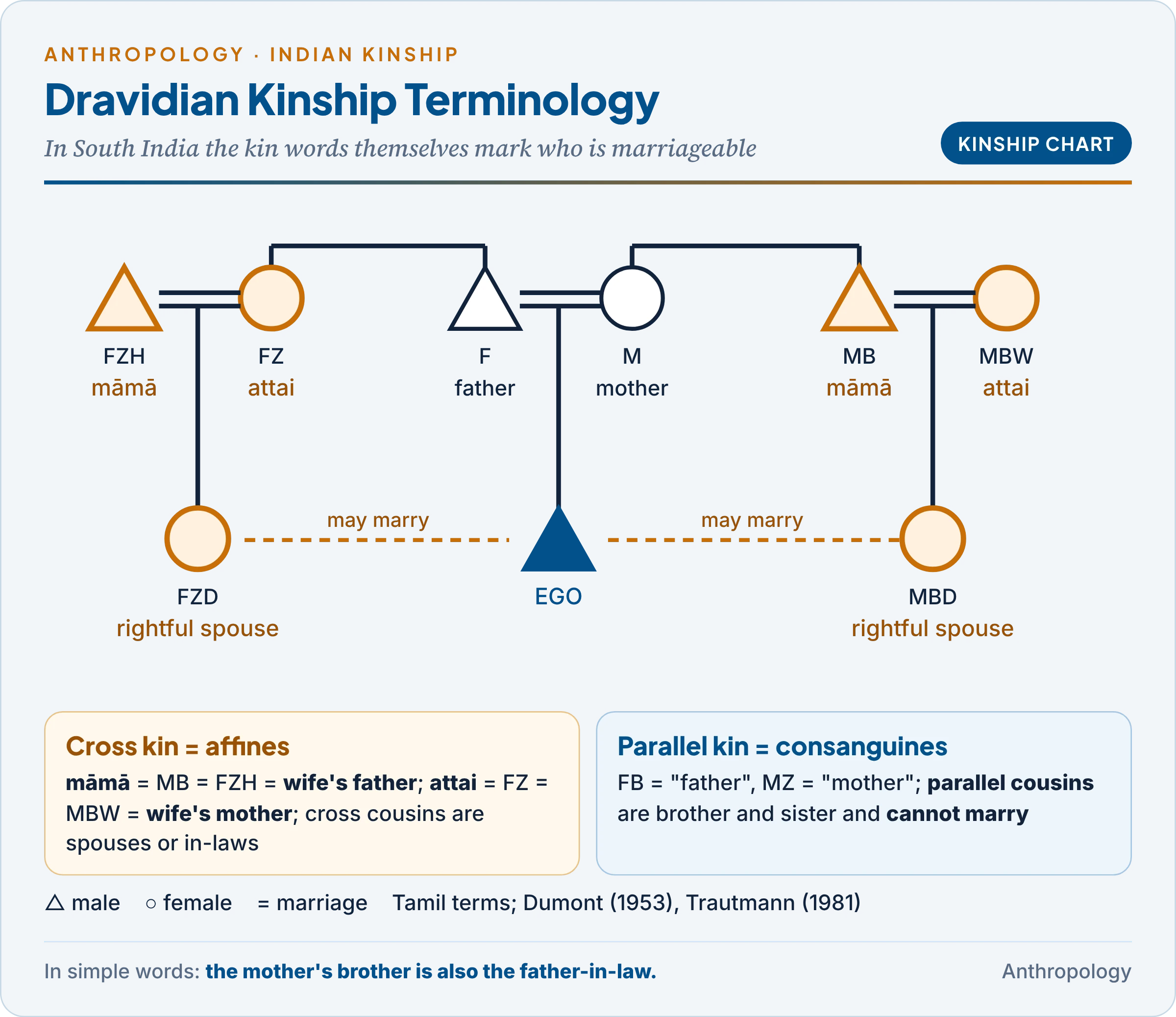
Louis Dumont, the French Indologist, argued in “The Dravidian Kinship Terminology as an Expression of Marriage” (1953) that South Indian terms are a language of alliance.
- Two kinds of kin in every generation: in the three middle generations, Dravidian terms divide relatives into parallel kin (consanguines, “our side“) and cross kin (affines, “the side we marry“).
- How it works:
- G+1: F = FB, M = MZ; but MB = FZH = WF (Tamil māmā, “uncle” and “father-in-law”), and FZ = MBW = WM (attai).
- G0: parallel cousins are brother and sister; cross cousins are spouses or brothers- and sisters-in-law (Tamil maittunan, MBS, FZS, WB). The cross cousin is the murai (rightful) spouse.
- G−1: the children of same-sex siblings are “son, daughter”; those of opposite-sex siblings are son- and daughter-in-law.
- Affinity is inherited: a man inherits his father’s affines as his own, so the alliance between two lineages repeats across generations. Dumont therefore treated alliance as a diachronic institution, as enduring as descent. He documented it among the Pramalai Kallar of Madurai (1957) and generalised it in Affinity as a Value (1983).
- Dravidian versus Iroquois: both separate cross from parallel kin, but Floyd Lounsbury (1964) showed that they reckon second cousins differently. Thomas Trautmann, Dravidian Kinship (1981), traced the system to Proto-Dravidian and showed its unity across the south.
- The north as contrast: north Indian terms keep affines separate (sasur, sala) and repeat no alliance. Marriage is a gift of a virgin (kanyadan) in which wife-takers rank above wife-givers, the reverse of the Kachin pattern. Sylvia Vatuk (1969) analysed the Hindi terminology structurally.
Common confusion
Are Iroquois and Dravidian terminology the same? No, though both split cross from parallel cousins. In Iroquois systems the split follows descent groups and cross cousins are simply “other-group” kin. In Dravidian systems the split is a marriage category: cross kin are affines, so MB is the father-in-law and the cross cousin the rightful spouse, and the calculation extends differently to distant cousins.
Key Terms
| Term | Meaning in simple words |
|---|---|
| Kinship terminology | The set of words a language uses for relatives |
| Term of address / reference | Word used when speaking to a relative / speaking about one |
| Denotative term | A kin word for one kind of relative only |
| Classificatory term | A kin word covering several kinds of relatives |
| Merging | Using one word for a lineal and a collateral relative (F = FB) |
| Bifurcation | Distinguishing kin by the sex of the connecting relative |
| Bifurcate merging | F = FB, but MB distinct |
| Bifurcate collateral | F, FB and MB all have different terms |
| Cross / parallel cousin | Child of a parent’s opposite-sex / same-sex sibling |
| Omaha / Crow skewing | Giving one term to kin of different generations in the same lineage |
| Avoidance | Rule of distance between certain relatives, often in-laws |
| Joking relationship | Licensed teasing between certain relatives |
| Teknonymy | Calling someone “parent of” their child instead of by name |
| Avunculate / amitate | Special bond with the mother’s brother / father’s sister |
| Couvade | A husband’s imitation of childbirth customs |
| Filiation | The link between a child and each parent |
| Complementary filiation | Ties to the parent whose line one does not join |
| Alliance | A lasting marriage relationship between groups |
| Elementary / complex structure | Kinship with a positive marriage rule / with only prohibitions |
| Prescriptive / preferential marriage | Marriage into a category defined by terms / a statistical preference |
Contemporary Developments
- Kinbank (2023): a global database of 210,903 kin terms from 1,229 languages (Passmore et al., PLOS ONE, May 2023). Its first test found no co-evolution between cross-cousin marriage and bifurcate-merging terms in Bantu languages, reopening the old Kroeber–Rivers question of how closely terms follow marriage rules.
- Karve’s map in survey data: analyses of NFHS-5 (2019–21) find about one marriage in ten in India is consanguineous, down from about 14% in 1992–93. Prevalence is highest in Tamil Nadu, Karnataka and Andhra Pradesh (around 30% in Tamil Nadu), lowest in the north-east, and low in Kerala despite being in the south. The Dravidian marriage zone remains visible statistically.
- Law and custom: in Neetu Grover v. Union of India (22 January 2024), the Delhi High Court upheld Section 5(v) of the Hindu Marriage Act, 1955, which bars marriage between sapindas unless a proven custom permits it. The custom exception is what keeps South Indian cross-cousin and uncle-niece marriage lawful, while parental consent alone cannot override the bar.
- Behavioural ethnography of usages: veiling and avoidance between a wife and her husband’s elder kin are weakening with nuclear urban households and women’s employment, while joking with devar and sali survives as a marker of affinal closeness.
Diagrams to Master
- Topic map of the article’s five themes.
- Six cousin terminologies (§2.3): for each system, label siblings, parallel cousins and cross cousins, and the usual descent rule.
- Omaha and Crow skewing (§2.4): show MBS called “MB” (Omaha) and FZS called “F” (Crow); shade the lineage being merged.
- Complementary filiation (§5.2): shade Ego’s descent group; mark the mother’s brother and the tie through the mother.
- Descent versus alliance (§6.3): vertical lineages against horizontal marriage links; name two scholars and one case for each.
- Dravidian terminology (§7.2): label MB = FZH = WF and cross cousin = spouse in △ ○ = notation.
Revision Grid
| Scholar | Work (year) | Key idea |
|---|---|---|
| Morgan | Systems of Consanguinity and Affinity (1871) | Descriptive vs classificatory; terms as survivals |
| Tylor | 1865; 1889 | Couvade, teknonymy; avoidance and residence |
| Kroeber | 1909; Zuni Kin and Clan (1917) | Eight categories; terms reflect psychology and language |
| Rivers | Kinship and Social Organization (1914) | Terms shaped by marriage and social structure |
| Sapir | 1916 | Levirate, sororate and bifurcate merging |
| Radcliffe-Brown | 1924; 1940; 1941 | Mother’s brother; joking and avoidance; sibling and lineage unity |
| Lowie; Kirchhoff | 1928; 1932 | Parental-generation types |
| Murdock | Social Structure (1949) | Nine criteria; six cousin systems; residence first |
| Lévi-Strauss | Elementary Structures of Kinship (1949) | Alliance; elementary, complex, semi-complex |
| Fortes | 1949; 1953; 1959 | Filiation, complementary filiation; descent theory |
| Leach | 1951; 1954; 1961 | Kachin mayu-dama; complementary filiation disguises affinity |
| Karve | Kinship Organisation in India (1953) | Four kinship zones |
| Dumont | 1953; 1957; 1983 | Dravidian terms express marriage; affinity inherited |
| Goodenough; Lounsbury | 1956; 1964 | Componential analysis; Dravidian vs Iroquois |
| Needham | 1958; Structure and Sentiment (1962) | Purum; prescription vs preference |
| Goody | Death, Property and the Ancestors (1962) | Property along complementary filiation |
| Ackerman | 1964 | Statistical critique of the Purum model |
| Trautmann | Dravidian Kinship (1981) | Proto-Dravidian cross-cousin system |
Previous Year Questions
Unit 2.5: Kinship (terminology, kinship behaviour, filiation, descent and alliance)
- 2025Write notes on: Theoretical significance of Purum kinship-system.
- 2025How the study of variation in forms of marriage led to rethinking on the concepts of social reproduction, kinship and family?
- 2024Write notes on: Critical perspective on avoidance and joking relationship.
- 2023Critically discuss A. L. Kroeber’s contribution to kinship studies.
- 2018Write a note in 150 words on Kinship Terminology.
- 2017Elucidate the determinants of Kinship terminology.
- 2016Describe the cardinal points of descent and alliance theories.
- 2001Explain the salient features of Descent and Alliance theories. Discuss the relevance to the analysis and understanding of Social Structure.
- 1994Write a note on Kinship terms and kinship behaviour.
- 1988What are incest regulation? Bring out their socio-cultural functions in the context of stability in the institutions marriage, family and kinship.
- 1984Evaluate the role of kinship in regulating sex and marriage.
Related questions from other units
- 2026Unit 2.3: Discuss ‘incest taboo’ as the basis of development of kinship systems in human societies.
- 2021Unit 2.3: Write notes on: Marriage Regulations and Alliance Theory.
- 2021Unit 6: Explain the structural analysis of kinship as proposed by Levi – Strauss.
- 2019Unit 6: How did Radcliffe-Brown and Levi-Strauss study kinship in terms of social structure?
- 2017Unit 2.3: Discuss the different forms of preferential marriage with suitable examples from tribal societies in India.
- 2016Unit 6: How do the concepts of binary opposites and exchange figure in Levi-Strauss’ structural analysis of kinship?
- 2015Unit 6: How did Morgan explain the evolution of marriage, family and Socio-Political organization and how did other evolutionists disagree with his explanation ?
- 1986Unit 9.3: What are the various forms of preferential mating? Explain with Indian examples.