

2.5 Kinship: Consanguinity and Affinity; Principles and types of descent (Unilineal, Double, Bilateral, Ambilineal); Forms of descent groups (lineage, clan, phratry, moiety and kindred); Kinship terminology (descriptive and classificatory); Descent, Filiation and Complimentary Filiation; Descent and Alliance.
Official Syllabus: Paper I, Unit 2.5 (descent and descent groups)
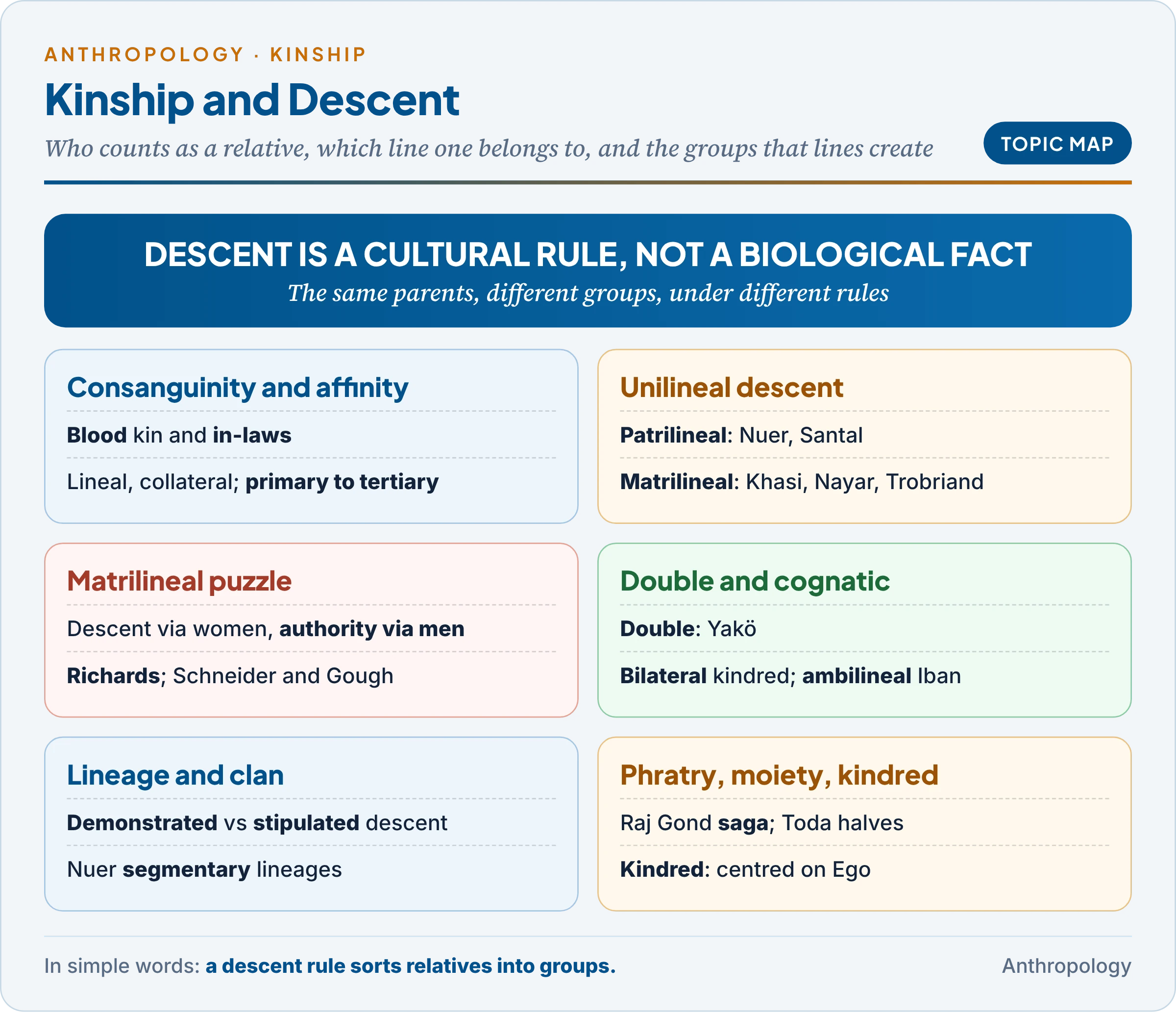
This article covers the first three parts of the syllabus line: kin types, descent and descent groups. Kinship terminology, filiation and complementary filiation, and the descent-versus-alliance debate follow in Unit 2.5b. Marriage rules that link descent groups (exogamy, cross-cousin marriage, restricted and generalised exchange) are in Unit 2.3.
1. Kinship: Consanguinity and Affinity
In simple words
Kinship is the web of relatives that every society recognises. Some relatives are linked by birth (“blood”) and some by marriage. Each society draws the web in its own way, so kinship is a social map, not a copy of biology.
Example first. A Khasi man of Meghalaya and his son share half their genes, yet the son belongs to his mother’s clan, carries his mother’s clan name and inherits nothing from his father’s clan. The father’s sister’s son, biologically no closer, is a full member of the father’s clan. In biology the two are equal; in Khasi kinship one is “in” and the other “out”. This is why anthropologists treat kinship as socially defined relationship.
1.1 What kinship is
- Kinship is the set of socially recognised relationships based on descent (links between generations) and marriage. The relationships may be real or putative (assumed, as with an adopted child or a mythical clan ancestor).
- Robin Fox, British anthropologist, Kinship and Marriage (1967), called kinship the study of what people do with the basic facts of life: mating, gestation, parenthood, socialisation and siblingship.
- Social, not biological: relationships are recognised by culture. A pater (social father) may differ from the genitor (biological father), and adoption, fictive kinship (kin terms used for non-relatives, such as godparenthood or calling a village woman “sister”) and milk kinship create kin without blood.
- David Schneider (1984) pushed this to the extreme: he argued that “kinship” as a separate domain is a Western idea built on “blood”, and may not exist in other cultures. Most anthropologists now keep the term but study “relatedness” (Janet Carsten) made through care, food and shared living as well as birth.
1.2 Consanguinity and affinity
The two basic kinds of kin are set out below; read the third column for the test that tells them apart.
| Kind | Meaning | Test | Examples |
|---|---|---|---|
| Consanguineal kin (consanguines) | Related by birth, real or putative | Linked through a parent-child or sibling chain | F, M, B, Z, S, D, FB, MZ, cousins |
| Affinal kin (affines) | Related through marriage | A spouse link in the chain | H, W, WF, HM, ZH, BW (in-laws) |
- Why the distinction matters: consanguines usually cannot marry (the incest taboo, Unit 2.3), so every society must find spouses among non-kin or affines. Marriage turns strangers into affines, and their children are consanguines of both sides, so kinship keeps growing outward.
- Where the line blurs: in Dravidian South India, the preferred spouse is a cross cousin (MBD or FZD), so the same person is a consanguine by birth and a potential affine. Kinship terms there classify the mother’s brother with the father-in-law (Unit 2.5b).
Other basic distinctions:
- Lineal and collateral kin: lineal kin are in a direct line of ascent or descent (F, FF, S, SS); collateral kin branch off through a sibling (FB, MZ, cousins).
- Agnatic and uterine kin: agnates are related through males only (patrikin); uterine kin are related through females only (matrikin). Cognates are relatives through either sex.
- Degrees of kin (Murdock, 1949):
- Primary kin: members of one’s own two nuclear families (7 types: F, M, B, Z, H or W, S, D).
- Secondary kin: primary kin of primary kin (33 types, e.g. FB, MM, WF).
- Tertiary kin: primary kin of secondary kin (151 types, e.g. FBS, MBW).
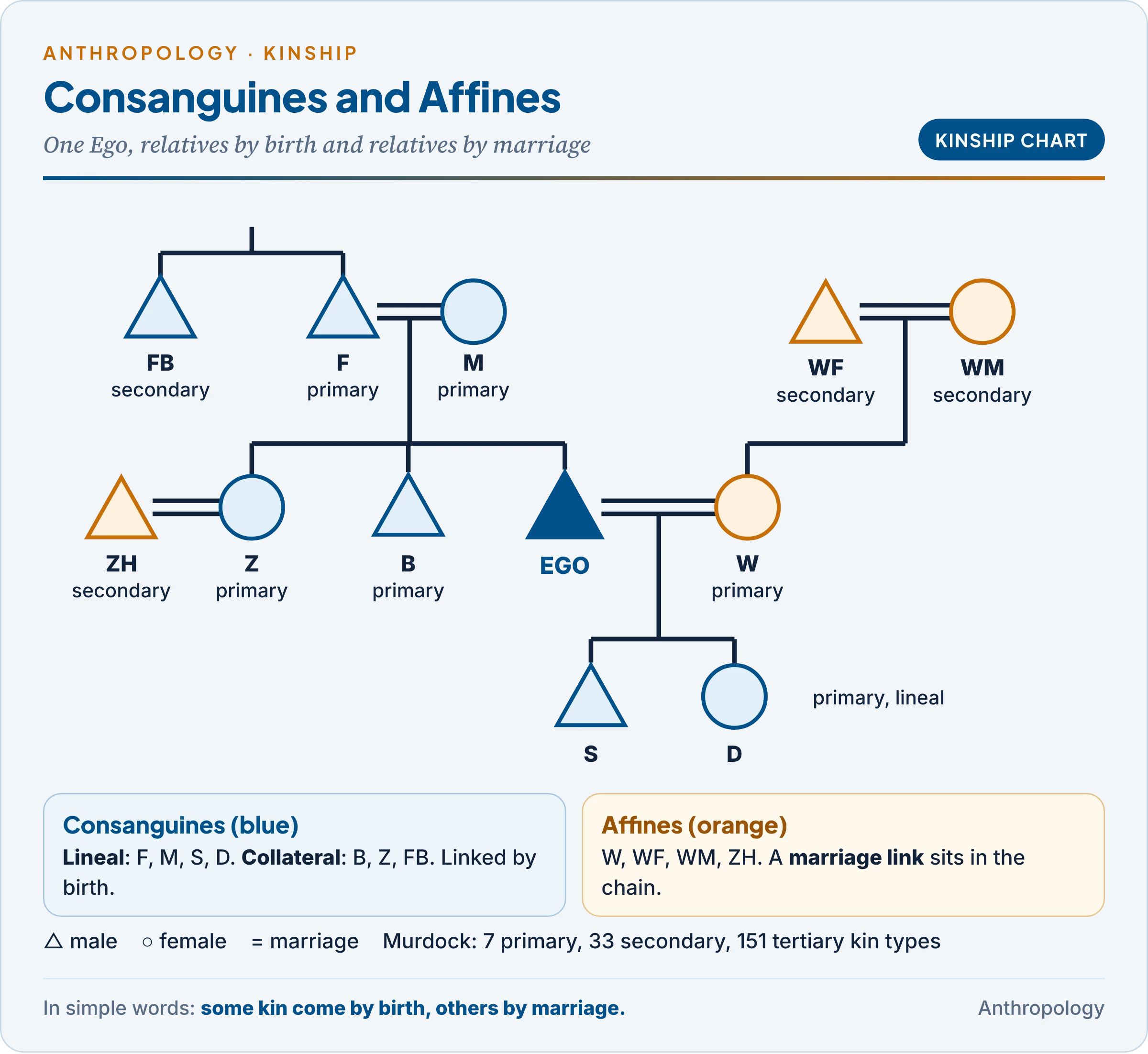
Consanguinity is cultural, not genetic. It is what a society counts as “blood”: an adopted child is a consanguine, and in a strongly patrilineal society the mother’s relatives may hardly count as kin at all. Genetic relatedness is measured by biology, while consanguinity is defined by culture. This is why the genetic study of consanguineous marriage (Unit 9.3) uses biological degrees of relationship, not local kin categories.
1.3 Functions and changing role of kinship
Kinship is the main organising principle of small-scale societies. In them it decides where a person lives, whom he may marry, whom he obeys, from whom he inherits and who will avenge him. Radcliffe-Brown, British structural-functionalist, saw kinship as the framework of social structure in such societies.
- Transmits status and property across generations (descent, inheritance, succession).
- Forms social groups (lineages and clans) that hold land, worship ancestors and act in politics and war.
- Regulates sex and marriage through incest taboos and exogamy.
- Provides social control and security: elders discipline, kin give mutual aid.
- Supplies an idiom for other relations: the British anthropologist Edmund Leach, Pul Eliya (1961), argued that in a Sri Lankan village kinship was largely an idiom for property and land rights.
Change in India. In complex societies, kinship loses ground to the market, the state and class, but it does not disappear:
- Adrian Mayer, Caste and Kinship in Central India (1960), distinguished the wide kindred of recognition (all kin one knows of) from the smaller kindred of cooperation (kin who actually help).
- Sylvia Vatuk, Kinship and Urbanization (1972), showed white-collar migrants in Meerut using kin networks for jobs and housing.
- Business communities run firms through kin (Unit 2.4). Under Westernisation, kinship shifts from corporate groups to personal networks chosen by need, but it remains central to marriage, crisis help and politics.
2. Principles and Types of Descent
In simple words
Descent is the rule that tells you which ancestors you belong to: your father’s line, your mother’s line, both, or one you choose. The rule decides which group you join at birth, whose land you can use and whose name you carry.
Example first. A Nuer boy of South Sudan belongs to his father’s lineage; his cattle, his political loyalty in a feud and his marriage prohibitions all follow the male line. A Khasi girl of Meghalaya belongs to her mother’s clan (kur), and if she is the youngest daughter (ka khadduh) she will inherit the ancestral house. Both societies have fathers and mothers; what differs is the rule that assigns children to groups.
2.1 Descent as a cultural rule
- Descent is the culturally recognised link between a person and their ancestors, used to assign membership of a group and the rights that go with it. The British anthropologist W.H.R. Rivers restricted the term to membership of a group; Meyer Fortes, “The Structure of Unilineal Descent Groups” (1953), made the corporate descent group the centre of descent theory.
- Descent is a cultural rule, not a biological fact:
- Every child has two parents, but a society may count only one of them for group membership.
- Ancestors may be mythical, as when a clan descends from an animal.
- Outsiders can be adopted into a line.
- The same biology yields patrilineal, matrilineal or bilateral rules in different societies.
- Related terms: inheritance is the passing of property and succession the passing of office; both often follow the descent rule but need not. Filiation, the link between parent and child, is treated in Unit 2.5b.
- Why societies need descent rules: some tasks are too big for a family, such as holding land over centuries, organising feuds or worship, and controlling marriage. A descent rule creates groups that outlive individuals. To work well, membership must be clear-cut, otherwise loyalties overlap.
2.2 Unilineal descent
Unilineal descent traces membership through one sex only. It produces discrete, non-overlapping groups, because each person belongs to exactly one line.
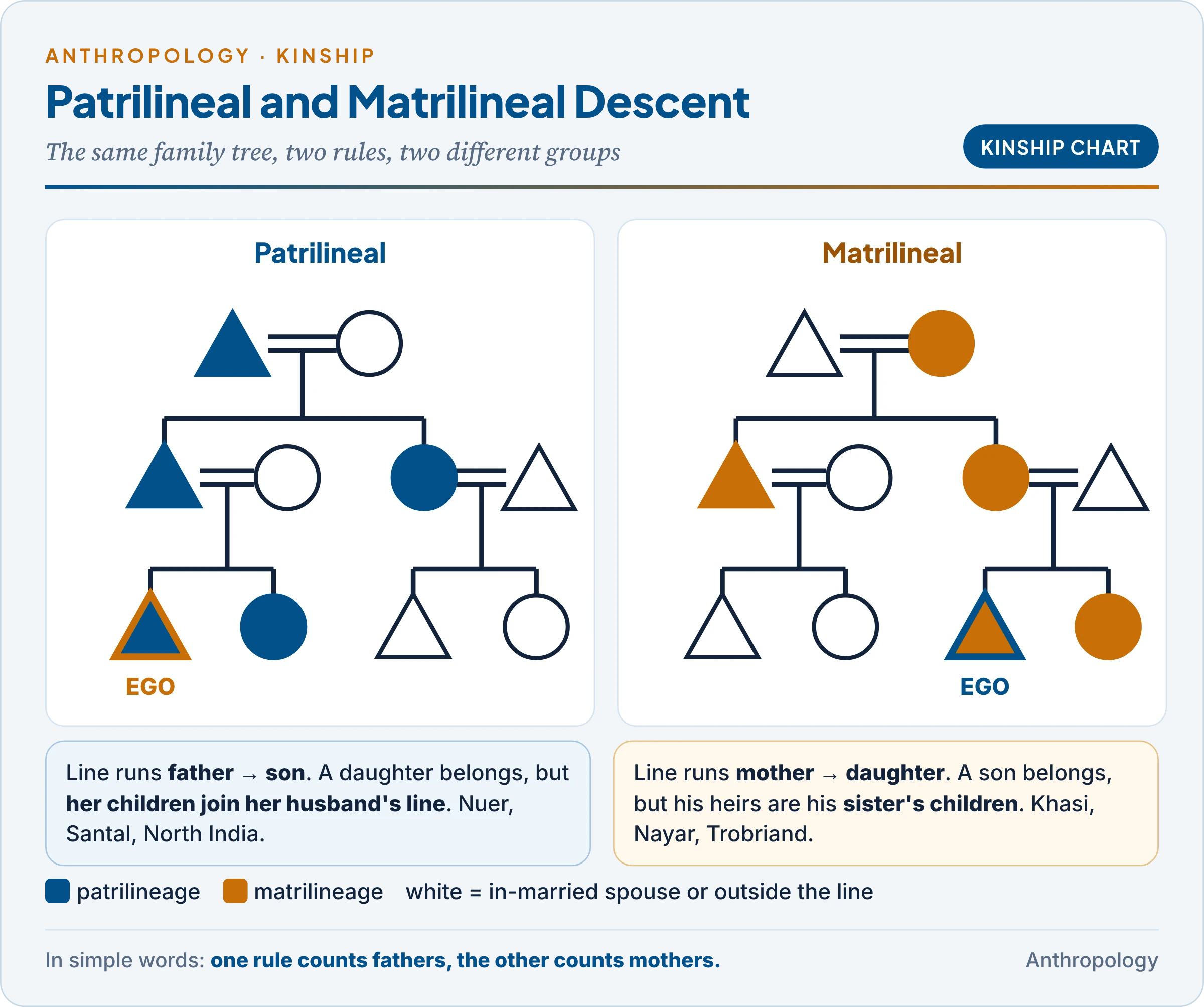
Patrilineal (agnatic) descent: membership passes through males: a man, his sons and daughters, his sons’ children, and so on.
- Women belong to the line but do not pass it on: a daughter is a member of her father’s lineage, but her children belong to her husband’s.
- Descent, residence and authority reinforce one another: with patrilocal residence, the men of a lineage live, work, own land and hold power together. This is why patrilineal systems are the most common.
- Cases: the Nuer (Evans-Pritchard), the Tallensi of Ghana (Fortes), the Yoruba idile patrilineages of Nigeria, south-eastern China (Maurice Freedman), Hindu north India, and Indian tribes such as the Santal, Munda, Oraon and Ho.
Matrilineal (uterine) descent: membership passes through females: a woman, her sons and daughters, her daughters’ children, and so on.
- Men belong to the line but cannot pass it on: a man’s heirs are his sister’s children, not his own.
- Matrilineal is not the mirror image of patrilineal. Authority in a matriline usually rests with men: brothers and mother’s brothers. So descent runs through women while authority runs through men.
- Cases:
- Khasi and Garo of Meghalaya.
- Nayar and Mappila of Kerala.
- Trobriand Islanders (Malinowski), Hopi, Navaho, Ashanti (Fortes), Bemba (Audrey Richards).
- Minangkabau of Sumatra, the largest matrilineal society.
2.3 The matrilineal puzzle: when descent contradicts residence
The puzzle. The British anthropologist Audrey Richards (1950), studying the Bemba and other Central African peoples, named the “matrilineal puzzle”. A matrilineal group must keep control over its women’s children (its future members) while those women marry men from other groups. Two loyalties collide:
- A man is a husband and father in his wife’s home but a brother and mother’s brother with authority in his sister’s line.
- If residence is patrilocal, the matrilineage’s children grow up in another group’s territory.
- If residence is matrilocal, the in-married husband is a stranger without authority, and the matrilineage’s own men are scattered among their wives’ homes.
Robin Fox explained why the puzzle arises with four “structural principles” that every kinship system must satisfy: women bear the children, men impregnate the women, primary kin do not mate, and men usually exercise control. A patrilineal-patrilocal system satisfies all four at once by keeping related men together and exchanging women. A matrilineal system must keep the women together, bring husbands from outside, and still let the women’s brothers control the group. That is harder, which is why matriliny is rarer.
Solutions. Societies solve the puzzle in different ways; the last column names the price each pays.
| Society | Ethnographer | Solution | Cost |
|---|---|---|---|
| Nayar (Kerala) | Kathleen Gough | Weaken marriage: visiting husbands, natolocal residence; the karanavan (eldest male) manages the taravad | Husband-father has almost no role |
| Trobriand (Melanesia) | Malinowski | Virilocal in childhood, then a boy moves to his mother’s brother’s village at adolescence (avunculocal) | Father loves sons he cannot make heirs |
| Khasi (Meghalaya) | P.R.T. Gurdon, The Khasis (1907) | Matrilocal; youngest daughter keeps house and rites; mother’s brother (u kni) manages clan affairs | Men divide time between natal and conjugal homes |
| Garo (Meghalaya) | D.N. Majumdar, Robbins Burling | Heiress (nokna) marries a man from her father’s clan (nokrom), who joins her house | Husband’s clan gains a foothold in her house |
| Hopi, Navaho (USA) | Fred Eggan, Clyde Kluckhohn | Matrilocal, with easy divorce | Husband remains an outsider |
- David Schneider and Kathleen Gough, Matrilineal Kinship (1961), compared many matrilineal systems and found that the marriage tie is typically weak, because descent-group loyalties and conjugal loyalties pull apart.
- David Aberle, in the same volume, linked matriliny to horticulture with women’s farm work, and showed that it tends to disappear with the plough, large herds and state markets. His phrase was that “the cow is the enemy of matriliny”.
- Indian change: the Kerala Joint Hindu Family System (Abolition) Act, 1975 ended the joint taravad in law, and partition, wage work and nuclear households have weakened Nayar matriliny. Khasi debates over surnames and property (Contemporary Developments) show the same strain.
2.4 Rarer unilineal variants
- Parallel descent: sons follow the father’s line and daughters the mother’s. The Kogi of the Sierra Nevada de Santa Marta, Colombia, studied by Gerardo Reichel-Dolmatoff, have male lines (tuxe) and female lines (dake). The Apinayé of Brazil (Curt Nimuendajú, 1939) are the classic earlier case.
- Cross descent: sons follow the mother and daughters the father. Margaret Mead reported “ropes” of this kind among the Mundugumor of New Guinea (1935).
2.5 Double descent
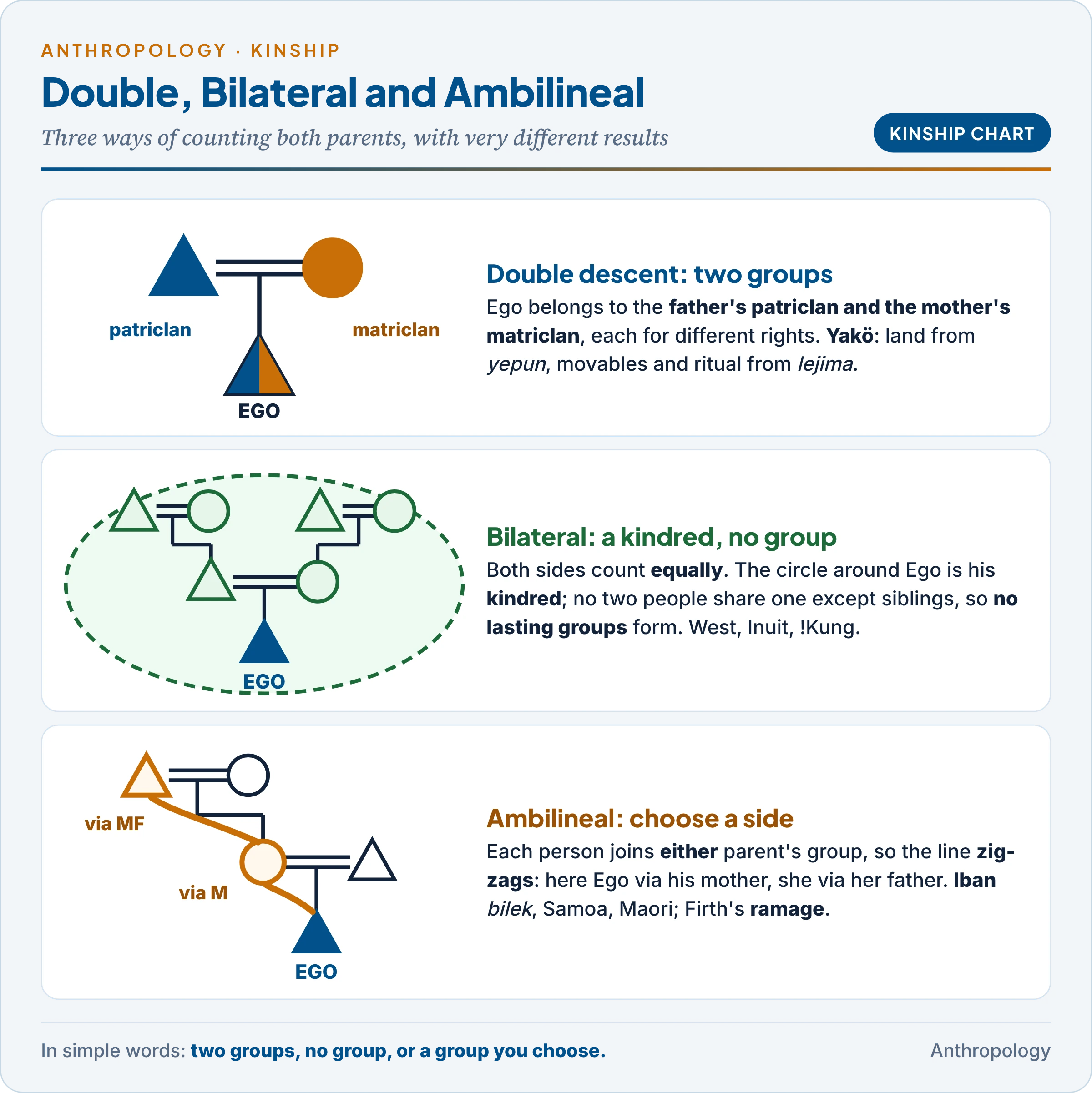
Double (double unilineal) descent means each person belongs to both a patrilineal group and a matrilineal group, with each group controlling different rights.
- Yakö of south-eastern Nigeria (Daryll Forde, 1950):
- Patriclans (yepun) hold land, house sites and farm plots, and organise residence.
- Matriclans (lejima) control movable wealth (livestock, currency) and ritual and fertility cults, and take part in funeral payments.
- A Yakö therefore inherits land from the father’s line and movables and ritual rights from the mother’s line.
- Why it exists: it divides rights so that neither line monopolises everything, and it ties every person into two cross-cutting networks.
- How it differs: double descent is still unilineal twice over; each group is traced through one sex.
2.6 Non-unilineal (cognatic) descent
Cognatic descent counts links through both sexes. It takes two very different forms.
Bilateral descent and the kindred:
- Bilateral descent gives equal weight to relatives on the father’s and mother’s sides. Ego is related to all four grandparents, all eight great-grandparents and, potentially, all cousins on both sides.
- Because the network multiplies with each generation, it is cut down in practice to a kindred: the close relatives on both sides, counted outwards from Ego (§3.5).
- Bilateral descent forms no lasting groups, because the kindreds of different people overlap. It is typical of Western societies, many foragers (Inuit, !Kung San) and urban India, where the Hindu Succession Act, 2005 now makes inheritance bilateral in law.
Ambilineal (optative, utrolateral) descent:
- Each person may choose to join either the father’s or the mother’s group, and the choice may differ from generation to generation, so the line of affiliation zig-zags.
- It creates real descent groups (ambilineages), unlike bilateral descent. The British anthropologist Raymond Firth called them ramages; the American Ward Goodenough (1955) called them non-unilinear descent groups.
- Iban of Sarawak (Derek Freeman): a couple joins the bilek (long-house apartment family) of either spouse at marriage, and membership follows residence. One may belong to only one bilek at a time.
- Samoans (‘aiga), Maori (hapu) and the Kwakiutl numaym of the Northwest Coast allow overlapping membership: one has claims in several groups but activates one.
- Why it exists: flexibility. It lets people move to where land or resources are available. On the Gilbert Islands of Micronesia, landholding cognatic groups grew too large and members moved off to join kin elsewhere; on the Northwest Coast, abundant but unpredictable salmon runs rewarded the freedom to shift groups. The cost, as Murdock noted, is that too much choice can blur loyalties.
The table compares the four types; read the last column for what each produces.
| Type | Traced through | Groups formed? | Example |
|---|---|---|---|
| Patrilineal | Males only | Yes: discrete patrilineages and patriclans | Nuer, Santal, North India |
| Matrilineal | Females only | Yes: discrete matrilineages and matriclans | Khasi, Nayar, Trobriand |
| Double | Both, for different purposes | Yes: two sets of groups, cross-cutting | Yakö |
| Ambilineal | Either, by choice | Yes: overlapping or optional groups (ramages) | Iban, Samoa, Maori |
| Bilateral | Both equally | No: ego-centred kindreds only | Western societies, Inuit, !Kung |
The table brings out one contrast: unilineal, double and ambilineal rules all produce ancestor-focused groups, while bilateral reckoning produces only ego-focused networks. That is why corporate land-holding and feuding groups are found where descent is unilineal or ambilineal.
Common confusion
Are “bilineal” and “bilateral” descent the same? No. Bilineal (double) descent means belonging to two unilineal groups, a patriline and a matriline, each with different rights, as among the Yakö. Bilateral descent means counting relatives on both sides equally, which produces a personal kindred but no descent groups, as in modern Western society.
2.7 What shapes the descent rule
- Residence first: Murdock (1949) argued that a change in post-marital residence comes first, because it changes who lives and works together; descent rules and kin terms then follow. Patrilocality tends to produce patrilineal groups, and matrilocality matrilineal ones.
- Economy and ecology:
- Where male cooperation in herding, plough farming or warfare is vital, patrilocal and patrilineal systems prevail.
- Matrilineal systems cluster among horticulturists, where women farm and men are often away (Aberle).
- Bilateral and ambilineal systems suit mobile or unstable conditions.
- Not an evolutionary sequence:
- J.J. Bachofen, Mother Right (1861), and Lewis Henry Morgan, Ancient Society (1877), held that matrilineal descent came first, because paternity was uncertain under “promiscuity”, and patrilineal descent came later with private property.
- Murdock refuted this: some of the simplest foragers, such as Arctic hunters, are bilateral, and descent types show no fixed relation to technological level.
- Descent and segmentary societies: unilineal descent groups are typical of segmentary societies, those made of equal, similar units without a central state (§3.2). In them, lineages do the work of government. Bilateral kinship, which forms no groups, cannot organise feud and alliance in the same way.
3. Forms of Descent Groups
In simple words
People who share a descent rule form groups of different sizes. A lineage is a family line whose links can be traced; a clan is a bigger group that only believes it shares an ancestor; clans may be grouped into phratries, and a whole society may be split into two halves called moieties. A kindred is different: it is just your own circle of relatives on both sides.
Example first. A Raj Gond of Adilabad (Telangana) belongs to a lineage, which belongs to a clan, which belongs to one of four exogamous phratries (saga), named by the number of mythical ancestors, from seven down to four. He may not marry anyone of his own saga, so the phratry, a group of many thousands of people he will never meet, decides his marriage. Christoph von Fürer-Haimendorf, the Austrian-born anthropologist, described this system in The Raj Gonds of Adilabad (1948) and later papers.
3.1 Descent groups and their character
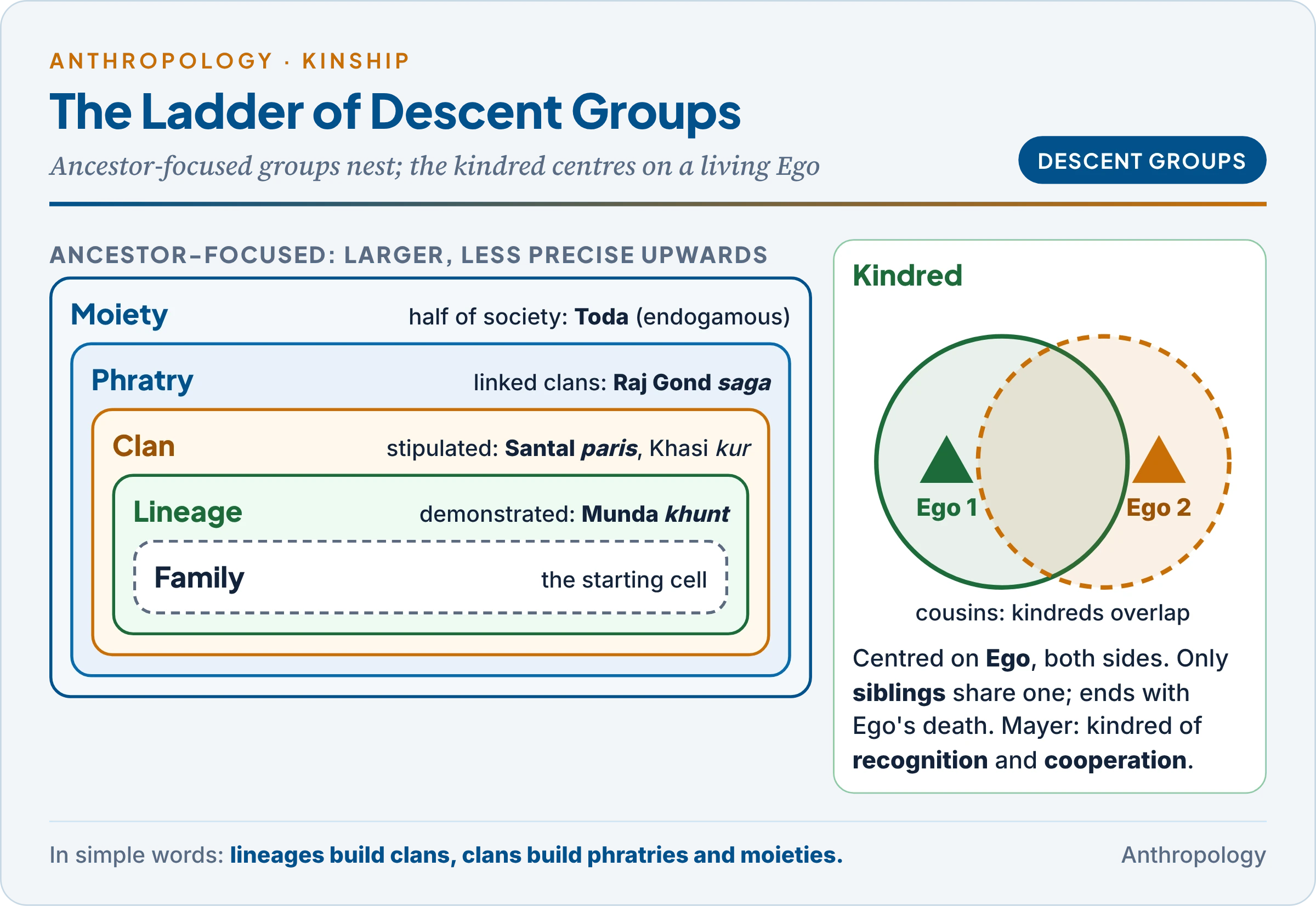
- Descent group: a group whose membership is fixed by a descent rule. Ancestor-focused groups (lineage, clan, phratry, moiety) persist across generations; the ego-focused kindred does not.
- Corporate group: following the 19th-century jurist Henry Maine‘s idea of a corporation that “never dies”, Fortes (1953) described unilineal descent groups as corporate. Such a group holds property, acts as a single person in law and politics, and outlives its members.
- Descent group or descent category: a group meets, owns and acts together; a category (such as a dispersed clan or a gotra) only shares a name and an exogamy rule.
3.2 Lineage
A lineage is a unilineal descent group whose members trace their descent from a known common ancestor through known links. Its descent is demonstrated.
- Kinds: patrilineage, matrilineage; an ambilineal equivalent is the ramage (§2.6).
- Typical features:
- Named and exogamous.
- Corporate: holds land or herds.
- Ancestor worship.
- Mutual aid and social control: elders settle disputes and discipline members.
- Feuding unit: the Nuer and the Tiv of Nigeria (Paul and Laura Bohannan).
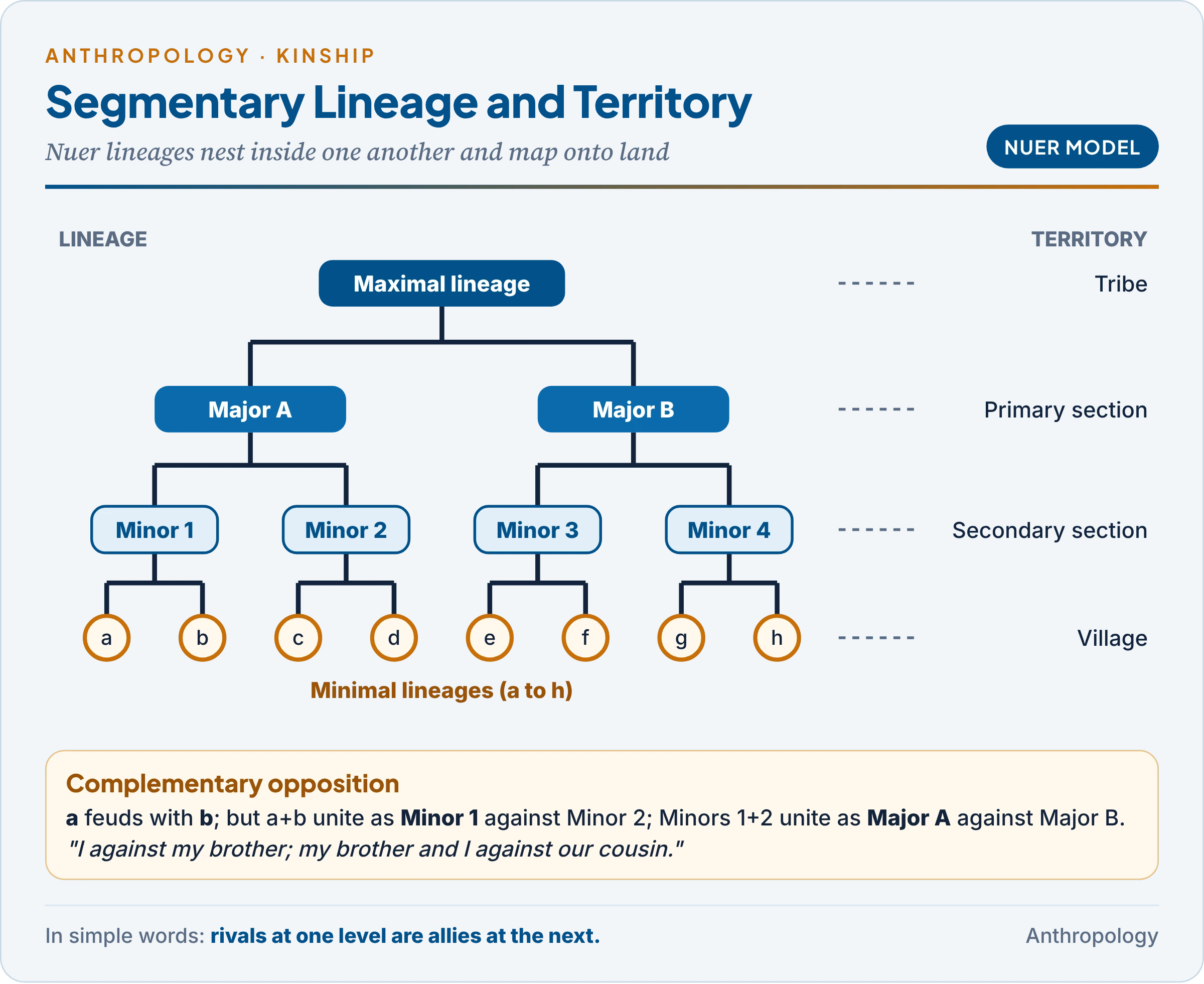
- Depth and segmentation: as a lineage grows over generations it splits, usually when brothers separate after their father’s death. The result is a segmentary lineage system: minimal lineages nested within minor, major and maximal lineages, each a segment of the next.
Segmentary lineage and territoriality (the Nuer). The British anthropologist E.E. Evans-Pritchard, The Nuer (1940), showed how lineage segments in a stateless society map onto territorial segments:
- Nuer clans are dispersed, but each tribal territory is associated with a dominant clan. Its maximal, major, minor and minimal lineages correspond to primary, secondary and tertiary tribal sections and villages.
- Complementary opposition:
- Segments that are rivals at one level unite against a segment of equal size at the next level.
- Two minimal lineages may feud with each other, yet join as one minor lineage against another minor lineage, and so on upwards.
- The Nuer put it as “I against my brother; my brother and I against our cousin.”
- Why it matters: the segmentary lineage system shows how descent can do the work of government, keeping order without chiefs or a state. Fortes‘ The Dynamics of Clanship among the Tallensi (1945) gave a parallel case in Ghana.
- Critiques:
- Later work showed that real Nuer local groups included many non-agnates (attached kin and adopted Dinka), so the lineage model is the people’s ideology more than a census of who lives where.
- Adam Kuper (1982) questioned whether the “lineage model” describes any society precisely.
- Indian case: in the Munda country of Jharkhand, a village was founded by a lineage (khunt) of the original forest-clearers, the khuntkattidar. Their descendants held corporate rights to its land, so lineage and territory coincided. S.C. Roy, Indian ethnographer, described this in The Mundas and their Country (1912).
3.3 Clan
A clan (also sib, Robert Lowie’s term; Morgan’s gens for a patrilineal clan) is a unilineal descent group whose members believe they descend from a common ancestor but cannot trace the links. Its descent is stipulated (assumed).
- The ancestor is often mythical: an animal, a plant or a hero. Where members revere the ancestral species, the clan is totemic (Unit 5).
- Features:
- Named, usually exogamous and often dispersed over many villages.
- Common rites and taboos; mutual hospitality and aid.
- In some societies the clan has legal and political functions, as among the Trobrianders and Ashanti.
- Among the Kipsigis of Kenya the clan works as a mutual-aid association.
- Relation to lineages: a clan is often made up of several lineages, but some societies have clans without lineages and others lineages without clans.
- How clans arise and why they are exogamous: when a lineage grows for many generations and its segments move apart, members forget the exact links but keep the name and the memory of common origin, and the lineage becomes a clan. Because members still regard one another as brothers and sisters, marriage inside the clan counts as incest. Clan exogamy therefore spreads marriage ties across many villages, which links scattered communities into one tribe.
Indian examples:
- Santal: twelve exogamous patriclans (paris), such as Hansda, Murmu, Kisku, Hembrom, Marndi, Soren, Tudu, Baske, Besra, each divided into sub-clans (khunt).
- Oraon: totemic patriclans named after animals and plants (S.C. Roy, 1915).
- Munda and Ho: exogamous patriclans called killi.
- Khasi and Garo: matriclans, the Khasi kur and the Garo machong.
- Brahmanical gotra: an exogamous patrilineal category tracing stipulated descent from a rishi (sage). It is a clan in form, though it rarely acts as a corporate group.
3.4 Phratry and moiety
A phratry (Greek phrater, brother) is a unilineal grouping of two or more clans that believe they are especially closely related.
- Phratries are usually exogamous, may share deities and rites, and rarely act corporately.
- Cases:
- Raj Gond saga (above): each phratry worships its own great god (persa pen), and marriage-alliance negotiations are conducted as if between phratries.
- Garo chatchi: five named matrilineal divisions, of which Sangma and Marak are found everywhere, so in practice they work almost like moieties.
- Muria Gond of Bastar (Verrier Elwin), Hopi phratries (exogamous) and the Aztec phratries (political units).
A moiety (French moitié, half) exists when a whole society is divided into two descent-based halves, so every person belongs to one or the other.
- Exogamous moieties make each half the marriage pool of the other. Lévi-Strauss, the French structuralist, saw this dual organisation as the simplest form of restricted exchange (Unit 2.3). Examples: the Tlingit of Alaska (Raven and Eagle/Wolf), the Miwok of California (land and water moieties) and many Australian Aboriginal groups.
- Endogamous moieties also exist. The Toda of the Nilgiris are divided into the Tartharol and Teivaliol, which are endogamous, each divided into exogamous patriclans (W.H.R. Rivers, The Todas, 1906).
- Ceremonial reciprocity: moieties often perform services for each other, such as burying each other’s dead or conducting each other’s rites.
3.5 Kindred
A kindred is the set of close relatives on both sides counted outwards from a particular Ego. It is the characteristic grouping of bilateral societies.
- Ego-focused, not ancestor-focused: its members share a relative in common (Ego), not an ancestor.
- No two people have the same kindred, except full siblings before marriage, so kindreds overlap and cannot divide a society into discrete groups.
- Temporary: it comes together for a purpose (a wedding, a funeral, a feud or, among Southeast Asian peoples, a raiding or trading party), then disperses, and it ends with Ego’s death.
- Cannot be corporate: it cannot hold property permanently or have a fixed leader. Derek Freeman (1961) called such a unit a personal kindred.
- Indian case: Mayer’s kindred of recognition and kindred of cooperation in a Malwa village (§1.3) show kindreds working alongside patrilineal descent.
The table sets the five forms side by side; read the second and third columns for the two key contrasts.
| Group | Focus | Descent | Typical size and span | Indian example |
|---|---|---|---|---|
| Lineage | Ancestor | Demonstrated | A few generations; often local and corporate | Munda khunt, Raj Gond lineages |
| Clan | Ancestor | Stipulated | Many lineages; often dispersed, totemic | Santal paris, Khasi kur, gotra |
| Phratry | Ancestor | Stipulated, linked clans | Several clans | Raj Gond saga, Garo chatchi |
| Moiety | Ancestor | Stipulated | Half of society | Toda (endogamous) |
| Kindred | Ego | Bilateral, no descent group | Ego’s close kin on both sides | Mayer’s Malwa village |
The pattern: the four ancestor-focused groups form a nested ladder of rising size and falling genealogical precision, from lineage to moiety. The kindred stands outside the ladder because it is centred on a living person. S.C. Dube noted that Indian tribes use different combinations of these levels, such as family, clan, phratry and tribe.
Common confusion
What is the real difference between a lineage and a clan? Demonstration. Lineage members can name every link back to the founding ancestor; clan members only assume a common ancestor they cannot trace, often a mythical or totemic one. Size usually follows from this: a lineage is smaller and more often corporate and local, while a clan is larger and dispersed.
Key Terms
| Term | Meaning in simple words |
|---|---|
| Consanguine | A relative by birth, real or assumed |
| Affine | A relative by marriage (an in-law) |
| Lineal / collateral kin | Direct-line relatives / relatives branching off through a sibling |
| Agnatic / uterine | Related through males only / through females only |
| Descent | The rule linking a person to ancestors and to a group |
| Patrilineal / matrilineal | Descent through males / through females |
| Double (bilineal) descent | Membership in both a patriline and a matriline, for different rights |
| Bilateral descent | Counting both sides equally, without forming descent groups |
| Ambilineal descent | Choosing either parent’s group to join |
| Ramage | Firth’s term for an ambilineal descent group |
| Matrilineal puzzle | The clash between descent through women and authority held by men |
| Corporate group | A group that holds property and outlives its members |
| Lineage | A descent group with traceable links to a known ancestor |
| Segmentary lineage | Lineages nested within larger lineages, uniting against equal rivals |
| Clan (sib) | A descent group claiming a common ancestor it cannot trace |
| Phratry | A linked set of clans |
| Moiety | One of two halves into which a society is divided by descent |
| Kindred | Ego’s circle of close relatives on both sides |
Contemporary Developments
- Matrilineal identity in law (Meghalaya): in 2023 the Khasi Hills Autonomous District Council directed headmen not to issue Scheduled Tribe certificates to Khasis who adopt their father’s surname. It relied on the Khasi Social Custom of Lineage Act, 1997, under which only those who take the mother’s clan name count as Khasi. The order drew protests from men’s-rights groups, showing matrilineal descent turned into administrative identity.
- Ancient DNA reveals prehistoric descent:
- At Hazleton North, an Early Neolithic tomb in England (about 5,700 years ago), a five-generation pedigree showed all 15 parent-to-child links in the tomb ran through men, i.e. patrilineal burial with female exogamy (Fowler et al., Nature, 2021).
- In Iron Age Durotrigian cemeteries of southern Britain (about 100 BC to AD 100), most kin shared one maternal lineage while incoming spouses were mainly male, i.e. matrilocal (Cassidy et al., Nature, January 2025).
- From patriliny towards bilateral inheritance: the Hindu Succession (Amendment) Act, 2005 made daughters coparceners by birth, and Vineeta Sharma v. Rakesh Sharma (2020) applied this regardless of the father’s date of death. In law, the Mitakshara patrilineal property group now includes daughters.
- End of the legal taravad: the Kerala Joint Hindu Family System (Abolition) Act, 1975 abolished the joint family governed by marumakkathayam (matrilineal inheritance), so Nayar matriliny survives as custom and identity, not as a property-holding corporation.
Diagrams to Master
- Topic map of the three themes.
- Ego-centred kin chart (§1.2) in △ ○ = notation. Shade consanguines and affines differently; mark lineal, collateral and primary kin.
- Patrilineal and matrilineal descent (§2.2). Shade Ego’s descent group and show that in-marrying spouses fall outside it.
- Double, bilateral and ambilineal (§2.5–2.6). Label which group Ego joins in each.
- Segmentary lineage (§3.2). Label maximal to minimal lineages and complementary opposition.
- Descent-group ladder (§3.5) with an Indian example at each rung, and the kindred beside it.
Revision Grid
| Scholar | Work (year) | Key idea |
|---|---|---|
| Bachofen | Mother Right (1861) | Matriliny first: an evolutionary stage, since refuted |
| Morgan | Ancient Society (1877) | Gens; matrilineal before patrilineal |
| Rivers | The Todas (1906) | Endogamous moieties; descent as group membership |
| Gurdon | The Khasis (1907) | Khasi matriclans, youngest-daughter heiress |
| S.C. Roy | The Mundas and their Country (1912) | Khuntkatti lineage land |
| Evans-Pritchard | The Nuer (1940) | Segmentary lineage, complementary opposition, territoriality |
| Fortes | Dynamics of Clanship among the Tallensi (1945); 1953 | Corporate unilineal descent group |
| Fürer-Haimendorf | The Raj Gonds of Adilabad (1948) | Phratries (saga) |
| Murdock | Social Structure (1949) | Primary, secondary, tertiary kin; residence shapes descent; refuted Morgan |
| Audrey Richards | 1950 | Matrilineal puzzle |
| Daryll Forde | 1950 | Double descent among the Yakö |
| Goodenough | 1955 | Non-unilinear descent groups |
| Firth | We, the Tikopia (1936); 1957 | Ramage |
| Mayer | Caste and Kinship in Central India (1960) | Kindreds of recognition and cooperation |
| Schneider and Gough | Matrilineal Kinship (1961) | Weak marriage tie; Aberle’s ecology of matriliny |
| Freeman | 1958; 1961 | Iban bilek; personal kindred |
| Leach | Pul Eliya (1961) | Kinship as an idiom of property |
| Fox | Kinship and Marriage (1967) | Four structural principles of kinship |
| Schneider | A Critique of the Study of Kinship (1984) | Kinship as a Western construct |
Previous Year Questions
Unit 2.5: Kinship (consanguinity, affinity, descent and descent groups)
- 2022Discuss how the rules of descent contradict the principles of residence in matrilineal society, mentioning suitable examples.
- 2021Write notes on : Descent Groups. (in about 150 words).
- 2017Write a note in 150 words on Bilineal and bilateral descents.
- 2016Write a note in 150 words on Lineage and Clan.
- 2014Write a note in 150 words on Double Descent.
- 2013Write a note in 150 words on Various types of descent.
- 2012Describe the types of kinship groups formed on the basis of different principles.
- 2010Write a note in 150 words on. Segmentary lineage and territoriality.
- 2010What factors are responsible for bringing about variation in residence of different societies ? Explain how kinship influences man’s social life.
- 2008Write a note on Forms of descent groups.
- 2003Define Kinship and throw light on the functional importance of Kinship in Anthropology.
- 1998Now we live more in a class than a caste. Discuss the role of kinship in this changed situation.
- 1997Discuss the distinguishing features of unilineal, bilineal and bilateral kin groups with suitable examples.
- 1995What is kinship system? Describe the changing roles of the system in the context of westernization in India.
- 1994Write a note on Lineage and clan.
- 1991What is kinship system? Discuss its relevance in understanding the social structure of society.
- 1986Write a note on Differences between clan and lineage in primitive society.
- 1984Distinguish between: Double descent and bilateral descent.
- 1984Descent is a cultural rule. Discuss.
- 1983Extended family and kinship ties are incompatible with an industrial society. Critically examine the view.
- 1982The modern State has taken over many functions of the family and kin groups. Discuss.
- 1981“Unilineal kinship is more characteristic of segmentary society than bilateral kinship.” Discuss.
Related questions from other units
- 2026Unit 2.3: Discuss ‘incest taboo’ as the basis of development of kinship systems in human societies.
- 2012Unit 9.3: What are the genetic effects of consanguinity? Give examples.
- 1991Unit 2.4: Write a note on Matrilineal society.
- 1987Unit 9.3: Is inbreeding different from consanguinity? Give an account of inbreeding studies in India and comment on their social relevance.