

Institutions and agencies since Independence; Rural development programmes: foci and strategies; Decentralization and Panchayati Raj; 73rd Constitutional amendment.
This article: Decentralisation and Panchayati Raj (rationale, gram swaraj, Article 40, roots); committees from Balwantray Mehta to the 64th Amendment Bill; the 73rd Amendment (Part IX, Eleventh Schedule, mandatory and voluntary provisions, reservation and its litigation); PESA, 1996; working of PRIs (functions and activity mapping, finances, SFCs and Finance Commission grants, functionaries, RGSA, Devolution Index and PAI); problems (State control, parallel bodies, elite capture, proxy representation, SECs and delayed polls); Gram Sabha and social audit; e-governance; Kerala, Karnataka and Maharashtra; the 2nd ARC’s Sixth Report; recent issues including Viksit Gram Panchayat Plans.
Official Syllabus: Paper II · Unit 2-11 Rural Development
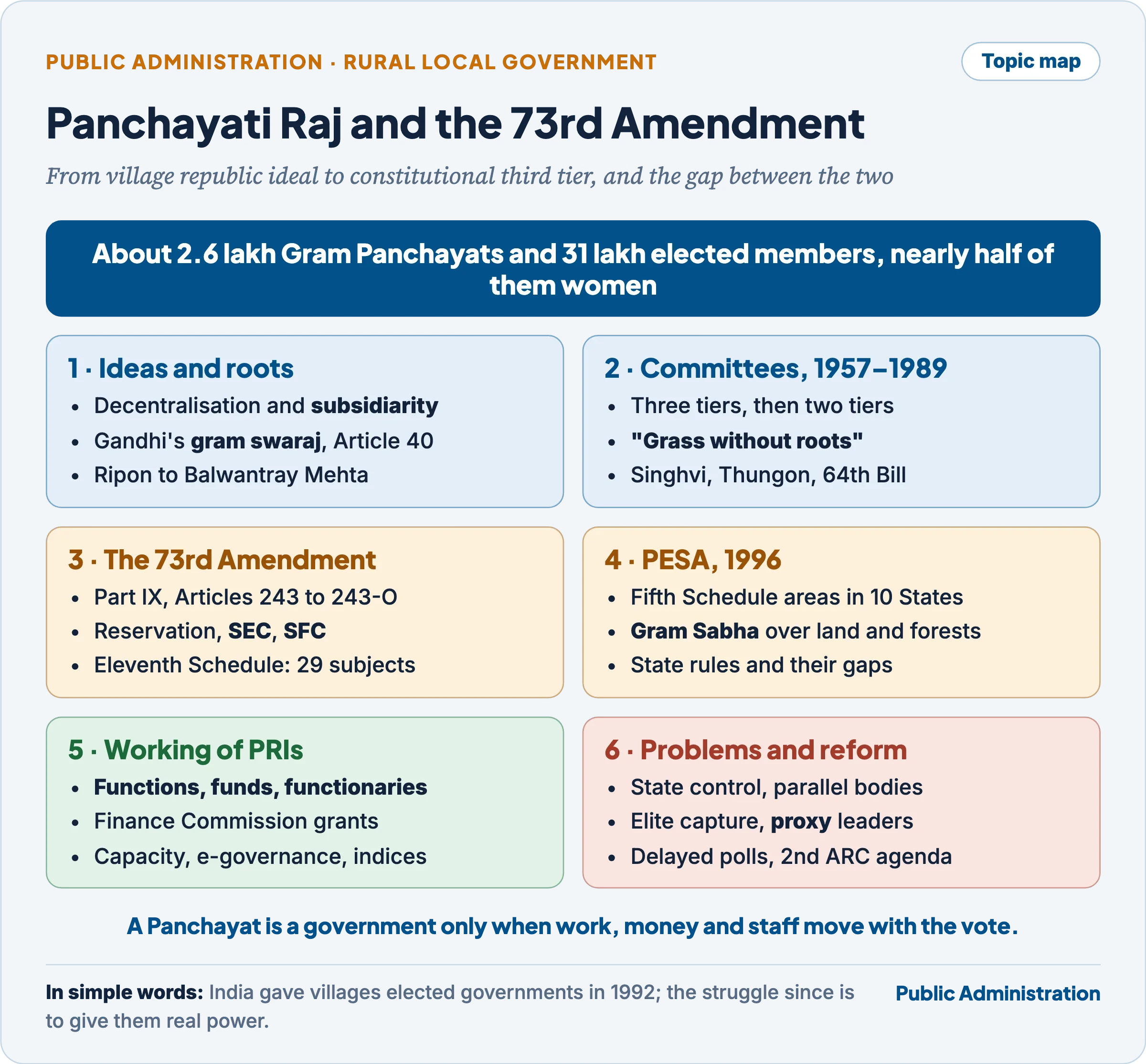
Panchayati Raj is India’s system of rural local self-government: elected councils at the village, block and district levels, with the Gram Sabha of all village voters at the base. It is the oldest idea in Indian administration and one of its newest constitutional institutions. The 73rd Constitutional Amendment Act, 1992 turned Panchayats from bodies that existed at the pleasure of State governments into a constitutionally mandated third tier, with fixed terms, reserved seats, State Election Commissions and State Finance Commissions. Whether this third tier has become a real government or remains an agency of the State is the central question of this article.
In simple words
Think of a housing society. Once the residents elect a committee, the law says it must meet, hold elections every five years and include women members. But whether it can fix the lift, collect maintenance and hire a watchman depends on what the builder hands over: keys, money and staff. The 73rd Amendment guaranteed the committee; the States still hold most of the keys.
1. Decentralisation and Panchayati Raj: Meaning, Rationale and Roots
In simple words
Decentralisation means letting decisions be taken closer to the people they affect. Panchayati Raj is the Indian form of this idea for villages: people elect their own councils, and those councils are meant to plan, spend and serve. The idea is old, but making it work has always been hard because the people who hold power above rarely want to give it away.
1.1 Meaning of the key terms
- Decentralisation. The transfer of authority, responsibility and resources from a central government to lower levels of government, field units, semi-autonomous bodies or the private sector. It is the opposite of centralisation, where decisions are concentrated at the top.
- Democratic decentralisation. Decentralisation in which power moves to elected local bodies accountable to local voters. The Balwantray Mehta Study Team (1957) gave the phrase its Indian meaning; the institutions it proposed were soon called Panchayati Raj.
- Local self-government. Government of a local area by bodies elected by its residents, with their own functions, revenue and staff, as distinct from local administration by officials posted from above (the Collector, the BDO).
- Panchayati Raj Institutions (PRIs). The Gram Panchayat (village or group of villages), the intermediate Panchayat (Panchayat Samiti, Mandal Parishad, Block Panchayat, Taluk Panchayat in different States) and the District Panchayat (Zilla Parishad), together with the Gram Sabha.
- Three dimensions. Political decentralisation (elected bodies), administrative decentralisation (staff and procedures under local control) and fiscal decentralisation (taxing powers and transfers). A Panchayat can be politically decentralised yet fiscally dependent, which is the typical Indian pattern.
- Rondinelli’s types. Dennis Rondinelli, the American development administration scholar, with John Nellis and G. Shabbir Cheema (Decentralization in Developing Countries, World Bank, 1983), separated deconcentration (to field officers), delegation (to semi-autonomous bodies), devolution (to elected local governments) and privatisation. Panchayats under Part IX are meant to be devolution; Collectors, BDOs and DRDAs are deconcentration and delegation. The full typology and Fesler’s approaches are in the article on District Administration, Democratic Decentralisation and Union–State–Local Relations.
1.2 Why decentralise: the arguments
Decentralisation is defended on far more than administrative efficiency, which is why it is never “just technical”; the theory is treated fully in the article on District Administration, Democratic Decentralisation and Union–State–Local Relations.
- Democratic: local bodies are schools of democracy (Tocqueville, J.S. Mill); Panchayat elections bring about 32 lakh people into office every five years.
- Efficiency and information: Wallace Oates‘ decentralisation theorem (Fiscal Federalism, 1972): provide each service at the lowest level that covers its beneficiaries, unless scale economies or spillovers justify a higher one.
- Subsidiarity: higher levels should do only what lower levels cannot, and support rather than replace them (Quadragesimo Anno, 1931; the Maastricht Treaty, 1992); the foundation of the 2nd ARC’s local governance report.
- Choice and competition: Charles Tiebout (1956): citizens “vote with their feet” among local governments; centralisation inclines to domination, decentralisation to competition and self-determination.
- Accountability and participation: Gram Sabha decisions are visible; downward accountability to neighbours can be sharper than upward accountability to departments.
- Equity: reserved seats for SCs, STs and women make decentralisation an instrument of social justice.
- Cautions: elite capture in unequal villages (Section 6.3), weak capacity, inequality between areas without equalising transfers, spillovers across boundaries, and decentralised corruption without audit.
1.3 Gandhi’s gram swaraj and Article 40
- Gandhi’s vision. Mahatma Gandhi saw the self-reliant village as the unit of a free India. In Harijan (26 July 1942) he wrote:
“My idea of village swaraj is that it is a complete republic, independent of its neighbours for its own vital wants, and yet interdependent for many others in which dependence is a necessity.” — M.K. Gandhi
- The oceanic circle. Gandhi rejected a pyramid with the apex sustained by the bottom; he imagined an “oceanic circle” whose centre is the individual, ready to sacrifice for the village, the village for the circle of villages, so that power flows upward from the base. Gram swaraj meant political self-rule, economic self-sufficiency (khadi, village industries) and moral self-discipline together.
- Ambedkar’s counterview. B.R. Ambedkar, presenting the draft Constitution (4 November 1948), called the Indian village “a sink of localism, a den of ignorance, narrow-mindedness and communalism”, fearing that village power meant domination of Dalits by upper castes. The draft therefore took the individual, not the village, as its unit.
- The compromise: Article 40. After protests in the Constituent Assembly, K. Santhanam‘s amendment added a Directive Principle: the State shall take steps to organise village panchayats and endow them with such powers as may be necessary to enable them to function as units of self-government. Being non-justiciable, it left Panchayats as creatures of State legislatures.
- Local government in the federal scheme. “Local government” is Entry 5 of the State List; hence even after 1992 the States, not the Union, decide the detailed powers of Panchayats.
Common confusion
Is today’s Gram Sabha the Gandhian village republic? Only in name. Gandhi’s village republic was self-sufficient and sovereign for its vital wants, with power flowing upward. The constitutional Gram Sabha (Article 243A) is a body of all voters whose powers are whatever the State legislature gives it; it sits at the base of a structure whose money, rules and schemes flow downward from the Union and the State. Outside PESA areas, most Gram Sabhas have advisory rather than binding powers. The Gram Sabha borrows Gandhi’s language of direct democracy but works inside a Weberian, centralised state.
1.4 Historical roots in brief
- Ancient and medieval India. Village assemblies (sabha and samiti in Vedic texts), the Chola village councils (Uttaramerur inscriptions of the tenth century describing election by lot to village committees) and the panchayat of elders for disputes show a long tradition of local self-management, though dominated by upper castes and men.
- Colonial period. Urban bodies came first (Madras Corporation, 1687–88); Lord Ripon’s Resolution of 18 May 1882, the Magna Carta of local self-government, favoured elected majorities; the Bengal Local Self-Government Act, 1885 created district boards; after the Montagu–Chelmsford Reforms (1919) made local self-government a transferred subject, provinces passed Village Panchayat Acts. These bodies stayed dominated by officials and notables, with narrow functions and thin finances (see the article on Legacy of British Rule).
- Three factors that shaped Indian local self-government.
- Historical: colonial bodies were built for administrative convenience and control, not democracy; district officers dominated them; the urban bodies came first, rural ones later, producing separate rural and urban laws.
- Ideological: the Gandhian village republic, Nehruvian planned development (Panchayats as instruments of plan implementation) and Ambedkarite suspicion of village hierarchy pulled in different directions.
- Administrative: a centralised civil service and departmental structure meant that development reached villages through officials; Panchayats were added on top of, not instead of, this machinery.
2. Evolution of Panchayati Raj, 1952–1992
In simple words
For forty years India experimented: first officials ran village development, then elected councils were added, then they were allowed to decay, then revived by committees, and finally written into the Constitution. Each committee was a reaction to the failure of the one before it.
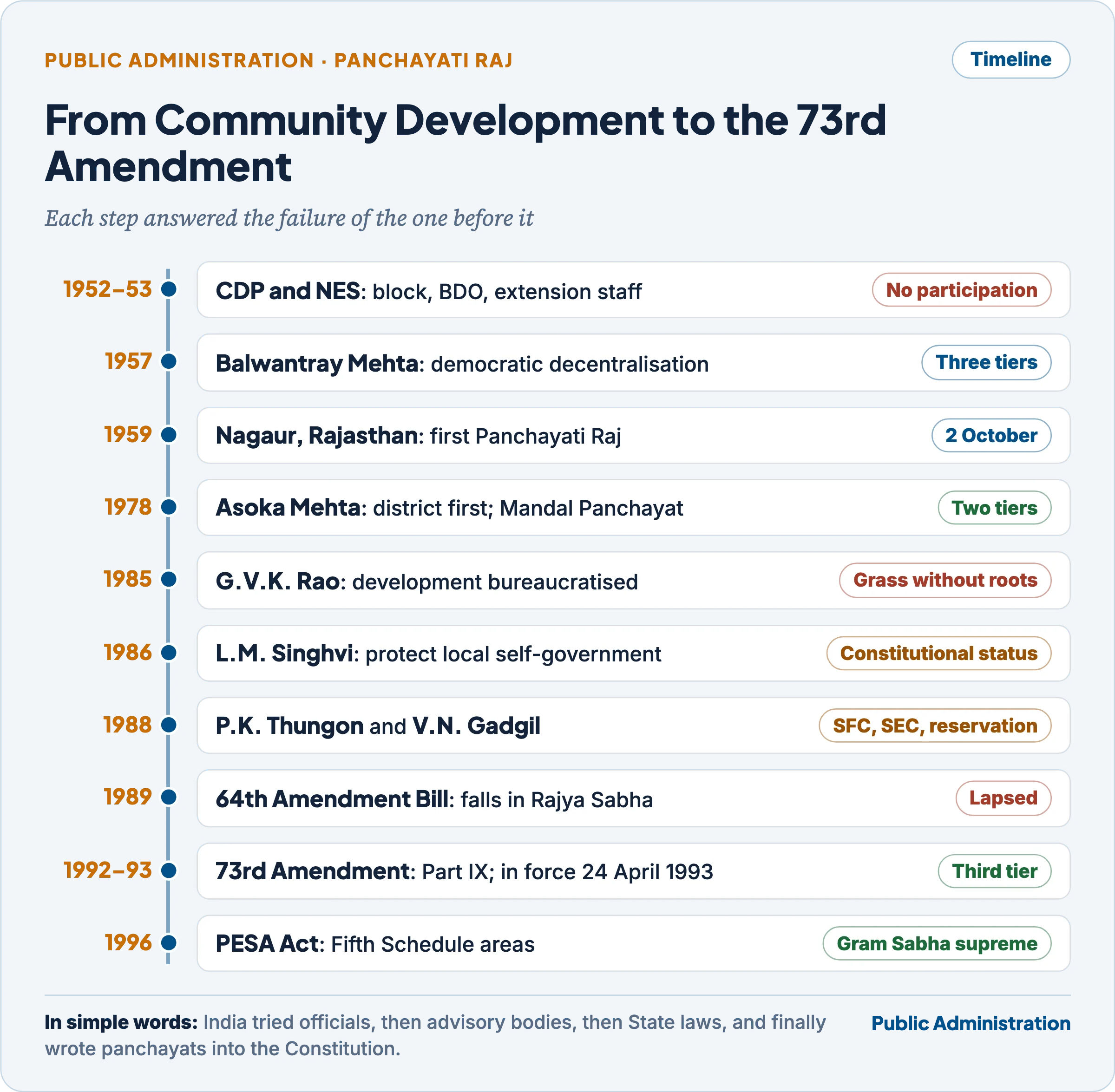
This section keeps the committees brief; their district-level design and the Collector’s place in each are covered in the article on District Administration, Democratic Decentralisation and Union–State–Local Relations, and their planning proposals in the article on Decentralised Planning after the 73rd and 74th Amendments.
2.1 From Community Development to Panchayati Raj
- Community Development Programme (2 October 1952) and National Extension Service (1953) worked through blocks under a BDO with extension staff; people saw them as government programmes, and participation stayed weak.
- The Balwantray Mehta Study Team (appointed January 1957, report November 1957) diagnosed this failure and proposed “democratic decentralisation”: three tiers (Gram Panchayat, Panchayat Samiti, Zila Parishad) linked by indirect elections, the Samiti as the executive body and the Zila Parishad advisory under the Collector, with genuine transfer of powers and resources. The National Development Council accepted it (January 1958); Rajasthan began at Nagaur on 2 October 1959, Andhra Pradesh followed, and by the mid-1960s Gram Panchayats covered about 90 per cent of the rural population. Maharashtra (1961) and Gujarat made the Zilla Parishad the strongest tier, with its own executive officer.
- Decline (1965–1977): elections postponed and bodies superseded; block funds cut as Plans turned to target-driven programmes (IADP, SFDA, DPAP) run by departments and special agencies; MLAs saw local leaders as rivals; parastatals took over water and other services. James Fesler’s “illusory decentralisation” fits this phase.
2.2 The committees, 1978–1989
| Committee | Year | Core recommendations |
|---|---|---|
| Asoka Mehta (Janata government) | 1978 | 132 recommendations; two tiers (Zila Parishad and Mandal Panchayat for 15,000–20,000 people); district as the first point of decentralisation; Zila Parishad as executive and planning body with a CEO; open party participation; compulsory taxation powers; SC/ST reservation by population; social audit; Nyaya Panchayats; no supersession, or elections within six months; constitutional recognition |
| G.V.K. Rao (CAARD, Planning Commission) | 1985 | Rural development bureaucratised and divorced from PRIs, “grass without roots”; Zila Parishad as principal development body; district as basic planning unit; District Development Commissioner as its chief executive |
| L.M. Singhvi (Revitalisation of PRIs for Democracy and Development) | 1986 | Local self-government to be constitutionally recognised, protected and preserved; Nyaya Panchayats; viable Gram Panchayats; more finances; Gram Sabha as embodiment of direct democracy |
| P.K. Thungon (Parliamentary Consultative Committee) | 1988 | Constitutional recognition; Zila Parishad as pivot; five-year term; SC/ST and women’s reservation; State Finance Commission; Collector as Zila Parishad CEO |
| V.N. Gadgil | 1988 | Three tiers, five-year term, direct elections, reservation, State Election and Finance Commissions |
- The Asoka Mehta Committee’s diagnosis. Panchayati Raj was not a “god that failed” but a schooling in democracy that had been starved and superseded; and it had been dominated by the privileged, so the weaker sections gained little. West Bengal (1978), Karnataka (Act of 1983, in force 1987) and Andhra Pradesh (Mandal Praja Parishads, 1987) built on its ideas.
- 64th Amendment Bill (1989). Passed by the Lok Sabha but defeated in the Rajya Sabha (October 1989), as opposition parties saw it as the Union reaching past the States. A combined bill of 1990 lapsed with the Lok Sabha’s dissolution.
Common confusion
Was the two-tier system the Asoka Mehta Committee’s most important idea? It was its most visible, but not its most lasting. The Mandal Panchayat survived in only a few States, and the 73rd Amendment returned to three tiers. Its durable ideas were the district as the first point of decentralisation, party participation, compulsory taxation powers, no indefinite supersession with elections within six months, and constitutional status, several of which entered the 73rd Amendment.
2.3 Generations of Panchayats
Students of Panchayati Raj often divide its history into generations, which helps answer whether Panchayats became political rather than developmental institutions.
| Generation | Period | Character | Examples |
|---|---|---|---|
| First | 1959 to mid-1970s | Agencies of development: delivering CDP and plan schemes; officials dominant; elections irregular; no party symbols | Rajasthan, Andhra Pradesh, Maharashtra under Mehta pattern |
| Second | Late 1970s to 1992 | Political institutions: party-based elections, district-level executive bodies, land reform and patronage roles | West Bengal (1978), Karnataka (1987), Andhra Pradesh Mandal Praja Parishads (1987) |
| Third | After 1993 | Constitutional third tier: mandatory elections, reservation, SEC and SFC; still dependent on States for powers | All Part IX States |
- The shift to politics. Second-generation Panchayats (West Bengal’s party-based councils after Operation Barga, Karnataka’s directly elected Zilla Parishads) made local bodies arenas of party competition and redistribution, not only implementers of schemes. Critics feared politicisation; defenders argued that development itself is political, and that party competition gave the poor a lever against local landlords.
- Political parties in Panchayat polls. It is unrealistic to keep parties out; most States now allow party symbols at upper tiers (and some at all tiers). The real question is how to make parties deliver good local government: by fixed terms, independent SECs, transparent finances and disqualification for defection in some State laws.
3. The 73rd Constitutional Amendment Act, 1992
In simple words
In 1992 Parliament added a new Part to the Constitution. Every State now has to have elected Panchayats at the village, block and district levels, hold elections every five years through an independent commission, reserve seats for SCs, STs and women, and set up a commission every five years to share money with Panchayats. What Panchayats actually do, and with how much money, is still left to each State.
3.1 Passage and purpose
- Passage. The P.V. Narasimha Rao government introduced the bill in September 1991. It was passed by the Lok Sabha on 22 December 1992 and the Rajya Sabha on 23 December 1992, ratified by 17 State legislatures, received Presidential assent on 20 April 1993 and came into force on 24 April 1993, now observed as National Panchayati Raj Day. All States had to bring their laws into conformity within one year (Article 243N), and most passed new Acts by April 1994.
- Statement of Objects and Reasons. Panchayats had failed to become viable and responsive people’s bodies because of absence of regular elections, prolonged supersessions, insufficient representation of SCs, STs and women, inadequate devolution of powers and lack of financial resources. The Amendment would give them certainty, continuity and strength.
- Two Amendments together. The 74th Amendment (Part IXA, Articles 243P to 243ZG, Twelfth Schedule) did the same for Municipalities; it also created the District Planning Committee (Article 243ZD), which consolidates rural and urban plans. Urban local government is covered in the article on urban local government; the DPC in the article on Decentralised Planning after the 73rd and 74th Amendments.
- Ministry of Panchayati Raj. A separate Union Ministry of Panchayati Raj was created in May 2004 to monitor implementation, advise States and run capacity-building and e-governance schemes.
3.2 Part IX article by article
The table gives each Article of Part IX with what it requires and why it matters administratively.
| Article | Provision | Administrative significance |
|---|---|---|
| 243 | Definitions: Gram Sabha, Panchayat, village, intermediate level, district | “Panchayat” defined as an institution of self-government for rural areas |
| 243A | Gram Sabha to exercise powers and functions as the State legislature provides | Direct democracy at the base, but its powers are State-defined |
| 243B | Panchayats at village, intermediate and district levels; intermediate tier optional in States with population not exceeding 20 lakh | Uniform three-tier structure; small States such as Goa and Sikkim have two tiers |
| 243C | Composition: all seats filled by direct election from territorial constituencies; State may provide representation of chairpersons of lower tiers, MPs and MLAs; chairperson of intermediate and district Panchayats elected by and from the elected members; village chairperson chosen as State law provides | Upper-tier chairs are indirectly elected; village heads may be direct or indirect by State choice |
| 243D | Reservation: SCs and STs in proportion to population; not less than one-third of seats (including SC/ST seats) for women, rotated; chairpersons’ offices reserved for SCs, STs and women; States may reserve for backward classes (243D(6)); SC/ST reservation tied to Article 334 | Social composition of local power changed; women’s share rose to about 46 per cent |
| 243E | Duration of five years; no dissolution without hearing; election before expiry, or within six months of dissolution | Ends indefinite supersession by officials |
| 243F | Disqualifications: as for State legislature elections (minimum age 21, not 25) or under State law | States add conditions (two-child norm, educational qualification, dues) |
| 243G | State may endow Panchayats with powers to function as institutions of self-government, including plans and schemes for economic development and social justice, including Eleventh Schedule matters | The heart of devolution, but discretionary |
| 243H | State may authorise Panchayats to levy taxes, duties, tolls, fees; assign State taxes; give grants-in-aid; create funds | Fiscal powers depend on State law |
| 243-I | State Finance Commission within one year and then every five years, on sharing of State taxes, assignment of taxes, grants and measures to improve finances; report and action taken memorandum laid before the legislature | State–local fiscal federalism |
| 243J | State law on maintenance of accounts and audit | Audit usually by a State Director of Local Fund Audit, with CAG technical guidance |
| 243K | State Election Commission: superintendence, direction and control of electoral rolls and elections; appointed by the Governor; removable only like a High Court judge; service conditions not varied to his disadvantage | Independent local election machinery |
| 243L | Application to Union Territories | President may modify |
| 243M | Exempted areas: Fifth Schedule Scheduled Areas and Sixth Schedule tribal areas; Nagaland, Meghalaya, Mizoram; Manipur hill areas with District Councils; Darjeeling Gorkha Hill Council at district level; SC reservation not in Arunachal Pradesh (243M(3A), added in 2000); Parliament may extend Part IX to Scheduled Areas by law (243M(4)(b)) | Basis of PESA, 1996; respects traditional institutions |
| 243N | Existing inconsistent laws continue for one year; existing Panchayats may run their term | Transition |
| 243-O | Bar on courts in electoral matters: delimitation and seat allotment laws not questioned; elections challenged only by election petition | Speedy elections |
| 280(3)(bb) | Union Finance Commission to recommend measures to augment a State’s Consolidated Fund to supplement Panchayat resources, on the basis of SFC recommendations | Basis of FC local body grants |
| Eleventh Schedule | 29 matters that may be devolved | Indicative list of rural functions |
3.3 Mandatory and voluntary provisions
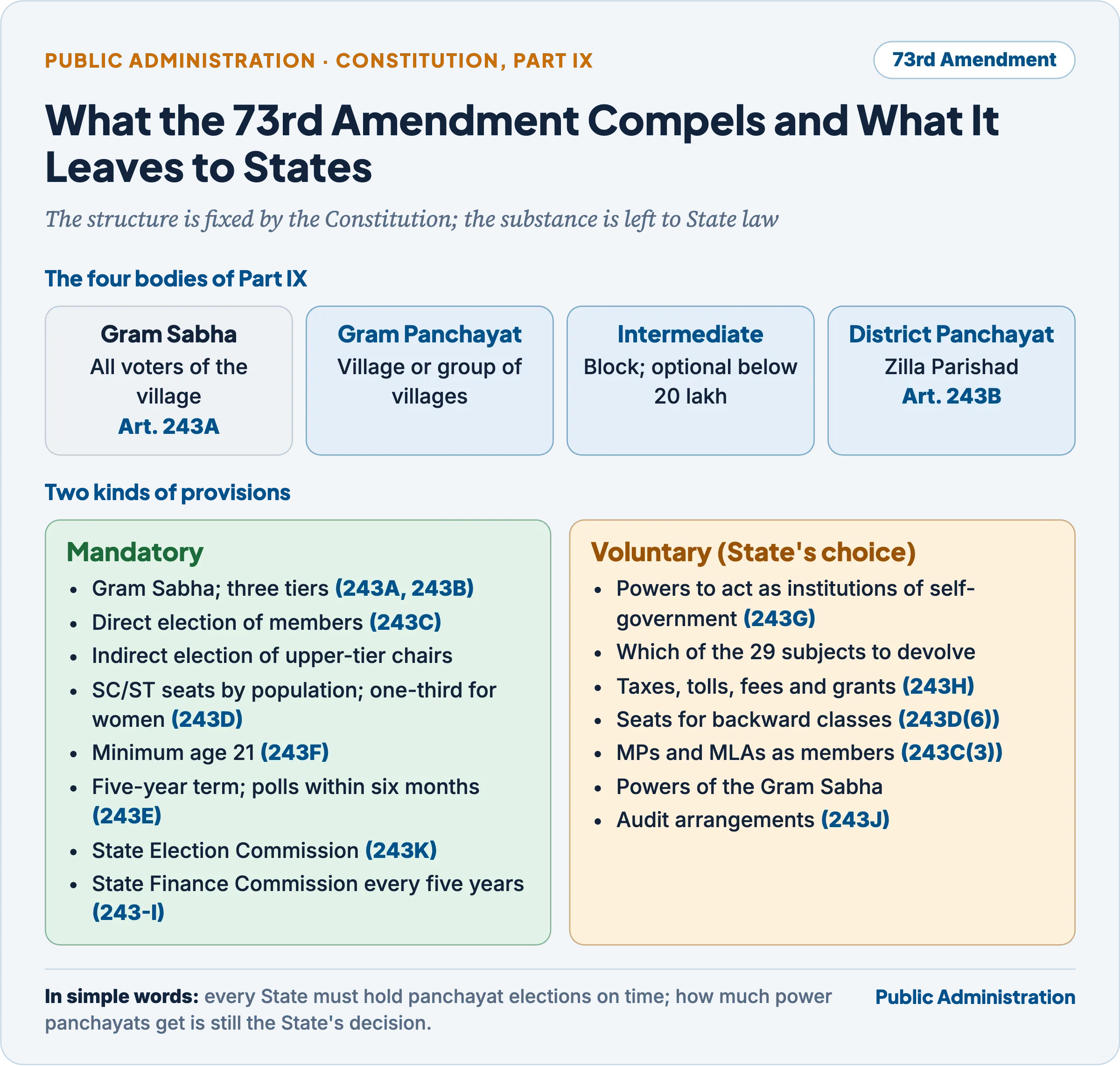
The Amendment is best understood as a floor of compulsory structure with a ceiling of optional substance, as the figure above shows: the mandatory provisions fix the bodies, elections, reservation, term, SEC and SFC; the voluntary ones (powers under 243G, which of the 29 subjects, taxes under 243H, backward-class seats, MP and MLA membership, Gram Sabha powers, audit) decide how much those bodies can actually do.
- What this design achieved. Within a decade every Part IX State had elected Panchayats at all levels, regular elections in most States, and lakhs of women, Dalit and Adivasi representatives. Supersession for years, the normal pattern before 1992, became rare. This is why the Amendment has been called a “silent social revolution” and a landmark in constitutional history.
- What it left open. The word “may” in Article 243G made devolution of functions, funds and staff a State choice. The Amendment also did not define the place of the Collector, the MLA, or the line departments in relation to Panchayats. The result is a uniform structure with wide variation in substance, from Kerala and Karnataka at one end to States where Panchayats remain implementing agencies at the other.
3.4 Reservation: Article 243D and the courts
- SCs and STs: seats in proportion to their population in the Panchayat area; one-third of these reserved for women of those groups. Chairpersons’ offices reserved in proportion to the State’s SC/ST population.
- Women: not less than one-third of seats and chairpersons’ offices, by rotation. Bihar (2006) was the first State to raise this to 50 per cent; today 21 States and 2 UTs provide 50 per cent, among them Kerala, Karnataka, Maharashtra, Madhya Pradesh, Rajasthan, Odisha, Andhra Pradesh, Telangana, Tamil Nadu and West Bengal. The Constitution (110th Amendment) Bill, 2009, which would have made 50 per cent mandatory everywhere, lapsed. About 14.5 lakh of roughly 31.9 lakh elected representatives (about 46 per cent) are women.
- Backward classes: optional under 243D(6); most States provide some quota.
- Rotation: reserved seats rotate, so a reserved woman or SC sarpanch usually gets one term. The 2nd ARC suggested rotating only after two terms, to allow leadership to mature.
- Key judgments:
- K. Krishna Murthy v. Union of India (2010): a five-judge bench upheld Articles 243D(6) and 243T(6) and reservation of chairpersons’ posts. It held that political reservation in local bodies is distinct from reservation in education and jobs under Articles 15(4) and 16(4), but that backward-class reservation must rest on empirical inquiry into political backwardness, and that vertical reservation should not ordinarily exceed 50 per cent.
- Vikas Kishanrao Gawali v. State of Maharashtra (2021): laid down the triple test for OBC reservation in local bodies: (i) a dedicated commission to study the nature of backwardness; (ii) local-body-wise proportion based on its findings; (iii) total SC, ST and OBC reservation not exceeding 50 per cent. Quotas without the test were struck down.
- Suresh Mahajan v. State of Madhya Pradesh (2022): elections cannot be postponed to complete the triple test; the SEC must notify polls, with OBC seats only where the test is met.
- Union of India v. Rakesh Kumar (2010): upheld PESA’s reservation of all chairpersons’ posts and of more than half the seats for STs in Scheduled Areas, given their special constitutional position.
- Maharashtra, 2025–26: after OBC litigation stalled polls from 2022, the Supreme Court on 6 May 2025 ordered elections with the OBC quota as it stood before the Banthia Commission report (July 2022), set 31 January 2026 as a final deadline (16 September 2025), and on 28 November 2025 allowed polls to proceed, with results where reservation crossed 50 per cent kept subject to its final decision. Zilla Parishad and Panchayat Samiti polls in 12 districts were held on 7 February 2026.
- Other disqualifications under State law (Article 243F(1)(b)):
- Javed v. State of Haryana (2003): upheld the two-child norm for Panchayat candidates as a reasonable classification serving population policy.
- Rajbala v. State of Haryana (2015): upheld minimum educational qualifications, a functional toilet at home and clearance of dues as conditions to contest. Critics argue such norms exclude poor, Dalit and women candidates, the very groups Article 243D meant to include.
Common confusion
Does the Constitution require 50 per cent reservation for women in Panchayats? No. Article 243D requires not less than one-third. The 50 per cent in 21 States and 2 UTs comes from State laws, using the words “not less than”. A bill to make 50 per cent constitutional (the 110th Amendment Bill, 2009) lapsed. Equally, OBC reservation is enabling, not compulsory, and is valid only if the triple test is met.
3.5 Powers, functions and the Eleventh Schedule
- Article 243G lets the State legislature endow Panchayats with powers and authority “as may be necessary to enable them to function as institutions of self-government”, including the preparation of plans and implementation of schemes for economic development and social justice, including those on the 29 Eleventh Schedule matters.
- The Eleventh Schedule lists 29 matters, grouped below.
| Group | Eleventh Schedule matters |
|---|---|
| Agriculture and natural resources | Agriculture and extension; land improvement, land reforms, consolidation, soil conservation; minor irrigation, water management, watershed development; animal husbandry, dairying, poultry; fisheries; social and farm forestry; minor forest produce; fuel and fodder |
| Economy and livelihoods | Small-scale industries including food processing; khadi, village and cottage industries; poverty alleviation programme; markets and fairs |
| Infrastructure | Rural housing; drinking water; roads, culverts, bridges, ferries, waterways; rural electrification including distribution; non-conventional energy |
| Social services | Education including primary and secondary schools; technical training and vocational education; adult and non-formal education; libraries; cultural activities; health and sanitation including hospitals, PHCs and dispensaries; family welfare |
| Welfare and equity | Women and child development; social welfare including welfare of persons with disabilities; welfare of weaker sections, especially SCs and STs; public distribution system |
| Community assets | Maintenance of community assets |
- Nature of the list. The Schedule is illustrative, not a separate legislative list: it does not give Panchayats exclusive jurisdiction or law-making power, and the State can keep any matter. The 2nd ARC noted incongruities: some items naturally rural (rural electrification, minor forest produce) sit alongside others (education, health, PDS) that span rural and urban areas.
- The 2nd ARC proposal. Article 243G should say the State “shall” (not “may”) vest Panchayats with powers over all functions that can be performed at the local level, including Eleventh Schedule matters, on the principle of subsidiarity.
3.6 Audit and the bar on courts
- Audit (243J). Left to State law; most States use a Director of Local Fund Audit under the Finance Department, with technical guidance and supervision by the CAG. Audit arrears have been chronic; the Fifteenth and Sixteenth Finance Commissions made online audited accounts an entry condition for grants.
- Article 243-O. Courts cannot question delimitation or seat allotment laws; election disputes go only by election petition. The Supreme Court in State of Goa v. Fouziya Imtiaz Shaikh (2021) read the parallel municipal bar (243ZG) as preventing courts from interfering once the election process begins, while allowing them to step in before notification or to help an SEC complete polls.
3.7 Assessing the Amendment
- Achievements:
- Permanent structure: Panchayats can no longer be wound up at will; elections are regular in most States.
- Scale of representation: about 31.9 lakh elected representatives, the largest body of elected officials anywhere.
- Social change: women, Dalits and Adivasis in office, including as sarpanch and Zilla Parishad president; the “silent social revolution”.
- Institutions of fiscal federalism (SFCs) and of electoral independence (SECs) at the State level.
- Platform for later reforms: Finance Commission grants direct to Panchayats, Gram Panchayat Development Plans, social audit, e-governance.
- Development with justice: Articles 243G and 243ZD tie local planning to “economic development and social justice”, and reservation under 243D builds social justice into who plans; the two together are the distinctive hallmarks of the 1992 Amendments.
- Limitations:
- Discretionary devolution (243G, 243H): structure without substance.
- No defined relationship with the Collector, line departments, MLAs or parastatals.
- No exclusive functions and no protection against State control powers (suspension, removal, approval of budgets).
- Weak Gram Sabha: its powers are whatever the State gives.
- Fiscal dependence: own revenue remains tiny.
- A third tier of federalism? Part IX gives Panchayats constitutional existence, fixed terms and their own election and finance machinery, which is why they are called the third tier of government. But they lack the defining features of a federal unit: no legislative list, no exclusive functions, no independent taxing power and no protection against State control. India has constitutionally protected local government within States, not three-tier federalism; making that model viable requires the 3Fs, not more structure.
- The World Bank’s fiscal warning. A World Bank study argued that the Amendment might accentuate fiscal indiscipline by creating between States and local governments a transfer system like the Union–State one, where lower governments spend money they do not raise. The logic is the soft budget constraint (János Kornai): an entity that expects bailouts has little incentive to tax or save. Evidence partly supports the fear: a 2025 NIPFP study for the Ministry of Panchayati Raj found that Panchayats’ own revenue is negatively correlated with grants. But the counter-argument is stronger: Panchayats spend tiny sums relative to States, most grants are conditional (audited accounts, plans, online payments), and the problem is too little, not too much, fiscal autonomy. Linking grants to own-revenue effort, as the Fourteenth and Sixteenth Finance Commissions did, answers the incentive problem.
4. The Panchayats (Extension to the Scheduled Areas) Act, 1996
In simple words
Tribal areas under the Fifth Schedule were left out of the 73rd Amendment because their customs and land needed special protection. In 1996 Parliament extended Panchayati Raj to these areas with one big change: the village assembly of the tribal community, the Gram Sabha, was put at the centre, with a say over land, forests, minerals, markets and liquor.
4.1 Why PESA was needed
- Article 243M(1) kept Fifth Schedule Scheduled Areas out of Part IX, and Article 243M(4)(b) allowed Parliament to extend it by law with exceptions and modifications.
- Tribal communities had their own customary institutions (village councils, headmen, community control of forests and water), which a uniform Panchayat model could have displaced. They also faced land alienation, displacement by dams and mines, exploitation by moneylenders and liquor traders, and loss of forest rights.
- The Bhuria Committee (chaired by Dilip Singh Bhuria, 1994–95) recommended self-rule centred on the Gram Sabha, and Parliament enacted the Provisions of the Panchayats (Extension to the Scheduled Areas) Act, 1996 (PESA), in force from 24 December 1996, now marked as PESA Day.
- Coverage: Fifth Schedule areas in 10 States (Andhra Pradesh, Chhattisgarh, Gujarat, Himachal Pradesh, Jharkhand, Madhya Pradesh, Maharashtra, Odisha, Rajasthan, Telangana): about 77,564 villages, 22,040 Panchayats, 664 blocks, 45 fully covered and 63 partly covered districts.
- Sixth Schedule areas (parts of Assam, Meghalaya, Tripura, Mizoram) are different: they have Autonomous District Councils with legislative powers, not PESA.
4.2 Key provisions (Section 4)
| Provision | What it says |
|---|---|
| Customary law (4(a), 4(d)) | State laws must be consistent with customary law, social and religious practices and traditional management of community resources; every Gram Sabha is competent to safeguard traditions, cultural identity, community resources and the customary mode of dispute resolution |
| Village and Gram Sabha (4(b), 4(c)) | A village is a habitation or group of habitations managing its affairs by custom (not just a revenue village); every village has a Gram Sabha |
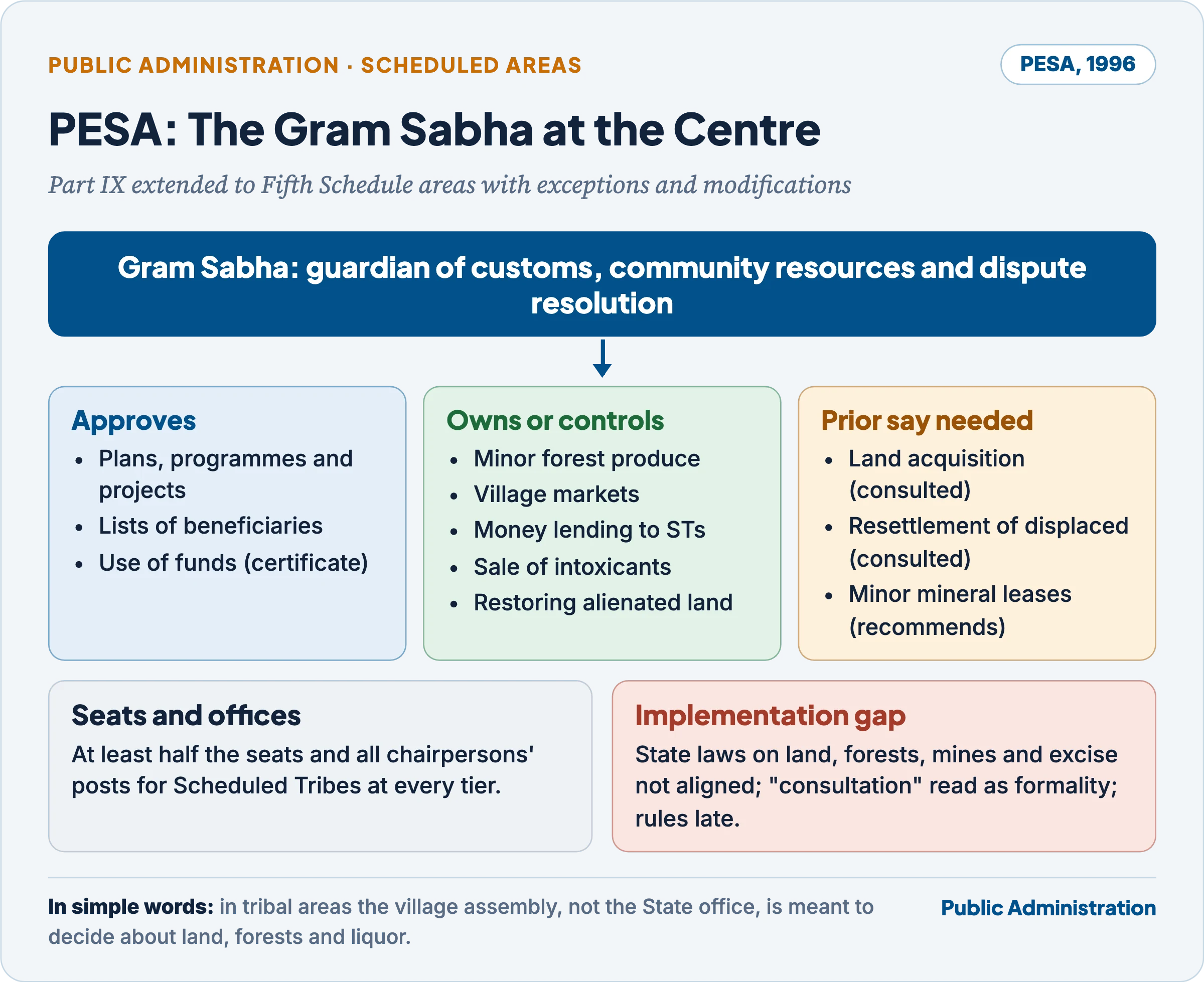
| Approval of plans (4(e), 4(f)) | Gram Sabha approves plans, programmes and projects before implementation, identifies beneficiaries, and the Panchayat must obtain a utilisation certificate from it |
| Reservation (4(g), 4(h)) | Seats for STs at least one-half; all chairpersons’ posts at every level reserved for STs; nomination of unrepresented STs at upper tiers |
| Land (4(i)) | Gram Sabha or Panchayat to be consulted before land acquisition for development projects and before resettlement |
| Water bodies (4(j)) | Minor water bodies planned and managed by Panchayats |
| Minerals (4(k), 4(l)) | Prior recommendation for prospecting licences, mining leases and auction concessions for minor minerals |
| Specific powers (4(m)) | Enforce prohibition or regulate intoxicants; ownership of minor forest produce; prevent land alienation and restore unlawfully alienated land; manage village markets; control money lending to STs; control institutions and functionaries in social sectors; control local plans and resources, including tribal sub-plans |
| Protection of lower levels (4(n)) | Higher tiers must not assume the powers of the Gram Sabha or lower Panchayats |
| District level (4(o)) | Administrative arrangements at district level on the pattern of the Sixth Schedule |
4.3 Status of implementation
- Incorporation into State laws: nine States amended their Panchayati Raj Acts; Rajasthan passed a separate Act (1999).
- State PESA rules: after the Ministry circulated draft model rules (2009), rules were framed by Andhra Pradesh and Himachal Pradesh (2011), Rajasthan (2011), Maharashtra (2014), Telangana (adopted 2014), Gujarat (2017), Chhattisgarh (August 2022) and Madhya Pradesh (15 November 2022). Jharkhand notified its rules on 2 January 2026, 25 years after statehood, making nine of ten PESA States with rules. Odisha published draft rules in November 2023 but had not finalised them by March 2026.
- Jharkhand’s rules (2026) require prior Gram Sabha consent for land acquisition and rehabilitation, recognise traditional village heads, give Gram Sabhas rights over minor forest produce, liquor licensing and monitoring of schools, anganwadis and ration shops, and create a Gram Kosh (village fund). Critics say rules giving Deputy Commissioners the power to recognise Gram Sabha boundaries may dilute customary autonomy.
- Monitoring: the Ministry has developed 10 PESA indicators (alignment of State laws, rules notified, amendment of line-department laws, PESA staff, training, GPDP uploads by PESA Gram Sabhas, minutes on the Panchayat NIRNAY portal) and held a PESA Mahotsav at Visakhapatnam on 23–24 December 2025.
4.4 Problems in implementing PESA
- Conflicting subject laws. State laws on land revenue, excise, forests, minor minerals, money lending and land acquisition were not amended to match PESA; the Act’s promise is defeated by departmental rules. The 2nd ARC asked for immediate amendment and, if States resist, Union directions under the Fifth Schedule.
- “Consultation” read as formality. Many States treat consultation on land acquisition as a non-binding hearing; Gram Sabha resolutions are ignored or obtained by pressure.
- Revenue village versus habitation. States notified Gram Sabhas at revenue-village or Panchayat level, not at the habitation where customary institutions actually work.
- Bureaucratic gatekeeping. Forest, mining and revenue departments retain control over MFP, leases and land records; traditional institutions sit uneasily with elected Panchayats.
- Capacity and awareness. Low awareness of rights, weak training in PESA areas, Gram Sabhas without staff or funds.
- Courts as allies. In Samatha v. State of Andhra Pradesh (1997) the Supreme Court held that transfer of Scheduled Area land to private mining companies was void; in Orissa Mining Corporation v. Ministry of Environment and Forests (2013), the Niyamgiri case, it left the decision on Vedanta’s bauxite mine to the Gram Sabhas under the Forest Rights Act, 2006 and PESA, and the twelve Gram Sabhas consulted rejected it. These judgments show what PESA could mean if implemented.
- Assessment. PESA is the most radical expression of decentralisation in Indian law, giving a community assembly powers that ordinary Panchayats lack. Thirty years on, it remains largely an unfulfilled promise: tribal society’s control over livelihoods and traditional rights depends on aligning subject laws, accepting Gram Sabha decisions as binding and building Gram Sabha capacity.
5. Working of PRIs: Functions, Funds and Functionaries
In simple words
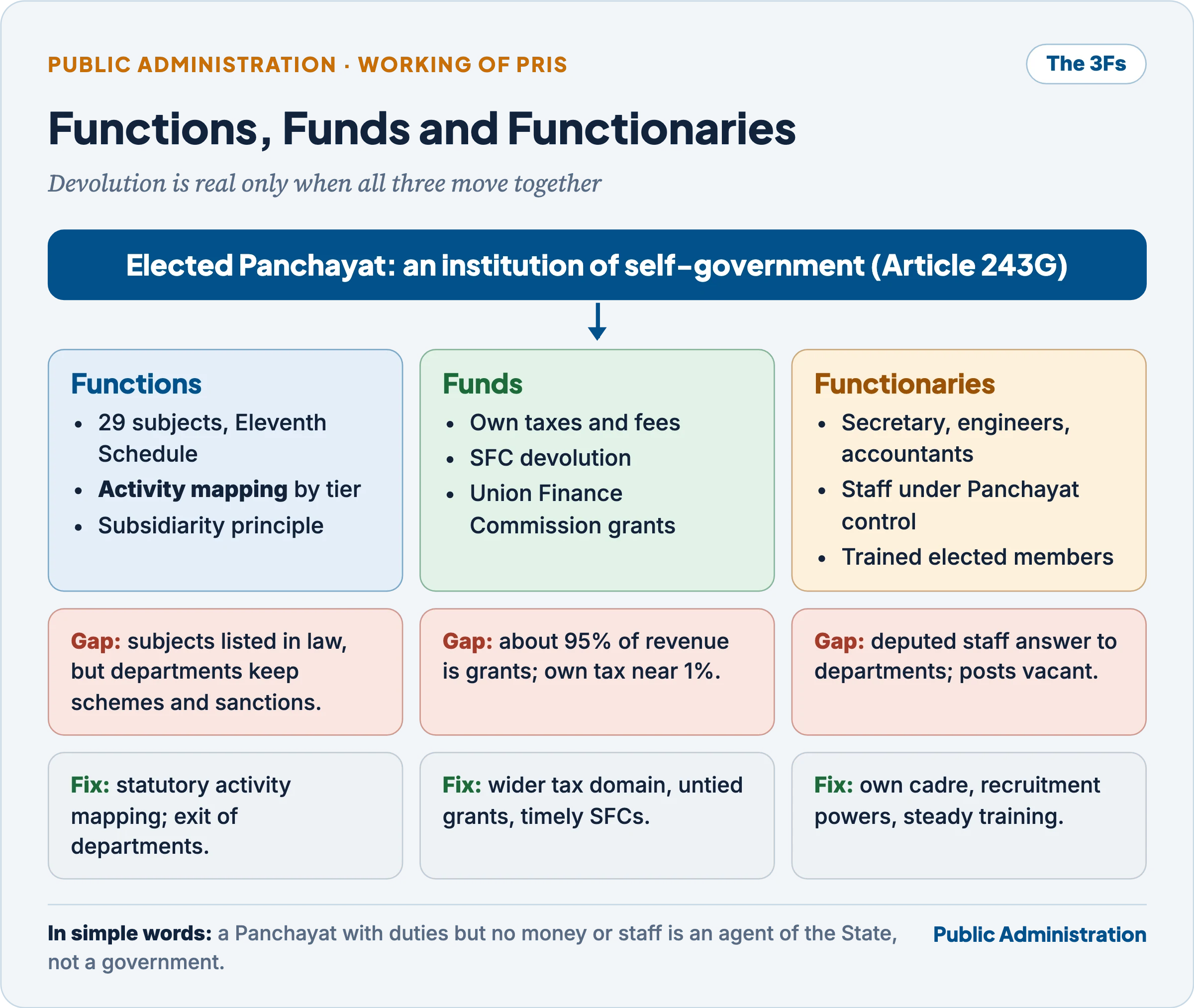
To act as a government, a Panchayat needs three things: clear jobs to do, money it can spend as it chooses, and staff who answer to it. These are called the “3Fs”. In most States Panchayats have long lists of subjects on paper, but little money of their own and few staff, so they end up doing what State departments tell them.
5.1 Scale of the system
- Bodies: about 2.6 lakh Gram Panchayats and equivalent bodies (2,66,999 counted for the Panchayat Advancement Index 2.0), about 6,700 intermediate Panchayats and about 675 District Panchayats.
- Representatives: about 31.9 lakh elected representatives, of whom about 14.5 lakh (46 per cent) are women.
- Two roles at once. Panchayats are institutions of self-government under Article 243G and also implementing agencies for Union and State schemes. The 2nd ARC distinguished three spheres: an exclusive sphere of the Panchayat, a partnership sphere with the State, and an agency sphere where Panchayats implement State or Union schemes. In most States the agency sphere dominates.
5.2 Functions and activity mapping
- The problem. States devolved functions mostly through omnibus clauses that repeat the 29 Eleventh Schedule items, without saying which tier does what, while departmental executive orders and scheme guidelines keep actual decisions (sanctions, staff, procurement) with line departments. This is “devolution on paper”.
- Activity mapping means unbundling each subject into activities and assigning each to the level of government best placed to perform it. The 2nd ARC’s illustration: basic education can be unbundled into monitoring teachers’ attendance, repairing schools, procuring equipment, recruiting teachers; horticulture into seed supply, nurseries, technical assistance, pest control, market information and post-harvest support.
- Five categories of activity: setting standards, planning, asset creation, implementation and management, and monitoring and evaluation.
- Principles of assignment:
- economies of scale push an activity upward (a multi-village water scheme to the Zilla Parishad);
- externalities push it to the level that covers all affected people (epidemic control beyond a village);
- equity may need a higher level to ensure uniform standards;
- heterogeneity of local preferences pushes it downward (the menu of mid-day meals);
- beneficiary selection should always be at the lowest level, the Gram Sabha.
- Why it matters. Clear roles let Panchayats be held accountable, make capacity building demand-driven, and show which functionaries and funds must move with each function. The 2nd ARC asked every State to complete activity mapping within one year through a task force, and the Union to do the same for Centrally Sponsored Schemes.
- Status. Activity maps exist in many States, but are often not notified or not followed by transfer of funds and staff. The Devolution Index 2024 ranked Tamil Nadu, Karnataka, Odisha and Rajasthan highest on the functions dimension.
5.3 Funds: own revenue, State transfers and Finance Commission grants
Panchayats draw on own taxes (mainly property or house tax), own non-tax revenue (fees, user charges, rents, auctions of fisheries and markets), State devolution on SFC recommendations, Union Finance Commission grants and scheme funds.
How dependent Panchayats are. The RBI report Finances of Panchayati Raj Institutions (January 2024), using data on 2.58 lakh Panchayats for 2020–21 to 2022–23, found:
- own tax revenue only about 1 per cent of revenue receipts, own non-tax revenue about 3–4 per cent;
- grants about 95 per cent, of which Union grants about 80 per cent and State grants about 15 per cent in 2022–23;
- average revenue per Panchayat ₹21.23 lakh in 2022–23, of which own tax only about ₹21,000;
- wide variation, from about ₹2.7 lakh per Panchayat in Andhra Pradesh to ₹64 lakh in West Bengal; better outcomes in health, education and water in States with higher devolution.
Why own revenue is so low:
- Thin tax domain: buoyant taxes (excise, GST, motor vehicles, stamp duty) belong to the State; the only significant local tax is property tax.
- Reluctance to tax neighbours and voters; elected heads fear unpopularity.
- Weak assessment (no property registers, undervalued property) and collection machinery.
- Grants crowd out effort (the NIPFP study cited above).
- Remedies: SVAMITVA property cards as the base for property tax, mineral royalty shares (2nd ARC), user charges for services, matching grants for own revenue, a band of rates set by the State and obligatory levy by Panchayats (2nd ARC); the Ministry has trained about 2.55 lakh participants on own source revenue under RGSA.
State Finance Commissions.
- Mandate (243-I): recommend principles for sharing State taxes, assigning taxes and giving grants, and measures to improve finances; the Governor lays the report with an action taken memorandum before the legislature.
- Purpose: to make State–local transfers formula-based, predictable and equalising, so that poorer and backward Panchayats get more, much as the Union Finance Commission does between the Union and States. SFCs thus serve regional balance within a State, though they distribute State funds, not Central ones; Central grants reach Panchayats through the Union Finance Commission route.
- Problems in practice:
- Delay: many States constituted SFCs late, irregularly or not at all; reports lie unacted for years, and action taken reports are tabled late or without decisions;
- composition: often retired officials without public finance expertise; no prescribed qualifications;
- data: no reliable accounts of local bodies, so recommendations rest on guesswork;
- non-binding: unlike Union FC awards, which the Union has always honoured, many States accept SFC recommendations partially and release funds late;
- periods not synchronised with the Union FC, so the Union FC cannot rely on SFC reports in assessing States’ needs.
- Effect on Central transfers. Successive Union Finance Commissions, from the Eleventh onwards, complained that they could not base local body grants on SFC reports because these were missing, dated or not comparable. State apathy towards SFCs has thus weakened the whole chain of fiscal transfers to local bodies.
- Reform proposals: constitute SFCs on time and synchronise them with the Union FC (Twelfth FC); prescribe qualifications of members by law; a permanent SFC cell in the Finance Department; an action taken report within six months; normative rather than historical assessment; an annual statement of devolution in the State budget (2nd ARC). The Sixteenth Finance Commission has now made regular constitution of SFCs and tabling of the action taken report an entry condition for any local body grant.
Union Finance Commission grants. Since the 73rd Amendment, Union Finance Commissions have become the most dependable source of untied money for Panchayats.
| Finance Commission | Period | Local body grants | Design for rural bodies |
|---|---|---|---|
| Tenth | 1996–2000 | ₹5,381 crore (₹4,381 crore rural) | First local body grant; ₹100 per rural person |
| Eleventh | 2000–05 | ₹10,000 crore (₹8,000 crore rural) | Priority to accounts and audit, databases |
| Twelfth | 2005–10 | ₹25,000 crore (₹20,000 crore rural) | Water supply and sanitation; SFC reforms |
| Thirteenth | 2010–15 | ₹87,519 crore | Share of divisible pool (1.5 per cent basic plus up to 1 per cent performance); conditions such as audit systems, local body ombudsman, electronic fund transfer, qualified SFC members |
| Fourteenth (Y.V. Reddy) | 2015–20 | ₹2,87,436 crore (₹2,00,292 crore to Gram Panchayats) | Only Gram Panchayats; 90 per cent basic, 10 per cent performance for audited accounts and higher own revenue; spent through a plan (origin of GPDP) |
| Fifteenth (N.K. Singh) | 2021–26 | ₹4,36,361 crore (rural ₹2,36,805 crore) | All three tiers; 60 per cent tied (drinking water, rainwater harvesting, sanitation, ODF), 40 per cent untied; online accounts as entry condition |
| Sixteenth (Arvind Panagariya) | 2026–31 | ₹7,91,493 crore (rural ₹4,35,236 crore) | Basic 80 per cent (half tied, half untied), performance 20 per cent; entry conditions on duly constituted bodies, published audited accounts and regular SFCs; State performance grant for devolving own resources |
- The trend: grants have grown more than 150-fold since the Tenth FC, moved directly to Panchayats through electronic transfer, and become conditional.
- Performance grants and accountability. The Thirteenth FC’s conditions and the Fourteenth FC’s 10 per cent performance grant (for audited accounts and growth in own revenue) pushed States to audit accounts, publish data and raise property tax; the Fifteenth and Sixteenth FCs made online accounts an entry condition. These have improved financial accountability, though many Panchayats failed to qualify, showing weak capacity rather than unwillingness.
- Tied versus untied. Tied grants serve national priorities (water, sanitation) but narrow the Gram Sabha’s choice; untied grants are what make local planning real. The Sixteenth FC’s design (half the basic grant untied, the whole performance grant untied) tries to balance the two.
- Release problems. Releases are delayed when States miss conditions or when software and accounting checks hold funds; Karnataka’s minister complained in July 2026 that about ₹2,186 crore of Fifteenth FC money due to its Gram Panchayats had been held back on technical grounds.
5.4 Functionaries
- The staffing gap. Most Gram Panchayats have only a Panchayat secretary, often shared between several Panchayats; few have engineers, accountants or data operators. Intermediate and district Panchayats work through the BDO and CEO, who are State officers.
- Deputation and dual control. Staff working for Panchayats are deputed from State departments and answer to them for postings, promotion and discipline. Frequent transfers prevent continuity; officials treat elected heads as subordinates, not employers.
- No power to recruit. In most States Panchayats cannot recruit staff or fix service conditions; where they can, they lack money.
- 2nd ARC recommendations: Panchayats should have power to recruit and regulate their staff within State standards, within three years; until then, State staff on defined deputation; a zero-based review of PRI staffing within one year, with Zilla Parishads involved; a pool of experts (engineers, planners) shared by a federation of local bodies.
- Better practice. Kerala (1995 onwards) transferred institutions and their staff (schools, primary health centres, Krishi Bhavans, anganwadis) to local governments; Karnataka placed district and taluk staff under Zilla and Taluk Panchayats; the Devolution Index 2024 ranked Gujarat, Tamil Nadu and Kerala highest on functionaries.
5.5 Capacity building
- Why it matters. About 32 lakh representatives are elected every five years, many for the first time, many with little schooling, and because of rotation of reserved seats most serve one term. Without training they cannot read budgets, use portals or challenge officials, and proxies or officials fill the gap.
- Rashtriya Gram Swaraj Abhiyan (RGSA). A Centrally Sponsored Scheme from 2018–19; the revamped RGSA was approved on 13 April 2022 for 2022–23 to 2025–26 with an outlay of ₹5,911 crore (60:40 Centre–State; 90:10 for the North-East, hill States and J&K). It funds training of elected representatives and functionaries, Panchayat buildings and computers, Gram Sabha strengthening, e-governance, localisation of SDGs and incentives. More than 24 lakh elected representatives have been trained, nearly half of them women. The Ministry has proposed continuation from 2026–27 with about ₹7,860.83 crore, and the parliamentary Standing Committee (2026) asked that training be linked to measurable outcomes (audit compliance, own revenue, Gram Sabha functioning) and third-party evaluation.
- Institutions: the National Institute of Rural Development and Panchayati Raj (Hyderabad), State Institutes of Rural Development and Panchayat training centres, using cascade training through master trainers; leadership programmes with IIMs and IITs; Panchayat Learning Centres.
- Women representatives: the Sashakt Panchayat-Netri Abhiyan (launched 4 March 2025) for leadership and negotiation skills; 744 Model Women-Friendly Gram Panchayats, one per district, identified to demonstrate gender-responsive governance.
- Limits: training is episodic, supply-driven and cascade-diluted; it rarely includes mentoring or assessment; and trained representatives remain frustrated where the 3Fs are not devolved. Capacity is also institutional: staff, money, buildings, data and authority.
5.6 Measuring devolution and performance
- Devolution Index. The Ministry of Panchayati Raj has commissioned devolution rankings since 2006; the Devolution Index 2024 (Status of Devolution to Panchayats in States, prepared with the Indian Institute of Public Administration, released in February 2025) ranks States on six dimensions: framework, functions, finances, functionaries, capacity enhancement and accountability.
- Top States: Karnataka (72.23), Kerala (70.59), Tamil Nadu (68.38), Maharashtra (61.44), Uttar Pradesh (60.07); national average 43.89.
- By dimension: framework, Kerala first; functions, Tamil Nadu; finances and accountability, Karnataka; functionaries, Gujarat; capacity building, Telangana.
- Low scorers: Goa, Haryana, Jharkhand, Punjab, Arunachal Pradesh, Manipur and most UTs.
- Findings: most States are not serious about SFCs; finances depend on timely Fifteenth FC releases; devolution is uneven even in leading States.
- Panchayat Advancement Index (PAI). A Panchayat-level report card on the nine Localised SDG themes (poverty-free and enhanced livelihoods, healthy, child-friendly, water-sufficient, clean and green, self-sufficient infrastructure, socially just and secured, good governance, women-friendly).
- PAI 1.0 (2022–23), released 9 April 2025: no Panchayat reached the top “Achiever” grade.
- PAI 2.0 (2023–24), released in April–May 2026: 2,59,867 Gram Panchayats (97.3 per cent) on 112 indicators; none in the Achiever grade (90+), 3,635 Front Runners, 1,18,824 Performers, 1,23,719 Aspirants and 13,689 Beginners. Tripura (943 of 1,176 GPs as Front Runners), Telangana, Andhra Pradesh and Odisha did best; West Bengal did not take part.
- Significance: the two indices separate how much power States give (Devolution Index) from what Panchayats achieve (PAI). Together they create yardstick competition among States and Panchayats; critics warn that indicator-chasing can turn local governments into data-reporting units for Union priorities.
5.7 Panchayats and rural development programmes
Rural development in India has moved from the Community Development Programme through area and target-group programmes (IRDP, DPAP), wage employment and self-employment schemes, to rights-based laws and missions (MGNREGA, the National Rural Livelihoods Mission, PMAY-G, PMGSY), and from 1 July 2026 the VB–G RAM G Act; the institutions, agencies and strategies of these programmes are covered in the article on Rural Development: Institutions, Agencies, Programmes and Strategies since Independence. For this article the point is that no rural development strategy has succeeded without appropriate Panchayati Raj institutions:
- the CDP failed for want of popular institutions, which is why Panchayati Raj was created;
- the IRDP and other DRDA-run programmes of the 1980s were captured by officials and middlemen, producing “grass without roots”;
- the most successful schemes give PRIs a defined role: Gram Sabha selection of beneficiaries (housing), Panchayat-planned works with social audit (rural employment), SHG federations linked to Panchayat plans (Kudumbashree, NRLM’s Village Poverty Reduction Plans);
- conversely, programmes run by parallel bodies (Section 6.2) duplicate effort and weaken accountability.
6. Problems in the Working of PRIs
In simple words
Even with the Constitution behind them, Panchayats are often held back by State governments that keep control, officials who treat elected heads as juniors, committees and agencies that work around them, powerful families who capture them, and elections that are delayed for years.
6.1 State control and bureaucratic dominance
- Legal controls in State Acts. Almost every State Panchayati Raj Act gives the State government or its officers powers to:
- suspend or rescind Panchayat resolutions;
- inquire into Panchayat affairs and inspect records;
- remove sarpanches and members for misconduct, and suspend them pending inquiry;
- approve budgets of lower tiers;
- withdraw powers and supersede or dissolve Panchayats.
These place the State in a position of command, and are often used politically against opponents.
- Bureaucratic dominance in practice.
- The CEO of the Zilla Parishad and the BDO are State officers who control files, payments and staff; the elected president often depends on them.
- Line departments keep sanction powers for schemes in subjects formally devolved.
- Scheme guidelines from Delhi and the State capital fix what can be built, by whom and how; Panchayats become implementing agencies.
- Digital dashboards and target reviews make the Panchayat accountable upward to the block and district rather than downward to the Gram Sabha.
- Political dominance. MLAs and MPs see Panchayat leaders as rivals; State ministers prefer MLA local area funds and departmental schemes to untied Panchayat funds. The 2nd ARC observed that legislators sometimes act as “executives”, intervening in transfers, contracts and tenders.
- Why control persists: local government is a State subject; State bureaucracies and politicians lose patronage if they devolve; State finances are tight; and distrust of Panchayats’ capacity and probity becomes self-fulfilling when capacity is never built.
- 2nd ARC remedy: abolish budget approval by higher tiers; take away the State’s power to suspend resolutions, remove members or dissolve Panchayats; route complaints of corruption or abuse to a local body Ombudsman (appointed by a committee of the Chief Minister, Speaker and Leader of Opposition) who reports through the Lokayukta to the Governor; and route election-related complaints to the SEC.
6.2 Parallel bodies and parastatals
- What they are. Bodies that perform local functions outside the Panchayat: registered societies, statutory boards and scheme committees with their own funds and staff.
- Examples:
- District Rural Development Agencies (DRDAs), societies that ran poverty programmes for decades; the Union discontinued DRDA administration funding from 1 April 2022 and asked States to merge them with Zilla Parishads, as Kerala, Karnataka and West Bengal had done earlier;
- District Health Societies, District Water and Sanitation Missions, State water boards;
- village-level user committees: Village Water and Sanitation Committees, School Management Committees, Joint Forest Management Committees, watershed committees, mid-day meal and ICDS committees;
- MPLADS and MLA local area schemes;
- DISHA (district monitoring committees chaired by MPs).
- Why they were created: faster delivery, technical expertise, donor or scheme requirements, and distrust of Panchayats.
- Effects: duplication, confusion over who is responsible, funds bypassing elected bodies, user committees captured by the same local elites, and erosion of Panchayat legitimacy.
- 2nd ARC remedies: parastatals must not undermine PRIs; DRDAs and district water and sanitation bodies to be merged with Zilla Parishads; health societies to have an organic link with Panchayats; community bodies to be created from below and be accountable to PRIs; local area development schemes (MPLADS, MLALADS) to be abolished and all rural development funds routed through Panchayats.
6.3 Elite capture, caste and the voice of weaker sections
- Elite capture is the domination of local institutions by locally powerful groups (dominant castes, landlords, contractors, party bosses), who direct benefits to themselves. Pranab Bardhan and Dilip Mookherjee (“Capture and Governance at Local and National Levels”, 2000) showed that whether local or central government is more prone to capture depends on local inequality, literacy and electoral competition.
- Indian evidence.
- The Asoka Mehta Committee (1978) found PRIs dominated by the privileged, with benefits not reaching the poor.
- Reserved SC and ST sarpanches face non-cooperation, social boycott and violence; in some villages they are made to sit on the floor or denied flag-hoisting; dominant castes run Panchayats through proxies.
- Rotation means a reserved Dalit sarpanch often serves once and loses office before gaining influence.
- Beneficiary lists are manipulated; the landless and migrants rarely attend Gram Sabhas.
- Evidence of real change. Reservation has brought lakhs of SC, ST and women representatives into office; studies of reserved Panchayats show more spending on public goods used by the reserved group (Chattopadhyay and Duflo’s finding that women-led Panchayats invested more in drinking water, 2004); and the presence of Dalit leaders has changed social expectations over time.
- Assessment. Constitutional representation is necessary but not sufficient: the voice of weaker sections depends on land and economic power, education, literacy, mobilisation (SHGs, social movements) and protection from violence. Measures that help: ward and mahila sabhas, SHG federations linked to Panchayats, social audit, rotation after two terms (2nd ARC), protection under the SC/ST (Prevention of Atrocities) Act, and independent grievance redress.
6.4 Women in Panchayats and proxy representation
- Scale: about 14.5 lakh women representatives, about 46 per cent, the largest number of elected women anywhere.
- Change they bring:
- Agenda shift: drinking water, sanitation, schools, anganwadis, liquor and domestic violence get attention;
- Contesting patriarchy: women heads presiding over men, signing cheques, dealing with officials, and inspiring other women to contest; in Karnataka women have won seats beyond those reserved;
- Social legitimacy: mothers, Dalit and Adivasi women gain public voice; women’s sabhas and SHG networks give them a base.
- Why many struggle:
- Proxy representation: the “sarpanch pati”, “pradhan pati” or “mukhiya pati” phenomenon, where husbands or male relatives exercise the office;
- Rotation: one term, then the seat moves; no time to learn;
- Low literacy and little prior experience; care burdens and restricted mobility;
- Hostility of officials and male members; violence and character attacks;
- Intersection of caste and gender: Dalit and Adivasi women face double exclusion.
- Sushil Kumar Committee. On the Supreme Court’s direction, the Ministry of Panchayati Raj set up an Advisory Committee under former Mines Secretary Sushil Kumar in September 2023; it reported in February 2025 (Transforming Women’s Representation and Roles in Panchayati Raj Systems and Institutions: Eliminating Efforts for Proxy Participation). Its recommendations, accepted by the Ministry:
- exemplary penalties for proven proxy leadership;
- public swearing-in of women heads in the Gram Sabha;
- women’s ombudspersons, helplines and whistleblower rewards;
- gender-exclusive quotas in Panchayat subject committees and ward committees (on the Kerala pattern);
- gender resource centres, mentorship by former women leaders, federations of women representatives;
- technology: tracking heads’ participation in meetings on the Panchayat NIRNAY portal, AI-based legal guidance in local languages, messaging groups linking them with officials;
- officials to deal only with the elected woman, not her relatives.
A Task Force was set up on 17 April 2025 to carry these forward.
6.5 State Election Commissions and delayed elections
- Constitutional design. Article 243K vests superintendence, direction and control of Panchayat elections in the SEC, appointed by the Governor, removable only like a High Court judge. But the SEC depends on the State government for staff, funds, delimitation and reservation of seats (done by the State in most States), and the timing of polls.
- Judicial reinforcement:
- Kishansing Tomar v. Municipal Corporation of Ahmedabad (2006): elections must be held before the term expires; the SEC must approach courts if the State does not cooperate; only exceptional situations (natural calamity) can delay polls.
- State of Goa v. Fouziya Imtiaz Shaikh (12 March 2021): a State government officer (the Law Secretary) cannot hold the post of SEC as an additional charge; the SEC must be independent of the State government, which the Court called a constitutional mandate.
- Suresh Mahajan (2022) and the Maharashtra orders of 2025: polls cannot be stalled for OBC data; SECs were censured for failing to act.
- Delays in practice:
- Maharashtra: local body polls stalled from 2022 to 2025–26 over OBC reservation; elected bodies were run by administrators for years, until the Supreme Court’s deadlines forced polls (Zilla Parishads, February 2026).
- Karnataka: Zilla and Taluk Panchayat elections not held since 2021 because of repeated delimitation and reservation exercises; by mid-2026 the terms of more than 90 per cent of Gram Panchayats had also ended, with administrators in charge, and the High Court recorded completion of ward formation only in September 2026.
- Puducherry: Panchayat elections not held after 2011 (as of 2024).
- Why delays happen: States control delimitation and reservation, which can be redone endlessly; ruling parties delay polls when unpopular; OBC litigation; and SECs headed by retired State officers hesitate to confront governments.
- Reforms: the 2nd ARC proposed that delimitation and reservation be done by the SEC, that the SEC be appointed on the recommendation of a collegium of the Chief Minister, Speaker and Leader of Opposition, and that an institutional mechanism link the Election Commission of India with SECs. The Sixteenth Finance Commission made duly constituted local bodies an entry condition for grants, giving States a fiscal reason to hold polls on time.
6.6 Competitive politics versus planning and service delivery
- Panchayats as political arenas. After 1993 Panchayats became sites of intense electoral competition: high turnout, party involvement, expensive campaigns and contests for control of contracts and beneficiary lists. This is real democratisation, but often of power over distribution, not of planning.
- Why they did not become agencies of planning and service delivery:
- the 3Fs were not transferred (Section 5);
- District Planning Committees are weak or inactive, so village plans are not consolidated;
- scheme silos and tied funds leave little room for local choice;
- weak technical capacity to estimate, design and supervise works;
- short time horizons of elected heads (one-term rotation);
- upward accountability to departments rather than to citizens.
- Signs of change: since 2015, Gram Panchayat Development Plans (GPDP) prepared annually through the People’s Plan Campaign, direct Finance Commission grants, e-GramSwaraj accounting and the Viksit Gram Panchayat Plans under the VB–G RAM G Act have pushed Panchayats towards planning. Whether these plans are chosen locally or filled in to central templates is the open question (see the article on Decentralised Planning after the 73rd and 74th Amendments).
- Should Panchayats go beyond development administration? The 73rd Amendment calls them institutions of self-government, not development agencies. Beyond implementing schemes, they can perform civic and regulatory functions (birth and death registration, certificates, building permissions, rural policing, weights and measures, as the 2nd ARC suggested), dispute resolution (the old Nyaya Panchayat idea, now partly met by Gram Nyayalayas under the Gram Nyayalayas Act, 2008), social justice (protecting the weak, fighting untouchability and gender violence), natural resource governance (PESA, forest rights) and democratic education. Limiting them to development administration repeats the error of the first generation.
6.7 Size and viability of Gram Panchayats
- Gram Panchayats range from a few hundred people (hill States, Uttar Pradesh) to 20,000 or more (Kerala, West Bengal): too small and they cannot sustain staff or revenue; too large and the Gram Sabha becomes distant.
- The 2nd ARC asked States to make Gram Panchayats viable (resource potential, staff, planning suitability, terrain, communication), respecting PESA, and to create Ward Sabhas in large Panchayats (as in Kerala, Odisha’s Palli Sabhas and Karnataka).
Criticism — Panchayati Raj has failed to deliver self-government
- Structure without substance: three decades after 1993, own revenue is about 1 per cent of Panchayat receipts and 95 per cent is grants.
- Agents, not governments: Panchayats implement schemes designed elsewhere; activity mapping is unenforced; departments keep sanctions and staff.
- Captured democracy: dominant castes, contractors and proxies run many Panchayats; reserved representatives are often figureheads.
- Weak Gram Sabhas: low attendance, scripted meetings, no binding power.
- Lawless delays: States postpone elections for years and rule through administrators.
- Corruption decentralised: leakage in works and beneficiary lists; weak audit.
Defence — Panchayati Raj has deepened democracy and is improving
- Unbroken elections in most States since 1994–95, with about 32 lakh representatives, 46 per cent women.
- Social revolution: Dalit, Adivasi and women leaders in office in the most hierarchical society in the world.
- Money is moving: Finance Commission grants have grown from ₹4,381 crore (rural, Tenth FC) to ₹4,35,236 crore (Sixteenth FC), most of it direct to Panchayats.
- Planning and transparency: annual GPDPs in over 96 per cent of Gram Panchayats, online payments, PAI report cards, social audit.
- Leaders show it can work: Kerala, Karnataka, Tamil Nadu, Tripura.
- Democracy needs time: institutions take generations to mature; three decades is short against two centuries of centralisation.
7. The Gram Sabha, Social Audit and Deliberative Democracy
In simple words
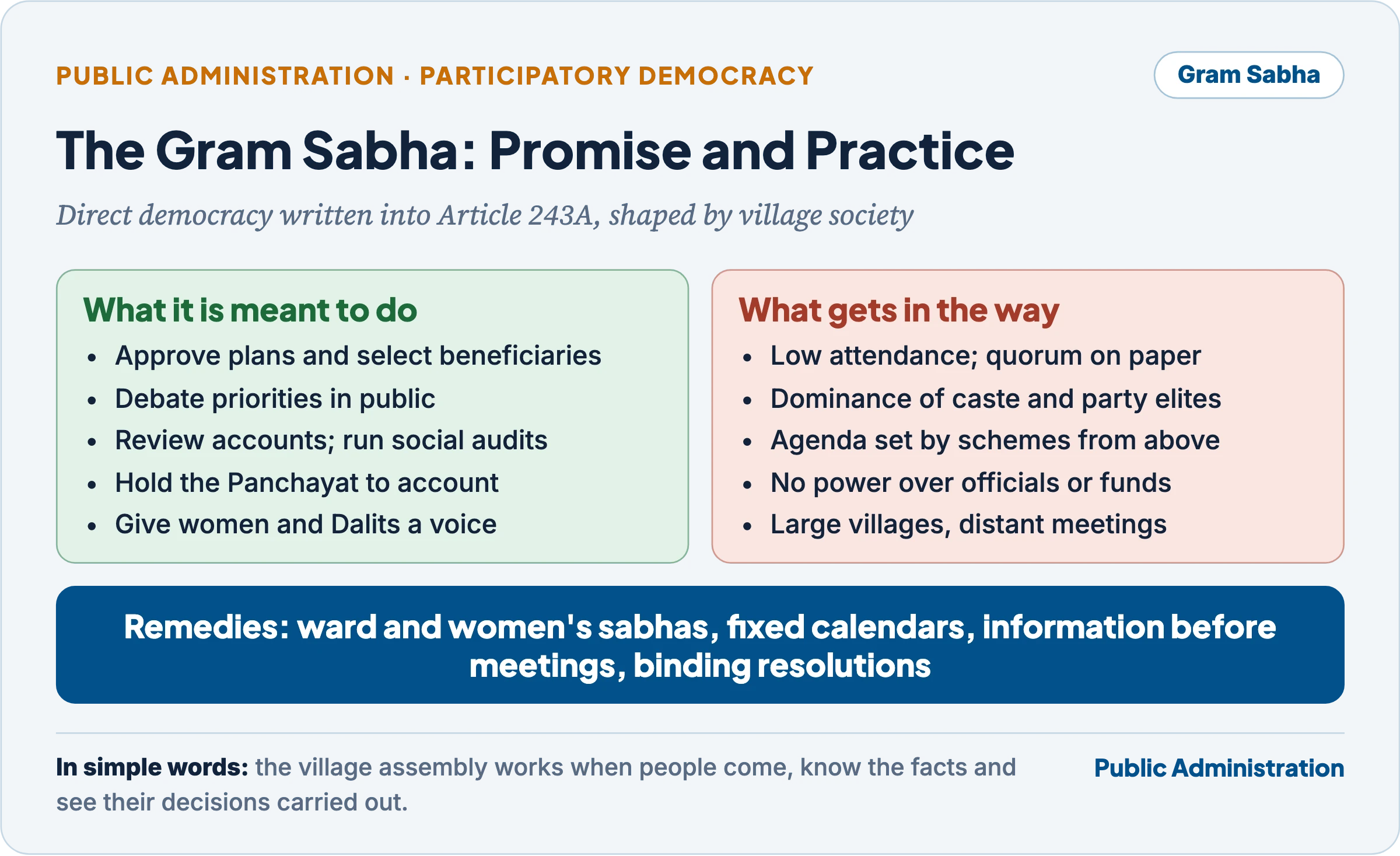
The Gram Sabha is the meeting of every adult voter in the village. It is meant to be the place where people decide what the village needs, check what the Panchayat spent, and question officials face to face. In practice, many Gram Sabhas are poorly attended and run by a few powerful people, but where they work, they are the most direct form of democracy India has.
7.1 The Gram Sabha in law and practice
- Constitutional position. Article 243A: the Gram Sabha “may exercise such powers and perform such functions” as the State legislature provides. It is the only direct-democracy body in the Constitution.
- Typical State provisions:
- two to six meetings a year, with special Gram Sabhas on 26 January, 1 May, 15 August and 2 October in many States;
- a quorum (often one-tenth of voters), frequently adjourned and then met without quorum;
- powers to approve plans, select beneficiaries, review accounts and works, issue utilisation certificates (PESA areas), and conduct social audits;
- ward sabhas and mahila sabhas before the Gram Sabha in several States (the Ministry has advised all States to hold them).
- Purpose: to enlist community participation in planning, beneficiary selection and monitoring, to make Panchayats accountable to voters between elections, and to give marginal groups a forum.
7.2 Gandhian direct democracy or a shadow of it?
- The gap with Gandhi. Gandhi’s village republic was sovereign for its vital needs; the Gram Sabha is an adjunct of a Panchayat that is itself an agent of the State. Its decisions are often recommendatory; officials can ignore them; its agenda is set by schemes (beneficiary lists for housing, toilets, pensions).
- But not unconnected. In PESA areas, Gram Sabhas have approval powers over plans, beneficiaries and certificates and a say on land and minerals; in Kerala, Gram Sabhas and development seminars shaped plans in the People’s Plan Campaign; Gram Sabhas under Forest Rights Act and Niyamgiri took real decisions. Where powers are given, the Gandhian spirit revives.
7.3 The deliberative ideal and its impediments
- Deliberative democracy holds that decisions gain legitimacy when free and equal citizens reason together in public before deciding (Jürgen Habermas; Joshua Cohen; in development, Archon Fung and Erik Olin Wright‘s empowered participatory governance, 2003, which used Kerala as a case). The Gram Sabha is India’s most ambitious deliberative institution.
- What studies find. Paromita Sanyal and Vijayendra Rao, in Oral Democracy, a study of Tamil Nadu’s Gram Sabhas, found that poor and low-caste villagers do speak, argue and make claims in Gram Sabhas, and that deliberation varies with literacy, state support and political competition; but other studies show many meetings are brief, scripted and dominated by activists and political groups.
- Impediments:
- Low and skewed attendance: the poor lose a day’s wage; women, Dalits and migrants stay away; quorum is met on paper;
- Elite and party domination; fear of reprisal;
- Information deficit: budgets and plans not shared in advance, accounts not read out;
- Agenda from above: meetings become beneficiary-selection sessions for schemes;
- No binding power over officials or funds; decisions not followed up;
- Size: large Panchayats with many habitations;
- Weak facilitation: secretaries treat meetings as formalities.
- Remedies: ward and mahila sabhas; a fixed calendar with notice and information before meetings; video recording and online minutes (Panchayat NIRNAY, SabhaSaar AI minutes in 13 languages, launched 14 August 2025); facilitators from the People’s Plan Campaign; binding Gram Sabha decisions on beneficiary selection and plans; follow-up action taken reports in the next meeting; the 2nd ARC’s proposal that one-third of those present in PESA Gram Sabhas be women for quorum.
7.4 Social audit
- Meaning. Social audit is the examination of a programme’s records and works by the community that is meant to benefit, usually in a public hearing (jan sunwai), comparing official records with ground reality. Unlike a statutory audit by an auditor, it judges not only legality and accounts but also outcomes and fairness. Its origins lie in the Mazdoor Kisan Shakti Sangathan’s public hearings in Rajasthan in the 1990s.
- In Panchayat governance:
- MGNREGA (2005), Section 17 required the Gram Sabha to conduct regular social audits of all works; the Audit of Schemes Rules, 2011 created independent State social audit units. Andhra Pradesh’s Society for Social Audit, Accountability and Transparency became the model, recovering misused funds and disciplining staff.
- Social audit has also been applied to housing, mid-day meals and the Fifteenth FC grants; the 2nd ARC asked every State to adopt robust social audit norms.
- Effect: social audit lent a critical edge to rural employment by exposing fake muster rolls, ghost works and delayed wages, and it complements CAG audit by catching what files hide. Its weaknesses are no penal power, dependence on State-funded units, intimidation of auditors, and slow action on findings.
8. E-Governance and Technology in Panchayats
In simple words
Panchayats now keep their plans, accounts and payments online, survey village houses with drones, and let citizens see on a mobile app what their Panchayat received and spent. This makes money easier to track, but it can also make Panchayats answer more to dashboards in Delhi than to their own Gram Sabha.
- Evolution. The e-Panchayat Mission Mode Project (National e-Governance Plan, 2006) and its suite of applications were unified in 2020.
- Key platforms:
- e-GramSwaraj (launched 24 April 2020): one portal for planning, accounting, progress reporting and asset records, integrated with the Public Financial Management System so that Finance Commission funds are paid online to vendors; over 2.5 lakh Gram Panchayats upload plans and make payments through it.
- AuditOnline: online audit of Panchayat accounts.
- SVAMITVA (launched 24 April 2020): drone survey of inhabited village land and property cards to owners. By August 2026, drone surveys were complete in about 3.30 lakh villages, 3.24 crore property cards prepared and about 2.72 crore distributed; property cards supported 11,147 loans worth about ₹1,713 crore. It also gives Panchayats a property tax base.
- Meri Panchayat app (launched 21 August 2023): citizens see elected members, budgets, funds received and spent, works with geo-tagged photos, beneficiary lists and audit status; they can suggest works, rate projects and give feedback, a mobile tool for social audit.
- Gram Manchitra (GIS planning), Panchayat NIRNAY (Gram Sabha meeting records), SabhaSaar (AI-generated minutes), Local Government Directory, the PAI portal.
- Benefits: efficiency (fewer cash transactions, faster payments), transparency (anyone can see funds and works), accountability (audit trails), standard data for SFCs and Finance Commissions, and spread of a digital culture among representatives and staff.
- Limits:
- Digital divide: connectivity, devices and skills are weak in remote and tribal areas; secretaries and data operators, not elected heads, control the systems;
- upward accountability: portals report to the Ministry and States, and planning risks becoming data entry for compliance;
- centralisation by software: what can be planned or paid is limited by what the system allows;
- data quality: uploads made to meet deadlines, not to reflect reality.
- Assessment. ICT has improved financial discipline and visibility; it enhances democratic accountability only when its information reaches the Gram Sabha in usable form and citizens can act on it.
9. Best Practices: Kerala, Karnataka, Maharashtra and Others
In simple words
A few States show that Panchayats can govern when they are given money, staff and freedom. Kerala gave them a large share of its plan budget, Karnataka gave them the most powers on paper and in practice, and Maharashtra built strong district councils decades ago. Each also has weaknesses.
9.1 Kerala
- Law and transfer: the Kerala Panchayat Raj Act, 1994; in 1995 institutions such as schools, primary health centres, Krishi Bhavans and anganwadis, with their staff, were transferred to local governments.
- People’s Plan Campaign (1996): about 35–40 per cent of the State’s Ninth Plan outlay given to local governments as untied funds, spent through plans made in Grama Sabhas, development seminars and task forces; a large volunteer and resource-person mobilisation; the Sen Committee recommended the institutional changes. The Kerala Institute of Local Administration became the training hub.
- Kudumbashree (1998): the State poverty eradication mission linking women’s neighbourhood groups to local governments.
- Results: Kerala ranks second on the Devolution Index 2024 and first on its framework dimension; its Gram Panchayats did very well in PAI 2.0.
- Limits: party domination of local bodies, plan quality and capital works bias, and fiscal stress of the State limiting devolution in recent years.
9.2 Karnataka
- Pioneer: the 1983 Act (in force 1987) under minister Abdul Nazir Sab created directly elected Zilla Parishads and Mandal Panchayats on the Asoka Mehta pattern.
- Today: the Karnataka Panchayat Raj Act, 1993 was amended in 2015 on the report of a committee under former Speaker K.R. Ramesh Kumar and renamed the Karnataka Gram Swaraj and Panchayat Raj Act. The amendments added habitation sabhas and ward sabhas below the Gram Sabha, a preamble and “directive principles of Panchayat policy”, activity mapping, at least 20 per cent of SFC devolution as untied funds, five-year terms for Panchayat heads, rotation of reservation over ten years, compulsory voting, declaration of assets by members, a Panchayat administrative service and a grievance redressal authority; the Panchatantra software tracks Panchayat finances.
- Results: first on the Devolution Index 2024 (72.23), and first on finances and accountability (social audit and Gram Sabhas).
- Paradox: the same State has not held Zilla and Taluk Panchayat elections since 2021, showing that even leading States can let the framework lapse.
9.3 Maharashtra
- Strong districts since 1961: the Maharashtra Zilla Parishads and Panchayat Samitis Act, 1961 (based on the V.P. Naik Committee) made the Zilla Parishad the key tier, with an IAS Chief Executive Officer, subject committees, and the Collector kept outside. It anticipated the Asoka Mehta idea of the district as the first point of decentralisation.
- Village models: Hiware Bazar (Ahmednagar), where the Gram Sabha under sarpanch Popatrao Pawar decided on water budgeting, a ban on borewells for irrigation, grazing rules and afforestation, turning a drought-prone village prosperous; Ralegan Siddhi, the watershed village associated with Anna Hazare; the State’s Adarsh Gaon scheme spread such models.
- Results: fourth on the Devolution Index 2024; but local polls were stalled for over three years (2022–2026) by OBC litigation.
9.4 Others and the lessons
- West Bengal (party-based Panchayats since 1978, tied to land reform), Tamil Nadu (first on functions in the Devolution Index) and Tripura (best in PAI 2.0) are other leaders.
- Lessons: devolution works where there is political commitment, untied money by formula, transferred staff, active Gram Sabhas and civil society support; without these the same constitutional framework yields form without function.
Indian Connect — Kerala’s model in one line
Kerala’s success came less from its Act than from three decisions: a fixed share of the State plan given to local governments as untied funds, institutions and staff transferred with the functions, and a mass campaign to make Grama Sabhas plan. The same three levers (formula money, staff, participation) are what the 2nd ARC and later Finance Commissions have tried to make national.
10. The 2nd ARC’s Sixth Report and the Reform Agenda
In simple words
In 2007 a national reform commission studied local government and said the Constitution had created the bodies but not the power. Its answer was to give each level only the jobs it can do best, give Panchayats their own staff and taxes, stop States from dismissing them at will, and set up independent watchdogs for corruption and elections.
10.1 The report
- The Second Administrative Reforms Commission (chair M. Veerappa Moily) submitted its Sixth Report, Local Governance: An Inspiring Journey into the Future, in October 2007. Its core principles were democratic decentralisation as the centre-piece of governance reform, subsidiarity, clear delineation of functions, devolution in real terms, convergence and citizen centricity.
- Diagnosis: compliance with even the mandatory provisions took years in some States; elections were postponed on pretexts; only the bare minimum of the Constitution was implemented; Panchayats were left “at the mercy of State legislatures and State executives”; strong vested interests after decades of centralisation resisted devolution.
10.2 Main recommendations for rural local government
| Area | Recommendation |
|---|---|
| Subsidiarity | Amend Article 243G so that the State “shall” vest Panchayats with powers over all functions that can be performed at the local level, including Eleventh Schedule matters |
| Structure | Leave the number of tiers to States (amend Article 243B); a District Council with rural and urban representation; MPs and MLAs not to be members of local bodies; retain reservation under 243D |
| Elections | SEC to do delimitation and reservation; SEC appointed by the Governor on a collegium’s recommendation (Chief Minister, Speaker, Leader of Opposition); rotation of reserved seats after two terms |
| Activity mapping | Comprehensive mapping of all Eleventh Schedule matters by a task force within one year; Union to do the same for CSS; a “local government memorandum” with every new law |
| Regulatory functions | Devolve rural policing, building byelaws, certificates, weights and measures to Panchayats |
| Personnel | Panchayats to recruit and control their staff within three years; zero-based staffing review |
| State control | Abolish budget approval by higher tiers; no State power to suspend resolutions, remove members or dissolve Panchayats; such complaints to a local body Ombudsman reporting through the Lokayukta to the Governor |
| Parastatals | DRDAs and water and sanitation bodies to merge with Zilla Parishads; no new committees outside PRIs; community bodies accountable to PRIs |
| Finance | Widen the tax domain and make levy obligatory; share of mineral royalty; untied allocations except major CSS; a separate Panchayat sector in the State budget; timely releases in instalments; borrowing for infrastructure; abolish MPLADS and MLALADS |
| SFCs | Constitute on time (“at such earlier time” in 243-I); prescribe members’ qualifications; normative devolution with backwardness indices; action taken report within six months |
| Audit and accountability | District audit committees; a legislature committee on local bodies; independent Local Fund Audit head from a CAG-vetted panel; social audit norms |
| Gram Sabha | Ward Sabhas in large Gram Panchayats; viable Panchayat size; Gram/Ward Sabha as the key body for planning, monitoring and audit of CSS |
| PESA | Bring Union and State laws into conformity; Union directions under the Fifth Schedule if States resist; Governors’ annual reports in the public domain; one-third women in PESA Gram Sabha quorum |
- Response. The Union accepted most recommendations in principle and forwarded them to States; the constitutional amendments (243G, 243B) and abolition of MPLADS were not accepted. Implementation has been piecemeal: DRDA merger (2022), Finance Commission conditions on accounts and SFCs, activity mapping in some States, social audit units, an Ombudsman for local bodies in Kerala and a few other States.
10.3 The way forward
- Constitutional: make devolution obligatory (“shall”) in Article 243G; SEC control of delimitation and reservation; protection from State control powers.
- 3Fs: notified statutory activity mapping; a Panchayat tax domain (property tax on SVAMITVA data, user charges, royalty shares) with formula-based untied SFC transfers; a Panchayat cadre answerable to Panchayats.
- Accountability and inclusion: a local body Ombudsman; empowered Gram, ward and mahila sabhas; social audit with follow-up; an end to proxy leadership and longer rotation cycles.
- Integration: fold parallel bodies into Panchayats; one village plan integrating GPDP and VGPP; working DPCs; aligned PESA subject laws.
Theory lens: Panchayati Raj through Paper I ideas
- Decentralisation theory (Rondinelli). Dennis Rondinelli (1983) distinguished deconcentration, delegation, devolution and privatisation. Part IX is constitutionally devolution, but with staff, money and sanctions left with departments, practice is often deconcentration in democratic dress, Fesler’s illusory decentralisation. See the article on Structure and Forms of Public Organisations.
- Subsidiarity. The principle that higher authorities should do only what lower ones cannot (Quadragesimo Anno, 1931; the Maastricht Treaty, 1992) is the organising idea of the 2nd ARC’s Sixth Report and of activity mapping. Indian practice often inverts it: national schemes decide even village-level choices. See the article on Administrative Reforms since Independence.
- Participatory and deliberative democracy. Carole Pateman (Participation and Democratic Theory, 1970) argued that participation in local institutions educates citizens for democracy; Sherry Arnstein‘s ladder of citizen participation (1969) separates real citizen power from tokenism and manipulation; Jürgen Habermas grounds legitimacy in public reasoning. The Gram Sabha sits on the lower rungs when it only ratifies scheme lists, and climbs towards delegated power in PESA areas and Kerala. See the article on Citizen and Administration: Media, Interest Groups, Voluntary Organisations and Civil Society.
- New Public Service. Robert and Janet Denhardt (The New Public Service, 2000; book 2003) argued that government should serve citizens, not steer them, and value citizenship and public interest over customer satisfaction. Gram Sabhas, social audit and participatory plans embody this; dashboard-driven, target-ranked Panchayat management reflects the earlier NPM logic. See the article on New Public Management and After: New Public Service, New Public Governance and Digital-Era Governance.
- Fiscal federalism (Oates). Wallace Oates (Fiscal Federalism, 1972) assigns each service to the lowest level that covers its beneficiaries and justifies intergovernmental grants for spillovers and equalisation. Panchayats’ vertical fiscal imbalance, the soft budget constraint and Finance Commission conditional grants are questions of fiscal federalism at the third tier. See the article on Monetary and Fiscal Policies, Public Borrowing and Public Debt.
- Riggs’ formalism. Fred Riggs (Administration in Developing Countries, 1964) described formalism: the gap between formal rules and actual behaviour in prismatic societies. “Institutions of self-government” that cannot hire a clerk, Gram Sabhas with quorum met on paper, and women sarpanches whose husbands sign files are classic prismatic formalism, as are overlapping formal and traditional (caste, kin) authority in villages. See the article on Riggsian Models and their Critique.
- Social capital (Putnam). Robert Putnam (Making Democracy Work, 1993) found that Italian regional governments performed better where civic traditions and associational networks were dense. Kerala’s literacy movements, SHGs and libraries help explain its Panchayats’ success; bonding (caste) rather than bridging social capital can fuel capture instead.
- Elite capture. Pranab Bardhan and Dilip Mookherjee (2000) showed that local governments are more prone to capture where inequality is high, literacy low and political competition weak. This explains the Asoka Mehta Committee’s findings, Ambedkar’s fears, and why reservation, social audit and Gram Sabha empowerment are preconditions, not afterthoughts, of devolution. See the article on Development Administration: Concept, Changing Profile and the Anti-Development Thesis.
11. Recent Issues in Panchayati Raj (2024–2026)
In simple words
In the last two years, a new rural jobs law made village plans the basis of rural works, courts forced long-delayed Panchayat elections, Jharkhand finally made PESA rules, a committee proposed penalties for husbands who run Panchayats in their wives’ names, and the Sixteenth Finance Commission gave Panchayats more money with stricter conditions.
- VB–G RAM G Act and Viksit Gram Panchayat Plans. The Viksit Bharat – Guarantee for Rozgar and Ajeevika Mission (Gramin) Act, 2025, enacted in December 2025, replaced MGNREGA and has been implemented from 1 July 2026, guaranteeing 125 days of wage employment per rural household, with 60:40 Centre–State sharing (90:10 for the North-East, Himalayan States and J&K). Under Section 16, every Gram Panchayat prepares a Viksit Gram Panchayat Plan (VGPP) through a participatory process in which the Gram Sabha identifies and prioritises works; plans are consolidated at block and district levels and spatially linked to PM Gati Shakti. For Panchayats this means:
- Gain: a statutory, Gram Sabha-based plan for the largest rural works programme; works chosen locally;
- Concern: a fixed menu of permissible works, national themes and normative allocations from above may make the VGPP a template filled locally; the shift from a demand-driven guarantee to a budget-bound scheme, a higher State share, and technology-led planning (Yuktdhara GIS) may move influence from the Gram Sabha to technical staff. Whether India ends up with one village plan or two (GPDP and VGPP) will decide the effect on Panchayat autonomy. The programme itself is covered in the article on Rural Development: Institutions, Agencies, Programmes and Strategies since Independence.
- Other recent issues (detailed in the sections above): court-forced Panchayat polls in Maharashtra (February 2026) and pending ones in Karnataka (Section 6.5); OBC reservation and the 50 per cent ceiling, which the Supreme Court indicated in November 2025 may go to a larger bench (Section 3.4); Jharkhand’s PESA rules (Section 4.3); the Sushil Kumar Committee on proxy representation (Section 6.4); the Sixteenth Finance Commission’s conditional grants (Section 5.3); and the Devolution Index 2024 and PAI 2.0 (Section 5.6).
Key Terms
The terms below recur across Panchayati Raj debates.
| Term | Meaning in simple words |
|---|---|
| Democratic decentralisation | Transfer of power and resources to elected local bodies accountable to local voters |
| Devolution | Transfer of authority to legally separate, elected local governments |
| Subsidiarity | A task should be done at the lowest level that can do it well |
| Gram swaraj | Gandhi’s idea of the self-reliant, self-governing village republic |
| Gram Sabha | Body of all registered voters of a village (Article 243A) |
| Eleventh Schedule | List of 29 matters that may be devolved to Panchayats |
| 3Fs | Functions, funds and functionaries that make devolution real |
| Activity mapping | Breaking each subject into activities and assigning each to a tier |
| State Finance Commission | Body set up every five years to recommend State–Panchayat fiscal transfers (243-I) |
| State Election Commission | Independent body that conducts Panchayat elections (243K) |
| Own source revenue | Taxes, fees and charges a Panchayat raises itself |
| Tied and untied grants | Grants that must be spent on fixed purposes / that the Panchayat may spend as it chooses |
| Soft budget constraint | Weak fiscal discipline when a body expects to be bailed out by higher governments |
| Parallel bodies | Societies, boards or committees that do local functions outside Panchayats |
| Elite capture | Domination of local institutions by locally powerful groups |
| Proxy representation | Male relatives exercising the office of women representatives (“sarpanch pati”) |
| Triple test | Commission, local-body-wise proportion and 50 per cent ceiling for OBC quotas |
| Social audit | Public examination of a programme’s records and works by the community |
| PESA | 1996 law extending Panchayats to Fifth Schedule areas with Gram Sabha powers |
| GPDP / VGPP | Gram Panchayat Development Plan / Viksit Gram Panchayat Plan under VB–G RAM G |
| Devolution Index | Ranking of States on how much power they give Panchayats |
| Panchayat Advancement Index | Report card of each Gram Panchayat on nine Localised SDG themes |
Commissions, Committees and Judgments
The table lists, in order, the bodies, laws and judgments that shaped Panchayati Raj.
| Body / case | Year | Key point |
|---|---|---|
| Balwantray Mehta Study Team (Balwantray G. Mehta) | 1957 | Democratic decentralisation; three tiers; Samiti executive, Zila Parishad advisory under Collector |
| Maharashtra ZP and PS Act (V.P. Naik Committee) | 1961 | Strong Zilla Parishad with own CEO; Collector outside |
| Asoka Mehta Committee (Asoka Mehta) | 1978 | Two tiers; district first point of decentralisation; party participation; constitutional status |
| CAARD (G.V.K. Rao) | 1985 | “Grass without roots”; Zila Parishad principal; District Development Commissioner |
| L.M. Singhvi Committee | 1986 | Constitutional recognition; Gram Sabha; Nyaya Panchayats; viable GPs |
| P.K. Thungon Committee | 1988 | Constitutional status; Zila Parishad pivot; Collector as CEO; SFC |
| V.N. Gadgil Committee | 1988 | Three tiers, direct elections, reservation, SEC and SFC |
| 64th Amendment Bill | 1989 | Passed by Lok Sabha; defeated in Rajya Sabha |
| 73rd Constitutional Amendment Act | 1992 (in force 24 April 1993) | Part IX, Arts. 243–243-O, Eleventh Schedule, Art. 280(3)(bb) |
| Bhuria Committee (Dilip Singh Bhuria) | 1994–95 | Gram Sabha-centred self-rule for Scheduled Areas |
| PESA Act | 1996 | Gram Sabha powers over land, MFP, minerals, intoxicants, markets in Fifth Schedule areas |
| Samatha v. State of Andhra Pradesh | 1997 | Transfer of Scheduled Area land to private miners void |
| Javed v. State of Haryana | 2003 | Two-child norm for Panchayat candidates upheld |
| Kishansing Tomar v. Municipal Corporation of Ahmedabad | 2006 | Local elections before expiry of term; SEC’s duty |
| 2nd ARC, 6th Report, Local Governance (M. Veerappa Moily) | 2007 | Subsidiarity; activity mapping; local body Ombudsman; SEC collegium; parastatals under PRIs |
| K. Krishna Murthy v. Union of India | 2010 | Arts. 243D(6), 243T(6) and chairperson reservation upheld; political backwardness needs inquiry; 50% ceiling |
| Union of India v. Rakesh Kumar | 2010 | PESA’s ST reservation of chairpersons and over half the seats upheld |
| Orissa Mining Corporation v. MoEF (Niyamgiri) | 2013 | Gram Sabhas to decide on mining affecting their rights |
| Fourteenth Finance Commission (Y.V. Reddy) | 2015 | ₹2,00,292 crore direct to Gram Panchayats; basis of GPDP |
| Rajbala v. State of Haryana | 2015 | Educational and other qualifications for Panchayat candidates upheld |
| Vikas Kishanrao Gawali v. State of Maharashtra | 2021 | Triple test for OBC reservation in local bodies |
| State of Goa v. Fouziya Imtiaz Shaikh | 2021 | SEC must be independent of the State government |
| Fifteenth Finance Commission (N.K. Singh) | 2021–26 | ₹2,36,805 crore to rural local bodies; 60:40 tied–untied |
| Suresh Mahajan v. State of Madhya Pradesh | 2022 | Local polls cannot be postponed for OBC data |
| Devolution Index 2024 (MoPR–IIPA) | 2025 | Karnataka, Kerala, Tamil Nadu top; national average 43.89 |
| Advisory Committee on proxy participation (Sushil Kumar) | 2025 | Exemplary penalties; women ombudspersons; public oath |
| VB–G RAM G Act | 2025 (in force 1 July 2026) | Viksit Gram Panchayat Plans through the Gram Sabha (s.16) |
| Sixteenth Finance Commission (Arvind Panagariya) | 2026 | ₹7,91,493 crore to local bodies; entry conditions on elections, accounts, SFCs |
Contemporary Developments
- 11 September 2026: the Karnataka High Court recorded that ward formation and seat reservation had been completed for all 5,864 Gram Panchayats, leaving it to the SEC to hold polls; Zilla and Taluk Panchayat elections had been pending since 2021, with administrators running most Panchayats.
- April–May 2026: Panchayat Advancement Index 2.0 (2023–24) covered 2,59,867 Gram Panchayats on 112 indicators; none reached the Achiever grade, 3,635 were Front Runners, and Tripura led.
- March 2026: the Union informed Parliament that nine of ten PESA States had framed rules, with Odisha still at the draft stage, and that the Ministry had developed 10 PESA indicators; the parliamentary Standing Committee recommended continuing RGSA with an outcome-based framework (proposed outlay ₹7,860.83 crore).
- 7–9 February 2026: Zilla Parishad and Panchayat Samiti polls were held in 12 districts of Maharashtra (731 ZP and 1,462 PS seats), after four years of delay over OBC reservation.
- 2 January 2026: Jharkhand notified its PESA rules, requiring prior Gram Sabha consent for land acquisition and recognising traditional village heads, 29 years after the Act.
- 1 February 2026: the Sixteenth Finance Commission report recommended ₹4,35,236 crore for rural local bodies in 2026–31, conditional on elected bodies, audited accounts online and regular SFCs.
- December 2025: Parliament enacted the VB–G RAM G Act, 2025 (in force from 1 July 2026), making Gram Sabha-approved Viksit Gram Panchayat Plans the basis for rural works.
- February 2025: the Devolution Index 2024 ranked Karnataka (72.23), Kerala (70.59) and Tamil Nadu (68.38) highest; the Sushil Kumar Committee report on ending proxy representation of women heads was submitted and accepted.
Revision Grid
| Thinker / body | Work or report (year) | Key idea |
|---|---|---|
| M.K. Gandhi | Harijan (1942) and other writings | Village swaraj; oceanic circle; power from below |
| B.R. Ambedkar | Constituent Assembly speech (1948) | Village as “sink of localism”; individual as unit |
| Balwantray Mehta | Study Team (1957) | Democratic decentralisation; three tiers |
| Asoka Mehta | Committee on PRIs (1978) | Two tiers; district first; parties; constitutional status |
| G.V.K. Rao | CAARD (1985) | Grass without roots; Zila Parishad principal |
| L.M. Singhvi | Committee (1986) | Constitutional recognition; Gram Sabha as direct democracy |
| 2nd ARC (M. Veerappa Moily) | Local Governance (2007) | Subsidiarity; activity mapping; Ombudsman; SEC collegium |
| Dennis Rondinelli | Decentralization in Developing Countries (1983) | Deconcentration, delegation, devolution, privatisation |
| James Fesler | “Approaches to the Understanding of Decentralization” (1965) | Illusory decentralisation |
| Wallace Oates | Fiscal Federalism (1972) | Decentralisation theorem; intergovernmental grants |
| János Kornai | Soft budget constraint (1979–86) | Expected bailouts weaken fiscal discipline |
| Carole Pateman | Participation and Democratic Theory (1970) | Participation educates citizens |
| Sherry Arnstein | “A Ladder of Citizen Participation” (1969) | Tokenism versus citizen power |
| Robert Putnam | Making Democracy Work (1993) | Social capital explains institutional performance |
| Bardhan and Mookherjee | “Capture and Governance” (2000) | Elite capture depends on inequality and competition |
| Chattopadhyay and Duflo | “Women as Policy Makers” (2004) | Women leaders shift public investment |
| Denhardt and Denhardt | The New Public Service (2000) | Serve citizens, not steer |
| Fred Riggs | Administration in Developing Countries (1964) | Formalism and overlapping |
Previous Year Questions
- 2026Women in panchayats challenge the established patriarchal norms and contest structural inequalities in society. Explain.
- 2025Gram Sabha aims to enlist community participation. Explain.
- 2025Many elected women representatives in local governments in India, especially from marginalized backgrounds, often struggle to govern effectively. Examine.
- 2024The journey of transformation of local governance has been long. Examine the challenges to realise the spirit of gram swaraj.
- 2024“The role of State Finance Commission in distribution of finances between state and local governments is vital.” Discuss.
- 2023Post-amendment period Panchayats have become a platform of competitive politics, but could not emerge as an agency of planning and service delivery. Examine.
- 2023Is it true that the Finance Commission has been lending Financial strength to the local bodies in India? Argue in favour of your response.
- 2022The main objective of Panchayats (Extension to Scheduled Areas) Act, 1996 is to enable tribal society to assume control over their livelihoods and traditional rights. Critically examine the implementation of the Act.
- 2021No rural development strategy can succeed unless it is complemented by appropriate Panchayati Raj Institutions. Examine the statement.
- 202173rd and 74th Constitutional Amendment Acts aimed at making the third tier of government more powerful and effective for democratic decentralization. Critically examine the extent to which this goal has been transformed into reality.
- 2020Panchayati Raj Institutions are still plagued by State control and domination of bureaucracy. Argue your case.
- 2020Despite the constitutional provisions for representation, the voice of weaker sections is not having the desired impact in the realms of Panchayati Raj Institutions. Critically examine.
- 2019The evidences suggest that the dream of deliberative democracy could not be realized in practice at the grassroot level. Evaluate the impediments in the functioning of Gram Sabha.
- 2019Efforts to strengthen State Finance Commissions have faced apathy of State Governments over the years, which has also affected the successive Central Finance Commissions in recommending appropriate fiscal transfers to local bodies. Substantiate the answer with examples.
- 2019Performance grants devolved by Finance Commission of India have increased the financial accountability of the local bodies. Elaborate.
- 2017“The institution of Gram Sabha has very little connection with the Gandhian spirit of direct democracy.” Critically examine.
- 2017“Effectiveness of local self-government institutions is hampered due to the lack of capacity building of the elected representatives.” Elaborate
- 2017“The Second Administrative Reforms Commission (ARC) makes a strong case for the principle of subsidiarity.” Elaborate.
- 2016“The objectives of fiscal devolution to local bodies as mandated by the 73rd and 74th Constitutional Amendment Acts has been derailed by the actual working of the State Finance Commissions.” Comment.
- 2016“The goals of good governance will remain utopian if local governments, responsible for providing all basic services directly to the citizens, are not empowered as mandated by the 73rd and 74th Constitutional Amendment Acts.” Critically evaluate the status of empowerment of the local bodies.
- 2015Do you think that the functioning of Panchayati Raj Institutions (PRIs), in practice, reflects genuine devolution of powers and resources? Give reasons for your answer.
- 2015“Decentralised governance must serve as an instrument of realising social change and social justice.” Comment on the statement.
- 2014Do you think that the role of Panchayati Raj should go beyond development Administration? Give reasons for your answer.
- 2014The 13 th Finance Commission highlighted an indispensable need to improve the finances of rural and urban level bodies. Des this make local bodies more accountable in the discharge of their functions?
- 2013“The second generation reforms in the Panchayati Raj institutions have changed Panchayats from an agency of development at local level into a political institution.” Discuss.
- 2013“Use of Information and Communication Technology (ICT) in Panchayat’s functions enhances efficiency, transparency and accountability and also induces mass ICT culture.” Examine.
- 2013“The 73 rd Amendment, it is felt, may accentuate fiscal indiscipline by establishing between States and Local Governments a system of transfers similar to the one in place between the Central and State Government.” (World Bank) Comment.
- 2012‘Panchayati Raj Institutions are still affected by State control and domination by bureaucracy.’ Do you agree?
- 2012Local self-government in India is the interplay of several factors-historical, ideological, and administrative. Critically examine these factors.
- 2008‘Economic Development and Social Justice are the hallmarks of the 1992 Constitutional Amendment Acts.’ Elucidate.
- 2007“73 rd Constitutional Amendment has provided permanent structural framework to PRI’s resulting into silent social revolution.” Comment.
- 2006“The 73 rd and 74 th Constitutional Amendments are major landmarks in India’s Constitutional History and Local Governance.” Comment.
- 2005“Even after a decade of having adopted the 73 rd Amendment to the Constitution, the Panchayat Raj institution still faces a number of problems towards making it a strong and vibrant unit of Government.” Comment.
- 2002The role of local self-government in the state administration is of considerable importance. Evaluate the statement in the context of the 73 rd and 74 th amendments made.
- 1998“The State Finance Commission under Panchayat Raj Law is designed to ensure regional balance in the distribution of State and Central Funds.” Comment.
- 1997“The most momentous recommendation of the Ashoka Mehta Committee was the creation of a two-tier system of panchayati Raj.” Examine the statement.
- 1996“The Panchayati Raj institutions at grass-roots level are ensuring greater peoples participation and involvement in development work.” Comment.
- 1996Examine the provisions of the 73 rd and 74 th Constitutional Amendments from the point of view of the autonomy of the local bodies.
- 1995“The most important feature of the second generation panchayats is their change from local developmental organization to local political institutions.” Comment.
- 1994“Autonomy of local bodies is conditioned by state-local relations and the managerial capability of the local bodies themselves.” Comment.
- 1993Discuss some of the State models of Panchayati Raj in the Uniform Constitutional frame of 73 rd Amendment with special reference to Panchayati Polls, grassroot justice, local finances and centrally sponsored development programmes.
- 1992Examine some of the Challenges to Development Administration in the Panchayati democracy of rural India. Do you think that the Constitutionalisation of three-tier Federalism will be a viable model for future?
- 1991‘The political will at higher levels seems hesitating to go wholehog for democratising the entire field administration. So long as this trend would persist, we would be having successive Committee Reports pinpointing same ailments of Panchayati Raj and prescriptions to restore its health,’ Elucidate the achievements and failures of the Panchayati Raj Institutions in the context of this statement.
- 1990The real problem with Panchayati Raj institutions is to promote efficiency in the implementation of the rural development programmes and to ensure social and economic justice to the poor in the country side.’ Examine the past experience of working of Panchayati Raj and Suggest specific constitutional measures to enforce genuine decentralisation in the light of the above statement.
- 1988“It is unrealistic to attempt to eliminate political parties from Panchayati Polls…. The issue is how to get these parties to provide good government at the local level?” Comment.
- 1987‘The Panchayati Raj bodies do provide an appropriate forum for effecting welfare of Weaker Sections, including the members of Scheduled Castes and Scheduled Tribes through decision-making and programme implementation processes at local level.’ Comment.
- 1993“Decentralization is never just a technical exercise, with intentions and effects neatly confined to questions of economy and efficiency.” Comment.
- 1992‘Decentralization has a more important justification than more administrative efficiency.’ Comment.