

Institutions and agencies since Independence; Rural development programmes: foci and strategies; Decentralization and Panchayati Raj; 73rd Constitutional amendment.
This article: Rural development: meaning, dimensions and approaches (growth-centred, community, area, target group, integrated, basic needs, wage employment, rights-based, livelihoods, convergence and saturation); institutions and agencies since Independence (Ministry of Rural Development and its departments, Ministry of Panchayati Raj, NIRDPR and SIRDs, NABARD, Regional Rural Banks, cooperatives, SHG federations, NGOs and CAPART, State departments, the DRDA and its merger into Zilla Parishads, the block and the BDO, the Gram Panchayat and Gram Sabha, why agencies work in silos); programmes by phase with their foci and strategies (Community Development and NES, IADP and IAAP, SFDA and MFAL, DPAP, DDP, CADP and hill and tribal programmes, IRDP and its evaluation, wage employment from Food for Work to MGNREGA and the VB–G RAM G Act 2025, SGSY to DAY-NRLM, IAY to PMAY-G, PMGSY, Bharat Nirman, PURA, rural water and sanitation, land records and SVAMITVA, watershed development, NSAP, programmes for women, children and tribal communities, Rurban Mission, Mission Antyodaya, Aspirational Blocks); evaluation and problems (targeting, leakages, convergence, capacity, social audit, CAG audits, DBT and JAM); the current approach of saturation, convergence and digital public infrastructure; a short note on Panchayati Raj.
Official Syllabus: Paper II · Unit 2-11 Rural Development
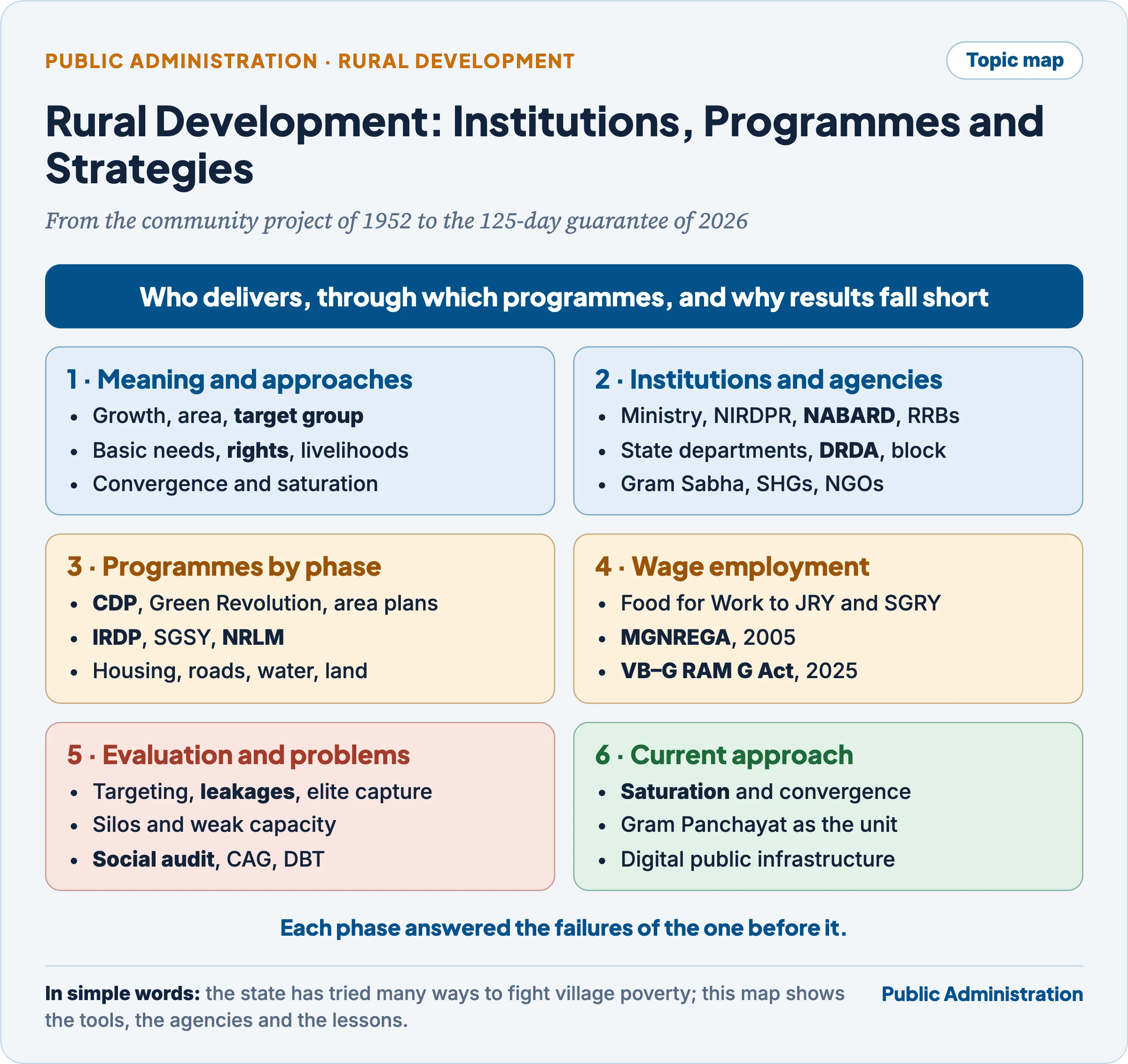
Rural development is the planned effort of the state, markets and communities to raise the income, assets, capabilities and voice of people who live in villages, especially the poorest among them. In 2011 about 69 per cent of Indians (83.3 crore people) lived in rural areas, and most of the country’s poor, landless and malnourished were rural. That is why every Five Year Plan, and every government since 1947, has treated rural development as the test of development administration: the use of public administration not merely to keep order but to bring about planned change. This article traces the agencies built for that task and the programmes they ran, the strategy behind each, and why results so often fell short of intentions.
In simple words
Imagine a village where most families farm small plots, some have no land at all, the road floods every monsoon and the nearest bank is twenty kilometres away. Rural development is everything that changes this: better seeds and water for the farmer, paid work for the landless, a loan for a woman’s goat or shop, a pucca house, a tap, a toilet, a road to the market and a voice in the village meeting. The question for public administration is who should do each of these things, and how.
1. Rural Development: Meaning, Dimensions and Approaches
In simple words
Rural development is not just growing more food. It means helping village people earn more, own more, learn more, live healthier and have a say in decisions. Over time India has tried different routes to this goal: first helping whole villages, then helping chosen poor families, then giving legal rights, and now trying to reach every eligible household at once.
1.1 Definitions
- World Bank (1975). The Bank’s Rural Development Sector Policy Paper defined rural development as a strategy designed to improve the economic and social life of a specific group of people, the rural poor, by extending the benefits of development to the poorest among those who seek a livelihood in rural areas. The definition shifted attention from areas to people, and from output to distribution.
- Robert Chambers. The British development scholar, in Rural Development: Putting the Last First (1983), described rural development as a strategy to enable poor rural women and men to gain for themselves and their children more of what they want and need, helping the poorest to demand and control more of the benefits of development. His stress on demand and control made participation part of the definition, not an extra.
- Gandhian view. Mahatma Gandhi’s idea of gram swaraj saw each village as a self-reliant republic for its vital needs, interdependent for the rest. It inspired Article 40 (village panchayats as units of self-government), Khadi and village industries, and later the emphasis on the Gram Sabha.
- T.N. Chaturvedi, former Comptroller and Auditor-General and scholar of Indian administration, argued that rural development is a balanced and rounded concept covering the social, economic, institutional and administrative development of rural society; the word “integrated” in later programmes only reminded planners that sectors cannot be developed in isolation.
- Working definition for this article. Rural development is the multi-sectoral, multi-agency process of raising rural incomes and productive assets, providing basic services and infrastructure, securing entitlements and social protection, and building institutions of the rural poor and of local self-government, so that rural people can lead the lives they value.
1.2 Dimensions of rural development
| Dimension | What it covers | Typical instruments |
|---|---|---|
| Economic | Farm productivity, non-farm jobs, credit, markets | Green Revolution packages, IRDP, NRLM, NABARD refinance |
| Social | Health, education, nutrition, sanitation, social security | Minimum Needs Programme, ICDS, NSAP, Swachh Bharat |
| Infrastructural | Roads, housing, water, electricity, telecom | PMGSY, PMAY-G, Jal Jeevan Mission, Bharat Nirman |
| Institutional and political | Panchayats, SHGs, cooperatives, Gram Sabha, rights | 73rd Amendment, PESA, SHG federations, social audit |
| Ecological | Land, water, forests, drought and desert proofing | DPAP, DDP, watershed programmes, MGNREGA water works |
The table shows why no single department can “do” rural development. Every dimension has its own ministry and budget line, so the central administrative problem of rural development has always been coordination and convergence, a theme that runs through every section below.
Common confusion
Is rural development the same as agricultural development? No. Until the late 1960s Indian planning largely treated them as one, because food self-sufficiency was the overriding goal. The Green Revolution showed that output could rise while small farmers, tenants and the landless gained little. From the 1970s rural development came to mean a multi-sectoral effort covering employment, non-farm livelihoods, social services, infrastructure and institutions. Agriculture remains central, but it is one part of rural development, not the whole of it.
1.3 Approaches and strategies
Indian planners have used ten broad strategies. They overlap in time, and each programme usually mixes two or three.
| Approach | Core idea | Indian examples | Main weakness |
|---|---|---|---|
| Growth-centred (trickle-down) | Raise overall output; benefits will spread | First three Plans; IADP; Green Revolution | Gains captured by the better-off |
| Community development | Whole village improves itself with extension help | CDP 1952, NES 1953 | Little real participation; elite dominance |
| Area development | Treat a backward or fragile region as the unit | DPAP, DDP, CADP, hill and tribal sub-plans | Benefits flow to landowners in the area |
| Target group | Identify poor households and give them assets or help | SFDA, MFAL, Antyodaya, IRDP | Wrong identification; subsidy-seeking |
| Integrated | Package of inputs, credit, training and services together | IRDP, IAY plus convergence | Coordination across many agencies |
| Basic or minimum needs | Guarantee a floor of services | Minimum Needs Programme (Fifth Plan), Bharat Nirman | Service quality and maintenance |
| Wage employment / safety net | Public works give income in lean seasons | Food for Work, NREP, JRY, MGNREGA | Leakage; assets of poor quality |
| Rights-based | Make benefits legal entitlements enforceable by citizens | MGNREGA, NFSA 2013, RTI | Rights unmet when funds or staff are short |
| Livelihoods | Build institutions of the poor and diversify income | SGSY, DAY-NRLM, Kudumbashree | Slow; depends on federations and markets |
| Convergence and saturation | Cover every eligible household; join schemes at the village | Mission Antyodaya, PMAY-G, JJM, VB–G RAM G | Top-down targets; data exclusion |
- The sustainable livelihoods framework. Developed by Robert Chambers and Gordon Conway (1992) and adopted by the British aid agency DFID in the late 1990s, it views poor households as managing a portfolio of five capitals (human, natural, financial, physical and social) in a context of shocks. NRLM’s design (SHG savings as financial capital, federations as social capital, skills as human capital) draws on it.
- The rights-based approach. It treats the rural poor as citizens with claims, not beneficiaries of charity. Its intellectual roots lie in Amartya Sen’s capability approach (Development as Freedom, 1999) and in the Right to Food litigation (from 2001), which converted schemes into court-enforceable entitlements. MGNREGA was its high point.
- Convergence and saturation. Since about 2014 the dominant strategy is to aim for 100 per cent coverage of eligible households (houses, tap water, toilets, bank accounts) and to make the Gram Panchayat the point where schemes meet. It is examined in Section 5.
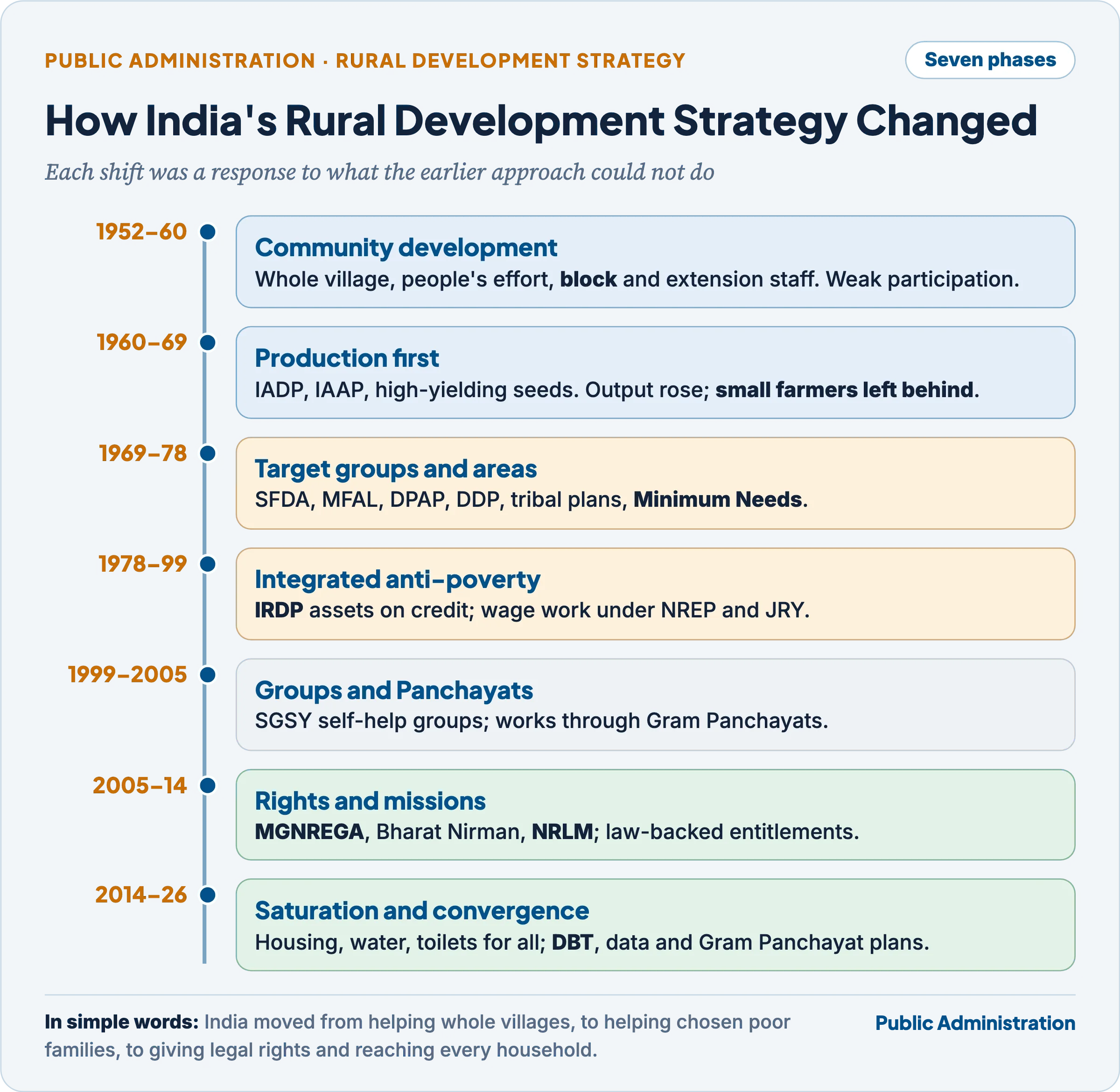
1.4 A three-point anti-poverty logic
From the Sixth Plan onwards the Government of India described its attack on rural poverty in three parts, which still organise the programme map:
- Raise the asset base of the poor: land reforms, IRDP, SGSY and NRLM, housing, land records.
- Raise wage incomes through public works in lean seasons: NREP, JRY, MGNREGA, now the VB–G RAM G Act.
- Improve access to basic services: the Minimum Needs Programme, drinking water, sanitation, health, education and social assistance.
Self-employment and wage employment are complements, not rivals. The first suits households with some skill, risk-bearing capacity and market access; the second is a self-targeting safety net for those without them, because only the needy accept hard manual work at the statutory wage. A rural development strategy needs both, and it needs public works that create assets the poor themselves can use.
2. Institutions and Agencies since Independence
In simple words
Rural programmes pass through a long chain of offices: a ministry in Delhi writes the scheme and sends money; a State department adds its share and rules; a district agency plans and checks; a block office runs the work; and the village panchayat and Gram Sabha choose the families and watch the spending. Banks, training institutes and voluntary groups help along the way.
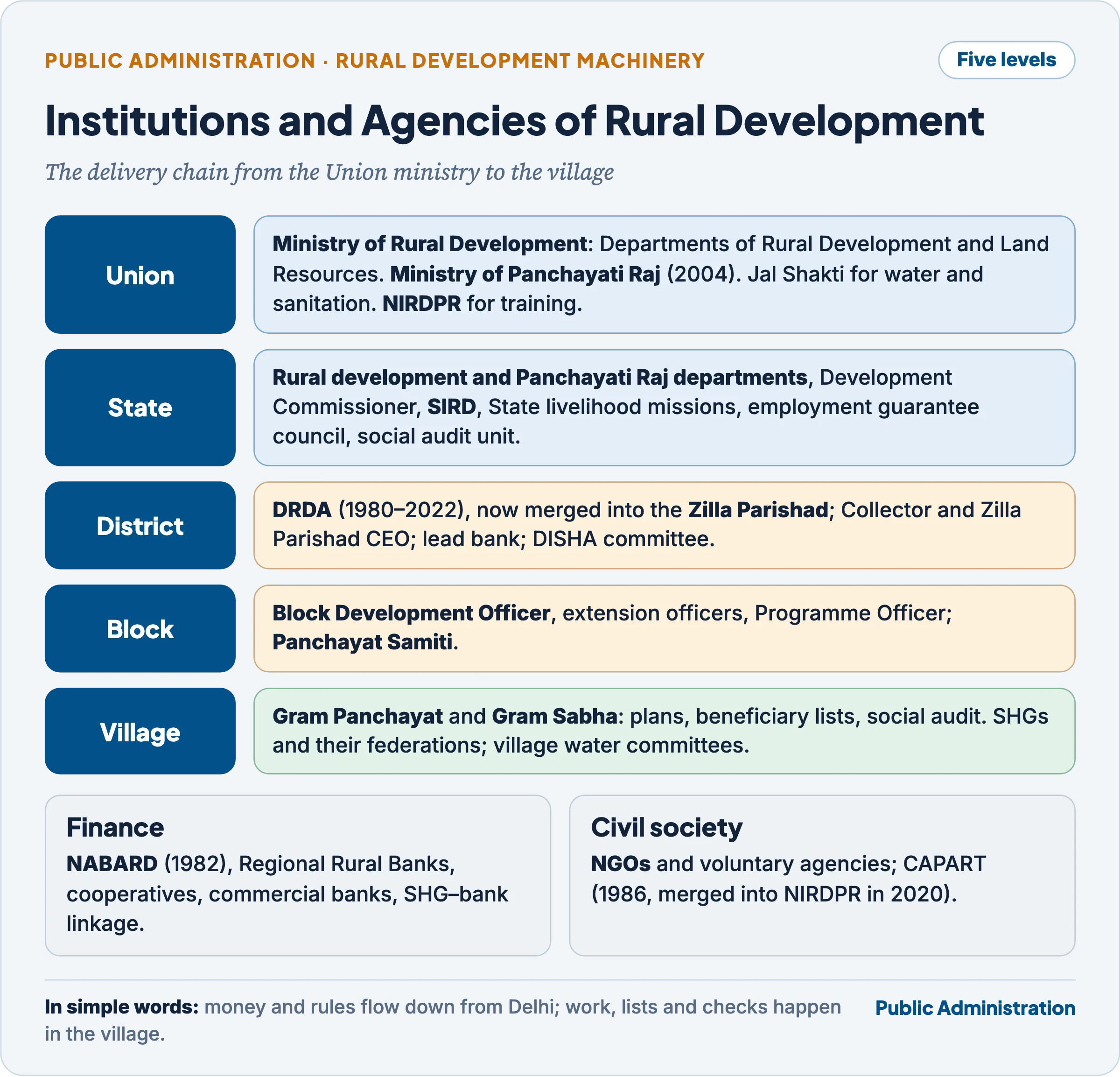
2.1 The Union level
Ministry of Rural Development (MoRD). Its organisational history shows how rural development moved in and out of agriculture before becoming a ministry in its own right.
- 31 March 1952: a Community Projects Administration was set up under the Planning Commission to run the Community Development Programme.
- October 1974: a Department of Rural Development was created in the Ministry of Food and Agriculture.
- 18 August 1979: it became the Ministry of Rural Reconstruction, renamed Ministry of Rural Development on 23 January 1982; in 1985 it went back to being a department under the Ministry of Agriculture.
- 5 July 1991: upgraded again to the Ministry of Rural Development; a Department of Wasteland Development was added on 2 July 1992.
- March 1995: renamed Ministry of Rural Areas and Employment (with departments of Rural Employment and Poverty Alleviation, Rural Development, and Wasteland Development); renamed Ministry of Rural Development again in 1999.
- Drinking water and sanitation became a separate Ministry of Drinking Water and Sanitation in 2011 and, from 2019, a department of the Ministry of Jal Shakti.
- Present structure. The Ministry has two departments:
- the Department of Rural Development (DoRD), which runs the wage employment guarantee (now VB–G RAM G), DAY-NRLM, PMAY-G, PMGSY, NSAP, the skills programme DDU-GKY and rural self-employment training institutes (RSETIs);
- the Department of Land Resources (DoLR), which runs DILRMP (land records) and the watershed component of PMKSY.
Ministry of Panchayati Raj (MoPR). Created on 27 May 2004 to oversee the implementation of Part IX of the Constitution and the PESA Act, 1996. It funds capacity building of panchayats (Rashtriya Gram Swaraj Abhiyan), runs e-GramSwaraj, the Gram Panchayat Development Plan (GPDP) process and the SVAMITVA property survey. Its separation from MoRD has a cost: schemes sit in one ministry and the institutions that should implement them in another.
Other Union bodies. Agriculture and Farmers’ Welfare (farm programmes), Jal Shakti (water, sanitation), Tribal Affairs, Women and Child Development (ICDS), Cooperation (a separate ministry since July 2021), and NITI Aayog (Aspirational Districts and Blocks; evaluation through its Development Monitoring and Evaluation Office). Statutory councils such as the Central Employment Guarantee Council advised on the employment guarantee.
2.2 Training and research: NIRDPR and SIRDs
- NIRDPR. Began in 1958 at Mussoorie as the Central Institute of Study and Research in Community Development, to train officers for the community development blocks. Merged with a trainers’ institute as the National Institute of Community Development (1962), moved to Hyderabad (1964–65), renamed National Institute of Rural Development (1977) and National Institute of Rural Development and Panchayati Raj (December 2013). It is an autonomous body under MoRD that trains officials, elected representatives and bankers, and conducts research and evaluations.
- SIRDs and Extension Training Centres. Each State has a State Institute of Rural Development (often combined with Panchayati Raj) and block-level extension training centres, which train panchayat members, secretaries, SHG leaders and scheme staff.
- CAPART (see 2.6) was merged into NIRDPR on 1 May 2020.
2.3 Financial institutions
Rural development is credit-hungry: IRDP, SGSY and NRLM all depend on bank loans. The banking architecture was built in stages.
- Nationalisation and the Lead Bank Scheme (1969). Bank nationalisation and the Lead Bank Scheme made one bank responsible for coordinating credit plans in each district; the District Level Consultative/Coordination Committee of bankers and officials still reviews the district credit plan.
- Regional Rural Banks. Set up on the recommendation of the Narasimham Working Group (1975) under an ordinance of 26 September 1975 (the first RRB opened on 2 October 1975) and then the Regional Rural Banks Act, 1976, to combine the local feel of cooperatives with the resources of commercial banks for small and marginal farmers, labourers and artisans. Repeated mergers reduced them from 196 to 43; under the principle of “One State, One RRB” they were reduced to 28 with effect from 1 May 2025.
- NABARD. The Committee to Review Arrangements for Institutional Credit for Agriculture and Rural Development (CRAFICARD), chaired by B. Sivaraman (1979), recommended a single apex development bank. Parliament passed the NABARD Act, 1981, and NABARD came into existence on 12 July 1982, taking over the agricultural credit functions of the RBI and the refinance functions of the Agricultural Refinance and Development Corporation. Its roles:
- refinance to cooperative banks, RRBs and commercial banks for crop and investment credit;
- development: the Rural Infrastructure Development Fund (loans to States for irrigation, rural roads, bridges, water), watershed and tribal development funds, farmers’ clubs, producer organisations;
- supervision of cooperative banks and RRBs;
- innovation: the SHG–Bank Linkage Programme (1992), which grew into the world’s largest microfinance programme, and the design of the Kisan Credit Card.
- Cooperatives. Primary agricultural credit societies (PACS), district and State cooperative banks, and marketing and dairy cooperatives (the Amul model) are the oldest rural institutions. Their weaknesses (political capture, poor recovery, weak governance) were among the reasons for creating RRBs and NABARD; the Ministry of Cooperation (2021) is now computerising PACS and making them multi-service centres.
Indian Connect — Kudumbashree: an SHG network joined to the panchayat
Kudumbashree, Kerala’s State Poverty Eradication Mission, was launched on 17 May 1998 during the People’s Plan Campaign. Neighbourhood groups of women (one from each poor household) federate into Area Development Societies at the ward and Community Development Societies at the panchayat, so the SHG federation is formally linked to the elected local government. It runs thrift and credit, micro-enterprises, collective farming and destitute identification, and has been the national resource organisation for NRLM. Its lesson is that institutions of the poor work best when they are federated and anchored in local self-government, not run as a parallel structure by a department.
2.4 The State level
- Departments. Most States have a Rural Development Department and a Panchayati Raj Department (sometimes combined), headed by a Principal Secretary or Additional Chief Secretary; some have a Development Commissioner to coordinate all development departments (in some States the Chief Secretary performs this role). States such as Rajasthan created a State Level Coordination Committee under the Chief Secretary.
- Missions and societies. Each programme has a State-level society or mission: the State Rural Livelihoods Mission (for example JEEViKA in Bihar, Kudumbashree in Kerala), the State Rural Roads Development Agency, the State Water and Sanitation Mission, the State housing cell. They give flexibility in hiring and fund flow, but multiply parallel structures.
- Statutory bodies. The State Employment Guarantee Council; an independent Social Audit Unit; the State Finance Commission and State Election Commission for panchayats.
2.5 The district level: from DRDA to Zilla Parishad
The District Rural Development Agency (DRDA) was for four decades the key district-level agency for anti-poverty programmes.
- Origin. The Small Farmers Development Agencies of the early 1970s were registered societies at the district level. When IRDP was extended to all blocks, DRDAs replaced the SFDAs from 1980 as the district agency for IRDP and, later, for most MoRD schemes.
- Legal form. Each DRDA was a society registered under the Societies Registration Act, 1860 (or the State’s version), so it could receive funds directly, keep them in bank accounts and use commercial accounting. In practice it worked like a government office.
- Governing body. Chaired by the Collector (in some States by the elected Zilla Pramukh), with MPs and MLAs of the district, the head of the Zilla Parishad, lead bank and RRB heads, district officers of industries, SC/ST finance and welfare, and representatives of weaker sections and rural women. An executive committee under the Collector met monthly; an Additional Collector-cum-Project Director ran the office with a small planning team (economist, credit planner, engineer, accountant).
- Functions. It identified BPL families, prepared annual action plans and block plans, arranged bank credit for beneficiaries, coordinated departments and banks, monitored progress, and reported to the State and the Union. It handled three kinds of programmes:
- individual beneficiary schemes (IRDP, TRYSEM), where its involvement was greatest, implemented through Panchayat Samitis;
- area programmes (DPAP, DDP), implemented mainly by district line officers;
- mixed approaches such as the Modified Area Development Approach for tribal pockets.
- Professionalisation (1999). A centrally sponsored DRDA Administration scheme (from 1 April 1999) paid for DRDA staff and prescribed wings for self-employment, wage employment, women, watershed, engineering, accounts, and monitoring and evaluation.
- Criticism. The DRDA was a bureaucratic body parallel to the elected Zilla Parishad: it controlled the largest share of rural development money in the district while the Parishad, created by the 73rd Amendment, had little. The G.V.K. Rao Committee (1985) and later the 2nd ARC’s Sixth Report on Local Governance (2007) argued that such parallel bodies should be merged into the Zilla Parishad.
- Merger. States such as Karnataka, Kerala and Rajasthan merged DRDAs into Zilla Parishads early (Rajasthan in 2001). The Union then discontinued the DRDA Administration scheme from 1 April 2022 and advised all States to merge DRDAs into Zilla Parishads, transferring their staff to scheme units or line departments. In most States a DRDA cell now sits inside the Zilla Parishad, while the Collector still reviews the schemes.
Other district actors: the Collector (coordinator and, under the employment guarantee, often the District Programme Coordinator), the Zilla Parishad CEO, district line officers, the lead bank, and the District Development Coordination and Monitoring Committee (DISHA), set up in 2016 under the senior-most MP to review Union schemes. The Collector’s changing role is discussed in the article on The District Collector: Changing Role, Development Management and Law and Order; district planning and the District Planning Committee are discussed in the articles on Decentralised Planning after the 73rd and 74th Amendments and on District Administration, Democratic Decentralisation and Union–State–Local Relations.
2.6 The block, the village and civil society
- The block. Created under the Community Development Programme as the unit of planning and extension, a block covers roughly 100 villages. Its head, the Block Development Officer (BDO), leads a team of extension officers (agriculture, animal husbandry, cooperation, industries, panchayats, women and children, engineering) and village level workers (VLWs, later called Gram Sevaks or Village Development Officers). The VLW was meant to be a multipurpose friend, philosopher and guide of villagers; in practice he became a clerk for many departments. Under the employment guarantee a Programme Officer at the block sanctions works and pays wages. The elected Panchayat Samiti is the intermediate tier.
- The Gram Panchayat and Gram Sabha. The panchayat executes works (at least half the works under the employment guarantee), verifies beneficiaries and maintains assets; the Gram Sabha approves plans, selects or verifies beneficiaries (housing, pensions, SHG lists) and conducts social audits. A Gram Rozgar Sahayak, a panchayat secretary, village water and sanitation committees and community resource persons from SHGs form the village-level machinery.
- SHGs and their federations. Under DAY-NRLM about 10 crore women are organised into SHGs, village organisations and cluster level federations. These are now among the most important rural institutions, used for credit, livelihoods, nutrition, sanitation drives and even banking (BC Sakhis).
- NGOs and voluntary agencies. Voluntary bodies pioneered many ideas later adopted by government: the Mazdoor Kisan Shakti Sangathan’s jan sunwais (social audit), MYRADA’s credit groups (SHGs), SEWA’s organisation of informal women workers, and watershed work at Ralegan Siddhi and Hiware Bazar. Their roles are to mobilise communities, deliver services in remote areas, innovate, build capacity, monitor government and advocate for the poor.
- CAPART. The Seventh Plan formally recognised voluntary agencies; in 1986 the Council for Advancement of People’s Action and Rural Technology (CAPART) was formed by merging the Council for Advancement of Rural Technology and People’s Action for Development India, as an autonomous society under MoRD to fund and promote voluntary action and appropriate rural technology. It funded thousands of NGOs but faced complaints of dependence, delay and misuse of grants; its regional centres were closed in 2012 and it was merged into NIRDPR in 2020.
- Limits of NGOs. They work at micro scale, depend on government or foreign funding, vary widely in quality and accountability, and can become sub-contractors of the state. Tighter rules on foreign contributions (the FCRA amendment of 2020 barred sub-granting and capped administrative spending) have reduced the space for foreign-funded rural NGOs.
Indian Connect — Hiware Bazar: a Gram Sabha that governs its watershed
In the drought-prone Ahmednagar district of Maharashtra, Hiware Bazar under its sarpanch Popatrao Pawar used the Gram Sabha to plan watershed works, ban borewells for irrigation, budget water crop by crop and regulate grazing and tree felling. Working with State watershed and employment schemes, the village turned from distress migration to prosperity. It shows what Chambers called “putting the last first”: when the community sets the rules and the state supplies funds and technical help, the same schemes that fail elsewhere succeed.
Do NGOs reflect the declining legitimacy of the state? Partly. Their growth since the 1980s owed much to the failures of bureaucratic delivery and to the global turn to “governance” and civil society after structural adjustment. But in India NGOs have mostly grown alongside the state, often funded by it (CAPART, NRLM, watershed projects), and their legitimacy rests on proximity and trust that the state also needs. The relationship is better described as partnership with tension than replacement.
2.7 Why rural development institutions work in silos
The 2026 question on the disconnect between rural development institutions and State agencies asks for reasons. They are structural.
- Scheme-wise vertical design. Each centrally sponsored scheme comes with its own guidelines, funds, MIS, staff and district society, so the line of accountability runs up the scheme, not across the district.
- Multiple ministries for one village. Rural development (MoRD), panchayats (MoPR), water and sanitation (Jal Shakti), agriculture, tribal affairs and women and child development all reach the same household separately.
- Parallel bodies. DRDAs, water and sanitation missions, livelihood missions and road agencies grew outside the panchayat system; the 2nd ARC called this a weakness of local governance.
- Incomplete devolution. States have not transferred the 29 subjects of the Eleventh Schedule with funds and functionaries, so panchayats cannot act as the convergence point.
- Fund-flow rules. Separate bank accounts, single nodal agencies and tied grants make it hard to pool money for a joint plan.
- Different data and targets. Each scheme counts its own outputs (houses sanctioned, kilometres built) rather than shared household outcomes.
- Capacity and staffing. Blocks and panchayats are short of engineers, accountants and data staff; the same few officials serve many schemes.
- Weak forums. District Planning Committees meet rarely; DISHA committees review rather than plan.
- Political economy. Each department and each level guards its budget and patronage; credit-claiming politics favours visible, branded schemes.
The responses so far (Mission Antyodaya, GPDP, Aspirational Blocks, the Viksit Gram Panchayat Plans of the VB–G RAM G Act, PM Gati Shakti layers) all try to force convergence at the Gram Panchayat through a common plan and common data (Section 5).
2.8 Articles and Acts
The constitutional and legal base of rural development lies mainly in the Directive Principles, the Eleventh Schedule and a few statutes.
| Provision | What it says or does |
|---|---|
| Article 21 | Right to life; read in Olga Tellis (1985) to include the right to livelihood |
| Article 38 | State to promote welfare and minimise inequalities of income, status and opportunity |
| Article 39(b), (c) | Distribution of material resources for the common good; no concentration of wealth |
| Article 40 | State to organise village panchayats as units of self-government |
| Article 41 | Right to work, education and public assistance in unemployment, old age, sickness and disablement (basis of NSAP and employment guarantee) |
| Article 43 | Living wage and decent conditions of work; cottage industries in rural areas |
| Article 46 | Promotion of educational and economic interests of SCs, STs and weaker sections |
| Article 47 | Nutrition, standard of living and public health |
| Article 243G and Eleventh Schedule | Panchayats to prepare and implement plans for economic development and social justice; 29 subjects including poverty alleviation, rural housing, drinking water, roads |
| Article 282 | Discretionary grants for public purposes, the main legal route for centrally sponsored schemes |
| Seventh Schedule | State List entry 5 (local government); Concurrent List entries 20 (economic and social planning) and 23 (social security) |
| Regional Rural Banks Act, 1976 | Creation of RRBs |
| NABARD Act, 1981 | Creation of NABARD (in existence from 12 July 1982) |
| PESA Act, 1996 | Gram Sabha powers in Fifth Schedule areas |
| NREGA, 2005 (MGNREGA from 2009) | Ss. 3 (100 days; wages within a fortnight), 7 (unemployment allowance), 16 (Gram Panchayat plans, at least 50% of works), 17 (social audit by Gram Sabha); repealed from 1 July 2026 |
| Forest Rights Act, 2006 | Individual and community forest rights for forest dwellers |
| National Food Security Act, 2013 | Legal entitlement to subsidised grain; s.28 social audit |
| Aadhaar Act, 2016, s.7 | Aadhaar authentication as a condition for subsidies and benefits |
| VB–G RAM G Act, 2025 (Act 36 of 2025) | 125-day guarantee (s.5); Viksit Gram Panchayat Plans (s.4); farm-season pause (s.6); PRIs as principal authorities (s.16); social audit (s.20); 60:40 funding and normative allocation (s.22) |
3. Programmes Before 1980: Community, Production, Target Groups and Areas
In simple words
In the 1950s the government tried to improve whole villages at once, with extension workers advising farmers and villagers. In the 1960s it put money into the best-irrigated districts to grow more food. When it saw that small farmers and the landless were being left behind, it began special programmes for chosen groups of people and for backward or fragile areas.
3.1 Before Independence
Several experiments shaped post-1947 thinking: Rabindranath Tagore’s Sriniketan (1921) for village reconstruction; the YMCA’s Marthandam project in Travancore (1921); F.L. Brayne’s Gurgaon experiment (1927), a Collector-driven “uplift” drive; the Baroda programme under V.T. Krishnamachari (1932); Gandhi’s Sevagram constructive programme; and the Madras Firka Development scheme (1946). After Independence the Etawah pilot project (1948, planned by the American architect Albert Mayer) and the Nilokheri refugee township (1948, led by S.K. Dey, later Union Minister for Community Development) tested the idea of multipurpose village workers and people’s self-help. Most were small, leader-dependent and hard to replicate, but Etawah supplied the template for the national programme.
3.2 The Community Development Programme (1952) and National Extension Service (1953)
- Launch. The Grow More Food Enquiry Committee (1952), chaired by V.T. Krishnamachari, concluded that food production could not rise without improving all aspects of village life, and recommended a nationwide extension organisation. The Community Development Programme (CDP) began on 2 October 1952 with 55 community projects, with American technical and Ford Foundation support. The National Extension Service (NES) followed on 2 October 1953 as the permanent extension network.
- Philosophy. Development of the people, by the people, with the government as catalyst: villagers would identify needs, contribute labour and money, and the state would supply technical help and matching funds. Agriculture was the main focus, together with animal husbandry, irrigation, health and sanitation, education, roads, cottage industries and social welfare.
- Structure. Each project of about 300 villages was divided into development blocks of about 100 villages. The BDO, extension officers and VLWs formed the block team (the NES); at the district a development committee under the Collector coordinated; at the Centre the Community Projects Administration (later the Ministry of Community Development) directed. Block advisory committees of non-officials were meant to secure participation.
- What went wrong. The Balwantray Mehta Study Team (1957), set up to review the CDP and NES, found that the programme had become a government programme with little people’s participation: advisory committees had no powers, panchayats were weak, and benefits went to the better-off villagers. Agricultural production did not rise noticeably.
- Consequence. The team recommended democratic decentralisation: elected, statutory bodies at the village, block and district levels to which development would be entrusted. This gave birth to Panchayati Raj (Rajasthan and Andhra Pradesh, 1959). The story continues in the article on Panchayati Raj and the 73rd Amendment: Decentralisation in Rural India.
- Legacy. The CDP gave India the block as a unit of administration, a network of extension staff, and the very idea of development administration as distinct from law and order. Its failure taught that participation cannot be decreed through advisory bodies; it needs power, money and local institutions.
Common confusion
Did the Community Development Programme fail completely? Not completely. It failed in its central aim of making development a people’s movement, and it did not raise farm output much. But it built the field machinery (blocks, BDOs, extension workers, training institutes) that every later programme used, spread basic roads, wells, schools and health centres, and its failure produced the Panchayati Raj experiment. It is better described as a programme that created institutions but not participation.
3.3 The production strategy: IADP, IAAP and the Green Revolution
- IADP (1960–61). Following a Ford Foundation team’s report (1959), the Intensive Agricultural District Programme concentrated a package of inputs (improved seeds, fertilisers, credit, pesticides, extension, marketing) in seven well-irrigated districts, later extended. It is often called the “package programme”.
- IAAP (1964–65). The Intensive Agricultural Area Programme extended the idea to selected areas in more districts.
- HYV Programme (1966). The programme for new dwarf wheat and rice varieties, with assured irrigation and fertiliser, produced the Green Revolution in Punjab, Haryana and western Uttar Pradesh.
- Strategy. “Betting on the strong”: invest where returns are highest and expect growth to spread.
- Outcomes and critique. Food output rose and famine imports ended, but regional inequality (irrigated north-west versus rain-fed east and centre) and interpersonal inequality (large farmers versus small farmers, tenants and labourers) widened; mechanisation threatened labour; the absence of land reform meant the gains went to landowners. This experience pushed planners towards programmes aimed at the poor themselves.
3.4 Target-group programmes: SFDA, MFAL and Antyodaya
- SFDA and MFAL (1969–71). The All India Rural Credit Review Committee (1969), chaired by B. Venkatappiah, recommended special agencies to help small farmers reach credit and inputs. The Small Farmers Development Agency (for holdings roughly between one and two hectares, depending on irrigation) and the Marginal Farmers and Agricultural Labourers Development Agency were set up as district-level registered societies, later combined. They gave subsidised credit for minor irrigation, dairying, poultry and other ancillary occupations.
- Antyodaya (1977–78). Rajasthan’s scheme identified the five poorest families in each village through the Gram Sabha and helped them with assets or pensions. It was praised for targeting the poorest first and for transparency of selection, and influenced IRDP.
- Significance. These programmes marked a shift from areas and crops to households, from “growth will trickle down” to direct attack on poverty, and from departments to special-purpose agencies. Their district societies became the DRDAs.
3.5 Area development programmes
Area programmes treat a region with a common handicap as the unit and attempt to remove the handicap.
| Programme | Year | Focus | Strategy |
|---|---|---|---|
| Rural Works Programme | 1970–71 | Drought-affected areas | Labour-intensive works; became DPAP |
| Drought Prone Areas Programme (DPAP) | 1973–74 | Chronically drought-hit blocks | Soil and moisture conservation, afforestation, water harvesting, pasture; watershed basis from 1995 |
| Command Area Development Programme (CADP) | 1974–75 | Areas commanded by major and medium irrigation projects | Close the gap between irrigation created and used: field channels, land levelling, warabandi |
| Hill Area Development Programme | Fifth Plan (1974–79) | Designated hill areas | Eco-development, horticulture, soil conservation |
| Tribal Sub-Plan and Integrated Tribal Development Projects | 1974–75 | Areas with tribal majority | Earmarked funds; ITDP as the area unit; MADA pockets and clusters for scattered tribal populations |
| Desert Development Programme (DDP) | 1977–78 | Hot and cold deserts (Rajasthan, Gujarat, Haryana, J&K, Himachal) | Sand dune stabilisation, shelter belts; water diversion in cold deserts |
| Minimum Needs Programme | 1974–75 | All rural areas | Floor of services: elementary education, health, water, roads, electricity, housing sites, nutrition |
- Strengths. Area programmes attack the physical causes of poverty (drought, desertification, waterlogging), create common assets and lend themselves to technical planning (the watershed as the unit).
- Weaknesses. Benefits flow mainly to land-owning households in the area; the landless gain only wage work. The programmes were run by line departments, often sectorally, and the Hanumantha Rao Technical Committee on DPAP and DDP (1994) found scattered works with little impact until they were rebuilt on a watershed basis with community participation. DPAP, DDP and the wasteland programme were finally merged into the Integrated Watershed Management Programme in 2009–10 (see 4.9).
The 1970s thus produced two families of programmes: beneficiary-oriented (SFDA, MFAL, Antyodaya, later IRDP; employment programmes such as Food for Work) and area-oriented (DPAP, DDP, CADP, hill and tribal plans). IRDP tried to join them.
4. Programmes since 1980: Foci and Strategies
In simple words
From 1980 the government gave poor families loans and subsidies to buy a cow, a cart or a shop (IRDP), and gave others paid work on village projects. Later it organised poor women into groups that save and borrow together, made rural work a legal right, and launched big missions to give every family a house, a road, a tap and a toilet.
4.1 The Integrated Rural Development Programme (IRDP)
Concept. IRDP was announced in the 1978–79 budget as an omnibus beneficiary-oriented programme to lift the rural poor above the poverty line. It started in 2,300 blocks in 1978–79, merged SFDA and MFAL, and was extended to all blocks from 2 October 1980 as the main anti-poverty programme of the Sixth Plan (1980–85). “Integrated” meant combining sectors (agriculture, animal husbandry, village industries, services), inputs (assets, credit, training, infrastructure, marketing) and agencies into one package for the household.
Strategy and design.
- Target group: small and marginal farmers, agricultural labourers, rural artisans and SC/ST families below the poverty line; in the Sixth Plan a family income below ₹3,500 a year (at 1979–80 prices), with the poorest to be helped first. About 600 families per block per year were to be assisted.
- Identification: household surveys by the block and DRDA, lists approved by the Gram Sabha.
- Assistance: an income-generating asset (milch animal, bullock cart, sewing machine, shop) financed by a subsidy (25 per cent for small farmers, 33.3 per cent for marginal farmers, labourers and artisans, 50 per cent for STs, within ceilings) and a bank term loan for the rest.
- Linked sub-schemes: TRYSEM (Training of Rural Youth for Self-Employment, 15 August 1979), DWCRA (Development of Women and Children in Rural Areas, 1982), SITRA (toolkits for artisans), Ganga Kalyan Yojana (group irrigation) and the Million Wells Scheme. From 1990 a group approach for women gave matching grants to women’s thrift groups; land purchase became permissible in 1991–92.
- Machinery: DRDA for planning and credit linkage, BDO and extension staff for identification and follow-up, banks for loans, line departments for inputs.
Coverage. Over 5 crore families were assisted between 1980 and 1999, making it one of the largest self-employment programmes in the world.
Evaluation and the reasons for its failure. Concurrent evaluations, independent studies and audits found the programme fell well short of its aim of a lasting rise above the poverty line.
- Wrong identification. A significant share of beneficiaries were ineligible; the very poor were often left out because they were seen as poor credit risks. Influential villagers captured lists.
- Target-driven, centralised design. Fixed physical targets per block (families to be “covered”) and uniform norms set in Delhi meant officials chased numbers, not viable projects. This is the substance of the 1999 question on IRDP’s “over-powering centralized approach”: planning was done for the poor, not with them; Gram Sabha approval was a formality; asset choice was not based on local markets or skills.
- Unsuitable assets and missing backward and forward linkages. A buffalo given where there was no fodder, veterinary care or milk collection, or a pump set where there was no electricity, could not generate income; assets were sold or died.
- Subsidy-seeking and corruption. Subsidised credit attracted the non-poor and intermediaries; beneficiaries paid bribes to officials and bank staff; “purchase committees” colluded with suppliers on inflated prices.
- Single dose of credit. A one-time loan, without working capital or repeat finance, left families vulnerable; repayment defaults were high, making banks reluctant to lend.
- Weak training and support. TRYSEM trained many but placed few; after-care and marketing support were minimal.
- Coordination failure. DRDA, banks, block staff and line departments had separate lines of command, the classic case of the “sheer difficulty of doing ordinary things” (the phrase in the 1987 question), where the hard problem is not design but routine implementation.
- Academic critique. Nilakantha Rath (1985) argued that asset-based self-employment was misconceived for the poorest, who lack entrepreneurial ability and risk-bearing capacity, and that wage employment suited them better. Others replied that the two are complementary.
Successor. The Hashim Committee (1997), chaired by S.R. Hashim, reviewed rural development programmes and recommended a single self-employment programme with a group (SHG) approach, cluster activities and multiple doses of credit. From 1 April 1999 IRDP, TRYSEM, DWCRA, SITRA, Ganga Kalyan Yojana and the Million Wells Scheme were merged into the Swarnajayanti Gram Swarozgar Yojana (SGSY) (see 4.3).
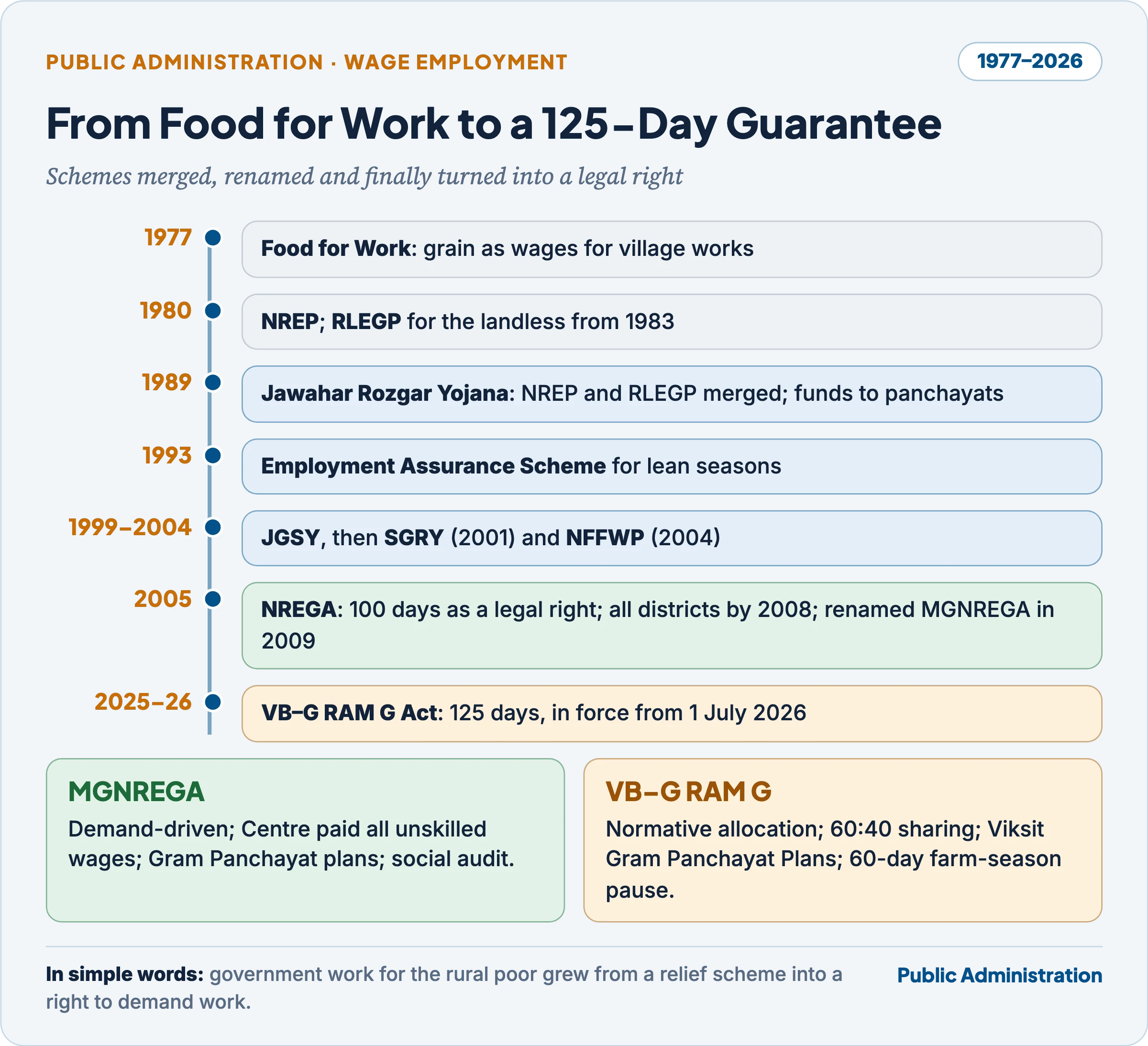
4.2 Wage employment: from Food for Work to the 125-day guarantee
Logic. Public works give income in lean seasons, are self-targeting (only the needy accept manual work at the statutory wage), need no entrepreneurship or credit, and can build community assets such as ponds, roads and soil conservation works. The risks are fake muster rolls, poor-quality assets and works that mainly benefit landowners.
| Programme | Year | Focus and strategy |
|---|---|---|
| Maharashtra Employment Guarantee Scheme | 1972 (statutory 1977) | Conceived by V.S. Page during the 1972 drought; the first legal employment guarantee; funded by a State tax on urban professionals |
| Food for Work Programme | 1977 | Foodgrains as wages for rural works |
| National Rural Employment Programme (NREP) | 1980 | Replaced Food for Work; durable community assets; 50:50 Centre–State |
| Rural Landless Employment Guarantee Programme (RLEGP) | 15 August 1983 | Up to 100 days for one member of each landless household; fully central |
| Jawahar Rozgar Yojana (JRY) | 1989 | NREP and RLEGP merged; funds sent directly to village panchayats; IAY and Million Wells as components |
| Employment Assurance Scheme (EAS) | 2 October 1993 | Assured 100 days in lean season in backward blocks; demand-based, later universal |
| Jawahar Gram Samriddhi Yojana (JGSY) | 1 April 1999 | JRY restructured to create village infrastructure through panchayats |
| Sampoorna Grameen Rozgar Yojana (SGRY) | 25 September 2001 | EAS and JGSY merged; cash plus foodgrains as wages |
| National Food for Work Programme (NFFWP) | 14 November 2004 | 150 most backward districts; precursor to NREGA |
| NREGA / MGNREGA | Act 2005; in force 2 February 2006 | Legal right to 100 days; all districts from 1 April 2008; renamed after Mahatma Gandhi in 2009 |
| VB–G RAM G Act | Assent 20 December 2025; in force 1 July 2026 | 125 days; Viksit Gram Panchayat Plans; 60:40 sharing; normative allocation; farm-season pause |
MGNREGA (2005–2026): design
The National Rural Employment Guarantee Act was notified on 7 September 2005, came into force in 200 districts on 2 February 2006, added 130 districts in 2007 and covered all rural areas from 1 April 2008. The intellectual push came from economists such as Jean Drèze and from the right to work and Right to Food campaigns.
- Right-based framework. Every rural household whose adult members volunteer for unskilled manual work was entitled to at least 100 days of work a year on demand. If work was not given within 15 days of application, a daily unemployment allowance was payable by the State (s.7).
- Process. Households registered with the Gram Panchayat and received a job card; applied in writing for work; work was given within 5 km (or with 10 per cent extra wages beyond); wages were to be paid within a fortnight, with compensation for delay.
- Planning by panchayats. The Gram Sabha recommended works; the Gram Panchayat prepared a development plan and shelf of projects; at least 50 per cent of works by cost were executed by Gram Panchayats (s.16).
- Works and ratios. Permissible works (Schedule I) centred on water conservation, drought proofing, irrigation, land development on the land of SC/ST and small farmers, rural connectivity, flood control; a 60:40 wage–material ratio; no contractors and no labour-displacing machines.
- Worker entitlements. At least one-third of beneficiaries women; equal wages; worksite facilities (drinking water, shade, crèche, first aid).
- Funding. The Union paid 100 per cent of unskilled wages, 75 per cent of material and skilled wages and administrative costs; States paid 25 per cent of material costs and the unemployment allowance.
- Institutions. Central and State Employment Guarantee Councils; a District Programme Coordinator (the Collector or Zilla Parishad CEO); a Programme Officer at the block; the Gram Panchayat as principal implementing agency.
- Transparency. Social audit by the Gram Sabha (s.17); the Audit of Schemes Rules, 2011; independent Social Audit Units (Andhra Pradesh’s SSAAT, 2009, was the model); proactive disclosure on wall paintings and the MIS; ombudspersons at district level; payment through bank and post office accounts; later geo-tagging of assets (GeoMGNREGA), the National Mobile Monitoring System app for attendance, and the Aadhaar-based payment system, made mandatory for wages from 1 January 2024.
MGNREGA: achievements
- Scale and self-targeting. For two decades it was the world’s largest public works programme, typically employing 5–6 crore households a year; in the COVID year 2020–21 it generated a record of about 389 crore person-days, acting as a shock absorber for returning migrants.
- Inclusion. Women made up more than half of person-days nationally (about 57 per cent in 2025–26), and SC/ST workers about a third; equal wages raised women’s bargaining power.
- Rural wages and distress migration. Studies found upward pressure on agricultural wages and reduced distress migration in active States.
- Assets. Ponds, wells, check dams and land development on small farms improved water security; natural resource management became the main category of works.
- Accountability innovations. Social audit, open MIS and bank payment of wages became models for other schemes.
MGNREGA: problems (“hurdles and pitfalls”)
The CAG’s first performance audit (2007–08) found “significant deficiencies”; the second (Report No. 6 of 2013, covering 2007–2012 in 3,848 Gram Panchayats) found:
- employment per household fell from 54 days in 2009–10 to 43 days in 2011–12, and the completion of works declined;
- Bihar, Maharashtra and Uttar Pradesh, with 46 per cent of the rural poor, used only about 20 per cent of central funds, so implementation did not track poverty;
- annual plans were not prepared or were incomplete in many panchayats; works were taken up outside the approved plans;
- records (job cards, muster rolls, asset registers) were badly maintained; MIS data did not match field records;
- unemployment allowance was rarely paid, and dedicated staff (Gram Rozgar Sahayaks, technical assistants) were short;
- the Central Council did not set up the mandated evaluation system.
Other problems documented by scholars, courts and the Ministry:
- Delayed wages. In Swaraj Abhiyan v. Union of India (18 May 2018) the Supreme Court held that wages must be paid within a fortnight and that the Union cannot escape liability for delays after the fund transfer order; “bureaucratic delays or red tape” cannot defeat the statutory right.
- Rationing of a demand-driven right. Funds released late or capped forced field staff to suppress demand (not recording applications), so the guarantee became a scheme in practice.
- Wages below State minimum wages in many States, reducing participation.
- Leakages and fake muster rolls where social audit was weak; elite capture of material-intensive works.
- Technology exclusion. Aadhaar seeding, the payment bridge and app-based attendance reduced fraud but also produced deletions of job cards and payment failures for genuine workers.
- Asset quality and maintenance; few households received the full 100 days.
The VB–G RAM G Act, 2025
The Viksit Bharat – Guarantee for Rozgar and Ajeevika Mission (Gramin) Act, 2025 (Act 36 of 2025) received the President’s assent on 20 December 2025. It was notified on 11 May 2026 and came into force on 1 July 2026, the date from which MGNREGA stands repealed. All States and Union Territories notified their schemes and began work from that date; ongoing MGNREGA works and e-KYC-verified job cards carried over.
| Feature | MGNREGA (2005) | VB–G RAM G Act (2025) |
|---|---|---|
| Guarantee | At least 100 days per household | At least 125 days per household (s.5(1)) |
| Nature | Demand-driven; Centre released funds to match demand | Demand-based entitlement retained, but Centre fixes State-wise normative allocations on objective parameters (ss.4(5), 22(4)); spending above the norm is borne by the State |
| Funding | Centre paid all unskilled wages and 75% of material | Centrally sponsored scheme: 60:40; 90:10 for North-Eastern and Himalayan States; 100% central for UTs without legislature (s.22) |
| Planning | Gram Panchayat labour budget and shelf of works | Viksit Gram Panchayat Plans approved by the Gram Sabha, aggregated at block, district, State and national levels and integrated with PM Gati Shakti (s.4) |
| Works | Schedule I list (water, land, connectivity) | Four domains: water security, core rural infrastructure, livelihood infrastructure, works against extreme weather; assets form a Viksit Bharat National Rural Infrastructure Stack |
| Farm season | No pause | States may notify periods aggregating to 60 days a year in peak sowing and harvest when works are not taken up (s.6) |
| Wages | Within 15 days | Weekly, or in any case within 15 days; delay compensation (s.5(3), Schedule II); payment only by DBT |
| Institutions | Gram Panchayat implements at least 50% | Panchayats at all three levels are the principal authorities for planning, implementation and monitoring (s.16) |
| Accountability | Social audit (s.17) | Social audit by Gram Sabha at least every six months (s.20, Schedule); biometric authentication, GPS monitoring, AI for fraud detection |
| Administrative costs | Up to 6% | Up to 9%; material spending capped at 40% at district level |
The debate. Supporters argue that the Act raises the guarantee, links work to durable, planned assets, brings predictability and fiscal discipline through normative allocation, frees farm labour in peak seasons and strengthens capacity and digital accountability. Critics, including several States and workers’ organisations, argue that normative allocations cap a demand-driven right, that 60:40 sharing shifts a large burden to poorer States, that the seasonal pause cuts work when landless labourers bargain for wages, that national aggregation of plans may centralise priorities, and that dropping the Mahatma Gandhi name was symbolic of a move away from the rights framework. Its working will depend on whether States fund demand above the norm and whether Gram Sabhas, not dashboards, shape the plans.
Common confusion
Does the end of MGNREGA mean the end of the legal right to work? No. MGNREGA was repealed on 1 July 2026, but the VB–G RAM G Act keeps a statutory guarantee (125 days), the right to apply for work, unemployment allowance and delay compensation. What changed is the fiscal design (normative State-wise allocations and 60:40 sharing), the planning frame (Viksit Gram Panchayat Plans aggregated nationally) and the seasonal pause. Whether the right stays enforceable in practice depends on funding and on whether demand is recorded, the same test MGNREGA faced.
4.3 Self-employment and livelihoods: SGSY to DAY-NRLM
SGSY (1 April 1999). A credit-cum-subsidy programme to set up micro-enterprises. Its innovations were the group (SHG) approach (at least half the groups for women), key activities chosen per block in clusters, multiple doses of credit, a revolving fund for groups, and earmarking (50 per cent SC/ST, 40 per cent women, 3 per cent disabled). By 2012 about 43 lakh SHGs had been formed. Its weaknesses were uneven social mobilisation, subsidy-driven lending, weak federations and inadequate professional support.
NRLM / Aajeevika (June 2011). SGSY was restructured as the National Rural Livelihoods Mission, later renamed Deendayal Antyodaya Yojana – NRLM (DAY-NRLM).
- Two strategic shifts: it is demand-driven (States prepare their own poverty-reduction plans) and it has a dedicated professional support structure (national, State, district and block mission units).
- Core belief: the poor have innate capacities; the task is to build strong institutions of the poor that let them access credit, services and markets.
- Components: universal social mobilisation (at least one woman from each poor household in an SHG); federations (village organisations, cluster level federations); financial inclusion (revolving fund, community investment fund, interest subvention, bank linkage); sustainable livelihoods (farm, non-farm, skilled wage employment through DDU-GKY and RSETIs); social inclusion (the poorest, PVTGs, disabled, manual scavengers).
- Identification: participatory identification of the poor (and SECC 2011 deprivation data), approved by the Gram Sabha, replacing the BPL list.
- Scale (2026). About 10.08 crore women in 92.3 lakh SHGs; more than ₹13 lakh crore of cumulative bank credit, with low non-performing assets.
- Lakhpati Didi. An SHG member whose household earns at least ₹1 lakh a year on a sustained basis; the target of 3 crore was reached early (3.01 crore reported in February 2026) and was raised to 6 crore by March 2029. Critics note that the measure is self-reported and household-based.
Assessment. NRLM is widely regarded as the most successful anti-poverty institution-building effort since Independence: SHG federations now deliver credit, nutrition, sanitation, banking and even panchayat-linked planning. Its limits are low-value enterprises, dependence on subsidised interest, uneven quality of federations across States, and the risk of SHGs becoming delivery arms of the state rather than autonomous organisations. Women’s empowerment through SHGs, Kabeer’s framework and microfinance critiques are covered in the article on Women and Development: the Self-Help Group Movement.
4.4 Women, children and tribal communities
- From welfare to empowerment. Early programmes treated women as recipients of welfare (maternity, nutrition, craft training through the Central Social Welfare Board from 1953). DWCRA (1982) organised women into income groups but often as an add-on to IRDP. From the 1990s the emphasis shifted to women as economic actors and decision-makers: SHGs and their federations, one-third (now one-half in most States) reservation in panchayats, the Mahila Kisan Sashaktikaran Pariyojana (2011) under NRLM, joint or women’s ownership of PMAY-G houses, and at least one-third of employment guarantee work for women.
- Children. The Integrated Child Development Services (1975) delivers supplementary nutrition, pre-school education, immunisation and health check-ups through anganwadis; the mid-day meal (now PM POSHAN) and rural school programmes complement it. Their record is mixed: wide coverage, but quality, staffing and leakages in supplementary nutrition remain concerns.
- Tribal development. The Tribal Sub-Plan (1974–75), ITDPs and MADA pockets, PESA (1996) and the Forest Rights Act (2006) recognise that tribal areas need protective as well as developmental administration. Recent saturation missions are PM-JANMAN (November 2023) for Particularly Vulnerable Tribal Groups and the Dharti Aaba Janjatiya Gram Utkarsh Abhiyan (2024) for tribal-majority villages. The erosion of the tribal resource base through land alienation, displacement by mines and dams, commercial forestry and moneylending (the theme of the 1994 question) shows that law and order administration and development administration need different skills: tribal welfare depends on land and forest rights, Gram Sabha consent and sensitive field staff, not only on schemes.
4.5 Rural housing: IAY to PMAY-G
- Indira Awaas Yojana (IAY). Began in 1985–86 as a sub-scheme of RLEGP, became part of JRY in 1989 and an independent scheme from 1 January 1996. It gave grants (not loans) to BPL households, especially SC/ST and freed bonded labourers, to build houses themselves; no contractors, house allotted in the woman’s name or jointly, sanitary latrine and smokeless chulha expected. Unit assistance rose slowly (₹45,000 in plains from 2010). Problems: small assistance, poor quality and incomplete houses, selection from flawed BPL lists, no technical support, and leakages.
- PMAY-Gramin (from 1 April 2016; launched 20 November 2016). IAY was restructured with a goal of “Housing for All”.
- Selection from SECC 2011 housing-deprivation data, verified by Gram Sabhas, plus the Awaas+ survey (2018–19) and a new Awaas+ 2024 survey with face-authenticated e-KYC.
- Unit assistance of ₹1.20 lakh in plains and ₹1.30 lakh in hill and North-Eastern States, paid by DBT in instalments linked to geo-tagged construction stages; 90–95 days of unskilled wages through the employment guarantee and ₹12,000 for a toilet through Swachh Bharat (convergence).
- Funding 60:40 (90:10 for NE and Himalayan States); minimum 60 per cent of targets for SC/ST.
- Targets. 2.95 crore houses by March 2024; extended (2024–29) for 2 crore more, a cumulative 4.95 crore by March 2029. By July 2026 about 3.92 crore houses had been sanctioned and 3.1 crore completed.
- Assessment. Faster completion, better quality and transparency than IAY; convergence with toilets, water, electricity and LPG. Concerns: exclusion of eligible households from SECC-based lists, landless beneficiaries without house sites, the inadequacy of unit assistance given construction costs (forcing borrowing), and large-State backlogs.
4.6 Rural roads: PMGSY
- Launch and design. The Pradhan Mantri Gram Sadak Yojana began on 25 December 2000 as a 100 per cent central scheme (later shared 60:40) to give all-weather road connectivity to unconnected habitations of 500+ people in plains and 250+ in hill, desert, tribal and (later) aspirational areas. The habitation, not the revenue village, is the unit. A three-tier quality control system, online monitoring (OMMAS), five-year maintenance contracts and the e-MARG maintenance system were built in.
- Phases. PMGSY-II (2013) upgraded existing roads; the Road Connectivity Project for LWE Areas (2016) covered 44 worst-affected districts in nine States; PMGSY-III (2019) consolidates 1.25 lakh km of through routes and major rural links to markets, schools and hospitals; PMGSY-IV (approved 11 September 2024) will connect 25,000 more habitations with 62,500 km at a cost of ₹70,125 crore in 2024–29.
- Progress. By December 2025 about 7.88 lakh km had been completed out of 8.25 lakh km sanctioned.
- Does connectivity transform the rural economy? Roads cut travel time and costs, raise school attendance and health-service use, and widen market access. The most rigorous evaluation, by Sam Asher and Paul Novosad (American Economic Review, 2020), found that PMGSY roads moved workers out of agriculture into wage jobs but produced no large gains in household income, consumption or farm output in the short run. Roads are necessary but not sufficient: transformation requires complementary credit, skills, market institutions and non-farm jobs.
4.7 Bharat Nirman and PURA
- Bharat Nirman (2005). A time-bound “business plan” for rural infrastructure for 2005–06 to 2008–09 (Phase II to 2014) with six components and explicit targets: irrigation (1 crore hectares), roads (all habitations of 1,000+, or 500+ in hill and tribal areas), housing (60 lakh IAY houses), drinking water (all uncovered habitations), electrification (all villages) and telephony. Its significance was administrative: it bundled schemes of several ministries under outcome targets with public monitoring, an early form of convergence.
- PURA (Provision of Urban Amenities in Rural Areas). Proposed by President A.P.J. Abdul Kalam, it aimed to give compact rural clusters around a growth centre urban amenities and livelihood opportunities through physical, electronic, knowledge and economic connectivity. It was piloted in seven clusters (2004–07) and restructured in 2012 as a public–private partnership between Gram Panchayats and private developers. It achieved little because private partners found few viable revenue models, and was succeeded by the Rurban Mission.
4.8 Drinking water and sanitation
Drinking water.
- Evolution. The Accelerated Rural Water Supply Programme (1972–73) funded States for “problem villages”; the National Drinking Water Mission (1986), a technology mission renamed the Rajiv Gandhi National Drinking Water Mission (1991); Swajaldhara (2002) introduced community contribution and ownership; the National Rural Drinking Water Programme (2009) stressed sustainability, water quality and handing schemes to panchayats.
- Jal Jeevan Mission (15 August 2019). Shifted the goal from habitation coverage to a functional household tap connection (55 litres per person per day of potable water) for every rural household, with village water and sanitation committees under the Gram Panchayat planning, owning and maintaining schemes, and community contribution. Coverage rose from 3.23 crore households (17 per cent) in 2019 to about 15.8 crore (82 per cent) by March 2026.
- JJM 2.0. On 10 March 2026 the Union Cabinet extended the Mission to December 2028 with an enhanced outlay of ₹8.69 lakh crore (central share ₹3.59 lakh crore), shifting from infrastructure creation to service delivery: a digital framework (Sujalam Bharat) with a service-area ID for every village, formal handover of schemes to panchayats and committees, and MoUs with States. The 2024 functionality assessment found about three-quarters of connections fully functional (regular, adequate, potable), showing the gap between connections and service.
Sanitation.
- Central Rural Sanitation Programme (1986) was supply-driven and subsidy-heavy and had little impact.
- Total Sanitation Campaign (1999) moved to a demand-driven, community-led approach with lower subsidies and awareness; the Nirmal Gram Puraskar (incentive awards to open-defecation-free panchayats, first given in 2005) energised panchayat leaders; Sikkim became the first “Nirmal” State.
- Nirmal Bharat Abhiyan (1 April 2012) raised incentives and sought convergence with MGNREGA.
- Swachh Bharat Mission (Gramin) (2 October 2014) set the goal of an open-defecation-free India by 2 October 2019 through behaviour change, a ₹12,000 incentive per toilet, mass mobilisation (swachhagrahis) and intense political leadership. Rural India was declared ODF in 2019, with more than 10 crore toilets built.
- Phase II (from 2020–21) aims at ODF Plus: sustaining ODF and managing solid and liquid waste; by September 2026 about 5.69 lakh villages were ODF Plus, of which about 5.25 lakh were in the “Model” category.
- Assessment. SBM is the most significant sanitation campaign in India’s history for its scale, speed and focus on behaviour, and for treating sanitation as a mass movement rather than a construction scheme. Critics point to slippage (households returning to open defecation), toilets without water, caste-linked pit-emptying, and verification by self-declaration.
4.9 Land, watersheds and property records
Land reforms (abolition of intermediaries, tenancy reform, ceilings, consolidation) were the first rural development strategy of independent India. Their incomplete implementation is one reason later programmes delivered more to landowners than to the landless. The administrative task today is accurate, conclusive and accessible land records.
- NLRMP to DILRMP. Two earlier schemes (Computerisation of Land Records, 1988–89, and Strengthening of Revenue Administration and Updating of Land Records) were merged into the National Land Records Modernisation Programme, approved on 21 August 2008. It was revamped as the Digital India Land Records Modernisation Programme (DILRMP) from 1 April 2016, a central sector scheme with full central funding, extended to 2030–31. By August 2026 about 99.9 per cent of records of rights were computerised, 97 per cent of cadastral maps digitised and about 69 per cent of parcels had a 14-digit Unique Land Parcel Identification Number (ULPIN, “Bhu-Aadhaar”).
- DILRMP 3.0 (2026–31). Proposes a GIS-based Land Stack layering maps, records of rights, registration and court cases, with State land stacks feeding a federated national stack; universal ULPIN; computerised revenue courts linked to records; modern sub-registrar offices; and the NAKSHA pilot for urban land records.
- Necessary but not sufficient. Digitisation does not by itself make records accurate: if the underlying survey is decades old, or mutations are not updated, digital records only digitise errors. Transparent district administration also needs resurvey, a move towards conclusive titling, quick dispute resolution and honest revenue staff.
- SVAMITVA (24 April 2020). The Ministry of Panchayati Raj’s Survey of Villages and Mapping with Improvised Technology in Village Areas uses drones to map the inhabited (abadi) areas of villages, which were never surveyed, and gives owners property cards. By August 2026 drone surveys covered about 3.3 lakh villages and 3.24 crore property cards had been prepared. Benefits: collateral for bank loans (an IIM Ahmedabad evaluation recorded loans against property cards), fewer disputes, and a base for panchayat property tax.
- Watershed development. The Integrated Wastelands Development Programme (1989–90), DPAP and DDP were placed on a watershed basis after the Hanumantha Rao Committee (1994); the Common Guidelines for Watershed Development Projects (2008), based on the Parthasarathy Committee (2006), merged them into the Integrated Watershed Management Programme (2009–10): cluster projects of about 5,000 hectares over 4–7 years in three phases (preparatory, works, consolidation), with a share of funds for livelihoods of the assetless. Since 2015–16 it is the watershed component of PMKSY (WDC-PMKSY), continued as WDC-PMKSY 2.0. An ICRISAT assessment for the Ministry reported higher incomes, crop intensity and groundwater, with a benefit–cost ratio of about 2.
4.10 Social assistance: NSAP
- Basis. Article 41 directs the state to provide public assistance in old age, sickness, disablement and undeserved want. The National Social Assistance Programme began on 15 August 1995 to set a national minimum of social assistance to which States add.
- Components today. Indira Gandhi National Old Age Pension (₹200 a month for BPL persons aged 60–79, ₹500 at 80+); Widow Pension (₹300, ages 40–79); Disability Pension (₹300 for severe disability, ages 18–79); National Family Benefit Scheme (₹20,000 lump sum on the death of the primary breadwinner aged 18–59); and Annapurna (10 kg of free grain for eligible elderly not receiving pensions).
- Problems. The central amounts have barely changed since 2012, so most of the pension now comes from State top-ups; BPL-based eligibility excludes many; payment delays and Aadhaar-related deletions recur. Beneficiary verification by social audit has been introduced.
4.11 Area convergence: Rurban Mission, Mission Antyodaya and Aspirational Blocks
- Shyama Prasad Mukherji Rurban Mission (SPMRM). Approved on 16 September 2015 and launched on 21 February 2016 to develop 300 “Rurban” clusters of villages with growth potential into hubs with urban amenities, through an Integrated Cluster Action Plan that converges existing schemes and adds a Critical Gap Fund of up to 30 per cent. About ₹27,700 crore was approved, three-quarters of it from convergence. Only a few clusters (the first was Aibawk in Mizoram, 2022) completed all works by the time the Mission was wound up for new commitments; its lesson is that cluster convergence needs a lead agency with power over other departments’ budgets, which a small gap fund cannot provide.
- Mission Antyodaya. Adopted in the Union Budget 2017–18 as a convergence and accountability framework for the rural spending of about 26 ministries, with the Gram Panchayat as the focal point. Its annual survey scores every panchayat and village on infrastructure and services across 21 sectors of the Eleventh Schedule, produces gap reports and rankings, and feeds the Gram Panchayat Development Plan through the People’s Plan Campaign. It was to make 50,000 panchayats poverty-free by 2019. Its strength is data-based, gap-driven planning at the village; its weaknesses are survey quality, the tendency to treat poverty as a gap in infrastructure rather than in income and power, and limited untied funds to close the gaps.
- Aspirational Districts (January 2018) and Aspirational Blocks (7 January 2023). NITI Aayog’s programmes rank 112 districts and 500 blocks (in 329 districts) on about 40 indicators in health and nutrition, education, agriculture, basic infrastructure and social development, driven by convergence, collaboration and competition, with block officials as “leaders of change” and data drawn from ministry MIS.
- Sansad Adarsh Gram Yojana (11 October 2014) asks MPs to develop model villages through convergence; the Pradhan Mantri Adarsh Gram Yojana (2009–10) does so for villages with a majority SC population.
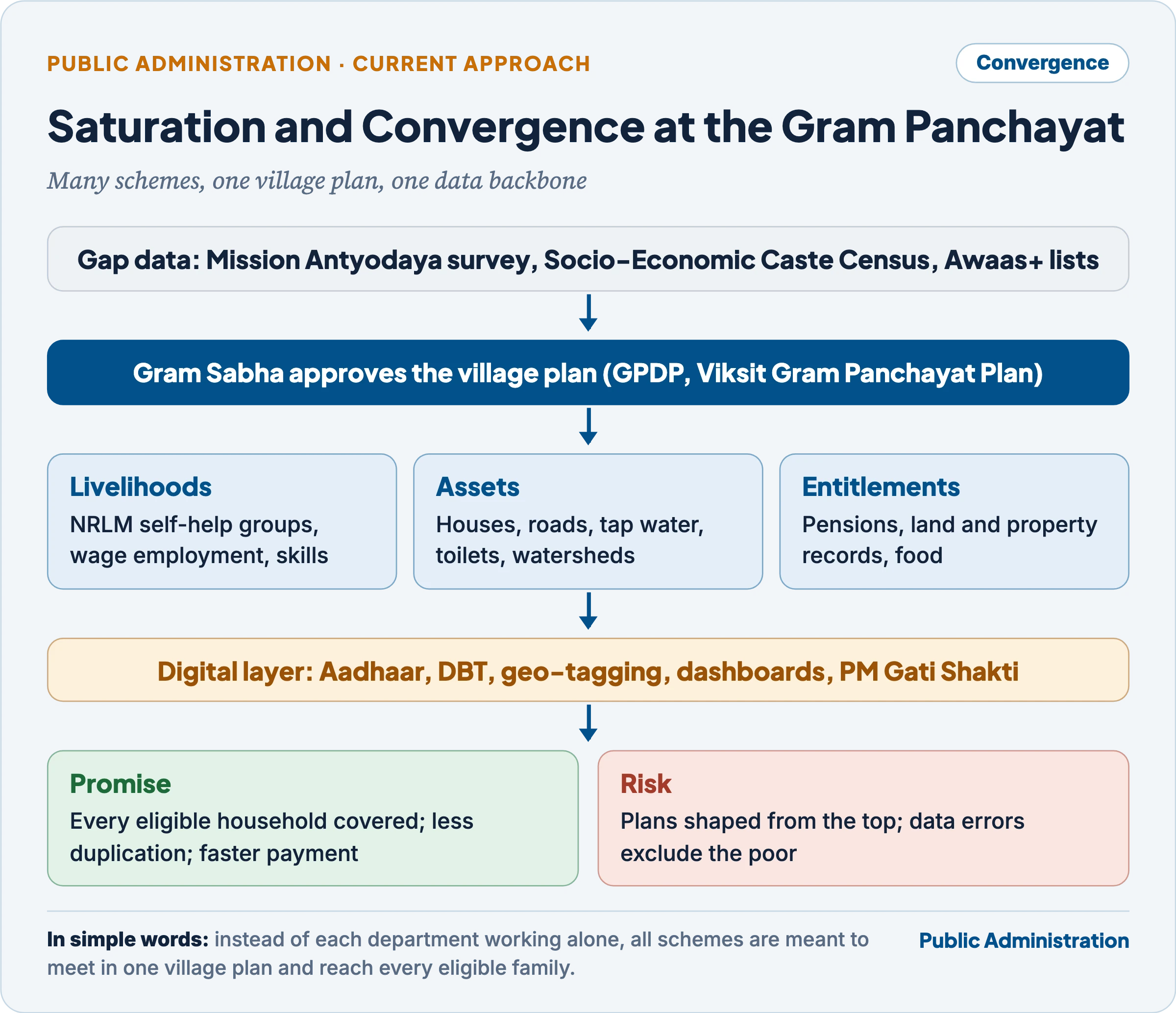
4.12 The direction of change
Read across Sections 3 and 4, three trends stand out: from areas to households to rights, from department-run schemes to institutions of the poor and panchayats, and from separate schemes to convergence and saturation.
5. Evaluation: Why Rural Development Programmes Fall Short
In simple words
Most rural schemes are well designed on paper. They go wrong in the choosing of families, in money leaking on the way, in departments not working together, in too few trained staff, and in villagers having little say. Social audits, government audits and direct payment into bank accounts are the main tools used to fix these faults.
5.1 What has been achieved
- Poverty has fallen sharply. Official rural poverty (Tendulkar method) fell from about 50 per cent in 1993–94 to about 26 per cent in 2011–12. NITI Aayog’s multidimensional poverty estimate fell from 29.17 per cent in 2013–14 to 11.28 per cent in 2022–23, with about 24.82 crore people moving out of multidimensional poverty; between 2015–16 and 2019–21 rural MPI poverty fell faster than urban (32.6 to 19.3 per cent).
- Basic infrastructure has reached most villages: all-weather roads to almost all eligible habitations, electricity, pucca houses for over 3 crore families, toilets in almost every household, tap water for over four-fifths.
- Institutions of the poor: about 10 crore women in SHGs, with access to bank credit on a scale unimaginable in the IRDP years.
- Rights and accountability: an employment guarantee for two decades, social audit, RTI and open MIS.
5.2 Persistent problems
Targeting and identification
- Inclusion and exclusion errors. BPL lists (1992, 1997, 2002 censuses) were widely manipulated; the N.C. Saxena Expert Group (2009) found large exclusion of the poorest and recommended automatic inclusion and exclusion criteria, adopted in the Socio-Economic and Caste Census, 2011. SECC lists are now fifteen years old, so newly poor households and split families are missed.
- Elite capture. Village elites and intermediaries influence beneficiary lists and contracts, especially where the Gram Sabha is weak or dominated by caste hierarchies.
Leakages and corruption
- Prime Minister Rajiv Gandhi’s often-quoted 1985 remark that only about 15 paise of every rupee reached the intended beneficiary captured the problem of the IRDP era.
- Channels of leakage: fake beneficiaries and muster rolls, inflated material bills, bribes for sanction, diversion by intermediaries, and delayed or partial payments.
- Gunnar Myrdal’s idea of the “soft state” (Asian Drama, 1968), a state that makes laws but cannot enforce discipline on its own officials and elites, explains why good schemes leaked.
Design and centralisation
- Top-down, uniform schemes. Centrally sponsored schemes with rigid norms and physical targets ignore local conditions, as the IRDP buffalo-without-fodder case showed. Theoretical perfection of a scheme is not proof of its soundness.
- Proliferation and fragmentation. Dozens of schemes, each with separate guidelines, accounts and agencies; the Sub-Group of Chief Ministers on Rationalisation of Centrally Sponsored Schemes (2015) recommended grouping them into “core of the core”, core and optional schemes with more flexibility for States.
- Populism and branding. Programmes launched with slogans before elections, renamed often, and implemented half-heartedly; frequent renaming disrupts staff and records.
Coordination and convergence
- Inter-institutional linkages. Special programmes depend on banks, line departments, DRDAs, blocks and panchayats acting together (the 1995 question); each answers to a different superior, so coordination depends on the Collector’s personality.
- Silos (see 2.7); parallel bodies outside the panchayat system; lack of a sound appraisal system: monitoring counted expenditure and physical outputs rather than outcomes such as income gains (the 1998 question).
Capacity
- Staff shortages at block and panchayat levels; VLWs and panchayat secretaries handling many villages and schemes; contractual staff with high turnover.
- Technical capacity (engineers, accountants, data operators) is thin; the 2nd ARC proposed dedicated panchayat cadres.
- Training is irregular and generic.
Participation
- Gram Sabhas meet infrequently and with low attendance, especially of women and Dalits; plans are often prepared by officials and approved as a formality.
- Bottom-up planning remains rhetoric where untied funds are small.
Credit and markets
- Banks reluctant to lend to the poor, delayed and inadequate loans, diversion of loans to consumption, absence of after-care; cooperatives charging above authorised rates (all documented in the IRDP era and partly solved by SHG–bank linkage).
Small and marginal farmers
- Programmes have not adequately addressed them (the 2018 question): Green Revolution inputs favoured large farmers; area programmes benefited landowners in proportion to land; IRDP gave them unsuitable assets; employment guarantee assets were often on common land; crop insurance and credit reach them unevenly; tenants and sharecroppers without records are excluded from most schemes.
- What would help: records of tenancy and land (DILRMP, SVAMITVA), farmer producer organisations for collective marketing, MGNREGA/VB–G RAM G works on their land, watershed development, crop diversification through SHG federations, and timely institutional credit through Kisan Credit Cards.
Fiscal and federal tensions
- Delayed central releases, State matching shares that poorer States cannot meet, and unspent balances parked in agency accounts (now addressed by the Single Nodal Agency and just-in-time release systems).
The 1988 question’s phrase “orchestration of development effort” sums up the institutional lesson: the real poor are reached only when many agencies act in concert, and Indian rural administration has been better at creating schemes than at orchestrating them.
5.3 Accountability mechanisms
- Social audit. Citizens verify records against reality in a public hearing. Pioneered by MKSS in Rajasthan in the 1990s, made mandatory for MGNREGA (s.17, Audit of Schemes Rules 2011, independent Social Audit Units, Auditing Standards issued with the CAG in December 2016), and extended to NFSA, PMAY-G, NSAP and mid-day meals. Andhra Pradesh’s SSAAT (2009) showed that independence, regularity and follow-up with recoveries and disciplinary action are what make social audits bite.
- The Meghalaya Act. The Meghalaya Community Participation and Public Services Social Audit Act, 2017 (passed on 4 April 2017) is the first State law to make social audit a general right across departments and schemes, not a scheme condition, with a State Social Audit Council and community participation in planning and grievance redress.
- Limits. Where there is no legal provision for punitive action and recovery, findings are ignored; SAUs depend on the department they audit for funds; resource persons face intimidation. Social audit complements statutory audit: it checks the ground, while the CAG checks systems and accounts, and the CAG’s audits have used social audit findings.
- CAG performance audits. The CAG’s reports on MGNREGA (2008, 2013) and on other rural schemes exposed systemic failures in planning, records and fund flow.
- Concurrent evaluation and third-party monitoring. National Level Monitors, NIRDPR and NITI Aayog’s evaluation office, impact studies by universities and research bodies.
- Grievance redress. Ombudspersons for the employment guarantee, helplines, the CPGRAMS portal, and the DISHA committees of MPs.
- Transparency tools. Proactive disclosure, citizen information boards, geo-tagged photographs, real-time dashboards, and the Right to Information Act, 2005.
5.4 DBT, JAM and digital delivery
- Direct Benefit Transfer began on 1 January 2013, transferring cash benefits straight into beneficiaries’ bank accounts. The 2014–15 Economic Survey described the JAM trinity (Jan Dhan bank accounts, Aadhaar identity, mobile phones) as the platform for disintermediated delivery.
- Legal basis. Section 7 of the Aadhaar Act, 2016 allows Aadhaar authentication as a condition for subsidies; the Supreme Court upheld it in K.S. Puttaswamy v. Union of India (Aadhaar case, 2018), while striking down private use.
- Gains. Removal of duplicate and ghost beneficiaries, faster payment, less cash handling, an audit trail, and less discretion for intermediaries. PMAY-G, NSAP, wage employment and SHG payments all now run on DBT.
- Concerns. Exclusion through authentication failures, mismatched names, inactive accounts and poor connectivity; the “last mile” problem of reaching bank points; deletions of genuine beneficiaries during clean-up drives; and the shift of grievance from a visible official to an invisible system. Digital delivery solves leakage between the state and the citizen but not errors in the list itself.
Criticism — Rural development programmes have failed the rural poor
- Benefits missed the poorest. From IRDP to housing, lists were captured by the better-off and those on the fence of the poverty line; the destitute stayed outside.
- Leakage and corruption consumed a large share of spending for decades; fake muster rolls and inflated bills survived every reform.
- Top-down design. Schemes were made in Delhi with uniform norms; people were treated as beneficiaries, not participants, and panchayats as executing agencies.
- Assets without livelihoods. Roads, houses and toilets were built, but rural incomes, farm earnings and non-farm jobs grew slowly; roads moved workers out of farming without raising consumption much.
- Fragmentation. Dozens of overlapping schemes, parallel agencies and weak coordination diluted impact.
- Rights diluted. Demand-driven entitlements were rationed by budgets, delayed wages and technology failures.
Defence — The programmes have transformed rural India, if unevenly
- Measured gains. Rural poverty, by both income and multidimensional measures, has fallen steeply; roads, houses, water, toilets and electricity now reach most households.
- Learning by doing. Each phase corrected the previous one: CDP’s failure produced Panchayati Raj; IRDP’s failure produced SHGs and NRLM; leakages produced social audit and DBT.
- Institutions of the poor. Ten crore organised women and the SHG–bank linkage are a durable change in rural power and credit.
- Rights and accountability. The employment guarantee, Right to Food orders, RTI and social audit changed the relationship between rural citizens and officials.
- Failures are of implementation, not intent. Where States invested in staff, independent audit and community institutions (Kerala, Andhra Pradesh, Tamil Nadu), the same schemes worked well.
Theory lens: why rural programmes succeed or fail
- Development administration. The term is credited to U.L. Goswami (1955) and was developed by Edward Weidner and Fred Riggs, who defined it as goal-oriented, change-oriented administration that carries out programmes of economic and social progress. The CDP was India’s first conscious experiment in it; the gap between its aims and the routine-minded bureaucracy that ran it shows the problem Weidner called the need for an “administration of development” alongside the “development of administration”. See the article on Development Administration: Concept, Changing Profile and the Anti-Development Thesis.
- Riggs’ prismatic society. In Administration in Developing Countries (1964) Fred Riggs described formalism (a gap between prescribed norms and actual behaviour), heterogeneity and overlapping of modern and traditional roles. Gram Sabhas that exist on paper, beneficiary lists shaped by caste and kinship, and subsidies traded in a “bazaar–canteen” market of influence are classic prismatic features of Indian rural administration. See the article on Riggsian Models and their Critique.
- Top-down versus bottom-up implementation. Jeffrey Pressman and Aaron Wildavsky (Implementation, 1973) showed how the probability of success falls as the number of clearance points rises; an IRDP loan needed the block, DRDA, bank, line department and supplier to agree. Michael Lipsky (Street-Level Bureaucracy, 1980) showed that front-line workers (the VLW, the Gram Rozgar Sahayak, the bank clerk) make policy in practice through their discretion, coping with heavy workloads by rationing and routinising. Bottom-up theorists argue that programmes should be designed from the field upward. See the article on The Policy Process: Conceptualisation, Planning, Implementation, Monitoring, Evaluation and Review.
- Participatory development. Robert Chambers (Rural Development: Putting the Last First, 1983; Whose Reality Counts?, 1997) criticised “rural development tourism” and the spatial, project, person and seasonal biases that keep officials from seeing the poorest, and promoted participatory rural appraisal. GPDP, People’s Plan Campaigns and Gram Sabha-approved plans apply his ideas; their formalism shows how hard it is.
- Rights-based approach and capabilities. Amartya Sen (Development as Freedom, 1999) defines development as expanding capabilities; rights-based law (employment guarantee, food security, forest rights) turns benefits into enforceable claims, shifting accountability from patronage to law, a shift tested again by the normative-allocation design of the VB–G RAM G Act.
- NPM, targeting and DBT. New Public Management, as described by Christopher Hood (1991), stresses performance targets, output measurement, agencies and contracting. DRDAs and State missions as agencies, dashboards and rankings (Aspirational Blocks) as performance management, and DBT as disintermediation are NPM tools; in principal–agent terms, DBT and geo-tagging reduce the agent’s (intermediary’s) information advantage. Their risk is “hitting the target and missing the point”. See the article on New Public Management and After: New Public Service, New Public Governance and Digital-Era Governance.
- Social capital. Robert Putnam (Making Democracy Work, 1993) showed that dense networks of trust and civic association make institutions perform. SHG federations build bonding capital among poor women and bridging capital to banks and panchayats; where social capital is weak or fragmented by caste, the same programmes are captured.
- Legibility and digital governance. James C. Scott (Seeing Like a State, 1998) warned that states simplify complex local realities to make them legible, often harming those who do not fit the categories. SVAMITVA maps, ULPINs, SECC lists and Aadhaar seeding make rural India legible to the state, with gains in delivery and risks of exclusion.
6. The Current Approach: Saturation, Convergence and Digital Public Infrastructure
In simple words
Today the government tries to give every eligible family a house, tap water, a toilet, a bank account and a pension, and checks this village by village. All schemes are supposed to come together in one village plan approved by the Gram Sabha, with computers and phones used to track every rupee and every house.
6.1 Features of the current approach
- Saturation. The aim is 100 per cent coverage of eligible households rather than a fixed number of beneficiaries per block. Saturation removes the discretion of choosing “who gets it this year”, a major source of patronage, and reduces exclusion. Campaigns such as the Viksit Bharat Sankalp Yatra (November 2023 to January 2024) took scheme enrolment to every panchayat.
- Convergence at the Gram Panchayat. The GPDP (from 2015) and the annual People’s Plan Campaign (from 2 October 2018), Mission Antyodaya gap reports, and now the Viksit Gram Panchayat Plans of the VB–G RAM G Act all make the panchayat the meeting point of schemes; PMAY-G houses come with employment guarantee wages, an SBM toilet, a JJM tap and an LPG connection.
- Area-based outcome monitoring. Aspirational Districts and Blocks rank areas on outcomes and push convergence through competition.
- Digital public infrastructure. Aadhaar and DBT, e-GramSwaraj for panchayat accounts, geo-tagging and drone mapping, PM Gati Shakti geospatial layers for planning, scheme MIS and dashboards, and the proposed Land Stack and Rural Infrastructure Stack.
- Institutions of the poor as partners. SHG federations deliver services (banking, drone spraying, nutrition, sanitation) and participate in panchayat planning.
- Missions with deadlines. Time-bound missions (JJM to 2028, PMAY-G to 2029) with political ownership at the highest level.
6.2 Strengths and risks
| Strengths | Risks |
|---|---|
| Ends rationing of benefits; fewer patronage choices | Targets still set from above; panchayat plans become formalities |
| Convergence of schemes on one household | Departments still keep separate budgets and MIS |
| Real-time data and audit trails | Data errors and authentication failures exclude the poorest |
| Faster, direct payments | Grievance redress weak when “the system” rejects a claim |
| Time-bound missions with political will | Assets built without maintenance (taps without water, toilets without use) |
| Clear outcome indicators | Focus on countable outputs over income, dignity and voice |
The current approach is in many ways the synthesis of seventy years of lessons: CDP’s whole-village idea (convergence), IRDP’s household focus (now universal rather than selective), the rights approach (guarantees), NRLM’s institutions of the poor, and NPM’s measurement. Whether it becomes decentralised convergence (panchayats deciding, schemes supporting) or centralised convergence (Delhi dashboards deciding, panchayats executing) is the key administrative question of the next decade.
6.3 Decentralisation and Panchayati Raj: a note
Rural development and local self-government grew together.
- The failure of the Community Development Programme led the Balwantray Mehta Study Team (1957) to recommend three-tier Panchayati Raj.
- The Asoka Mehta (1978), G.V.K. Rao (1985) and L.M. Singhvi (1986) committees sought to revive it.
- The 73rd Constitutional Amendment (1992) gave panchayats constitutional status, with the Eleventh Schedule listing 29 subjects, most of them rural development functions.
How far panchayats have become institutions of self-government rather than agents of schemes is discussed in the article on Panchayati Raj and the 73rd Amendment: Decentralisation in Rural India; district and decentralised planning are covered in the articles on Decentralised Planning after the 73rd and 74th Amendments and on District Administration, Democratic Decentralisation and Union–State–Local Relations.
Can a rural development strategy succeed without panchayats? Experience says rarely. CDP failed for want of people’s institutions; IRDP’s lists were captured when Gram Sabhas were weak; MGNREGA worked best where Gram Panchayats planned and Gram Sabhas audited; Kerala’s and Hiware Bazar’s successes rested on strong local government. Panchayats supply local knowledge, legitimacy, beneficiary verification, asset maintenance and accountability, which no department can supply from outside.
Key Terms
The terms below recur in rural development administration.
| Term | Meaning in simple words |
|---|---|
| Rural development | Planned improvement of the incomes, assets, services, rights and institutions of rural people, especially the poor |
| Extension | Taking new knowledge and practices from experts to farmers and villagers through field workers |
| Block | Sub-district unit of about 100 villages created for development administration in 1952 |
| VLW / Gram Sevak | Village level worker; multipurpose extension worker at the bottom of the block team |
| DRDA | District Rural Development Agency; registered society that ran anti-poverty schemes (1980–2022), now merged into Zilla Parishads |
| Target group approach | Identifying poor households and giving them help directly |
| Area development | Treating a backward or fragile region as the unit for development works |
| Self-employment programme | Gives the poor assets, credit and training to run their own enterprise |
| Wage employment programme | Gives the poor paid manual work on public works |
| Self-targeting | A benefit designed so that only the needy choose to take it, such as manual work at a basic wage |
| Rights-based approach | Making benefits legal entitlements that citizens can claim and enforce |
| Normative allocation | Funds given to each State by a formula fixed in advance, rather than in response to actual demand |
| Social audit | Public verification of records and works by the community, with findings read out in the Gram Sabha |
| SHG | Self-help group of 10–20 women who save, lend among themselves and borrow from banks |
| Federation | Higher-level body of SHGs: village organisation, cluster level federation |
| Convergence | Bringing several schemes together on the same place, household or plan |
| Saturation | Covering every eligible household rather than a fixed number |
| DBT | Direct Benefit Transfer: cash paid straight into the beneficiary’s bank account |
| JAM | Jan Dhan accounts, Aadhaar and mobile phones as the platform for digital delivery |
| SECC | Socio-Economic and Caste Census 2011, used to identify deprived households |
| ULPIN | Unique Land Parcel Identification Number; 14-digit “Bhu-Aadhaar” for each land parcel |
| Watershed | Area draining to a common point, used as the unit for soil and water conservation |
| ODF Plus | A village that stays open-defecation-free and manages solid and liquid waste |
| Elite capture | Local powerful people taking a programme’s benefits meant for the poor |
| Leakage | Loss of funds or benefits between the government and the intended beneficiary |
| Viksit Gram Panchayat Plan | Gram Sabha-approved village plan under the VB–G RAM G Act, aggregated upward and linked to PM Gati Shakti |
Commissions, Committees and Judgments
The table lists the bodies, reports, laws and cases that shaped rural development administration.
| Body / case | Year | Key point |
|---|---|---|
| Grow More Food Enquiry Committee (V.T. Krishnamachari) | 1952 | Food output needs all-round village development; national extension service, leading to the CDP |
| Balwantray Mehta Study Team (Balwantray Mehta) | 1957 | CDP and NES lacked people’s participation; democratic decentralisation through three-tier Panchayati Raj |
| Working Group on Inter-departmental and Institutional Coordination (Ram Subhag Singh) | 1963 | Coordination of agencies for agricultural production at district and block |
| All India Rural Credit Review Committee (B. Venkatappiah) | 1969 | Special agencies for small farmers, leading to SFDA |
| Working Group on Rural Banks (M. Narasimham) | 1975 | Regional Rural Banks combining local feel and bank resources |
| Working Group on Block Level Planning (M.L. Dantwala) | 1978 | Block as the unit of planning for the rural poor |
| CRAFICARD (B. Sivaraman) | 1979 | Single apex bank for rural credit, leading to NABARD (1982) |
| Working Group on District Planning (C.H. Hanumantha Rao) | 1984 | District planning bodies; decentralised planning for rural development |
| CAARD (G.V.K. Rao) | 1985 | Bureaucratisation of rural development, “grass without roots”; Zilla Parishad as main agency |
| Technical Committee on DPAP and DDP (C.H. Hanumantha Rao) | 1994 | Watershed approach with community participation; 1995 guidelines |
| Committee on Rural Development Programmes (S.R. Hashim) | 1997 | Single self-employment programme with SHGs, leading to SGSY (1999) |
| Technical Committee on Watershed Programmes (S. Parthasarathy) | 2006 | Common Guidelines 2008; IWMP |
| 2nd ARC, Sixth Report: Local Governance (Veerappa Moily) | 2007 | Merge DRDAs into Zilla Parishads; activity mapping; panchayat cadres |
| Expert Group on BPL Census Methodology (N.C. Saxena) | 2009 | Automatic inclusion and exclusion criteria; basis of SECC 2011 |
| CAG Report No. 6 of 2013 on MGNREGA | 2013 | Fall in days per household; poorest States used little of the funds; weak records and plans |
| Sub-Group of Chief Ministers on Rationalisation of CSS (Shivraj Singh Chouhan) | 2015 | Core of the core, core and optional schemes; more State flexibility |
| Olga Tellis v. Bombay Municipal Corporation | 1985 | Right to livelihood is part of the right to life (Article 21) |
| PUCL v. Union of India (Right to Food) | 2001 onwards | Interim orders turned food schemes into legal entitlements; Commissioners to monitor |
| Swaraj Abhiyan v. Union of India | 2016 | Drought-hit States must implement MGNREGA, NFSA and relief fully |
| Swaraj Abhiyan v. Union of India | 2018 | Wages within a fortnight; Union cannot escape liability for delays after fund transfer orders |
| K.S. Puttaswamy v. Union of India (Aadhaar) | 2018 | Section 7 of the Aadhaar Act upheld for subsidies and benefits |
| NREGA (MGNREGA) | 2005 | Legal right to 100 days of work; social audit (s.17); repealed 1 July 2026 |
| Meghalaya Community Participation and Public Services Social Audit Act | 2017 | First State law making social audit a general right across schemes |
| VB–G RAM G Act (Act 36 of 2025) | 2025 | 125-day guarantee; Viksit Gram Panchayat Plans; 60:40 funding; in force 1 July 2026 |
Contemporary Developments
- 20 December 2025 and 1 July 2026: the VB–G RAM G Act, 2025 received assent and, after notification on 11 May 2026, came into force on 1 July 2026, repealing MGNREGA; all States and UTs notified their schemes, and rules notified on 1 July 2026 require wages to be paid only by DBT through the Aadhaar payment system and govern the transition of MGNREGA liabilities and spending beyond the normative allocation.
- 10 March 2026: the Cabinet extended the Jal Jeevan Mission to December 2028 as JJM 2.0 (outlay ₹8.69 lakh crore), shifting from infrastructure to service delivery, with the Sujalam Bharat digital framework; about 15.8 crore rural households (82 per cent) had tap connections.
- February and August 2026: under DAY-NRLM, about 10.08 crore women were organised in 92.3 lakh SHGs; the Lakhpati Didi target was raised to 6 crore by March 2029 after the 3-crore target was met early.
- July 2026: PMAY-G had sanctioned about 3.92 crore and completed about 3.1 crore houses towards the 4.95 crore target for March 2029.
- 10 September 2026: operational guidelines of DILRMP 3.0 (2026–31), a ₹565.50 crore central sector scheme, were launched, with a GIS-based Land Stack, universal ULPIN (about 69 per cent of parcels covered by August 2026), computerised revenue courts and the NAKSHA urban pilot.
- August 2026: SVAMITVA drone surveys covered about 3.3 lakh villages, with 3.24 crore property cards prepared; an IIM Ahmedabad evaluation recorded bank loans taken against the cards.
- 1 May 2025: under “One State, One RRB”, Regional Rural Banks were amalgamated from 43 to 28.
- December 2025 and September 2026: PMGSY had completed about 7.88 lakh km of rural roads, with PMGSY-IV (2024–29) under way; under SBM-G Phase II, about 5.69 lakh villages were ODF Plus.
Revision Grid
The grid links thinkers and bodies to the ideas used in this article.
| Thinker / body | Work or report (year) | Key idea |
|---|---|---|
| World Bank | Rural Development Sector Policy Paper (1975) | Rural development as a strategy for the rural poor |
| Robert Chambers | Rural Development: Putting the Last First (1983) | Poor to demand and control benefits; biases of outsiders; PRA |
| Chambers and Gordon Conway | Sustainable rural livelihoods (1992) | Livelihood as a portfolio of capitals; basis of NRLM design |
| Amartya Sen | Development as Freedom (1999) | Capabilities; basis of rights-based approach |
| T.N. Chaturvedi | Writings on rural development administration | Rural development as balanced, integrated development |
| Nilakantha Rath | EPW article on IRDP (1985) | Asset-based self-employment misconceived for the poorest |
| Fred Riggs | Administration in Developing Countries (1964) | Formalism and prismatic administration |
| Edward Weidner; U.L. Goswami | Development administration (1955 onwards) | Goal-oriented, change-oriented administration |
| Pressman and Wildavsky | Implementation (1973) | Many clearance points reduce chances of success |
| Michael Lipsky | Street-Level Bureaucracy (1980) | Front-line staff make policy through discretion |
| Gunnar Myrdal | Asian Drama (1968) | “Soft state” unable to enforce its own laws |
| Robert Putnam | Making Democracy Work (1993) | Social capital makes institutions work |
| James C. Scott | Seeing Like a State (1998) | State simplification and legibility |
| Christopher Hood | “A Public Management for All Seasons?” (1991) | NPM: targets, agencies, output measurement |
| Balwantray Mehta Study Team | Report (1957) | Democratic decentralisation after CDP’s failure |
| CAG | Report No. 6 of 2013 | MGNREGA’s implementation did not track poverty |
| S.R. Hashim Committee | Report (1997) | Single SHG-based self-employment programme |
| 2nd ARC | Sixth Report, Local Governance (2007) | DRDA merger; activity mapping; local cadres |
| Sam Asher and Paul Novosad | American Economic Review (2020) | Rural roads shift labour out of farming; small income gains |
Previous Year Questions
- 2026Disconnect between the rural development institutions and state level agencies have led to each operating in silos at both levels resulting in inefficiencies. Find the reasons.
- 2025Examine the significance of field organizations in enhancing policy implementation of projects like MGNREGA and Swachh Bharat Mission.
- 2023“Mission Antyodaya strives to realize the vision of poverty-free India.” Examine.
- 2023The Swachh Bharat Abhiyan is by far the most significant cleanliness campaign by the Government of India. Comment.
- 2023Shyama Prasad Mukherji Rurban Mission is a cluster-based approach of converging rural development efforts of different departments of the government. Comment.
- 2021No rural development strategy can succeed unless it is complemented by appropriate Panchayati Raj Institutions. Examine the statement.
- 2021Rural development programmes are designed to facilitate multifaceted growth of rural poor. Evaluate the role of some key rural development programmes in India in this context.
- 2019All weather rural connectivity scheme to even unconnected rural habitations has the potential to transform the rural economy. Do you agree? Justify.
- 2018“Rural development programmes have failed to effectively address the problems of small and marginal farmers.” Analyse and give suggestions.
- 2018“Social audit has lent a critical edge to the implementation of programmes such as MGNREGA.” Comment.
- 2017”Digitalization of land records is a necessary but not sufficient precondition for ensuring transparent district administration.” Explain.
- 2016“The growing prominence of NGOs in development areas is strongly related to the declining legitimacy of the State.” Explain.
- 2014“Social auditing of flagship programmes of the Central government facilitates the performance of the Comptroller and Auditor-General.” Elaborate the statement with appropriate examples.
- 2013“Self-Help Groups (SHGs) have contributed to a change in the role of rural women in development – from symbolic participation to empowerment.” Discuss.
- 2010“Non – Governmental Organisations play a catalytic role in enabling communities to define their own priorities…….” Comment.
- 2008What are the basic hurdles and pitfalls in the implementation of the National Rural Employment Guarantee Act?
- 2004“The special development programmes taken up for poverty alleviation with a hope that benefits of these programmes may reach to the people living below poverty line – have utterly failed to achieve its objectives.” Comment.
- 2002“Women’s development programmes of recent have shifted from welfarist approach to empowerment of women.” – Elaborate.
- 2002“The machinery for welfare administration at the national and state level trickling down to grassroots becomes meaningless in the context of global constitutionalism.” Discuss.
- 2002“Rural and urban development programmes have gained in importance, but implementation has been a failure.” Comment.
- 2001“Despite the serious commitment on the part of the government, the benefits of the rural development programmes do not seem to reach the intended targets and they fail to serve fully the purpose for which they were intended.” Elucidate.
- 1999“The failure of I.R.D.P. is attributed to its over-powering centralized approach.” Comment.
- 1998“Rural development programmes in India suffer from lack of co-ordination and a sound appraisal system.” Comment.
- 1997“The District Rural Development Agency is presently serving as the nodal agency of rural development at the district level.” Explain.
- 1995“In rural development, people are the starting point centre and end goal of all development programmes.” Comment.
- 1995“Special development programmes seek to solve special problems, but their successful implementation depends on complex inter-institutional linkages.” Comment.
- 1995“The emphasis in women’s development programmes has in recent years shifted from a purely welfare and consumption oriented one to a realistic one which recognizes women as contributors to the country’s economy.” Elaborate.
- 1994“The resource base and the social and cultural heritage of our Scheduled Tribe population is getting eroded through a combinations, commercial exploitation and ineffective legal and administrative systems.” Comment.
- 1993Attempt an evaluation of various welfare programmes, sponsored by the Central and State governments and district level agencies, for the development of women and children, accounting for their success or failure.
- 1993“A holistic approach to Integrated Rural Development implies strengthening and regulating the sectoral and spatial interactions and linkages and transformation of the rural habitat.” Comment.
- 1991‘Welfare and development administration calls for qualities different from law and order administration.’ Examine, in the light of this statement, the crucial issues in tribal welfare and development administration, highlighting the role of the Government agencies involved in it.
- 1989Evaluate the administrative experience of Rural Development Schemes or Programmes in the area of Social Justice during last two decades. What role should the voluntary agencies play in the administration of Social welfare to ameliorate the conditions of women in the villages?
- 1988Identify the major inadequacies in the administration of the welfare programmes of the weaker sections. Suggest effective strategies and proper implementation and to enhance beneficiary faction.
- 1988“The rural development programs have helped only those who are on the fence of the poverty line. The ‘guest schemes’ have lots of organisational overlap and the lack of ‘orchestration of development effort’ has pushed the ‘real poor’ into a state of destitution,.” Comment.
- 1987‘The administrative problems of Integrated Rural Development Problem include the most fatal but common cold of public administration-the sheer difficulty of doing ordinary things.’ Comment.
- 2024Strengthening social audit through appropriate ways will promote inclusive government. Comment.
- 2022Social auditing is not just saving the money, it creates positive impact on governance. Comment.
- 2019In a society marked by social inequity and gender inequality women self-help groups are bound to play a marginal role. Do you agree? Give reasons for your answer.
- 2016“In spite of certain advantages, Social Audit arrangements have mostly been ineffective because there is no legal provision for punitive action.” Comment.
- 2016“Self-Help Groups are considered as one of the most significant tools to adopt participatory approach for economic empowerment of women.” Comment.
- 2014“Self-help groups have not only empowered women, but have also brought about attitudinal change among all stakeholders towards women development.” Discuss.