

Municipal governance: main features, structures, finance and problem areas; 74th Constitutional Amendment; Global-local debate; New localism; Development dynamics, politics and administration with special reference to city management.
This article: Municipal governance: urbanisation and the case for city government; evolution from the Madras Corporation (1688) to the National Commission on Urbanisation (1988); the 74th Constitutional Amendment Act, 1992 (Part IXA, Articles 243P–243ZG, Twelfth Schedule, mandatory and voluntary provisions, judgments); main features and structures (types of urban local bodies, deliberative and executive wings, commissioner, Mayor-in-Council and elected-mayor models, parastatals, Smart City SPVs, cantonment boards, ward committees and area sabhas, municipal personnel); municipal finance (own revenue, property tax, user charges, GST, State and Union Finance Commission transfers, 15th and 16th Finance Commission grants, municipal and green bonds, RBI reports); problem areas (CAG compendium 2024); reforms (JNNURM, AMRUT, Smart Cities Mission, SBM-U, PMAY-U, 2nd ARC, municipal cadre, e-governance, Swachh Survekshan, Urban Challenge Fund, the 2026 split of MoHUA); theory lens.
Official Syllabus: Paper II · Unit 2-12 Urban Local Government
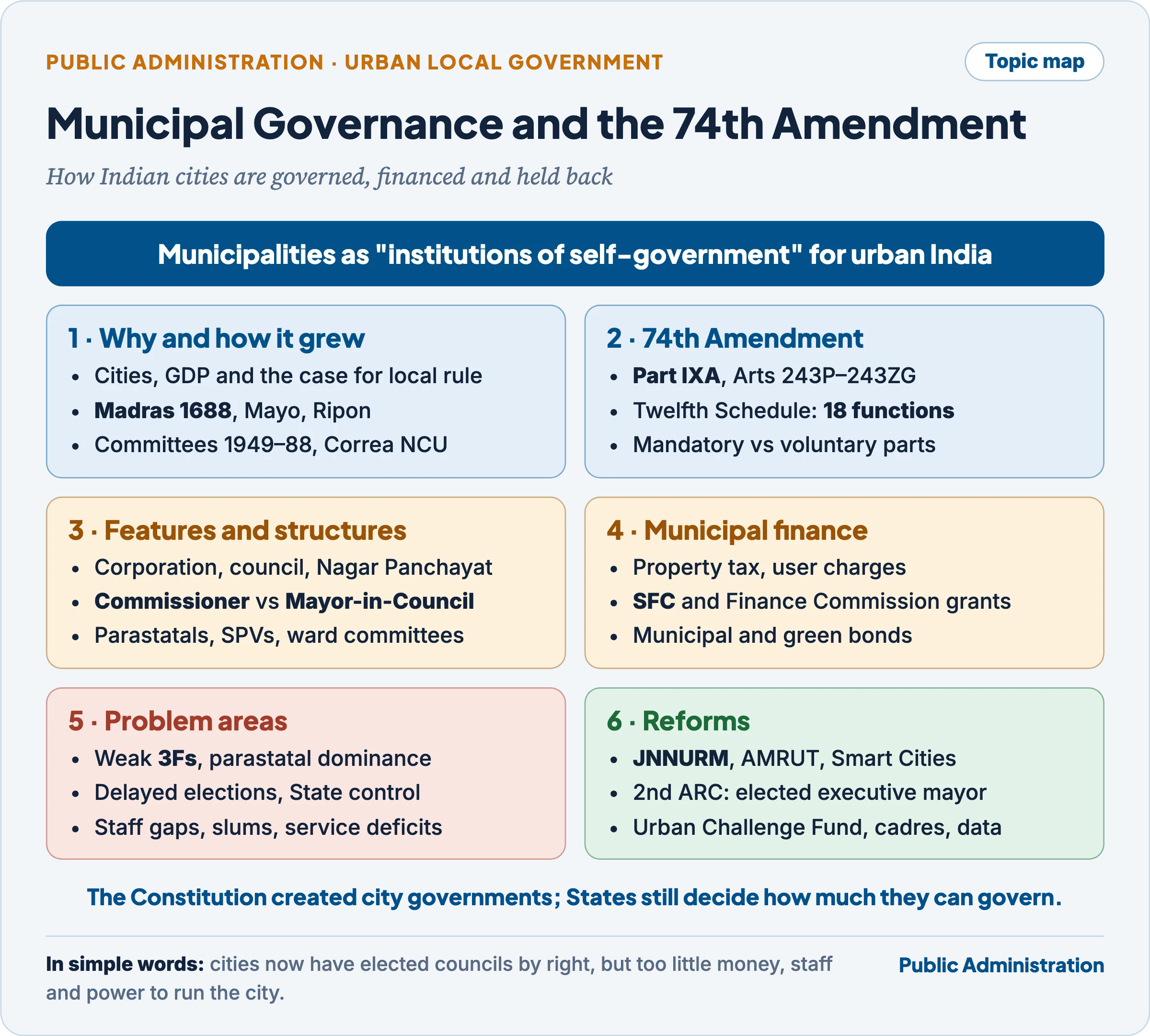
Municipal governance is the government of towns and cities by their own elected bodies: municipal corporations, municipal councils and Nagar Panchayats. These bodies supply the services people use every day (water, drains, roads, street lights, garbage removal, birth and death certificates, building permits), and they are meant to be the level of democracy closest to the urban citizen. India’s cities produce most of its national income, yet for most of the twentieth century their councils were weak, often suspended, and starved of money. The 74th Constitutional Amendment Act, 1992 gave them constitutional status, guaranteed elections and representation, and created State Finance Commissions to fund them. Three decades later, the central question is how far this constitutional promise has turned into real city government.
In simple words
Think of a large housing society. If the residents elect a committee but the builder keeps the keys, the accounts and the staff, the committee can hold meetings but cannot fix a leaking pipe. Many Indian cities are in this position: they elect councils, but the State government, its officers and its boards hold most of the keys.
1. Urbanisation and the Idea of Municipal Government
In simple words
More and more Indians live in towns. A town needs services that a village can do without, and it needs someone local to run them and answer for them. That “someone” is the municipality. This section explains why cities matter and why they should govern themselves.
1.1 Urban India in numbers
- Scale. The Census of 2011 counted 377 million urban residents, 31.16 per cent of the population, living in 7,933 towns: 4,041 statutory towns (with a municipal body) and 3,892 census towns (urban in character but still governed as villages). The next Census has a reference date of 1 March 2027.
- Number of bodies. The Local Government Directory listed 4,979 urban local bodies (ULBs) in November 2024: 253 municipal corporations, 2,187 municipal councils, 2,107 Nagar Panchayats and 432 other bodies (cantonment boards, notified area and town area committees and similar).
- Urban growth. The 16th Finance Commission projected India’s urbanisation at about 40.7 per cent by 2031. Urban India is commonly estimated to produce around three-fifths of GDP.
- Slums. The 2011 Census counted about 65 million people in slums in 2,613 towns, roughly one in six urban households.
- Census towns. Thousands of settlements are urban by population, density and occupation but have only a Gram Panchayat. They grow without building rules, drains or planning, which is why the 16th Finance Commission created an urbanisation premium to reward their merger into municipalities (Section 5.6).
1.2 What municipal government means
- Local self-government: the management of a locality’s affairs by a body elected by its residents, with its own powers, funds and staff, under the law of the State.
- Statutory, not sovereign. A municipality is created by a State Act (or an Act of Parliament for a Union Territory). It has no inherent powers; it exercises only those the law grants. Since 1993 its existence, elections and composition are guaranteed by Part IXA of the Constitution, but its powers and money still depend on State law.
- Constitutional entry. “Local government”, including the constitution and powers of municipal corporations and improvement trusts, is Entry 5 of the State List (Seventh Schedule). “Economic and social planning” is Entry 20 of the Concurrent List. Unlike Panchayats, for which Article 40 (a Directive Principle) asks the State to organise village panchayats, the original Constitution gave no direction about urban bodies.
1.3 Why cities should govern themselves: the values of local government
The case for municipal government rests on several arguments, some democratic and some economic.
- Democracy and political education. Local bodies train citizens and leaders in self-rule. Lord Ripon’s Resolution of 1882 valued them chiefly “as an instrument of political and popular education”, above administrative efficiency; J.S. Mill, the English liberal philosopher, in Considerations on Representative Government (1861), called local institutions the school of free government.
- Proximity and responsiveness. The “government next door” knows which drain floods and which street is dark. Citizens can reach a councillor more easily than an MLA or a Secretary in the State capital.
- Efficiency in matching services to preferences. Wallace Oates, the American public-finance economist, in Fiscal Federalism (1972), stated the decentralisation theorem: a public service whose benefits are local should be provided by the lowest level of government that covers those benefits, because it can match quantity and quality to local tastes.
- Benefit linkage and accountability. When people pay a property tax or water charge to a body they elect, they can see what they get for it. The link between tax and service, weak in distant governments, is strongest locally.
- Coordination of the urban environment. Land use, roads, water, sewerage and waste are interdependent; one body responsible for an area can coordinate them better than many departments.
- Equity and inclusion. Reservation for women, Scheduled Castes and Scheduled Tribes brings excluded groups into decision-making about their own neighbourhoods.
Common confusion
Is a municipality a “government” or only a service agency of the State? Before 1993, most State laws treated municipalities as local authorities that delivered civic services under State supervision. Article 243W now describes them as “institutions of self-government“, and Article 243P gives them a constitutional definition. They are therefore a third tier of government in constitutional language, but not a sovereign tier: they have no legislative list of their own, and their functions, taxes and staff are still decided by State law. Scholars describe this as “constitutional status without constitutional powers”.
2. Evolution of Urban Local Government in India
In simple words
City councils are old in India; the first was set up in Madras more than three hundred years ago. But for most of that time they were either controlled by British officials or, after 1947, neglected and suspended by State governments. Constitutional protection came only in 1993.
2.1 Before 1947 (in brief)
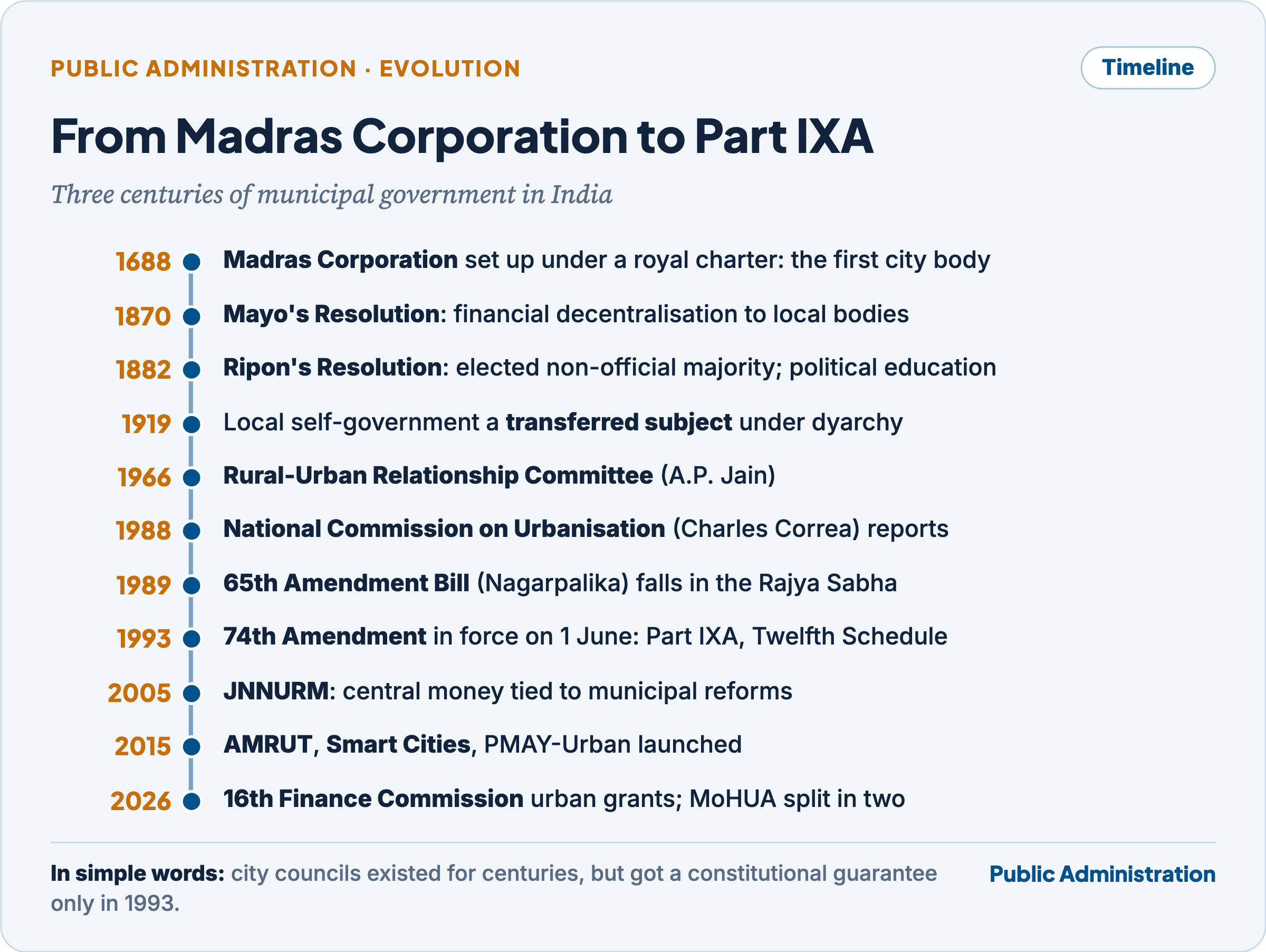
- Madras Corporation (1688). Set up under a charter of the East India Company’s directors in 1687 and constituted in 1688, it was the first municipal body in India, created largely to shift the cost of local administration onto residents. Mayor’s Courts were set up in Madras, Bombay and Calcutta by the Charter of 1726.
- Nineteenth-century Acts. An Act of 1842 for Bengal and the Act of 1850 for all British India allowed towns to form committees for sanitation and conservancy, financed by local taxes. Members were mostly nominated officials.
- Lord Mayo’s Resolution (1870) decentralised finance to the provinces and encouraged municipal bodies to take over local functions with local funds.
- Lord Ripon’s Resolution (18 May 1882), the “Magna Carta of local self-government“, proposed elected non-official majorities (officials not more than one-third), non-official chairmen where possible, local control over local funds, and outside control that advised rather than commanded. It was diluted by bureaucratic resistance and by Lord Curzon.
- Royal Commission on Decentralisation (1907–09), chaired by C.E.H. Hobhouse, found local bodies weak because of official control, narrow franchise and meagre resources, and recommended elected majorities and elected chairmen; the Resolution of 1915 and the Resolution of 1918 carried some of this forward.
- Government of India Act, 1919 made local self-government a transferred subject under an Indian minister in the provinces (dyarchy); franchise widened and elected chairmen spread. The 1935 Act kept it a provincial subject but earmarked no taxes for local bodies.
- For the colonial story in detail, including the Ripon and Decentralisation Commission debates, see the article on Legacy of British Rule: Indianisation of Services, Revenue, District and Local Self-Government.
2.2 1947 to 1992: neglect, committees and parastatals
After Independence, States enacted municipal laws of their own (for example the Uttar Pradesh Nagar Mahapalika Adhiniyam, 1959, a general Act that created corporations for Kanpur, Agra, Varanasi, Allahabad and Lucknow), but city government declined for four reasons.
- No constitutional guarantee. Elections were postponed for years; supersession (replacing the elected council with a State-appointed administrator) was routine. Some corporations went over a decade without councils.
- Parastatal takeover. States created single-purpose agencies outside the councils: improvement trusts (Bombay 1898, Calcutta 1911), development authorities (the Delhi Development Authority, 1957; Calcutta Metropolitan Development Authority, 1970; MMRDA, 1975; Bangalore Development Authority, 1976), water and sewerage boards and housing boards. They were funded and controlled by the State and answerable to it, not to citizens.
- Starved finances. Taxes such as octroi and property tax were inelastic, poorly collected and often controlled by State approvals.
- Rural bias. Planning and politics focused on villages; urban bodies had no counterpart to the Community Development or Panchayati Raj movements.
The Union government responded with a series of committees, most acting through the Central Council of Local Self-Government (set up in 1954 under Article 263).
| Committee / commission | Year | Chair | Main contribution |
|---|---|---|---|
| Local Finance Enquiry Committee | 1949–51 | P.K. Wattal | Widen municipal taxation; local bodies that do not use their own taxes have no claim on State funds |
| Taxation Enquiry Commission | 1953–54 | John Matthai | Reserve certain taxes exclusively for local bodies |
| Committee on the Training of Municipal Employees | 1963–65 | Nur-ud-din Ahmed | Training institutes at Union and State levels; led to the Centre for Training and Research in Municipal Administration at IIPA (1966) |
| Committee of Ministers on Augmentation of Financial Resources of ULBs | 1963 | Rafiq Zakaria | ULBs were not levying even assigned taxes; statutory urban development boards |
| Rural-Urban Relationship Committee | 1963–66 | A.P. Jain | Comprehensive review of personnel, finance and planning; merge small town area committees with Panchayati Raj; municipal finance corporations |
| Committee on Service Conditions of Municipal Employees | 1965–68 | (Central Council committee) | State-wide municipal cadres |
| Committee on Budgetary Reform in Municipal Administration | 1974 | Girijapati Mukharji | Modernise municipal budgets and accounts |
| Study Group on Constitution, Powers and Laws of ULBs and Municipal Corporations | 1982 | K.N. Sahaya | Metropolitan government above municipal bodies in big cities |
| National Commission on Urbanisation | 1985–88 | Charles Correa | First holistic review of urbanisation; reported in August 1988 |
The table shows a recurring pattern: almost every committee diagnosed the same three problems (finance, personnel and State control) and none had the authority to force States to act. That gap is what the constitutional amendment of 1992 tried to close.
2.3 The National Commission on Urbanisation (1988)
- Appointed by the Rajiv Gandhi government with the architect Charles Correa as chairman, the NCU submitted an interim report in 1987 and its final report in August 1988.
- It warned that the urban population would more than double in two decades and that cities had become “parasites” seeking subsidies instead of “generators of wealth”.
- Recommendations:
- A restructured Ministry of Urban Development as the nodal ministry for urbanisation, and a National Urbanisation Council to frame and monitor policy.
- Identification of GEMs (Generators of Economic Momentum) and SPURs (Spatial Priority Urban Regions) to spread urban growth beyond the metros.
- An Indian Council for Citizens’ Action to encourage voluntary effort, and an urban community development department in every town above 50,000.
- A “New Deal for the Urban Poor” with thirteen action points, and two-tier metropolitan government for very large cities.
- Its ideas on stronger, democratic and adequately financed city governments fed directly into the Nagarpalika Bill.
- Ministry history. Urban affairs were first handled by the Ministry of Health; a Ministry of Urban Development was created in 1985. It was later split into Urban Development and Urban Employment and Poverty Alleviation (2004), the latter becoming Housing and Urban Poverty Alleviation; the two were merged as the Ministry of Housing and Urban Affairs (MoHUA) in 2017. On 22 July 2026 MoHUA was reorganised into a Department of Capital Development (Delhi, DDA, CPWD, Central estates, Delhi Metro, NCR) and a Department of Urban Development (national missions, urban policy, RERA, street vending law).
2.4 The road to the 74th Amendment
- 65th Amendment Bill, 1989 (the “Nagarpalika Bill”). Introduced by the Rajiv Gandhi government, it proposed three types of Nagarpalikas, ward committees, reservation, State Finance Commissions, elections by the Election Commission of India and audit by the CAG. It passed the Lok Sabha but was defeated in the Rajya Sabha in October 1989, criticised as an intrusion of the Union into a State subject.
- 1990 Bill. The National Front government introduced a combined Bill for Panchayats and Municipalities in September 1990; it lapsed with the dissolution of the Lok Sabha.
- 1991 Bill. The Narasimha Rao government introduced a separate Bill for municipalities on 16 September 1991; after a Joint Parliamentary Committee it was passed by the Lok Sabha on 22 December 1992 and the Rajya Sabha on 23 December 1992, ratified by more than half the State legislatures, received assent on 20 April 1993, and came into force on 1 June 1993 as the Constitution (Seventy-fourth Amendment) Act, 1992.
- The changes from 1989 met the federal objection: elections went to State Election Commissions instead of the Election Commission of India, and audit was left to State law instead of the CAG.
3. The 74th Constitutional Amendment Act, 1992
In simple words
The 74th Amendment is the rulebook that every State must follow when it sets up town and city councils. It fixes some things firmly: councils must exist, must be elected every five years, and must have seats for women and SC/ST members. Other things, such as what work and money councils get, it leaves to each State.
3.1 Objects of the Amendment
The Statement of Objects and Reasons gave three reasons for constitutional protection:
- Many municipalities had become weak and ineffective because elections were not held regularly and supersessions were prolonged.
- Their functions and revenues were steadily encroached upon by State agencies (parastatals).
- Urban bodies needed a firm footing in their relations with States on functions, taxation, elections and planning, and the weaker sections and women needed representation.
3.2 Article-by-article scheme
The Amendment inserted Part IXA (Articles 243P to 243ZG), the Twelfth Schedule (18 functions) and clause (c) in Article 280(3). The table gives the exact provisions.
| Article | Subject | What it provides |
|---|---|---|
| 243P | Definitions | “Metropolitan area”: population of 10 lakh or more, in one or more districts, with two or more municipalities or panchayats, notified by the Governor |
| 243Q | Constitution of municipalities | Nagar Panchayat for a transitional area; Municipal Council for a smaller urban area; Municipal Corporation for a larger urban area; an industrial township may be exempted |
| 243R | Composition | All seats filled by direct election from wards; State may add persons with municipal experience (no vote), MPs, MLAs, MLCs and Rajya Sabha members registered in the area, and ward committee chairpersons; manner of electing the chairperson left to the State |
| 243S | Wards Committees | Mandatory in municipalities with population of 3 lakh or more; composition and area by State law; additional committees allowed (243S(5)) |
| 243T | Reservation | SC/ST seats in proportion to population; not less than one-third of all seats (including SC/ST seats) for women; rotation; State may reserve chairpersons’ posts and seats for backward classes |
| 243U | Duration | Five years from the first meeting; hearing before dissolution; fresh elections before expiry or within six months of dissolution |
| 243V | Disqualifications | As under laws for State legislature elections, with minimum age of 21, and as State law provides |
| 243W | Powers and responsibilities | State may endow powers to function as institutions of self-government, including plans for economic development and social justice and the Twelfth Schedule matters |
| 243X | Taxation and funds | State may authorise levy of taxes, fees and tolls, assign State-collected taxes, give grants-in-aid, and create municipal funds |
| 243Y | Finance Commission | The State Finance Commission under Art. 243I also reviews municipal finances and recommends devolution, assignment and grants |
| 243Z | Audit | State may provide for accounts and audit |
| 243ZA | Elections | State Election Commission (Art. 243K) superintends electoral rolls and conducts municipal elections |
| 243ZB | Union Territories | Part applies to UTs as the President directs |
| 243ZC | Exempted areas | Not applicable to Scheduled Areas (Art. 244(1)) and tribal areas (Art. 244(2)), or to the Darjeeling Gorkha Hill Council’s powers; Parliament may extend it by law |
| 243ZD | District Planning Committee | In every district, to consolidate Panchayat and municipal plans; at least four-fifths elected by and from elected members of the district panchayat and municipalities |
| 243ZE | Metropolitan Planning Committee | In every metropolitan area; at least two-thirds elected by and from municipal members and panchayat chairpersons |
| 243ZF | Existing laws | Inconsistent State laws to continue for one year at most |
| 243ZG | Bar on courts | Delimitation and seat allotment laws not to be questioned in courts; election disputes only by election petition |
| 280(3)(c) | Union Finance Commission | Recommends measures to augment a State’s Consolidated Fund to supplement municipal resources, on the basis of the SFC’s recommendations |
Three things stand out. First, the Amendment is detailed on representation (243R, 243T, 243U, 243ZA) but permissive on powers and money (243W, 243X, 243Z use “may”). Second, it borrowed the SFC, SEC and DPC from the companion 73rd Amendment, so the two Parts work as a pair. Third, the DPC (243ZD) sits in Part IXA although it covers rural areas too, because it is the meeting point of rural and urban planning.
3.3 The Twelfth Schedule: 18 functions
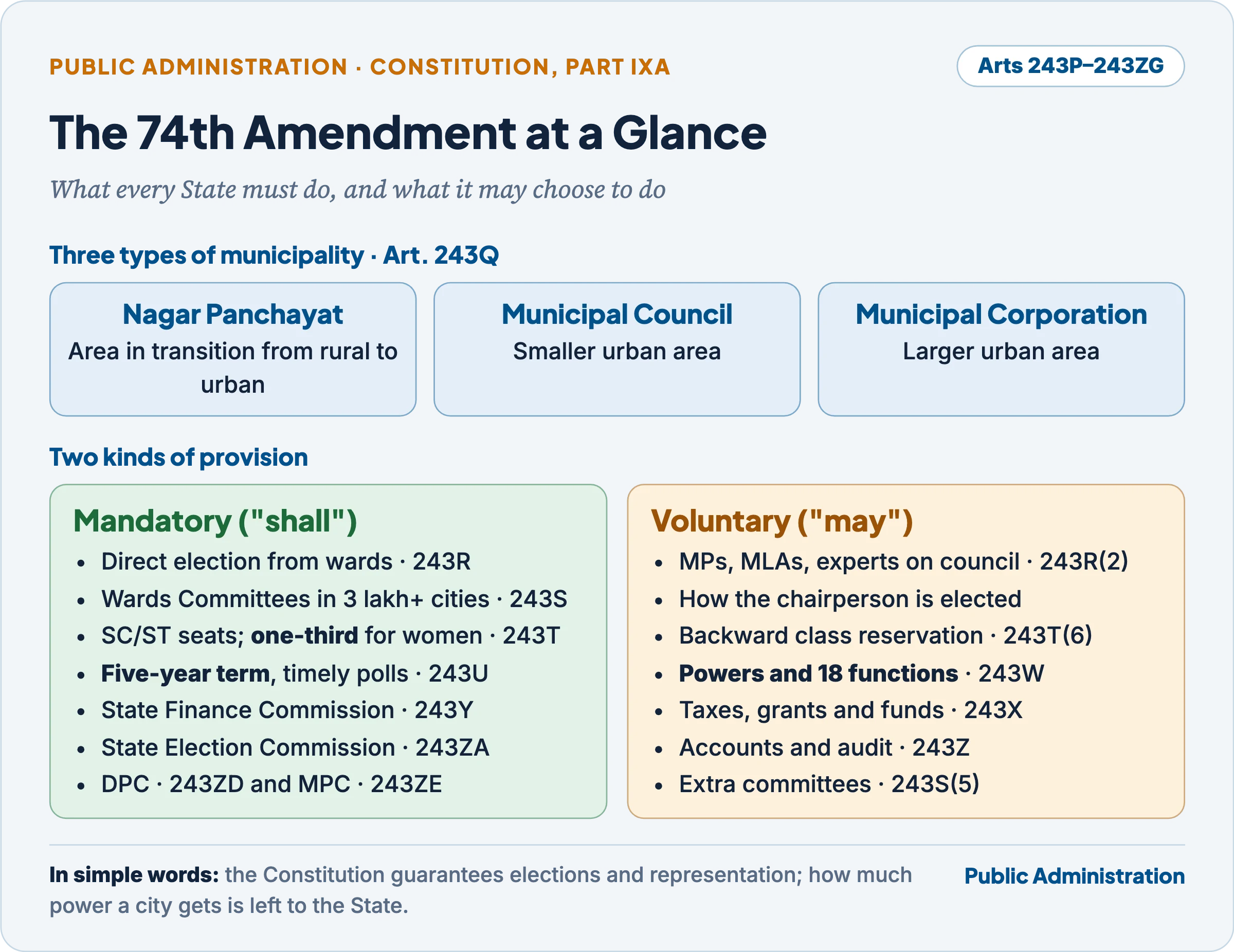
The Twelfth Schedule is an illustrative list of functions a State may entrust to municipalities under Article 243W:
- Urban planning, including town planning
- Regulation of land use and construction of buildings
- Planning for economic and social development
- Roads and bridges
- Water supply for domestic, industrial and commercial purposes
- Public health, sanitation, conservancy and solid waste management
- Fire services
- Urban forestry, protection of the environment and promotion of ecological aspects
- Safeguarding the interests of weaker sections, including persons with disabilities
- Slum improvement and upgradation
- Urban poverty alleviation
- Urban amenities such as parks, gardens and playgrounds
- Promotion of cultural, educational and aesthetic aspects
- Burials and burial grounds; cremations, cremation grounds and electric crematoriums
- Cattle pounds; prevention of cruelty to animals
- Vital statistics, including registration of births and deaths
- Public amenities including street lighting, parking lots, bus stops and public conveniences
- Regulation of slaughterhouses and tanneries
- What the list adds. Items 1 to 3 and 10 to 11 move municipalities beyond civic housekeeping into planning, development and poverty reduction, a role that marks the sharpest break from the pre-1992 municipal laws.
- What it leaves out. Primary education, primary health, urban transport, electricity and policing are not on the list, though many cities historically ran schools, hospitals and even buses (Mumbai’s BEST). The Schedule thus fixes a narrower domain than the Eleventh Schedule’s 29 items for Panchayats.
- What it does not do. It does not transfer any function by itself: devolution needs a State law. The CAG found in 2024 that States had transferred on average 17 of the 18 functions by law, but only 4 with full autonomy in practice (Section 6).
3.4 Mandatory and voluntary provisions
| Mandatory (the State shall) | Voluntary (the State may) |
|---|---|
| Constitute the three types of municipality (243Q) | Exempt industrial townships (243Q proviso) |
| Direct elections to all seats from wards (243R(1)) | Add experts (non-voting), MPs, MLAs, MLCs (243R(2)) |
| Wards Committees in municipalities of 3 lakh+ (243S(1)) | Decide composition of ward committees; create more committees (243S(2), (5)) |
| SC/ST reservation and one-third for women (243T) | Reserve chairpersons’ posts; reserve for backward classes (243T(4), (6)) |
| Five-year term; elections before expiry or within six months (243U) | Decide how the chairperson (Mayor) is elected (243R(2)(b)) |
| State Finance Commission every five years (243Y with 243I) | Devolve powers and Twelfth Schedule functions (243W) |
| State Election Commission conducts polls (243ZA) | Grant taxing powers, assign taxes, give grants (243X) |
| DPC and MPC (243ZD, 243ZE) | Provide for accounts and audit (243Z) |
The left column secures democracy: bodies must exist and be elected and representative. The right column decides autonomy: functions, finance and staff. The Amendment’s critics call it an “enabling” amendment for this reason; its defenders reply that constitutional amendments cannot specify the workload of 5,000 bodies in 28 States, and that the mandatory column was itself a revolution after decades of supersession.
Common confusion
Are Wards Committees mandatory in every municipality? No. Article 243S makes Wards Committees compulsory only in municipalities with a population of three lakh or more; smaller towns need not have them. Even where compulsory, the Constitution leaves their composition, area and powers to the State, and allows one committee to cover several wards. That is why many large cities created a handful of large “zonal” ward committees with no budget, and why the 2nd ARC recommended a committee for every ward plus area sabhas below it.
3.5 DPC and MPC in brief
- District Planning Committee (243ZD): consolidates plans of Panchayats and municipalities into a draft district development plan, having regard to spatial planning, water and natural resources, infrastructure and environment; the chair is left to State law.
- Metropolitan Planning Committee (243ZE): prepares a draft development plan for a metropolitan area of 10 lakh or more, taking into account municipal and panchayat plans, Union and State priorities and the investments of all agencies.
- Practice: DPCs exist almost everywhere but rarely consolidate plans; MPCs have been set up in only a few metropolitan areas (the CAG found MPCs constituted in only 3 of 9 audited States that needed them), and where they exist they are overshadowed by State development authorities such as MMRDA.
- For their composition, working and reform proposals, see the article on Decentralised Planning after the 73rd and 74th Amendments. Metropolitan governance as a whole is treated in the article on Global–Local Debate, New Localism and City Management.
3.6 Scheduled Areas and special cases
- Exemption (243ZC). Part IXA does not apply to Scheduled Areas under the Fifth Schedule or to tribal areas under the Sixth Schedule. Parliament extended the Panchayat Part to Scheduled Areas through PESA, 1996, but no equivalent law for municipalities has been enacted; a draft Municipalities (Extension to Scheduled Areas) Bill was prepared in 2001 but never passed. Towns in Fifth Schedule areas therefore run under ordinary State municipal laws without special protection for tribal self-rule.
- Cantonments are governed by the Cantonments Act, 2006 (Union law), not Part IXA.
- Delhi: the Municipal Corporation of Delhi, split into three in 2012, was reunified in 2022 by an Act of Parliament; the New Delhi Municipal Council is a nominated body under a separate Act.
3.7 Judgments that shaped Part IXA
- Kishansing Tomar v. Municipal Corporation of the City of Ahmedabad (2006). A Constitution Bench held that elections must be completed before the term expires; the State cannot delay them for delimitation or other reasons, and the State Election Commission may approach the High Court to enforce this duty. Only extraordinary situations such as natural calamities justify delay.
- K. Krishna Murthy v. Union of India (2010). A Constitution Bench upheld reservation for backward classes in local bodies (Articles 243D(6) and 243T(6)) as a distinct, political form of reservation, subject to a 50 per cent ceiling on vertical reservation and to a rigorous empirical inquiry into political backwardness.
- Vikas Kishanrao Gawali v. State of Maharashtra (2021). Laid down the “triple test” for OBC reservation in local bodies: a dedicated commission to study backwardness local body by local body, specified proportions based on its findings, and a total of SC, ST and OBC reservation not exceeding 50 per cent.
- State of Goa v. Fouziya Imtiaz Shaikh (2021). Held that the State Election Commissioner must be independent of the State government; giving the post as additional charge to the State’s Law Secretary was a “mockery” of Article 243K. Under 243ZA the SEC may issue directions to the State and fill gaps in the law; the bar in 243ZG operates only while the election process is under way.
- Suresh Mahajan v. State of Madhya Pradesh (2022). Elections to local bodies cannot be postponed for want of the triple-test exercise; SECs were directed to notify elections. On 6 May 2025 the Supreme Court applied the same principle to Maharashtra, ordering long-stalled local body polls within four months and observing that bureaucrats had been running elected bodies without accountability. The Brihanmumbai Municipal Corporation finally voted on 15 January 2026, about four years after its council’s term ended.
Indian Connect — The Amendment in practice: 30 years on
All States passed conformity laws by 1994, and SECs and SFCs exist everywhere. But the CAG’s 2024 compendium of performance audits in 18 States (393 ULBs) found that 1,600 of 2,625 ULBs in 17 States had no active elected council at the time of audit, only five of the States had directly elected Mayors, and only four of 15 had given their SEC power over ward delimitation. Representation has become routine; regular elections and autonomy have not.
4. Main Features and Structures of Municipal Governance
In simple words
A city council has two halves: a “thinking” half (the elected councillors and Mayor, who pass the budget and rules) and a “doing” half (the Commissioner and staff, who carry them out). Who controls the doing half decides who really runs the city. Around both halves stand many State boards and authorities that do municipal work without answering to the council.
4.1 Types of urban local bodies
| Body | Where and how created | Key features |
|---|---|---|
| Municipal Corporation (Nagar Nigam, Mahanagar Palika) | Large cities; separate or general State Act | Council headed by Mayor; Standing and other committees; Commissioner (usually IAS) as chief executive |
| Municipal Council (Nagar Palika, municipality) | Smaller cities and towns | Elected council and President/Chairperson with some executive role; Chief Municipal / Executive Officer appointed by the State |
| Nagar Panchayat | Transitional areas, rural to urban | Small elected council and chairperson; Executive Officer; combines rural and urban functions |
| Notified Area Committee | Fast-growing or industrial towns not yet meeting municipal criteria; created by notification, not statute | Wholly nominated by the State, including chairman; largely replaced by Nagar Panchayats after 1993 |
| Town Area Committee | Small towns, under a separate Act (most in Uttar Pradesh historically) | Limited functions (drainage, roads, lighting, conservancy); partly or wholly elected or nominated; many merged with Panchayati Raj or converted after the Rural-Urban Relationship Committee |
| Cantonment Board | Military stations; Cantonments Act, 2006 (earlier 1924) under the Ministry of Defence | Station Commander as President; partly elected; Chief Executive Officer from the Defence Estates service |
| Township | Large public-sector plants (Bhilai, Rourkela, Jamshedpur area) | Run by the enterprise through a town administrator; no elected body; may be exempted under 243Q proviso |
| Port Trust | Major ports (Mumbai, Kolkata, Chennai) | Created by Act of Parliament; civic functions in port areas; now Major Port Authorities |
| Special Purpose Agency | State Act or executive order | Function-based: development authorities, water boards, housing boards, pollution control boards |
- Criteria under 243Q(2). The Governor classifies areas by population, density, revenue generated, share of non-agricultural employment and economic importance. Because each State uses its own thresholds, a town of 40,000 may be a Nagar Panchayat in one State and a municipal council in another; the 2nd ARC asked for a common national categorisation.
- Nagar Panchayats need care in creation: a Nagar Panchayat must handle both rural and urban functions, and premature conversion can raise taxes on still-rural residents while giving them few urban services.
4.2 Deliberative and executive wings
Every municipal corporation separates two wings by statute, a design that dates from the Bombay Municipal Corporation Act, 1888, which created three “co-ordinate municipal authorities“: the Corporation, the Standing Committee and the Commissioner.
- Deliberative wing:
- The Council (General Body): directly elected councillors (corporators) from wards, plus non-voting experts and ex-officio legislators where the State law so provides; it passes the budget, levies taxes within the law, makes bye-laws and oversees administration.
- The Mayor: presides over the council and is the “first citizen” of the city. In most States the Mayor is elected by the councillors, often for a one-year (Delhi, with rotation) or two-and-a-half-year term, and has ceremonial rather than executive powers.
- Standing Committee and subject committees: the Standing Committee is the most powerful council body: it scrutinises the budget, sanctions contracts above the Commissioner’s limit and supervises finance. Subject committees deal with works, health, education, improvements and so on.
- Ward Committees: under 243S, for wards or groups of wards in large cities.
- Executive wing:
- The Municipal Commissioner: appointed by the State government, usually from the IAS in large corporations, and removable only by the State. The Commissioner prepares the budget, controls staff, executes council decisions, enters into contracts within limits and holds emergency powers. In most corporations the Commissioner is the principal executive authority by statute, not by delegation from the Mayor.
- Heads of departments (engineering, health, revenue, town planning) report to the Commissioner.
- In municipal councils the elected President often has real executive authority over staff and finance, assisted by a State-appointed Executive Officer; the balance varies by State.
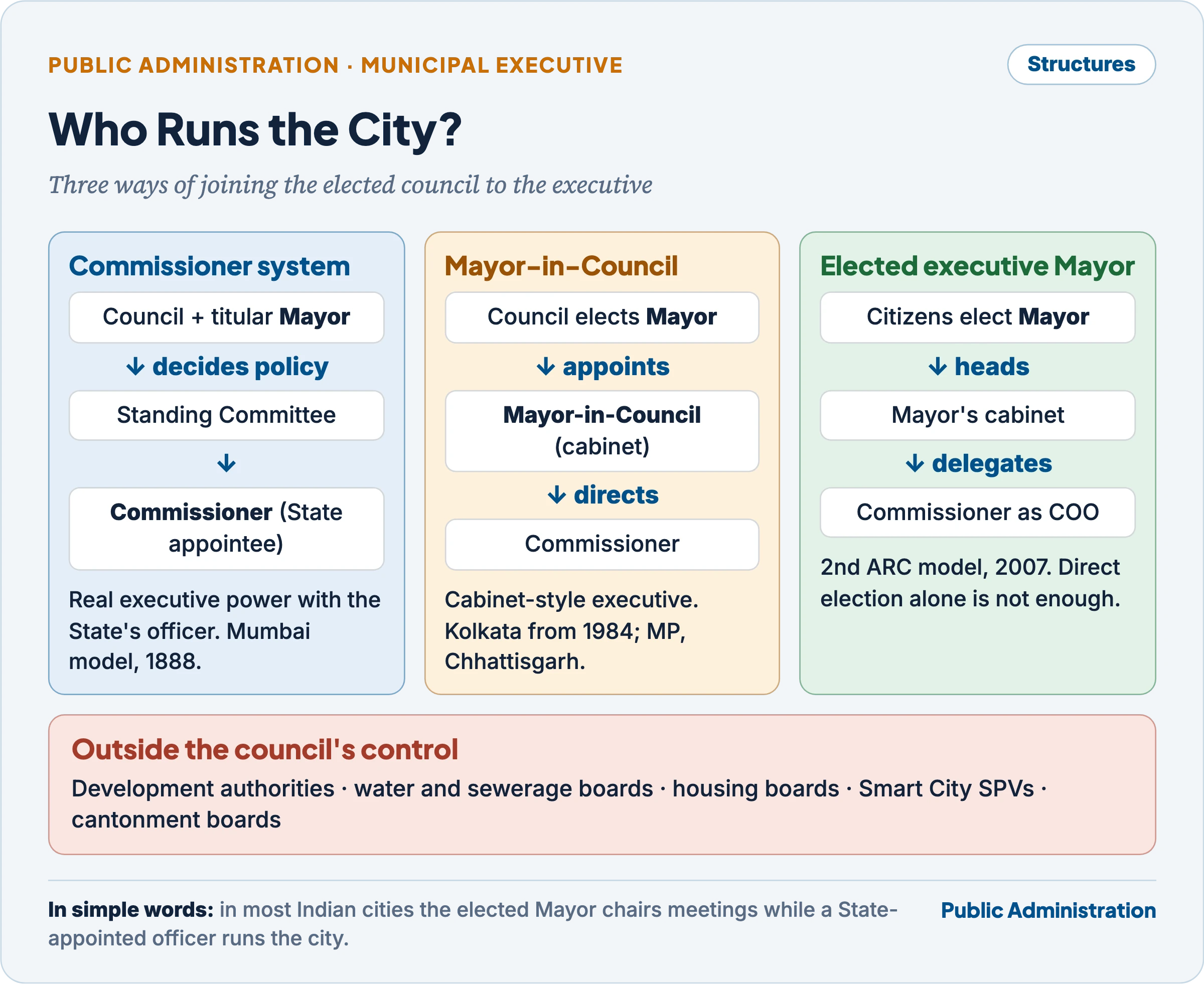
4.3 Three models of the municipal executive
| Feature | Commissioner system | Mayor-in-Council | Elected executive Mayor |
|---|---|---|---|
| Where | Most corporations (Mumbai model) | Kolkata (from 1984), MP, Chhattisgarh, West Bengal, Assam, Tripura | Recommended by 2nd ARC; partial versions in States with direct election |
| Who holds executive power | State-appointed Commissioner | Mayor and a cabinet of councillors | Directly elected Mayor |
| Mayor’s position | Ceremonial chair, short term | Real head, like a Chief Minister | Chief executive, five-year term |
| Commissioner’s position | Chief executive | Principal executive officer under the cabinet | Chief operating officer, exercising delegated powers |
| Strength | Professional management, continuity, insulation from local pressure | Collective political leadership, clear accountability | Single visible point of accountability to voters |
| Weakness | Unelected officer runs the city; accountable to the State, not citizens | Commissioner still a State officer; party control | Risk of personalised power; deadlock with council |
- The Kolkata model. The Kolkata Municipal Corporation Act, 1980, brought into operation in 1984, copied the parliamentary model: the Mayor heads a Mayor-in-Council of portfolio-holding councillors, and the Commissioner acts as principal executive officer under it. A 2024 urban governance index by the civil-society group Praja found Mayor-in-Council provisions in five States (Assam, Chhattisgarh, Madhya Pradesh, Tripura and West Bengal).
- Directly elected Mayors. Seven States (Bihar, Chhattisgarh, Haryana, Jharkhand, Madhya Pradesh, Uttar Pradesh and Uttarakhand) provided for direct election of Mayors by 2024, though rules change with governments: Madhya Pradesh moved to indirect election in 2019 and back to direct election for its 16 corporations in 2022; Chhattisgarh restored direct election by ordinance in December 2024; Bihar adopted it in 2022. The CAG noted that only about 61 million of the 241 million urban residents in its 18 audited States could directly elect their Mayor.
- Strong vs weak Mayor. The terms come from American city government. In the strong-mayor form the Mayor is directly elected, appoints department heads, prepares the budget and has a veto; in the weak-mayor form the council holds executive powers and the Mayor is largely ceremonial. The council-manager form (a council appoints a professional city manager) resembles the Indian commissioner system, except that the Indian Commissioner is appointed by the State, not the council. Indian Mayors are therefore weaker than even weak American mayors.
- Direct election is not enough. In Uttar Pradesh and Uttarakhand, Mayors are directly elected but the Commissioner remains the statutory executive. A directly elected Mayor without control over staff, budget and contracts adds legitimacy without authority, which can sharpen conflict instead of resolving it.
4.4 The Mayor–Commissioner debate
- Case for the Commissioner: an IAS officer brings professional competence, neutrality and financial discipline, is insulated from contractor and builder lobbies, and provides continuity when Mayors change every year. Mumbai’s commissioner-run corporation is often cited as administratively capable.
- Case for an empowered Mayor: an unelected officer accountable to the State holds real power while elected representatives are blamed for floods and garbage; citizens cannot vote out the person who actually runs the city. The 2nd ARC (2007) concluded that “the functions of chairing the municipal council and exercising executive authority should be combined” in a directly elected Mayor, with a Mayor’s cabinet of not more than 10 per cent of councillors or fifteen, and the Commissioner performing functions delegated by the Mayor. It also proposed that metropolitan corporations select their own Commissioners within two years.
- Underlying issue: the debate is really about whose agent the executive is. In principal–agent terms, the Commissioner has two principals (the State and the council) and naturally obeys the one that appoints, transfers and promotes him.
4.5 Parastatals and the “functional jungle”
- Meaning. A parastatal is a State-created agency (statutory board, authority, corporation or registered society) that performs a municipal function in a city but answers to a State department. Examples: development authorities (DDA, BDA, MMRDA), water supply and sewerage boards (Bangalore 1964, Delhi Jal Board 1998), housing boards and slum boards, urban transport corporations, and HUDCO (1970) at the Union level.
- Why they were created: specialised skills, ability to borrow and execute large projects, freedom from municipal politics and from rigid municipal finance rules, and the State’s wish to control land and big projects.
- Problems:
- Fragmented accountability: a citizen with a waterlogged street does not know whether to approach the corporation, the water board, the development authority or the PWD. In Jaipur more than thirty agencies have worked on urban development.
- Hollowing out of the council: the most valuable functions (planning, land, water, large projects) and revenues (land sales, development charges) sit outside the elected body. The council keeps the costly, thankless tasks.
- Coordination failures: roads dug up by one agency after being laid by another; overlapping jurisdiction over drains and sewers.
- Democratic deficit: boards are chaired by Ministers or officers, with token municipal representation.
- “Functional jungle” is the phrase used for this tangle of uni-functional agencies and authorities, each with its own jurisdiction and chain of command.
- Reform proposals: the 2nd ARC recommended that the downstream activities of every utility become accountable to the ULB once they enter its boundary, that development authorities be merged with ULBs and their planners moved to DPCs and MPCs, and that until then 25 per cent of land-sale revenue of development authorities go to municipalities. Bengaluru’s Greater Bengaluru Governance Act, 2024 (in force April 2025) created a Greater Bengaluru Authority chaired by the Chief Minister to coordinate parastatals and replaced the BBMP with five city corporations from 2 September 2025, a different answer that combines coordination at the metropolitan level with smaller corporations below.
4.6 Special Purpose Vehicles under the Smart Cities Mission
- Design. Each of the 100 Smart Cities set up an SPV as a limited company under the Companies Act, 2013, with equity held 50:50 by the State and the ULB, a full-time CEO, and a board with representatives of the Union, State and ULB. The SPV planned, appraised and executed projects and received the mission funds directly.
- Arguments for: speed, professional project management, ring-fenced funds, freedom from municipal procurement delays; all 100 cities built Integrated Command and Control Centres.
- Criticism:
- Corporate structures bypass the elected council; councillors had little say over projects in their wards.
- The area-based development model concentrated spending in small zones (often already better-off areas).
- SPVs are accountable under company law rather than to citizens through municipal law.
- They are an NPM-style agencification that the 74th Amendment had sought to reverse.
- After the mission. The Smart Cities Mission closed financially on 31 March 2025; MoHUA’s Advisory No. 27 (10 June 2025) asked States to repurpose SPVs as technical and project arms that support ULBs and to keep the ICCCs running.
4.7 Cantonment boards
- Status. There are 62 notified cantonments, governed by the Cantonments Act, 2006 under the Ministry of Defence; they are the only urban local bodies under Union administration. Boards are categorised by population, are presided over by the Station Commander, include elected members and officials, and have a Chief Executive Officer from the Defence Estates service. Their obligatory functions resemble a municipality’s.
- Excision. In 2023 the Ministry of Defence decided to excise civil areas from cantonments and merge them with State municipalities, keeping military areas as military stations. Khas Yol (Himachal Pradesh) was de-notified on 27 April 2023; gazette notifications in March 2024 began excision in ten cantonments in five States. The reform ends a colonial dual system under which cantonment residents could not fully benefit from State schemes or elect normal municipal councils.
4.8 Ward committees and area sabhas: participation below the council
- The constitutional minimum (243S): ward committees only in cities of 3 lakh+, possibly covering many wards, with composition left to States.
- Model Nagara Raj Bill, 2008. Under JNNURM, enactment of a Community Participation Law was a mandatory State reform. The Union circulated a Model Nagara Raj Bill creating a third tier of Area Sabhas (all voters of one or more polling-booth areas) below Ward Committees, with an elected Area Sabha representative who sits on the ward committee and helps identify beneficiaries, set priorities and monitor works.
- Practice: many States passed laws to satisfy JNNURM, but few made area sabhas work. The CAG found test-checked ULBs in Uttar Pradesh had not formed ward committees at all; Praja’s 2024 index found 14 cities had not constituted committees required by their own municipal Acts. Kerala and West Bengal provide ward-level committees even in smaller towns; Bengaluru’s 2024 law makes ward committees “basic units of urban governance“.
- Participatory budgeting. Pune began citizen budgeting in 2006–07, allowing residents to propose ward-level works within a set share of the budget, on the model of Porto Alegre (Brazil, 1989). Kerala’s local governments plan through ward sabhas under the People’s Plan approach.
- Why ward committees remain “paper tigers”: no assured budget; chaired by the councillor who may see them as rivals; members nominated by parties; urban residents’ low civic participation and migrant populations; officials not answerable to them; and the absence of an urban equivalent of the Gram Sabha in the Constitution.
4.9 Municipal personnel
Three systems of municipal personnel exist in India:
| System | Meaning | Example |
|---|---|---|
| Separate | Each ULB recruits, controls and pays its own staff; not transferable | Lower staff in most States; West Bengal, Gujarat historically |
| Unified | State-wide municipal service for all ULBs, transferable among them, administered by the State | Rajasthan, Uttar Pradesh, Andhra Pradesh, Tamil Nadu, Maharashtra (State municipal cadres) |
| Integrated | Municipal and State posts form one service, transferable between ULBs and State departments | Commissioners, Executive Officers and senior technical posts drawn from IAS and State services |
- Problems:
- Onion-like layering: different systems coexist in one body, each layer answering to a different authority.
- The State controls sanction of posts, pay and recruitment; councils cannot discipline staff they do not appoint.
- Pay and prospects lower than State services; training neglected.
- High vacancies: the CAG found an average of 37 per cent of sanctioned posts vacant; Praja found Patna with 89 per cent vacancy at city level.
- Shortage of urban planners, engineers, finance and IT professionals: India has far fewer trained planners per lakh people than comparable countries.
- A specialised municipal cadre. A cadre of specialised municipal executives equal in status to State services is a long-standing proposal (Committee on Service Conditions, 1965–68; Rural-Urban Relationship Committee). Gujarat and Rajasthan created State municipal services; scholars argue the real issue is quality, pay and career rather than which system is used. The 2nd ARC instead wanted ULBs to recruit their own staff and abolish State Directorates of Municipal Administration, while the CAG found only 7 of 12 States had training institutes for municipal functionaries.
5. Municipal Finance
In simple words
A city needs money to clean streets, pipe water and fix roads. Indian cities raise very little of it themselves, mainly through property tax and fees, and depend on grants from the State and the Union. Without their own money, they cannot plan, borrow or be fully accountable to their voters.
5.1 Principles of municipal finance
- Independence and responsibility: the body that spends money should also raise it, so that taxing and spending decisions are taken together.
- Adequacy and elasticity: resources should match functions and grow with population, prices and economic activity.
- Simplicity and economy in collection; uniformity so that no city has to tax far above others.
- Integration of Union, State and local finance, and accountability through budgets, accounts and independent audit.
- Fiscal access: freedom to tap new sources as responsibilities grow.
5.2 Theory: fiscal federalism and the local public economy
- Oates’ decentralisation theorem (1972): local provision of local public goods is efficient because it fits local preferences (Section 1.3).
- Tiebout model. Charles Tiebout, in “A Pure Theory of Local Expenditures” (1956), argued that when many local governments offer different tax-and-service packages, citizens “vote with their feet” by moving to the one they prefer, producing efficiency like a market. The model assumes mobility and full information, rarely true for India’s urban poor, but it explains why cities compete for investors and residents.
- Benefit principle and user charges. Public choice economists such as James Buchanan argued that charging users for services they consume (water, parking, waste) reveals demand, prevents over-consumption and makes officials accountable. User charges therefore suit municipal services with identifiable beneficiaries; taxes suit pure public goods.
- Vertical fiscal imbalance: the most buoyant taxes (income, GST) are collected by higher governments, while spending needs are local; transfers are needed to close the gap, but transfers weaken the link between tax and service.
5.3 Sources of municipal revenue
| Source | Main items | Notes |
|---|---|---|
| Own tax revenue | Property tax, profession tax, advertisement tax (other than newspapers), vacant land tax, water and sewerage benefit taxes, tax on animals and vehicles, entertainment tax where retained | Property tax is about half of municipal tax collections; profession tax capped at ₹2,500 a year (Art. 276(2)) |
| Own non-tax revenue | User charges (water, sewerage, solid waste), trade licence and building permission fees, development and betterment charges, parking, market and slaughterhouse fees, rents, fines | Fees and user charges are two-thirds of non-tax revenue of corporations (RBI 2024) |
| Assigned and shared revenue | Surcharge on stamp duty, share of motor vehicle tax and entertainment tax collected by the State, GST-loss compensation | Determined by State law and SFC |
| Grants | SFC devolution, Union Finance Commission grants, scheme grants (AMRUT, SBM-U, PMAY-U, SCM) | Largest source for most ULBs |
| Borrowing | Loans from State, banks, HUDCO; municipal bonds; pooled finance; PPPs | Regulated by the Local Authorities Loans Act, 1914 and State approval |
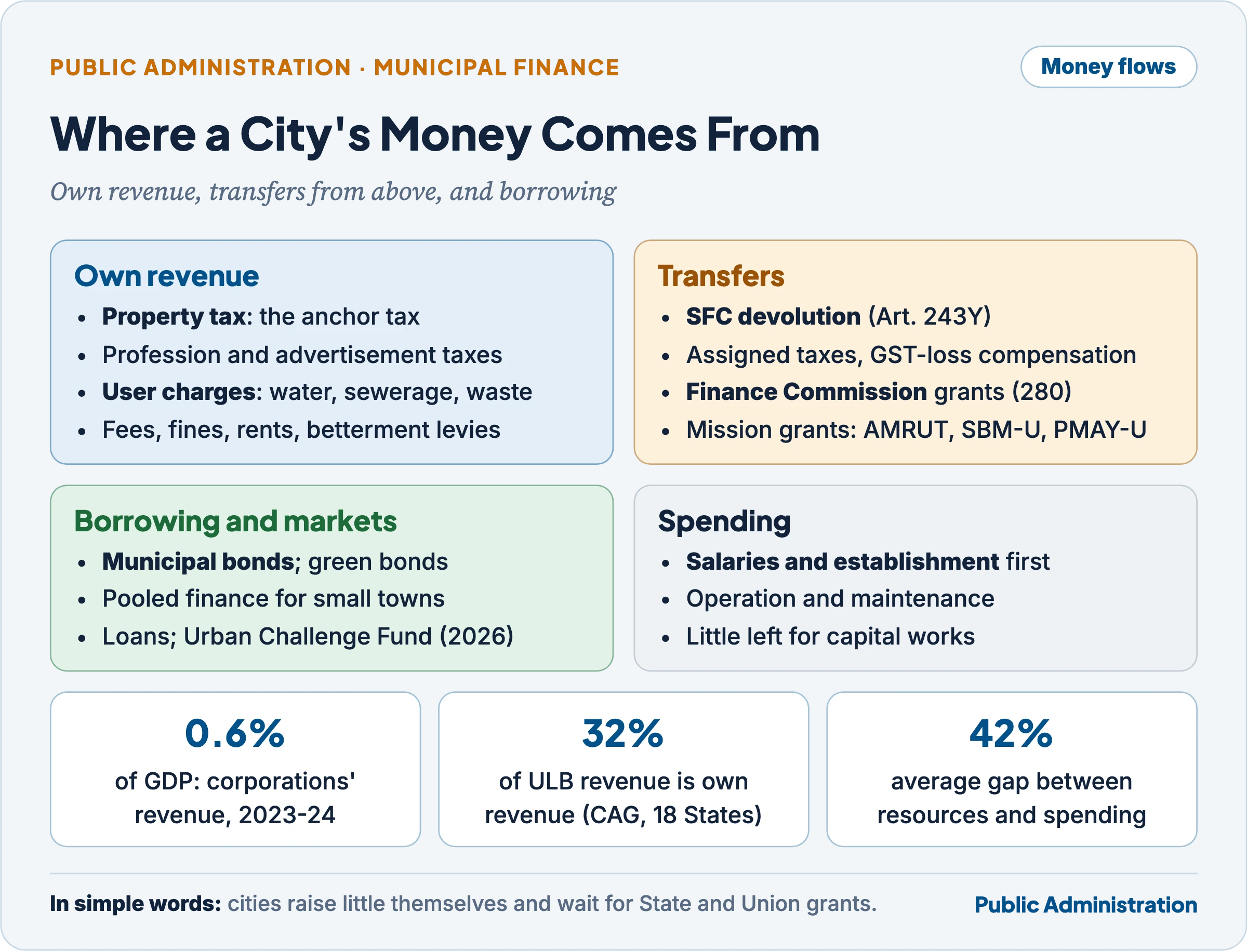
5.4 How small is municipal finance? The RBI reports
- RBI Report on Municipal Finances (November 2022), the first of its kind, compiled budgets of 201 municipal corporations: their revenue receipts were about 0.61 per cent of GDP in 2017–18, budgeted at 0.72 per cent in 2019–20; own tax revenue about 0.21 per cent, of which property tax only about 0.1 per cent of GDP.
- RBI Report on Municipal Finances (November 2024) covered 232 corporations with the theme “Own Sources of Revenue Generation“. Corporations’ revenue receipts were about 0.6 per cent of GDP in 2023–24, against 9.2 per cent for the Union and 14.6 per cent for the States. Own tax revenue formed about 30 per cent of their revenue receipts, grants about a quarter, and fees and user charges about a fifth.
- International contrast. The High Powered Expert Committee on Urban Infrastructure (chaired by Isher Judge Ahluwalia, 2011) estimated municipal revenue in India at well under 1 per cent of GDP, a small fraction of the levels in Brazil or South Africa, and projected urban infrastructure investment needs of about ₹39 lakh crore over 2012–31.
- CAG compendium (2024): across 18 States, own revenue was only 32 per cent of total ULB revenue; ULBs faced an average resource–expenditure gap of 42 per cent; only 29 per cent of current expenditure went to programme and development work; and ULBs in 15 States received ₹1,606 crore less than their SFCs had recommended.
5.5 Property tax: the anchor that drags
- Methods of assessment:
- Annual rental value (ARV): tax on the rent a property would fetch. It is frozen by rent control laws, open to negotiation, litigation and corruption.
- Unit area value (UAV): tax per square metre adjusted by location, use, age and type of structure. Pioneered by Patna (1993), adopted in Delhi (2004) and Bengaluru’s self-assessment scheme, it is simple and transparent.
- Capital value (CV): tax on market value, often using circle rates; adopted by Mumbai (2010). It is the most buoyant method.
- Why collections are low:
- Incomplete registers (many properties never assessed).
- Outdated values revised once in decades, and wide exemptions (including Union government property, exempt under Article 285, which can only pay service charges).
- Political reluctance to raise rates; poor collection efficiency (often under half of demand in older studies of Kolkata, Delhi, Ahmedabad and Chennai), arrears and litigation.
- Reforms:
- GIS mapping and digital databases; self-assessment with random checks; online and QR-code payment.
- Publishing all property tax details to prevent collusion (2nd ARC).
- The 15th Finance Commission’s condition that States notify floor rates of property tax and show collection growth in step with GSDP growth to receive ULB grants from 2022–23.
- AMRUT 2.0 reforms on property tax and user charges.
5.6 Transfers: State and Union Finance Commissions
State Finance Commissions (Arts. 243I and 243Y)
- The Governor must constitute an SFC every five years to recommend the distribution of State taxes between the State and municipalities, the taxes to be assigned to them, grants-in-aid from the State’s Consolidated Fund, and measures to improve municipal finances. The State must lay the report and an action-taken memorandum before the legislature.
- Record:
- States are now on their fifth to seventh SFCs.
- SFCs are often appointed late, staffed thinly and given poor data; reports are tabled years later, accepted selectively and funded partially.
- Some States share only a small fraction of own tax revenue, not Union transfers.
- The CAG found delays in constitution, submission and acceptance in most audited States, and the RBI (2024) called for a rule-based State system of transfers including regular SFCs.
- Why it matters for Union grants: under Article 280(3)(c), the Union Finance Commission must base its local body recommendations on SFC reports. Weak SFCs therefore weaken the whole chain; State apathy towards SFCs thus limits what the Union Commission can recommend.
Union Finance Commission grants
| Commission | Award period | Grants for ULBs | Key conditions |
|---|---|---|---|
| 10th | 1996–2000 | First local body grants; ₹1,000 crore for municipalities | Matching contribution |
| 11th | 2000–05 | ₹2,000 crore | Accounts and audit database |
| 12th | 2005–10 | ₹5,000 crore | Priority to solid waste management |
| 13th (Vijay Kelkar) | 2010–15 | Basic plus performance grants linked to a share of the divisible pool | Six conditions: accounts supplement, audit, local body ombudsman, electronic transfer, SFC appointment, property tax board and service standards |
| 14th (Y.V. Reddy) | 2015–20 | ₹87,144 crore (80% basic, 20% performance) | Audited accounts, increase in own revenue, service-level benchmarks |
| 15th (N.K. Singh) | 2021–26 | ₹1,21,055 crore for ULBs (plus health grants) | Accounts online; property tax floor rates; Million-Plus Cities Challenge Fund of ₹38,196 crore tied to air quality and water, sanitation and waste benchmarks; tied grants for non-million cities split between sanitation and drinking water |
| 16th (Arvind Panagariya) | 2026–31 | Urban share ₹3,56,257 crore of total local body grants of ₹7,91,493 crore | Duly constituted elected bodies; provisional and audited accounts online; performance components; special infrastructure and urbanisation premium |
The table shows the transformation of Union grants from token sums into a major, conditional source of municipal revenue. Each Commission has used grants as a lever for reform (accounts, property tax, service levels), which raises accountability but also makes local finance follow Union priorities.
- 16th Finance Commission in detail:
- The basic and performance pool is split 60:40 between rural and urban bodies, reflecting projected urbanisation of about 40.7 per cent by 2031.
- Urban grants have four parts: basic (₹2,32,125 crore), performance (₹58,032 crore, half for ULB performance and half for State performance), a special infrastructure component of ₹56,100 crore for comprehensive wastewater and drainage systems in up to two cities per State with populations between 10 and 40 lakh, and an urbanisation premium of ₹10,000 crore.
- The urbanisation premium is a one-time ₹2,000 per person for merging peri-urban villages into adjoining ULBs of at least one lakh population, conditional on a State rural-to-urban transition policy.
- Inter-State distribution of ULB grants uses projected urban population (90 per cent) and own source revenue of ULBs (10 per cent).
- For the Finance Commission’s wider role, see the article on The Finance Commission and Fiscal Federalism.
5.7 GST and municipal finance
- The 101st Amendment (2016) introducing GST deleted Entry 52 (entry tax, including octroi) and Entry 55 (taxes on advertisements other than in newspapers) of the State List, and limited Entry 62 (entertainment tax) to taxes levied by Panchayats, municipalities and district councils.
- Octroi and local body tax, once major sources in Maharashtra, disappeared; Maharashtra enacted the Maharashtra Goods and Services Tax (Compensation to Local Bodies) Act, 2017 to compensate its corporations. In other States, entry tax revenues earmarked for ULBs were subsumed without compensation, as the CAG noted for Uttar Pradesh.
- Effect: the municipal tax base narrowed to property-related taxes and charges, increasing dependence on State transfers. Proposals to give ULBs a share of GST (a “municipal GST” or a fixed share of State GST) have been debated but not adopted.
5.8 Municipal bonds and market finance
- First phase (1997–2005): Bangalore Mahanagara Palike issued India’s first municipal bond (₹125 crore) in 1997 with a State guarantee; Ahmedabad Municipal Corporation issued ₹100 crore in January 1998 without a State guarantee, the first such issue. About nine corporations raised around ₹1,200 crore, plus pooled finance for small towns (Tamil Nadu Water and Sanitation Pooled Fund, Karnataka Water and Sanitation Pooled Fund). Issues dried up after JNNURM grants made borrowing less attractive.
- SEBI (Issue and Listing of Debt Securities by Municipalities) Regulations, 2015 created a framework: credit ratings, escrow of specified revenues, at least 20 per cent own contribution to project cost, public issues only for revenue bonds.
- Second wave:
- Pune Municipal Corporation issued ₹200 crore of ten-year bonds in June 2017, the first under the SEBI rules, followed by Hyderabad, Indore, Bhopal, Visakhapatnam, Ahmedabad, Surat, Lucknow, Vadodara, Pimpri-Chinchwad, Rajkot and Agra (2025).
- MoHUA offered an incentive of about ₹13 crore for every ₹100 crore raised under AMRUT.
- By 2026 MoHUA counted about ₹3,800 crore raised through 26 issues by 19 corporations since 2017.
- Green bonds: Ghaziabad Nagar Nigam issued India’s first municipal green bond (₹150 crore, March 2021) to fund a tertiary treatment plant reusing sewage; Indore followed with a ₹244 crore green bond in February 2023, India’s first public issue of municipal green bonds; Ahmedabad and Vadodara issued green bonds in 2024.
- Limits:
- Only large, creditworthy corporations can borrow; of about 470 rated cities, only 164 received an investment-grade rating.
- State control over borrowing and weak accounting.
- Small issue sizes and an illiquid secondary market; investor preference for State guarantees.
- Urban Challenge Fund (2026). Announced in the Budget 2025–26 and approved by the Union Cabinet in February 2026, the UCF provides ₹1 lakh crore of central assistance over 2025–26 to 2030–31. Central assistance covers 25 per cent of a bankable project, and at least 50 per cent must come from bonds, bank loans or PPPs. The fund includes ₹5,000 crore for project preparation and a ₹5,000 crore Credit Repayment Guarantee Sub-Scheme for first-time borrowers among smaller cities; guidelines were issued on 15 April 2026. It marks a shift from grant-based missions to market-linked urban finance.
5.9 Expenditure and financial management
- Establishment first: salaries and pensions consume a large share (often half or more) of municipal revenue; little remains for capital works.
- Accounting: most ULBs used single-entry cash accounting until the National Municipal Accounts Manual (2004) introduced accrual-based double-entry accounting, made a JNNURM reform and a Finance Commission condition. Audited accounts are still often years behind.
- Audit: by the State’s Director of Local Fund Audit, with technical guidance from the CAG in many States; audit objections pile up for years.
- Budgets: often unrealistic and approved late; State approval needed for re-appropriations, loans and large works.
- Transparency: the cityfinance.in portal publishes municipal accounts and ratings; the Municipal Performance Index (2020) measured services, finance, planning, technology and governance.
6. Problem Areas in Municipal Governance
In simple words
Indian cities are elected but not empowered. They lack work they can do on their own, money they raise themselves, and staff they control. Elections are often delayed, State officers and boards make the big decisions, and citizens take little part. These problems feed one another.
6.1 Weak devolution: the 3F deficit
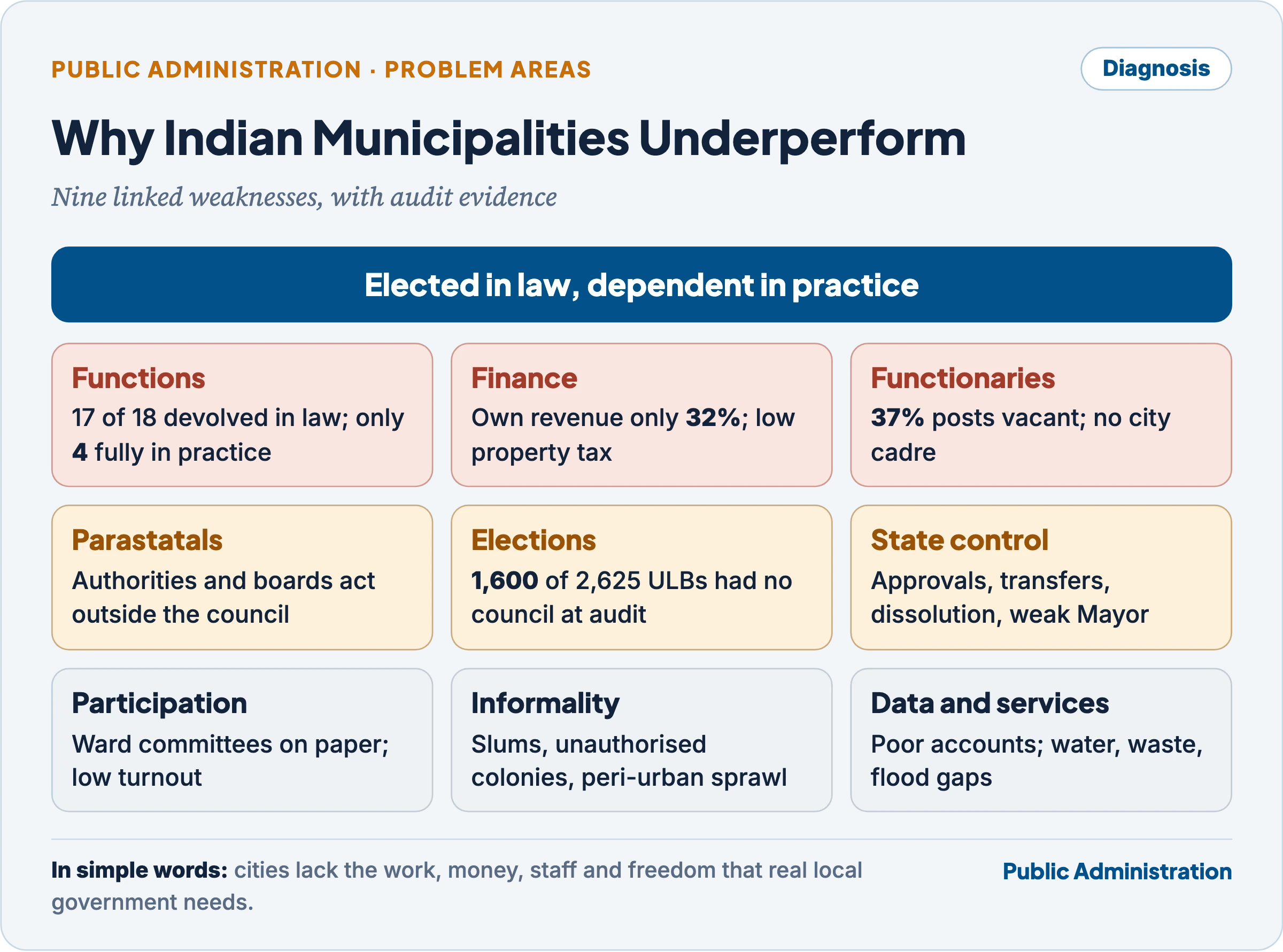
- Functions: the CAG (2024) found 17 of 18 Twelfth Schedule functions transferred by law on average, but only 4 under full ULB jurisdiction; on average 5 were performed by parastatals, and seven States labelled some functions “discretionary”. Ten of 14 States kept overriding powers on more than five functions.
- Funds: own revenue only about a third of revenue; grants unpredictable and tied.
- Functionaries: staff appointed, transferred and disciplined by the State.
- The CAG’s Uttar Pradesh audit (2024) illustrated the pattern: 15 functions devolved fully on paper, but ULBs were solely responsible for only one; staff shortfall was 43 per cent; and the State routed grants meant for ULBs directly to parastatals.
6.2 Parastatal dominance and fragmentation
- Worse in metropolitan regions (see Section 4.5): dozens of municipalities, panchayats, development authorities, transport and water agencies share one functional city with no single elected authority for the whole. This is the “intricate institutional relationships” problem of the 2025 question; metropolitan governance is treated in the article on Global–Local Debate, New Localism and City Management.
6.3 Elections, supersession and State control
- Delayed elections: despite Article 243U and the Kishansing Tomar judgment, States have delayed polls through delimitation, reservation litigation and ordinances. At the time of the CAG audits, 1,600 of 2,625 ULBs in 17 States had no active elected council. Delhi’s unified corporation (2022), Bengaluru (no council since 2020) and Maharashtra’s 29 corporations (elections only in January 2026) are prominent cases.
- Dissolution: the 74th Amendment replaced indefinite supersession with dissolution followed by elections within six months, but States still dissolve councils and run cities through administrators in the interval.
- Control mechanisms: prior approval of budgets, loans, posts and large works; power to suspend resolutions; inspection; directions; control over taxes and rates. The 2nd ARC recommended that no resolution be suspended and no council dissolved unless a local body ombudsman recommends it.
- SEC weaknesses: only four of 15 States had given SECs power over delimitation (CAG); several SECs were headed by serving officers until the Goa judgment of 2021.
- “Ruralised” State governments: the political economy works against cities. Legislatures dominated by rural constituencies, and MLAs who see Mayors as rivals, have little interest in empowering cities.
6.4 Depoliticisation and disempowerment
Urban local government has been disempowered and depoliticised in several ways:
- Technocratic missions (SCM, AMRUT) decided by Union and State officials, with SPVs bypassing councils.
- Bureaucratic executives (Commissioners) hold power; elected Mayors are ceremonial with one-year terms.
- Parastatals and outsourcing (PPPs for water, waste, parking) shift decisions into contracts and boards.
- Delayed elections leave administrators in charge for years.
- Elite civil society (resident welfare associations, corporate-backed citizen groups) gains access through partnerships, while the urban poor’s channel (the elected councillor) weakens. Scholars call this the shift from “government” to “governance” at the city level.
6.5 Capacity, staffing and leadership
- High vacancies (37 per cent on average), shortage of planners and engineers, poor training (only 7 of 12 States have municipal training institutes), low pay, frequent transfers of Commissioners.
- Weak leadership: able politicians aim for State and Union legislatures; councillors often lack training; casteism, patronage and corruption in contracts and building permissions erode credibility.
- Capacity of elected representatives: short induction programmes, little budgetary or technical support; the 2nd ARC recommended continuous training and a shared pool of experts maintained by a federation of local bodies.
6.6 Data gaps
- Municipal finance data were scattered until the RBI’s 2022 report; many ULBs do not publish audited accounts; urban data rely on the 2011 Census, now fifteen years old.
- Census towns, peri-urban settlements, migrants and informal workers are poorly captured, distorting planning and Finance Commission formulas. Tools such as the India Urban Data Exchange, cityfinance.in and the Ease of Living Index aim to fill the gap.
6.7 Informal settlements and urban poverty
- About a sixth of urban households lived in slums in 2011; many more live in unauthorised colonies and peri-urban villages without legal tenure, water connections or sewers.
- Municipal laws treat informality as illegality, while governments periodically regularise colonies, a cycle that rewards violation and leaves services permanently behind. Exclusionary land and planning rules are themselves a cause, as the Rajiv Awas Yojana (2011) acknowledged.
- Street vendors were given legal status by the Street Vendors (Protection of Livelihood and Regulation of Street Vending) Act, 2014, which requires Town Vending Committees in every ULB; PM SVANidhi (2020) provides working-capital loans.
6.8 Service delivery
- Service-level benchmarks for water, sewerage, solid waste and drainage (set by MoHUA in 2008) are missed in most cities; intermittent water supply, high non-revenue water and untreated sewage are common.
- Sanitation improved under SBM-U (cities declared open-defecation-free), but legacy dumpsites, waste segregation and used-water treatment lag.
- Mobility is fragmented among municipal, State and metro agencies; the 2nd ARC recommended Unified Metropolitan Transport Authorities for million-plus cities.
6.9 Disaster preparedness
- Urban floods (Mumbai 2005, Chennai 2015, Bengaluru 2022), heatwaves and building collapses expose weak municipal preparedness: encroached drains and lakes, outdated drainage designed for low rainfall, unenforced building codes, and no dedicated disaster cell in most ULBs.
- Responses:
- The NDMA Guidelines on Management of Urban Flooding (2010).
- The Ahmedabad Heat Action Plan (2013), copied by many cities.
- The 2nd ARC’s call to build disaster risk into zoning and building bye-laws.
- The 16th Finance Commission’s ₹56,100 crore component for drainage and wastewater systems in growth centres.
- The core gap: the city is the first responder but lacks disaster staff, plans and funds.
6.10 Participation and accountability
- Low urban voter turnout (often below 50 per cent in big cities; Mumbai’s 52.9 per cent in 2026 was among its highest), apathy of the middle class, migrants without local voter registration.
- Ward committees and area sabhas on paper; few cities publish annual reports; social audit and citizen report cards are occasional.
- Grievance redressal depends on apps and helplines rather than accountable institutions; no local body ombudsman in most States.
6.11 Planning without power
- Master plans are prepared by State agencies (town planning departments or development authorities), not councils; DPCs and MPCs are weak; land-use changes are decided in the State capital.
- Integration of land use, transport, water and housing, demanded by contemporary urbanism, is hard when each is under a different agency. City management, metropolitan planning and the global city are discussed in the article on Global–Local Debate, New Localism and City Management.
Common confusion
Did the 74th Amendment abolish the State’s power to supersede municipalities? Not exactly. Before 1993 States could supersede councils indefinitely. Article 243U still allows a State to dissolve a municipality (after giving it a hearing, as State law provides), but requires fresh elections within six months, and the new body serves only the remainder of the term. What changed is the duration: indefinite rule by administrators is unconstitutional, as the Supreme Court has repeatedly held (Kishansing Tomar, 2006; Suresh Mahajan, 2022). In practice, litigation over delimitation and reservation has still produced years-long gaps.
7. Reforms and Programmes since 2005
In simple words
Since 2005 the Union government has tried to change city government by offering money in return for reforms: give citizens a voice, fix property tax, keep proper accounts, and you get funds for water, sewers, housing and buses. Some reforms stuck; many were done on paper.
7.1 Second Administrative Reforms Commission, Sixth Report (2007)
The 2nd ARC, chaired by M. Veerappa Moily, submitted its sixth report, Local Governance: An Inspiring Journey into the Future, in October 2007. Its urban recommendations:
- Structure:
- A common national categorisation of urban bodies.
- Three tiers in every city: council, ward committee for every ward, and area sabhas of one or more polling-station areas electing a small committee of representatives.
- Executive:
- A directly elected Mayor as chief executive, with a Mayor’s cabinet; the council to approve budgets, frame policy and oversee.
- The Commissioner to perform delegated functions; corporations to select and appoint their Commissioners and staff within two to three years.
- Directorates of Municipal Administration to be abolished.
- Finance:
- Property tax on unit area or capital value with GIS databases and public disclosure; fewer exemptions; service charges on government property.
- Profession tax ceiling in Article 276(2) to be raised and reviewed periodically; grants linked to own-revenue effort; betterment and congestion levies.
- Borrowing without State guarantees, with pooled finance for small towns; land banks of development authorities to be leveraged, with 25 per cent of their land-sale revenue to ULBs.
- Services:
- Utilities and parastatals accountable to ULBs within city limits; ULBs responsible for water distribution.
- Unified Metropolitan Transport Authorities in million-plus cities.
- One-stop service centres, citizens’ charters with time limits, and self-certification of building plans.
- Metropolitan bodies: MPCs chaired by the Chief Minister for cities above 5 million, and metropolitan police and environment authorities.
- Accountability:
- Local body ombudsman; a legislative committee on local bodies.
- State Election Commissioners chosen by a collegium (Chief Minister, Speaker, Leader of Opposition), and SECs to handle delimitation and reservation.
- State suspension or dissolution only on the ombudsman’s recommendation.
- Private townships and SEZs to be brought under local body jurisdiction.
7.2 JNNURM (2005–2014): reforms for money
- Jawaharlal Nehru National Urban Renewal Mission, launched on 3 December 2005 for seven years, was the first large reform-linked urban programme. It covered 63 (later 65) mission cities through two sub-missions:
- Urban Infrastructure and Governance (UIG) under the Ministry of Urban Development.
- Basic Services to the Urban Poor (BSUP) under the Ministry of Housing and Urban Poverty Alleviation.
- Smaller towns were covered by UIDSSMT and IHSDP.
- Process: each city prepared a City Development Plan and detailed project reports and signed a memorandum of agreement committing to reforms with timelines; central assistance ranged from 35 per cent of project cost in the largest cities to 90 per cent in the North East.
- Mandatory reforms:
- State level: implement the 74th Amendment (including transfer of the Twelfth Schedule functions and integration of city planning with ULBs); repeal the Urban Land Ceiling Act; reform rent control; rationalise stamp duty to about 5 per cent; enact a public disclosure law and a community participation law (the Model Nagara Raj Bill).
- ULB level: e-governance; accrual-based double-entry accounting; property tax reform with GIS and 85 per cent collection efficiency; user charges recovering full operation and maintenance costs; internal earmarking of budgets for the urban poor; basic services to the poor.
- Assessment:
- Achievements: a revival of urban investment after decades of neglect; city-level planning; accounting and e-governance reforms in many ULBs; the first bus rapid transit and modern bus fleets.
- Shortfalls: concentration of funds in a few States and big cities; delays and cost overruns; reforms such as community participation and devolution of functions done mostly on paper; capacity gaps; parastatals rather than ULBs implementing projects. The 2nd ARC noted that the programme had made little progress in delegating powers to local bodies.
- It ended in 2014 (projects continued to 2017).
7.3 Rajiv Awas Yojana (2011–2015)
- Launched in 2011 for a “slum-free India“, RAY adopted a “whole city, all slums” approach: in-situ redevelopment with basic services, property rights for slum dwellers, and affordable housing to prevent new slums, with central support of half the cost (90 per cent in special category States). It was subsumed into PMAY-Urban in 2015.
7.4 The missions of 2015 and after
| Programme | Launched | Purpose | Status |
|---|---|---|---|
| SBM-Urban | 2 Oct 2014; SBM-U 2.0 from Oct 2021 | Open-defecation-free cities, solid waste management; “garbage-free cities” | SBM-U 2.0 runs to 2025–26 |
| AMRUT | 25 June 2015 (500 cities); AMRUT 2.0 from Oct 2021 | Water supply, sewerage, green spaces; reforms on property tax, user charges, credit ratings, bonds | AMRUT 2.0 aims at universal water supply in all statutory towns |
| Smart Cities Mission | 25 June 2015 (100 cities) | Area-based development and pan-city ICT solutions through SPVs | Financial closure 31 March 2025; about 8,000 projects worth about ₹1.64 lakh crore; over 94 per cent completed |
| PMAY-Urban | 25 June 2015; PMAY-U 2.0 approved Aug 2024 | Housing for all: in-situ slum redevelopment, credit-linked subsidy, affordable housing, beneficiary-led construction | PMAY-U 2.0 targets 1 crore more houses |
| DAY-NULM | 2013 (as NULM) | Urban livelihoods: SHGs, skills, shelters for the homeless, vendor support | Linked with PM SVANidhi (2020) |
| Urban Challenge Fund | Cabinet approval Feb 2026 | Market-linked infrastructure finance (Section 5.8) | Guidelines April 2026 |
- The common design: central assistance for projects, conditional on State and ULB reforms, monitored through rankings and online dashboards. This is cooperative-competitive federalism at the urban level: States and cities compete for funds by meeting benchmarks.
- Smart Cities Mission: it popularised ICT-based city management and Integrated Command and Control Centres, and demonstrated project capacity in SPVs. Critics point to the area-based bias, bypassing of councils, modest private investment and limited impact on basic services for the poor. AMRUT complemented it by addressing water and sewerage in 500 cities and linking funds to municipal finance reforms, so the two together addressed both “smart” and “basic” needs.
- Is it new localism or new centralism? Mission guidelines from Delhi decide what cities build and how; ULBs often act as implementing agencies. Union strategies that sideline local initiative and discretion illustrate this tension; its theoretical side (new localism) is discussed in the article on Global–Local Debate, New Localism and City Management.
7.5 Rankings and competition: Swachh Survekshan and indices
- Swachh Survekshan, launched in 2016, ranks cities on sanitation, waste management and citizen feedback. Indore topped it seven times in a row. In the 2024–25 edition (results 17 July 2025) a Super Swachh League of 23 consistently top cities was created (Indore, Surat, Navi Mumbai and Vijayawada among million-plus cities), and Ahmedabad, Bhopal and Lucknow emerged as the cleanest of the rest.
- Ease of Living Index and Municipal Performance Index (2018 onward; 2020 editions) rank cities on quality of life and municipal capacity.
- Indore’s model: door-to-door segregated collection, decentralised composting, a bio-CNG plant, user charges, legacy dumpsite cleared, strong political and administrative leadership and citizen campaigns. It shows that municipal performance depends as much on leadership and management as on legal powers.
- Critique: rankings motivate but can encourage window-dressing before surveys and reward visible cleanliness over invisible infrastructure.
7.6 E-governance in cities
- e-Nagarpalika was a Mission Mode Project under the National e-Governance Plan (2006) to computerise municipal services: births and deaths, property tax, licences, building permits, grievances, accounts.
- The National Urban Digital Mission (2021) builds shared digital infrastructure for cities (including the open-source DIGIT platform used by several States); ICCCs under the Smart Cities Mission integrate traffic, surveillance and utilities.
- Benefits: transparency, fewer visits to offices, online payments and building approvals, data for planning. Limits: digital divide, uneven back-end reform, privacy concerns with surveillance, vendor dependence.
7.7 Other reform directions
- Municipal cadres and capacity: State municipal services (Gujarat, Rajasthan, Maharashtra and others); MoHUA capacity-building programmes; the National Urban Learning Platform.
- Model Municipal Law (2003): MoUD’s model encouraged coterminous five-year Mayoral terms, accounts reform, PPPs and a municipal regulatory framework; the CAG found only nine States had coterminous terms.
- Credit ratings: under AMRUT, over 470 cities were rated by 2022.
- Land-based financing: MoHUA’s Value Capture Finance Policy Framework (2017) encourages betterment levies, transfer of development rights and land pooling (as in Gujarat’s town planning schemes).
- Reorganisation of MoHUA (22 July 2026): the split into a Department of Capital Development (Delhi, DDA, CPWD, NCR, Central government estates) and a Department of Urban Development (national missions including SBM-U, AMRUT, PMAY-U, PM SVANidhi and the Urban Challenge Fund; climate adaptation; RERA and street-vending laws) separates the Union’s role as landlord of the capital from its role as national urban policy-maker.
- Proposed constitutional changes: civil society groups have proposed amending the 74th Amendment to mandate directly elected Mayors with five-year terms, timelines for devolving the 18 functions, area sabhas, SEC control over delimitation and reservation, and metropolitan authorities headed by elected Mayors.
8. Assessment and Theory Lens
In simple words
Has the 74th Amendment made cities self-governing? It has made them democratic: councils exist, women and SC/ST members sit in them, and elections are a constitutional duty. It has not yet made them powerful. The theories below explain why.
8.1 A “federation within a federation”?
- Arguments that it does: the Amendment created a third tier with constitutional status, elections conducted by an independent SEC, a constitutional finance mechanism (SFC and Article 280(3)(c)), reserved representation and a planning role; Union Finance Commissions now allocate grants directly for ULBs. Local bodies thus have a constitutional identity beyond the reach of ordinary State law.
- Arguments that it does not: a federation requires constitutionally divided powers. Municipalities have no legislative list, no guaranteed tax base and no protected staff; their functions depend on State law. Indian federalism remains two-tier in powers and three-tier only in representation. The 2nd ARC therefore proposed a framework law making devolution mandatory.
Criticism — The 74th Amendment has failed to create city governments
- “May” defeated “shall”: the provisions on powers, taxes and audit are optional, and States used that discretion to transfer functions in name only (17 of 18 by law, 4 in practice).
- Executive power stayed with the State: Commissioners appointed and transferred by the State run cities; Mayors are ceremonial, often for a year.
- Parastatals and SPVs were not dismantled: planning, land, water and big projects remain outside councils.
- Finances are tiny and dependent: corporations’ revenue is about 0.6 per cent of GDP, own revenue a third, and GST narrowed the tax base.
- Elections are still delayed: at audit, 1,600 of 2,625 ULBs in 17 States had no council; Mumbai waited four years.
- Participation is thin: ward committees and area sabhas exist on paper; the Amendment created no urban Gram Sabha.
Defence — The 74th Amendment has made city democracy irreversible
- Councils are now a constitutional right: indefinite supersession has ended, and courts enforce elections (Kishansing Tomar, Suresh Mahajan, the 2025 Maharashtra order).
- Representation has widened: one-third (in several States half) of seats go to women, with SC/ST and backward class reservation.
- Institutions exist everywhere: SECs, SFCs and DPCs in every State; finance flows have grown from ₹1,000 crore (10th FC) to ₹3.56 lakh crore (16th FC) for urban bodies.
- Reform levers work: Finance Commission conditions, JNNURM and AMRUT reforms improved accounts, property tax systems, credit ratings and bonds.
- Strong cities show what is possible: Indore’s sanitation, Pune and Surat’s finances and Kerala’s participatory planning prove that the framework permits real self-government where political will exists.
The balance of evidence suggests that the Amendment achieved democratisation (who sits in the council) far more than decentralisation (what the council controls). The constraint is not the Constitution’s text alone but the political economy of State–city relations: State politicians, bureaucrats and parastatals gain from controlling urban land and money, and cities lack a constituency strong enough to claim them.
8.2 Theory lens: municipal governance through Paper I ideas
- Rondinelli’s forms of decentralisation (Dennis Rondinelli, with John Nellis and G. Shabbir Cheema, Decentralization in Developing Countries, World Bank, 1983): deconcentration to field offices, delegation to semi-autonomous agencies, devolution to elected local governments, and privatisation. Indian urban policy has favoured delegation (development authorities, water boards, SPVs) over devolution to councils; the 74th Amendment is devolution in law, but practice remains delegation. See the article on Structure and Forms of Public Organisations.
- Fiscal federalism (Wallace Oates, Fiscal Federalism, 1972; Charles Tiebout, “A Pure Theory of Local Expenditures”, 1956): local provision of local goods is efficient and cities compete for residents. India’s cities, however, lack the tax autonomy that makes Tiebout competition meaningful; competition happens instead for Union grants and rankings. Vertical fiscal imbalance and weak SFCs explain dependence. See the article on The Finance Commission and Fiscal Federalism.
- Public choice and user charges (James Buchanan and Gordon Tullock, The Calculus of Consent, 1962; William Niskanen’s budget-maximising bureaucrat, 1971): charging for water and waste reveals demand and curbs waste; bureaus and parastatals expand budgets and resist transfer of functions. Councillors avoid property tax revisions to win votes, a classic political business cycle. See the article on New Public Administration and the Public Choice Approach.
- New Public Management in urban services (Christopher Hood, “A Public Management for All Seasons?”, 1991; David Osborne and Ted Gaebler, Reinventing Government, 1992): PPPs in waste and water, corporatisation through SPVs, performance-linked grants, rankings, credit ratings and bonds are NPM tools. They raise efficiency and project speed but fragment accountability and can depoliticise city government (Section 6.4). See the articles on New Public Management and After and Regulatory Authorities and Public-Private Partnerships.
- New Public Service and participatory budgeting (Janet and Robert Denhardt, “The New Public Service: Serving Rather than Steering”, 2000): citizens are co-producers, not customers. Area sabhas, ward committees, Pune’s participatory budget and Porto Alegre’s model embody this; their weakness in India shows that participation needs funds and legal status, not only forums.
- Riggs’ formalism (Fred Riggs, Administration in Developing Countries, 1964): a gap between prescribed rules and actual behaviour. Wards committees that exist only on paper, functions devolved by law but not in practice, SFC reports shelved, building codes overridden by regularisation, and elected Mayors without power are textbook formalism; the coexistence of modern municipal law with patronage and caste politics reflects heterogeneity and overlapping. See the article on Riggsian Models and their Critique.
- Principal–agent theory and accountability: the Commissioner serves two principals (the State that appoints him and the council that legislates), and serves the stronger. Parastatals answer to State departments, not citizens. Accountability improves when appointment, budget and evaluation sit with the same elected principal, which is the logic of the 2nd ARC’s executive Mayor. See the article on Accountability and Control.
- Polycentric governance (Vincent Ostrom, Charles Tiebout and Robert Warren, “The Organization of Government in Metropolitan Areas”, 1961): multiple overlapping authorities need not be chaos if they coordinate through rules and markets. Indian metros have many centres but little coordination, which is why the 2nd ARC and Bengaluru’s 2024 law add metropolitan coordinating authorities rather than one giant corporation.
8.3 Beyond this article: the global–local debate and city management
The second part of the unit’s syllabus asks how globalisation shapes cities, what new localism means, and how mega-cities are managed. In brief, global capital and technology compete for “global cities”, pushing both centralised mission-mode programmes and demands for local flexibility; new localism is a managed devolution within national frameworks that some see as strengthening and others as diluting the 74th Amendment; and city management concerns metropolitan governance, planning and inclusion. See the article on Global–Local Debate, New Localism and City Management.
Key Terms
| Term | Meaning in simple words |
|---|---|
| Urban local body (ULB) | Any elected town or city government: corporation, council or Nagar Panchayat |
| Part IXA | Part of the Constitution on municipalities, Articles 243P–243ZG |
| Twelfth Schedule | List of 18 functions States may give to municipalities |
| Nagar Panchayat | Body for an area changing from rural to urban |
| Transitional area | An area in transition from rural to urban, notified by the Governor |
| Metropolitan area | Area of 10 lakh+ population with two or more local bodies (Art. 243P) |
| Wards Committee | Committee for one or more wards; mandatory in 3 lakh+ cities (Art. 243S) |
| Area Sabha | Assembly of voters of one or more polling-booth areas below a ward |
| Supersession | Replacing an elected council with a State-appointed administrator |
| Deliberative wing | Council, Mayor and committees that make policy and budgets |
| Executive wing | Commissioner and staff who implement decisions |
| Commissioner system | State-appointed officer is the city’s chief executive |
| Mayor-in-Council | Mayor and a cabinet of councillors hold executive power |
| Strong/weak mayor | Mayor with/without real executive powers over staff and budget |
| Parastatal | State-created board or authority doing municipal work outside the council |
| Functional jungle | Tangle of single-purpose agencies with overlapping jobs in a city |
| SPV | Special Purpose Vehicle: company formed to run Smart City projects |
| 3Fs | Functions, funds and functionaries that local bodies need |
| SFC | State Finance Commission: recommends State–local sharing of money |
| Property tax (UAV/CV) | Tax on buildings, by area-based value or market value |
| User charge | Price paid for a specific service such as water or waste collection |
| Municipal bond | Debt raised by a city from investors for projects |
| Green bond | Bond whose money is used only for environment-friendly projects |
| Pooled finance | Several small towns borrowing together through a State fund |
| Urbanisation premium | 16th FC grant for merging peri-urban villages into municipalities |
| Formalism | Rules that exist on paper but are not followed |
| Triple test | Conditions for OBC reservation in local bodies (Gawali, 2021) |
Commissions, Committees and Judgments
The table lists, in order, the bodies, laws, reports and judgments on municipal governance covered in this article.
| Body / case | Year | Key point |
|---|---|---|
| Madras Corporation (East India Company charter) | 1688 | First municipal body in India |
| Lord Mayo’s Resolution | 1870 | Financial decentralisation; local funds for local services |
| Lord Ripon’s Resolution | 1882 | Elected non-official majority; local bodies as political education |
| Royal Commission on Decentralisation (C.E.H. Hobhouse) | 1907–09 | Elected majorities and chairmen; less official control |
| Government of India Act | 1919 | Local self-government a transferred subject |
| Local Finance Enquiry Committee (P.K. Wattal) | 1949–51 | Wider municipal taxation |
| Taxation Enquiry Commission (John Matthai) | 1953–54 | Taxes reserved for local bodies |
| Central Council of Local Self-Government (Art. 263) | 1954 | Union–State forum on local government |
| Committee on Training of Municipal Employees (Nur-ud-din Ahmed) | 1963–65 | Training institutes; IIPA centre (1966) |
| Committee of Ministers on Augmentation of Financial Resources of ULBs (Rafiq Zakaria) | 1963 | ULBs not using assigned taxes; development boards |
| Rural-Urban Relationship Committee (A.P. Jain) | 1963–66 | Comprehensive review; merge small TACs with Panchayati Raj |
| Committee on Service Conditions of Municipal Employees | 1965–68 | State-wide municipal cadres |
| Committee on Budgetary Reform in Municipal Administration (Girijapati Mukharji) | 1974 | Budget and accounts reform |
| Study Group on Constitution, Powers and Laws of ULBs (K.N. Sahaya) | 1982 | Metropolitan government above municipalities |
| National Commission on Urbanisation (Charles Correa) | 1985–88 | Holistic urban policy; GEMs, SPURs; New Deal for the Urban Poor |
| Constitution (65th Amendment) Bill | 1989 | Nagarpalika Bill; defeated in Rajya Sabha |
| Constitution (74th Amendment) Act | 1992 (in force 1 June 1993) | Part IXA, Twelfth Schedule, Art. 280(3)(c) |
| Model Municipal Law (MoUD) | 2003 | Coterminous Mayoral term, accounts and PPP reforms |
| National Municipal Accounts Manual | 2004 | Accrual-based double-entry accounting |
| JNNURM | 2005 | Reform-linked central assistance to 63–65 cities |
| Kishansing Tomar v Municipal Corporation of Ahmedabad | 2006 | Municipal elections must be held before expiry of term |
| 2nd ARC, 6th Report, Local Governance (M. Veerappa Moily) | 2007 | Elected executive Mayor, area sabhas, parastatals accountable to ULBs, ombudsman |
| Model Nagara Raj Bill | 2008 | Area sabhas and ward committees (JNNURM reform) |
| K. Krishna Murthy v Union of India | 2010 | Backward class reservation in local bodies upheld with limits |
| 13th Finance Commission (Vijay Kelkar) | 2010 | Performance grants with six conditions incl. property tax board |
| HPEC on Urban Infrastructure (Isher Judge Ahluwalia) | 2011 | About ₹39 lakh crore urban investment need, 2012–31 |
| Street Vendors Act | 2014 | Legal status for vendors; Town Vending Committees |
| 14th Finance Commission (Y.V. Reddy) | 2015 | ₹87,144 crore for ULBs; 80:20 basic–performance |
| SEBI Municipal Debt Regulations | 2015 | Framework for municipal bonds |
| 101st Amendment (GST) | 2016 | Octroi, entry and advertisement taxes subsumed |
| Vikas Kishanrao Gawali v State of Maharashtra | 2021 | Triple test for OBC reservation in local bodies |
| State of Goa v Fouziya Imtiaz Shaikh | 2021 | State Election Commissioner must be independent |
| 15th Finance Commission (N.K. Singh) | 2021–26 | ₹1,21,055 crore for ULBs; property tax floor rates; Million-Plus Cities Challenge Fund |
| Suresh Mahajan v State of Madhya Pradesh | 2022 | Local body polls cannot wait for triple-test exercise |
| RBI Report on Municipal Finances | 2022 | First all-India municipal finance data; revenue about 0.7% of GDP |
| RBI Report on Municipal Finances | 2024 | 232 corporations; revenue 0.6% of GDP; own sources of revenue |
| CAG Compendium on the 74th Amendment (18 States) | 2024 | 4 of 18 functions effectively devolved; 32% own revenue; 37% vacancies |
| Supreme Court order on Maharashtra local body polls | 2025 | Notify within four weeks, complete within four months |
| Greater Bengaluru Governance Act, 2024 | 2025 | Greater Bengaluru Authority and five city corporations |
| 16th Finance Commission (Arvind Panagariya) | 2026–31 | ₹3,56,257 crore for ULBs; special infrastructure; urbanisation premium |
Contemporary Developments
- Smart Cities Mission closed (31 March 2025). About 8,000 projects worth roughly ₹1.64 lakh crore, over 94 per cent completed; MoHUA’s Advisory No. 27 (10 June 2025) repurposes SPVs as support arms of ULBs.
- Greater Bengaluru (2025). The Greater Bengaluru Governance Act, 2024 came into force in April 2025; BBMP was replaced on 2 September 2025 by five corporations under a Greater Bengaluru Authority chaired by the Chief Minister.
- Maharashtra polls (2025–26). After the Supreme Court’s order of 6 May 2025, elections to 29 municipal corporations were completed; the Brihanmumbai Municipal Corporation voted on 15 January 2026 after a four-year gap.
- 16th Finance Commission (tabled 1 February 2026). ₹7,91,493 crore for local bodies in 2026–31, with a 60:40 rural–urban split, a ₹56,100 crore wastewater component for urban growth centres and a ₹10,000 crore urbanisation premium.
- Urban Challenge Fund (February 2026). ₹1 lakh crore central assistance covering 25 per cent of bankable projects, with at least half from bonds, loans and PPPs; guidelines issued 15 April 2026.
- MoHUA split (22 July 2026). Cabinet Secretariat notification S.O. 4040(E) created a Department of Capital Development and a Department of Urban Development within MoHUA.
- CAG compendium on the 74th Amendment (November 2024). The first national synthesis of performance audits in 18 States documented the gap between devolution in law and in practice.
- Swachh Survekshan 2024–25 (17 July 2025). A Super Swachh League of 23 cities created; Ahmedabad, Bhopal and Lucknow top the next tier of large cities.
Revision Grid
| Thinker / body | Work or report (year) | Key idea |
|---|---|---|
| Lord Ripon | Resolution on Local Self-Government (1882) | Local bodies for political education; elected majorities |
| C.E.H. Hobhouse | Royal Commission on Decentralisation (1907–09) | Weak bodies due to official control and poor finance |
| A.P. Jain | Rural-Urban Relationship Committee (1966) | Integrated review; town–village interdependence |
| Charles Correa | National Commission on Urbanisation (1988) | Holistic urbanisation policy; GEMs and SPURs |
| M. Veerappa Moily | 2nd ARC, 6th Report (2007) | Directly elected executive Mayor; area sabhas; parastatals under ULBs |
| Isher Judge Ahluwalia | HPEC on Urban Infrastructure (2011) | Massive investment gap; stronger municipal finance |
| N.K. Singh | 15th Finance Commission (2020–21) | Property tax floor rates; million-plus city challenge fund |
| Arvind Panagariya | 16th Finance Commission (2025–26) | Urban growth centres; urbanisation premium |
| CAG | Compendium on the 74th Amendment (2024) | 17 of 18 functions in law, 4 in practice |
| RBI | Reports on Municipal Finances (2022, 2024) | Municipal revenue about 0.6–0.7% of GDP |
| Wallace Oates | Fiscal Federalism (1972) | Decentralisation theorem |
| Charles Tiebout | “A Pure Theory of Local Expenditures” (1956) | Voting with feet among local governments |
| Dennis Rondinelli | Decentralization in Developing Countries (1983) | Deconcentration, delegation, devolution, privatisation |
| James Buchanan and Gordon Tullock | The Calculus of Consent (1962) | Public choice; benefit principle and user charges |
| Christopher Hood | “A Public Management for All Seasons?” (1991) | NPM: agencification, contracting, performance |
| Janet and Robert Denhardt | “The New Public Service” (2000) | Citizens as co-producers; participatory budgeting |
| Fred Riggs | Administration in Developing Countries (1964) | Formalism: law on paper, different practice |
| Vincent Ostrom, Tiebout, Warren | “Organization of Government in Metropolitan Areas” (1961) | Polycentric metropolitan governance |
Previous Year Questions
- 2025Metropolitan cities are providing major portions of national wealth, but their governance is fraught with intricate institutional relationships. Explain.
- 2024Lack of financial resources and independence in managing local funding is hindering the economic and social development of urban areas. Discuss.
- 2024“The role of State Finance Commission in distribution of finances between state and local governments is vital.” Discuss.
- 2023Is it true that the Finance Commission has been lending Financial strength to the local bodies in India? Argue in favour of your response.
- 2022“The financial suitability of the Urban local bodies can become a reality only when they receive their due share of public finances.” Explain
- 2021Contemporary urbanism advocates the integration of diverse modes of urban planning and management concerns. Discuss the above statement in light of urban development in India.
- 202173rd and 74th Constitutional Amendment Acts aimed at making the third tier of government more powerful and effective for democratic decentralization. Critically examine the extent to which this goal has been transformed into reality.
- 2021The Union government develops and practices strategies to administer increasing number of existing local government services by sidelining local initiatives and discretion. Examine.
- 2020Urban local governance is perpetually afflicted with lack of financial autonomy and starvation of funds. Elaborate.
- 2020Ward committees in urban local governance have remained mere paper tigers. The ideal of realizing effective people’s participation in collaboration with local functionaries is still in the pipeline. Evaluate the gap in theory and practice.
- 2019Efforts to strengthen State Finance Commissions have faced apathy of State Governments over the years, which has also affected the successive Central Finance Commissions in recommending appropriate fiscal transfers to local bodies. Substantiate the answer with examples.
- 2019Performance grants devolved by Finance Commission of India have increased the financial accountability of the local bodies. Elaborate.
- 2018“The disempowerment and depoliticisation of urban local government has happened in multiple ways.” Comment.
- 2018“A government next-door is the government that matters most for the people.” Discuss the statement with special reference to the values of local government.
- 2017“Effectiveness of local self-government institutions is hampered due to the lack of capacity building of the elected representatives.” Elaborate
- 2016“The goals of good governance will remain utopian if local governments, responsible for providing all basic services directly to the citizens, are not empowered as mandated by the 73rd and 74th Constitutional Amendment Acts.” Critically evaluate the status of empowerment of the local bodies.
- 2016“The objectives of fiscal devolution to local bodies as mandated by the 73rd and 74th Constitutional Amendment Acts has been derailed by the actual working of the State Finance Commissions.” Comment.
- 2015How do the Union Government policies on Smart and AMRUT Cities address the problems of management of urban development? Explain.
- 2015“Municipal governance in India is not sufficiently prepared to meet the challenges of frequent natural disasters.” Elucidate the statement and add your suggestions.
- 2014Explain the notion of one hundred ‘smart cities’ and its likely impact on India’s urbanization.
- 2014The 13 th Finance Commission highlighted an indispensable need to improve the finances of rural and urban level bodies. Des this make local bodies more accountable in the discharge of their functions?
- 2013“Municipal Administration in India faces both structural and operational challenges.” Examine in the context of post-74 th Amendment Act.
- 2012Local self-government in India is the interplay of several factors-historical, ideological, and administrative. Critically examine these factors.
- 2012To what extent has the 74 th Constitutional Amendment Act created a ‘federation within a federation’ in India?
- 2011Examine the institutional vulnerability of municipal governance in the midst of an emerging spectre of multiple partnerships.
- 2010“The Jawaharlal Nehru National Urban Renewal Mission (JNURM) is one of the biggest reform-linked development programmes taken up by the Government.” Comment.
- 2009“Sound municipal governance requires a cadre of specialized municipal services executives equal in status to State Services.” Comment.
- 2008In urban governance, uni-functional agencies and development authorities create a “functional jungle.” Explain.
- 2006“The 73 rd and 74 th Constitutional Amendments are major landmarks in India’s Constitutional History and Local Governance.” Comment.
- 2002The role of local self-government in the state administration is of considerable importance. Evaluate the statement in the context of the 73 rd and 74 th amendments made.
- 1997“A singular feature of the 74 th Constitutional Amendment is the new role assigned to the urban local bodies in the field of planning.” Comment.
- 1996Examine the provisions of the 73 rd and 74 th Constitutional Amendments from the point of view of the autonomy of the local bodies.
- 1996“The institution of Nagar Panchayat as mentioned in the 73th Constitutional Amendment has to be created with utmost care.” Comment.
- 1994Discuss the urban anti-poverty programmes launched in recent times to ameliorate the poverty situation in our urban areas.
- 1994“Autonomy of local bodies is conditioned by state-local relations and the managerial capability of the local bodies themselves.” Comment.
- 1993“It is time to rationalise urban bodies in matters of size and distribution of functions with a regional authority taking an overall charge of area-wide problems.” Comment.
- 1992‘The State Governments now have little alternative but to accept autonomy, innovation and political directions by representative bodies in Urban Local Government.’ Comment.
- 1991‘The mega growth of urban areas unaccompanied by matching urban government reforms in which the ruralised State Governments are least interested, have left urban governance in India neither autonomous nor effective.’ Comment.
- 1989‘The Old City owned its vitality to religious and cultural forces as a centre of administration…. The Modern City, however, is an economic phenomenon.’ In the light of the above statement discuss the problems of Suburban Sprawls, Slum Dwelling, and Urban Renewal in Metropolitan areas, high-lighting the Central Issues of Structural reorganisation, and Functional distribution in City Government.
- 1987‘The public administration perspective of urban areas has primarily been concerned with the problems of their multiple structures and working relationships in the field.’ Examine the validity of this observation.
- 1993“Decentralization is never just a technical exercise, with intentions and effects neatly confined to questions of economy and efficiency.” Comment.
- 1992‘Decentralization has a more important justification than more administrative efficiency.’ Comment.