

Municipal governance: main features, structures, finance and problem areas; 74th Constitutional Amendment; Global-local debate; New localism; Development dynamics, politics and administration with special reference to city management.
This article: The global–local debate (globalisation and cities, world and global cities, glocalisation, competitive and entrepreneurial cities, the world-class city versus the inclusive city, global urban agendas such as SDG 11 and the New Urban Agenda, World Bank and ADB lending, local responses); new localism (old and new localism in Britain, the Localism Act 2011 and after, Katz and Nowak’s new localism, subsidiarity, place-based policy, city deals, networked community governance, neighbourhood management, new localism in India and its fit with the 74th Amendment); development dynamics of Indian cities (urbanisation data from Census 2011 to Census 2027, urban poverty, informality, slums and housing, urban anti-poverty programmes, urban missions from JNNURM to the Urban Challenge Fund); politics of the city (state control, MLAs, mayors, parastatals, builders, RWAs, the urban poor, courts); city management (council–manager, mayor–council, commission and commissioner models, the mayor–commissioner debate, municipal cadres, metropolitan governance and development authorities, Mumbai, Bengaluru, Hyderabad, Delhi and Kolkata, urban planning, smart cities and e-governance, mobility, climate resilience, PPPs, urban finance innovations, the 2026 split of the Ministry of Housing and Urban Affairs); comparison with London, New York, Tokyo and Singapore; theory lens.
Official Syllabus: Paper II · Unit 2-12 Urban Local Government
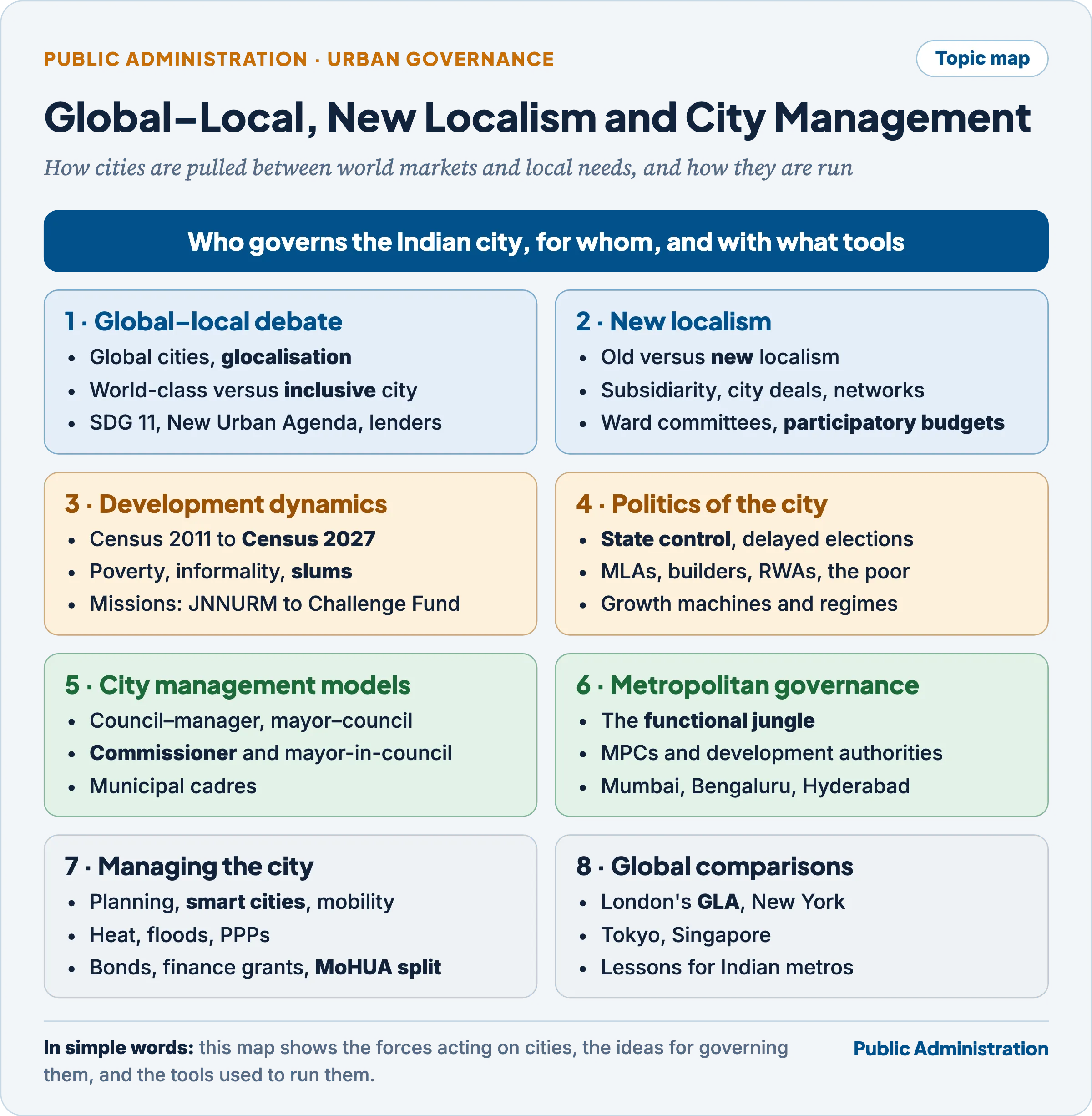
Cities are where globalisation lands on the ground. Foreign capital, global firms, international agencies and world rankings press cities to compete, while residents, councillors and neighbourhoods press them to serve local needs. Public administration has to manage this global–local tension through institutions: city governments, metropolitan authorities, parastatal agencies, State departments and Union missions. This article explains the debate, the idea of new localism that grew out of it, the development dynamics and politics of Indian cities, and the models and tools of city management, with comparisons from London, New York, Tokyo and Singapore. The constitutional design of municipalities is covered in a separate article and is only summarised here.
In simple words
Think of Bengaluru. Software firms serving clients in California want fast roads, reliable power and an airport; a vegetable vendor in a ward wants a place to sell and a drain that does not overflow. The same city government must satisfy both, while the State government, the Union ministries and global lenders all have a say. City management is the art of running that crowded house.
1. Cities in a Globalising World: The Global–Local Debate
In simple words
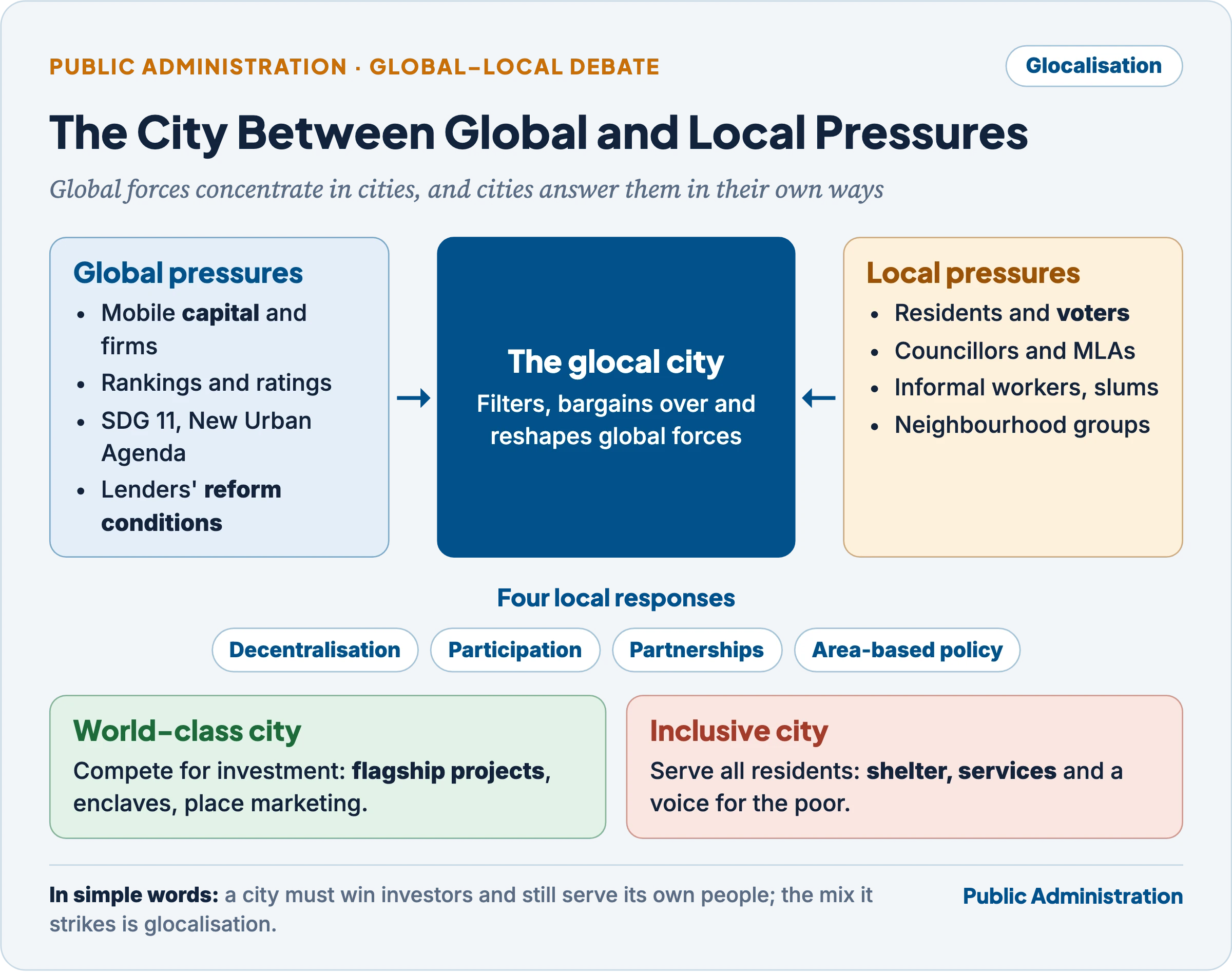
“Global” means acting on a world stage, under world rules and for world markets; “local” means acting for one place and its people. The global–local debate asks whether globalisation flattens cities into copies of one another, or whether each city answers global forces in its own way. Most scholars now say both happen at once, and call the mix “glocalisation”.
1.1 What the debate is about
The global–local debate is about how far forces operating at the world scale (trade, finance, technology, migration, international norms) shape life and governance in particular places, and how far places shape themselves. For urban local government, it is a question of balance: how to stay responsive to local problems and local democracy while meeting the standards and competitive pressures set globally.
Three disagreements run through the debate:
- Inexorable process or ideological project? One view treats globalisation as an unstoppable integration of markets, states and technologies. The other treats it as a deliberate project to establish the supremacy of markets, which can be resisted, slowed or reshaped by policy.
- End of the nation-state or a new form of capitalism? Some argued that global integration would hollow out the nation-state and open a new era of development. Critics replied that globalisation is capitalism in a new form, and that states remain powerful, often as the agents that open economies to it.
- Homogenisation or hybridisation? One camp predicted cultural homogenisation or even “cultural imperialism”, as global norms displace local cultures. The other observed that global practices are absorbed differently in each locality, producing new hybrid cultures rather than uniform ones.
The table sets out the contrasting traits usually associated with the two poles.
| Dimension | “Global” pole | “Local” pole | Glocal outcome |
|---|---|---|---|
| Identity | Cosmopolitan, open | Rooted, authentic, sometimes parochial | Hybrid identities |
| Economy | Mobile capital, global value chains | Place-bound firms and labour | Local clusters plugged into global chains |
| Culture | Uniform, standardised | Unique, different | Global forms used in local ways |
| Governance | International rules, rankings, lenders | Elected councils, neighbourhoods | Multi-level, networked governance |
| Risk | Fragmentation and inequality | Insularity and exclusion | Negotiated balance |
Neither pole describes a real city. What we see is a two-way interaction: global forces shape cities, and cities filter, bargain over and reshape those forces.
1.2 Globalisation and cities: world cities and global cities
- World cities. The British geographer Peter Hall in The World Cities (1966) described a few metropolises as centres of national and international power. John Friedmann, in “The World City Hypothesis” (1986), argued that a hierarchy of world cities acts as the “basing points” of global capital, and that their growth produces social and spatial polarisation.
- Saskia Sassen’s global city. The Dutch-American sociologist Saskia Sassen, in The Global City: New York, London, Tokyo (1991), showed that the dispersal of production across the world creates a need for centralised command and control. This happens in a few cities that concentrate advanced producer services (finance, law, accounting, consulting, advertising).
- Global cities are strategic sites where global networks meet national governance.
- They produce a “new geography of centrality and marginality”: highly paid professionals and a large low-wage service workforce (cleaners, guards, drivers, domestic workers) live side by side, so inequality rises within the city.
- Global cities can be more connected to each other than to their own hinterland.
- Space of flows. The Spanish sociologist Manuel Castells, in The Rise of the Network Society (1996), described a “space of flows” (networks of capital, information and elites) that sits above the “space of places” where most people live. Cities become nodes in networks rather than self-contained units.
- Indian anchor. After 1991, Mumbai, Delhi–NCR and Bengaluru became nodes of finance, IT services and business process outsourcing. Gurugram, Whitefield and Bandra–Kurla Complex grew as global enclaves, while older neighbourhoods and informal settlements next to them stayed poorly served, a pattern that fits Sassen’s polarisation thesis.
1.3 Glocalisation
- Meaning. Glocalisation is the simultaneous working of global and local processes, in which global products, ideas and institutions are adapted to local conditions, and local actors use global resources for their own ends. The phrase “think globally, act locally” captures the popular sense.
- Origin. The British sociologist Roland Robertson popularised the term in social theory (Globalization: Social Theory and Global Culture, 1992; “Glocalization: Time–Space and Homogeneity–Heterogeneity”, 1995). He borrowed it from Japanese business practice (dochakuka, adapting farming techniques to local soil) and argued that globalisation produces locality rather than erasing it.
- Rescaling of the state. The geographer Erik Swyngedouw used “glocalisation” for the rescaling of state power: some powers move upward (to the WTO, the EU, global lenders) and others downward (to regions and cities). This is why decentralisation and globalisation often arrive together.
- Why it matters for cities. Global forces concentrate in cities, but cities differ in how they respond. Glocalisation therefore turns the city into an active strategic actor, not a passive recipient.
- Indian anchor. The 74th Amendment (1992) came within a year of the 1991 liberalisation. One reading treats urban decentralisation as an inevitable companion of globalisation: cities that are to attract investment need accountable local bodies able to provide infrastructure. Another reading treats it as a domestic democratic project with its own roots in the Panchayati Raj debate. Both readings are part of the glocal story.
Common confusion
Is glocalisation the same as localisation? No. Localisation means power and decisions moving to the local level. Glocalisation means global and local processes working together and through each other: a McDonald’s menu adapted to Indian vegetarian tastes, a World Bank-funded water reform shaped by a State’s politics, or a Smart City command centre run by an Indian municipal SPV. It describes an interaction, not a transfer of power.
1.4 Competitive and entrepreneurial cities
- The pressure to compete. As cities compete to attract global capital, firms and talent, they offer an enabling package: well-run infrastructure, efficient transport and communications, housing, education and recreation, fast approvals and a skilled workforce. Rankings of “liveability”, “ease of doing business” and “cleanliness” add to the pressure.
- From managerialism to entrepreneurialism. The geographer David Harvey (“From Managerialism to Entrepreneurialism”, 1989) argued that city governments shifted from managing services for residents to entrepreneurial promotion of the city: public–private partnerships, flagship projects, place marketing and incentives for investors. The risks are speculation and the transfer of public risk to taxpayers.
- City limits. The American political scientist Paul Peterson, in City Limits (1981), argued that because capital and wealthier residents can leave, cities favour developmental policies (that raise the tax base) over redistributive policies (that serve the poor). This logic explains why many Indian cities spend on flyovers and convention centres more readily than on slum services.
- Indian anchor. The Second Administrative Reforms Commission (2nd ARC), in its sixth report Local Governance (2007), argued that India needs world-class cities, big and small, and saw an opportunity to create 25 to 30 world-class mega cities through the Jawaharlal Nehru National Urban Renewal Mission (JNNURM). Mumbai’s ambition to become an international financial centre, the GIFT City project in Gujarat and the Union Budget 2025–26 idea of “Cities as Growth Hubs” reflect the same competitive logic.
1.5 The world-class city versus the inclusive city
The drive to be world-class has produced a strong counter-argument for the inclusive city.
- Exclusion by aesthetics. The geographer D. Asher Ghertner, in Rule by Aesthetics (2015), showed how Delhi’s drive to look “world-class” led courts and officials to treat slums as “nuisances” by appearance, justifying large demolitions. Amita Baviskar used the term “bourgeois environmentalism” for middle-class campaigns for clean, green cities that push the poor and their livelihoods out.
- Spatial segregation. Rising land prices push lower-income groups to the urban fringe. Business districts, gated estates and slums sit geographically adjacent but socially apart: the core and periphery of the global economy are found inside one city. The urban elite often has more in common with elites abroad than with fellow citizens: one global language, one currency, homogenised malls and suburbs.
- The right to the city. The French philosopher Henri Lefebvre, in Le Droit à la ville (1968), argued that all inhabitants have a right to shape and use urban space, not merely to consume it. David Harvey (“The Right to the City”, 2008) linked this to resisting dispossession by redevelopment.
- Politics of the poor. Partha Chatterjee, in The Politics of the Governed (2004), showed that the urban poor often deal with the state not as rights-bearing citizens of civil society but as “political society”: groups that occupy land or services illegally and negotiate collectively through votes and intermediaries.
- Localised responses from below. Even with little influence over global forces, the poor organise: they save and lend to each other when banks will not, build their own shelter, and form federations. The Mumbai alliance of SPARC, the National Slum Dwellers’ Federation and Mahila Milan, part of Slum/Shack Dwellers International, has influenced resettlement and sanitation policy nationally and abroad. Cities thus localise democratic processes: the critical mass of people, institutions and information makes it easier to organise social movements.
- Indian anchor. The Commonwealth Games works in Delhi (2010) and riverfront projects displaced settlements; the Rajiv Awas Yojana (RAY) and later PMAY-Urban (both covered in Section 3) embody the inclusive-city response of in-situ slum redevelopment and property rights.
1.6 Global urban agendas and global lenders
Global institutions now set norms, targets and financing conditions for cities.
| Agenda or actor | Year | What it asks of cities |
|---|---|---|
| Habitat I (Vancouver) | 1976 | Put human settlements on the UN agenda; led to the UN Centre for Human Settlements (later UN-Habitat) |
| Habitat II (Istanbul) | 1996 | Adequate shelter for all and sustainable settlements; enabling markets and partnerships |
| Sustainable Development Goal 11 | 2015 | Make cities and human settlements inclusive, safe, resilient and sustainable: housing, transport, participatory planning, heritage, disaster risk, air quality, waste, public space |
| Paris Agreement and Sendai Framework | 2015 | Climate mitigation and adaptation; disaster risk reduction with a strong urban dimension |
| New Urban Agenda (Habitat III, Quito) | October 2016 | A shared vision of “cities for all”: urban planning, municipal finance, governance and the right to adequate housing as tools of sustainable development |
| UN World Urbanization Prospects 2025 | November 2025 | Adopted the harmonised Degree of Urbanisation method; ranks New Delhi fourth (about 30 million) and Kolkata ninth among the world’s most populous cities in 2025 |
- Localising the SDGs. NITI Aayog’s SDG Urban Index and Dashboard 2021–22 ranked 56 urban areas on SDG indicators, an attempt to make global goals measurable at city level.
- World Bank. Its first large urban loan in India supported the Calcutta Metropolitan Development Authority in the 1970s. Later lending moved from building projects to reform-linked programmes: property tax reform, double-entry accrual accounting, user charges, credit ratings and PPP frameworks. Its 2022 report, Financing India’s Urban Infrastructure Needs, estimated that Indian cities need about USD 840 billion over 15 years and that only about 5 per cent of city infrastructure is privately financed.
- Asian Development Bank (ADB). ADB has funded State-level urban sector programmes (water, sewerage, environmental improvement) in States such as Karnataka, Rajasthan, West Bengal and Tamil Nadu, typically with policy conditions on municipal finance and institutional reform.
- Others. JICA, the former DFID and networks such as Cities Alliance and C40 spread practices through grants, technical assistance and peer learning.
- Critique. Reform-linked lending can carry a one-size-fits-all market model into cities with weak capacity, push full-cost user charges onto poor households, and make cities accountable upward to lenders rather than downward to citizens. Supporters reply that the same conditions introduced transparency, accrual accounting and credit discipline that States had neglected.
1.7 Local responses: new ways of governing
Globalisation and urbanisation together have added responsibilities to city governments. They must promote their local economy in a competitive world while securing social justice and equity within the city. Four trends in urban governance answer this:
- Decentralisation. Decisions on infrastructure and services move to the level of government closest to the community. Decentralisation without matching resources, clear rules and accountability can worsen poverty and inequality and can simply decentralise corruption.
- Participation. Cities widen the role of civil society in plans and budgets. Participation helps legitimise policy and makes it more responsive, but it does not automatically empower the poor if they are weakly organised or if accountability mechanisms are absent.
- Partnerships. Partnerships between levels of government and between public, private and voluntary sectors help close the gap between needs and resources, share risks and pool skills. They still need sound public intervention to protect the poorest groups.
- Process-driven and territorial policy. Since no single actor can steer complex urban change, policy is made through alliances, negotiation and coalitions. Territorial, area-based initiatives replace uniform national regulation.
National governments still matter. Despite talk of the “hollowing out” of the state, they hold the financial resources and long-term agendas, act as watchdogs for weak and vulnerable groups, intervene when local actors fail, and bear ultimate responsibility for social cohesion and justice. This is the bridge to new localism.
2. New Localism
In simple words
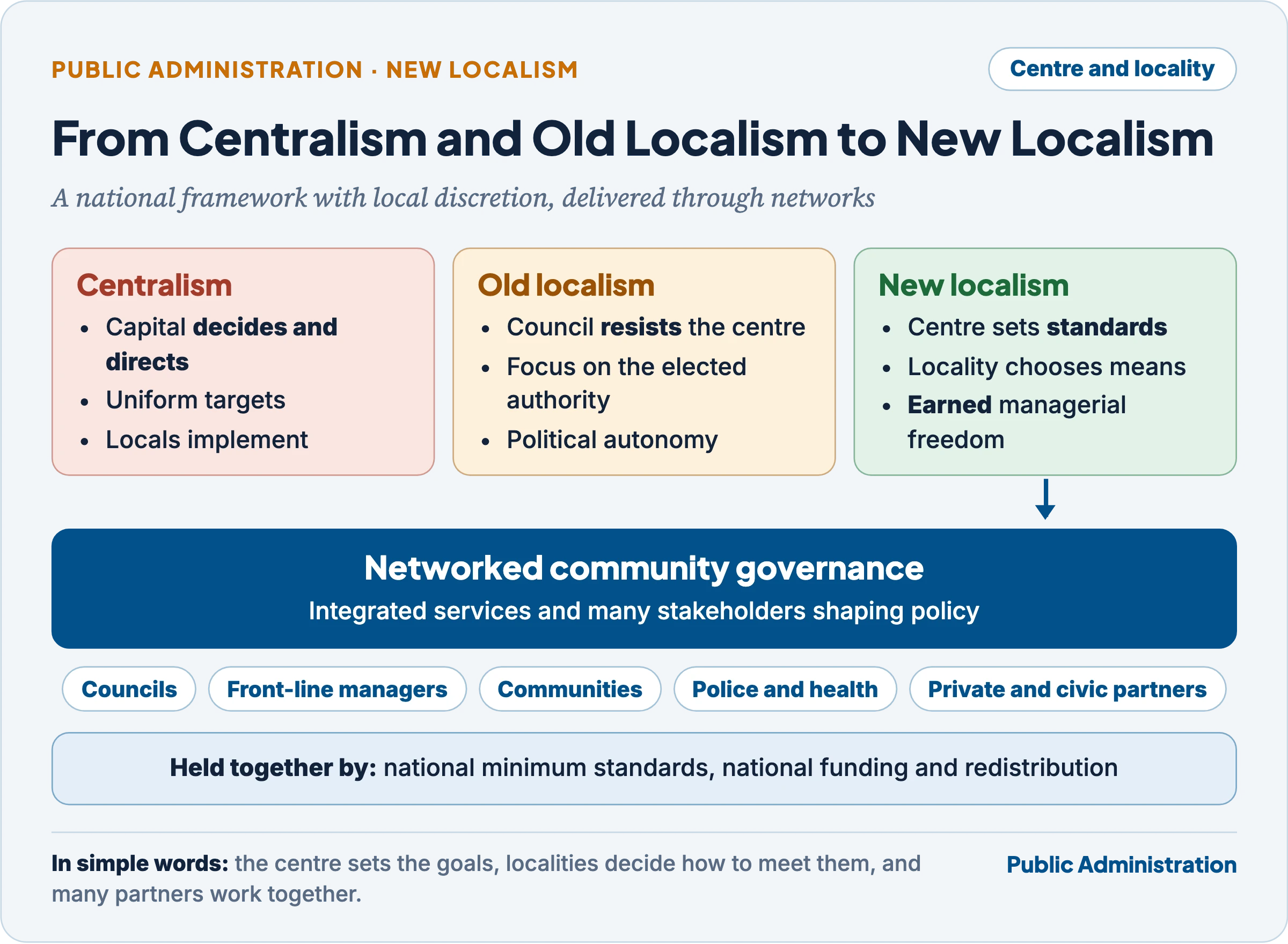
New localism says the national government should stop running everything from the capital, set a few clear national standards, and then let local councils, local managers, communities and partners decide how to meet them. It is not about leaving localities alone; it is about a smarter division of labour between the centre and the locality.
2.1 Meaning and origins in Britain
- Definition. New localism is a strategy of devolving power and resources away from central control towards front-line managers, local democratic structures, and local consumers and communities, within an agreed framework of national minimum standards and policy priorities.
- Why it emerged. It grew from a recognition of the limits of centrally driven policy implementation: local problems cannot be solved by standardised approaches imposed from above, and local agencies need space to adapt and innovate within national policy.
- Labour’s first term (1997–2001). Tony Blair’s government governed in a highly centralised way: national literacy and numeracy hours in schools, Public Service Agreements between departments and the Treasury, the Best Value review and inspection regime for councils, and star ratings for hospitals. These targets proved bureaucratic and had perverse effects, as organisations chased central targets at the expense of what residents valued (for example, environmental services that drive public satisfaction were under-resourced). Councils looked better to Whitehall but not to their publics.
- The new localist turn (2002 onwards). Dan Corry and Gerry Stoker, in New Localism: Refashioning the Centre–Local Relationship (New Local Government Network, 2002), and Stoker’s later paper New Localism, Participation and Networked Community Governance (University of Manchester) gave the idea its academic case. Policies followed:
- “Earned autonomy”: councils rated excellent in the Comprehensive Performance Assessment (from 2002) got freedoms such as fewer plans to submit, lighter inspection and freedom to borrow.
- Foundation hospitals (from 2004): high-performing NHS trusts got freedom to borrow and set pay, with boards including elected local members.
- Local Area Agreements (2004) between the centre and local partnerships, and the minister Nick Raynsford’s ten-year “Local Vision” strategy.
- “Double devolution” (David Miliband, 2006): power should pass from Whitehall to councils, and beyond councils to neighbourhoods and citizens.
- Coalition and after. The Localism Act 2011 (Royal Assent on 15 November 2011) gave councils a general power of competence and created community rights (to challenge service delivery, to bid for assets of community value) and neighbourhood development plans approved by local referendum. City Deals (first wave with eight core cities, 2012) and combined authorities with directly elected “metro mayors” (first elected in 2017) followed. The English Devolution and Community Empowerment Act 2026 (Royal Assent on 29 April 2026) puts “strategic authorities” into law, gives mayors more powers over transport, planning, housing and growth, and adds a community right to buy.
2.2 Old localism and new localism
New localism is characterised by a cautious devolution of power to the local level in order to implement national goals better. It emphasises the devolution of managerial power more than political power: the aim is to let local managers meet national priorities more effectively, not to let local politicians depart from national goals.
| Point of contrast | Old localism (1980s) | New localism (2000s) |
|---|---|---|
| Attitude to the centre | Resisted central control; local authority as a counter-power | Accepts the centre’s role in setting goals, standards and funding |
| Focus | The elected local authority | The wider locality: council, communities, police, health and other services |
| What is devolved | Political autonomy | Mainly managerial discretion, earned by performance |
| Accountability | To local voters | Multiple and overlapping: to residents, service users and the centre’s minimum standards |
| Tool | Local taxation and municipal enterprise | Agreements, inspection, earned autonomy, partnerships |
The contrast shows why new localism is a middle way between centralisation and full local autonomy: the centre steers, localities row, and the boundaries are negotiated.
2.3 The case for new localism
The case rests on three grounds.
- Complexity. Few community problems have simple solutions: protecting the environment, building a sound local economy, keeping communities healthy or preventing crime all need coordinated action by many agencies at several levels. Neither full local autonomy nor central steering of the whole system works. New localism offers local capacity-building and local solutions within a national framework, connected through networked community governance to wider networks of learning and support.
- Building a road needs one kind of state capacity; helping a damaged child or a deprived neighbourhood reach its potential needs a subtler capacity in which the recipient is actively engaged.
- A more engaging democracy. Drawing on the British political theorist Paul Hirst’s idea of associative democracy (Associative Democracy, 1994):
- Democracy must have a strong local dimension; the nation-state is not its only building block.
- The centre should be an enabler, regulator and standard-setter, not a direct provider deciding the detail of services.
- Provision should be plural, through many organisations and associations, so citizens can choose and judge.
- Democracy can be organised along functional as well as territorial lines.
- Accountability is a rounded process of reason-giving, questioning and continuous exchange between providers and the public, not only periodic elections.
- Social capital and civil renewal. Involvement and exchange create trust and social capital, the glue that lets people agree, act collectively and “go the extra mile”. Civil renewal gives people a greater sense of efficacy and a say over their lives, joining rights (to respect, decent services and influence) with responsibilities (to others, to the community and to accepting democratic outcomes).
2.4 Objections and the answer
- Parochialism. Local decision-making can serve the narrow concerns of insular groups; behind romantic notions of community lies “not in my back yard” (NIMBY) politics, while progressive politics needs a wider canvas.
- Inequality. Tackling inequality needs national or even international intervention; more local discretion may entrench inequality, as rich areas stay rich and poor areas are “free” to spend resources they do not have.
- The answer of new localists. That is why the localism is “new”: it is set within national framework-setting and funding, as part of a wider system of multi-level governance. It does not assume local politics is free of conflict, does not rely on a romantic faith in communities, and is compatible with redistribution by higher levels of government. Equity means tailoring solutions to different needs, not treating all places the same. The point is not that all decisions should be local, but that more of them should be.
2.5 Networked community governance
Networked community governance is the form of local governance that new localism, combined with real public participation, makes possible. It goes beyond both traditional public administration and New Public Management (NPM): it focuses on integrated service and programme delivery and on the capacity to involve many stakeholders in shaping policy. Stoker later linked it to public value management (“Public Value Management: A New Narrative for Networked Governance?”, 2006), building on Mark Moore’s Creating Public Value (1995).
| Feature | Traditional public administration | New Public Management | Networked community governance |
|---|---|---|---|
| Core aim | Implement political mandates through rules | Efficiency and results; customer satisfaction | Public value: outcomes citizens care about |
| Role of public managers | Follow procedures | Meet performance targets | Steer networks, broker partnerships |
| Role of citizens | Voters and clients | Customers | Co-producers and participants |
| Accountability | Upward through hierarchy | Through contracts and targets | Multiple: to citizens, users, partners and the centre |
| Preferred delivery | Public bureaucracy | Contracting out, agencies | Whatever works: public, private, voluntary, community |
2.6 American “new localism”: Katz and Nowak
- The argument. Bruce Katz and Jeremy Nowak, in The New Localism: How Cities Can Thrive in the Age of Populism (Brookings Institution Press, 2018), argued that power is shifting downward from national governments to cities and metropolitan areas, and horizontally from government alone to networks of government, business, universities, philanthropy and civic groups. Cities are where problems such as jobs, infrastructure and inclusion are solved pragmatically while national politics is polarised.
- Tools. Metropolitan partnerships, publicly owned asset companies (such as Copenhagen’s City and Port Development Corporation), innovation districts, and new local financing institutions.
- Critique. It can favour corporate and philanthropic elites over elected councils, and cities with weak capacity or a poor tax base cannot “solve problems locally” on their own.
2.7 Principles of new localism
| Principle | Meaning | Example |
|---|---|---|
| Subsidiarity | Functions should be performed at the lowest level able to perform them well | European Charter of Local Self-Government (1985); Maastricht Treaty (1992); a core principle in the 2nd ARC’s sixth report |
| Place-based policy | Policy tailored to the assets and problems of each place, instead of uniform national schemes | EU cohesion policy reform (Barca Report, 2009); India’s Aspirational Districts approach |
| City deals and earned autonomy | Negotiated packages of powers and funds in return for agreed outcomes | UK City Deals (2012); reform-linked Indian missions such as AMRUT and the Urban Challenge Fund |
| Networked governance | Problems solved through partnerships of public, private and civic actors | Neighbourhood partnerships, PPPs, citizen groups |
| National minimum standards | The centre sets floors and goals; localities choose means | Service-level benchmarks for water, sewerage and waste in India |
| Participation and co-production | Citizens shape and help deliver services | Participatory budgeting, ward committees, area sabhas |
2.8 Neighbourhood management: a glocal strategy against exclusion
- Meaning. Neighbourhood management places a dedicated manager or partnership at the level of a neighbourhood to join up services (police, housing, waste, health, schools) and involve residents in deciding priorities. It treats social exclusion as the result of several overlapping deprivations concentrated in particular places.
- Origin. Britain’s National Strategy for Neighbourhood Renewal (2001) created Neighbourhood Management Pathfinders in deprived areas, following the Social Exclusion Unit’s work from 1998.
- Why “glocal”. It answers global problems (deindustrialisation, migration, labour-market polarisation) by local, place-specific action; it uses globally circulating ideas of partnership and participation, adapted to the neighbourhood.
- Indian forms.
- Advanced Locality Management (ALM) in Mumbai (1997): resident groups partnering the municipal corporation on waste and local upkeep.
- Bhagidari in Delhi (2000): structured partnership between the Delhi government and resident welfare associations (RWAs) and market associations.
- Mohalla committees formed in Mumbai after the 1992–93 riots to rebuild trust between police and communities.
- Area sabhas and ward committees, and Kerala’s ward-level planning under the People’s Plan Campaign.
- Limits. Middle-class RWAs dominate many such forums, so slum dwellers and tenants are under-represented. Neighbourhood management works against exclusion only when the poor have a guaranteed voice and resources.
2.9 New localism in India
India never adopted “new localism” as an official doctrine, but its elements are visible in four strands.
- Centrally steered local action (the British pattern). Union missions set national goals and reform conditions and let cities choose projects: JNNURM (2005) with its 23 mandatory and optional reforms, AMRUT and the Smart Cities Mission (2015), Swachh Bharat Mission–Urban (2014), and now the Urban Challenge Fund (2026). This is cautious, managerial devolution to meet national goals.
- Participatory institutions.
- Ward committees under Article 243S (mandatory in municipalities of three lakh or more population).
- Area sabhas at polling-booth level, promoted through the Model Nagara Raj Bill (2008) as JNNURM’s community participation reform; few States implemented them in substance.
- Participatory budgeting in Pune (since 2006–07), where citizens propose ward-level works within a share of the budget, and Kerala’s People’s Plan Campaign (1996), which devolved a large share of plan funds to local bodies, including municipalities.
- Civil society scholarship and monitoring. These are subjects of study and examples of civic action:
- The Public Affairs Centre in Bengaluru, founded by Samuel Paul, introduced citizen report cards (first in 1993–94), rating public agencies on user feedback.
- Janaagraha (founded 2001) campaigned for ward-level participation and, from 2013, published the Annual Survey of India’s City-Systems (ASICS), which assesses cities on urban planning and design, capacities and resources, empowered and legitimate political representation, and transparency, accountability and participation.
- The Bangalore Agenda Task Force (1999), a partnership of business leaders and civic agencies, and Bhagidari in Delhi.
- Market and partnership strand. Special purpose vehicles (SPVs), PPPs in waste, water and transport, and municipal bonds.
Criticism — New localism undermines the spirit of the 74th Amendment
- Managerial, not political, devolution. New localism devolves to managers and SPVs, while the 74th Amendment sought to make municipalities institutions of self-government with elected leadership.
- Bypassing elected councils. Smart City SPVs, development authorities and parastatals report to State governments; councillors have little say.
- Centralised conditionality. Union missions decide priorities and attach conditions, turning cities into implementing agencies of national schemes.
- Middle-class capture. Bhagidari, RWAs and ALMs give voice to organised property-owners; the urban poor and tenants are left out, and councillors see these forums as rivals.
- Market logic. Partnerships and user charges can turn citizens into customers and shift risk onto the public.
Defence — New localism complements and deepens the 74th Amendment
- Participation beyond elections. Ward committees, area sabhas, report cards and participatory budgets make local democracy continuous, which the 74th Amendment intended but did not secure.
- Capacity and finance. Missions and reform conditions brought double-entry accounting, credit ratings, GIS property tax and e-governance to cities that States had neglected.
- Realism. In a federal system where municipalities are a State subject, a national framework with local discretion is the most practical route to better services.
- Networks fit complexity. No single municipal body can manage water, transport, housing and climate risk alone; networked governance is a necessity, not a betrayal.
- The fix lies in design. Making SPVs and parastatals accountable to the elected city government, as the 2nd ARC and NITI Aayog (2026) recommend, reconciles new localism with the 74th Amendment.
2.10 New localism and Centre–State–local relations
New localism changes relations between all three levels, especially since liberalisation.
| Relationship | Before 1991 | Under new localism and LPG |
|---|---|---|
| Union–city | Little direct contact; urban development a State subject | Direct relationship through missions, reform conditions, rankings and challenge funds; the Union sets national urban goals |
| State–city | Tight control: supersession, nominated bodies, parastatals | Constitutional guarantees (elections, State Finance Commissions) but continued State dominance through parastatals, SPVs and delayed polls; States act as gatekeepers of reforms |
| City–market | Municipal monopoly or State boards | PPPs, municipal bonds, credit ratings, private operators |
| City–citizen | Voters every five years | Ward committees, RWAs, report cards, grievance apps and co-production |
| City–global | Mediated by the Union | Direct engagement with lenders, investors, networks and global agendas |
The table shows that new localism is less a transfer of power to cities than a re-scaling of governance: the Union gains steering power, the market and civil society gain roles, and the State remains the hinge.
3. Development Dynamics of Indian Cities
In simple words
India is becoming more urban every year, but its cities are growing faster than the services, housing and jobs they can provide. Many people live in slums, work without contracts and depend on the city government for water, sanitation and shelter. The Union and States have run a series of missions to close these gaps, with mixed success.
3.1 Urbanisation: trends and data
- Long-run trend. India’s urban share rose from about 17 per cent in 1951 to 27.8 per cent in 2001 and 31.16 per cent in 2011, when 37.7 crore people lived in urban areas. In 2001–11, for the first time since Independence, the urban population grew by more people (about 9.1 crore) than the rural population.
- Towns and cities (Census 2011). 7,935 towns: 4,041 statutory towns (with a municipality, corporation, cantonment board or notified area) and 3,894 census towns (at least 5,000 people, 75 per cent of male main workers outside agriculture, and density of 400 per sq km). The number of million-plus cities and urban agglomerations rose from 35 (2001) to 53 (2011); Greater Mumbai (18.4 million), Delhi (16.3 million) and Kolkata (14.1 million) were the largest.
- Hidden urbanisation. Almost half of India’s urban settlements are census towns governed as villages by panchayats, so the urban reality is larger than municipal India. International comparisons using the UN’s Degree of Urbanisation method suggest an even larger urban population.
- Projections. The World Bank expects about 60 crore urban residents (about 40 per cent) by 2036. The UN’s World Urbanization Prospects 2025 ranks New Delhi the world’s fourth most populous city (about 30 million) in 2025.
- Census 2027. The next census is India’s first digital census: houselisting from April to September 2026 with an option of self-enumeration, and population enumeration in February 2027 (reference date 1 March 2027; 1 October 2026 for snow-bound areas), including caste enumeration. Its urban data will reset city boundaries, mission eligibility and finance commission formulae.
- Urbanisation and growth. Urbanisation and per capita income are strongly correlated, because industry and services, the drivers of growth, concentrate in cities. But some of the largest agglomerations are in poorer countries because rural economies cannot hold their populations. The National Commission on Urbanisation (1988) warned that cities were overcrowded, services breaking down, city management ineffective and resource allocation following problems instead of anticipating them.
Common confusion
Are census towns governed by municipalities? No. A statutory town has a municipal body; a census town meets urban criteria of population, density and non-farm work but is still governed by a gram panchayat. This is why India’s urban governance covers less territory than its urbanisation: the NITI Aayog report on urban planning capacity (2021) noted that almost half of the 7,933 urban settlements are census towns.
3.2 Urban poverty and informality
- Scale. By the Tendulkar method, urban poverty was 13.7 per cent in 2011–12; the Rangarajan Expert Group (2014) put it at 26.4 per cent. The gap shows how sensitive urban poverty is to housing, transport and food costs.
- Informality. Most urban workers are in the informal sector: street vending, construction, domestic work, waste picking, transport and home-based work, with no written contract or social security.
- Street vendors. The Street Vendors (Protection of Livelihood and Regulation of Street Vending) Act, 2014 requires town vending committees, surveys and vending zones; PM SVANidhi (2020) gives small working-capital loans. Implementation varies widely between cities.
- Multiple deprivations. The urban poor face insecure tenure, poor sanitation, unsafe water, distance from work and harassment by authorities. Urban poverty is therefore as much about access to services and land as about income.
3.3 Slums and housing
- Slums. Census 2011 counted about 6.5 crore people in slums, roughly one in six urban residents, spread over 2,613 towns. The Pronab Sen Committee on Slum Statistics (2010) defined a slum as a compact settlement of at least 20 households with poorly built, congested tenements and inadequate sanitation and water.
- Why slums form. The 2011 RAY guidelines located the cause in exclusionary planning, land management and land law that did not adapt to the pace of urban growth or make room for the informal working classes in planned spaces.
- Housing shortage. The Technical Group on Urban Housing Shortage (Amitabh Kundu, 2012) estimated a shortage of about 1.88 crore units for 2012, almost all among economically weaker and low-income groups.
- Policy shift.
- Slum clearance and resettlement (1950s–1970s) gave way to environmental improvement of urban slums (1972) and then to in-situ upgrading.
- JNNURM’s sub-missions, Basic Services to the Urban Poor (BSUP) and the Integrated Housing and Slum Development Programme (IHSDP), financed slum housing from 2005.
- Rajiv Awas Yojana (2011) aimed at a “slum-free India” through a whole-city, all-slums approach and property rights for slum dwellers.
- PMAY-Urban (2015) with four verticals (in-situ redevelopment, credit-linked subsidy, affordable housing in partnership, beneficiary-led construction), and PMAY-U 2.0 (approved 9 August 2024) for one crore urban poor and middle-class families with government assistance of ₹2.30 lakh crore, including affordable rental housing.
- Courts. In Olga Tellis v. Bombay Municipal Corporation (1985) the Supreme Court linked the eviction of pavement dwellers to the right to livelihood under Article 21; in Ajay Maken v. Union of India (2019) the Delhi High Court required surveys and rehabilitation before slum eviction.
3.4 Urban anti-poverty programmes
Urban anti-poverty programmes moved from employment schemes to livelihoods, shelter and finance.
| Programme | Year | Focus |
|---|---|---|
| Nehru Rozgar Yojana | 1989 | Urban micro-enterprises, wage employment, shelter upgradation |
| Urban Basic Services for the Poor | 1990 | Community-based basic services, with UNICEF support |
| Prime Minister’s Integrated Urban Poverty Eradication Programme | 1995 | Poverty in small towns |
| Swarna Jayanti Shahari Rozgar Yojana | 1997 | Merged earlier schemes: self-employment, wage employment, community structures |
| BSUP and IHSDP under JNNURM | 2005 | Housing and basic services in slums |
| National Urban Livelihoods Mission (later DAY-NULM) | 2013 | Self-help groups of the urban poor, skills, credit, shelters for the homeless, support to street vendors |
| PMAY-Urban | 2015 | Housing for all |
| PM SVANidhi | 2020 | Working-capital loans for street vendors |
The trend reflects a shift from target-driven employment programmes to community institutions and entitlements, borrowing from the self-help group model that worked in rural India.
3.5 Urban missions from JNNURM to the Urban Challenge Fund
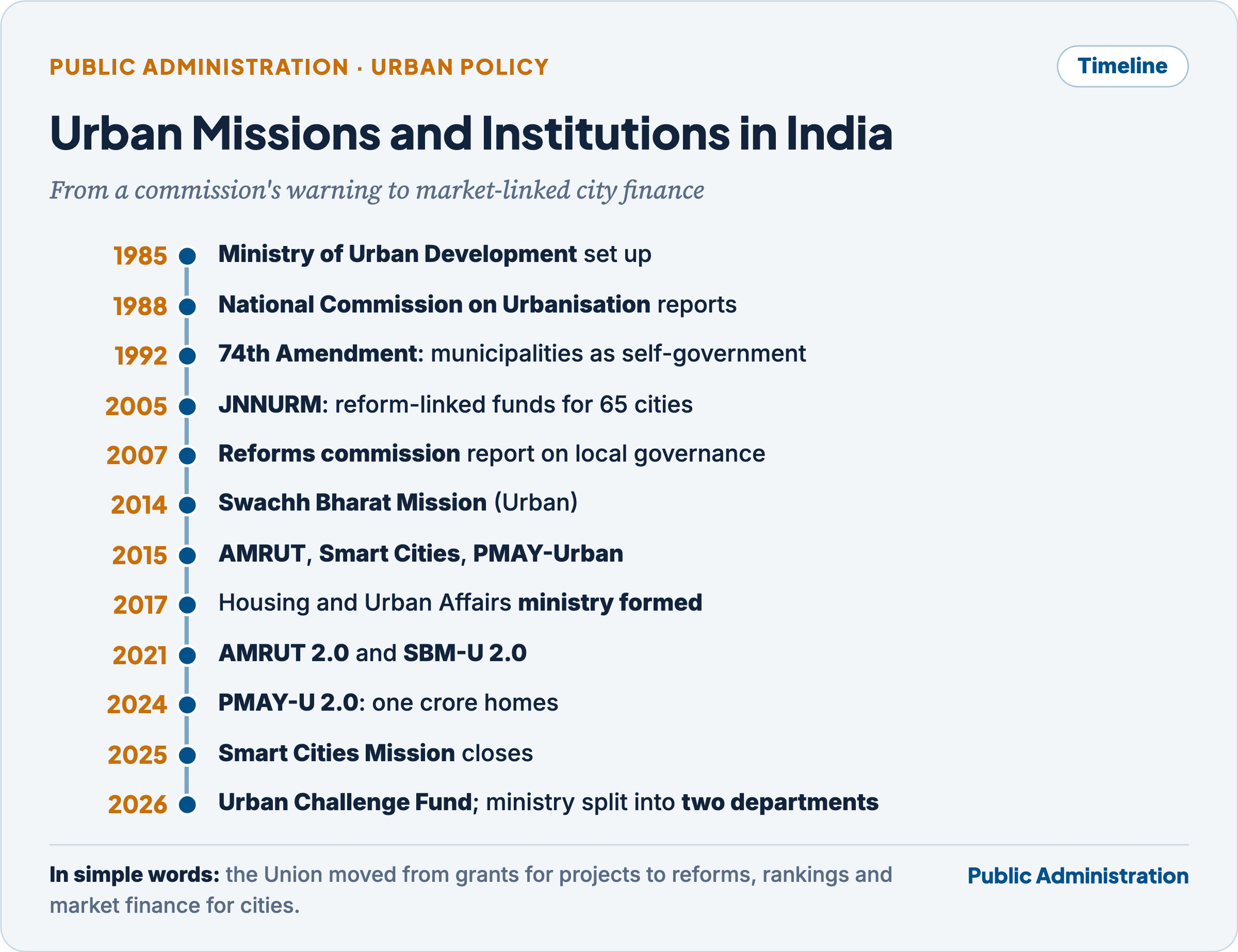
- JNNURM (launched 3 December 2005). A reform-linked mission for 65 mission cities (63 at launch), with Additional Central Assistance of about ₹50,000 crore and two sub-missions: Urban Infrastructure and Governance (UIG) and BSUP. Cities prepared City Development Plans and signed agreements committing to reforms: repeal of urban land ceiling laws, rent control reform, lower stamp duty, accrual accounting, e-governance, property tax reform, user charges, a community participation law and a public disclosure law.
- Achievements. The first concerted push for both reform and infrastructure; bottom-up assessment through City Development Plans; buses, water and sewerage projects in many cities.
- Limits noted by the 2nd ARC. Transport projects took the largest share, at the cost of sanitation; cities had to raise their share regardless of the sector; consultants, not municipal staff, prepared plans; capacity building and devolution of powers lagged.
- The 2014–15 generation. Swachh Bharat Mission–Urban (2 October 2014; 2.0 from October 2021), AMRUT (25 June 2015; AMRUT 2.0 from October 2021 for water-secure cities), the Smart Cities Mission (25 June 2015, closed on 31 March 2025), PMAY-U (2015) and HRIDAY for heritage cities (2015).
- Recent instruments. PM e-Bus Sewa (August 2023) and the Urban Challenge Fund (approved by the Cabinet on 13 February 2026), which shifts Union support from grants to market-linked, competitive financing (see Section 7.6).
- What the missions reveal. The Union now acts as a national urban policymaker despite urban development being a State subject; missions have built assets, but municipal capacity and accountability remain the binding constraint, a concern summed up in the phrase “governance deficit” in development administration.
4. Politics of the City
In simple words
A city is run not only by its municipal corporation. MLAs, ministers, State-run boards, builders, resident associations, slum leaders, courts and the media all pull in different directions. Who actually decides what gets built, and for whom, is the politics of the city.
4.1 The actors
| Actor | Interest and influence |
|---|---|
| State government (Chief Minister, urban development department) | Controls municipal laws, finances, parastatals, land and appointments of commissioners; treats large cities as revenue and political assets |
| MLAs and MPs | Represent overlapping constituencies, control constituency development funds and often sit ex officio in municipal bodies; see corporators as rivals for local patronage |
| Mayor and councillors | Elected, close to voters, but usually with weak executive power and short terms |
| Municipal commissioner and bureaucracy | Real executive authority in most States; appointed and transferred by the State |
| Parastatals and SPVs | Development authorities, water boards, transport corporations, housing boards; technically strong but accountable upward to the State |
| Builders and real-estate interests | Push land-use changes, floor area ratio increases and regularisation; finance politics |
| Middle-class activism and RWAs | Organised, articulate, use PILs, media and partnerships (Bhagidari); can be exclusionary |
| Urban poor and their leaders | Negotiate through votes, intermediaries and occupation (Chatterjee’s “political society”); organised federations sometimes shape policy |
| Courts | Act through PILs on waste, pollution, encroachment, housing rights and elections |
| Media, NGOs, think-tanks | Rankings, report cards, campaigns and data |
Two theories from the United States help explain these patterns (developed in the theory lens below).
- The growth machine. Harvey Molotch (“The City as a Growth Machine”, 1976) and John Logan and Harvey Molotch (Urban Fortunes, 1987) argued that land-based elites (developers, landowners, local media, utilities) form a coalition that pushes for growth, because growth raises the exchange value of land, often at the expense of the use value residents get from neighbourhoods.
- Urban regimes. Clarence Stone, in Regime Politics: Governing Atlanta, 1946–1988 (1989), showed that elected officials govern through informal coalitions with business and civic actors who control resources the government lacks. Power is “power to” get things done, not only “power over”.
- Indian anchor. Scholars of Indian cities describe “occupancy urbanism” (Solomon Benjamin, 2008): poor and lower-middle groups claim land and services through local politicians and lower bureaucracy, while elites work through State-level planning agencies and mega-projects. City politics thus runs on two tracks.
4.2 Urban local politics versus State control
- Excessive State control. States exercise legislative, administrative, financial and judicial control, often negatively. City decisions are subject to State-level checks on everything from creating posts to passing budgets and selling property; the businessman and public servant Nandan Nilekani described municipalities as being reduced to “vestigial organs” of the State.
- Delayed elections. Despite Article 243U (elections before the term ends), many big cities went years without elected councils:
- Bengaluru had no council from September 2020; after the BBMP was replaced by five corporations, the Supreme Court in July 2026 directed that elections be held in December 2026.
- Mumbai was run by its commissioner as administrator from March 2022 until elections on 15 January 2026.
- In Suresh Mahajan v. State of Madhya Pradesh (2022) the Supreme Court held that the State Election Commission must notify overdue local elections and cannot wait indefinitely for OBC reservation exercises; Kishansing Tomar v. Municipal Corporation of Ahmedabad (2006) had earlier held that elections must be completed before the term expires.
- Why States resist. City elections are barometers of political mood; it is easier to deal with appointed officials than with elected bodies; parastatals and contracts run on patronage that cannot stand council scrutiny; and State legislatures remain dominated by rural constituencies, which the 1991 question calls “ruralised State Governments”.
- Disempowerment and depoliticisation. Urban local government has been weakened in many ways at once:
- Functional: parastatals and SPVs take core functions; the CAG’s 2024 compendium found that, on average, ULBs had full control over only four functions of the Twelfth Schedule.
- Executive: power with the State-appointed commissioner; mayors indirectly elected, often for one to two-and-a-half years.
- Fiscal: dependence on State transfers; delayed State Finance Commissions.
- Electoral: postponed polls and long administrator rule.
- Technocratic: missions, command centres and consultants replace council deliberation; RWAs and partnerships bypass ward councillors.
- Political: State ministers chair metropolitan bodies (the Chief Minister chairs the Greater Bengaluru Authority).
- Low participation. City dwellers, despite higher literacy, show civic apathy: many migrants see the city as a place to earn, not belong; elected leaders rarely visit wards; ward committees exist on paper. The 74th Amendment cross-reference below explains the formal design.
Indian Connect — Municipal Council, Ratlam v. Vardhichand (1980)
Residents of Ratlam complained of open drains and filth. The Supreme Court, in a judgment by Justice V.R. Krishna Iyer, held that a municipality cannot plead lack of funds to escape its statutory duty to provide sanitation, and that a magistrate can order it to act under the criminal procedure law on public nuisance. The case made municipal service failures justiciable and is the root of later PILs on waste and pollution, such as Almitra Patel v. Union of India (orders from 2000 that led to the municipal solid waste rules).
5. City Management: Models and the Municipal Executive
In simple words
Every city must decide who is the real boss: an elected mayor, a hired professional manager, a committee of elected commissioners, or a State-appointed officer. Each choice balances democracy against expertise. India mostly gives power to a State-appointed commissioner, which is why many reformers want stronger, directly elected mayors.
5.1 The municipal framework in brief
The 74th Constitutional Amendment Act, 1992 (Part IXA, Articles 243P to 243ZG, and the Twelfth Schedule) gave municipalities constitutional status: three types of bodies (nagar panchayats, municipal councils, municipal corporations), five-year terms, reservation, State Election Commissions, State Finance Commissions, ward committees, District and Metropolitan Planning Committees, and an indicative list of 18 functions. Its weak spots are that devolution of functions and finances is left to the States. See the article on Municipal Governance and the 74th Amendment: Features, Structures, Finance and Problems.
5.2 Models of city government
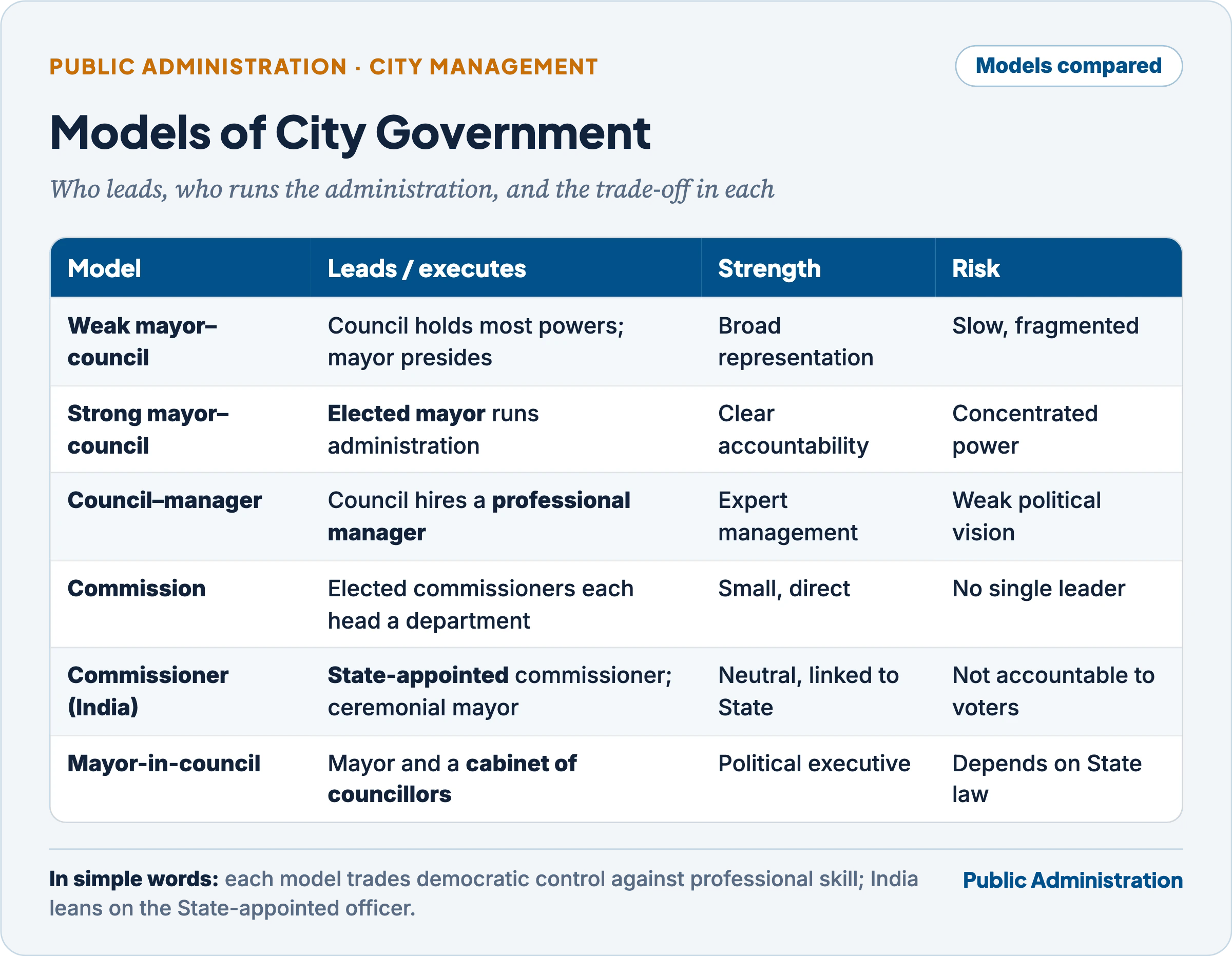
City management literature, much of it American, identifies four standard forms.
- Weak mayor–council. A council holds most executive and appointing powers; the mayor presides but has limited authority. Fragmentation and slow decisions are common.
- Strong mayor–council. A directly elected mayor is the chief executive, appoints department heads, prepares the budget and can veto council decisions. It gives clear political leadership and accountability (New York is the leading case).
- Council–manager (city manager) model. An elected council sets policy and hires a professional city manager who runs administration and can be dismissed by the council. It began in Staunton, Virginia (1908) and spread after Dayton, Ohio (1914); it was a Progressive Era answer to machine politics, separating policy (council) from administration (manager), in the spirit of Woodrow Wilson’s politics–administration dichotomy.
- Commission model. A small board of elected commissioners acts collectively as the legislature, and each commissioner heads a department. It began in Galveston, Texas (1901) after a hurricane; it suffered from no single leader and has largely disappeared.
India’s variants:
- Commissioner model (the Bombay model). Codified in the City of Bombay Municipal Act, 1888: a deliberative corporation led by an indirectly elected mayor (largely ceremonial), a powerful standing committee for finance, and a State-appointed municipal commissioner (usually an IAS officer) holding statutory executive powers. It is the dominant pattern in Indian municipal corporations and resembles the council–manager model, except that the manager is appointed and removed by the State, not by the council.
- Mayor-in-council model (the Kolkata model). Introduced by the Calcutta Municipal Corporation Act, 1980 (in force from 1984): a mayor with a cabinet of councillors holding portfolios, on the parliamentary pattern, with the commissioner as principal executive officer under them. Madhya Pradesh also uses a mayor-in-council.
- Directly elected mayor. According to NITI Aayog (2026), mayors are directly elected in only a few States, such as Bihar, Chhattisgarh, Haryana, Jharkhand, Madhya Pradesh, Odisha, Uttar Pradesh and Uttarakhand, and States have changed the method repeatedly. Even directly elected mayors usually lack control over the commissioner and parastatals.
- Municipal councils. In smaller towns the chairperson has more executive power, assisted by a State-appointed chief or executive officer.
5.3 The mayor–commissioner debate
The table sets out the main arguments on each side.
| For the commissioner system | For an empowered, directly elected mayor |
|---|---|
| Professional, neutral management by an experienced officer | Democratic legitimacy: the person voters can hold responsible |
| Shields administration from contractor–politician cartels | Ends a “dual track” where the elected head lacks power and the executive lacks electoral accountability |
| Links the city to State departments and funds | Gives the city a single political voice to bargain with the State, investors and the Union |
| Continuity when councils are divided or superseded | Fixed tenure allows long-term vision (the 2nd ARC and NITI Aayog both stress fixed terms) |
| Commissioners are frequently transferred and accountable upward to the State |
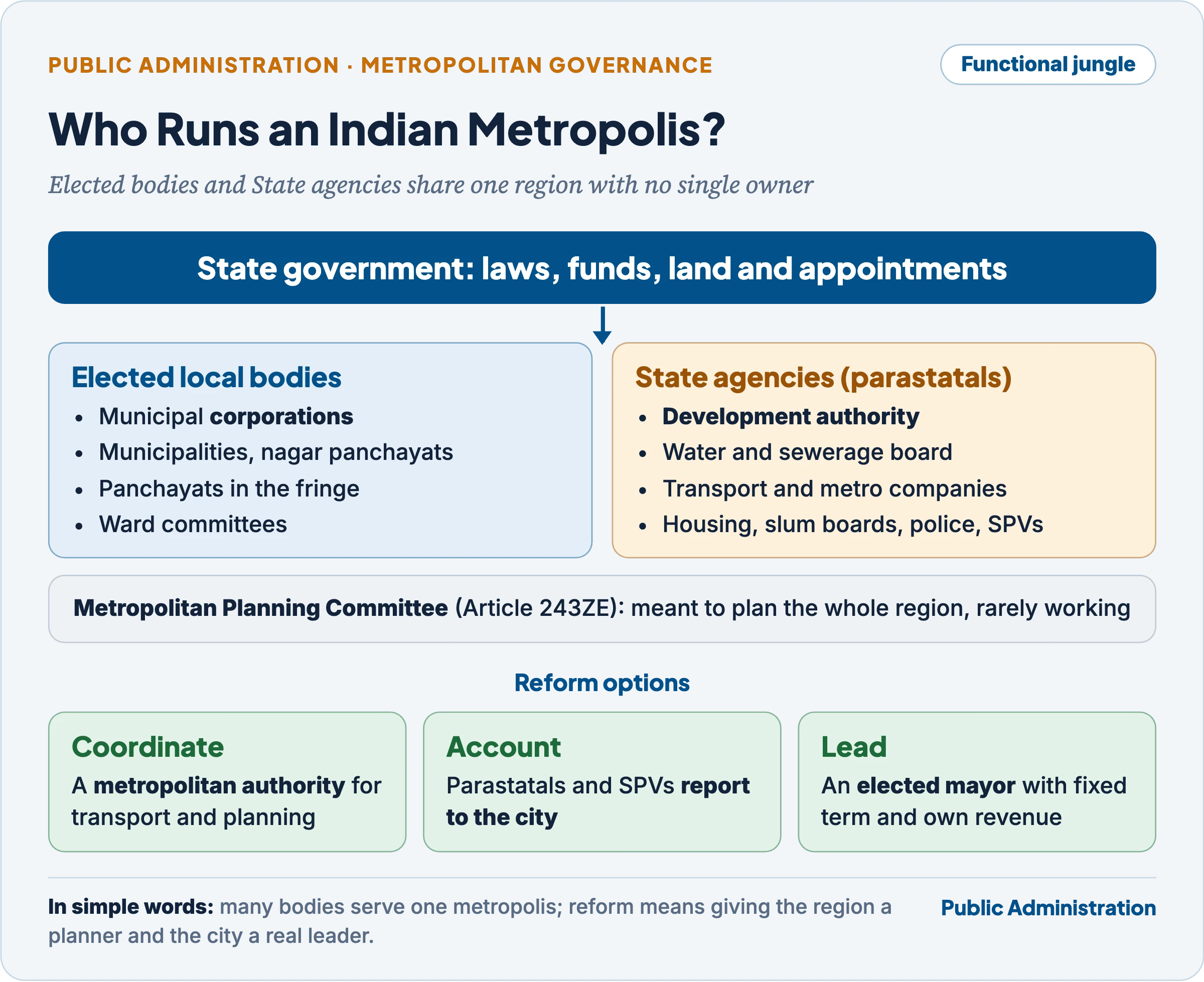
- 2nd ARC (2007). Recommended making the mayor a directly elected chief executive of urban local governments, making all infrastructure and service providers accountable to the ULB, and special institutional arrangements for mega cities.
- NITI Aayog (April 2026). Its report Moving Towards Effective City Government: A Framework for Million-Plus Cities recommended, starting with million-plus cities:
- a directly elected mayor with a fixed tenure and stronger executive authority;
- an empowered mayor-in-council;
- that parastatals and SPVs delivering essential urban services report to the city government;
- stronger State Finance Commissions for predictable transfers.
- The counter-view. An all-powerful mayor in a city with weak checks could become a local boss; a strong mayor without control over funds, staff and parastatals becomes only a figurehead with a vote mandate. Reform must therefore be a package: mayoral power, municipal cadres, fiscal autonomy and accountability through councils, audit and transparency.
5.4 Professionalising city management: municipal cadres
- The problem. Municipal staff are drawn from a confusing mix of systems:
- separate (each body recruits its own staff);
- unified (a State-wide municipal service, transferable between municipalities);
- integrated (municipal and State staff form one service).
The scholar of local government Abhijit Datta compared the resulting organisation to an onion, each layer of personnel rotating on its own path without a common purpose. Municipal services are treated as inferior services, with poorer pay and promotion prospects, and staff are disciplined and transferred by the State.
- What reformers propose. A cadre of specialised municipal executives equal in status to State services, with professional streams (planning, finance, engineering, public health); training as a continuous activity; and, per the 2nd ARC, a pool of experts (engineers, planners) maintained by a federation of local bodies. A study of Rajasthan by Ashok Mukhopadhyay found that the type of personnel system mattered less than its quality and incentives.
- Planning capacity. NITI Aayog’s report Reforms in Urban Planning Capacity in India (September 2021) found vacancies of about 42 per cent in State town planning departments and recommended lateral entry of town planners for a limited period.
6. Metropolitan Governance
In simple words
A big city does not stop at the municipal boundary. Mumbai’s workers live in Thane and Navi Mumbai; Bengaluru’s water comes from far away; Delhi’s traffic spills into Haryana and Uttar Pradesh. Running a metropolis means getting many separate bodies to plan and act together, which India has found very hard.
6.1 The problem: a “functional jungle”
- Fragmentation. A metropolitan region contains several municipal corporations, municipalities, panchayats, census towns and districts, plus uni-functional agencies: development authorities, water and sewerage boards, transport corporations, metro rail companies, housing boards, slum boards, pollution boards, police and electricity companies.
- The “functional jungle”. This term (in the 2008 question) describes overlapping, uncoordinated jurisdictions. Even in a medium-sized city like Jaipur, more than thirty government agencies take part in urban development; the Jaipur Development Authority, the Housing Board, the Public Health Engineering Department, electricity companies and the municipal corporation must coordinate, so decisions move up to the State secretary and minister, causing centralisation and delay.
- Consequences. Diffused accountability (citizens do not know whom to approach), the elected city body pays towards agencies it cannot control, plans of different agencies conflict, and no institution owns outcomes such as flooding or congestion.
- Inter-organisational relations. The scholar Mohit Bhattacharya used the Calcutta Metropolitan Development Authority (CMDA) to illustrate a focal organisation that takes inputs (funds, materials, personnel) from many organisations and passes its outputs (roads, water works, housing) to others such as the municipal corporation and municipalities. Coordination depends on contracts, joint bodies and exchange, not hierarchy alone.
6.2 Approaches to governing metropolitan areas
| Approach | Logic | Examples | Risk |
|---|---|---|---|
| Consolidated metropolitan government | One government for the whole region | Toronto’s amalgamation (1998); Hyderabad’s 2007 GHMC | Too large and remote; weak local voice |
| Two-tier government | A metropolitan tier for strategic functions, local tiers for services | Greater London Authority and boroughs; Tokyo Metropolitan Government and special wards | Conflict between tiers |
| Special-purpose and development authorities | Expert agencies for planning, land and infrastructure | DDA, MMRDA, KMDA, BMRDA, HMDA | Unelected; bypass municipalities |
| Voluntary cooperation | Councils of governments, inter-municipal agreements | Many US regions | Weak enforcement |
| Metropolitan Planning Committee | Elected representatives plan the region together | Article 243ZE | Advisory, rarely constituted |
- Public choice view. Charles Tiebout (“A Pure Theory of Local Expenditures”, 1956) argued that many small jurisdictions let mobile citizens “vote with their feet” for the tax–service mix they prefer. Vincent Ostrom, Charles Tiebout and Robert Warren (1961) defended polycentric metropolitan governance: many overlapping units can be efficient if they cooperate through contracts and special districts.
- Metropolitan reform view. Consolidationists argue that fragmentation causes inequality (rich suburbs escape the costs of poor cores), duplication and coordination failure. India’s mix of State-run authorities is neither polycentric democracy nor unified metropolitan government.
- Indian proposals. The Study Group on the Constitution, Powers and Laws of Urban Local Bodies and Municipal Corporations favoured a metropolitan government above municipal government, and the National Commission on Urbanisation (1988) favoured two-tier city government for settlements above five lakh. The 2nd ARC recommended that States assess the extended metropolitan region and constitute an MPC for it, deemed to act as the DPC for that area.
6.3 The Metropolitan Planning Committee
Article 243ZE requires a Metropolitan Planning Committee (MPC) in every metropolitan area of ten lakh or more (defined in Article 243P(c)) to prepare a draft development plan for the area as a whole, with at least two-thirds of members elected by elected members of municipalities and chairpersons of panchayats in the area. In practice MPCs were not constituted in most metropolitan areas or have met rarely, while development authorities kept planning powers; Kolkata is among the few cases of a functioning MPC. See the article on Decentralised Planning after the 73rd and 74th Amendments.
6.4 Metropolitan development authorities
| Authority | Year | Nature |
|---|---|---|
| Delhi Development Authority (DDA) | 1957 | Under the Union (now the Department of Capital Development); master plans and land for Delhi; chaired by the Lieutenant Governor |
| Calcutta (now Kolkata) Metropolitan Development Authority | 1970 | Planning and infrastructure for the Kolkata metropolitan area; World Bank-supported in the 1970s |
| Madras (now Chennai) Metropolitan Development Authority | 1974 | Planning authority for the Chennai metropolitan area |
| Mumbai Metropolitan Region Development Authority (MMRDA) | 1975 | Regional planning, metro and infrastructure for a region of nine municipal corporations and more; chaired by the Chief Minister |
| Bangalore Metropolitan Region Development Authority | 1985 | Regional planning around Bengaluru; the Bangalore Development Authority (1976) plans the city |
| Hyderabad Metropolitan Development Authority | 2008 | Planning for a large region beyond the municipal corporation |
These authorities are technically capable and land-rich but unelected and accountable to the State. They plan and build; municipalities maintain. The result is a gap between capital creation and maintenance, and between planning and local democracy.
6.5 Indian metropolitan cases
- Mumbai. The Brihanmumbai Municipal Corporation is India’s richest municipal body, run on the commissioner model; the MMRDA plans the wider region; BEST runs buses and electricity supply in the island city. Elections on 15 January 2026 ended almost four years of administrator rule.
- Bengaluru: the Greater Bengaluru Governance Act.
- The Greater Bengaluru Governance Act, 2024 (Karnataka Act 36 of 2025; Governor’s assent on 23 April 2025; in force from 15 May 2025) dissolved the BBMP.
- It set up a three-level structure: the Greater Bengaluru Authority (GBA) for coordination and supervision, chaired by the Chief Minister, with the minister for Bengaluru development as vice-chair and the heads of the BDA, the water board, the transport and metro corporations, the electricity company and the police as members; up to seven city corporations; and ward committees as the basic units of governance.
- Five corporations (Bengaluru Central, North, South, East and West) were notified on 2 September 2025, with 369 wards and a 30-month term for mayors.
- The Act brings parastatals into one coordinating forum, but critics note that State ministers, not elected city leaders, chair it, and that the city went six years without an elected council.
- Hyderabad. The Greater Hyderabad Municipal Corporation was formed in 2007 by merging surrounding municipalities; the HMDA (2008) plans the region. In December 2025 Telangana merged 27 peripheral urban bodies into the GHMC (area up from about 650 to 2,053 sq km, wards from 150 to 300), and on 11 February 2026 it trifurcated the enlarged body into the Greater Hyderabad, Cyberabad and Malkajgiri municipal corporations under its Core Urban Region plan.
- Delhi. A city-State with overlapping authorities: the Municipal Corporation of Delhi (split into three in 2012 and reunified in 2022), the New Delhi Municipal Council, the Delhi Cantonment Board, the Union-controlled DDA and Delhi Police, and the elected Delhi government. Land and policing are with the Union, services with the city and the State government, which keeps accountability blurred.
- Kolkata. The mayor-in-council model of the Kolkata Municipal Corporation, the KMDA for regional development, and an MPC.
6.6 Articles and Acts
| Provision | Content |
|---|---|
| Entry 5, List II (State List) | Local government, including municipal corporations, improvement trusts and other local authorities |
| Entry 20, List III (Concurrent) | Economic and social planning, which covers urban planning |
| Article 243P(c) | Metropolitan area: population of ten lakh or more, two or more municipalities or panchayats, specified by the Governor |
| Article 243Q | Constitution of nagar panchayats, municipal councils and municipal corporations |
| Article 243S | Wards committees in municipalities of three lakh or more |
| Article 243U | Five-year term; elections before expiry |
| Article 243W and Twelfth Schedule | Powers and responsibilities of municipalities; 18 functions, including urban planning, water, slum upgrading and urban poverty alleviation |
| Article 243ZE | Metropolitan Planning Committee |
| City of Bombay Municipal Act, 1888 | Classic commissioner model (corporation, standing committee, commissioner) |
| Delhi Development Act, 1957 | Delhi Development Authority |
| Calcutta (now Kolkata) Municipal Corporation Act, 1980 | Mayor-in-council model |
| Street Vendors Act, 2014 | Town vending committees and vending zones |
| Greater Bengaluru Governance Act, 2024 (Karnataka Act 36 of 2025) | Greater Bengaluru Authority, up to seven city corporations, ward committees |
| SEBI (Issue and Listing of Municipal Debt Securities) Regulations, 2015 | Framework for municipal bonds |
| Digital Personal Data Protection Act, 2023 | Governs personal data collected by city command centres and apps |
7. Managing the City: Planning, Services, Technology and Finance
In simple words
Managing a city means planning how land is used, keeping water, waste and transport running, preparing for floods and heatwaves, using technology to see problems early, and finding money to pay for it all. Indian cities are trying new tools in each area, from master plans and command centres to municipal bonds.
7.1 Urban planning
- Master plans. Statutory plans for 20–25 years that zone land and plan infrastructure; Delhi’s first master plan (1962) set the model. Weaknesses: rigid, slow to prepare, outdated on arrival, poorly linked to budgets and often ignored by unauthorised growth. NITI Aayog (2021) found that 65 per cent of India’s 7,933 urban settlements had no master plan.
- Town planning (TP) schemes. Under laws going back to the Bombay Town Planning Act, 1915 and Gujarat’s Town Planning and Urban Development Act, 1976, landowners pool land; the authority returns reconstituted, serviced plots and keeps a share for roads, open spaces and housing for the poor. Ahmedabad and Surat show that TP schemes can deliver planned growth without compulsory acquisition.
- Transit-oriented development (TOD). The National TOD Policy (2017) and the Metro Rail Policy (2017) encourage dense, mixed-use development within walking distance of transit, with land value capture (the 2017 framework) to fund it.
- Integrated planning and management. “Contemporary urbanism” (the 2021 question) calls for joining land use, transport, environment, housing and finance in one planning process, and joining planning with management (operations, budgets, data). India’s divided responsibilities make this integration the core reform.
- Ease of Living Index (ELI). MoHUA’s index (first in 2018; the 2020 edition ranked Bengaluru top among million-plus cities and Shimla among smaller cities) measures quality of life, economic ability and sustainability, with a citizen perception survey; the companion Municipal Performance Index 2020 ranked Indore first. It supports a data-driven approach to planning, alongside the DataSmart Cities strategy (2019) and the National Urban Digital Mission (2021).
- Strengths: comparable indicators, competition, a feedback loop between citizens and city governments.
- Limits: dependence on self-reported municipal data, weights chosen centrally, under-coverage of informal settlements and equity, and the risk of “teaching to the test” as cities chase rankings.
7.2 Smart cities and e-governance
- The Smart Cities Mission (2015–2025). Launched on 25 June 2015; 100 cities selected through a “Smart City Challenge” between January 2016 and June 2018.
- Design. Area-based development (retrofitting, redevelopment or greenfield) plus pan-city ICT solutions, implemented through an SPV registered under the Companies Act, 2013, owned equally by the State and the ULB.
- Outcomes. The mission closed on 31 March 2025 after four extensions; about 8,067 projects worth ₹1.64 lakh crore were taken up, about 94 per cent complete by May 2025, and almost the entire central allocation of ₹48,000 crore was released. Integrated Command and Control Centres (ICCCs) operate in all 100 cities, integrating traffic, CCTV surveillance, waste-vehicle tracking, water SCADA and disaster response; they served as COVID-19 war rooms. MoHUA’s Advisory No. 27 (10 June 2025) asked States to keep SPVs and ICCCs going.
- Critiques. SPVs bypassed elected councils; area-based development served small, often affluent enclaves of each city; projects favoured visible hardware over services; command centres raise surveillance and privacy concerns under the DPDP Act, 2023; and the idea of “smart” was defined by technology vendors more than residents.
- AMRUT (2015) and AMRUT 2.0 (2021). Focused on water supply, sewerage, storm drainage, green spaces and non-motorised transport in about 500 cities, with reforms (credit ratings, property tax, online building permissions) and incentives for municipal bonds; AMRUT 2.0 aims at water-secure cities across statutory towns.
- E-governance. Online property tax and building permissions, grievance apps, GIS-based property mapping, the National Urban Digital Mission’s shared platforms and municipal accounting reform. E-governance can shift power from intermediaries to citizens, but also from councillors to technocrats.
7.3 Urban mobility
- Policy. The National Urban Transport Policy (2006) set the principle of moving people, not vehicles, favouring public and non-motorised transport, and proposed Unified Metropolitan Transport Authorities (UMTAs), which remain weak or absent in most cities.
- Metro rail and BRT. Metro systems now run in many cities under State–Union joint companies; Ahmedabad’s Janmarg BRTS showed a cheaper alternative; bus services have shrunk relative to population.
- PM e-Bus Sewa (August 2023). 10,000 electric buses on a PPP gross-cost model in 169 cities, with total cost of ₹57,613 crore (central support ₹20,000 crore), plus green mobility works in 181 cities.
- Governance issue. Metro companies, transport corporations, traffic police, municipal roads and development authorities belong to different masters; integrating land use, fares, ticketing and last-mile links needs a metropolitan transport authority.
7.4 Climate resilience, disasters and heat
- The threat. Floods in Mumbai (2005), Chennai (2015) and Bengaluru (2022), recurring waterlogging in Delhi, landslides in hill towns, and lengthening heatwaves made climate risk a core municipal issue.
- Why municipalities are unprepared. Encroached lakes, wetlands and drains; master plans that ignore hydrology; no ward-level disaster plans; weak building enforcement; multiple agencies with no single command; and limited funds and trained staff.
- Heat action plans. Ahmedabad’s Heat Action Plan (2013), adopted after the 2010 heatwave, was South Asia’s first: early warning, cooling centres, hospital preparedness, outreach to outdoor workers and cool roofs. In March 2025 NDMA said nearly 200 city-level heat action plans had been finalised and about 300 more were planned. Studies find many plans copy the Ahmedabad template, ignore urban heat island planning and do not target the most vulnerable.
- Tools. NDMA guidelines on urban flooding and heatwaves, the Climate Smart Cities Assessment Framework, and the Department of Urban Development’s new responsibility for “climate and climate adaptation” (2026). The 16th Finance Commission’s disaster management grants and the Urban Challenge Fund’s resilience projects provide money.
7.5 Public–private partnerships in urban services
- Forms. Management contracts, lease, build–operate–transfer (BOT), concessions, design–build–finance–operate, hybrid annuity, and gross-cost bus contracts. Common sectors: solid waste management, water and sewage treatment, street lighting, parking, buses, and redevelopment of markets and housing.
- Gains. Private capital and skills, risk sharing, faster delivery, performance-based payments.
- Risks: the “spectre of multiple partnerships”. Contracts are often poorly designed; cities lack regulatory and contract-management capacity; tariffs become political; partners can capture decisions; and accountability blurs because citizens cannot see who is responsible. Lester Salamon’s idea of “third-party government” (The Tools of Government, 2002) warns that when governments act through others, they need new skills of negotiation, enablement and oversight. See the article on Regulatory Authorities and Public-Private Partnerships.
- NGOs as partners. NGOs now deliver many urban programmes (shelters, health, slum services, waste picking cooperatives). They complement but do not replace government: they depend on public funds and rules, lack scale, and raise their own accountability questions.
7.6 Urban finance innovations
Municipal finance basics (taxes, grants, State Finance Commissions) are covered in the article on Municipal Governance and the 74th Amendment: Features, Structures, Finance and Problems. The innovations below are the city-management side of finance.
- The gap. Central and State governments finance over 75 per cent of city infrastructure; ULBs’ own surpluses fund about 15 per cent; private sources about 5 per cent (World Bank, 2022). Urban property tax yielded only about 0.15 per cent of GDP in 2011–18, against 0.3–0.6 per cent in comparable countries.
- Municipal bonds. Bangalore (1997) issued the first municipal bond with a State guarantee; Ahmedabad (1998) issued the first without one. SEBI’s 2015 regulations created a framework, AMRUT offered an incentive for issuing bonds, and Ghaziabad (2021) and Indore issued green bonds. Even so, NITI Aayog counted only about 25 issues worth about ₹3,579 crore between 2017 and 2025, and borrowing was about 2.4 per cent of municipal receipts.
- Credit ratings and pooled finance. Under AMRUT, 468 ULBs were rated by 2023–24, of which only about 162 were investment grade; Tamil Nadu’s Urban Development Fund (1996) pioneered pooled financing for smaller towns.
- Land value capture. Betterment levies, premium floor area ratio, TOD charges and impact fees let cities capture part of the land value their investments create.
- 16th Finance Commission (2026–31). Recommended ₹3,56,257 crore for ULBs:
- basic grants of ₹2,32,125 crore, half tied to sanitation, waste and water;
- performance grants of ₹58,032 crore linked to own-source revenue growth and State transfers;
- a special infrastructure component of ₹56,100 crore for wastewater systems in cities of 10–40 lakh;
- a ₹10,000 crore urbanisation premium for merging peri-urban villages into cities and adopting a rural-to-urban transition policy.
All grants depend on constituted local bodies, published accounts and timely State Finance Commissions.
- Urban Challenge Fund. Announced in the Budget 2025–26 and approved by the Cabinet on 13 February 2026:
- ₹1 lakh crore of central assistance from 2025–26 to 2030–31, covering 25 per cent of project cost, provided at least 50 per cent comes from the market (bonds, bank loans, PPPs);
- three verticals: Cities as Growth Hubs, Creative Redevelopment of Cities, and Water and Sanitation;
- a ₹5,000 crore Credit Repayment Guarantee for first-time borrowing by small and hill cities;
- selection by challenge and release linked to reforms.
Guidelines came on 15 April 2026, and 33 projects had been approved by July 2026. It marks the shift from grant-based to market-linked, outcome-oriented financing.
7.7 Union-level institutional change
- Evolution. Urban development sat with the Ministry of Health, then Works and Housing; a separate Ministry of Urban Development came in 1985; urban employment and poverty alleviation was separated in 2004 as a ministry later renamed Housing and Urban Poverty Alleviation; the two were merged into the Ministry of Housing and Urban Affairs (MoHUA) in 2017.
- The 2026 split. On 22 July 2026 an amendment to the Government of India (Allocation of Business) Rules, 1961 (notification S.O. 4040(E)) created two departments within MoHUA, each with its own Secretary:
- The Department of Capital Development (Rajdhani Vikas Vibhag): 25 subjects relating to the national capital, including Union government estates and buildings, the CPWD, the DDA, government land in Delhi, the Delhi Metro Rail Corporation, the National Capital Region Transport Corporation and NCR planning.
- The Department of Urban Development (Shahari Vikas Vibhag): national urban policy and schemes (PMAY-U, AMRUT, SBM-Urban, PM SVANidhi, the Urban Challenge Fund), urban laws such as RERA and the Street Vendors Act, and climate and climate adaptation.
- Government stationery and printing moved to the Ministry of Information and Broadcasting.
- Reading the change. In Luther Gulick’s terms, the split combines departmentation by area (the capital) and by purpose (national urban development), letting one department concentrate on Delhi’s Union-run institutions while the other acts as the national urban policy department. Whether it improves coordination with States and cities, or simply adds a layer, will depend on practice. See the article on Classical Theory: Fayol, Gulick–Urwick and Mooney–Reiley.
8. Global City Governance Compared
In simple words
Big cities abroad also struggle to run huge, complex regions, but many give their city leaders more power and money than Indian cities have. London has an elected mayor for the whole city, New York has a powerful mayor, Tokyo has an elected governor, and Singapore runs the city as a nation.
| Feature | London | New York | Tokyo | Singapore |
|---|---|---|---|---|
| Structure | Two-tier: Greater London Authority (GLA, 2000) over 32 boroughs and the City of London | Strong mayor–council for a consolidated city of five boroughs (since 1898) | Metropolitan prefecture (Tokyo Metropolis) over 23 special wards and other municipalities | City-state: no separate municipal tier; national ministries and statutory boards |
| Executive | Directly elected Mayor (since 2000) with a 25-member London Assembly for scrutiny | Directly elected Mayor with wide appointing and budget powers; 51-member City Council | Directly elected Governor; elected Metropolitan Assembly; elected ward mayors | Cabinet and statutory boards (Housing and Development Board, Urban Redevelopment Authority, Land Transport Authority) |
| Key powers | Transport (Transport for London), strategic planning (London Plan), policing oversight, housing strategy, fire | Police, schools, housing, sanitation, transport partly with State agencies | Water, sewerage and fire for the ward area; strategic planning; issues its own bonds | Integrated land, housing, transport and water planning |
| Citizen interface | Borough councils deliver local services | Community boards and borough presidents | Ward governments | Town councils run by elected MPs manage housing estates; five Community Development Councils with mayors |
| Lesson for India | A metropolitan tier with an elected leader coordinating transport and planning | Single point of accountability; fiscal capacity (large bond market) | Strong metropolitan government with strong finances | Integration of land, housing and transport by capable agencies (but without local democracy) |
The comparison shows that successful global cities either concentrate strategic powers in an elected metropolitan leader (London, New York, Tokyo) or integrate planning in capable national agencies (Singapore). Indian metros have neither: their strategic functions sit with State-run parastatals and their elected bodies have weak executives. The NITI Aayog report of 2026 cites London’s GLA and Transport for London as models for empowering Indian city governments.
9. Theory Lens and Assessment
In simple words
Different theories of public administration explain different parts of the urban story: why cities compete, why parastatals multiply, why builders have so much say, why citizens want a voice, and why networks have replaced simple hierarchies. Putting them together explains why Indian city government is both busy and weak.
Theory lens: glocalisation, networks, markets and regimes in Indian cities
- Glocalisation (Robertson; Swyngedouw). Global forces and local institutions work through each other: the World Bank’s reform-linked lending, SDG 11 and global rankings are filtered through State politics and municipal capacity, producing hybrid outcomes such as Smart City SPVs that are global in form and State-controlled in practice. See the article on Challenges of Liberalisation, Privatisation and Globalisation; Good Governance.
- Network governance (R.A.W. Rhodes). In “The New Governance: Governing without Government” (1996) and Understanding Governance (1997), Rhodes described governing through self-organising inter-organisational networks, with a “hollowed-out” state that steers rather than rows. Indian metropolitan regions are dense networks of municipalities, parastatals, SPVs, private operators and civic groups; the problem is that the networks are steered by the State government, not the elected city.
- New Public Governance (Stephen Osborne). Osborne (“The New Public Governance?”, 2006; edited volume, 2010) described a plural and pluralist state where many actors deliver public services and relationships and trust matter more than contracts. Networked community governance, neighbourhood partnerships and city deals are its urban form. See the article on New Public Management and After: New Public Service, New Public Governance and Digital-Era Governance.
- NPM and public choice (Tiebout; Ostrom). SPVs, PPPs, user charges, rankings and challenge funds apply NPM ideas of agencies, contracts, competition and performance targets. Tiebout’s model and Ostrom, Tiebout and Warren’s polycentric theory justify many small, competing jurisdictions; Hyderabad’s trifurcation and Bengaluru’s five corporations follow a similar logic of smaller units within a coordinating frame. Critics answer that Indian citizens, especially the poor, cannot “vote with their feet”, so fragmentation produces inequality, not choice. See the article on New Public Administration and the Public Choice Approach.
- Urban regime theory (Clarence Stone). City outcomes depend on governing coalitions of officials and those who control private resources. In Indian cities, regimes link State ministers, development authorities, builders and business associations; elected councils are often junior partners. Bengaluru’s IT-business-led task forces illustrate a corporate-civic regime.
- The growth machine (Logan and Molotch). Land-based coalitions push growth that raises land values: floor area ratio increases, land-use conversions, mega-projects and regularisation of unauthorised building. The exchange value of land often wins over residents’ use value, which explains slum evictions and lost wetlands.
- New Public Service and participatory democracy (Denhardt; Arnstein). Robert and Janet Denhardt (“The New Public Service: Serving Rather than Steering”, 2000) argued that administrators should serve citizens, not customers, and build shared public interest through dialogue. Sherry Arnstein’s “ladder of citizen participation” (1969) shows that much Indian urban participation (consultations, apps, RWA meetings) sits on the rungs of tokenism; ward committees and participatory budgets aim at partnership and delegated power but rarely reach them.
- Riggs’ prismatic model. Fred Riggs (Administration in Developing Countries, 1964) described formalism, a gap between formal rules and actual practice. Master plans that are ignored, ward committees that exist on paper, and MPCs never constituted are urban examples of formalism; “occupancy urbanism” shows how informal negotiation fills the gap. See the article on Riggsian Models and their Critique.
Taken together, the theories explain why Indian city governance is busy but weak: it is networked without being democratically steered, market-oriented without strong municipal finance, and participatory in form while State-controlled in substance.
Key Terms
| Term | Meaning in simple words |
|---|---|
| Global city | A city that concentrates the command functions and advanced services of the world economy (Sassen) |
| World city | A major node in the global urban hierarchy through which capital flows (Friedmann) |
| Space of flows | Networks of capital, information and elites that link distant places (Castells) |
| Glocalisation | Global and local processes working together, with global forms adapted locally |
| Entrepreneurial city | A city government that markets the city and partners business to attract investment |
| Right to the city | The claim of all residents to shape and use urban space |
| Political society | Groups of the poor who deal with the state through collective negotiation rather than formal rights (Chatterjee) |
| New localism | Devolution to local managers, councils and communities within national standards and priorities |
| Old localism | The 1980s defence of local authority autonomy against the centre |
| Double devolution | Power passing from the centre to councils and on to neighbourhoods and citizens |
| Earned autonomy | Extra freedoms granted to local bodies that perform well |
| Subsidiarity | A function should be performed at the lowest level able to perform it well |
| Networked community governance | Local governance through partnerships of many agencies and citizens to deliver integrated services |
| Neighbourhood management | A partnership or manager joining up services at neighbourhood level, with resident involvement |
| Census town | A settlement urban by population, density and non-farm work but governed by a gram panchayat |
| Parastatal | A State-created board or authority that performs an urban function outside municipal control |
| Functional jungle | Overlapping, uncoordinated urban agencies with unclear responsibility |
| Commissioner model | City system where a State-appointed commissioner holds executive power and the mayor is largely ceremonial |
| Mayor-in-council | A mayor and a cabinet of councillors holding executive portfolios |
| Council–manager model | An elected council hires a professional manager to run the city |
| Metropolitan Planning Committee | Constitutional body to plan a metropolitan area of ten lakh or more (Article 243ZE) |
| Special purpose vehicle (SPV) | A company set up to implement a project, such as a Smart City SPV |
| ICCC | Integrated Command and Control Centre: a city’s digital hub for monitoring services and emergencies |
| Town planning scheme | Land pooling and readjustment in which owners get back serviced plots and the authority keeps land for public uses |
| Transit-oriented development | Dense, mixed-use growth around public transport stations |
| Land value capture | Recovering part of the rise in land value caused by public investment |
| Growth machine | A coalition of land-based interests promoting urban growth (Logan and Molotch) |
| Urban regime | An informal governing coalition of officials and private actors (Stone) |
| Occupancy urbanism | Claims to urban land and services made through local politics and informal negotiation (Benjamin) |
Commissions, Committees and Judgments
The table lists the bodies, reports and cases that shaped city management, metropolitan governance and urban policy.
| Body / case | Year | Key point |
|---|---|---|
| Rural–Urban Relationship Committee (A.P. Jain) | 1963–66 | Studied municipal personnel, planning and taxation; town–village interdependence; merge small town area committees with Panchayati Raj bodies |
| Municipal Council, Ratlam v. Vardhichand | 1980 | A municipality cannot plead lack of funds to avoid its statutory duty of sanitation |
| Olga Tellis v. Bombay Municipal Corporation | 1985 | Eviction of pavement dwellers engages the right to livelihood under Article 21; fair procedure needed |
| National Commission on Urbanisation (Charles Correa) | Set up 1985; report 1988 | Restructure urban ministry; National Urbanisation Council; urban community development departments; “New Deal for the Urban Poor”; two-tier government for large cities |
| Sodan Singh v. New Delhi Municipal Committee | 1989 | Street trading is protected by Article 19(1)(g), subject to reasonable regulation |
| 74th Constitutional Amendment Act | 1992 | Part IXA; ward committees, MPCs, State Finance Commissions; 18 functions in the Twelfth Schedule |
| Expert Group on Commercialisation of Infrastructure Projects (Rakesh Mohan) | 1996 | Estimated urban infrastructure needs; argued for commercial financing and private participation |
| Almitra Patel v. Union of India | 2000 (orders) | Directions on municipal solid waste management that led to national waste rules |
| Kishansing Tomar v. Municipal Corporation of Ahmedabad | 2006 | Municipal elections must be completed before the term expires; State Election Commission’s duty |
| 2nd ARC, Sixth Report: Local Governance (M. Veerappa Moily) | 2007 | Directly elected mayor as chief executive; service providers accountable to ULBs; mega-city arrangements; MPC for extended metropolitan regions |
| Committee on Slum Statistics (Pronab Sen) | 2010 | Slum defined as a compact settlement of at least 20 households lacking basic amenities |
| High Powered Expert Committee on Urban Infrastructure (Isher Judge Ahluwalia) | 2011 | Estimated urban infrastructure investment need at about ₹39 lakh crore over 20 years; empowered and financially stronger ULBs |
| Technical Group on Urban Housing Shortage (Amitabh Kundu) | 2012 | Urban housing shortage of about 1.88 crore units, mostly among poor households |
| Ajay Maken v. Union of India (Delhi High Court) | 2019 | Right to adequate housing; survey and rehabilitation before slum eviction |
| NITI Aayog, Reforms in Urban Planning Capacity in India | 2021 | 65 per cent of 7,933 urban settlements lack master plans; healthy cities programme; lateral entry of planners |
| Suresh Mahajan v. State of Madhya Pradesh | 2022 | State Election Commissions must notify overdue local body elections |
| CAG, Compendium of Performance Audits on the 74th Amendment | 2024 | Across 18 States, ULBs fully controlled only about 4 of 18 functions on average |
| 16th Finance Commission (Arvind Panagariya) | Award 2026–31 | ₹3.56 lakh crore for ULBs: basic, performance, wastewater infrastructure and urbanisation premium grants |
| NITI Aayog, Moving Towards Effective City Government | April 2026 | Directly elected mayor with fixed tenure; mayor-in-council; parastatals and SPVs to report to city government; stronger SFCs |
Contemporary Developments
- 13 February 2026 and 15 April 2026: the Cabinet approved the ₹1 lakh crore Urban Challenge Fund (central assistance capped at 25 per cent of project cost, at least 50 per cent from bonds, loans or PPPs, plus a ₹5,000 crore credit guarantee for small cities); operational guidelines followed in April, and 33 projects had been approved by July 2026.
- 22 July 2026: an amendment to the Allocation of Business Rules split the Ministry of Housing and Urban Affairs into the Department of Capital Development (Delhi’s Union-run institutions such as DDA, CPWD and DMRC) and the Department of Urban Development (national missions, RERA, street vending, climate adaptation).
- 25–27 April 2026: NITI Aayog released Moving Towards Effective City Government: A Framework for Million-Plus Cities, recommending directly elected mayors with fixed tenure, mayor-in-council systems and accountability of parastatals and SPVs to city governments.
- 2 September 2025 and July 2026: Karnataka notified five city corporations under the Greater Bengaluru Governance Act, 2024, replacing the BBMP; in July 2026 the Supreme Court directed elections to all five in December 2026.
- 11 February 2026: Telangana trifurcated the enlarged GHMC into the Greater Hyderabad, Cyberabad and Malkajgiri municipal corporations after merging 27 peripheral urban bodies in December 2025.
- 15 January 2026: Brihanmumbai Municipal Corporation elections were held, ending administrator rule that had lasted since March 2022.
- 2026–31 award: the 16th Finance Commission recommended ₹3,56,257 crore for urban local bodies, including a ₹56,100 crore wastewater component and a ₹10,000 crore urbanisation premium, with entry conditions on published accounts and timely State Finance Commissions.
- 31 March 2025 and 10 June 2025: the Smart Cities Mission closed with about 94 per cent of 8,067 projects complete; MoHUA’s Advisory No. 27 asked States to retain SPVs and ICCCs as permanent urban management assets.
Revision Grid
| Thinker / body | Work or report (year) | Key idea |
|---|---|---|
| Peter Hall | The World Cities (1966) | A few metropolises as world centres of power |
| John Friedmann | “The World City Hypothesis” (1986) | Hierarchy of world cities as basing points of capital; polarisation |
| Saskia Sassen | The Global City (1991) | Command functions and producer services concentrate; new geography of centrality and marginality |
| Manuel Castells | The Rise of the Network Society (1996) | Space of flows over space of places |
| Roland Robertson | Globalization (1992); “Glocalization” (1995) | Globalisation produces and reshapes locality |
| Erik Swyngedouw | Writings on glocalisation (1990s) | Rescaling of state power upward and downward |
| David Harvey | “From Managerialism to Entrepreneurialism” (1989); “The Right to the City” (2008) | Entrepreneurial city; resisting dispossession |
| Henri Lefebvre | Le Droit à la ville (1968) | Right of inhabitants to shape urban space |
| Paul Peterson | City Limits (1981) | Cities favour developmental over redistributive policy |
| Partha Chatterjee | The Politics of the Governed (2004) | Political society of the urban poor |
| D. Asher Ghertner | Rule by Aesthetics (2015) | World-class aesthetics used to justify slum demolition |
| Dan Corry and Gerry Stoker | New Localism (2002) | Refashioning centre–local relations; devolution within national framework |
| Paul Hirst | Associative Democracy (1994) | Plural, local and functional democracy |
| Bruce Katz and Jeremy Nowak | The New Localism (2018) | Power shifting to cities and metropolitan networks |
| Mark Moore | Creating Public Value (1995) | Managers create public value; basis of public value management |
| Charles Tiebout | “A Pure Theory of Local Expenditures” (1956) | Citizens vote with their feet among jurisdictions |
| Ostrom, Tiebout and Warren | Metropolitan governance article (1961) | Polycentric metropolitan governance |
| Harvey Molotch; Logan and Molotch | “The City as a Growth Machine” (1976); Urban Fortunes (1987) | Land-based growth coalitions |
| Clarence Stone | Regime Politics (1989) | Governing coalitions of public and private actors |
| R.A.W. Rhodes | “The New Governance” (1996) | Governing without government through networks |
| Stephen Osborne | “The New Public Governance?” (2006) | Plural, relational public service delivery |
| Robert and Janet Denhardt | “The New Public Service” (2000) | Serve citizens rather than steer |
| Sherry Arnstein | “A Ladder of Citizen Participation” (1969) | From manipulation to citizen control |
| Lester Salamon | The Tools of Government (2002) | Third-party government needs enablement skills |
| National Commission on Urbanisation (Charles Correa) | Report (1988) | Urban crisis; two-tier city government |
| 2nd ARC (M. Veerappa Moily) | Local Governance (2007) | Directly elected mayor; accountable service providers; subsidiarity |
| NITI Aayog | Moving Towards Effective City Government (2026) | Elected mayor with fixed tenure; parastatals report to city |
Previous Year Questions
- 2026Ease of living index lays the foundation for data driven approach to urban planning. Analyse critically.
- 2026Discuss the major management challenges faced by Indian Mega Cities and explore sustainable, inclusive urban development strategies for balanced future growth.
- 2025New localism plays a crucial role in empowering the local actors. Expand.
- 2025Metropolitan cities are providing major portions of national wealth, but their governance is fraught with intricate institutional relationships. Explain.
- 2022Do you think that the new localism relegate the spirit of 74th Constitutional Amendment Act, 1992?.
- 2021Contemporary urbanism advocates the integration of diverse modes of urban planning and management concerns. Discuss the above statement in light of urban development in India.
- 2019The concept of new localism arrangement may defeat the very purpose of local self-governance. Do you agree? Justify.
- 2018“Neighbourhood management provides an appropriate glocal strategy of dealing with social exclusion in the urban development scenario.” Comment.
- 2016“The concept of ‘new localism’ is related to the emerging nature of the relationship between the State Governments and local government bodies.” Explain.
- 2015How do the Union Government policies on Smart and AMRUT Cities address the problems of management of urban development? Explain.
- 2015Do you agree that there has been a serious governance-deficit in development administration in India? Give reasons for your answer and add your suggestions.
- 2015“Municipal governance in India is not sufficiently prepared to meet the challenges of frequent natural disasters.” Elucidate the statement and add your suggestions.
- 2014Explain the notion of one hundred ‘smart cities’ and its likely impact on India’s urbanization.
- 2012How does New Localism impact Centre-State-Local relations in the era of LPG?
- 2011Discuss the basic principles of ‘New Localism’ as a part of the global-local debate.
- 2011Examine the institutional vulnerability of municipal governance in the midst of an emerging spectre of multiple partnerships.
- 2010“The Jawaharlal Nehru National Urban Renewal Mission (JNURM) is one of the biggest reform-linked development programmes taken up by the Government.” Comment.
- 2009“Sound municipal governance requires a cadre of specialized municipal services executives equal in status to State Services.” Comment.
- 2008New Localism is identified with the new Local-State and local activism. Examine how this has impacted city management in India.
- 2008In urban governance, uni-functional agencies and development authorities create a “functional jungle.” Explain.
- 2003“NGOs are fast replacing the government in the implementation of a large number of programmes.” Elucidate.
- 2001“Although District Planning Committee and Metropolitan Planning Committees have been provided, those remain mostly on paper.” Comment.
- 1994Discuss the urban anti-poverty programmes launched in recent times to ameliorate the poverty situation in our urban areas.
- 1993“It is time to rationalise urban bodies in matters of size and distribution of functions with a regional authority taking an overall charge of area-wide problems.” Comment.
- 1991‘The mega growth of urban areas unaccompanied by matching urban government reforms in which the ruralised State Governments are least interested, have left urban governance in India neither autonomous nor effective.’ Comment.
- 1989‘The Old City owned its vitality to religious and cultural forces as a centre of administration…. The Modern City, however, is an economic phenomenon.’ In the light of the above statement discuss the problems of Suburban Sprawls, Slum Dwelling, and Urban Renewal in Metropolitan areas, high-lighting the Central Issues of Structural reorganisation, and Functional distribution in City Government.
- 1987‘The public administration perspective of urban areas has primarily been concerned with the problems of their multiple structures and working relationships in the field.’ Examine the validity of this observation.
- 2021Public-private partnership phenomenon has been transformed into a type of governance scheme or mechanism. Discuss its capacity to overcome future challenges.
- 2020“Globalization is impacting the context of national policy making. The national policy agenda is becoming international.” Explain.