

British legacy; National Police Commission; Investigative agencies; Role of Central and State Agencies including para military forces in maintenance of law and order and countering insurgency and terrorism; Criminalisation of politics and administration; Police-public relations; Reforms in Police.
This article: Role of Central and State agencies including paramilitary forces in maintaining law and order and countering insurgency and terrorism: the federal frame of internal security (State List, Article 355, Union List Entry 2A, deployment with and without consent, the Concurrent List debate); central agencies (MHA, IB, MAC and SMACs, NATGRID, the NCTC proposal of 2012, NIA, NSG, NDRF); the six CAPFs, their cadre dispute and the 2025 Supreme Court judgment; the Army in aid of civil power and AFSPA; State agencies (armed police, IRBs, ATS, SOG, Greyhounds, intelligence branches, Home Guards); J&K, the North-East and left-wing extremism; terror attacks and their lessons, UAPA, PRAHAAR and cyber threats; criminalisation of politics (Vohra Committee, ADR data, disclosure and disqualification judgments, Law Commission and Election Commission proposals, special courts, the lifetime-ban plea, the 130th Amendment Bill) and of administration (the nexus, transfers, encounter killings); theory lens.
Official Syllabus: Paper II · Unit 2-13 Law and Order Administration
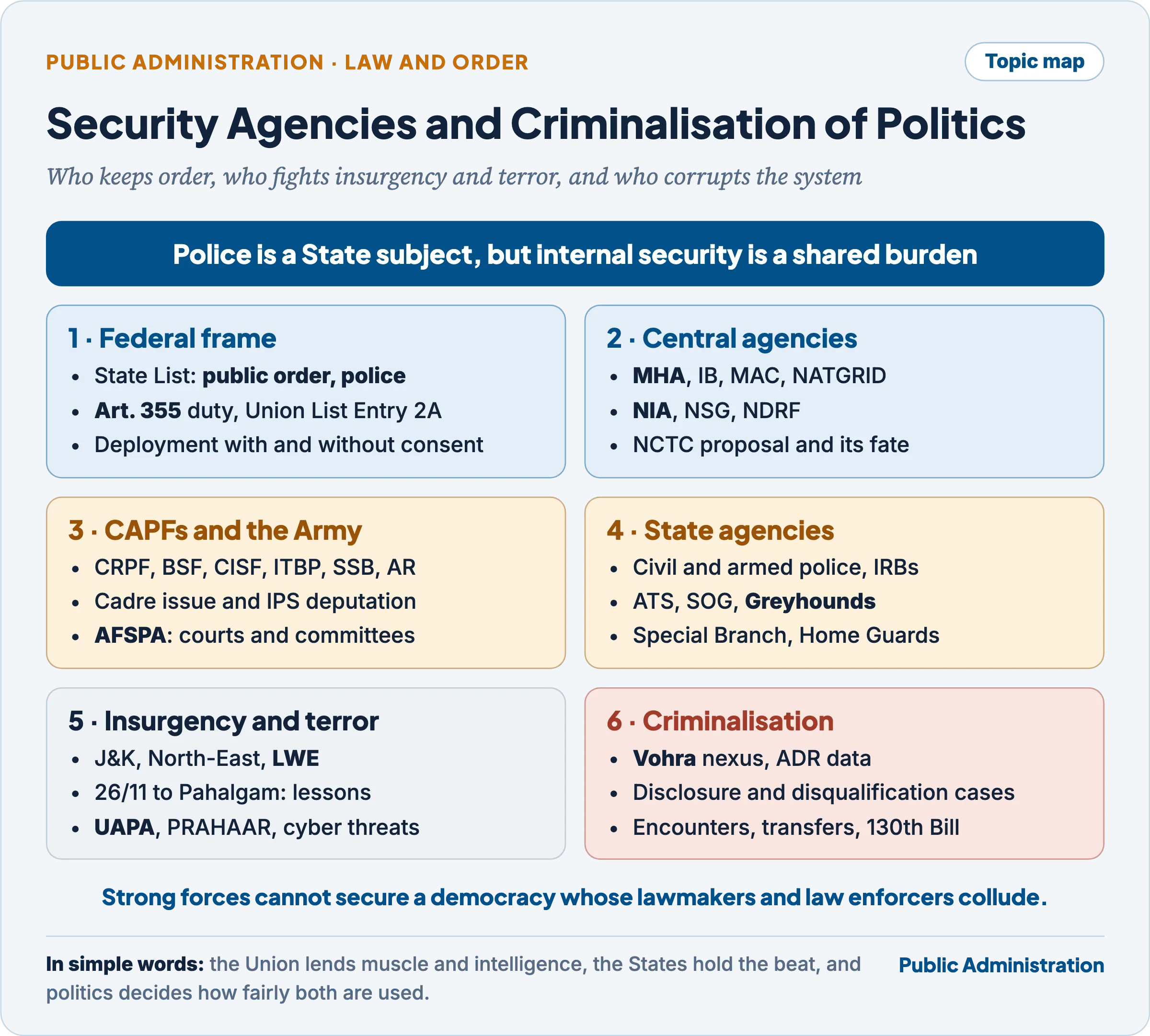
Law and order is the oldest duty of any state, and in India it is formally a State subject: “public order” and “police” sit in the State List. Yet the threats India has faced since independence, from insurgency in the North-East and Kashmir to Maoist violence and cross-border terrorism, rarely stop at a State’s border. The result is a layered system in which State police remain the first responders while the Union supplies intelligence, specialist investigators and over ten lakh Central Armed Police Force (CAPF) personnel. Running through the whole system is a second problem: when people with criminal records enter legislatures and ministries, the very agencies meant to enforce the law come under the control of those who break it. This article covers both halves of that story: who secures India internally, and how criminalisation of politics and administration weakens them.
In simple words
Think of a large housing complex. Each building has its own watchmen (State police). The complex also keeps a central security team (Union forces) that rushes to any building when a fire, a riot or a break-in is too big for one building’s guards. The system works only if the watchmen are honest. If the residents’ committee is run by people who own the burglar gang, no number of guards will make the complex safe.
1. Internal Security in a Federal Constitution
In simple words
The Constitution gives police and public order to the States, but it also tells the Union to protect every State against “internal disturbance”. So both governments have a role, and much of the debate is about where one role ends and the other begins.
1.1 Law and order, public order and internal security
- Three concentric circles. In Ram Manohar Lohia v. State of Bihar (1966), Justice Hidayatullah explained that law and order is the largest circle, public order a smaller circle inside it, and security of the State the smallest. Every breach of law is not a threat to public order, and every threat to public order is not a threat to the State’s security.
- A street fight disturbs law and order; a communal riot disturbs public order; an armed rebellion or a terror strike threatens the security of the State.
- Internal security is the protection of the country’s people, institutions and territory against threats arising or operating inside it: insurgency, terrorism, left-wing extremism, communal and ethnic violence, organised crime, cyber attacks. It overlaps with national security, which also covers external aggression.
- Not in any list. The Punchhi Commission (2010) noted that “national security” appears in none of the three lists of the Seventh Schedule. Security is spread across Union powers (defence, armed forces, emergency) and State powers (police, public order), so it has to be managed cooperatively.
1.2 The constitutional scheme
The table lists the provisions that divide internal security between the Union and the States.
| Provision | What it says | Effect on internal security |
|---|---|---|
| State List, Entries 1 and 2 | Public order; police (including railway and village police) | States raise, control and pay for the police |
| Union List, Entry 2A (42nd Amendment, 1976) | Deployment of armed forces or any other force under Union control in any State in aid of the civil power; their powers and privileges while deployed | Basis for sending CAPFs and the Army into States |
| Union List, Entry 8 | Central Bureau of Intelligence and Investigation | Basis of IB and CBI |
| Union List, Entry 65 | Union agencies for police training, research, scientific aid to investigation | NPA, BPR&D, forensic laboratories |
| Union List, Entry 70 | Union Public Service Commission; All-India Services | IPS officers head State and central forces |
| Union List, Entry 80 | Extension of a State’s police powers to another State with its consent | Inter-State police action |
| Concurrent List, Entries 1 and 2 | Criminal law; criminal procedure | BNS, BNSS, UAPA, NIA Act apply nationally |
| Article 355 | Duty of the Union to protect every State against external aggression and internal disturbance and to ensure government according to the Constitution | Justifies Union action, including deployment |
| Articles 256, 257 | States must comply with Union laws; Union may give directions | Directions on security matters |
| Article 352 | National emergency for war, external aggression or armed rebellion (the words “internal disturbance” replaced by the 44th Amendment, 1978) | Extreme cases only |
| Article 356 | President’s Rule on failure of constitutional machinery | Used in Punjab (1987–92) and Manipur (2025–26) |
- Two Acts give the Union direct field powers: the National Investigation Agency Act, 2008 (investigation of scheduled terror offences anywhere) and the Armed Forces (Special Powers) Act, 1958 (special powers to forces in “disturbed areas”).
- The new criminal codes apply to every agency: the Bharatiya Nyaya Sanhita (BNS), Bharatiya Nagarik Suraksha Sanhita (BNSS) and Bharatiya Sakshya Adhiniyam replaced the IPC, CrPC and Evidence Act from 1 July 2024. BNS Section 113 now defines a “terrorist act” in the general penal law, alongside the UAPA; an officer not below the rank of Superintendent of Police decides which law to use.
Common confusion
Does Article 257 let the Union send its forces into a State? Many notes say so. In fact, Article 257 only empowers the Union to give directions to a State about the exercise of its executive power. The power to deploy Union forces comes from Article 355 (the duty to protect States against internal disturbance) read with Union List Entry 2A. Deployment is normally on a State’s request, but the Constitution does not make the State’s consent a legal condition.
1.3 The Union’s role: the Ministry of Home Affairs
The Ministry of Home Affairs (MHA) is the nodal ministry for internal security. Its role has grown from “advice and coordination” into continuous operational involvement.
- Functions:
- manages the IPS cadre and the Intelligence Bureau;
- raises, funds and deploys the six CAPFs, the NSG and the NDRF;
- runs the NIA, NCRB, BPR&D, the National Police Academy and forensic services;
- frames internal security laws (UAPA, NIA Act, Arms Act) and counter-terrorism policy;
- funds the modernisation of State police, India Reserve Battalions, and Security Related Expenditure in insurgency-hit areas;
- coordinates with States through DGP/IGP conferences, Zonal Councils and the Multi Agency Centre.
- Specialised divisions reflect the threats: Counter Terrorism and Counter Radicalisation (CTCR), Cyber and Information Security (both created in 2017), Left Wing Extremism Division, North-East Division, Jammu, Kashmir and Ladakh Affairs, Border Management, Police Divisions and the Women Safety Division.
- Political head: the Union Home Minister; administrative head: the Union Home Secretary. The National Security Adviser and National Security Council Secretariat (Cabinet Secretariat) advise on the wider national-security picture, including intelligence coordination.
1.4 Deploying central forces: with and without consent
How deployment normally works: a State facing an election, a riot or an insurgency requisitions CAPF companies from the MHA; the forces work under the operational direction of the State police and the district magistrate, though their command and discipline remain with their own officers. States pay for deployment beyond the free entitlement, a long-running source of dispute.
Deployment without consent is legally possible and politically explosive:
- Sarkaria Commission (1988) accepted the Union’s power to deploy forces in a State on its own under Article 355, but advised prior consultation with the State as a convention.
- Punchhi Commission (2010) proposed amending Articles 355 and 356 to allow a “localised emergency”: the Union could take over a district or part of a State for a limited period (it suggested not more than three months) and deploy forces suo motu for about a week, seeking the State’s consent afterwards. This would avoid the blunt choice between doing nothing and imposing President’s Rule.
- Flashpoints:
- Elections: the Election Commission decides CAPF deployment for polls, often over the objections of State governments, especially in West Bengal.
- BSF jurisdiction (October 2021): the MHA extended the belt within which the BSF can search, seize and arrest under the BNSS (then CrPC) and passport laws from 15 km to 50 km of the border in Punjab, West Bengal and Assam. Punjab challenged it in the Supreme Court through an original suit under Article 131 (December 2021), calling it an intrusion into State List Entries 1 and 2.
- NIA’s suo motu power to take over State cases, and the 2012 NCTC proposal (Section 2.3).
- CBI general consent: several States withdrew their consent under Section 6 of the DSPE Act (see the article on British Legacy, Police Commission and Investigative Agencies).
1.5 Should “law and order” be on the Concurrent List?
This question has been debated since the 1980s, and the arguments are now sharper.
| Arguments for a larger Union role | Arguments against |
|---|---|
| Terror, organised crime, cyber crime and narcotics are inter-State and transnational | Federalism is a basic feature; policing is closest to the citizen and should stay local |
| States lack capacity, specialist units and forensic science | The Union already has Entry 2A, Article 355, the NIA Act and the UAPA |
| Uniform standards of training, data and response | Central agencies are open to partisan misuse against opposition-ruled States |
| Union already funds and staffs much of internal security: a de facto concurrent subject | Local knowledge, language and community trust cannot be centralised |
| 2nd ARC (2007) proposed a category of “federal crimes” for a central agency | Reform of State police (Prakash Singh directives) is the real gap, not jurisdiction |
- Assessment: the trend is towards concurrent practice without concurrent law. The Union adds agencies and funds while the formal division of powers stays the same. A middle path, followed by most expert bodies, is a narrow list of federal offences (terrorism, organised inter-State crime, cyber attacks on critical infrastructure) for central investigation, with policing proper left to the States.
2. Central Agencies for Internal Security
In simple words
The Union’s agencies do three jobs: they find out what is coming (intelligence), they investigate the most serious crimes (investigation), and they supply trained forces when States need help (response). Over the years these jobs have been split among many bodies, so getting them to share information is as important as creating them.
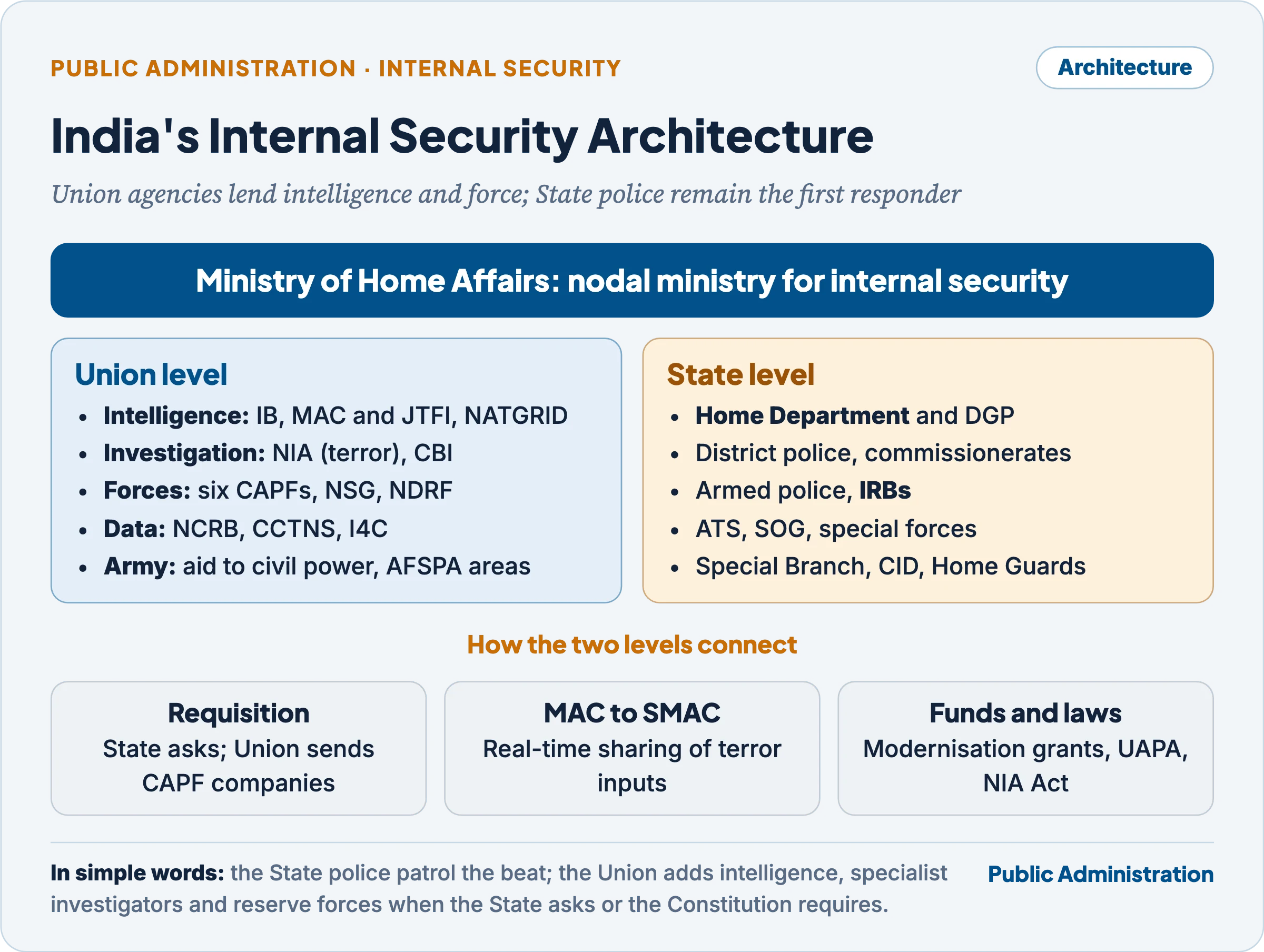
2.1 Intelligence agencies
- Intelligence Bureau (IB): India’s internal intelligence agency under the MHA, among the oldest in the world.
- Set up as the Central Special Branch in 1887; renamed Central Criminal Intelligence Department after the Indian Police Commission (1902–03); called the Intelligence Bureau from 1920.
- Covers terrorism, insurgency, espionage, subversion and threats to public order; it has no statutory charter and no police powers of arrest.
- Research and Analysis Wing (R&AW, 1968): external intelligence, under the Cabinet Secretariat; it took over foreign intelligence from the IB after failures in the 1962 and 1965 wars.
- Other bodies: National Technical Research Organisation (technical intelligence), Defence Intelligence Agency and service intelligence, Directorate of Revenue Intelligence, Financial Intelligence Unit, Narcotics Control Bureau, and State Special Branches.
- Coordination at the top: the National Security Council (in its present form since 1998) and the National Security Council Secretariat, which absorbed the old Joint Intelligence Committee, assess intelligence for the Prime Minister and the Cabinet Committee on Security.
Multi Agency Centre (MAC) and Subsidiary MACs
- Origin: the Kargil Review Committee (chair K. Subrahmanyam, report December 1999, tabled 2000) and the Group of Ministers on National Security (2001) found that agencies did not share what they knew. The MAC was created in the IB in December 2001 as a common platform.
- After 26/11 it was made a 24×7 nodal centre for terror-related intelligence from January 2009; every agency, central and State, must feed inputs into it and receives assessments back. Subsidiary MACs (SMACs) in State capitals and the Joint Task Force on Intelligence (JTFI) link it to State police.
- Recent upgrade: the MHA told Parliament in December 2025 that MAC connectivity now reaches the district level, that the MAC–SMAC network has been upgraded with AI and machine-learning tools, and that focus groups work on radicalisation, terror financing, cryptocurrency, drugs and fake currency.
NATGRID
- National Intelligence Grid (NATGRID) was conceived in 2009 after 26/11 to give authorised agencies secure, real-time access to some 21 government and private databases: bank records, travel and immigration, telecom, vehicle and driving licences, tax data, FIRs.
- Long delay: it went live only after more than a decade. By December 2025 it was handling about 45,000 requests a month, had been linked to the National Population Register, and was opened to SP-rank officers in the States; tools such as GANDIVA and an Organised Crime Network Database were built on it.
- Concerns: NATGRID has no statute defining its powers, limits or oversight, and it is outside the RTI Act. After the Digital Personal Data Protection Act, 2023, questions of proportionality and data protection have grown. Its value also depends on States uploading data; officers noted that details of the Red Fort bomber (November 2025) had not been uploaded by two State police forces.
Crime data and cyber
- NCRB maintains national crime statistics and the Crime and Criminal Tracking Network and Systems (CCTNS), which links police stations; the Inter-operable Criminal Justice System (ICJS) connects police, courts, prisons, prosecution and forensics.
- Indian Cyber Crime Coordination Centre (I4C) under the MHA (operational from 2020) runs the 1930 helpline and cybercrime portal; CERT-In (Section 70B, IT Act) handles cyber incidents and NCIIPC (Section 70A) protects critical information infrastructure.
2.2 The NCTC proposal (2012) and its fate
- The idea: after 26/11, Home Minister P. Chidambaram proposed a National Counter Terrorism Centre on the model of the US NCTC, to bring intelligence, analysis and operations against terror under one roof.
- The order: an MHA office memorandum of 3 February 2012 created the NCTC inside the IB, to start on 1 March 2012, with powers of arrest and search under Section 43A of the UAPA.
- Why States objected:
- created by executive order, not by law, yet with police powers in a State subject;
- placed inside an intelligence agency, mixing intelligence with coercive powers and escaping accountability;
- no requirement to inform or consult the State before operations.
- Over a dozen Chief Ministers, from Gujarat, West Bengal, Odisha, Tamil Nadu, Bihar and other States, opposed it; one called it a design that treated States as “dependent vassals”.
- Fate: the start date was put off days before 1 March 2012, a meeting of Chief Ministers on 5 May 2012 ended without agreement, and the NCTC was never operationalised. Parts of its purpose were later met piecemeal: a stronger MAC, NATGRID, the NIA, and in 2026 a written counter-terrorism policy (Section 5.7).
- Lesson: a sound idea failed on process: federal consent cannot be bypassed by executive orders in a State subject.
2.3 National Investigation Agency (NIA)
The NIA is India’s central counter-terrorism law-enforcement agency, created after the Mumbai attacks of November 2008 exposed the lack of an agency that could investigate terror cases with inter-State and international links.
- Law: National Investigation Agency Act, 2008 (passed in December 2008), on the lines recommended by the 2nd ARC’s report on Combating Terrorism (2008), which had asked for a specialised federal investigation agency.
- Scheduled offences: offences under the UAPA, Atomic Energy Act, Anti-Hijacking Act, SUA Acts, Weapons of Mass Destruction Act and others listed in the Schedule.
- How jurisdiction works (concurrent):
- a State police station registering a scheduled offence must report it to the State, which reports to the Union;
- the Union decides within a fixed time whether the NIA should take it over, and can also direct the NIA suo motu (Section 6);
- the NIA may hand a case back to the State (Section 7); the State’s own power to investigate and prosecute is otherwise saved (Section 10).
- Special Courts (Section 11) try NIA cases; trials are to be held on a day-to-day basis.
- NIA (Amendment) Act, 2019:
- extra-territorial jurisdiction over scheduled offences committed outside India against Indian citizens or interests;
- new scheduled offences: human trafficking, cyber terrorism, explosive substances, manufacture or sale of prohibited arms;
- Sessions Courts can be designated as Special Courts.
- Organisation: headed by a Director General (usually an IPS officer); headquarters in New Delhi with branch offices across States (18 by 2023). It runs the National Terror Database Fusion and Analysis Centre (2024) and circulates a UAPA investigation handbook to States.
- Record: the NIA has handled the major terror cases of the last decade (Pathankot, Pulwama, the Pahalgam attack, the Red Fort blast) and terror-financing cases in J&K and the North-East. Its conviction rate in decided cases is reported to be high, though many trials remain pending for years.
- Criticism:
- Federal intrusion: a State loses control over a case on its own soil; Chhattisgarh challenged the Act under Article 131 (2020).
- Selective use: opposition parties allege the choice of cases is political.
- Long pre-trial custody under UAPA bail rules, with slow trials.
- Dependence on State police for first response, local intelligence and witnesses.
Indian Connect — NIA in practice: the Pahalgam case
After terrorists killed 26 people (25 tourists and a local) at Baisaran, Pahalgam on 22 April 2025, the MHA handed the case to the NIA. Two local men who sheltered the attackers were arrested in June 2025; the three Pakistani gunmen were killed by security forces in Operation Mahadev (July 2025). On 15 December 2025 the NIA filed a 1,597-page chargesheet before the Special Court, Jammu, naming the Lashkar-e-Taiba / The Resistance Front as an accused organisation along with a Pakistan-based handler. The case shows the NIA’s role as the link between operational forces, State police and prosecution.
2.4 National Security Guard (NSG)
- Raised in 1984 after Operation Blue Star and the rise of terrorism in Punjab; governed by the National Security Guard Act, 1986. Called the “Black Cats”.
- Role: a federal contingency force for counter-terrorism and counter-hijack operations, hostage rescue, bomb disposal and anti-sabotage checks; it trains State special forces.
- Composition: Special Action Groups (from the Army) and Special Ranger Groups (from the CAPFs and State police), all on deputation.
- Operations: Akshardham (2002), the Mumbai attacks (2008), Pathankot (2016).
- Regional hubs: 26/11 showed the cost of flying commandos from Manesar, so hubs were opened at Mumbai, Chennai, Hyderabad and Kolkata (2009) and Gandhinagar; a sixth at Ayodhya was announced in October 2025. In 2024 the Union decided to move the NSG out of VIP protection so that it could concentrate on counter-terrorism.
2.5 National Disaster Response Force (NDRF)
- Constituted under Section 44 of the Disaster Management Act, 2005 and raised in 2006; now 16 battalions (about 18,500 personnel) drawn from the BSF, CRPF, CISF, ITBP, SSB and Assam Rifles.
- Why it belongs here: it separated disaster response from law-and-order duties of the CAPFs, and it is the Union’s first responder in chemical, biological, radiological and nuclear incidents, including those caused by terrorists. The Disaster Management (Amendment) Act, 2025 gave statutory backing to State Disaster Response Forces. (See the article on disaster management in Significant Issues in Indian Administration.)
3. Central Armed Police Forces and the Army
In simple words
The CAPFs are the Union’s own armed police: some guard borders, some guard airports and factories, and some are sent wherever a State cannot cope. Over time, border forces have also been pulled into riots, elections and insurgency, so almost all of them now do internal security work.
3.1 What the CAPFs are
- Name: called “Central Police Organisations” and then “Central Para-Military Forces”; the MHA adopted the uniform name Central Armed Police Forces in 2011 to distinguish them from the Army-led paramilitary (Coast Guard, Special Frontier Force). The Assam Rifles, though under MHA, is officered by the Army.
- Legal status: each is an “armed force of the Union” under its own Act, under the MHA, headed by a Director General (an IPS officer, except the Assam Rifles, led by a Lieutenant General).
- Two groups: border guarding forces (BSF, ITBP, SSB, Assam Rifles) and internal security forces (CRPF, CISF), though all are used for internal security.
3.2 The six forces
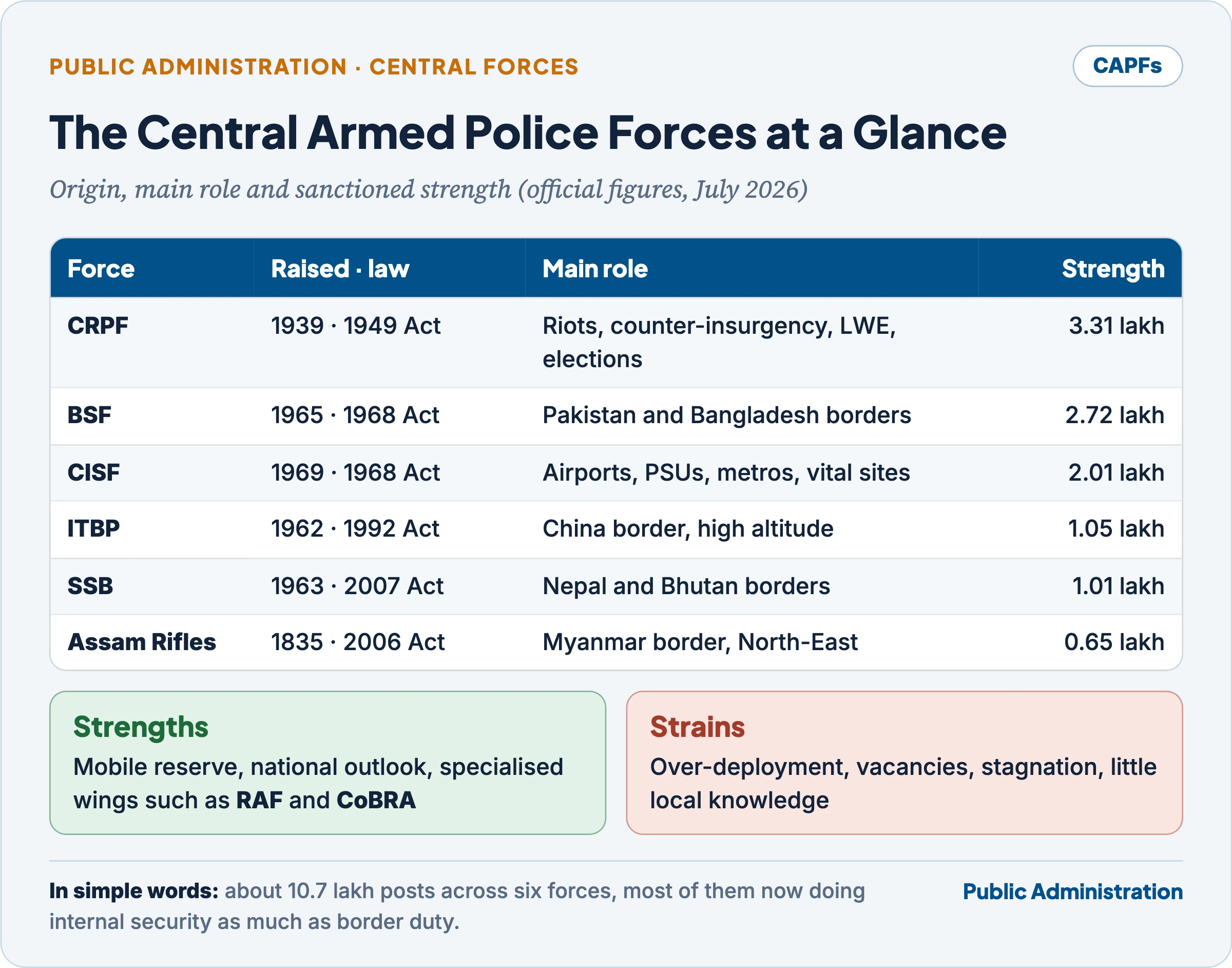
| Force | Raised and law | Core role | Sanctioned strength (July 2026) |
|---|---|---|---|
| CRPF | 1939 as the Crown Representative’s Police, Neemuch; CRPF Act, 1949 | Internal security, riots, LWE and J&K counter-insurgency, elections; Rapid Action Force (1992) for riots; CoBRA jungle commandos (2008) | about 3.31 lakh (largest) |
| BSF | 1 December 1965 after the 1965 war; BSF Act, 1968 | Pakistan and Bangladesh borders; anti-smuggling; counter-insurgency in J&K and the North-East | about 2.72 lakh |
| CISF | 1969; CISF Act, 1968; armed force of the Union from 1983 | Security of airports (after the 1999 hijack), PSUs, ports, metros, nuclear and space sites, Parliament complex (from 2024); consultancy to private industry | about 2.01 lakh |
| ITBP | 24 October 1962 after the China war; ITBP Act, 1992 | India–China border (3,488 km), high-altitude posts; also anti-Naxal duties | about 1.05 lakh |
| SSB | 1963 as the Special Service Bureau (stay-behind role); moved to MHA in 2001; SSB Act, 2007 | Nepal (2001) and Bhutan (2004) borders under the “one border, one force” principle | about 1.01 lakh |
| Assam Rifles | 1835 as the Cachar Levy; Assam Rifles Act, 2006 | Myanmar border and counter-insurgency in the North-East; under MHA for administration, Army for operations | about 0.65 lakh |
- Total: about 10.7 lakh sanctioned posts, with roughly 62,000 vacancies in mid-2026 (the CISF and ITBP had the largest gaps).
- Correcting old figures: older notes give CRPF strength as 154 battalions, ITBP’s border as 2,115 km and the Assam Rifles Act as 1941. These are outdated: the CRPF has more than doubled since, the ITBP guards the full 3,488 km China border, and the 1941 Act was replaced in 2006.
3.3 Roles in law and order, insurgency and terrorism
- Maintenance of law and order: riot control (especially the RAF, which also does post-riot confidence building), bandobast at large gatherings, elections in every State.
- Counter-insurgency: the CRPF and Assam Rifles in the North-East; the CRPF, BSF and ITBP in J&K alongside the Army’s Rashtriya Rifles; the CRPF (with CoBRA), BSF, ITBP and SSB in the LWE theatre, where they made up the bulk of the forces.
- Counter-terrorism: cordon and search, protection of vital installations (CISF), quick-reaction teams; the NSG for hostage situations.
- Border management: preventing infiltration, smuggling of arms, drugs and fake currency, which feed insurgency.
- Other: VIP security (CRPF, CISF), disaster response (through NDRF and own teams), UN peacekeeping, Amarnath and Kailash-Mansarovar yatras (ITBP).
3.4 The paradox of growth
It looks paradoxical that a “State subject” has produced one of the largest central police establishments in the world. The causes are institutional as much as security-driven.
- Why the CAPFs grew:
- Insurgencies in Punjab, J&K and the North-East from the 1980s, and the spread of LWE after 2004;
- weak State police: low strength (well below sanctioned levels in many States), poor training, politicised command;
- States prefer central forces: they come at little or no political cost, can be blamed if things go wrong, and are paid for largely by the Union;
- new duties: airports, metros, elections, VIP protection.
- Why “Police” in CRPF or ITBP is called a misnomer: these forces are organised in battalions, trained for armed combat and counter-insurgency, live in camps, and seldom register crimes or investigate. They behave more like light infantry than police; their “police” status gives them legal powers in aid of civil authorities without the Army’s command structure.
3.5 Are central forces more effective than State police?
| Point | Central forces | State police |
|---|---|---|
| Training and arms | Better trained for armed operations; modern weapons | Uneven; armed wings vary widely |
| Neutrality | Seen as less partisan in riots and elections | Often accused of bias under local political pressure |
| Local knowledge | Little; language barriers; rotate often | Strong: language, informers, terrain |
| Investigation | No role in registering or solving crime | Sole agency for FIRs, investigation, prosecution |
| Legitimacy | Can look like an outside force; human-rights complaints in J&K and North-East | Closer to the community, but trust deficits remain |
| Durability | Temporary deployment; problem returns when they leave | Permanent presence |
- Evidence from practice: successes in Punjab (where the State police led), Andhra Pradesh (the State’s Greyhounds) and Tripura (State police and TSR) show that durable results came when State forces led and central forces supported. In Bastar, the decisive gains of 2024–26 came from joint operations of the CRPF/CoBRA with Chhattisgarh’s District Reserve Guard, drawn from local youth and surrendered cadres.
- Conclusion: CAPFs are effective as a force multiplier, not as a substitute. Over-reliance lets States avoid reforming their own police.
3.6 Problems of the CAPFs
- Over-deployment and fatigue: long tours away from families, little rest between operations, poor housing; stress-related deaths and suicides have drawn parliamentary concern.
- Vacancies and stagnation: about 62,000 posts vacant in mid-2026; officers wait years for promotion.
- Ad hoc deployment for elections and VIP duty disrupts training and unit cohesion.
- Command friction with State police and district magistrates; unclear accountability for operations.
- Human-rights complaints in conflict areas; weak internal inquiry mechanisms.
The cadre dispute and the 2025 Supreme Court judgment
- The grievance: senior posts in the CAPFs are reserved for IPS officers on deputation: about 20 per cent of Deputy Inspector General and 50 per cent of Inspector General posts. Officers who joined the CAPFs directly (as Assistant Commandants through UPSC) argued that this blocks their promotion and denies them command of their own forces.
- Background: in Union of India v. Harananda (2019) the Supreme Court upheld Non-Functional Financial Upgradation for CAPF officers as Organised Group A Services (OGAS); the DoPT accepted their OGAS status in July 2019.
- Sanjay Prakash v. Union of India (23 May 2025): a Bench of Justices A.S. Oka and Ujjal Bhuyan held that:
- CAPF Group A officers are OGAS for all purposes, so all OGAS benefits must follow;
- the overdue cadre review (due 2021) and revision of recruitment rules must be completed within six months, after hearing cadre officers;
- IPS deputation posts up to Senior Administrative Grade (IG level) should be “progressively reduced” within an outer limit of two years;
- the presence of IPS officers is a policy choice of the Union, but stagnation hurts morale and must be weighed.
- Review dismissed (28 October 2025): the Union’s review petition was rejected, so the directions stand.
- The debate:
- For IPS presence: IPS officers bring State police experience, coordinate with State governments where CAPFs are deployed, and keep the forces “police” rather than military in outlook.
- For cadre officers: they know their forces from the ground up; deputationists serve short tenures; leadership without career prospects demoralises about 13,000 officers.
3.7 The Army in aid of civil authority
- Legal basis: Union List Entry 2A; BNSS Sections 148–151 (formerly CrPC Sections 129–132). Under Section 149, a District Magistrate or authorised Executive Magistrate may ask the officer commanding armed forces to disperse an unlawful assembly that cannot otherwise be dispersed; the officer decides the manner, using as little force as possible. Section 151 protects acts done in good faith, with prosecution only after government sanction.
- Principles: last resort after police and CAPFs; on requisition of the civil authority; minimum force; return to barracks as soon as order is restored.
- Uses: communal riots (Delhi 1984, Gujarat 2002 after delay), floods and earthquakes, counter-insurgency (where AFSPA applies), and essential services during strikes.
- Concerns: repeated use erodes the Army’s primary role and the civil administration’s own capacity, and risks militarising policing.
3.8 The Armed Forces (Special Powers) Act, 1958
The AFSPA gives special powers to the armed forces (the Army, and other Union forces when operating as land forces) in areas declared “disturbed”. It began as a 1958 Act for Assam and Manipur; a separate AFSPA for Jammu and Kashmir followed in 1990.
- Section 3: the Governor/Administrator of a State or UT, or the Central Government (power added in 1972) may declare all or part of a State a disturbed area where armed forces are needed in aid of civil power.
- Section 4 powers (to commissioned officers, warrant officers and NCOs):
- after due warning, fire upon or use force, even causing death, against persons acting against law in force prohibiting assembly or carrying weapons;
- destroy arms dumps and hideouts;
- arrest without warrant on reasonable suspicion, using necessary force;
- enter and search premises without warrant.
- Arrested persons must be handed to the nearest police station with the least possible delay.
- Section 6: no prosecution or legal proceeding against any person for acts under the Act without prior sanction of the Central Government.
Common confusion
Is AFSPA only for the Army? No. The Act defines “armed forces” as the military and air forces operating as land forces and any other armed forces of the Union so operating. CAPF personnel such as the Assam Rifles and CRPF can exercise AFSPA powers in a disturbed area when deployed there. Equally, AFSPA does not apply automatically wherever the Army is deployed; it applies only to areas formally notified as disturbed under Section 3.
Courts and committees on AFSPA
- Naga People’s Movement of Human Rights v. Union of India (27 November 1997): a five-judge Bench upheld the Act. Deployment in aid of civil power does not supplant civil authority; a declaration must be for a limited period and reviewed before six months; force must be minimal; the Army’s “Dos and Don’ts” are binding; arrested persons must reach the police quickly; complaints of misuse must be inquired into.
- Justice B.P. Jeevan Reddy Committee (set up November 2004 after the custodial death of Thangjam Manorama and the protests in Manipur; report 6 June 2005): AFSPA had become a symbol of oppression; repeal it and insert necessary powers in a new chapter of the UAPA with safeguards. The 2nd ARC’s Public Order report (2007) agreed. The recommendation was never implemented.
- Justice N. Santosh Hegde Commission (2013): appointed by the Supreme Court on 4 January 2013 to examine six sample “encounter” killings in Manipur. It found that none was a genuine encounter or an act of self-defence, and that the forces involved had also acted as the investigators.
- Extra Judicial Execution Victim Families Association v. Union of India (8 July 2016): no absolute immunity; excessive or retaliatory force is not permissible even in disturbed areas; every death must be thoroughly inquired into. In 2017 the Court ordered a CBI Special Investigation Team into Manipur killings.
- Oting, Nagaland (4 December 2021): an ambush by Army special forces killed coal-mine workers mistaken for militants, and more civilians died in the violence that followed. The episode renewed demands for repeal; prosecution sanction under Section 6 was refused in 2023.
Withdrawal and the present map
- Withdrawals: Tripura (May 2015); Meghalaya (2018); Mizoram has had no disturbed areas for years. In April 2022 the Union sharply reduced disturbed areas in Assam, Nagaland and Manipur, citing improved security after peace accords.
- Present position (from 1 October 2026, six-month notifications of 24 September 2026):
- Manipur: the whole State except 13 police stations in five valley districts (re-extended after the ethnic conflict that began on 3 May 2023);
- Nagaland: 9 districts and 21 police stations in five others;
- Arunachal Pradesh: Tirap, Changlang and Longding districts and three police stations in Namsai;
- Assam: by State notification, three Upper Assam districts (Tinsukia, Charaideo, Sivasagar) in 2025–26, where ULFA (Independent) remains active;
- J&K: under its separate 1990 Act.
- Tripura as a model: the State police and Tripura State Rifles defeated the NLFT and ATTF insurgency through intelligence-led operations, border fencing, development and surrender schemes. Withdrawal of AFSPA in 2015 did not bring violence back, and the NLFT–ATTF peace accord (September 2024) closed the chapter. This supports a rational, area-by-area review in place of automatic six-monthly renewals.
Criticism — AFSPA puts security above rights
- Impunity: Section 6 sanction is rarely granted, so even proven wrongful killings (Hegde Commission) go unpunished.
- Shoot to kill on suspicion: Section 4 permits lethal force against anyone violating a prohibitory order, a power wider than ordinary self-defence.
- Permanent “temporary” law: six-monthly renewals have kept parts of the North-East “disturbed” for decades; this signals failure of governance.
- Alienation: the Jeevan Reddy Committee called it a symbol of oppression; it feeds insurgent recruitment and distrust of the Indian state.
- Weak oversight: NHRC cannot investigate the armed forces directly (it can only seek a report from the Union under Section 19 of the Protection of Human Rights Act, 1993).
Defence — AFSPA is needed in genuine insurgency
- Legal cover: soldiers fighting armed groups who hide among civilians need protection from motivated litigation.
- Upheld by the Court: NPMHR (1997) found the Act constitutional with safeguards, which EEVFAM (2016) strengthened.
- Not permanent in practice: notified areas have shrunk sharply since 2015 as violence fell.
- Discipline exists: the Army court-martials offenders and follows binding “Dos and Don’ts”.
- Alternatives are slow: inserting its powers into UAPA, as proposed, has not been legislated, so repeal would leave a vacuum.
- Balanced position: the defensible course is a sunset-and-review approach: notify only areas where violence crosses a set threshold, publish the reasons, grant or refuse Section 6 sanction within a fixed time with reasons, give the NHRC investigative access, and transfer responsibility to State police as they become capable, as Tripura did.
4. State Agencies
In simple words
Most policing in India is done by State police. Each State has ordinary police for crime and patrolling, armed battalions for riots and insurgency, special commando units for terror attacks, intelligence branches, and volunteers such as Home Guards. When these work well, the Union’s forces are rarely needed.
4.1 State police organisation (in brief)
- Apex: the State Home Department (Home Minister, Additional Chief/Principal Secretary Home) makes policy; the Director General of Police (DGP) commands the force.
- Field: zones (IGs), ranges (DIGs), districts (SPs), sub-divisions (DSPs/ASPs), circles and police stations (SHOs), which register FIRs and investigate. Large cities have Police Commissionerates with magisterial powers.
- Specialised wings: CID/Crime Branch, Special Branch/State Intelligence, armed police, railway police, traffic, training, technical and wireless services.
- The organisational history, the Police Act of 1861 and dual control are covered in the article on British Legacy, Police Commission and Investigative Agencies; police reforms and community policing in the article on Police–Public Relations and Police Reforms.
4.2 Armed police and India Reserve Battalions
- State Armed Police carry different names: Provincial Armed Constabulary (Uttar Pradesh), Special Armed Force (Madhya Pradesh), Bihar Military Police, Malabar Special Police (Kerala), Tripura State Rifles, Manipur Rifles, Assam Police Battalions. Organised in battalions and companies, they handle riots, VIP security and internal security, and are deployed on the requisition of district and range officers.
- India Reserve Battalions (IRBs): raised by States with Union funding and to Union standards; the Union can deploy them in other States in an emergency. They give States an armed reserve without new central forces and absorb local youth, including in LWE and border areas.
4.3 Special counter-terror and counter-insurgency units
- Greyhounds (Andhra Pradesh, 1989): an elite anti-Naxal force of the State police, trained in jungle warfare, small-team operations and intelligence-led strikes. With surrender and rehabilitation policies and development, it broke the People’s War Group in Andhra Pradesh in the 2000s. The Greyhounds model (State-raised, locally knowledgeable, well-paid and highly trained special force) was copied elsewhere: Jharkhand Jaguar, Odisha’s Special Operations Group, Chhattisgarh’s District Reserve Guard, Maharashtra’s C-60 in Gadchiroli.
- Anti-Terrorism Squads (ATS): investigative and operational units against terror modules: Maharashtra ATS (2004), followed by Gujarat, Uttar Pradesh, Rajasthan, Kerala and others; they work with the NIA through the MAC–SMAC network.
- Special Operations Group (SOG): J&K Police’s counter-terror wing; similar SOGs in other States.
- State NSG-type commandos: Force One (Maharashtra, after 26/11), Octopus (Andhra Pradesh), SWAT teams in several cities, trained by the NSG as first responders.
4.4 State intelligence and Home Guards
- State intelligence: Special Branches or State Intelligence Departments collect political and security intelligence, watch extremist groups and feed the SMACs. Their quality decides early warning; many are understaffed and used for political surveillance.
- Home Guards: a voluntary auxiliary force first raised in Bombay in 1946; now under State laws, with Union guidance, to assist police in traffic, festivals, elections and disasters. Civil Defence (Civil Defence Act, 1968) and Village Defence Guards in J&K, and village defence parties in some States, add community-level presence.
- Assessment: auxiliaries extend reach cheaply but are poorly trained and paid, so they cannot replace regular police.
4.5 Union support to State police
- Modernisation of police forces grants for weapons, vehicles, communication, forensic labs and buildings;
- Security Related Expenditure reimbursement and special infrastructure (fortified police stations) in LWE, J&K and North-East areas;
- training at NPA, NSG and CAPF institutions; CCTNS and ICJS for data.
- Limitation: grants go unspent or are used for equipment rather than staff; the Prakash Singh directives on autonomy and accountability remain only partly implemented.
5. Countering Insurgency and Terrorism
In simple words
Insurgents want to control territory or break away; terrorists want to frighten a whole population to force a political change. India has faced both, in Kashmir, the North-East and the forest belt of central India. The lesson of six decades is that force can break armed groups, but only justice, development and trust stop new ones forming.
5.1 Concepts and causes
- Insurgency: an organised, armed movement against the state, usually with territorial aims and local support (Naga, Mizo, Manipur valley groups, ULFA).
- Terrorism: the use or threat of violence against civilians to spread fear and coerce a government or society for political, religious or ideological ends; often state-sponsored from across the border in India’s case.
- Left-wing extremism (Naxalism): an armed Maoist movement that began at Naxalbari (1967), seeking to overthrow the state through “protracted people’s war”.
- Types of collective violence: David Bayley, the American police scholar who studied Indian policing, distinguished violence of remonstrance, violence of confrontation and violence of frustration.
- Causes identified by the 2nd ARC (Public Order, 2007):
- social (caste hierarchy), communal (religious extremism), economic (poverty, land alienation, displacement);
- administrative (poor service delivery, failure to enforce rights, corruption), political (use of administration for partisan ends, short-term populism);
- external support to insurgents and terrorists; the crime–terror nexus of drugs, arms and hawala.
5.2 Jammu and Kashmir
- Phases: armed insurgency from 1989–90, Pakistan-sponsored and later dominated by foreign fighters; a long decline after the mid-2000s, with surges after 2016.
- Agencies: the Army (including Rashtriya Rifles), CRPF, BSF, J&K Police and its SOG, IB and NIA; a Unified Headquarters coordinates them.
- Article 370 was rendered inoperative on 5 August 2019 and the State reorganised into two Union Territories; police and public order in J&K came under the Union. Militant recruitment, stone-pelting and terror incidents fell, but targeted killings and attacks in the Jammu region continued.
- Pahalgam and Operation Sindoor: after the Pahalgam attack (22 April 2025), India struck nine terror sites in Pakistan and Pakistan-occupied Kashmir on the night of 6–7 May 2025 in Operation Sindoor; after Pakistani retaliation and Indian counter-strikes, a ceasefire followed on 10 May 2025. India declared that any future terror attack would be treated as an act of war, raising the threshold of response.
5.3 The North-East
- Roots: ethnic diversity, identity and land, migration (especially into Assam and Tripura), isolation, and a long porous border with Myanmar and Bangladesh. The Naga movement began in the 1950s; Mizo insurgency followed (ended by the Mizo Accord, 1986); ULFA, NDFB, Manipur valley groups and Tripura’s NLFT followed later.
- Approach: counter-insurgency under AFSPA, Suspension of Operations agreements, and accords: the Naga Framework Agreement (2015), the Bodo Accord (2020), Karbi Anglong (2021), the ULFA (pro-talks) accord (2023) and NLFT–ATTF (2024); development through the North Eastern Council (1971 Act) and the Ministry of DoNER (2004).
- Manipur since May 2023: ethnic violence between Meitei and Kuki-Zo communities killed more than 200 people, displaced tens of thousands and led to looting of police armouries. President’s Rule was imposed on 13 February 2025 and revoked on 4 February 2026, when a new government took office. The episode showed the limits of central forces when State police themselves split along ethnic lines, and the need for buffer zones, disarmament and political dialogue.
5.4 Left-wing extremism
- Spread and nature: the CPI (Maoist) was formed in 2004 by merging the People’s War Group and the Maoist Communist Centre. Prime Minister Manmohan Singh called it the “single biggest internal security challenge” (2006). At its peak around 2010 there were 1,936 incidents and 1,005 deaths in a year, concentrated in the tribal forest belt of Chhattisgarh, Jharkhand, Odisha, Maharashtra, Andhra Pradesh, Telangana, Bihar and West Bengal.
- Why it took root: land alienation, displacement by mining and dams, denial of forest rights, weak administration and absent services in the Fifth Schedule areas; the Maoists filled the governance vacuum with “Jan Adalats” and parallel structures.
- Strategy:
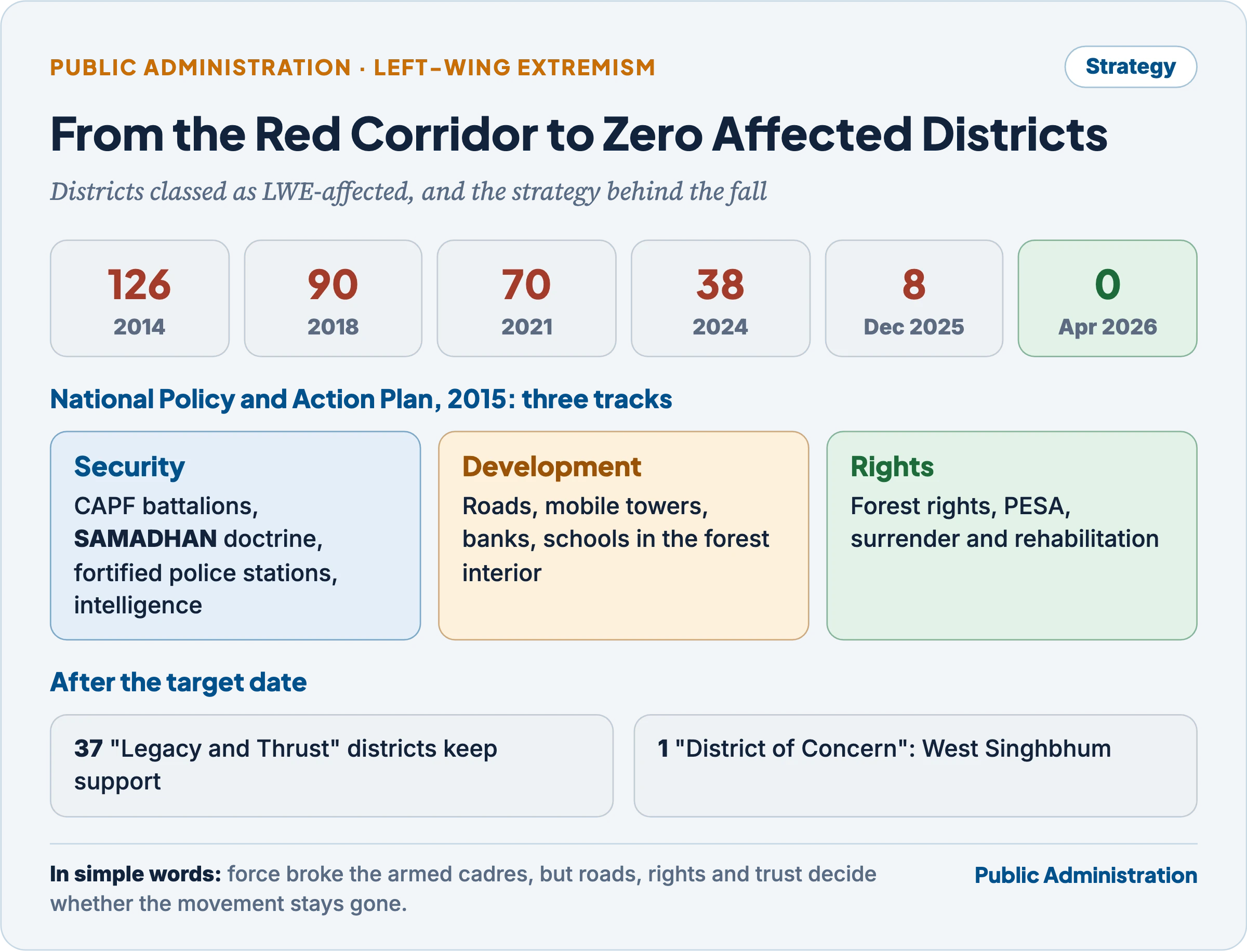
- National Policy and Action Plan (2015): a whole-of-government approach combining security, development and rights and entitlements.
- SAMADHAN (2017): the security doctrine announced by the Home Minister in May 2017: Smart leadership, Aggressive strategy, Motivation and training, Actionable intelligence, Dashboard-based key result areas, Harnessing technology, Action plan for each theatre, No access to financing.
- Development: the Road Requirement Plan and road connectivity projects, mobile towers, bank branches, Eklavya schools, the Special Central Assistance and Aspirational Districts programmes.
- Rights: Forest Rights Act, 2006, PESA, 1996, and surrender-cum-rehabilitation policies.
- The March 2026 target and its outcome:
- On 24 August 2024 the Union set 31 March 2026 as the deadline to end LWE.
- Operations intensified in Bastar: CPI (Maoist) general secretary Nambala Keshava Rao (“Basavaraju”) was killed in May 2025, and hundreds of cadres, including senior leaders, surrendered through 2025.
- Affected districts fell from 126 (2014) to 90 (2018), 70 (2021), 38 (April 2024) and 8 (December 2025).
- On 30 March 2026 the Home Minister told Parliament India was free of Maoism; an MHA communication of 8 April 2026 to nine States said no district is now classed as LWE-affected. 37 districts were reclassified as “Legacy and Thrust” districts and West Singhbhum (Jharkhand) as the only “District of Concern”, to keep security and development support going.
- What remains: isolated incidents still occurred in parts of Jharkhand and Chhattisgarh after the deadline; about 3,000 surrendered cadres in Chhattisgarh need rehabilitation; and the causes (land, forest rights, displacement) must be addressed if the movement is not to return in another form.
Indian Connect — Lessons from the LWE campaign
Andhra Pradesh showed in the 2000s that a State-led force (Greyhounds) plus surrender policy and development could break the movement. Bastar in 2024–26 combined CRPF/CoBRA firepower with local District Reserve Guard units, forward camps that brought roads and services, and a generous surrender policy. In both, State police led with local knowledge while central forces held ground. The administrative lesson matches the Paper I idea of development administration: security creates space, but only service delivery fills it.
5.5 Terror attacks and their lessons
The table summarises major attacks and what each revealed about the security system.
| Attack | Date | What happened | Lessons and reforms |
|---|---|---|---|
| Mumbai (26/11) | 26–29 November 2008 | Ten Lashkar-e-Taiba terrorists landed by sea and attacked hotels, a railway terminus and a hospital; 166 killed | Coastal security gaps, slow NSG arrival, poor police equipment and command; led to NIA Act, UAPA amendments, NSG hubs, 24×7 MAC, NATGRID, coastal police stations; R.D. Pradhan Committee (Maharashtra, 2009) reviewed the police response |
| Pathankot airbase | 2 January 2016 | Jaish-e-Mohammed attackers entered the airbase; seven security personnel killed | Delay in acting on warnings, unclear unified command among NSG, Army and Defence Security Corps, weak perimeter security; a parliamentary committee faulted coordination |
| Uri | 18 September 2016 | Attack on an Army camp | India’s first publicised cross-LoC surgical strikes (29 September 2016) |
| Pulwama | 14 February 2019 | Suicide car bomb on a CRPF convoy; 40 CRPF personnel killed | Convoy movement and road-opening procedures, local radicalisation; air travel for CAPF personnel; Balakot air strike (26 February 2019) |
| Pahalgam | 22 April 2025 | TRF/LeT gunmen killed 26 people at a tourist meadow after identifying victims’ religion | Protection of tourist sites, intelligence on infiltration; Operation Sindoor; NIA chargesheet (December 2025) |
| Red Fort, Delhi | 10 November 2025 | Car bomb near the Red Fort Metro station; about 15 killed | A “white-collar” module of doctors radicalised online, linked to Jaish-e-Mohammed; about 2,900 kg of explosive material found at Faridabad; inter-State data gaps on NATGRID; J&K Police’s alertness unearthed the module |
- Recurring lessons:
- Intelligence existed but was not acted upon or not shared in time (Kargil, 26/11, Pathankot);
- first responders are State police, often poorly armed and trained;
- command confusion when several agencies arrive;
- new methods: sea routes, drones, online radicalisation, educated recruits, cryptocurrency and hawala financing.
5.6 The legal framework against terrorism
- TADA, 1985: lapsed in 1995 after widespread misuse (confessions to police admissible, low conviction rates).
- POTA, 2002: enacted after the attack on Parliament (2001); repealed in 2004, again over misuse. The Law Commission’s 173rd Report (2000) had drafted the bill.
- UAPA, 1967: originally a law against unlawful associations threatening India’s sovereignty; became the main anti-terror law after the 2004 amendment absorbed POTA’s terror provisions.
- 2008 (after 26/11): stricter bail (Section 43D(5): no bail if accusations appear prima facie true), longer pre-charge detention (up to 180 days);
- 2012: threats to economic security and terror financing;
- 2019: power to designate individuals as terrorists (Fourth Schedule), DG NIA may approve seizure of property in NIA cases, and NIA officers of Inspector rank may investigate.
- Judicial approach:
- NIA v. Zahoor Ahmad Shah Watali (2019): at the bail stage courts should not examine evidence in depth; the prima facie test under 43D(5) is strict.
- Union of India v. K.A. Najeeb (2021): prolonged incarceration without trial can justify bail despite 43D(5), since Article 21 prevails.
- Criticism: wide definitions, very low conviction rates compared with arrests, years of pre-trial detention, and use against dissent; defenders point to the need for strong tools against organised, cross-border terror. BNS Section 113 now adds a general-law terror offence, raising questions of overlap and forum shopping.
5.7 Coordination failures and intelligence reform
- The core problem is not a lack of agencies but fragmentation: many intelligence bodies, central and State investigators, several forces, and no single point of accountability.
- Reform milestones:
- Kargil Review Committee (1999) and GoM (2001): MAC, Defence Intelligence Agency, NTRO, border management reforms;
- 2nd ARC, Combating Terrorism (June 2008): a comprehensive anti-terror law with safeguards, a specialised federal agency, strengthening of State police and intelligence, witness protection;
- post-26/11 package (2008–09): NIA, NSG hubs, 24×7 MAC, NATGRID, coastal security; the NCTC failed (2012);
- PRAHAAR (23 February 2026): India’s first written National Counter-Terrorism Policy and Strategy, built on seven pillars: Prevention of attacks; swift and proportionate Responses; Aggregating internal capacities through a whole-of-government approach; Human rights and rule-of-law based processes; Attenuating conditions that enable terrorism, including radicalisation; Aligning international efforts; Recovery and resilience through a whole-of-society approach. It names the MAC/JTFI as the nodal sharing platform, local police as first responders, NSG as the national counter-terror force and the NIA with State police for investigation, and it stresses cyber threats, drones and terror financing.
- Gaps still noted: intelligence agencies lack statutory charters and parliamentary oversight; State police intelligence is weak; NATGRID and MAC depend on States uploading data; there is no permanent national body that owns counter-terrorism end to end.
5.8 Cybersecurity and new threats
- Threats: attacks on critical infrastructure (power grids, ports, hospitals, as in the 2022 AIIMS Delhi ransomware incident), state-backed hacking, online radicalisation and recruitment, drones dropping arms and drugs across the Punjab border, crypto and dark-web financing, deepfakes used to incite violence.
- Institutions: CERT-In, NCIIPC, I4C, State cyber cells and the MHA’s Cyber and Information Security Division; the Financial Action Task Force (June 2024) placed India in its “regular follow-up” category, recognising its anti-terror-financing framework.
- Administrative challenge: police forces trained for street crime must now investigate digital, cross-border offences; cyber skills, forensic capacity and data-protection safeguards are the new frontier (developed further in the article on Police–Public Relations and Police Reforms).
6. Criminalisation of Politics
In simple words
Criminalisation of politics means people accused or convicted of crimes become candidates, legislators and ministers. Once they hold power, they can transfer honest officers, stall their own trials and use the police against rivals. The agencies meant to enforce the law end up protecting those who break it.
6.1 Meaning: two faces of one problem
- Criminalisation of politics: politicians use criminals for muscle power (booth capturing, intimidation of voters, collection of funds) and in return protect them from police and courts.
- Politicisation of criminals: criminals enter politics themselves, contest elections and become legislators and ministers, because office brings immunity, resources and respectability.
- The shift: in the first decades after independence criminals worked behind politicians; from the 1980s many came forward as candidates. The Election Commission’s own data showed that about 1,500 of the candidates in the 1996 Lok Sabha election had criminal records, and some 40 members of that Lok Sabha faced charges.
- Criminalisation of administration: the same nexus reaches police and bureaucracy through transfers, protection of favoured officers, and complicity in crime (Section 7).
6.2 The Vohra Committee (1993)
- Set up on 9 July 1993, after the Bombay serial blasts of March 1993 exposed links between a crime syndicate, officials and politicians. Chaired by Union Home Secretary N.N. Vohra, with the Directors of the IB and CBI, the Secretary of R&AW and a Special Secretary (Home).
- Report: dated 5 October 1993 (some notes give 3 October), laid before Parliament on 1 August 1995 after the Naina Sahni (tandoor) murder case caused public outrage.
- Findings:
- crime syndicates had become a law unto themselves, even in small towns and rural areas;
- a nexus of criminal gangs, police, bureaucracy and politicians existed across the country, and in some areas the mafia ran a “parallel government”;
- the criminal justice system, built for individual crimes, could not deal with organised mafia activity; laws on economic offences and confiscation of illegal property were weak.
- Recommendation: a nodal agency under the Union Home Secretary to collect and act on information from all agencies. A nodal group was set up, but it had little effect, and the annexures of the report were never made public.
6.3 The data
The table traces Lok Sabha members with declared criminal cases, from the affidavits analysed by the Association for Democratic Reforms (ADR).
| Lok Sabha | MPs with declared criminal cases | MPs with serious criminal cases |
|---|---|---|
| 2004 | 125 (23%) | not compared |
| 2009 | 162 (30%) | 76 (14%) |
| 2014 | 185 (34%) | 112 (21%) |
| 2019 | 233 (43%) | 159 (29%) |
| 2024 | 251 (46%), the highest ever | 170 (31%) |
- Trend: the number of MPs with declared cases rose 55 per cent between 2009 and 2024, and those with serious cases (murder, attempt to murder, rape, kidnapping, crimes against women) rose 124 per cent.
- Winnability: in 2024 a candidate with a declared criminal case had about a 15.3 per cent chance of winning, against 4.4 per cent for one with a clean record. 27 winning candidates declared past convictions.
- Pending trials: the Supreme Court recorded 5,175 cases pending against sitting and former MPs and MLAs in November 2022, of which 2,116 had been pending for more than five years; Uttar Pradesh, Bihar, Maharashtra and Odisha had the largest numbers.
- Caution: declared cases include politically motivated cases filed against opposition leaders and protest-related charges, so the numbers overstate actual criminality; serious-case data are a better indicator.
6.4 Why criminals succeed in politics
- Money power: elections are expensive and the official spending limit is unrealistic; candidates who can raise untaxed money have an edge. Milan Vaishnav, in When Crime Pays: Money and Muscle in Indian Politics (2017), shows that parties pick such candidates because they self-finance campaigns.
- Muscle power and “credibility”: where the state is weak, voters may back a strongman who can “get things done”, settle disputes and protect the community. Vaishnav argues that criminal reputation can signal credibility in fragmented, caste-divided constituencies.
- Identity politics: voters forgive criminal charges when the candidate belongs to their caste or community.
- Slow justice: trials take years, so an accused can serve full terms before conviction; parties argue a person is innocent until proven guilty.
- Party structures: centralised, leader-driven parties choose candidates for winnability with no internal democracy.
- Weak enforcement: police under political control do not investigate their own patrons; witnesses turn hostile.
6.5 Effects on law-and-order administration
- Selective enforcement: cases against favoured persons are not pursued, or are withdrawn when a government changes.
- Transfers as weapons: honest officers are moved out; compliant ones are rewarded (Section 7).
- Communal and electoral violence is organised by local criminal-politicians, as many riot inquiry commissions noted.
- Erosion of legitimacy: citizens lose faith in police and courts and turn to strongmen, completing a vicious circle.
- Policy capture: mining, land, liquor and contracts are steered by those with criminal networks, which feeds both corruption and violence (including in LWE areas).
6.6 The legal framework
- Constitution: Articles 102 and 191 allow Parliament to prescribe disqualifications for members; candidates must meet qualifications under Articles 84 and 173.
- Representation of the People Act, 1951, Section 8:
- 8(1): conviction for listed offences (promoting enmity, bribery and undue influence at elections, rape, offences under the UAPA, PC Act, NDPS and others) disqualifies whatever the sentence: for six years from conviction if only fined, or until six years after release if imprisoned;
- 8(2): conviction for specified social and economic offences with a sentence of at least six months, until six years after release;
- 8(3): conviction for any other offence with sentence of two years or more: disqualified from conviction until six years after release;
- 8(4): protected sitting members if they appealed within three months; struck down in 2013 (Lily Thomas).
- Disclosure: Section 33A and Rule 4A (Conduct of Election Rules, 1961) with Form 26 require candidates to declare pending cases, convictions, assets, liabilities and education; Section 125A punishes false affidavits (up to six months, or fine).
Common confusion
Does a pending criminal case, even a murder charge, stop a person from contesting? No. Under Section 8 of the RP Act, only conviction with the specified sentence disqualifies. A person facing serious charges, even after a court has framed charges, can contest and become a minister. The Law Commission (1999, 2014) and the Election Commission (2004, 2016) proposed disqualification at the stage of framing of charges, but Parliament has not legislated, and the Supreme Court has held that it cannot add a disqualification itself (Public Interest Foundation, 2018).
6.7 What the courts have done
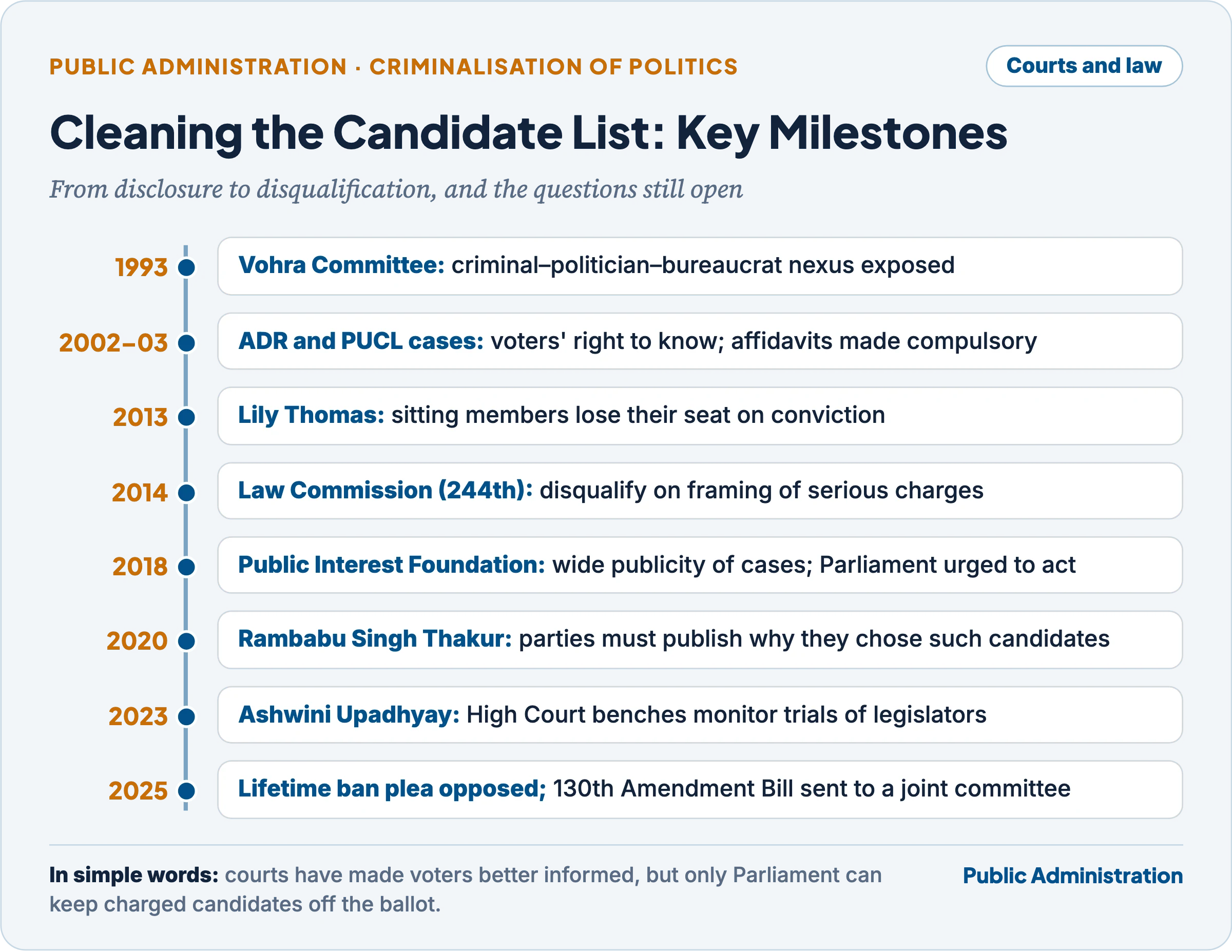
- Union of India v. Association for Democratic Reforms (2 May 2002): the voter’s right to know a candidate’s criminal antecedents, assets and education is part of freedom of expression (Article 19(1)(a)); the Court directed the Election Commission to require disclosure.
- People’s Union for Civil Liberties v. Union of India (13 March 2003): Parliament’s response, Section 33B (inserted in 2002 to limit disclosure to what the Act required), was struck down; affidavits became mandatory.
- PUCL v. Union of India (2013): introduced the NOTA option to allow negative voting.
- Lily Thomas v. Union of India (10 July 2013): Section 8(4) unconstitutional; legislators are disqualified immediately on conviction with the specified sentence. (A conviction stayed on appeal suspends the disqualification, as Lok Prahari, 2018, clarified.)
- Manoj Narula v. Union of India (27 August 2014): a Constitution Bench declined to add a disqualification for ministers, but said the Prime Minister and Chief Ministers, as holders of a constitutional trust, ought not to appoint persons facing charges of heinous offences or corruption.
- Krishnamurthy v. Sivakumar (2015): non-disclosure of criminal antecedents amounts to undue influence and can void an election.
- Public Interest Foundation v. Union of India (25 September 2018): a Constitution Bench directed that candidates declare cases in bold, inform their party, and that candidates and parties give wide publicity to cases in newspapers and on television at least three times after nomination; parties must post the information on their websites. It urged Parliament to make a law keeping persons charged with serious offences out of politics, holding that the Court itself could not add disqualifications.
- Rambabu Singh Thakur v. Sunil Arora (13 February 2020): parties must publish on their websites and social media the reasons for selecting candidates with pending cases, and why others without such cases could not be chosen; “winnability” alone is not a reason. Non-compliance is contempt; in 2021 the Court fined several parties for violations.
- Withdrawal of cases (10 August 2021): prosecutions against sitting or former MPs and MLAs cannot be withdrawn under Section 321 CrPC (now BNSS) without the High Court’s permission.
- Ashwini Kumar Upadhyay v. Union of India (9 November 2023): after years of monitoring, and after special courts for legislators had been set up since 2017, the Court directed every High Court to register a suo motu case (“In re: designated courts for MPs/MLAs”), with a Special Bench to monitor trials, priority to cases punishable with death or life imprisonment, no adjournments except for rare reasons, review of stayed trials, and district-wise status on High Court websites.
6.8 Committees and commissions
| Body | Year | Main recommendation |
|---|---|---|
| Dinesh Goswami Committee | 1990 | Electoral reforms; stronger laws against booth capturing and electoral violence |
| Vohra Committee | 1993 | Expose and break the nexus; a nodal agency under the Home Secretary |
| Indrajit Gupta Committee | 1998 | Partial State funding of elections in kind, to reduce dependence on illicit money |
| Law Commission, 170th Report (Chair: B.P. Jeevan Reddy) | 1999 | Disqualify on framing of charges for serious offences; internal democracy in parties |
| NCRWC (Chair: M.N. Venkatachaliah) | 2002 | Bar persons charged with serious offences; faster trials of politicians |
| Election Commission, Proposed Electoral Reforms | 2004 (repeated 2016) | Disqualify persons charged with offences punishable by five years or more if the case was filed at least six months before the election; tougher punishment for false affidavits |
| 2nd ARC, Ethics in Governance (4th Report) | 2007 | Endorsed the Election Commission’s proposal; special courts; state funding |
| Law Commission, 244th Report (Chair: A.P. Shah) | 2014 | Disqualify on framing of charges for offences punishable by five years or more, if charges were framed at least a year before nomination; trials of sitting legislators within a year; false affidavits a ground for disqualification |
| Law Commission, 255th Report | 2015 | Electoral reforms on finance and paid news |
6.9 Recent developments
- The lifetime-ban plea: in Ashwini Upadhyay’s petition (filed 2016) challenging the six-year limit in Sections 8 and 9, the Supreme Court remarked in February 2025 on the “apparent conflict of interest” of lawbreakers becoming lawmakers. The Union’s affidavit of 24 February 2025 opposed a lifetime ban: penalties are finite by design, six years after release ensures deterrence without undue harshness, and the duration is solely for Parliament; the Court cannot rewrite “six years” as “life”.
- The Constitution (130th Amendment) Bill, 2025: introduced on 20 August 2025 with two companion Bills for the UTs of J&K and Puducherry.
- It provides that a Minister, Chief Minister or the Prime Minister who is arrested and detained for 30 consecutive days on charges punishable with five years or more must be removed or cease to hold office on the 31st day; reappointment after release is not barred.
- Supporters: ministers should not govern from jail (as happened with ministers in Delhi and Tamil Nadu in 2023–24); constitutional morality and the Manoj Narula idea of trust.
- Critics: removal on arrest, not conviction; investigative agencies of a rival government could topple elected governments; it may violate parliamentary government, federalism and the rule of law.
- Status: referred to a Joint Parliamentary Committee (Chair: Aparajita Sarangi). Its draft report (July 2026) reportedly proposed suspension instead of removal, a schedule of offences, automatic reinstatement on discharge or acquittal and fast-track trials, but the committee deferred adoption on 17 July 2026; on 31 July 2026 it was given time until the Winter Session 2026 to report.
6.10 Is institutional change enough?
Legal and institutional reform is necessary but not sufficient: rules change incentives only when parties, voters and agencies act on them.
| Institutional measures (necessary) | Why they are not sufficient |
|---|---|
| Disclosure, publicity, Form 26 | Voters still elect such candidates; disclosure is “priced in” |
| Disqualification on conviction (Lily Thomas) | Trials take decades; convictions are rare |
| Special courts and High Court monitoring | Shortage of judges, prosecutors, witness protection |
| Proposed disqualification on charges | Risk of false cases by rivals; needs safeguards |
| Election Commission powers | No power to deregister parties or punish tainted nominations |
| Party-level reasons for tickets | Parties cite “winnability” in different words; contempt penalties are small |
- What else is needed: internal party democracy and transparent candidate selection; election finance reform (the electoral bonds scheme was struck down in ADR v. Union of India, 15 February 2024, for violating the right to information); police and prosecution independence (Prakash Singh directives); witness protection; and voter awareness that changes social norms, the “political culture” dimension in Almond and Verba’s sense.
7. Criminalisation of Administration
In simple words
When politics is criminalised, the administration follows. Officers who obey are rewarded with good postings; those who resist are transferred. Some police officers start acting like the criminals they are meant to catch, through fake “encounters”, custodial torture or deals with gangs.
7.1 The nexus inside the administration
- The triangle: criminals fund and serve politicians; politicians control postings, transfers and promotions; officers who play along protect criminals and share in rents. The Vohra Committee named the police and bureaucracy as part of the nexus, and the National Police Commission (1979–81) called political interference in transfers the root of police demoralisation.
- David Bayley observed in 1981 that the Indian police had been “penetrated by” partisan politics, and that officers protect themselves by finding political patrons, a decline of the rule of law.
- Forms:
- transfers as punishment and reward (frequent transfer of SPs and SHOs before elections or after inconvenient arrests);
- selective registration of FIRs and refusal to act against the powerful;
- police involvement in crime: extortion, land grabbing, protection of illegal mining and liquor;
- custodial violence and extra-judicial killings presented as encounters;
- leakage to criminals: as in the Bikru ambush (July 2020), where eight policemen were killed by Vikas Dubey’s gang after an alleged tip-off from within the police; the Justice B.S. Chauhan Commission later found that Dubey had enjoyed the patronage of local police and revenue officials.
- Bureaucratic politicisation: T.S.R. Subramanian v. Union of India (2013) directed fixed minimum tenures, Civil Services Boards for transfers, and written instructions from political executives, to protect civil servants from arbitrary pressure.
7.2 Encounter killings
- Meaning: a killing by police said to be in self-defence during an exchange of fire; many are alleged to be staged. Encounters often enjoy public support as “instant justice” when courts are slow, which makes them politically attractive.
- PUCL v. State of Maharashtra (23 September 2014): the Supreme Court laid down 16 binding guidelines for every police encounter causing death or grievous injury:
- record any intelligence tip in writing before acting;
- register an FIR and send it to court without delay;
- an independent investigation by the CID or a team from another police station under a senior officer;
- a magisterial inquiry in every death (then Section 176 CrPC);
- inform the NHRC/SHRC of the inquiry’s progress (NHRC has its own guidelines since 1997);
- no out-of-turn promotion or gallantry award until gallantry is beyond doubt;
- the victim’s family may approach the Sessions Judge if the guidelines are not followed.
- Earlier warning: in Prakash Kadam v. Ramprasad Vishwanath Gupta (2011), the Court said policemen who commit fake encounters deserve the death penalty, calling them murder by those meant to protect.
- Why it persists: political reward for “tough” policing, public frustration with courts, weak magisterial inquiries, and rare prosecution.
7.3 Remedies (in brief)
- Insulate police from politics: State Security Commissions, Police Establishment Boards, fixed tenures and Police Complaints Authorities as directed in Prakash Singh v. Union of India (2006), and a modern Police Act replacing the 1861 Act; see the article on Police–Public Relations and Police Reforms.
- Separate investigation from law and order, with an independent prosecution directorate.
- Internal vigilance and quick action on complaints; body cameras and CCTV in police stations (directed by the Supreme Court in Paramvir Singh Saini, 2020).
- Civil service protections: tenure, Civil Services Boards, written orders.
8. Assessment and Theory Lens
In simple words
Looking back over the whole system, two forces pull in opposite directions: the Union keeps adding agencies and forces to deal with threats that cross borders, while the Constitution and democratic politics insist that policing stay local and answerable. Theories from Paper I help explain why the system looks the way it does.
8.1 An overall assessment
- Achievements: insurgency ended in Punjab, Mizoram and Tripura; violence in the North-East and J&K fell sharply; LWE was officially ended as a district-level threat by 2026; the NIA and NATGRID finally exist; PRAHAAR gives counter-terrorism a written doctrine.
- Weaknesses: weak State police (vacancies, training, political control); over-reliance on CAPFs; fragmented intelligence without statutory oversight; slow trials under UAPA; persistent human-rights deficits under AFSPA; and a political class increasingly drawn from those facing criminal charges.
- Direction: a cooperative security federalism in which the Union sets standards, shares intelligence and funds capacity, while accountable State police do the policing; and electoral reform that makes crime a liability, not an asset, in politics.
Theory lens: force, coordination and the criminal state
- Weber’s monopoly of legitimate force. Max Weber, the German sociologist, defined the state in Politics as a Vocation (1919) as the body that successfully claims the monopoly of the legitimate use of physical force in a territory. Insurgents, Maoist “liberated zones” and mafia “parallel governments” (Vohra) are challenges to that monopoly; AFSPA and encounter killings show how the state can keep the monopoly of force yet lose its legitimacy. See the article on Weber and Bureaucracy.
- Coordination theory and inter-agency networks. Luther Gulick (1937) treated coordination as the central problem of administration once work is divided; Eugene Bardach in Getting Agencies to Work Together (1998) showed that inter-agency collaboration needs shared platforms, trust and leadership, not just orders. The MAC, NATGRID and PRAHAAR are attempts to build such a network; 26/11 and Pathankot showed what happens without one. See the article on Classical Theory.
- Federalism and the principal–agent problem. The Union (principal) funds and equips State police (agents) whose goals and political masters differ, so it adds monitoring (MAC, NATGRID) or bypasses them (NIA, CAPFs). States in turn treat central agencies as agents of the ruling party at the Centre, which explains resistance to the NCTC and to CBI and NIA jurisdiction. See the article on Union-State Relations.
- Public choice and rent-seeking. Gordon Tullock (1967) and Anne Krueger (1974) showed how actors spend resources to capture state-created rents. Criminal politicians invest money and muscle to win office because office yields rents (contracts, protection, transfers); parties nominate them because they finance themselves. This is the logic Milan Vaishnav documented. See the article on New Public Administration and Public Choice.
- Riggs’ prismatic society and clects. Fred Riggs, in Administration in Developing Countries (1964), described the prismatic society, where formal rules coexist with fused traditional loyalties (formalism and overlapping). His “clects” are groups that combine a modern organisational form with communal or particularistic aims. The criminal-politician-police nexus works like a clect: formal police and party structures serve caste, faction and gang interests, and laws on disclosure exist on paper without changing behaviour. See the article on Riggsian Models.
- Securitisation (Copenhagen School). Barry Buzan, Ole Wæver and Jaap de Wilde, in Security: A New Framework for Analysis (1998), argued that an issue becomes a security issue when leaders successfully present it as an existential threat, which justifies extraordinary measures outside normal politics. Declaring areas “disturbed” under AFSPA, designating individuals as terrorists under UAPA, or treating LWE as the biggest internal threat are acts of securitisation; the democratic test is whether issues are later de-securitised (AFSPA withdrawal in Tripura, LWE reclassification in 2026) and returned to ordinary governance.
- Bayley’s political development thesis. David Bayley, in The Police and Political Development in India (1969), argued that the police shape and reflect a nation’s political development: a police force that serves rulers rather than law weakens democratic legitimacy. This links criminalisation of politics directly to policing.
Key Terms
| Term | Meaning in simple words |
|---|---|
| Public order | A level of peace above ordinary law and order; disturbed by riots and mass violence (State List Entry 1) |
| Internal security | Protection against threats arising inside the country: insurgency, terrorism, extremism, organised crime |
| Article 355 | The Union’s duty to protect States against external aggression and internal disturbance |
| Entry 2A, Union List | Union power to deploy its forces in a State in aid of the civil power |
| CAPF | Central Armed Police Forces: CRPF, BSF, CISF, ITBP, SSB and Assam Rifles |
| Aid to civil power | Use of armed forces at the request of civil authorities when police cannot restore order |
| AFSPA | Armed Forces (Special Powers) Act, 1958: special powers in areas declared “disturbed” |
| Disturbed area | An area notified under Section 3 of AFSPA where special powers apply |
| MAC / SMAC | Multi Agency Centre in the IB and its State-level units for sharing terror intelligence |
| NATGRID | National Intelligence Grid linking government and private databases for security agencies |
| NCTC | Proposed National Counter Terrorism Centre (2012), never set up |
| NIA | National Investigation Agency, the central counter-terror investigation agency (2008) |
| Scheduled offence | An offence listed in the NIA Act’s Schedule that the NIA can investigate |
| UAPA | Unlawful Activities (Prevention) Act, 1967, India’s main anti-terror law |
| SAMADHAN | The 2017 security doctrine against left-wing extremism |
| Legacy and Thrust district | A former LWE district still receiving support to prevent relapse (2026) |
| IRB | India Reserve Battalion: State armed battalion raised with Union funds |
| Greyhounds | Andhra Pradesh’s elite anti-Naxal force (1989), model for State special forces |
| OGAS | Organised Group A Services; status confirmed for CAPF officers in 2025 |
| Criminalisation of politics | Entry and influence of criminals in electoral politics and government |
| Politicisation of criminals | Criminals themselves becoming candidates, legislators and ministers |
| Form 26 | Affidavit in which candidates disclose criminal cases, assets and education |
| Framing of charges | Court’s decision that there is enough material to try an accused; proposed stage for disqualification |
| Encounter killing | A killing by police claimed as self-defence; often alleged to be staged |
| Securitisation | Presenting an issue as an existential threat to justify extraordinary measures |
| Clect | Riggs’ term for a group with a modern form but particularistic, communal aims |
| PRAHAAR | India’s first National Counter-Terrorism Policy and Strategy (2026) |
Commissions, Committees and Judgments
The table lists, in order, the bodies and cases that shaped internal security and the fight against criminalisation covered in this article.
| Body / case | Year | Key point |
|---|---|---|
| Ram Manohar Lohia v. State of Bihar | 1966 | Concentric circles: law and order, public order, security of the State |
| Sarkaria Commission (Chair: R.S. Sarkaria) | 1988 | Union may deploy forces under Article 355 but should consult the State |
| Dinesh Goswami Committee | 1990 | Electoral reforms against booth capturing and electoral violence |
| Vohra Committee (Chair: N.N. Vohra) | 1993 | Criminal–police–bureaucrat–politician nexus; nodal agency under the Home Secretary |
| Naga People’s Movement of Human Rights v. Union of India | 1997 | AFSPA upheld with safeguards: limited, reviewed declarations; minimum force; Dos and Don’ts binding |
| Indrajit Gupta Committee | 1998 | Partial State funding of elections |
| Law Commission, 170th Report (Chair: B.P. Jeevan Reddy) | 1999 | Disqualification on framing of charges for serious offences |
| Kargil Review Committee (Chair: K. Subrahmanyam) | 1999 | Intelligence failures; led to the GoM (2001), MAC, DIA and NTRO |
| Union of India v. ADR | 2002 | Voter’s right to know candidates’ antecedents under Article 19(1)(a) |
| NCRWC (Chair: M.N. Venkatachaliah) | 2002 | Bar persons charged with serious offences; speedy trials |
| PUCL v. Union of India | 2003 | Section 33B struck down; disclosure affidavits mandatory |
| Election Commission, Proposed Electoral Reforms | 2004 | Disqualify on charges for offences punishable by five years or more, filed six months before polls |
| Justice B.P. Jeevan Reddy Committee | 2005 | Repeal AFSPA; move powers into UAPA with safeguards |
| Prakash Singh v. Union of India | 2006 | Seven directives on police autonomy and accountability (see the article on Police Reforms) |
| 2nd ARC, Ethics in Governance (4th) and Public Order (5th) Reports (Chair: M. Veerappa Moily) | 2007 | Disqualify charged candidates; federal crimes; repeal AFSPA; police reform |
| 2nd ARC, Combating Terrorism (8th Report) (Chair: M. Veerappa Moily) | 2008 | Comprehensive anti-terror law with safeguards; specialised federal agency |
| R.D. Pradhan Committee (Maharashtra) | 2009 | Review of police response to 26/11: command, equipment, intelligence follow-up |
| Punchhi Commission (Chair: M.M. Punchhi) | 2010 | “Localised emergency”; short suo motu deployment of central forces |
| Prakash Kadam v. Ramprasad Vishwanath Gupta | 2011 | Fake encounters by police are murder deserving the severest punishment |
| Justice N. Santosh Hegde Commission | 2013 | All six sample Manipur “encounters” found to be unlawful killings |
| Lily Thomas v. Union of India | 2013 | Section 8(4) RP Act struck down; immediate disqualification on conviction |
| T.S.R. Subramanian v. Union of India | 2013 | Fixed tenures, Civil Services Boards, written instructions |
| Law Commission, 244th Report (Chair: A.P. Shah) | 2014 | Disqualify on framing of charges (five years or more, a year before nomination) |
| Manoj Narula v. Union of India | 2014 | PM and CMs ought not to appoint ministers charged with heinous offences |
| PUCL v. State of Maharashtra | 2014 | 16 guidelines on encounter killings |
| Krishnamurthy v. Sivakumar | 2015 | Non-disclosure of criminal antecedents is undue influence |
| EEVFAM v. Union of India | 2016 | No absolute immunity under AFSPA; excessive force barred; every death inquired into |
| Public Interest Foundation v. Union of India | 2018 | Bold declaration and repeated publicity of cases; Parliament urged to legislate |
| NIA v. Zahoor Ahmad Shah Watali | 2019 | Strict prima facie test for bail under UAPA Section 43D(5) |
| Rambabu Singh Thakur v. Sunil Arora | 2020 | Parties must publish reasons for fielding candidates with criminal cases |
| Union of India v. K.A. Najeeb | 2021 | Long incarceration without trial can justify bail despite UAPA bar |
| Ashwini Kumar Upadhyay v. Union of India | 2023 | High Court Special Benches to monitor trials of MPs and MLAs |
| Sanjay Prakash v. Union of India | 2025 | CAPF officers are OGAS for all purposes; cut IPS deputation up to IG level within two years |
Contemporary Developments
- India declared free of LWE (2026): after the 31 March 2026 deadline, the MHA told nine States on 8 April 2026 that no district is now LWE-affected; 37 Legacy and Thrust districts and one District of Concern (West Singhbhum) keep support. The Home Minister formally declared India “Naxal-free” in Bastar on 18 May 2026.
- PRAHAAR (23 February 2026): the MHA released India’s first National Counter-Terrorism Policy and Strategy, with seven pillars from prevention to recovery, the MAC as the nodal platform and the NSG as the national counter-terror force.
- Pahalgam, Operation Sindoor and the NIA chargesheet (2025): the attack of 22 April 2025 (26 killed) led to Operation Sindoor (7 May 2025) against nine terror sites; the NIA chargesheeted LeT/TRF on 15 December 2025.
- Red Fort blast (10 November 2025): a car bomb by a “white-collar” module linked to Jaish-e-Mohammed exposed online radicalisation of professionals and gaps in inter-State data sharing.
- NATGRID and MAC scaled up (December 2025): NATGRID linked to the National Population Register, opened to SP-rank officers and handling about 45,000 requests a month; the MAC–SMAC network upgraded with AI tools down to districts.
- CAPF cadre judgment upheld (October 2025): the Supreme Court dismissed the Union’s review of Sanjay Prakash (23 May 2025), so IPS deputation up to IG level must be progressively reduced by May 2027.
- AFSPA renewed and Manipur government restored (2026): AFSPA was extended from 1 October 2026 in Manipur (except 13 police stations), parts of Nagaland and Arunachal Pradesh; President’s Rule in Manipur ended on 4 February 2026.
- Criminalisation: the Union opposed a lifetime ban on convicted politicians (24 February 2025); the JPC on the 130th Amendment Bill deferred its report in July 2026 and was given time until the Winter Session 2026.
Revision Grid
| Thinker / body | Work or report (year) | Key idea |
|---|---|---|
| Max Weber | Politics as a Vocation (1919) | State = monopoly of legitimate force |
| Luther Gulick | “Notes on the Theory of Organization” (1937) | Coordination as the central problem after division of work |
| Eugene Bardach | Getting Agencies to Work Together (1998) | Inter-agency collaboration needs platforms and trust |
| Fred Riggs | Administration in Developing Countries (1964) | Prismatic society, formalism, clects |
| Gordon Tullock / Anne Krueger | Rent-seeking (1967 / 1974) | Resources spent to capture state rents |
| Buzan, Wæver and de Wilde | Security: A New Framework for Analysis (1998) | Securitisation and de-securitisation |
| David Bayley | The Police and Political Development in India (1969) | Politicised police weaken democratic development |
| Milan Vaishnav | When Crime Pays (2017) | Parties field criminals for money and “credibility” |
| Vohra Committee | Report (1993) | Criminal–political–bureaucratic nexus |
| Kargil Review Committee | Report (1999) | Intelligence coordination; MAC |
| Jeevan Reddy Committee | Report (2005) | Repeal AFSPA |
| 2nd ARC | Public Order (2007), Combating Terrorism (2008) | Federal crimes; anti-terror agency; police reform |
| Punchhi Commission | Report (2010) | Localised emergency; suo motu deployment |
| Law Commission | 244th Report (2014) | Disqualify on framing of charges |
| MHA | National Policy on LWE (2015), SAMADHAN (2017), PRAHAAR (2026) | Whole-of-government security doctrine |
Previous Year Questions
- 2024National Investigation Agency (NIA) is playing an important role in countering terrorism. Comment.
- 2023“The withdrawal of AFSPA from Tripura has sent a positive signal across the state and North-Eastern Region.” Do you think that now it is an appropriate time to take a more rational policy decision in this matter.
- 2021The increasing criminalization of politics is a major threat to the basic fabric of Indian democracy. Comment.
- 2021National Human Rights Commission is handicapped by its jurisdictional limitations of not being able to investigate the cases of violation of human rights by the armed forces. Discuss.
- 2019Even though the law and order administration is a State subject, it is paradoxical that the Central agencies- NIA or paramilitary forces under the Union Government— have restricted the powers of State Governments. Discuss.
- 2018“The AFSPA debate reveals that the Indian paramilitary forces are caught between the imperatives of national security and protection of human rights.” Discuss.
- 2018“Institutional change is a necessary but not a sufficient condition for reducing criminalisation of politics.” Examine.
- 2017In view of the contemporary internal scenario should “law and order” be made a part of the Concurrent List of the Constitution of India? Justify your opinion.
- 2015Discuss critically the salient features of the National Investigation Agency (NIA) regarding its purposes and jurisdiction.
- 2015Discuss the significance and role of the Central Paramilitary Forces in maintaining law and order and countering insurgency as well as terrorism.
- 2014Do you think that the Central para-military police forces have proven more effective than the State police service? Give your answer objectively in a critical vein.
- 2013“There is both criminalisation of politics and politicisation of criminals in India.” Examine and identify the challenges they cause for law & order administration.
- 2012“Even though law and order administration is a State subject in the Indian Constitution, it is paradoxical that the para- military and other kinds of security forces under the Union Government have grown in recent years.” Critically analyse the statement.
- 2009“Law and order problems of the twenty-first century cannot be tackled through legislations and structures of the nineteenth century.” Give suggestions for transforming the law and order machinery at the State level.
- 2005“The role played by Central and State Government in maintaining law and order is inadequate and unmatched to growing criminalization.” Comment.
- 2004“Criminalisation of politics has been responsible for the problems related to law and order in our nation.” Comment.
- 2003“Criminalization of politics in India has been extended to politicization of criminals.” Comment.
- 2000“Maintenance od law and order is a State subject but the Union Government can deploy armed forces in any State.” Comment.
- 1999“In the midst of political and socio-economic challenges, the law and order administration has become both difficult and delicate.” Explain.
- 1997“The word ‘Police’ in the title of the Central Reserve Police Force and the Indo-Tibetan Border Police is a misnomer.” Comment.
- 1994“Maintenance of law and order is a de facto concurrent subject.” Discuss, in this connection, the roles of the centre and the states in the law-and-order field.
- 1993“Internal Security is a para-political exercise and a para-military operation in detecting, combating and dissolving ‘Threat Profiles’ in the area of law and order, social order and national security.” Discuss.
- 1987‘Even though law and order administration is State subject in the Indian Constitution it is paradoxical that the para- military and other kinds of security forces under the Union Government have surgeoned in recent years.’ Comment.