

British legacy; National Police Commission; Investigative agencies; Role of Central and State Agencies including para military forces in maintenance of law and order and countering insurgency and terrorism; Criminalisation of politics and administration; Police-public relations; Reforms in Police.
This article: Law and order as a State subject (Seventh Schedule, Article 355, law and order versus public order, the State police structure); the British legacy (pre-colonial policing, the Cornwallis daroga system, the Police Commission of 1860, the Police Act of 1861 and its colonial purpose, the Indian Police Commission of 1902–03, CID and the Intelligence Bureau, from Indian Police to IPS, magisterial and dual control, the colonial mindset, the survival of the 1861 Act and the new State Police Acts); post-Independence State police commissions; the National Police Commission (1977–81): context, eight reports, key recommendations and why they were not implemented; later bodies (Ribeiro, Padmanabhaiah, Malimath, Mooshahary, the Police Act Drafting Committee and the Model Police Act 2006, the 2nd ARC’s Fifth Report, the Model Police Bill 2015); investigative agencies (CBI, NIA, ED, NCB, SFIO, State CIDs, CB-CID, anti-corruption bureaus), the forensic and data backbone (NFSU, NATGRID, CCTNS, ICJS); investigation under the BNS, BNSS and BSA; conviction and pendency data; the separation of investigation from law and order and from prosecution; a theory lens.
Official Syllabus: Paper II · Unit 2-13 Law and Order Administration
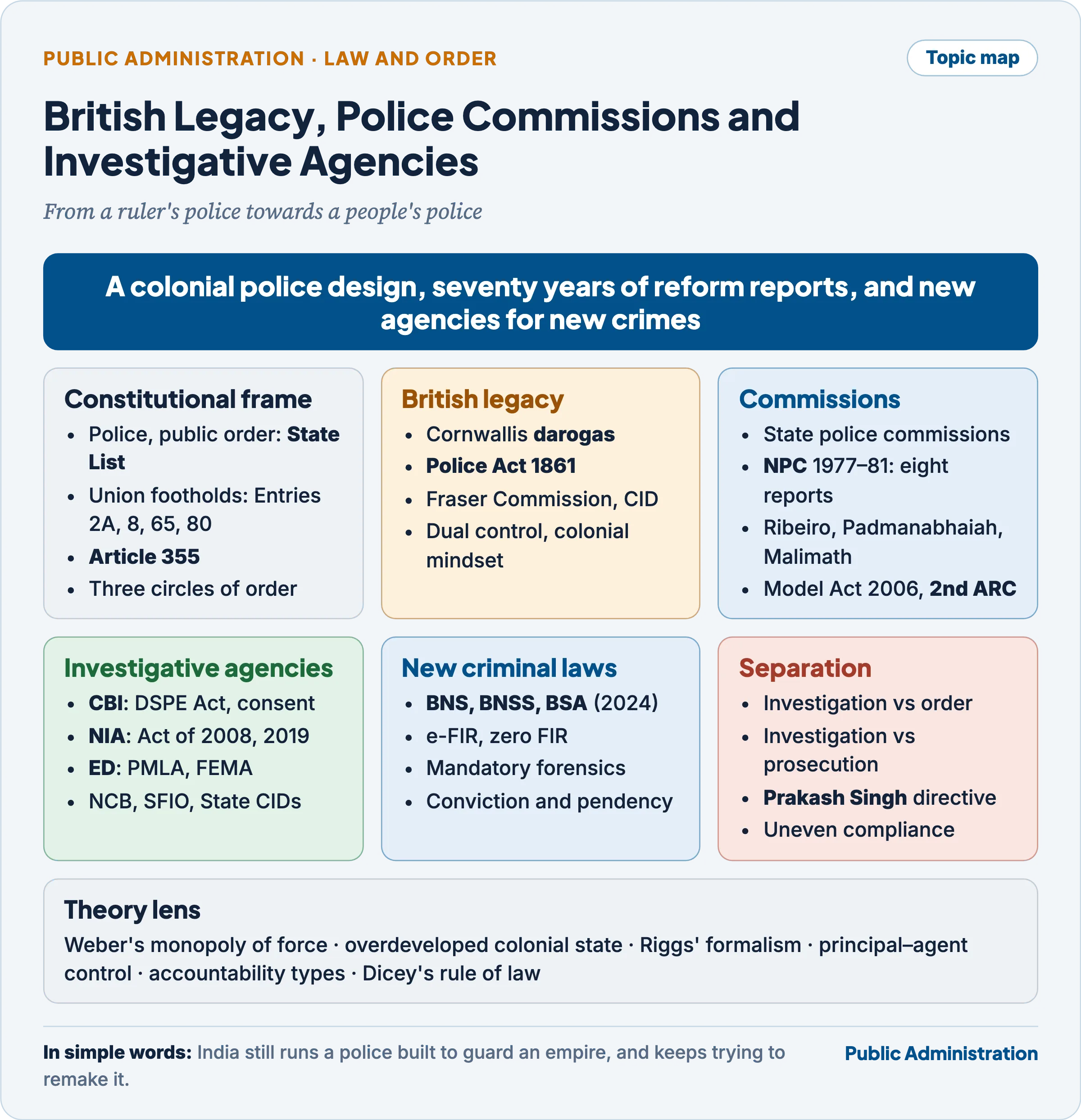
The police is the most visible face of the State. A citizen may never meet a Collector or a Secretary, but will meet a constable at a crossing, a sub-inspector at the police station or an investigating officer after a crime. How that police force is organised, controlled and held to account decides whether the State’s power to use force protects citizens or frightens them.
India’s police was built by a colonial government, after a rebellion, to hold a subject population in order. Independent India kept the structure and the main law, the Police Act of 1861, and has spent seventy years trying to turn a ruler’s police into a people’s police; commissions from the National Police Commission (1977–81) to the 2nd ARC (2007) diagnosed the same problems.
Meanwhile crime changed. Terrorism, money laundering and cyber fraud cross State and national borders, so the Union built specialised investigative agencies (CBI, NIA, ED) that sit uneasily with police as a State subject. In 2024 the colonial criminal codes gave way to the Bharatiya Nyaya Sanhita (BNS), Bharatiya Nagarik Suraksha Sanhita (BNSS) and Bharatiya Sakshya Adhiniyam (BSA).
In simple words
Think of a house built by a landlord to keep tenants under watch, with high walls, one gate and a guard who answers only to the landlord. The tenants now own the house. They have repainted it and changed the nameplate, but the walls, the gate and the guard’s habits are still the old ones. Indian police reform is the long, unfinished job of rebuilding that house for its new owners.
1. Law and Order as a State Subject: The Constitutional Frame
In simple words
The Constitution gives the job of keeping the peace and running the police to the States. The Union makes the main criminal laws, trains the senior officers, runs some special agencies and must step in if a State cannot cope. This split explains most of the friction between the Centre and the States in policing.
1.1 Law and order, public order and security of the State
- Law is the body of rules the State enforces; order is the condition of peace and predictability in which people go about their lives. Law and order go together: order without law becomes arbitrary force, and law without order cannot be enforced.
- Three concentric circles. In Ram Manohar Lohia v State of Bihar (1966), Justice M. Hidayatullah explained the difference with three circles: the largest circle is law and order, a smaller one inside it is public order, and the smallest is security of the State.
- A street fight between two neighbours disturbs law and order but not public order.
- A communal riot that disturbs the even tempo of life of a whole locality is a breach of public order.
- An armed rebellion threatens the security of the State.
- So an act may affect law and order without affecting public order, and public order without affecting the security of the State. The test is the reach and intensity of the disturbance, not the kind of act.
- Why it matters for administration. Preventive detention laws and prohibitory orders can be used only for the narrower categories (public order, security of the State), so the distinction decides when the State may restrict liberty.
- Order in a democracy. Not every disorder is illegitimate: Gandhi’s Salt Satyagraha (1930) broke the law yet is now seen as a turning point of the freedom struggle. Democratic policing must allow protest, assembly and dissent while preventing violence. This makes the police’s task harder than in a colonial state, where order meant the absence of challenge to the ruler.
Common confusion
Are “law and order” and “public order” the same thing? No. In everyday speech they are used together, but in constitutional law public order is narrower. It covers disturbances that affect the community at large, not every breach of law by an individual. The Seventh Schedule uses “public order” (List II, Entry 1), and the Supreme Court’s three-circle test in Ram Manohar Lohia (1966) is the standard way to tell them apart.
1.2 The constitutional distribution of powers
The Constitution places policing mainly with the States but gives the Union several footholds. The table lists them.
| Provision | What it says | Effect on policing |
|---|---|---|
| List II, Entry 1 | Public order (but not the use of the Union’s armed forces in aid of the civil power) | States are primarily responsible for keeping the peace |
| List II, Entry 2 | Police, including railway and village police, subject to Entry 2A of List I | States raise, organise, pay and control their police forces |
| List I, Entry 2A | Deployment of the Union’s armed forces or other forces in any State in aid of the civil power (added by the 42nd Amendment, 1976) | The Union may send the army or CAPFs; their powers while deployed are Union matters |
| List I, Entry 8 | Central Bureau of Intelligence and Investigation | Base for the CBI and central intelligence |
| List I, Entry 65 | Union agencies for police training, research and scientific or technical assistance in investigation | Base for the National Police Academy, BPR&D, CFSLs, NFSU |
| List I, Entry 80 | Extension of a State’s police powers to another State only with that State’s consent | Root of the consent requirement in s.6 of the DSPE Act |
| List III, Entries 1, 2 and 12 | Criminal law, criminal procedure and evidence | Parliament enacted the BNS, BNSS and BSA; States may amend with Presidential assent |
| Article 355 | Duty of the Union to protect every State against external aggression and internal disturbance and to ensure government according to the Constitution | Justifies deployment of central forces and advisories |
| Article 356 | President’s Rule on failure of constitutional machinery | The ultimate (and politically contested) Union remedy |
| Article 312 | All India Services, including the Indian Police Service | Senior police leadership is recruited and trained by the Union, controlled by States while serving there |
- Result. Policing in India is formally a State subject but in practice a shared field: the Union legislates the criminal law, trains the IPS, funds modernisation, runs intelligence and specialised agencies, and deploys central forces. This is why law and order is often described as a “de facto concurrent subject”. The role of the Central Armed Police Forces, the Intelligence Bureau and the debate on putting law and order in the Concurrent List are covered in the article on Central and State Agencies, Paramilitary Forces, Insurgency, Terrorism and Criminalisation of Politics.
1.3 The State police machinery in brief
- Control and command. The Home Department frames policy and budgets; the Director General of Police heads the force, with wings for crime (CID), intelligence, armed police and training. The field chain runs zone (IGP) → range (DIG) → district (SP) → sub-division (DSP) → circle (Inspector) → police station (SHO) → outposts and beats.
- The police station registers every FIR and does most investigation, prevention and order work. The constabulary is the bulk of the force (around 85–88 per cent), so its training and attitudes shape the citizen’s experience of the State.
- Cities and districts. Large cities use the commissionerate (a single chain of command, with magisterial powers for the Commissioner); districts use dual control (section 2.7). See the article on The District Collector.
2. The British Legacy
In simple words
Before the British, villages largely policed themselves through headmen and watchmen, and towns had a kotwal. The British replaced this with a salaried, uniformed police answerable to the government. After the revolt of 1857 they built one police force for all of India whose main purpose was to keep the empire safe. Most of that design is still with us.
2.1 Policing before the British
- Ancient and medieval India. Kautilya’s Arthashastra describes spies (gudhapurusha) and magistrates (pradeshtri) for crime; under the Mughals, the kotwal policed towns and the faujdar the countryside, while zamindars and village headmen answered for crime within their limits. See the articles on Kautilya’s Arthashastra and Mughal Administration.
- Local responsibility. If property was stolen in a village, the headman had to trace the thief or make good the loss, much like Anglo-Saxon frankpledge: the community, not a professional force, guaranteed the peace. As Mughal authority decayed, zamindari police turned oppressive, giving the East India Company a reason to take policing over.
2.2 Company rule: the Cornwallis daroga system (1792–93)
- The reform. Lord Cornwallis removed the police powers of the zamindars in Bengal (1792) and embodied the change in his Code of 1793. Each district was divided into thanas (police circles), each under a salaried daroga appointed by and answerable to the district magistrate.
- The thana as the unit. The police station of today descends from the daroga’s thana. The daroga had wide powers of arrest and investigation and a small staff of armed men (barkandazes).
- What went wrong.
- Darogas were poorly paid and loosely supervised, so extortion became routine; “daroga raj” became a byword for petty tyranny.
- Abolishing zamindari and village responsibility destroyed local roots without creating public trust; crime rose in several districts.
- The magistrate was also the revenue and judicial authority, so police work was subordinated to revenue collection.
- Experiments elsewhere. In Madras, Munro’s district officers combined revenue and police work; in Sindh (1843), Charles Napier built a separate, disciplined police under its own officers on the Royal Irish Constabulary model. The Sindh model was copied in Bombay (1853) and Madras (1859); the Madras District Police Act, 1859 was the first modern provincial police statute.
- Torture and the evidence law. The Madras Torture Commission (1855) found that the police routinely used torture to extract revenue and confessions. This finding is the origin of the colonial distrust of police confessions written into the Indian Evidence Act, 1872 (ss.25–26), and carried today into s.23 of the BSA.
2.3 After 1857: the Police Commission of 1860
- Why a commission. The revolt of 1857 showed that the Company’s patchwork of military police, village watchmen and darogas could neither prevent nor contain a large uprising. The Crown, now governing directly, wanted a cheap, uniform and dependable civil force that would free the army from routine order duties.
- Appointment. A Police Commission was set up by a Government of India resolution of 17 August 1860. It reviewed the English and Irish police systems and the newer Madras and Calcutta police.
- Main propositions.
- Abolish the military police as a separate arm and create a single civil constabulary for each province.
- Place each provincial force under an Inspector General of Police, and each district force under a District Superintendent of Police.
- Keep the force wholly subordinate to the civil executive, an “efficient instrument in the hands of the Magistrate” for preventing and detecting crime.
- Separate police work from judicial work (the daroga would no longer try cases).
- The draft Bill attached to its report became the Police Act, 1861.
2.4 The Police Act, 1861: features and purpose
The Police Act (Act V of 1861), passed on 22 March 1861, set the pattern for every provincial police force. Its preamble aimed to make the police “a more efficient instrument for the prevention and detection of crime”.
| Section | Provision | What it meant in practice |
|---|---|---|
| s.2 | One police force for the whole province, its strength fixed by the government | A single, provincial, uniformed force replacing scattered establishments |
| s.3 | Superintendence of the police vests in the (now State) Government | Complete political–executive control from the top |
| s.4 | Inspector General heads the force; in each district, administration is vested in the District Superintendent, under the “general control and direction” of the District Magistrate | Origin of dual control |
| s.7 | Senior officers may dismiss, suspend or fine subordinate ranks | Discipline by fear of punishment; little protection for lower ranks |
| s.12 | Inspector General may frame rules on organisation and duties | Basis of State police manuals, often stricter than the Act |
| s.15 | Punitive police: extra police quartered in a “disturbed” area at the inhabitants’ cost | Collective punishment of whole communities |
| s.17 | Appointment of special police officers from among residents | Co-opting local notables when needed |
| s.23 | Duties: obey lawful orders, collect intelligence affecting public peace, prevent and detect crime, apprehend offenders | Intelligence and order come first in the list |
| s.30 | Regulation of public assemblies and processions; licences | Control of political meetings and protest |
| s.44 | Officer in charge to keep a general diary | Paper trail upward, not to citizens |
- The colonial purpose. The Act’s design shows whom the police served.
- Regime policing. The force existed to protect the government, collect political intelligence and suppress unrest; crime control mattered mainly where it threatened order or revenue.
- Upward accountability only. The police answered to the Magistrate and the provincial government, never to the public or a legislature.
- Military structure. Armed reserves, drill, barracks and a two-tier rank structure: a small European officer class and a mass of poorly paid, barely literate Indian constables.
- Distrust of the lower ranks: investigation was entrusted to sub-inspectors and above, and confessions to police were made inadmissible.
- Cheapness. One force replaced the army in daily order work at a fraction of the cost.
- Supporting codes. The Indian Penal Code (1860, in force 1862), the Code of Criminal Procedure (1861, consolidated in 1872, 1882 and 1898) and the Indian Evidence Act (1872) completed the framework. The police thus worked within rules made for a colony, with wide powers of arrest and preventive action.
2.5 The Indian Police Commission, 1902–03 (Andrew Fraser)
- Appointment. Lord Curzon set up the second all-India commission in 1902 under Sir Andrew Fraser, with members drawn from the services, the judiciary and Indian notables.
- Findings. The police was corrupt, inefficient, poorly trained and distrusted. The Commission described how complainants paid fees at every step, how investigating officers became a burden on whole villages, and how crime was concealed or minimised to keep returns low. It noted that provincial rules had allowed a degree of interference “which the law did not contemplate”.
- Recommendations.
- A Criminal Investigation Department (CID) in every province under a Deputy Inspector General, to collate crime information, maintain the finger print bureau and assist districts with trained detectives.
- A central department for all-India intelligence on organised and inter-provincial crime; this built on the Central Special Branch (1887) and became the Central Criminal Intelligence Department, renamed the Intelligence Bureau in 1920.
- Ranges of districts under DIGs; training schools for constables and sub-inspectors; direct recruitment of sub-inspectors.
- Indians admitted to the officer class through a provincial police service of Deputy Superintendents (introduced from 1905), below the European Imperial service.
- Better pay for the lower ranks.
- The District Magistrate’s supremacy was retained, but he was asked not to interfere in the internal management and discipline of the police.
- Significance. The Fraser Commission professionalised the force without changing its purpose. CIDs and the IB soon came to be used heavily for political surveillance of the national movement.
2.6 From the Indian Police to the Indian Police Service
- A European officer class. After 1860 senior officers came from the army and by nomination; from 1893 a competitive examination in London recruited the Imperial (Indian) Police, in practice a European preserve. The Islington (1912–15) and Lee (1924) Commissions pressed for Indianisation, but Indians remained a minority of officers in 1947.
- The IPS. The Premiers’ Conference of October 1946 replaced the Indian Police with the Indian Police Service, which came into being in 1948; Article 312 and the All India Services Act, 1951 gave it its base, and Sardar Patel defended the All India Services in the Constituent Assembly (10 October 1949) as essential to unity. Training began at Mount Abu (1948) and moved to Hyderabad (1975), now the Sardar Vallabhbhai Patel National Police Academy.
- What changed and what did not. An Indian officer class recruited on merit replaced a foreign one, but the Police Act, the rank structure and the culture continued. See the article on Legacy of British Rule.
2.7 Magisterial control and dual control
- The legal basis. Section 4 of the Police Act places the district police under the general control and direction of the District Magistrate, while the SP runs its internal administration under the IG. State manuals call the DM the head of the criminal administration of the district.
- How it works. The DM coordinates law and order, issues prohibitory orders (now under s.163 BNSS, earlier s.144 CrPC), authorises use of force against unlawful assemblies, reviews crime and receives reports; the SP commands the force, investigation and discipline.
- Why the British wanted it. The Collector-Magistrate was the Crown’s representative in the district; keeping the police under him ensured that the force served the political needs of administration, and that no single uniformed officer became too powerful.
- Criticism.
- It breaks unity of command (Fayol): the SP answers to the DIG on professional matters and to the DM on order.
- It causes delay in crises and blurs responsibility for outcomes.
- It reflects the colonial distrust of the police, and the IAS–IPS rivalry it creates has slowed reform since 1947.
- Defence. Civilian oversight by a generalist magistrate checks police excess and coordinates the many departments (revenue, health, transport) a crisis needs.
- The commissionerate alternative. The Presidency towns (Calcutta, Bombay, Madras) had Commissioners of Police with magisterial powers from the nineteenth century; after Independence the system spread to most large cities. The National Police Commission favoured it for big cities. See the article on The District Collector.
2.8 The colonial mindset: what survived 1947
The table compares the colonial design with what persisted after Independence.
| Colonial feature | Why the British wanted it | How it survives |
|---|---|---|
| Regime orientation | Protect the Raj, not the citizen | Police used by ruling parties against opponents; Emergency (1975–77) as the extreme case |
| Executive superintendence (s.3) | Total control by government | Transfers and postings as reward and punishment; politicised investigations |
| Military culture and drill | Suppress riots and rebellion | Parade-ground training, orderly system, armed reserves larger than investigation staff |
| Two-tier ranks | European officers, cheap Indian constables | Constables (about 85 per cent of the force) with little career growth or say |
| Distrust of police evidence | Torture and false confessions | BSA s.23 (old Evidence Act ss.25–26); courts’ scepticism of police witnesses |
| Secrecy and upward reporting | Intelligence for rulers | Weak public accountability; complaints handled internally |
| Thana as the seat of power | The daroga as the State in the countryside | The police station still feels intimidating to the poor and to women |
- The thana as the “last bastion” of the British legacy. Most institutions have changed in form; the police station has changed least. It still works through the general diary, the FIR register and the beat book first designed in the nineteenth century; it is often understaffed, overloaded with VIP and bandobast duty, and treats complainants as supplicants. The counter-argument is that the thana has changed: CCTNS has digitised it, women help desks and citizen portals exist, and the e-FIR and zero FIR under the BNSS reduce the station’s power to refuse a complaint.
- Training and the colonial mindset.
- Content. Training still gives more weight to drill, weapons and physical endurance than to law, forensics, human rights and soft skills; the “muscle over mind” criticism is old (the Gore Committee on Police Training, 1971–73, and the NPC made it).
- Institutions. Many training schools have been treated as “dumping grounds” for officers out of favour, with weak infrastructure and trainers.
- Culture. The orderly system (constables as personal servants of officers) and the hierarchical distance between ranks continue the colonial pattern.
- What has changed. Modules on gender sensitisation, cyber crime, community policing and the new criminal laws are now part of basic courses; soft-skill and attitudinal training programmes, SVPNPA’s revised curriculum and Mission Karmayogi’s iGOT courses for police show a shift. The gap is in constable-level and in-service training.
- David Bayley, the American scholar of policing, in The Police and Political Development in India (1969) and later work, argued that the Indian police remained an instrument of the government of the day and that politicisation deepened in the 1970s, producing a decline in the rule of law. The NPC made the same point: the police appeared as an agency to enforce the will of the government in power rather than the law impartially.
2.9 The 1861 Act after Independence and the new State Police Acts
- The Act survived. Because police is a State subject and the 1861 Act was a convenient tool of control, most States simply continued it, with police manuals and executive orders adding further control.
- Early State Acts. The Bombay Police Act, 1951, Kerala Police Act, 1960, Karnataka Police Act, 1963 and Delhi Police Act, 1978 were enacted, but they followed the 1861 pattern and in some respects tightened political control without adding accountability.
- After 2006. Following the Prakash Singh judgment and the Model Police Act, 2006, the Union told Parliament (July 2015) that 15 States had enacted new Police Acts (Assam, Bihar, Chhattisgarh, Haryana, Himachal Pradesh, Kerala, Maharashtra, Meghalaya, Mizoram, Punjab, Rajasthan, Sikkim, Tamil Nadu, Tripura and Uttarakhand) and 2 States (Gujarat and Karnataka) had amended their old Acts.
- The catch. Civil-society reviews found that many of these Acts legalised non-compliance: State Security Commissions dominated by ministers and officials, DGP tenure qualified by wide grounds for removal, and complaints authorities without independent members. The detailed compliance story is covered in the article on Police–Public Relations and Police Reforms.
Indian Connect — The 1861 Act today
The Police Act, 1861 is still on the statute book and still applies, with State amendments, in several States and Union Territories that have not enacted their own law. Even where new Acts exist, the organisation, ranks, district structure and dual control created in 1861 remain the norm. The BNS, BNSS and BSA of 2023 replaced the colonial codes of procedure and evidence, but not the law that organises the police itself.
3. Police Commissions after Independence: The States Look First
In simple words
Before the Union looked at the police as a whole, several States appointed their own commissions in the 1960s. They reached conclusions that every later commission repeated: separate investigation from order duty, fight corruption, improve the constable’s lot and build trust with the public.
The main State commissions and one national committee of this period are listed below.
| Commission | Year | Main points |
|---|---|---|
| Kerala Police Commission (N.C. Chatterjee) | 1959 | The first State commission after Independence |
| West Bengal Police Commission (K.C. Sen) | 1960–61 | Separate investigation from other work at thanas in towns and industrial areas; stop the practice of not registering crime to keep returns low; strengthen the forensic laboratory |
| Uttar Pradesh Police Commissions (A.P. Jain; later Gangeshwar Prasad) | 1960–61; 1970–71 | Rising crime under-recorded; station staff working 11 or more hours a day; poor investigation and political interference; opposed transferring police functions to local bodies |
| Bihar Police Commission (B.P. Jamuar) | 1961 | Corruption widespread up to the Inspector rank; recommendations on recruitment, training, magistracy, women police and police–public relations |
| Punjab Police Commission (M.C. Mahajan) | 1961 | Structure, service conditions and public relations |
| Delhi Police Commission (G.D. Khosla) | 1966–68 | City policing and a modern police law for the capital |
| Tamil Nadu Police Commission (R.A. Gopalaswamy) | 1969–71 | Three-tier cadre structure, pay, housing, better lock-ups |
| Gore Committee on Police Training (M.S. Gore) | 1971–73 | Training at all levels to stress attitudes, behaviour and public service, not only drill |
- Maharashtra (1964), Madhya Pradesh (1966) and Assam (1971) also set up commissions, and Andhra Pradesh had a one-man commission in 1984.
- Their limit. As C.V. Narasimhan, later Member-Secretary of the NPC, observed, these commissions worked within the framework of the 1861 Act: they won better pay, transport and housing, but did not ask how the police could become an impartial agent of law in a democracy. Their recurring themes (separate investigation, honest crime recording, better constables, public trust) became the agenda of the National Police Commission.
4. The National Police Commission (1977–81)
In simple words
After the Emergency showed how easily the police could be turned against citizens, the new government asked a commission to rethink the police from top to bottom. It wrote eight reports and a new draft police law. Almost everything that later committees and the Supreme Court asked for was first written down here.
4.1 Why it was set up
- The Emergency (1975–77). Mass preventive detentions, censorship enforcement and custodial excesses showed the police acting as an arm of the ruling party. The Shah Commission (1977–78) documented this misuse.
- The 1977 change of government. The Janata government appointed the National Police Commission (NPC) by a Ministry of Home Affairs resolution of 15 November 1977. It was the third all-India police commission (after 1860 and 1902) and the first since Independence.
- Composition. Chairman Dharma Vira (a retired Governor and former Cabinet Secretary); members N. Krishnaswamy Reddy, K.F. Rustamji (founding Director General of the BSF), N.S. Saksena and Prof. M.S. Gore (social scientist); Member-Secretary C.V. Narasimhan (former Director, CBI).
- Terms of reference. Redefine the role, duties and powers of the police; review recruitment, training and service conditions; examine police–public relations, misuse of police by political and executive authority, and methods to make the police accountable to the law and responsive to the people.
- Reports. Eight reports between February 1979 (First) and May 1981 (Eighth), with a compendium of recommendations. The government that returned to power in 1980 shelved them, and for years only the First Report was public; civil-liberties groups had to press, including in court, for their release.
4.2 The eight reports
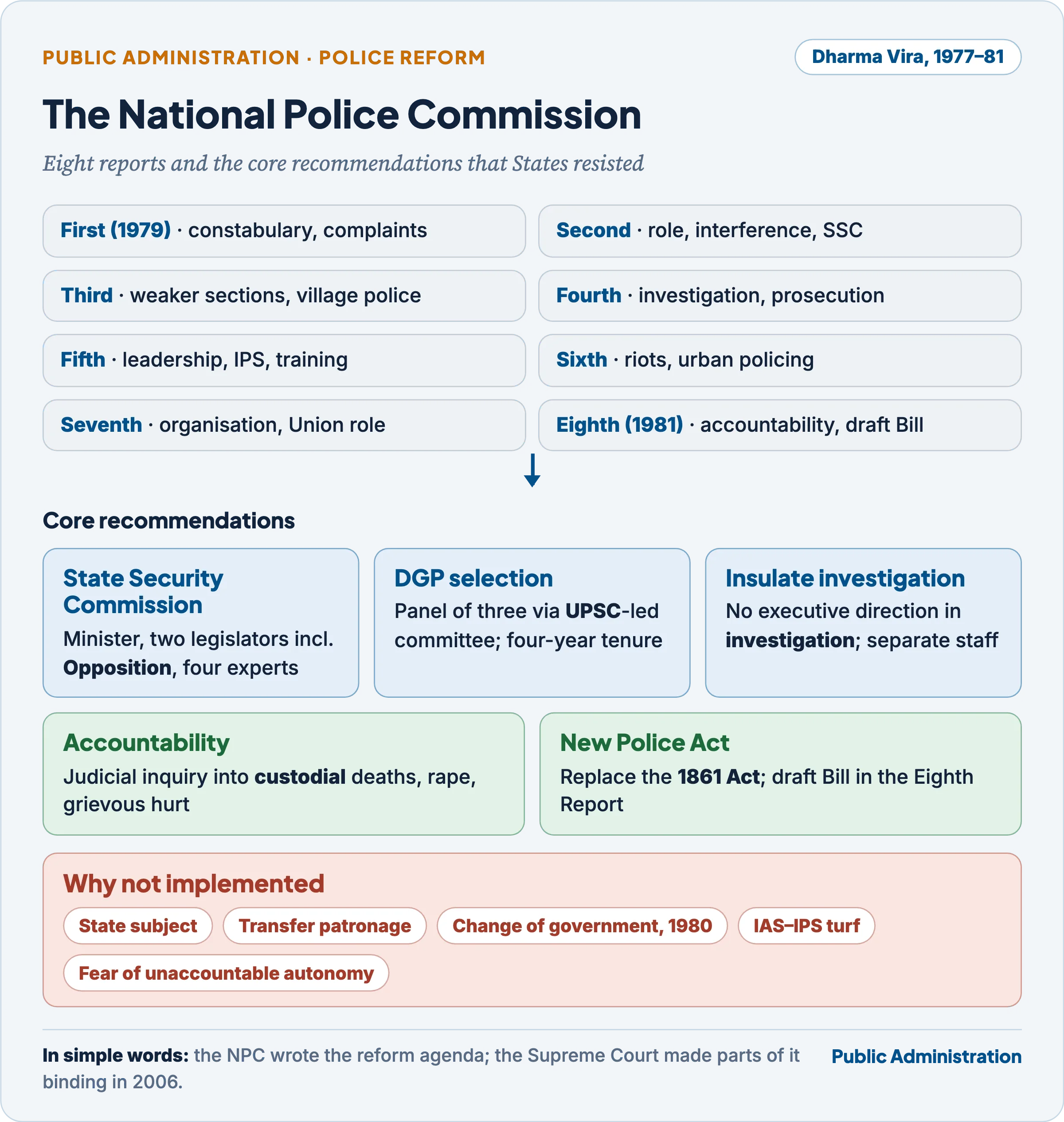
| Report | Main subjects |
|---|---|
| First (Feb 1979) | The constabulary: pay, housing, the orderly system, grievances and career prospects; inquiry into complaints against the police; judicial inquiry into custodial deaths and rape |
| Second (1979) | Role, duties and powers of the police; political and executive interference; the State Security Commission and tenure of the police chief; Gram Nyayalayas; crime records |
| Third (1980) | Police and the weaker sections; village police; special law for serious and organised crime; modernisation |
| Fourth (1980) | Investigation, court trials and prosecution; police role in industrial and agrarian disputes, social legislation and prohibition |
| Fifth (1980) | Police leadership: the IPS, recruitment, training, cadre management; police and students; disciplinary control |
| Sixth (1981) | Communal riots, urban policing and the commissionerate system; reorganisation of police establishments |
| Seventh (1981) | Organisation of State and district police, armed police, traffic, ministerial staff, delegation of financial powers, performance appraisal, Union government’s role |
| Eighth (May 1981) | Accountability of police performance, and a draft Police Bill to replace the 1861 Act |
- The table shows the NPC’s breadth: it treated the police not as a force to be equipped but as an institution to be redesigned, from the constable’s housing to the Chief Minister’s powers.
4.3 Key recommendations
- Three kinds of police tasks. The NPC separated investigative, preventive and service-oriented tasks.
- Investigation must be beyond any executive or non-executive interference: no minister or official may direct who is to be arrested or charged.
- For preventive and service tasks, the government may give directions, but these should be open, in writing and known to the legislature.
- State Security Commission (SSC). A statutory body in each State to make the government’s superintendence open and lawful.
- Composition: the Minister in charge of police as chairman and six members: two legislators (one from the ruling side and one from the Opposition) and four appointed by the Chief Minister, with the legislature’s approval, from retired High Court judges, retired senior civil servants and eminent social scientists or academics.
- Functions: lay down broad policy guidelines for preventive and service tasks; evaluate police performance annually and report to the legislature; act as a forum of appeal for officers given illegal or irregular orders; review the functioning of the force.
- The police chief. The DGP to be chosen from a panel of three IPS officers of the State cadre prepared by a committee headed by the Chairman of the UPSC (with the Union Home Secretary, the senior-most head of a central police organisation, the Chief Secretary and the outgoing DGP); a fixed tenure of four years or until retirement, whichever is earlier; removal before that only with the SSC’s approval.
- Insulation of investigation. Investigation staff to be separated from law-and-order staff in urban areas, and the head of the Anti-Corruption Bureau to be chosen from a panel prepared by a committee headed by the Central Vigilance Commissioner.
- Accountability for misconduct. A mandatory judicial inquiry into every case of death, rape or grievous hurt in police custody; a system for inquiring into complaints against the police outside the normal chain of command.
- Constabulary. End the orderly system; better pay, housing and promotion; recruitment of educated young people; reduce the gap between officers and men.
- Confessions. Make confessions recorded by senior police officers admissible under safeguards (a recommendation the Law Commission also made but Parliament did not adopt).
- Cities. The commissionerate system for large, fast-growing cities.
- A new Police Act. Replace the 1861 Act with a law that changes superintendence and control, defines duties and social responsibilities, and makes the police an agency that upholds the rule of law and serves the community impartially. The Eighth Report attached a draft Police Bill.
Common confusion
Did the National Police Commission create the Police Establishment Board and the Police Complaints Authority? Not in those names. The NPC laid down the principles: insulation of postings and of investigation, a State Security Commission, and external inquiry into police misconduct. The Police Establishment Board and the District and State Police Complaints Authorities took their final form in the Ribeiro (1998–99) and Padmanabhaiah (2000) reports and in the Supreme Court’s Prakash Singh (2006) directives, which drew on all of them.
4.4 Why the NPC was not implemented
- Police is a State subject. The Union could only forward the reports to States; most States saw them as an attempt to reduce their control.
- Loss of patronage. The core proposals (SSC, fixed tenure, insulation of investigation) would end the use of transfers and postings as political currency and the use of police against opponents. Governments of every party found the police too useful to give up.
- Change of government (1980). The returning government shelved the reports; they were long kept from the public.
- Bureaucratic resistance. The IAS was wary of losing the District Magistrate’s control; parts of the police leadership were comfortable with the status quo and its rewards.
- Fear of an autonomous police. Politicians and civil-liberties groups alike feared a police free of political control but not truly accountable; the NPC’s answer (the SSC) was not trusted by either side.
- Partial implementation. The Union reported that it had acted on many non-core recommendations: police housing, communications, computerisation under the modernisation scheme, the National Crime Records Bureau (1986), management courses at the National Police Academy, restructuring BPR&D, and arrest guidelines. But the crucial ones (SSC, DGP selection and tenure, insulation of investigation, replacement of the 1861 Act) were not.
- The Indrajit Gupta letter. In 1997 Union Home Minister Indrajit Gupta wrote to all Chief Ministers urging them to set up State Security Commissions and implement the core recommendations; the response was negligible.
- The road to the courts. In 1996 two former DGPs, Prakash Singh and N.K. Singh, petitioned the Supreme Court for directions to implement the NPC. That petition led to the Ribeiro Committee and, ten years later, to the 2006 judgment.
Indian Connect — What the NPC changed despite non-implementation
The NPC’s reports became the reference text for every later reform body. The Supreme Court’s seven directives in Prakash Singh v Union of India (2006) are largely the NPC’s core recommendations, made binding until States legislate. The NCRB, modern police communications, police housing schemes and the idea of separating investigation all trace back to it.
5. After the NPC: Committees, Model Acts and the Supreme Court
In simple words
For thirty years after the NPC, committee after committee was asked the same question and gave much the same answer. Each added something new, for example on criminal justice, on drafting a model law or on the police’s place in the whole justice system, but the core proposals stayed the same.
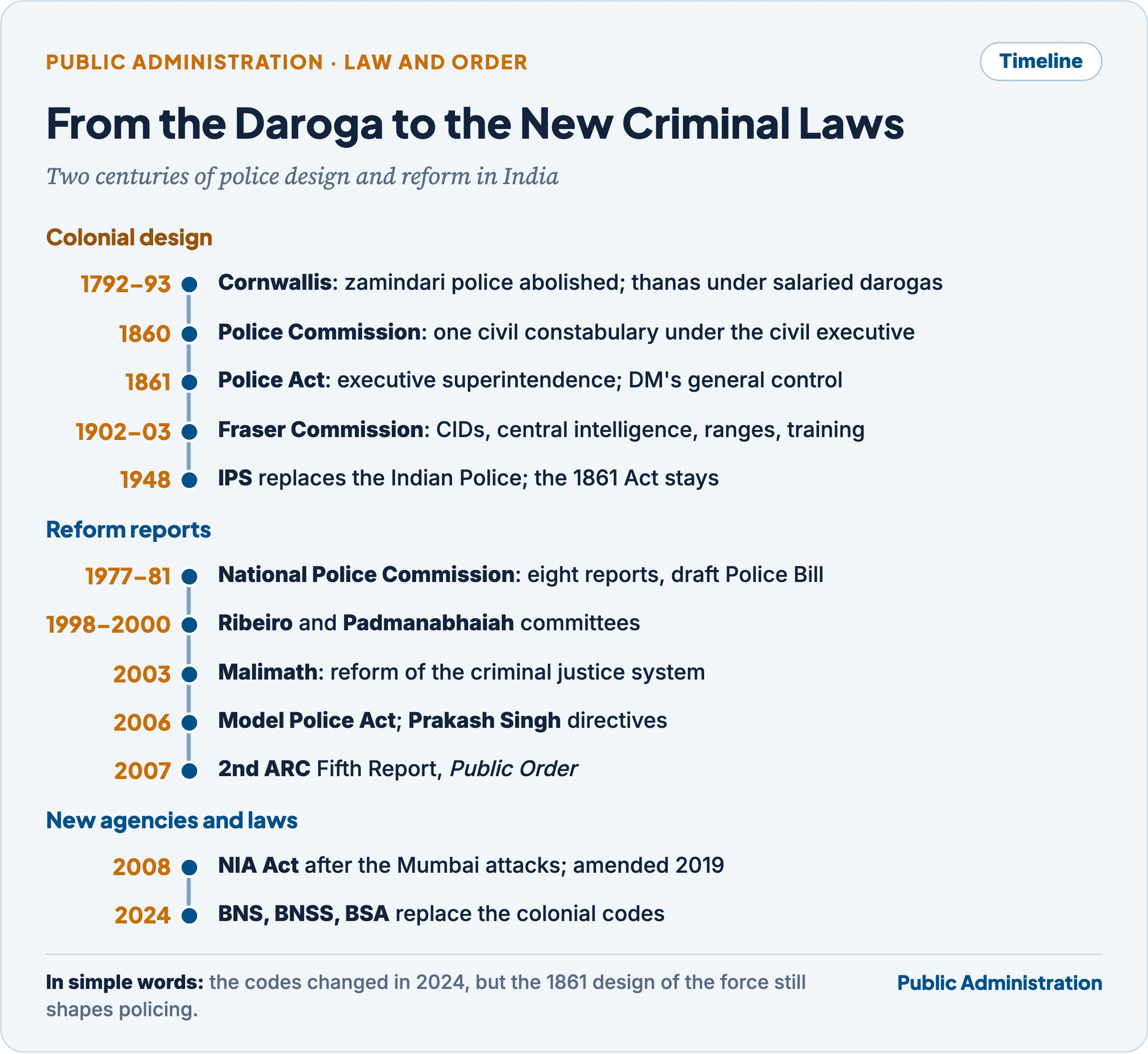
5.1 The Ribeiro Committee (1998–99)
- Origin. Set up on 25 May 1998 on the Supreme Court’s direction in the Prakash Singh petition, under Julio F. Ribeiro, former DGP of Punjab and Commissioner of Police, Mumbai. It reviewed action on the NPC and reported in October 1998 and March 1999.
- Main recommendations.
- A Police Performance and Accountability Commission in each State (in place of the NPC’s SSC), to evaluate performance and ensure lawful transfers and merit-based promotion.
- A panel-based selection of the DGP and a minimum tenure.
- A Police Establishment Board of senior officers for postings and transfers.
- District and State Police Complaints Authorities to inquire into public complaints.
- Separation of investigation from law-and-order work, at least in urban areas.
- Replacement of the 1861 Act with a new law.
5.2 The Padmanabhaiah Committee (2000)
- Origin. Appointed in January 2000 under K. Padmanabhaiah, former Union Home Secretary, to suggest structural changes for the new millennium; reported on 30 August 2000.
- Main recommendations.
- Recruitment and training: recruit more sub-inspectors and fewer constables (a teeth-to-tail ratio of 1:4 against the existing 1:7 to 1:15); recruit constables young after Class 10 with two-year training, and sub-inspectors after Class 12 with three-year training; classify the constable as a skilled worker.
- Insulation: a body headed by the Chief Justice of the High Court to recommend a panel for DGP; a Police Establishment Board for transfers of DSP and above; two-year minimum tenure for all officers.
- Investigation: separate investigation from law and order, starting at police stations in urban areas, with an Additional SP for crime; delete ss.25–26 of the Evidence Act and admit confessions to officers of SP rank and above; investigation kits and mobile forensic laboratories.
- Federal offences: crimes with inter-State, national and international ramifications to be declared federal offences and investigated by the CBI’s Special Crimes Division.
- Terrorism: a special comprehensive law and a national counter-terrorism coordinator.
- Accountability: a statutory Inspectorate of Police; a non-statutory District Police Complaints Authority chaired by the DM; mandatory judicial inquiry into custodial deaths and rape.
- Community policing and a review of VIP security.
- Response. The Union rejected the structural items (federal offences, IPS-related changes, commissionerates) but passed recruitment, training and beat-system proposals to the States.
5.3 The Malimath Committee on Reforms of the Criminal Justice System (2000–03)
- Origin. Set up on 24 November 2000 under Justice V.S. Malimath, former Chief Justice of the Karnataka and Kerala High Courts; reported in March 2003 with 158 recommendations. Its subject was the whole criminal justice system, not only the police.
- Main recommendations.
- Truth-seeking trials: borrow features of the inquisitorial system (an active judge, a duty to seek the truth); allow courts to draw adverse inferences from an accused’s silence; replace “proof beyond reasonable doubt” with “clear and convincing” proof.
- Investigation: a separate investigation wing at police stations; more investigating officers; a strong forensic and finger print set-up; confessions to an SP-rank officer, audio-video recorded, made admissible.
- Structure: a State Security Commission; a new Police Act; a central law and agency for federal crimes.
- Prosecution: a Director of Prosecution in each State and better coordination between police and prosecutors.
- Victims and witnesses: victims’ right to participate, compensation, and a witness protection law.
- Courts: more judges, fewer adjournments, plea bargaining and reclassification of offences.
- Criticism. Civil-liberties groups attacked it as pro-prosecution: diluting the right to silence and the standard of proof would increase convictions of the poor and the innocent rather than of the powerful. Some proposals were adopted later: plea bargaining (2005), the Directorate of Prosecution (s.25A CrPC, 2005), victim compensation (s.357A CrPC, 2009), and the Witness Protection Scheme, 2018 (approved by the Supreme Court in Mahender Chawla).
The three reports are compared below.
| Point | Ribeiro (1998–99) | Padmanabhaiah (2000) | Malimath (2003) |
|---|---|---|---|
| Scope | Implementation of NPC; police accountability | Structure of the police for the new century | Entire criminal justice system |
| Insulation body | Police Performance and Accountability Commission | Panel body chaired by the HC Chief Justice for DGP; PEB | State Security Commission |
| Investigation | Separate from law and order | Separate in urban police stations; Addl SP crime | Separate investigation wing; forensic push |
| Confessions to police | Not a main theme | Admissible before SP and above | Admissible before SP, if recorded |
| Complaints | District and State Complaints Authorities | DM-chaired District Complaints Authority; Inspectorate | Through new Police Act |
| Federal crime | Not a main theme | CBI Special Crimes Division | Central law and agency |
| Distinctive idea | Accountability commission | Recruitment ratio and training overhaul | Inquisitorial features; lower standard of proof |
- The common core of all three is insulation of postings, separation of investigation, external complaints machinery and a new Police Act. They differ in emphasis: Ribeiro on accountability, Padmanabhaiah on personnel and structure, Malimath on trial and evidence.
5.4 The Mooshahary Review Committee (2004–05)
- Set up in December 2004 under R.S. Mooshahary, it reviewed the recommendations of the NPC and of the eleven State commissions and later committees, and listed those still relevant for action. It reported in March 2005, and its list fed the drafting of a model law.
5.5 The Police Act Drafting Committee and the Model Police Act, 2006
- Origin. Constituted on 20 September 2005 under Soli J. Sorabjee, former Attorney General; it submitted the Model Police Act on 30 October 2006, which the Union sent to States the next day.
- Main features.
- Police as a service: a professional, efficient, responsive police accountable to the rule of law, governed by impartiality and human rights, with special attention to weaker sections and minorities.
- Superintendence of the State government through policies and guidelines only, with functional autonomy for the police (s.39).
- A State Police Board (ss.42–50) headed by the Home Minister to frame policy, prepare the DGP panel and set performance indicators.
- DGP chosen from the three senior-most empanelled officers, with a minimum two-year tenure irrespective of retirement (s.6); security of tenure for key field officers.
- Police Establishment Committees (s.53) for postings and officers’ grievances.
- Dedicated crime-investigation units in urban areas; separate civil and armed cadres.
- Accountability: a State Police Accountability Commission and District Accountability Authorities for complaints; performance accountability chapters.
- Welfare: rational working hours, a weekly day off, a Police Welfare Bureau, insurance.
- The District Magistrate keeps a coordinating role.
- Significance. It complemented the Prakash Singh judgment delivered a month earlier and became the template for the new State Acts.
5.6 The 2nd ARC’s Fifth Report, “Public Order” (2007)
- The report. Public Order: Justice for Each… Peace for All (June 2007), by the 2nd ARC under M. Veerappa Moily, made wide-ranging recommendations on the police and the criminal justice system. It quoted the NPC’s verdict that “an authoritarian police of the imperial regime cannot function well in a democratic country” and Sardar Patel’s hope that the police would win “the affection and regard of the people”.
- Main recommendations.
- Separation of investigation: a Crime Investigation Agency in each State under a Chief of Investigation with a three-year tenure, supervised by a Board of Investigation headed by a retired or sitting High Court judge; all offences punishable with three years or more to go to this agency, while registration of FIRs and first response stay with the law-and-order police.
- A State Police Board, a Police Performance and Accountability Commission, a Police Establishment Committee and independent Complaints Authorities at State and district levels.
- Outsource non-core functions (verification, summons, guarding) to other agencies.
- Criminal justice: amend ss.161–162 CrPC on witness statements; make confessions before police admissible if video-recorded and confirmed before a magistrate; define obstruction of justice as an offence.
- Repeal AFSPA and add a chapter to the UAPA for the North East; strengthen intelligence for preventive action; work with the media in crises.
- Endorsed the Sorabjee committee’s direction but asked for a holistic review of the whole criminal justice system.
- Government response. A Group of Ministers accepted some points and left others to States; the separation recommendations were referred to the drafting of a revised model Act.
5.7 The Model Police Bill, 2015
- The BPR&D revised the 2006 Act into a draft Model Police Bill, 2015, uploaded for comment on 15 October 2015. It added the ten attributes of SMART policing (strict and sensitive, modern and mobile, alert and accountable, reliable and responsive, tech-savvy and trained), respect for privacy during investigation, a ban on using police personnel for personal servitude (the orderly system) and the complainant’s right to be told the progress of investigation. It remains a model, not a law.
5.8 Prakash Singh (2006) in brief
- In Prakash Singh v Union of India (22 September 2006), the Supreme Court, using Articles 32, 142 and 144 and citing Vineet Narain, issued seven directives binding until States legislate: a State Security Commission; DGP selection from three officers empanelled by the UPSC with a two-year minimum tenure; two-year tenure for IGs, DIGs, SPs and SHOs on field duty; separation of investigation from law and order (starting with towns of 10 lakh or more); a Police Establishment Board; State and District Police Complaints Authorities; and a National Security Commission for central police organisations.
- In July 2018 the Court added that States must send DGP proposals to the UPSC three months before a vacancy and must not appoint “acting” DGPs.
- How States complied (often through Acts that diluted the directives), the Justice K.T. Thomas Monitoring Committee (2008–10) and the current position are covered in the article on Police–Public Relations and Police Reforms. Separation of investigation, the one directive that belongs to this article’s theme, is taken up in section 8.
6. Investigative Agencies
In simple words
Most crimes are investigated by the local police station. But some crimes are too big, too technical or too spread out for one district or one State: bribery by central officials, terror networks, money laundered abroad, drug cartels, company frauds. For these the Union has built specialised agencies, and the States have their own crime branches. Who controls these agencies, and whether they can enter a State without its permission, is now one of the sharpest questions in Indian federalism.
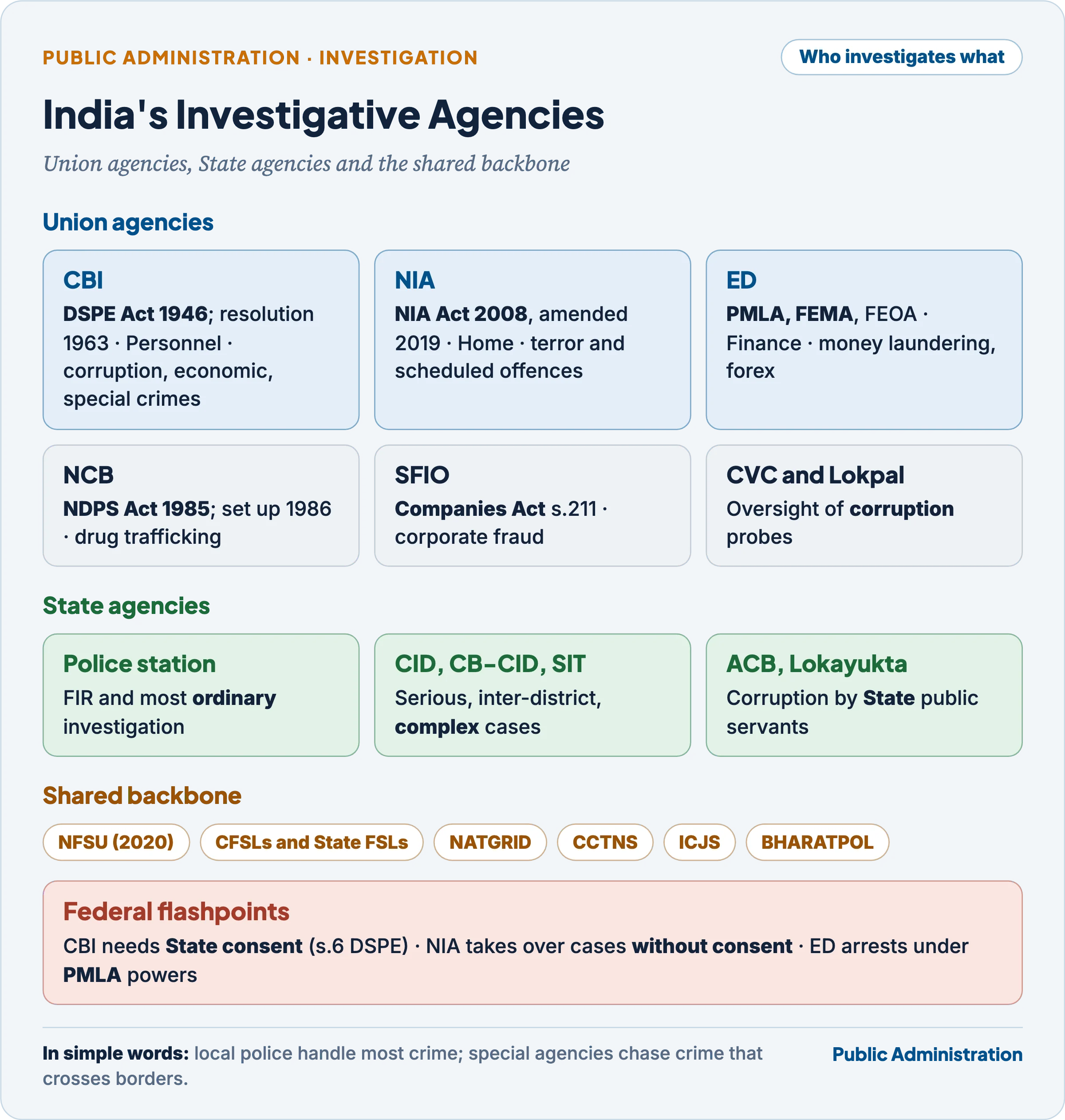
The main investigative agencies and their legal bases are listed below.
| Agency | Legal basis and year | Parent ministry | Mandate |
|---|---|---|---|
| CBI | DSPE Act, 1946; MHA resolution of 1 April 1963 | Personnel (DoPT) | Corruption by central public servants, economic and special crimes, cases referred by States or courts |
| NIA | NIA Act, 2008 (amended 2019) | Home Affairs | Terrorism and other scheduled offences affecting national security |
| ED | FEMA, 1999; PMLA, 2002; FEOA, 2018 (unit formed 1 May 1956) | Finance (Revenue) | Money laundering, foreign-exchange violations, fugitive economic offenders |
| NCB | NDPS Act, 1985, s.4(3) (constituted 1986) | Home Affairs | Coordination and enforcement against drug trafficking |
| SFIO | Resolution of 2 July 2003; statutory under s.211, Companies Act, 2013 | Corporate Affairs | Serious and complex corporate frauds |
| DRI | Set up 1957 | Finance (CBIC) | Customs and smuggling intelligence and investigation |
| State CID / Crime Branch | State police law and manuals | State Home Department | Serious, inter-district, organised and technical crime |
| State ACB / Vigilance / Lokayukta police | State notifications; Prevention of Corruption Act, 1988; State Lokayukta Acts | State government or Lokayukta | Corruption by State public servants |
- The table shows the asymmetry in the system: the Union’s agencies rest on special statutes (or, for the CBI, an old Delhi police law), while ordinary crime, the bulk of all investigation, stays with State police stations working under the BNSS.
6.1 The Central Bureau of Investigation (CBI)
- Origin.
- 1941: the Special Police Establishment (SPE) was set up to investigate bribery and corruption in the War and Supply Department during the Second World War.
- 1946: the Delhi Special Police Establishment (DSPE) Act gave it a statutory base, moved it to the Home Department and extended it to all departments of the Government of India.
- 1 April 1963: a Ministry of Home Affairs resolution created the Central Bureau of Investigation, with the DSPE as its core. Its founder Director, D.P. Kohli (1963–68), gave it the motto “Industry, Impartiality, Integrity”.
- Its remit grew with the public sector and, after bank nationalisation (1969), public sector banks.
- Structure today. The CBI works under the Department of Personnel and Training. Its divisions include Anti-Corruption, Economic Offences, Special Crimes, a Directorate of Prosecution, policy and international cooperation, and the Central Forensic Science Laboratory. It is the National Central Bureau for INTERPOL in India.
- The DSPE Act: key sections.
| Section | Provision |
|---|---|
| s.2 | Constitution of the special police force for Delhi and Union Territories |
| s.3 | It may investigate only offences notified by the Central Government |
| s.4 | Superintendence vests in the CVC for Prevention of Corruption Act cases and in the Central Government for all others |
| s.4A | Director appointed on the recommendation of a committee of the Prime Minister, the Leader of the Opposition (or leader of the largest Opposition party) and the Chief Justice of India or a judge nominated by him (inserted by the Lokpal and Lokayuktas Act, 2013) |
| s.4B | Minimum two-year tenure; since the 2021 amendment, extendable one year at a time up to five years in all, on the committee’s recommendation |
| s.5 | Union may extend the CBI’s powers to any area in a State |
| s.6 | But not without the consent of the State Government (except in Union Territories and railway areas) |
- Vineet Narain v Union of India (18 December 1997). In the Jain hawala case the Supreme Court:
- struck down the “Single Directive”, an executive instruction requiring prior permission before the CBI could inquire into officers of Joint Secretary rank and above;
- directed that the CVC be given statutory status and superintendence over the CBI’s corruption work;
- fixed a minimum two-year tenure for the CBI Director and the Director of Enforcement, and a selection committee;
- developed “continuing mandamus”: the Court kept the case open to monitor investigation of the powerful.
- The CVC Act, 2003 gave effect to these directions, but it also inserted s.6A into the DSPE Act, bringing back prior approval for senior officers. A Constitution Bench struck s.6A down in Subramanian Swamy v Director, CBI (2014) as violating equality; in 2018, s.17A of the Prevention of Corruption Act reintroduced prior approval for inquiries into decisions taken by any public servant in official functions.
- “Caged parrot” (May 2013). In the coal-block allocation case, a bench led by Justice R.M. Lodha called the CBI “a caged parrot speaking in its master’s voice”, after its Director admitted that a status report had been shared with and altered by the Law Minister and officials. The phrase captures the principal–agent problem of an investigating agency whose budget, staff, postings and prosecution sanctions are controlled by the executive it may have to investigate.
- Navendra Kumar v Union of India (Gauhati High Court, 6 November 2013). The High Court held that the 1963 resolution was only an executive instruction, that the CBI was not a police force validly constituted under the DSPE Act, and quashed the resolution. The Supreme Court stayed the verdict on 9 November 2013 in a special sitting; the appeal is still pending, so the CBI functions under the stay. The case exposes the CBI’s thin legal base: a 1946 Delhi police law stretched to cover a national agency.
- Consent of States (s.6).
- States give general consent (for classes of cases) or specific consent (case by case). Withdrawing general consent forces the CBI to seek permission for each new case in that State, though existing cases and cases ordered by courts continue.
- Withdrawals. Mizoram (2015), West Bengal (16 November 2018), Chhattisgarh, Rajasthan, Maharashtra, Kerala, Jharkhand and Punjab (2019–20), Meghalaya, Telangana and Tamil Nadu (2022–23) and Karnataka (2024) withdrew consent; some later restored it after a change of government. In 2025 the CBI told a parliamentary committee that eight States had withdrawn general consent.
- State of West Bengal v Committee for Protection of Democratic Rights (2010). A Constitution Bench held that the High Courts and the Supreme Court may direct a CBI inquiry in a State without its consent, since constitutional courts are not bound by s.6.
- State of West Bengal v Union of India (10 July 2024). The Supreme Court held West Bengal’s Article 131 suit against the Union maintainable, ruling that the CBI is an organ established by and under the superintendence of the Union government, so the dispute is genuinely between the State and the Union. The merits are pending.
- State (CBI) v A. Satish Kumar (2 January 2025). The Court held that the CBI needs no State consent to register a case under a central law against central government employees merely because they are posted in that State.
- Parliamentary committee (March 2025). The Standing Committee on Personnel recommended a new law empowering the CBI to investigate cases affecting national security and integrity without State consent; another report (August 2025) suggested an exception for cyber crime.
- Persistent problems.
- No dedicated statute defining its mandate, powers, accountability and independence, despite repeated parliamentary recommendations.
- Dependence on deputation from State police for much of its staff, and chronic vacancies.
- Prosecution sanction for public servants under s.19 of the Prevention of Corruption Act and prior approval under s.17A delay or block cases against officials.
- Perception of selectivity: cases against Opposition leaders that move fast, and cases against allies that stall, damage legitimacy whichever party is in power.
- Delay: long investigations and trials, with thousands of CBI cases pending in courts for years.
Common confusion
Was the CBI created by the DSPE Act, 1946, or on the Santhanam Committee’s recommendation? Neither, strictly. The DSPE Act, 1946 created the Special Police Establishment, which remains the CBI’s investigating arm and the only source of its police powers. The CBI itself was created by an executive resolution of 1 April 1963, while the Santhanam Committee on Prevention of Corruption (1962–64) was at work; the Committee’s own best-known outcome was the Central Vigilance Commission (1964). This gap between an executive bureau and a statutory force is exactly what the Gauhati High Court seized on in Navendra Kumar (2013).
6.2 The National Investigation Agency (NIA)
- Origin. After the 26 November 2008 Mumbai attacks, Parliament passed the NIA Act within weeks; it received assent on 31 December 2008. The Bill’s statement of objects noted that terror cases had complex inter-State and international linkages (arms, drugs, fake currency, infiltration) and that the Administrative Reforms Commission and other bodies had recommended such an agency. It works under the Ministry of Home Affairs as India’s central counter-terrorism law-enforcement agency.
- How jurisdiction works (a concurrent model).
- Scheduled offences (the Schedule to the Act) include the UAPA, Atomic Energy Act, Anti-Hijacking Act, Weapons of Mass Destruction Act, offences against the State, and others.
- s.6: when a scheduled offence is registered, the State police reports it to the State government, which forwards it to the Centre; the Centre decides within 15 days whether the NIA should take over. The Centre may also direct the NIA suo motu.
- s.7: the NIA may transfer a case back to the State.
- s.8: the NIA may investigate connected offences.
- s.10: the State’s own power to investigate scheduled offences is not taken away.
- s.11: Special Courts try NIA cases.
- No State consent is needed: this is the main federal difference from the CBI.
- The 2019 amendment (assent 24 July 2019):
- Extra-territorial reach: the NIA may investigate scheduled offences committed outside India against Indian citizens or interests, subject to treaties and foreign law; the Special Court in New Delhi has jurisdiction.
- New scheduled offences: human trafficking (IPC ss.370–370A), counterfeit currency (ss.489A–489E), manufacture or sale of prohibited arms (Arms Act s.25(1AA)), cyber terrorism (IT Act s.66F) and the Explosive Substances Act, 1908.
- Special Courts: the Union (and States) may designate Sessions Courts as Special Courts in consultation with the Chief Justice of the High Court.
- Performance. As on 12 March 2025, the NIA had registered 652 cases since inception, charge-sheeted 516, and secured conviction in 150 of 157 decided cases (a conviction rate of 95.54 per cent); 51 Special Courts had been designated. It runs a National Terror Data Fusion and Analysis Centre (since January 2024) and is the nodal agency for high-quality fake currency cases; zonal offices at Guwahati and Jammu and 21 branch offices.
- Federal and rights concerns.
- Chhattisgarh filed an Article 131 suit (2020) arguing that the Act lets the Union take over State police functions without consent.
- The conviction rate counts only decided cases; most NIA cases are pending for years, and under the UAPA’s bail bar (s.43D(5)) accused persons may spend long periods in custody before trial.
- Critics see selective use in politically charged cases; supporters point to the need for one agency to follow terror networks across States and borders.
- The NIA’s role in counter-terrorism, alongside the IB, MAC and CAPFs, is discussed in the article on Central and State Agencies, Paramilitary Forces, Insurgency, Terrorism and Criminalisation of Politics.
6.3 The Directorate of Enforcement (ED)
- Origin and laws.
- An Enforcement Unit was formed on 1 May 1956 in the Department of Economic Affairs to enforce the Foreign Exchange Regulation Act, 1947; it was renamed the Enforcement Directorate in 1957 and moved to the Department of Revenue in 1960.
- FERA, 1973 gave way to the civil Foreign Exchange Management Act, 1999 (in force 1 June 2000).
- The ED enforces the Prevention of Money-laundering Act, 2002 from 1 July 2005, and the Fugitive Economic Offenders Act, 2018 from 21 April 2018.
- PMLA powers. s.3 (offence of money laundering), s.5 (provisional attachment of property for 180 days), s.17 (search and seizure), s.19 (arrest), s.24 (reverse burden of proof), s.45 (twin conditions for bail: the court must believe the accused is not guilty and unlikely to offend on bail), s.50 (summons and statements before ED officers). Money laundering depends on a scheduled (predicate) offence investigated by another agency.
- Vijay Madanlal Choudhary v Union of India (27 July 2022). A three-judge bench upheld these provisions:
- ED officers are not “police officers”, so statements under s.50 are not barred as confessions;
- the ECIR (Enforcement Case Information Report) is an internal document, not an FIR, and need not be supplied to the accused;
- the twin bail conditions and the reverse burden are valid given the gravity of money laundering.
- Review petitions (limited at first to the ECIR and the reverse burden) are pending; the bench was reconstituted on 20 August 2026.
- Later Supreme Court checks.
- Pankaj Bansal v Union of India (3 October 2023): the grounds of arrest must be given to the accused in writing.
- Tarsem Lal v Directorate of Enforcement (16 May 2024): once a Special Court takes cognisance of a complaint, the ED cannot arrest an accused who appears on summons without the court’s permission.
- Prem Prakash v Union of India (28 August 2024): a statement recorded under s.50 while the accused is in custody in another ED case is hit by the bar on confessions and inadmissible against him.
- In August 2025, hearing the review, a judge remarked that the ED must act “within the four corners of the law”, noting its low conviction figures.
- Outcomes. The government told the Rajya Sabha (29 July 2025) that between 1 January 2015 and 30 June 2025 the ED took up 5,892 PMLA cases, filed 1,398 prosecution complaints, saw charges framed in 300, and secured the conviction of 15 persons in 8 orders; it filed 49 closure reports. The ED counters that it has won 50 of 53 decided cases (over 94 per cent, September 2025) and restored assets worth over ₹34,000 crore to victims. Both figures are true: very few cases reach a verdict, and the process itself (arrest, attachment, long custody) is often the real punishment.
6.4 Other central bodies
- Narcotics Control Bureau (NCB). Constituted in 1986 under s.4(3) of the NDPS Act, 1985 (Home Affairs) to coordinate drug-law enforcement and international cooperation.
- Serious Fraud Investigation Office (SFIO). Set up on 2 July 2003 on the Naresh Chandra Committee’s (2002) advice after the stock-market and vanishing-company scams; statutory under s.211 of the Companies Act, 2013. A multi-disciplinary team of accountants, lawyers, tax and IT experts whose officers can arrest (s.212).
- Others. The DRI (1957) for smuggling; the Lokpal’s inquiry and prosecution wings (2013); the NCRB (1986) for crime data, CCTNS and ICJS; BPR&D (1970) for police research and model laws; and I4C for cyber crime.
6.5 State investigative agencies
- CID / Crime Branch. The Fraser-era provincial CIDs survive as the State CID or Crime Branch-CID (CB-CID), taking over serious, inter-district or complex cases on orders of the DGP, the government or a court; Special Investigation Teams are formed case by case, often under court monitoring. ATS, STFs, Economic Offences Wings and cyber police stations handle specialised crime.
- Anti-corruption bodies. Anti-Corruption Bureaus or Vigilance departments probe State public servants. In Karnataka, the High Court in 2022 quashed the order creating a separate ACB and restored powers to the Lokayukta police: independence depends on whether the agency answers to the government or to an ombudsman.
- Common weaknesses. Political control of postings, diversion of investigators to order duty, weak forensics and large vacancies.
6.6 The forensic and data backbone
- Forensic science.
- Central Forensic Science Laboratories (Chandigarh, Hyderabad, Kolkata, Bhopal, Guwahati, Pune and others) and State and regional FSLs; the e-Forensics platform links 140 laboratories with the justice system (June 2026).
- National Forensic Sciences University (NFSU). Created by the NFSU Act, 2020 (assent 28 September 2020) as an institution of national importance, by merging the Gujarat Forensic Sciences University (Gandhinagar, the headquarters) and the LNJN National Institute of Criminology and Forensic Science (Delhi). Campuses have since opened in Goa, Tripura, Bhopal, Dharwad and Guwahati among others.
- National Forensic Infrastructure Enhancement Scheme (approved 19 June 2024, ₹2,254.43 crore for 2024–29): nine more NFSU campuses and seven CFSLs. A separate Scheme for Modernisation of Forensic Capacities (₹2,080.5 crore, 2021–26) helps States.
- Why it matters. The BNSS now makes forensic examination mandatory for serious offences (section 7), which the existing laboratories cannot yet meet; pendency in FSLs delays trials and invites a return to confession-based investigation.
- NATGRID (National Intelligence Grid).
- Conceived after 26/11 (approved by the Cabinet Committee on Security in 2011), it gives authorised agencies secure, real-time access to some 20 categories of government and private data: bank and financial records, tax data, airline and railway bookings, immigration, telecom KYC, vehicle registration, FIU suspicious-transaction reports and more.
- It became operational in 2024 after long delays; it serves 11 central agencies (IB, R&AW, NIA, CBI, ED, DRI, NCB, CBDT, FIU and others) and now also State police officers of SP rank and above. In 2025 the MHA urged all DGPs to use it, and it was linked to the National Population Register; its “Gandiva” tool supports entity resolution and facial matching.
- Concern. Access without an FIR, to data on almost every citizen, raises the proportionality test of K.S. Puttaswamy v Union of India (2017); safeguards are internal (logged queries, stated purpose, senior oversight) rather than statutory or judicial. The DPDP Act, 2023 lets the government exempt its agencies on grounds such as security of the State.
- CCTNS (Crime and Criminal Tracking Network and Systems). Started in 2009 under the National e-Governance Plan (outlay ₹2,000 crore) to computerise every police station on a common application. As on 1 June 2026, all 17,762 police stations use it; citizen services include online complaints, FIR copies, verification requests and missing-person searches.
- ICJS (Inter-operable Criminal Justice System). Links the five pillars: police (CCTNS), courts (e-Courts), prisons (e-Prisons), forensics (e-Forensics) and prosecution (e-Prosecution), under a data-sharing matrix approved by the Supreme Court’s e-Committee. ICJS 2.0 is run by the NCRB; by June 2026, 1,314 prisons, 140 FSLs and 2,283 prosecution offices were integrated, and FIRs and charge sheets flow electronically into courts in all States and UTs. Apps such as e-Sakshya (evidence capture), Nyaya Setu, Nyaya Shruti (video testimony) and e-Summons support the new criminal laws.
Criticism — Criticism: investigative agencies as instruments of the government of the day
- Executive control of the essentials. Budgets, postings, deputation, prosecution sanction and the choice of cases sit with ministries; “many masters and one parrot“, as the Supreme Court put it in 2013.
- Selective targeting. The pattern of cases against Opposition leaders, and their slowing when leaders change sides, suggests political rather than legal priorities; this is said of governments of every party.
- Process as punishment. PMLA and UAPA cases end in very few convictions, but arrest, attachment and denial of bail impose years of punishment without trial.
- Federal erosion. NIA takeovers without consent, CBI cases in non-consenting States and ED raids timed with elections undermine State control of police and trust between governments.
- Weak legal foundations. The CBI rests on a 1946 Delhi police law and a 1963 resolution; the ED’s sweeping powers rest on a judgment under review.
Defence — Defence: specialised agencies under law and courts
- Crime has outgrown State borders. Terror finance, cyber fraud, hawala and cartels need agencies that can follow money and people across States and countries; State police cannot do this alone.
- Judicial oversight is real. Vineet Narain, Pankaj Bansal, Tarsem Lal, Prem Prakash and the CPDR principle show courts disciplining agencies and directing probes the executive resisted.
- Statutory safeguards exist. A collegium selects the CBI Director; the CVC supervises corruption cases; tenure security limits pressure; NIA cases go to Special Courts.
- Results in core areas. The NIA’s conviction rate in decided cases and the CBI’s role in exposing major scams show professional capacity.
- Reform, not dismantling. The answer is a CBI Act, independent prosecution, time-bound trials and transparent case selection, not weaker agencies.
7. Investigation under the New Criminal Laws (2024)
In simple words
On 1 July 2024 India replaced its three colonial criminal laws. For investigators the biggest changes are about technology and time: complaints can be filed online and at any police station, searches and crime scenes must be filmed, serious crimes must be examined by forensic experts, and victims must be told how the case is going. Whether these promises are kept depends on laboratories, training and equipment that are still being built.
7.1 The three laws
- Bharatiya Nyaya Sanhita, 2023 (BNS) replaced the Indian Penal Code, 1860: substantive offences and punishments, with new offences such as organised crime (s.111), petty organised crime (s.112) and terrorist act (s.113), and community service as a punishment.
- Bharatiya Nagarik Suraksha Sanhita, 2023 (BNSS) replaced the Code of Criminal Procedure, 1973: arrest, investigation, prosecution, bail and trial.
- Bharatiya Sakshya Adhiniyam, 2023 (BSA) replaced the Indian Evidence Act, 1872: what evidence is admissible and how it is proved.
- All three came into force on 1 July 2024; offences committed earlier are still tried under the old laws, so police and courts will run two systems for years.
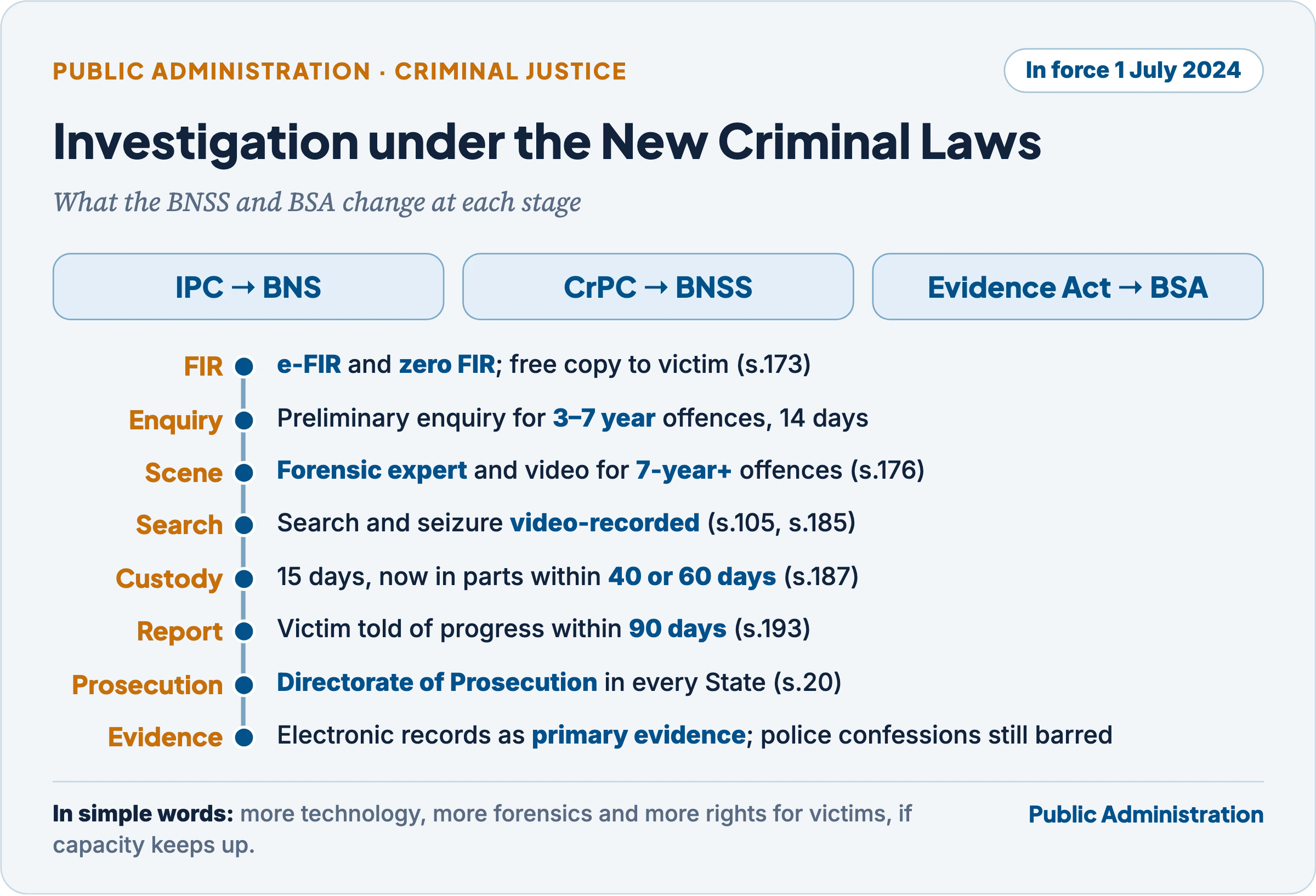
7.2 What changed for investigation
The main changes at each stage of investigation are compared below.
| Stage | Old law (CrPC / Evidence Act) | New law (BNSS / BSA) | Effect |
|---|---|---|---|
| FIR | s.154: oral or written, at the station with jurisdiction | s.173: also by electronic communication (e-FIR), signed within three days; zero FIR at any station; free copy to informant or victim | Fewer refusals to register; jurisdiction no longer an excuse |
| Preliminary enquiry | Only in limited classes (Lalita Kumari, 2013) | s.173(3): for offences punishable with 3 to 7 years, the SHO may hold a preliminary enquiry within 14 days, with a DSP’s permission | Filters frivolous complaints but may let police delay FIRs |
| Diary to Magistrate | s.157: report forwarded | s.176(2): daily diary report sent fortnightly | More judicial oversight |
| Crime scene | No duty to call experts | s.176(3): for offences punishable with 7 years or more, a forensic expert must visit and the process be video-recorded; States without facilities may use another State’s | Science over confession, if capacity exists |
| Search and seizure | s.100, s.165 | s.105 and s.185: audio-video recording, preferably on a mobile phone, sent to the Magistrate (within 48 hours for s.185) | Less planting of evidence; proof of procedure |
| Victim’s statement in rape | Recorded by a woman officer | s.176(1) proviso: may be recorded by audio-video means | Fewer retractions and disputes |
| Witness statements | s.161 (examination), s.162 (not signed; used only to contradict) | s.180 and s.181: same rule continues | Statements to police are still not substantive evidence |
| Confessions | Evidence Act ss.25–26: confession to police inadmissible; in custody only before a magistrate; s.27 discovery exception | BSA s.23: same rule, with the discovery proviso | Colonial safeguard retained |
| Police custody | s.167: up to 15 days, in the first 15 days of arrest | s.187: up to 15 days, in whole or in parts within the first 40 or 60 days | Flexibility for investigators; critics fear prolonged custody |
| Arrest safeguards | s.41 onwards | s.35(7): no arrest for offences under 3 years of the infirm or over 60 without a DSP’s permission; s.37: a designated police officer to display details of arrested persons | Transparency |
| Report to victim | Not required | s.193(3)(ii): inform the informant or victim of progress within 90 days; chain of custody of electronic devices in the police report; further investigation within 90 days | Victim-centric |
| Prosecution | s.25A (since 2005): optional Directorate | s.20: Directorate of Prosecution in every State, monitoring cases punishable with 10 years or more | Independent review of police reports |
| Electronic evidence | s.65B certificate (Arjun Panditrao Khotkar, 2020) | BSA s.57: electronic records can be primary evidence; s.63: certificate in two parts | Digital evidence easier to prove |
| Absconders | Trial needed presence | s.356: trial in absentia of proclaimed offenders | Prevents fugitives stalling trials |
- The direction of change. The table shows three shifts: from paper to digital (e-FIR, e-Sakshya, electronic evidence), from confession to science (forensics, videography), and from a police-centred to a victim-centred process (free FIR copy, 90-day updates).
- Why statements to police are not signed or used as evidence. The rule in old s.162 CrPC, now s.181 BNSS, is that a statement made to a police officer during investigation is not signed by the person and cannot be used at any inquiry or trial, except by the defence (and, with permission, the prosecution) to contradict that witness in court.
- Reason: the colonial lawmakers feared that police would write what they wanted and coerce signatures; an unsigned record cannot be passed off as the witness’s own document.
- Effect: the witness must testify afresh before the court, so evidence is tested by cross-examination, not by the police diary.
- Cost: witnesses who turn hostile can retract freely, which weakens prosecutions; the 2nd ARC and Malimath proposed recording important statements on audio-video or before a magistrate. The BNSS’s video options are a partial answer.
- What did not change. The organisation of the police (still under the 1861 Act or State Acts), the inadmissibility of police confessions, and the dependence of investigation on the same stations, staff and supervisors.
7.3 Concerns and implementation
- Capacity gap. Mandatory forensics for every offence punishable with seven years or more loads laboratories that already have long pendency.
- Discretion. The preliminary enquiry and the custody rules widen police discretion, the opposite of what Lalita Kumari sought.
- Overlap of terror laws. BNS s.113 (terrorist act) overlaps with the UAPA; the choice of law rests with police officers of SP rank and above.
- Transition and money. Lakhs of personnel had to be retrained and CCTNS and ICJS updated; Union schemes (police modernisation, forensics, ICJS 2.0) help, but police remain a State expense.
7.4 Conviction rates and pendency
The National Crime Records Bureau’s Crime in India 2024 (released 6 May 2026) gives the latest national picture.
- Crime registered. 58.86 lakh cognisable crimes in 2024 (35.45 lakh under the IPC and BNS, 23.41 lakh under special and local laws), down 6 per cent from 2023; the crime rate fell from 448.3 to 418.9 per lakh population.
- Police stage. Of 51.24 lakh IPC/BNS cases for investigation, police disposed of 35.21 lakh, filing charge sheets in 72.1 per cent; police pendency rose from 29.2 to 31.2 per cent.
- Court stage. Courts convicted in 53.3 per cent of trials completed (54 per cent in 2023), but 1.66 crore IPC/BNS cases were pending trial at the end of 2024, a court pendency rate of 90.3 per cent.
- By crime. Conviction rates were far lower for rape (24.4 per cent), kidnapping (26.8) and rioting (19.7), and 43.8 per cent for murder.
- What the numbers say. A high charge-sheeting rate with a modest conviction rate and huge pendency points to weak investigation (reliance on oral evidence and hostile witnesses), weak prosecution and overloaded courts. Over the decades, conviction rates for IPC crimes fell while the share of cases charge-sheeted rose, a trend the 2nd ARC highlighted. This is the strongest practical argument for separating and professionalising investigation.
Indian Connect — The cost of weak investigation
Replying in the Rajya Sabha in December 2025, the Law Ministry put the overall IPC conviction rate for 2023 at 54 per cent against a charge-sheeting rate of 72 per cent, and stated that conviction depends largely on the quality of investigation and evidence; the question itself had noted that conviction for several major crimes was far lower. High-profile failures (the Jessica Lal, Priyadarshini Mattoo and Nithari cases) show the pattern the 2nd ARC described: callous investigation, collusion and hostile witnesses that court-led or media-led pressure corrects only in a few cases.
8. Separating Investigation from Law and Order, and from Prosecution
In simple words
A police station that must guard a minister’s visit in the morning, control a protest at noon and investigate a murder in the evening will do none of these well. Giving investigation its own trained staff, and letting independent prosecutors check the case before it goes to court, is the oldest and least-implemented police reform in India.
8.1 Why separation
- Specialisation. Investigation needs legal knowledge, forensic skill, patience and continuity; law-and-order work needs mobility, crowd skills and readiness. Fayol’s division of work and Simon’s stress on expertise both point to separate cadres.
- Time. Investigators are routinely pulled into VIP security, bandobast, elections and festivals; cases go cold and witnesses turn hostile.
- Quality and convictions. Low conviction rates trace back to poor first investigation; a dedicated cadre can build expertise and use forensics.
- Insulation. A crime wing under its own chain of command (and, in the 2nd ARC model, a Board of Investigation) is harder for politicians to direct than a station officer who also needs their goodwill for postings.
- Rights. Specialist investigators relying on evidence are less tempted to use third-degree methods to extract confessions.
8.2 The long history of the idea
- A sixty-year consensus. The West Bengal Police Commission (1960–61), the NPC, Ribeiro, Padmanabhaiah, Malimath, the Model Police Act (2006) and the 2nd ARC (2007) all recommended it (sections 3 to 5). Prakash Singh (2006) made it binding, starting with towns of 10 lakh or more, with full coordination between the wings.
- Still pending. In 2022 the Parliamentary Standing Committee on Home Affairs (237th Report) again urged it, and the MHA wrote to all States. The 1988 idea of splitting the force into a “law police” and an “order police” is the same reform in other words.
8.3 Status and difficulties
- Partial implementation. Several States have created crime teams or investigation units in city police stations or commissionerates; few have a separate cadre with its own recruitment, training and career path, and in practice staff are still diverted when order duties peak.
- Manpower shortage. Large vacancies in State police make two separate wings hard to staff; sanctioned strength is already low by international standards.
- Coordination. Separate wings need clear rules on who registers the FIR, who arrests, and how intelligence flows; poor coordination can hurt both functions.
- Rural areas. Small stations cannot be split; separation has to start in cities.
- Supervision. Without a separate chain of command, a “separate” investigator still depends on the SHO and SP for postings and so on the same political pressures.
8.4 Separating investigation from prosecution
- The principle. The police investigate; an independent prosecutor decides whether the evidence justifies trial and presents the case. Under the CrPC (s.25(3)), a police officer could not be an Assistant Public Prosecutor; in S.B. Shahane v State of Maharashtra (1995) the Supreme Court directed that prosecutors be placed in a separate department, not under the police.
- The Directorate of Prosecution. s.25A CrPC (2005) allowed States to create one; s.20 BNSS makes a Directorate of Prosecution mandatory, headed by a Director (an advocate of at least 15 years or a Sessions Judge), to monitor cases punishable with 10 years or more, review police reports and advise on appeals. s.18 BNSS keeps the appointment of public prosecutors with governments.
The merits and demerits of separating the two functions are set out below.
| Merits | Demerits and challenges |
|---|---|
| Independent scrutiny of police reports; weak or false cases filtered before trial | Coordination gap: prosecutors join late and investigators lose ownership of the case |
| Prosecutors free from police hierarchy and pressure | Prosecutors under the Home or Law Department remain under political control |
| Better charge framing and evidence presentation; higher convictions | Many States have vacant prosecutor posts and weak training |
| Protects the accused from police-driven prosecution | Without a guidance role at the investigation stage, errors are discovered too late |
| Matches practice in the UK (Crown Prosecution Service, 1986) | Separate cadres need money and career paths States have not provided |
- The balance. Most reform bodies want separation with cooperation: independent prosecutors who advise investigators early (as Malimath proposed), shared case files through e-Prosecution in ICJS, and joint accountability for outcomes.
Theory lens: police and investigation through Paper I ideas
- Weber’s monopoly of legitimate violence. Max Weber, in Politics as a Vocation (1919), defined the State as the community that successfully claims the monopoly of the legitimate use of physical force within a territory. The police is the everyday bearer of that monopoly; its legitimacy, not its strength, is what reform is about. Weber’s legal-rational bureaucracy (rules, hierarchy, impersonality) is the ideal the Police Acts claim, and politicised transfers and selective investigation are departures from it. See the article on Weber and Bureaucracy.
- The colonial state as a coercive bureaucracy. Hamza Alavi, in “The State in Post-Colonial Societies” (1972), argued that colonial rule left an “overdeveloped” state apparatus, a bureaucratic-military machine stronger than the society it governed. The Police Act of 1861, built to subordinate a population after 1857, is a textbook case; its survival explains why the Indian police often stands above rather than within society. See the article on Legacy of British Rule.
- Riggs’ formalism and the prismatic police. Fred Riggs (Administration in Developing Countries, 1964) described formalism, the gap between prescribed norms and actual behaviour. India has model Acts, Supreme Court directives and charters on paper, while third-degree methods, unregistered FIRs and caste and party influence persist in practice; the thana shows overlapping, where formally modern structures are shaped by older loyalties. See the article on Riggsian Models.
- Principal–agent and political control. In principal–agent theory, elected principals control bureaucratic agents through rewards, sanctions and monitoring. Ministers control police postings and transfers, the main reward; agencies such as the CBI face multiple principals (the DoPT, the CVC, the courts), which the Supreme Court captured as “many masters and one parrot”. Reforms such as fixed tenure, collegium selection and Police Establishment Boards try to realign incentives so that agents serve the law, not a party. See the article on New Public Administration and Public Choice.
- Accountability theory. Barbara Romzek and Melvin Dubnick (1987) distinguished hierarchical, legal, professional and political accountability. The Indian police has strong hierarchical and political accountability (to superiors and ministers) but weak legal (complaints authorities, prosecutions of police misconduct) and professional accountability (peer standards, forensic quality). The NPC’s SSC and the complaints authorities aim to rebalance this mix. See the article on Accountability and Control.
- Dicey’s rule of law. A.V. Dicey, in Introduction to the Study of the Law of the Constitution (1885), held that no one is punished except for a breach of law established in ordinary courts, and that officials are subject to the same law as citizens. Custodial violence, “process as punishment” in PMLA and UAPA cases and the inadmissibility of police confessions (a colonial admission that police could not be trusted) all show the tension between police power and the rule of law. See the article on Administrative Law and Dicey.
- Unity of command and dual control. Henri Fayol’s principle that each subordinate should take orders from one superior is broken by dual control of the district police (DM and the police hierarchy), which helps explain delay and diffused responsibility in crises; the commissionerate restores unity of command at the cost of a civilian check. See the article on Classical Theory.
Key Terms
| Term | Meaning in simple words |
|---|---|
| Public order | Peace of the community at large; narrower than “law and order” and wider than “security of the State” |
| Daroga | Salaried officer in charge of a thana under the Cornwallis system (1792–93) |
| Thana | Police station; the basic unit of police administration since colonial times |
| Police Act, 1861 | Colonial law (Act V of 1861) that organised a single provincial police under executive control |
| Dual control | District police run by the SP but under the District Magistrate’s general control and direction |
| Commissionerate | City policing in which the Commissioner of Police also holds executive-magisterial powers |
| CID | Criminal Investigation Department, created in each province after the 1902–03 Commission |
| State Security Commission | Body proposed by the NPC and ordered in Prakash Singh to keep government control of police open and lawful |
| Police Establishment Board | Departmental board of senior officers to decide transfers and postings below a set rank |
| Police Complaints Authority | Independent body at State and district level to inquire into serious misconduct by police |
| Single Directive | Executive rule requiring permission before the CBI probed senior officers; struck down in 1997 |
| General consent | A State’s standing permission under s.6 of the DSPE Act for the CBI to act in its territory |
| Scheduled offence | An offence listed in the NIA Act’s Schedule that the NIA may investigate |
| ECIR | Enforcement Case Information Report: the ED’s internal record that starts a money-laundering case |
| Twin conditions | PMLA bail test: court must believe the accused is not guilty and unlikely to offend on bail |
| Zero FIR | FIR registered at any police station regardless of where the crime occurred, then transferred |
| e-FIR | FIR lodged by electronic communication, to be signed within three days (s.173 BNSS) |
| Preliminary enquiry | Check of up to 14 days before an FIR for offences punishable with 3 to 7 years (s.173(3) BNSS) |
| Conviction rate | Share of completed trials that end in conviction |
| CCTNS | Network linking every police station on a common crime and criminal database |
| ICJS | System linking police, courts, prisons, forensics and prosecution for data exchange |
| NATGRID | Platform giving authorised agencies real-time access to multiple government and private databases |
Commissions, Committees and Judgments
The bodies, laws and cases that shaped the police and investigative agencies are listed by year.
| Body / case | Year | Key point |
|---|---|---|
| Cornwallis police regulations and Code | 1792–93 | Zamindari police abolished; thanas under salaried darogas responsible to the magistrate |
| Madras Torture Commission | 1855 | Routine torture by police; root of the distrust of police confessions |
| Police Commission | 1860 | Single civil constabulary per province, IG and District SP, subordinate to the civil executive |
| Police Act (Act V of 1861) | 1861 | Executive superintendence (s.3); DM’s general control in districts (s.4); still in force in several States |
| Indian Police Commission (Andrew Fraser) | 1902–03 | Provincial CIDs, central criminal intelligence, ranges under DIGs, training schools, Indian Deputy SPs |
| Kerala to Tamil Nadu Police Commissions | 1959–71 | State-level reviews within the 1861 framework; West Bengal (1960–61) urged separating investigation |
| Ram Manohar Lohia v State of Bihar | 1966 | Three concentric circles: law and order, public order, security of the State |
| Gore Committee on Police Training (M.S. Gore) | 1971–73 | Training to stress attitudes, behaviour and public service |
| National Police Commission (Dharma Vira) | 1977–81 | Eight reports; SSC, DGP panel and tenure, insulation of investigation, new Police Act |
| S.B. Shahane v State of Maharashtra | 1995 | Prosecutors to be in a department separate from the police |
| Vineet Narain v Union of India | 1997 | Single Directive struck down; CVC superintendence; two-year tenure for CBI and ED chiefs |
| Ribeiro Committee (Julio Ribeiro) | 1998–99 | Police Performance and Accountability Commission, PEB, complaints authorities, new Act |
| Padmanabhaiah Committee (K. Padmanabhaiah) | 2000 | Recruitment and training overhaul, separate investigation, federal offences, DM-chaired complaints authority |
| Malimath Committee (V.S. Malimath) | 2000–03 | 158 recommendations; inquisitorial features, separate investigation wing, Director of Prosecution, witness protection |
| CVC Act | 2003 | Statutory CVC with superintendence of CBI in corruption cases |
| Review Committee (R.S. Mooshahary) | 2004–05 | Culled actionable points from NPC and State commissions |
| Police Act Drafting Committee (Soli Sorabjee) | 2005–06 | Model Police Act, 2006: State Police Board, tenure, accountability commission, crime units |
| Prakash Singh v Union of India | 2006 | Seven binding directives, including separation of investigation in cities of 10 lakh+ |
| 2nd ARC, Fifth Report “Public Order” (M. Veerappa Moily) | 2007 | Crime Investigation Agency under a Board of Investigation; accountability and complaints bodies |
| NIA Act | 2008 | Central counter-terror agency with concurrent jurisdiction; no State consent needed |
| State of West Bengal v CPDR | 2010 | Constitutional courts may order CBI probes without State consent |
| Lalita Kumari v Government of UP | 2013 | FIR registration mandatory for cognisable offences; preliminary enquiry only in limited cases |
| Coal-block case (“caged parrot”, R.M. Lodha J.) | 2013 | CBI described as “a caged parrot speaking in its master’s voice” |
| Navendra Kumar v Union of India (Gauhati HC) | 2013 | CBI’s 1963 resolution quashed; stayed by the Supreme Court; appeal pending |
| Lokpal and Lokayuktas Act | 2013 | Collegium (PM, LoP, CJI) for selecting the CBI Director (s.4A DSPE Act) |
| Subramanian Swamy v Director, CBI | 2014 | s.6A DSPE Act (prior approval for senior officers) struck down |
| Model Police Bill (BPR&D) | 2015 | SMART policing, privacy, ban on personal servitude, complainant’s right to updates |
| NIA (Amendment) Act | 2019 | Offences abroad; human trafficking, fake currency, arms, cyber terrorism added; Sessions Courts as Special Courts |
| NFSU Act | 2020 | National Forensic Sciences University as an institution of national importance |
| Vijay Madanlal Choudhary v Union of India | 2022 | PMLA arrest, attachment, reverse burden and twin conditions upheld; review pending |
| Jaya Thakur v Union of India | 2023 | Extension of CBI and ED chiefs’ tenure up to five years upheld; individual extensions in breach of mandamus illegal |
| Pankaj Bansal v Union of India | 2023 | ED must give grounds of arrest in writing |
| BNS, BNSS and BSA | 2023 (in force 2024) | e-FIR, zero FIR, mandatory forensics for 7-year offences, videography, Directorate of Prosecution |
| State of West Bengal v Union of India | 2024 | Article 131 suit on CBI consent maintainable; CBI is under Union superintendence |
| State (CBI) v A. Satish Kumar | 2025 | No State consent needed to probe central employees under central laws |
Contemporary Developments
- New criminal laws in force (1 July 2024). The BNS, BNSS and BSA replaced the IPC, CrPC and Evidence Act, bringing e-FIR and zero FIR, mandatory forensic examination for offences punishable with seven years or more, videography of searches and the Directorate of Prosecution; ICJS apps such as e-Sakshya and Nyaya Shruti support them.
- CBI consent before the Supreme Court (10 July 2024). In State of West Bengal v Union of India, the Court held the State’s Article 131 suit maintainable, treating the CBI as an organ under Union superintendence; the suit challenges cases registered after West Bengal withdrew consent in 2018.
- Karnataka withdraws general consent (September 2024), becoming the eighth State then without consent; in January 2025 the Supreme Court held (A. Satish Kumar) that no consent is needed for central-law cases against central employees posted in a State.
- BHARATPOL launched (7 January 2025). The CBI’s portal connects it, as INTERPOL’s National Central Bureau, with 51 law-enforcement agencies and more than 500 unit offices for international requests and notices.
- Parliamentary push for a CBI law (March and August 2025). The Standing Committee on Personnel recommended a new law letting the CBI probe matters of national security and integrity without State consent, and later an exception for cyber crime.
- ED outcomes and the PMLA review (2025–26). The government told the Rajya Sabha (29 July 2025) that of 5,892 PMLA cases since 2015, 15 persons had been convicted; the Supreme Court bench hearing the review of Vijay Madanlal Choudhary was reconstituted on 20 August 2026.
- NATGRID opened to State police (2025). The MHA asked DGPs to make SP-rank officers use NATGRID routinely, and the grid was linked to the National Population Register, renewing debate on surveillance and privacy safeguards.
- Crime in India 2024 (released 6 May 2026). IPC/BNS charge-sheeting at 72.1 per cent, conviction at 53.3 per cent, and 1.66 crore cases pending trial (90.3 per cent court pendency); all 17,762 police stations were on CCTNS by June 2026.
Revision Grid
| Thinker / body | Work or report (year) | Key idea |
|---|---|---|
| Kautilya | Arthashastra | Spies, magistrates and investigation under the king’s duty of protection |
| Lord Cornwallis | Police regulations and Code (1792–93) | Daroga and thana under the magistrate; end of zamindari police |
| Police Commission | Report (1860) | Civil constabulary as an instrument of the civil executive |
| Andrew Fraser | Indian Police Commission (1902–03) | CIDs, central intelligence, professionalisation without changing purpose |
| Max Weber | Politics as a Vocation (1919) | State as the monopoly of legitimate force |
| David Bayley | The Police and Political Development in India (1969) | Police as an instrument of the government of the day; politicisation |
| Hamza Alavi | “The State in Post-Colonial Societies” (1972) | Overdeveloped colonial state apparatus |
| Fred Riggs | Administration in Developing Countries (1964) | Formalism and overlapping in the prismatic police |
| Romzek and Dubnick | Accountability types (1987) | Hierarchical, legal, professional and political accountability |
| A.V. Dicey | Law of the Constitution (1885) | Officials subject to the ordinary law and courts |
| Dharma Vira | National Police Commission (1979–81) | SSC, DGP tenure, insulation of investigation, new Police Act |
| Julio Ribeiro | Committee reports (1998–99) | Police Performance and Accountability Commission |
| K. Padmanabhaiah | Committee report (2000) | Personnel overhaul; federal offences; separate investigation |
| V.S. Malimath | Criminal justice report (2003) | Truth-seeking trials; separate investigation wing; witness protection |
| Soli Sorabjee | Model Police Act (2006) | Police as a service with functional autonomy and accountability |
| 2nd ARC (M. Veerappa Moily) | Fifth Report, Public Order (2007) | Crime Investigation Agency; from ruler’s police to people’s police |
| Supreme Court | Vineet Narain (1997); Prakash Singh (2006) | Insulation of investigating agencies and police leadership |
Previous Year Questions
- 2024The separation of police, investigation, and prosecution has its own benefits and challenges. Analyse in context of recent developments.
- 2024National Investigation Agency (NIA) is playing an important role in countering terrorism. Comment.
- 2020There has been a long-standing demand for separation of police investigation from prosecution. Analyze its merits and demerits.
- 2019Even though the law and order administration is a State subject, it is paradoxical that the Central agencies- NIA or paramilitary forces under the Union Government— have restricted the powers of State Governments. Discuss.
- 2016Is training of police in India still a reflection of the colonial mindset? Give reasons for your answer.
- 2015Discuss critically the salient features of the National Investigation Agency (NIA) regarding its purposes and jurisdiction.
- 2014Critically examine the statement: ‘Thana’ (police station) as the last bastion of the waning British administrative legacy in India.
- 2013“The design of the Indian Police was to subjugate the Indian People in the aftermath of 1857.” Analyse in the context of the Indian Police Act of 1861.
- 2012Compare and contrast the Padmanabhaiah, Ribeiro and Mallinath Committee Reports.
- 2011“The theme of Police Reforms continues to haunt the Parliament.” In the light of this statement, discuss the state of Criminal Justice System administration in India.
- 2009“Law and order problems of the twenty-first century cannot be tackled through legislations and structures of the nineteenth century.” Give suggestions for transforming the law and order machinery at the State level.
- 1990‘The Present culture of the Indian police system appears as continuation of what obtained under the British regime. In public estimate the police appears as an agency more to implement and enforce the objectives of the Government in power as district from enforcing law as such as an independent and impartial agency.’ Comment.
- 1989‘No Statement made by any person to a Police Officer in the course of an investigation shall be signed by the person making it; nor shall any such Statement or any record thereof, be used for any purpose at any enquiry or trial.’ Comment.
- 1988“Law and order are neither synonymous nor supplementary hence one perspective on police reforms in India can be a bifurcation of the existing Police administration into two independent entities-Judicial (or law) Police and Executive (or Order) Police.” Comment.