

Painting: Cultural Tradition in India (750–1200)

- From the medieval period, very few painted works survive — whether murals or manuscript illustrations — making the surviving examples of painting as a cultural tradition in India (750–1200) all the more valuable for reconstructing the artistic history of the era.
- This article surveys these surviving traditions under two broad categories: (A) Mural Paintings — spanning the Ellora caves, the Pandya-era rock-cut temples, and the Chola temple frescoes — and (B) Miniature Painting — spanning the Pala (Bengal), Jain (Western Indian), and Hoysala schools.
(A) Mural Paintings
(1) Ellora Painting
- A number of Hindu, Buddhist, and Jain temples were excavated from the living rock between the 8th and 10th centuries AD. The most impressive of these, the Kailashnath temple, is a free-standing structure that is, in effect, a single monolith.
- The Ellora monuments were built under Hindu dynasties — the Rashtrakuta dynasty, which constructed part of the Hindu and Buddhist caves, and the Yadava dynasty, which constructed a number of the Jain caves.
- Funding for these monuments came from royals, traders, and the wealthy of the region.
- Mural paintings at Ellora survive across five caves, though only in the Kailasa temple are they somewhat well preserved.
- Several painted fragments survive on the ceiling of different parts of the Kailashnath temple, and on the walls of some associated Jain cave temples — though very few murals in the Jain temples themselves remain well preserved.
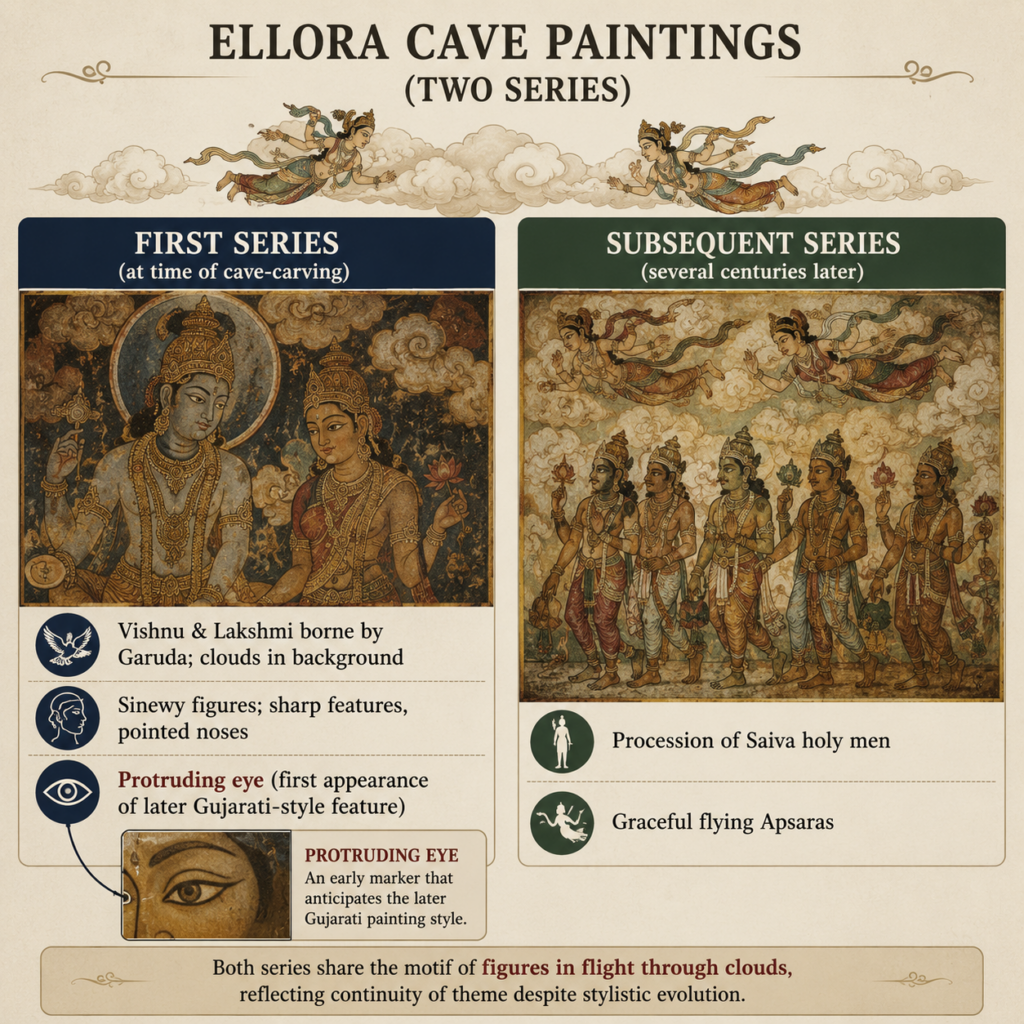
Two Series of Ellora Paintings
- The Ellora murals were executed in two distinct series:
- The first series, painted at the time the caves were carved.
- These earlier paintings depict Vishnu and Lakshmi borne through the clouds by Garuda, with clouds forming the background; the sinewy figures display sharp features and pointed noses, and the protruding eye — a feature later typical of the Gujarati style — appears here for the first time in Ellora.
- The subsequent series, painted several centuries later.
- Its principal composition depicts a procession of Saiva holy men, alongside gracefully rendered flying Apsaras.
- The first series, painted at the time the caves were carved.
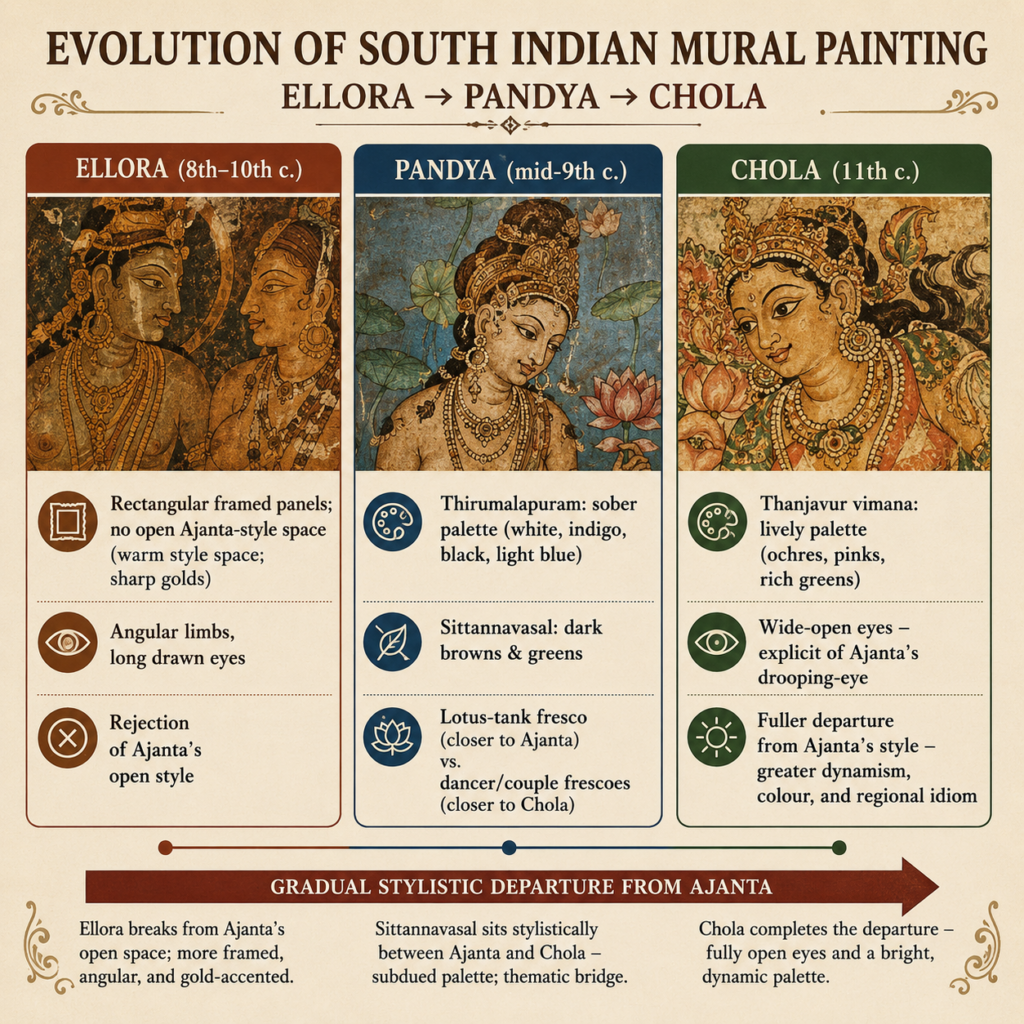
- The composition of Ellora paintings is consistently measured out within rectangular panels with thick borders — conceived, in effect, within the fixed limits of these framing borders. Consequently, the sense of open, boundless space characteristic of Ajanta does not exist at Ellora.
- Ellora painting thus represents a clear departure from the classical Ajanta norm, even though the classical tradition of modelling mass with a rounded, soft outline, and the illusion of forms coming forward from depth, is not altogether abandoned.
- The most important characteristic features of Ellora painting include:
- A sharp twist of the head.
- Painted angular bends of the arms.
- The concave curve of the closed limbs.
- A sharp, projected nose.
- Long, drawn-open eyes — a feature that can reasonably be considered the defining medieval character of Indian painting more broadly.
- The most important characteristic features of Ellora painting include:
- The flying figures from cave temple No. XXXII at Ellora, dating to the mid-ninth century AD, offer particularly beautiful examples of swift movement through clouds.
- Here, both the rounded plasticity of classical Ajanta-style modelling on the faces, and the angular bends of the arms characteristic of medieval tendencies, are clearly visible together — making this work perhaps a genuine product of the transitional period between the two styles.
(2) Painting during the Pandyas
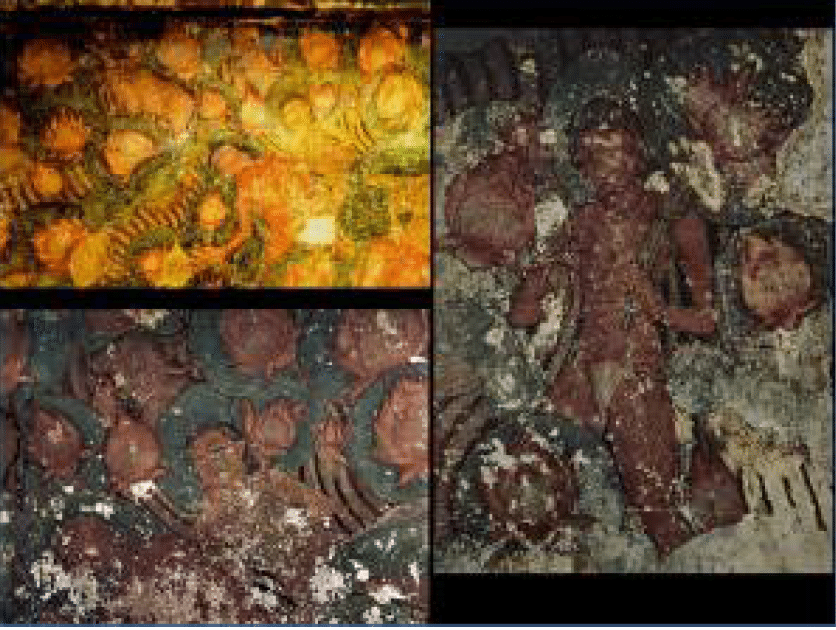
- Several mural paintings dating to the middle of the 9th century survive in temples excavated from rock at Thirumalapuram and Sittannavasal.
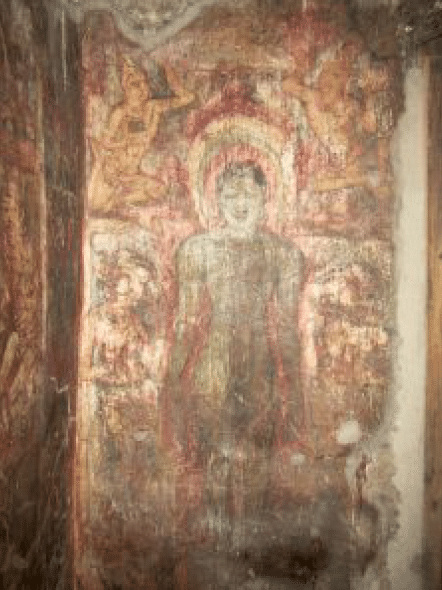
Painting in Jain Cave 32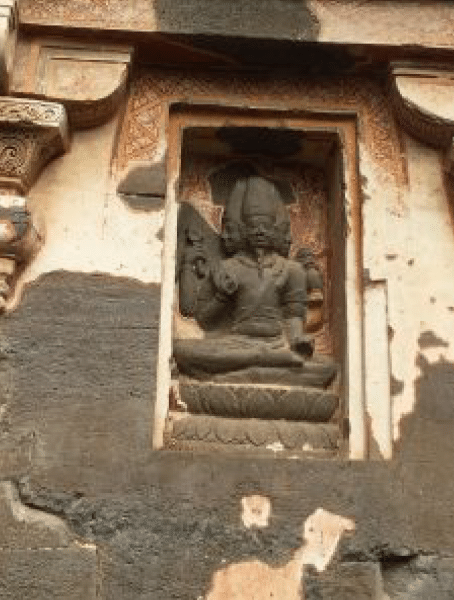
Brahma at Kailasha temple of Ellora, with painted decorations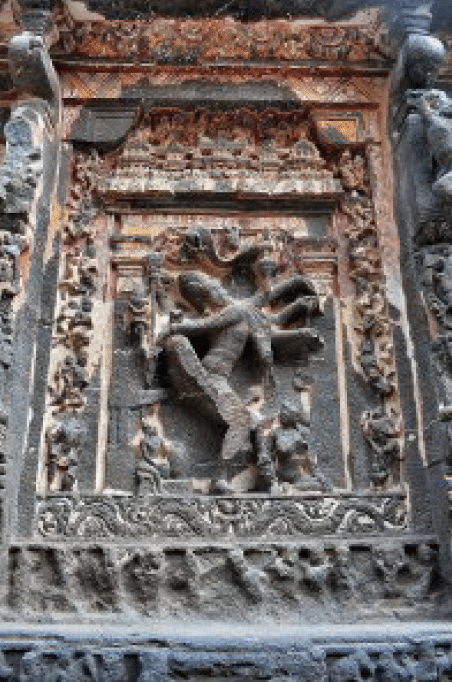
Cave 16 surviving plaster and painted artwork
Thirumalapuram Painting
- Traces of early Pandya painting can still be seen in the Thirumalapuram rock-cut caves.
- The roof contains representations of small secondary deities (gana) — one shown riding a mythical lion, others depicted amid lotus foliage, among which a duck is rendered in a strikingly naturalistic manner.
- These works unfold with genuine confidence, using a sober range of colours: white, indigo, black, and light blue.
- A column capital also depicts a group of bearded characters (possibly hunters) in the company of girls, a drum player, and several dynamic gana dancers.
- The roof contains representations of small secondary deities (gana) — one shown riding a mythical lion, others depicted amid lotus foliage, among which a duck is rendered in a strikingly naturalistic manner.
Sittannavasal Painting
- Though severely damaged, the surviving frescoes at Sittannavasal have been preserved on the upper portions of columns and ceilings inside the cave temple.
- Fragments survive in the Jain cavern of Sittannavasal, where two superimposed layers of frescoes were discovered, along with an inscription dated to around 850 AD.
- Pandyan-style frescoes from around 850 AD are located on the ceiling, walls, and columns of the veranda.
- One depicts a couple with abundantly jewelled busts; a second depicts two female dancers; and a third presents a rather enigmatic composition — a stylised lotus tank, inside which three men are shown holding flowers, alongside fishes, birds, and several quadrupeds, including elephants.
- This last lotus-tank fresco is painted in a style closely related to the Ajanta frescoes, sharing several specific peculiarities: the attitudes and simplicity of the characters, the purity of line, and the use of more sustained colours to suggest modelling.
- By contrast, the two other compositions — the female dancers and the couple — are more closely related to Chola painting, and are therefore likely to be more recent than the lotus-tank fresco.
- One depicts a couple with abundantly jewelled busts; a second depicts two female dancers; and a third presents a rather enigmatic composition — a stylised lotus tank, inside which three men are shown holding flowers, alongside fishes, birds, and several quadrupeds, including elephants.
- The most central and important fresco in this rock-cut cave depicts a pond filled with lotuses (Lotus Tank), painted on the ceilings of both the sanctum and the ardha-mandapam of the cave.
- The scene depicts a lotus tank populated with naturalistic images of monks, animals, flowers, swans, and fishes.
- This scene specifically refers to the Samava-sarvana, an important episode in Jain religion — an audience hall in which Tirthankaras deliver sermons after attaining realisation (kevala-gnana), attended by bulls, elephants, apsaras, and gods, all gathered to witness the scene.
- The paintings employ fresco-secco techniques, with colours composed from mineral sources: white from lime, black from wood charcoal, yellow from yellow ochre, red from red ochre, blue from ultramarine/lapis lazuli, and green from terre verte.
- Compared to the classical cave-painting style of Ajanta, these decorative paintings show only minor variations in material use, and are reported to provide a genuine stylistic link between the Ajanta paintings (4th–6th century AD) and the Chola paintings of the eleventh century at Thanjavur.
- Pillars at the site carry figures of the Pandya king Srimara Srivallabha (9th century AD) and his queen, shown offering reverence to Ilam Gautaman, the acharya of Madura credited with creating these paintings.
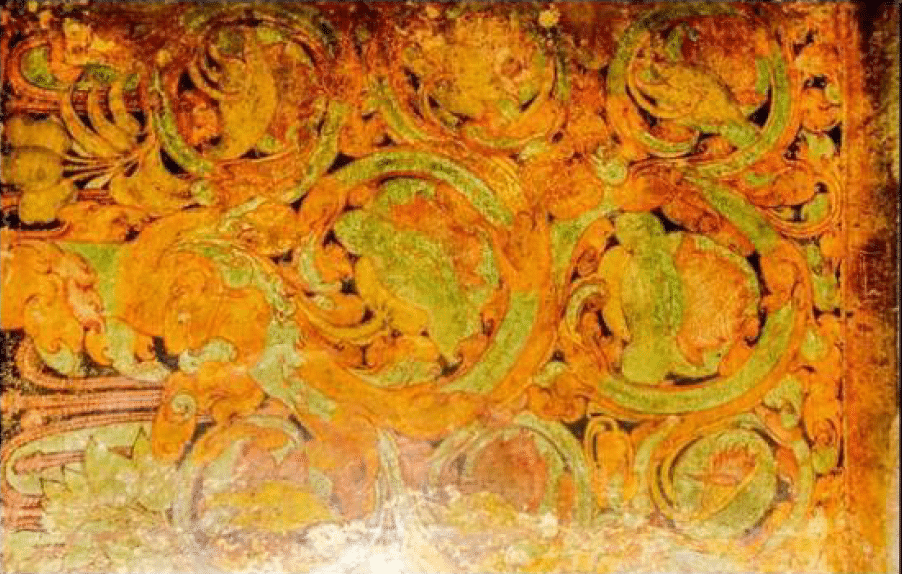
An intricate floral pattern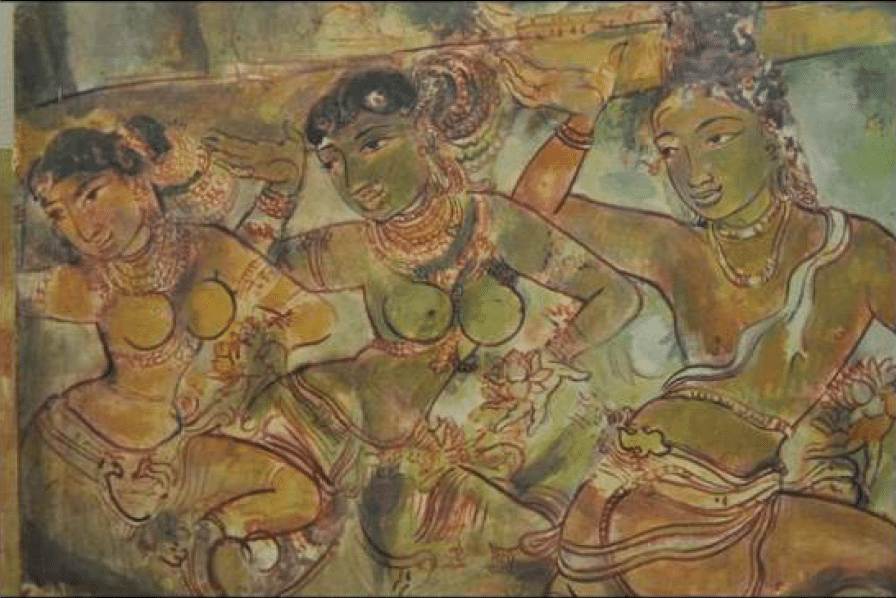
Women and man dancing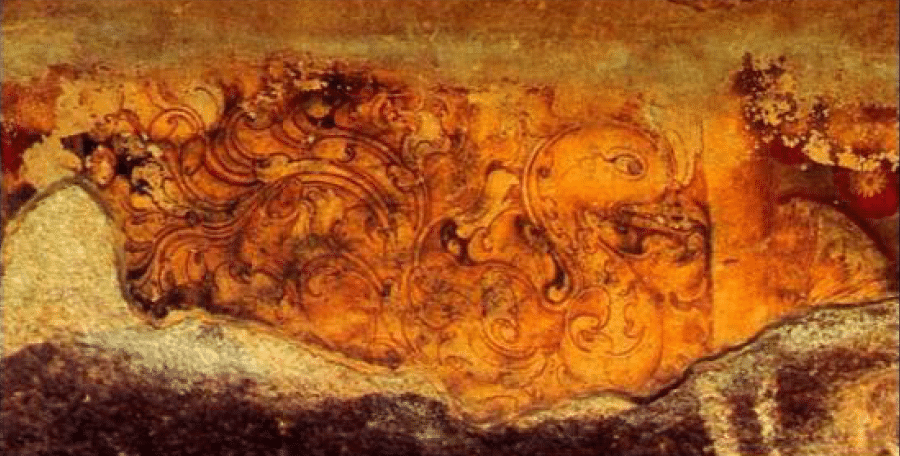
An stylized duck.
(3) Paintings of the Cholas
- Chola paintings have been found on the walls of the Narthamalai, Malayadipatti, and Tanjore (Thanjavur) temples.
- While inspired by Ajanta, Chola painting belongs to a distinct regional idiom; qualitatively, however, it is generally regarded as less significant than its Ajanta antecedent.
- Chola paintings closely follow the sculptural art of their period in conception, though rendered in a two-dimensional form — with both sculpture and painting alike remarkably dynamic and aesthetically pleasing.
- The paintings exhibit a fine fresco technique, and the wide-open eyes of all figures stand as a clear rejection of the Ajanta tradition of half-closed, drooping eyes.
- The vimana of Thanjavur houses the most important surviving frescoes of the eleventh century AD.
- These develop mainly along the western wall of the pradakshina patha.
- One notable scene shows a guru meditating under a banyan tree, attending the dance of celestial female dancers (apsaras), while a highly dynamic divine orchestra paces their steps — the figures throughout are full of movement and throb with genuine vitality.
- Additional scenes include gana figures and musicians playing the drum and other instruments, a gentleman figure, and Shaiva scenes such as the wedding of Shiva Tripurantaka on a chariot driven by Brahma, surrounded by four deities.
- In terms of colour, the rather dark palette of Sittannavasal (dominated by dark browns and greens) contrasts sharply with the lively palette of Thanjavur, rich in warm ochres, pinks, and “golds” that accentuate the rhythm of its figures.
- Across early medieval South India, religious themes predominate the visual arts, and all three art forms — architecture, sculpture, and painting — were consciously brought together within the temple as a unified whole.
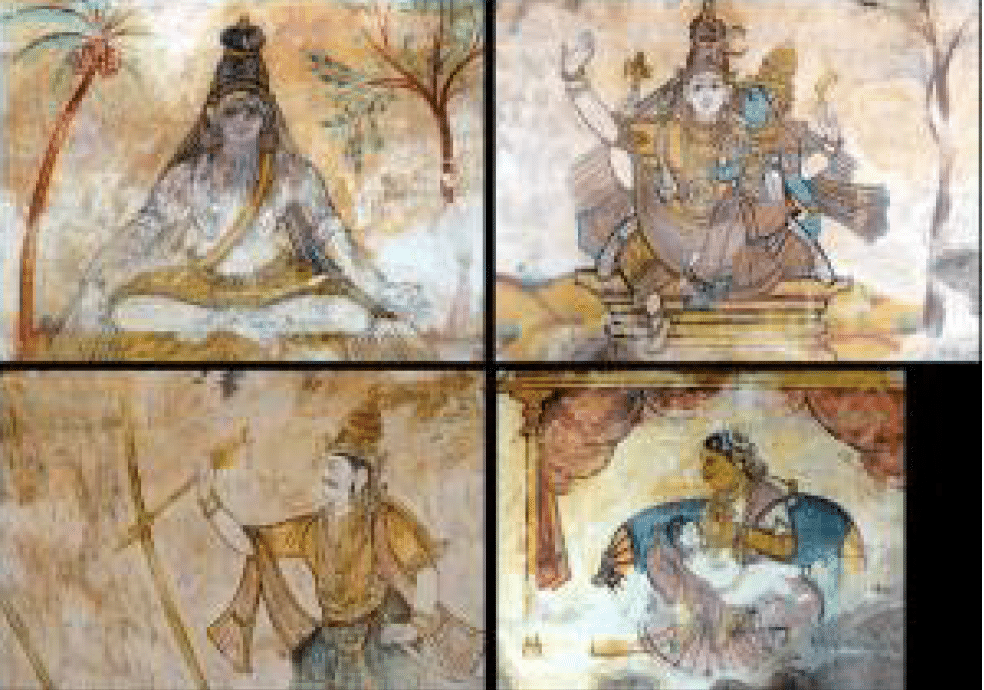
Mural paintings at the Brihadishvara Temple in Thanjavur.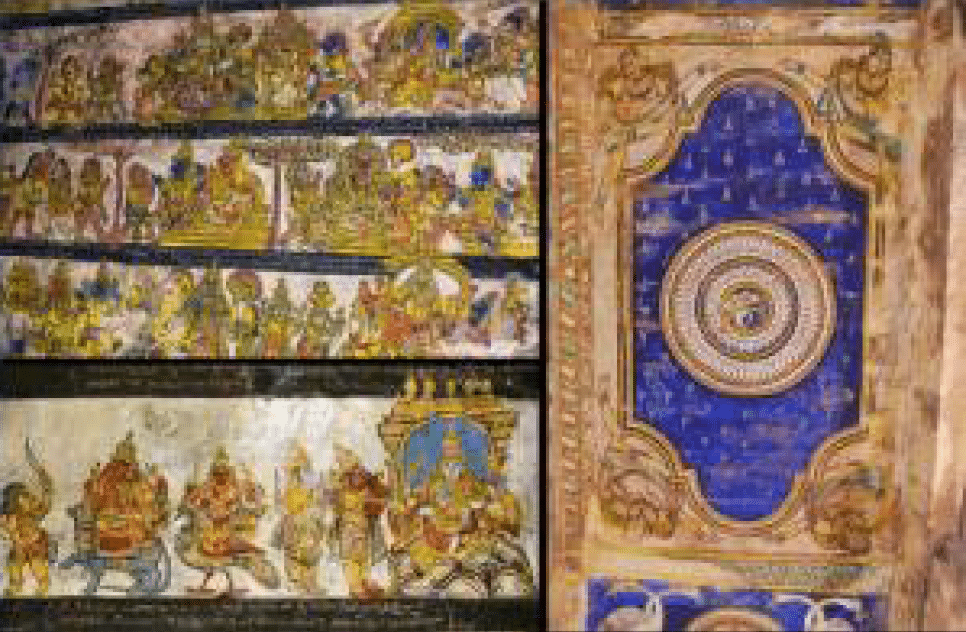
Mural paintings at the Brihadishvara Temple in Thanjavur. These Chola frescoes are located on the sanctum walls along
the circumambulatory pathway and cover floor to ceiling. They mostly narrate Hindu mythology, as well as scenes of
Chola royalty, courtly and common life.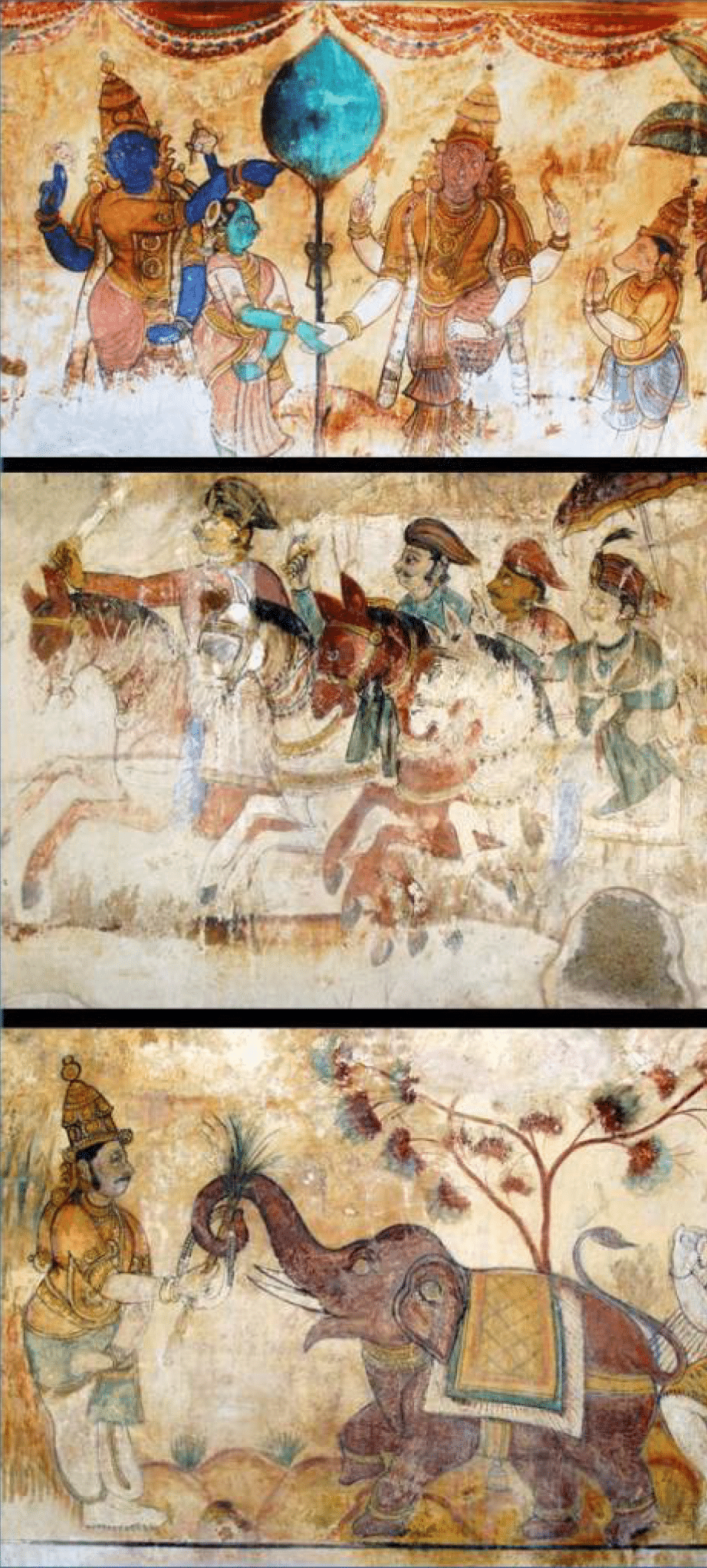
Mural paintings at the Brihadishvara Temple in Thanjavur.
(B) Miniature Painting
- From the 11th century AD onward, a new mode of pictorial expression emerged — miniature painting on palm leaves and paper, a technique that was likely both easier and more economical than mural work.
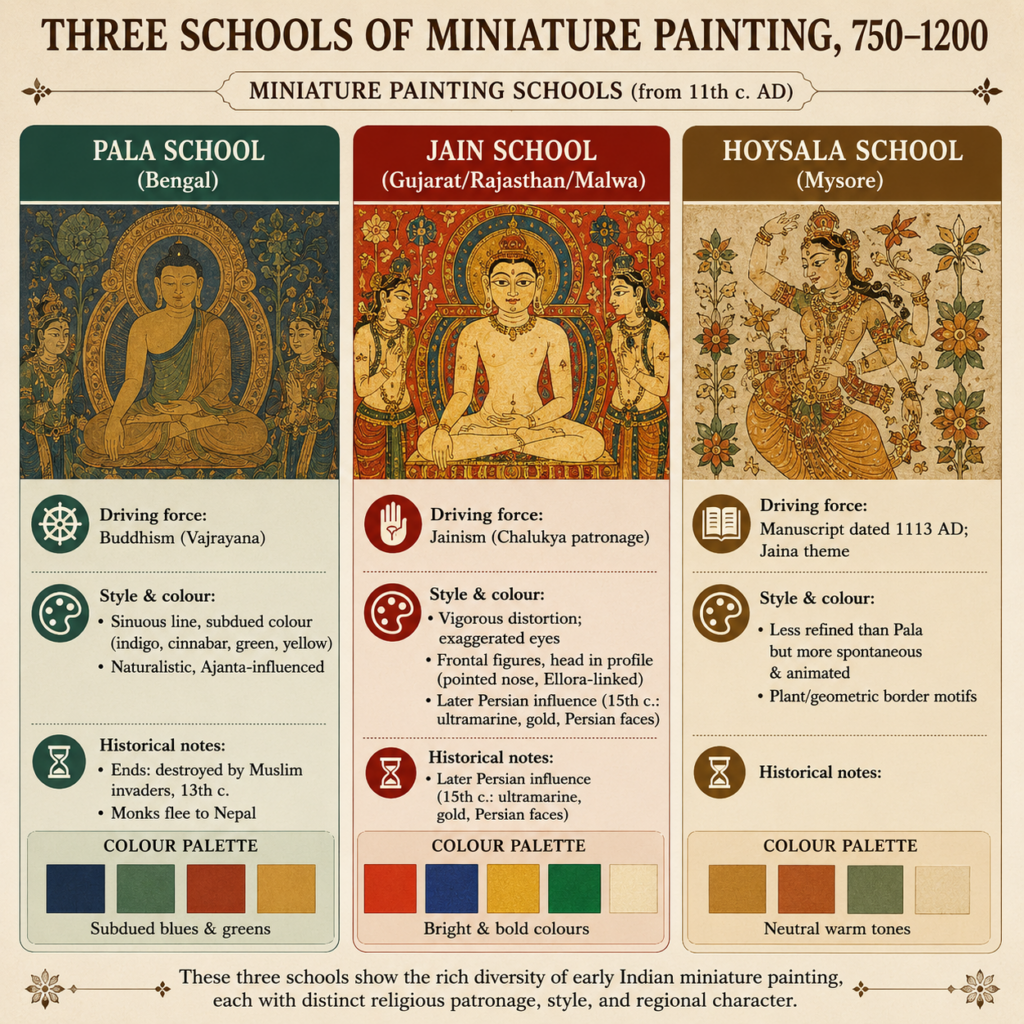
- Manuscript illustration during this medieval period was concentrated mainly across three regions:
- Bengal (under Pala and Sena rule).
- Gujarat, to the west.
- Mysore, to the south.
- In these and other regions alike, manuscripts were typically made of palm leaves, whose physical dimensions imposed a characteristic long, narrow format (generally around 55 × 6 cm). Even after paper was adopted toward the end of the 14th century, this inherited format was barely modified.
(1) Pala School (Bengal School) of Painting
- The earliest surviving examples of miniature painting in India take the form of illustrations to Buddhist religious texts, executed under the Palas of eastern India, alongside Jain texts illustrated in western India, both dating to the 11th–12th centuries AD.
- The Pala period (750 AD to the middle of the 12th century) witnessed the last great phase of both Buddhism and Buddhist art in India.
- The great Buddhist monasteries (mahaviharas) of Nalanda, Odantapuri, Vikramsila, and Somarupa served as major centres of Buddhist learning and art.
- A large number of palm-leaf manuscripts relating to Buddhist themes were written and illustrated with images of Buddhist deities at these centres, which also maintained workshops for casting bronze images.
- Students and pilgrims from across Southeast Asia gathered at these centres for education and religious instruction.
- On returning home, they carried examples of Pala Buddhist art — in the form of bronzes and manuscripts — helping to spread the Pala style to Nepal, Tibet, Burma, Sri Lanka, and Java, among other regions.
- The surviving examples of Pala illustrated manuscripts belong predominantly to the Vajrayana school of Buddhism.
- Pala painting is characterised by:
- A sinuous line and subdued tones of colour.
- A limited palette — indigo, cinnabar, green, and yellow — skilfully arranged to achieve a relief effect.
- A naturalistic style, echoing the ideal forms of contemporary bronze and stone sculpture, and reflecting something of the classical art of Ajanta.
- A strongly traditionalistic approach, illustrating iconographic themes with genuine finesse of line and close attention to detail.
- A fine example of a typical Buddhist palm-leaf manuscript in the Pala style survives in the Library of Oxford, England.
- It is a manuscript of the Astasahasrika Prajnaparamita (“the Perfection of Wisdom in Eight Thousand Lines”).
- It was executed at the Nalanda monastery, in the fifteenth year of the reign of the Pala king Ramapala, during the last quarter of the eleventh century.
- The manuscript carries illustrations across six pages, as well as on the insides of both wooden covers.
- Pala art came to a sudden end following the destruction of the Buddhist monasteries at the hands of Muslim invaders in the first half of the 13th century.
- Some monks and artists escaped, fleeing to Nepal, where they helped reinforce existing local art traditions.
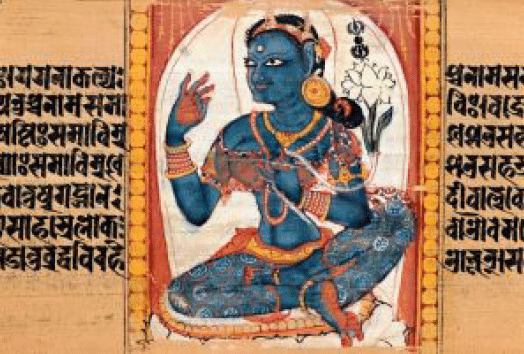
Astasahasrika Prajnaparamita Sutra, an illuminated manuscript on Pattra (dried palm leaf) from the Pala era, late
11th century.
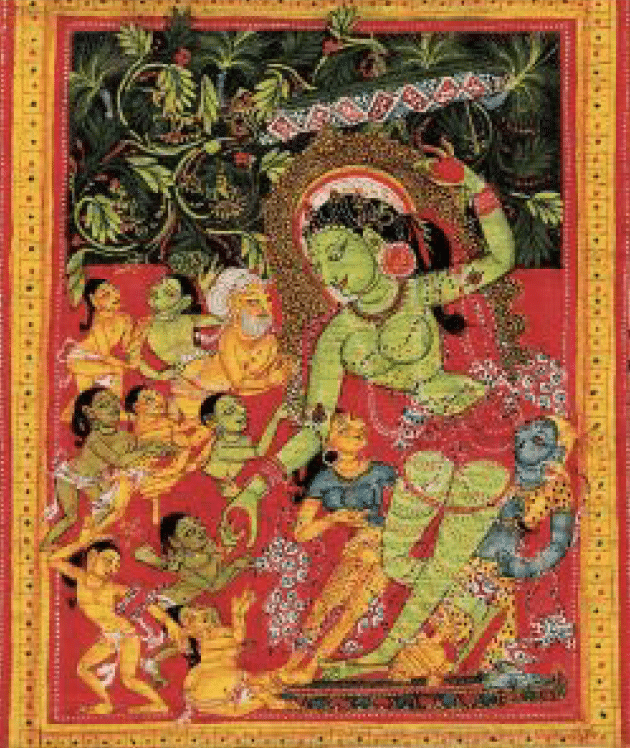
A palm leaf folio of a medieval manuscript from Bengal representing a Green Tara (female Buddha).
(2) Jain School of Paintings
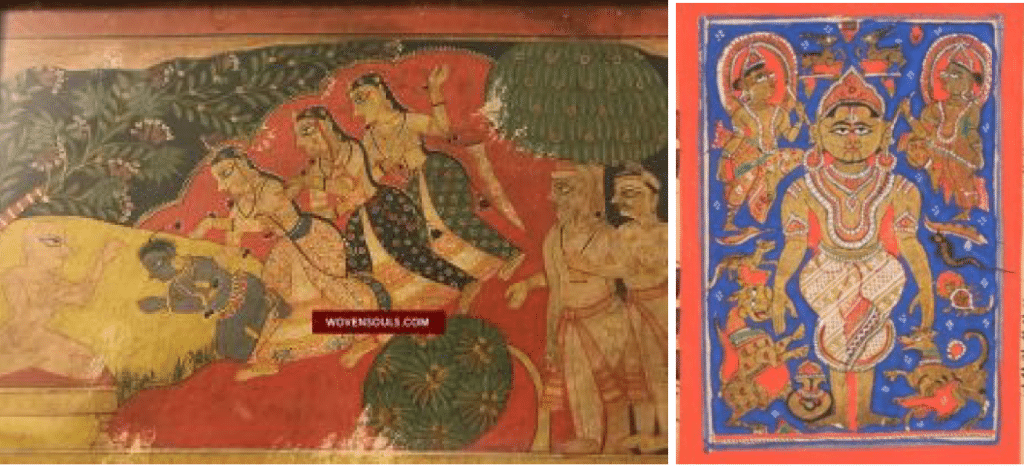
- The Western Indian style of painting, also known as Jaina painting, represents a highly conservative style of Indian miniature painting, prevailing across the region comprising Gujarat, Rajasthan, and Malwa.
- The Gujarat school of the 12th–14th centuries developed within a distinctly Jaina environment, evidencing a remarkable unity of style — offering a very particular stylisation of both characters and compositional elements, with faces rendered in three-quarter view and unusually prominent eyes.
- The primary motivating force behind artistic activity in Western India was Jainism, much as Buddhism had driven the art of Ajanta and the Pala tradition.
- Jainism enjoyed patronage from the Chalukya dynasty, which ruled Gujarat and parts of Rajasthan and Malwa from 961 AD to the end of the 13th century.
- An enormous number of Jain religious manuscripts were commissioned between the 12th and 16th centuries by princes, their ministers, and wealthy Jain merchants, largely as a means of earning religious merit.
- Jainism enjoyed patronage from the Chalukya dynasty, which ruled Gujarat and parts of Rajasthan and Malwa from 961 AD to the end of the 13th century.
- The illustrations on these manuscripts follow a style of vigorous distortion:
- Certain physical traits — eyes, breasts, hips — are deliberately exaggerated.
- Figures appear flat, with angular features, and the further eye is shown protruding into space — an art marked by primitive vitality, vigorous line, and forceful colours.
- The school as a whole is characterised by simple, bright colours, highly conventionalised figures, and wiry, angular drawing — the naturalism typical of earlier Indian wall painting is entirely absent.
- Figures are generally shown from a frontal view, with the head rendered in profile. The characteristic pointed-nose facial type relates directly to that seen in the Ellora wall paintings (mid-8th century), and remains remarkably close to contemporary medieval sculpture.
- Western Indian painting exerted considerable influence on the later development of painting across India, particularly on the Rajasthani schools of western and central India.
- From roughly 1100 to 1400 AD, palm leaf remained the primary manuscript medium, with paper introduced only later. Two especially popular Jain texts — the Kalpasutra and the Kalakacharya-Katha — were repeatedly written and illustrated with paintings across this period.
- During the 15th century, the Persian style of painting began influencing Jaina painting — evident in the appearance of Persian facial types and hunting scenes along the borders of some illustrated Kalpasutra manuscripts.
- The introduction of ultramarine blue and gold colour into Western Indian manuscripts is likewise believed to reflect the influence of Persian painting.
- During the 15th century, the Persian style of painting began influencing Jaina painting — evident in the appearance of Persian facial types and hunting scenes along the borders of some illustrated Kalpasutra manuscripts.
(3) Hoysala Painting
- In Mysore, under the Hoysalas (11th–13th centuries), a surviving manuscript made on palm leaf illustrates a Jaina theme, and is dated to 1113 AD.
- Its style is somewhat less refined than that of the Pala miniatures, but is correspondingly more spontaneous and animated.
- The illustrations are bordered by decorative plant or geometric motifs, which serve to separate the imagery from the accompanying text.
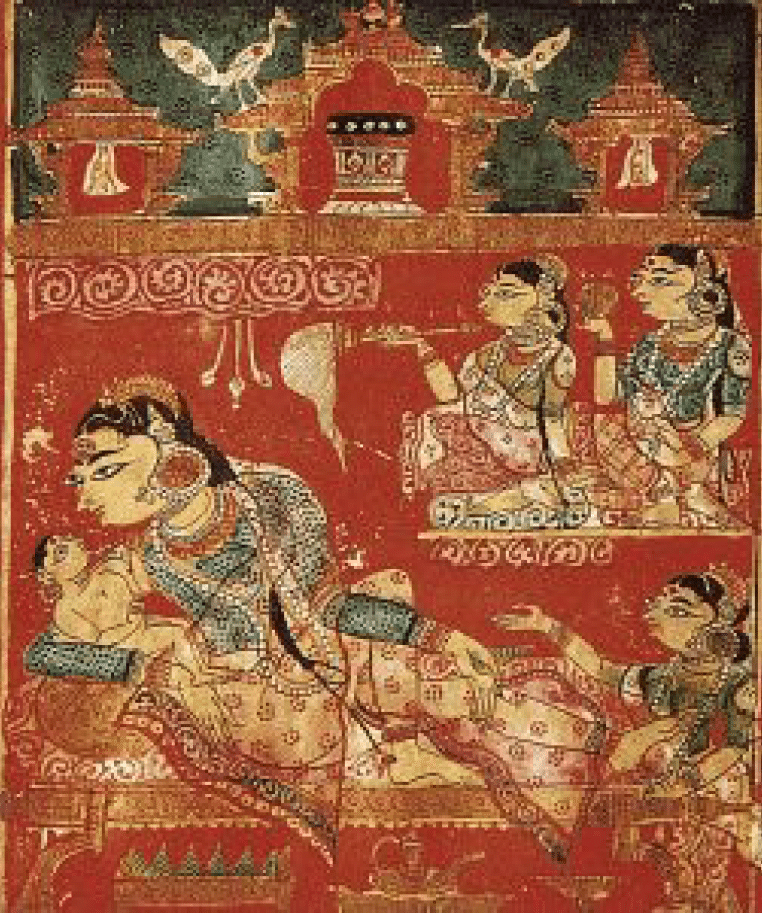
Detail of a Pattra leaf manuscript representing the birth of Mahavira, a spiritual teacher in Jainism (Kalpasutra Manuscript,
ca. 1375–1400).
Conclusion
- Painting as a cultural tradition in India (750–1200) unfolded along two closely related tracks — the mural tradition, tracing a clear stylistic arc from Ellora’s departure from Ajanta, through the Pandya-era frescoes of Thirumalapuram and Sittannavasal, to the vivid, dynamic temple paintings of the Cholas at Thanjavur; and the miniature tradition, in which the Pala, Jain, and Hoysala schools each translated religious devotion — Buddhist, Jain, and again Jain respectively — into a distinctive regional visual language on palm leaf and paper.
- Across both traditions, religious patronage — royal, mercantile, and monastic alike — remained the central driving force, and painting continued to develop in close dialogue with contemporary sculpture and architecture, together forming the unified artistic character of the early medieval Indian temple.




