

Moore, Russell and Early Wittgenstein: Defence of Commonsense; Refutation of Idealism; Logical Atomism; Logical Constructions; Incomplete Symbols; Picture Theory of Meaning; Saying and Showing.
Official Syllabus: Paper I, Section A, Unit 6
Moore’s Refutation of Idealism (1903) is the paper that broke the hold of idealism on British philosophy. Idealism holds that reality is mental or spiritual — that nothing exists except as experienced by some mind. Moore did not try to prove that reality is not spiritual. Instead, he attacked one premise that, he argued, every idealist argument depends on: Berkeley’s principle esse est percipi — “to be is to be perceived“. Moore showed that this principle rests on a simple but fatal confusion between the act of consciousness and its object — between my awareness of blue and the blue itself. Once the two are distinguished, there is no reason to think that whatever exists must be experienced, and the way is open for realism: the view that things exist independently of being known.
In simple words
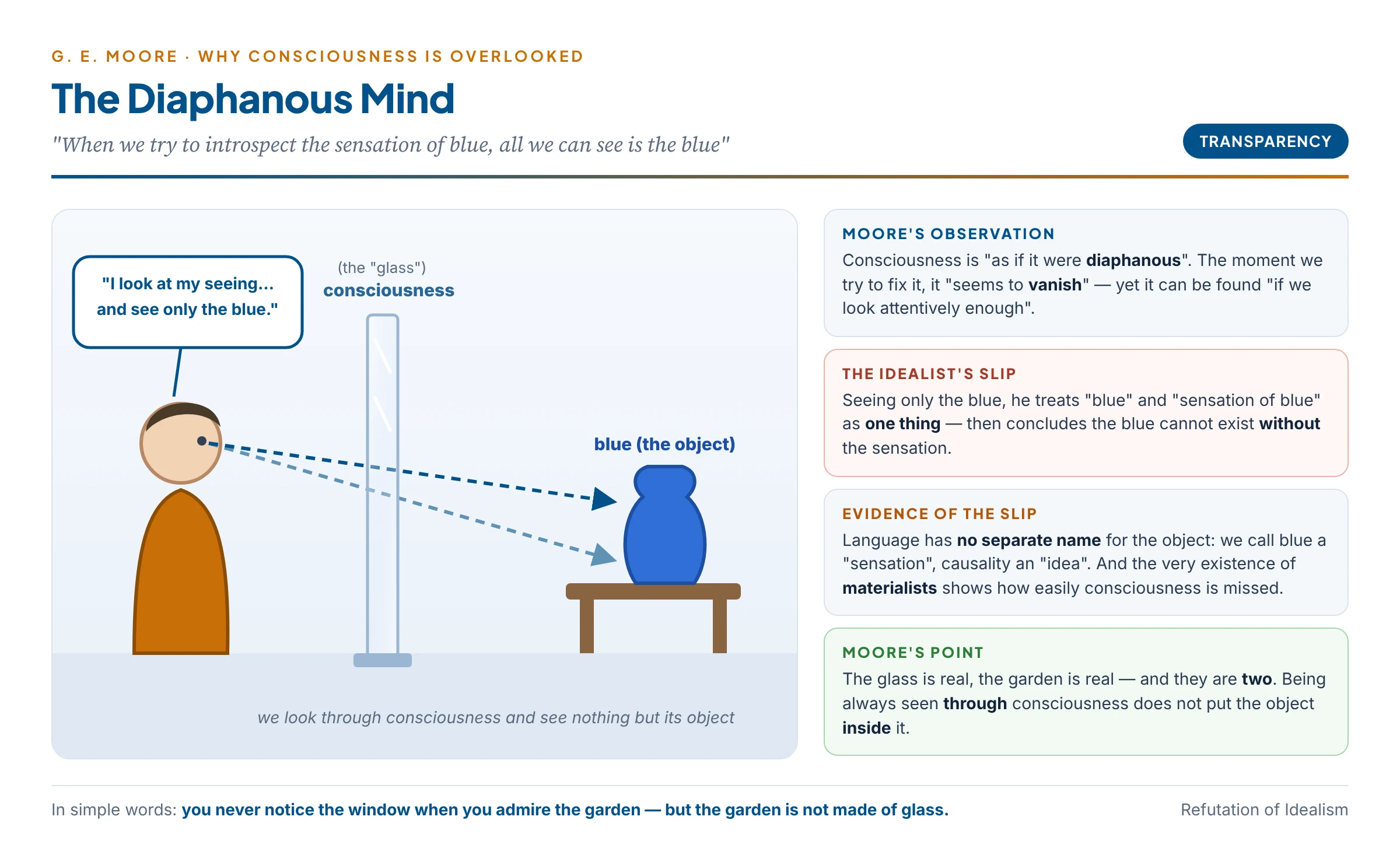
Look at a garden through a clean glass window. You see flowers, trees and sky — you hardly notice the glass at all. Yet nobody concludes that the flowers are made of glass, or that they would vanish if the window were removed. Moore says consciousness is like that glass: transparent, so that we “see through” it to its object. The idealist’s mistake is to think that because we always see the garden through the glass, the garden must be part of the glass.
Context & Problem
What Idealism Claims
- Idealism defined. Idealism is the doctrine that reality is fundamentally dependent on mind or consciousness. Material objects do not exist independently of experience; their being is inseparable from being perceived or known. The external world is not self-subsisting but is constituted, structured or sustained by mental activity.
- Its stronger form. In its stronger forms (Hegel, Bradley, McTaggart), idealism holds that reality is ultimately spiritual, rational and unified — one Absolute Mind.
- What “reality is spiritual” means. Moore points out two features of the idealist conclusion:
- The universe is very different from what it seems. Chairs, tables and mountains seem lifeless and unconscious; the idealist says they are, in some sense, far more like us than we think.
- The universe has many properties it does not seem to have — it is not only in some sense conscious but intelligent, purposeful, not mechanical: it possesses the “higher” qualities that we value in ourselves.
- Moore’s surprising modesty. Moore says he does not claim to show that reality is not spiritual: “Reality may be spiritual, for all I know; and I devoutly hope it is.” A theologian who simply believes the universe is spiritual is not thereby an idealist. Moore attacks only the arguments that idealists use — and claims that these arguments give no reason whatever for their conclusion.
Moore’s Strategy: Break the Common Link
- The chain of argument. Suppose an argument runs: “Since A is B, and B is C, and C is D, therefore A is D.” Even if “B is C” and “C is D” are perfectly true, if “A is B” is false we have no more reason to assert “A is D” than if all three were false. The conclusion may still happen to be true — but so far as this argument goes, it is “the barest supposition“.
- The weak link. For idealism, the first link “A is B” is esse est percipi, and the final conclusion “A is D” is “reality is spiritual“. Moore claims that every argument ever used by idealists depends, directly or indirectly, on this premise. If it falls, the citadel of idealism falls.
- Why this premise is essential. If esse est percipi, then whatever is, is experienced, and so in a sense whatever is, is mental. The idealist then needs further steps:
- From “to be is to be perceived” (esse est percipi) to “to be is to perceive” (esse est percipere) — that reality is itself experiencing, i.e. mind.
- From “reality is mind” to “reality has the higher qualities we call spiritual”.
- Typical idealist inferences that depend on the premise:
- “Whatever is, is experienced; some things are not experienced by me; so they must belong to some other experience” (finally, an Absolute Experience).
- “An object necessarily implies a subject; the whole world is an object; so it must belong to some subject.”
- “Thought enters into the essence of all reality; so behind it there must be a spirit akin to ours” — “spirit greets spirit” in its object.
- “Percipi” taken widely. Moore is fair to the idealists: by percipi he understands not only sensation but also thought — whatever is common to all forms of experiencing. (He even credits the idealist school for insisting, against sensationalism and empiricism, on the distinction between sensation and thought.) The question is simply: must whatever exists be experienced?
- A clear idealist statement. Moore quotes a contemporary idealist, A. E. Taylor: what makes any fact real “can be nothing but its presence as an inseparable aspect of a sentient experience“. Moore undertakes to show that what makes a thing real cannot possibly be this.
- “Quite uninteresting.” Moore ironically calls his subject “quite uninteresting” and “trivial” — yet if he is right, the most striking results of sensationalism, agnosticism and idealism alike have “no more foundation than the supposition that a chimera lives in the moon“.
- Three methods. Moore attacks esse est percipi by (1) conceptual/logical analysis of its possible meanings, (2) analysis of consciousness into act and object, and (3) the appeal to common sense.
Core Doctrine
1. The Analytical Method: What Could “Esse est Percipi” Mean?
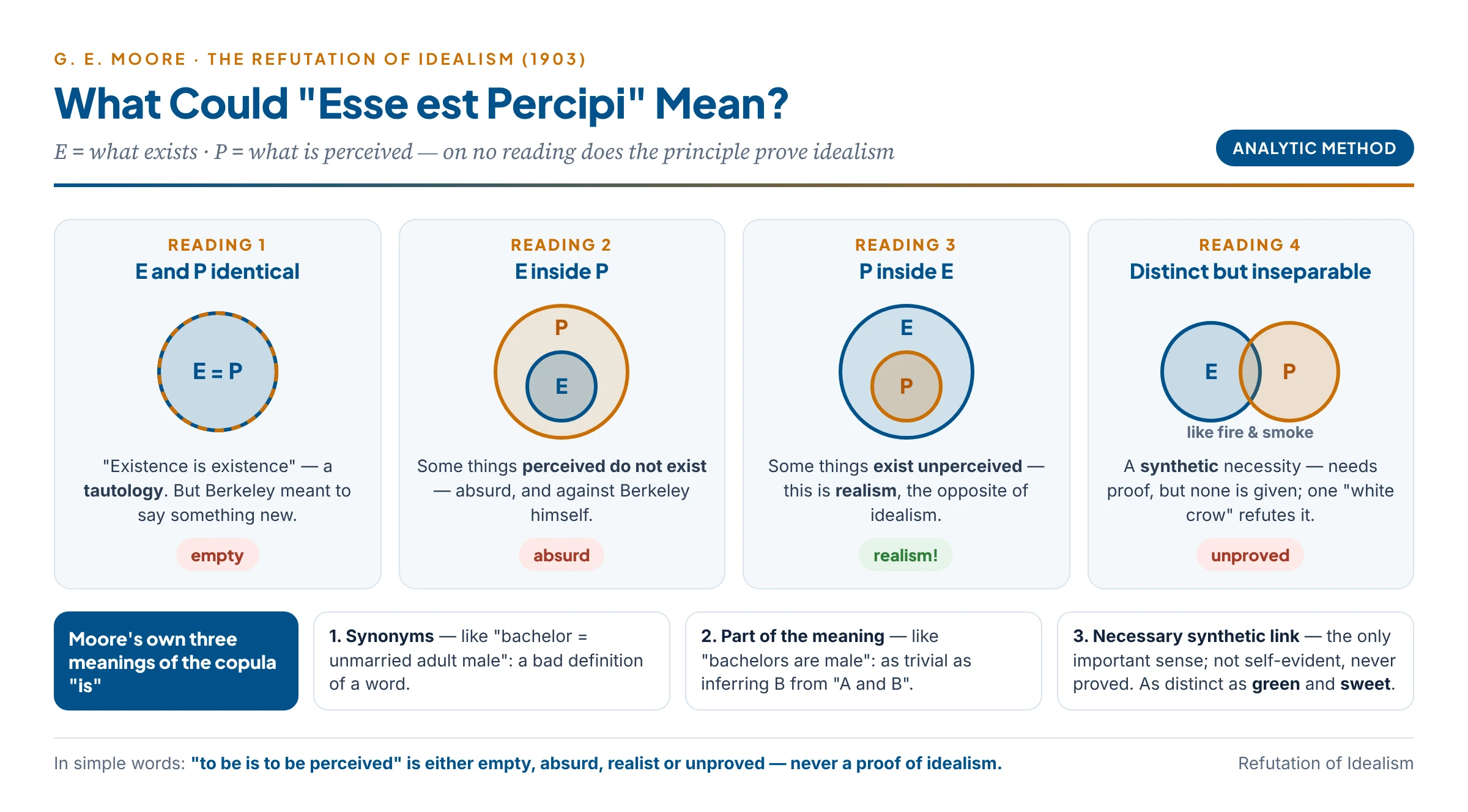
Moore’s method is to take a doubtful statement, list its alternative meanings, and examine each in turn. The key word is the little copula “is” (est). It can mean identity, partial identity, or a necessary connection.
- Synonymy (complete identity). “Esse” and “percipi” mean exactly the same — like “bachelor” and “unmarried adult male“. Then esse est percipi is a mere definition of a word — and a bad one; it says no more than “existence is existence” or “being perceived is being perceived”. A tautology gives no information about reality. Yet Berkeley clearly meant to say something new.
- Analytic containment (partial identity). “Percipi” is part, but not the whole, of what “esse” means — like “bachelors are male“. Then to say a thing is real is to say it is experienced and something more (call this further element x). From “real” we could infer “experienced”; but this would be as trivial as inferring “B” from “A and B”. It becomes important only if the other element x cannot occur without percipi.
- Necessary synthetic connection. “Esse” (the element x) and “percipi” are two distinct things that are necessarily connected: whatever has x must also be experienced. This is the only meaning in which the principle is both true (if it is true) and important. But now it is a synthetic proposition — it adds to our knowledge — and it needs proof. The idealists offer none. Moore admits he cannot strictly refute it; he simply says that, once you see how distinct esse and percipi are — as distinct as “green” and “sweet” — nobody would believe that “whatever is, is experienced” any more than that “whatever is green is sweet”.
- The inference reading. Some notes state the third meaning as inference: existence is inferred from perception, as fire from smoke. Fire and smoke are distinct but related. But such a proposition is synthetic, and synthetic propositions are never self-evidently necessary — they are sometimes true, sometimes false, like “all crows are black“, which one white crow would falsify. A single case of something that exists unperceived would overthrow the idealist position.
- The dilemma. If esse est percipi is analytic, it says nothing about any state of affairs and proves nothing about reality. If it is synthetic, it is not self-evident and must be proved — and it has not been. It cannot be both analytic and synthetic.
| Reading of “esse est percipi” | Example of the same form | What follows |
|---|---|---|
| Synonymy (identity) | Bachelor = unmarried adult male | Tautology — “existence is existence”; no news about reality |
| Part of the meaning (partial identity) | Bachelors are male | Trivial — like inferring B from “A and B” |
| Necessary synthetic link | Whatever is green is sweet (?) | Important if true, but not self-evident and never proved |
| Inference (popular version) | Where there is smoke there is fire | Synthetic, contingent; one exception (“white crow”) refutes it |
In simple words
Suppose someone says “to be a mango is to be sweet“. If he means the two words mean the same, he has told you nothing about mangoes. If he means sweetness is part of what “mango” means, he has only defined a word. If he means that every mango, as a matter of fact, must be sweet — then he must show it, and one sour mango proves him wrong. Moore treats “to be is to be perceived” in exactly this way.
2. A Fuller Logical Map of the Options
A popular way of presenting Moore’s analysis draws the relation between E (things that exist) and P (things perceived) as circles, in the manner of Venn diagrams.
- E and P identical — the two circles coincide. Then the statement is a tautology. But Berkeley claims to tell us something new.
- E inside P (esse is part of percipi) — then some percipi is not esse: something is perceived that does not exist. This is absurd and contrary to Berkeley’s own view.
- P inside E (percipi is part of esse) — then some esse is not percipi: something exists without being perceived. This is exactly what Berkeley denies — it is realism.
- E and P distinct but inseparable (like fire and smoke) — then the statement would be a necessary truth needing no proof; yet Berkeley offers proofs for it, showing he does not treat it as self-evident.
- Result. On no reading does esse est percipi establish idealism: it is either empty, absurd, realist, or unproved.
Common confusion
Did Moore claim to have proved that reality is not spiritual, or that idealism is false? No. Moore explicitly says that nothing in his paper has “the smallest tendency to prove that reality is not spiritual”. His claim is narrower and logically sharper: the idealists’ arguments depend on esse est percipi, and that premise is unsupported — so their conclusion is, as far as these arguments go, “a pleasant supposition”. Many notes overstate the paper as a disproof of idealism.
3. Why Idealists Thought the Principle Was Self-Evident
- The analytic–synthetic confusion. Before Kant, many philosophers held that necessary truths — especially those whose opposite is “inconceivable” — are analytic, provable by the law of contradiction alone. Modern idealists say that truths are “both analytic and synthetic“. But if “analytic” means “provable by the law of contradiction alone” and “synthetic” means “not so provable”, no truth can be both.
- Moore’s diagnosis. The idealist treats “the object of experience is inconceivable apart from the subject” as if denying it were self-contradictory. Why? Because he fails to see that subject and object are two at all.
- The yellow example. When the idealist thinks of “yellow” and of “the sensation of yellow“, he fails to see anything in the second that is not in the first. Then “yellow cannot exist apart from the sensation of yellow” reduces to “yellow cannot be other than yellow” — a purely identical, analytic truth.
- The hidden contradiction. But the idealist also holds that experience is something distinct from yellow — otherwise there would be no point in calling yellow a “sensation”. So his position both affirms and denies that yellow and the sensation of yellow are distinct. This is what refutes it.
- An antinomy. The idealist holds two propositions that cannot both be true:
- “Experience is something unique and different from anything else.”
- “Experience of green is entirely indistinguishable from green.“
- Arguing both ways. The idealist argues from the first proposition in some contexts and from the second in others.
4. The Doctrine of “Organic Unities” Criticised
- The idealist escape route. Many idealists admit that green and the sensation of green are distinct — but add that they form an “organic unity“: each would not be what it is apart from its relation to the other, so to consider either alone is an “illegitimate abstraction“.
- Moore’s reply. An abstraction is illegitimate only when we assert of a part what is true only of the whole. But the idealist uses the principle to say that whatever we assert of a part can only be true of the whole. This is necessarily false: if the whole can always be substituted for the part, the whole must be identical with the part.
- “Distinct but inseparable” = distinct and not distinct. So when we are told that green and the sensation of green are “certainly distinct but not separable”, we are being told that although they are two, we must treat them as if they were one. The principle of organic unities is used “to defend the practice of holding both of two contradictory propositions“.
- Moore’s jibe at Hegel. Hegel’s main service to philosophy, Moore says, was to give a name to, and erect into a principle, a type of fallacy to which philosophers had always been addicted.
5. The Analysis of Sensation: Consciousness and Its Object
This is the heart of the paper — and the source of two recent UPSC questions.
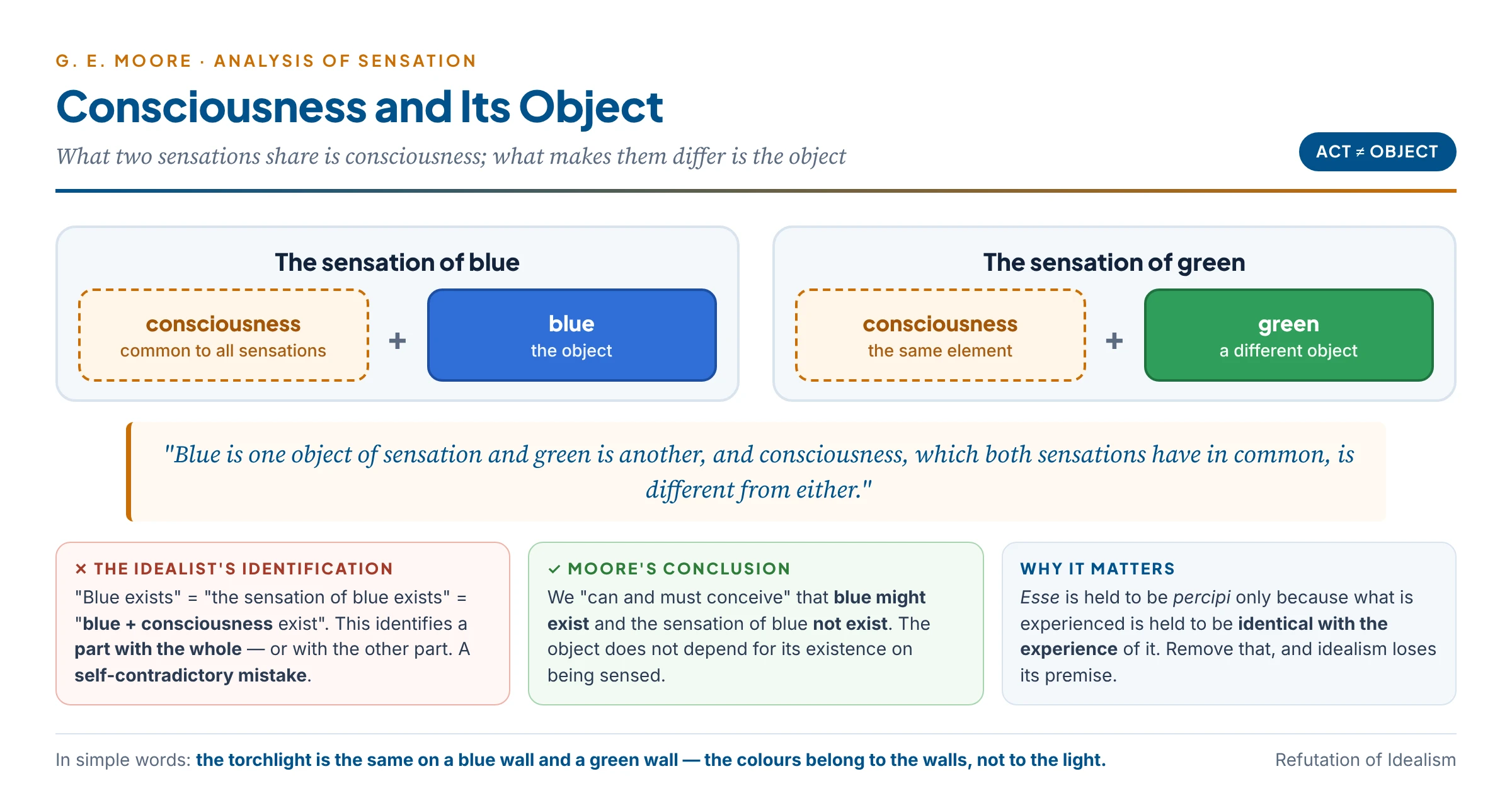
- What do two sensations share? The sensation of blue differs from the sensation of green. But since both are sensations, they must also have something in common. Moore calls this common element “consciousness“, and the element in which they differ the “object“.
- Moore’s key sentence: “Blue is one object of sensation and green is another, and consciousness, which both sensations have in common, is different from either.“
- So every sensation has two distinct elements:
- Consciousness — that in respect of which all sensations are alike, which makes them mental facts.
- The object — that in respect of which one sensation differs from another (blue, green, sweet).
- What exists when the sensation exists? When “the sensation of blue exists”, is it the consciousness that exists, or the blue, or both? These three alternatives are all different. And consciousness certainly exists (that is what makes it a sensation). So either both exist, or consciousness alone.
- The self-contradictory mistake. Hence Moore’s second famous sentence: “If anyone tells us that to say ‘Blue exists’ is the same thing as to say that ‘Both blue and consciousness exist’, he makes a mistake and a self-contradictory mistake.” To identify the existence of blue with the existence of the sensation of blue is to identify a part either with the whole of which it is a part (blue + consciousness) or with the other part of that whole (consciousness alone).
- Blue without its sensation. “We can and must conceive the existence of blue as something quite distinct from the existence of the sensation. We can and must conceive that blue might exist and yet the sensation of blue not exist.” Moore adds that he not only conceives this — he believes it is true.
- The real root of idealism. “Esse is held to be percipi, solely because what is experienced is held to be identical with the experience of it.” Berkeley and Mill, Moore says, clearly committed this error; modern idealists commit it in subtler forms.
In simple words
Think of two torches, one shining on a blue wall, the other on a green wall. The two scenes differ because of the walls, not because of the light — the light is the same in both. Moore says consciousness is like the light, and blue and green are like the walls. To say “the blue wall exists” is not to say “the blue wall plus the torchlight exists” — the wall was there before you switched the torch on.
6. Why Philosophers Missed the Distinction
Moore offers two pieces of evidence that the confusion is widespread.
- Language has no separate name for the object. We have no natural way of referring to “blue”, “green” or “sweet” except by calling them sensations; it sounds odd to call them “things” or “objects”. Likewise “causality”, “likeness” and “identity” are called “ideas” or “notions“. If philosophers had clearly distinguished the experience from its object, there would surely be two names. The single name suggests they took the two to be one.
- Introspection makes consciousness invisible. When we introspect the sensation of blue, the blue is easy to see, but the other element — consciousness — is “extremely difficult to fix“. The moment we try to attend to it, “it seems to vanish: it seems as if we had before us a mere emptiness”. “When we try to introspect the sensation of blue, all we can see is the blue: the other element is as if it were diaphanous.” Yet it can be distinguished “if we look attentively enough, and if we know that there is something to look for”.
- A side remark on materialism. The fact that there are materialists — who see nothing in a sensation but a physical process — shows how easily consciousness escapes notice.
7. Against the “Content” Theory of Sensation
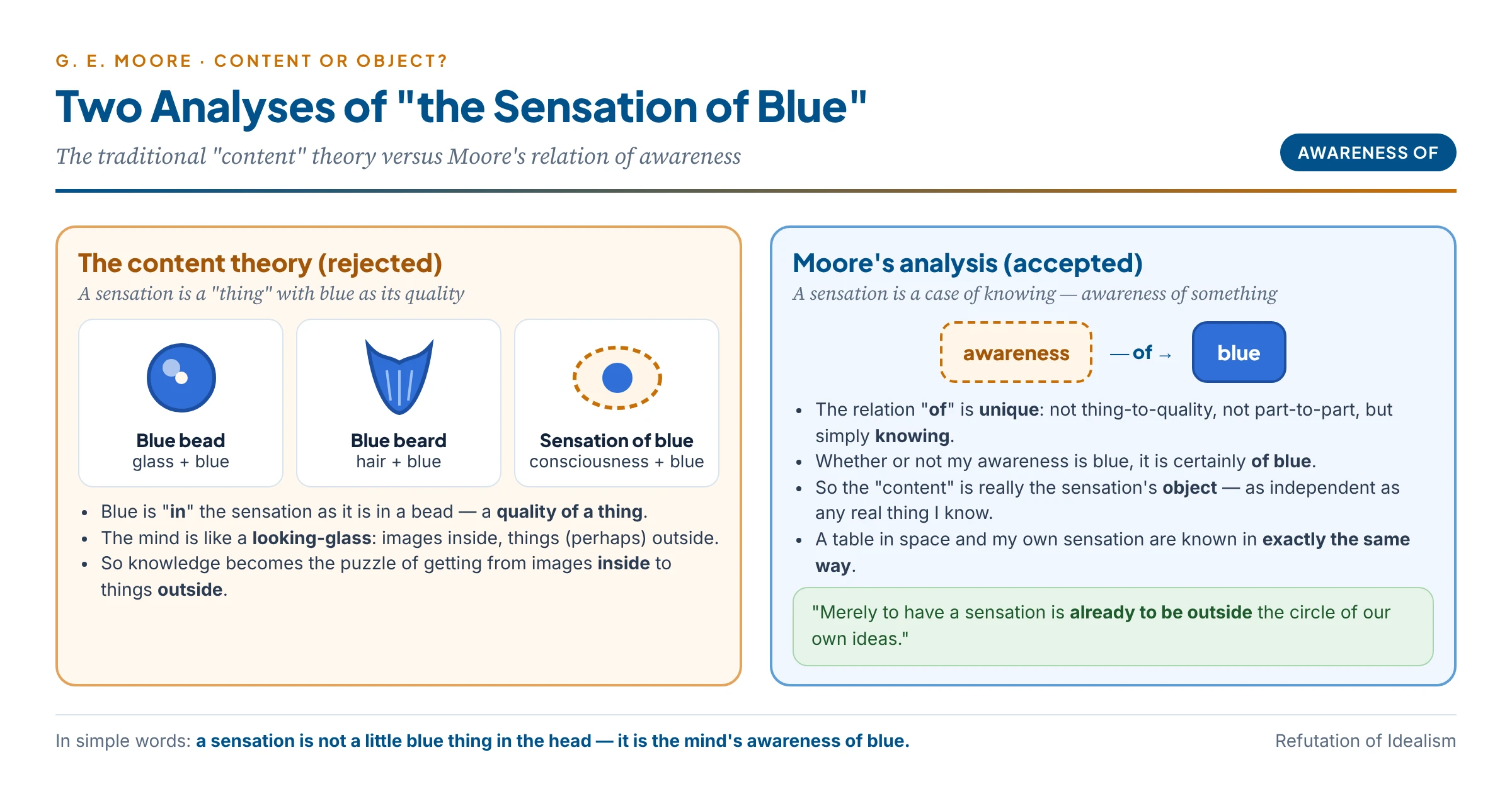
- The received view. Philosophers commonly held that a sensation is a whole with two “inseparable aspects”, content and existence: the “content” is what is felt (blue), and the “existence” is the fact that there is feeling.
- What “content” means. Blue is rightly said to be part of the content of a blue flower, in the way a quality belongs to a thing: to say the thing exists implies that its qualities exist. If blue is the content of the sensation in this sense, then the sensation is just another “thing” of which blue is a quality.
- The blue bead and the blue beard. On this view, the sensation of blue differs from a blue bead or a blue beard in exactly the way those differ from each other: the bead contains glass, the beard contains hair, and the sensation contains consciousness — blue being a quality of each.
- Two senses of “content”. If “content” means the whole of what exists when the sensation exists (Bradley’s “what“), then blue is not the whole content — consciousness is part of it, and the analysis again identifies “blue exists” with “the sensation of blue exists”. If “content” means only the differing element (as opposed to consciousness, the common “substance”), then the analysis into “content and existence” is at least misleading.
- The mental image as a mirror image. The content theory treats a mental image like an image in a looking-glass: the same content (blue), with glass in one case and consciousness in the other. Then knowledge becomes a puzzle: “What reason have we for supposing that there are things outside the mind corresponding to these things inside it?”
- Moore’s two claims against it:
- We have no reason to think that blue is part of the content of the sensation at all — no reason to think that when I sense blue, my consciousness is blue.
- Even if it were, this “content” relation is not what makes the sensation a sensation of blue. That depends on a quite different relation, which the traditional analysis omits.
8. Awareness: The Unique Relation of Knowing
- The true analysis. A sensation is really a case of knowing, being aware of, or experiencing something. When we know that “the sensation of blue exists”, the fact we know is that there exists an awareness of blue.
- A unique relation. This awareness is not only distinct from blue; it has to blue “a perfectly distinct and unique relation” — not that of thing to quality, nor of part to part, but simply what we mean by knowing. Whether or not my awareness is blue, “it is of blue“. This “of” is the relation that alone justifies distinguishing knowledge of a thing from the thing known — indeed mind from matter.
- Awareness of awareness. To be aware of the sensation of blue is not to be aware of a mental image containing blue; it is to be aware of an awareness of blue, in exactly the same sense of “awareness”.
- Object, not content. So what was called the content of a sensation is truly its object. “Blue” is as much an object, and as little a mere content of my experience, as “the most exalted and independent real thing” of which I am ever aware.
- Out of the circle of ideas. This removes the old problem of how to “get outside the circle of our own ideas and sensations“. “Merely to have a sensation is already to be outside that circle. It is to know something which is as truly and really not a part of my experience, as anything which I can ever know.”
In simple words
When you point at the moon, your finger and the moon are two things, and the pointing relates them. Nobody thinks the moon is inside the finger. Moore says awareness is a kind of “pointing” of the mind at its object: the arrow of “of” — awareness of blue — already reaches beyond the mind.
9. Consequences: Idealism Undermined, Realism Restored
- Idealists cannot get the inference started. Idealists hold that some things — above all the contents of their own sensations — are inseparable aspects of experience, and generalise from these to everything. But if even the “contents” of sensation are not inseparable aspects of experience, then nothing we experience is. “How utterly unfounded is the assumption that esse is percipi appears in the clearest light.“
- Idealism collapses into solipsism. If every object of experience were merely a content of that experience, the idealist could never be aware of himself, of other minds, or of the spirituality of reality: these would all be contents of an awareness that is “aware of nothing“. He would have no reason to believe that anything exists except himself — solipsism would not be proved true, but he could never show it false.
- Matter and mind on the same footing. If awareness is involved equally in every experience, and its object is precisely what it would be if we were not aware of it, then “the existence of a table in space is related to my experience of it in precisely the same way as the existence of my own experience is related to my experience of that“. If my experience can exist when I am not aware of it, so can the table.
- Berkeley and Kant both wrong. Berkeley supposed that we are directly aware only of our own ideas — false. Kant supposed that the objectivity of things in space consists in their being representations (Vorstellungen) related in certain ways — equally false. “I am as directly aware of the existence of material things in space as of my own sensations.“
- The question reversed. The real question about matter is not “What reason have we to suppose something exists corresponding to our sensations?” but “What reason have we for supposing that material things do not exist, since their existence has precisely the same evidence as that of our sensations?”
- The only alternative. If being an aspect of experience were a reason for doubting matter, the same reasoning would prove that our experience does not exist either. “The only reasonable alternative to the admission that matter exists as well as spirit, is absolute Scepticism” — that, as likely as not, nothing exists at all. The agnostic’s and the idealist’s positions are, without belief in matter, “as baseless as the grossest superstitions“.
10. Supporting Arguments for the Act–Object Distinction
These arguments, found in many notes, develop Moore’s point in simple form.
- Same mechanism, different sensations. The visual mechanism is the same when I see blue and when I see green; so the difference must lie in the objects, not in the seeing.
- Consciousness would become coloured. If awareness and its content were inseparable, then “consciousness of blue” would mean “consciousness is blue“. But when I see a red rose, my vision does not become red: it is sensible to say “the rose is red”, absurd to say “my consciousness is red”.
- Knowledge and error would be indistinguishable. If the object were just a content of awareness, there would be no difference between awareness of blue and awareness of green except a difference in the awareness itself — and no way to tell a true perception from a mistaken one.
- Mind would only know mind. If all knowledge were mental projection, then knowing would be the mind knowing itself — but to know, there must be something known other than the knowing.
- Image and reality differ. The mental image of a ferocious tiger does not terrify us as a real tiger in the forest does; we react with fight or flight to the real animal, not to the picture in our mind. If image and object were the same, why the difference in our response?
11. Moore against Kantian Idealism
Moore’s opposition to idealism began with Kant.
- The charge of psychologism. Kant blurred the distinction between the psychological faculty of judging (how human beings actually think — a matter for psychology) and what is true and valid (a matter for logic and epistemology). Moore insists that the gap between a thought and its truth cannot be bridged by facts about the mind.
- The dilemma about the a priori. The principles Kant uses to explain a priori knowledge must be either contingent or necessary. If contingent, they cannot ground necessity; if necessary, further synthetic a priori principles are needed to explain their necessity. Mental structures, being contingent facts, cannot explain logical necessity.
| Kant’s position | Moore’s counter-argument |
|---|---|
| Knowledge depends on the structure of human cognition | Truth and validity are independent of how humans think |
| A priori principles arise from the mind’s faculties | A priori truths are recognised, not created, by the mind |
| Moral law is grounded in the structure of the rational will | Moral truth cannot rest on psychological facts about willing |
| Necessity is explained by mental structures | Mental structures are contingent and cannot explain necessity |
| Objective validity rests on conditions of possible experience | Objective validity belongs to logic, not psychology |
| Kant’s idealism avoids subjectivism | It collapses into psychologism |
12. Moore against Absolute Idealism
- The target. Bradley’s Absolute Idealism (close to Hegel’s) holds that reality is one organic whole; individual things are real only as aspects of the whole; and all relations are internal — essential to the nature of their terms. In “External and Internal Relations” (1919), Moore attacked this doctrine.
- Moore’s objections:
- The organic whole is self-contradictory. If each part analytically contains the whole, the parts would not even be distinct objects of thought — yet idealists speak of them as distinct.
- Many relations are external. A change in one object does not logically require changes in all others. My moving a chair does not alter the intrinsic nature of the moon.
- Misuse of Leibniz’s Law. Idealists argue: if A has a relation that B lacks, A differs from B; so every relation enters into a thing’s nature. Moore replies that this confuses relational properties with intrinsic nature: relations can change while the intrinsic nature of their terms stays the same.
- Pluralism fits logic and common sense better than monism.
| Absolute Idealism (Bradley, after Hegel) | Moore’s counter-argument |
|---|---|
| Reality is a single organic whole | Reality consists of many distinct entities |
| Things are real only as parts of the whole | Things have independent reality and can be known separately |
| The whole is prior to the parts | Parts can exist without presupposing the whole |
| Each part implicitly contains the whole | Then parts could not be thought of separately — absurd |
| All relations are internal and necessary | Many relations are external and contingent |
| Difference in relations means difference in nature | Relations can change without altering intrinsic nature |
13. Moore’s and Russell’s Reactions to Berkeley
The 2018 question asks how Moore and Russell reacted to Berkeley and how their reactions differ.
- Berkeley’s argument in brief. Berkeley held that what we perceive are ideas; ideas exist only in a mind; so the objects of perception — the “things” of common sense — are collections of ideas whose being is to be perceived. An apple is a jumble of colour, shape, taste, smell — each a sensation, so an idea in the mind. Things continue to exist unperceived by us because they are perceived by God.
- Moore’s reaction. Moore attacks the premise directly. Berkeley’s word “idea” covers both the act of perceiving and the object perceived; once these are separated, there is no reason why the object should be mental. Moore adds the authority of common sense: the bedroom exists while I sleep.
- Russell’s reaction. Russell made the same criticism: Berkeley’s argument trades on the ambiguity of “idea” — the act of apprehension is mental, but it does not follow that what is apprehended is mental. But Russell went on differently:
- He accepted that what we are directly acquainted with are sense-data, and that sense-data vary with the perceiver’s position (the colour of a table changes with the light).
- At first (1912) he held that physical objects are the best hypothesis to explain our sense-data — not known directly.
- Later (1914 onwards) he treated physical objects as logical constructions out of actual and possible sense-data — a view that keeps the language of common sense but stands, in some respects, closer to Berkeley than Moore’s realism does.
- The difference. Moore’s reaction is direct realism grounded in common sense and the act–object distinction. Russell’s is logical analysis grounded in sense-data: he agrees that Berkeley’s argument is fallacious, but does not claim that we know physical objects directly; and he finally reduces them to constructions. (The comparison is developed in the synthesis article of this unit.)
Common confusion
Is Russell’s reaction to Berkeley the same as Moore’s? Only in part. Both say that Berkeley confuses the act of perceiving with the object perceived. But Moore goes on to direct realism, while Russell accepts that we are directly acquainted only with sense-data and later constructs physical objects out of them. On the question of what we directly perceive, Russell remains nearer to the empiricist tradition of Berkeley than Moore does.
Critical Evaluation
Objections to Moore’s Refutation
- Not all idealism rests on esse est percipi. Plato’s objective idealism and the Absolute Idealism of Hegel and Bradley do not start from Berkeley’s subjective principle. They argue from the rationality and coherence of the real, not from perception. So Moore’s claim to have refuted idealism as such is too strong.
- Berkeley is not a pure subjectivist. Once Berkeley makes God the perceiver who sustains things when no finite mind perceives them, his position becomes a form of objective idealism. Moore’s criticism, aimed at subjective idealism, is then incomplete.
- Kant’s synthetic a priori. Moore argues that a synthetic proposition cannot be necessary and self-evident. But Kant’s whole theory of synthetic a priori judgements challenges this assumption; an idealist could claim that esse est percipi is synthetic a priori.
- Did idealists really confuse act and object? Many idealists — Bradley among them — explicitly distinguished the sensation from what is sensed; they held only that the two are inseparable. Moore’s reply (the critique of “organic unities”) is strong, but the charge of simple confusion may be unfair to them.
- The elusive “consciousness”. Moore admits that consciousness is diaphanous and almost impossible to fix in introspection. Critics ask: if we can hardly find it, how can we be sure it is a distinct element standing in a unique relation to its object?
- Stace’s “Refutation of Realism” (1934). W. T. Stace turned Moore’s method against Moore. The realist claims that “some entities exist without being perceived by any finite mind“. But this cannot be proved:
- Not by experience — to experience a thing is to perceive it; we can never observe an unobserved object.
- Not by inference — any inference to unperceived objects needs some premise already known about unperceived things, which we lack.
- Conclusion: realism is unproved — exactly as Moore said idealism is unproved. Even Russell admitted that belief in things existing outside all experience cannot be strictly demonstrated.
- Moore’s own later doubts. When the paper was reprinted in 1922, Moore himself said it now seemed to him very confused and to contain a good many mistakes. His later theory of sense-data also left it unclear whether what we directly see could exist unperceived.
Replies and Strengths
- Unproved is not refuted. Stace shows at most that realism, like idealism, is unproved. This leaves Moore’s negative point intact: idealists have no reason for esse est percipi. And Moore can add, from his defence of common sense, that we know that things exist unperceived, even if we cannot prove it.
- The act–object distinction endures. Moore’s distinction between the act of awareness and its object became the foundation of twentieth-century realism and of the analytic philosophy of perception. A parallel idea — that consciousness is always consciousness of something — was developed in phenomenology as intentionality.
- The diaphanous mind. Moore’s observation that introspection “sees through” experience to its object is still discussed in philosophy of mind as the transparency of experience.
- Method. By analysing a slogan into its possible meanings and testing each, Moore gave analytic philosophy its model method.
- Historical impact. Together with Russell’s attack on monism, the paper ended the dominance of British Idealism.
Critics and Defenders
Criticism — Critics
- Objective and Absolute idealists: their idealism never rested on esse est percipi.
- Berkeley’s defenders: God makes his idealism objective, not subjective.
- Kantians: synthetic propositions can be necessary (synthetic a priori).
- Bradley’s school: they never confused act and object — they held them inseparable.
- W. T. Stace: by Moore’s method, realism too is unproved.
- Moore himself (later): the paper was “very confused”.
Defence — Defenders and strengths
- Negative point stands: idealists give no proof of esse est percipi.
- Act and object: awareness is always awareness of something distinct from it.
- Organic unities exposed as a licence for contradiction.
- Transparency of experience is a lasting insight.
- Matter and mind have the same evidence.
- Historical effect: British Idealism lost its dominance.
Cross-Tradition Comparison
Moore and the Idealists Compared
| Point | Berkeley | Kant | Hegel / Bradley | Moore |
|---|---|---|---|---|
| Type of view | Subjective idealism | Transcendental idealism | Absolute idealism | Common-sense realism |
| What we directly know | Our own ideas | Appearances (Vorstellungen) | The Absolute in its appearances | Material things as directly as sensations |
| Relation of act and object | Not distinguished (“idea”) | Object structured by the mind | Organic unity of subject and object | Distinct; related by awareness of |
| Unperceived objects | Exist only in God’s mind | Things in themselves unknowable | Real only as aspects of the whole | Exist independently |
| Relations | — | — | Internal | Often external |
Moore and the Indian Refutation of Buddhist Idealism
Indian philosophy saw an almost identical debate fifteen centuries earlier, between the Buddhist Vijñānavāda (Yogācāra) idealists and the realist schools.
| Point | Vijñānavāda (Buddhist idealism) | Nyāya, Mīmāṃsā and Śaṅkara (realist critics) | Moore |
|---|---|---|---|
| Central thesis | Only consciousness (vijñapti-mātratā) is real; objects are its forms | External objects are real and distinct from cognition | Objects exist independently of being perceived |
| Key argument | Sahopalambha-niyama: blue and the cognition of blue are always apprehended together, so they are not different | Constant co-presence does not prove identity; cognition is always of an object | “Blue” and “awareness of blue” are distinct; co-presence is not identity |
| Dream argument | Waking objects are like dream objects | Dream cognitions are sublated on waking; waking ones are not — they differ in nature | “Dream” presupposes waking reality |
| Nature of consciousness | Self-luminous (svaprakāśa) | Nyāya: cognition reveals its object, not itself (paraprakāśa) | Consciousness is diaphanous — we see through it to the object |
Indian Connect — Key takeaways
- Dharmakīrti’s argument and Moore’s target. The Buddhist logician Dharmakīrti argued that blue and the cognition of blue are never apprehended apart, so they are identical (sahopalambha-niyamād abhedo nīla-taddhiyoḥ). This is precisely the inference Moore attacks: being always perceived together does not make the object part of the perceiving.
- Śaṅkara’s reply. Commenting on the Brahma Sūtra, Śaṅkara rejects the non-existence of external things “because they are perceived” (nābhāva upalabdheḥ): in every cognition we are aware of an object — a pillar, a wall — as distinct from the cognition. He also insists that waking experience is not like dreaming, since dream objects are cancelled on waking. Like Moore, he appeals to what is actually given in experience.
- Nyāya’s “other-revealing” cognition. For Nyāya, a cognition reveals its object but not itself; we know the cognition only by a later reflective awareness (anuvyavasāya). This is very close to Moore’s point that consciousness is transparent in introspection.
- A difference. Śaṅkara affirms the reality of objects only at the empirical level (vyāvahārika); ultimately only Brahman is real. Moore’s realism makes no such reservation.
Synthesis (Siddhānta)
Moore’s Refutation of Idealism is a model of attacking a system at its weakest joint. Without denying that reality might be spiritual, Moore showed that the idealist’s key premise, esse est percipi, is on every reading either an empty tautology, a trivial analytic truth, or an unproved synthetic claim. Behind the idealist’s confidence he found a confusion: the failure to distinguish consciousness, which all sensations share, from its object, in which they differ. “Blue is one object of sensation and green is another, and consciousness … is different from either.” To say “blue exists” is therefore not to say “blue and consciousness exist”. Awareness is a unique relation of knowing; merely to have a sensation is already to be outside the circle of one’s ideas; and the existence of a table has exactly the same evidence as the existence of my sensations.
The refutation has limits. It strikes subjective idealism far harder than Plato’s or Hegel’s; the Kantian can appeal to the synthetic a priori; Stace showed that realism is no better proved; and Moore himself later found the paper confused. But its central achievement — the clear distinction between the act and the object of awareness — became one of the foundations of modern realism and of analytic philosophy.
- Philosophy of mind still debates the “transparency” of experience that Moore described.
- Cognitive science distinguishes the vehicle of a mental state (brain process) from its content (what it is about) — a modern version of the act–object distinction.
- Indian philosophy shows that the same issue divided Buddhist idealists and their realist critics, and that Moore’s blue had an ancient Indian counterpart.
Being always seen together does not make two things one: the blue is not in the seeing.
Previous Year Questions
- 2025“Blue is one object of sensation and green is another, and consciousness, which both sensations have in common, is different from either.” Present an account of Moore’s refutation of idealism with reference to this statement.
- 2020Critically discuss the following statement by Moore: “If anyone tells us that to say ‘Blue exists’ is the same thing as to say that ‘Both blue and consciousness exist’, he makes a mistake and a self-contradictory mistake.”
- 2018How does Berkeley establish that Mind and its ideas alone are real? How do Moore and Russell react to Berkeley’s view in this regard? Do you find any difference between Moore’s reaction and Russell’s one? Discuss.
- 2015G. E. Moore’s refutation of idealism.
- 2011Are the arguments given by G. E. Moore against Idealism adequate? Give reasons for your answer.
- 2004Critically discuss Moore’s Refutation of Idealism.
- 2000Give a critical account of Moore’s refutation of idealism.
- 1998How does Moore refute idealism? Critically evaluate.