

Moore, Russell and Early Wittgenstein: Defence of Commonsense; Refutation of Idealism; Logical Atomism; Logical Constructions; Incomplete Symbols; Picture Theory of Meaning; Saying and Showing.
Official Syllabus: Paper I, Section A, Unit 6
G. E. Moore’s Defence of Common Sense is the claim that certain ordinary propositions — “there exists a living human body which is my body“, “the earth has existed for many years“, “other people exist and have experiences“, “here is one hand, and here is another” — are not only wholly true but are known with certainty, and that any philosophy which denies them must be mistaken. Moore aimed this defence at two opponents who dominated British philosophy around 1900: the idealists (Bradley, McTaggart, and behind them Berkeley and Hegel), who said that matter, space and time are unreal appearances, and the sceptics (in the line of Hume), who said that we can never know that the external world exists. Moore’s reply was simple and revolutionary: we are far more certain of these everyday truths than of any clever philosophical premise used to deny them. With this, Moore — together with Russell — launched analytic philosophy and the “linguistic turn” of the twentieth century.
In simple words
Imagine a brilliant lawyer who builds a long, ingenious argument to prove that you were not present at your own wedding. You may not be able to spot at once which step of the argument is wrong — but you know you were there. You will rightly conclude that the argument has a flaw somewhere, not that you were absent. Moore treats sceptical and idealist arguments in exactly this way: when a theory denies that I have hands, the theory loses, not my hands.
Context & Problem
Moore and the Revolt against Idealism
- Who was Moore? George Edward Moore (1873–1958), born at Upper Norwood in south London and schooled at Dulwich College, was a British philosopher who spent almost his whole academic life at Trinity College, Cambridge. He began as an idealist, but soon became the leader of the revolt against British Idealism. Along with Bertrand Russell (and later Wittgenstein), he formed the famous Cambridge “trinity” that founded analytic philosophy.
- Other contributions. In ethics, his Principia Ethica (1903) argued that “good” is a simple, indefinable, non-natural quality (the “open question argument”). In epistemology he defended common-sense realism; in method he pioneered analysis of meaning.
- How the revolt began. Moore came to Cambridge to study classics and heard in philosophy lectures “the most astonishing things” — denials of what every sane person knows. When McTaggart taught that time is unreal, Moore asked whether that meant the class would not end at noon; when it was said that space is unreal, he asked whether the wall beside him was not nearer than the library.
- Russell’s testimony. Russell later wrote that Moore “took the lead in rebellion, and I followed, with a sense of emancipation“. Against Bradley, who held that everything common sense believes is mere appearance, they now allowed themselves “to think that grass is green, that the sun and stars would exist if no one was aware of them“.
- Moore’s favourite question. His friends remembered one question constantly on his lips: “What exactly do you mean?” If it turned out that a philosopher meant nothing exact, he was suspected of meaning nothing at all.
Why Moore Felt Common Sense Needed Defending
- Views before Moore:
- Berkeley — “to be is to be perceived” (esse est percipi); matter does not exist apart from minds.
- Hume — we cannot prove the existence of matter or of a substantial self; our beliefs rest on habit.
- Hegel, Bradley, McTaggart — space, time and individual things have no objective reality; only the Absolute is fully real, and it merely “appears” as the world.
- Moore’s complaint. Such theses make philosophy, science and practical life impossible. A philosopher who says time is unreal still catches his train on time; one who says other minds cannot be known still argues with other philosophers.
- Two methods against idealism. Moore attacked idealism in two ways:
- Practical critique — by defending the beliefs of common sense (this article).
- Analytical (linguistic) critique — by analysing the idealist principle esse est percipi (see the next article on the Refutation of Idealism).
- The philosophers’ long disdain for common sense. Moore stood against a long tradition:
- Thales made water the ultimate stuff, Heraclitus fire — both departing from common sense; Parmenides dismissed the “way of belief” of ordinary people.
- Socrates used his dialectic to refute commonly held beliefs (for example, that life is always preferable to death).
- Plato discredited both the common man and the common-sense world in favour of the world of Ideas.
- Aristotle was the first true common-sense philosopher: he refused to duplicate the world and kept philosophy within reach of ordinary experience.
- Descartes began his Discourse on Method by praising “good sense” as “of all things among men, the most equally distributed” — and then used it to doubt common beliefs. Locke endorsed this faith in common sense; Berkeley appealed to common sense while denying the common-sense world.
- In the twentieth century, Moore became the strongest advocate of common sense; ordinary-language philosophers and, in their own way, existentialists followed.
What Moore Means by “Common Sense”
- Moore never defined it. He neither gave a definition nor a complete list; he showed what he meant through examples. Nor did he accept the dictionary sense — “the ability to think in a practical way and make sensible decisions”.
- Possible meanings of “common sense” — and Moore’s attitude to each:
- Beliefs held by all human beings without exception, including those philosophers who deny them in theory. This is Moore’s main sense.
- Beliefs commonly but not universally held — for example, belief in God or the immortality of the soul. Moore does not defend these; they are “a common man’s beliefs”, often imposed from outside by tradition. (In his essay Moore even says he sees no good reason to believe in God or in survival after death.)
- A way of knowing without proof — truths grasped directly and intuitively, without effort, sometimes called a faculty of “primary truths”. Moore accepts this sense too: truisms are “ordinary truths known in the ordinary way“, and their being ordinary does not disqualify them from being truths.
- Truths that cannot be deductively proved but whose denial is absurd. Moore defends these: one cannot sincerely deny that other people exist.
- Natural propensities to believe when arguments are undecided — for example, our belief that we are free to some degree, or our “instinctive belief” that certain sensible things exist when unperceived.
- Features of common-sense beliefs:
- Public, not private — they are shared by all normal human beings; they are not the opinion of a majority.
- Lived by — whoever holds them acts on them; doubting them seriously would raise doubts about a person’s sanity.
- Not scientific, but intuitive — known directly, without proof and without contradiction.
- About this world — the body, the earth, other people, past and present; not about the supernatural.
- Not analytic — they are not true by definition, so in principle they are not logically necessary; but they have never been refuted.
In simple words
Think of the difference between “everyone in this village believes the river goddess protects us” and “everyone in this village believes the river exists“. The first is a widely shared tradition — it can vary from village to village. The second is something nobody anywhere really doubts, not even the sceptic who sits on its bank arguing that rivers may be illusions. Moore’s common sense is only of the second kind.
Core Doctrine
1. The Truisms: Moore’s Two Lists (1925)
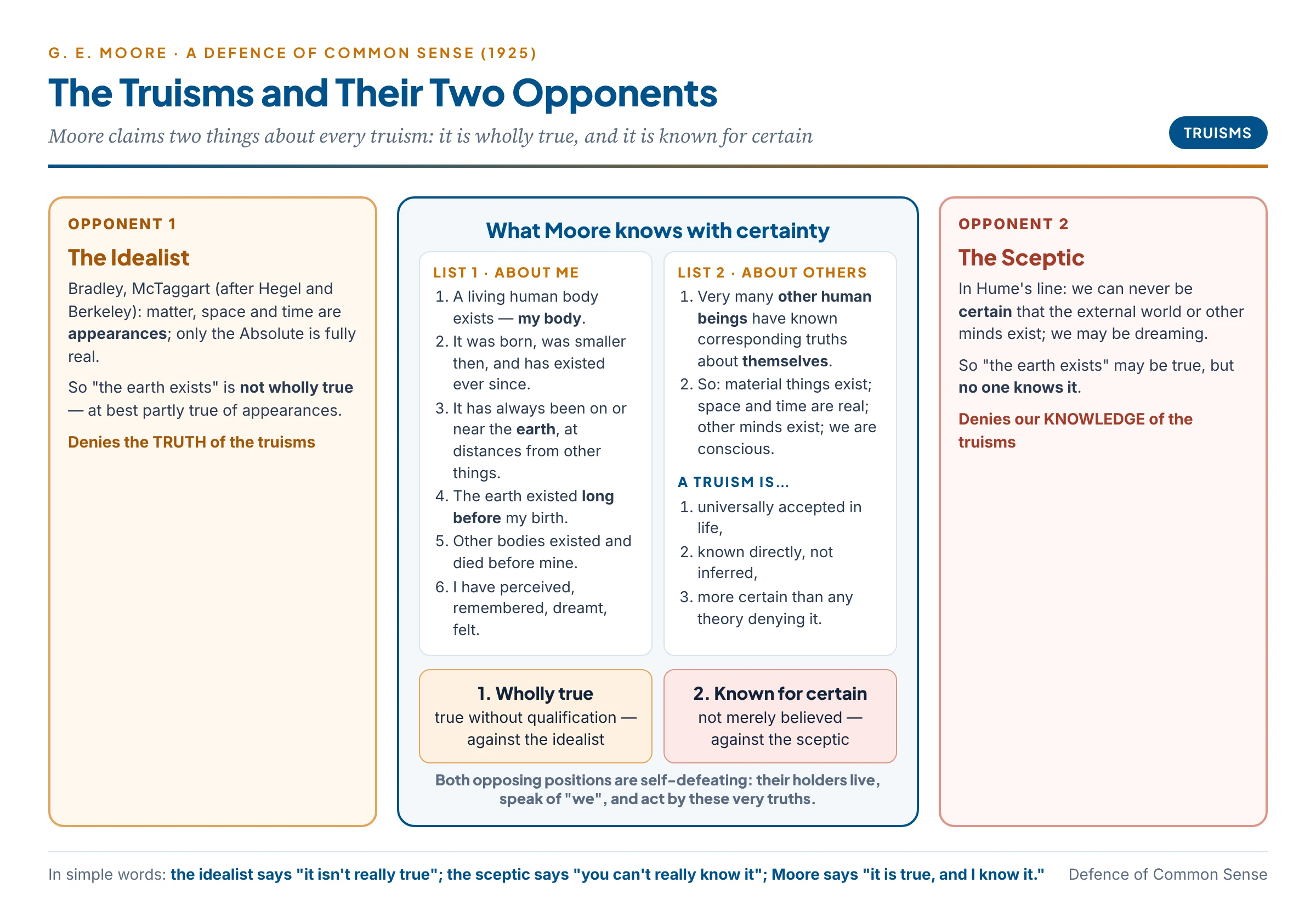
In “A Defence of Common Sense” (1925) Moore sets out a deliberately boring list of propositions which, he says, he knows with certainty to be true.
List 1 — truisms about myself and the world:
- “There exists at present a living human body, which is my body.”
- This body was born at a certain time in the past, and has existed continuously ever since, though with changes; it was much smaller when born than it is now.
- Ever since it was born, it has been in contact with or not far from the surface of the earth, and at various distances from many other physical objects (for example, “my body is at a distance from that mantelpiece”).
- The earth had existed for many years before my body was born.
- Many other human bodies had existed before mine, and many had already died before my birth.
- I am a human being; I have had many experiences — I have perceived, remembered, imagined, believed, dreamt, felt.
List 2 — truisms about others: Very many other human beings have each frequently known corresponding propositions about themselves — that their bodies exist, that the earth existed before them, and so on.
- Two kinds of statements. So Moore makes two kinds of claims: self-regarding (“I know that I have a body”) and other-regarding (“I know that others have known the same about themselves”).
- What the lists add up to. Together they assert that material things exist, that space and time are real, that I exist, that other persons exist, that the earth exists, and that we are conscious.
- Why such a dull list? Moore knew the list was tedious. His point was that every single one of these propositions has been denied by some philosopher, somewhere, sometime. Truth is usually boring; we should grow suspicious when dramatic metaphysics contradicts it.
2. What Moore Wants to Establish through the Truisms
Moore makes two separate claims about the truisms, and each is aimed at a different opponent.
- They are wholly true. Not “partly true”, not “true for practical purposes”, not “true of appearances only” — but true simpliciter. This is aimed at the idealist, who holds that no proposition about an isolated object can be wholly true, because individual things are real only as fragments of the Absolute.
- They are known with certainty. Not merely believed, not merely probable. This is aimed at the sceptic, who allows that they may be true but denies that anyone knows them.
- The double conclusion. Hence Moore divides his opponents into two groups: (a) those who say the truisms are false (idealists), and (b) those who say they are not known (sceptics). Both positions are untenable.
- Truism defined. For Moore a truism is a proposition of common sense that is universally accepted in ordinary life, known immediately (not inferred), and more certain than any philosophical theory that denies it.
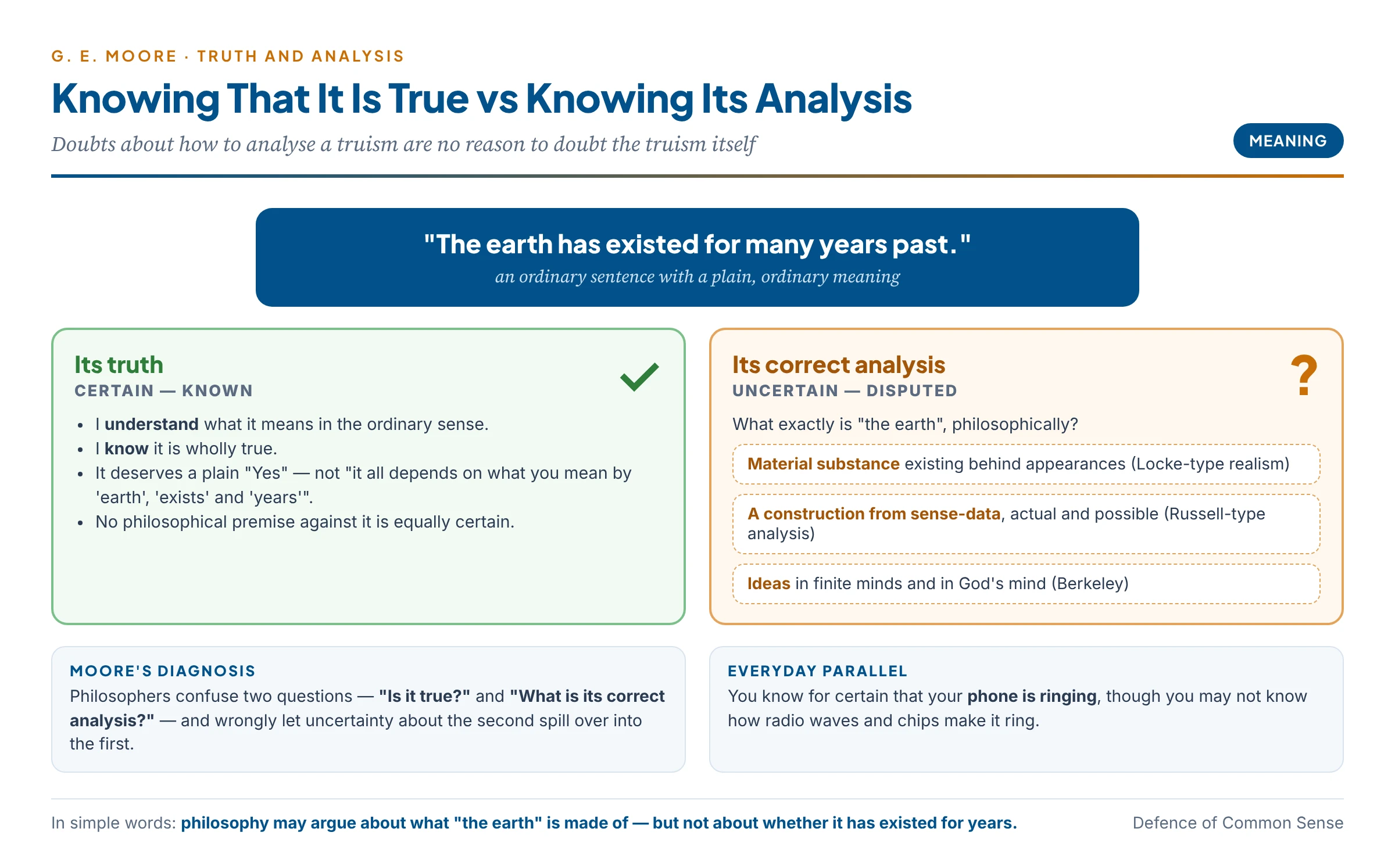
- Meaning versus analysis — Moore’s subtle point. Moore insists that he understands the meaning of “The earth has existed for many years” perfectly well, in the ordinary sense, and knows it to be true. What he does not know is its correct analysis — for example, whether “the earth” is to be analysed into sense-data, into material substance, or into something else. Philosophers confuse these two questions. Uncertainty about the analysis gives no reason for doubt about the truth.
- The philosopher who says “It all depends”. Moore rejects those who answer the question “Do you believe the earth has existed for many years?” with: “It all depends on what you mean by ‘the earth’, ‘exists’ and ‘years’…”. Such a view, he says, is “as profoundly mistaken as any view can be“. The question has a plain, ordinary meaning and deserves a plain “Yes”.
In simple words
You know for certain that your phone is ringing. You may have no idea how it works — radio waves, chips, networks. Not knowing the correct explanation does not make you doubt that it is ringing. Moore says the same about “the earth exists”: its truth is certain; only its philosophical analysis is uncertain.
3. Moore’s Arguments in Defence of Common Sense
Moore claimed that truisms are self-evident, yet he also offered several lines of support. These can be grouped as follows.
- Argument from universal acceptance. Certain beliefs are accepted by all persons of normal health and understanding — “I exist”, “this is my left hand and that is my right”, “the earth exists”, “other human beings exist”. They are believed even by the philosophers who set out to refute them.
- Argument from compulsive acceptance. Some beliefs are compulsive: life would be impossible without them. “Water quenches thirst” must be accepted alike by the idealist and the realist the moment either of them is thirsty.
- Argument from strong conviction. We hold these beliefs with full conviction. If I did not really believe that I have two hands, I should not even use them.
- Argument from sense experience. We are bound by sense experience and cannot transcend it. And sense experience points outward: the table does not exist because I have a sense experience; rather, I have a sense experience because the table exists.
- Argument from dreams. Descartes used dreams to doubt the external world. Moore replies that “dream” is a relative term: we can call an experience a dream only by contrast with waking experience. The very concept of dreaming therefore presupposes a real world of waking life. (A dream may even be true: a man who falls asleep standing may dream that he is standing.)
- Argument from inconsistency (self-refutation). Moore finds both logical and pragmatic inconsistency in his opponents:
- A philosopher who says “We cannot know that other people exist” uses the word “we” — and so already assumes that others exist.
- The proposition “No human being has ever known of the existence of other human beings” really says: “There have been many human beings besides myself, and none of them (including myself) has known that there were others” — which is self-contradictory.
- An idealist sitting in a chair while declaring that material things do not exist is in a practically absurd position.
- McTaggart’s argument for the unreality of time is delivered in time — in a lecture that begins and ends. If time were unreal, there would be no difference between morning and noon.
- If it were really true that we cannot know that other people exist, all philosophical controversy would end: no one could know that any other philosopher had ever held a view. Moore could then safely ignore what his opponents “supposedly” said! He meant this seriously: to make his opponents see how queer their views were.
- Argument from ordinary language and clarity. Ordinary language expresses these beliefs clearly and correctly. Philosophical arguments that deny them usually arise from misinterpreting or misusing ordinary words (see section 6).
- Argument from pragmatic reliability. Common-sense beliefs work: our belief in physical objects lets us cross roads, build houses and do science successfully.
- A short summary of the whole defence:
- The common-sense view of the world is universally accepted.
- We feel a kind of compulsion to accept it.
- Inconsistencies follow from denying it.
- To say that there is a common-sense view of the world is already to say that it is true.
- We can see by inspection that it is self-evident.
- Moore’s modesty. Moore admits that common-sense beliefs may in principle be false, and that clever arguments can be built against them. But it remains far more reasonable to hold them true than to accept the arguments.
4. Epistemic Priority and the Reversal of the Burden of Proof
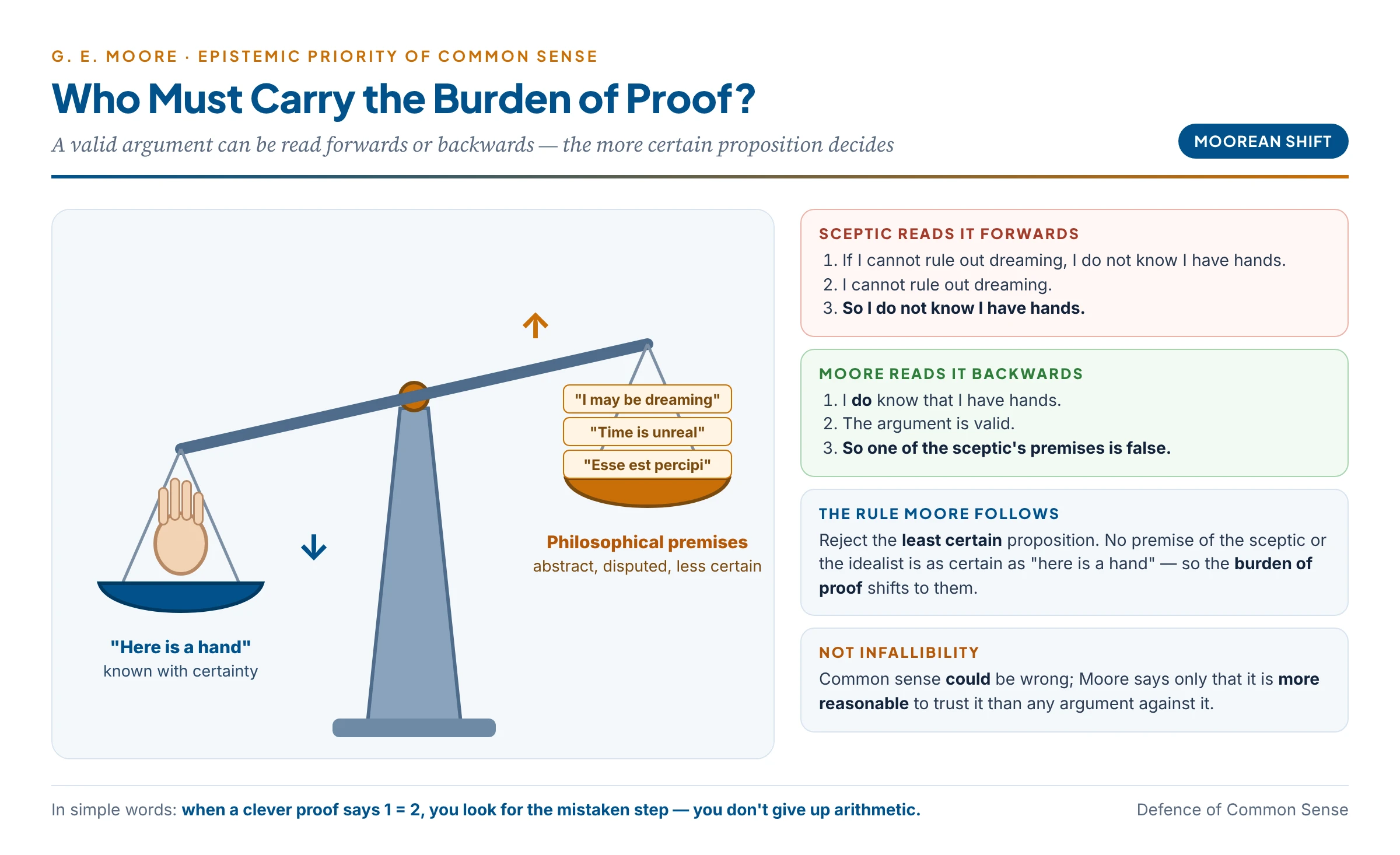
- Epistemic priority. By this Moore means that some ordinary beliefs are known with greater certainty than any philosophical premise that could be used to attack them. They therefore form the secure starting point of philosophy. Common sense became for Moore what reason was for the rationalists and sense-data were for the empiricists: the foundation of certainty.
- Not infallibility. Moore does not claim common sense can never err. He claims only that we have better reasons for accepting these beliefs than for accepting sceptical or idealist premises.
- Reversing the burden of proof. Traditionally, the realist was asked to prove the external world. Moore turns the tables: the sceptic or idealist must show that his premises are more certain than the truisms he denies. Until he does, scepticism fails.
- The “Moorean shift”. Consider the sceptic’s argument:
- If I cannot rule out that I am dreaming, I do not know that I have hands.
- I cannot rule out that I am dreaming.
- Therefore, I do not know that I have hands.
- Running the argument backwards. Moore accepts that the argument is valid, but reverses it: “I do know that I have hands; therefore at least one of the premises is false.” The same logical link can be read in either direction; what decides which way to go is which proposition is more certain. For Moore, “here is a hand” is more certain than any abstract premise about dreaming.
- Philosophy’s proper task. Philosophy must begin from what we know most certainly; it may explain and analyse common sense, but it cannot legitimately overturn the very conditions of everyday knowledge and action.
In simple words
A friend proves on paper, step by step, that 1 = 2. You may not find the trick at once, but you do not start believing that one rupee equals two rupees. You say: “There is a mistake somewhere in your steps.” Moore treats sceptical proofs the same way: the conclusion is less believable than the denial of one of the steps.
5. “Here Is One Hand”: Moore’s Proof of an External World (1939)
In a lecture to the British Academy in 1939, Moore went further and offered a positive proof that external things exist.
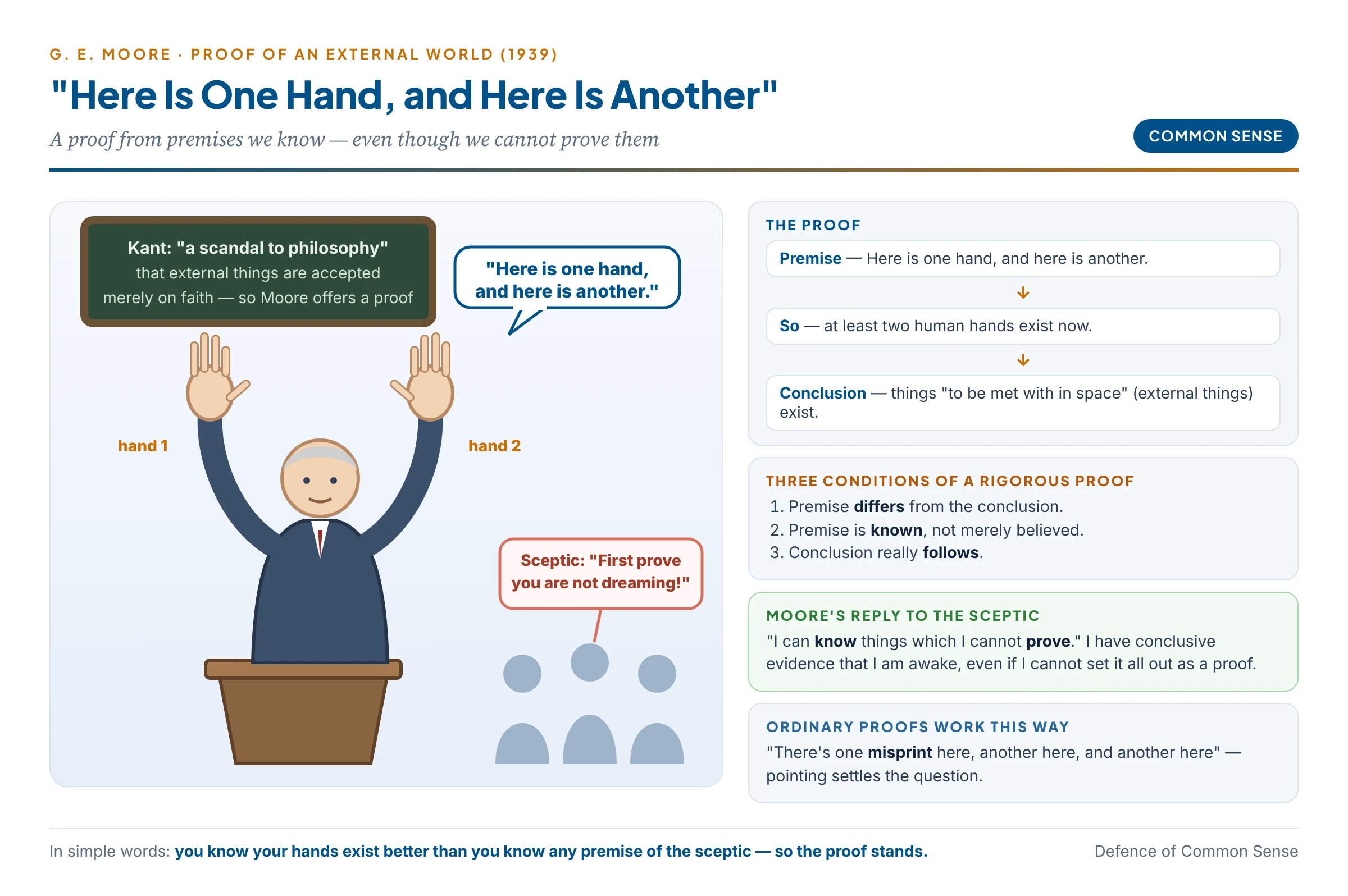
- The challenge from Kant. Kant had called it “a scandal to philosophy” that the existence of things outside us must be accepted merely on faith, without a satisfactory proof — and he thought only his own transcendental proof could work.
- What counts as “external”? Moore explains “things outside us” as “things to be met with in space” — things like hands, shoes, sheets of paper and soap bubbles, which are not merely in our minds and which could exist without being perceived. If he can prove that two such things exist, he will have proved that external things exist.
- The proof. In Moore’s own words: “I can prove now, for instance, that two human hands exist. How? By holding up my two hands, and saying, as I make a certain gesture with the right hand, ‘Here is one hand’, and adding, as I make a certain gesture with the left, ‘and here is another’.“
- The structure:
- Premise: Here is one hand, and here is another.
- Intermediate step: So at least two human hands exist now.
- Conclusion: Therefore external things exist (hands being things to be met with in space).
- Three conditions of a rigorous proof. Moore insists the proof is “perfectly rigorous” — “perhaps impossible to give a better or more rigorous proof of anything whatever” — because it meets all three conditions:
- The premise is different from the conclusion (the premise says much more than the conclusion — it points to particular hands at particular places).
- The premise is something Moore knows, not merely believes. “How absurd it would be to suggest that I did not know it, but only believed it!“
- The conclusion really follows from the premise.
- Why two hands? One hand would also prove the conclusion, but naming two makes vivid that the premise and conclusion are different propositions, and shows that the method can be repeated “in numbers of other ways” (shoes, socks, papers).
- Proofs of the past. Moore adds that he can equally prove that external things existed in the past: “I held up two hands above this desk not very long ago; therefore two hands existed then.”
- This is how proofs ordinarily work. If A and B dispute whether there are three misprints on a page, A settles it by pointing: “There’s one misprint here, another here, and another here.” We all accept such proofs as conclusive. Moore’s proof of hands is exactly of this kind.
- Knowing without proving. Moore admits he cannot prove his premise “here is one hand”. To do so he would have to prove, as Descartes saw, that he is not dreaming — and this he cannot do, though he has “conclusive evidence that I am awake“. But he denies that this matters: “I can know things, which I cannot prove.” The sceptic’s mistake is to assume that what cannot be proved cannot be known.
- Why philosophers remain dissatisfied. Moore diagnoses their dissatisfaction: they want a general proof of how any proposition of the form “here is a hand” can be known — a proof that would first refute every sceptical possibility. Moore thinks no such proof can be given; but this does not make his own proof inconclusive.
Common confusion
Did Moore claim to have proved that he is not dreaming? No. Moore openly said that he could not prove that he was not dreaming, although he had conclusive evidence that he was awake. His claim was different: a proof needs only premises that are known, not premises that are proved. Many notes present the “hands” argument as a direct refutation of the dream hypothesis; in fact it is a challenge to the assumption that knowledge requires proof.
6. The Defence of Common Sense as a Defence of Ordinary Language
Moore’s defence can also be read as a defence of ordinary language: philosophical paradoxes arise when philosophers reject the ordinary meaning of ordinary words.
- Philosophers’ hidden meanings. When a philosopher denies “there are material things” or “there are bodies”, he implies that these sentences mean something different from what they ordinarily mean. In doing so he rejects ordinary language. Moore insists that there is no sophisticated meaning behind the ordinary one; ordinary language is the correct language.
- Moore’s typical replies:
- To “No material thing exists unperceived“: “What you say is absurd — no one perceived my bedroom while I was fast asleep last night, and yet it certainly did not cease to exist.”
- To “We never know for certain any statement about material things“: “Both of us know for certain that there are chairs in this room. How absurd it would be to say that we do not know it but only believe it, or that it is only highly probable!”
- “Knowing” means knowing. In ordinary speech, “material things” means things like tables and chairs, and “know” means know with certainty, not merely believe. It would be absurd to say that a man sitting on a chair only believes that he is sitting.
- Berkeley as an example. In ordinary language “there is an apple” means an apple is physically present whether or not I notice it. Berkeley’s esse est percipi misinterprets this ordinary meaning.
- Then what is left for philosophy? If ordinary language is in order, is philosophy useless? No: the philosopher’s task is analysis of meaning. Moore himself analysed sentences like “I see a table” in his essays on perception.
- Moore’s influence. This side of Moore inspired ordinary-language philosophy at Cambridge and Oxford (Wittgenstein, Ryle, Austin), which treated philosophical puzzles as products of language “misused“.
7. Why Moore’s Philosophy Is Called Common-Sense Realism
- Realism. Realism is the view that objects exist independently of their being known or perceived. Moore holds that tables, trees, hands and other bodies exist outside and independent of the knower, and continue to exist unperceived (the bedroom while he sleeps).
- Common-sense realism. Moore’s realism is grounded not in a speculative theory of matter but in the certainties of common sense. The reason for accepting a statement is that it agrees with common sense; the reason for rejecting it is that it conflicts with common sense. Hence his position is called common-sense realism (also Moorean realism).
- Direct, not representative. Moore aligned himself with direct realism against representationalism. The representationalist (Locke) says we perceive only ideas that represent objects, which leaves the external world in doubt. Moore insists that in ordinary perception we know hands, tables and trees, not merely inner copies.
- Rejection of global scepticism. Knowledge does not require us to defeat every sceptical possibility; it rests on what we are most justified in believing.
- Pluralism. Against the idealist Absolute, Moore holds that the world consists of many distinct things standing in external relations, each of which can be known on its own.
- A modest epistemology. Philosophy should clarify and defend our ordinary knowledge claims, not replace them with speculative theories that undermine their certainty.
In simple words
A realist says: “The mango tree in my courtyard is there whether or not anyone is looking at it.” A common-sense realist adds: “And I don’t need a metaphysical theory to tell me so — this is one of the things I know better than any theory.”
8. Moore’s Way of Analysis
- Analysis, not system-building. Moore built no metaphysical system. Philosophy for him is the analysis of the meaning of propositions we already understand and know to be true — not a search for new truths about the universe.
- Analysandum and analysans. To analyse a concept is to state, in other terms, exactly what is meant by it — as when “brother” is analysed as “male sibling“. The concept analysed (analysandum) and the analysing expression (analysans) must have the same meaning, yet the analysis should be informative. (This raised the famous puzzle: if the analysis is correct, how can it tell us anything new? — the “paradox of analysis“.)
- The question “What exactly do you mean?” Moore’s method was to take a philosophical claim, separate its possible meanings, and test each one. His refutation of esse est percipi is the classic case.
- Problems came from philosophers, not the world. Moore once said: “I do not think that the world or the sciences would ever have suggested to me any philosophical problems. What has suggested philosophical problems to me is things which other philosophers have said about the world or the sciences.“
- Analysis of perception. When he analysed “I see a table”, Moore concluded that what we directly see is a sense-datum — perhaps a part of the surface of the table — and the rest is inferred. This later drew the charge that he had abandoned common sense (see the critique below).
Critical Evaluation
Objections to Moore’s Defence
- Common sense is never defined. Moore neither defined common sense nor gave a complete list of its beliefs. Critics say he uses “common sense” in an uncommonsensical way.
- If self-evident, why argue? Moore says the truisms are self-evident; then why does he give arguments for them? And his arguments overlap — compulsive acceptance and strong conviction are almost the same point.
- Common sense has often been wrong. Many once-universal beliefs were overturned by science: the sun “rises in the east”, the earth is flat and stationary, heavy bodies fall faster. Some “common-sense” beliefs rest on superstition or dogma. So there is always a chance of future refutation. Russell himself later said that science has shown that none of the common-sense notions will quite serve to explain the world.
- Questionable universality. Not all cultures share the same “self-evident” beliefs; the line between common sense and local tradition is not sharp.
- Reliance on intuition. Intuitions can be biased, mistaken or vary between people; feeling certain is not proof of truth.
- Begging the question against the sceptic. The sceptic’s whole point is that Moore does not know “here is a hand”. To use it as a premise seems to assume what is in dispute. Moore’s proof, critics say, is evasive: it does not engage with why scepticism arises. It does not answer the dream or the “evil demon” hypothesis.
- The sense-data contradiction. Moore’s own sense-data theory says we directly see only sense-data (part of a surface) and infer the object. This contradicts his direct realism and reopens the very gap — between perception and reality — that feeds scepticism. Ryle objected that we never see “patches of colour” or “glimpses of horse races”; we see robins and horse races. Sense-data are a philosopher’s myth; if they existed, ordinary language would have words for observing them.
- The same sophistication he condemned. In analysing “I see a table”, Moore ends up with the same departure from common sense for which he blamed his opponents. Berkeley too was analysing ordinary talk of an apple (“a jumble of qualities — colour, shape, taste — each a sensation, so an idea in the mind”). How, then, is Moore different? If ordinary language already gives perfect access to reality, analysis seems illegitimate; if analysis is legitimate, common sense is not the final judge.
- Stace’s turning of the tables. W. T. Stace, in “The Refutation of Realism” (1934), used Moore’s own analytical method to argue that realism is unproved — no experience can show that a thing exists unperceived (see the next article).
- Wittgenstein’s critique (On Certainty). Wittgenstein agreed with Moore’s conclusions but rejected his method. “Here is a hand” is not an empirical knowledge-claim at all; it is a hinge proposition — part of the framework within which doubting and knowing make sense. Saying “I know I have a hand” in ordinary circumstances is a misuse of “know”, because there is no room for doubt and no way of giving grounds. Such certainties need no arguments. “If you do know that here is one hand, we’ll grant you all the rest” — but whether one can know it in that way is precisely the question.
- Lack of depth. Critics say Moore’s defence is pragmatic and straightforward but does not engage with deeper questions about perception, knowledge and reality.
In simple words
Wittgenstein’s point can be pictured with a door and its hinges. You can open and close a door — that is like doubting and checking ordinary claims. But the hinges must stay fixed for the door to move at all. “The earth exists” and “here is my hand” are like hinges: not things we know by evidence, but fixed points that make knowing and doubting possible.
Replies and Strengths
- The burden really is on the sceptic. Moore’s central insight survives: an argument is only as strong as its weakest premise, and no sceptical premise is as certain as “here is a hand”.
- Knowledge without proof. Moore showed that knowing need not wait for proving — a view now widely shared in epistemology.
- Common sense is not science’s rival. Moore’s truisms (the earth existed long before me, other people exist) are not the kind of beliefs science overthrows; science presupposes them. The “sun rises” is a manner of speaking, not a truism of Moore’s list.
- Clarity of method. “What exactly do you mean?” became the working question of analytic philosophy.
- Respect for ordinary people. For perhaps the first time, a technical philosopher gave the common man a place in philosophy and woke professional philosophers up to the authority of everyday knowledge — later developed by Wittgenstein and Ryle.
- Effectiveness against idealism. Together with the refutation of idealism, the defence of common sense ended the dominance of British Idealism within a generation.
Critics and Defenders
Criticism — Critics
- Sceptics: Moore begs the question; he cannot prove he is not dreaming.
- Wittgenstein: “I know I have a hand” misuses “know”; truisms are hinges, not knowledge-claims.
- Ryle: Moore’s sense-data are a philosopher’s myth.
- Stace: by Moore’s own method, realism is unproved.
- Historians of science: common sense has been wrong before.
- Methodological critics: common sense never defined; overlapping arguments.
Defence — Defenders and strengths
- Burden of proof: no sceptical premise is more certain than “here is a hand”.
- Knowledge without proof: we know much that we cannot prove.
- Ordinary language: philosophical paradoxes come from distorting ordinary meanings.
- Realism: things exist unperceived — the bedroom while we sleep.
- Analytic method: separate the meanings, test each.
- Historical impact: ended British Idealism; gave the common man a place in philosophy.
Cross-Tradition Comparison
Moore and Other Western Responses to Scepticism
| Thinker | Response to doubt about the external world | Relation to Moore |
|---|---|---|
| Descartes | Doubts everything doubtable; rebuilds knowledge from the cogito and God’s veracity | Moore rejects the demand to doubt first and prove later |
| Hume | Reason cannot prove the external world; nature forces belief on us | Like Moore, belief is unavoidable; unlike Moore, Hume denies that it is knowledge |
| Thomas Reid (Scottish school) | First principles of common sense are constitutive of the human mind; philosophy must respect them | Moore’s closest predecessor |
| Kant | “Scandal” without a proof; offers a transcendental refutation of idealism | Moore offers a much simpler “proof” from hands |
| Later Wittgenstein | Certainties are hinges of our language-games, beyond doubt and beyond knowledge-claims | Accepts Moore’s certainties, rejects his “I know” |
Moore and Indian Realism
| Point | G. E. Moore | Nyāya-Vaiśeṣika | Mīmāṃsā | Advaita Vedānta |
|---|---|---|---|---|
| External world | Exists independently of being perceived | Objects (artha) exist independently of cognition (jñāna) | Realist: objects are real and known as they are | Real at the empirical level (vyāvahārika satya) |
| Status of ordinary knowledge | Truisms known with certainty | Valid cognition (pramā) through pramāṇas | Every cognition is valid by itself (svataḥ prāmāṇya) unless defeated | Valid for practical life, sublated only by Brahman-knowledge |
| Burden of proof | On the sceptic | On the doubter; doubt needs a ground | Doubt needs a defeater (bādhaka-jñāna) | Empirical world not denied in experience |
| Answer to the sceptic | Self-refuting; less certain than truisms | Sceptic’s denial of pramāṇas uses a pramāṇa | Universal doubt has no ground | Śaṅkara rejects Buddhist idealism by appeal to experience |
Indian Connect — Key takeaways
- Udayana’s limit on doubt. The Naiyāyika Udayana argued that doubt is legitimate only up to the point of practical self-contradiction (vyāghāta): a man who doubts whether eating removes hunger still eats. This is almost exactly Moore’s argument from inconsistency — and anticipates Wittgenstein’s view that doubt itself needs a background of certainty.
- Intrinsic validity. The Mīmāṃsā doctrine of svataḥ prāmāṇya — a cognition is presumed valid unless a defeating cognition arises — is a precise Indian form of Moore’s reversal of the burden of proof: belief is innocent until proved guilty.
- Self-refutation of the sceptic. The Nyāya Sūtra argues that one who denies the validity of all means of knowledge must use a means of knowledge to establish his denial — the same self-refutation that Moore found in the sceptic’s use of “we”.
- Realism of everyday experience. Like Moore against Berkeley, Śaṅkara defended the reality of external objects against the Buddhist idealists (Vijñānavāda) by appealing to what we actually experience, while placing this reality at the empirical level.
Synthesis (Siddhānta)
Moore’s Defence of Common Sense is a philosophy of the obvious — and that is its strength. Against idealists who called matter, space and time unreal, and sceptics who said we can never know them, Moore set a list of truisms that he claimed to know with certainty, and insisted that no philosophical premise is as certain as these. His key moves were three: (1) separating the truth of a proposition from its analysis; (2) reversing the burden of proof, so that the sceptic must show his premises are more certain than “here is a hand”; and (3) showing that we can know what we cannot prove. His “proof of an external world” by holding up two hands was not a trick but a demonstration of how proofs ordinarily work.
The defence has real weaknesses: common sense is never defined, its arguments overlap, Moore’s own sense-data theory undermines his direct realism, and the sceptic may say the question has been begged. Wittgenstein’s criticism goes deepest: truisms are not knowledge-claims but the hinges on which knowing and doubting turn. Yet even this criticism grows out of Moore’s insight that some things stand fast for us. Moore changed philosophy by insisting on clarity of meaning and by giving the ordinary person’s knowledge a place of honour.
- Contemporary epistemology still speaks of “Moorean facts” — things we know better than any philosophical premise — and debates whether knowledge requires ruling out every sceptical possibility.
- Fact-checking and misinformation. Moore’s demand “What exactly do you mean?” is the first step in testing any dramatic public claim.
- Science communication. The idea that wild theories must not be allowed to overturn well-established everyday knowledge without stronger evidence is the logic of rational trust.
- Indian epistemology shows the same wisdom: doubt must have a ground, and doubt that contradicts one’s own life refutes itself.
If a philosopher’s argument proves that I have no hands, so much the worse for the argument.
Previous Year Questions
- 2026“I can prove now, for instance, that two human hands exist.” How does Moore use this illustration to prove the existence of an external world? Critically discuss.
- 2024What arguments are offered by Moore to prove that there are certain truisms, knowledge of which is a matter of common sense? Critically discuss.
- 2021What are the main arguments put forward by Moore in his paper “A Defence of Common Sense” to prove that there are possible propositions about the world that are known to be true with certainty? Do you think Moore’s arguments provide a sufficient response to objections presented by the sceptic against the possibility of knowledge? Give reasons in support of your answer.
- 2019Why is Moore’s philosophy called common-sense realism?
- 2014Are G. E. Moore’s arguments in defence of common sense satisfactory? Give reasons.
- 2013Comment: “Moore’s defence of common sense essentially is defence of common language“.
- 2010What does Moore want to establish when he asserts that propositions like “the earth exists” or “we have consciousness” are truisms? Discuss.
- 2002Moore’s Defence of Common-Sense. Short Notes.
- 1999Clarify Moore’s conception of common sense and examine his arguments in its defence.
- 1994Critical Notes on Philosophy of Common-Sense.
- 1993Critical Notes on G. E. Moore’s way of analysis.