

Hegel: Dialectical Method; Absolute Idealism.
Official Syllabus: Paper I, Section A, Unit 5
Hegel saw his own philosophy as the culmination of the whole history of philosophy: “the latest philosophy … must be a mirror of the entire history”, containing everything true in earlier systems. So the best way to understand Hegel’s Absolute Idealism and dialectic is to place him beside the thinkers he absorbed and corrected — Plato, Aristotle, Descartes, Spinoza, Leibniz, Kant and Berkeley — and beside those who later followed or attacked him: the British idealists, the realists, Marx and the existentialists. Indian philosophy gives a further mirror: Śaṅkara’s Advaita, Rāmānuja’s Viśiṣṭādvaita and Sri Aurobindo’s integral idealism all ask Hegel’s question — how is the one Absolute related to the many things of the world? — and answer it in strikingly different ways.
In simple words
Think of Hegel as a chief editor compiling an encyclopaedia from many earlier books. He does not throw the old books away; he keeps what is sound, corrects what is one-sided, and fits each into a larger plan. Plato supplies the idea that reality is rational, Aristotle the idea of development, Spinoza the idea of one whole, Kant the active mind. Comparing Hegel with them is like reading the editor’s notes: you see what he kept, what he changed, and why.
Context & Problem
Why Hegel Must Be Read Comparatively
- A totalising philosophy. Hegel deliberately set out to synthesise the notions of all his predecessors; his Lectures on the History of Philosophy read the whole tradition as one truth unfolding from Thales to his own time.
- Absolute Idealism defined by contrast. Many of Hegel’s key ideas are formed against others: concrete universal (against Plato), subject not substance (against Spinoza), many-in-one (against Spinoza and Leibniz), no unknowable noumenon (against Kant), objective not subjective idealism (against Berkeley).
- The one and the many. The central problem running through all these comparisons is the relation of one and many:
- Spinoza — the one without the many (abstract monism).
- Leibniz — the many without the one (pluralism of monads).
- Hegel — the one in the many and the many in the one (concrete monism).
- The same problem in India. Śaṅkara (the one, the many an appearance), Rāmānuja (the one qualified by the many), and Aurobindo (the one evolving into the many) give three Indian answers to the same question.
Core Doctrine
1. Hegel and Plato: Absolute Idea and the Form of the Good
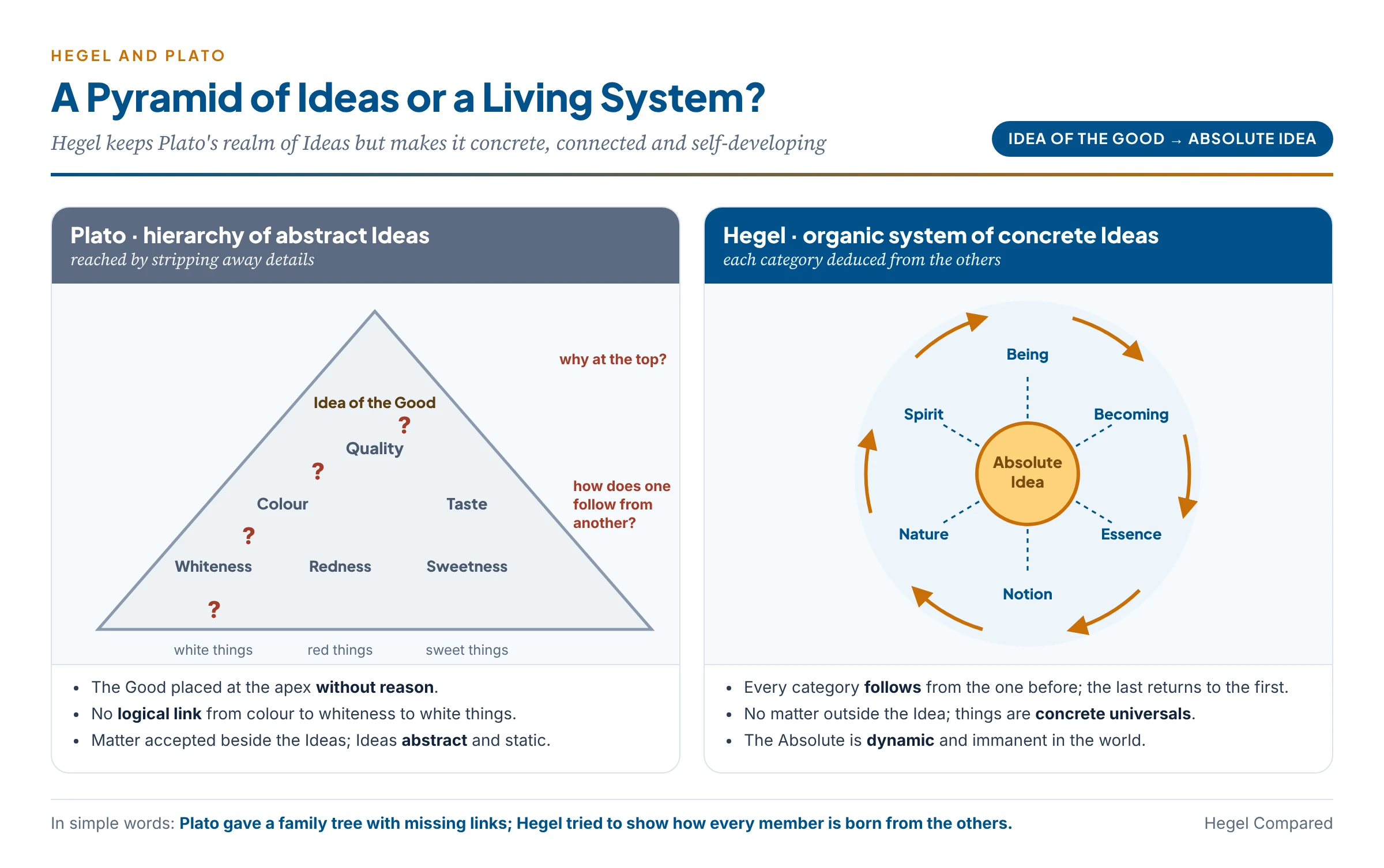
Hegel’s debt to Plato. Like Aristotle, Hegel begins from Plato’s Ideas. Reality is a system of Ideas, arranged hierarchically by degrees of generality, and the Ideas are discovered, not created by the human mind. One may even say that Hegel’s Absolute Idea is “Plato’s Idea of the Good arranged in a proper manner“. In the Parmenides, Plato had already hinted that one and many imply each other — one without many is unreal; many without one is a mere heap.
Hegel’s four criticisms of Plato’s hierarchy:
- Why is the Good at the apex? Plato simply assumed that the Idea of the Good is the highest Idea; he gave no reason. A philosophical system must show why the first Idea is first.
- No rational relation among the Ideas. Plato did not logically connect the Ideas with one another or with things. How do white things follow from the Idea of whiteness? How does whiteness or redness follow from the Idea of colour, or colour from quality, or quality from the Good? Plato says only that things “participate in” or “imitate” Ideas.
- Matter alongside Ideas. Plato seems to accept, besides the Ideas, a pre-existing matter (the Demiurge in the Timaeus shapes the world out of chaotic matter). For Hegel there is no matter at all apart from Ideas: a table is an aggregate of heaviness, hardness, brownness and the like.
- Abstract, not concrete, Ideas. Because Plato’s Ideas are reached by abstraction — dropping details — they are empty and cannot give back the particulars. Reality must consist of concrete Ideas that include their details, as a bicycle includes its spokes, rims, chain and handles.
Plato’s teleology accepted. Hegel accepts Plato’s view that the whole is governed by an ideal end. The Good moves everything without itself moving — as a princess’s beauty sets all her suitors in motion while she remains still. So too the Absolute “contains many histories but has no history of its own”.
| Point | Plato | Hegel |
|---|---|---|
| Number | Ideas are many | The Absolute Idea is one (a system) |
| Status | Independent, self-subsistent substances | Nothing exists independently of the Absolute |
| Change | Eternal and unchangeable | Dialectical development goes on within the Absolute |
| Relation to world | Transcendent; subsist apart from things and minds | Immanent; not separate from worldly objects |
| Things | Imperfect copies of the Ideas | Results of the dialectical unfolding of the Idea |
| Structure | Pyramidal, hierarchical | Dialectical, organic, inclusive |
| Kind of universal | Abstract | Concrete |
| Matter | Accepted (receptacle, chaotic matter) | Denied; everything is Idea |
| Method | Intuition and dialectic of dialogue | Dialectical logic of speculative reason |
| Highest principle | Form of the Good, static | Absolute Idea, dynamic and self-developing |
Similarities: both are idealists and absolutists; both hold that Ideas are real and that there are many Ideas, with lower Ideas subsumed under higher; both see reality as intelligible, link the ultimate principle with truth, and give philosophy the highest access to it.
2. Hegel and Aristotle: Absolute Idea and the Unmoved Mover
- Hegel’s deepest Greek debt. Hegel’s idealism is “as much Greek as German”, and much of it comes from Aristotle.
- Forms as immanent reasons. Aristotle’s form is the immanent, moulding principle of a thing — its inner essence and reason, which becomes explicit as the thing develops (the acorn becoming the oak). Hegel’s Ideas likewise pass from the implicit to the explicit, from possibility to actuality.
- The end is the beginning. For Aristotle, the end (form) is the reason of a thing’s changes and is logically prior to it; pure actuality (actus purus, the Prime Mover) is the foundation of all that exists. For Hegel, the Absolute is the logical foundation of everything, and the last category explains the first.
- “Thought thinking itself.” Aristotle’s God is pure thought thinking itself; Hegel ends his Encyclopaedia by quoting Aristotle’s description of divine thought.
- Anticipating Hegel and Marx. Aristotle’s view of change as the actualisation of potential — always a qualitative advance — anticipates the developmental thinking of Hegel and Marx.
| Point | Aristotle | Hegel |
|---|---|---|
| Similarity — reality | Rational and teleological | Rational and teleological |
| Similarity — ultimate | Pure thought (Nous) | The Idea, thought thinking itself |
| Similarity — actuality | Actuality prior to potentiality | The end (Absolute) prior to the beginning |
| Ultimate reality | Static Unmoved Mover | Self-developing Absolute |
| Relation to world | God thinks only himself; separate from the world | The Absolute realises itself through nature and history; immanent |
| Method | Analysis and classification; no dialectical development | Dialectic |
3. Hegel and Descartes
- Method. Descartes’ method is linear and mathematical: from one indubitable truth (cogito), each further step is proved in order. Hegel’s method is implicative: each phase implies every other, and the system is proved by its coherence as a whole. The deductive method suits a static world; the dialectic suits a developing one.
- Dualism. Descartes left an unbridgeable gap between mind and matter, joined only by God (or the pineal gland). Hegel overcomes dualism by showing mind and nature as moments of one Spirit.
- God. Descartes’ God is infinite and separate from the finite things he creates; the infinite stands opposed to the finite. For Hegel, such an infinite, set over against the finite, is a “bad infinite” — limited by what it excludes. The true infinite includes the finite within itself.
- Certainty. Descartes began from the certainty of the individual “I think”; Hegel begins from the poorest category, Being, and reaches the self only after a long development.
4. Hegel and Spinoza: Subject versus Substance
What Hegel admired. “Either Spinozism or no philosophy at all” — “to be a philosopher one must first be a Spinozist”. Spinoza saw that reality is one, that God and the world are not two, and that everything follows from the nature of the whole with rational necessity.
What Hegel rejected:
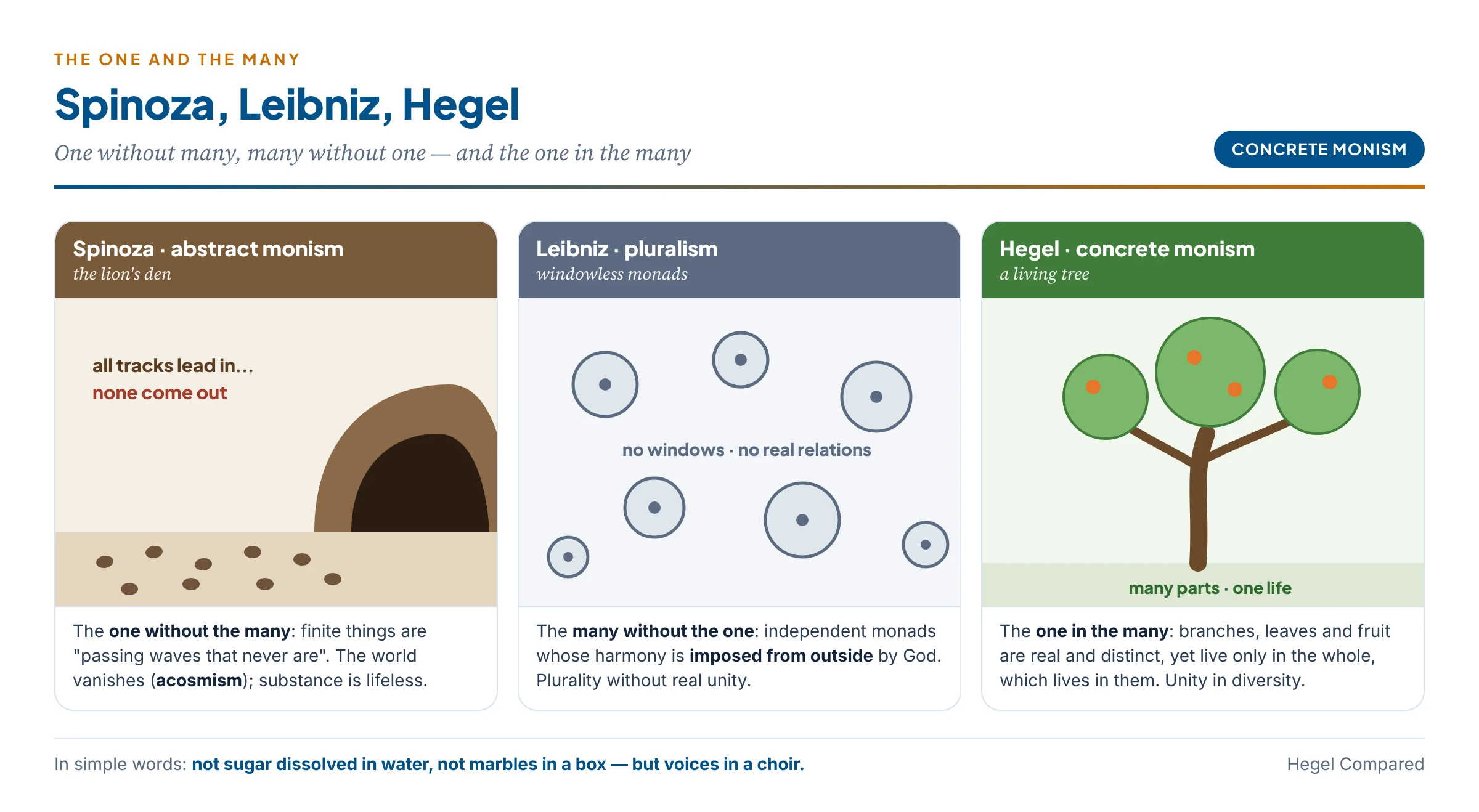
- Abstract monism. In Spinoza the many disappear: finite things, including human beings, become “passing waves that never are“. Reality is one without the many.
- The lion’s den. Spinoza’s substance is like the lion’s den of the fable, “to which all footprints point, but from which none return”: everything goes into substance and nothing comes back out as real. Reality should explain things, not swallow them.
- Acosmism. Spinoza is often called an atheist; Hegel says the opposite is true — he is an acosmist: it is the world, not God, that vanishes in his system.
- Substance without subject. Spinoza’s substance is lifeless: it lacks self-consciousness, activity and development. The Absolute must be grasped “not only as substance but equally as subject“.
- Determination and negation. Spinoza’s “determination is negation” makes every definite quality a limitation, so substance must be indeterminate. Hegel reverses this: negation is determination — it produces content and development.
- Static, geometrical method. The geometrical method cannot explain how finite modes come out of infinite substance; its “A is A” excludes growth.
- The attributes. Hegel read Spinoza’s attributes as forms imposed by the intellect on substance — a “subjective” interpretation that makes thought primary.
| Point | Spinoza | Hegel |
|---|---|---|
| Similarity | Monism; reality one unified whole | Monism; reality one unified whole |
| Similarity | Reality as rational necessity | Reality as rational necessity |
| Similarity | No dualism of God and world; rejects materialism | No dualism of God and world; rejects materialism |
| Absolute | Impersonal Substance | Self-conscious Spirit (Subject) |
| Character | Static, timeless (sub specie aeternitatis) | Dynamic, historical |
| Monism | Abstract — one without many | Concrete — one in and through the many |
| Freedom | Denied to individuals (only understanding necessity) | The essence of reality |
| Teleology | Rejected — no purposes in nature | Central — the Idea realises its end |
| God and world | God = Nature (Deus sive Natura) | God is the fullest reality, achieved through self-determination; not reducible to nature |
Common confusion
Did Hegel call Spinoza’s philosophy “the night in which all cows are black”? Many notes say so, but the famous jibe in the preface to the Phenomenology of Spirit is aimed chiefly at Schelling’s philosophy of identity — an Absolute in which all differences simply vanish, “the night in which, as the saying goes, all cows are black”. Because the same criticism fits Spinoza’s abstract monism (the one swallowing the many), the phrase is often applied to Spinoza too. The image of the lion’s den and the charge of acosmism are Hegel’s direct criticisms of Spinoza.
5. Hegel and Leibniz: The Many Without the One
- Pluralism. Leibniz took the many seriously — infinitely many independent substances, the monads. But he could not explain their real relation: monads are “windowless“, and their harmony is imposed from outside by God (pre-established harmony).
- Hegel’s verdict. Leibniz accepts the many at the cost of the one. If there are many independent realities, each is limited by the others; to unify them one must posit another, higher reality — which shows that pluralism cannot be the last word.
- What Hegel kept. Leibniz’s view that each monad mirrors the whole universe from its own point of view anticipates Hegel’s idea that each part expresses the whole; and Leibniz’s monads are active, as Hegel’s Spirit is.
In simple words
Think of three ways of making “one” out of “many”. Sugar dissolved in water: the grains vanish completely into one solution — that is Spinoza’s one without the many. A heap of marbles in a box: every marble stays separate, and nothing makes them one except the box — that is Leibniz’s many without the one. A choir: every voice remains distinct and audible, yet together they make one piece of music that each voice serves — that is Hegel’s one in the many.
6. Hegel and Kant: Dualism and Its Culmination
| Point | Kant | Hegel |
|---|---|---|
| Type of philosophy | Dualism of phenomena and noumena | Monism of the Absolute Idea |
| Reality | Noumenal reality unknowable | Absolute Idea knowable; nothing unknowable in principle |
| Reason | Limited to experience | Absolute; can know the whole |
| Attitude | Agnostic about things in themselves | Gnostic — reason knows reality |
| Soul, world, God | Ideas of reason: regulative, not knowledge | Moments of the Absolute, known in philosophy |
| Contradiction | Antinomies — signs of reason’s limits | Dialectic — engine of development |
| Categories | Twelve fixed forms of the human understanding | Self-developing categories of reality |
| Unity of apperception | Logical condition of knowledge | The Absolute Mind itself |
| The whole | Knowledge arises from synthesis of intuitions and concepts | “The True is the whole” |
| Method | Aesthetic → Analytic → Dialectic: a critique of faculties | Immediate → negation → sublation |
| History and spirit | God, freedom and immortality are postulates of practical reason | The Absolute unfolds through history; reason realised in institutions |
| Kind of idealism | Transcendental (critical) idealism | Absolute (objective) idealism |
How Kant and Hegel conceived reality and our thinking about it:
- Kant: thinking shapes appearances. Objects as we experience them conform to the forms of our sensibility and understanding. But reality in itself lies beyond the reach of our concepts: we can think it but not know it. There is a gap between thought and being, and philosophy’s task is to mark the limits of thought.
- Hegel: thinking and reality are not two. The categories of thought are the categories of being; reality is thought objectified, and in human thinking reality comes to know itself. “The rational is real and the real is rational.” Philosophy’s task is to comprehend the whole.
- Shared ground: both deny that the mind merely copies a ready-made world; both give reason an active, constitutive role. The difference is whether that constitutive role stops at appearances (Kant) or extends to reality itself (Hegel).
Is Hegel’s Absolutism the culmination of Kant’s dualism?
- Kant’s dictum “Understanding makes nature” means that the human understanding gives a priori laws to phenomenal nature — but out of material it does not make. This dictum directly paved the way for idealism.
- Hegel’s step: if the understanding makes nature and the thing in itself is an empty abstraction, then nature is a system of thoughts, and the “I think” becomes the Absolute Mind of which human minds are finite expressions.
- Kant’s triads, antinomies and Ideas supplied the raw material of the dialectic; Hegel resolved Kant’s unresolved contradictions through speculative reason.
- Yes, a culmination: Hegel completes the movement Kant began — from the primacy of the mind to the identity of mind and reality — through Fichte and Schelling.
- No, a betrayal: from Kant’s point of view, Hegel returns to the very dogmatic metaphysics that the Critique had forbidden; he ignores the distinction between thinking and knowing, and the finitude of human understanding.
In simple words
Kant is like a map-maker who says: “Every map we draw uses our symbols and scales, so we know the land only as it appears on our maps — the land itself we can never see.” Hegel replies: “If the symbols and scales are the very grammar of the land itself, then a complete map is the land understood. There is no secret land behind all possible maps.”
7. Hegel and Berkeley: Two Kinds of Idealism
Common ground: both are idealists; both reject materialism (in different ways); both make God central (Berkeley’s infinite Spirit, Hegel’s Absolute Spirit); both are theists of a kind.
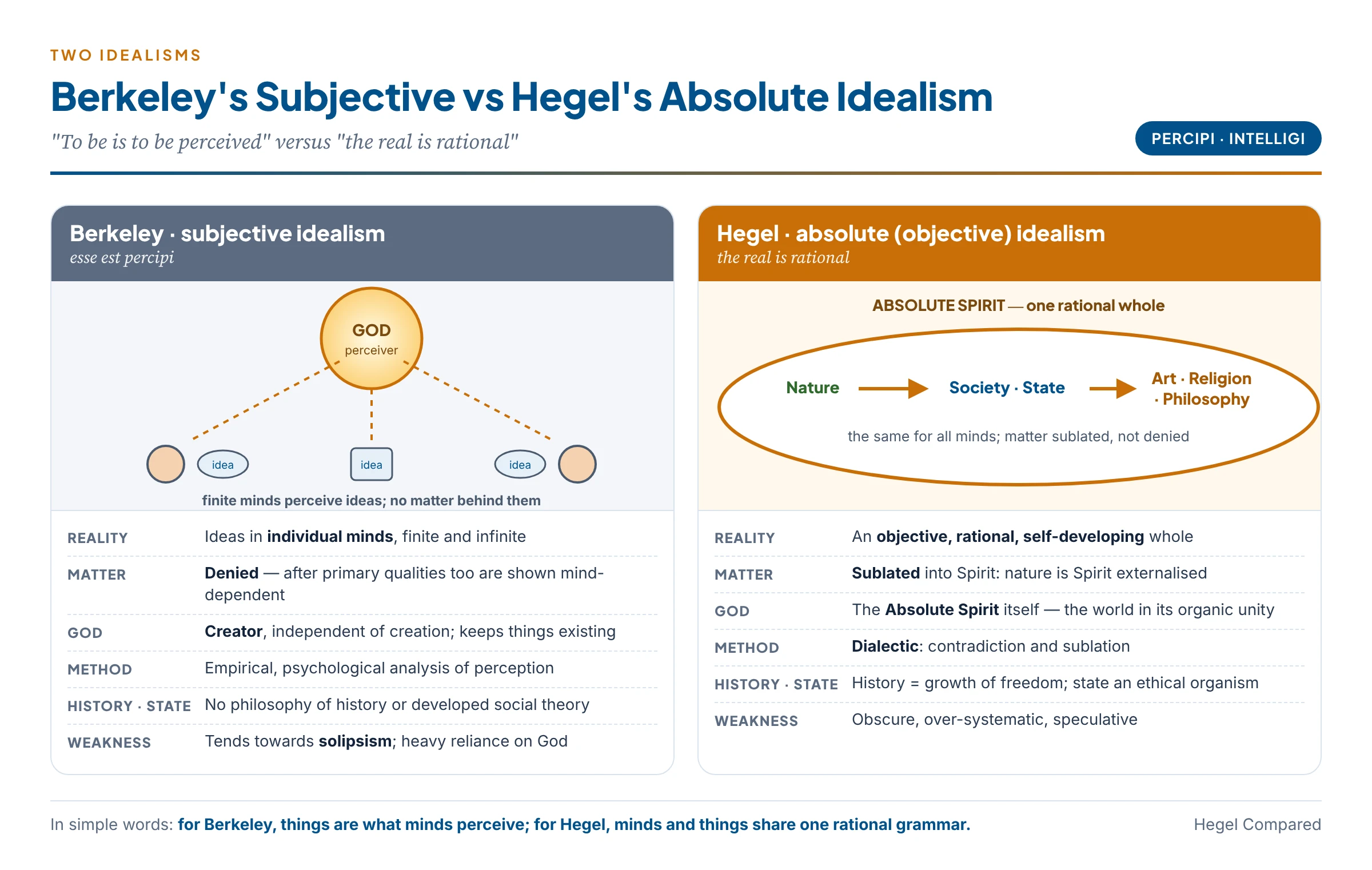
Berkeley’s rejection of primary qualities. Locke had distinguished primary qualities (extension, shape, motion — said to be in objects) from secondary qualities (colour, taste — said to be in the mind). Berkeley argued that primary qualities are as mind-dependent as secondary ones — size and shape vary with perception, and cannot even be conceived apart from colour — so matter, the supposed bearer of primary qualities, is an empty notion. This argument was instrumental in his move to idealism: esse est percipi (to be is to be perceived).
| Point | Berkeley — subjective idealism | Hegel — absolute idealism |
|---|---|---|
| Reality | Ideas existing in individual minds (finite and infinite spirits) | An objective, rational, self-developing whole (Absolute Spirit) |
| Key principle | Esse est percipi — to be is to be perceived | The rational is real and the real is rational |
| External world | No existence independent of being perceived | Real, as a moment in the self-unfolding of Spirit |
| Matter | Denied altogether | Not denied but sublated into Spirit |
| Individual minds | Primary perceivers of ideas | Finite expressions of the Universal Mind |
| God | Infinite perceiver and creator, existing independently of creation; guarantees continuity of things | Identical with the Absolute Spirit realised through nature and history; the world in its organic unity, not its creator |
| Type | Empirical, theistic idealism (deistic in tendency) | Rationalistic, pantheistic (panentheistic) idealism |
| Knowledge | Immediate, sensory, experiential | Objective, historical, mediated by concepts |
| Method | Empirical-psychological analysis | Dialectic (contradiction and sublation) |
| Nature | A collection of perceived ideas | Spirit in self-externalisation |
| History | No philosophy of history | History rational, the growth of freedom |
| Society and state | No developed social philosophy | Society and state as ethical organisms |
| Main criticism | Tends to solipsism; over-reliance on God | Obscure, over-systematic, speculative |
- The decisive difference. Berkeley’s idealism is psychological and individual — tied to acts of perceiving by particular minds. Hegel’s idealism is logical and universal — reality is a rational system of concepts valid for all minds and independent of any particular mind.
- From percipi to intelligi. Later idealists such as T. H. Green and F. H. Bradley kept the idealist thesis but replaced “to be is to be perceived” with “to be is to be thought (or understood)” — esse est intelligi — moving from Berkeley’s subjective idealism to Hegel’s objective idealism.
In simple words
Compare a television serial with the rules of grammar. For Berkeley, things are like the pictures on a screen: they exist only while someone is watching — and God is the viewer who never switches off, so the room does not vanish when you leave it. For Hegel, things are more like a language: its grammar is real and objective, the same for every speaker, and does not depend on whether you or I happen to be speaking at this moment. Berkeley’s idealism rests on perceiving; Hegel’s on the rational structure that all perceiving and thinking share.
- Moore’s attack. When Moore tried to refute idealism by refuting esse est percipi, critics replied that Plato and Hegel were idealists without holding esse est percipi — so Moore’s refutation, even if valid, does not touch Hegel.
8. Hegel and His Successors
- British idealism. T. H. Green, the Caird brothers, Bosanquet and F. H. Bradley developed Hegel’s ideas in Britain. Bradley kept the one Absolute expressing itself in all appearances and the organic “spirit of totality”, but replaced the dialectic with degrees of reality and held that even God and the self are appearances, not the Absolute. His “My Station and Its Duties” developed Hegel’s social ethics.
- The realist revolt. Moore and Russell began as idealists under Bradley’s influence, then rejected monism, internal relations and the identity of thought and being — the start of analytic philosophy.
- Marx kept the dialectic but made it materialist (see the article on history and the state).
- Kierkegaard and the existentialists rejected the system in the name of the existing individual.
- Husserl used “phenomenology” in a new sense — the description of how things are given to consciousness — whereas for Hegel the Phenomenology traced the stages of consciousness on its way to absolute knowing. Husserl criticised Hegel for assuming without ground that his dialectic could reveal everything.
- Heidegger took up Hegel’s claim that pure Being and pure Nothing are the same, making nothingness central to his own question of Being.
Critical Evaluation
What the Comparisons Reveal
- Hegel’s real originality lies in three moves: making the Absolute subject (against Spinoza), making universals concrete (against Plato), and abolishing the unknowable (against Kant). Each comparison shows one of these moves at work.
- The price of synthesis. In absorbing all earlier positions, Hegel risks flattening them — Plato becomes a forerunner, Spinoza a stage, Kant a half-way house. Critics say he reads the history of philosophy as if it were written to lead to Hegel.
- Are the criticisms of predecessors fair?
- Spinoza: Hegel’s charge of acosmism ignores Spinoza’s detailed account of modes and his ethics of human freedom.
- Kant: Hegel underrates the distinction between thinking and knowing and Kant’s moral faith.
- Berkeley: Berkeley’s God-centred idealism is less subjective than the “subjective idealist” label suggests — Berkeley himself is sometimes called an objective idealist because ideas exist in God’s mind.
- Plato: Plato’s later dialogues (Parmenides, Sophist) already explore the interweaving of Forms that Hegel says Plato neglected.
Critics and Defenders
Criticism — Critics
- Realists (Moore, Russell): Hegel’s synthesis rests on internal relations and monism, both false.
- Historians of philosophy: Hegel reads predecessors teleologically, as steps to himself.
- Kantians: absolute idealism returns to forbidden dogmatic metaphysics.
- Spinozists: the charge of acosmism misreads Spinoza’s modes.
- Advaitins: Hegel’s Absolute is still a relational, dynamic whole — not the truly unconditioned.
Defence — Defenders and strengths
- Genuine synthesis: one, many and their relation are all kept.
- Subject, not substance: brings life, history and freedom into metaphysics.
- Concrete universal: solves Plato’s problem of relating Ideas and things.
- No unknowable: removes a real inconsistency in Kant.
- Objective idealism: avoids Berkeley’s slide towards solipsism.
Cross-Tradition Comparison
Hegel and Indian Absolutism
| Point | Śaṅkara (Advaita) | Rāmānuja (Viśiṣṭādvaita) | Hegel | Sri Aurobindo |
|---|---|---|---|---|
| Ultimate reality | Nirguṇa Brahman — pure consciousness without qualities | Saguṇa Brahman qualified by souls and matter | Absolute Spirit | Saccidānanda |
| World | Mithyā — appearance through māyā | Real; the body of Brahman | Real as a moment of Spirit | Real; a manifestation of Spirit |
| One and many | One alone real; many superimposed (adhyāsa) | One qualified by many (apṛthaksiddhi) | One in and through the many | One becoming many (involution–evolution) |
| Change | Apparent (vivartavāda) | Real transformation (pariṇāmavāda) | Real dialectical development | Real evolution of consciousness |
| Method | Neti neti; sublation (bādha) of lower truth | Scripture and reason; relations real | Dialectic; Aufhebung preserves | Integral knowledge; experience |
| Goal | Mokṣa: realising “I am Brahman” | Loving devotion; eternal service of God | Spirit knowing itself in philosophy | Divine life on earth; Supermind |
| History | No ultimate significance | Moral and devotional significance | Essential: realisation of freedom | Essential: evolution of consciousness |
Indian Connect — Key takeaways
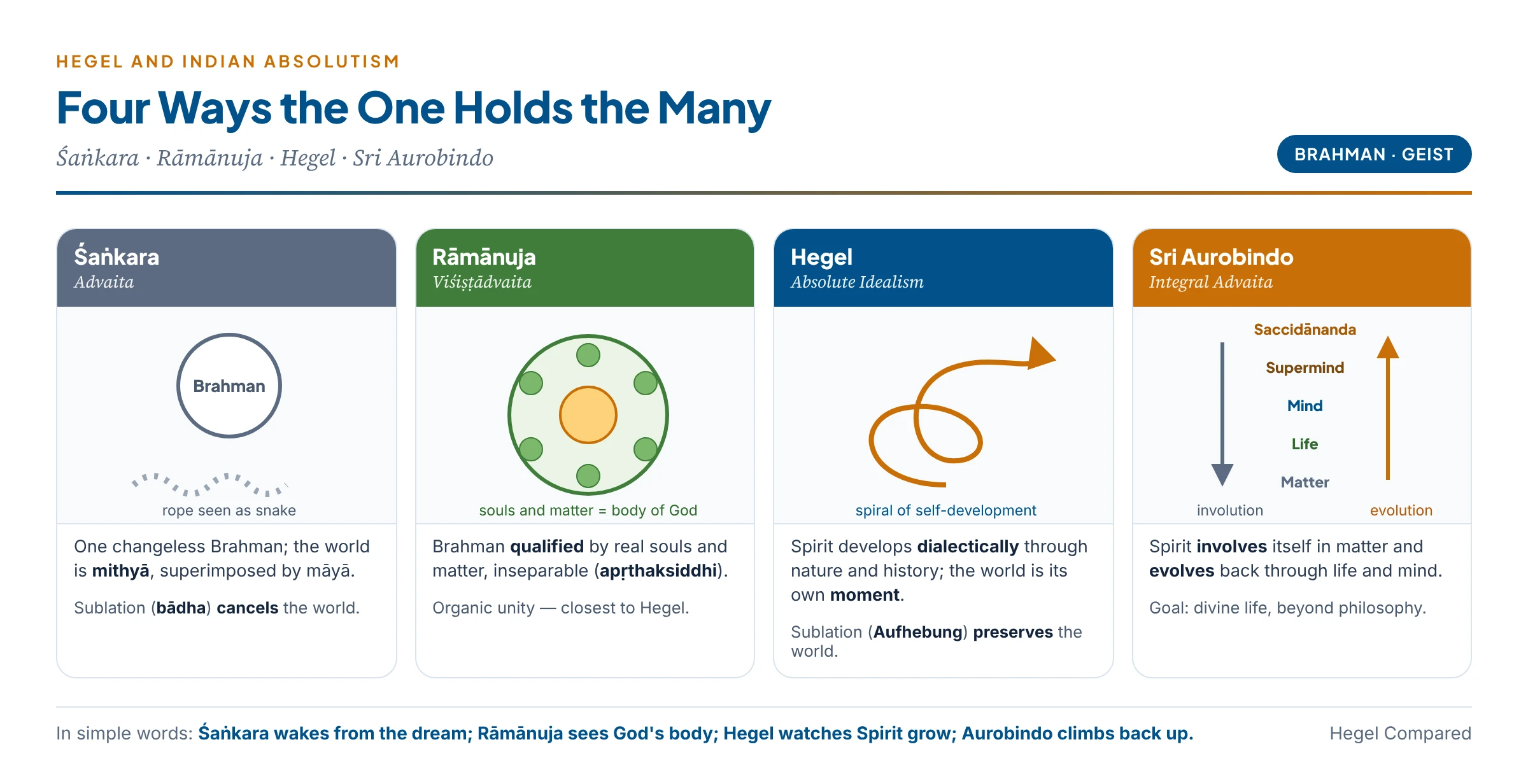
- Śaṅkara and Hegel share absolutism, the use of neti neti (Hegel’s pure Being is “not this, not that”), and the conviction that knowledge, not ritual, reveals the Absolute. But Śaṅkara’s Brahman is beyond change and relation, and the world is sublated and cancelled; Hegel’s Absolute needs the world and preserves it. Śaṅkara’s bādha and Hegel’s Aufhebung are both “sublation” — but the first cancels, the second keeps.
- Rāmānuja is Hegel’s closest Indian parallel. The world and souls are real, inseparable from Brahman (apṛthaksiddhi) and related to it as body to soul (śarīra–śarīrī) — an organic unity like Hegel’s concrete universal. Both reject an abstract, quality-less Absolute.
- Sri Aurobindo is often called the “Indian Hegel”. Spirit involves itself in matter and evolves back through life and mind towards Supermind — a dynamic, historical absolutism. Unlike Hegel, Aurobindo’s ascent is not only conceptual but a transformation of consciousness through yoga, and its goal is beyond philosophy in a divine life.
- Hegel’s own view of India — “religion of substance”, Brahman as abstract unity in which the individual vanishes — repeats against Vedānta the criticism he made of Spinoza. It ignores Rāmānuja’s qualified non-dualism and the Indian traditions that affirm the world.
Hegel and Buddhist and Jaina Thought
- Buddhism. The Buddhist doctrine of momentariness (kṣaṇikavāda) and dependent origination (pratītyasamutpāda) shares Hegel’s sense that everything is process and exists only through relations. But Buddhism denies any permanent Absolute or self, while Hegel makes all process the self-development of one Spirit. Nāgārjuna’s dialectic is negative — it empties every view (śūnyatā) — whereas Hegel’s is constructive.
- Jainism. The Jaina anekāntavāda (many-sidedness of reality) and syādvāda (conditional predication) resemble Hegel’s identity-in-difference: a pot is permanent as clay and impermanent as form; truth is many-sided. But the Jaina keeps the partial standpoints side by side, while Hegel arranges them in a rising order that ends in one complete truth.
- Sāṅkhya. Sāṅkhya’s satkāryavāda — the effect is implicit in the cause — parallels Hegel’s view that the end is implicit in the beginning. But Sāṅkhya keeps a dualism of puruṣa and prakṛti, which Hegel would see as an unresolved opposition.
Synthesis (Siddhānta)
Comparison shows Hegel at his most characteristic. Against Plato, he insists that universals must be concrete and logically connected; with Aristotle, he makes the end the reason of the beginning and reality a process of actualisation; against Descartes and Kant, he overcomes dualism and denies any reality closed to reason; against Spinoza, he makes the one Absolute a living subject that keeps the many within itself; against Leibniz, he refuses a plurality without unity; and against Berkeley, he makes idealism objective — the rational structure of reality itself, not the contents of individual minds. The result is a concrete monism: the one in the many, the many in the one.
The Indian comparison sharpens the picture. Hegel shares the absolutism of Śaṅkara, but where Advaita cancels the world in the knowledge of Brahman, Hegel preserves it as the Absolute’s own self-expression; he is closer to Rāmānuja’s organic non-dualism and to Sri Aurobindo’s evolving Spirit. Hegel’s synthesis can be accused of reading every predecessor as a step towards himself, yet it remains the most ambitious attempt in Western philosophy to show that unity and diversity, eternity and history, thought and being belong together.
- Interdisciplinary thinking: Hegel’s habit of placing rival views as complementary moments is a model for integrating perspectives in law, policy and science.
- Dialogue of traditions: Hegel–Vedānta comparisons, begun by Indian philosophers such as K. C. Bhattacharya and continued by Aurobindo, show how Indian and Western absolutism can illuminate each other.
- Against one-sidedness: the one-without-many (homogenising nationalism) and the many-without-one (fragmented individualism) remain live dangers; Hegel’s “many-in-one” offers a philosophical ideal of unity in diversity — the ideal of India’s own constitutional and cultural life.
Every great philosophy is a moment of the truth; the whole truth is their living unity.
Previous Year Questions
- 2026Analyze and discuss the different ways in which Kant and Hegel conceived the relationship between reality and our thinking about reality.
- 2025How does Hegel challenge Kant’s distinction between Phenomena and Noumena? Discuss.
- 2024Is rejection of Locke’s notion of primary qualities instrumental in Berkeley’s leaning towards idealism? In this context, also discuss how Berkeley’s subjective idealism is different from the absolute idealism proposed by Hegel.
- 2018Explain the significance of the Kantian dictum, ‘Understanding makes Nature’. How far do you agree that Hegel’s Absolutism is the culmination of the Kantian Dualism? Discuss. Give reasons in favour of your answer.