

Moore, Russell and Early Wittgenstein: Defence of Commonsense; Refutation of Idealism; Logical Atomism; Logical Constructions; Incomplete Symbols; Picture Theory of Meaning; Saying and Showing.
Official Syllabus: Paper I, Section A, Unit 6
Russell’s Theory of Descriptions, set out in his paper “On Denoting” (1905), is the most famous example of logical analysis in modern philosophy. It answers an old puzzle: how can we talk meaningfully about things that do not exist — “the present King of France“, “the golden mountain“, “a unicorn” — without filling the universe with ghostly non-existent objects? Russell’s answer is that phrases like “the so-and-so” and “a so-and-so” are not names at all. They are incomplete symbols: expressions that have no meaning on their own and do not stand for any object, but contribute to the meaning of the whole sentence in which they occur. When the sentence is properly analysed, the description disappears, and what remains is a set of general claims about what exists. “The present King of France is bald” turns out to be meaningful but false. The theory showed that the grammatical form of a sentence can hide its logical form — and it became the main tool of Russell’s logical atomism.
In simple words
A notice on a college board says: “The student who topped the exam will receive a gold medal.” If no student wrote the exam this year, the notice is not nonsense — you understand it perfectly. It is simply false that there is such a student. Russell says “the present King of France is bald” is like this: it does not name a strange invisible king; it claims that there is exactly one King of France and that he is bald — and that claim is false.
Context & Problem
Russell and the Problem of Denoting
- Who was Russell? Bertrand Russell (1872–1970) was a British philosopher, logician and public intellectual, born into a noble family (his grandfather, Lord John Russell, was a Prime Minister). Orphaned early and raised by his grandparents, he studied at Trinity College, Cambridge. With A. N. Whitehead he wrote Principia Mathematica (1910–1913), which tried to show that mathematics can be derived from logic (logicism). He was a pacifist, jailed during the First World War, a campaigner against nuclear weapons in his old age, and won the Nobel Prize in Literature (1950).
- Philosophy as analysis. “Ever since I abandoned the philosophy of Kant and Hegel, I have sought solutions of philosophical problems by means of analysis.” With Moore, Russell led the revolt against British Idealism; unlike Moore, he armed philosophy with the new symbolic logic.
- “A paradigm of philosophy”. The young philosopher Frank Ramsey called the theory of descriptions “that paradigm of philosophy“. Russell himself claimed it cleared up “two millennia of muddle-headedness about existence“.
- The referential theory of meaning. Russell’s early view (shared by many) was that the meaning of a word is the object it stands for. “Socrates” means Socrates; “red” means redness. This works for genuine names — but trouble starts with denoting phrases.
- Denoting phrases. Russell’s term for phrases such as “a man“, “some man“, “any man“, “every man“, “all men“, “the present King of England“, “the present King of France“, “the centre of mass of the solar system“. A phrase “denotes” in virtue of its form, whether or not anything answers to it.
- Two kinds of description:
- Indefinite descriptions — “a man“, “an author“, “a river“. They do not pick out any particular individual; they say only that some individual of a certain kind exists. They are vague, depend on context and claim no uniqueness.
- Definite descriptions — “the author of Waverley“, “the present King of France“, “the Prime Minister of India“, “the first Prime Minister of India“. They seem to pick out one and only one individual and so look like proper names: they typically occupy the subject position of a sentence.
Three Puzzles about Existence
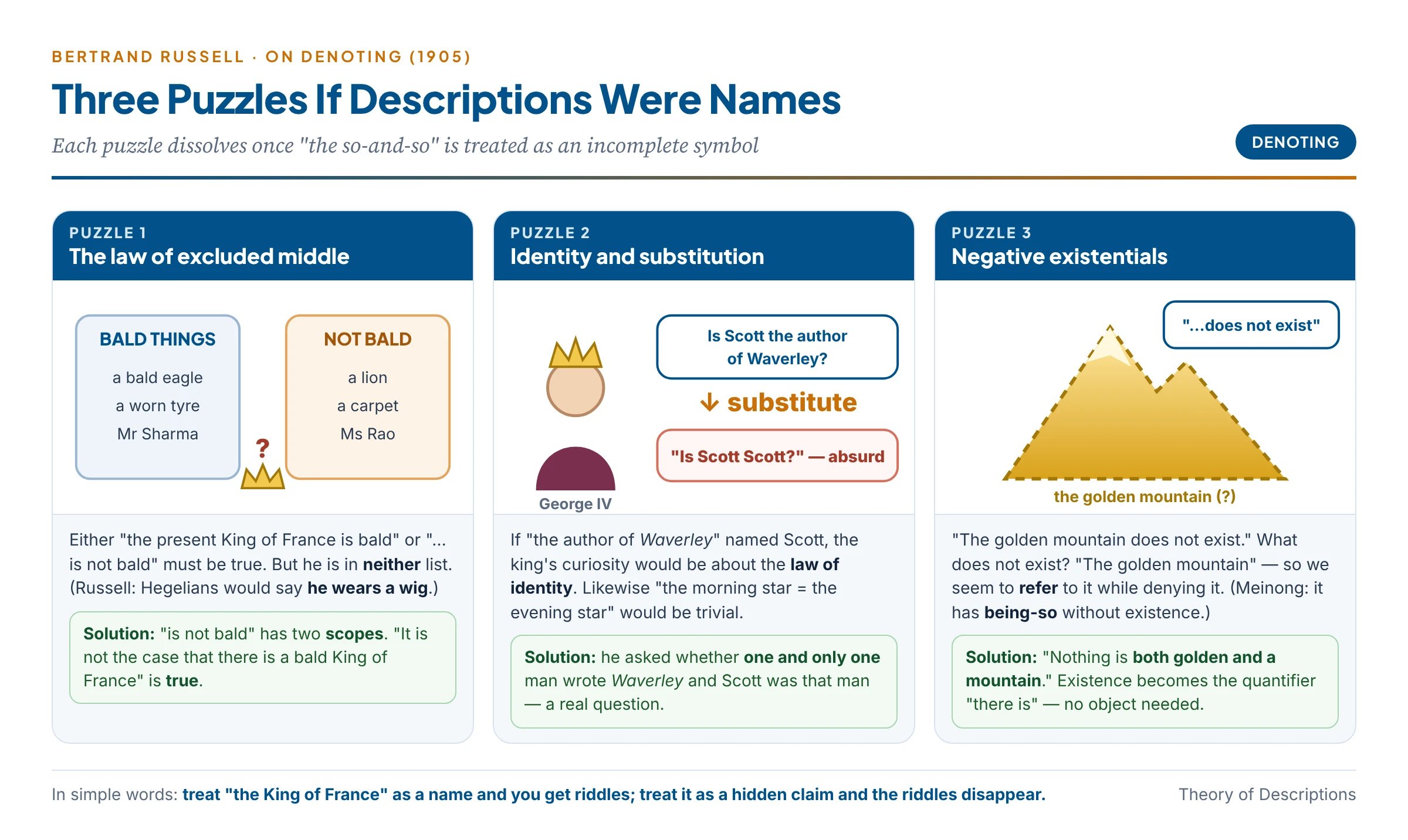
If “the present King of France” were a name, and its meaning were the object named, three puzzles would arise.
- The puzzle of excluded middle. By the law of excluded middle, either “The present King of France is bald” or “The present King of France is not bald” must be true. But if we list all bald things and all non-bald things, we will not find the King of France in either list. Russell joked: “Hegelians, who love a synthesis, will probably conclude that he wears a wig.“
- The puzzle of identity (substitution). The novel Waverley was published anonymously; King George IV wished to know whether Scott was the author of Waverley. In fact Scott was the author. If “the author of Waverley” simply names Scott, we may substitute “Scott” for it — and then George IV wished to know whether Scott was Scott. But “an interest in the law of identity can hardly be attributed to the first gentleman of Europe”! Similarly, “the morning star” and “the evening star” both refer to Venus, yet “the morning star is the evening star” was an astronomical discovery, not a trivial truth like “Venus is Venus”.
- The puzzle of negative existentials. “The golden mountain does not exist.” What is it that does not exist? “The golden mountain.” Then it seems we have referred to it — given it some kind of being — in the very act of denying its existence. Saying “unicorns do not exist” and “round squares do not exist” seems to speak of three different things, none of which exists!
- One more puzzle: “I met a man”. If “a man” is a name, what does it name? Not some particular man, for I may not know who he is; and not an “ambiguous man“, for no such creature exists. Yet “I met a man” is perfectly meaningful — and so is “I met a unicorn“, though there are no unicorns.
Two Earlier Answers: Meinong and Frege
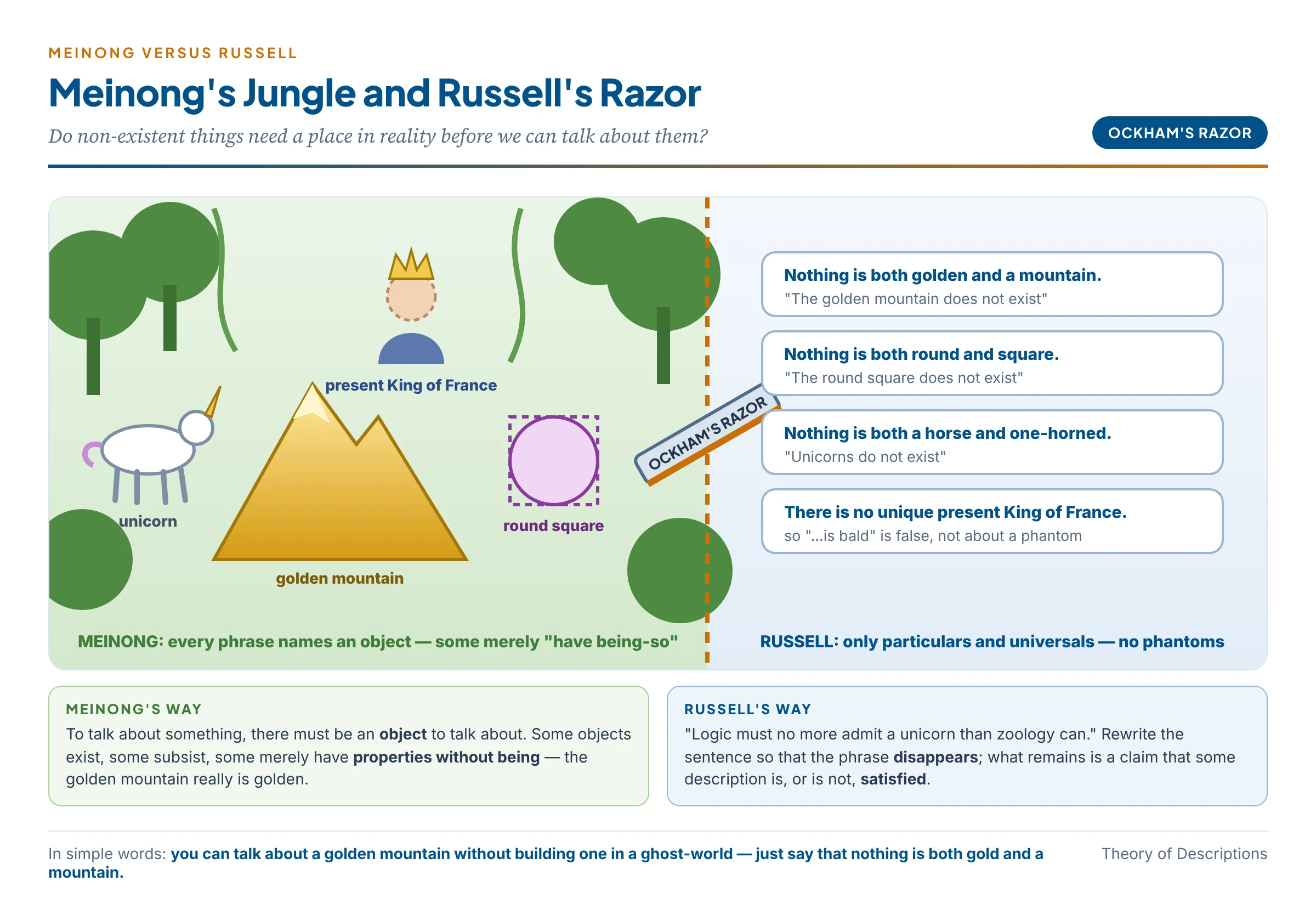
- Meinong’s answer. The Austrian philosopher Alexius Meinong argued that every denoting phrase stands for an object. Some objects exist (Mount Everest), some merely subsist (numbers), and some have no being at all but still have properties (Sosein, “being-so”): the golden mountain is golden and a mountain; the round square is round and square. This crowded universe was later nicknamed “Meinong’s jungle“.
- Russell’s objection to Meinong. Such objects violate the law of contradiction (the round square is both round and not round) and offend against a “robust sense of reality“. “Logic must no more admit a unicorn than zoology can.” Russell’s guiding rule was Ockham’s razor: do not multiply entities beyond necessity.
- Frege’s answer. Gottlob Frege distinguished the sense (Sinn) of an expression — the way it presents something, its “mode of presentation” — from its reference (Bedeutung) — the object itself. “The morning star” and “the evening star” have different senses but the same reference; that is why the identity is informative. For empty phrases like “the present King of France”, Frege said the expression has a sense but no reference, so the sentence has no truth-value (or he stipulated artificial references).
- Russell’s objection to Frege. Leaving sentences without truth-values (or assigning them artificial objects, such as the empty set) seemed arbitrary. In a precise logical language every sentence should be either true or false, otherwise inference breaks down — and in mathematics we often cannot tell in advance whether a complex expression conceals a contradiction.
Core Doctrine
1. Names versus Descriptions
- Logically proper names. A genuine name stands directly for an object and has meaning independently of any sentence. For Russell, a logically proper name can only name something with which we are directly acquainted — in the end, only words like “this” and “that” applied to a present sense-datum.
- Descriptions are not names. “The author of Waverley” describes something that may or may not exist; it does not directly name anything. Test: “Scott is the author of Waverley” is informative (it records a literary fact), while “Scott is Scott” is a trivial identity. If the description were a name for Scott, the two would mean the same — they do not.
- Ordinary proper names are disguised descriptions. “Julius Caesar“, “Bismarck“, “Queen Victoria” are, for most of us, short for descriptions — “the Roman general who crossed the Rubicon”, “the first Chancellor of the German Empire”. When I say “Caesar crossed the Rubicon”, there is no constituent of my thought with which I am acquainted except general characteristics and relations; the name stands for a description.
- Why descriptions are mistaken for names. They function as grammatical subjects of which something is predicated; and we tend to mix logical thinking with psychological association. The confusion of grammar with logic produces the puzzles.
2. What Is an Incomplete Symbol?
- Definition. An incomplete symbol is an expression that has no meaning in isolation, but which may occur as a constituent of a sentence and contribute to the meaning of the sentence as a whole. It looks as if it names an object, but does not.
- Contextual definition. Instead of defining the phrase itself, Russell defines every sentence in which it occurs — he gives a rule for rewriting the whole sentence without the phrase. On analysis, the incomplete symbol disappears.
- Analogies. Signs such as “+” or “×” have no meaning standing alone; they mean something only in “2 + 3 = 5”. The word “sake” has no meaning on its own; it works only in phrases like “for the sake of”.
- Contrast with complex symbols. A proposition is a complex symbol: it is made of words (symbols) and is itself a symbol with a complete meaning. An incomplete symbol, by contrast, is only a part that never has a meaning of its own.
- Examples of incomplete symbols in Russell’s philosophy:
- Descriptive phrases — definite and indefinite descriptions (the clearest case).
- Class expressions — “the class of men” (see the article on logical constructions).
- Ordinary names of persons and physical objects, insofar as they are disguised descriptions.
- Why Russell introduced them. To block the mistaken assumption that every meaningful expression must refer to something that exists — and so to keep language meaningful without committing us to fictional entities.
In simple words
The word “nobody” behaves like a name in grammar: “Nobody came to the party.” But it would be silly to ask “Who is this Nobody, and why didn’t he come?” “Nobody” works only inside the whole sentence, which means “It is not the case that anyone came.” Russell says “the present King of France” is a bit like “nobody”: it seems to name someone, but in fact it only helps the sentence make a general claim.
3. Indefinite Descriptions: “I Met a Man”
- The problem. “I met a man” seems to be about a man. But which? If it is about some particular man (say, Jones), then “I met a man” would mean “I met Jones” — but I may say “I met a man” without knowing his name, and it would remain true if I had met someone else. If it is about an “indefinite man“, no such thing exists. And “I met a unicorn” is perfectly intelligible though there are no unicorns.
- Russell’s analysis. “I met a man” means: “‘I met x, and x is human’ is not always false” — that is, there is at least one x such that I met x and x is human. “I met a unicorn” means “there is at least one x such that I met x and x is a unicorn” — which is false, but meaningful.
- Result. The phrase “a man” disappears; what remains is a propositional function (“I met x and x is human”) and a claim about how often it is true. No strange “indefinite man” and no unicorn is needed.
4. Definite Descriptions: The Three-Part Analysis
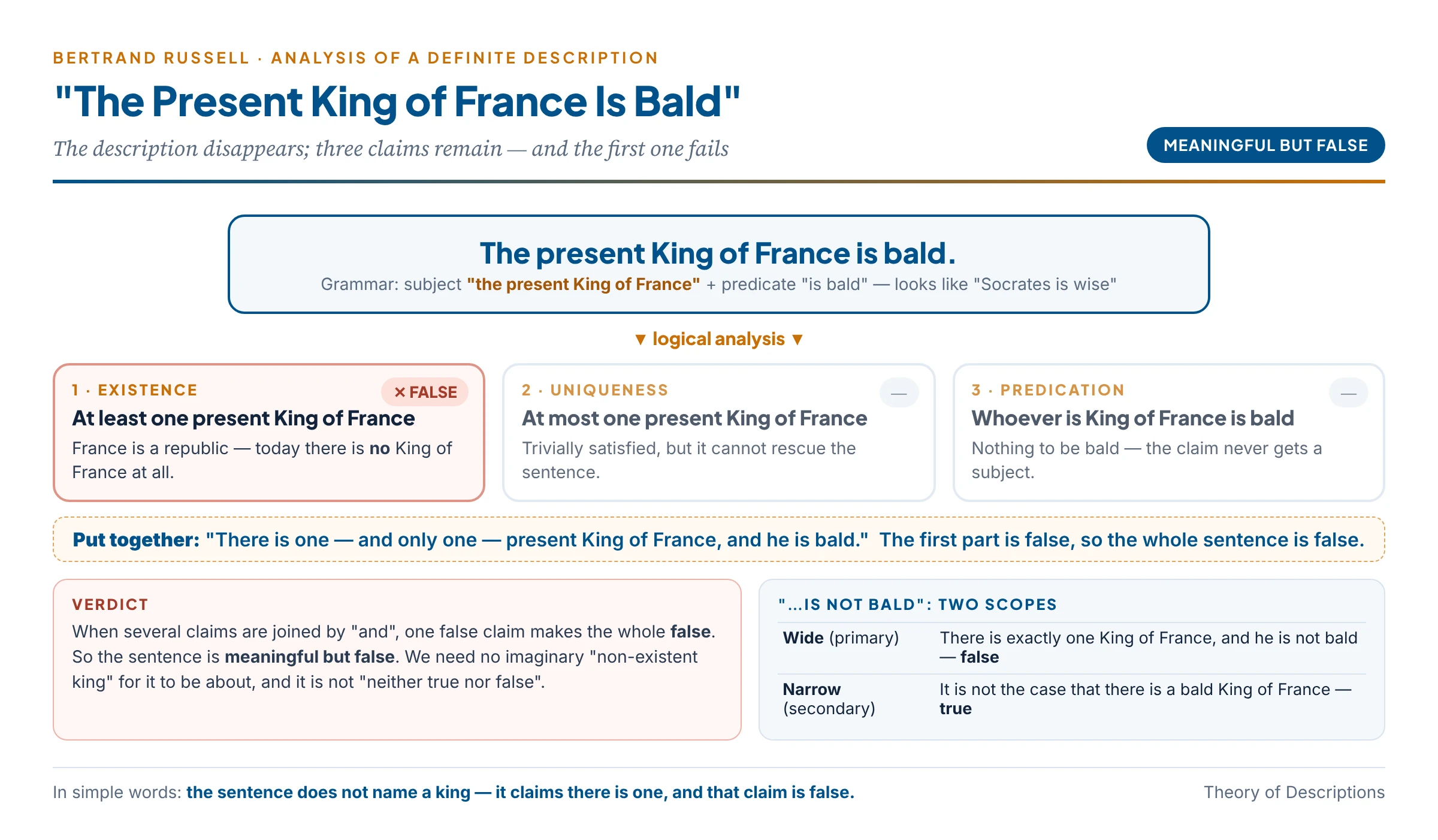
A sentence of the form “The so-and-so is such-and-such” — for example, “the author of Waverley was a Scot” — is analysed into three claims:
- Existence — there is at least one so-and-so (at least one person wrote Waverley).
- Uniqueness — there is at most one so-and-so (only one person wrote it).
- Predication — whoever is the so-and-so is such-and-such (whoever wrote it was a Scot).
- Put together in one sentence: “The so-and-so is such-and-such” means “there is one, and only one, so-and-so, and it is such-and-such“. For example, “the tallest girl in the class is a singer” means: there is a tallest girl in the class, there is only one such girl, and she is a singer.
- Examples:
- “The author of Waverley was a Scot” = at least one person wrote Waverley; at most one person wrote Waverley; whoever wrote Waverley was Scotch. (True.)
- “The brother of Charles II was deposed” = some individual was brother to Charles II; only this individual was; and he was deposed. Nothing in the analysis names James II; there are only predicates and quantifiers.
- “The present King of France is bald” = there is at least one present King of France; there is at most one; and he is bald. The first clause is false — so the whole sentence is false. It is meaningful but false, not meaningless, and needs no shadowy king.
- What has happened to the description? In the analysed sentence, the phrase “the present King of France” has vanished. It was an incomplete symbol: its contribution is spread across the existence, uniqueness and predication clauses.
- Why falsity, not a truth-gap? Russell wanted a scientific language in which every sentence has a truth-value. On his theory “the sovereign of the United States is male” is simply false, and its denial is true — no special rule is needed.
5. How the Theory Solves the Puzzles
Puzzle 1 — Excluded middle: scope of negation.
- “The present King of France is not bald” is ambiguous. It can mean:
- “There is exactly one King of France, and he is not bald” — the description has a primary occurrence (wide scope). This is false, since there is no King of France.
- “It is not the case that there is exactly one King of France who is bald” — the description has a secondary occurrence (narrow scope). This is true.
- So the law of excluded middle is saved: of “the King of France is bald” and “it is not the case that the King of France is bald“, exactly one (the second) is true. No wig is needed.
In simple words
“The topper of our class is not a girl.” If there is no topper (no exam was held), this can mean two things. (1) “There is a topper, and that person is not a girl” — false, because there is no topper. (2) “It is not true that there is a topper who is a girl” — true. Russell calls this a difference of scope: does the “not” apply inside the description or to the whole sentence?
Puzzle 2 — Identity: George IV and Scott.
- “George IV wished to know whether Scott was the author of Waverley” means: George IV wished to know whether one and only one man wrote Waverley and Scott was that man. Since the description is not a name, we may not substitute “Scott” for it. George IV’s curiosity was about a substantial fact, not the law of identity.
- In the same way, “the morning star is the evening star” says that the one body that appears at dawn in a certain place is the one body that appears at dusk in a certain place — an informative, empirical claim.
Puzzle 3 — Negative existentials: the golden mountain.
- “The golden mountain does not exist” means: “It is false that there is exactly one thing which is both golden and a mountain” — or “there is no entity c such that ‘x is golden and mountainous’ is true if and only if x is c“. The notion of existence has been analysed out of the description; it now appears as the quantifier “there is”. We deny that a description is satisfied, not that a peculiar object lacks existence.
- “The round square does not exist” similarly denies that anything is both round and square — no contradictory object is required.
The 2025 question: “The golden mountain is very high.”
- Grammar suggests a subject–predicate sentence about a golden mountain, to which the property “very high” is ascribed.
- Meinong’s reading: the golden mountain is an object that has no being, but it has its properties; if it is described as very high, then “the golden mountain is very high” might even be true of that non-existent object.
- Russell’s reading: “There is exactly one thing that is golden and a mountain, and it is very high.” Since nothing is both golden and a mountain, the first clause is false, and the whole sentence is false — but perfectly meaningful. Its negation, read with narrow scope (“it is not the case that the golden mountain is very high”), is true.
- Lesson: “the golden mountain” is an incomplete symbol; the sentence is about the world (it claims something is satisfied) — not about a mountain of gold in a realm of non-being.
Common confusion
Does Russell say that “The present King of France is bald” is meaningless? No — this is the most common slip. For Russell the sentence is meaningful but false: we understand it perfectly, and its existence clause fails. It is P. F. Strawson who later said that such a sentence, used today, is neither true nor false because its presupposition fails. Also note: for Russell an empty genuine name (a would-be logically proper name that names nothing) would yield no proposition at all — which is exactly why he denies that descriptions are names.
6. Grammatical Form and Logical Form
- The central insight. “Socrates is wise” and “The present King of France is bald” look alike — both are subject–predicate sentences. But logically they are very different: the first contains a name of an existing individual; the second contains no name at all, but a hidden existential claim.
- Surface hides depth. Grammatical subjects and predicates do not always correspond to real objects and properties. Philosophy must look beneath grammar to the logical form, which shows how quantifiers, variables and predicates really work.
- Dissolving rather than solving. Russell does not answer the question “What kind of being does the King of France have?” — he shows that the question rests on a misreading of the sentence. Many problems about existence, reference and negation simply disappear once language is properly analysed.
- Wittgenstein’s tribute. In the Tractatus, Wittgenstein wrote: “Russell’s merit is to have shown that the apparent logical form of the proposition need not be its real form.“
- Logical versus psychological thinking. Ordinary speakers mix logic with psychological associations and so take descriptions for names. Logical analysis separates the two.
In simple words
Two shirts can look the same on a hanger but be very different inside — one of cotton, one of plastic. “Socrates is wise” and “The King of France is bald” look the same on the “hanger” of grammar. Logical analysis turns them inside out and shows the first is made of a name and the second of a hidden “there is exactly one…” claim.
7. Knowledge by Acquaintance and Knowledge by Description
- Acquaintance. We are directly acquainted with what is immediately present to us: sense-data (colours, sounds, shapes), our own present mental states, things remembered, and — Russell held — universals (redness, similarity). Acquaintance is non-inferential and the most certain form of knowledge.
- Description. Most things we talk about — physical objects, other minds, historical figures (Bismarck, Queen Victoria, Julius Caesar), the centre of mass of the solar system, “the first Prime Minister of India” — are known only by description, as “the so-and-so that has such-and-such properties”.
- The principle of acquaintance. “Every proposition which we can understand must be composed wholly of constituents with which we are acquainted.” How then can we understand propositions about Caesar, whom we have never met? Because the proposition contains no constituent “Caesar”: the name abbreviates a description built from universals and particulars we are acquainted with.
- So the theory of descriptions is essential to Russell’s epistemology. It explains how knowledge can extend beyond our narrow circle of acquaintance to the whole world of things we have never directly met.
8. Incomplete Symbols, Ockham’s Razor and Logical Fictions
- Russell’s maxim. “Wherever possible, logical constructions are to be substituted for inferred entities.” The theory of descriptions is the model: instead of inferring a strange entity (the King of France who does not exist), we construct the meaning of the sentence from items we already accept.
- “Logical fictions”. Russell called the apparent objects of incomplete symbols — classes, and in a sense physical objects and minds — “logical fictions“. This does not mean that tables and minds do not exist; it means that sentences about them can be rewritten in terms of more basic entities.
- Economy of ontology. Philosophy no longer needs to populate reality with fictional, impossible or imaginary objects. Clarity and precision replace metaphysical inflation.
- Quine’s later echo. The American philosopher Quine called Meinong’s crowded universe “Plato’s beard” — tough enough to have “dulled the edge of Ockham’s razor” — and praised Russell’s theory for shaving it.
9. From Incomplete Symbols to Logical Atomism
This link is asked directly (2024, 2018).
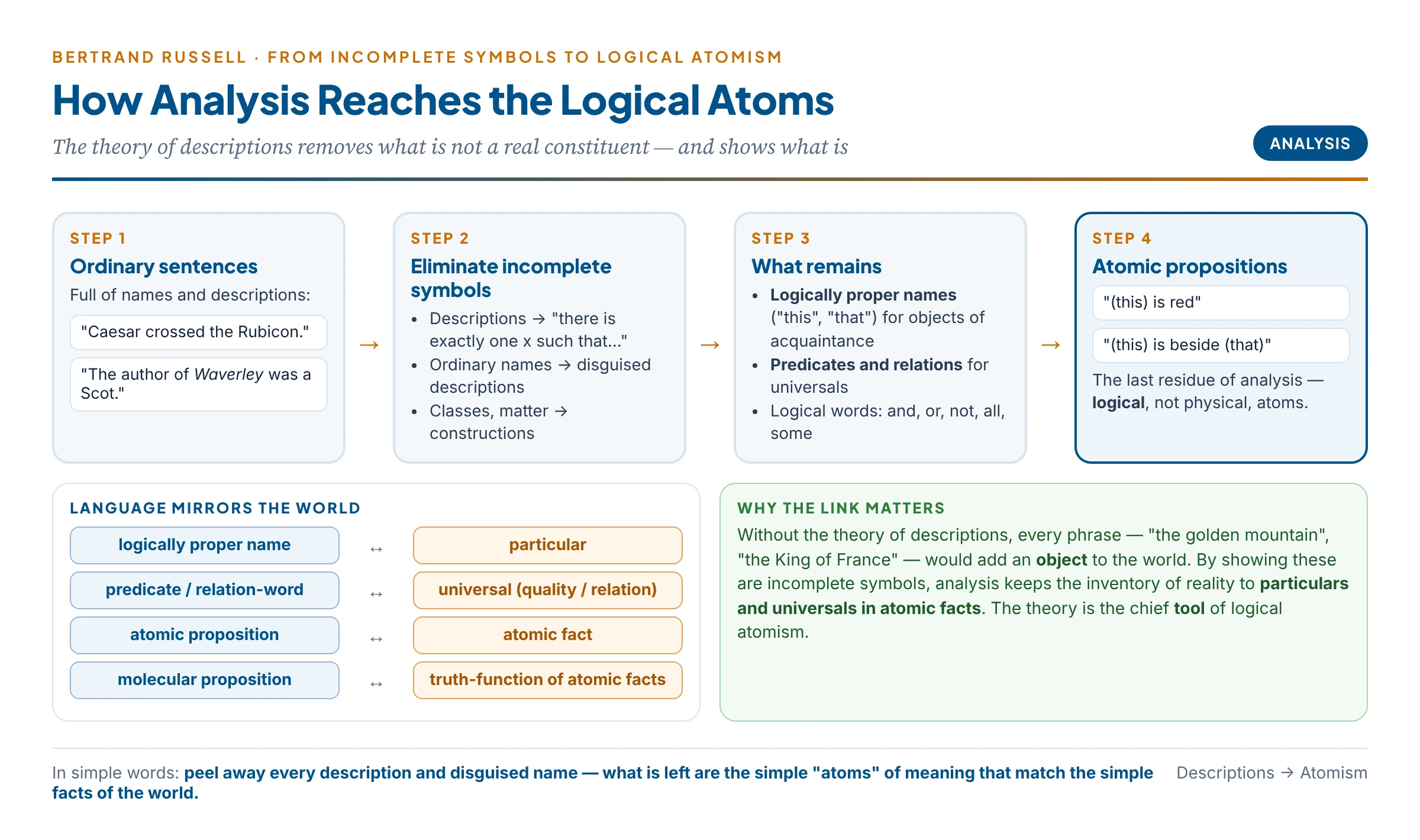
- Step 1 — Analysis eliminates incomplete symbols. Every sentence containing a description can be rewritten without it. Sentences about classes, numbers, physical objects and persons can be rewritten in the same way.
- Step 2 — What remains at the end of analysis? When all incomplete symbols have been eliminated, we are left with sentences containing only logically proper names (for particulars we are acquainted with — “this”, “that”) and predicates and relation-words (for universals). These are atomic propositions: “(this) is red”, “(this) is beside (that)”.
- Step 3 — Language mirrors the world. If an ideal language contains only such atomic propositions and the truth-functional combinations of them (and, or, not), then its structure mirrors the structure of reality: atomic facts composed of particulars and universals.
- Step 4 — The atoms are logical, not physical. The “atoms” reached are not bits of matter but the simplest elements of meaning — “logical atoms“. This is logical atomism.
- Hence the relation. The theory of descriptions is the chief analytic tool of logical atomism. It tells us what is not a genuine constituent of the world (whatever is denoted by an incomplete symbol), and thereby shows what is: the particulars and universals named in fully analysed propositions. Without it, every description would bring a new “object” into the world, and the inventory of reality would be endless.
Critical Evaluation
Objections to the Theory of Descriptions
- Strawson’s “On Referring” (1950). Strawson argued that Russell confused sentences with their uses:
- A sentence (“The King of France is wise”) is neither true nor false; it is significant if there are rules for its correct use. Only a use of it — a statement made on a particular occasion — can be true or false. Uttered in the reign of Louis XIV it would have made a true or false statement; uttered today, it makes neither.
- A speaker who uses “the King of France” refers to something; he does not assert that it exists. The existence of the King is a presupposition of the statement, not part of what is stated (not “entailed” by it).
- When the presupposition fails, “the question of whether his statement was true or false simply didn’t arise” — there is a truth-value gap, not falsity.
- Meaning is not the object referred to. The meaning of an expression is not the thing it refers to — “the brick is broken” does not mean that the meaning of “brick” is broken. Russell, Strawson says, identified meaning with reference.
- Uniqueness. “The table is covered with books” does not claim that there is only one table in the universe; ordinary definite descriptions depend on context.
- Russell’s reply (1957). Russell answered that Strawson was concerned with the everyday use of words, while he was concerned with constructing a precise logical language; that whether we call the sentence “false” or “neither true nor false” is largely a verbal matter; and that Strawson’s appeal to the “time of utterance” merely introduces the problem of “egocentric” words like “now” and “present”.
- Referential uses. Later philosophers noted that a description can be used simply to pick someone out — “the man drinking a martini is a famous scientist” — so that a speaker may say something true about the person meant even if the description does not quite fit him. Russell’s analysis fits the attributive use (“whoever is F”) better than the referential use.
- Proper names are not descriptions. If “Aristotle” meant “the teacher of Alexander”, then “Aristotle might never have taught Alexander” would be self-contradictory — but it is not. Kripke argued that names are “rigid designators” that pick out the same individual in every possible situation, not abbreviated descriptions.
- Meinong’s defenders. Some argue that we do think and talk about fictional and impossible objects (Sherlock Holmes, the round square) as objects, and that a theory of such “non-existent objects” is coherent.
- Inconsistency with Russell’s own ontology. Having used Ockham’s razor to remove the King of France, Russell later admitted negative facts and general facts into the world (see the next article) — critics say this violates the same razor.
- Later Wittgenstein and ordinary language. Meaning is use in a language-game, not a hidden logical form beneath grammar; Russell’s “ideal language” is a philosopher’s construction.
- Too narrow an acquaintance. If only “this” and “that” are logically proper names, almost nothing in ordinary language is a genuine name — an unrealistic picture of how reference works.
Replies and Strengths
- Logic needs bivalence. In mathematics and science we want every well-formed sentence to be true or false; Russell’s theory provides this without ad hoc rules.
- Clear treatment of scope. The distinction between primary and secondary occurrences (wide and narrow scope) remains a standard tool in logic and linguistics.
- No Meinongian jungle. The theory explains talk about the non-existent without contradictory objects.
- Model of analysis. It showed that philosophical puzzles can be dissolved by revealing logical form — the defining method of analytic philosophy.
- Russell’s answer to Strawson is partly right: the two were doing different jobs — one analysing logic, the other describing ordinary usage.
Critics and Defenders
Criticism — Critics
- Strawson: confuses sentence and use; existence is presupposed, not asserted; truth-value gap.
- Referential-use theorists: descriptions can simply pick someone out.
- Kripke: names are rigid designators, not disguised descriptions.
- Neo-Meinongians: non-existent objects are coherent.
- Later Wittgenstein: meaning is use, not hidden logical form.
- Ockham critics: negative and general facts contradict Russell’s own razor.
Defence — Defenders and strengths
- Bivalence preserved for scientific language.
- Scope distinction solves excluded middle.
- Substitution puzzle solved — George IV’s question was not trivial.
- Negative existentials made harmless.
- Ramsey: “that paradigm of philosophy”.
- Quine: shaves “Plato’s beard”.
Cross-Tradition Comparison
Russell, Meinong, Frege and Strawson
| Question | Meinong | Frege | Russell | Strawson |
|---|---|---|---|---|
| What does “the present King of France” stand for? | A non-existent object | Has sense, no reference | Nothing — an incomplete symbol | Used to refer; reference fails |
| “The present King of France is bald” is… | About a real (non-existent) object | Neither true nor false | False | Neither true nor false (presupposition fails) |
| Existence of the King is… | Not needed for the object to have properties | Presupposed | Asserted (part of what is said) | Presupposed |
| Basic distinction | Being vs being-so | Sense vs reference | Grammatical vs logical form | Sentence vs use |
Indian Debates on Empty Terms
| Point | Russell | Nyāya | Buddhist (apoha) | Bhartṛhari (Grammarian) |
|---|---|---|---|---|
| Stock examples | King of France, golden mountain, round square | Hare’s horn (śaśa-viṣāṇa), sky-flower (gagana-kusuma), son of a barren woman (vandhyā-putra) | Same examples | Same examples |
| Do such words refer? | No; incomplete symbols | No real object; they are unreal (alīka) | Words never refer to real universals; they exclude the other (anyāpoha) | Words give their objects a “metaphorical existence” (upacāra-sattā) in thought |
| “The hare’s horn does not exist” means… | No x is both … and … | The relation of horn to hare is absent; horn and hare are each real | A conceptual construction is negated | The mentally presented object is denied outer existence |
Indian Connect — Key takeaways
- Navya-Nyāya and Russell. The Naiyāyikas analysed “the hare’s horn does not exist” not as denying a strange object, but as denying a relation between two real things — horns (which exist, on cows) and hares (which exist) — that is, a relational absence (saṃsargābhāva). Like Russell, they analysed the empty phrase into real constituents plus a false combination.
- Bhartṛhari and Meinong. The grammarian-philosopher Bhartṛhari held that every word presents its object to the mind with a kind of verbal or metaphorical being (upacāra-sattā), so that even “hare’s horn” has an object of thought. This is close to Meinong, whom Russell opposed.
- Buddhist apoha. For the Buddhist logicians, words never name real universals; “cow” means “not non-cow”. Like Russell, they deny that every meaningful word must stand for a real entity — but they go further and deny real universals altogether.
Synthesis (Siddhānta)
Russell’s Theory of Descriptions solved, with one analytical move, a cluster of puzzles that had troubled philosophers since Plato: how we can speak meaningfully of the non-existent, how identity statements can be informative, and how the law of excluded middle survives sentences about kings who do not exist. The move was to deny that descriptions are names. “The so-and-so” and “a so-and-so” are incomplete symbols: meaningless in isolation, they contribute to the meaning of whole sentences which, once analysed, contain no description at all but claims of existence, uniqueness and predication. “The present King of France is bald” is meaningful and false; “the golden mountain is very high” is false, not true of a non-existent mountain; “I met a man” says only that something was both met by me and human.
The theory revealed the gap between grammatical form and logical form, gave a powerful example of Ockham’s razor, explained how knowledge by description extends beyond acquaintance, and became the chief tool of logical atomism. Strawson’s criticism — that existence is presupposed rather than asserted, and that truth belongs to uses of sentences rather than sentences — showed that ordinary language works differently from Russell’s ideal logic; but in logic, linguistics and computer science Russell’s analysis remains a standard.
- Database queries and AI. A query for “the customer with ID 42” that returns no record or two records is exactly a failed existence or uniqueness clause; systems must decide whether to report “false” or “no answer” — Russell’s or Strawson’s choice.
- Fake news and loaded questions. “Why did the minister resign?” smuggles in the claim that the minister resigned; spotting such hidden existential claims is Russell’s lesson in action.
- Indian logic reached a similar analysis of empty terms through the hare’s horn and the sky-flower.
A description is not a name: it does not point at an object — it makes a claim about the world.
Previous Year Questions
- 2025“The golden mountain is very high.” Discuss this statement in the context of Russell’s theory of descriptions.
- 2024Explain Russell’s notion of incomplete symbols. Also explain how this notion leads to the doctrine of logical atomism.
- 2023Why according to Russell is the proposition — “The present king of France is bald” — problematic? Critically discuss.
- 2018How is Russell’s theory of definite description related to his Logical Atomism? Discuss and give reasons for your answer.
- 2017How is the statement ‘I met a man’ semantically problematic for Russell? How does he account for the meaningfulness of this statement?
- 2015What do you understand by incomplete symbols? What role do they play in Russell’s theory of meaning?
- 2012Explain the theory of definite descriptions according to Russell.
- 2011What is Russell’s idea of ‘Incomplete symbols’ in his theory of description? Discuss.
- 2007State and discuss Russell’s analysis of Definite Descriptions.
- 1997Elucidate Bertrand Russell’s theory of descriptions, and examine it with special reference to its criticism by P. F. Strawson.