

Moore, Russell and Early Wittgenstein: Defence of Commonsense; Refutation of Idealism; Logical Atomism; Logical Constructions; Incomplete Symbols; Picture Theory of Meaning; Saying and Showing.
Official Syllabus: Paper I, Section A, Unit 6
Logical Atomism is Bertrand Russell’s theory of what the world is made of and how language represents it. It holds that the world is not one indivisible Absolute, as the Hegelians claimed, but a plurality of independent facts; that these facts are built out of ultimate, simple elements — particulars (such as momentary patches of colour or sounds) and universals (qualities and relations); and that a logically perfect language would mirror this structure exactly, with atomic propositions corresponding to atomic facts and complex propositions built from them by logical connectives. The “atoms” are reached not by physics or psychology but by logical analysis: they are “logical atoms and not physical atoms“. Russell presented the doctrine in his 1918 lectures, The Philosophy of Logical Atomism, acknowledging a large debt to his former pupil Wittgenstein.
In simple words
Think of a big LEGO model of a city. However complicated it looks, it is built from a small set of basic bricks joined in particular ways. Logical atomism says the world is like that: complicated facts (“the Prime Minister met three Chief Ministers in Delhi yesterday”) can be broken down into simple facts, and simple facts into simple elements — “this is red”, “this is beside that”. And a well-built language would have exactly one “word-brick” for each “world-brick”.
Context & Problem
From Hegelian Monism to Logical Pluralism
- Russell’s Hegelian start. As a young man Russell accepted the monistic idealism of Bradley and the Hegelians: the world is essentially mental, and apparently separate facts can be understood only in relation to the whole of reality. Truth belongs only to the whole; every partial truth is partly false.
- Why he rejected it:
- It undermines mathematics. Mathematics needs many distinct terms (numbers, points) and real relations between them; monism dissolves these into one whole.
- Truth is correspondence to particular facts. “Napoleon married Josephine” is true because of a particular fact, not because of its place in the Absolute.
- It makes analysis impossible. If no element can be understood in isolation but only after one sees how it fits the whole, then no analysis into simple parts can ever begin.
- The Hegelian objection and Russell’s reply. Hegelians said that analysis is falsification: when you analyse an object into parts, it ceases to be what it was; things are real only as a unity, and apart from it are mere appearance. Russell replied that analysis does not destroy; it reveals the constituents that were always there.
- External relations. The deepest disagreement concerned relations. Idealists held that all relations are internal — essential to their terms — and finally dissolve into the single Absolute. Russell held that relations are real and external: “A is greater than B” cannot be reduced to a property of A alone or of B alone; “is taller than”, “is to the left of”, “loves” are genuine relations between independent terms. Real relations make a plural world possible.
- From monism to pluralism. So Russell moved to pluralistic realism: the world consists of many independent elements standing in real relations — a view he shared with Moore.
What “Logical Atomism” Means
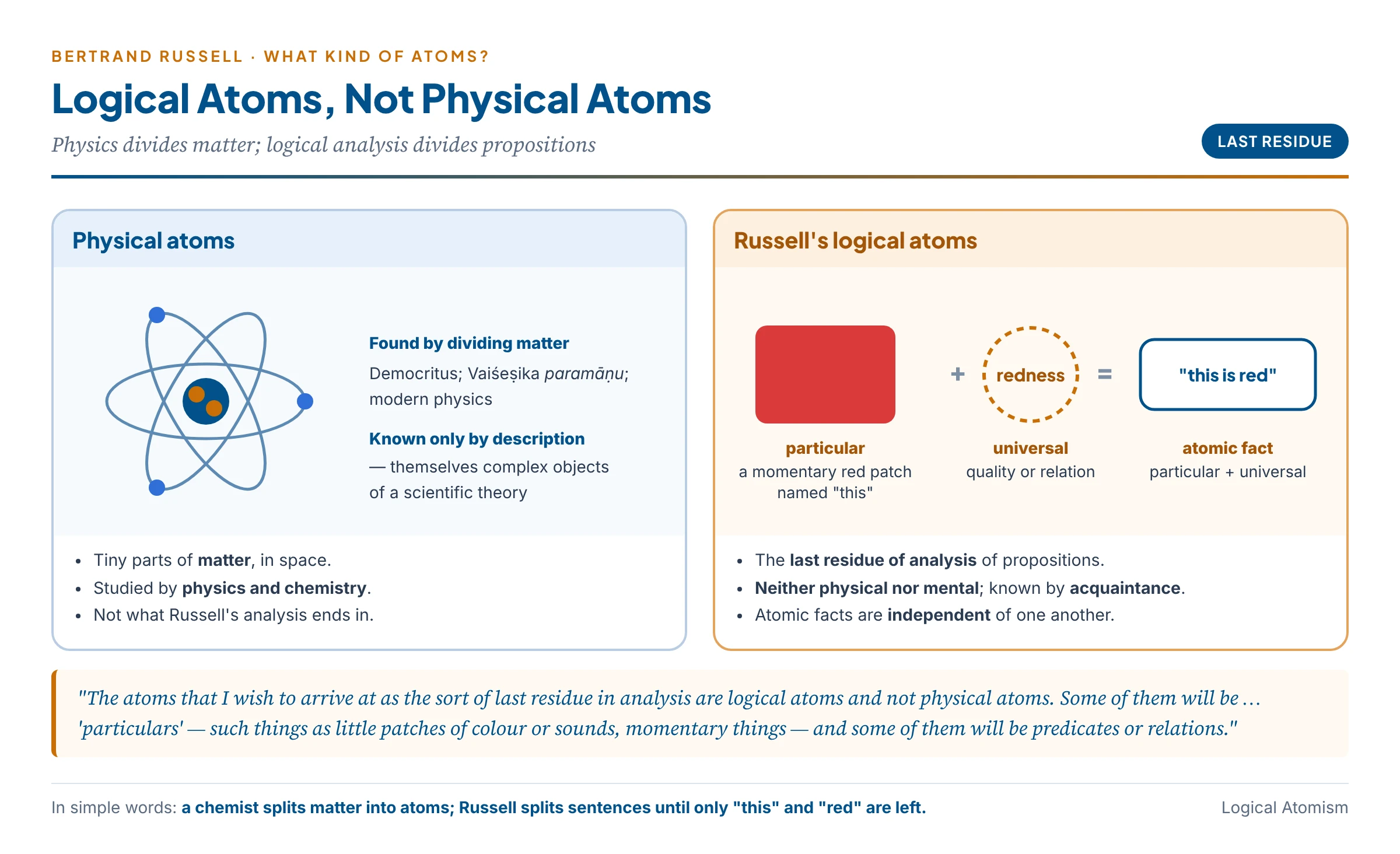
- Russell’s own explanation (the 2020 question): “The reason that I call my doctrine logical atomism is because the atoms that I wish to arrive at as the sort of last residue in analysis are logical atoms and not physical atoms. Some of them will be what I call ‘particulars’ — such things as little patches of colour or sounds, momentary things — and some of them will be predicates or relations and so on.“
- An atom of analysis. An atom is the point beyond which no further analysis is possible — the ultimate, irreducible unit revealed by logical analysis. Philosophy’s task is to reach these simple elements by analysing complex (“gross”) objects into simpler constituents.
- Three characteristics of logical atomism:
- It is a metaphysical theory: it describes the structure of reality and answers “What can be known about the world?”
- It is pluralist: reality consists of many independently existing objects and facts.
- It seeks the simplest units needed for an adequate description of the world.
- Two inseparable aspects:
- Metaphysical (actual) aspect — concerned with the nature of reality and its facts.
- Logical (linguistic) aspect — concerned with the structure of the language that describes reality.
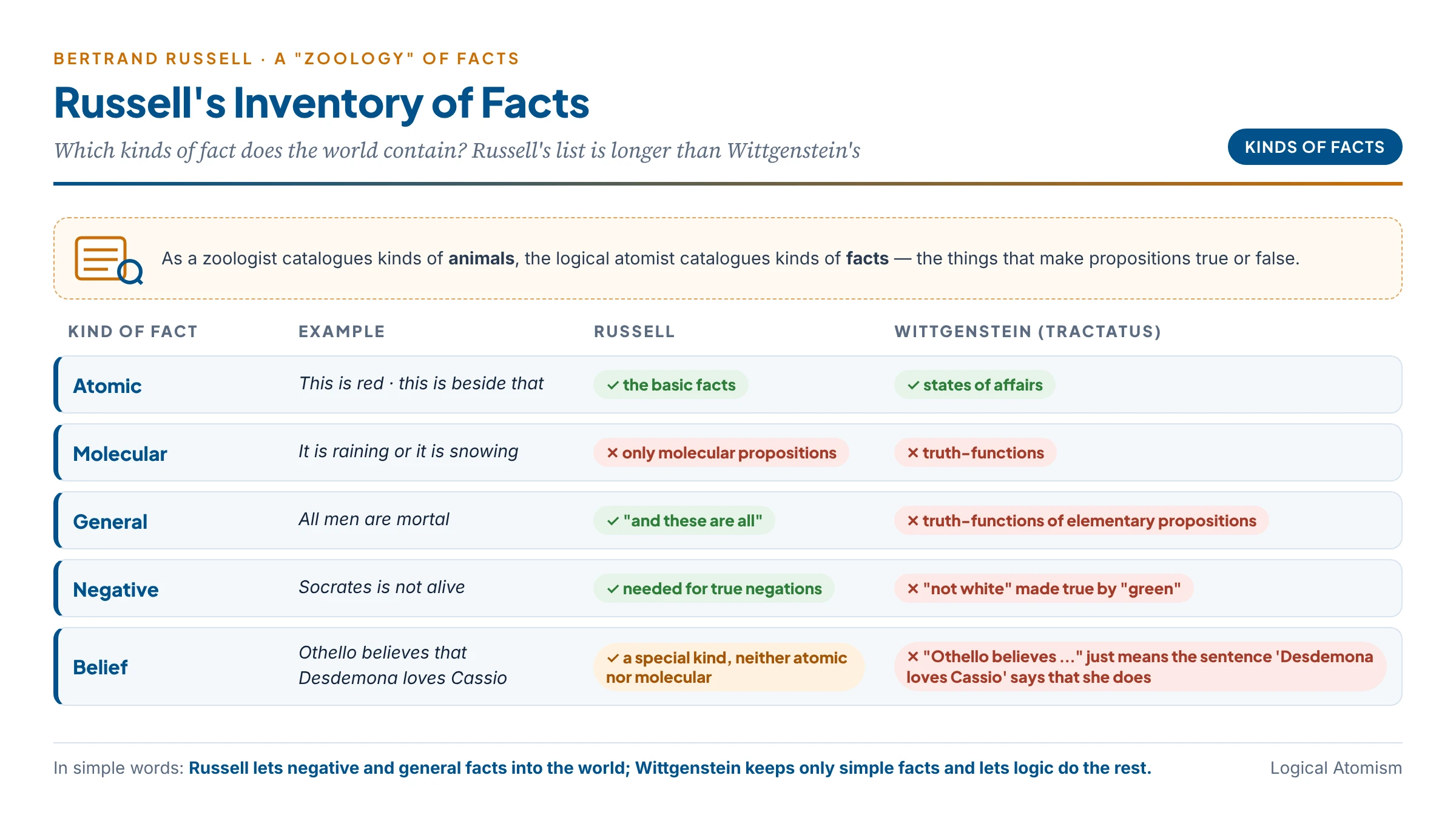
- An inventory of the world. Russell compared his aim to zoology: as zoology classifies the kinds of animals, logical atomism classifies the kinds of facts — atomic, general, negative, belief facts and so on.
- Logical, not psychological, analysis. Hume analysed ideas into impressions — a psychological analysis of how the mind works. Russell replaces this with a logical analysis of concepts and propositions, which makes philosophy more objective and scientific.
- Debt to Wittgenstein. Russell said that the lectures were “very largely concerned with explaining certain ideas which I learnt from my friend and former pupil Ludwig Wittgenstein“. Wittgenstein’s Tractatus (1921) gave the most rigorous version of the doctrine — and differed from Russell’s on important points (section 13).
Core Doctrine
1. Philosophy as Logical Analysis
- No grand systems. Philosophy does not build speculative systems about the universe as a whole. Its main task is to clarify concepts, propositions and beliefs by analysing them with the help of logic.
- Language misleads. Many philosophical problems arise not because reality is mysterious but because ordinary language is vague, ambiguous and logically confused. Grammar hides the true logical structure of what we say.
- Breaking down the complex. Logical analysis breaks complex propositions into simpler components until it reaches atomic propositions, which correspond to atomic facts and form the foundation of knowledge.
- Critical function. Analysis eliminates pseudo-problems, false assumptions and meaningless metaphysics. Once language is properly analysed, many traditional disputes simply disappear.
- Philosophy and science. Philosophy does not compete with science in discovering facts; it clarifies the concepts and assumptions on which knowledge rests. Russell wrote in 1924 that the most important part of philosophy consists in “criticizing and clarifying notions which are apt to be regarded as fundamental and accepted uncritically” — mind, matter, consciousness, knowledge, experience, causality, will, time — notions “infected with vagueness“.
- The ideal language. The central thesis of logical atomism is that an ideal language, properly constructed, would be isomorphic with reality: precise, unambiguous and logically perfect, with one name for every simple and never the same name for two simples.
2. The World Consists of Facts, Not Things
- What a fact is. A fact is “the kind of thing that makes a proposition true or false“. If I say “It is raining“, what makes it true or false is a certain condition of the weather — a fact.
- Facts are not things. A fact is not a particular existing thing like a river or a mountain, or like Napoleon. “Napoleon” is not a fact; but “Napoleon is ambitious” or “Napoleon married Josephine” expresses a fact. A fact is “that a certain thing has a certain quality, or that certain things have a certain relation”.
- Facts are expressed by sentences, not names. A thing is named by a single word; a fact is expressed by a whole sentence.
- Facts are neither true nor false. There are just facts; they belong to the objective world, independent of our thinking. It is propositions — “the vehicle of the duality of truth and falsehood” — that are true or false, according as they correspond or fail to correspond to facts.
- Relational, not substance metaphysics. “The book is on the table” is not about the book alone or the table alone, but about the relation “being on” connecting them. By putting facts before things, Russell moves philosophy from substance-based metaphysics to a relational and logical understanding of reality.
In simple words
A pile of words — “Virat”, “Anushka”, “married” — tells you nothing true or false. Only when they are arranged into a sentence — “Virat married Anushka” — do you get something that can be true or false. Russell says the world is the same: a heap of things is not yet a world; the world is made of facts — things standing in relations or having qualities.
3. Particulars and Universals: The Logical Atoms
- Particulars. Individual, concrete entities that can be named only by logically proper names. In Russell’s strict view these are momentary items of experience — “little patches of colour or sounds, momentary things” — not enduring tables or persons, which are complex.
- Universals. Qualities and relations that can be shared by many particulars — redness, hardness, being taller than, being earlier than.
- Both are real. Russell rejects the idea that universals are merely mental or linguistic: without universals we could not explain similarity between things or meaningful predication. At the same time, he rejects the idealist reduction of particulars to appearances of the Absolute.
- Three kinds of constituent. Atomic facts have constituents of three types: particular, quality, relation. Quality and relation together form the category of universal. So all the “atoms” fall into particulars and universals.
4. Atomic Facts and Atomic Propositions
- Atomic fact. The simplest kind of fact: a particular having a quality, or particulars standing in a relation. It cannot be broken into simpler facts.
- Kinds of atomic fact:
- Monadic — one particular and a quality: “this is red“, “this is white”.
- Dyadic — two particulars and a relation: “this is to the left of that“, “this is before that”.
- Triadic — three particulars: “A gives B to C“; and so on for relations of more terms.
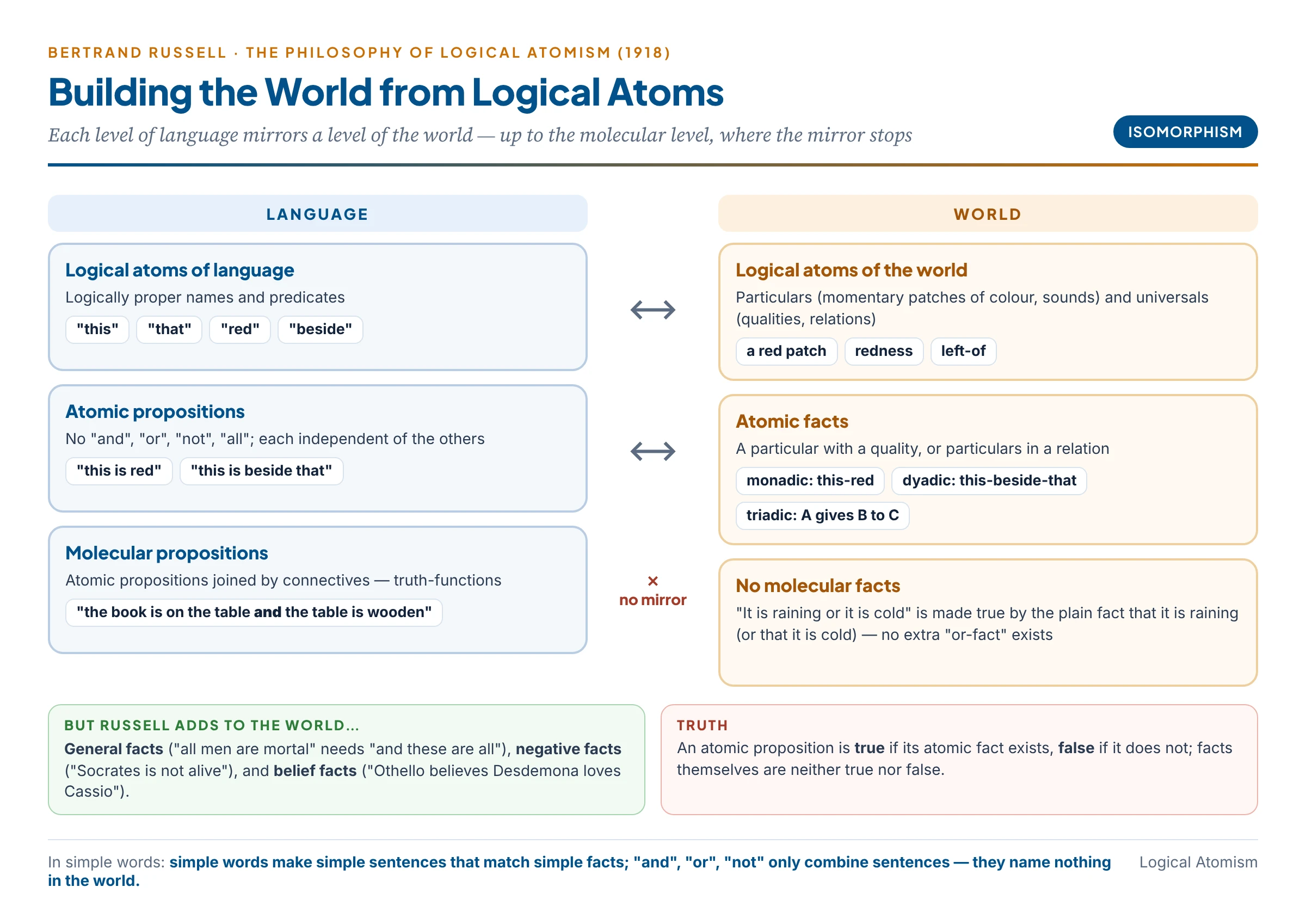
- Atomic proposition. A proposition that asserts an atomic fact. It contains no logical connectives (no “and”, “or”, “not”, “if…then”) and no “all” or “some”. In a perfect language it would consist of logically proper names (“this”, “that”) and a predicate or relation-word: “(this) red”, “(this) beside (that)”.
- Logical independence. Each atomic proposition is independent of every other: its truth or falsity does not depend on the truth of any other proposition.
- Truth. An atomic proposition is true if the corresponding atomic fact exists, and false if it does not. This gives a direct link between language and reality — a correspondence theory of truth.
- Foundation of knowledge. Atomic facts and atomic propositions together form the base on which all complex knowledge is built.
Common confusion
Is “All men are mortal” an atomic fact? No. Some notes give “all men are mortal” as an example of an atomic fact, or give “this is a red rose” as a “simplest fact” different from atomic facts. In Russell’s scheme, an atomic fact contains no generality and no connectives: “this is red”, “this is beside that”. “All men are mortal” is a general proposition; its truth depends on a general fact, which Russell treats as a separate kind.
5. Molecular Propositions and Logical Connectives
- Molecular propositions. Propositions built from two or more atomic propositions by logical connectives: “the book is on the table and the table is wooden“, “A is tall and B is fat“, “either it is raining or it is snowing”, “if this is red then that is blue”.
- Connectives do not name objects. Words like and, or, not, if…then do not refer to anything in the world; they express logical relations between propositions.
- Truth-functions. The truth of a molecular proposition depends only on the truth-values of its atomic components. “It is raining and it is cold” is true only if both parts are true; “it is raining or it is cold” is true if at least one part is true.
- Are there molecular facts? Russell argued that there are no molecular facts corresponding to molecular propositions. An “or” sentence such as “it is raining or it is cold” is made true simply by the atomic fact that it is raining (or the fact that it is cold); there is no extra “disjunctive fact” in the world. Molecular propositions are verified by reducing them to atomic ones.
Common confusion
Did Russell believe in “molecular facts”? Many notes speak of molecular facts built out of atomic facts. Russell himself denied that there are molecular facts: the world contains atomic facts (and, he argued, negative and general facts), but no disjunctive or conjunctive facts over and above them. Molecular propositions exist; molecular facts do not.
6. General Facts
- The problem. Can “All men are mortal” be reduced to a long conjunction — “Socrates is mortal and Plato is mortal and Aristotle is mortal and …”? Russell says no. Even if we listed every man, we would still need the further statement “and these are all the men there are” — and that statement is itself general.
- So there are general facts. “I think you must admit general facts as distinct from and over and above particular facts.” Without them, universal knowledge would be impossible.
- Asymmetry of verification. A single atomic fact can falsify a universal proposition — one metal that contracts on heating falsifies “all metals expand on heating” — but no list of particular facts can by itself verify it.
- Wittgenstein’s view. For the early Wittgenstein there are no general facts: general propositions are truth-functions of elementary propositions (a kind of molecular proposition), and their truth is settled entirely by elementary facts.
In simple words
A teacher calls the roll: Asha — present, Ravi — present, Meena — present… Can she now write “all students are present“? Only if she also knows “and these are all the students on the register“. That extra piece of knowledge is itself general. Russell says the world must contain such a general fact for “all students are present” to be true.
7. Negative Facts
- Russell’s position. To explain why “Socrates is not alive” is true, we must admit a negative fact — Socrates’ not being alive. A false negative proposition can be refuted by a positive fact (if Mr A is at home, “Mr A is not at home” is false). But a true negative proposition needs something to make it true, and no positive fact by itself does so.
- Examples of positive and negative facts:
- The positive fact of Mr X’s being in the college makes “Mr X is in the college” true.
- The negative fact of Mr A’s not being at home makes “Mr A is not at home” true.
- Wittgenstein’s objection. Facts are combinations of objects; objects cannot be “negative”; so there are no negative facts. A negative proposition is verified by positive facts: “This wall is not white” is made true by the positive fact that the wall is green; “the board is not white” by “the board is black”.
- Russell’s reply:
- “This wall is green” and “this wall is not white” do not mean the same. To get from green to not-white we need the further proposition that green is incompatible with white — and incompatibility is itself a negative notion.
- Some negative propositions — “Socrates is not alive” — cannot be verified by any simple positive fact.
- So, Russell argued, denying negative facts is less reasonable than accepting them. Russell reported that when he defended negative facts at Harvard in 1914, it “nearly produced a riot“.
In simple words
You open the fridge and say “there is no milk“. What makes this true? Wittgenstein would point to the positive contents — eggs, curd, vegetables. Russell would say: listing what is there does not by itself tell you what is not there; you also need the fact of milk’s absence. That is a negative fact.
Common confusion
Was Russell’s famous “no rhinoceros in the room” argument about negative facts? Not quite. The story usually told (sometimes with a “hippopotamus”) comes from 1911, when the young Wittgenstein refused to admit that it was certain there was no rhinoceros in Russell’s lecture room, though Russell looked under all the desks. It was about whether empirical propositions can be known for certain — not Russell’s later theory that negative facts exist. Keep the two apart.
8. Belief Facts and Other Propositional Attitudes
- A new kind of fact. “Othello believes that Desdemona loves Cassio” is true, though “Desdemona loves Cassio” is false. So the truth of a belief-statement does not depend on the truth of the proposition believed. Belief propositions are therefore neither atomic nor molecular (not truth-functions of their parts).
- Mental (intentional) facts. Russell recognised belief facts — “I think that X is Y” — as a distinct kind. Their truth depends not on X and Y but on my attitude to them.
- Wittgenstein’s objection. Russell’s analysis of judgement treated it as a relation between a mind and several separate objects (Othello, Desdemona, loving, Cassio). Wittgenstein objected that such an analysis cannot prevent us from “believing” nonsense — such as “this table penholders the book“. The objection deeply shook Russell, who abandoned his book on the theory of knowledge in 1913.
9. Isomorphism between Language and Reality
- Structural correspondence. By isomorphism Russell means a correspondence of logical structure — not of words and things one by one, but of the form of propositions and the form of facts.
- The mirror. In an ideal language:
| Language | World |
|---|---|
| Logically proper name (“this”) | Particular |
| Predicate / relation-word (“red”, “beside”) | Universal (quality / relation) |
| Atomic proposition | Atomic fact |
| Molecular proposition | (No molecular fact) — truth-function of atomic facts |
| General proposition | General fact |
| Negative proposition | Negative fact (Russell) |
- Grammatical form versus logical form. “Socrates is wise” and “The present King of France is bald” look alike but differ logically: the first contains a name of an existing individual; the second, analysed by the theory of descriptions, contains no name but a hidden claim of existence. Logical form shows how propositions really represent facts and prevents us from assuming false existence.
- Why analysis reveals the world. Because language mirrors the world, analysing language to its atomic propositions is a way of discovering the world’s atomic facts. Russell’s logic contained individual variables and propositional functions; correspondingly, the world contains particulars and universals.
10. “Logical Atoms, Not Physical Atoms”
This sub-topic answers the 2020 question directly.
- Not the atoms of physics. Russell’s atoms are not tiny lumps of matter (the atoms of Democritus or modern physics). Physical atoms are themselves complex objects of science, known only by description.
- The last residue of analysis. Logical atoms are what remains when logical analysis of propositions can go no further — the simplest elements of meaning and of fact.
- Two kinds:
- Particulars — momentary sense-given items such as little patches of colour or sounds, each a genuine individual, nameable only by “this” while it is present.
- Universals — predicates and relations (“red”, “to the left of”).
- Atoms of fact. Strictly, the ultimate units of truth are atomic facts: a particular having a quality or particulars in a relation. They are independent of one another: one atomic fact can obtain or fail to obtain without affecting any other.
- Neither physical nor mental. Logical atoms are neither physical nor conscious; they are the linguistic and logical residue of analysis. (This neutrality foreshadows Russell’s later neutral monism.)
- Known by acquaintance. For Russell, atoms are objects of acquaintance — given directly in experience. This ties his atomism to empiricism, and is exactly where Wittgenstein disagreed.
11. The Metaphysics Involved in Logical Atomism
The 2003 question asks for the “conception of metaphysics” in logical atomism.
- Pluralism — reality is many, not one; against Bradley’s monism.
- Realism — facts exist independently of our minds; propositions are true by corresponding to them.
- External relations — relations are real and do not alter the intrinsic nature of their terms.
- Facts as basic — the world is the totality of facts, not things or substances.
- Ontological economy — the only ultimate constituents are particulars and universals; tables, persons, classes and numbers are logical constructions or “logical fictions” (the next article).
- No enduring substance — particulars are momentary; a “thing” or a “self” is a series of such particulars, not a permanent substrate.
- Metaphysics through logic — the structure of reality is read off from the structure of a logically perfect language. Metaphysics becomes analysis, not speculation.
- Empiricist foundation — the atoms are things we are acquainted with; complex knowledge is built from them.
12. Atomic and General Propositions: How Are They Justified?
This answers the 2013 question.
- Atomic propositions. They are justified by direct acquaintance with the corresponding atomic facts: I am acquainted with this red patch, and so know that “this is red”. Their justification is perceptual and immediate; no other proposition is needed.
- Molecular propositions. They are justified truth-functionally: once the truth-values of the atomic components are known, the truth of the molecular proposition follows.
- General propositions. They cannot be justified by atomic propositions alone, for no list of particular facts includes “and these are all”. So:
- Empirical generalisations (“all men are mortal”) rest on induction from particular cases, and remain probable rather than certain.
- Logical generalisations (“whatever is red is red”, “if all men are mortal and Socrates is a man, Socrates is mortal”) are known a priori, by insight into logical form.
- Russell concluded that some general knowledge must be primitive — not derived from particular facts — otherwise we could know nothing general at all.
- Contrast. For Wittgenstein, general propositions are simply truth-functions of elementary propositions, and logical generalities are tautologies that say nothing about the world.
13. Why Wittgenstein Disagreed with Russell’s Atomism
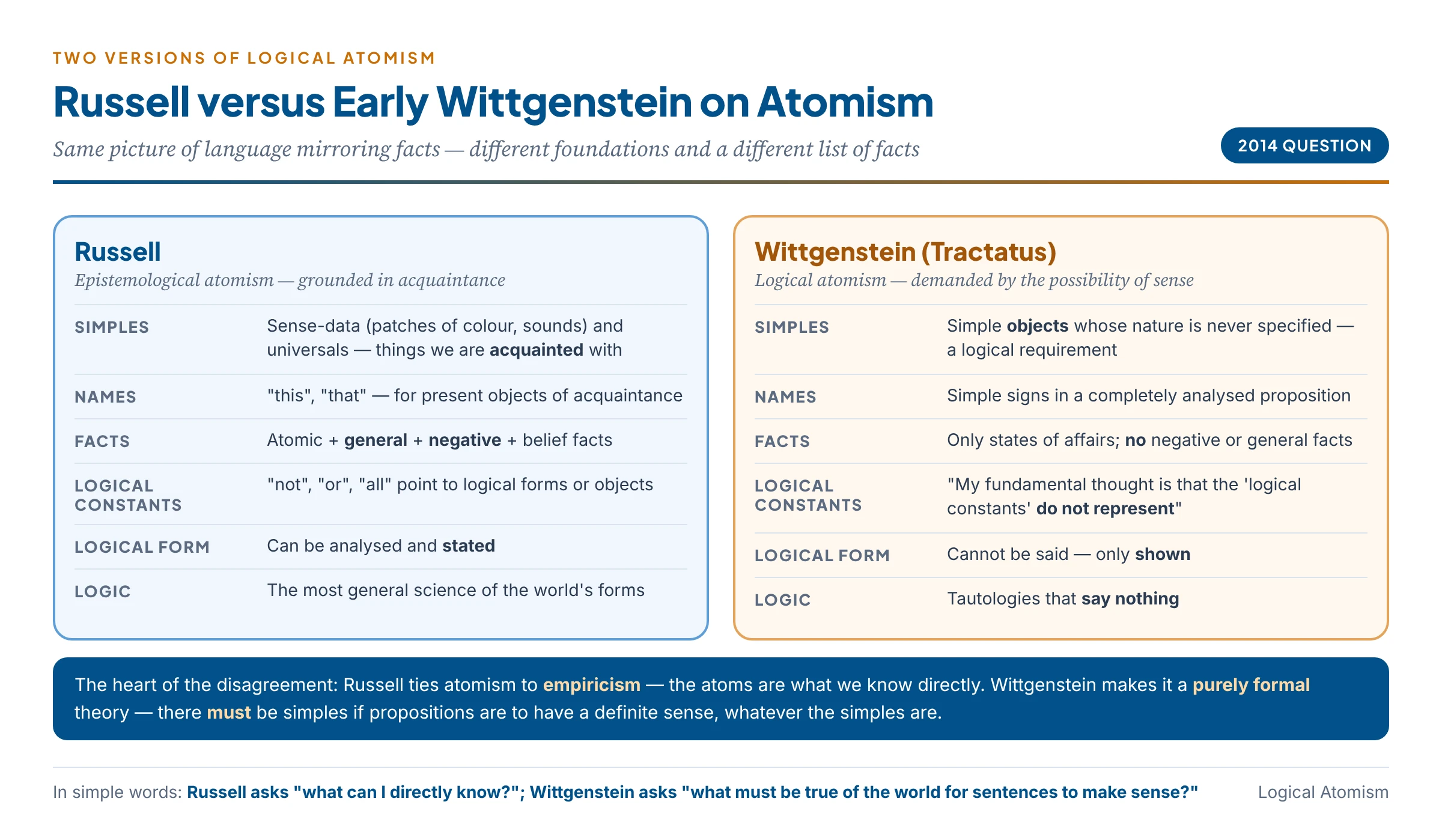
Russell called the Tractatus the most authoritative formulation of logical atomism, yet the two versions differ deeply (the 2014 question).
| Point | Russell’s atomism | Wittgenstein’s atomism (Tractatus) |
|---|---|---|
| Basis | Epistemological: atoms are objects of acquaintance (sense-data, universals) | Logical: simple objects are demanded by the very possibility of sense; we need not know what they are |
| Examples of simples | Patches of colour, sounds; “this”, “that” | None given — simples are a logical requirement, like an electron in theory |
| Universals | Real constituents (qualities, relations) | Not separate constituents; the way objects hang together in a state of affairs |
| Negative and general facts | Accepted | Rejected; negation and generality belong to propositions, not facts |
| Logical constants (“not”, “or”) | Treated as stand-ins for logical objects or forms | “My fundamental thought is that the ‘logical constants’ do not represent“ |
| Logical form | Can be analysed and stated | Can only be shown, not said |
| Theory of judgement | Belief is a relation of a mind to several objects | Must make it impossible to judge nonsense; “A believes it is raining” has the form “the sentence ‘it is raining’ says that it is raining” |
| Logic | Reveals the most general features of the world; the “zoology” of facts | Propositions of logic are tautologies that say nothing |
- The core of the disagreement. Russell tied atomism to empiricism: the atoms are what we are acquainted with. Wittgenstein treated atomism as a purely formal theory about the conditions of meaningful language: there must be simple objects if propositions are to have determinate sense, whatever those objects turn out to be.
- Wittgenstein’s tribute and criticism. Wittgenstein credited Russell with showing that “the apparent logical form of the proposition need not be its real form“, but rejected Russell’s view that logic and philosophy could describe the structure of the world in propositions — that structure can only be shown.
Critical Evaluation
Objections to Logical Atomism
- Where are the simples? No one has ever produced an indisputable example of a logical atom. Are patches of colour really simple? A patch has parts, shades and edges; analysis seems to go on without end.
- The colour-exclusion problem. Atomic propositions are supposed to be independent. But “this is red” and “this is green” (said of the same spot at the same time) cannot both be true. Their incompatibility shows that they are not independent atomic propositions — a difficulty that led Wittgenstein to abandon atomism.
- Logically proper names are too few. If only “this” and “that” are genuine names, almost nothing in real language is a name, and the “ideal language” becomes a private language of momentary sense-data, which no one could teach or share.
- Negative and general facts violate Ockham’s razor. Russell used the razor to remove the King of France and the golden mountain, but then added negative facts and general facts to the world. Critics see an inconsistency: the same economy should have removed them too.
- Is analysis falsification after all? A melody is more than its notes; a face is more than its features. Holists argue that wholes have emergent structure that atomistic analysis misses.
- The ideal language is not our language. Ordinary language is not a disguised logical calculus; later Wittgenstein argued that meaning is use in many different language-games, not correspondence to atomic facts. Ryle and Austin called sense-data and logical atoms philosophical myths.
- Holism of meaning and belief. Later analytic philosophers (notably Quine) argued that sentences face experience not one by one but as a body; no sentence has its own private set of confirming facts — contrary to the atomistic picture.
- Russell’s own retreat. Russell himself soon modified the doctrine — turning to neutral monism and admitting that complete analysis might never end.
Replies and Strengths
- Method over doctrine. Even if no one has found the final atoms, the method of analysing complex statements into simpler ones transformed philosophy and logic.
- Correspondence theory of truth. The idea that true propositions correspond to facts remains a natural and widely held account of truth.
- Pluralism and external relations won the argument against British monism and made modern logic and mathematics philosophically respectable.
- Precision. Logical atomism set the standard of clarity that shaped logical positivism, the Tractatus, and later analytic philosophy.
- Modern echoes. Knowledge representation in computer science — databases of simple facts combined by logical operators — follows an atomistic design.
Critics and Defenders
Criticism — Critics
- Wittgenstein (early): no negative or general facts; logical constants do not represent; form only shown.
- Wittgenstein (later): no simples, no ideal language; meaning is use.
- Colour-exclusion problem: atomic propositions are not independent.
- Ockham critics: negative and general facts multiply entities.
- Holists: analysis falsifies wholes; meaning faces experience as a body.
- Ryle and Austin: sense-data and logical atoms are myths.
Defence — Defenders and strengths
- Analysis as the model philosophical method.
- Pluralism and external relations against monism.
- Correspondence theory of truth made precise.
- Logical form distinguished from grammatical form.
- Influence on the Tractatus and logical positivism.
- Computing: fact databases and logic programs are atomistic.
Cross-Tradition Comparison
Logical Atomism and Indian Atomism and Analysis
| Point | Russell’s logical atomism | Vaiśeṣika | Abhidharma Buddhism | Nyāya / Mīmāṃsā on absence |
|---|---|---|---|---|
| Ultimate units | Logical atoms: momentary particulars and universals | Physical atoms (paramāṇu) of earth, water, fire, air, plus other categories | Momentary elements (dharmas) | — |
| Method | Logical analysis of propositions | Division of wholes down to the indivisible | Analysis of persons and things into dharmas | Analysis of negative cognition |
| Composite things | Logical constructions (“logical fictions”) | Real wholes (avayavin) produced from parts | Conventional designations (prajñapti), not ultimately real | — |
| Language and reality | Ideal language mirrors facts | Categories (padārtha) are “meanings of words“: whatever exists is knowable and nameable | Two truths: conventional and ultimate | — |
| Negative facts | Accepted (Socrates is not alive) | Absence (abhāva) is a real category | — | Prābhākara Mīmāṃsā: absence is just the bare locus — “no pot” = the bare floor (like Wittgenstein’s “the wall is green”) |
Indian Connect — Key takeaways
- Padārtha means “the meaning of a word”. The Vaiśeṣika categories are literally “word-meanings“, and the school held that whatever exists is knowable (jñeya) and nameable (abhidheya). This is a striking Indian form of the atomist faith that the structure of language and the structure of reality correspond.
- Absence as a category. Russell’s negative facts have a close parallel in the Nyāya-Vaiśeṣika doctrine of absence (abhāva) as a real category, perceived through the absence of a perceivable thing; while the Prābhākara Mīmāṃsakas, like Wittgenstein, held that absence is nothing over and above the positive locus — “there is no pot here” is made true by the bare floor.
- Momentary atoms. Russell’s momentary particulars, out of which tables and selves are constructed, recall the Buddhist theory of momentary dharmas (kṣaṇikavāda), out of which persons and chariots are only conventional designations.
- The difference. Vaiśeṣika atoms are physical and eternal; Russell’s are logical and momentary.
Synthesis (Siddhānta)
Logical atomism was Russell’s attempt to replace the monistic metaphysics of the Hegelians with a pluralistic, realist and analytical picture of the world. Reality is the totality of facts; facts are built from particulars and universals; atomic propositions mirror atomic facts, molecular propositions are truth-functions of them, and a logically perfect language would display the world’s structure exactly. The atoms are logical, not physical: the last residue of analysis. Russell’s inventory went further than Wittgenstein’s — admitting general, negative and belief facts — and was grounded in acquaintance with sense-data, whereas Wittgenstein’s version was purely logical, admitted no negative or general facts, and held that logical form can only be shown.
The theory faced serious problems — the elusiveness of simples, the colour-exclusion problem, the poverty of logically proper names, and the apparent conflict between negative facts and Ockham’s razor — and Russell and Wittgenstein both moved away from it. But its method of analysis, its defence of pluralism and external relations, and its precise correspondence theory of truth left a permanent mark on philosophy, logic and the sciences of information.
- Computer science: relational databases and logic programming store atomic facts and derive complex ones by logical rules — logical atomism in practice.
- Philosophy of science: the hope of building scientific knowledge from simple observation statements began here, and its failures taught the lesson of holism.
- Indian philosophy shows parallel debates about atoms, the meaning of words and the reality of absence.
Analyse the sentence to its simplest parts, and you will find the simplest parts of the world.
Previous Year Questions
- 2024Explain Russell’s notion of incomplete symbols. Also explain how this notion leads to the doctrine of logical atomism.
- 2022What is Bertrand Russell’s method of logical analysis? How does it ultimately end in establishing atomic theory of meaning? Discuss.
- 2020“The reason that I call my doctrine logical atomism is because the atoms that I wish to arrive at as the sort of last residue in analysis are logical atoms and not physical atoms.” Write a note on the nature of atomic facts according to Russell in the light of the above statement.
- 2018How is Russell’s theory of definite description related to his Logical Atomism? Discuss and give reasons for your answer.
- 2014Why does Wittgenstein disagree with Bertrand Russell’s interpretation of atomism in the philosophy of Tractatus? Discuss.
- 2013Distinguish between atomic and general propositions. Show how they are justified as true.
- 2003What is Russell’s logical atomism? Bring out in this connection the conception of metaphysics involved in it.
- 1999Russell’s concept of negative facts.
- 1998Critical Notes on Logical atomism.