

Financial Administration: Monetary and fiscal policies; Public borrowings and public debt; Budgets – types and forms; Budgetary process; Financial accountability; Accounts and audit.
This article: Meaning and scope of financial administration and its place in public administration; fiscal techniques of responsible administration; monetary policy (objectives, quantitative and qualitative instruments, flexible inflation targeting and the Monetary Policy Committee, transmission, development role); monetary–fiscal coordination and RBI autonomy (Section 7, 2018); fiscal policy (Musgrave’s three functions, instruments, Keynesian and neoclassical views, counter-cyclical policy); deficit concepts and deficit financing; the FRBM Act 2003, the N.K. Singh Committee and the debt anchor; tax reforms since 1991; economic reforms and international institutions; fiscal federalism, GST and the Finance Commission (bridge); public borrowing and public debt (types, instruments, contingent liabilities, Articles 266, 292 and 293, debt management and the PDMA debate, sustainability, States’ debt); theories of public debt (burden, crowding out, Ricardian equivalence); international comparisons.
Official Syllabus: Paper I · Unit 1-12 Financial Administration
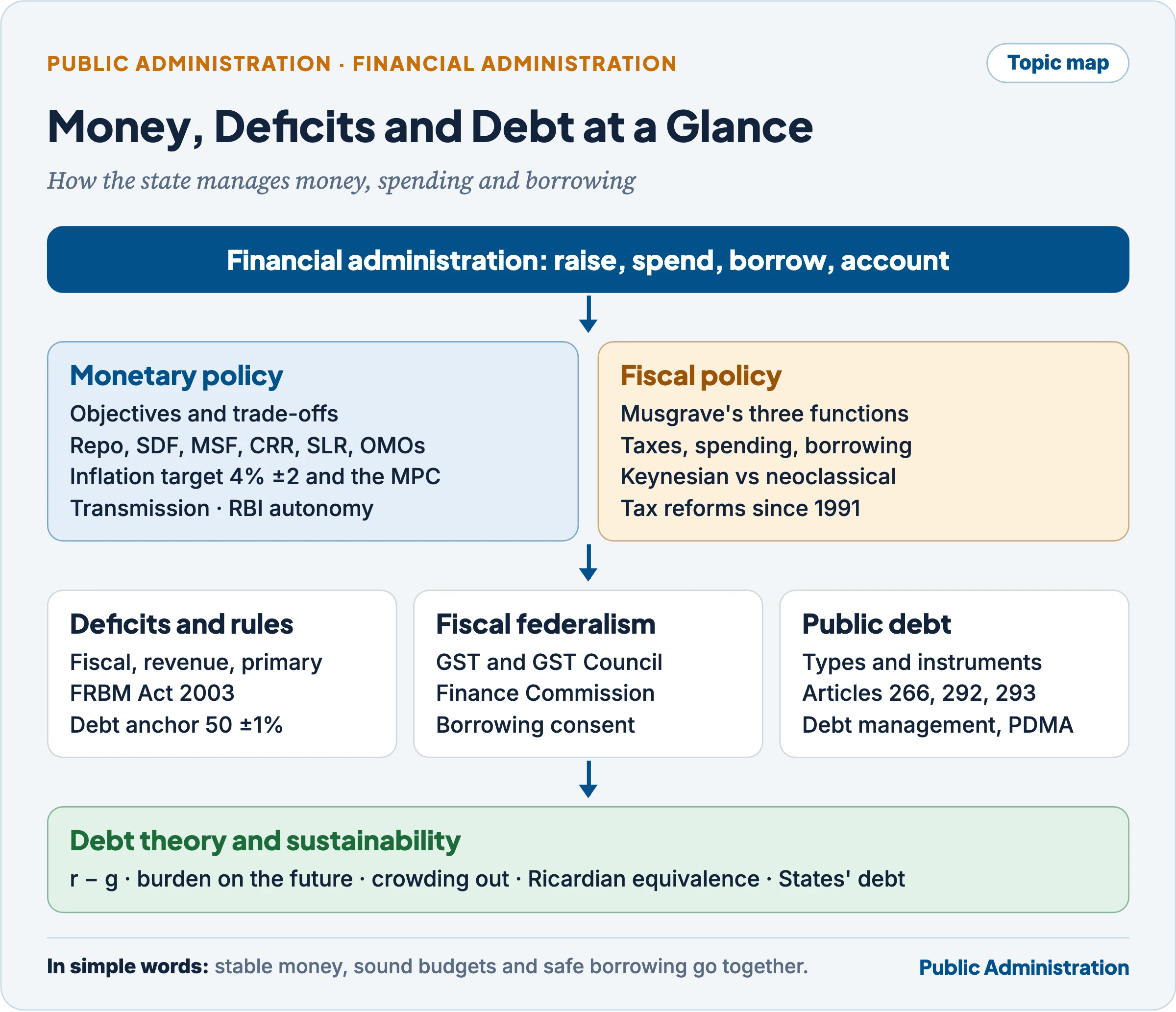
Financial administration is the part of public administration that raises, spends, borrows and accounts for public money. Its two macro-level tools are monetary policy, run by the central bank through the price and quantity of money, and fiscal policy, run by the government through taxes, spending and borrowing. When revenue falls short of spending, the gap is met by public borrowing, and the stock of past borrowing is public debt. Together these decide whether prices stay stable, whether the state can pay for roads, schools and pensions, and how much of tomorrow’s taxes are already promised to today’s lenders.
- The subject sits where economics, law and administration meet: the economist designs the policy, the Constitution and statutes (RBI Act 1934, FRBM Act 2003, Articles 266, 292, 293) set the rules, and administrative agencies (Ministry of Finance, Reserve Bank of India, Finance Commission, CAG) carry it out.
- The other two articles of this unit take up the budget (types, forms and process) and financial accountability, accounts and audit; this article supplies the macro-fiscal frame within which every budget is made.
In simple words
A household runs on three things: what it earns, what it spends and what it borrows. If it spends more than it earns year after year, the loan instalments start eating the grocery money. A government is the same, with two differences: it can also print money through its central bank, and its loans are repaid by taxpayers who may not yet be born. Monetary policy, fiscal policy and debt management are the rules that stop these two extra powers from being misused.
1. Financial Administration: Meaning, Scope and Place in Public Administration
In simple words
Almost every government decision costs money or brings money in. Financial administration is the machinery that plans these flows, gets the legislature’s permission, spends the money, and then proves that it was spent as allowed.
1.1 Meaning
- In a broad sense, financial administration covers every process involved in collecting, budgeting, appropriating, spending, accounting for and reporting on public money, including the management of the government’s assets and liabilities.
- Kautilya, in the Arthashastra, held that all undertakings depend on finance and so the treasury deserves foremost attention; the modern remark often attributed to Lloyd George that “government is finance” makes the same point.
- Finance as the life-blood of administration: no scheme, salary or service can run without money. Lack of funds, or funds released late, is a common reason why well-designed programmes fail in delivery.
1.2 Three objectives
Writers on public finance usually group the aims of financial administration under three heads:
| Objective | What it means | Indian illustration |
|---|---|---|
| Fiscal policy | Using taxes, spending and debt to influence growth, prices, employment and distribution | Capex-led budgets since 2021-22; GST rate rationalisation 2025 |
| Accountability | Spending only as authorised, with honesty and propriety, and answering for it | Appropriation Acts, CAG audit, Public Accounts Committee |
| Management | Getting results at least cost and on time: economy, efficiency, effectiveness | Outcome Budget, PFMS, Direct Benefit Transfer |
- Accountability is the hallmark of public finance because public money is held in trust. In a democracy officials must not only be honest but be seen to be honest; hence the many mechanical and human checks on public money.
- Accountability does not end with correct accounts. It also covers wisdom, faithfulness and economy in spending (the idea behind propriety and performance audit).
1.3 Scope: a continuous chain of operations
Financial administration is a cycle rather than a single act:
- Preparation of the budget: estimating revenue and expenditure for the coming year.
- Legislative sanction: voting of demands, Appropriation and Finance Acts.
- Execution: release of funds, raising of revenue, control of expenditure.
- Treasury and cash management: safe custody of funds, borrowing to meet temporary gaps, debt service.
- Accounting and audit: rendering accounts and their independent audit, followed by legislative review.
These operations are carried out by four sets of actors: the central finance department (in India, the Ministry of Finance), the legislature, the financial officers of administrative departments (Financial Advisers, Chief Controllers of Accounts) and the committees of the legislature (Public Accounts, Estimates, Committee on Public Undertakings). The budget cycle is the subject of the article on budgets and the budgetary process; audit and legislative scrutiny are taken up in the article on financial accountability, accounts and audit.
1.4 Why financial administration belongs to public administration
- Most administrative acts have financial consequences: they either draw on the exchequer or bring money into it.
- Finance is an instrument of policy: taxes can be designed to reduce inequality, subsidies to change behaviour, borrowing to stimulate a slack economy.
- It raises organisational questions: what finance machinery there should be, how financial officers relate to line officers, and who controls whom. The old tension between the Finance Ministry’s “treasury control” and the operational freedom of spending ministries is a classic public administration problem.
Why its importance has grown:
- The welfare and developmental state has multiplied public expenditure and made state finances complex.
- Democracy demands that the procedures of public finance be simple enough for an ordinary citizen to follow, at least in outline.
- New techniques (performance and outcome budgeting, digital payments, accrual accounting) have widened what finance departments can measure and control.
1.5 Fiscal techniques and responsible administration
Long before “accountability” became a fashionable word, the purse was the main way of keeping administration responsible. Control over money gives the legislature and the finance department leverage over every agency.
- Legislative appropriation: no money can be drawn from the Consolidated Fund without an Appropriation Act (Article 114); every head of account is a limit.
- Treasury control: the Finance Ministry’s prior sanction for new schemes, posts and re-appropriations; delegation of financial powers in graded steps.
- Accounts and audit: classification by function and object, monthly accounts, the CAG’s financial, compliance and performance audit.
- Fiscal rules and disclosure: FRBM statements, mid-year reviews and disclosure of guarantees and off-budget borrowings make fiscal conduct visible to Parliament and markets.
- Performance and outcome measures: outcome budgets and output-outcome frameworks connect money to results.
These techniques are “time-honoured” because they are old and routine, and “not sufficiently appreciated” because routine control rarely makes news. Yet they shape behaviour every day: a scheme cannot start without a budget head, a post cannot be filled without sanction, and an unexplained excess must be regularised by Parliament. Their weaknesses (rigid rule of lapse, March rush of spending, audit that comes years later) explain why reforms now stress outcomes and transparency alongside control.
Indian Connect — The Ministry of Finance and macroeconomic policy
- Department of Economic Affairs (DEA): prepares the Union Budget, frames fiscal policy and the FRBM statements, plans market borrowing (through its Public Debt Management Cell), deals with the IMF and multilateral lenders, and services the GST Council’s macro work; the Chief Economic Adviser writes the Economic Survey.
- Department of Expenditure: expenditure control, the Pay Commissions, and the Controller General of Accounts; Department of Revenue: the CBDT and CBIC; DIPAM: disinvestment; Department of Financial Services: banks and insurers.
- Link with monetary policy: under the RBI Act the Centre, in consultation with the RBI, fixes the inflation target and appoints the three external members of the Monetary Policy Committee; the Finance Minister chairs the Financial Stability and Development Council (2010), the main forum for coordinating fiscal, monetary and regulatory policy.
- The Ministry therefore designs fiscal policy directly and frames monetary policy indirectly, while leaving rate-setting to the MPC.
2. Monetary Policy: Meaning, Objectives and Evolution in India
In simple words
Monetary policy is the central bank’s control over how much money is around and how costly it is to borrow. When prices rise too fast it makes loans dearer; when the economy is sluggish it makes them cheaper.
2.1 Meaning
- Monetary policy is the use by the central bank of its control over (i) the supply of money, (ii) the availability of credit and (iii) the cost of money, that is the interest rate, to achieve price stability and growth.
- Stance: a policy is expansionary (accommodative) when it lowers rates or adds liquidity, contractionary (tight) when it raises rates or drains liquidity, and neutral when it leans neither way. The RBI’s stance in October 2026 is “calibrated tightening“.
- Who runs it: in India the Reserve Bank of India (set up in 1935, nationalised in 1949) under the RBI Act 1934; since 2016 the policy rate is fixed by the statutory Monetary Policy Committee (MPC).
2.2 Objectives
| Objective | Why it matters | Possible conflict |
|---|---|---|
| Price stability | Inflation is a hidden tax that hurts the poor and savers most | Tight money can slow growth |
| Growth and employment | Adequate, affordable credit for productive sectors | Cheap money can fuel inflation and asset bubbles |
| Exchange-rate stability | Avoids import inflation and capital flight | Defending the rupee may need high rates or reserve sales |
| Financial stability | Healthy banks and orderly markets | Rate hikes can hurt bank balance sheets |
- The objectives complement each other in the long run (low inflation helps growth) but trade off in the short run. This is the central dilemma the RBI has always faced: giving enough credit to the government and the commercial sector without fuelling inflation.
- After 2016 the law resolves the dilemma in favour of a primary objective: the amended RBI Act’s preamble directs the Bank to maintain price stability while keeping in mind the objective of growth.
2.3 Evolution of monetary policy in India
| Phase | Character |
|---|---|
| 1950s–1980s: monetary policy in the service of planning | Fiscal policy led; the RBI financed government deficits almost automatically through ad hoc treasury bills; credit was directed by sector; interest rates were administered |
| 1985: monetary targeting | The Chakravarty Committee recommended targeting growth of broad money (M3) consistent with output and inflation goals |
| 1991–1997: reforms | SLR and CRR cut steadily, interest rates deregulated; a 1994 agreement between Government and RBI ended automatic monetisation, and ad hoc treasury bills were replaced by Ways and Means Advances from 1 April 1997 |
| 1998–2015: multiple indicators | The RBI watched many variables (money, credit, rates, exchange rate, output); the Liquidity Adjustment Facility (2000) made the repo rate the operating signal |
| 2014–2016: inflation targeting | The Urjit Patel Committee (report January 2014) proposed CPI-based targeting; a Monetary Policy Framework Agreement was signed in February 2015; the Finance Act 2016 gave it statutory form |
| 2016 onwards: flexible inflation targeting | MPC sets the repo rate to keep CPI inflation at 4 per cent ±2 |
- The broad shift is from fiscal dominance (money printed to finance the deficit) to monetary dominance (an independent rule-based central bank), mirroring worldwide trends since the 1980s.
3. Instruments of Monetary Policy
In simple words
The RBI has two kinds of tools. Some change the total amount of money and its price for everyone (like turning a main tap). Others direct credit towards or away from particular uses (like adjusting individual pipes).
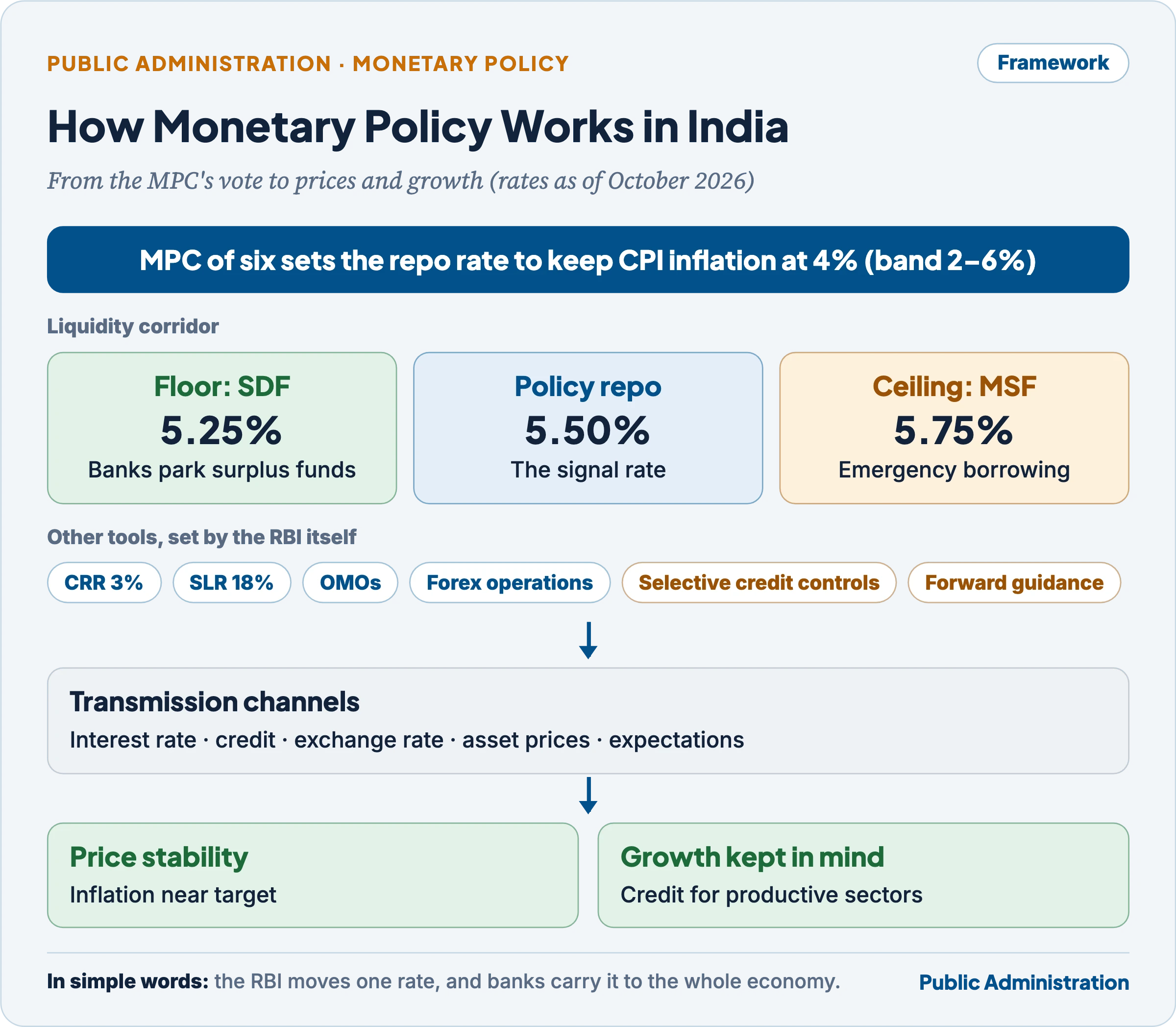
3.1 Quantitative (general) instruments
| Instrument | What it is | Position, October 2026 | Effect of a rise |
|---|---|---|---|
| Policy repo rate | Rate at which the RBI lends overnight to banks against government securities under the LAF | 5.50% (raised 25 bps on 7 October 2026) | Dearer borrowing across the economy |
| Standing Deposit Facility (SDF) | Rate at which banks park surplus funds with the RBI without collateral; floor of the corridor since April 2022 | 5.25% (repo − 0.25) | Raises the floor of short-term rates |
| Marginal Standing Facility (MSF) | Emergency overnight borrowing by banks, partly against SLR securities; ceiling of the corridor | 5.75% (repo + 0.25); Bank Rate aligned at 5.75% | Raises the cost of emergency funds |
| Fixed reverse repo | Earlier floor of the corridor, now a residual instrument | 3.35% | Largely symbolic since 2022 |
| Cash Reserve Ratio (CRR) | Share of deposits (NDTL) banks must keep as cash with the RBI, earning no interest (Section 42, RBI Act) | 3% (cut in tranches to 3% by end-November 2025) | Less money for banks to lend |
| Statutory Liquidity Ratio (SLR) | Share of NDTL banks must hold in cash, gold or approved securities (Section 24, Banking Regulation Act) | 18% | Locks more funds in government paper |
| Open Market Operations (OMOs) | Outright purchase or sale of government securities by the RBI | Used to add or drain durable liquidity | Sale drains money; purchase injects it |
| Variable rate repo / reverse repo auctions | Fine-tuning of day-to-day liquidity | Used routinely | Adjusts the overnight call rate |
| Market Stabilisation Scheme | Special securities issued (from 2004) to absorb liquidity from capital inflows | Occasional | Sterilises forex inflows |
| Forex market operations | Buying or selling dollars | Heavy dollar sales in 2025-26 to support the rupee | Selling dollars drains rupee liquidity |
- The LAF corridor (SDF–repo–MSF) keeps the overnight weighted average call rate, the operating target, close to the repo rate.
- CRR and SLR are fixed by the RBI, not the MPC; the MPC decides only the policy repo rate (and, by convention, the SDF and MSF move with it).
- Reserve ratios were once main instruments (in 1991 SLR stood at 38.5% and CRR at 15%); their steady reduction since then shows the shift from direct to market-based, price-based monetary control.
3.2 Qualitative (selective) instruments
| Instrument | How it works | Example |
|---|---|---|
| Margin requirements | Changing the share of a loan’s value that the borrower must put up | Higher margins on loans against commodities to curb hoarding |
| Regulation of consumer credit | Limits on instalment credit, higher risk weights | Higher risk weights on unsecured personal loans (2023) |
| Credit rationing and directed credit | Ceilings for some sectors, quotas for others | Priority sector lending targets (40% of adjusted net bank credit) |
| Moral suasion | Persuasion, letters and meetings with bank heads | Urging banks to pass on rate cuts |
| Direct action | Penalties or restrictions on errant banks | Prompt Corrective Action framework |
| Forward guidance (“open-mouth operations”) | Shaping expectations through communication | The October 2026 statement that rate cuts are “off the table” |
- Qualitative tools matter more in developing economies, where credit markets are segmented and the interest rate alone may not reach small borrowers.
4. Flexible Inflation Targeting and the Monetary Policy Committee
In simple words
Instead of chasing many goals at once, the RBI was given one clear target by law: keep retail inflation around 4 per cent. A six-member committee votes on the interest rate, and if it misses the target for long, it must explain why in writing.
4.1 The statutory framework (RBI Act as amended by the Finance Act, 2016)
- Section 45ZA (inflation target): the Central Government, in consultation with the RBI, fixes the target in terms of the Consumer Price Index once every five years. The first notification (5 August 2016) set 4% with an upper tolerance of 6% and a lower tolerance of 2% for 2016–2021.
- Section 45ZB (Monetary Policy Committee): six members.
- Three from the RBI: the Governor (chair), the Deputy Governor in charge of monetary policy, and one officer nominated by the Central Board.
- Three external members appointed by the Central Government on the advice of a search-cum-selection committee, for four years, without reappointment.
- Quorum of four; one vote each; the Governor has a casting vote in a tie.
- The MPC’s decision on the policy rate is binding on the RBI.
- Meetings and transparency: at least four meetings a year (in practice six); the resolution is published after each meeting and the minutes two weeks later, showing how each member voted.
- Section 45ZN (accountability for failure): “failure” is average inflation above 6% or below 2% for three consecutive quarters. The RBI must then report to the Government the reasons, the remedial action and the time needed to return to target. This was triggered for the first time in 2022, after post-pandemic and war-related price shocks.
4.2 Reviews of the target
- March 2021: the first review retained 4% ±2% for April 2021 to March 2026.
- August 2025: the RBI released a discussion paper asking whether to target headline or core inflation, whether 4% was still optimal, and whether the band should be changed, narrowed or replaced by a range. It warned that raising the target could be read as a dilution of the framework.
- 25 March 2026: the Government notified (S.O. 1580(E)) the same target, 4% with a 2–6% band, for 1 April 2026 to 31 March 2031, keeping every feature of the framework.
4.3 Assessment of inflation targeting
Gains:
- Credibility and anchoring: a numerical target and published votes have made policy predictable and helped anchor inflation expectations, after the high and volatile inflation of 2009–2013.
- Depersonalisation: decisions by a committee with external members reduce dependence on one Governor’s views and insulate rate-setting from day-to-day political pressure.
- Accountability: the failure clause makes the central bank answerable in a defined way.
Criticisms:
- Food and fuel shocks: food has a large weight in India’s CPI; supply shocks (monsoon, crude oil, war) drive inflation that interest rates cannot cure, so tightening may hurt growth without much effect on prices. The Economic Survey 2023-24 suggested considering a target that excludes food; the RBI’s 2025 discussion paper argued for staying with headline CPI.
- Growth sacrifice: critics argue that real interest rates were kept too high in some years (for example 2017–2019).
- Weak transmission (section 5) limits what the repo rate can achieve.
- Narrow mandate: financial stability, exchange-rate stress and employment are not formally in the target.
4.4 Recent course of policy (2025–2026)
- February 2025 to December 2025: an easing cycle cut the repo rate by 125 bps, from 6.50% to 5.25%, with a 100 bps CRR cut to 3% in tranches, as inflation fell sharply.
- February–August 2026: the rate was held at 5.25% for four meetings.
- 7 October 2026: with crude prices rising after renewed conflict in West Asia, a weaker rupee and inflation projected near 5.8% over the next three quarters, the MPC raised the repo rate by 25 bps to 5.50%, its first hike since February 2023, and moved the stance to calibrated tightening. Two members preferred to keep the stance neutral.
- Days later the RBI raised the daily minimum CRR maintenance from 90% to 99% of the requirement (from 16 October 2026), tightening day-to-day liquidity without changing the ratio itself.
5. Transmission and the Development Role of Monetary Policy
In simple words
When the RBI changes its rate, the effect is meant to travel through banks to the rates people pay on home loans and the rates firms pay for working capital, and from there to spending and prices. If the pipes are leaky or slow, the RBI’s decision reaches the economy late and weak.
5.1 Channels of transmission
| Channel | How a rate rise works through it |
|---|---|
| Interest rate | Bank lending and deposit rates rise; borrowing for consumption and investment falls |
| Credit (quantum) | Banks lend less; money and credit aggregates slow |
| Exchange rate | Higher rates attract capital, support the rupee, cheapen imports |
| Asset prices | Bond and share prices fall, reducing wealth and collateral |
| Expectations | A credible central bank lowers expected inflation, moderating wage and price setting |
5.2 India’s long struggle with transmission
- Lending-rate benchmarks were changed repeatedly because banks did not pass on cuts quickly: Prime Lending Rate (1994) → Benchmark PLR (2003) → Base Rate (2010) → MCLR (April 2016) → External Benchmark Lending Rate, linked to the repo rate or a market rate, mandatory for new floating-rate retail and MSME loans from 1 October 2019.
- Transmission to new loans is now fairly quick; transmission to old loans and deposits remains slower.
5.3 Why monetary policy is weaker in developing economies
- Large informal sector: many households and small firms borrow from moneylenders, chit funds or relatives, outside the formal rate structure.
- Administered rates: small savings interest rates are set by the government and do not move fully with market rates, so banks hesitate to cut deposit rates.
- Fiscal dominance: large government borrowing keeps bond yields high whatever the policy rate.
- Supply-side inflation: food and fuel price shocks do not respond to demand management.
- Shallow bond markets and bank stress: weak balance sheets (as in 2015–2019) make banks reluctant to lend even when money is cheap.
For these reasons it is often argued that in India fiscal policy is more direct and quicker in its effect, while monetary policy depends on the depth of the financial system.
5.4 Can monetary policy help or hinder development?
| Monetary policy can help development by | It can hinder development when |
|---|---|
| Keeping inflation low and predictable, which protects the poor and encourages saving and long-term investment | Real interest rates stay too high for too long, choking investment and small firms |
| Ensuring credit to agriculture, MSMEs and weaker sections (priority sector, refinance windows) | Pre-emption of bank funds by high SLR and CRR (“financial repression”) starves the private sector |
| Maintaining financial stability and a stable rupee, which attracts foreign investment | Automatic monetisation of deficits produces inflation that wipes out development gains |
| Supporting financial inclusion and digital payments | Sudden tightening, as in the 2013 “taper tantrum” or the 2022 global tightening, raises borrowing costs abruptly |
- The Indian record shows both faces: the directed credit of the planning era spread banking to villages but also produced bad loans and inflation; the inflation-targeting era has brought price stability but has been criticised for growth costs. The lesson is that monetary policy helps development when it provides stable money and sound credit and leaves the direct financing of development to transparent fiscal policy.
Common confusion
Does the Monetary Policy Committee decide the CRR and the SLR? No. The MPC decides only the policy repo rate (the SDF and MSF rates move with it by a fixed spread). The CRR, SLR, OMOs, liquidity operations and regulatory measures remain with the RBI itself. The June 2025 CRR cut and the October 2026 change in the daily CRR rule were RBI decisions, not MPC votes.
6. Monetary–Fiscal Coordination and the Autonomy of the RBI
In simple words
The government spends and borrows; the central bank decides the price of money. If the government spends too much, the central bank has to fight the resulting inflation; if the central bank is forced to print money for the government, inflation follows anyway. The two must coordinate, but the central bank also needs enough independence to say no.
6.1 Monetary and fiscal policy compared
| Basis | Monetary policy | Fiscal policy |
|---|---|---|
| Authority | RBI; repo rate by the MPC | Government (Ministry of Finance) with Parliament’s approval |
| Instruments | Repo rate, SDF/MSF, CRR, SLR, OMOs, selective controls | Taxes, public expenditure, borrowing, debt management |
| Main target | Price stability (CPI 4% ±2), financial stability | Growth, employment, distribution, public goods, stability |
| Legal basis | RBI Act 1934 (sections 45ZA–45ZO), Banking Regulation Act 1949 | Articles 112–117, 265, 266; FRBM Act 2003; tax laws |
| Speed | Decided quickly (six meetings a year) but acts with long, variable lags | Slow to decide (annual budget, legislation) but acts more directly once spent |
| Selectivity | Broad, economy-wide | Can target regions, sectors and groups |
| Democratic control | Technocratic, at arm’s length; accountable through reports and the failure clause | Directly voted by elected legislature |
- Different but complementary: both regulate aggregate demand. Fiscal policy is better at allocation and distribution; monetary policy at price stability. Stabilisation needs both.
- Policy mix: expansionary fiscal with tight monetary policy (as in parts of 2022–2023) raises interest rates and can crowd out private investment; tight fiscal with easy monetary policy (as planned in 2025) lowers rates and supports private spending.
6.2 Fiscal dominance and its end
- Ad hoc treasury bills allowed the Centre, until 1997, to borrow from the RBI automatically, creating reserve money and inflation. Thomas Sargent and Neil Wallace (“Some Unpleasant Monetarist Arithmetic”, 1981) showed that if fiscal deficits are not controlled, a central bank cannot control inflation for long: it will eventually have to monetise.
- FRBM Act, section 5: from April 2006 the RBI could not subscribe to primary issues of central government securities, except through Ways and Means Advances. The 2018 amendment allowed such subscription when the escape clause grounds apply.
- COVID-19 (2020–2021): the RBI raised Ways and Means Advance limits, bought government bonds through the G-SAP programme (2021) and OMOs, and helped the record borrowing go through at low yields. Critics called this monetisation by another name; the RBI described it as liquidity management.
6.3 RBI autonomy: the Section 7 episode (2018)
- Section 7 of the RBI Act allows the Central Government, after consulting the Governor, to give the Bank directions “in the public interest”. It had never been used.
- In October 2018 the Government sent letters seeking consultation under Section 7 on easing the Prompt Corrective Action framework for weak banks, credit to MSMEs and power companies, and use of the RBI’s reserves. No direction was finally issued.
- Deputy Governor Viral Acharya, in the A.D. Shroff Memorial Lecture (26 October 2018), warned that undermining central bank independence could trigger a crisis of confidence in markets. Governor Urjit Patel resigned on 10 December 2018.
- The reserves dispute was settled through the Bimal Jalan Committee on the Economic Capital Framework (report August 2019), which led to a transfer of ₹1.76 lakh crore and a rule-based Contingent Risk Buffer. The RBI later widened the buffer range to 4.5–7.5% of its balance sheet; in May 2026 it set the buffer at 6.5% and transferred a record ₹2.87 lakh crore surplus for 2025-26.
Theory lens on central bank independence:
- Time inconsistency (Finn Kydland and Edward Prescott, 1977): governments are tempted to create surprise inflation to boost output before elections, so promises of low inflation are not credible unless policy is delegated or bound by rules.
- Conservative central banker (Kenneth Rogoff, 1985) and the evidence of Alberto Alesina and Lawrence Summers (1993) that more independent central banks achieved lower inflation without lower growth.
- Democratic critique: unelected technocrats should not have unchecked power over jobs and growth; independence must therefore be instrument independence within a goal set by the elected government, which is exactly India’s 2016 design.
Indian Connect — Coordination machinery in India
- Goal set by Government, instrument set by MPC: the 2016 law divides roles clearly; the Government also appoints half the MPC.
- Financial Stability and Development Council (2010): chaired by the Finance Minister, with the RBI Governor and the heads of SEBI, IRDAI, PFRDA and IBBI, for macro-prudential and inter-regulatory coordination.
- Debt management link: the RBI manages government borrowing as its banker and debt manager, which can conflict with monetary policy (section 16).
- Surplus transfers: RBI dividends (₹2.69 lakh crore in May 2025, ₹2.87 lakh crore in May 2026) are a significant non-tax revenue, so the Economic Capital Framework is itself a coordination device.
7. Fiscal Policy: Meaning, Functions, Objectives and Instruments
In simple words
Fiscal policy is how the government uses its own budget to steer the economy: what it taxes, what it spends on, and how much it borrows. A road built with public money creates jobs today and faster trade tomorrow; a tax cut leaves more money in people’s pockets.
7.1 Meaning
- Fiscal policy is the use of taxation, public expenditure and public debt to influence the level and pattern of economic activity, the allocation of resources between public and private sectors, and the distribution of income.
- A. Premchand, the Indian-born IMF expert on public expenditure management, stressed that fiscal policy rests on its institutional base: tax systems and their incidence, budget formulation and execution, and financial management. Good fiscal policy is therefore also good financial administration.
- Because the budget is the main vehicle, fiscal policy is often used interchangeably with budgetary policy.
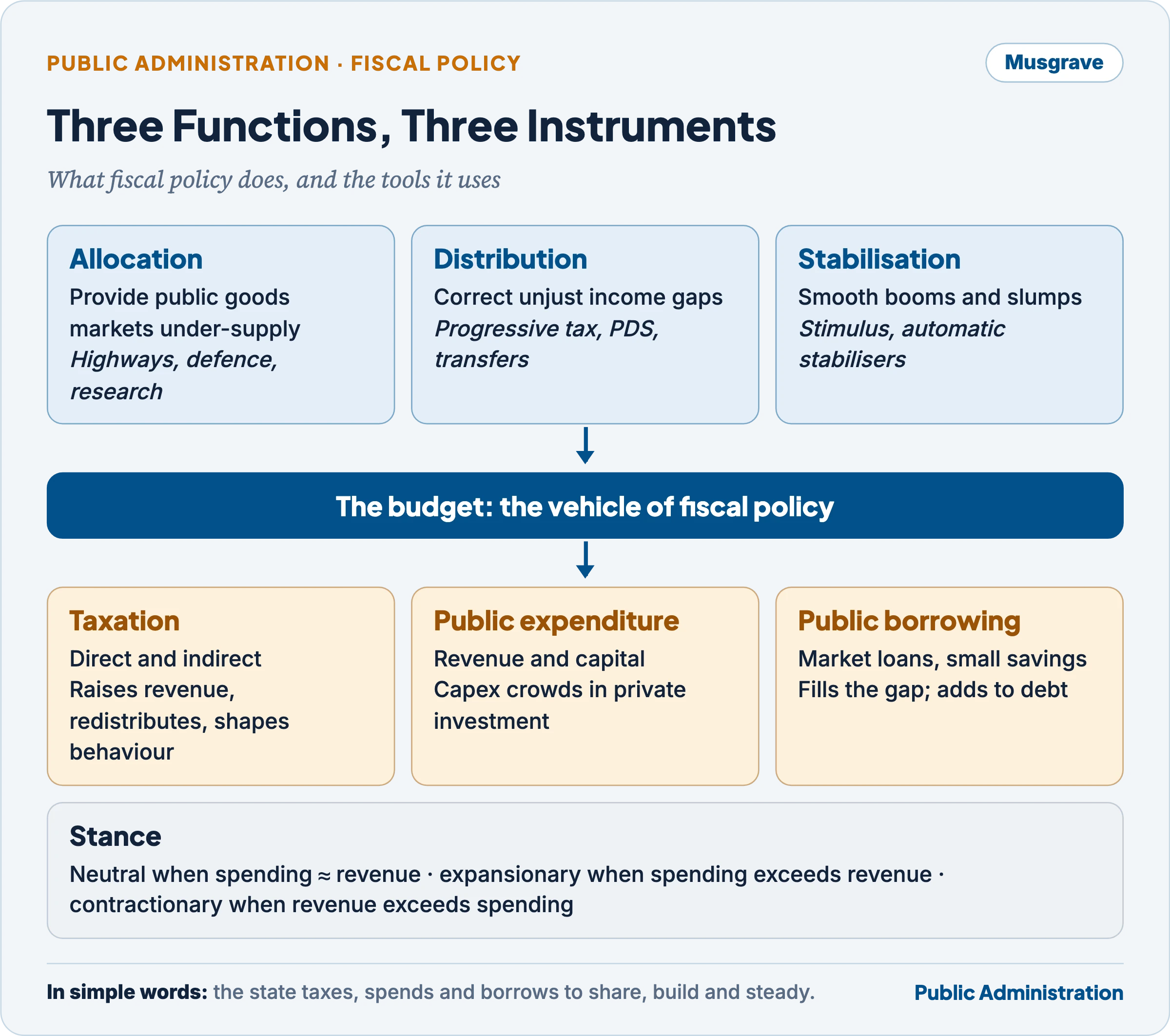
- Stance: neutral when spending roughly equals revenue (G = T), expansionary when the government spends more than it collects (G > T, a larger deficit), contractionary when it collects more than it spends (G < T).
7.2 Musgrave’s three functions
Richard Musgrave, the German-American public finance economist, in The Theory of Public Finance (1959), divided the fiscal role of the state into three “branches”. The framework remains the standard way to classify what budgets do.
| Function | Problem it addresses | Fiscal tools | Indian examples |
|---|---|---|---|
| Allocation | Markets under-supply public goods (defence, roads, research) and mis-price externalities | Public provision, subsidies, corrective taxes | National highways, PM Gati Shakti, carbon-intensity reduction through green bonds |
| Distribution | Market incomes may be unjust or unequal | Progressive taxes, transfers, subsidised services | Income tax slabs, PM-KISAN, PDS, MGNREGA |
| Stabilisation | Unemployment, inflation and business cycles | Changes in total spending and taxes, automatic stabilisers | COVID relief packages 2020; capex push 2021–2026 |
- Musgrave’s point: the three functions should be analysed separately even though one budget carries them all, because each needs a different test (efficiency, equity, stability).
- Federal application: Wallace Oates (Fiscal Federalism, 1972) argued that stabilisation and distribution suit the national government, while allocation of local public goods suits lower tiers (the decentralisation theorem).
7.3 Objectives of fiscal policy in a developing country
- Raising capital formation: mobilise savings and channel them into investment; restrain wasteful consumption.
- Reducing inequality: progressive taxation, taxes on luxuries, and spending on anti-poverty programmes, the PDS and employment schemes. Who actually benefits from public spending must be checked: much spending (on administration, defence, urban hospitals) does not reach the poor directly.
- Balanced growth: across sectors (agriculture, industry, services), regions and between public and private sectors.
- Economic and social overheads: transport, irrigation, power, health and education, which the private sector will not finance at the scale needed.
- Price stability: avoiding excess demand from deficits; non-inflationary financing of development.
- Employment and external balance: labour-intensive spending; avoiding twin deficits.
- The Seventh Five-Year Plan described fiscal policy as the means by which government creates and sustains the public economy (public services and investment) and reallocates resources according to national priorities, redistributes income, promotes saving and maintains stability.
7.4 Instruments
(a) Taxation
- Direct taxes (income tax, corporation tax) are borne by the person on whom they are imposed and can be progressive; indirect taxes (GST, customs, excise) are shifted to consumers and tend to be regressive.
- Taxes raise revenue, redistribute income, discourage harmful consumption (tobacco, carbon) and, by changing disposable income, act as automatic stabilisers.
(b) Public expenditure
- Revenue expenditure (salaries, interest, subsidies, transfers) keeps the state running; capital expenditure (roads, railways, defence equipment, loans to States) creates assets.
- Capital expenditure has a larger multiplier than most revenue spending because it adds to productive capacity and crowds in private investment. The Union Budget raised capital spending from about 2.5% of GDP in 2021-22 to above 3% of GDP from 2023-24, and in 2026-27 budgets ₹12.2 lakh crore, plus interest-free 50-year loans to States for capital works (₹2 lakh crore in 2026-27).
(c) Public borrowing and debt management
- Borrowing finances the gap between expenditure and non-debt receipts. Its size, source and use decide whether debt helps or harms growth (sections 14–18).
(d) Other instruments
- Non-tax revenue (RBI surplus, dividends, user charges), disinvestment, administered prices and tax expenditures (exemptions that act like hidden spending).
8. Keynesian and Neoclassical Views; Counter-cyclical Fiscal Policy
In simple words
When a recession hits, should the government spend more to keep people in jobs, or tighten its belt like a family? Keynes said spend; his critics said such spending only pushes up interest rates or prices. Today’s view lies in between: support the economy in bad times, save in good times.
8.1 The classical and “Treasury” view
- Classical economists (Adam Smith, David Ricardo, J.B. Say) favoured balanced budgets and minimal debt; by Say’s law, supply creates its own demand, so general unemployment cannot persist.
- The “Treasury View” of the British Treasury in the 1920s–30s held that public works financed by borrowing would simply divert savings from private investment, adding nothing to total employment.
8.2 The Keynesian revolution
- John Maynard Keynes, The General Theory of Employment, Interest and Money (1936), argued that in a depression private demand collapses, savings lie idle and the economy can stay below full employment. Government spending, even financed by deficits, raises demand and output through the multiplier.
- Abba Lerner (“Functional Finance and the Federal Debt”, 1943) went further: judge budgets by their effects on employment and prices, not by whether they balance; internal debt is largely owed “to ourselves”.
- Alvin Hansen popularised compensatory finance: deficits in slumps, surpluses in booms. The New Deal in the United States and post-war welfare states drew on these ideas.
- Keynes did not “invent” fiscal policy (governments had always taxed and spent); he supplied the theory of active, counter-cyclical fiscal policy.
8.3 The neoclassical and monetarist reaction
- Crowding out: government borrowing raises interest rates and displaces private investment, so the multiplier is small.
- Monetarism (Milton Friedman): long and variable lags make discretionary policy destabilising; stable money growth and rules are better.
- Rational expectations (Robert Lucas): people anticipate policy and neutralise it; the Lucas critique (1976) questioned policy predictions based on past behaviour.
- Ricardian equivalence (Robert Barro, 1974): debt-financed tax cuts do not raise spending because people save to pay future taxes (section 18).
- Public choice (James Buchanan and Richard Wagner, Democracy in Deficit, 1977): Keynesian ideas gave politicians an excuse for permanent deficits, since spending is popular and taxes are not. This “deficit bias” is the intellectual root of fiscal rules such as India’s FRBM Act.
| Point | Keynesian view | Neoclassical / monetarist view |
|---|---|---|
| Markets | Can stay stuck below full employment | Self-correcting if prices are flexible |
| Deficits in recession | Necessary and useful | Ineffective or harmful (crowding out, Ricardian equivalence) |
| Public debt | Internal debt is not a real burden if it raises output | Burdens future generations and growth |
| Main tool | Fiscal policy | Monetary policy under rules |
| Role of state | Active manager of demand | Limited, rule-bound |
8.4 Counter-cyclical policy in practice
- Automatic stabilisers (progressive taxes, unemployment and welfare benefits) widen the deficit in slumps and narrow it in booms without new decisions. They are weak in India because the income-tax base is narrow and formal unemployment insurance is limited.
- Discretionary policy faces lags: recognition, decision (budget, legislation) and implementation. By the time spending arrives, the recession may be over.
- Pro-cyclicality in emerging markets: governments often spend more in good times when revenue is plentiful and must cut in bad times when markets lose confidence. The N.K. Singh Committee noted that a headline deficit rule makes fiscal policy pro-cyclical, which is why it proposed escape and buoyancy clauses.
- After 2008 and COVID-19, the consensus moved back towards active fiscal policy: with interest rates near zero, monetary policy lost power, and Olivier Blanchard (AEA presidential address, 2019) argued that when the interest rate on debt is below the growth rate, the fiscal cost of debt is lower than once thought.
Indian Connect — Counter-cyclical fiscal policy in India
- 2008–09 global crisis: the FRBM targets were paused; stimulus through tax cuts and spending pushed the Centre’s fiscal deficit to about 6–6.5% of GDP in 2008-09 and 2009-10.
- COVID-19: the Centre’s fiscal deficit rose to about 9.2% of GDP in 2020-21; the response combined direct support (free food grains, cash to Jan Dhan accounts, MGNREGA) with credit guarantees, then a capex-led recovery.
- Consolidation with growth (2021–2026): the Centre committed in 2021 to bring the deficit below 4.5% of GDP by 2025-26 and achieved 4.4% (RE 2025-26), while protecting capital spending; this is the counter-cyclical cycle completed: expand in the crisis, consolidate in the recovery.
9. Deficits: Concepts, Measurement and Deficit Financing
In simple words
A deficit is simply the amount by which spending exceeds income in a year. But which spending and which income? Different deficit measures answer different questions: how much is the government borrowing, how much is it borrowing just to pay salaries and interest, and how much of the borrowing is only to pay interest on old loans?
9.1 The deficit family
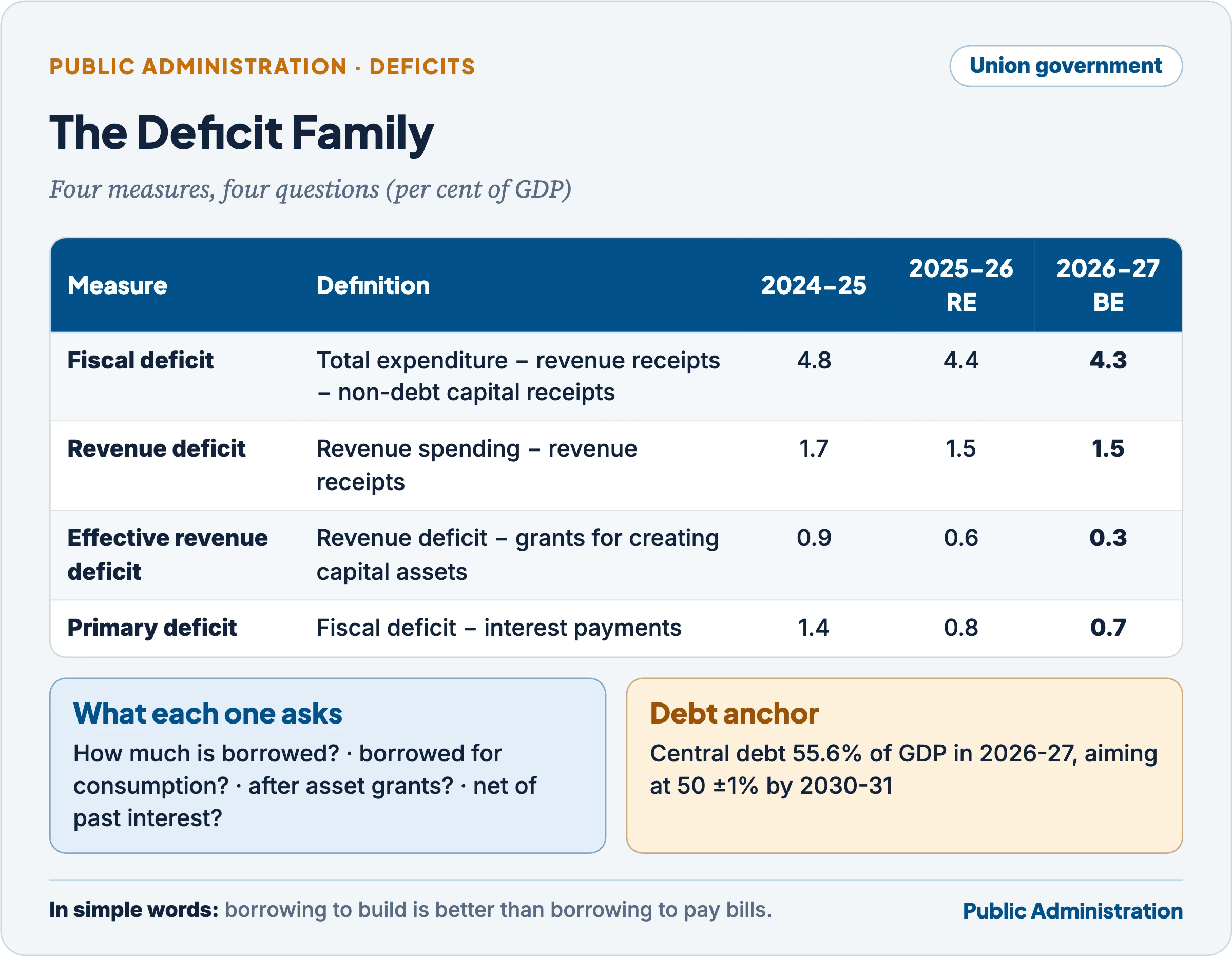
| Measure | Definition | 2024-25 Actual | 2025-26 RE | 2026-27 BE |
|---|---|---|---|---|
| Fiscal deficit (FD) | Total expenditure − (revenue receipts + non-debt capital receipts) = total borrowing need | 4.8 | 4.4 | 4.3 |
| Revenue deficit (RD) | Revenue expenditure − revenue receipts | 1.7 | 1.5 | 1.5 |
| Effective revenue deficit (ERD) | RD − grants-in-aid for creation of capital assets | 0.9 | 0.6 | 0.3 |
| Primary deficit (PD) | FD − interest payments | 1.4 | 0.8 | 0.7 |
(Per cent of GDP. Source: Union Budget documents as summarised by the RBI, February 2026.)
- Fiscal deficit is the most comprehensive measure: it equals the government’s net borrowing in the year and adds to debt.
- Revenue deficit shows borrowing to finance consumption; it violates the golden rule that governments should borrow only to invest. In 2026-27 roughly a third of the fiscal deficit is pre-empted by the revenue deficit.
- Effective revenue deficit (introduced in the Union Budget 2011-12) recognises that some revenue grants (for example to States for building rural roads or houses) create assets, though not on the Centre’s books.
- Primary deficit shows the current year’s fiscal stance by removing interest on past debt; a primary surplus means the government is paying part of the interest from its own revenue.
- Older measures: the budget deficit (total expenditure − total receipts including borrowing, met by drawing down cash or 91-day treasury bills) was dropped in 1997-98 when ad hoc treasury bills ended; the monetised deficit (net RBI credit to the government) measures the part of the deficit financed by money creation.
- Quality of the deficit: a fiscal deficit financing capital outlay is less worrying than one financing subsidies and salaries. The share of capital outlay in the fiscal deficit rose from about 37% (2019-20 to 2024-25 average) to about 56% in 2025-26 and 2026-27.
Common confusion
Is the fiscal deficit the same as the budget deficit or the public debt? No. The fiscal deficit is the flow of new borrowing in one year. The budget deficit, in Indian usage before 1997, was the narrower gap met by cash drawdown and treasury bills; the term is no longer reported. Public debt is the stock of all past borrowing still outstanding. A government can reduce its fiscal deficit every year and still see its debt rise in rupees; what matters for sustainability is whether debt as a share of GDP is falling.
9.2 Deficit financing
- In Western usage, deficit financing means financing a deliberate excess of expenditure over revenue by any borrowing, which activates idle savings in a slump.
- In Indian planning usage, it meant something narrower: the part of the gap met by borrowing from the RBI (creating new money) and by drawing down cash balances. Borrowing from the public and banks was called “market borrowing”, not deficit financing. The First Five-Year Plan defined it as the direct addition to national expenditure through budget deficits.
- Three historical uses: war (always inflationary because supply cannot keep pace), depression (Keynesian: employs idle capacity, little inflation) and development (inflationary in the short run because investment in heavy industry and infrastructure has long gestation, while incomes rise at once).
Why development deficit financing tends to be inflationary in poor economies:
- High propensity to consume out of new incomes; inelastic supply of food and consumer goods; long gestation of projects; bank credit expansion on top of new money; speculative hoarding; weak tax systems that cannot mop up the extra income.
The “safe limit” of deficit financing depends on the elasticity of supply of consumer goods, the productive use of the funds, foreign-exchange reserves (imports can absorb demand), the time lag of projects, the tax system’s ability to capture new incomes, and whether inflation is already high. It changes with conditions and cannot be fixed once and for all.
Advantages and limitations:
| Case for deficit financing | Case against |
|---|---|
| Mobilises idle resources and raises capital formation where savings are low | Inflation acts as a regressive, invisible tax on the poor and fixed-income earners |
| A growing economy needs more money for transactions; some new money is non-inflationary | Distorts investment towards speculation; worsens the balance of payments |
| Mild inflation may stimulate investment and “forced saving” | Raises the administrative burden (dearness allowances, price controls, rationing) |
| Unavoidable in emergencies (war, pandemic) | Feeds a debt–interest–deficit spiral if used for consumption |
- Concealed deficit financing: the March rush of spending to avoid lapse of grants pushes out unproductive expenditure that acts like deficit financing without being counted as such.
- The Indian experience: deficit financing exceeded plan targets in most plans (the Third and Fourth Plans especially), and periods of fast money growth were followed by high inflation; the 1991 crisis followed a decade of rising fiscal deficits (the Centre’s deficit was estimated at about 8% of GDP in 1990-91).
9.3 Is deficit budgeting still relevant in a liberal era?
- The liberal objection: deficits crowd out private investment, invite inflation and downgrades, and reflect the state doing what markets can do; hence fiscal rules, independent central banks and a ban on monetisation.
- Why deficits remain relevant:
- Monetisation has gone, but debt-financed deficits remain central: India’s general government deficit is still about 7% of GDP.
- Crises: 2008 and COVID-19 showed that even liberal economies run large deficits; Euro-area and US deficits rose sharply.
- Public investment in infrastructure, climate transition and human capital is still financed largely by borrowing; the golden rule permits borrowing for investment.
- Counter-cyclical role: rules now include escape clauses precisely to allow deficits in downturns.
- What has changed is the form and discipline: deficits are financed in the market rather than by the central bank, are judged by their quality (capital vs revenue), and are bounded by a debt anchor. Deficit budgeting has moved from being a tool of planned development to a tool of stabilisation and investment within rules.
10. Fiscal Responsibility: The FRBM Act and Its Evolution
In simple words
Governments find it easy to borrow and hard to stop. A fiscal responsibility law is a promise the government makes to Parliament and the public in advance: this is how far we will borrow, these are the numbers we will publish, and if we break the limit, we will explain why.
10.1 Background and enactment
- The 1991 crisis: high fiscal deficits, rising interest costs and external debt, and a balance-of-payments emergency. Fiscal correction in the 1990s was uneven; by the late 1990s the deficits and the revenue deficit had worsened again.
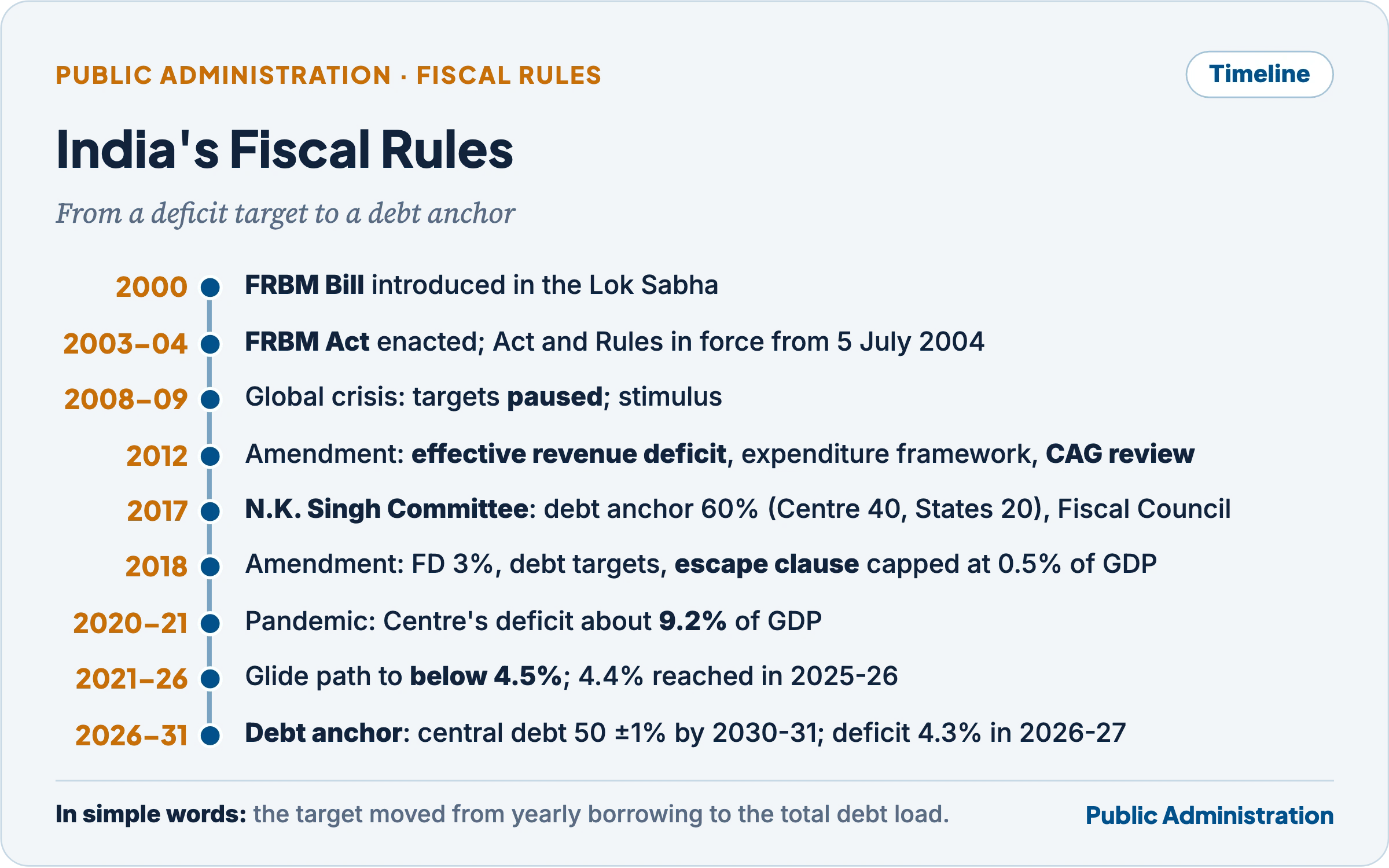
- A committee on fiscal responsibility legislation was set up in 2000; the Fiscal Responsibility and Budget Management Bill was introduced in the Lok Sabha in December 2000, examined by a parliamentary committee, and passed in diluted form. The Act received assent in August 2003 and the Act and FRBM Rules came into force on 5 July 2004.
- Aim: to make the Centre responsible for intergenerational equity in fiscal management and long-term macroeconomic stability, by removing fiscal impediments to monetary policy and ensuring prudent debt management, with greater transparency and a medium-term framework.
10.2 Original provisions
- Targets: eliminate the revenue deficit and bring the fiscal deficit to 3% of GDP, originally by March 2008 (extended to March 2009 by a 2004 amendment); annual reduction of at least 0.5% of GDP in RD and 0.3% in FD.
- Limits: no additional guarantees beyond 0.5% of GDP a year; a cap on new liabilities.
- No borrowing from the RBI in the primary market from 2006-07, except Ways and Means Advances.
- Statements before Parliament with each budget: the Medium-term Fiscal Policy Statement, the Fiscal Policy Strategy Statement and the Macroeconomic Framework Statement; later a Medium-Term Expenditure Framework Statement.
- Disclosure forms on guarantees, arrears, assets and accounting changes, and mid-year reviews with corrective action if deficits ran ahead of targets.
- Exception: targets could be exceeded on grounds of national security, national calamity or “such other exceptional grounds” as the Centre may specify, a vague clause later criticised.
10.3 Pause, amendments and review
- 2008–09: the global crisis led to the targets being suspended; the Thirteenth Finance Commission and the Kelkar Committee (2012) later laid down new consolidation roadmaps.
- 2012 amendment: introduced effective revenue deficit and the Medium-Term Expenditure Framework statement, and inserted section 7A requiring the CAG to review compliance periodically and lay the reviews before Parliament.
- 2015 amendment: again deferred the targets.
- N.K. Singh FRBM Review Committee (constituted 2016; report submitted January 2017, released April 2017), with Sumit Bose, Urjit Patel, Rathin Roy and Chief Economic Adviser Arvind Subramanian:
- Debt as the anchor: general government debt 60% of GDP by 2023 (Centre 40%, States 20%), because solvency depends on debt, debt is easy for citizens to understand, and rating agencies watch it.
- Fiscal deficit as the operational target: 3% of GDP up to 2019-20, falling to 2.5% by 2022-23; revenue deficit to 0.8% by 2022-23.
- Independent Fiscal Council to give forecasts, monitor compliance and advise on escape clauses.
- Escape clause for national security, war, national calamity, collapse of agriculture, far-reaching structural reforms, or a fall in real growth of at least 3 percentage points below the previous four quarters’ average; deviation capped at 0.5 percentage points (Urjit Patel preferred 0.3), with a path of return.
- Buoyancy clause: if growth exceeds the average by 3 points, the deficit must fall by at least 0.5 points below target.
- A new Debt Management and Fiscal Responsibility Act in place of the FRBM Act.
- The CEA recorded a note of disagreement, arguing that the primary deficit, rather than the headline fiscal deficit, should be the main operational target.
- 2018 amendment (Finance Act 2018), the current law:
- FD 3% by 31 March 2021; endeavour to keep general government debt within 60% and central government debt within 40% of GDP by 2024-25.
- Revenue deficit and ERD targets dropped.
- Escape clause in the statute with the Committee’s grounds and a 0.5% of GDP cap, and a buoyancy clause requiring a cut of at least 0.25% of GDP.
- The RBI may subscribe to primary issues when escape-clause grounds apply.
- The Fiscal Council was not created.
10.4 COVID-19 and the new debt anchor
- The escape clause was invoked for 2019-20 (deficit target relaxed by 0.5 points); in 2020-21 the deficit reached about 9.2% of GDP, far above any rule.
- Budget 2021-22 set a glide path to below 4.5% of GDP by 2025-26; the Centre’s deficit fell from 6.7% (2021-22) to 4.8% (2024-25) and 4.4% (RE 2025-26).
- Shift to a debt anchor: the Union Budget of July 2024 announced that from 2026-27 the fiscal deficit each year would be set to keep central government debt on a declining path; the Budget 2025-26 FRBM statements fixed the goal of central government debt of 50 ± 1% of GDP by 31 March 2031.
- Union Budget 2026-27 (1 February 2026): fiscal deficit 4.3% of GDP; central government debt 55.6% of GDP (from 56.1% in RE 2025-26); total expenditure ₹53.5 lakh crore, of which capital expenditure ₹12.2 lakh crore; net market borrowing from dated securities ₹11.7 lakh crore and gross market borrowing ₹17.2 lakh crore; interest payments about ₹14 lakh crore, roughly a third of revenue expenditure.
- Why a debt anchor: the deficit is a means, debt is the end; a debt path allows flexibility year to year while keeping the medium-term goal fixed. The IMF’s 2025 Article IV review judged the 50 ± 1% goal achievable and suggested it could be more ambitious.
10.5 States’ fiscal rules
- All States have Fiscal Responsibility Legislation (FRL), prompted by the Twelfth Finance Commission’s debt-relief incentive (2005), with a fiscal deficit limit of 3% of GSDP as the norm; extra room was allowed for COVID (4% in 2021-22, then 3.5%) and for power sector reforms.
- The Centre enforces limits through its consent under Article 293(3), fixing a Net Borrowing Ceiling each year.
- The Sixteenth Finance Commission (report submitted 17 November 2025, tabled 1 February 2026) recommended a cap of 3% of GSDP on States’ fiscal deficits (excluding the 50-year capital loans), strict enforcement through Article 293(3), an end to off-budget borrowings, uniform State FRLs, and a Union fiscal deficit of 3.5% of GDP by 2030-31. The Government accepted the borrowing-ceiling principle and said the rest would be examined separately.
10.6 Assessment: has the FRBM Act delivered?
Achievements:
- Built a culture of fiscal reporting: medium-term statements, disclosures and mid-year reviews are now routine.
- Ended automatic monetisation and helped the RBI’s independence.
- The Centre met the original targets once (fiscal deficit of about 2.5% in 2007-08) and the post-COVID glide path; States, as a whole, have broadly kept within 3% of GSDP in most years.
Limitations (why the early optimism proved unwarranted):
- Targets repeatedly deferred or suspended (2004, 2008, 2012, 2015, 2018, 2020); a law that is amended whenever it binds offers weak commitment.
- No enforcement: no penalty for breach beyond a statement in Parliament; no independent Fiscal Council.
- Creative accounting: off-budget borrowings (NSSF loans to the FCI, borrowing by NHAI, IRFC and special vehicles), deferred subsidy bills and below-the-line items lowered reported deficits. The CAG found many such liabilities undisclosed (Indian Connect below).
- Pro-cyclical bias: headline targets squeezed capital spending in bad years.
- Focus on the deficit, not its quality: revenue deficits persisted throughout.
Indian Connect — CAG’s audit of FRBM compliance
- Under section 7A, the CAG reviews the Centre’s compliance. Its Report No. 18 of 2022 (on 2019-20, tabled 8 August 2022) found that:
- the fiscal deficit was 4.65% of GDP on budget figures but 5.14% on the Union Government Finance Accounts, against a target of 3.3%;
- the primary deficit nearly doubled in a year;
- mid-year benchmarks were breached (fiscal deficit at about 93% of the budget estimate by September);
- central government debt stood at 52.3% of GDP against the 40% goal;
- extra-budgetary resources such as borrowings by Air India Asset Holding, IRFC and NHAI and carried-forward fertiliser subsidy dues were not fully disclosed in the budget statement.
- The episode shows audit acting as the enforcement gap-filler of a fiscal rule that has no penalty, which is why reformers ask for a Fiscal Council.
Criticism — The case against binding fiscal rules
- Rigid numbers ignore the cycle: a 3% target forces cuts in recessions and allows splurges in booms (N.K. Singh Committee’s own admission).
- Capital spending is the first casualty: governments meet targets by cutting investment rather than subsidies or salaries.
- Rules invite creative accounting: off-budget borrowings and deferred payments move deficits out of sight rather than eliminating them.
- Democratic objection: fixing fiscal choices in statute narrows what future elected governments may do; Keynesian and functional-finance critics see “deficit fetishism”.
- Repeated breaches erode credibility: a rule amended at every difficulty may do more harm than having none.
Defence — The case for fiscal rules and a debt anchor
- Deficit bias is real: spending is popular and taxes are not, so without rules debt tends to rise (Buchanan and Wagner); rules protect intergenerational equity.
- Credibility lowers borrowing costs: markets, rating agencies and index providers reward predictable fiscal paths, cutting the interest bill.
- Supports monetary policy: an independent central bank cannot control inflation if deficits are unchecked.
- Modern rules are flexible: escape and buoyancy clauses and a medium-term debt anchor allow counter-cyclical action with a path of return.
- Transparency gains: mandatory statements, disclosures and CAG review have made Indian public finances far more visible than before 2003.
11. Taxation and Tax Reforms since 1991
In simple words
A good tax system raises enough money, falls fairly on those who can pay, is easy to understand and comply with, and does not choke work and enterprise. India’s reforms since 1991 have tried to lower rates, widen the base and simplify, using technology to make evasion harder.
11.1 Principles
- Adam Smith’s canons (The Wealth of Nations, 1776): equity (according to ability), certainty, convenience and economy of collection. Later writers added productivity, elasticity and simplicity.
- Buoyancy measures how much tax revenue grows when GDP grows (including rate changes); elasticity measures the same without discretionary changes.
- Tax expenditure: revenue forgone through exemptions and deductions, now reported with the budget.
11.2 Major reforms
| Period | Reform | Key change |
|---|---|---|
| 1991–93 | Tax Reforms Committee (Raja J. Chelliah) | Few, simple, broad-based taxes at moderate rates; lower peak customs duties; reliance on direct taxes |
| 1994-95 | Service tax introduced | Began with telephone, general insurance and stockbroking; widened steadily as services grew to over half of GDP |
| 1990s–2000s | Rate reduction | Top personal income tax rate cut from above 50% to 30%; peak customs duty on non-agricultural goods cut from well above 100% in 1991 to 10% by 2007-08 |
| 2002 | Kelkar Task Forces on direct and indirect taxes | Simplification, wider base, computerisation (TIN, Annual Information Return); a GST proposal |
| 2005 | State VAT | Replaced cascading State sales taxes |
| 2017 | Goods and Services Tax (101st Amendment 2016) | One nationwide tax on supply, subsuming central excise, service tax, VAT and others |
| 2019 | Corporate tax cut | Base rate 22% (15% for new manufacturing firms) without exemptions |
| 2020 | Faceless assessment and the taxpayers’ charter; optional new personal tax regime without exemptions (made default in 2023) | Removed face-to-face contact, cut discretion |
| 2025 | Budget 2025-26 | No income tax up to ₹12 lakh of income under the new regime |
| 2025–26 | Income-tax Act, 2025 (assent 21 August 2025; in force 1 April 2026) | Replaces the 1961 Act with a simpler, shorter law without changing tax policy |
| 2025 | GST rate rationalisation (56th GST Council, 3 September 2025) | Two main slabs of 5% and 18% plus a 40% rate for sin and luxury goods, effective 22 September 2025 |
- Shift in structure: commodity taxes made up about 84% of tax revenue in 1990-91; direct taxes now exceed half of gross tax revenue, and the Centre’s direct tax–GDP ratio is budgeted at about 6.9% in 2026-27.
11.3 Why direct tax reform matters
- Equity: direct taxes can be progressive; indirect taxes fall on the poor as heavily as on the rich.
- Revenue productivity: a growing salaried and corporate economy offers a widening base; India’s tax–GDP ratio (about 11% for the Centre, about 18% for the general government) is low for its level of development.
- Economic efficiency: lower rates with fewer exemptions reduce distortion and litigation.
- Governance: TDS, PAN–Aadhaar linking, the Annual Information Statement and faceless processes reduce discretion and corruption; the new Act aims to cut disputes, which tie up large amounts of revenue in appeals.
11.4 Neo-liberal policies and taxation
Neo-liberal reform is often assumed to shrink the state’s revenue, but in India it widened the opportunities for taxation:
- Formalisation: GST invoices, digital payments and e-way bills brought many traders into the tax net.
- Lower rates, wider base: the supply-side logic (associated with the Laffer curve) that moderate rates improve compliance; corporate and personal tax collections grew after rate cuts.
- Growth of taxable sectors: services, organised retail, capital markets and a larger salaried middle class.
- Technology: data-matching and third-party reporting make evasion harder.
- Limits: tax competition among countries (answered by the OECD/G20 global minimum corporate tax of 15%, agreed 2021), concessions to attract investment, and dependence on regressive indirect taxes remain.
11.5 Inequity, intricacy and obscurantism
A good fiscal policy must address three weaknesses of the tax-and-spend system:
| Problem | What it means | Reform direction |
|---|---|---|
| Inequity | Heavy reliance on indirect taxes; exemptions that benefit the better-off; subsidies that leak to the non-poor; untaxed high agricultural incomes | Progressive direct taxes, targeted transfers (DBT), review of tax expenditures |
| Intricacy | Complex laws, many rates and exemptions, frequent amendments, huge litigation | Simplification (Income-tax Act 2025, GST two-slab structure), dispute settlement schemes |
| Obscurantism | Opaque practices: cesses and surcharges kept outside the divisible pool, off-budget borrowing, hidden subsidies, unclear tax incidence | Full disclosure, statements of tax expenditure and contingent liabilities, budget transparency |
12. Economic Reforms since 1991: Monetary and Fiscal Policy and the Role of International Institutions
In simple words
In 1991 India nearly ran out of foreign exchange. It borrowed from the IMF and the World Bank and began opening its economy. Whether those institutions pushed India into reform, or India used the crisis to do what its own reformers already wanted, is still debated.
12.1 The 1991 crisis and the policy response (1991–2001)
- Causes: chronic fiscal deficits (Centre around 8% of GDP in 1990-91), a rising revenue deficit, external commercial borrowing, the Gulf War oil shock and NRI deposit outflows; reserves fell to a few weeks of imports.
- Fiscal policy: fiscal deficit cut to about 5–6% of GDP within two years by curbing fertiliser and export subsidies and non-plan spending; tax reform on Chelliah lines; disinvestment began.
- Monetary and financial policy: devaluation of the rupee (July 1991) and a move to a market-determined exchange rate (1993); phased cuts in SLR (38.5% towards 25%) and CRR; interest rate deregulation; end of ad hoc treasury bills (1997); Narasimham Committee reforms of banking (1991 and 1998); development of a government securities market with auctions (1992).
- Assessment: inflation and the balance of payments stabilised and growth picked up, but by the late 1990s the combined deficit had risen again (the Fifth Pay Commission, falling customs revenue), showing that fiscal correction was incomplete.
12.2 Role of world financial institutions
- Direct role: the IMF stand-by credit and the World Bank’s structural adjustment loan in 1991 carried conditions on fiscal deficits, trade liberalisation and public sector reform, the agenda later called the Washington Consensus.
- Indirect role: they framed the ideas of the time and lent credibility to reform with investors.
- Limits of their role: many reforms (rupee convertibility on current account, tax reform, banking reform) followed Indian committees and had been debated since the 1980s; India repaid the IMF early and avoided capital-account liberalisation that the institutions favoured elsewhere, which helped it escape the 1997 Asian crisis. The fair view is that the crisis and the institutions accelerated an agenda that Indian policymakers had largely owned.
12.3 Reforms as a “work in progress”
The state has loosened its hold on the economy in stages, but it remains reluctant to let go of several levers:
- Still held: majority ownership of most public sector banks and many enterprises; administered prices (fertilisers, some fuels, minimum support prices); administered small savings rates; directed credit; government control of major ports, railways and coal for long periods.
- Reforms that stalled or reversed: the 2020 farm laws were repealed in 2021; disinvestment targets were missed in most years; land acquisition reform could not pass.
- Reforms that moved ahead: GST (2017), the Insolvency and Bankruptcy Code (2016), inflation targeting (2016), privatisation of Air India (2022), commercial coal mining, labour codes, and the Income-tax Act 2025.
- Why the state hesitates: coalition and electoral constraints, federal bargaining, interest groups (employees, farmers, trade unions), concerns about equity and strategic control, and administrative capacity. Reform in a democracy is therefore incremental, crisis-driven and negotiated.
13. Fiscal Federalism: GST, the GST Council and the Finance Commission
In simple words
India’s States do most of the spending on health, police, schools and farms, but the Centre collects the more buoyant taxes. Fiscal federalism is the set of rules that decides who taxes what, how the money is shared, and who may borrow how much.
13.1 The constitutional scheme
- Separate tax powers in the Union and State Lists, now joined by the concurrent GST power (Article 246A).
- Vertical imbalance: the Centre raises a larger share of revenue than its share of spending; States spend about 60% of general government expenditure.
- Transfers: (i) tax devolution under Article 270 on the recommendation of the Finance Commission (Article 280); (ii) grants-in-aid under Article 275; (iii) discretionary grants under Article 282, mainly for Centrally Sponsored Schemes.
- Borrowing: Articles 292 and 293 (section 15).
13.2 GST and the GST Council
- 101st Constitutional Amendment (2016); GST launched 1 July 2017.
- GST Council (Article 279A): Union Finance Minister (chair), Union Minister of State for finance and State Finance Ministers; the Centre has one-third and the States two-thirds of the weighted vote, and decisions need three-fourths of the votes. A forum of cooperative federalism and pooled sovereignty.
- Union of India v. Mohit Minerals (2022): the Supreme Court held that the Council’s recommendations are persuasive, not binding on Parliament and State legislatures, which retain power to legislate on GST.
- Compensation to States for revenue loss was guaranteed for five years (to June 2022); the compensation cess was continued to repay loans taken to meet the COVID-era shortfall.
- GST 2.0 (September 2025): two main rates (5% and 18%) and a 40% rate on a narrow set of demerit goods; lower rates on many daily-use items, drugs and farm machinery. The RBI noted that GST collections are budgeted to contract in 2026-27 because of the rate cuts.
13.3 The Finance Commission (bridge)
- The Fifteenth Finance Commission (N.K. Singh) set the States’ share of the divisible pool at 41% (2021–26); the Sixteenth Finance Commission (chair Arvind Panagariya, constituted 31 December 2023) retained 41% for 2026–31, added a criterion for States’ contribution to GDP, recommended grants of about ₹1.4 lakh crore for 2026-27 (local bodies and disaster management) and the fiscal rules described in section 10.5. The detailed working of the Finance Commission belongs to the Paper II study of Union–State relations.
13.4 Bottlenecks of fiscal federalism
- Cesses and surcharges are outside the divisible pool, so a rising share of Union revenue is not shared with States.
- Centrally Sponsored Schemes with matching shares and conditions reduce States’ freedom to set priorities.
- Loss of tax autonomy under GST: States gave up sales tax and entry tax and depend on Council decisions and settlement of IGST.
- Borrowing controls under Article 293(3), including counting off-budget borrowings against the ceiling since 2022.
- Delays and uncertainty in transfers (for example GST compensation in 2020) and dependence of poorer States on transfers.
- Weak third tier: State Finance Commissions are often delayed, so local bodies remain under-funded.
13.5 Union funding of State and Concurrent List subjects
| Pros | Cons |
|---|---|
| Ensures national minimum standards in health, education, nutrition and sanitation (for example the National Health Mission, Samagra Shiksha) | Encroaches on State priorities; “one size fits all” design |
| Corrects horizontal inequality, since poorer States cannot finance these services alone | Matching shares strain State budgets and divert funds from State schemes |
| Spreads innovation and helps achieve national goals (SDGs) | Blurs accountability: citizens cannot tell who is responsible |
| Allows outcome monitoring through common indicators | Many small schemes, delays in fund release, and conditions that weaken cooperative federalism |
14. Public Borrowing and Public Debt: Meaning, Causes and Types
In simple words
When the government borrows, it is not printing money; it is taking people’s savings now and promising to return them later with interest. Whether that is wise depends on what the money buys: a dam that earns water charges, or this month’s salaries.
14.1 Meaning
- Public debt is the obligation of a government to repay, with interest, the money it has borrowed. In the words of Richard and Peggy Musgrave, public borrowing is a withdrawal of funds made in return for the government’s promise to pay interest in the meantime and repay later.
- Sovereign difference: a government’s property cannot normally be seized by creditors; lenders rely on its power to tax and its reputation.
- Changing attitudes: David Hume and Adam Smith condemned public debt as a source of waste and future taxes; after the Depression, Keynes and his followers saw it as a tool to raise demand, employment and output; since the 1980s concern about debt sustainability has returned.
14.2 Why governments borrow
- Development and infrastructure: railways, roads, power and irrigation cost too much to finance from current taxes.
- Temporary gaps: revenue arrives unevenly through the year (treasury bills, Ways and Means Advances).
- Deficits: persistent gaps between expenditure and revenue.
- Emergencies: war, pandemics, natural calamities.
- Lending to others: loans to States, public enterprises and, earlier, the private sector.
- Counter-cyclical policy: borrowing in slumps to sustain demand.
- Monetary operations: securities issued to absorb liquidity (Market Stabilisation Scheme).
14.3 Classification
| Basis | Types | Note |
|---|---|---|
| Use | Reproductive (productive) vs dead-weight (unproductive) | Reproductive debt creates assets whose income pays interest; dead-weight debt (war, revenue deficits) must be serviced from taxes |
| Source | Internal vs external | Internal debt transfers income within the country; external debt brings in resources now but drains them later and carries exchange-rate risk |
| Willingness | Voluntary vs compulsory | Compulsory loans are rare, used in war or to curb inflation (India used compulsory deposit schemes in the 1960s–70s) |
| Maturity | Short-term (floating, unfunded) vs long-term (funded) | Treasury bills and WMA are floating debt; dated securities are funded debt |
| Marketability | Marketable vs non-marketable | Dated securities and T-bills trade; small savings and special securities do not |
| Repayment | Redeemable vs irredeemable | Irredeemable (perpetual) bonds such as British consols pay interest without a repayment date |
14.4 Instruments of public borrowing in India
| Instrument | Features |
|---|---|
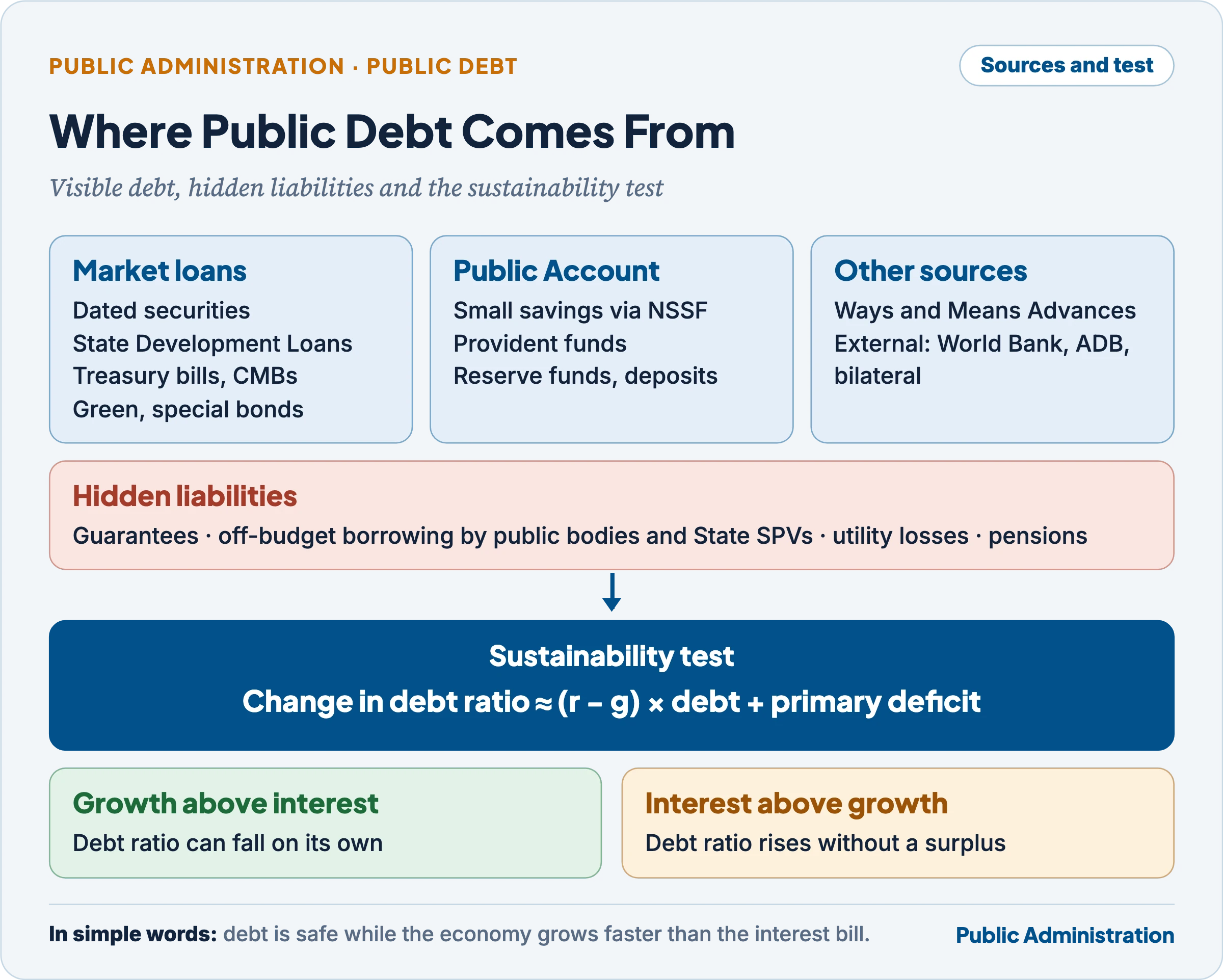
| Dated securities (G-secs) | Bonds of maturities up to 50 years, auctioned by the RBI for the Centre; the bulk of central debt. States issue State Development Loans (SDLs) |
| Treasury bills | Short-term discounted paper of 91, 182 and 364 days; Cash Management Bills of under 91 days for temporary mismatches |
| Ways and Means Advances (WMA) | Short-term overdraft-like advances from the RBI within limits, replacing ad hoc T-bills since 1997 |
| Small savings and NSSF | Post office deposits, PPF, NSC, Sukanya Samriddhi, Senior Citizens’ Savings Scheme; collections go to the National Small Savings Fund (set up 1999), which lends to the Centre (and some States) |
| Provident funds, reserve funds and deposits | Held in the Public Account; the government is a trustee and must repay |
| Special securities | Issued to specific bodies instead of cash: oil bonds, fertiliser bonds, bank recapitalisation bonds |
| Special-purpose bonds | Floating rate bonds, inflation-indexed bonds, Sovereign Gold Bonds (from 2015), and Sovereign Green Bonds (first auctioned 25 January and 9 February 2023, ₹8,000 crore each, under a framework of November 2022; they were sold slightly below normal yields, a “greenium”) |
| External debt | Loans from multilateral bodies (World Bank, ADB, AIIB, New Development Bank) and bilateral partners; States’ external project loans are routed through the Centre |
- Ownership: commercial banks, insurance companies, provident and pension funds, the RBI and, increasingly, foreign investors after India’s government bonds were included in the J.P. Morgan emerging-market bond index from June 2024. The RBI Retail Direct scheme (2021) lets individuals buy G-secs directly.
- Country external debt (government and private) was about US $736 billion at end-March 2025, roughly 19% of GDP; the sovereign’s share is small, which limits currency risk to the budget.
14.5 Contingent liabilities and hidden debt
- Contingent liabilities are obligations that become real only if some event occurs: guarantees on loans of public enterprises, State power utilities and cooperatives; PPP termination payments; deposit insurance; pension promises.
- Off-budget and extra-budgetary borrowings: loans raised by public bodies (FCI from the NSSF, NHAI, IRFC, special purpose vehicles of States such as Kerala’s KIIFB or irrigation corporations) whose repayment ultimately falls on the budget.
- Controls: the FRBM Act caps new central guarantees at 0.5% of GDP a year; in Budget 2021-22 the Centre ended NSSF loans to the FCI and brought the food subsidy on budget; in 2022 it began counting State off-budget borrowings through SPVs against the Net Borrowing Ceiling; the Sixteenth Finance Commission asked States to end such borrowings.
- Why they matter: they make reported debt look lower than true debt, weaken legislative control, and can suddenly crystallise (as with State power distribution company losses taken over under UDAY in 2015-16).
15. Constitutional Provisions on Borrowing
In simple words
The Constitution lets the Centre borrow freely within limits Parliament may set, but lets States borrow only inside India, and only with the Centre’s permission if they still owe it money. That one clause gives the Centre a strong hand over State finances.
| Provision | Content | Practical position |
|---|---|---|
| Article 266 | All revenues, loans raised (by treasury bills, loans or WMA) and repayments received form the Consolidated Fund; other public money (small savings, provident funds, deposits) goes to the Public Account | Borrowed money enters the Consolidated Fund and can be spent only with appropriation; Public Account money is held in trust |
| Article 112(3)(c) / 202(3)(c) | Debt charges (interest, sinking fund, redemption) are charged on the Consolidated Fund | Voted on by neither House as demands; protects creditors |
| Article 292 | Centre may borrow upon the security of the Consolidated Fund of India within limits fixed by Parliament by law, and give guarantees | No such law has ever fixed an overall limit; the FRBM Act functions as the practical limit |
| Article 293(1) | States may borrow only within the territory of India, on the security of their Consolidated Fund, within limits fixed by the State legislature | States cannot borrow abroad directly |
| Article 293(2) | Centre may lend to or guarantee loans of States, within limits under Article 292 | Back-to-back loans (for example GST compensation, 2020–22) and 50-year capital loans |
| Article 293(3) | A State may not raise a loan without the Centre’s consent if any part of a loan from, or guaranteed by, the Centre is still outstanding | Since practically every State owes the Centre money, all State borrowing needs consent; this is the legal basis of the Net Borrowing Ceiling |
| Article 293(4) | Consent may be given subject to conditions | Conditions on power sector reform, off-budget borrowing and fiscal deficit |
- Is the scheme biased towards the Union? Yes, in design: the Centre’s borrowing is limited only by its own Parliament, while States’ borrowing needs the Centre’s consent, and the Centre controls the transfers that service State debt. The justification is macroeconomic stability (one sovereign, one bond market, one currency) and the Centre’s role as lender of last resort. The critique is that consent is used to impose policy conditions and that the Centre counts State off-budget borrowing while running large extra-budgetary borrowing of its own.
Indian Connect — Kerala v. Union of India (2024)
- Kerala sued the Centre under Article 131, challenging the Net Borrowing Ceiling, the 2018 FRBM amendment and the counting of borrowings by its infrastructure fund (KIIFB) and pension company against the ceiling.
- On 1 April 2024 a two-judge bench of the Supreme Court (Justice Surya Kant) refused interim relief, observing that hardship created by a State’s own financial mismanagement is not irreparable injury, and referred the questions on Article 293 to a five-judge Constitution Bench, since the Article had never been authoritatively interpreted.
- The case is the first judicial test of how far the Union may control State borrowing; its outcome will shape fiscal federalism and the treatment of off-budget borrowing.
16. Public Debt Management: The RBI as Debt Manager and the PDMA Debate
In simple words
Borrowing hundreds of thousands of crores every year is a job in itself: when to borrow, for how long, at what cost, and how to repay old loans without a crunch. In India the central bank has done this job for the government, which raises the question whether a central bank should also be the government’s borrowing agent.
16.1 What debt management involves
Public debt management means deciding the size, composition, maturity, cost and risk of government debt, the timing of issues, the investor base and cash management, so that the government’s financing needs are met at the lowest cost over the medium term, consistent with prudent risk.
Methods of redeeming debt (the classical list):
| Method | How it works | Assessment |
|---|---|---|
| Refunding | New bonds issued to repay maturing ones | Postpones, does not reduce, the debt |
| Conversion | Old high-interest debt exchanged for new lower-interest debt | Cuts interest cost; India uses switches and buybacks |
| Sinking fund | A fund built from revenue each year to repay debt at maturity | Systematic and confidence-building, but tempting to raid in crises (States maintain Consolidated Sinking Funds with the RBI) |
| Terminable annuities | Repayment in annual instalments | Debt falls steadily |
| Surplus budget | Using revenue surplus to repay | Rare today; may be deflationary |
| Additional taxation / capital levy | New taxes, or a once-for-all levy on wealth (advocated by Hugh Dalton for war debts) | Painful; capital levy is politically difficult |
| Balance-of-payments surplus | Foreign exchange earned to repay external debt | Needed for external debt |
| Monetisation | Central bank creates money to repay | Inflationary; restricted by law in India |
16.2 The RBI as debt manager
- The RBI manages the Centre’s debt by statute (sections 20 and 21 of the RBI Act) and the States’ debt by agreement (section 21A).
- It announces half-yearly issuance calendars in consultation with the Government, conducts auctions through primary dealers, maintains the securities registry under the Government Securities Act, 2006, manages WMA and cash, and develops the G-sec market (e-Kuber, NDS-OM trading, Retail Direct).
- Debt sustainability features of India’s debt: mostly domestic, in rupees, with long maturity and a captive investor base (banks under SLR, insurers, provident funds). These lower rollover and currency risk.
16.3 The PDMA debate
The conflict of interest. As monetary authority the RBI may need to raise interest rates; as debt manager it wants to keep government borrowing costs low. As banking regulator it can require banks to hold government bonds (SLR), creating captive demand.
Proposals for separation:
- Many committees recommended an independent debt office outside the RBI: the Committee on Capital Account Convertibility (1997), the Working Group on Separation of Debt Management from Monetary Management (1997), the Committee on Fuller Capital Account Convertibility (2006), the Raghuram Rajan Committee on Financial Sector Reforms (2008) and others.
- The Budget speech of February 2015 announced a statutory Public Debt Management Agency (PDMA) bringing domestic and external debt “under one roof”; the provisions were dropped from the Finance Bill 2015 after the RBI’s objections.
- In October 2016 the Ministry of Finance set up the Public Debt Management Cell (PDMC) in the Department of Economic Affairs as an interim, advisory body to plan borrowing, monitor cash and contingent liabilities, publish debt data and prepare for a PDMA. It still functions in that interim role.
| For an independent PDMA | Against (or for caution) |
|---|---|
| Removes the conflict between monetary policy and debt management; strengthens inflation targeting | The RBI’s market expertise and infrastructure would be lost or duplicated |
| Brings domestic, external and contingent liabilities under one office; better risk analysis | In a shallow market, coordination of borrowing with liquidity management is easier inside the central bank |
| International practice (UK Debt Management Office, Sweden, Australia) | A government-controlled agency may borrow more freely and lean on the RBI informally |
| Encourages market-based pricing and a wider investor base | Separation needs a deep, liquid market first; India’s market still relies on captive investors |
Indian Connect — CAG’s audit of public debt management
- The CAG’s performance audit of public debt management (Report No. 16 of 2016) examined the Centre’s borrowing. It noted that external borrowing from the World Bank’s IBRD and the ADB, about 31% of external borrowing in March 2015, was not on concessional terms; that risk analysis of external debt was not being performed by the Middle Office; and it listed the long line of committees that had recommended a debt office outside the RBI.
- Audit thus supplies an independent check on whether borrowing was done at least cost and risk, the same “3E” logic (economy, efficiency, effectiveness) that performance audit applies to schemes.
17. Public Debt Sustainability and India’s Debt Position
In simple words
A loan is manageable if your income grows faster than the interest on it. A country’s debt is sustainable in the same sense: if the economy grows faster than the interest rate on debt, the debt ratio can fall even with some borrowing; if interest runs ahead of growth, the ratio climbs unless the government runs a surplus before interest payments.
17.1 The arithmetic of sustainability
The change in the debt-to-GDP ratio depends on three things:
- The interest–growth differential (r − g): if the nominal interest rate (r) on debt is below nominal GDP growth (g), existing debt shrinks as a share of GDP on its own.
- The primary balance: a primary deficit adds to debt; a primary surplus reduces it.
- Other flows: exchange-rate changes on external debt, recognition of hidden liabilities, privatisation receipts.
In words: Change in debt ratio ≈ (r − g) × previous debt ratio + primary deficit.
- Evsey Domar (“The ‘Burden of the Debt’ and the National Income”, 1944) showed that with steady growth, a constant deficit ratio leads the debt ratio to settle at a finite level, so debt need not explode as long as the economy grows.
- The N.K. Singh Committee cautioned that India’s debt had fallen mainly because of a favourable r − g (high growth, low real rates), not fiscal prudence, and that this cannot be taken for granted.
- Indicators watched by the CAG and the RBI: debt–GDP, interest payments as a share of revenue receipts, primary balance, maturity profile, share of short-term and external debt, and the use of borrowing (capital vs revenue).
17.2 India’s debt position
| Level | Debt (per cent of GDP) | Source |
|---|---|---|
| Central government | 56.5 (2024-25), 56.1 (RE 2025-26), 55.6 (BE 2026-27); target 50 ± 1 by 2030-31 | Union Budget 2026-27 |
| States (combined) | About 28% of GDP | IMF Article IV, 2025 |
| General government | About 81% of GDP in 2025-26, down from about 89% in 2020-21 | IMF Article IV, 2025 |
- Risks: a high interest burden (about 3.6% of GDP for the Centre; about a third of its revenue expenditure); a general government deficit of about 7% of GDP; rising State debt; contingent liabilities; and, in 2026, higher bond yields and a weaker rupee as oil prices rose.
- Mitigating features: debt is overwhelmingly domestic and rupee-denominated, long in maturity, and held by domestic institutions; growth has been strong; the IMF assessed the risk of sovereign stress as moderate.
17.3 States’ debt: a growing concern
- CAG’s first decadal analysis of State finances (released 19 September 2025) found that the public debt of the 28 States rose 3.39 times, from ₹17.57 lakh crore in 2013-14 to ₹59.60 lakh crore in 2022-23, from 16.66% to 22.96% of GSDP; debt averaged about 150% of States’ revenue receipts.
- Most indebted (debt–GSDP, 2022-23): Punjab 40.35%, Nagaland 37.15%, West Bengal 33.70%; the least indebted were Odisha (8.45%), Maharashtra (14.64%) and Gujarat (16.37%). Eight States were above 30%.
- Golden rule breached: in 11 States (including Andhra Pradesh, Punjab, Kerala, Tamil Nadu, West Bengal, Haryana and Himachal Pradesh) capital expenditure was less than net borrowing, meaning borrowed money paid for current spending; in Andhra Pradesh and Punjab capital spending was only 17% and 26% of net borrowing.
- Off-budget borrowing through State corporations and funds (water, irrigation, infrastructure funds, power utilities) hides further liabilities.
Constraints on prudent fiscal management by States:
- Committed expenditure (salaries, pensions, interest) absorbs a large share of revenue; the revival of the Old Pension Scheme in some States adds long-term liabilities.
- Loss of tax autonomy under GST and reliance on central transfers that vary with Union decisions (cesses outside the pool, CSS conditions).
- Electoral competition in cash transfers, free power and loan waivers.
- Losses of power distribution companies, which periodically land on State budgets.
- Borrowing limits under Article 293(3) that restrict capital spending even for fiscally sound States, and uneven quality of State FRLs.
- Weak capacity in revenue administration, cash management and outcome monitoring.
18. Theories of Public Debt: Burden, Crowding Out and Ricardian Equivalence
In simple words
If the government borrows today and repays in thirty years, who really pays? Some say nobody, because we owe the money to ourselves. Others say our children do, because they inherit higher taxes and fewer factories. The answer depends on who lends, what the money is used for, and how people react.
18.1 The burden of public debt
| View | Thinker and work | Argument |
|---|---|---|
| “We owe it to ourselves” | Abba Lerner (1943) and Keynesians | Internal debt is a transfer from taxpayers to bondholders within the same society; the nation as a whole is not poorer. Only external debt is a real burden |
| Burden falls on future generations | James Buchanan, Public Principles of Public Debt (1958) | Those who lend give up resources voluntarily; the real burden falls on future taxpayers who must pay compulsory taxes to service the debt |
| Smaller capital stock | Franco Modigliani (1961) | Debt-financed spending displaces private capital, so future generations inherit a smaller capital stock and lower output, unless the debt financed productive public investment |
| Money vs real burden | Hugh Dalton, Principles of Public Finance | Direct money burden (taxes to pay interest), direct real burden (loss of welfare to taxpayers, especially if the poor are taxed to pay rich bondholders) and indirect burden (disincentives of higher taxes) |
Synthesis on intergenerational burden:
- Debt does shift burden forward when it finances current consumption, displaces private investment, or is held abroad.
- Debt need not burden the future when it finances productive assets (whose returns pay the interest), when it is used in slumps to employ idle resources, or when growth exceeds the interest rate.
- Even internal debt has real costs: deadweight losses of the taxes needed to pay interest, and regressive redistribution from taxpayers to wealthier bondholders.
18.2 Is public debt a means of increasing employment?
- Yes, in a slump: with idle labour and capacity, debt-financed spending raises demand and employment through the multiplier (Keynes, Lerner), and public investment crowds in private investment.
- But the burden argument limits it: in a fully employed economy, or with high existing debt, extra borrowing raises interest rates, inflation and future taxes; as debt grows, interest pre-empts the budget.
- Modern resolution: use debt for counter-cyclical and investment purposes, keep the debt ratio on a declining path over the cycle, and ensure that r − g stays favourable. India’s post-COVID strategy (borrow, invest, then consolidate) follows this logic.
18.3 Crowding out and crowding in
- Financial crowding out: government borrowing competes for the same pool of savings, raising interest rates and reducing private investment. In India the SLR requirement and large borrowing programmes have been described as financial repression, which channels savings into government paper at below-market rates.
- Real crowding out: public sector use of scarce real resources (steel, cement, skilled labour) at full employment.
- Crowding in: public investment in infrastructure raises the returns on private investment (a highway makes a factory viable). The case for India’s capex-led budgets rests on this effect.
- Evidence depends on the state of the economy: crowding out is strong near full employment and weak in slack times.
18.4 Ricardian equivalence
- David Ricardo (in his Essay on the Funding System, 1820) noted, and doubted, that financing spending by debt instead of taxes might make no difference, because rational taxpayers would save to pay the future taxes.
- Robert Barro (“Are Government Bonds Net Wealth?”, 1974) revived the idea: if households care about their heirs, a debt-financed tax cut leads them to save the entire amount, so private saving rises to offset public dissaving and total demand is unchanged.
- Assumptions: rational, forward-looking households; perfect capital markets; bequest motives linking generations; lump-sum taxes; no growth faster than interest.
- Criticisms: households are liquidity-constrained (especially in India) and spend extra income; people are short-sighted; future taxes may fall on others; taxes are distortionary. Evidence finds at most partial Ricardian offsets.
- Significance: if Ricardian equivalence held, fiscal stimulus through tax cuts would not work; its partial failure is what gives fiscal policy its power.
18.5 Debt, taxes and public services
A large public debt can force higher taxes and reduced services through several routes:
- Interest pre-emption: interest becomes the largest single item of spending (for India’s Centre about a third of revenue expenditure in 2026-27), squeezing health, education and capital spending.
- Debt overhang: fear of future tax rises discourages private investment.
- Higher risk premia: markets and rating agencies demand higher yields, which raises the cost of new debt.
- Loss of fiscal space: less room for counter-cyclical action when a crisis hits.
- Austerity episodes: Greece after 2010 and Sri Lanka, which defaulted on its external debt in 2022, had to cut services and raise taxes sharply under IMF programmes.
The statement is true when debt is high, rising and financing consumption. It is less true where debt is domestic, growth exceeds interest, and borrowing has financed productive assets. Japan, with debt above 200% of GDP but low interest rates and domestic ownership, shows that the level alone does not decide the outcome.
18.6 Effects of public borrowing on the economy
| Area | Possible effects |
|---|---|
| Consumption | Bond-holders may feel wealthier and spend more; tax-payers may cut spending in anticipation of future taxes |
| Saving and investment | Mobilises idle savings in a slump; crowds out private investment near full employment; crowds in through infrastructure |
| Interest rates | Large borrowing raises yields; central bank purchases can offset this temporarily |
| Prices | Borrowing from the central bank or in full employment is inflationary; market borrowing in a slump is not |
| Distribution | Interest transfers income from tax-payers to (usually richer) bond-holders |
| External sector | Foreign borrowing adds reserves now and outflows later; can cause twin deficits |
| Growth | Positive if invested productively; negative beyond some level, though the 90% threshold claimed by Carmen Reinhart and Kenneth Rogoff (“Growth in a Time of Debt”, 2010) was weakened when Herndon, Ash and Pollin (2013) found data errors in their work |
19. International Comparisons
In simple words
Other countries show that there is no single safe level of debt. What matters is who holds the debt, in what currency, at what interest rate, and how fast the economy grows.
| Country or group | Debt situation | Lesson |
|---|---|---|
| Japan | General government debt above 200% of GDP, held mostly by domestic savers and the central bank | Domestic, own-currency debt at low interest can be sustained far longer than foreign-currency debt |
| United States | Debt above 120% of GDP; repeated debt-ceiling standoffs | Even the reserve-currency issuer faces political and interest-cost limits |
| Euro area | Maastricht limits of 3% deficit and 60% debt; the Stability and Growth Pact was reformed in 2024 to allow country-specific debt paths | India’s FRBM numbers echo Maastricht; the move to debt-path rules mirrors India’s own shift |
| Greece (2010 onwards) | Debt crisis, bailouts, deep austerity | Hidden deficits and loss of market access are costly |
| Sri Lanka (2022) | Default on external debt after tax cuts, falling reserves and short-term foreign borrowing | Foreign-currency debt and revenue erosion are a dangerous mix |
| India | General government debt about 81% of GDP, mostly domestic and long-term | Higher than most emerging-market peers, hence the debt anchor and State-level discipline |
Key Terms
| Term | Meaning in simple words |
|---|---|
| Financial administration | The processes of raising, spending, borrowing, accounting for and auditing public money |
| Monetary policy | Central bank control over the supply, availability and cost of money |
| Fiscal policy | Government use of taxes, spending and borrowing to influence the economy |
| Policy repo rate | Rate at which the RBI lends overnight to banks; the main signal of monetary policy |
| Standing Deposit Facility | RBI window where banks park surplus funds without collateral; floor of the rate corridor |
| Marginal Standing Facility | Emergency borrowing window for banks; ceiling of the rate corridor |
| Flexible inflation targeting | Framework in which the central bank aims at an inflation target with a tolerance band, while keeping growth in mind |
| Monetary transmission | Passage of policy rate changes to lending rates, spending and prices |
| Fiscal dominance | Situation in which deficits force the central bank to finance the government |
| Fiscal deficit | Total expenditure minus revenue and non-debt capital receipts; the year’s borrowing |
| Revenue deficit | Revenue expenditure minus revenue receipts; borrowing for consumption |
| Effective revenue deficit | Revenue deficit minus grants for creating capital assets |
| Primary deficit | Fiscal deficit minus interest payments |
| Deficit financing | In Indian usage, meeting a gap by borrowing from the central bank or using cash balances |
| Golden rule | Borrow only to invest, not to pay for current spending |
| Escape clause | Statutory permission to exceed a fiscal target in defined emergencies, within a cap |
| Debt anchor | A medium-term debt-to-GDP target that guides annual deficits |
| Contingent liability | An obligation, such as a guarantee, that becomes payable only if an event occurs |
| Off-budget borrowing | Borrowing by public bodies, serviced from the budget but not shown as government debt |
| Ways and Means Advances | Short-term advances from the RBI to cover temporary cash gaps |
| r − g | Interest rate on debt minus growth rate of GDP; negative values make debt easier to sustain |
| Crowding out | Reduction in private investment caused by government borrowing |
| Ricardian equivalence | Claim that debt-financed tax cuts do not raise spending because people save for future taxes |
Commissions, Committees and Judgments
| Body or case | Year | Key point |
|---|---|---|
| Chakravarty Committee (Sukhamoy Chakravarty) | 1985 | Monetary targeting based on growth of broad money |
| Tax Reforms Committee (Raja J. Chelliah) | 1991–93 | Broad base, moderate rates, simpler taxes |
| Narasimham Committees | 1991, 1998 | Banking sector reform; lower SLR and CRR |
| Kelkar Task Forces (Vijay Kelkar) | 2002, 2004 | Direct and indirect tax reform; implementation of the FRBM Act |
| FRBM Act | 2003 (in force 5 July 2004) | Fiscal targets, transparency, ban on RBI primary subscription |
| Raghuram Rajan Committee on Financial Sector Reforms | 2008 | Among others, recommended a debt office outside the RBI |
| Kelkar Committee on fiscal consolidation | 2012 | Roadmap after the 2008 crisis |
| Urjit Patel Committee on the monetary policy framework | 2014 | CPI inflation target of 4% ±2 and an MPC |
| N.K. Singh FRBM Review Committee | 2017 | Debt anchor of 60% (Centre 40, States 20), Fiscal Council, escape clause |
| Bimal Jalan Committee on the RBI’s Economic Capital Framework | 2019 | Rule-based reserves; ₹1.76 lakh crore transfer |
| Fifteenth Finance Commission (N.K. Singh) | 2020–21 | 41% devolution; State deficit paths after COVID |
| Sixteenth Finance Commission (Arvind Panagariya) | Report 2025, tabled 2026 | 41% retained; State deficits capped at 3% of GSDP; end to off-budget borrowing |
| Union of India v. Mohit Minerals | 2022 | GST Council recommendations are persuasive, not binding |
| State of Kerala v. Union of India | 2024 | Article 293 questions referred to a Constitution Bench; interim relief refused |
| CAG Report No. 16 of 2016 | 2016 | Performance audit of public debt management |
| CAG Report No. 18 of 2022 | 2022 | FRBM compliance 2019-20; undisclosed extra-budgetary resources |
| CAG decadal report on State finances | 2025 | States’ debt up 3.39 times in ten years; golden rule breached in 11 States |
Contemporary Developments
- 21 August 2025: the RBI released a discussion paper on reviewing the monetary policy framework (headline vs core inflation, level of target, band).
- 3 September 2025: the 56th GST Council approved GST 2.0: two main rates of 5% and 18% and a 40% rate for demerit goods, effective 22 September 2025.
- 19 September 2025: the CAG released its first decadal report on State finances: States’ debt up from ₹17.57 lakh crore to ₹59.60 lakh crore (2013-14 to 2022-23); Punjab most indebted at 40.35% of GSDP.
- 1 February 2026: Union Budget 2026-27 set the fiscal deficit at 4.3% of GDP and debt at 55.6%, under the new debt anchor of 50 ± 1% by 2030-31; the Sixteenth Finance Commission’s report was tabled, retaining 41% devolution and recommending a 3% of GSDP cap on State deficits and an end to off-budget borrowing.
- 25 March 2026: the Government retained the 4% ±2 inflation target for April 2026 to March 2031 (S.O. 1580(E)).
- 1 April 2026: the Income-tax Act, 2025 came into force, replacing the Income-tax Act, 1961.
- 22 May 2026: the RBI Board approved a record ₹2.87 lakh crore surplus transfer for 2025-26, keeping the Contingent Risk Buffer at 6.5% of the balance sheet.
- 7 October 2026: the MPC raised the repo rate by 25 bps to 5.50% and moved to a stance of calibrated tightening, its first hike since February 2023, amid higher crude prices and rupee weakness; on 9 October the RBI raised the daily minimum CRR maintenance to 99%.
Revision Grid
| Thinker / body | Work or report (year) | Key idea |
|---|---|---|
| Adam Smith | The Wealth of Nations (1776) | Canons of taxation; distrust of public debt |
| David Ricardo | Essay on the Funding System (1820) | Debt vs taxes equivalence (doubted by Ricardo himself) |
| John Maynard Keynes | The General Theory (1936) | Deficit spending to restore employment; the multiplier |
| Abba Lerner | “Functional Finance and the Federal Debt” (1943) | Judge budgets by effects; internal debt owed to ourselves |
| Evsey Domar | “The ‘Burden of the Debt’ and the National Income” (1944) | Debt ratio stabilises if the economy grows |
| James Buchanan | Public Principles of Public Debt (1958) | Burden of debt falls on future generations |
| Richard Musgrave | The Theory of Public Finance (1959) | Allocation, distribution, stabilisation |
| Franco Modigliani | Burden of the national debt (1961) | Debt reduces the capital stock inherited by the future |
| Wallace Oates | Fiscal Federalism (1972) | Decentralisation theorem |
| Robert Barro | “Are Government Bonds Net Wealth?” (1974) | Ricardian equivalence |
| Buchanan and Wagner | Democracy in Deficit (1977) | Deficit bias in democracies |
| Kydland and Prescott | “Rules Rather than Discretion” (1977) | Time inconsistency; case for rules |
| Sargent and Wallace | “Some Unpleasant Monetarist Arithmetic” (1981) | Fiscal deficits limit monetary control |
| Alesina and Summers | Central bank independence (1993) | Independence lowers inflation without growth cost |
| Reinhart and Rogoff | “Growth in a Time of Debt” (2010) | 90% threshold (later contested) |
| Olivier Blanchard | AEA presidential address (2019) | Lower fiscal cost of debt when r < g |
| Urjit Patel Committee | Report (2014) | Flexible inflation targeting and an MPC |
| N.K. Singh Committee | FRBM review (2017) | Debt anchor, Fiscal Council, escape clause |
| Sixteenth Finance Commission | Report (2025) | 41% devolution; State fiscal rules |
Previous Year Questions
- 2026Deficit budgeting as a tool for stimulating economic development emerged with government investment and initiative. Is deficit budgeting still relevant in the era of liberal ideology? Justify your answer.
- 2025Neo-liberal policies have enhanced the scope and opportunities of taxation for the government. Explain.
- 2024Modern economists think public debt is an essential means of increasing employment and an element of economic policy, but it also shifts the burden to future generations. Analyse.
- 2023“Monetary Policy and fiscal policy are different; but both are used to regulate economy.” Discuss.
- 2020“Fiscal policy should address the issues of inequity, intricacy and obscurantism.” Explain.
- 2019Discuss the major areas of change in the Tax-Reforms of the post liberalisation era. How do you justify the importance of the direct Tax reform in this context?
- 2018“Monetary policy of a country can help or hinder its development process.” Discuss.
- 2017“A large public debt forces the adoption of tax and spending policies that result into higher taxes and reduced services.” Analyse.
- 2016“Public borrowing produces different effects on the economy”. Examine.
- 2016“Fiscal policy and monetary policy are the two tools used by the State to achieve its macroeconomic objectives.” Examine the statement and point out the differences between the tools.
- 2013“Economic reforms are a work in progress with the state reluctant to fully relinquish its reins.” Discuss the statement with regard to implementation of economic reforms in India.
- 2001Critically examine the monetary and fiscal policies of Government of India in the decade 1991 to 2001. Do you think world financial institutions had a role to play in opening Indian economy to global forces? Give reasons to substantiate your argument.
- 1997“Time-honoured and yet often not sufficiently appreciated are the fiscal techniques for securing responsible conduct of administrative business.” Discuss.
- 2026Public debt of states in India has increased significantly in the last one decade. In this context discuss the constraints of the states in planning prudent fiscal management.
- 2025Despite the division of subjects, the Union Government contributes towards subjects in the State and Concurrent Lists. Discuss its pros and cons in the light of fiscal federalism.
- 2010The optimism expressed by the proponents of the Financial Responsibility and Budget Management Act, 2003, in ensuring fiscal discipline appears to be unwarranted. Comment.
- 2009Examine the role of the Finance Ministry of the Union Government in designing and implementing monetary and fiscal policies.
- 2006“The main problem of Centre-State relations in India is bottenecks in fiscal federalism.” Comment.
- 1996“The Union-State financial relation, as provided in the Constitution, are biased towards Union Government in the context of borrowing.” Comment.