

Public Policy: Models of policy-making and their critique; Processes of conceptualisation, planning, implementation, monitoring, evaluation and review and their limitations; State theories and public policy formulation.
This article: The policy cycle and the stagist critique; levels of policy and the role of administrators; conceptualisation (problem definition, agenda-setting, Kingdon’s window, non-decisions); policy planning and formulation (policy analysis, rational techniques, tacit knowledge, policy tools); implementation (Pressman–Wildavsky, perfect administration, top-down and bottom-up schools, synthesis models, implementation gap, Indian cases); monitoring (PRAGATI, dashboards, DMEO); evaluation (types, impact evaluation and RCTs, cost–benefit analysis, PEO and DMEO, outcome budgets, evidence-based policy); review and termination; participation across the process; limitations at each stage.
Official Syllabus: Paper I · Unit 1-10 Public Policy
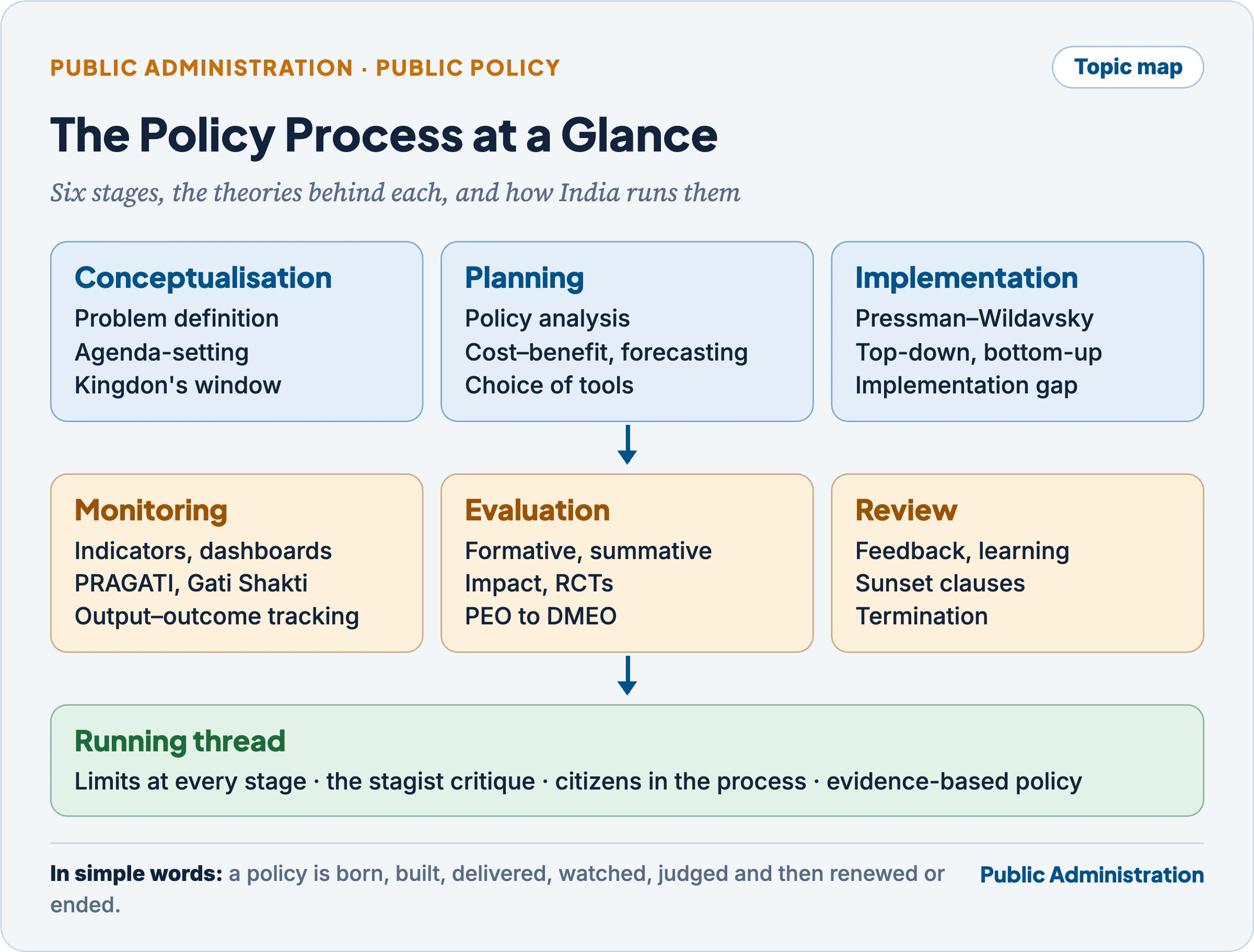
A public policy is not a single decision but a process that runs over months and years: a condition is noticed and defined as a problem, options are worked out, one is chosen, agencies deliver it, its progress is watched, its results are judged, and it is then continued, redesigned or ended. Each of these stages has its own actors, its own techniques and its own typical failures. The syllabus asks for the processes and their limitations, so this article follows the policy from birth to death and asks, at every stage, what goes wrong and why.
- The models of policy-making (rational, incremental, mixed scanning, optimal, elite, group, systems, public choice) and the state theories behind policy formulation are covered in the companion article on models of policy-making. In brief: the models explain how choices are made; this article explains what happens to a policy before and after the choice.
- The two articles meet at many points. Lindblom’s incrementalism explains why review rarely ends programmes; Dror’s optimal model includes a post-policy-making phase of execution, evaluation and feedback; the elite and group models explain who controls the agenda.
In simple words
Think of a family deciding to build a house. First they agree that the old house is too small (the problem). Then they compare plans and costs (planning). The contractor builds it (implementation), someone visits the site every week (monitoring), and after a year they ask whether the house really meets their needs (evaluation). Finally they decide to add a room or sell it (review). Government policy moves through the same steps, only with millions of people and many more ways to go wrong.
1. The Policy Process and the Policy Cycle
In simple words
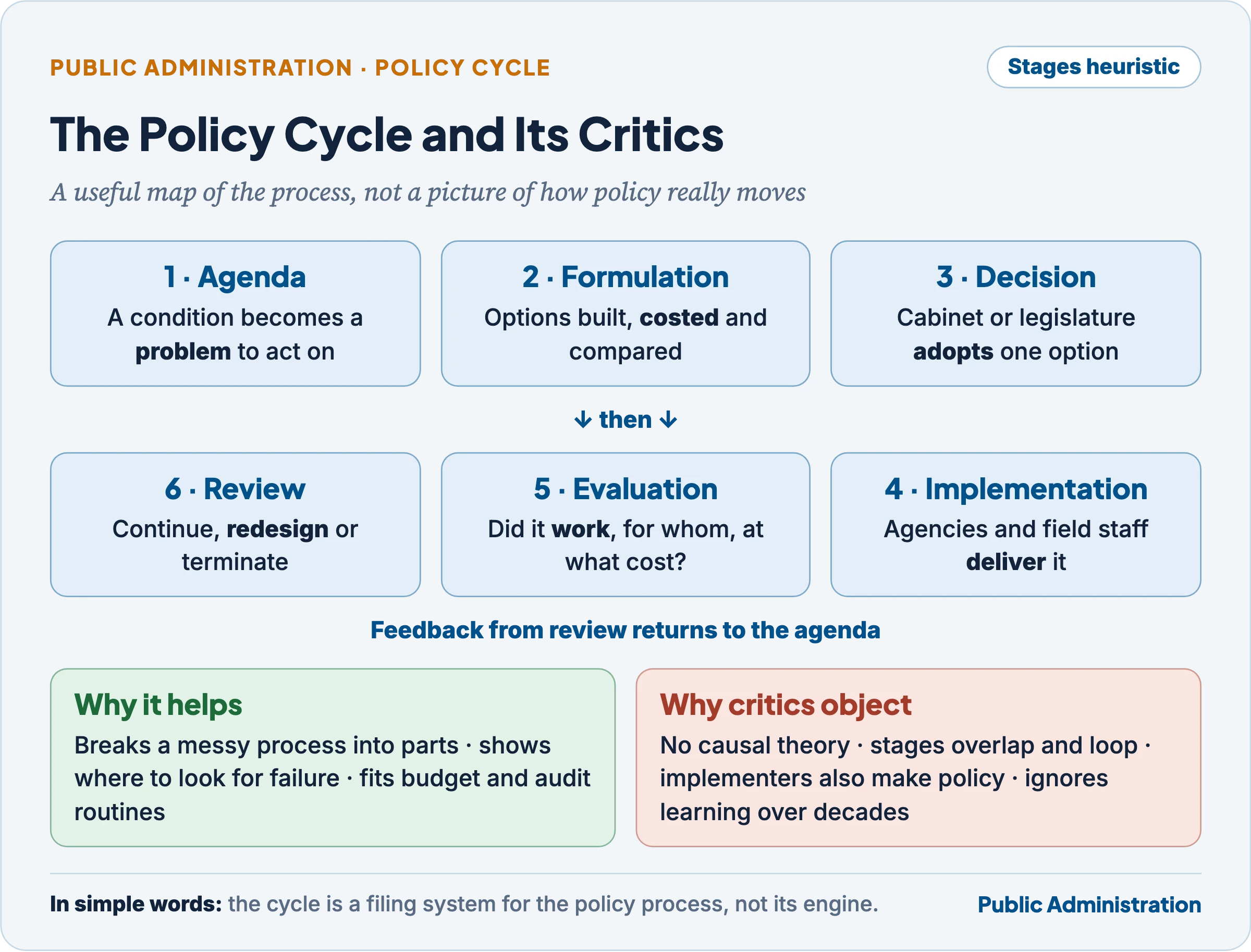
The policy cycle is a way of cutting a long, messy process into named stages so that it can be studied. It is like dividing a cricket match into overs: useful for keeping score, though the game itself flows without pausing at each over.
1.1 From “policy science” to the stages model
- Harold Lasswell, the American political scientist who launched the policy sciences with Daniel Lerner in The Policy Sciences (1951), first broke the process into functions in The Decision Process (1956). His seven stages were:
- Intelligence: gathering information on the problem.
- Promotion (recommending): advocating particular options.
- Prescription: laying down the authoritative rule.
- Invocation: provisionally applying the rule to conduct.
- Application: final application by courts or officials.
- Appraisal: judging success or failure.
- Termination: ending or modifying the policy.
- Garry Brewer (1974) simplified this to initiation, estimation, selection, implementation, evaluation and termination, and made two changes that stuck: the process starts with recognition of a problem, and it is continuous, without a fixed end.
- Charles Jones (An Introduction to the Study of Public Policy, 1970) and James Anderson (Public Policy-Making, 1975) gave the textbook sequence of problem identification, agenda, formulation, adoption, implementation and evaluation.
- Michael Howlett and M. Ramesh (Studying Public Policy, 1995) linked each stage to applied problem-solving, which is the five-stage cycle most widely used today:
| Applied problem-solving | Stage of the policy cycle | Main question |
|---|---|---|
| Problem recognition | Agenda-setting | Which conditions become problems government will act on? |
| Proposal of solution | Policy formulation | What options exist and what will they cost? |
| Choice of solution | Decision-making | Which option is adopted, by whom? |
| Putting solution into effect | Implementation | Who delivers it, and with what discretion? |
| Monitoring results | Evaluation (and review) | Did it work? Should it continue? |
The syllabus words map neatly onto this cycle: conceptualisation is agenda-setting and problem definition; planning covers formulation and decision; implementation, monitoring, evaluation and review follow. The value of the cycle is that it tells an analyst where to look when a policy fails: at a wrong diagnosis, a poor design, weak delivery, poor tracking or a refusal to learn.
1.2 Other stage schemes found in the literature
- Yehezkel Dror, the Israeli policy scientist, divided policy-making in Public Policymaking Reexamined (1968) into meta-policy-making (deciding how to make policy), policy-making proper and post-policy-making (motivating execution, executing, evaluating and feeding back), with eighteen sub-phases. His point was that the system that makes policy must itself be designed and improved.
- Austin Ranney (Political Science and Public Policy, 1968) listed five components of any policy: a particular object, a desired course of events, a selected line of action, a declaration of intent and an implementation of intent. The last item already says that a policy unimplemented is only half a policy.
- R.K. Sapru, the Indian policy scholar, describes rational policy-planning as discerning the problem, formulating alternative courses of action, forecasting their consequences, making the policy choice, and appraisal and review.
- Herbert Simon‘s three phases of decision (intelligence, design and choice) sit inside the formulation stage; the companion article on decision-making explains them.
1.3 Levels of policy and who makes them
Policy is not made at one point. It starts general at the top and becomes more particular as it moves down:
| Level | What it is | Who makes it | Indian example |
|---|---|---|---|
| Political policy | The general programme of the party in power, endorsed at the polls | Party, Parliament, Cabinet | A manifesto pledge of housing for all |
| Executive policy | The general policy brought “down to earth”; legislative proposals framed | Cabinet and the minister in charge | Cabinet approval of a housing mission |
| Administrative policy | The design that carries the government’s will into effect | Ministry, department, board | Scheme guidelines on beneficiary selection |
| Technical policy | Day-to-day choices made by officials applying their expertise | Field and technical officers | An engineer’s choice of building design |
- The four levels reduce to two types, political and administrative, each with a detailed form. The lowest level matters more than it looks: every official with discretion makes policy, an idea that Lipsky later built into a full theory (section 4).
- Policy must also be told apart from neighbouring terms:
- Policy and decision: every policy involves decisions, but most decisions are not policy. Policy decisions are of general application, wider implication and longer time frame; routine decisions are taken within them. (The companion article on decision-making develops this.)
- Policy and goal: a goal is a desired state, such as removal of poverty; it becomes a policy only when translated into a line of action, such as a rural employment guarantee.
- Policy and plan: planning allocates investment and sets targets; it needs a policy framework behind it, and the decision to plan is itself a policy.
1.4 Administrators in the policy process
Classical public administration, following Woodrow Wilson‘s essay of 1887, treated policy as the business of politicians and administration as its neutral execution. Practice never fitted the dichotomy.
- Paul Appleby, the American administrator and scholar who also reported on Indian administration in 1953 and 1956, argued in Policy and Administration (1949) that administrators are continually laying down rules for the future and recommending legislation, so administration is policy-making.
- Luther Gulick held that politics cannot be taken out of administration nor administration out of politics; Dwight Waldo called the dichotomy an outworn creed.
- Senior civil servants play three roles in formulation:
- Informative: collecting and organising the data on which a proposal rests.
- Suggestive: advising on feasibility, pitfalls and methods of implementation, and offering alternatives (the Indian administrator B. Sivaraman stressed this advisory role).
- Analytical: testing proposals for technical, economic, administrative and political feasibility.
- In implementation, the bureaucracy anticipates policy needs, develops alternatives, recommends a choice, decides the instruments, and finally applies general policy to individual cases, which is where most citizens meet the state.
Indian Connect — Who formulates policy in India
- Political executive: the Union Cabinet and its committees decide; the Prime Minister’s Office sets priorities; ministers pilot proposals.
- Ministries and the Cabinet Secretariat: a ministry drafts the Cabinet note after inter-ministerial consultation; the Ministry of Law and Justice vets the Bill.
- NITI Aayog (since 1 January 2015, replacing the Planning Commission): strategy documents, indices that rank States, and evaluation through its attached office, the DMEO.
- Parliament: debates, passes Bills and examines them through Department-related Standing Committees and select committees.
- Judiciary: shapes policy through judicial review and directions (for example the Vishaka guidelines of 1997 on sexual harassment at the workplace, later replaced by the 2013 Act).
- Others: political parties and manifestos, interest groups, media, think tanks, and citizens through consultation.
1.5 The stagist critique
The stages model became the standard textbook frame, and from the 1980s it drew sustained criticism.
- Paul Sabatier, the American policy scholar, with Hank Jenkins-Smith in Policy Change and Learning (1993), made the main charges:
- No causal theory: the stages describe a sequence but explain nothing about why policy moves from one stage to the next.
- Wrong sequence: evaluation of an existing programme often comes first and sets the agenda; formulation goes on during implementation.
- Top-down bias: the model focuses on one statute passed at the top, and neglects street-level actors and the many laws that interact in any field.
- Wrong unit of time: real policy change takes a decade or more, and is better studied through policy subsystems and coalitions of actors who learn over time (his advocacy coalition framework, first set out in 1988).
- Robert Nakamura (1987) called it the “textbook” policy process, a teaching device rather than a description.
- Charles Lindblom and the incrementalists argued that policy is never made once; it is continually remade in small steps, so there is no clean start or finish.
- Hal Colebatch (Policy, 1998) contrasted the vertical view of policy as authoritative choice with the horizontal view of policy as a negotiated order among many organisations; the cycle captures only the first.
- John Kingdon‘s streams model and the garbage can model (Cohen, March and Olsen, 1972) show solutions chasing problems, the reverse of the cycle’s order.
Common confusion
Is the policy cycle a description of how policy is really made? No. It is a heuristic: a way of organising study and practice. Real policy moves in loops, overlaps and jumps; solutions sometimes exist before the problem is defined, and implementers reshape the policy as they deliver it. The cycle remains useful because budgets, audits and evaluations are organised around its stages, but it should never be read as a causal theory.
2. Conceptualisation: Problem Definition and Agenda-Setting
In simple words
Many things are wrong in any society at any moment, but government can attend to only a few. Conceptualisation is the stage where some of these conditions get noticed, named as problems and placed on the government’s list of things to do. Whoever controls that list controls much of what follows.
2.1 Problem definition
- A condition (high infant mortality, traffic deaths, crop residue burning) becomes a problem only when people come to see it as undesirable and open to public action. The same condition can be defined in different ways, and each definition points to a different policy:
- Stubble burning seen as farmers’ indiscipline leads to fines; seen as a cost problem it leads to subsidised machinery; seen as a cropping-pattern problem it leads to crop diversification.
- Malnutrition seen as food shortage leads to distribution; seen as poor sanitation and maternal care it leads to convergence of health, water and nutrition schemes.
- Problem definition is therefore political: it assigns causes, blame and responsibility. A wrong diagnosis at this stage cannot be rescued by excellent implementation later; this is the error of solving the wrong problem.
- Geoffrey Vickers, the British administrator-theorist, in The Art of Judgment (1965) described policy judgement as having three parts:
- Reality judgements: what the situation is (facts, trends).
- Value judgements: how far the situation is acceptable, given the standards one holds.
- Instrumental judgements: what can be done about it, with what means.
His appreciative system is the set of readiness to notice some facts and value them in particular ways; problem definition depends on it, which is why two governments looking at the same data define different problems.
2.2 The agenda and how issues reach it
- Roger Cobb and Charles Elder (Participation in American Politics, 1972) distinguished two agendas:
- The systemic agenda: all issues the community thinks deserve public attention.
- The institutional (formal) agenda: the much shorter list that government actually takes up for active consideration.
- Cobb, Ross and Ross (1976) described three routes onto the agenda:
- Outside initiation: groups outside government raise an issue and push it onto the formal agenda (common in pluralist democracies). Example: the right to information campaign in Rajasthan in the 1990s, which fed into the RTI Act, 2005.
- Mobilisation: leaders inside government place an item on the formal agenda and then build public support (common where the state is strong). Example: national sanitation and cleanliness drives launched from the top.
- Inside access: influential groups close to government raise an issue and keep it away from public debate, often in technical or economic fields.
- Anthony Downs (1972) described an issue-attention cycle: a pre-problem stage, alarmed discovery, realisation of the cost of action, gradual decline of interest, and a post-problem stage. Many issues (air pollution in Delhi each winter is the familiar example) rise and fall with media attention rather than with the problem itself.
- Peter Bachrach and Morton Baratz (“Two Faces of Power”, 1962) showed the hidden side of agenda-setting: non-decision-making, where powerful interests keep issues off the agenda by prevailing values, procedures and threats, so that the issue never reaches the stage of decision at all.
2.3 Kingdon’s multiple streams and the policy window (brief)
John Kingdon, in Agendas, Alternatives, and Public Policies (1984), explained why some issues rise suddenly while others wait for years.
- Three largely independent streams flow through the political system:
- The problem stream: indicators, focusing events (a disaster, a crime, a crisis) and feedback from existing programmes.
- The policy stream: a “primeval soup” of ideas worked out by experts, officials and researchers in policy communities; ideas survive if technically feasible and acceptable.
- The political stream: national mood, elections, changes of government and interest-group campaigns.
- When the three streams couple, a policy window opens, usually briefly. Policy entrepreneurs (ministers, officials, activists) who have kept a solution ready use the window to push it through.
- Indian illustrations:
- The 2004 Indian Ocean tsunami (problem) met long-discussed disaster management proposals (policy) and political will, producing the Disaster Management Act, 2005.
- The December 2012 Delhi gang-rape case (problem) met the recommendations of the Justice J.S. Verma Committee (January 2013) and intense public pressure, producing the Criminal Law (Amendment) Act, 2013.
- The 1991 balance of payments crisis opened the window for economic liberalisation.
- The model is the reverse of the cycle: the solution often exists before the problem is recognised. Its limit is that it explains agenda-setting better than implementation, and the streams are rarely fully independent in parliamentary systems where the executive dominates. The companion article on models treats it with the other theories.
2.4 Interest groups, media and agenda-setting in developing countries
- Interest groups work in two directions: they raise issues (farmers’ unions on minimum support prices, industry chambers on taxation) and they deny other groups the chance to raise theirs, through non-decisions and control of information.
- In developing countries the pattern differs from the Western pluralist picture:
- Organised groups are few and unequal: business associations, large farmers and urban middle classes are organised; landless labourers, informal workers, tribal communities and women in rural areas are not. The agenda therefore tilts towards the organised.
- The state and the political executive dominate agenda-setting, often through the mobilisation route; bureaucracies carry great weight.
- Donors and international agencies shape agendas through conditions, funding and targets (the Millennium and Sustainable Development Goals).
- Social movements and courts compensate: public interest litigation has placed issues such as the right to food, bonded labour and environmental protection on the agenda when legislatures did not.
- The media can widen the agenda by publicising neglected problems, but can also distort it: dramatic events crowd out chronic problems, and governments may respond to headlines rather than evidence. This is the core of the debate whether media influence helps or hinders agenda-setting by government.
2.5 Globalisation and the national agenda
- National agendas are increasingly set beyond the nation: climate commitments under the Paris Agreement (2015), the Sustainable Development Goals (2015–2030), trade rules, global tax agreements and pandemic responses all enter national policy agendas.
- India adapts these through its own institutions: NITI Aayog’s SDG India Index (first released in 2018) ranks States on the goals, and national missions on renewable energy follow from climate pledges.
- The limit is that international agendas may not match local priorities, and the capacity to implement them is uneven across States.
Indian Connect — Consultation at the conceptualisation stage
- The Pre-Legislative Consultation Policy was adopted by the Committee of Secretaries chaired by the Cabinet Secretary on 10 January 2014. Each ministry is to place the draft legislation (or at least its justification, essential elements, financial implications and an estimate of its impact on environment, fundamental rights and livelihoods) in the public domain for at least thirty days, with an explanatory note in simple language.
- A summary of the feedback is to go with the Cabinet note and to the Department-related Standing Committee; the Ministry of Law and Justice is to check compliance while vetting.
- Limitation: the policy is an executive decision, not a statute, so compliance is uneven; several important Bills have been introduced with little or no prior consultation.
- The three farm laws of 2020, passed without wide consultation with farmers’ organisations, faced a year-long protest and were withdrawn by the Farm Laws Repeal Act, 2021: a reminder that weak conceptualisation and consultation can sink a policy however carefully its economics was designed.
2.6 Limitations of conceptualisation
- Biased access: organised and articulate groups dominate; the voiceless are left out.
- Non-decisions: powerful interests keep issues off the agenda altogether.
- Crisis-driven agendas: focusing events produce hurried laws; chronic problems wait.
- Misdiagnosis: problems are defined by the tools an agency already has (“if all you have is a hammer”).
- Information gaps: weak data, especially at district and block level, hide problems from view.
3. Policy Planning and Formulation
In simple words
Once a problem is on the list, someone has to work out what to do about it. Planning is the homework stage: listing options, guessing what each will cost and achieve, and choosing the means. Good homework does not guarantee success, but bad homework almost guarantees failure.
3.1 What formulation involves
- Formulation is the development of alternative courses of action for a problem on the agenda; decision-making (adoption) is the authoritative choice among them by the Cabinet, legislature or competent authority.
- The rational ideal, set out by writers from Lasswell to Stokey and Zeckhauser (A Primer for Policy Analysis, 1978), runs: define the problem; clarify and rank goals; list all alternatives; forecast the costs and benefits of each; choose the option with the greatest net benefit. McNichols described policy formulation in similar steps: analysing the situation, determining objectives and plans of action, organising the plans into action with control measures, and reappraising.
- Administrative planning begins where economic planning ends: after targets and allocations are fixed, someone must work out the organisation, staff, procedures and timelines needed to deliver them. Neglect of this step is a classic cause of failure in Indian plans.
3.2 Policy analysis and its rational techniques
Policy analysis is the application of systematic knowledge to the choice among policy options. It uses a family of techniques, each of which handles a different kind of uncertainty.
| Technique | What it does | Where it helps |
|---|---|---|
| Cost–benefit analysis (CBA) | Puts money values on all costs and benefits, discounts them to the present, and compares net benefit | Infrastructure, irrigation, roads |
| Cost-effectiveness analysis | Compares the cost of options that reach the same non-money goal | Health and education (cost per life saved, per child enrolled) |
| Forecasting and modelling | Projects trends and simulates the effects of options | Demand for power, population, revenue |
| Scenario planning | Builds several plausible futures and tests options against each | Climate, energy, security |
| Sensitivity and risk analysis | Tests how results change if key assumptions change; assigns probabilities | Large projects with uncertain costs |
| Decision trees | Maps sequential choices and chance events with their pay-offs | Phased projects, contingency planning |
| Environmental and social impact assessment | Identifies effects on ecology and affected communities before approval | Dams, mines, land acquisition |
| Pilots and phased roll-out | Tries the policy on a small scale first | New schemes, technology platforms |
- A dam in a forested mountain valley inhabited by ethnic communities shows how these combine:
- Environmental impact assessment under the Environment (Protection) Act, 1986 notifications, and forest clearance.
- A social impact assessment and consent provisions under the Right to Fair Compensation and Transparency in Land Acquisition, Rehabilitation and Resettlement Act, 2013, and, in Scheduled Areas, consultation with gram sabhas under PESA, 1996 and the Forest Rights Act, 2006.
- Cost–benefit analysis that includes displacement, loss of livelihoods and forest, not only power and irrigation gains.
- Risk and sensitivity analysis for seismic hazard, floods and cost overruns; scenario planning for changing rainfall.
- Phased design and contingency plans for rehabilitation, with independent monitoring.
- Cost–benefit analysis deserves particular attention:
- For it: it forces explicit statement of assumptions, makes trade-offs visible, ranks options on a common scale, and disciplines political enthusiasm.
- Against it: many values (life, culture, biodiversity, dignity) resist money valuation; the choice of discount rate silently decides how much future generations count; it adds up gains and losses regardless of who bears them, so a project can pass while hurting the poor; and its apparent precision can legitimise decisions already taken.
- The balanced position is that CBA is a useful aid to judgement, not a substitute for it, and should be read with distributional and environmental analysis.
3.3 The limits of rational analysis: tacit knowledge and judgement
- Michael Polanyi, the Hungarian-British scientist-philosopher, argued in The Tacit Dimension (1966) that “we can know more than we can tell”: much expert knowledge is tacit, held in skill and experience rather than written rules.
- In policy-making, tacit knowledge appears as the experienced officer’s sense of what will work in a district, the politician’s feel for public mood, and the field worker’s knowledge of local power relations. Dror‘s optimal model explicitly includes such extra-rational inputs (intuition, judgement, creativity) alongside rational analysis.
- Its value: it fills gaps where data are absent, warns of implementation problems that models miss, and supports quick action in crises.
- Its limits: it can hide bias and prejudice, it is hard to test or transfer, and it can be used to override evidence. The best practice is to combine tacit knowledge with systematic evidence, for example by involving field officers and beneficiaries in design.
- Policy analysis is also limited when outcomes and alternatives are neglected: if analysts consider only the option already favoured, or only intended outcomes, they miss unintended effects (the Bengal famine of 1943 is often cited as an extreme case of policies producing outcomes nobody intended) and better options.
3.4 Policy tools: the means of policy
The choice of instrument is a central planning decision, because the same goal can be pursued by very different means.
- Christopher Hood, the British scholar of public management, in The Tools of Government (1983) classified tools by the governing resource they use, the NATO scheme:
- Nodality: government’s place at the centre of information networks (advice, campaigns, publishing data).
- Authority: the power to command and forbid (laws, licences, bans).
- Treasure: money (grants, subsidies, tax concessions).
- Organisation: direct provision through government’s own staff and assets.
- Lester Salamon (The Tools of Government, 2002) showed that modern governments increasingly act through indirect tools (contracts, grants, loan guarantees, vouchers, tax expenditures) that depend on third parties, so implementation becomes the management of networks.
- Michael Howlett and M. Ramesh arrange tools on a spectrum of state involvement: voluntary (family, community, markets), mixed (information, subsidies, taxes and user charges) and compulsory (regulation, public enterprises, direct provision).
- Anne Schneider and Helen Ingram (1990) classified tools by the behaviour they assume: authority, incentive, capacity-building, symbolic and hortatory, and learning tools.
- Nudges (Richard Thaler and Cass Sunstein, Nudge, 2008) change the way choices are presented without forbidding options or changing incentives much, for example default enrolment or social comparison messages.
| Tool type | Indian example | Typical limitation |
|---|---|---|
| Information (nodality) | Public health campaigns; publishing district rankings | Weak where literacy or trust is low |
| Authority (regulation) | Bans on single-use plastic; licensing | Enforcement capacity; rent-seeking |
| Treasure (money) | Direct Benefit Transfer of subsidies; fertiliser subsidy | Leakage, fiscal cost, distorted incentives |
| Organisation (direct provision) | Government schools, public health centres | Staff absence, rigidity |
| Behavioural (nudge) | Social messaging in sanitation campaigns | Effects may fade; ethical concerns about manipulation |
- Choosing tools depends on the nature of the problem, the state’s capacity, political acceptability and the target group. A frequent planning error in India has been choosing tools that assume capacity the field does not have (for example online-only processes in areas with poor connectivity).
3.5 Limitations of planning and formulation
- Information and data: poor and late data, especially for districts and blocks; administrative data that are incomplete or inflated.
- Sunk costs and past commitments: earlier investments and policies limit options; departments sometimes pursue contradictory policies (one discourages tobacco use while another supports tobacco cultivation).
- Bounded rationality: decision-makers consider a few options and settle for a satisfactory one (Simon’s “satisficing”).
- Optimism bias and strategic misrepresentation: costs are underestimated and benefits overstated to win approval, a pattern well documented in large projects.
- Political feasibility: what is technically best may be politically impossible; what is feasible is often incremental.
- Weak capacity for policy analysis: limited specialist staff, few links with research institutions, and frequent transfers.
- Neglect of implementation at the design stage: schemes designed in the capital without asking who will deliver them, with what staff and money.
4. Implementation
In simple words
A policy written in Delhi reaches a village only through many hands: ministries, State departments, district officers, block staff and finally the teacher, nurse or patwari. Implementation is the study of what happens to the policy on that journey, and why it so often arrives changed, late or not at all.
4.1 Meaning and importance
- Implementation is the set of activities that carry a policy decision into effect: issuing rules and guidelines, creating or assigning organisations, releasing funds, recruiting and training staff, delivering goods and services, and applying the policy to individual cases.
- Until the 1970s it was assumed to be a technical, non-political matter that followed automatically once a policy was decided. Implementation research showed otherwise: implementation can have as great an impact on policy as the decision itself, because those who deliver it reinterpret it.
- Why it is often called the most important stage:
- A policy is judged by its effects on people, and effects arise only through implementation.
- Policy analysis is incomplete without policy delivery: an option that cannot be delivered is not a real option.
- Much of what public administration does is implementation, so some scholars argue that “policy implementation” captures the field better than the older label “public administration”: it focuses on results, multi-organisational networks and the interaction of politics and administration, rather than on the internal machinery of single departments.
- Implementation as learning: Giandomenico Majone and Aaron Wildavsky (1978) described implementation as evolution, in which policies are continually reshaped as implementers discover what works and what does not. A policy is a hypothesis; implementation tests it.
4.2 Pressman and Wildavsky: the complexity of joint action
Jeffrey Pressman and Aaron Wildavsky, American political scientists, wrote Implementation (1973), subtitled How Great Expectations in Washington Are Dashed in Oakland. It is usually taken as the founding study of implementation.
- The case: in 1966 the federal Economic Development Administration announced a programme to create jobs for minority unemployed people in Oakland, California, through public works (an airport hangar, a marine terminal) and business loans. Money was approved and there was little open opposition, yet years later only a small fraction of the promised jobs had appeared.
- The explanation: the complexity of joint action. The programme needed the agreement of many participants (federal agencies, city bodies, the port, businesses), each with its own priorities. The authors counted about seventy decision points (clearances). Even if each clearance had a high probability of success, the probability that all would succeed was low: with 99 per cent at each of seventy points, overall success falls below one in two.
- Lessons:
- Implementation should not be divorced from policy design: designers must ask how many agencies and clearances a programme needs.
- Simpler designs, fewer veto points and direct routes are more likely to succeed.
- Delay is itself a form of failure: each clearance takes time, and support erodes.
- Economic theory must match the delivery mechanism: the programme’s theory (capital spending creates jobs for the target group) was weak.
- The authors’ remark that one should normally expect new programmes to fail to get off the ground, because the cards are stacked against things happening, expresses the core insight: success is the surprising outcome and needs explaining.
- Criticism: later scholars argued that the authors started from a top-down standard (the original federal goals) and so counted every local adaptation as failure; some adaptations were sensible responses to local conditions.
4.3 “Perfect administration” and the preconditions of perfect implementation
- Christopher Hood, in The Limits of Administration (1976), approached implementation the way economists approach markets: by describing perfect administration, a model in which external factors and resources are given and administration itself produces perfect results, just as economists use perfect competition as a benchmark. Its conditions are:
- A unitary administrative system, like an army, with a single line of authority.
- Uniform norms and rules enforced throughout.
- Perfect obedience or perfect control.
- Perfect information and communication and perfect coordination.
- Sufficient time.
- No real system meets these conditions, so the model shows where and why real implementation falls short: limits of authority, conflicting norms, resistance, information loss and time pressure.
- Brian Hogwood and Lewis Gunn (Policy Analysis for the Real World, 1984) listed ten preconditions of perfect implementation, among them: no crippling external constraints; adequate time and resources; the right combination of resources available at each stage; a valid theory of cause and effect with few intervening links; minimal dependency relationships; agreed and understood objectives; tasks fully specified in the correct sequence; perfect communication and coordination; and perfect compliance with commands.
- The value of both models is diagnostic: each missing precondition names a possible cause of failure and a possible remedy.
4.4 The top-down school
Top-down writers begin with the policy decision at the top and ask how far it was carried out as intended, and what conditions make faithful implementation more likely.
- Donald Van Meter and Carl Van Horn (“The Policy Implementation Process: A Conceptual Framework”, 1975) identified six variables that link policy to performance:
- Policy standards and objectives, which must be clear and measurable.
- Resources: funds and incentives.
- Inter-organisational communication and enforcement activities.
- Characteristics of the implementing agencies: competence, size, control, vitality.
- Economic, social and political conditions in the environment.
- Disposition of implementers: their understanding of, and agreement with, the policy.
They also noted that implementation is easier where the change required is small and goal consensus is high.
- Paul Sabatier and Daniel Mazmanian (“The Conditions of Effective Implementation”, 1979; Implementation and Public Policy, 1983, with Mazmanian as lead author) set out six conditions for effective implementation:
- Clear and consistent objectives.
- An adequate causal theory linking the policy’s action to the desired change.
- A legally structured process that maximises compliance by implementers and target groups (enough authority, few veto points, supportive agencies).
- Committed and skilful implementing officials.
- Support of interest groups and legislative and executive sovereigns.
- Changes in socio-economic conditions that do not undermine political support or the causal theory.
Their wider framework groups the variables into three sets: the tractability of the problem, the ability of the statute to structure implementation, and non-statutory variables such as public support and media attention.
- George Edwards III (Implementing Public Policy, 1980) reduced the factors to four:
- Communication: orders must be transmitted clearly and consistently; distortion grows with every layer.
- Resources: staff, skills, information, authority and facilities.
- Dispositions: implementers’ attitudes and self-interest; if they disagree with a policy they may delay or dilute it.
- Bureaucratic structure: standard operating procedures can help routine tasks but obstruct new ones; fragmentation of responsibility across agencies hinders coordination.
- Eugene Bardach (The Implementation Game, 1977) described implementation as a set of games in which actors divert resources, deflect goals, resist control and waste energy; the remedy is a “fixer”, a powerful actor who intervenes to repair the process.
4.5 The bottom-up school
Bottom-up writers begin at the point of delivery, with the officials and citizens who meet there, and ask what actually happens.
- Michael Lipsky, Street-Level Bureaucracy: Dilemmas of the Individual in Public Services (1980):
- Street-level bureaucrats are public employees who interact directly with citizens and have substantial discretion: teachers, police constables, health workers, social workers, revenue clerks.
- They work with chronically inadequate resources, ambiguous and conflicting goals, demand that rises to meet supply, and clients who do not choose them.
- To cope, they develop routines and simplifications: rationing services through queues and waiting, “creaming” (serving the easiest cases), stereotyping clients, and modifying goals.
- Their decisions, taken together, become the policy that citizens actually experience. Policy is made, in an important sense, at the street level.
- Indian examples: a constable deciding whether to register a complaint; a patwari deciding how quickly to record a mutation; a school teacher deciding which children to attend to; a frontline health worker deciding which households to visit.
- Benny Hjern, the Swedish scholar, with David Porter (“Implementation Structures: A New Unit of Administrative Analysis”, 1981) and Chris Hull (1982):
- Implementation is carried out by implementation structures, networks of actors from many public and private organisations, not by a single agency following a single statute.
- The method is to map the network from the bottom: identify the actors who deal with a problem locally, then trace upwards whom they depend on.
- Richard Elmore (“Backward Mapping”, 1979–80) proposed designing policy backwards: start from the behaviour at the point of delivery that the policy wants to change, ask what capacity and resources the local unit needs, and only then decide what the higher levels must do. Forward mapping (from the top down) assumes that policymakers control the process; backward mapping assumes they do not.
- Susan Barrett and Colin Fudge (Policy and Action, 1981) described a policy–action continuum: implementation is a process of negotiation and bargaining between those who seek to put policy into effect and those on whom action depends.
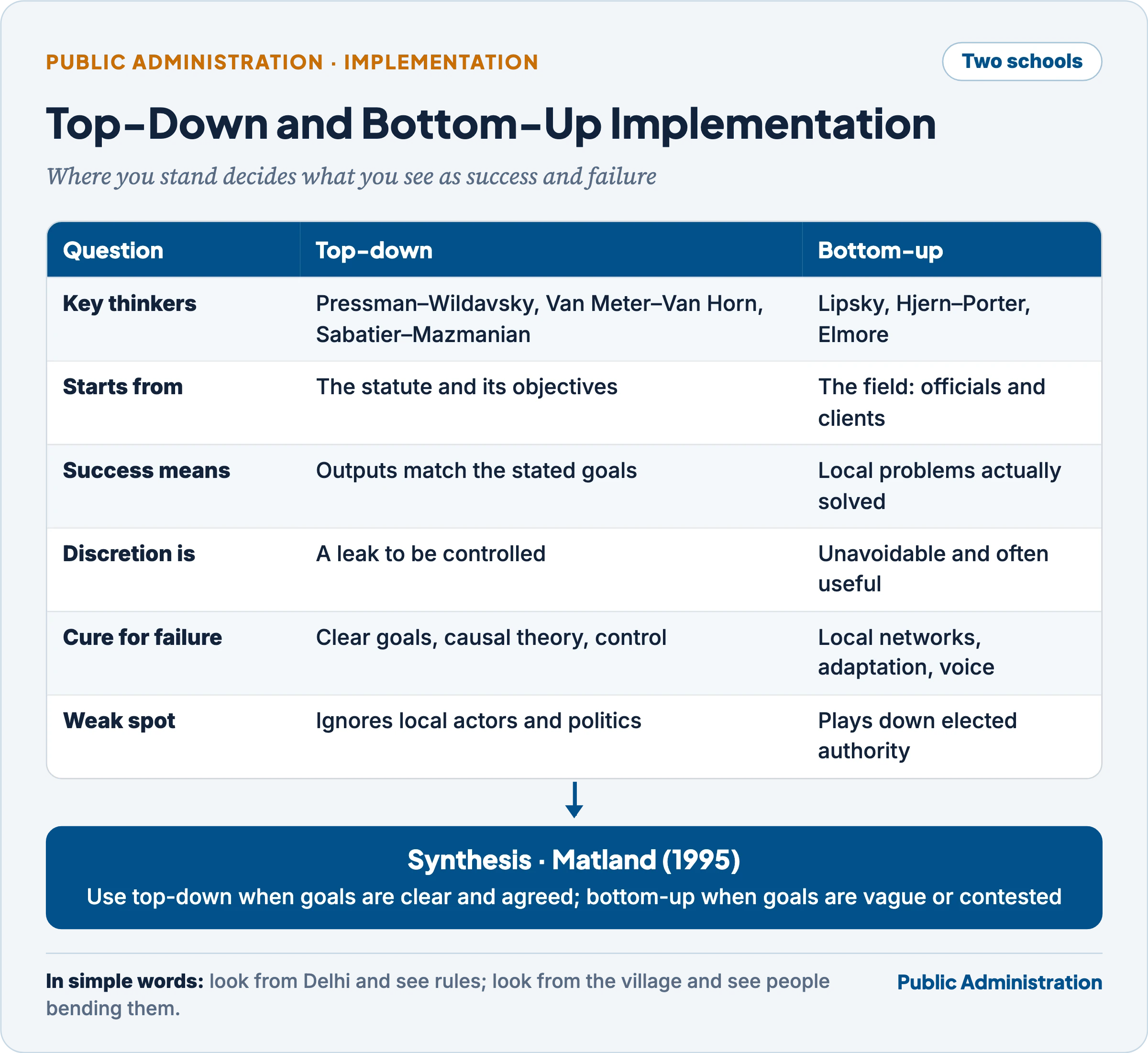
The two schools disagree on almost every point: where to start, what counts as success, whether discretion is a problem or a resource. The top-down school speaks for democratic control (elected bodies should decide, officials should carry out); the bottom-up school speaks for realism and responsiveness (officials must adapt general rules to particular cases).
4.6 Synthesis and later models
- Richard Matland (“Synthesizing the Implementation Literature”, 1995) argued that each school fits different situations, depending on the ambiguity of goals and means and the conflict among actors:
| Low conflict | High conflict | |
|---|---|---|
| Low ambiguity | Administrative implementation: outcome decided by resources (for example, a vaccination drive) | Political implementation: outcome decided by power (for example, land reform) |
| High ambiguity | Experimental implementation: outcome decided by local context (for example, pilot innovations) | Symbolic implementation: outcome decided by the strength of local coalitions (for example, vague declarations on gender equality) |
Top-down models fit the low-ambiguity cells; bottom-up models fit the high-ambiguity cells.
- Malcolm Goggin and colleagues (Implementation Theory and Practice, 1990) proposed a third generation of research, treating implementation as communication between federal and state levels, with inducements and constraints flowing both ways.
- Sabatier’s advocacy coalition framework (1988) moved beyond both schools by studying policy subsystems over a decade or more.
- Network and collaborative governance approaches treat implementation as joint work of public agencies, private firms and civil society, which brings its own problems of accountability.
4.7 The implementation gap
- The implementation gap is the difference between what a policy promised (its goals and targets) and what was actually achieved. A former Prime Minister, Rajiv Gandhi, famously remarked in 1985 that only about 15 paise of every rupee meant for the poor actually reached them, an image of the gap that has been quoted ever since.
- Causes, drawing on the theories above:
- Design causes: vague or conflicting objectives; a weak causal theory; too many clearances and agencies; unrealistic targets and timelines; schemes designed without field input.
- Resource causes: insufficient funds, staff vacancies, poor skills, delayed releases of money.
- Organisational causes: fragmentation, poor coordination between departments, weak headquarters–field links, frequent transfers, and unclear division of roles between the State Secretariat (policy) and directorates (execution).
- Behavioural causes: implementers’ disagreement, self-interest and corruption; street-level coping routines.
- Environmental causes: social structures such as caste and gender, local power elites who capture benefits, low awareness among beneficiaries, and political interference.
- Federal causes: in India, most social sector schemes are designed by the Union but delivered by States and local bodies, which have different priorities and capacities.
4.8 Policy design or implementation: the contestation
When policies fail, designers blame implementers and implementers blame the design. Both have a case.
- The designers’ view: the policy was sound, but implementing agencies lacked commitment, capacity or integrity. This is the top-down reading.
- The implementers’ view: the policy set impossible targets, ignored local conditions, gave too little money and staff, or depended on too many agencies; failure was built in at the design stage. Pressman and Wildavsky’s central lesson supports them.
- Why the contest cannot be settled in general: design and implementation are not separable. A policy that ignores delivery is badly designed by definition; and implementers inevitably redesign policy as they apply it.
- The way forward joins the two: involve implementers and citizens in design; pilot before scaling; use backward mapping; build feedback loops so that problems found in the field reach designers quickly; and evaluate whether failure came from the theory (the policy idea was wrong) or the execution (the idea was not carried out), a distinction evaluators call theory failure versus implementation failure.
Indian Connect — Implementation in Indian cases
- Rural employment guarantee: the Mahatma Gandhi National Rural Employment Guarantee Act, 2005 built in a rights-based design, gram sabha planning and mandatory social audit (section 17), and achieved wide coverage, yet faced delayed wage payments, fake muster rolls in places and uneven State capacity. Social audits, pioneered in Andhra Pradesh, gave the programme a critical edge. In December 2025 Parliament enacted the Viksit Bharat–Guarantee for Rozgar and Ajeevika Mission (Gramin) Act, 2025, which raises the guarantee to 125 days and will repeal MGNREGA from a date to be notified.
- Direct Benefit Transfer and the JAM trinity (Jan Dhan accounts, Aadhaar and mobile phones) shortened the chain between government and beneficiary, removing many intermediaries and duplicate beneficiaries: a direct response to Pressman and Wildavsky’s problem of too many clearances. Its limits are exclusion errors when authentication fails and weak connectivity in remote areas.
- Swachh Bharat Mission (2014): rapid construction of toilets showed the power of mission-mode implementation with political leadership, but studies also found gaps between toilet construction and sustained use, a classic difference between output and outcome.
- Field organisations carry most of the load in such missions: district and block administrations, panchayats and frontline workers; weak field capacity is the most common bottleneck.
- The farm laws of 2020 failed before implementation began, because formulation ignored the main stakeholders: an example of implementation problems rooted in design and consultation.
4.9 Implementation of the Sustainable Development Goals
- The SDGs (17 goals, 169 targets, 2015–2030) depend on many actors: Union and State governments, local bodies, private firms, civil society and international partners. Their success therefore depends on the wisdom, experience and willingness to cooperate of these actors, exactly the variables stressed by implementation theory.
- India’s arrangements: NITI Aayog coordinates and publishes the SDG India Index; the Ministry of Statistics and Programme Implementation maintains the national indicator framework; many States have SDG cells and district indicator frameworks; the localisation of goals through panchayat development plans brings them to the village.
- Problems: goals that span many departments with no single owner (the coordination problem); data gaps at sub-national level; competing priorities and fiscal limits; and weak capacity in the poorest districts. Bottom-up approaches (local plans, community monitoring) and collaborative governance are the usual remedies.
4.10 Implementation in less developed countries
- Fred Riggs‘s idea of formalism (the gap between formal rules and actual practice in prismatic societies) and Gunnar Myrdal‘s idea of the soft state (Asian Drama, 1968), where laws are not enforced, describe why implementation is especially hard in developing societies.
- Typical features: ambitious laws with weak enforcement; scarce resources; political interference in transfers and postings; local elites capturing benefits; low awareness among beneficiaries; and reliance on donor-driven programmes.
- Effective implementation matters most here because the state is the main agent of development; remedies include simpler designs, technology to shorten delivery chains, decentralisation with capacity, social audit and citizen charters, and stable tenure for key officials.
4.11 Limitations of implementation
- Complexity of joint action: many agencies and clearances.
- Goal ambiguity: vague laws pass political conflict down to field officials.
- Resource gaps: “unfunded mandates”, vacancies, delayed funds.
- Discretion: necessary but open to bias, corruption and coping routines.
- Coordination failure: between ministries, between Centre and States, between headquarters and field.
- Capture: benefits diverted to local elites; regulators captured by the regulated.
- Context: social structures and local politics that the policy did not anticipate.
5. Monitoring
In simple words
Monitoring is checking on a policy while it is running, the way a doctor checks a patient’s temperature every few hours. It does not ask whether the treatment was the right one; it asks whether the treatment is being given on time and whether the patient’s numbers are moving.
5.1 Meaning and types
- Monitoring is the continuous, systematic collection and use of information on the progress of a policy or programme against its planned inputs, activities, outputs and, increasingly, outcomes. It is mainly a management tool, carried out by the implementing agency or a central unit.
- Types of monitoring:
- Input monitoring: funds released and spent, staff in position, materials supplied.
- Process (compliance) monitoring: whether activities follow the prescribed procedure and timeline.
- Output monitoring: goods and services delivered (houses built, children vaccinated).
- Outcome monitoring: changes in the condition of beneficiaries (incomes, learning levels, health status).
- Tools: management information systems (MIS), field inspections, geo-tagging and photographs, dashboards, third-party monitoring, community and social monitoring, and grievance data.
| Monitoring | Evaluation | |
|---|---|---|
| Timing | Continuous, during implementation | Periodic: before, midway or after |
| Question | Are we doing things as planned? | Are we doing the right things, and with what effect? |
| Focus | Inputs, activities, outputs | Outcomes, impact, relevance, efficiency |
| Who | Mainly the implementing agency | Often an independent unit or third party |
| Use | Quick course correction | Redesign, continuation or termination |
Common confusion
Are monitoring and evaluation the same thing? No. Monitoring tracks a programme continuously against its plan and answers “is it on track?”; evaluation judges it at a point in time and answers “did it work, and why?”. A scheme can be perfectly monitored (every rupee and every toilet counted) and still be a poor policy if the toilets are not used. The two are complementary: monitoring data feed evaluation, and evaluation tells monitoring which indicators matter.
5.2 Why monitoring matters
- Laxity in monitoring can render even the best policies ineffective: without timely information, delays, leakages and bottlenecks go unnoticed until it is too late; funds lie unspent; officials face no pressure to perform.
- Good monitoring creates accountability (upwards to ministers and Parliament, outwards to citizens), enables early correction, and supplies the data for evaluation.
Indian Connect — PRAGATI, dashboards and the DMEO
- PRAGATI (Pro-Active Governance and Timely Implementation), launched on 25 March 2015, is an ICT-based, multi-modal platform through which the Prime Minister reviews, by video conference, delayed infrastructure projects, major programmes and public grievances with Secretaries of the Government of India and Chief Secretaries of the States on the same screen. It combines three elements: grievance redressal data, programme review and project monitoring.
- Its 50th meeting was held on 31 December 2025; by then 377 projects had been reviewed under the platform, and the government stated that the PRAGATI-led ecosystem had helped accelerate projects worth more than ₹85 lakh crore. The Prime Minister urged States to set up similar mechanisms at Chief Secretary level, especially for the social sector.
- Strengths: it resolves inter-ministerial and Centre–State bottlenecks that ordinary channels leave stuck; the visibility of review at the top creates pressure to act.
- Limits: it depends on the personal attention of the Prime Minister; it covers a small number of large projects; and it centralises monitoring, which raises federal concerns.
- PM Gati Shakti National Master Plan (launched October 2021) puts infrastructure data from many ministries on a common geospatial platform for integrated planning and monitoring.
- Champions of Change dashboard: under the Aspirational Districts Programme, districts upload data that feed a monthly delta ranking.
- CPGRAMS (the Centralised Public Grievance Redress and Monitoring System) uses grievance data as a signal of implementation problems, though its ability to resolve local issues is limited.
- DMEO (Development Monitoring and Evaluation Office), attached to NITI Aayog since 18 September 2015, maintains the Output–Outcome Monitoring Framework dashboard and monitors sectoral performance for the government.
5.3 The Aspirational Districts Programme as a monitoring model
- Launched in January 2018, the Aspirational Districts Programme (ADP) aims to transform 112 of the most under-developed districts.
- Its design rests on three Cs: Convergence of Central and State schemes, Collaboration of Central prabhari officers, State nodal officers and District Collectors, and Competition among districts through monthly delta ranking on 49 key performance indicators under five themes: health and nutrition, education, agriculture and water resources, financial inclusion and skill development, and basic infrastructure.
- It is a monitoring-led reform: real-time data, public rankings and rewards create pressure for improvement, and the District Collector becomes the central implementing leader.
- The Aspirational Blocks Programme, launched on 7 January 2023, extends the approach to 500 blocks in 329 districts, with about 40 indicators; the Sampoornata Abhiyan (July 2024) seeks saturation of selected indicators in aspirational districts and blocks.
- Strengths: focus on outcomes rather than spending; data-driven review; inter-district learning; attention to the most deprived areas. A UNDP appraisal (2020) found that aspirational districts had improved faster than comparable districts on several indicators.
- Limits: dependence on administrative data that districts themselves report (risk of gaming); focus on measurable indicators at the cost of harder-to-measure goals; dependence on individual Collectors, whose transfers break continuity; and limited fiscal autonomy for districts.
5.4 Limitations of monitoring
- Output bias: it is easier to count what was delivered than what changed.
- Gaming and goal displacement: when indicators carry rewards, officials improve the numbers rather than the reality. Donald Campbell, the American methodologist, observed that the more a quantitative indicator is used for social decision-making, the more it is subject to corruption pressures and the more it distorts the process it is meant to monitor (Campbell’s law).
- Data quality: self-reported administrative data are often inflated; independent verification is costly.
- Information overload: many dashboards, few decisions.
- Centralisation: monitoring from the top can crowd out local judgement and strain federal relations.
- Exclusion of citizens: monitoring systems often record what officials report, not what beneficiaries experience; social audit and community monitoring fill this gap.
6. Evaluation
In simple words
Evaluation is the report card of a policy. After a programme has run for a while, someone independent asks: did it reach the right people, did their lives actually change, was it worth the money, and would something else have worked better? Without that question, governments keep repeating both their successes and their mistakes.
6.1 Meaning and purpose
- Policy evaluation is the systematic assessment of the design, implementation, outcomes and impact of a policy, in order to judge its merit and guide decisions. Edward Suchman (Evaluative Research, 1967) and Carol Weiss (Evaluation Research, 1972) established it as applied social research; Weiss stressed that evaluation is always political, because programmes are creatures of political decisions and evaluation results enter political arenas.
- The basic questions, in the form often put by policy scholars: even if policies are well organised, efficiently run, widely used and well financed, so what? Do they work? What are their costs, outputs and impact?
- Purposes:
- Accountability: telling Parliament and citizens what public money achieved.
- Learning: finding what works, for whom, under what conditions.
- Decision: whether to continue, expand, redesign or end a programme.
- Legitimation: demonstrating success (which is also its risk, see 6.6).
- Why evaluation contributes fundamentally to sound governance: it closes the policy loop. Without it, formulation becomes guesswork, budgets become incremental additions to the past, and the state cannot learn. That is why it is said that without a sound evaluation mechanism, policy formulation remains redundant: each new policy is designed blind to the results of the last.
6.2 Types of evaluation
| Type | When | Question | Example |
|---|---|---|---|
| Ex ante (appraisal) | Before adoption | Is the proposal likely to work and worth its cost? | Appraisal of a new scheme by the expenditure committee |
| Formative | During implementation | How can the programme be improved while it runs? | Mid-term review of a mission |
| Process | During implementation | Is it being delivered as designed? | Study of fund flow and staffing in a health scheme |
| Summative | At or after completion | Did it achieve its goals? Should it continue? | End-of-cycle evaluation before renewal |
| Impact | After sufficient time | What change did the programme cause, compared with no programme? | Effect of a cash transfer on school attendance |
| Ex post (cost–benefit) | After completion | Were the benefits worth the costs? | Review of an irrigation project’s returns |
- The distinction between formative and summative evaluation comes from Michael Scriven, the evaluation theorist, in “The Methodology of Evaluation” (1967): formative evaluation improves a programme in progress; summative evaluation judges a completed programme. A cook tasting the soup is formative; a guest tasting it is summative.
- Common criteria (used by the OECD’s Development Assistance Committee and adopted widely): relevance, coherence, effectiveness, efficiency, impact and sustainability.
6.3 Approaches: traditional, cost–benefit and impact evaluation
- Traditional (administrative) evaluation checks compliance and outputs: were funds spent as sanctioned, were targets met, were rules followed? It is quick and fits audit and budget routines, but says little about outcomes and causes.
- Cost–benefit evaluation compares the money value of a programme’s benefits with its costs. Its strengths and weaknesses mirror those of CBA at the planning stage (section 3.2): it gives a single, comparable measure, but values only what can be priced, ignores distribution, and can be manipulated through assumptions. That is why some scholars regard it as a very unsatisfactory basis for evaluating policy on its own, especially social policy, while others defend it as indispensable discipline in the use of scarce resources.
- Impact evaluation asks what difference the programme caused. The central difficulty is the counterfactual: what would have happened without the programme? Methods:
- Randomised controlled trials (RCTs): units are randomly assigned to receive the programme or not, so that any difference in outcomes can be attributed to it. The 2019 Nobel Memorial Prize in Economic Sciences was awarded to Abhijit Banerjee, Esther Duflo and Michael Kremer for their experimental approach to alleviating global poverty, much of it tested in India.
- Quasi-experimental methods: difference-in-differences, regression discontinuity, matching, used when randomisation is not possible.
- Theory-based evaluation: tracing the programme’s theory of change (the chain from inputs to outputs to outcomes) and testing each link.
- Limits of RCTs: they answer narrow questions; results in one place may not hold elsewhere (external validity); they are costly and slow; withholding a benefit from a control group raises ethical issues; and they cannot easily evaluate large policies such as trade or monetary policy.
6.4 Criteria of evaluation: is “public interest” enough?
- Policies are often justified as serving the public interest, but the concept is too vague to evaluate them: everyone claims it, it hides conflicts between groups, and it gives no measurable standard. Glendon Schubert (The Public Interest, 1960) concluded that the concept had no operational meaning; others defend it as a necessary ethical aim even if it cannot be measured.
- Evaluators therefore use more specific criteria: effectiveness, efficiency, equity (who gains and who loses), responsiveness, sustainability and legitimacy; and public value approaches ask what citizens themselves value.
- The output studies approach (comparative studies of expenditure and outputs, associated with Thomas Dye and others in the 1960s) was criticised for over-stressing rational techniques and the allocative dimension, that is, how much was spent on what, while neglecting the political process, the quality of services, and distributive and symbolic effects.
6.5 Evaluation institutions in India
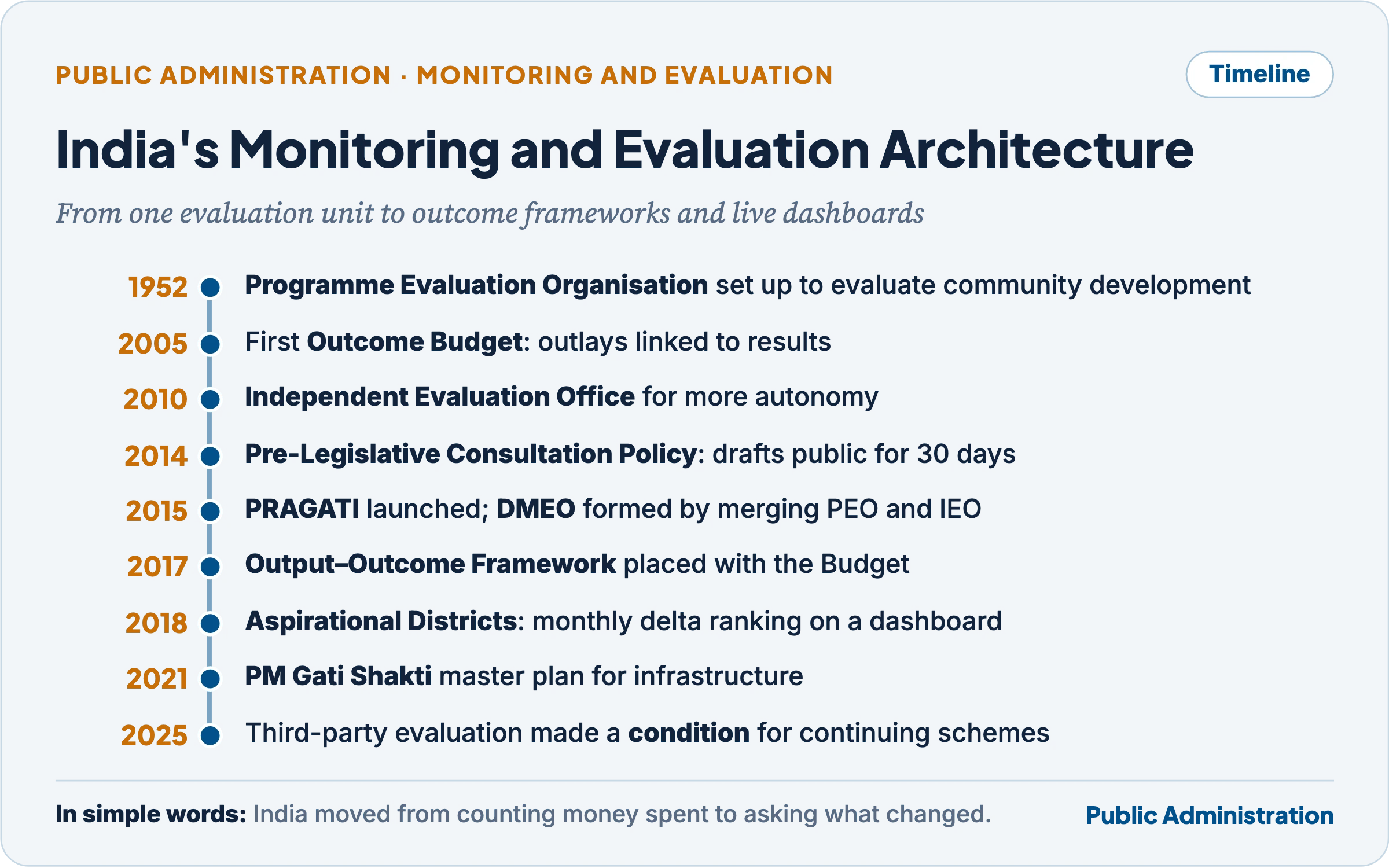
- Programme Evaluation Organisation (PEO): set up in October 1952 to evaluate the Community Development Programme and intensive area schemes; it worked as a division of the Planning Commission, with regional and project evaluation offices across the country.
- Independent Evaluation Office (IEO): set up in 2010 to give evaluation more autonomy, headed by a Director General.
- Development Monitoring and Evaluation Office (DMEO): constituted on 18 September 2015 by merging the PEO and the IEO, as an attached office of NITI Aayog with its own budget and functional autonomy. It:
- evaluates Centrally Sponsored Schemes and other programmes, on its own initiative or at the request of ministries and the PMO;
- maintains the Output–Outcome Monitoring Framework (OOMF), entrusted to it in 2017, which sets output and outcome indicators for Central Sector and Centrally Sponsored Schemes and is laid before Parliament with the Budget;
- builds evaluation capacity in ministries and States.
- Outcome budgeting: the Outcome Budget 2005-06, presented on 25 August 2005, introduced the principle that “outlays do not necessarily mean outcomes”, linking each ministry’s spending to measurable deliverables. From 2017-18, with the end of the Plan/non-Plan distinction, outlays, outputs and outcomes have been presented together in a single Output–Outcome Framework. Outcome budgeting tries to remedy the weakness of the older performance budgeting, which measured physical activity rather than results; it also makes sound performance audit possible by providing the targets against which performance can be tested. (The article on budgets develops this.)
- Scheme sunset and evaluation: the Union Budget speech of 2016 announced that every scheme would have a sunset date and an outcome review; schemes were aligned with Finance Commission cycles. For the Sixteenth Finance Commission cycle beginning 1 April 2026, the Department of Expenditure decided in May 2025 that no scheme would be appraised for continuation without a third-party evaluation; DMEO evaluated the Centrally Sponsored Schemes and ministries commissioned evaluations of Central Sector Schemes. Some 54 Centrally Sponsored and 260 Central Sector Schemes with approvals ending on 31 March 2026 went through re-appraisal.
- Other evaluators: the CAG‘s performance audits, Parliamentary committees (Estimates, Public Accounts and Standing Committees), social audits by gram sabhas, independent research institutions and the courts.
Indian Connect — Evaluation feeding back into policy
- Aspirational Districts: monitoring data and independent appraisal led to extension of the model to blocks (2023) and to the saturation campaign (2024).
- Scheme rationalisation: evaluations of Centrally Sponsored Schemes have repeatedly led to merger of overlapping schemes into umbrella schemes and closure of those that had outlived their purpose.
- Social audit: the Meghalaya Community Participation and Public Services Social Audit Act, 2017 was the first State law to make social audit of public services a legal requirement beyond a single scheme.
- Limits: evaluation reports are not always published; ministries can delay or ignore findings; evaluators funded by the implementing ministry may be reluctant to criticise it.
6.6 Evidence-based policy and its limits
- Evidence-based policy-making means using the best available evidence (evaluations, data, research) to design and choose policies, rather than ideology, anecdote or habit. It gained ground with the British government’s modernising agenda after 1997, and in India through DMEO, NITI Aayog’s indices, the National Data and Analytics Platform and the use of RCTs.
- Have political realities thwarted it? In part:
- Politics sets the agenda: electoral cycles reward visible, quick results over long-term evidence.
- Evidence is contested: different studies point in different directions, and interest groups commission their own.
- Value conflicts cannot be settled by evidence: evidence tells what works, not what is right.
- Capacity gaps: weak data, few trained analysts and slow evaluation.
- Policy-based evidence: evidence is sometimes gathered to justify decisions already taken.
- The more realistic aim is evidence-informed policy: evidence as one important input alongside values, public opinion and judgement.
- Policy analysis as legitimation of the status quo? Critics from the critical and Marxist traditions argue that policy analysis, by accepting existing goals and institutions and focusing on marginal improvements, tends to legitimise the existing order and the interests that dominate it; its technical language can also exclude citizens. Defenders reply that analysis has also exposed failure and supported radical reforms, and that participatory and critical policy analysis (Frank Fischer, John Forester) can widen whose questions are asked.
- Learning from experience: some scholars doubt that governments learn systematically from policy experience at all, since policies are shaped by many forces besides their record; institutionalised evaluation, sunset clauses and public reporting are attempts to make learning routine.
6.7 Limitations of evaluation
- Attribution: it is hard to prove that a change was caused by the programme rather than by other factors.
- Vague goals: policies with unclear or multiple goals cannot be measured against them.
- Timing: impacts may take years, but decisions need answers now.
- Data: weak baseline data make before–after comparison unreliable.
- Independence: evaluators dependent on the implementing agency may soften findings.
- Use: findings may be ignored, delayed or used selectively.
- Cost: rigorous evaluation is expensive and requires skills that are scarce.
7. Review and Termination
In simple words
Every policy should be asked, from time to time, whether it is still needed. Review is that question; termination is the decision to end what no longer works. Governments find it easy to start programmes and very hard to end them.
7.1 Review and feedback
- Review is the stage where the results of monitoring and evaluation are used to decide a policy’s future: continuation, modification (redesign, expansion or contraction), succession (replacement by a new policy) or termination.
- Feedback is the link that turns the policy process into a cycle: the effects of a policy change the environment and generate new demands, which re-enter the agenda (the systems model of David Easton describes this loop).
- Policy learning happens at three levels (Peter Hall, 1993): changing the settings of instruments, changing the instruments themselves, and changing the goals behind them (a paradigm shift).
- Indian review mechanisms include scheme appraisal at the end of each Finance Commission cycle, Parliamentary committee reviews, periodic repeal of obsolete laws through Repealing and Amending Acts on the recommendation of the Law Commission and expert committees, and decriminalisation of minor offences.
7.2 Policy termination
- Peter deLeon (“A Theory of Policy Termination”, 1978) distinguished the termination of functions, organisations, policies and programmes, with functions hardest to end and programmes easiest.
- Eugene Bardach (“Policy Termination as a Political Process”, 1976) explained why termination is rare:
- Policies are designed to last; ending them is seen as admitting failure.
- Termination creates intense, concentrated losers (staff, beneficiaries, contractors) and diffuse winners.
- It requires political will, often a change of government or a crisis.
- Legal and institutional commitments make reversal costly.
- Herbert Kaufman asked, in Are Government Organizations Immortal? (1976), why government organisations so rarely die; his answer lay in the protection they gain from clients, legislators and their own staff.
- Conditions that make termination easier: a change of government or ideology, a fiscal crisis, strong evaluation evidence, a ready replacement, and sunset clauses that make continuation, not termination, require positive action.
Indian Connect — Review and termination in India
- Planning Commission to NITI Aayog (1 January 2015): termination of an organisation and its function of five-year plan allocation, replaced by a policy think tank.
- Railway Budget merged with the Union Budget and the Plan/non-Plan distinction removed (2017-18).
- Farm Laws Repeal Act, 2021: termination of policies after sustained opposition.
- Jan Vishwas (Amendment of Provisions) Act, 2023 decriminalised 183 provisions in 42 Central Acts; the Jan Vishwas (Amendment of Provisions) Act, 2026, passed by Parliament in April 2026 after a Lok Sabha Select Committee widened the 2025 Bill, amends 784 provisions across 79 Central Acts, of which 717 are decriminalised: a large-scale review of regulatory policy.
- Rural employment: MGNREGA, after two decades, is to be replaced by the VB–G RAM G Act, 2025, an example of policy succession rather than simple termination.
- Scheme rationalisation at the end of each Finance Commission cycle merges or closes schemes on the basis of evaluation.
7.3 Limitations of review
- Inertia and incrementalism: budgets grow by adding to last year’s base; programmes are rarely questioned.
- Political cost: ending a scheme is visible and unpopular; continuing it is invisible.
- Weak feedback: evaluation findings do not always reach decision-makers, or reach them too late.
- Symbolic review: reviews that rename and repackage schemes without changing their substance.
8. Citizens and Collaboration Across the Policy Process
In simple words
A policy made for people but without them is like a suit stitched without measuring the person who will wear it. Involving citizens at every stage, from defining the problem to judging the results, makes policies fit better and makes people more willing to accept them.
- Why participation matters: citizens bring local knowledge (tacit knowledge of the most direct kind), they raise problems the state would miss, they monitor delivery where officials cannot, and participation makes policies legitimate. A policy without active involvement of people in its formulation, implementation and evaluation risks becoming a facade: formally in force, practically ignored or resisted.
- Participation at each stage:
- Conceptualisation: public consultation on drafts (Pre-Legislative Consultation Policy, 2014), gram sabhas, petitions, public hearings for environmental clearance.
- Planning: participatory planning through Gram Panchayat Development Plans and ward committees; consultation with affected groups.
- Implementation: self-help groups, user committees (water users’ associations, school management committees), community health workers.
- Monitoring: community monitoring, citizen report cards, grievance portals, RTI.
- Evaluation: social audit, participatory evaluation, beneficiary surveys.
- Correcting the anomaly of policies without people requires: making consultation statutory rather than discretionary; devolving funds, functions and functionaries to local bodies; strengthening gram sabhas and ward committees; protecting social audit units’ independence; publishing data in accessible forms; and responding visibly to feedback.
- Collaboration and its cognates (cooperation, coordination, co-production, partnerships, networks) in service delivery need to be viewed through a governance lens: they shift the state’s role from sole provider to steerer and partner, raising questions of accountability (who answers when a partnership fails), power (which partners dominate) and capacity (whether the state can manage networks). New Public Governance and collaborative governance (Chris Ansell and Alison Gash, 2008) treat these as central questions; the articles on governance and on public–private partnerships develop them.
- Limits of participation: elite capture of local forums, consultation fatigue, tokenism, delays, and exclusion of those without time or literacy to take part.
9. Limitations at Each Stage: An Overview
In simple words
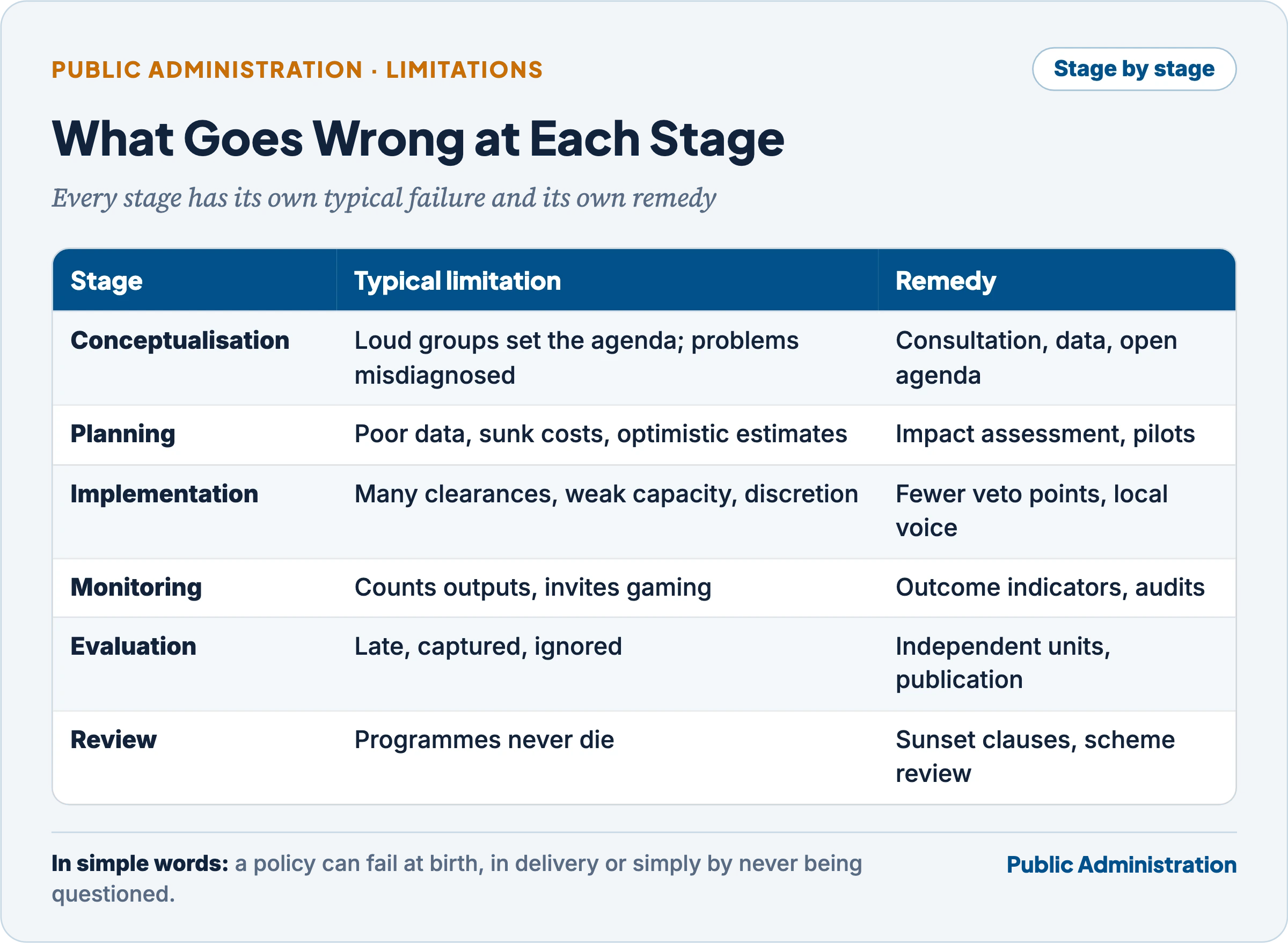
Each stage of the policy process has its own typical weakness. Seeing them side by side shows why a policy can fail even when most stages go well: one broken link is enough.
| Stage | Main limitations | Illustrative remedy |
|---|---|---|
| Conceptualisation | Biased access, non-decisions, crisis-driven agendas, misdiagnosis | Statutory consultation, better data, deliberative forums |
| Planning and formulation | Bounded rationality, poor data, sunk costs, optimism bias, neglect of delivery | Impact assessment, pilots, backward mapping, involving implementers |
| Implementation | Complexity of joint action, ambiguity, resource gaps, discretion, coordination failure, capture | Fewer veto points, adequate resources, technology to shorten chains, local voice |
| Monitoring | Output bias, gaming, poor data, centralisation | Outcome indicators, independent verification, community monitoring |
| Evaluation | Attribution problems, lack of independence, non-use of findings | Independent evaluation units, mandatory publication, linking evaluation to budgets |
| Review | Inertia, political cost of ending schemes, symbolic review | Sunset clauses, Finance Commission cycle appraisals |
- Some limitations run through every stage:
- The politics–administration interface: activities of administrators at every stage show how hard it is to separate politics from administration; policy is shaped by both throughout.
- The context of the authority: the political complexion of a government, the demography of the area and the historical pattern of service provision constrain what is possible at each stage, which is why the same policy produces different results in different States.
- Information and capacity: weak data and thin specialist capacity affect every stage.
- Accountability: the longer and more networked the process, the harder it is to say who is responsible for failure.
Criticism — The stages model and the policy process: criticisms
- No causal theory: it describes a sequence but does not explain why policy changes (Sabatier).
- False sequence: stages overlap, repeat and reverse; solutions often precede problems (Kingdon; garbage can model).
- Top-down bias: it privileges the statute and its makers over the officials and citizens who reshape it (Lipsky, Hjern).
- Too short a time frame: real change comes over a decade through learning in policy subsystems.
- Technocratic: it presents policy as problem-solving, hiding conflict and power (critical policy analysts).
Defence — The stages model and the policy process: defence
- Indispensable heuristic: it organises a vast field into manageable parts and allows comparison across countries and sectors.
- Matches institutional practice: budgets, appraisals, audits and evaluations are organised by stage, so the model fits how governments actually manage policy.
- Diagnostic value: it tells an analyst where to look when a policy fails: diagnosis, design, delivery, tracking or learning.
- Accommodates the critics: modern versions are cyclical, allow feedback and overlap, and can house the streams, implementation and learning theories within each stage.
- Teaching and practice: officials, legislators and citizens can follow and take part in a process they can name.
Key Terms
| Term | Meaning in simple words |
|---|---|
| Policy cycle | A model dividing the policy process into stages from agenda to review |
| Stagist critique | The argument that the cycle describes but does not explain how policy changes |
| Systemic agenda | All issues a community thinks deserve public attention |
| Institutional agenda | The shorter list government actually takes up |
| Non-decision | Keeping an issue off the agenda so it is never decided at all |
| Policy window | A brief opportunity when problem, solution and politics come together |
| Policy entrepreneur | A person who keeps a solution ready and pushes it when a window opens |
| Policy analysis | Systematic use of knowledge to compare policy options |
| Cost–benefit analysis | Comparing the money value of all costs and benefits of an option |
| Tacit knowledge | Knowledge held in experience and skill that is hard to write down |
| Policy tools | The means government uses: information, authority, money, organisation |
| Nudge | A change in how choices are presented that steers behaviour without compulsion |
| Implementation gap | The difference between what a policy promised and what it achieved |
| Complexity of joint action | Many agencies and clearances making success improbable |
| Perfect administration | An ideal benchmark of flawless implementation used to show real shortfalls |
| Street-level bureaucrat | A frontline official with discretion whose choices become the policy citizens experience |
| Implementation structure | The network of actors from many organisations that delivers a policy |
| Backward mapping | Designing policy from the point of delivery upwards |
| Monitoring | Continuous tracking of a programme against its plan |
| Output and outcome | Output is what is delivered; outcome is the change in people’s lives |
| Formative evaluation | Evaluation during a programme to improve it |
| Summative evaluation | Evaluation at the end to judge it |
| Impact evaluation | Measuring the change caused by a programme against a counterfactual |
| Randomised controlled trial | Random assignment of a programme to compare outcomes with a control group |
| Evidence-based policy | Designing and choosing policy on the basis of tested evidence |
| Sunset clause | A provision that ends a policy on a set date unless renewed |
| Policy termination | Deliberate ending of a function, organisation, policy or programme |
Common confusion
Is a high output figure proof that a policy has succeeded? No. Outputs (toilets built, accounts opened, children enrolled) show that the programme delivered; outcomes (toilets used, accounts operated, children learning) show that lives changed; impact is the part of that change the programme actually caused. Many Indian schemes reported excellent outputs while outcomes lagged, which is why outcome budgeting, outcome indicators and impact evaluation were introduced.
Contemporary Developments
- 31 December 2025: the 50th PRAGATI meeting reviewed five projects worth over ₹40,000 crore; by then 377 projects had been reviewed under the platform since 2015, and the Prime Minister asked States to create PRAGATI-like mechanisms, especially for the social sector.
- May–November 2025: for the Sixteenth Finance Commission cycle (2026–31), the Department of Expenditure made third-party evaluation a condition for continuing any Central Sector or Centrally Sponsored Scheme beyond 31 March 2026; DMEO evaluated the Centrally Sponsored Schemes, and ministries had to show positive outcomes and plans for a sunset.
- 20 December 2025: the Viksit Bharat–Guarantee for Rozgar and Ajeevika Mission (Gramin) Act, 2025 received assent, raising the rural wage-employment guarantee to 125 days and providing for the repeal of MGNREGA from an appointed date: a major instance of policy review and succession.
- April 2026: Parliament passed the Jan Vishwas (Amendment of Provisions) Act, 2026 (assent 7 April 2026), amending 784 provisions across 79 Central Acts after a Lok Sabha Select Committee (chair: Tejasvi Surya) expanded the 2025 Bill; it continues the review of criminal provisions begun by the 2023 Act.
- July 2024: NITI Aayog launched the Sampoornata Abhiyan to saturate selected indicators in the 112 aspirational districts and 500 aspirational blocks.
- December 2023: the first delta rankings of the Aspirational Blocks Programme (launched 7 January 2023 in 500 blocks of 329 districts) were announced, extending dashboard-based competitive monitoring below the district.
- Ongoing: the Output–Outcome Monitoring Framework continues to be laid before Parliament with the Union Budget each year, linking scheme outlays to output and outcome indicators maintained by DMEO.
Revision Grid
| Thinker / body | Work or report (year) | Key idea |
|---|---|---|
| Harold Lasswell | The Decision Process (1956) | Seven stages from intelligence to termination |
| Garry Brewer | (1974) | Six-stage continuous cycle beginning with problem recognition |
| Howlett and Ramesh | Studying Public Policy (1995) | Five-stage cycle linked to problem-solving; tool spectrum |
| Sabatier and Jenkins-Smith | Policy Change and Learning (1993) | Stagist critique; advocacy coalition framework |
| Cobb and Elder | Participation in American Politics (1972) | Systemic and institutional agendas |
| Cobb, Ross and Ross | (1976) | Outside initiation, mobilisation, inside access |
| Anthony Downs | Issue-attention cycle (1972) | Public attention rises and fades |
| Bachrach and Baratz | “Two Faces of Power” (1962) | Non-decision-making |
| John Kingdon | Agendas, Alternatives, and Public Policies (1984) | Three streams and the policy window |
| Geoffrey Vickers | The Art of Judgment (1965) | Reality, value and instrumental judgements |
| Michael Polanyi | The Tacit Dimension (1966) | Tacit knowledge |
| Christopher Hood | The Tools of Government (1983); The Limits of Administration (1976) | NATO tools; perfect administration |
| Lester Salamon | The Tools of Government (2002) | Indirect tools and third-party government |
| Pressman and Wildavsky | Implementation (1973) | Complexity of joint action in Oakland |
| Van Meter and Van Horn | (1975) | Six variables linking policy to performance |
| Sabatier and Mazmanian | (1979); Implementation and Public Policy (1983) | Six conditions of effective implementation |
| George Edwards III | Implementing Public Policy (1980) | Communication, resources, dispositions, structure |
| Eugene Bardach | The Implementation Game (1977); termination (1976) | Implementation games; why termination is rare |
| Michael Lipsky | Street-Level Bureaucracy (1980) | Frontline discretion makes policy |
| Hjern and Porter | (1981) | Implementation structures |
| Richard Elmore | Backward mapping (1979–80) | Design from the point of delivery |
| Richard Matland | (1995) | Ambiguity–conflict synthesis |
| Michael Scriven | “The Methodology of Evaluation” (1967) | Formative and summative evaluation |
| Carol Weiss | Evaluation Research (1972) | Evaluation as applied, political research |
| Peter deLeon | (1978) | Types of policy termination |
| Programme Evaluation Organisation | 1952 | First Indian evaluation unit |
| DMEO, NITI Aayog | 18 September 2015 | Merged PEO and IEO; OOMF since 2017 |
| Pre-Legislative Consultation Policy | 10 January 2014 | Drafts in public domain for 30 days |
| PRAGATI | 25 March 2015 | Prime Minister’s review platform for projects and grievances |
| Aspirational Districts Programme | January 2018 | 112 districts; 49 indicators; delta ranking |
Previous Year Questions
- 2025Policy analysis process is limited if possible outcomes and alternate potential policies are neglected. Discuss.
- 2025Evaluate the role and scope of tacit knowledge and personal experience as an important source of knowledge in policy making process.
- 2024Unless there is a sound mechanism for policy evaluation, policy formulation process remains redundant. Examine.
- 2023”Cost-benefit analysis is of great help to the policy makers in framing policies and providing advice on developing public policy.” Examine.
- 2022Failure of Public policies has often been attributed to problems of implementation, while implementors question the policy design. Discuss the contestation.
- 2022Policy evaluation contributes fundamentally to sound public governance. Discuss.
- 2022‘Outcome budgeting addresses the weaknesses of performance budgeting.’ Elaborate.
- 2021The successful attainment of SDGs objectives largely depends upon the wisdom, experience and farsightedness of the actors involved and their willingness to cooperate in the implementation process. Analyze.
- 2021Groups work to elevate issues on the policy agenda or seek to deny other groups the opportunity to place issues. In this background, discuss the role of interest groups in agenda setting in the developing countries.
- 2020Have political realities thwarted the move towards evidence based policy making? Critically examine.
- 2020“Collaboration and its cognates for public service delivery need to be viewed from the governance lenses.” Comment.
- 2020“Globalization is impacting the context of national policy making. The national policy agenda is becoming international.” Explain.
- 2020Has policy analysis become a major source of legitimation of status quo in political and social order? Discuss.
- 2018“A public policy without the active involvement of people in its formulation, implementation and evaluation is only a facade.” How can this anomaly be corrected?
- 2018“Sound Performance Auditing is impossible without systematic Performance or Outcome Budgeting.” Explain the relationship between the two.
- 2017“Of all the processes involved in public policy, implementation is of greatest importance.” Examine the impediments in policy implementation.
- 2015“Policy analysis is incomplete without taking into account policy delivery.” Argie.
- 2015“The term policy implementation is, in some respects preferable to the label public administration.” Argue.
- 2015How far do you agree with the view that the growing influence of media comes in the way of agenda-setting by the Government?
- 2014“The output studies approach to public policy analyses ovestresses the rational techniques and allocative dimension of public policy.” Analyse the statement.
- 2013Suppose the Government of India is thinking of constructing a dam in a mountain valley girded by forests and inhabited by ethnic communities. What rational techniques of policy analysis should it resort to for coping with likely uncertainties and unforeseen contingencies.
- 2013“Public interest is still inadequate as a ground concept to evaluate public policy.” Discuss.
- 2012‘Our normal expectation should be that new programs will fail to get off the ground and that, at best, they will take considerable time to get started. The cards in this world are stacked against things happening’ (Pressman and Wildavsky). Comment.
- 2012‘Policy judgements comprise reality judgements, value judgements and instrumental judgements’ (Geoffrey Vickers). Elucidate.
- 2010“Cost-benefit analysis a very unsatisfactory view of evaluating public policy.” Comment.
- 2010“Public administration can be portrayed as a wheel of relationships focused on the formulation and implementation of public policy.” Explain.
- 2009“… even if policies are well-organized, efficiently operated, widely utilized, adequately financed and supported, we may still ask, so what? Do they work? … What about their costs, outputs and impact?” Discuss.
- 2008“Laxity in monitoring and evaluation can render even the best policies infructuous.” Discuss.
- 2007“Implementation a public policy is a process of discovering what works and what does not.” Examine.
- 2006“Nothing comes across more strongly than the great naivete about policy implementation.” Discuss.
- 2005Give an assessment of the processes of policy formulation and discuss the problems of policy implementation.
- 2004Public Policy is not an independent variable and human history shows little evidence of systematic learning from policy experience. Discuss.
- 2003Comment on the role of public administration in policy making and its implementation. What are the other factors influencing the policy process?
- 1999Elucidate the political process of policy formulation. Bring out its distinguishing features in developing countries.
- 1998“Policy implementation in Less Developed Countries needs to be effective.” Comment.
- 1997“Policy- making does not and once a decision is made. The implementation of the decision can have just as great an impact on public policy as the decision itself.” Discuss.
- 1995Explain how factors such as communications, resources, self interests and bureaucratic structures affect implementation of public policies.
- 1994Elucidate the concept of policy implementation. How does implementation assessment focus on the operation of a public policy?
- 1993“One way of analysing implementation problems is to begin by thinking about what “perfect administration” would be like, comparable to the way in which economists employ the model of perfect competition.” Discuss.
- 1993“The activities of public administrators at various stages of the policy process illustrate the difficulty of divorcing politics from administration.” Comment.
- 1991‘There has been an increasing emphasis on the need for policy formulation and policy analysis in order to ensure improved performance and to avoid ad hoc or fragmented approach to administration, particularly in the context of active role of the state in economic, social, defence and scientific areas.’ Discuss.
- 1991‘Every public policy is a government decision aimed at solving a problem of its planning and implementation. Comment.
- 1989“Policy process must take account of the political complexion of an authority, demography and the historical pattern of service.” Comment.
- 1988Outline the traditional and Cost-Benefit approaches to policy-evaluation.
- 1987Define Public Policy. How does its formulation and implementation involve participation by administrators, voluntary agencies and pressure groups in a democracy?
- 2025Lack of clear demarcation of roles between the State Secretariat and the Directorate has serious implications for policy making and policy implementation. Do you agree?
- 2025Examine the significance of field organizations in enhancing policy implementation of projects like MGNREGA and Swachh Bharat Mission.
- 2017“Pro-Active Governance and Timely implementation (PRAGATI) is an innovative project of the Union Government.” Discuss its features and modalities.