

Kautilya’s Arthashastra; Mughal administration; Legacy of British rule in politics and administration – Indianization of public services, revenue administration, district administration, local self-government.
This article: Mughal administration: Sultanate and Sur antecedents (iqta, shiq, pargana, Sher Shah’s reforms); nature of the Mughal state (centralised despotism and military-rule debate, Indian and extra-Indian elements, kingship); the emperor and central ministers (wakil, diwan or wazir, mir bakhshi, mir saman, sadr-us-sudur, qazi, muhtasib) and departments; the mansabdari and jagirdari system (zat and sawar, dagh and chehra); provincial, sarkar, pargana and village administration and their officials; revenue administration (zabt and ain-i-dahsala, batai, kankut, nasaq, land categories, zamindars); justice, police and military; strengths and decline; the legacy in today’s revenue and district administration; theory lens.
Official Syllabus: Paper II · Unit 2-01 Evolution of Indian Administration
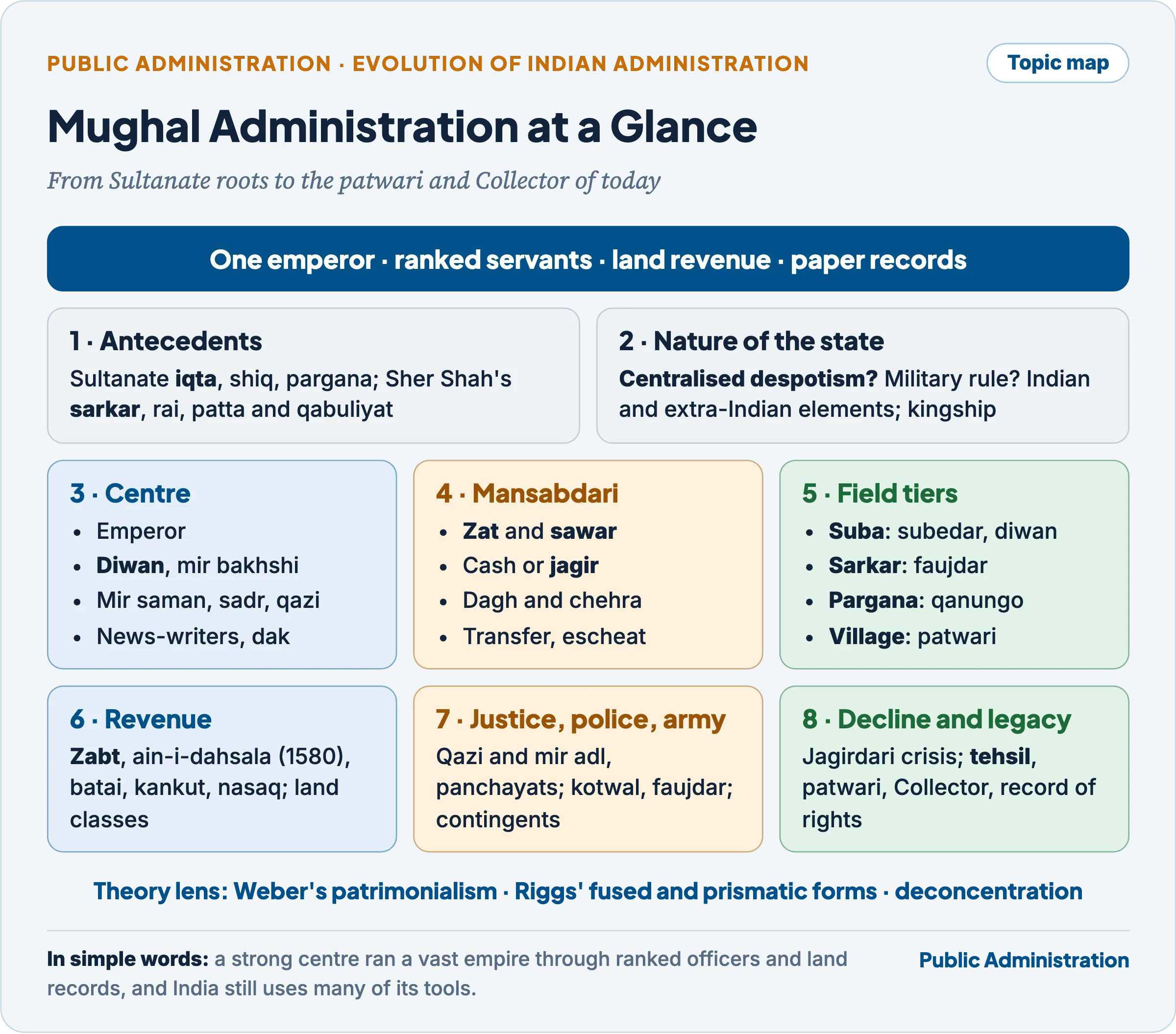
The Mughal empire (1526–1857, effectively 1556–1707 at its height) gave most of the subcontinent its first uniform administrative grid: the same ranks, the same revenue rules, the same official language (Persian), the same coinage and the same chain of provinces, districts and parganas from Kabul to Bengal. When the East India Company took the diwani (right to collect revenue) of Bengal, Bihar and Orissa in 1765, it stepped into this Mughal frame rather than building a new one. That is why the patwari, the qanungo, the tehsil, the Collector’s revenue role and words like khasra, jamabandi and taqavi are still part of district administration in India.
- The topic sits between Kautilya (the ancient Indian state) and the British legacy (the modern bureaucratic state); see the companion articles on Kautilya’s Arthashastra and on the legacy of British rule.
- It is studied for three things: the nature of the Mughal state (centralised despotism, military rule, Indo-Persian synthesis), its institutions (mansabdari, the territorial tiers, the revenue machinery) and its legacy in Indian administration today.
In simple words
Imagine a giant company run by one owner. Every manager gets a numbered rank that fixes his salary and how many security guards he must keep. Instead of cash, many managers are paid by being allowed to collect rent from a farm for a few years, then moved to another farm. A head office keeps files on everything, and spies report back on the managers. That, in short, was the Mughal system: one master, ranked servants, land revenue as salary and paper records as control.
1. Antecedents: Sultanate and Sur Administration
In simple words
The Mughals did not start from zero. For three hundred years before them, the Delhi Sultans and then Sher Shah Sur had built revenue offices, provinces and village officials. Akbar took this machinery, improved it and made it uniform.
1.1 The Delhi Sultanate (1206–1526)
The Delhi Sultanate brought a Perso-Islamic model of government (from the Abbasid caliphate and the Ghaznavid and Seljuk states) into contact with the old Indian village and revenue system.
- Central ministries (diwans). The wazir headed the diwan-i-wizarat (revenue and finance); the ariz-i-mamalik the diwan-i-arz (military establishment, strengthened by Balban); the diwan-i-insha handled royal correspondence; the diwan-i-risalat religious and foreign affairs; the sadr-us-sudur religious grants; the qazi-ul-quzat justice; the barid-i-mamalik news and intelligence. The Mughal central departments are a refined version of this list.
- The iqta. An iqta was a territorial assignment of revenue given to a noble (muqti or iqtadar) in return for maintaining troops and governing the tract. Iltutmish (1211–36) organised it as the main instrument of rule. It was transferable and non-hereditary in principle; from Balban the muqti had to remit the surplus (fawazil) to the centre, and Alauddin Khalji tightened central audit of iqta incomes. Firuz Shah Tughluq made iqtas virtually hereditary, which weakened central control. The Mughal jagir is the direct descendant of the iqta.
- Shiq and pargana. In the fourteenth century the larger provinces (wilayat, iqta) were divided into shiqs under a shiqdar, who kept order and supervised smaller units. Below the shiq stood the pargana, a cluster of villages, with an amil (revenue collector), a karkun (accountant) and a chaudhari (the leading local headman). Under the Afghans (Lodis and Surs) the shiq became the sarkar.
- The village. The khut, muqaddam (headman) and patwari (village accountant) were hereditary local functionaries who helped collect revenue and keep order. The Sultans used them rather than replacing them.
- Alauddin Khalji’s reforms (1296–1316) foreshadowed Mughal revenue practice: assessment by measurement of land (masahat), a demand of half the produce, curbs on the privileges of khuts and muqaddams, the dagh (branding of horses) and huliya (descriptive roll of soldiers), and a large salaried army. Muhammad bin Tughluq created a department of agriculture (diwan-i-amir-kohi) to extend cultivation.
Common confusion
Was the iqta “the lowest unit of administration”, subdivided into shiqs, with a shiqdar over a number of parganas? Only partly. The iqta was not the lowest unit: it was a large provincial or regional revenue assignment held by a powerful muqti. In the fourteenth century provinces were split into shiqs under shiqdars, and each shiq contained several parganas. The lowest units were the pargana (with its chaudhari, amil and karkun) and the village (with its muqaddam or khut and patwari). So the second half of the familiar description (shiqdar over parganas, a chaudhari in every pargana and a patwari in every village) is accurate, but the iqta sat at the top of the territorial ladder, not at the bottom.
1.2 Sher Shah Sur (1540–45): the bridge to Akbar
Sher Shah Sur, the Afghan ruler who drove out Humayun, ruled for only five years but built the administrative base that Akbar later perfected. His revenue expert Todar Mal later served Akbar.
- Territorial units. The empire was divided into sarkars (about 47 in the usual count), each under a shiqdar-i-shiqdaran (law and order, military) and a munsif-i-munsifan (revenue and civil disputes). Each pargana had a shiqdar (order), an amin or munsif (revenue), a fotedar (treasurer) and two karkuns, one writing in Hindi and one in Persian. The bilingual record is a striking early example of administering in the people’s language.
- Revenue by measurement. Sown land was measured every year; a schedule of crop rates called the rai gave the yield per bigha for each crop on good, middling and poor land, and the state took one-third of the average, payable in cash or kind.
- Patta and qabuliyat. The peasant received a patta (a written statement of what he owed) and gave a qabuliyat (a deed accepting the demand). The fees of the measuring staff (jaribana, muhasilana) were fixed, and a small famine cess was collected. This is the earliest Indian form of a written revenue contract with each cultivator.
- Other measures: a pure silver rupiya and copper dam, rebuilding of the great north road (later the Grand Trunk Road) with sarais that doubled as dak (post) stations, collective responsibility of village headmen for crime in their area, and revival of dagh and the descriptive roll for the army.
- Limit: the system depended on Sher Shah’s personal energy; his successors could not sustain it, a weakness of personal rule that the Mughal system would also show.
| Element | Sultanate | Sher Shah | Mughal (Akbar onward) |
|---|---|---|---|
| Assignment of revenue | Iqta to muqti | Cash salaries preferred | Jagir to mansabdar |
| Regional unit | Wilayat / iqta, then shiq | Sarkar | Suba, then sarkar |
| Local revenue officer | Amil, karkun | Amin / munsif, fotedar, karkuns | Amalguzar, amil, bitikchi, khazanadar |
| Assessment | Measurement, half share (Alauddin) | Measurement, rai, one-third | Zabt with dahsala rates, one-third |
| Army control | Dagh, huliya (Alauddin) | Dagh revived | Dagh and chehra within mansabdari |
The table shows that the Mughal system was an evolution, not an invention: Akbar’s achievement was to standardise older devices across a far larger empire and to tie them together through one ranked service, the mansabdari.
2. Nature of the Mughal State
In simple words
Was the Mughal emperor an all-powerful dictator, or did he depend on nobles, chiefs and village elites to govern? Historians agree that power was concentrated at the top, but disagree about how far that power actually reached on the ground.
2.1 Sources and periodisation
- Babur (1526–30) founded the empire after the first battle of Panipat (1526); Humayun (1530–40, 1555–56) lost it to Sher Shah and recovered it. Neither had time to build a civil administration.
- Akbar (1556–1605) is the architect. His successors Jahangir (1605–27), Shah Jahan (1628–58) and Aurangzeb (1658–1707) worked within his pattern with modifications. After 1707 central authority weakened rapidly, though the emperor remained a source of legitimacy until 1857.
- Main source: the Ain-i-Akbari of Abu’l Fazl, Akbar’s minister and historian, completed around 1598 as the third volume of the Akbarnama. It describes every department, rank, revenue rule and province. Later sources include manuals of official duties (dastur-ul-amal), provincial histories such as the eighteenth-century Mirat-i-Ahmadi of Gujarat, imperial orders (farmans) and European travellers’ accounts.
2.2 Salient features
Historians of administration list the following features of the Mughal system. Each is a building block for the debates that follow.
- A Perso-Arabic system in an Indian setting. The court, titles, departments and higher law came from Central Asia, Persia and the Islamic world; the village, the pargana, the revenue staff and customary law were Indian. It was a combination of Indian and extra-Indian elements (section 2.3).
- Military in origin and character. Every officer, civil or military, held a mansab (rank) in one army list, was paid by the military paymaster (bakhshi) and was promoted by an increase in his nominal command of horsemen. Even judges, accountants and superintendents of posts held mansabs.
- Centralised despotism. The emperor held legislative, executive, judicial and military authority; his order (farman) was law and no minister could bind him.
- Blend of religion and politics. The ruler was expected to govern by Islamic law (sharia) with the advice of the ulema (religious scholars). Jadunath Sarkar, the historian of Aurangzeb, argued that the state took up welfare functions for Muslim subjects but confined itself to police and revenue for others. This is too sweeping: Akbar abolished jizya (the poll tax on non-Muslims) in 1564, admitted Rajputs and Hindu officials to the highest ranks and followed sulh-i-kul (peace with all); even Aurangzeb, who re-imposed jizya in 1679, issued land grants to Brahmins and yogis.
- Kaghazi raj, a “paper government”. Outside military campaigns, administration ran on written records: daily abstracts, monthly returns, registers of ranks and jagirs, news reports and revenue rolls. A vast territory, slow communications and no political role for the people produced a multiplication of correspondence and a large clerical establishment.
- A police-and-revenue state. The state’s aims were largely order and revenue collection. Education, health and art were left to private, religious or charitable initiative; Akbar was the main exception in his paternal interest in welfare.
- State as manufacturer. The state ran karkhanas (imperial workshops) in the main cities under a darogha, producing robes, arms, carpets and luxury goods for the court, supervised by the khan-i-saman (high steward). This is an early form of state enterprise.
- Order left to localities. In the countryside the state acted mainly against violent crime and rebellion; rural watch was kept by village chaukidars paid by the village, and villagers were held responsible for thefts on nearby roads.
- Urban orientation. Officials and nobles were city-dwellers; Sarkar wrote that they despised village life and kept contact with villages through faujdars, revenue staff, zamindars’ visits and governors’ tours.
- Uniformity. All provinces had the same machinery, procedure, official language and currency; a native of one province felt at home in another, and traders and travellers moved easily across the empire.
- Decentralisation without local autonomy. Administration was spread across provinces, sarkars and parganas, but these were agents of the centre, not self-governing bodies. Villages enjoyed what has been called parochial self-government: left alone so long as they paid and obeyed, with no political rights.
2.3 Indian and extra-Indian elements
The Mughals came from Central Asia (Babur was a Timurid prince of Fergana) and drew on Persian court culture and Islamic law. In India they modified this inheritance to suit Indian conditions.
| Extra-Indian (Perso-Arabic, Central Asian) | Indian |
|---|---|
| Padshahi kingship, court ceremony, titles, Persian as official language | Village community, muqaddam, patwari, chaukidar, panchayat |
| Central diwans (wazir, bakhshi, sadr, qazi, muhtasib) | Pargana and revenue staff (qanungo, chaudhari) inherited from earlier regimes |
| Mansab as numerical rank, derived from Mongol-Timurid decimal military ranks | Land revenue as the state’s main income and the king’s right to a share of produce (an ancient Indian idea) |
| Iqta-style revenue assignment (the jagir) | Assessment by measurement, crop-sharing and local customary rates |
| Sharia (Hanafi law), qazis, muftis; zakat and jizya | Hindu personal law and caste and village panchayats for local disputes |
| Persian notions of the just king (farr-i-izidi, divine light) | Rajput chiefs absorbed as mansabdars and watan jagirdars |
- The pattern of the blend: foreign models dominated the court and higher offices, Indian usage the village and lower rungs. The revenue system has been described as the resultant of two forces: long-standing Hindu practice and Islamic fiscal theory.
- Akbar’s contribution was to make the blend inclusive: Rajput rulers became imperial nobles; Todar Mal, a Khatri, was revenue minister; Persian was used, but Hindi-speaking revenue staff kept local records.
- Why it matters today: the synthesis shows that durable administrative systems graft new structures onto existing local institutions rather than replacing them, a point Riggs would later make about prismatic societies (section 10).
2.4 Kingship and the position of the emperor
- Theory of kingship. Abu’l Fazl presented the emperor as the bearer of farr-i-izidi (divine light), above sects, whose duty was justice and peace among all subjects; the title zill-i-ilahi (shadow of God) expressed the same idea. Akbar’s 1579 declaration (mahzar) asserted his authority to decide among conflicting interpretations of religious law.
- Powers. The emperor was head of state, government, army and judiciary. He appointed, promoted, transferred and dismissed every high official; no farman could issue without his seal; he decided expenditure and the sources of revenue. His sovereignty was indivisible and inalienable.
- Accessibility as control. Akbar transacted business in open court (diwan-i-aam), confidential matters in the diwan-i-khas, and showed himself daily at the jharokha window. Jahangir wrote that he hung a chain of justice at Agra fort that any petitioner could pull. Emperors toured constantly and carried the capital with them in a moving camp.
- Absence of a law of succession. There was no rule of primogeniture; every son had a claim, so each succession produced war (1657–58 being the bloodiest). This was the structural weakness of personal rule.
- Benevolent despotism. The emperor was not accountable to any assembly or to the people, but most emperors covered their despotism with a thick veil of paternalism. Everything depended on the character of the ruler: the system worked under Akbar and Shah Jahan and frayed under weak successors.
2.5 Was it centralised despotism and military rule? The debate
Several Mains questions (2005, 2012, 2022, 2024) ask whether the Mughal system was centralised, despotic and military in nature. The answer needs both the case for and the limits.
The case for “centralised despotism”:
- Concentration of authority in the emperor, with ministers reduced to advisers whose advice did not bind. Sarkar remarked that they deserved to be called “secretaries rather than ministers”; they never resigned when overruled.
- Control through appointment and transfer. Every mansab was the emperor’s gift, revocable at will; jagirs were transferred every few years so that no noble could build a local base; mansabs were not hereditary and estates escheated to the crown at death.
- Uniform rules from the centre: the same revenue rates (dasturs), ranks and procedures across all subas, and a stream of reports flowing to the court.
- Surveillance: a network of news-writers (waqia-navis, sawanih-nigar, khufia-navis) and harkaras (runners and spies) reported on every governor and official.
- Dual control in the provinces: the subedar and the diwan were appointed separately and reported separately, so that neither could become independent.
The case for “military rule”:
- The mansabdari made the whole civil service a branch of the army list; status and pay were expressed as command over horsemen.
- Conquest and the suppression of rebellion were the state’s constant business; faujdars with troops held the countryside; the empire’s revenue paid above all for the cavalry.
- The court itself was a camp: the emperor moved with the army and the administration together.
The limits and the counter-view:
- The military form was partly a fiction. Many mansabdars performed purely civil duties; the mansab was a convenient pay-and-status scale, not a battlefield command. The system was “the army, the peerage and the civil administration rolled into one”.
- Civil institutions were elaborate: a revenue bureaucracy measuring fields, a judiciary of qazis, a record office and a postal system cannot be reduced to military rule. It was a military-bureaucratic state rather than a camp.
- Despotism was limited in practice by Islamic law and the ulema, by custom (urf) and village usage, by the need to bargain with zamindars and Rajput chiefs (many kept hereditary watan jagirs and their own troops), by distance and slow communications, and by the emperor’s dependence on a heterogeneous nobility (Turani, Irani, Afghan, Indian Muslim and Rajput).
- Historians’ positions: Jadunath Sarkar (Mughal Administration, 1920) stressed despotism and theocratic bias; Ibn Hasan (The Central Structure of the Mughal Empire, 1936) stressed the emperor’s practical limits and the working of institutions; the Aligarh historians (Irfan Habib, M. Athar Ali) saw a highly centralised state whose ruling class extracted the agrarian surplus through the jagir; Stephen Blake (“The Patrimonial-Bureaucratic Empire of the Mughals”, 1979) used Max Weber’s model of a patrimonial-bureaucratic empire, arguing that earlier scholars read the British Raj back into the Mughal state; Muzaffar Alam and Sanjay Subrahmanyam emphasised negotiation between the centre and regional elites.
Criticism — The case that Mughal rule was centralised military despotism
- One will: the emperor was law-giver, executive head, chief judge and commander; ministers only advised and could not resign in protest.
- Militarised service: every official was a mansabdar on the army list, paid and promoted as a commander of horse.
- Insecure tenure: non-hereditary mansabs, frequent jagir transfers and escheat kept nobles dependent on royal favour.
- No accountability downward: no assembly, no rights for subjects, no channel for popular grievance except petition to the throne.
- Extraction over welfare: a police-and-revenue state that took up to a third or more of the peasant’s crop and gave little back.
Defence — The case that it was a bounded, negotiated bureaucratic state
- Rule-bound administration: written dasturs, graded ranks, pay schedules, audits and record offices are bureaucratic, not merely personal.
- Plural legal order: sharia, imperial regulations (zawabit) and custom co-existed; Hindu and village disputes went to panchayats.
- Negotiated power: Rajput chiefs, zamindars and regional nobles kept hereditary rights and troops; the centre bargained as much as it commanded.
- Built-in checks: dual provincial authority, independent reporters and separate revenue and military channels prevented any one official from dominating.
- Synthesis: it was a centralised patrimonial-bureaucratic state: highly centralised in design and command, but dependent in practice on intermediaries, records and bargaining, which is why it weakened when the centre weakened.
3. The Emperor and the Central Administration
In simple words
At the centre, the emperor ruled through a handful of chief officers: one for money, one for the army and the nobles, one for the royal household and workshops, one for religious grants, one for justice and one for public morals. All of them were the emperor’s servants, not a cabinet.
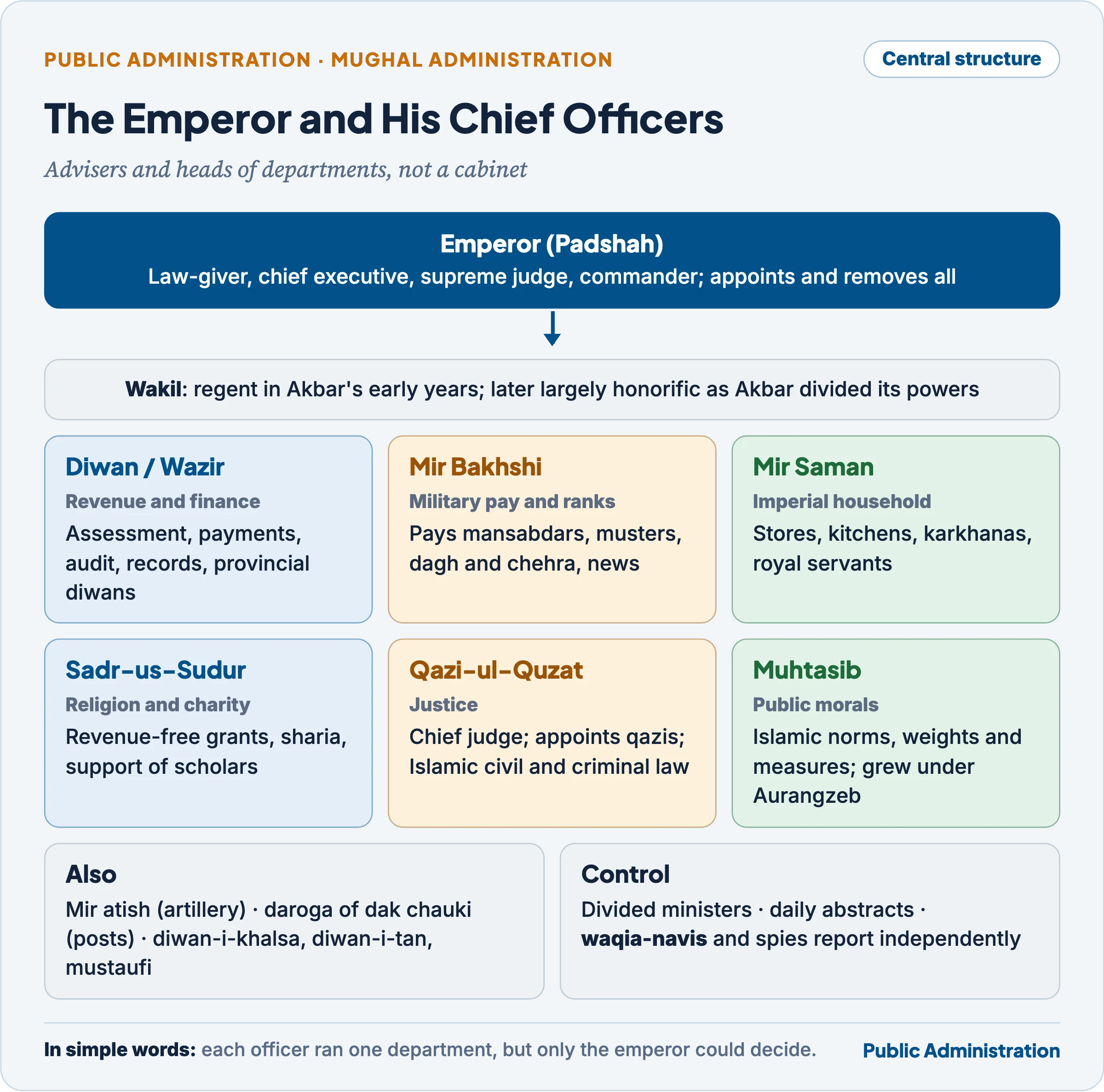
3.1 The chief officers
| Officer | Department | Main duties |
|---|---|---|
| Wakil (wakil-us-saltanat) | Regency, general superintendence | Highest office early in Akbar’s reign (Bairam Khan as regent, 1556–60); Akbar then split its powers and it became largely honorific |
| Diwan / wazir (diwan-i-kul, diwan-i-ala) | Revenue and finance (exchequer) | Revenue assessment and collection, all payments, audit, records, appointments’ paperwork; head of the provincial diwans |
| Mir bakhshi | Military pay and establishment | Paymaster of all mansabdars, recruitment, muster, dagh and chehra, presenting candidates for mansabs, news reports |
| Mir saman (khan-i-saman) | Imperial household and karkhanas | Royal stores, kitchens, workshops, personal servants, daily expenditure |
| Sadr-us-sudur | Religious affairs and charity | Grants of revenue-free land (madad-i-maash, suyurghal) to scholars and holy men; guardian of sharia; some civil cases |
| Qazi-ul-quzat | Justice | Chief judge; appointed qazis; administered Islamic civil and criminal law (often combined with the sadr’s office) |
| Muhtasib | Censorship of public morals | Enforced Islamic norms (prohibition of intoxicants, gambling), checked weights and measures; expanded under Aurangzeb |
- The diwan or wazir was the pivot of civil administration. The two titles were used interchangeably (Akbar preferred diwan, Jahangir revived wazir), but not every diwan was a wazir: wazir was a higher honour, and no Hindu diwan, not even Todar Mal, held it. All revenue papers, provincial returns and despatches reached his office; every order for payment above small sums needed his signature; he sent the emperor daily abstracts of finance. When the emperor was a minor or weak, the wazir became the real ruler.
- Akbar’s balance of power. After the wakil’s eclipse, Akbar divided central authority among the diwan, mir bakhshi and mir saman so that no minister could dominate. He also rotated the diwan’s office. This is a deliberate check-and-balance design inside an autocracy.
- The diwan’s assistants grew in number: the diwan-i-khalsa (crown lands), the diwan-i-tan (salaries and jagirs), the mustaufi (auditor) and the mushrif (chief accountant). The diwan-i-buyutat worked under the mir saman, recording the household’s stores and the property of deceased nobles.
- Other departments: the mir atish or daroga-i-topkhana (artillery), the daroga-i-dak chauki (posts and intelligence), the mint and the treasury.
3.2 Chief departments of the empire
The standard list of central departments (eight in all) is:
- Exchequer and revenue, under the high diwan.
- Imperial household, under the khan-i-saman.
- Military pay and accounts, under the mir bakhshi.
- Canon law, civil and criminal, under the chief qazi.
- Religious endowments and charity, under the chief sadr.
- Censorship of public morals, under the muhtasib.
- Artillery, under the mir atish.
- Intelligence and posts, under the daroga of dak chauki.
- Functional division of work is visible here: finance, personnel and military pay, household, law, religion and communications are separate.
- But departments had no autonomy. They could not claim to be consulted as of right; every department depended on the emperor for its money, and he “could feed one fat and starve another”. Officers could be moved to any duty at any time.
3.3 Records, secretariat and communications
- Dar-ul-insha: the department of royal correspondence drafted farmans, sanads (grants) and parwanas (orders of officials). Its surviving papers are among the richest records of any pre-modern state.
- Record office: copies of orders, abstracts of accounts and provincial reports were kept centrally; the diwan’s office acted as the public record office of the empire.
- News and intelligence: four kinds of reporters kept the centre informed: the waqia-navis (open news-writer recording events), the sawanih-nigar (reporter of important occurrences), the khufia-navis (secret reporter) and the harkaras (runners and spies). Reports from provinces reached the emperor through the mir bakhshi.
- Dak chauki: relays of runners and horsemen along main roads carried official mail; sarais doubled as post stations.
- Assessment: these devices made the empire a kaghazi raj whose records gave the centre real information. They also bred delay, duplication and clerical power, which later observers would recognise in Indian red tape.
4. The Mansabdari System
In simple words
Every important officer got a number: say 1,000. That number told everyone his rank, his salary and how many cavalrymen he had to keep for the emperor. Later two numbers were used: one for personal rank and pay, one for the horsemen. The number could go up or down at the emperor’s will, and it could not be passed on to a son.
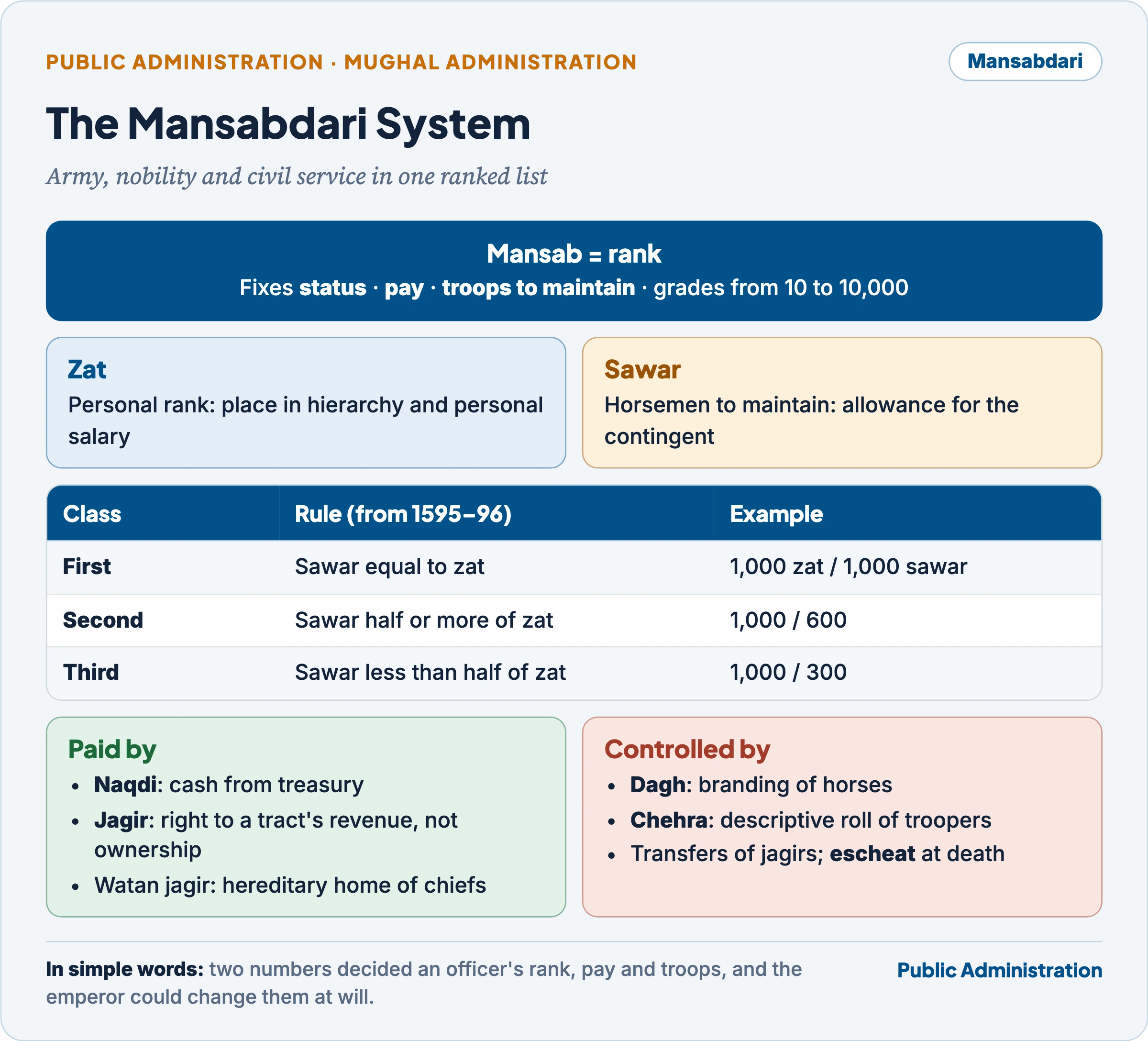
4.1 Meaning and origin
- Mansab means a rank or position; a mansabdar is its holder. The decimal ranking of commanders goes back to Mongol and Timurid armies, but Akbar turned it into a single graded service from the mid-1570s (around 1573–74, along with the revival of the dagh).
- A mansab fixed three things: the holder’s status in the official hierarchy, his pay, and his obligation to maintain a contingent of horses, men and equipment.
- One army list for all. Civil officers, judges, accountants and military commanders were all mansabdars. The system was thus army, peerage and civil service in one, the official nobility of the empire.
4.2 Grades and the dual rank
- Grades: Abu’l Fazl speaks of 66 grades from commanders of 10 to commanders of 10,000, but lists only 33. Under Akbar ranks above 5,000 were normally reserved for princes; Raja Man Singh was the rare noble raised to 7,000. Ranks were inflated under later emperors.
- Zat and sawar. By the 1590s every mansab carried two numbers:
- zat: the personal rank, fixing the holder’s place in the hierarchy and his personal salary;
- sawar: the number of horsemen he had to maintain, fixing the allowance for his troops.
- Three classes (1595–96): first class if sawar equalled zat; second class if sawar was half or more of zat; third class if sawar was less than half of zat. A mansabdar of 4,000 zat and 2,000 sawar still outranked one of 3,000/3,000, because status followed zat.
- Titles by rank: holders below 500 zat were simply mansabdars; 500 to 2,500 were amirs; 2,500 and above amir-i-umda or umara-i-azam, the great nobles.
4.3 Payment: cash or jagir
- Naqdi: some mansabdars were paid in cash from the treasury.
- Jagirdar: most were paid by a jagir, an assignment of the land revenue of a tract whose estimated revenue (jama) equalled their sanctioned pay. The jagirdar did not own the land; he only had the right to collect and enjoy the revenue due to the state, under imperial rules.
- Types of jagir:
- tankhwah jagir: in lieu of salary, transferable (the normal type);
- watan jagir: the hereditary homeland of a Rajput or other chief, left with him as part of his mansab and not transferred;
- mashrut jagir: given on condition of a particular service;
- altamgha: a hereditary grant to favoured Muslim nobles, rare in practice.
- Khalisa: land whose revenue went directly to the imperial treasury, administered by the diwan-i-khalsa; its share rose and fell with the emperors’ needs.
- Transfer and escheat. Tankhwah jagirs were transferred every few years, so that the noble never struck roots. On his death his property was escheated (zabt) to the crown until his debts to the state were settled; heirs received fresh mansabs only by imperial favour. Pensions (in cash or land) existed but could be withdrawn at pleasure; the bait-ul-mal held escheated property.
- Consequence: with no security of inheritance, nobles spent lavishly in their lifetime, and with no permanent stake in a jagir they had little interest in its long-term development: a short-horizon incentive that later fed peasant distress.
4.4 Control devices: dagh and chehra
- Dagh (branding): every horse presented by a mansabdar was branded with an imperial mark, so that the same animal could not be shown for two nobles or twice.
- Chehra (descriptive roll): the physical description of each trooper was recorded, so that men could not be borrowed for a muster.
- Muster (tashiha) was conducted by the mir bakhshi’s department; failure to maintain the sanctioned contingent led to deductions or reduction of rank. Under Shah Jahan a mansabdar holding his jagir in the province where he served had to muster one-third of his sawar, one serving elsewhere one-fourth, and on the distant Balkh campaign one-fifth.
- These are early performance verification devices: the state paid for capacity and checked that the capacity existed.
4.5 Changes after Akbar
- Jahangir introduced du-aspa sih-aspa ranks: troopers with two or three horses, raising the effective cavalry of trusted nobles (first given to Mahabat Khan) without raising their zat.
- Shah Jahan adjusted pay to actual yields through month-scale jagirs: a jagir was rated as yielding the revenue of, say, six or eight months of the year, recognising that real collections (hasil) fell short of the paper estimate (jama).
- Aurangzeb used mashrut (conditional) increases of sawar rank during the Deccan wars and admitted many Deccani and Maratha nobles; the number of mansabdars grew faster than the land available for jagirs.
4.6 Personnel administration under the Mughals
| Personnel function | Mughal practice | Modern comparison |
|---|---|---|
| Recruitment | Imperial discretion; recommendation by nobles (tajwiz), birth, loyalty, military record; heterogeneous intake (Turani, Irani, Afghan, Indian Muslims, Rajputs) | Open competitive examination (UPSC) |
| Classification | Numerical grades (zat), three classes by sawar ratio | Pay matrix levels, services and grades |
| Pay | Fixed scale per grade; very liberal at the top; paid in cash or jagir | Pay Commission scales, cash salaries |
| Promotion | Increase of rank at the emperor’s pleasure, often on the subedar’s recommendation | Seniority-cum-merit rules |
| Training | No formal training; learning on the job | Academies, Mission Karmayogi |
| Transfer | Frequent, to prevent local power bases | Transfers, often criticised as political |
| Leave | Formal leave (rukhsat) granted through the diwan | Leave rules |
| Tenure | Non-hereditary, at pleasure; escheat at death | Security of tenure (Article 311) |
| Specialisation | None: Birbal, a courtier, was sent to command on the frontier and died there; Todar Mal was both finance minister and general | Generalist and specialist cadres |
- What was modern: hierarchy, graded pay, written records, verification of service, non-hereditary office and an empire-wide service. These are recognisably bureaucratic features.
- What was not: no separate civil service, no open merit recruitment, no training, no specialisation, no security of tenure and no rule-bound promotion. The Mughals did not develop the idea of a professional “civil service” distinct from the ruler’s household and army.
Common confusion
Did the mansabdar own his jagir, and was the mansab hereditary? Neither. A jagir was only the right to collect the state’s land revenue from a tract, in place of salary; the land belonged to the cultivators and zamindars under their customary rights, and the sovereign’s right to revenue was only assigned temporarily. The mansab was a personal, non-hereditary rank; at death the estate escheated and sons had to win their own mansabs. The partial exception was the watan jagir of chiefs such as the Rajputs, which stayed hereditary. Confusing the jagir with a feudal fief or a zamindari is a common error.
4.7 Strengths and weaknesses of the mansabdari
- Strengths: a single integrated elite loyal to the emperor; uniform rules of rank and pay; the ability to absorb new groups (Rajputs, Afghans, Deccanis) and so widen the empire’s base; mobility of officers across the empire; a measurable link between pay and military capacity.
- Weaknesses:
- Personal dependence: promotion depended on favour, which bred factions at court.
- Divided loyalty of troops: soldiers were recruited by and attached to their mansabdar, not to the emperor, so the army was a federation of private contingents.
- Fraud: borrowed horses and men at muster, despite dagh and chehra.
- Short-term exploitation of jagirs because of frequent transfers.
- The jagirdari crisis (section 8): from the late seventeenth century there were too many mansabdars for too little revenue-yielding land (be-jagiri, waiting without jagirs), producing intense competition, factionalism and loss of loyalty.
5. Provincial, District, Pargana and Village Administration
In simple words
The empire was cut into provinces (subas), each province into districts (sarkars), each district into sub-districts (parganas), and each pargana into villages. At each level one officer kept order and another collected revenue, and they watched each other. The village largely ran itself through its headman, accountant and panchayat.
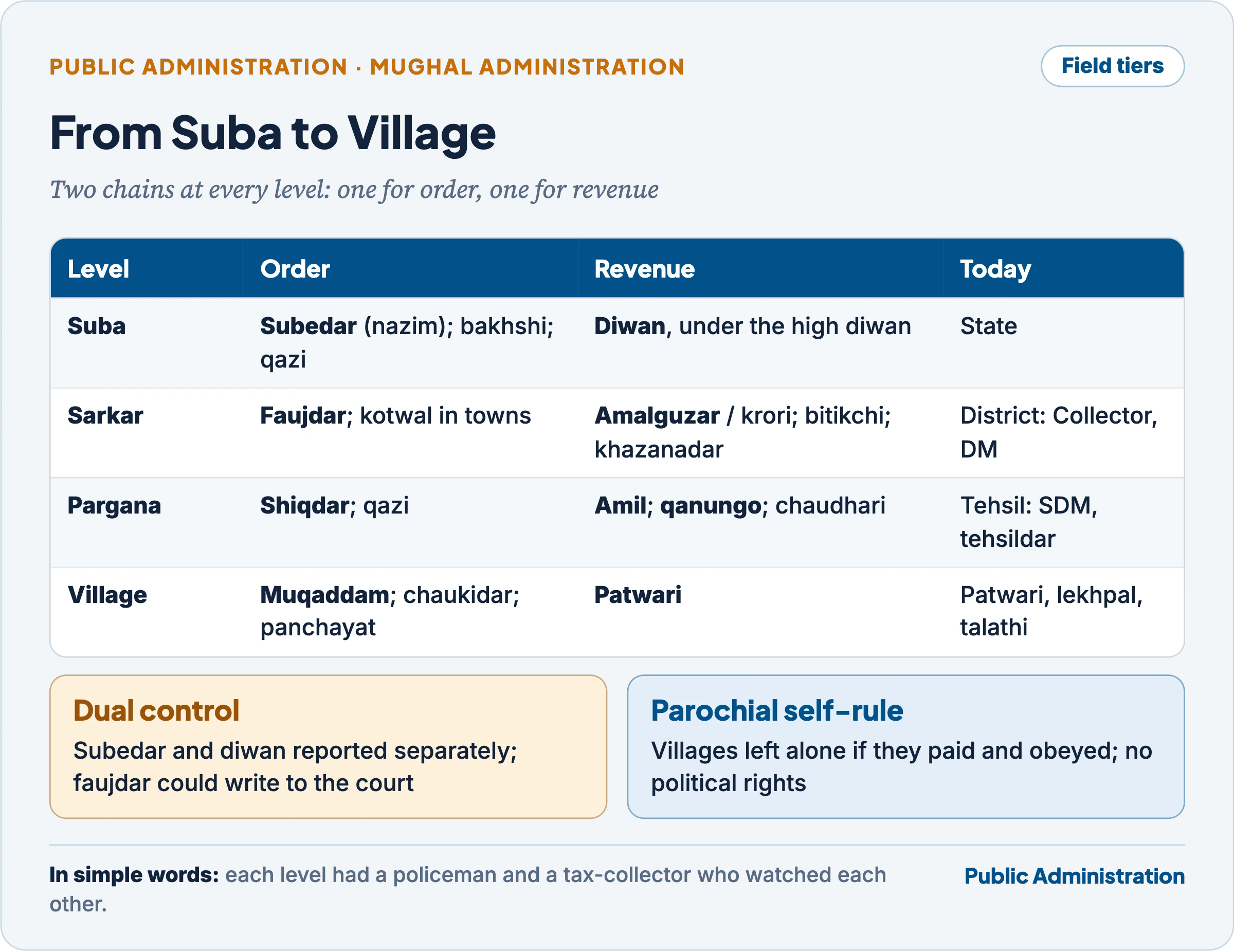
5.1 The suba (province)
- Organisation. In 1580 Akbar organised the empire into 12 subas; conquests in the Deccan (Berar, Khandesh, Ahmadnagar) raised the number to 15 by the end of his reign, and to about 21 under Aurangzeb. The provincial machinery was an exact miniature of the centre.
- Subedar (also sipah salar in the Ain, or nazim): head of the province, appointed by the emperor with an instrument of instructions; responsible for law and order, defence, general supervision and prosperity, control of zamindars and tributary chiefs, execution of imperial orders, supervision of justice and recommendation of appointments and promotions. There was no fixed tenure; frequent transfer was the rule.
- Provincial diwan: in charge of revenue and finance, appointed by the emperor on the high diwan’s recommendation and reporting directly to him (twice a month with a statement of the cash balance). He collected revenue, kept accounts, disbursed salaries of provincial officials, managed jagirs and khalisa in the province, appointed amins, kroris and tehsildars with the high diwan’s consent, and decided civil revenue cases.
- Dual control. The diwan was second in rank but not subordinate to the subedar. The two jealously watched and reported on each other; records show frequent quarrels and transfers. The design sacrificed unity of command to prevent provincial rebellion: neither the man with troops nor the man with money could act alone.
- Provincial bakhshi: counterpart of the mir bakhshi; kept the military establishment, musters and pay accounts of provincial mansabdars, and was often also the provincial waqia-navis (news-writer).
- Provincial sadr and qazi: the sadr supervised religious grants and stipends to scholars; the qazi headed the provincial judiciary. In some provinces the two offices were held by one person.
- Kotwal: in the provincial capital and big cities, in charge of urban police, prisons, markets, weights and measures, night watch, inventory of heirless property and execution of the qazi’s orders.
- Reporting: the subedar sent regular reports to the imperial record office, and independent news-writers sent their own. The centre therefore had several channels of information about every province.
5.2 The sarkar (district)
- Faujdar: the executive and military head of the sarkar, appointed by the centre and subordinate to the subedar but able to correspond directly with the court. He commanded a small force to suppress rebel zamindars, protect highways and tax-payers, investigate crime and help revenue officials. His tract was called a faujdari. Police, military, executive and some judicial authority were rolled into one.
- Amalguzar (or amil): the chief revenue officer of the sarkar, under the provincial diwan. He ensured that land was surveyed, produce ascertained, revenue assessed and deposited, encouraged cultivation, gave taqavi (agricultural loans) and checked the excesses of subordinates.
- Bitikchi: the accountant who prepared the assessment papers, maintained land records and sent monthly abstracts to the court.
- Khazanadar (potdar at lower levels): the treasurer who received payments from cultivators and issued receipts.
- Qazi of the sarkar for justice and religious matters; a kotwal in the main town.
- Krori: under Akbar’s 1574–75 experiment, officers placed over tracts expected to yield one crore dams (about 2.5 lakh rupees) were called kroris; the title survived for district revenue collectors long after the arithmetic had lapsed. The krori, the amalguzar and the British Collector are part of one lineage.
- Chakla: in the seventeenth century, especially under Shah Jahan and in Bengal, a chakla grouping several parganas appeared between the sarkar and the pargana for revenue convenience, under a chakladar.
5.3 The pargana (sub-district)
The pargana was where people met the state: it was the unit of revenue records and the base of all assessment.
- Shiqdar: the executive head of the pargana, responsible for law and order and criminal justice and for helping revenue collection; in function a small-scale faujdar and kotwal.
- Amil (or munsif): the pargana revenue officer, assisted by karkuns (writers) and a fotedar (treasurer).
- Qanungo: the hereditary keeper of the pargana’s revenue records: areas, crops, past assessments, local rates, customs and rights. He was the memory of the revenue system; Akbar paid qanungos and used their returns (from 1567 onward) to build the dahsala rates. He also supervised the village patwaris.
- Chaudhari: the leading zamindar or headman of the pargana, who helped in collection and stood surety for the villages’ payments, receiving a fee or revenue-free land (nankar) in return.
- Qazi of the pargana for local justice.
5.4 The village
- The village (mauza or deh, with hamlets called naglah) included its surrounding fields, so its boundary was clearly demarcated for revenue.
- Muqaddam (headman, patel in the Deccan): responsible for collecting revenue from the peasants and for village order; often held a share of village land rent-free.
- Patwari: the village accountant who recorded land holdings, crops and payments; strictly a servant of the village community, not of the state, though his papers fed the state’s records.
- Chaukidar: the village watchman, paid by the village.
- Panchayat: the village and caste panchayats regulated social life, resolved disputes among villagers (with appeal to officials) and managed common affairs.
- Assessment: this was parochial self-government, not local democracy. Villages had no political rights; they were “left alone if they left the government alone“, in Sarkar’s phrase. Other historians point out that the state did take an interest in agriculture: amins were told to see that peasants had ploughs and seed, and to give taqavi loans when they did not.
| Level | Order and general administration | Revenue and finance | Others |
|---|---|---|---|
| Suba | Subedar (nazim) | Provincial diwan | Bakhshi, sadr, qazi, kotwal, waqia-navis |
| Sarkar | Faujdar | Amalguzar / krori | Bitikchi, khazanadar, qazi, kotwal |
| Pargana | Shiqdar | Amil, fotedar, karkuns | Qanungo, chaudhari, qazi |
| Village | Muqaddam, chaukidar | Patwari | Panchayat |
At every level the table shows the same two-track design: an officer for order and an officer for revenue, each answering upward along a separate chain. The British fused the two tracks in the Collector-cum-District Magistrate; the Mughal separation of the two is one reason the empire could check provincial ambition, and also one reason coordination was weak.
6. Revenue Administration
In simple words
Most of the empire’s money came from a share of the farmers’ crops. The Mughals measured fields, worked out average yields and prices over ten years, and fixed a cash rate for each crop on each kind of land. Where measuring was not possible, they shared the crop or estimated it. Local record-keepers and village headmen made the system work.
6.1 Sources of revenue
- Land revenue (mal or kharaj) was the largest source by far: the ancient right of the ruler to a share of the produce, which only had to be fixed periodically.
- Other central sources: customs (on imports and exports), the mint, escheat (property of deceased nobles), tributes and presents (peshkash) from chiefs and nobles, jizya (abolished by Akbar in 1564, re-imposed by Aurangzeb in 1679), zakat on Muslims, and booty and indemnities.
- Provincial and local levies on trades, transit, markets and occupations; the abwab (cesses beyond the sanctioned revenue) were repeatedly declared illegal, and Aurangzeb abolished dozens of them, including rahdari (road tolls), yet local officials kept reviving them.
6.2 Categories of land
By administrative status:
- Khalisa: revenue to the imperial treasury.
- Jagir: revenue assigned to mansabdars in place of salary.
- Madad-i-maash or suyurghal (inam): revenue-free grants to scholars, religious men and institutions, supervised by the sadr. Akbar resumed many and audited the rest.
- Zamindari and watan tracts of hereditary chiefs, who paid tribute or revenue while running local affairs.
By continuity of cultivation (the Ain’s classification for assessment):
| Category | Meaning | Assessment |
|---|---|---|
| Polaj | Cultivated every year | Full rate |
| Parauti | Left fallow for a short time to regain fertility | Full rate in the year it was sown |
| Chachar | Fallow for three or four years | Concessional rate, rising to full |
| Banjar | Uncultivated for five years or more | Low rate, to encourage reclamation |
Polaj and parauti land were further graded good, middling and poor by yield, and the average of the three was used to compute the state’s share. The four-way classification rewarded extension of cultivation, a sound fiscal and developmental rule.
6.3 Akbar’s experiments and the ain-i-dahsala
Akbar reached his final system through a series of experiments over about twenty years.
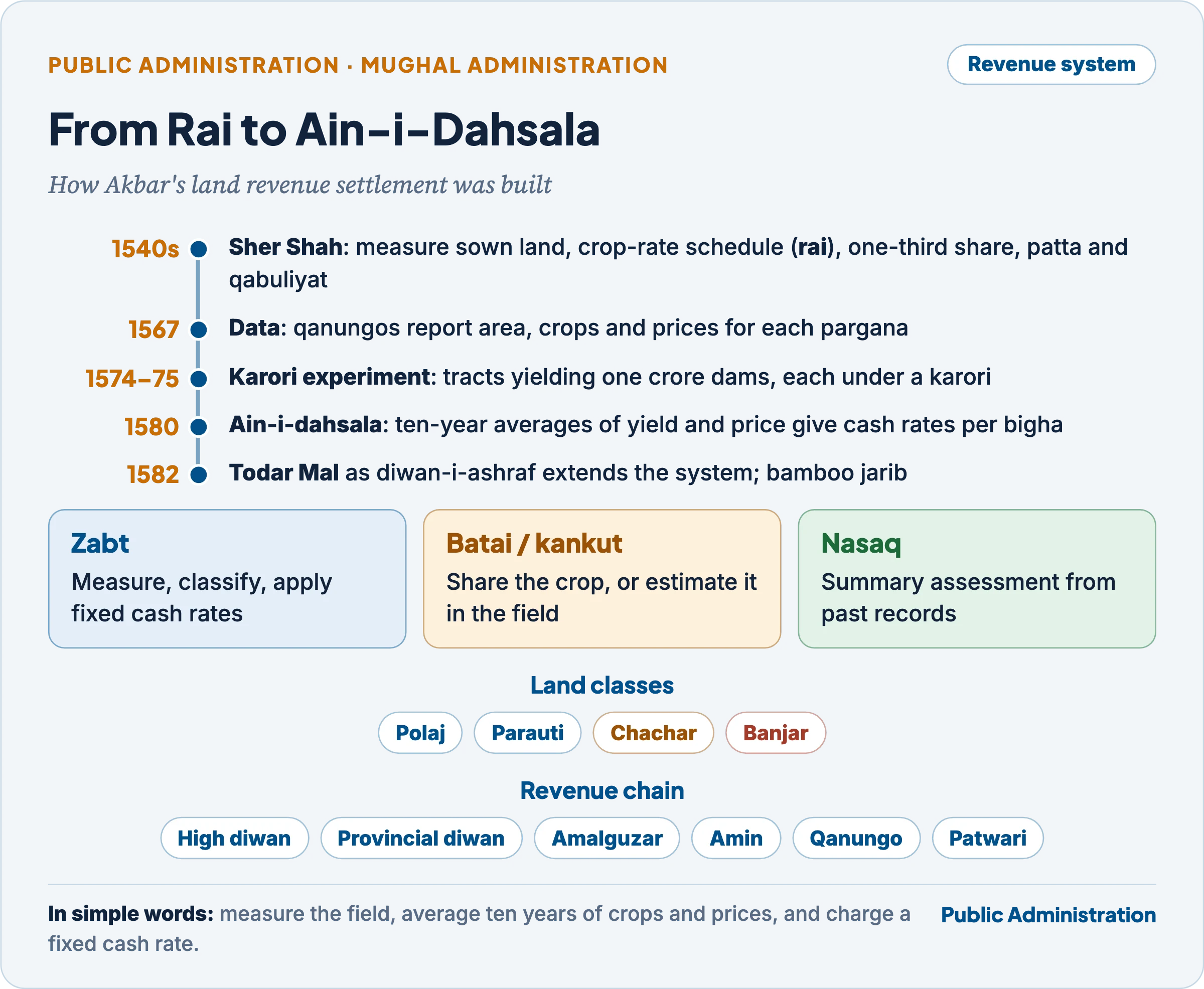
- Early years (from 1556): Sher Shah’s rai was used, with its in-kind demand converted to cash at prices fixed at the court; the prices did not match local markets.
- Data collection (1567 onward): the diwan Muzaffar Khan Turbati, with Todar Mal, had the qanungos submit returns of cultivated area, crops and prices for each pargana and revised the jama (estimated revenue) accordingly.
- The karori experiment (1574–75): the khalisa of northern India was divided into units each expected to yield one crore dams, each under a karori who measured the land and collected the revenue. The officers were often oppressive and the experiment was wound up, but it produced five or more years of measured data.
- The ain-i-dahsala (1580): for each pargana, the produce and prices of the previous ten years (1570–71 to 1579–80) were averaged; the state’s demand of one-third of the average produce was converted at the average price into a cash rate per bigha for each crop. These dastur-ul-amal rates, fixed for each assessment circle (dastur) of similar soil and prices, were then applied to the area actually sown each season. Todar Mal became diwan-i-ashraf in 1582 and extended the system.
- Measurement reforms: a standard ilahi gaz (about 33 inches) and bigha, and a jarib of bamboo pieces joined by iron rings instead of a hemp rope that shrank and stretched with the weather.
- The zabt (or bandobast) system is the name for this whole method: measurement + classification + fixed cash rates per crop. It applied in the core provinces (Lahore, Multan, Delhi, Agra, Awadh, Allahabad, Ajmer, Malwa, Bihar and parts of Gujarat).
- Merits: the peasant knew his liability in advance (through a patta), the state’s income became predictable, rates reflected local prices, and assessment was on the individual cultivator rather than a lump sum on a village or intermediary.
- Limits: it needed an army of honest measurers and record-keepers; cash demand hurt peasants when prices fell; the “permanent” rates aged as prices changed; it never covered Bengal, Kashmir, the Deccan or the hill and forest tracts.
6.4 Other methods of assessment
| Method | How it worked | Where used |
|---|---|---|
| Zabt (with dahsala rates) | Measure the sown area, apply fixed cash rates per crop per bigha | Core northern provinces |
| Ghalla-bakhshi / batai (crop-sharing) | Divide the actual crop: khet batai (field divided at sowing), lang batai (reaped crop divided in stacks), rasi batai (grain divided on the threshing floor) | Where peasants preferred to share risk; Thatta, parts of Kabul and Kashmir |
| Kankut | Estimate the produce standing in the field, often by sample measurement, and take the state’s share of the estimate | Widely, as a quick alternative to measurement |
| Nasaq | Summary assessment on a village or zamindar on the basis of past assessments and records, without fresh measurement | Bengal and other regions with strong zamindars |
- Peasants could often choose between methods; batai shared the risk of a bad harvest with the state, while zabt protected them from arbitrary estimates.
- The share under Akbar was nominally one-third of produce; in many areas under Aurangzeb it approached one-half, as the needs of war grew.
6.5 The revenue machinery
- Centre: the high diwan, with the diwan-i-khalsa and diwan-i-tan, fixed the jama, supervised collection and audited accounts.
- Province: the provincial diwan, directly under the high diwan.
- Sarkar: the amalguzar (or krori), with the amin (assessor and arbitrator between the state and the ryot; the word means a trustee or umpire), the bitikchi (accountant), the khazanadar or potdar (treasurer).
- Pargana: the amil, qanungo and chaudhari.
- Village: the muqaddam and the patwari.
- Documents: the patta (statement of liability given to the peasant), the qabuliyat (acceptance), receipts, the jamabandi (rent roll) and the pargana registers. Officials were told not to demand revenue out of season and to collect the kharif dues in the kharif season and the rabi dues in the rabi.
- Relief: taqavi loans for seed, cattle and ploughs, and remissions for crop failure.
6.6 Zamindars and intermediaries
- Zamindar literally means landholder; in Mughal usage it meant the holder of a hereditary right to a share of the produce or revenue of a tract, often with armed retainers.
- The historian S. Nurul Hasan classified them as autonomous chiefs (rajas who paid tribute and kept their own administration), intermediary zamindars (who collected revenue from others and passed it on, keeping a share), and primary zamindars (holders of proprietary rights over land they or their tenants cultivated).
- The state used zamindars as collectors, guarantors and local policemen, rewarding them with nankar (a percentage or revenue-free land), while trying to restrain them through faujdars. Their local entrenchment limited imperial despotism, and their revolts in the late seventeenth century helped break the empire.
6.7 Problems in practice
- Corruption at the lower levels. Sarkar described how a diwan auctioned the post of krori to whoever promised most revenue. He attributed the harshness of petty officials to their nominal salaries, the submissiveness of the people and the custom of presents up the chain: each subordinate had to keep his superior pleased.
- Bakhshish: the custom of tipping lower functionaries for any favourable decision, a habit that survives in the petty corruption of land and revenue offices.
- Chronic arrears and hostility between collector and tax-payer, because the peasant received little in return for the revenue paid.
- Abwab banned on paper but collected in practice, a classic gap between formal rule and actual behaviour.
- Ijara (revenue farming): from the seventeenth century jagirdars increasingly farmed out collection to the highest bidder, who squeezed the peasant.
- Agrarian crisis: Irfan Habib (The Agrarian System of Mughal India, 1963) argued that the rising revenue demand, short-term jagirdars and ijara drove peasants to flight and revolt (Jats, Satnamis, Sikhs, Marathas), undermining the empire’s base.
Indian Connect — How Mughal revenue terms live on in Indian land administration
- Tehsil and tehsildar come from tahsil, “collection”; the tehsil is today’s revenue sub-division and the tehsildar its revenue officer, with a naib tehsildar below.
- Qanungo survives as the revenue inspector’s title in Uttar Pradesh and other northern States; the patwari survives in Punjab, Haryana, Rajasthan and Madhya Pradesh, as lekhpal in Uttar Pradesh (renamed in 1953), talathi in Maharashtra and village administrative officer in Tamil Nadu.
- Khasra (field-wise register), khatauni (holder-wise register), jamabandi (record of rights and rent roll), girdawari (crop inspection), mutation (dakhil-kharij) and nazul land are Mughal-era terms still used in State land revenue codes.
- Taqavi loans were codified by the British as taccavi under the Land Improvement Loans Act, 1883 and the Agriculturists’ Loans Act, 1884.
- In December 2025 the Department of Land Resources issued a Glossary of Revenue Terms to harmonise words such as khasra, dag and pula across States, a sign of how much of this vocabulary still runs the system.
7. Justice, Police and the Military
In simple words
The emperor was the highest judge. Qazis decided cases under Islamic law, village and caste panchayats settled local quarrels, and the same officers who kept order also punished offenders. There was no separate judiciary in the modern sense.
7.1 Principles of Mughal justice
- The emperor as fountain of justice: he heard appeals and petitions in open court, usually on a fixed day each week, and had original and appellate jurisdiction over all cases. Jahangir’s chain of justice symbolised direct access.
- Sources of law:
- Sharia (the Quran, Hadith and Hanafi jurisprudence) for Muslims and for criminal law generally;
- fatwas (opinions of jurists, given by muftis);
- imperial regulations (qanun-i-shahi, zawabit), which prevailed so long as they did not contradict the sharia;
- custom (urf) and Hindu law for Hindus’ personal and civil matters, applied mostly through panchayats and pandits.
- Fatawa-i-Alamgiri: Aurangzeb had a digest of Hanafi law compiled (in the 1660s and 1670s) to guide qazis, an early attempt at codification.
7.2 The hierarchy of courts
| Level | Courts and officers | Jurisdiction |
|---|---|---|
| Centre | Emperor; qazi-ul-quzat (chief qazi); mir adl; chief sadr | Appeals, important original cases, grants and religious cases |
| Suba | Provincial qazi; governor’s court; provincial diwan; sadr | Civil and criminal cases; revenue cases (diwan); appeals from below |
| Sarkar | Qazi; faujdar; amalguzar; kotwal (in towns) | Local civil and criminal cases; revenue disputes; petty offences |
| Pargana | Qazi; shiqdar | Petty civil and criminal cases |
| Village | Panchayat of the village or caste | Local disputes, with appeal to officials |
- Qazi and mir adl: the qazi heard the case and found the law; the mir adl, a secular officer posted in big towns, dealt with matters not specifically covered by religious law and, where both were present, exercised general control over the qazi and executed the decree.
- Executive justice: the governor, faujdar, kotwal, diwan and amalguzar also decided cases, so judicial and executive functions were fused. Revenue cases went to revenue officers, a practice the British continued in revenue courts.
7.3 Criminal law and procedure
- Classification of crimes (Islamic law): crimes against God, against the sovereign, and against individuals.
- Punishments: hadd (fixed by scripture, such as for theft or adultery), qisas (retaliation, or blood-money in lieu, as the victim’s right), tazir (discretionary: admonition, fines, flogging, exile) and tashhir (public humiliation). Punishments were severe; treason was punished brutally.
- Discrimination: under Aurangzeb, the evidence of a non-Muslim was not admissible against a Muslim.
- Procedure: simple and quick, with no lawyers in the modern sense; but qazis were often corrupt, the system was concentrated in towns, and the countryside relied on panchayats and officials’ summary justice.
- Assessment: justice was personalised, plural and executive-dominated: there was no separation of powers, no independent judiciary and no uniform law. With the collapse of central power in the eighteenth century, regular courts survived only in the chief towns.
7.4 From Mughal to British courts: landmarks to 1911
The East India Company inherited this order after 1765 and changed it in stages. The full story belongs to the article on the legacy of British rule; the landmarks are:
| Year | Landmark | Significance |
|---|---|---|
| 1765 | Diwani of Bengal, Bihar and Orissa granted to the Company | Company becomes Mughal diwan; nizamat (criminal justice) left with the Nawab’s officers (“dual government”) |
| 1772 | Warren Hastings’s Judicial Plan | Mofussil diwani adalats (civil) and faujdari adalats (criminal) in each district under the Collector‘s supervision; sadar diwani and sadar nizamat adalats at the top; Muslim law officers kept for criminal cases |
| 1773–74 | Regulating Act; Supreme Court at Calcutta (1774) | First Crown court; conflicts with the Company’s courts |
| 1781 | Act of Settlement | Limited the Supreme Court’s jurisdiction over revenue matters and Company officials |
| 1793 | Cornwallis Code | Collector stripped of judicial powers; separation of revenue and judicial functions; zillah courts, provincial courts of appeal; Collector’s revenue courts (mal adalats) abolished |
| 1837 | Act XXIX of 1837 | Persian replaced by vernaculars (and in time English) in courts and revenue proceedings |
| 1860–61 | Indian Penal Code (1860, in force 1862); Criminal Procedure Code (1861) | Islamic criminal law, administered with modifications by Company courts, finally replaced |
| 1861 | Indian High Courts Act | High Courts at Calcutta, Bombay and Madras (1862) replace the Supreme and Sadar courts |
| 1911 | Indian High Courts Act, 1911 | Allowed the Crown to set up new High Courts (Patna followed in 1916) |
- Continuity: the Company’s courts kept Mughal law officers (qazis and muftis) until the 1860s, kept Persian until 1837, and kept the Mughal practice of revenue officers deciding revenue disputes, which survives in today’s revenue courts of the tehsildar, SDM, Collector and Board of Revenue.
- Change: the British gradually introduced codified, uniform and territorial law, a professional judiciary and the principle of separating the executive from the judiciary, which the Mughals never had (completed in independent India by Article 50 and the Criminal Procedure Code of 1973).
7.5 Police administration
- Cities: the kotwal maintained watch and ward, arrested thieves, regulated markets, prices, weights and measures, kept a register of residents and travellers, appointed a headman for each mohalla (ward), employed spies, ran the prison, and took charge of heirless property.
- Districts: the faujdar with his troops dealt with rebels, dacoits and highway robbery; thanas (military outposts under a thanedar) held strategic points.
- Countryside: the village headman and chaukidars, paid by the village, kept order; the village was held collectively responsible for thefts in its area.
- No Home Minister: there was no central minister for internal order; the emperor and the wakil or wazir held this responsibility in general.
- Legacy: kotwali (city police station), thana and thanedar, the chaukidar and the daroga (Cornwallis put each thana under a daroga in 1793) all carried Mughal names into the British police system; see the article on the legacy of British rule.
7.6 The military
- Components:
- mansabdars’ contingents (tabinan), the bulk of the cavalry, recruited and paid through the mansabdar;
- ahadis, “gentleman troopers” recruited directly by and loyal to the emperor, mustered by their own bakhshi;
- dakhili troops paid by the state but placed under mansabdars;
- walashahis, the emperor’s personal guard;
- artillery under the mir atish, increasingly dependent on foreign gunners;
- infantry of townsmen and peasants, and a weak navy.
- Weaknesses: cavalry dominance and neglect of the navy; soldiers’ loyalty to their recruiter rather than the emperor; a heterogeneous, unwieldy force; luxury on the march (the camp was a moving city of elephants, harem and workshops) that made it slow against mobile Maratha forces; fraudulent musters.
8. Strengths, Weaknesses and Decline
In simple words
The Mughals gave India a uniform government, a working revenue system and an empire-wide service. But the system rested on one person, extracted a great deal from peasants and gave little back, and never built a sense of shared citizenship. When the centre weakened, the parts pulled away.
8.1 Achievements
- Administrative unity and homogeneity: one grid of subas, sarkars and parganas; one official language; one currency; one ranked service.
- A rational revenue system: measurement, classification, ten-year averages, written liabilities and records, much of whose terminology and machinery survives.
- Inclusive elite formation: Rajputs, Persians, Turanis, Afghans and Indian Muslims in one nobility, with Hindus in high civil posts.
- Records and communications: a secretariat (dar-ul-insha), record office, news-writers and posts that gave the centre real information.
- Rudimentary principles of public administration: hierarchy, division of work, decentralisation (without local autonomy), written communication, verification of service and graded pay. Other principles, such as unity of command, specialisation, recruitment, training and promotion by rule, were not followed.
8.2 Weaknesses
- Personalised power: everything depended on the emperor’s ability; there was no law of succession, no institutional check and no mechanism of self-criticism or endogenous reform.
- No popular base: no representative institutions, no popular education, no idea of rights; the people remained, in Sarkar’s phrase, “human sheep“. Sarkar’s verdict was that the Mughals ignored the principle that “there cannot be a great empire without great people”: they built administrative union but not nationality.
- Extraction without service: a police-and-revenue state that did little for the tax-payer, producing chronic hostility and arrears.
- Urban bias and neglect of villages.
- Fusion of functions: executive, judicial and military authority in the same hands, with no independent judiciary.
8.3 Causes of decline (from the late seventeenth century)
- Jagirdari crisis: Satish Chandra (Parties and Politics at the Mughal Court, 1959) traced the court’s factional struggles to the shortage of revenue-yielding jagirs relative to the swelling number of mansabdars, worsened by Aurangzeb’s inclusion of Deccani and Maratha nobles.
- Agrarian crisis: Irfan Habib linked peasant flight and revolts to excessive revenue demand, ijara and short-term jagirdars.
- Regional assertion: Muzaffar Alam (The Crisis of Empire in Mughal North India, 1986) showed that in Awadh and Punjab the eighteenth century meant the rise of regional elites and successor states, not simple collapse; the Mughal administrative forms continued under nawabs and nizams.
- Wars of succession, Aurangzeb’s long Deccan wars (1681–1707), religious policies that alienated Rajputs and others, the decay of the mansabdari army and foreign invasions (Nadir Shah, 1739).
- Result: by the 1750s the subedars of Bengal, Awadh and Hyderabad were independent in fact, and the British took over a Mughal machinery already working at the regional level.
9. The Legacy in Indian Administration
In simple words
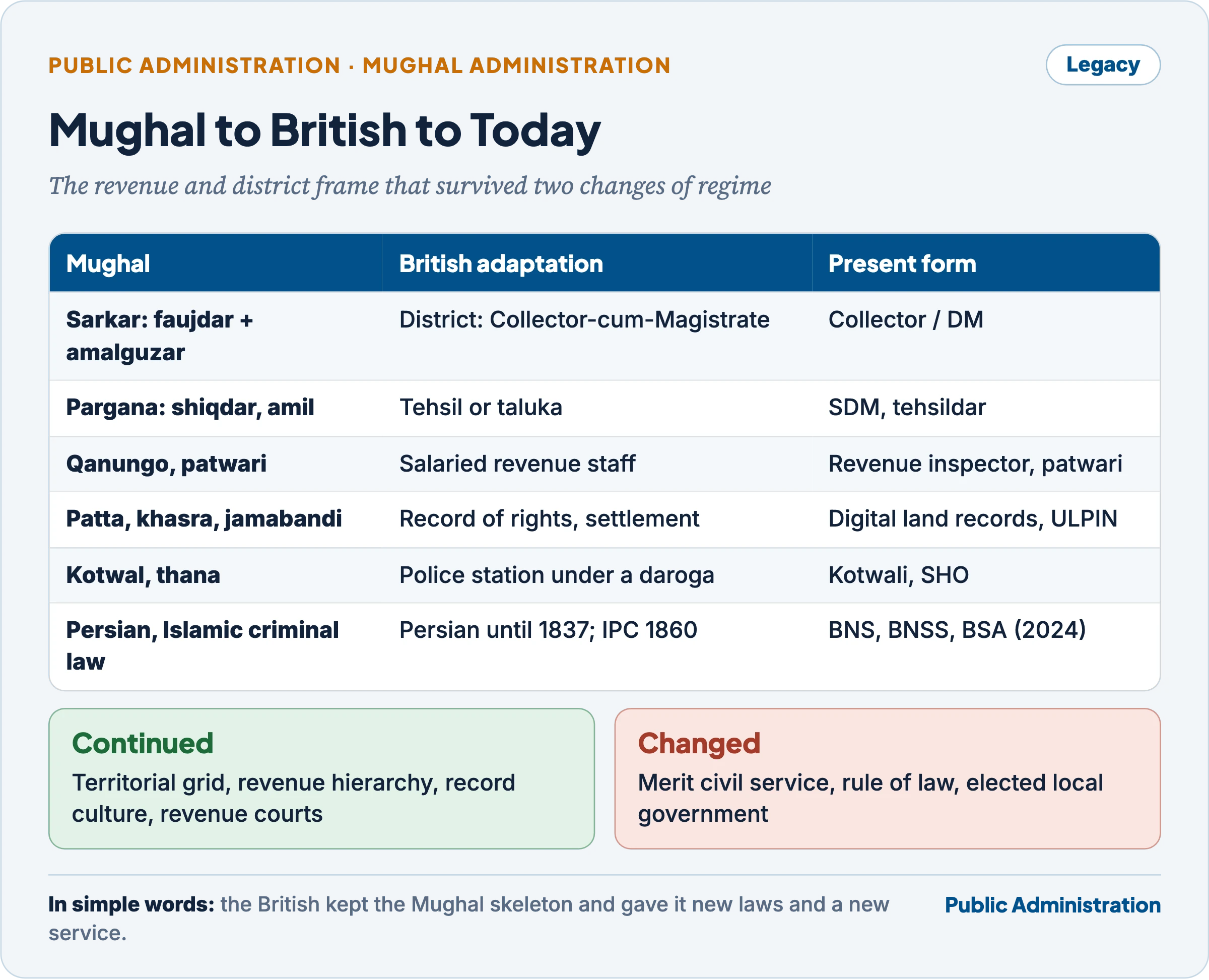
When the British took over, they did not throw away the Mughal machinery: they kept the districts, the revenue offices, the record-keepers and many of the words, and added their own laws and a new kind of civil service. So today’s tehsil office, patwari and Collector are partly British and partly Mughal.
9.1 How the British took over the Mughal frame
- Constitutional cover: the Company ruled Bengal as the Mughal emperor’s diwan from 1765; until 1835 its coins bore the emperor’s name. It needed Mughal forms to look legitimate.
- Revenue machinery: in 1772 Warren Hastings decided that the Company would “stand forth as diwan” and appointed Collectors to districts; the Mughal amalguzar’s office became the Collector’s. Qanungos and patwaris were retained (after an early attempt to abolish the qanungos in Bengal), and the British settlements (Permanent, ryotwari and mahalwari) were built on Mughal records and categories.
- Language and law: Persian remained the language of courts and revenue until 1837; Islamic criminal law was applied in modified form until the IPC.
- Territorial units: the sarkar became the district (zila), the pargana survived as a revenue unit (and as the core of the tehsil or taluka), the suba became the province.
9.2 Continuities and changes
| Mughal institution | British adaptation | Present form |
|---|---|---|
| Suba under subedar and diwan | Presidency or province under Governor | State under Governor and elected government |
| Sarkar under faujdar and amalguzar | District under Collector-cum-District Magistrate | District under Collector / DM / Deputy Commissioner |
| Amalguzar / krori (revenue) | Collector (1772) | Collector as chief revenue officer, with Additional Collector |
| Faujdar (order) | District Magistrate; Superintendent of Police after 1861 | DM as Executive Magistrate (BNSS 2023, s.14); SP |
| Pargana under shiqdar and amil | Tehsil / taluka under tehsildar or mamlatdar | Tehsil and sub-division (SDM, tehsildar) |
| Qanungo | Kanungo / revenue inspector | Revenue inspector or kanungo |
| Patwari (village servant) | Salaried village accountant (Bengal and NWP Regulations) | Patwari, lekhpal, talathi, VAO |
| Muqaddam / patel | Lambardar, village headman | Lambardar (Punjab, Haryana), police patil (Maharashtra) |
| Kotwal, thana, chaukidar | Thana under daroga (1793), Police Act 1861 | Kotwali and police station, SHO, village chowkidar |
| Waqia-navis, harkaras | Political and police intelligence | Intelligence Bureau and State special branches |
| Patta, jamabandi, khasra, taqavi | Record of rights, settlement reports, taccavi Acts | Record of rights, mutation, Kisan credit and crop loans |
- What continued: the territorial grid, the revenue hierarchy, the record-keeping culture, the combination of revenue and order in one district head, revenue courts, and the vocabulary of land.
- What changed under the British: a professional, salaried, non-hereditary civil service recruited by examination (the ICS); codified law and the rule of law; separation of judiciary from executive; security of tenure; property rights in land (zamindari under the Permanent Settlement of 1793, ryotwari and mahalwari settlements in the 1820s), which turned the Mughal right to revenue into ownership; and local self-government (Ripon’s resolution of 1882).
- What changed after 1947: democracy, the welfare state, the 73rd and 74th Amendments (1992) creating elected local governments, land reforms abolishing zamindari, and development administration that turned the Collector from a revenue officer into a coordinator of development.
9.3 Revenue and district administration today
- The Collector’s revenue role: collection of land revenue and dues recoverable as arrears of land revenue, maintenance of land records, mutation, partition, land acquisition, government land, revenue courts, relief in natural calamities and taqavi-type agricultural loans remain with the Collector and his tehsil machinery. Land revenue itself has become fiscally minor, but land administration has become more important.
- Record of rights: the patwari’s village records (khasra, khatauni, jamabandi), updated through girdawari each season and mutation on transfer, are the record of rights. The Supreme Court has held repeatedly that these entries are for fiscal purposes only and do not confer title, which must be settled by civil courts (Suraj Bhan v. Financial Commissioner, 2007; Jitendra Singh v. State of Madhya Pradesh, 2021). India still has a presumptive, not a conclusive, title system.
- Digitisation: the National Land Records Modernisation Programme (approved by the Cabinet on 21 August 2008) aimed at conclusive titling with title guarantee; it became the Digital India Land Records Modernisation Programme (DILRMP) from 1 April 2016, fully funded by the Centre. By August 2026 about 99.9% of records of rights were computerised and about 97% of cadastral maps digitised.
- Why digitisation is necessary but not sufficient: computerising old records also computerises their errors; transparency needs updated surveys, integration of registration and mutation, time-bound mutation services, dispute resolution in revenue courts, and accountable staff at the tehsil. The Mughal problem of corrupt lower revenue officials reappears wherever the patwari remains the sole gatekeeper of records.
Indian Connect — The patwari from Akbar to Bhu-Aadhaar
- Mughal: a hereditary village accountant paid by the village, whose papers fed the qanungo’s pargana registers and Todar Mal’s ten-year averages.
- British: a salaried revenue servant whose records became the legal record of rights under provincial land revenue Acts.
- 1953: when about 26,000 Uttar Pradesh patwaris resigned en masse in a strike, the State created a new cadre of lekhpals in their place; the Supreme Court upheld the State’s right to exclude those who had broken discipline (Banarsi Das v. State of Uttar Pradesh, 1956).
- Today: the ULPIN or Bhu-Aadhaar (a 14-digit land parcel number), SVAMITVA drone surveys of village homesteads, the NAKSHA urban land survey and the mobile Digital Crop Survey under Agristack are replacing the patwari’s paper registers with geo-referenced digital records, attacking the old gatekeeper problem.
9.4 Behavioural and cultural legacies
- Centralisation and paternalism: the habit of referring decisions upward and treating the district officer as a ruler-protector (mai-baap) rather than a servant of citizens.
- Kaghazi raj: file-bound procedure and the power of clerks and record-keepers, which British office procedure reinforced.
- Transfers as a tool of control: Mughal emperors moved officers to stop them building local bases; frequent and arbitrary transfers remain a lever of political control over civil servants.
- Bakhshish and petty corruption at the cutting edge of revenue and police administration.
- Revenue-first orientation of district administration, with development added later; and the urban bias of administrative attention.
- Prefectoral district administration: a single generalist head representing the central authority in the district. The British grafted their prefectoral Collector onto this inherited Mughal district at a time when no rural local government existed above the village; this is why, even after 1992, the Collector tends to overshadow elected district panchayats (see the article on the legacy of British rule).
9.5 Where the legacy does not reach
- Indian administration today rests on a Constitution, the rule of law, fundamental rights, elections and judicial review, none of which had a Mughal counterpart.
- Its civil service is merit-recruited (Articles 312, 315–320), politically neutral in principle and protected by Article 311, unlike the mansabdar who served at pleasure.
- Local self-government under Parts IX and IX-A is democratic devolution, unlike Mughal parochial self-government.
- The useful Mughal lessons are therefore specific: standardised measurement and records, checks against concentration of power in the field (dual channels and independent reporting), and the warning that a strong centre without popular participation and welfare cannot hold a large country together.
10. Theory Lens
In simple words
The ideas of Paper I help explain why the Mughal system worked as it did: it was a ruler’s personal household grown into a bureaucracy, a mix of old and new forms, and highly centralised in design but dependent on local intermediaries in practice.
Theory lens: patrimonial authority, prismatic forms and centralisation
- Weber: patrimonial versus rational-legal authority. Max Weber, the German sociologist, in Economy and Society (1922), distinguished traditional authority (including patrimonialism, where the ruler treats administration as an extension of his household and officials as personal servants, and sultanism, its most discretionary form) from rational-legal authority exercised through rule-bound bureaucracy. The Mughal state fits patrimonialism: offices at the ruler’s pleasure, the household (khan-i-saman, karkhanas) fused with the state, rewards as personal favour. Stephen Blake (1979) called it a patrimonial-bureaucratic empire, a mixed type that also had graded ranks, written rules and record offices. See the article on Weber’s Bureaucratic Model, its Critique and Post-Weberian Developments.
- Weber’s prebend and the jagir. Weber described a prebend as an income attached to office and granted for life or for a term, not owned. The jagir is a prebend, not a feudal fief: the noble held revenue rights, not land, and could be moved. This explains why Mughal nobles did not become a hereditary landed aristocracy like European feudal lords, and why the ruler’s power over them was greater.
- Weber’s separation of the official from the means of administration. Rational bureaucracy requires that officials do not own their offices or resources. The Mughals achieved part of this (non-hereditary mansabs, escheat, transfer), but mansabdars raised and paid their own troops, so the means of coercion stayed partly private, which is why the army fragmented when the centre weakened.
- Riggs: fused and prismatic societies. Fred Riggs, in “Agraria and Industria” (1957) and Administration in Developing Countries (1964), described fused societies where one structure performs many functions, and prismatic ones where new formal structures coexist with old practices. The mansab fused military command, civil office, noble status and pay in one structure; the faujdar fused police, military, executive and judicial work; the emperor’s household and the state overlapped. Banned abwab collected in practice and “permanent” dasturs ignored on the ground are examples of what Riggs called formalism, the gap between rule and reality. The British-made Indian state became prismatic partly by layering modern forms on this Mughal base. See the article on Riggsian Models and their Critique.
- Centralisation versus decentralisation. In Paper I terms, the Mughal empire practised deconcentration (delegating tasks to centrally appointed field agents), not devolution (transferring power to autonomous local bodies). Its decentralisation was administrative, not political; villages had autonomy by neglect, not by right. Today’s 73rd and 74th Amendments represent the opposite principle, devolution to elected bodies. See the article on Structure and Forms of Public Organisations.
- Classical theory: unity of command versus checks and balances. Henri Fayol and the classical school insisted on unity of command. The Mughal province deliberately broke it: the diwan answered to the high diwan, the faujdar could write directly to the court, and news-writers reported independently. The design traded coordination for control, showing that in an empire facing the threat of rebellion, checks on agents mattered more than efficiency. See the article on Classical Theory: Fayol, Gulick–Urwick and Mooney–Reiley.
- Principal–agent theory. The emperor (principal) faced information asymmetry and moral hazard in distant agents. Dagh and chehra (verifying contingents), independent reporters (monitoring), frequent transfers (preventing capture by local interests), escheat (preventing accumulation) and separate revenue and order chains (mutual monitoring) are textbook solutions to the agency problem, centuries before the theory.
- Oriental despotism and its critics. Karl Wittfogel, in Oriental Despotism (1957), saw Asian empires as total bureaucratic despotisms built on control of irrigation. Indian historians, notably Irfan Habib, rejected this for Mughal India: irrigation was largely local and private, and the state’s power rested on revenue extraction through intermediaries, not on hydraulic monopoly. The debate cautions against reading the Mughal state as either all-powerful or merely feudal.
- Ecology of administration. John Gaus and Riggs argued that administration must be understood in its environment. The Mughal system was shaped by an agrarian economy, a heterogeneous warrior nobility, slow communications and a plural society; its institutions (cash revenue from land, mobile nobility, written reports) were adaptations to that ecology. The same reasoning explains why its forms survived into British and independent India where the ecology (an agrarian, record-based revenue system) persisted. See the article on Comparative Public Administration.
Key Terms
| Term | Meaning in simple words |
|---|---|
| Mansab | A numbered rank fixing an officer’s status, pay and troop obligation |
| Zat | The personal rank within a mansab, fixing status and personal pay |
| Sawar | The number of horsemen a mansabdar had to maintain |
| Jagir | Temporary right to collect the land revenue of a tract in place of salary |
| Watan jagir | Hereditary homeland of a chief, kept as part of his mansab |
| Khalisa | Land whose revenue went directly to the imperial treasury |
| Madad-i-maash / suyurghal | Revenue-free grant to scholars and religious persons |
| Dagh and chehra | Branding of horses and descriptive roll of troopers, to stop fraud at musters |
| Iqta | Sultanate revenue assignment to a noble (muqti), forerunner of the jagir |
| Shiq | Sultanate sub-division of a province under a shiqdar, later the sarkar |
| Suba, sarkar, pargana | Province, district and sub-district of the Mughal empire |
| Subedar (nazim) | Governor of a suba |
| Diwan / wazir | Head of revenue and finance (centre or province) |
| Mir bakhshi | Paymaster and head of the military establishment |
| Faujdar | Military-executive head of a sarkar, responsible for order |
| Amalguzar / amil | Revenue collector of a sarkar or pargana |
| Qanungo | Hereditary keeper of pargana revenue records |
| Patwari | Village accountant keeping land and revenue records |
| Muqaddam / chaudhari | Village headman / leading headman of a pargana |
| Kotwal | Chief of police and civic order in a town |
| Zabt | Assessment by measurement and fixed cash rates per crop |
| Ain-i-dahsala | Akbar’s 1580 rule fixing cash rates from ten-year averages of yield and price |
| Batai, kankut, nasaq | Crop-sharing, crop estimation and summary assessment on past records |
| Polaj, parauti, chachar, banjar | Land classes by continuity of cultivation |
| Abwab | Illegal cesses above the sanctioned revenue |
| Taqavi | State loans to peasants for seed, cattle and implements |
| Kaghazi raj | “Paper government”: administration through written records |
Commissions, Committees and Judgments
The topic is historical, so the table lists the regulations, Acts and judgments that connect Mughal practice to present revenue and district administration.
| Body / case / Act | Year | Key point |
|---|---|---|
| Ain-i-dahsala (Akbar; Raja Todar Mal) | 1580 | Cash rates per crop per bigha from ten-year averages of yield and price; basis of zabt |
| Ain-i-Akbari (Abu’l Fazl) | c. 1598 | Official account of Akbar’s administration, ranks and revenue rules |
| Diwani grant (Treaty of Allahabad, Shah Alam II to the Company) | 1765 | Company becomes Mughal diwan of Bengal, Bihar and Orissa |
| Warren Hastings’s Judicial Plan | 1772 | District diwani and faujdari adalats under the Collector; sadar courts |
| Regulating Act; Supreme Court at Calcutta | 1773; 1774 | First Crown court in India |
| Cornwallis Code (Bengal Regulations) | 1793 | Collector loses judicial powers; Permanent Settlement; thanas under darogas |
| Act XXIX of 1837 | 1837 | Persian replaced as language of courts and revenue proceedings |
| Indian Penal Code | 1860 | Replaced the Islamic criminal law administered by Company courts |
| Indian High Courts Act | 1861 | High Courts at Calcutta, Bombay and Madras (1862) |
| Indian High Courts Act | 1911 | Enabled new High Courts (Patna, 1916) |
| Banarsi Das v. State of Uttar Pradesh (Supreme Court) | 1956 | Upheld UP’s replacement of striking patwaris by a new lekhpal cadre (1953); no right to re-employment for those who broke discipline |
| Suraj Bhan v. Financial Commissioner (Supreme Court) | 2007 | Entries in revenue records and jamabandi serve a fiscal purpose only; they do not confer title |
| National Land Records Modernisation Programme | 2008 | Cabinet approval (21 August); goal of conclusive titling; renamed DILRMP in 2016 |
| 2nd ARC, 15th Report “State and District Administration” (chair M. Veerappa Moily, later V. Ramachandran) | 2009 | Reviewed the Collector’s office and land administration; called for modernised district administration |
| Jitendra Singh v. State of Madhya Pradesh (Supreme Court) | 2021 | Mutation entry confers no right, title or interest; title disputes go to civil courts |
| Bharatiya Nagarik Suraksha Sanhita, s.14 | 2023 (in force 1 July 2024) | State appoints Executive Magistrates and one District Magistrate in every district; SDM for sub-divisions |
Contemporary Developments
- Budget 2024–25 (23 July 2024): announced incentives for States to assign a Unique Land Parcel Identification Number (ULPIN, “Bhu-Aadhaar”) to all land, digitise cadastral maps, survey sub-divisions, create a land registry linked to the farmers’ registry, and digitise urban land records with GIS mapping.
- Digital Agriculture Mission (Cabinet, 2 September 2024; outlay Rs 2,817 crore): builds Agristack with a farmers’ registry, geo-referenced village maps and a crop-sown registry recorded through a seasonal mobile Digital Crop Survey, a digital successor to the patwari’s crop inspection.
- SVAMITVA (18 January 2025): about 65 lakh property cards were distributed in over 50,000 villages, taking the total to about 2.25 crore record-of-rights cards for rural homesteads mapped by drones; the scheme was launched on 24 April 2020.
- NAKSHA (18 February 2025): a pilot National Geospatial Knowledge-based Land Survey of Urban Habitations was launched at Raisen, Madhya Pradesh, for 152 urban local bodies in 26 States and 3 UTs, with the Survey of India as technical partner and a cost of about Rs 194 crore.
- Draft Registration Bill, 2025 (27 May 2025): the Department of Land Resources published a draft to replace the Registration Act, 1908 with an online, paperless registration system, with consent-based Aadhaar authentication and alternatives.
- Land Stack and Glossary of Revenue Terms (31 December 2025): a GIS-based Land Stack was piloted in Tamil Nadu and Chandigarh, and a Glossary of Revenue Terms was issued to harmonise terms such as khasra, dag and pula across States; by November 2025 ULPIN had been assigned to over 36 crore land parcels.
- DILRMP 3.0 (guidelines launched 10 September 2026): a central sector phase for 2026–2031 (Rs 565.50 crore) for a National Land Stack, universal Bhu-Aadhaar, scanning of legacy records, paperless revenue courts linked to land records and Registration Seva Kendras; as of 6 August 2026, 99.90% of records of rights were computerised and 69.04% of land parcels had a ULPIN.
Revision Grid
| Thinker / body | Work or report (year) | Key idea |
|---|---|---|
| Abu’l Fazl | Ain-i-Akbari (c. 1598) | Official description of Akbar’s ranks, departments and revenue system; theory of divine-light kingship |
| Jadunath Sarkar | Mughal Administration (1920) | Centralised despotism; kaghazi raj; ministers as “secretaries”; urban bias; no great empire without great people |
| W.H. Moreland | India at the Death of Akbar (1920); The Agrarian System of Moslem India (1929) | Pioneering economic and agrarian studies of the Mughal revenue system |
| Ibn Hasan | The Central Structure of the Mughal Empire (1936) | Working of central institutions and practical limits on the emperor |
| Satish Chandra | Parties and Politics at the Mughal Court (1959) | Jagirdari crisis: too many mansabdars, too few jagirs |
| Irfan Habib | The Agrarian System of Mughal India (1963) | Centralised extraction of surplus; agrarian crisis behind the empire’s decline |
| M. Athar Ali | The Mughal Nobility under Aurangzeb (1966) | Composition and crisis of the mansabdari nobility |
| S. Nurul Hasan | Thoughts on Agrarian Relations in Mughal India (1973) | Autonomous chiefs, intermediary and primary zamindars |
| Stephen Blake | “The Patrimonial-Bureaucratic Empire of the Mughals” (1979) | Weber’s patrimonial-bureaucratic model fits the Mughal state better than a British-style bureaucracy |
| Muzaffar Alam | The Crisis of Empire in Mughal North India (1986) | Eighteenth-century decline as regional reconfiguration, not mere collapse |
| Max Weber | Economy and Society (1922) | Patrimonialism, sultanism and prebends versus rational-legal bureaucracy |
| Fred Riggs | “Agraria and Industria” (1957); Administration in Developing Countries (1964) | Fused and prismatic societies; formalism |
| Karl Wittfogel | Oriental Despotism (1957) | Hydraulic despotism thesis, rejected for Mughal India |
| Sher Shah Sur | Revenue and administrative reforms (1540–45) | Sarkar and pargana officials, measurement, rai, patta and qabuliyat |
| Raja Todar Mal | Ain-i-dahsala (1580) | Measurement, land classes, ten-year average cash rates |
Previous Year Questions
- 2024“The Mughal Administration was by nature centralised.” Analyse.
- 2022“Mughal administrative system was centralised despotism”. Comment.
- 2020Mughal administration incorporated a combination of Indian and extra-Indian elements. Discuss.
- 2017”Digitalization of land records is a necessary but not sufficient precondition for ensuring transparent district administration.” Explain.
- 2016“A significant legacy of the Mughal rule in India is a well-organized revenue administration at the State and District Levels.” Comment.
- 2012“The Mughal Administrative System was military rule by nature and a form of centralised despotism.” Analyse.
- 2008‘Some features of Mughal Administration, in essence, do exist in Indian Administration.’ Elaborate.
- 2005“The Mughal by nature and was centralized despotism.” Comment.
- 1993“The British colonial administration superimposed the prefectorial system on the historically inherited district administration in India, in the absence of rural local governments at the district level.” Comment.
- 1989Trace the evolution of Judicial Administration in India during the Mughal and British periods of Indian History and highlight the major landmarks of this evolution from 1774 to 1911.
- 1988“Iqta’, the liwest unit of administration during the Sultanate period was sub-divided ‘Shiqs’. The Shiqdar administrered a number of ‘Paraganas’. A Chaudhari in every paragana and a Patwari in every Village Constituted the Local administration.” Comment.
- 2024Undoubtedly, social and historical factors play a significant role in shaping administrative system, but side by side, understanding of these influences is essential for designing responsive governance structure. Examine.
- 2018“Administrative systems across the world can be understood only in their respective historical and social contexts.” Explain the statement giving examples.