

Study of consciousness – meditation.
Official Syllabus: Paper I · Unit 14 Issues and Perspectives in Modern Contemporary Psychology
“Meditation refers to a family of self-regulation practices that focus on training attention and awareness in order to bring mental processes under greater voluntary control and thereby foster general mental well-being and development and/or specific capacities such as calm, clarity and concentration.”
— Walsh and Shapiro (2006)
Meditation is the one route to an altered state of consciousness that is deliberately trained, self-induced and reversible without any external agent, which is why it became the first such state to be taken into the laboratory. The scientific literature on it divides sharply into two eras: an early one that reported large and wide-ranging benefits, and a later one that shrank most of those claims once active control conditions were used. Both belong in an accurate account.
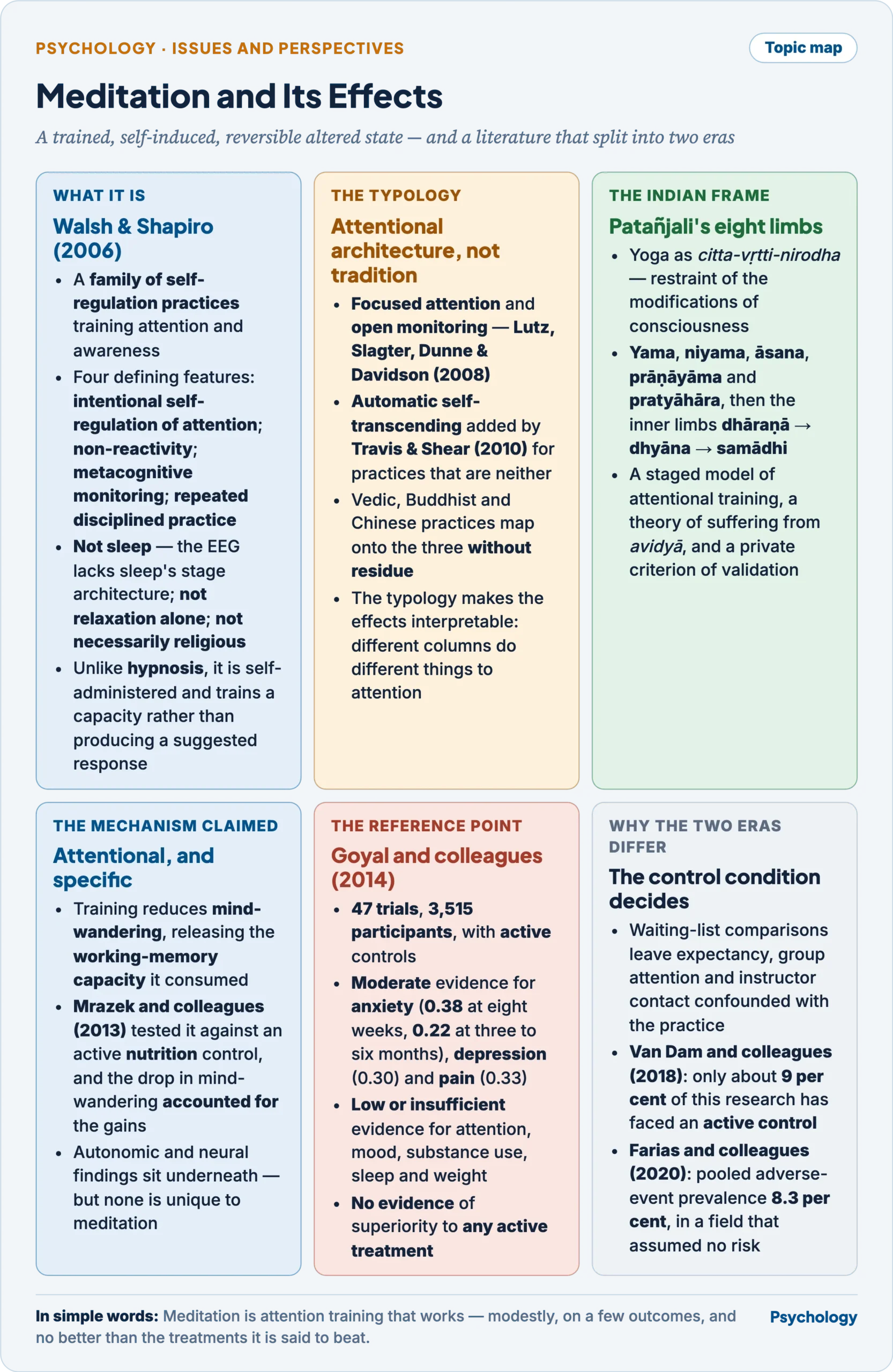
The typology on the left is what makes the effects on the right interpretable: practices in different columns do different things to attention.
The study of consciousness and what meditation is
- Four features recur across every tradition and define the family (Walsh and Shapiro, 2006).
- Intentional self-regulation of attention — a chosen object, whether a mantra, the breath, a visual form, or the stream of experience itself.
- Non-reactivity — a set stance towards whatever arises, typically non-judgemental and non-elaborative.
- Metacognitive monitoring — noticing that attention has wandered, which is a second-order operation on one’s own cognition.
- Repeated, disciplined practice, since the trained capacity is what distinguishes meditation from a passing mood.
- What it is not. It is not sleep, since the electroencephalogram of meditation lacks the stage architecture of sleep; not relaxation alone, since relaxation accompanies some forms and not others; and not necessarily religious, since every technique has been detached from its doctrinal frame and tested secularly.
- The distinction from the hypnotic trance is one of agency and suggestion: hypnosis proceeds through another person’s suggestions acting on a suggestible subject, whereas meditation is self-administered, trains a capacity rather than producing a response, and does not involve suggested alterations of perception or volition. The hypnotic side of the contrast is set out in Hypnotic and Drug-Induced States.
The main types of meditation: a principled classification
A list of named practices is not a typology, because the names come from traditions and the effects come from what the practice does to attention. The classification now standard in the research literature sorts practices by their attentional architecture.
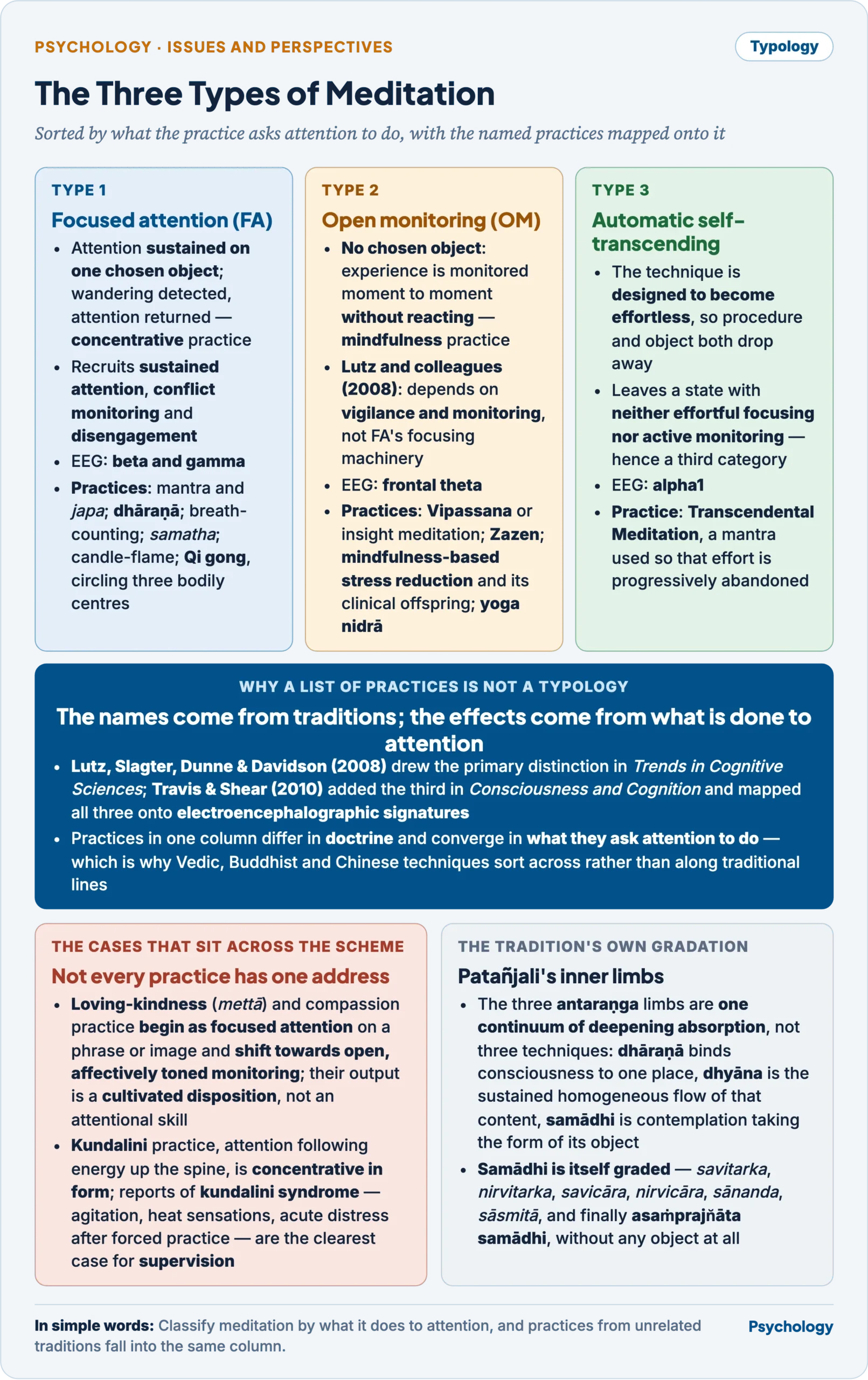
The practices in each column differ in doctrine and converge in what they ask attention to do.
- Lutz, Slagter, Dunne and Davidson (2008) drew the primary distinction in Trends in Cognitive Sciences.
- Focused attention (FA), also called concentrative practice: attention is voluntarily sustained on a single chosen object, wandering is detected, and attention is returned. It recruits sustained attention, conflict monitoring and attentional disengagement.
- Open monitoring (OM), also called mindfulness practice: there is no chosen object, and the practitioner monitors the content of experience from moment to moment without reacting to it. Lutz and colleagues (2008) predicted it would depend more on vigilance and monitoring systems and less on the focusing machinery of FA.
- Travis and Shear (2010) added a third category in Consciousness and Cognition, on the ground that some practices involve neither effortful focusing nor active monitoring.
- Automatic self-transcending: the technique is designed to become effortless, so that the procedure and the object both drop away, leaving a state without focused attention.
- They mapped the three onto electroencephalographic signatures — FA with beta and gamma activity, OM with frontal theta, and automatic self-transcending with alpha1 — and placed Vedic, Buddhist and Chinese practices accordingly.
- The named practices map onto the scheme without residue.
- Focused attention: mantra repetition and japa; dhāraṇā in the yogic sequence; breath-counting; samatha; candle-flame and visual-form practice; Qi gong with its orbit of attention around three bodily centres.
- Open monitoring: Vipassana or insight meditation, which attends non-judgementally to whatever enters awareness; Zazen; mindfulness-based stress reduction and the clinical programmes derived from it; yoga nidrā, a guided rotation of awareness through the body in a state between waking and sleep.
- Automatic self-transcending: Transcendental Meditation, in which a mantra is used so that effort is progressively abandoned.
- Loving-kindness (mettā) and compassion practice sit across the scheme — they begin as focused attention on a phrase or an image and shift towards an open, affectively toned monitoring, and their intended output is a cultivated emotional disposition rather than an attentional skill.
- Kundalini practice, in which attention follows energy upward from the base of the spine, is concentrative in form. Reports of kundalini syndrome — agitation, heat sensations and acute distress following forced practice — are the clearest case for supervision.
Patañjali’s eight limbs and the Indian frame
- In the Indian tradition meditation is not a technique but one stage of a graded discipline. The Yoga Sūtra of Patañjali defines yoga as citta-vṛtti-nirodha — the restraint of the modifications of consciousness — and sets out eight limbs (aṣṭāṅga).
- Yama (restraints) and niyama (observances) are ethical preconditions; āsana (posture, whose criteria are sthira and sukha, steadiness and ease) and prāṇāyāma (breath regulation) prepare the body; pratyāhāra withdraws the senses from their objects.
- The last three are the antaraṅga or inner limbs, and they form a continuum of deepening absorption: dhāraṇā, the binding of consciousness to one place; dhyāna, the sustained homogeneous flow of that content; and samādhi, in which the act of contemplation takes the form of its object and loses itself.
- Samādhi is itself graded rather than single, and the gradation is the tradition’s own phenomenology of altered states — savitarka and nirvitarka, savicāra and nirvicāra, sānanda, sāsmitā, and finally asaṁprajñāta samādhi, which is without any object of cognition at all.
- The metaphysics is Sāṃkhya dualism: puruṣa, the unchanging knower, and prakṛti, the material principle. Their contact yields citta, the psychological apparatus, whose three guṇas — sattva, rajas, tamas — generate the vṛttis that practice restrains.
- The framework’s psychological content is substantial and should be read as theory rather than as devotion: it offers a staged model of attentional training, a theory of suffering grounded in misidentification (avidyā) of the self with its contents, and a criterion of validation — that the states are privately verifiable by anyone who repeats the procedure.
- Patañjali’s own account of what obstructs the practice is a list of afflictions (kleśas) — avidyā, asmitā, rāga, dveṣa and abhiniveśa — that reads as a theory of motivated distortion, and the modern clinical constructs of acceptance and emotional detachment (vairāgya) descend directly from it.
Physiological and electroencephalographic effects
- The two founding studies produced opposite physiological patterns, and the opposition is the first evidence that the typology is real.
- Anand, Chhina and Singh (1961) recorded Indian yogis in samādhi and found persistent alpha rhythm that external stimulation failed to block — the stimulus-insensitive pattern a concentrative, sense-withdrawing practice would predict.
- Kasamatsu and Hirai (1966) recorded Zen priests and found the opposite: alpha blocking did occur in response to repeated click stimuli, and it did not habituate, where controls habituated quickly. Sustained non-selective responsiveness to each recurrence is what open monitoring is for.
- Wallace (1970), in Science, reported reduced oxygen consumption, reduced heart rate, increased skin resistance and increased alpha activity during Transcendental Meditation. Wallace, Benson and Wilson (1971) named the pattern a wakeful hypometabolic state — low metabolic rate with an alert, non-sleeping cortex.
- Benson (1975) generalised these autonomic changes as the relaxation response, an integrated reduction in sympathetic arousal elicitable by several techniques and not specific to any one tradition. That generality is a finding, not a flaw, but it removes the basis for claims about any single method’s uniqueness.
- Lutz, Greischar, Rawlings, Ricard and Davidson (2004), in PNAS, reported high-amplitude gamma-band synchrony during compassion meditation in long-term Buddhist practitioners, far larger than in novices, and present to a degree at rest.
- Structural and network findings followed. Lazar and colleagues (2005) reported greater cortical thickness in prefrontal and right anterior insular regions in experienced insight meditators; Hölzel and colleagues (2011) reported regional grey-matter changes after an eight-week mindfulness programme against a waiting-list control — increases in the left hippocampus, posterior cingulate, temporo-parietal junction and cerebellum, while the insula, which they had predicted in advance, showed no change — so the second study is in part a failure to replicate the first, since the insula is exactly where Lazar’s thickness difference sat, and the cross-sectional and longitudinal designs disagree on it; Brewer and colleagues (2011) reported reduced activity and altered connectivity in the default mode network — posterior cingulate and medial prefrontal cortex — in experienced meditators, the network whose activity accompanies mind-wandering and self-referential thought.
- All three carry the same caveat: small samples, and in the first and third a cross-sectional design in which self-selection of long-term practitioners cannot be excluded as the cause of the difference.
Effects on cognitive functioning
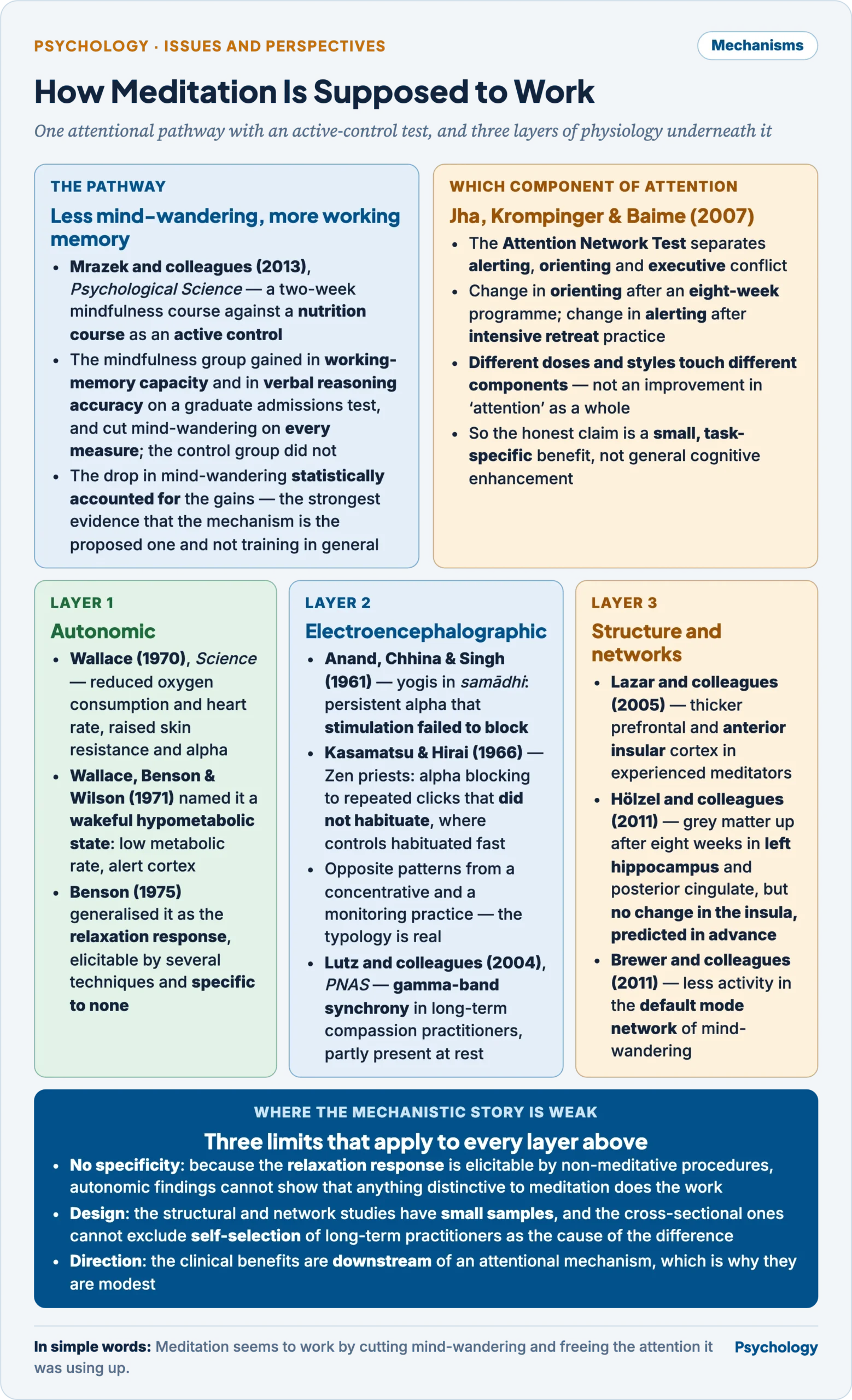
The mechanisms are attentional and regulatory; the clinical benefits are downstream of them, which is why they are modest.
- The proposed mechanism is attentional, and it is specific. Mindfulness training reduces mind-wandering, which releases working-memory capacity that mind-wandering had been consuming, which in turn improves performance on any task that loads on that capacity.
- Mrazek, Franklin, Phillips, Baird and Schooler (2013), in Psychological Science, ran the cleanest demonstration: a two-week mindfulness course against a nutrition course as an active control.
- The mindfulness group improved in working-memory capacity and in accuracy on the verbal reasoning section of a graduate admissions test, and reduced mind-wandering on every measure used; the control group did not.
- The reduction in mind-wandering statistically accounted for the gains, which is the strongest available evidence that the mechanism is the one proposed rather than a general effect of training or attention from an instructor.
- Jha, Krompinger and Baime (2007) used the Attention Network Test to separate attentional subsystems and found training-related change in orienting after an eight-week mindfulness programme and in alerting after intensive retreat practice — evidence that different doses and styles of practice touch different components rather than improving “attention” as a whole.
- Against this, the cautionary finding has to be stated with equal weight. Goyal and colleagues (2014) found low evidence of no effect, or insufficient evidence of any effect, of meditation programmes on attention — along with positive mood, substance use, eating habits, sleep and weight.
- The disagreement is explicable rather than mysterious. A single controlled laboratory study can detect a real, small effect on one attentional measure, while a review demanding clinical populations and active controls grades the pooled evidence as too thin. The defensible claim is a small and task-specific cognitive benefit, not a general enhancement of cognition.
Effects on health and psychological well-being
- Goyal and colleagues (2014), in a review of randomised trials with active controls, is the reference point for every claim in this area. They screened 18,753 citations and included 47 trials with 3,515 participants.
- Moderate evidence that mindfulness programmes improve anxiety (effect size 0.38 at eight weeks, falling to 0.22 at three to six months), depression (0.30, falling to 0.23) and pain (0.33).
- Low evidence of improvement in stress or distress and in mental-health-related quality of life.
- No evidence that meditation programmes were better than any active treatment — drugs, exercise, or other behavioural therapies.
- For mantra programmes, including Transcendental Meditation, Goyal and colleagues (2014) graded the evidence as showing no effect or as insufficient on every outcome examined, chiefly because very few such trials met the inclusion criteria.
- The effect sizes are small to moderate, and they decay with time since training, which is the honest summary of the clinical literature.
- Clinical programmes built on open monitoring are nonetheless established interventions. Mindfulness-based stress reduction, developed by Jon Kabat-Zinn (1979) as an eight-week group programme combining sitting meditation, body scanning and gentle yoga, is the parent form.
- Mindfulness-based cognitive therapy was developed by Segal, Williams and Teasdale (2002) for the prevention of depressive relapse, drawing on the interacting cognitive subsystems model of Barnard and Teasdale (1991); its target is metacognitive awareness — relating to a depressive thought as a mental event rather than as a fact.
- Acceptance and commitment therapy (Hayes, Strosahl and Wilson, 1999) uses mindfulness and acceptance to increase psychological flexibility; its own meta-analysts find it effective but not demonstrably superior to established treatments (Powers and colleagues, 2009).
Criticisms and evaluation
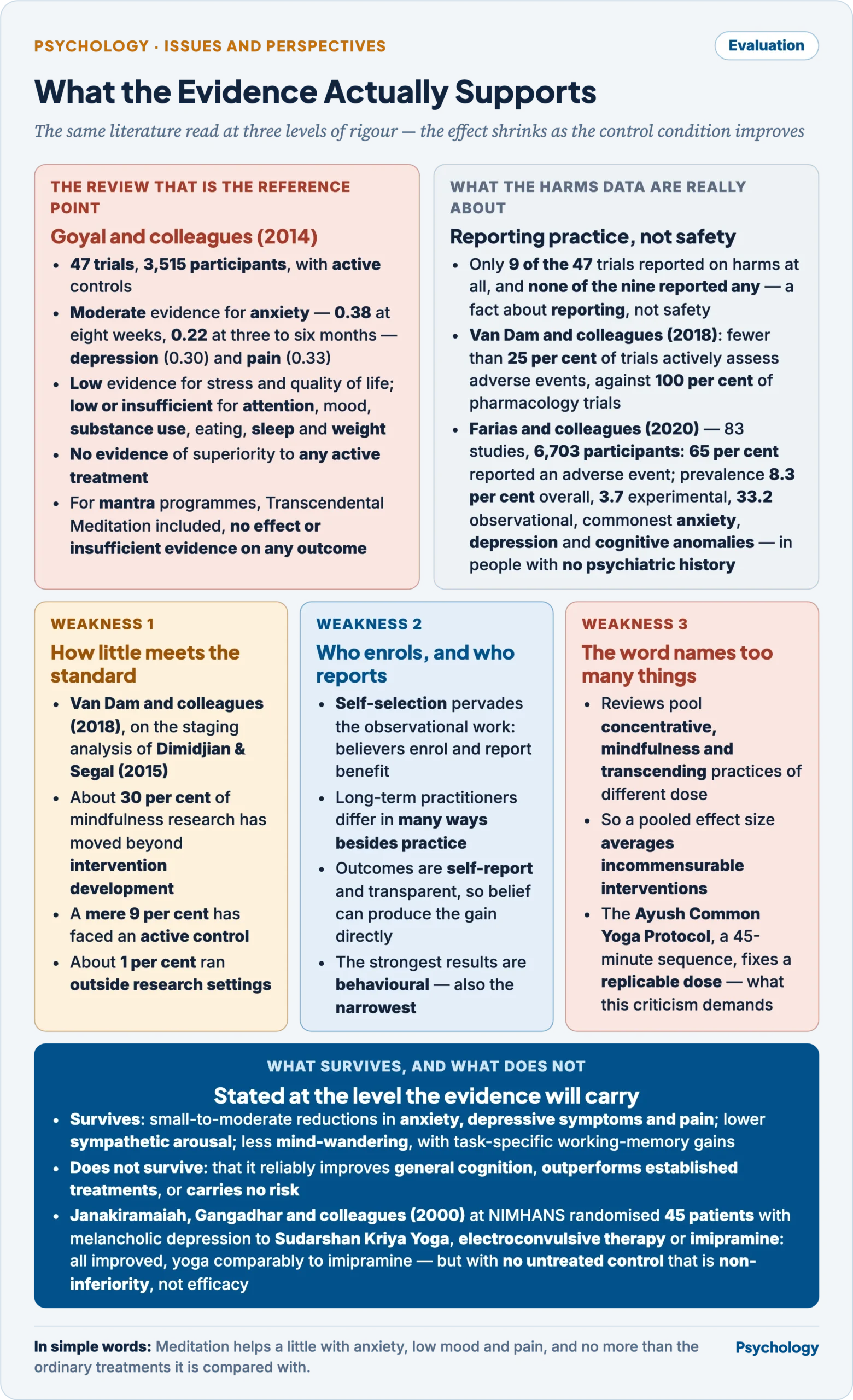
The same literature read at three levels of methodological rigour: the effect shrinks as the control condition improves.
- The control condition decides the result. Waiting-list and treatment-as-usual comparisons leave expectancy, group attention, instructor contact and demand characteristics confounded with the practice. Against active controls the effects shrink to small or vanish (Goyal and colleagues, 2014).
- Van Dam and colleagues (2018), in Perspectives on Psychological Science, quantified how little of the literature meets that standard: citing the staging analysis of Dimidjian and Segal (2015), only about 30 per cent of mindfulness-intervention research has moved beyond intervention development at all, a mere 9 per cent of the total has been tested against an active control, and about 1 per cent has been conducted outside research settings.
- Self-selection pervades the observational and cross-sectional work. People who believe in meditation enrol in meditation studies and report benefit, and long-term practitioners differ from non-practitioners in many ways besides practice.
- Adverse effects are systematically under-recorded, and the field long treated meditation as risk-free by default.
- Van Dam and colleagues (2018) report that fewer than 25 per cent of meditation trials actively assess adverse events, against 100 per cent of pharmacology trials, and that reliance on spontaneous reporting can underestimate their frequency by more than twentyfold.
- Goyal and colleagues (2014) found only 9 of their 47 trials reported on harms at all, and none of those nine reported any — a result about reporting practice rather than about safety.
- Farias, Maraldi, Wallenkampf and Lucchetti (2020), reviewing 83 studies with 6,703 participants, found that 55 of the 83, or 65 per cent, reported at least one adverse event. Pooled prevalence was 8.3 per cent, but it was 3.7 per cent in experimental studies and 33.2 per cent in observational ones. The commonest events were anxiety (33 per cent of reports), depression (27 per cent) and cognitive anomalies (25 per cent), and they occurred in people with no prior psychiatric history.
- Clinical caution follows for specific groups: acute psychosis, severe depression with rumination, dissociative conditions, and intensive retreat practice without supervision.
- “Meditation” names too many things to support a general claim. Reviews pool concentrative, mindfulness and transcending practices with different durations, doses, instructors and ideological framings, so a pooled effect size is an average over incommensurable interventions.
- Mechanistic specificity is weak. Because the relaxation response (Benson, 1975) is elicitable by several non-meditative procedures, autonomic findings cannot establish that anything distinctive to meditation is doing the work.
- Outcome measures are self-report and transparent to the participant, so belief in the practice can produce the reported improvement directly. The strongest results are those measured behaviourally rather than by self-report, as in Mrazek and colleagues (2013) — and those are also the narrowest.
- What survives is worth having. Small-to-moderate reductions in anxiety, depressive symptoms and pain; reliable reductions in sympathetic arousal; reduced mind-wandering with task-specific working-memory gains; and measurable changes in attention-related and default-mode networks. What does not survive is the claim that meditation reliably improves general cognition, outperforms established treatments (Goyal and colleagues, 2014), or carries no risk (Farias and colleagues, 2020).
- The place of these findings within the wider revival of consciousness as a scientific object — the measurement problem, the levels and states framework, and the first-person methods meditation research helped rehabilitate — is treated in Consciousness: Nature, Levels and Altered States.
Indian context
- International Day of Yoga was proclaimed for 21 June by United Nations General Assembly resolution 69/131, adopted on 11 December 2014 and co-sponsored by 175 member states on a proposal from India.
- The Ministry of Ayush (Government of India) issues the Common Yoga Protocol, a standardised 45-minute sequence of āsana, prāṇāyāma and meditation used for mass observance. Its psychological significance is that it fixes a replicable dose and sequence, which is precisely what the heterogeneity criticism above demands of research protocols.
- Indian clinical research has produced the field’s boldest comparative trial. Janakiramaiah, Gangadhar and colleagues (2000), at the National Institute of Mental Health and Neurosciences, randomised 45 hospitalised patients with melancholic depression to Sudarshan Kriya Yoga, electroconvulsive therapy, or imipramine over four weeks.
- All three groups improved substantially on the Beck Depression Inventory and the Hamilton scale, with the yogic breathing group performing comparably to imipramine.
- The limitation is structural and was accepted for ethical reasons. There was no untreated control group (Janakiramaiah and colleagues, 2000), and the sample was small, so the trial establishes non-inferiority within a treated sample rather than efficacy against no treatment.
Previous Year Questions
- 2025“Meditation alters consciousness.” Discuss this by explaining meditation and consciousness along with relevant research examples.
- 2021Describe different types of Meditation and its effect on health and well-being.
- 2014What are the main types of meditation? Describe their effects on cognitive functioning.
- 2011Elaborate upon the salient developments in consciousness studies and indicate the effect of ‘meditation’ on psychological functions.
- 2006Examine the notion of meditation. What are its cognitive implications? Explain.
- 1997What is the difference in the altered state of consciousness through meditation and hypnotic trance?