

Study of consciousness – stimulus deprivation.
Official Syllabus: Paper I · Unit 14 Issues and Perspectives in Modern Contemporary Psychology
“Sensory deprivation is a marked reduction in the absolute level of sensory input; perceptual deprivation is a reduction in its variety and patterning while the level of input is maintained.”
— after Zubek (1969)
Normal waking consciousness is sustained by a continuous inflow of varied stimulation, and the experiments reviewed here were designed to find out what happens when that inflow is cut. The answer turned out to be more modest and more conditional than the first reports were read as saying, and the correction is itself the main lesson: the same reduction of input can be distressing, trivial or therapeutic depending on what exactly is reduced, for how long, and what the person has been led to expect.
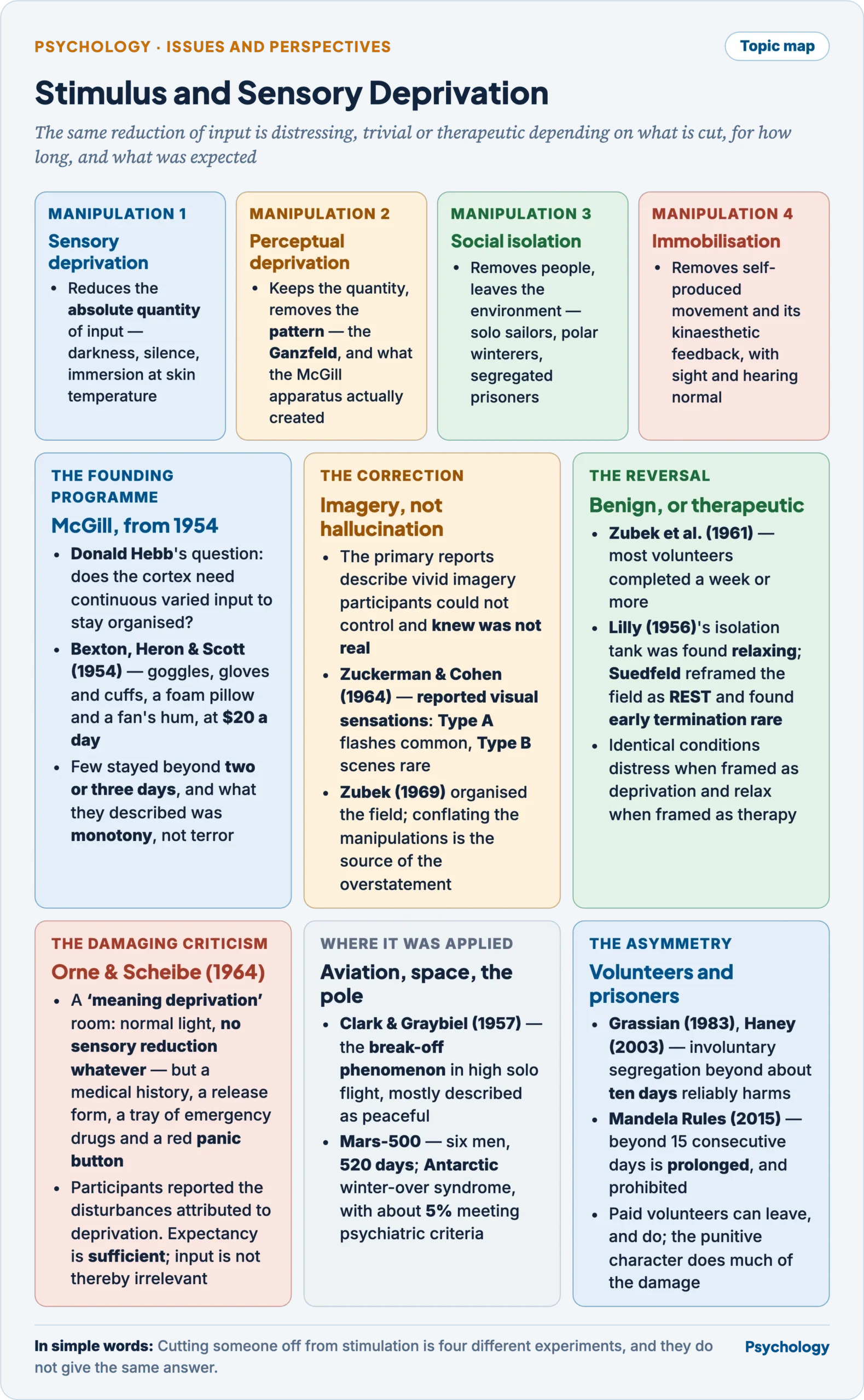
The three manipulations in the top row are routinely run together under one name, and they do not produce the same effects.
Three manipulations that are not the same thing
- Sensory deprivation reduces the absolute quantity of input — darkness, silence, water immersion at skin temperature. The receptors are given almost nothing to register.
- Perceptual deprivation keeps the quantity but removes the pattern, substituting unstructured input: translucent goggles passing diffuse light, continuous white noise or a fan’s hum. The receptors fire; nothing in the firing carries information.
- The Ganzfeld — a homogeneous, unstructured visual field — is the pure case, and it is the condition the McGill apparatus actually created. The programme’s own later papers used the term perceptual isolation, not sensory deprivation.
- Social isolation removes other people while leaving the physical environment intact. Solo sailors, polar winterers and prisoners in segregation are in this condition, and it has a different symptom profile dominated by mood and interpersonal effects.
- Immobilisation removes self-produced movement and the kinaesthetic feedback it generates, while sight and hearing stay normal.
- These are often combined in practice, which is why single-cause explanations of the results fail. Zubek (1969) organised the field around exactly this set of distinctions, and the conflation of them in popular accounts is the source of most overstatement about the topic.
The McGill programme
- The experiments were run at McGill University under Donald Hebb, whose theoretical interest was whether the cortex requires continuous varied input to maintain organised function. The programme was funded by Canadian defence research in the early Cold War, when confessions extracted by isolation were a live policy concern.
- Bexton, Heron and Scott (1954) reported the founding study, “Effects of decreased variation in the sensory environment”.
- Male college students lay on a bed in a lighted, sound-damped cubicle and were asked to stay as long as they could, leaving only to eat and use the toilet.
- Translucent plastic goggles admitted diffuse light but no shapes; cotton gloves and cardboard cuffs extending past the fingertips removed patterned touch; a U-shaped foam pillow and the hum of an air conditioner masked sound.
- Pay was $20 a day — several times a student’s alternative earnings at the time, and the detail matters, because it is the measure against which tolerance should be judged.
- How long participants lasted is the finding most often dropped. Despite the pay, few volunteers would stay beyond two or three days, and many quit earlier. Monotony, not terror, is what they described.
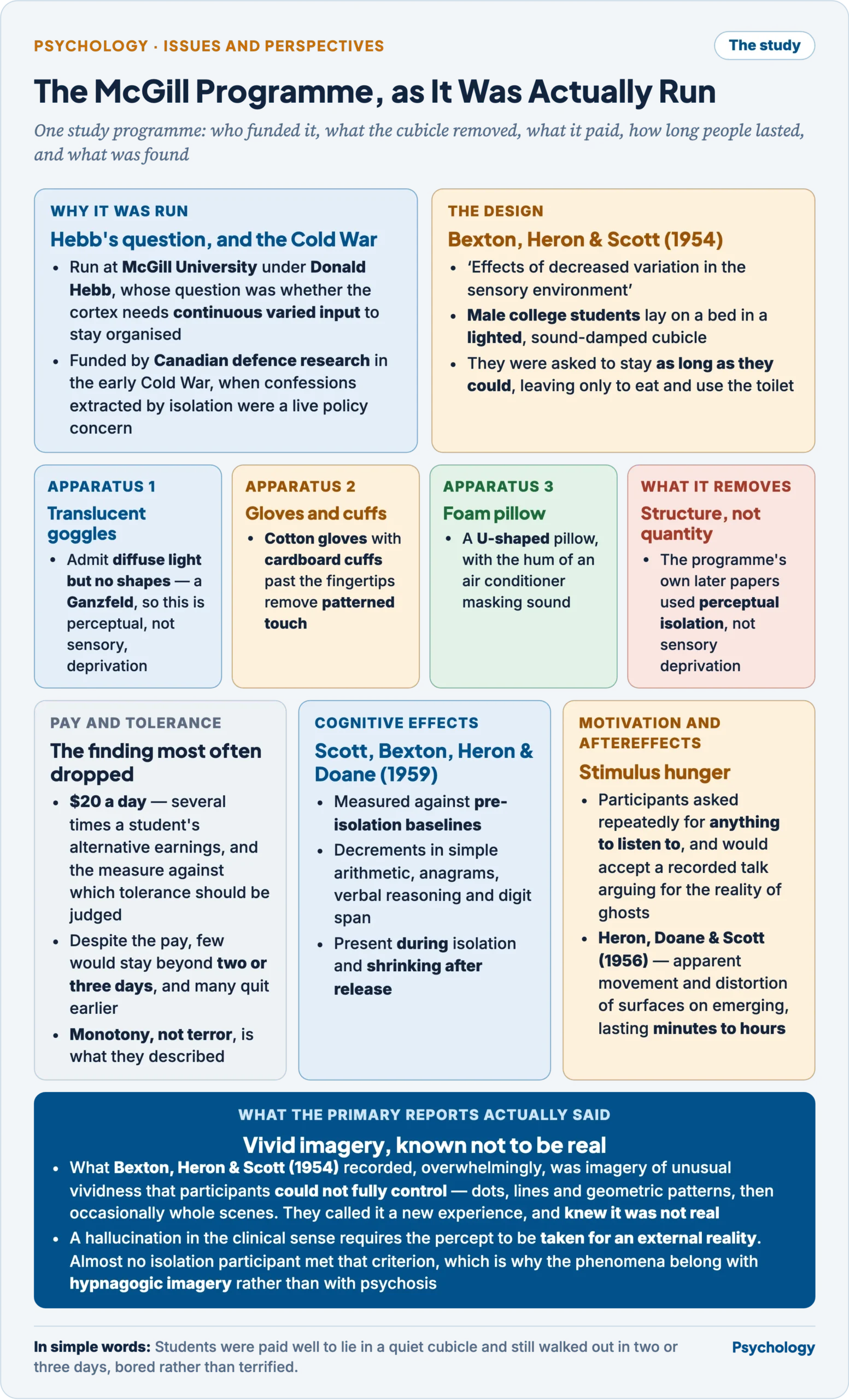
Only the goggles are unusual. What the apparatus removes is the structure of stimulation, not its quantity.
- Cognitive effects were measured against pre-isolation baselines. Scott, Bexton, Heron and Doane (1959) reported decrements across a range of tasks — simple arithmetic, anagrams, verbal reasoning and digit span — that were present during isolation and shrank after release.
- Motivational effects were as striking as the cognitive ones. Participants showed stimulus hunger: they asked repeatedly for anything to listen to, and would accept a recorded talk arguing for the reality of ghosts, which Bexton, Heron and Scott (1954) had expected them to find tedious.
- Heron, Doane and Scott (1956) reported perceptual aftereffects in the paper titled “Visual disturbances after prolonged perceptual isolation” — apparent movement and distortion of surfaces and lines on emerging, lasting minutes to hours.
What the primary reports actually said about hallucinations
- The best-known claim about this literature is that isolation produces hallucinations. The primary reports — Bexton, Heron and Scott (1954) and Heron, Doane and Scott (1956) — describe the phenomena far more cautiously than secondary accounts do, and the correction is substantive rather than pedantic.
- What Bexton, Heron and Scott (1954) recorded, overwhelmingly, was imagery of unusual vividness that participants could not fully control — dots, lines and geometric patterns, then occasionally whole scenes. Participants described it as a new experience, and knew it was not real.
- Zuckerman and Cohen (1964) reviewed the whole set of studies and proposed the neutral term reported visual sensations precisely because “hallucination” imports a claim the data do not support.
- They separated Type A reports — simple, meaningless flashes, dots and forms — from Type B reports, which are meaningful, integrated scenes. Type A is common; Type B is far rarer.
- A hallucination in the clinical sense requires that the percept be taken for an external reality. Almost no isolation participant met that criterion, which is why the phenomena are better classed with hypnagogic imagery than with psychosis.
- The nearest modern evidence supports the weaker reading. Merabet and colleagues (2004) blindfolded thirteen sighted adults for five consecutive days; ten of the thirteen reported visual hallucinations, mostly beginning after the first day and ceasing when the blindfold came off.
- This is visual deprivation, not whole-body deprivation, and the mechanism it suggests is deafferentation — a cortex deprived of input generating its own activity, as in the Charles Bonnet syndrome of the visually impaired — rather than a breakdown of the mind.
Zubek’s programme and the collapse of the dramatic picture
- John Zubek, at the University of Manitoba from 1959, ran the largest and best-controlled replication effort, and his results repeatedly undercut the severity of the original picture.
- Tolerance was far higher than McGill’s. In his darkened, sound-proofed chamber, Zubek, Pushkar, Sansom and Gowing (1961) kept volunteers for up to a week and beyond; most completed the full period, and the drop-outs clustered in the first days.
- Immobilisation alone produced comparable deficits. Zubek and colleagues (1963) confined volunteers for a week with normal and varied sight and hearing but with movement severely restricted, and found intellectual and perceptual impairments similar in kind to those following visual and auditory deprivation.
- The implication is awkward for the standard account: if removing movement does what removing sensation does, the critical variable is not the quantity of sensory input but the absence of variation and of self-produced change.
- Zubek and Welch (1963) reported a progressive slowing of the EEG across prolonged deprivation, with recovery after release — the clearest physiological marker the field produced, and consistent with a reduction in cortical arousal rather than with a psychotic process.
- The programme ended badly and the ending is part of the topic. Zubek’s work was cited during a 1971 inquiry into interrogation practices in Northern Ireland, his funding lapsed in 1974, and the association between isolation research and coercive interrogation has shaped the field’s reputation since.
Reduced stimulation as benign or therapeutic
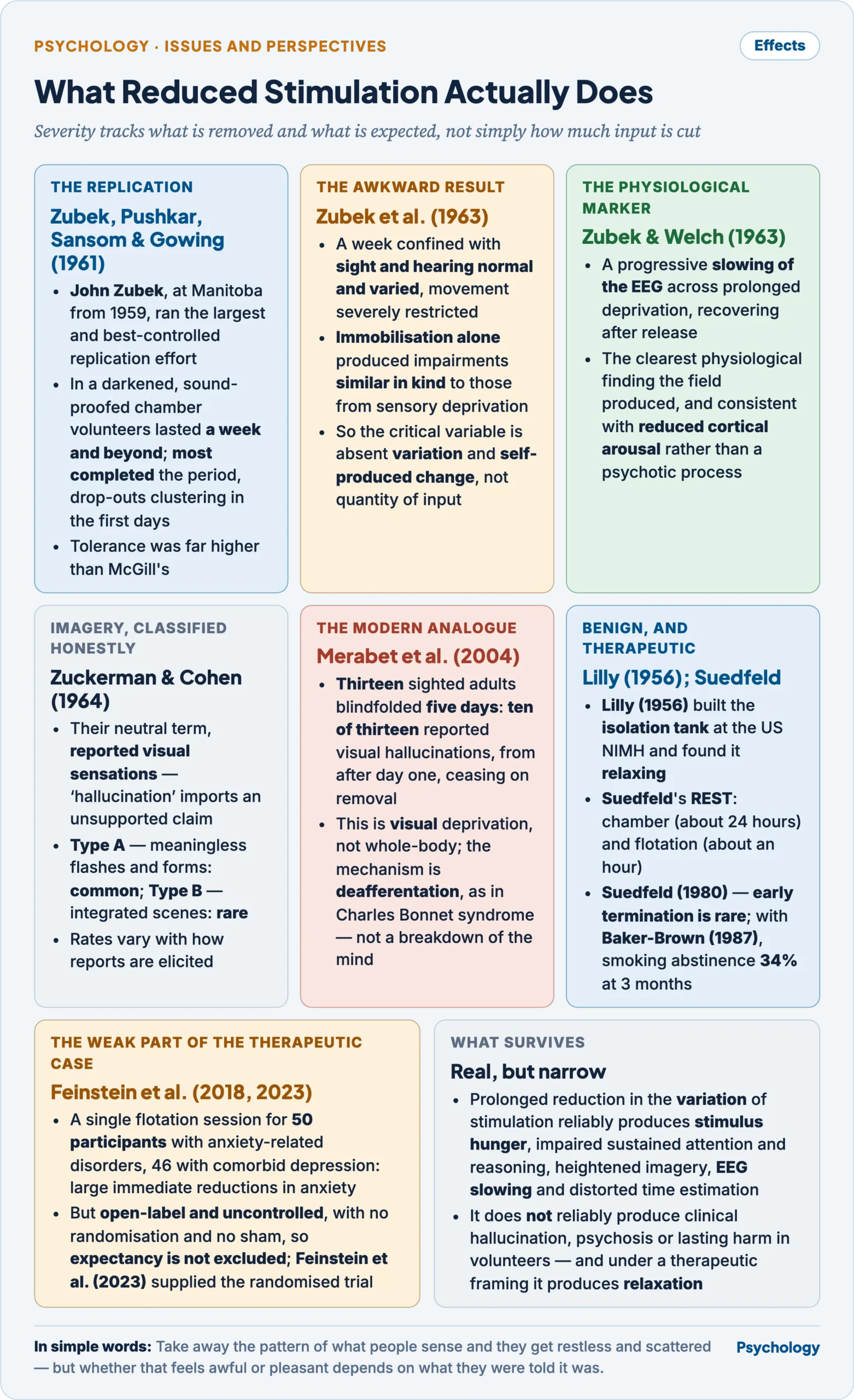
Severity tracks what is removed and what is expected, not simply how much input is cut.
- John Lilly (1956), at the United States National Institute of Mental Health, built the isolation tank — suspension in water at skin temperature, in darkness and silence, with breathing apparatus. He and his colleagues found the experience relaxing rather than distressing, which was not what the McGill results had predicted.
- Peter Suedfeld reframed the whole field from the 1960s as REST — Restricted Environmental Stimulation Therapy, distinguishing chamber REST (a dark, quiet room, typically 24 hours) from flotation REST (shallow Epsom-salt solution, typically an hour).
- Reviewing the accumulated chamber studies, Suedfeld (1980) reported that early termination is rare — a direct contradiction of the two-or-three-day tolerance ceiling at McGill, and attributable to the different framing, briefing and apparatus rather than to a different reduction of input.
- Suedfeld and Baker-Brown (1987) reported chamber REST as an aid to smoking cessation, with abstinence of 34 per cent at three months and 21 per cent at twelve months in their series.
- Flotation REST has a growing but weak evidence base. Feinstein and colleagues (2018) gave a single flotation session to 50 participants with anxiety-related disorders, forty-six of them with comorbid depression, and recorded large immediate reductions in anxiety and improvements in mood.
- The limitation is severe and must travel with the finding: it was open-label and uncontrolled, with no randomisation and no sham condition, so expectancy is not excluded. Feinstein and colleagues (2023) followed it with a randomised safety and feasibility trial, which is the design the earlier result needed.
- The reversal is the point worth carrying. Identical physical conditions produce distress when framed as deprivation and relaxation when framed as therapy, which locates much of the original effect outside the sensory manipulation altogether.
Stimulus deprivation in aviation and space flight
- High-altitude solo flight is a naturally occurring low-stimulation environment. Clark and Graybiel (1957) interviewed naval aviators about the break-off phenomenon — a sense of physical detachment from the earth, of being isolated from it rather than flying over it.
- The three conditions Clark and Graybiel (1957) associated with it are high altitude, flying alone, and having little to do — that is, low stimulus variation plus social isolation plus underload. Most pilots who reported it described the feeling as peaceful; a minority found it frightening. Flight experience did not predict it.
- Space flight compounds every variable at once: confinement, monotony, social isolation from everyone but a few crewmates, disrupted light-dark cycles, microgravity and irreversible commitment. Ground analogues supply the experimental evidence, since the flights themselves cannot be randomised.
- Mars-500, run at the Institute of Biomedical Problems in Moscow, sealed six men in a mock interplanetary vehicle for 520 days in 2010–2011. Basner and colleagues (2013), reporting in PNAS, used wrist actigraphy and weekly neurobehavioural testing.
- The result was protracted crew hypokinesis — sedentariness rising across the mission — with sleep lengthening from about 7.12 hours daily in the first quarter to about 7.71 hours in the last, and sleep timing altered (Basner and colleagues, 2013).
- Four of the six crew showed disturbances of sleep timing, sleep quality or vigilance; two showed none at all, and crew conflict was low. The individual differences were larger than the group effect.
- A companion Mars-500 analysis (Basner and colleagues, 2014) reported a stage-like pattern of adaptation resembling the third-quarter phenomenon — a dip in morale after the mission’s midpoint, independent of how much remains.
- Antarctic overwintering is the longest-running analogue. Palinkas and Suedfeld (2008), reviewing the polar literature in The Lancet, described three overlapping syndromes: winter-over syndrome (depressed mood, irritability, insomnia and cognitive impairment, worsening after the midpoint), polar T3 syndrome (a thyroid-linked cyclical mood change), and subsyndromal seasonal affective disorder.
- Their prevalence figure is the corrective one: about 5 per cent of expedition members meet diagnostic criteria for a psychiatric disorder, and the common reactions rarely reach a level requiring clinical intervention (Palinkas and Suedfeld, 2008).
- Kanas and colleagues studied crew-ground relations in two successive programmes — first across Shuttle/Mir (2001), then aboard the International Space Station (2007) — using mood and group-climate questionnaires alongside critical-incident logs.
- Both found consistent displacement of tension and negative emotion from crew onto mission control, and from mission control onto management, interpreted as misdirection of in-group tension that cannot be expressed in a tiny group.
- Neither found the predicted decline in well-being in the second half of a mission, which is the result that most contradicts the expectation the literature began with.
- Perceived support from the commander declined in the second half of missions, and — the finding most often omitted — both crew and ground scored better than comparable work groups on Earth on mood and cohesion measures.
- Further analogue habitats, including the Hawaii Space Exploration Analog and Simulation (HI-SEAS) missions of four, eight and twelve months, extend the same paradigm; the published behavioural findings from this generation of studies remain small-sample and are better treated as hypothesis-generating than as established.
- The sleep half of the aviation and space-flight problem — circadian desynchrony, shortened sleep and the vigilance cost of both — belongs with the sleep literature and is set out in Sleep Deprivation and Sleep Disorders.
Criticisms and evaluation
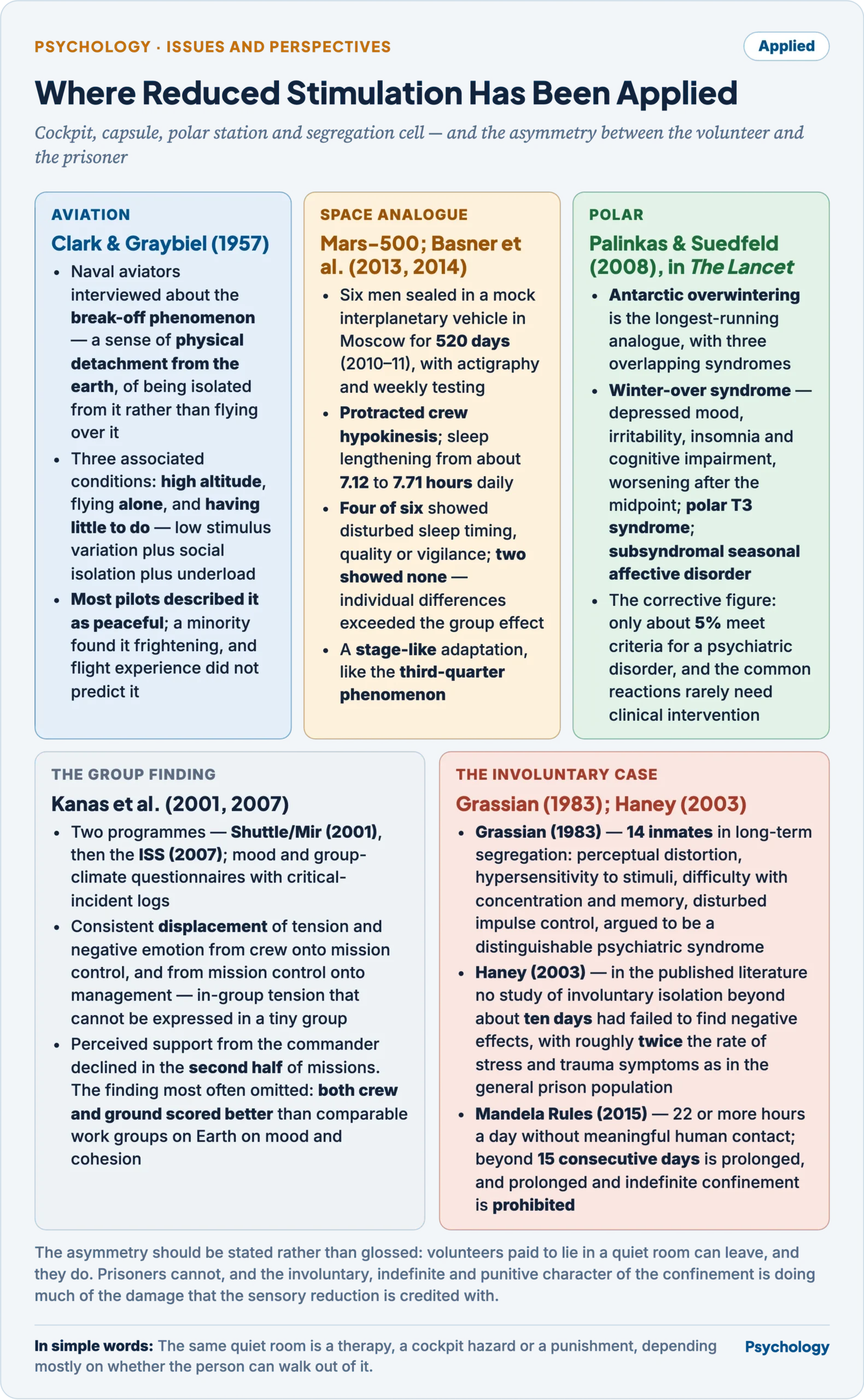
Where the same reduction of stimulation has been applied: the valence of the outcome follows the framing, not the physics.
- Demand characteristics explain a large share of the classic findings, and this is the most damaging criticism available. Orne and Scheibe (1964) constructed a “meaning deprivation” condition: a comfortable, normally lit room with no sensory reduction whatever, but with the full apparatus of a deprivation experiment — a medical history, a release form, a tray of emergency drugs and a red panic button the participant could press to escape.
- In that condition participants reported many of the perceptual and cognitive disturbances that had been attributed to deprivation itself, and the effects diminished when the ominous equipment was taken away (Orne and Scheibe, 1964).
- The authors were careful about the inference, since the room could not be construed as a deprivation environment: the study (Orne and Scheibe, 1964) establishes that expectancy is sufficient, not that sensory reduction is irrelevant.
- Terminology was never stabilised, and the resulting confusion is not merely verbal. “Sensory deprivation” has been used for perceptual deprivation, social isolation and immobilisation, and because these have different effects, pooled reviews of the literature compare incommensurable conditions.
- The criterion for a hallucination was loose. Zuckerman and Cohen (1964) showed that reported rates depend heavily on how the response is classified and elicited, so prevalence figures from this era are not comparable across studies.
- Samples were small, self-selected and almost entirely young male students, and payment selected for people willing to endure boredom for money. Generalisation to coerced isolation, to older adults or to clinical populations is unwarranted.
- No baseline existed on the dependent variable that mattered. Participants who had never attended to their own closed-eye imagery before had nothing against which to judge its vividness, so the central phenomenological finding has no comparison condition.
- Individual differences dominate. In every programme, from McGill to Mars-500, the variance between participants exceeded the mean effect, and the field never produced a reliable predictor of who would do badly.
- Ethically the research is now closed in its original form. Non-consensual isolation cannot be studied, and existing work has been used to justify practices its authors did not intend.
- Grassian (1983) described a cluster of symptoms in 14 inmates in long-term segregation — perceptual distortion, hypersensitivity to stimuli, difficulty with concentration and memory, and disturbances of impulse control — and argued it constitutes a distinguishable psychiatric syndrome.
- Haney (2003) reported that in the published literature no study of involuntary isolation beyond about ten days had failed to find negative psychological effects, and found roughly twice the rate of stress and trauma symptoms in long-term segregation units as in the general prison population.
- The United Nations Standard Minimum Rules for the Treatment of Prisoners, the Mandela Rules (2015), define solitary confinement as 22 or more hours a day without meaningful human contact, treat confinement beyond 15 consecutive days as prolonged, and prohibit prolonged and indefinite solitary confinement outright.
- The asymmetry with the laboratory work is instructive and should be stated: volunteers paid to lie in a quiet room can leave, and they do; prisoners cannot, and the involuntary, indefinite and punitive character of the confinement is doing much of the damage that the sensory reduction is credited with.
- What survives is real but narrow. Prolonged reduction in the variation of stimulation reliably produces stimulus hunger, impaired sustained attention and complex reasoning, heightened and less controllable imagery, slowing of the EEG, and distorted time estimation. It does not reliably produce hallucination in the clinical sense, psychosis, or lasting harm in volunteers — and under a therapeutic framing it produces relaxation instead.
Previous Year Questions
- 2019Discuss the effects of stimulus-deprivation on human behaviour with empirical evidences.
- 1998Specify the human problems associated with space flight. Give experimental evidences.
- 1997How does sleep and sensory deprivation affect behaviour of individuals who go for aviation and space flights?
- 1995Sensory deprivation and its effects on behaviour.