

Study of consciousness – hypnotic/drug induced states.
Official Syllabus: Paper I · Unit 14 Issues and Perspectives in Modern Contemporary Psychology
Hypnosis is a social interaction in which one person, the subject, responds to suggestions offered by another, the hypnotist, for experiences involving alterations in perception, memory and voluntary action.
— the standard formulation, after Kihlstrom (2008)
Both states here are induced — produced on purpose, by an identifiable procedure, and reversible — rather than arising spontaneously as dreaming does. They differ in everything else: one works through meaning, expectancy and another person’s words, the other through molecules occupying receptors. Both have been used to argue that ordinary consciousness is a construction, and in both cases the strong form of that argument outruns the evidence.
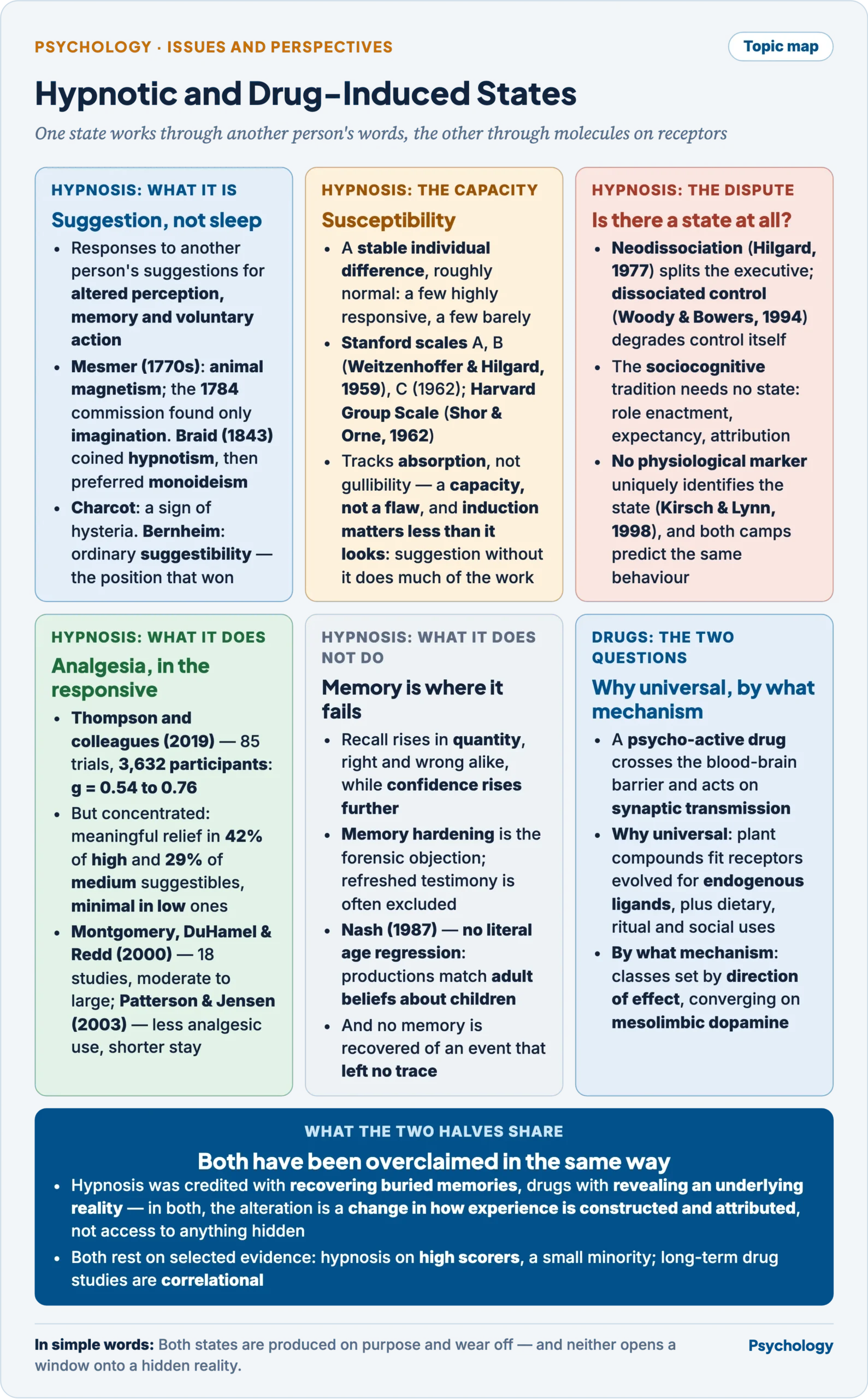
The left branch is contested as to whether a special state exists at all; the right branch is not, and its argument is about mechanism.
The study of hypnotic states: induction and the historical dispute
- Franz Anton Mesmer (1770s) attributed the phenomena to a physical fluid, animal magnetism; a French royal commission (1784) found no such fluid and traced the effects to imagination — the first demonstration that the active ingredient was psychological.
- James Braid (1843) coined hypnotism from the Greek for sleep, then saw the analogy was wrong and proposed monoideism — a single dominant idea — instead; the misleading name outlived him.
- Two nineteenth-century positions set the terms of the modern debate: Jean-Martin Charcot treated hypnotic responding as a pathological sign of hysterical constitution, while Hippolyte Bernheim of the Nancy school treated it as ordinary suggestibility in normal people — the position the evidence has since favoured.
- A standard induction combines a focusing instruction, suggestions for relaxation and absorption, then test suggestions — arm levitation, hand lowering, inability to unclasp the hands, a suggested anosmia or analgesia.
- Induction matters less than it looks: suggestions given without any induction produce much of the same responding in the same people, which points to suggestibility rather than to any state the induction creates.
Hypnotic susceptibility and its measurement
- Responsiveness is a stable individual difference, roughly normally distributed: a small minority are highly responsive, a similar minority barely respond, and most fall between.
- The standard instruments are behavioural, scoring observable responses to a fixed series of suggestions: the Stanford Hypnotic Susceptibility Scale, Forms A and B (Weitzenhoffer and Hilgard, 1959) and the harder Form C (1962), administered individually, and the Harvard Group Scale of Hypnotic Susceptibility (Shor and Orne, 1962) for group administration and self-scoring.
- Scores correlate with absorption and imaginative involvement, and only weakly with gullibility, compliance or general personality — which is why hypnotisability is treated as a capacity, not a character flaw.
Dissociated experience and dissociated control
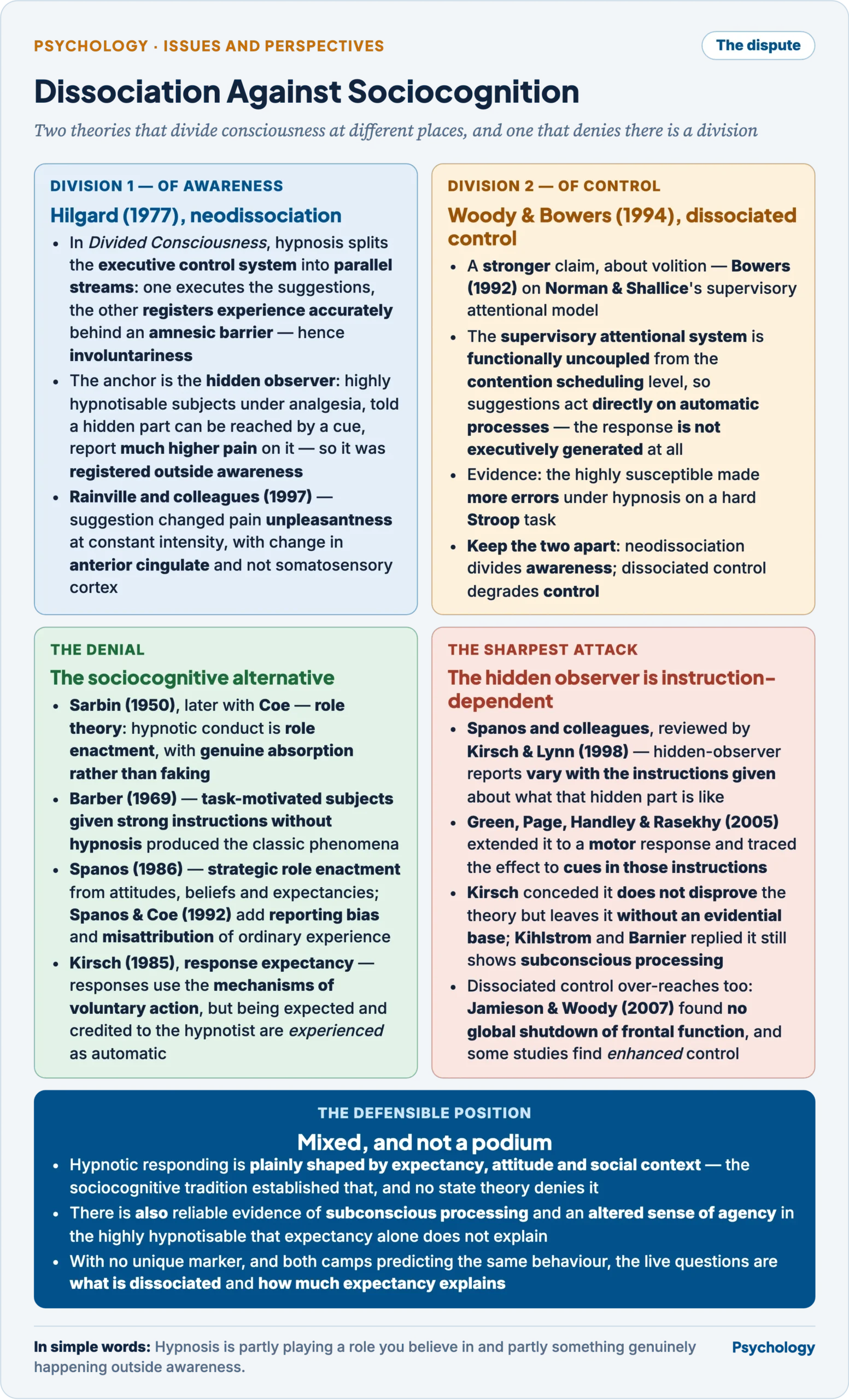
The two dissociation theories divide consciousness at different places, and the sociocognitive account denies the division.
Hilgard’s neodissociation theory and the hidden observer
- Ernest Hilgard (1977), in Divided Consciousness, proposed neodissociation theory: hypnosis splits the normally unified executive control system into parallel streams.
- One stream carries out the hypnotist’s suggestions; the other continues to register experience accurately but is cut off from awareness by an amnesic barrier.
- The subject therefore undergoes the suggested effect — the arm rises, the pain goes — without access to how it was produced, which is why hypnotic responses feel involuntary.
- The empirical anchor is the hidden observer. Highly hypnotisable subjects given suggestions for analgesia, and told that a hidden part of them can be contacted by a prearranged cue, will on that cue report substantially higher pain than they reported while hypnotised (Hilgard, 1977, 1986, 1994).
- The inference is that the pain was registered and stored all along, outside awareness, which is exactly “dissociated experience”.
- Dissociated control is a separate and stronger claim about volition. Woody and Bowers (1994), developing Bowers (1992), applied the supervisory-attentional-system model of Norman and Shallice.
- In highly hypnotisable people the supervisory attentional system becomes functionally uncoupled from the contention scheduling level that selects among automatic action schemas.
- Suggestions then act directly on lower-level automatic processes, bypassing executive control altogether — so the response is not merely experienced as involuntary, it genuinely is not executively generated.
- The supporting evidence is of this shape: on demanding executive tasks of the Stroop type, highly susceptible participants under hypnosis perform worse rather than better, which is what a degradation of control predicts and a redirection of attention does not.
- The two theories must be kept apart: neodissociation divides awareness and leaves control intact behind the barrier, whereas dissociated control degrades control itself.
The sociocognitive alternative
- The opposing tradition denies that any special state or division of consciousness is needed.
- Sarbin (1950), later with Coe, developed role theory: hypnotic conduct is role enactment, intelligible in the same terms as any other social role, and involving genuine absorption rather than faking.
- Barber (1969) found that task-motivated subjects given strong instructions without hypnosis produced the classic hypnotic phenomena, which removes the need for a state to explain them.
- Spanos (1986) set out the fullest version: hypnotic phenomena arise from attitudes, beliefs, expectancies and attributions through strategic role enactment. Spanos and Coe (1992) attributed suggested amnesia and analgesia to ordinary processes — compliance-induced reporting bias, shifts in attentional focus, and misattribution of ordinary experience as involuntary.
- Kirsch (1985) proposed response expectancy theory: expectancies directly alter subjective experience. Responses use the same mechanisms as voluntary action, but being expected and attributed to the hypnotist they are experienced as happening by themselves.
- The sharpest attack is on the hidden observer. Spanos and colleagues, reviewed by Kirsch and Lynn (1998), showed that hidden-observer reports vary with the instructions given about what the hidden part is like; Green, Page, Handley and Rasekhy (2005) extended the paradigm to a motor response and traced the phenomenon to cues in those instructions.
- Kirsch conceded the logical point that instruction-dependence does not disprove neodissociation, while arguing it leaves the theory without an evidential base; Kihlstrom and Barnier replied that the technique still demonstrates that the actual state of affairs was processed subconsciously.
- The defensible position is mixed: hypnotic responding is plainly shaped by expectancy, attitude and social context, and there is also reliable evidence of subconscious processing and an altered sense of agency in highly hypnotisable people that expectancy alone does not obviously explain.
Hypnotic analgesia, and what hypnosis does not do
- Analgesia is the best-supported hypnotic effect, and the one with a physiological signature.
- Rainville and colleagues (1997), in Science, changed the unpleasantness of a painful stimulus by suggestion while holding its intensity constant, and found corresponding change in the anterior cingulate cortex but not in primary somatosensory cortex — pain affect dissociated from pain sensation.
- Montgomery, DuHamel and Redd (2000) meta-analysed 18 studies and found a moderate to large hypnoanalgesic effect; Patterson and Jensen (2003) reported reduced pain ratings, analgesic requirement and hospital stay clinically.
- Thompson and colleagues (2019) meta-analysed 85 controlled experimental trials with 3,632 participants, finding g = 0.54 to 0.76 across pain outcomes — but the benefit was concentrated in the responsive: clinically meaningful relief in 42 per cent of high and 29 per cent of medium suggestibles, and minimal benefit in low suggestibles.
- Memory is where hypnosis fails, and the failure matters practically.
- Hypnotic procedures increase the quantity recalled, accurate and inaccurate alike, while raising confidence disproportionately. The resulting memory hardening — a suggested detail becoming subjectively indistinguishable from a real one — is the central forensic objection.
- Hypnotically refreshed eyewitness testimony is therefore restricted or excluded in many jurisdictions and treated at most as an investigative lead needing independent corroboration, though admissibility varies considerably.
- Age regression is not a literal return to childhood. Nash (1987), in Psychological Bulletin, found no evidence of literal reinstatement: regressed subjects’ cognition, perception and physiology remain adult, and their “childlike” productions match adult beliefs about children rather than real child performance.
- Hypnosis also confers no strength beyond voluntary capacity, compels no action against settled values, and recovers no memory of an event that left no retrievable trace.
Drug induced states: why almost every culture uses psycho-active drugs
A psycho-active drug is an exogenous substance that crosses the blood-brain barrier and alters perception, mood, cognition or behaviour by acting on synaptic transmission.
- The universality is a genuine fact requiring explanation, and the explanations are functional rather than moral.
- Pharmacological: psycho-active plants act on receptor systems that evolved for endogenous ligands — opioid receptors for endorphins, cannabinoid receptors for anandamide — so the brain is pre-equipped to respond.
- Dietary and evolutionary: on Dudley’s drunken-monkey hypothesis, primate frugivory on ripe and fermenting fruit selected for attraction to low-concentration ethanol and the capacity to metabolise it, a disposition humans inherited.
- Ritual and religious: altered states are institutionalised as routes to the sacred — soma in the Vedic texts, peyote, ayahuasca and kava elsewhere — with the alteration socially framed, supervised and bounded.
- Instrumental: coca, betel, khat, tea and tobacco for endurance and vigilance under hard labour; opium and alcohol as the only analgesics available for most of history.
- Social: shared consumption marks hospitality, status and group membership, and relaxes the vigilance that cooperation among non-kin demands.
- Siegel (1989) went furthest, calling the pursuit of intoxication a fourth drive alongside hunger, thirst and sex. Reviewers objected that extrapolating from animal self-administration to a human motive is facile, so the claim is a framing rather than a finding.
Stimulants and depressants: action on the central nervous system
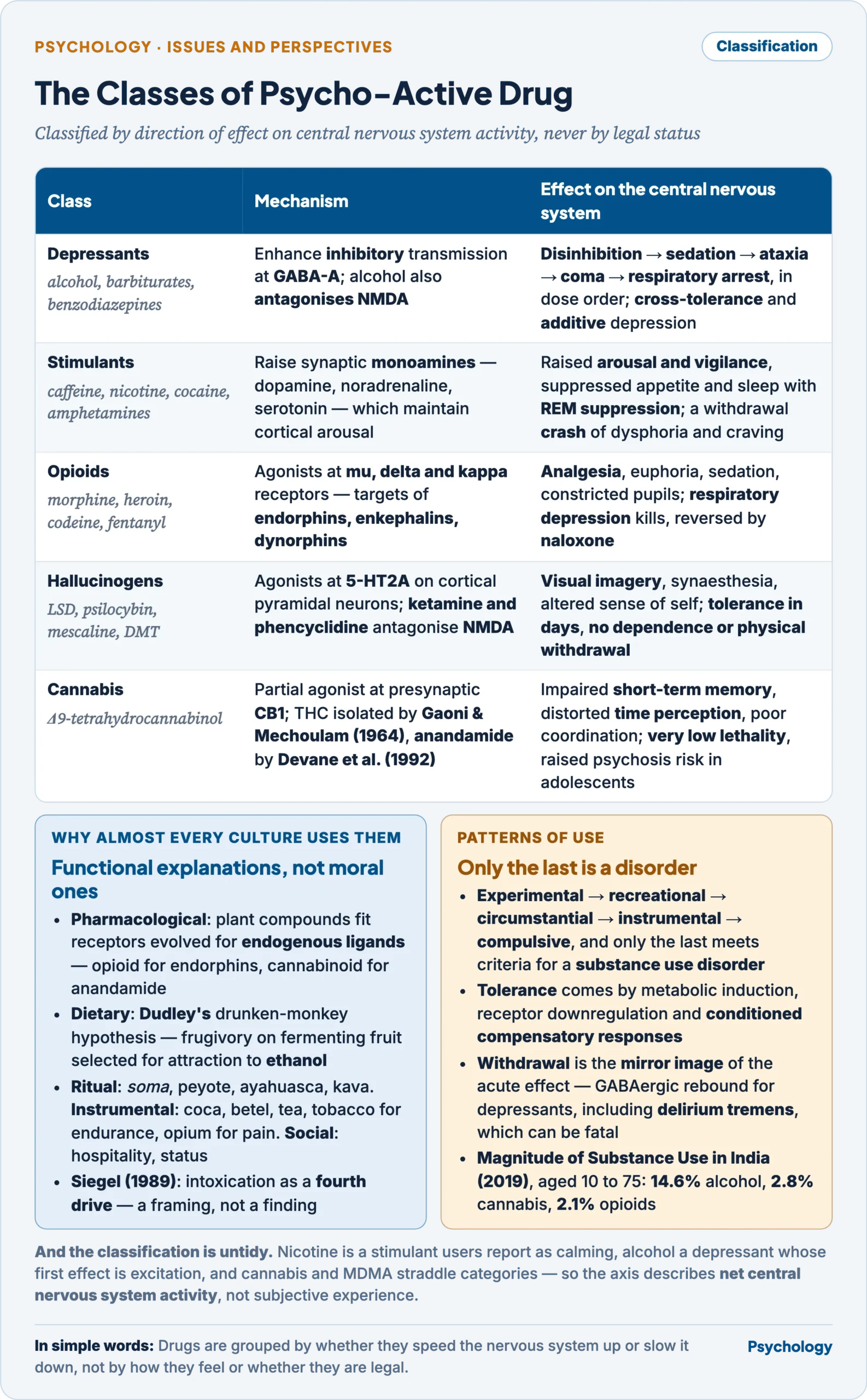
Classification follows the direction of effect on central nervous system activity, not the legal status of the substance.
Depressants
- Depressants reduce central nervous system activity by enhancing inhibitory transmission, in a dose-ordered sequence: disinhibition, sedation, ataxia, anaesthesia, coma, respiratory arrest.
- Alcohol (ethanol) acts at several sites: it is a positive allosteric modulator of the GABA-A receptor, increasing chloride conductance, and an antagonist at the NMDA glutamate receptor, reducing excitatory transmission.
- The behavioural course follows regional sensitivity: early disinhibition from suppressed prefrontal control, ataxia from cerebellar action, anterograde amnesia or blackout from hippocampal suppression, then medullary respiratory depression. Chronic use produces the Wernicke-Korsakoff syndrome through thiamine depletion, and prenatal exposure fetal alcohol spectrum disorder.
- Barbiturates bind the GABA-A receptor complex and increase the duration of chloride channel opening; at high doses they open the channel without GABA present, which is why their therapeutic index is low and overdose is lethal.
- Benzodiazepines bind a distinct site on the same receptor and increase the frequency of channel opening, but require endogenous GABA to act — hence a far wider margin of safety, reversible by the antagonist flumazenil. They are anxiolytic, sedative, anticonvulsant and muscle-relaxant, and produce anterograde amnesia.
- All three converge on the GABA-A receptor, hence cross-tolerance between them and dangerously additive depression when combined. Withdrawal is GABAergic rebound — tremor, anxiety, seizures and, for alcohol, delirium tremens, which can be fatal.
Stimulants
- Stimulants increase central nervous system activity by raising synaptic availability of the monoamines — dopamine, noradrenaline, serotonin — whose ascending projections maintain cortical arousal.
- Caffeine is an antagonist at adenosine A1 and A2A receptors. Adenosine accumulates during waking and inhibits arousal-promoting neurons, so blocking it removes an inhibition rather than adding excitation. Chronic use upregulates adenosine receptors, producing tolerance and the characteristic withdrawal headache.
- Nicotine is an agonist at nicotinic acetylcholine receptors, notably the α4β2 subtype on dopamine neurons of the ventral tegmental area, driving dopamine release in the nucleus accumbens. Pulmonary absorption delivers it to the brain within seconds, and that speed is what makes smoked nicotine so strongly reinforcing.
- Cocaine blocks the dopamine transporter, and also the noradrenaline and serotonin transporters, so released transmitter is not cleared and accumulates in the synapse. It is additionally a sodium-channel-blocking local anaesthetic and a vasoconstrictor, which accounts for stroke and myocardial infarction in users.
- Amphetamines act more drastically. They enter the terminal through the transporter, displace dopamine from vesicles, and reverse the transporter so that dopamine is pumped out independently of neuronal firing.
- The release is therefore larger and less regulated than cocaine’s, with a longer duration. High or repeated doses produce stimulant psychosis — paranoid delusions and hallucinations closely resembling paranoid schizophrenia — and methamphetamine is toxic to dopamine terminals.
- Across the class the central nervous system effects are increased arousal and vigilance, elevated mood and confidence, suppressed appetite and sleep with REM suppression, and on withdrawal a crash of dysphoria, hypersomnia and craving.
Opioids, hallucinogens and cannabis
- Opioids (morphine, heroin, codeine, oxycodone, fentanyl) are agonists at mu, delta and kappa receptors, the targets of the endogenous endorphins, enkephalins and dynorphins.
- Analgesia arises in the periaqueductal grey and spinal dorsal horn; euphoria from mu receptors on inhibitory interneurons of the ventral tegmental area, whose inhibition disinhibits dopamine neurons. Respiratory depression at medullary chemoreceptors is the mechanism of overdose death, reversible by naloxone, and withdrawal is driven largely by noradrenergic rebound in the locus coeruleus.
- Hallucinogens (LSD, psilocybin, mescaline, DMT) are agonists or partial agonists at the serotonin 5-HT2A receptor, densely expressed on cortical pyramidal neurons. They produce vivid visual imagery, synaesthesia and altered sense of self, develop tolerance within days, and cause no dependence syndrome or physical withdrawal. The dissociative anaesthetics (ketamine, phencyclidine) work instead by NMDA receptor antagonism.
- Cannabis acts through Δ9-tetrahydrocannabinol, isolated by Gaoni and Mechoulam (1964), a partial agonist at the presynaptic CB1 receptor; the endogenous ligand anandamide was identified by Devane and colleagues (1992).
- CB1 receptors are dense in hippocampus, cerebellum, basal ganglia and cortex and sparse in the brainstem, which explains both the effects — impaired short-term memory, distorted time perception, poor coordination — and the very low lethality. Heavy adolescent use is associated with raised psychosis risk, and a cannabis withdrawal syndrome is now recognised.
The mesolimbic dopamine pathway and the common reward mechanism
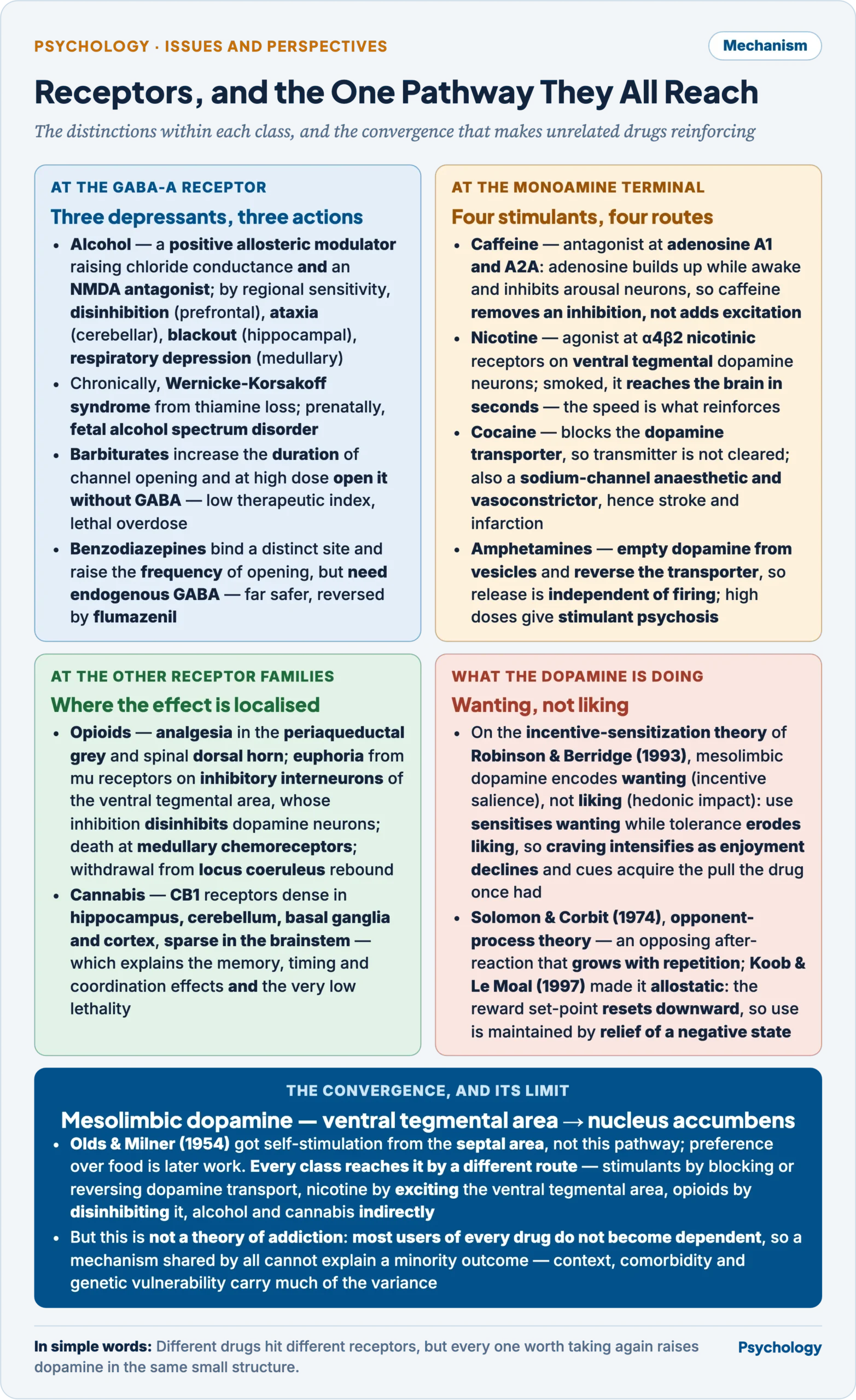
Different receptors, one convergence: every reinforcing drug raises dopamine in the nucleus accumbens.
- The mesolimbic pathway runs from the ventral tegmental area to the nucleus accumbens, branching to prefrontal cortex and amygdala.
- The founding observation is older and narrower than it is usually reported. Olds and Milner (1954) implanted electrodes in the septal area and neighbouring forebrain sites — the first placement by accident — and found rats would press a lever to stimulate themselves. They did not stimulate the mesolimbic projection, and the much-quoted finding that animals will self-stimulate in preference to eating comes from later self-stimulation work, not from this paper.
- The mesolimbic account of why drugs are reinforcing was built afterwards, and attaching it to the 1954 citation is a textbook compression worth avoiding.
- Every class above converges on it by a different route — stimulants by blocking or reversing dopamine transport, nicotine by direct excitation of the ventral tegmental area, opioids by disinhibiting it, alcohol and cannabis indirectly — which is why chemically unrelated substances are reinforcing.
- Dopamine is not the pleasure itself. On the incentive-sensitization theory of Robinson and Berridge (1993), mesolimbic dopamine encodes wanting (incentive salience) rather than liking (hedonic impact), and repeated use sensitises wanting while tolerance erodes liking.
- This explains the paradoxical clinical picture: craving intensifies as enjoyment declines, and drug cues acquire the pull the drug itself once had.
- Solomon and Corbit (1974), in opponent-process theory, modelled the opposing after-reaction that grows with repetition; Koob and Le Moal (1997) developed this into an allostatic account in which the reward set-point resets downward, so use comes to be maintained by relief of a negative state.
- Tolerance arises by metabolic induction, receptor downregulation and conditioned compensatory responses; physical dependence makes withdrawal the mirror image of the drug’s acute effect; and patterns of use run from experimental and recreational through circumstantial and instrumental to compulsive, only the last meeting criteria for a substance use disorder.
Criticisms and evaluation: what induced states show about consciousness
- The state debate may be unresolvable as posed. No physiological marker uniquely identifies a hypnotic state (Kirsch and Lynn, 1998), and both camps predict most of the same behaviour, so the dispute has shifted to mechanism — what is dissociated, and how much expectancy explains.
- The hidden observer is instruction-dependent, which is the strongest single objection to neodissociation (Kirsch and Lynn, 1998; Green and colleagues, 2005), even if instruction-dependence does not by itself refute the theory.
- Dissociated control over-reaches on the neuroscience. Jamieson and Woody (2007) concluded that the data do not support a simple global shutdown of frontal function, and several studies find enhanced attentional control under hypnosis.
- Hypnosis research relies on highly selected samples — high scorers on the susceptibility scales, a small minority — so findings generalise poorly, and simulator controls mimic much of the behaviour.
- The drug literature’s problems are inferential: human studies of long-term use are almost all correlational, so premorbid differences, poly-drug use and the social consequences of illegality are confounded with pharmacology. The cannabis-psychosis association is the clearest case.
- The reward-pathway account is incomplete as a theory of addiction. Most users of every drug do not become dependent, so a mechanism common to all users cannot by itself explain an outcome in a minority; social context, availability, comorbidity and genetic vulnerability carry much of the variance.
- Classification by direction of effect is untidy. Nicotine is a stimulant that users report as calming, alcohol is a depressant whose first effect is excitation, and cannabis and MDMA straddle categories — so the stimulant-depressant axis describes net central nervous system activity, not subjective experience.
- Both halves have been overclaimed in the same way. Hypnosis was credited with recovering buried memories, drugs with revealing an underlying reality; in both cases the alteration is a change in how experience is constructed and attributed, not access to something ordinarily hidden.
Indian context
- The Narcotic Drugs and Psychotropic Substances Act, 1985 (Ministry of Finance) prohibits production, possession, sale and consumption of listed substances, punishment graded by quantity. Its provision with psychological content lets a court divert an addict to treatment and rehabilitation instead, recognising dependence as a condition rather than purely an offence.
- Magnitude of Substance Use in India (2019), the national household survey for the Ministry of Social Justice and Empowerment, is the baseline. Among those aged 10 to 75, about 14.6 per cent were current alcohol users, 2.8 per cent cannabis and 2.1 per cent opioids, a substantial fraction of them dependent.
- The National Action Plan for Drug Demand Reduction (Ministry of Social Justice and Empowerment, in force from 1 April 2018) funds de-addiction centres and peer-led community intervention. Its campaign Nasha Mukt Bharat Abhiyaan, launched 15 August 2020 in 272 districts and extended nationwide from August 2023, works through school and college outreach — norm change rather than deterrence.
- The Mental Healthcare Act, 2017 (Ministry of Health and Family Welfare) brings substance use disorders within mental illness, giving a dependent person a right to treatment, advance directives and a nominated representative, and operationalises capacity as decision-specific rather than global — directly relevant where intoxication impairs decision-making.
Previous Year Questions
- 2026Why do the people in almost every culture use psychoactive drugs? Discuss the effects of various stimulants and depressants on central nervous system.
- 2016Explain different types of psycho-active drugs and patterns of their use.
- 2002Explain and evaluate the view that hypnosis represents ‘dissociated experience and dissociated control.’
- 1997What is the difference in the altered state of consciousness through meditation and hypnotic trance?