

Schools of Vedānta: Brahman; Īśvara; Ātman; Jīva; Jagat; Māyā; Avidyā; Adhyāsa; Mokṣa; Apṛthaksiddhi; Pañcavidhabheda.
Official Syllabus: Paper I, Section B, Unit 19
“Jagan mithyā” — “the world is false” — is the most misunderstood phrase in Indian philosophy. Śaṅkara does not say that the world is nothing, or a private dream, or a hallucination. He says it is mithyā: neither absolutely real (it can be sublated by the knowledge of Brahman) nor absolutely unreal (it is experienced, public and causally effective). It belongs to the empirical order of reality (vyāvahārika), between private illusions and Brahman. Its relation to Brahman is vivarta — apparent transformation, like a rope appearing as a snake — not pariṇāma, real transformation, like milk becoming curd. This article explains the three orders of reality, the precise meaning of mithyā, the theory of vivarta and its relation to pariṇāma, Śaṅkara’s realist refutation of Buddhist idealism, his critique of Sāṃkhya and of asatkāryavāda, the debate with Rāmānuja over the status of the world, and the logical consequences of Advaita’s absolutism.
In simple words
In a dream you drink water and your thirst goes away — in the dream. The dream water is “real” for the dreamer and works for him, yet on waking it is seen never to have been water. Now imagine a waking that stands to our ordinary life as ordinary waking stands to a dream. From there, the world would be seen as we now see dreams. Until that waking comes, the world’s water really quenches thirst, its fire really burns, and its laws really hold. That is “jagan mithyā”.
Context & Problem
The Question
- If Brahman alone is real, what is the status of the mountains, rivers, bodies and societies we live among? Three answers seem possible, and Śaṅkara rejects two of them:
- The world is fully real (Nyāya, Mīmāṃsā, Rāmānuja, Madhva) — then there are two realities, and Brahman is not “one without a second”.
- The world is nothing / a private idea (as Śaṅkara reads certain Buddhists) — then experience, science and ethics collapse.
- The world is mithyā — real at its own level, sublated by a higher one. This is Śaṅkara’s answer.
Real, Unreal and False
| Term | Meaning | Example |
|---|---|---|
| Sat (real) | What exists at all times and is never contradicted (trikālābādhya) | Brahman alone |
| Asat (unreal) | What cannot even appear, even in thought | A hare’s horn, a sky-flower, a barren woman’s son |
| Mithyā (false) | What appears and is real from a standpoint, but can be contradicted by a higher truth | The rope-snake, a dream, the world |
- Mithyā has two senses (Padmapāda): “false” can mean simple negation — “it is not” — or indescribable — “neither real nor unreal”. Śaṅkara’s “jagan mithyā” uses the second sense.
- Unreal means non-eternal. When “reality” denied to the world means “reality for all time“, the “unreality” attributed to it means only “non-eternality“. Who can say the world is not “unreal” in this sense?
Core Doctrine
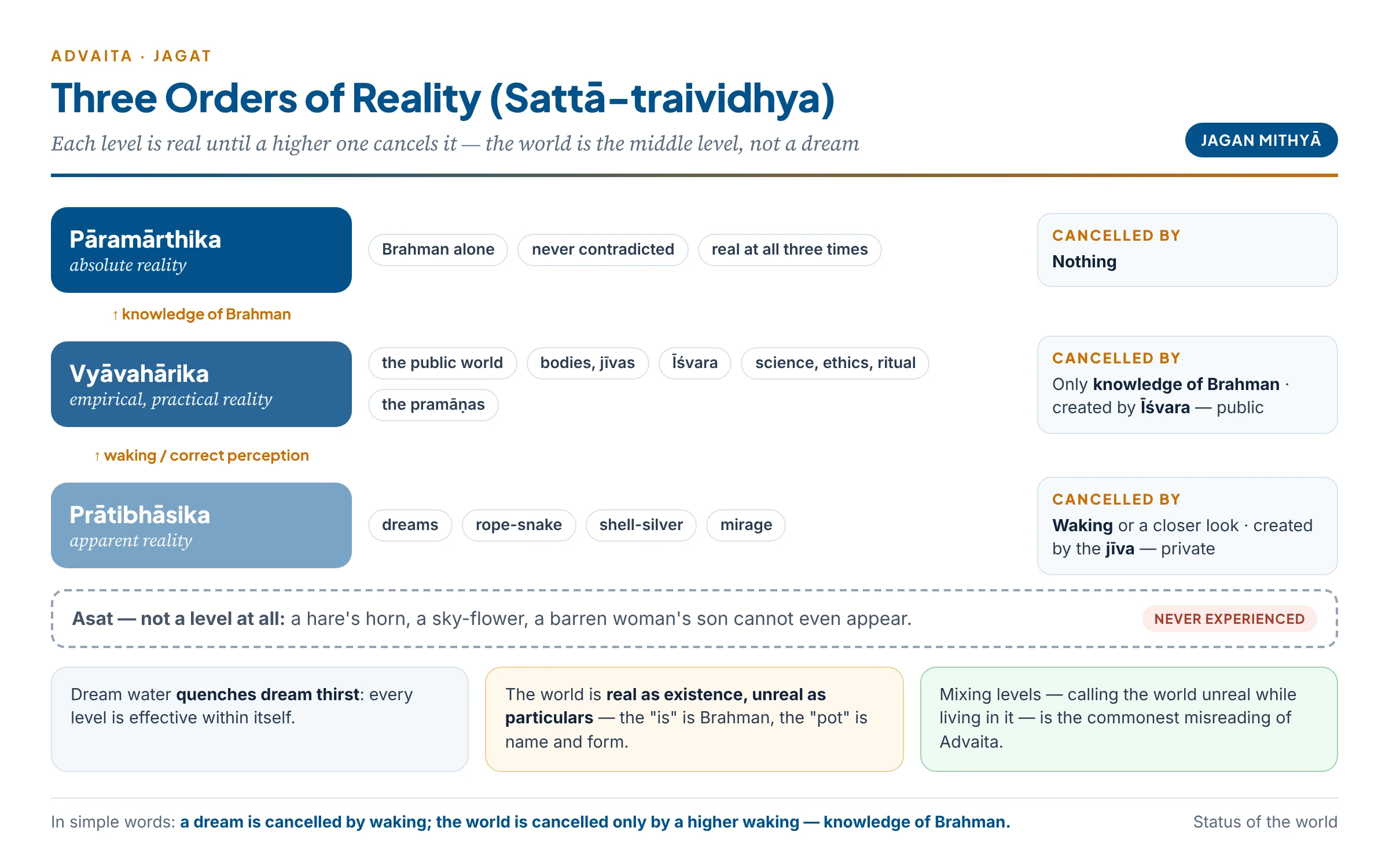
The Three Orders of Reality (Sattā-traividhya)
| Order | What belongs to it | Sublated by | Character |
|---|---|---|---|
| Prātibhāsika (apparent) | Dreams, rope-snake, shell-silver, mirage | Waking, normal perception | Private, momentary — created by the individual’s ignorance (jīva-sṛṣṭa) |
| Vyāvahārika (empirical, practical) | The world of waking experience — objects, bodies, jīvas, Īśvara | Only knowledge of Brahman | Public, lawful, causally effective — created by Īśvara (īśvara-sṛṣṭa) |
| Pāramārthika (absolute) | Brahman alone | Nothing — never contradicted | Eternal, one, changeless |
- Each lower order is cancelled only by the next higher one. The unreality of dream objects is realised only on waking; the unreality of the waking world only from the absolute standpoint. To mix the levels — to call the world “unreal” while living in it — is the commonest mistake about Advaita.
- Even dreams have some reality. Dream objects are real while the dream lasts; dream water quenches dream thirst; a man bitten by a snake in a dream may feel himself dying in the dream. And though dream objects are sublated, the consciousness that had the dream is never sublated — even the waking man knows he dreamt.
- Śaṅkara claims some reality even for error. “It is the Real which appears, and so every appearance must have some degree of truth in it, though none can be absolutely true.” No appearance is so low that the Real does not underlie it.
- The world is a workable reality. It is “true for all practical purposes” — the sphere of science, ethics, ritual and the pramāṇas.
What “Jagan Mithyā” Means — and Does Not Mean
- The world is an appearance with a real ground. As the snake is rooted in the rope, the world is rooted in Brahman. Without a substratum there could be no appearance at all. The world is Brahman misperceived.
- The world exists in Brahman in an unmanifested form. Before creation, names and forms lie potential in their cause; creation is their manifestation.
- Real as existence, unreal as particulars. “All particular modes of existence, with their different names and forms, are real as existence and unreal as particulars.” The “is” in “the pot is” is Brahman; the “pot” is name and form.
- As the cause, Brahman, never lacks existence, so the world never lacks existence — as existence. If “world” means the pure existence shining through all things, it is eternally real.
- Persistence and exclusion. Śaṅkara’s criterion: what persists is real; what excludes and is excluded is not. A pot and a cloth exclude each other; each particular is open to being experienced otherwise later (as the “snake” turned out to be a rope). Only existence runs through all and can never be contradicted.
- Two kinds of contradiction.
- Experiential — one experience corrects another (the rope corrects the snake). Everyone accepts this.
- Logical — experience is shown inconsistent by thought, as Zeno, Kant and Bradley argued about change, space and relations. Śaṅkara uses both: particular, changing things are “self-contradictory” and therefore not ultimately real.
Common confusion
Does Śaṅkara say the world is an illusion like a dream or a mirage? Not in the ordinary sense. He uses the images of dream, mirage, magic and rope-snake to stress that the world is not ultimately real, but he sharply distinguishes the world (vyāvahārika, public, lawful, sublated only by knowledge of Brahman) from dreams and illusions (prātibhāsika, private, cancelled by waking). “The metaphors are metaphors and should not be stressed beyond the breaking point.” Calling Advaita “illusionism” in the popular sense is a misreading.
How Can an Unreal Cause Produce Real Effects?
The objection. If māyā is unreal, how can it make the real Brahman appear as the world? And how can unreal persons, using unreal means (the Vedānta texts), reach a real goal (liberation)? “One bitten by a rope-snake does not die; no one can drink or bathe in mirage-water.”
Śaṅkara’s replies.
- Even unreal things produce real effects. The roar of a tiger in a dream is unreal, yet it makes the dreamer tremble and may wake him; if a man strongly imagines he is bitten by a snake, fear can cause heart failure; a reflection in a mirror is unreal yet correctly shows the face.
- Like removing a thorn with a thorn. A person stuck in mud gets out with the help of mud; a thorn in the foot is removed with another thorn. Unreal means can remove unreal bondage.
- The objector confuses standpoints. The unreality of the dream is seen only from waking; the unreality of the world only from Brahman. Until knowledge dawns, all secular and religious practices are real.
- Knowledge is real in its result. The knowledge that removes ignorance is not sublated by anything further; its fruit — the removal of ignorance — is real.
In simple words
A child is terrified of a “ghost” in a dark room. You can argue all night that ghosts do not exist; the fear stays. You switch on the light and the “ghost” turns out to be a coat on a chair. The light did not fight a real ghost — it removed the not-seeing. Scripture and reasoning, though they belong to the world of appearance, work like that light switch.
Creation: The Order of Manifestation
- Five subtle elements arise from Brahman (associated with māyā) in order: ether (ākāśa), air, fire, water, earth.
- Quintuplication (pañcīkaraṇa). Each gross element is formed by mixing the subtle elements: half of itself plus one-eighth of each of the other four. Gross ether, for instance, is half subtle ether and one-eighth each of air, fire, water and earth. That is why every gross thing contains traces of all elements.
- The older threefold mixing (trivṛt-karaṇa) of the Chāndogya Upaniṣad — fire, water and earth combined — is the earlier form of the same idea; Rāmānuja keeps the threefold version.
- All this is real only at the empirical level. Creation is “real only as long as avidyā lasts”. At the highest level Śaṅkara agrees with Gauḍapāda’s non-origination (ajāti): nothing is really born.
Vivartavāda: Apparent Transformation
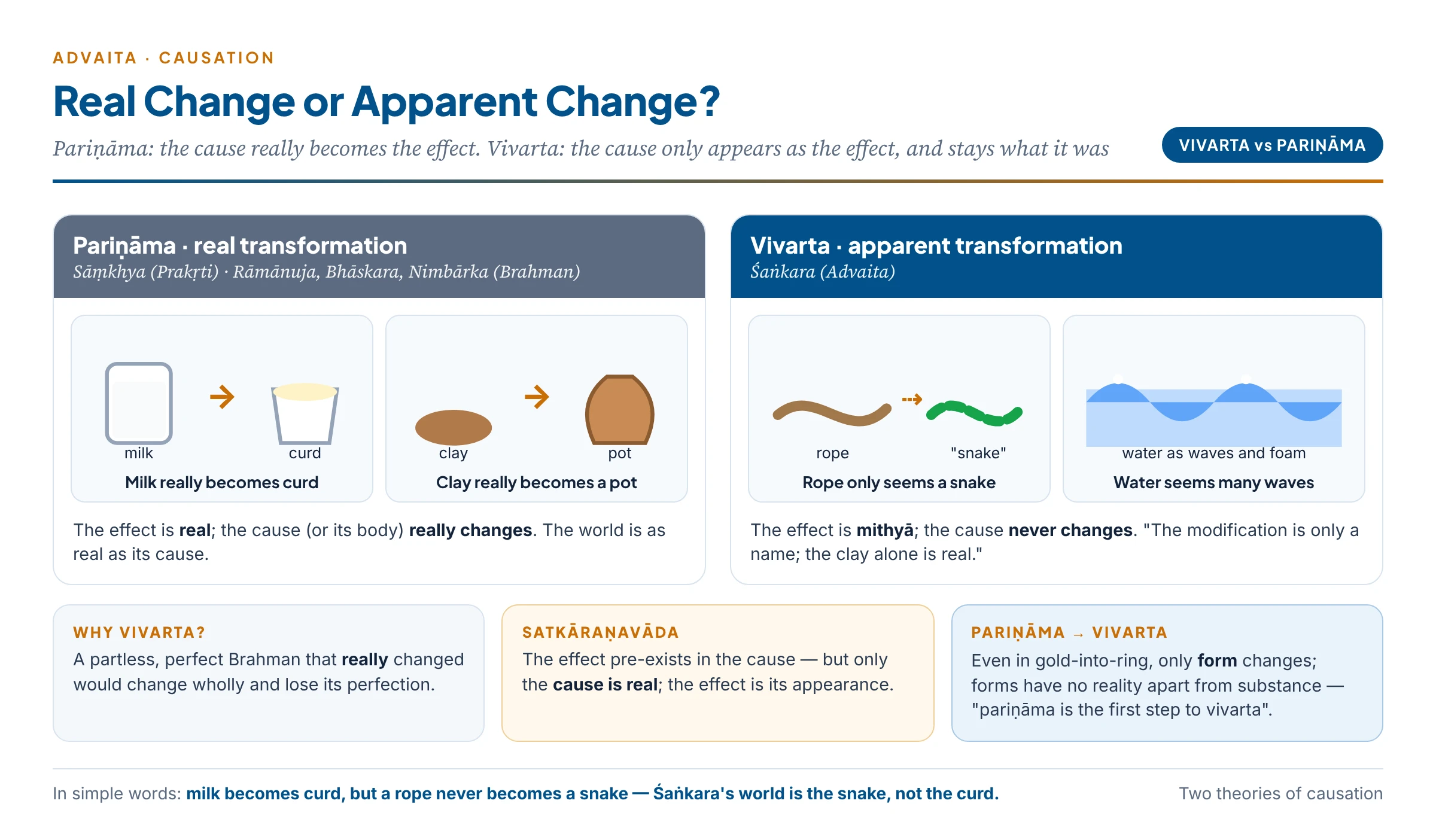
- The theory. Vivarta is the doctrine that the effect is an apparent, not a real, transformation of the cause. Brahman undergoes no real change in “creation”; the world is an apparent manifestation (vivarta) of Brahman due to avidyā.
- Definitions.
- Pariṇāma (real change): “the cause becoming otherwise in reality” (satattvato ‘nyathā prathā) — milk becoming curd, clay becoming pot, gold becoming ornament.
- Vivarta (apparent change): “the cause appearing otherwise without reality” (atattvato ‘nyathā prathā) — rope appearing as snake, water appearing as waves and foam.
- Why Śaṅkara needs vivarta. Brahman is changeless, partless, perfect. If Brahman really turned into the world, it would change, become imperfect and lose its absoluteness — and since it has no parts, it would have to change wholly, leaving no Brahman. Vivarta saves both Brahman’s immutability (kūṭastha-nityatā) and the experience of plurality.
- Vivarta is a form of satkāryavāda. Śaṅkara accepts that the effect pre-exists in its cause (satkāryavāda), but interprets it as satkāraṇavāda — “the cause alone is real; the effect is only its appearance”. The effect has no being apart from the cause; the cause does not depend on the effect.
- Scriptural basis. “As by knowing one lump of clay, everything made of clay is known — the modification is only a name, a matter of words; the clay alone is real.“
| Point | Vivartavāda (Śaṅkara) | Pariṇāmavāda (Sāṃkhya: Prakṛti; Rāmānuja, Bhāskara, Nimbārka: Brahman) |
|---|---|---|
| Definition | Cause appears as effect without changing | Cause really changes into effect |
| Example | Rope → snake; water → waves | Milk → curd; clay → pot |
| Status of effect | Mithyā — empirically real, ultimately unreal | Real |
| Status of cause | Changeless, alone real | Changes (in itself or in its body/modes) |
| Nature of Brahman | Nirguṇa; Īśvara a lower reality | Saguṇa, with real qualities and real body |
| Relation of world to Brahman | Superimposition (adhyāsa) through māyā | Body–soul (Rāmānuja); difference-and-non-difference (Nimbārka) |
| Jīva | Ultimately identical with Brahman | Real, eternal part or mode |
| Liberation | Realising identity: “I am Brahman” | Blissful communion; individuality kept |
| Purpose | Preserve Brahman’s changelessness and non-duality | Affirm the reality of plurality within unity |
In simple words
Ocean waves rise, crash and vanish, each with its own shape and size. Has the water “turned into” waves? Not really — no new stuff has appeared; the water has only taken on passing shapes. Śaṅkara says the world is to Brahman what waves are to water, or the snake to the rope: shapes and names without a second stuff. That is vivarta.
Is Vivartavāda the Logical Development of Pariṇāmavāda?
- The Advaita claim. Sarvajñātman says that pariṇāmavāda is the first step (pūrva-bhūmi) of vivartavāda in Vedānta. They are not absolutely opposed; pariṇāma logically leads to vivarta, which is “only a step ahead”.
- Reasons for “yes”.
- Only the form changes. When gold becomes a ring, the gold remains gold; only the form — a name and shape — is new. Form has no reality apart from its substance. So even “real” change, examined, turns out to be a change of name and form over an unchanging stuff — which is vivarta.
- Infinite regress. If change were real in the substance, the substance itself (gold) would be a changing form of something deeper, and so on; the regress ends only in unchanging pure existence, of which all forms are appearances.
- The partless cannot really change. For Brahman, real transformation would be total transformation; a partless reality can only appear to change.
- The world that is not real in the beginning or the end (it comes from and returns to Brahman) cannot be real in the middle.
- Historical sequence. Sāṃkhya’s satkāryavāda (real transformation of Prakṛti) and the early Vedāntic Brahma-pariṇāma lead naturally to Śaṅkara’s refinement.
- Reasons for “no”.
- Different ontologies. Pariṇāma affirms the reality of the effect; vivarta denies it. One is realism, the other absolutism — a change of kind, not of degree.
- Rāmānuja and Madhva hold that experience shows real change, and that “appearance” needs a perceiver’s error, which cannot apply to God’s creation.
- Vivarta needs avidyā as an extra principle that pariṇāma does not need.
- A balanced view. Vivarta is the logical completion of satkāryavāda for one who holds that the ultimate cause is changeless; for one who holds that the ultimate cause can have a changing body or real powers, pariṇāma remains self-sufficient.
Śaṅkara against Buddhist Idealism (Vijñānavāda)
Śaṅkara, the “illusionist”, is in fact one of the strongest realists about the empirical world when he argues against Buddhist idealism, which holds that only momentary cognitions exist and external objects are mere ideas.
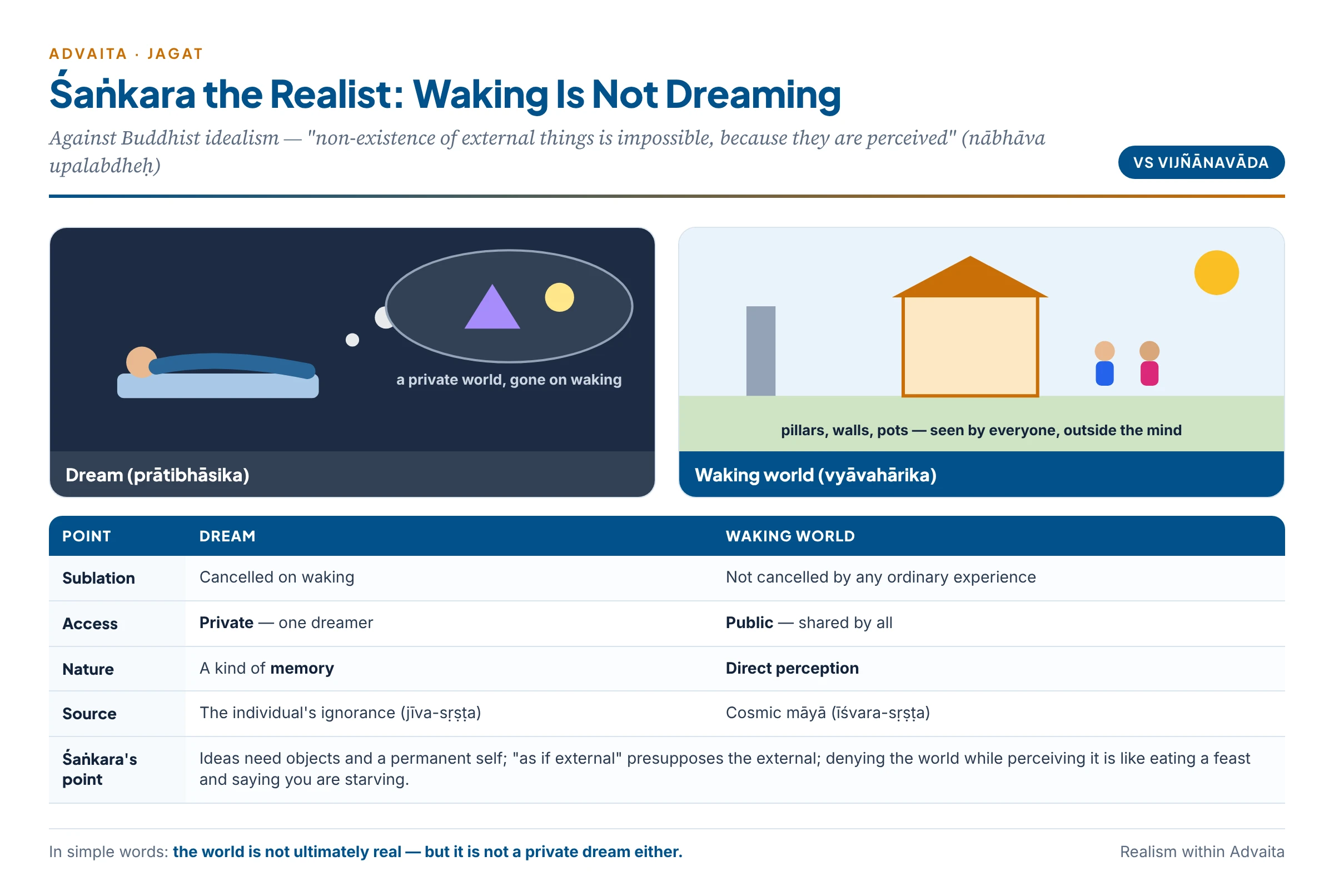
- “Non-existence is impossible, because of perception” (nābhāva upalabdheḥ). We perceive external objects — pillars, walls, pots, cloths — as existing outside and distinct from our cognitions. What is directly perceived by all valid means of knowledge cannot be denied. To deny the external world while perceiving it is like eating a meal and declaring oneself starving.
- “As if external” gives the game away. A Buddhist verse says consciousness appears “as if external“. Śaṅkara retorts: if nothing were ever external, the notion “external” could not even arise; the honest statement is that things appear as external, not “as if” external.
- Waking is not like dreaming. The two states cannot be placed on a par:
- Dream objects are sublated on waking; waking objects (posts, walls) are not sublated in the same way.
- Dreams are private; the waking world is public.
- Dreams are a kind of memory; waking objects are directly perceived.
- The difference is acknowledged by the Buddhist himself; “what is directly experienced cannot be refuted by intellectual jugglery”.
- Impressions need objects. The Buddhist says the variety of ideas is due to the variety of past impressions (vāsanā), not of objects. But without external objects there could be no impressions in the first place; and a beginningless series of impressions would be like “a line of the blind leading the blind” — an infinite regress.
- Impressions need a substratum. Impressions are modifications and must inhere in something permanent; the Buddhist has no such substratum. The “store-consciousness” (ālaya-vijñāna) is itself momentary and cannot serve.
- A permanent self is needed. Momentary ideas cannot synthesise themselves; a permanent witness must unite the fleeting ideas and give them meaning. To say a momentary idea illumines itself is like saying fire burns itself; knowledge without a knower is like “a thousand lamps shining inside an impenetrable rock” with no one to see them.
- Consequences. If ideas alone were real, the distinctions of subject and object, means and end, action and result would vanish; bondage, liberation and the Buddhist scriptures themselves would be pointless.
- Against Śūnyavāda. Śaṅkara takes “śūnya” as mere negation and dismisses it as nihilism, contradicted by all valid means of knowledge and “below criticism”: one cannot negate all practices without some higher truth.
- Historical note. The idealism Śaṅkara attacks is mainly the later “independent” Vijñānavāda of Dignāga and Dharmakīrti, whose verses he quotes. The older Yogācāra of Asaṅga and Vasubandhu, which also regards pure consciousness as the permanent background, is closer to his own view; Śaṅkara’s criticism “applies with full force” only to the doctrine of momentary, many ideas. In a sense Śaṅkara transforms Buddhist ideas: Vasubandhu’s “consciousness-only” becomes Brahman, the store-consciousness becomes Īśvara, the defiled mind becomes the jīva, the world of objects becomes jagat, and real transformation becomes vivarta.
Śaṅkara against Sāṃkhya and Asatkāryavāda
Against Sāṃkhya’s Prakṛti-pariṇāmavāda — Sāṃkhya is the “chief wrestler” (pradhāna-malla) among Vedānta’s opponents, closest to it and strongest; defeat it and the others fall.
- Design needs intelligence. Stones, bricks and mortar do not build a house without a builder; unconscious Pradhāna cannot account for the order and harmony of the universe.
- Activity needs a mover. Clay does not become a pot without a potter; what disturbs the balance of the guṇas and starts creation?
- The analogies fail.
- Milk flows for the calf only because there is a living cow with love for the calf.
- Grass becomes milk only inside a cow, not when it lies uneaten or is eaten by a bull.
- The blind and the lame who cooperate are both conscious, active persons; Prakṛti is unconscious and Puruṣa indifferent.
- If the mere presence of Puruṣa moved Prakṛti like a magnet moves iron, since Puruṣa is always present, creation would never stop and liberation would be impossible.
- No relation is possible. Prakṛti is unconscious, Puruṣa indifferent, and there is no third principle to relate them; the chasm Sāṃkhya creates between subject and object cannot be bridged.
- Vicarious suffering. Why should Puruṣa suffer for the doings of Prakṛti? Responsibility is thrown overboard.
- The remedy. Sāṃkhya should let its Prakṛti glide into māyā, its pariṇāma into vivarta, its satkāryavāda into satkāraṇavāda, its many Puruṣas into jīvas, and its painless kaivalya into blissful mokṣa. (Detailed in the article on Sāṃkhya dualism.)
Against Nyāya’s asatkāryavāda (the effect is a new creation, not pre-existing):
- Curd comes only from milk, pots only from clay. If effects did not pre-exist, anything could come from anything.
- The “special power” reply fails. If the cause has a special capacity (atiśaya) for one effect, that capacity is either the effect’s antecedent state (then asatkāryavāda is abandoned) or a power non-different from the cause.
- Cause and effect must be related by identity (tādātmya), not by inherence (samavāya), which would need another relation to relate it, and so on to infinity.
- No relation between the existent and the non-existent. Nobody says “the barren woman’s son was a king”.
- The cause is not destroyed. When milk becomes curd, or seed sprout, the cause is not annihilated; otherwise recognition would be impossible.
Śaṅkara and Rāmānuja on the Status of the World
| Point | Śaṅkara | Rāmānuja |
|---|---|---|
| Status | Mithyā — empirically real, ultimately sublated | Real — as real as God, though dependent |
| Relation to Brahman | Appearance on Brahman (superimposition) | Body of Brahman (śarīra–śarīrī) |
| Causation | Vivarta | Brahma-pariṇāma — real transformation of Brahman’s body |
| Māyā | Indescribable power producing appearance | God’s real, wonderful creative power |
| Levels of truth | Two (or three) | One — all is real, but dependent |
| “Unity” texts mean | Only Brahman is real | Nothing exists independently of Brahman |
| World in liberation | Sublated for the liberated | Remains, as God’s body |
| Key argument | Change and plurality are contradictory; Brahman is changeless | Knowledge always reveals real objects; if the world were false, the Vedas, which exist in the world, would be false too |
- Rāmānuja’s response to Śaṅkara. The Upaniṣadic passages that condemn multiplicity deny only the independent existence of the world, not its reality. Māyā is God’s real power. There is no pramāṇa for an indescribable world-illusion. And “if the world is mithyā, the Vedas also become mithyā, since they exist within the world” — so they could not reveal Brahman.
- Śaṅkara’s answer, in advance. Unreal means can produce real knowledge (the dream tiger, the thorn); the Vedas are real at the empirical level, which is all they need to be to remove ignorance.
The Logical Consequences of Advaita’s Absolutism
If Brahman alone is real and non-dual, several conclusions follow necessarily:
- The world is mithyā — appearance, not a second reality; creation is not ultimately real (non-origination, ajāti).
- Causation is appearance — vivarta, not real transformation; the effect is non-different from the cause.
- God (Īśvara) is the highest appearance — real only at the empirical level; Brahman is “beyond God“.
- The jīva is Brahman — individuality and plurality of selves are empirical.
- Bondage and liberation are empirical — “there is no dissolution, no birth, none bound, none striving, none seeking liberation, none liberated: this is the highest truth” (Gauḍapāda).
- The pramāṇas are valid only at the empirical level; Brahman is not their object.
- Ethics, ritual and devotion are provisional — valid and necessary for purification, but transcended by the knower.
- Liberation is by knowledge alone — since bondage is ignorance, only knowledge can end it; action cannot.
- Jīvanmukti is possible — since liberation is knowledge, not a change of state, it can come while the body lasts.
- Difference is not ultimately real — the Advaitin dialecticians (Śrīharṣa, Citsukha) even argued that difference itself cannot be coherently defined.
Criticisms of these consequences.
- Ethical: if the world and the self are not ultimately real, why should dharma and social duties matter? Realist schools say this undermines responsibility.
- Logical: a “middle status” between real and unreal is untenable (Nyāya, Mīmāṃsā, Rāmānuja).
- Religious: God, grace and devotion become provisional (Rāmānuja, Madhva).
- The charge of explaining the world away, and of being a “crypto-Buddhist” (Madhva, Rāmānuja), who teaches Śūnyavāda in Vedāntic dress.
Replies.
- Philosophy must examine experience, not accept it wholesale; Śaṅkara grades experience rationally — the momentary illusions, the practical world, and pure existence — rather than denying any of it. If one insists on a single word for the world as a whole, the fairest is “indescribable“.
- The world as existence is eternally real; only its particular forms are sublatable.
- Ethics is fully real at the level where it applies; the provisional is not the worthless.
- Śaṅkara’s intention, in one sentence: “None can condemn this world as unreal: he who does so is not qualified to do so, and he who is qualified will not do so, for he has risen above language and finite thought.“
- Modern defenders — Vivekananda, Radhakrishnan — read Advaita not as world-negation but as value-transcendence: the world is a relative reality pointing to its absolute ground.
Critical Evaluation
Objections (Pūrva-pakṣa)
- Rāmānuja: the world is God’s body and real; mithyā has no pramāṇa; unity texts deny only independence; if the world is false, so are the Vedas.
- Madhva: to brand a perceived object false requires a stronger pramāṇa than perception, and there is none; “the world is false” is never observed; Advaita is Buddhism in disguise.
- Nyāya–Mīmāṃsā: a thing must either exist or not; “neither” abandons logic.
- Modern critics: Advaita encourages world-renunciation and indifference to social progress.
Replies (Siddhānta)
- Perception is not overruled at its own level — Śaṅkara defends perception against the idealist; it is overruled only from the level of Brahman-knowledge, as dream perception is overruled by waking.
- Contraries, not contradictories. “Absolutely real” and “absolutely unreal” do not exhaust all possibilities; mithyā is not “both” but “neither in the absolute sense”.
- Not Buddhism: the world has a real, positive ground (Brahman); Śaṅkara himself attacks idealism and nihilism.
- Not world-negation: the liberated sage, like Śaṅkara himself, works for the welfare of the world; it is attachment, not the world, that is renounced.
Critics and Defenders
Criticism — Critics
- Rāmānuja: the world is real as God’s body; if it is false, so are the Vedas.
- Madhva: no pramāṇa can overrule perception; Advaita is crypto-Buddhism.
- Nyāya–Mīmāṃsā: “neither real nor unreal” abandons the laws of thought.
- Ethical critics: mithyā undermines duty and social concern.
Defence — Defenders and strengths
- Śaṅkara: three orders of reality; the world is vyāvahārika, never a private dream.
- Realism against idealism: nābhāva upalabdheḥ — external objects are perceived; waking is not dreaming.
- Vivarta: keeps Brahman changeless and the world lawful; pariṇāma leads to it.
- Strength: grades experience rationally instead of denying any of it.
- Strength: “real as existence, unreal as particulars” gives the world a real ground.
Cross-Tradition Comparison
The World in Śaṅkara and Western Philosophy
| Thinker | Status of the world | Like Śaṅkara | Unlike Śaṅkara |
|---|---|---|---|
| Plato | Visible world a lower grade of reality, image of the Forms | Degrees of reality; the many as copies | Forms are many; matter a real receptacle |
| Parmenides | Change and plurality are illusion; only Being is | One changeless Being | Parmenides gives the world no empirical status |
| Kant | Empirically real, transcendentally ideal | Very close: real for experience, not as things in themselves | Kant’s ultimate is unknowable; Śaṅkara’s is realised |
| Berkeley | Objects are ideas in minds | — | Śaṅkara rejects subjective idealism outright |
| Hegel / Bradley | Finite things contradictory, partial truths of the Absolute | Contradiction as the mark of the finite | The Absolute includes the world as its content |
| Spinoza | Modes of the one Substance | One reality underlies all | Modes are real, not appearances |
Indian Connect — Key takeaways
- Kant’s “empirical reality and transcendental ideality” is the closest Western parallel to Śaṅkara’s vyāvahārika world.
- Śaṅkara is a realist against Berkeley and the Yogācāra (the world is public, outside individual minds) and an absolutist with Parmenides and Bradley (change and plurality are not ultimate).
- Vivarta stands between Sāṃkhya’s real transformation and Nyāya’s new creation — a third theory of causation.
Synthesis (Siddhānta)
- Jagan mithyā means the world is neither absolutely real nor absolutely unreal — not a hare’s horn, not Brahman, but an appearance with a real ground.
- Reality has three orders: apparent (dreams, illusions), empirical (the public world, Īśvara, jīvas) and absolute (Brahman). Each lower order is cancelled only by the next higher.
- The world is real as existence, unreal as particulars; persistence marks the real, exclusion the unreal.
- Unreal causes can produce real effects — the dream tiger, the thorn that removes a thorn — and the confusion of standpoints underlies most objections.
- Vivartavāda: Brahman appears as the world without changing, as the rope appears as a snake; it is satkāryavāda read as satkāraṇavāda, and the logical completion of pariṇāmavāda for a changeless cause.
- Against Buddhist idealism, Śaṅkara is a realist: external objects are perceived; waking is not dreaming; impressions need objects and a self. Against Sāṃkhya, unconscious matter cannot design or move itself; against asatkāryavāda, the effect must pre-exist.
- With Rāmānuja, the debate is whether the world is God’s real body or Brahman’s appearance.
- Absolutism entails: world mithyā, causation vivarta, God the highest appearance, jīva = Brahman, bondage and liberation empirical, pramāṇas empirical, ethics provisional, liberation by knowledge, jīvanmukti possible.
- Contemporary relevance.
- Physics and appearance. Talk of everyday solidity as “emergent” from a deeper quantum reality echoes the idea of levels of reality.
- Virtual worlds. A video game world is fully lawful and real for the player, yet “virtual” from outside — a modern image of vyāvahārika reality.
- Ethics of detachment. Seeing the world as real-but-not-ultimate supports engaged action without attachment — the Gītā’s ideal.
“All modification is a matter of words, a mere name; the clay alone is real.” — Chāndogya Upaniṣad
Previous Year Questions
- 2025Why does Śaṅkara consider Sāṃkhya Philosophy as his chief opponent (pradhāna malla)? Examine his arguments against Sāṃkhya Philosophy.
- 2023“If Puruṣa and Prakṛti are two completely independent realities, then no relation between the two is possible.” In the light of this statement make a brief presentation of Śaṅkara’s criticism of Sāṃkhya dualism.
- 2022Do you agree with the view that ‘Vivartavāda is the logical development of Pariṇāmavāda’? Give reasons in support of your answer.
- 2021Compare and contrast the views of Śaṅkara and Rāmānuja regarding the status of the world.
- 2019Explain the logical consequences of the metaphysical absolutism of Advaitism.
- 2018How do the Advaita Vedāntins react to the Prakṛti-pariṇāmavāda of the Sāṃkhya philosophy? How do the Sāṃkhyas defend their own position in this regard? Discuss.
- 2017Distinguish between vivartavāda and pariṇāmavāda with reference to causation and explain how in the light of these theories Śaṅkara and Rāmānuja differ on the status of the world.
- 2012Write a note on Śaṅkara’s Vivartavāda and discuss its implications.
- 2008Explain Śaṅkara’s view on the status of Jagat and Rāmānuja’s response to it.