

Schools of Vedānta: Brahman; Īśvara; Ātman; Jīva; Jagat; Māyā; Avidyā; Adhyāsa; Mokṣa; Apṛthaksiddhi; Pañcavidhabheda.
Official Syllabus: Paper I, Section B, Unit 19
For Śaṅkara, liberation (mokṣa) is not going somewhere, becoming something or getting something new. The Self is already Brahman, ever free (nitya-mukta); bondage is only the ignorance of this fact. So liberation is the removal of ignorance by knowledge — “the attainment of what is already attained“, like finding the necklace that was round one’s neck all along. Since bondage is ignorance, only knowledge (jñāna) can end it; action and devotion purify the mind and prepare it, but cannot themselves liberate. And since liberation is knowledge, not a change of place or state, it can come while the body still lives — jīvanmukti — with final release (videhamukti) at the body’s fall. This article explains bondage, the nature of liberation, the preparation (sādhana-catuṣṭaya), the threefold practice (śravaṇa, manana, nididhyāsana), the relation of knowledge to action and devotion, jīvanmukti and the theory of karma behind it, and the criticisms — especially Rāmānuja’s.
In simple words
A woman searches the whole house for her necklace, upset and anxious. A friend points: “It’s round your neck!” She touches it and laughs. Did she “gain” the necklace? No — she always had it. What she lost was only her ignorance of having it. Liberation, for Śaṅkara, is exactly this: not getting Brahman, but discovering that one has always been Brahman.
Context & Problem
Why Liberation Must Be Knowledge
- What binds us? If bondage were a real chain — a real impurity, a real karmic substance — it would need a real action to break it. But for Advaita the Self is never really bound; bondage is superimposition — the false notion “I am the body, the doer, the enjoyer”.
- What removes a false notion? Only knowledge. Darkness is removed by light, not by a stick; the rope-snake is removed by seeing the rope, not by beating the snake.
- So the whole of soteriology follows from metaphysics. Because Brahman alone is real and the Self is Brahman, liberation must be realisation, not production.
How Advaita Differs from Other Schools on Liberation
| School | Liberation is… | Śaṅkara’s objection |
|---|---|---|
| Nyāya–Vaiśeṣika | Cessation of all pain (apavarga); the self without consciousness | Liberation is not mere absence of pain but positive bliss — Brahman is bliss |
| Sāṃkhya–Yoga | Isolation (kaivalya) of Puruṣa from Prakṛti | Not isolation of one self among many, but unity with Brahman |
| Buddhism | Nirvāṇa — extinction, emptiness | Not a void, but positive, self-luminous consciousness |
| Mīmāṃsā | Heaven through ritual (earlier); avoiding rebirth (later) | Heaven is temporary, a fruit of karma |
| Rāmānuja / Madhva | Eternal loving service of God in Vaikuṇṭha, individuality kept | Duality persists; the soul is not really free while separate |
Core Doctrine
Bondage (Bandha): Ignorance-based Misidentification
- The Self is ever free. In its true nature the Self is “eternal, pure, conscious, free” (nitya-śuddha-buddha-mukta-svabhāva). Bondage is not a real limitation of the Self.
- Bondage is an ignorance-made condition. Owing to beginningless ignorance, the Self wrongly identifies itself with the body, gross and subtle, and with the mind (antaḥkaraṇa). It thinks “I am stout“, “I am lame“, “I am ignorant“. Thus arises the ego, which sets itself against the rest of existence.
- The three marks of bondage.
- Doership (kartṛtva) — “I act”.
- Enjoyership (bhoktṛtva) — “I experience pleasure and pain”.
- Saṃsāra — repeated birth and death driven by karma.
- The cycle. Identification with the body → sense of doership → karma → rebirth → further identification. Karma cannot destroy ignorance; it only feeds the cycle. Only knowledge can break it.
- Bondage is itself mithyā. It belongs to the empirical body–mind, not to the true Self.
- From the absolute standpoint: there never was any bondage — the Self is ever-free Brahman.
- From the empirical standpoint: bondage appears real to the ignorant, as the snake appears in the rope.
In simple words
A man dreams he is a beggar, hungry and afraid. He feels truly poor — the dream-hunger is real for him while it lasts. But he was a wealthy man asleep in his own bed the whole time. Waking does not make him rich; it shows him he always was. Bondage is the beggar-dream; the Self was never poor.
Liberation (Mokṣa): Not a New Attainment
- Destruction of ignorance, not production of a new state. Liberation is avidyā-nivṛtti — the removal of ignorance. Its realisation is: “I was never bound; I have always been Brahman.“
- Two aspects.
- Negative: cessation of ignorance, of false identification, of bondage and of saṃsāra.
- Positive: realisation of the Self as eternal, pure, consciousness, free — and as bliss (ānanda), because Brahman is bliss and liberation is identity with Brahman. Advaita, following the Upaniṣads, conceives liberation as positive bliss, not merely as absence of misery.
- What liberation is not.
- Not going to heaven (svarga), which is temporary — a fruit of action that ends when the merit is spent.
- Not a product of action (karma). Rituals and good deeds (karma, upāsanā) can purify the mind (citta-śuddhi) but cannot give liberation.
- Not a transformation of the Self, because the Self is already free; it is only realised.
- Not reaching a distant place or God — Brahman is one’s own Self, nearer than near.
- Why action cannot produce liberation. An action can do only four things to its object: produce it (as a potter produces a pot), modify it (as milk is turned to curd), purify it (as a cloth is washed), or obtain it (as one goes to a village). Liberation is none of these: Brahman is eternal (not produced), changeless (not modified), pure (not purified) and one’s own Self (not reached). Hence only knowledge — which reveals what already is — fits.
- “The knower of Brahman becomes Brahman” (brahmavid brahmaiva bhavati) — and even this “becoming” is only a manner of speaking, for he always was Brahman.
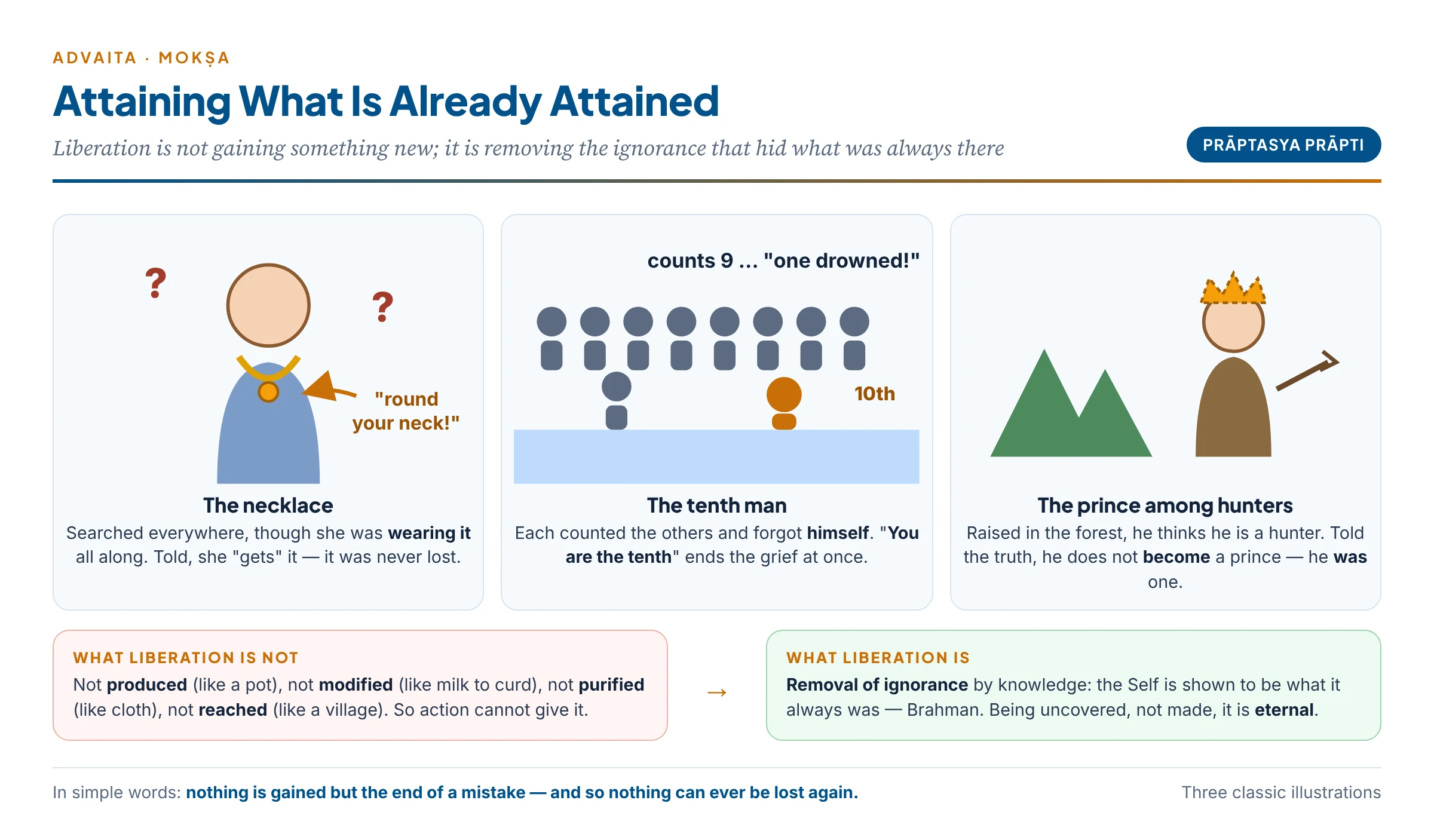
“The Attainment of What Is Already Attained” (Prāptasya Prāpti)
Advaita defines liberation as prāptasya prāpti — attaining the already attained — and the removal of bondage as nivṛttasya nivṛtti — removing what was already absent.
How Śaṅkara and the tradition illustrate it:
- The necklace round the neck. One searches everywhere for a necklace one is already wearing; told “it is round your neck”, one “attains” it — though it was never lost.
- The tenth man. Ten men cross a river; each counts the others and finds only nine, and they weep for the “drowned” tenth. A passer-by says “You are the tenth!” (daśamas tvam asi). Nothing new is gained; the tenth was always present, unrecognised. The knowledge is immediate — the moment it is heard and understood, the grief ends.
- The prince raised by hunters. A prince, lost as a baby and brought up among forest-dwellers, believes himself a hunter; told the truth, he does not become a prince — he realises he always was one.
- The rope-snake. The snake was never there; seeing the rope “removes” what was never present.
Why this definition matters.
- Liberation is eternal. Whatever is newly produced must end; heaven, being produced by action, ends. Liberation, being one’s eternal nature merely uncovered, cannot end.
- No effort can produce it, yet effort is needed — not to create the Self but to remove the obstacles to seeing it, as the friend’s pointing is needed though the necklace is already there.
Comments and evaluation.
- Strength: it explains why liberation is permanent and why it is the same for all — the Self is not improved, only uncovered.
- Strength: it fits the experience of insight — the “aha” of recognising what was always true.
- Objection: if one is already free, the whole effort seems pointless — “liberating the already liberated“. Reply: the effort is real at the empirical level, where ignorance is real; the woman without her necklace really suffers until she knows.
- Objection (Rāmānuja): bondage is due to real karma, which abstract knowledge cannot remove. Reply: karma itself rests on ignorance — the sense of doership; remove the root and the tree dies.
The Preparation: Fourfold Qualification (Sādhana-catuṣṭaya)
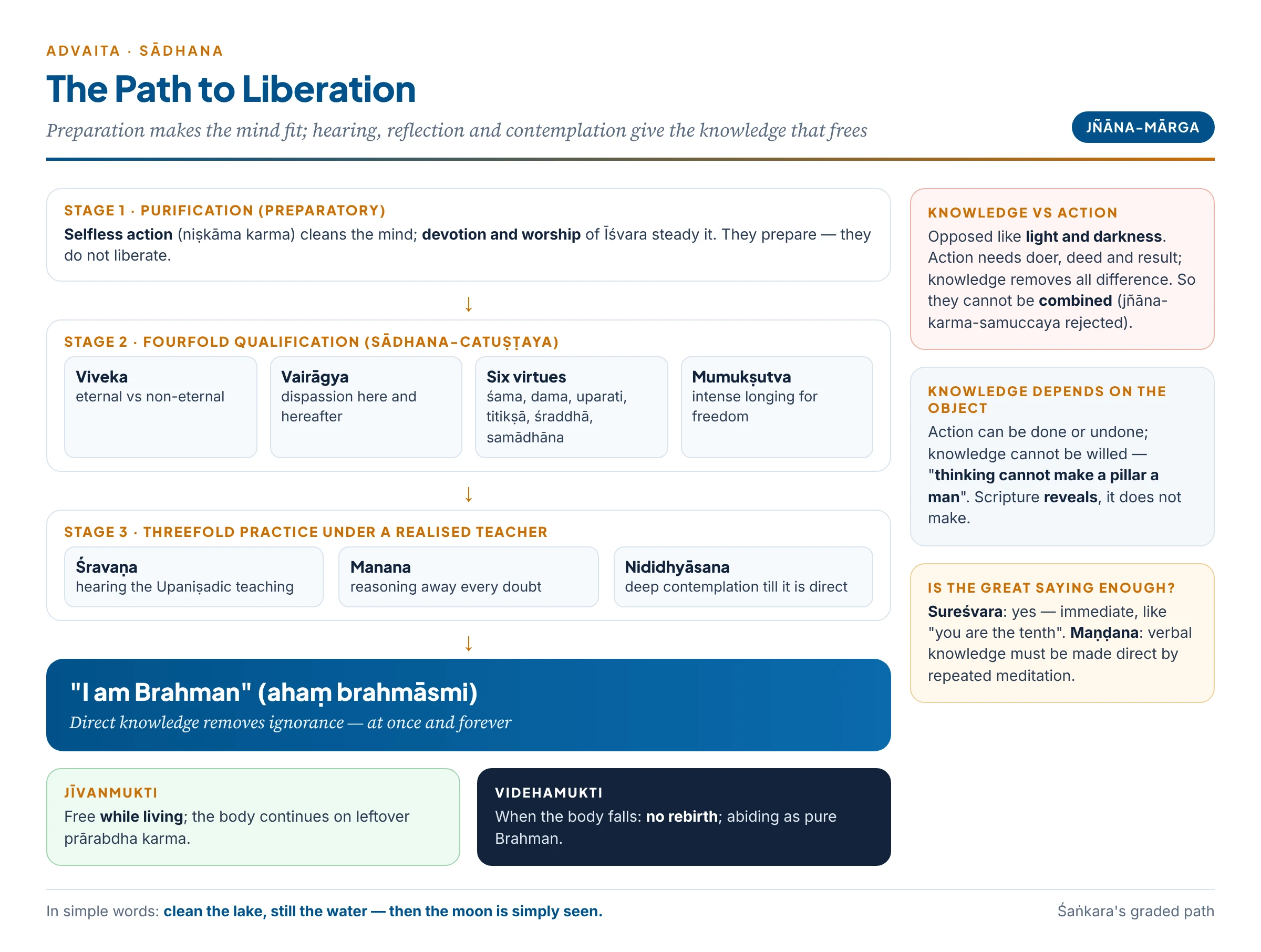
Knowledge liberates, but not everyone is ready to receive it. Śaṅkara lays down four qualifications before the inquiry into Brahman.
- Viveka — discrimination between the eternal and the non-eternal (nityānitya-vastu-viveka). The ability to see that Brahman alone is eternal and the world of names and forms transient.
- Vairāgya — dispassion for the enjoyment of fruits here and hereafter (ihāmutrārtha-bhoga-virāga) — detachment from worldly pleasures and from heaven, rooted in seeing their impermanence.
- Ṣaṭ-sampatti — the six treasures (virtues) of mind-control (śamādi-ṣaṭka-sampatti):
- Śama — control of the mind.
- Dama — control of the senses.
- Uparati — withdrawal from distractions (and from ritual duties).
- Titikṣā — forbearance in pain and pleasure, heat and cold.
- Śraddhā — faith in the scripture and the teacher.
- Samādhāna — concentration, one-pointedness.
- Mumukṣutva — intense longing for liberation, a deep yearning to be free from birth and death.
- These prepare the intellect, emotion and will. With them one should study Vedānta under a teacher who has himself realised Brahman — the knowledge is transmitted, not invented.
The Threefold Practice: Śravaṇa, Manana, Nididhyāsana
- Śravaṇa (hearing). Hearing and studying the Upaniṣadic teaching — especially the great sayings — from the teacher, and grasping their purport.
- Manana (reflection). Rational reflection to remove doubts and objections — “a thing should be understood through reasoning“. Here Śaṅkara’s logic against rivals has its place.
- Nididhyāsana (contemplation). Deep, uninterrupted meditation that assimilates the knowledge until it becomes direct realisation and dissolves the old habits of identification.
- When ignorance is destroyed, knowledge shines by itself. “I am Brahman” (ahaṃ brahmāsmi) dawns; the aspirant is liberated.
- Is the great saying itself enough? Sureśvara (following Śaṅkara): the knowledge from the great saying is immediate and liberates directly — like “you are the tenth“. Maṇḍana Miśra: verbal knowledge is only indirect; it must be made direct by repeated meditation (prasaṅkhyāna). For both, nididhyāsana matters; they differ on whether it is the cause of liberation or the removal of obstacles to it.
Knowledge, Action and Devotion
- Knowledge alone liberates. Śaṅkara repeats that the Absolute is realised through knowledge and knowledge alone. “The opposition of knowledge and action stands firm like a mountain.” They are contradictory, like light and darkness.
- Why they cannot be combined. Action presupposes difference — doer, deed, instrument, result; knowledge of Brahman removes all difference. Action is prescribed for those in ignorance; for the enlightened there is nothing to do.
- Knowledge depends on the object, not on the will. Action can be done, misdone or left undone; injunctions and prohibitions depend on us. But knowledge depends on the thing known — “our thinking cannot make a pillar a man“. Knowledge of Brahman “can neither be produced by a hundred injunctions nor destroyed by a hundred prohibitions”. Scripture reveals; it does not make (jñāpaka, not kāraka).
- No succession in knowledge. Once it dawns, it dawns forever and at once removes all ignorance and bondage.
- The rejection of jñāna-karma-samuccaya. Śaṅkara rejects the view (of the Mīmāṃsakas, Maṇḍana and later Rāmānuja) that knowledge must be combined with Vedic action for liberation: “those who talk of combining knowledge with action have perhaps not read the Bṛhadāraṇyaka”.
- But action and devotion have a real role.
- Disinterested action (niṣkāma karma) — work without attachment, as the Gītā teaches — purifies the mind (sattva-śuddhi, citta-śuddhi) and is necessary for one who has not yet obtained knowledge.
- Devotion (bhakti) and worship (upāsanā) of Īśvara steady and purify the mind, prepare it for knowledge, and lead gradually to the highest truth.
- Their place is preparatory. “Karma and bhakti are subsidiary to jñāna”: they prepare; knowledge liberates.
- Do knowledge, action and devotion all lead to liberation in the Indian tradition? The Gītā presents them as three paths suited to different temperaments; Rāmānuja makes devotion (as intuitive knowledge of God) the direct means; Madhva makes devotion and grace central; Śaṅkara keeps all three but in an order — action purifies, devotion concentrates, knowledge liberates.
In simple words
To see the moon reflected in a lake, the water must be still and clean. Stirring it up hides the moon; cleaning it and letting it settle allows the reflection to appear. Selfless work cleans the water, devotion calms it — but it is the moon, not the cleaning, that you see. Knowledge is the seeing; action and devotion are the cleaning and calming.
Jīvanmukti: Liberation While Living
- Possible because liberation is knowledge. If liberation were a change of place or body, it could come only after death; since it is the removal of ignorance, it can come while the body lives. “That blessed person who has realised Reality is liberated here and now.“
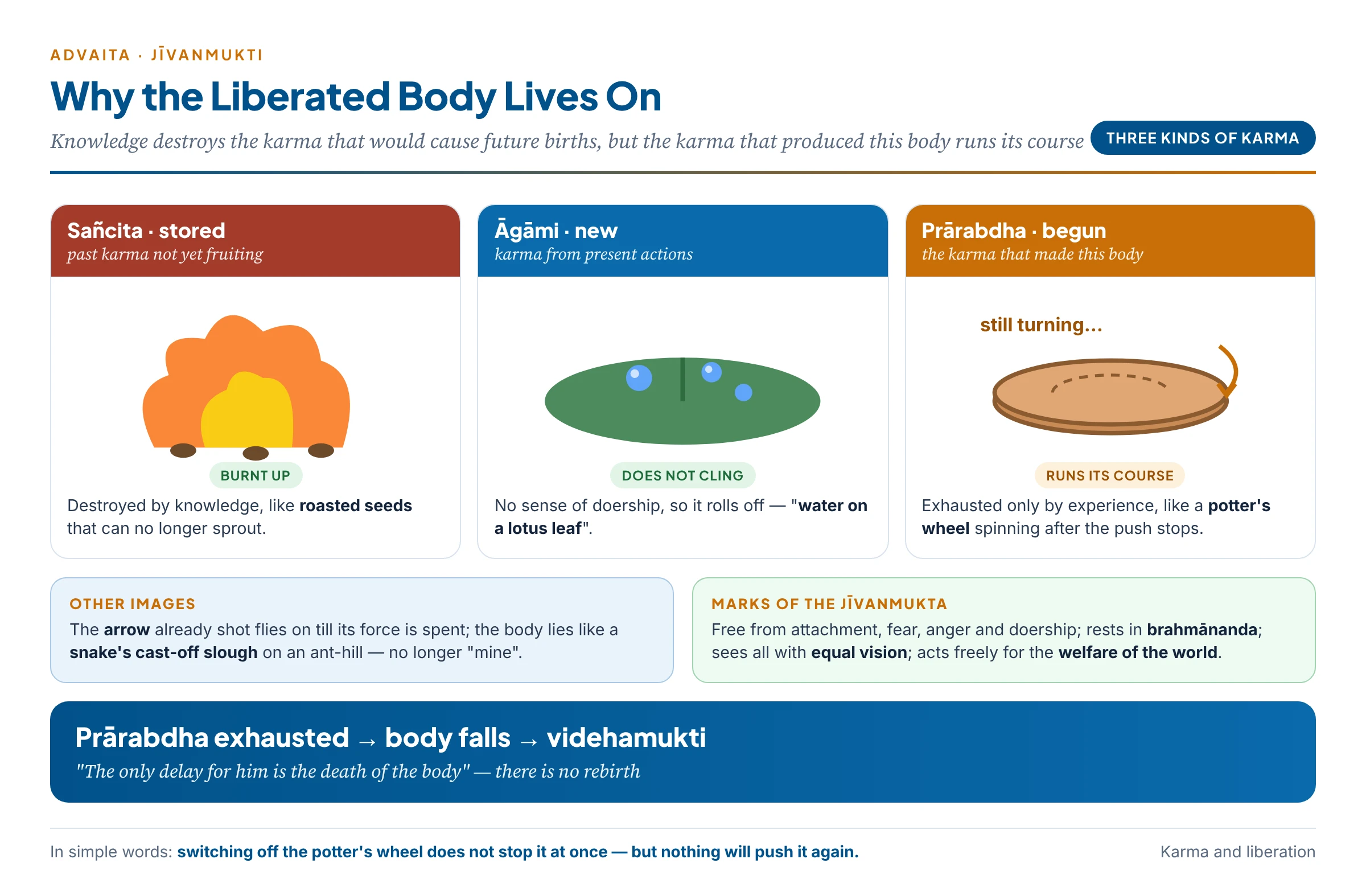
- Why the body continues. Karma is of three kinds:
| Kind of karma | Meaning | Fate on liberation |
|---|---|---|
| Sañcita (accumulated) | The stock of past karma not yet bearing fruit | Burnt up by knowledge, as seeds are roasted |
| Āgāmi / kriyamāṇa (new) | Karma that would accrue from present action | Does not cling — the knower has no sense of doership, “as water does not cling to a lotus leaf” |
| Prārabdha (begun) | The karma that has already begun to bear fruit — it produced the present body | Must run its course; it is exhausted only by being experienced |
- The images of the continuing body.
- The potter’s wheel, which keeps turning for a while after the potter stops pushing it.
- The arrow already shot, which keeps flying until its force is spent.
- The snake’s slough: “as the slough cast off by a snake lies on an ant-hill, so does this body lie” — the liberated person no longer identifies with it.
- Marks of the jīvanmukta.
- Free from attachment, fear and anger; free from doership and desire.
- Established in the bliss of Brahman (brahmānanda).
- Treating all beings with equal vision (sama-darśitva); the Gītā’s sthita-prajña (one of steady wisdom).
- Beyond the compulsion of rituals, caste-duties and desires.
- Still able to act — without fear of bondage, for work binds only when done with attachment. Such a person works for the welfare of the world, as Śaṅkara’s own life of teaching and travel shows.
- Videhamukti (liberation on the body’s fall). When the prārabdha is exhausted and the body falls, there is no further rebirth; the Self abides as pure Brahman, free from every limitation. “The only delay for him is the death of the body.“
- Jīvanmukti and the Gītā. The Gītā’s portrait of the one of steady wisdom, who “abandons all desires of the mind and is satisfied in the Self by the Self“, is the classic description of the jīvanmukta.
In simple words
An actor playing a king on stage weeps, rages and gives orders — yet he never forgets he is an actor. When the play ends, he walks home unchanged. The jīvanmukta plays his part in the world in the same way: the body acts out its remaining karma, but he no longer mistakes the role for himself.
Common confusion
If the jīvanmukta still has a body and still suffers pain, is he really liberated? Many critics (Nyāya, Rāmānuja, and even Maṇḍana among Advaitins) say real liberation comes only after death. Śaṅkara replies that liberation is the end of identification with the body, not the end of the body. Pain may arise in the body, as in a dream one sees a fire, but the knower no longer takes it as “mine”. Sureśvara accepts the jīvanmukta as fully liberated (siddha); Maṇḍana treats him only as an advanced aspirant.
What Kind of Knowledge Liberates?
- Not verbal or intellectual knowledge. If mere study liberated, every scholar of Vedānta would be free. Liberating knowledge is direct, intuitive realisation (aparokṣa-anubhūti, samyag-jñāna) of one’s identity with Brahman.
- Not object-knowledge. It is not knowledge of Brahman as an object, but the removal of the ignorance that hides the Self — “to know Brahman is to be Brahman”.
- Self-validating and final. It is not sublated by any further knowledge; it ends doubt once and for all. “The knot of the heart is cut, all doubts are dispelled, and all karma is destroyed when He is seen.“
- The liberated person’s knowledge is therefore not information but being: the end of the ego’s misidentification and the abiding awareness “I am Brahman”, together with spontaneous compassion and equanimity.
Religious Experience in Advaita
- Its object is not a God over against the self but Brahman as one’s own Self — “religious experience” culminates in non-dual realisation (anubhava).
- Its features.
- Non-duality — the distinction of knower, known and knowing disappears.
- Self-luminosity and immediacy — it is not mediated by senses, inference or concepts.
- Bliss — Brahman is ānanda.
- Noetic certainty — it is knowledge, not mere feeling, and it is never contradicted.
- Ineffability — words, including scripture, point to it but cannot contain it.
- Transformation of life — freedom from fear, desire and ego; equal vision.
- Its relation to scripture and reason. Śruti is the authoritative pointer; reason (manana) removes doubts; but the ultimate criterion of truth in Śaṅkara is immediate spiritual realisation, in which finite intellect “casts off its relational garb” and becomes one with pure consciousness. Later Advaitins such as Vidyāraṇya stress this experiential side.
- Lower forms. Worship of Īśvara gives real experiences of the divine at the empirical level; they purify and lead towards the non-dual.
Liberation without a Real Agent?
- The question. Can there be liberation if there is no real agent who is bound and freed? Rāmānuja says no: someone must be liberated and someone must enjoy liberation.
- Advaita’s answer. The agent (doer and enjoyer) is real at the empirical level and is the one who strives; but liberation is precisely the discovery that the Self was never an agent. “There is none bound, none striving, none liberated — this is the highest truth.” Liberation is not for the agent but from the agent-notion.
- Viśiṣṭādvaita’s answer. The soul is a real knower, doer and enjoyer; liberation is the real soul’s real release from real karma by God’s grace, and it keeps its individuality to enjoy communion with God. “Egoity, not individuality, is the cause of bondage.”
- The difference. For Advaita, individuality itself is part of the bondage; for Viśiṣṭādvaita, individuality is the bearer of liberation.
Critical Evaluation
Objections (Pūrva-pakṣa)
- Over-emphasis on knowledge. The bhakti traditions (Rāmānuja, Madhva) say this undervalues ethical conduct, ritual and devotion stressed in the Vedas.
- The problem of jīvanmukti. Nyāya–Vaiśeṣika and Rāmānuja: as long as pain, pleasure and karmic results are experienced in the body, no one can be truly liberated; real liberation is only after death.
- Mithyā and ethics. If the world is mithyā, why should dharma and social duties matter?
- Neglect of karma. Mīmāṃsakas: if knowledge alone sufficed, the Vedic injunctions would be meaningless; dharma is central, not merely preparatory.
- Elitism. Emphasis on renunciation, study and meditation makes liberation accessible only to a few ascetics and intellectuals, excluding ordinary householders.
- Self-contradiction. If bondage is illusion, liberation is illusion too — what is the point of the whole soteriology? It is “liberating the already liberated“.
- No grace. Rāmānuja and Madhva: without God’s saving grace, human effort and knowledge are insufficient.
- Intellectual, not experiential. Bhakti schools: Śaṅkara makes liberation an intellectual realisation, not a transformation of the whole person.
- Venkaṭanātha. Illusions do not vanish by mere knowledge — the yellowness seen by a jaundiced person goes only with medicine; and if knowledge liberated, Śaṅkara would have merged in Brahman and would not have taught.
- Rāmānuja’s general objection. Bondage is real karma, a concrete reality; abstract knowledge cannot remove it — karma, knowledge, devotion and grace together are needed.
Advaitin Replies (Siddhānta)
- Ethics and devotion are preparatory, not useless — without purification there is no knowledge; Śaṅkara “is never against the paths advocated by Rāmānuja, except that he places jñāna-mārga higher”.
- Jīvanmukti means freedom from identification, not from the body; the potter’s wheel explains why the body continues.
- Mithyā does not license immorality: the world is fully real where ethics operates, and the liberated naturally act for the good of all.
- Root and branches. Karma rests on ignorance (the sense of doership); remove the root, and karma loses its hold.
- Against Venkaṭa. “If a dreamer knows he is dreaming, he is no longer a dreamer”; the jaundiced person who knows the yellowness is illusory is no longer under the illusion, though his body may still need medicine. And the great teachers descend to the empirical plane out of compassion to teach — which is how Śaṅkara taught.
- Grace has a place: knowledge “dawns”, and devotion to Īśvara purifies; later Advaitins even speak of Īśvara’s grace as giving the desire for non-dual knowledge.
- Elitism: the qualifications are inner virtues, not social status; Śaṅkara’s own teaching was public and his monasteries open.
Critics and Defenders
Criticism — Critics
- Rāmānuja: real karma needs more than abstract knowledge; no jīvanmukti while karma persists; grace is essential.
- Madhva: devotion and grace, not identity-knowledge, liberate; the soul stays distinct.
- Mīmāṃsā: Vedic duties become meaningless.
- Venkaṭanātha: knowledge alone cannot cure illusion, as jaundice needs medicine.
- Social critics: a path of renunciation suited only to a few.
Defence — Defenders and strengths
- Śaṅkara: bondage is ignorance, so only knowledge frees — “attaining the already attained”.
- Sureśvara: the great saying gives immediate knowledge, like “you are the tenth”.
- Jīvanmukti: the potter’s wheel and the arrow explain the continuing body; the Gītā’s sthita-prajña is the model.
- Strength: liberation is eternal because it is uncovered, not produced.
- Strength: action and devotion are honoured as preparation, giving a graded path for all temperaments.
Cross-Tradition Comparison
Liberation in Advaita and Other Traditions
| Tradition | Goal | Means | Like Advaita | Unlike Advaita |
|---|---|---|---|---|
| Viśiṣṭādvaita | Eternal service of God in Vaikuṇṭha | Bhakti, prapatti, grace | Knowledge (as intuition of God) needed | Individuality kept; no jīvanmukti |
| Dvaita | Graded bliss near God | Bhakti and grace | Liberation is blissful | Eternal difference, graded bliss, no jīvanmukti |
| Sāṃkhya–Yoga | Isolation of Puruṣa | Discriminative knowledge | Knowledge liberates; jīvanmukti accepted | Many selves; liberation is not bliss |
| Buddhism | Nirvāṇa | Eightfold path, insight | Liberation possible in this life (sopadhiśeṣa) | No self; no positive Brahman |
| Spinoza | “Intellectual love of God” — blessedness | Knowledge of the third kind | Knowledge frees from bondage to passions; eternal aspect of mind | No identity of self and God in the Advaita sense |
| Plotinus | Union with the One | Purification and contemplation | Return to one’s source; ineffable union | Emanationist scheme |
Indian Connect — Key takeaways
- Advaita and Spinoza both make knowledge the means of freedom and blessedness the result; both treat bondage as inadequate understanding.
- Advaita and Buddhism both accept liberation in this life; they differ on whether a positive Self is realised.
- Viśiṣṭādvaita and Dvaita keep the devotee distinct from God in liberation and therefore reject jīvanmukti.
Synthesis (Siddhānta)
- Bondage is ignorance-based misidentification of the ever-free Self with body and mind — doership, enjoyership and saṃsāra — mithyā from the highest standpoint.
- Liberation is the removal of ignorance, not the production of a new state: negative (end of saṃsāra) and positive (bliss of Brahman); not heaven, not a product of action, not a transformation.
- It is “the attainment of the already attained” — the necklace round the neck, the tenth man, the prince among hunters — and therefore eternal.
- The path: sādhana-catuṣṭaya (discrimination, dispassion, six virtues, longing) and śravaṇa–manana–nididhyāsana under a realised teacher.
- Knowledge alone liberates; action and devotion purify and prepare; knowledge and action cannot be combined, being as opposed as light and darkness.
- Jīvanmukti is possible: sañcita karma is burnt, new karma does not cling, prārabdha runs out like a potter’s wheel; videhamukti follows at death.
- Liberating knowledge is direct, self-validating realisation; religious experience culminates in non-dual, blissful, ineffable certainty.
- Critics — Rāmānuja, Madhva, Mīmāṃsā, Nyāya — question knowledge-only liberation, jīvanmukti and the place of grace; Advaita answers by the two standpoints and the preparatory role of action and devotion.
- Contemporary relevance.
- Psychology of freedom. The idea that suffering comes from identification and ends with insight anticipates modern therapies based on de-identification and self-inquiry.
- Engaged spirituality. The jīvanmukta who acts without attachment for the welfare of all is the model behind Vivekananda’s and Gandhi’s ideal of service.
- Ethics without ego. Equal vision (sama-darśitva) offers a ground for universal compassion beyond group identity.
“The knot of the heart is cut, all doubts are dispelled, and all karma is destroyed when That, the higher and the lower, is seen.” — Muṇḍaka Upaniṣad
Previous Year Questions
- 2025Discuss the nature of embodied liberation (Jīvanmukti) with reference to Advaita Vedānta.
- 2024Discuss the main features of religious experience according to Advaita Vedānta.
- 2023Liberation is defined by Advaita Vedāntins as ‘attainment of that which is already attained’. How does Śaṅkara illustrate this statement? Discuss with your own comments.
- 2022Is it possible to have an idea of Liberation without the conception of a real agent? In this context, discuss the difference between Advaita and Viśiṣṭādvaita systems of thought.
- 2021Elucidate the concept of liberation according to Advaita Vedānta. Explain the role of knowledge in the attainment of liberation.
- 2020Do you accept that knowledge, Action and Devotion are the means to attain liberation in Indian tradition? Discuss.
- 2015What is liberation? Briefly discuss the ways to attain it as outlined in the system of Vedānta.
- 2010If ignorance is the cause of suffering, knowledge should remove suffering. What is the notion of knowledge which a liberated person acquires? Discuss.
- 2005What do you understand by liberation? Is it possible for one to be liberated in this very life? If it is, what are the characteristics of a liberated person? Discuss.
- 2002Advaita Vedānta theory of jīvanmukti (critical note).
- 2001Evaluate Śaṅkara’s analysis of mokṣa in the light of Rāmānuja’s arguments.