

Schools of Vedānta: Brahman; Īśvara; Ātman; Jīva; Jagat; Māyā; Avidyā; Adhyāsa; Mokṣa; Apṛthaksiddhi; Pañcavidhabheda.
Official Syllabus: Paper I, Section B, Unit 19
How does the one, changeless Brahman come to appear as a world of many changing things, and the infinite Self as a limited, suffering individual? Śaṅkara’s answer uses three closely linked ideas. Adhyāsa (superimposition) is the basic error — seeing one thing as another, as a rope is seen as a snake; avidyā (ignorance) is the beginningless not-knowing that produces this error; māyā is the cosmic power, belonging to Brahman, through which the world-appearance is projected. Both avidyā and māyā are anirvacanīya — “indescribable as either real or unreal“. This article explains Śaṅkara’s famous preface on superimposition, the two powers of concealing and projecting, why māyā is neither real nor unreal, how māyā differs from avidyā, where ignorance resides, the Advaita theory of error (anirvacanīya-khyāti) and its defence against Nyāya and Mīmāṃsā, and the debate on self-luminous knowledge and intrinsic validity.
In simple words
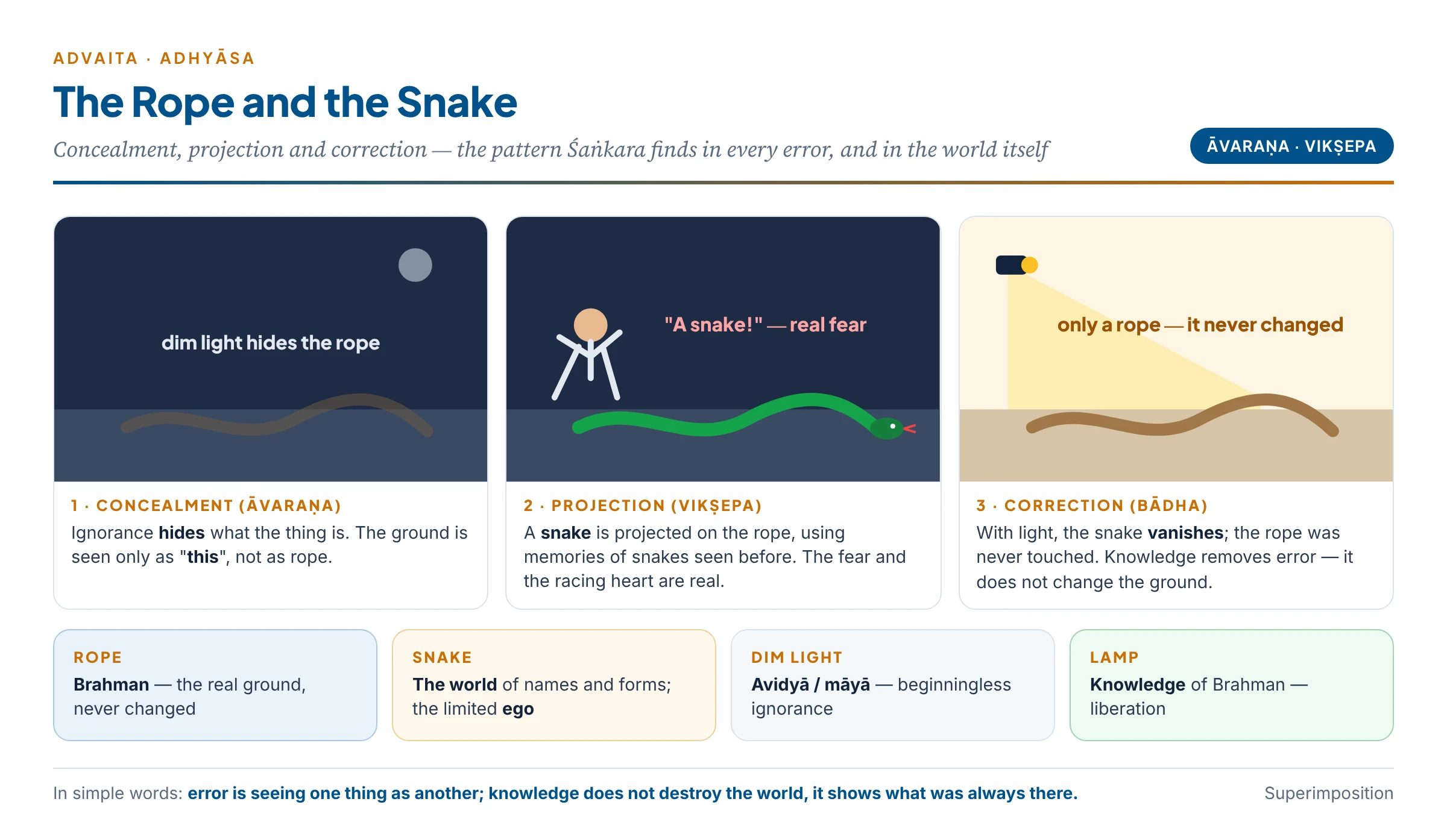
Walking home at dusk you see a snake on the path and jump back, heart pounding. You shine a torch — it is a coil of rope. Three things happened: the dim light hid the rope; your mind put a snake in its place; and the snake was real enough to make your heart race, yet unreal enough to vanish the moment you saw clearly. Advaita says our whole experience of the world and of ourselves as limited beings works like this — with Brahman as the rope.
Context & Problem
Why Advaita Needs These Concepts
- The puzzle. Brahman alone is real, one and changeless; yet we experience plurality, change, individuality and suffering. If Brahman really changed into the world, it would lose its perfection; if the world were nothing, we could not experience it.
- The solution. The world and the individual are appearances on Brahman — like the snake on the rope — produced by ignorance. Appearance is a third possibility between “real” and “nothing”.
- The words used. Many words are used almost interchangeably in Vedānta — māyā, avidyā, ajñāna, adhyāsa, adhyāropa, anirvacanīya, vivarta, bhrānti, bhrama, nāma-rūpa, avyakta, bīja-śakti, mūla-prakṛti. Of these, māyā, avidyā, adhyāsa and vivarta are the most important; Śaṅkara himself often uses them as near-synonyms.
Core Doctrine
Adhyāsa: Śaṅkara’s Preface on Superimposition
Śaṅkara opens his commentary on the Brahmasūtra not with Brahman but with a short preface on superimposition (the adhyāsa-bhāṣya), because the whole purpose of Vedānta is to remove it.
- Subject and object are opposed like light and darkness. The subject — what is referred to by “I” (asmad) — is pure consciousness; the object — what is referred to by “you / this” (yuṣmad) — is unconscious. They are “by nature opposed, like light and darkness“, and neither they nor their attributes can be identical.
- Yet we mix them. It is the natural and universal practice of people to superimpose the object and its attributes on the subject, and the subject and its attributes on the object — “coupling the real and the unreal” (satyānṛte mithunīkṛtya) — and to say “I am this“, “this is mine“.
- Definitions of adhyāsa.
- “The appearance, in the form of a memory, of something previously seen, in another place” (smṛti-rūpaḥ paratra pūrva-dṛṣṭāvabhāsaḥ) — snakes seen before appear on the rope now.
- “The notion of a thing in what is not that thing” (atasmin tad-buddhiḥ).
- “The appearance of one thing with the attributes of another” (anyasya anya-dharmāvabhāsatā).
- Everyday examples. A shell seen as silver; one moon seen as two by a person with defective eyes; the colourless sky seen as blue and dome-shaped.
- Two directions of superimposition.
- Not-self on the Self. The body, senses and mind — and their attributes — are superimposed on the Self: “I am fat“, “I am blind“, “I am happy“, “I am the doer“. (Even outer things: “when my son or wife is hurt, I am hurt”.)
- Self on the not-self. The Self’s consciousness is superimposed on the mind and body, so they seem to be conscious knowers.
- It is beginningless and natural. This cycle of superimposition has no beginning (anādi); it produces the notions of agent and enjoyer and underlies all practical life. Even learned people who distinguish subject from object in theory confuse them in practice, “like ordinary goatherds and shepherds“.
- It is not figurative. Saying “I am fat” is not a metaphor (gauṇa), like “the boy is a lion”; it is a genuine error (mithyā).
- It is the presupposition of all knowledge and action. All means of knowledge, all scriptural injunctions, all distinctions of knower and known presuppose superimposition: only one who takes himself to be a body uses the eyes, performs rituals, seeks heaven. The study of Vedānta is undertaken to free oneself from this false notion and realise the unity of the Self.
- Superimposition needs a ground. There is no superimposition without a substratum (adhiṣṭhāna): no snake without a rope. And the ground must be partly known and partly unknown — the rope must be seen as “this”, but not as rope. In the world-error, Brahman is known as “existence” (“it is”) but not as Brahman.
“This superimposition, thus defined, the learned call ignorance (avidyā); and the ascertainment of the true nature of the thing by discriminating it, they call knowledge (vidyā).” — Śaṅkara, preface to the Brahmasūtra commentary
Concealment and Projection (Āvaraṇa and Vikṣepa)
Ignorance works through two powers:
| Power | What it does | In the rope–snake | In the world |
|---|---|---|---|
| Āvaraṇa-śakti (veiling, concealing) | Hides the real nature of the ground | Darkness hides the rope | Brahman’s nature as pure consciousness is hidden |
| Vikṣepa-śakti (projecting) | Projects something else in its place | The snake is projected on the rope | The world of names and forms (nāma-rūpa), and the limited ego, are projected |
- Ignorance is thus both non-apprehension (not seeing the rope) and misapprehension (seeing a snake). Śaṅkara notes three forms: wrong knowledge, doubt, and absence of knowledge.
Is Adhyāsa Logical or Psychological?
- The psychological reading. Adhyāsa looks like a psychological process — like projection in psychology, where one thing is perceived as another. Every jīva feels it: the false sense of identity with the body, the false sense that the world is independently real. In this sense it is experienced as a psychological fact.
- The logical reading. On reflection, adhyāsa is better seen as a logical (or transcendental) postulate. Two statements seem to clash:
- “The changeless Brahman alone is real” (from scripture and reason);
- “The changing world with many jīvas and things is real” (from experience).
They are reconciled only by saying that Brahman is concealed and projected as the world — superimposition. Adhyāsa is what must be supposed if both truths are to stand.
- Why it cannot be merely psychological.
- A psychological error belongs to an individual mind; but the mind and the individual are themselves products of adhyāsa. The error that produces the person cannot be an event in the person.
- We never experience the world vanishing in ordinary life; the world-error is not like a passing illusion. It is the condition of all experience — “the presupposition of all practices of this phenomenal world“.
- It is beginningless and universal, not caused by a particular defect of eye or light.
- A balanced answer. Adhyāsa has a psychological face (it is lived as ego and attachment) but a logical–transcendental foundation (it is the necessary condition of empirical experience). It is “more logical than psychological” — a postulate of Advaita metaphysics confirmed in experience.
In simple words
A pair of tinted glasses can explain why one person sees the world green — that is psychology. But if everyone has always worn the glasses, and the glasses are part of what makes anyone a “seer” at all, they are no longer a private mistake; they are the frame of all seeing. Adhyāsa is like glasses of the second kind — which is why it is called transcendental rather than merely psychological.
Significance of Adhyāsa for Śaṅkara’s Metaphysics
- Explains the world. The world is Brahman with names and forms superimposed — the basis of vivartavāda.
- Explains the jīva. The individual self is the Self with the body–mind superimposed — the basis of the jīva theories.
- Explains Īśvara. God is Brahman with the cosmic adjunct of māyā — creatorship is a superimposed (indicative) feature.
- Explains bondage. “I am the doer, the enjoyer, the one who is born and dies” is superimposition — bondage is adhyāsa.
- Defines liberation. Liberation is not a change of state but the removal of superimposition by knowledge, as the snake vanishes when the rope is seen.
- Grounds the theory of error (anirvacanīya-khyāti) and the three levels of reality.
- Keeps Brahman unaffected. The ground is never touched by what is superimposed — “mirage-water cannot make the desert muddy“.
Māyā: Brahman’s Indescribable Power
- Meaning. Māyā has been explained as “that which is not” — the power responsible for the appearance, projection or illusion of the world on Brahman.
- Characteristics of māyā (or avidyā).
- Material and unconscious (jaḍa). Like Sāṃkhya’s Prakṛti it is unconscious, as opposed to Brahman, which is consciousness — but unlike Prakṛti it is neither real nor independent.
- Brahman’s power (śakti). It is the inherent power of Brahman, coeval with it, dependent on and inseparable from it. Its relation to Brahman is unique — neither identity nor difference — called tādātmya.
- Beginningless (anādi). We cannot ask when it began, for time itself is within it. Yet it is ended by knowledge (sānta): “beginningless but removable”, as darkness has no starting date in a cave yet vanishes when a lamp is lit.
- Positive (bhāva-rūpa) though not real. It is called “positive” to stress that it is not merely an absence of knowledge; it actively projects. It is both non-apprehension and misapprehension.
- Indescribable (anirvacanīya, sad-asad-vilakṣaṇa) — see below.
- Phenomenal (vyāvahārika). It operates at the empirical level; it is an appearance only (vivarta).
- Of the nature of superimposition (adhyāsa).
- Removable by right knowledge (vijñāna-nirasyā). When knowledge dawns, ignorance vanishes, as the rope-snake vanishes when the rope is known.
- Its locus and object is Brahman (on the main view), yet Brahman is untouched by it — as a magician is not deceived by his own magic, or as the colourless sky is untouched by the blue we attribute to it.
- Harmless to reality. Māyā can do no harm to Reality, just as mirage-water cannot make the sandy desert muddy.
- The philosophical roles of māyā.
- Cosmological — explains how the manifold universe arises from Brahman without compromising Brahman’s changelessness (through vivarta).
- Epistemological — explains error: we project false attributes (body, mind, world) on the Self.
- Soteriological — explains bondage and liberation: ignorance binds, knowledge frees.
- Theological — explains how the one Brahman is conceived as a personal God by the worshipper, and how jīvas appear as many.
In simple words
A desert mirage shows a lake. Is the lake real? No — walk to it and there is only sand. Is it nothing? No — everyone on the road sees it, and it can even be photographed. It is something that appears without being. That in-between status is what Advaita means by “indescribable” — and the sand, which never got wet, is Brahman.
Why Avidyā and Māyā Are Called Anirvacanīya
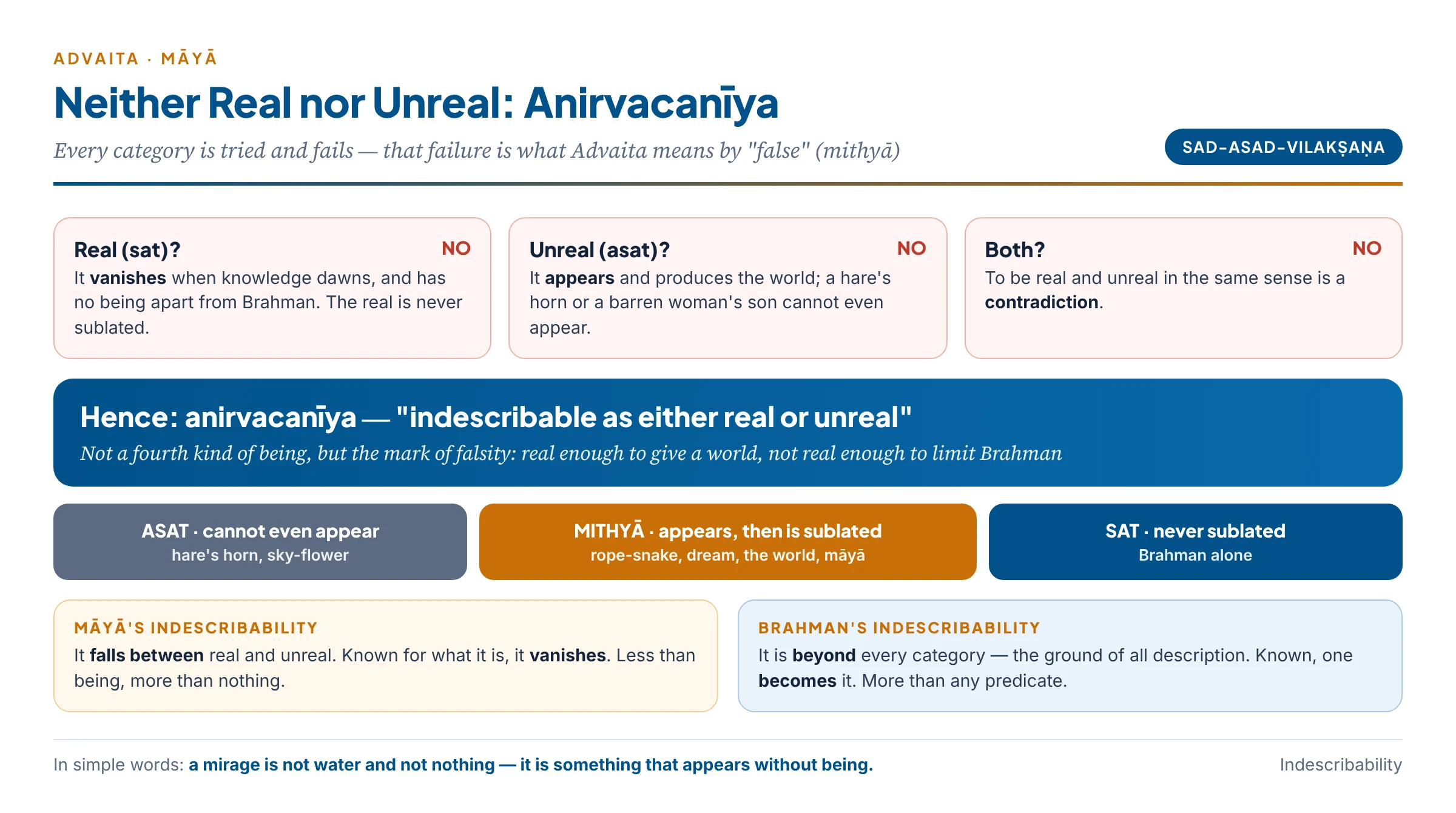
Māyā is “indescribable as either real or unreal” (sadasadbhyām anirvacanīyā). The reasoning runs through all the possibilities:
| Could māyā be… | Answer | Reason |
|---|---|---|
| Real (sat)? | No | It has no existence apart from Brahman; it vanishes when knowledge dawns; what is real is never sublated |
| Unreal (asat)? | No | It appears and produces the world of experience; it is true as long as it lasts; the utterly unreal — a hare’s horn, a barren woman’s son — cannot even appear |
| Both real and unreal? | No | That would be self-contradictory |
| Hence | Anirvacanīya | Not a fourth “kind of being” but the failure of both categories to apply — the mark of falsity (mithyātva) |
- It is not real enough to limit Brahman, yet real enough to give rise to the world of appearance.
- Indescribability is not inability. “Indescribable” does not mean that nothing can be said about māyā — much is said. It means it cannot be described as either real or unreal. A later Advaitin puts it sharply: indescribability “lies in showing that every way in which the opponent wishes to describe it is untenable“. When Udayana mocks it as mere “silence of the ignorant“, he misses this meaning.
- A merit, not a defect. “The inexplicability of avidyā is its ornament, not its fault” — if avidyā were consistent and explicable, it would be real and would not be avidyā. Its self-contradictory nature is seen only when one rises above it, as the falsity of a dream is seen only on waking.
- Positive ignorance in experience. Two examples show that ignorance is something we positively experience:
- “I do not know whether what you say is true” — what is said is known, but its truth is positively not known.
- On waking from deep sleep: “I slept happily; I knew nothing” — a remembered experience of ignorance.
Two Kinds of Indescribability: Brahman and Māyā
| Brahman’s anirvacanīyatā | Māyā’s anirvacanīyatā | |
|---|---|---|
| Why indescribable | Brahman is beyond all categories — too full, the ground of all description | Māyā falls between the categories of real and unreal |
| Ontological status | Supremely real (pāramārthika sat) — never sublated | False (mithyā) — sublated by knowledge |
| What it means | No predicate can capture it; pointed to by neti neti | It is neither sat nor asat — the definition of falsity |
| Known how | Realised directly as the Self | Seen through and dissolved by knowledge |
| Result of knowing it | One becomes Brahman | It vanishes |
| Analogy | Light that shows everything but cannot itself be pointed at as an object | The snake in the rope — neither there nor nothing |
- In short: Brahman is indescribable because it is more than any category; māyā because it is less than being and more than nothing. To confuse the two would make Brahman false or māyā real.
Māyā and Avidyā: Same or Different?
- Śaṅkara and most Advaitins treat them as synonyms, distinguishing only the two aspects — concealment and projection.
- Others distinguish them.
| Māyā | Avidyā | |
|---|---|---|
| Scope | Cosmic, universal — also called root ignorance (mūlāvidyā) | Individual — also called derivative ignorance (tūlāvidyā) |
| Character | Positive power of projection, an indistinguishable śakti of Brahman | Negative — absence of knowledge of reality |
| Conditions | Īśvara, who controls it (māyā-pati) | The jīva, who is controlled by it |
| Composition | Mostly pure sattva | All three guṇas — sattva mixed with rajas and tamas |
| Removable? | Not dispelled — it is Brahman’s power | Dispelled by the individual’s knowledge |
| Brahman reflected in it | Īśvara | Jīva |
- The difference is only in words. Both schools agree that Īśvara is free from the negative, concealing side of ignorance and that sattva predominates in him. Whether concealment is called avidyā and projection māyā, or both are called by either name, “the fundamental position remains the same“.
- Root and derivative ignorance. The ignorance responsible for the normal waking world is the public, relatively permanent root ignorance (mūlāvidyā); that responsible for a temporary illusion like the rope-snake is a private derivative ignorance (tūlāvidyā).
Where Does Avidyā Reside? The Locus Debate
- The question. If ignorance exists, whose is it? Where does it reside (āśraya), and what does it cover (viṣaya)?
- Śaṅkara’s attitude. Questions like “What is avidyā? Whose is it? Where does it appear?” are useless: if avidyā is not known, they cannot be answered; if its nature is known, it has already vanished. Brahman itself is the locus and object of avidyā.
- The two schools after Śaṅkara.
| Vivaraṇa school (Sureśvara, Padmapāda, Prakāśātman, Sarvajñātman) | Bhāmatī school (Maṇḍana, Vācaspati Miśra) | |
|---|---|---|
| Locus of avidyā | Brahman | The jīva |
| Object of avidyā | Brahman | Brahman |
| Number of avidyās | One cosmic ignorance | Many — one for each jīva |
| Reason | Only Brahman exists, so only it can be the seat; the jīva is a product of avidyā and cannot be its seat | Brahman is pure knowledge and cannot harbour ignorance; if Brahman were ignorant, liberation of one would liberate all |
| Answer to circularity | — | Jīva and avidyā form a beginningless cycle, like seed and sprout; or a beginningless chain of illusions, each due to the one before |
| Jīva theory | Reflection (pratibimba) | Limitation (avaccheda) |
- Maṇḍana’s bold reply. Avidyā belongs neither to Brahman nor to the jīvas — “this should not shock us, because avidyā is itself an inconsistent category; if it were consistent, it would not be avidyā”.
- Sarvajñātman’s middle way. Avidyā resides neither in the jīva (its product) nor in pure Brahman (which it cannot touch), but in Brahman as it shows itself as the inner self (pratyak-cit).
- Why it matters. Rāmānuja’s first and most famous objection — “Where does avidyā reside?” — attacks exactly this point. (See the article on Rāmānuja’s critique.)
Common confusion
Is “Brahman is the locus of avidyā” the only Advaita view? No. It is Śaṅkara’s and the Vivaraṇa school’s view. The Bhāmatī school holds that the jīva is the seat of ignorance and Brahman only its object. Many notes state one of these as “the” Advaita position; both are Advaita, and they differ precisely on this question.
The Advaita Theory of Error: Anirvacanīya-khyāti
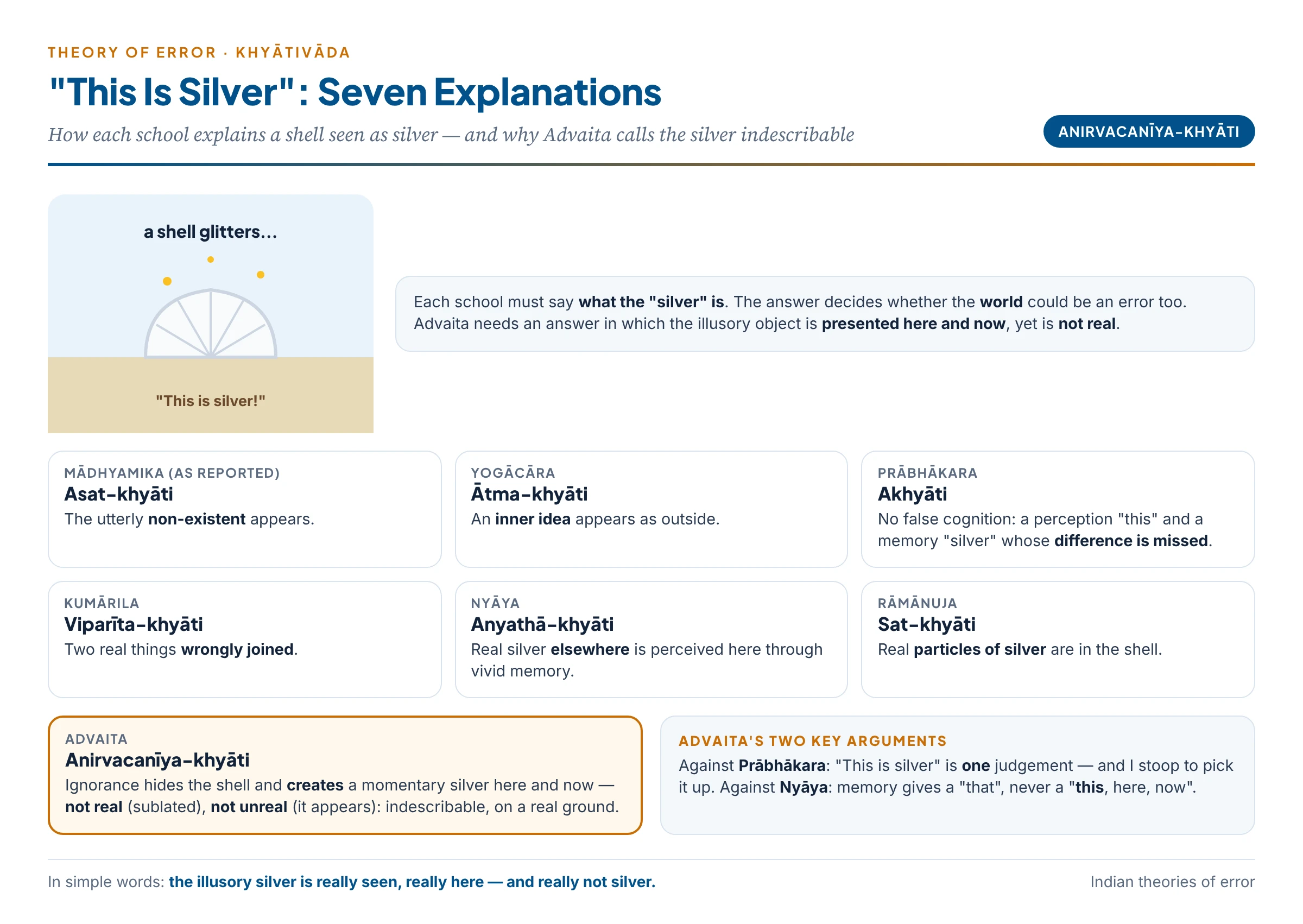
Every Indian school had to explain perceptual error — seeing a shell as silver, a rope as a snake — because the explanation of error decides whether the world could be an “error” too.
| Theory | School | What is the “silver”? |
|---|---|---|
| Asat-khyāti (apprehension of the non-existent) | Mādhyamika (as reported) | The utterly non-existent appears |
| Ātma-khyāti (apprehension of one’s own idea) | Yogācāra | An inner idea appears as outside |
| Akhyāti (non-apprehension) | Prābhākara Mīmāṃsā | No false cognition at all — a perception (“this”) and a memory (“silver”) whose difference is not grasped |
| Viparīta-khyāti (contrary apprehension) | Kumārila (Bhāṭṭa) | Two real things wrongly synthesised |
| Anyathā-khyāti (apprehension otherwise) | Nyāya | Real silver existing elsewhere is perceived here through the vivid memory (extraordinary perception) |
| Sat-khyāti (apprehension of the real) | Rāmānuja | Real particles of silver are present in the shell |
| Anirvacanīya-khyāti (apprehension of the indescribable) | Advaita | An indescribable silver, created for the moment by ignorance, neither real nor unreal |
Against Prābhākara’s akhyāti:
- The judgement “This is silver” is one cognition, not two placed side by side. If perception and memory merely lay undiscriminated, we would have two judgements — “I perceive this” and “I remember silver”.
- In error the silver is predicated of the present “this” — there is a positive identification, not mere non-recognition of difference.
- Without such identification the reaction — stooping to pick up the silver, running from the snake in fear — would be unexplained.
- As long as the error lasts, the object is not remembered but actually presented.
Against Nyāya’s anyathā-khyāti:
- A memory, however vivid, is always of a “that” (there, then), never of a “this” (here, now). The presence of the illusory object remains unexplained.
- To say a memory-idea can transport a real object from another time and place to here and now is absurd.
- Nyāya itself has to call this an “extraordinary” perception — an admission that the illusory object is presented here and now though not real here.
- Hence one must admit that what does not exist here can appear as present, due to ignorance of the thing that is here.
The Advaita account.
- Through defective senses, poor light or similarity, ignorance conceals the shell (or rope) and, aided by a revived memory, creates an apparent silver (or snake) here and now.
- This silver is a temporary creation of ignorance (anirvacanīya-sṛṣṭi). It is not real (it is sublated by the later perception of shell) and not unreal (it appears, unlike a barren woman’s son). Hence it is indescribable.
- The illusory object has a real ground: shell (or Brahman). Advaita error is never “nothing appearing” (as with the nihilist) or “an idea appearing outside” (as with the subjectivist); there is always the background of pure existence.
- Even illusions are objective — they are created and presented, not merely imagined. Advaita is here “more realistic than ordinary realists“: it grants objectivity even to illusions, but denies that objectivity implies reality.
- From the snake to the world. Śaṅkara’s definition — “the appearance of what was previously seen, in another place” — applies to the world too: through ignorance we superimpose on pure existence the forms experienced in previous lives in a beginningless series. Even without this hypothesis, every illusion demonstrates that what does not really exist can appear as real.
- A simple illustration of the subjective root. People walking at night each feel that “the moon is following me“. The moon is fixed; the “moving moon” is created by each walker’s situation. The I-centred standpoint (ahaṅkāra, “this is mine“) produces a world of separate, “my” objects in the same way.
Self-luminous Knowledge and Intrinsic Validity
Two separate questions are often confused:
- Svayaṃprakāśa-vāda — is cognition self-revealing (known in the very act of knowing), or is it known by another cognition?
- Svataḥ-prāmāṇya-vāda — is the validity (truth) of a cognition known intrinsically (by the same conditions that produce it), or extrinsically (by further checking)?
| School | Cognition self-revealing? | Validity intrinsic? | Notes |
|---|---|---|---|
| Nyāya | No — a cognition is known by a later introspective cognition (anuvyavasāya) | No — validity known by successful action (parataḥ-prāmāṇya) | Consistent: both rejected |
| Prābhākara Mīmāṃsā | Yes — every cognition reveals knower, known and itself together (tripuṭī) | Yes | Both accepted |
| Bhāṭṭa Mīmāṃsā | No — cognition is inferred from the “knownness” (jñātatā) it produces in the object | Yes | Intrinsic validity without self-luminosity |
| Advaita | Yes — consciousness is self-luminous; cognitions are lit by the witness (sākṣī) | Yes — the witness that reveals a cognition also reveals its validity; invalidity is extrinsic | Both accepted |
- Does self-luminosity necessarily lead to intrinsic validity? Not necessarily — they answer different questions. The Bhāṭṭa case shows that one can hold intrinsic validity without self-luminosity; and one could hold that a cognition reveals itself but that its truth must still be checked against the world.
- But they fit together naturally. If a cognition is self-revealing, it seems natural that it reveals itself as it is — including its claim to truth — unless a defect is later found. Hence Prābhākara and Advaita accept both, while Nyāya, rejecting self-revelation, consistently also rejects intrinsic validity.
- Advaita’s version. All knowledge is valid unless contradicted; only the knowledge of Brahman is never contradicted. Empirical cognitions are intrinsically valid at the empirical level, though sublatable by higher knowledge.
Advaita Accepts the Pramāṇas
- Advaita is often thought to reject ordinary knowledge because it calls the world mithyā. In fact, at the empirical level it accepts six pramāṇas — perception, inference, testimony, comparison, postulation (arthāpatti) and non-cognition (anupalabdhi) — largely following the Bhāṭṭa Mīmāṃsā (“in empirical matters, the Bhāṭṭa method“).
- These means of knowledge are valid within the world of superimposition; they cannot reveal Brahman, which only the Upaniṣads reveal — and then only by removing ignorance, not by making Brahman an object.
Critical Evaluation
Objections (Pūrva-pakṣa)
- Rāmānuja’s seven objections — no locus for avidyā; it cannot conceal self-luminous Brahman; its nature (positive or negative) is incoherent; “indescribable” breaks the laws of thought; no pramāṇa proves it; no knowledge can remove it; nothing positive can be removed by knowledge. (Treated fully in the article on Rāmānuja’s critique.)
- Madhva. Māyā is God’s will, not an illusion; the world is fully real. To brand a perceived object false needs a stronger pramāṇa than perception, and none exists.
- Nyāya. Error is a mistaken cognition of real things, not the projection of an indescribable world; “indescribable” is the silence of ignorance.
- Logical objections. A category between real and unreal violates the law of excluded middle; calling māyā “indescribable” is already a description.
- Moral objection. If the world is a product of ignorance, ethics and duty seem to lose their seriousness.
Advaitin Replies (Siddhānta)
- “Real” and “unreal” are used in the absolute sense. Real = real for all time; unreal = absolutely unreal like a hare’s horn. These are contraries, not contradictories; they do not exhaust all possibilities, so the law of excluded middle is not broken. Advaita never says māyā is real and unreal from the same standpoint.
- Indescribability is a genuine limit of finite intellect, not verbal jugglery; its contradictory nature is part of what it is to be false.
- Locus. Brahman can be the seat of avidyā without being touched — as the rope is unaffected by the snake; or, with Vācaspati, avidyā and the jīva determine each other in a beginningless cycle — the same move Rāmānuja makes when he says karma and the soul are related from beginningless time.
- Means of knowing avidyā. It is known by postulation (arthāpatti) — as the only way to reconcile the unity of Brahman with the experience of plurality — and by the witness that reveals “I do not know”.
- Ethics. The world is fully real at the empirical level, where ethics applies; and ethical discipline is the preparation for knowledge.
Critics and Defenders
Criticism — Critics
- Rāmānuja: avidyā has no locus, no coherent nature, no proof and no remover; “indescribable” refuses to think.
- Madhva: māyā is God’s will; perception cannot be overruled without a stronger pramāṇa.
- Nyāya: error is misperception of real things; “indescribable” is silence.
- Logicians: a third status between real and unreal breaks the laws of thought.
Defence — Defenders and strengths
- Śaṅkara: adhyāsa is the presupposition of all experience; its removal is the purpose of Vedānta.
- Advaitins: real and unreal (absolutely) are contraries, not contradictories; indescribability is the mark of falsity.
- Theory of error: the presence of the illusory object here and now defeats akhyāti and anyathā-khyāti.
- Strength: one concept (superimposition) explains world, jīva, God, bondage and liberation.
- Strength: grants objectivity even to illusion while keeping Brahman untouched.
Cross-Tradition Comparison
Māyā and Western Ideas of Appearance
| Thinker | Doctrine | Like māyā | Unlike māyā |
|---|---|---|---|
| Plato | The Cave — shadows taken for reality | The everyday world is a lower grade of reality; knowledge is turning around | Shadows are of real Forms; no “indescribable” status |
| Kant | Phenomena shaped by forms of intuition and categories | We know things only as they appear through our own forms | Kant’s phenomena are not illusion and not sublatable by any human knowledge |
| Bradley | Appearance and Reality — contradictions show finite things are appearances | Contradiction as the mark of appearance; appearances are not nothing | Bradley’s Absolute includes appearances as its content |
| Berkeley | Objects are ideas in minds | — | Śaṅkara rejects subjective idealism: the world is public and objective |
| Schopenhauer | The world as representation, the “veil of Māyā” | Borrowed the term from Vedānta | The thing-in-itself is blind Will, not blissful consciousness |
Indian Connect — Key takeaways
- Śaṅkara and Kant both distinguish how things appear from what is ultimately real; but for Śaṅkara the ultimate is knowable by realisation, for Kant not at all.
- Śaṅkara and Bradley both make contradiction the mark of appearance — an “appearance” is not nothing, but it is not the whole truth.
- Śaṅkara’s anirvacanīya-khyāti stands against Nyāya’s realism and Yogācāra’s idealism alike: the illusory object is objective but not real.
Synthesis (Siddhānta)
- Adhyāsa is the superimposition of one thing on another — the appearance of what was previously seen in another place, the notion of a thing in what it is not. Subject and object, opposed like light and darkness, are mixed in a beginningless, natural error: “I am the body“.
- Ignorance works by concealing (āvaraṇa) the ground and projecting (vikṣepa) something else, as the rope is hidden and a snake appears.
- Adhyāsa has a psychological face but a logical–transcendental basis: it is the necessary condition of empirical experience and the key to Śaṅkara’s whole metaphysics — world, jīva, Īśvara, bondage, liberation.
- Māyā is Brahman’s unconscious, beginningless, positive, removable, indescribable power; it explains the world without changing Brahman.
- Avidyā and māyā are anirvacanīya: not real (sublated), not unreal (they appear), not both (contradiction) — the mark of falsity. Brahman, by contrast, is indescribable because it is beyond all categories.
- Māyā and avidyā are synonyms for Śaṅkara, cosmic and individual for others; the locus of avidyā is Brahman (Vivaraṇa) or the jīva (Bhāmatī).
- Anirvacanīya-khyāti defeats akhyāti and anyathā-khyāti by the presence of the illusory object here and now, and grants objectivity to illusion while denying its reality.
- On self-luminosity and intrinsic validity, Advaita accepts both; the Bhāṭṭa shows they are logically distinct, though they fit together.
- Contemporary relevance.
- Cognitive science. Perception is increasingly understood as the brain’s construction or “best guess”, which can mislead — a modern echo of superimposition.
- Psychology. Projection, identification with roles and the “constructed self” parallel adhyāsa’s psychological face.
- Philosophy of physics. Debates on whether the world of everyday objects is “emergent” or “apparent” relative to a deeper reality revive the question of degrees of reality.
“Inexplicability is the ornament of avidyā, not its defect.” — an Advaita maxim (durghaṭatvam avidyāyā bhūṣaṇaṃ na tu dūṣaṇam)
Previous Year Questions
- 2021How do the advocates of anirvacanīya-khyāti refute the position of the Naiyāyikas and establish the position of Advaitins regarding the problem of error? Critically discuss.
- 2018What is the difference between the indescribability (Anirvacanīyatā) of Brahman and the indescribability (Anirvacanīyatā) of Māyā in the Advaita Vedānta system? Discuss.
- 2018Does the admission of Svayaṃprakāśavāda necessarily lead to the admission of Svataḥprāmāṇyavāda? Discuss after the Naiyāyikas, the Mīmāṃsakas and the Advaita Vedāntins.
- 2014Bring out the significance of the concept of adhyāsa in Śaṅkara’s philosophy to develop his metaphysics.
- 2012Explain why avidyā and māyā are considered anirvacanīya (indescribable) in Advaitavāda?
- 2010Is Śaṅkara’s concept of adhyāsa logical or psychological? Discuss.
- 2006Examine Śaṅkara’s Māyāvāda (short note).
- 2005Elucidate Śaṅkara’s conception of Adhyāsa.