

Schools of Vedānta: Brahman; Īśvara; Ātman; Jīva; Jagat; Māyā; Avidyā; Adhyāsa; Mokṣa; Apṛthaksiddhi; Pañcavidhabheda.
Official Syllabus: Paper I, Section B, Unit 19
Who am I? For Śaṅkara the answer has two layers. The Ātman — the true Self — is pure, self-luminous consciousness, eternal, changeless, the witness (sākṣī) of every experience, and identical with Brahman. The jīva — the individual, empirical self that says “I am fat, I am sad, I am the doer” — is that same consciousness appearing as limited because it is wrongly identified with the body and mind. The many jīvas are real for practical life, but in essence each is Brahman. This article explains how Śaṅkara proves the Self, how he analyses it through the three states and five sheaths, the role of the ego (ahaṅkāra) and the witness (sākṣī), the post-Śaṅkara theories of how the one becomes many — reflection (bimba–pratibimba), limitation (avaccheda) and semblance (ābhāsa) — and the Advaita reading of the great saying “That thou art” (tat tvam asi).
In simple words
Think of the sun shining on a hundred pots of water. You see a hundred suns — one shaking in a pot that is being carried, one dim in a muddy pot, one bright in a clean pot. Yet there is only one sun in the sky, untouched by the shaking or the mud. The jīvas are like the reflected suns: they seem many, they seem to tremble, suffer and change; the Ātman is the one sun. Break the pots, and the reflections return to their source — or rather, it turns out they were never anything but sunlight.
Context & Problem
Two Selves or One?
- The puzzle. Experience shows many selves, each with its own body, pleasures and pains, merit and demerit. Scripture says “This self is Brahman” and “That thou art“. How can the limited, suffering individual be the infinite, blissful Brahman?
- Śaṅkara’s distinction.
- Ātman = the pure subject, consciousness itself — never an object, never changing, the same in all.
- Jīva = the empirical self — consciousness plus the body–mind complex with which it is confused; the agent (kartā) and enjoyer (bhoktā); many in number at the empirical level.
- The key claim. The great sayings that teach identity apply to the Ātman, not to the jīva as limited. The limited individual as such is not Brahman; its conscious core is.
What Rival Schools Say about the Self
| School | The self is… | Consciousness is… |
|---|---|---|
| Cārvāka | The living body | A product of matter |
| Buddhism | No permanent self — a stream of momentary states | Momentary cognitions |
| Nyāya–Vaiśeṣika | A substance, eternal and all-pervading, many | An adventitious quality that arises when self, mind and senses meet |
| Sāṃkhya | Puruṣa — pure consciousness, many | The nature of each Puruṣa |
| Rāmānuja | An atomic, eternal knower, many, a mode of God | Its essence and its attribute (attributive knowledge) |
| Advaita | One Ātman = Brahman | Its very nature — not a quality it has |
Core Doctrine
The Self Needs No Proof — It Is Self-Evident
- Everyone knows he exists. “Everyone believes that he exists, and never thinks ‘I am not’.” The existence of the self is not reached by argument; it is self-manifest in every experience.
- Doubt presupposes the self. All doubts, all denials, all assertions rest on the self. “He who would refute the Self is himself the Self.” The self is self-proved (svayaṃ-siddha), not derived or adventitious (āgantuka).
- The sight of the seer is never lost. The Bṛhadāraṇyaka says “the sight of the seer is never destroyed“. The knower knows no change; existence is its very nature.
- The knower cannot be known as an object. “How, O dear, can the knower be known?” Whatever can be presented as an object is relative and so not the ultimate subject. The tragedy of the intellect is that it tries to know everything as an object — including the self.
- But what is the self? Since people attach so many meanings to “I” — the body, the senses, the mind — analysis and reasoning are needed to find out what the self really is.
Śaṅkara’s Rational Case for the Self as Pure Consciousness
- The illumination argument. Objects are known only when lit up by consciousness. Consciousness is self-revealing (svayam-prakāśa) — like a lamp that shows itself while showing other things. Even its denial presupposes it.
- Permanent and impermanent. Body, mind and world change and decay. If the self also changed, identity and memory would be impossible. So the self is the changeless consciousness, not the perishable body or mind.
- The witness (sākṣī) argument. Thoughts, desires and emotions rise and fall, yet they are known. This implies a knower that stays constant — the witness-consciousness.
- Neti neti. By negating identity with body, senses and mind — all of which are finite and known — the self is seen to be the knower of them all, not any of them.
- Continuity of personal identity. “I am the same person who studied yesterday“: memory and recognition imply an enduring subject. If the self were a mere flux, as the Buddhists hold, continuity of experience would be unintelligible.
- Refutation of rival views.
- Against the Cārvāka: the self cannot be the body, since the body is unconscious matter.
- Against the Buddhists: a pure flux of momentary cognitions cannot explain continuity; a witness is needed to unite them.
- Against Nyāya–Vaiśeṣika: the self is not a substance that has consciousness as a quality; consciousness is its essence.
- The epistemological argument. Every means of knowledge (pramāṇa) presupposes a conscious knower. The self is the ground of all knowledge and never its object; it is self-certifying — one need not prove consciousness, for all proofs depend on it.
So the self is eternal, self-luminous consciousness, distinct from the body–mind complex, and finally identical with Brahman. Śaṅkara’s view rests not only on scripture but on logical analysis and rational necessity.
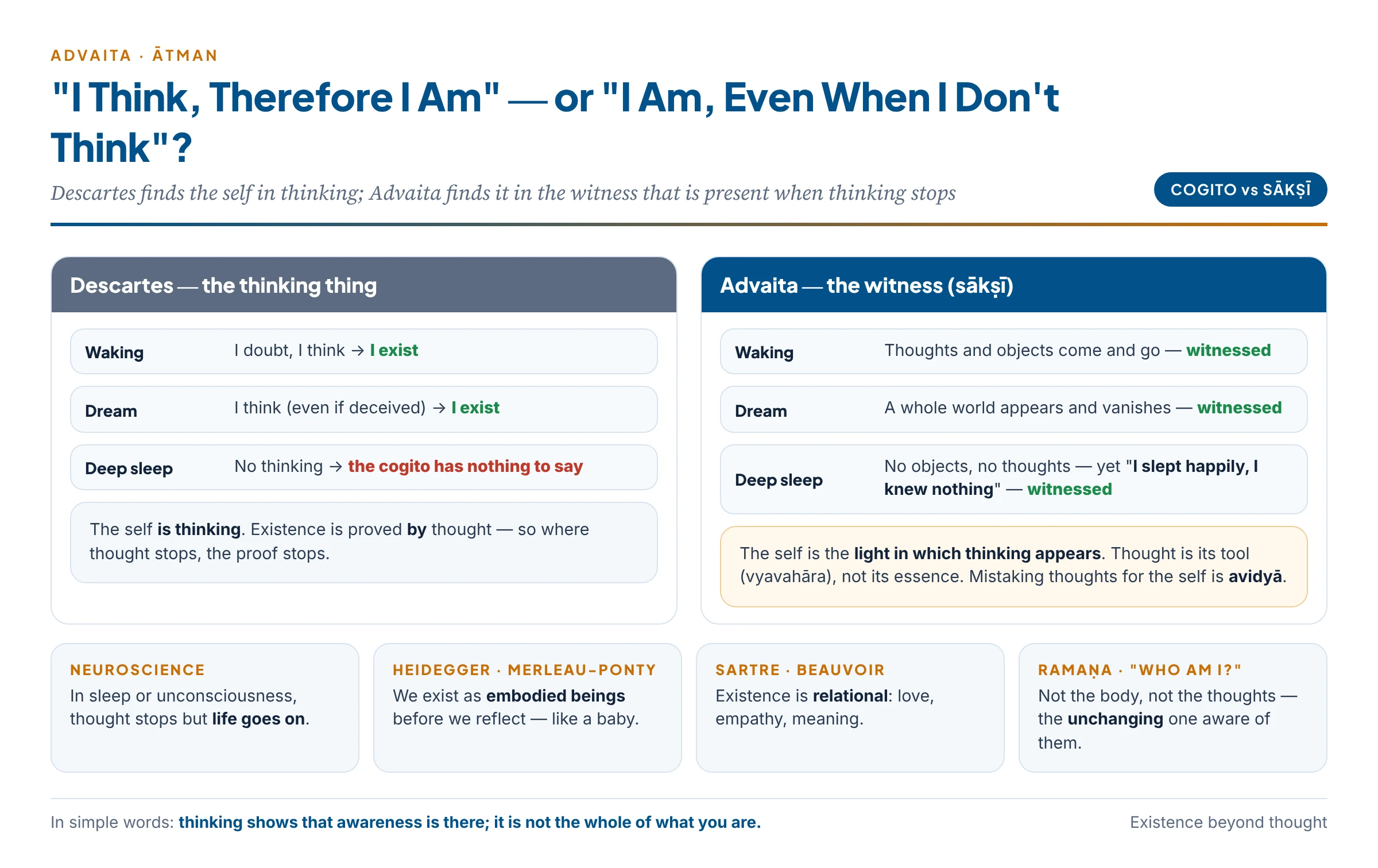
Descartes’ Cogito and the Advaita Self
| Descartes | Advaita | |
|---|---|---|
| Starting point | Doubt — but doubting is thinking | Experience of “I am” in all states |
| Formula | “I think, therefore I am” — thinking proves existence | The self exists independently of thought; thought is its instrument |
| Nature of self | A thinking thing (res cogitans) | Pure consciousness, beyond thinking — the witness of thoughts |
| Deep sleep | Thinking stops — awkward for the cogito | In deep sleep (suṣupti), thinking ceases yet the self remains — “I slept happily” |
| Mistake to avoid | Taking the body as the self | Taking thoughts, emotions and perceptions as the self — this is avidyā |
| Goal | Certain foundation for science | Self-realisation — liberation |
- Wider modern views of existence help to locate both:
- Neuroscience: consciousness is bound up with the body; in deep sleep or unconsciousness, thought is absent but life and physical presence continue — existence is not limited to thought.
- Heidegger and Merleau-Ponty: we exist as embodied beings engaged with the world before reflective thinking — a baby acts and senses long before it reflects.
- Sartre and Beauvoir: existence is relational — love, empathy, cooperation go beyond thought.
- Non-human existence: a tree grows, adapts and sustains an ecosystem without reflective thought — it too “is“.
- Advaita’s lesson. Mind and intellect are tools for practical life (vyavahāra), not the essence of being. Thought aids self-inquiry (ātma-vicāra) but is not the final truth. Ramaṇa Maharṣi’s question “Who am I?” separates the unchanging self from passing thoughts, emotions and the body.
- Conclusion. Thinking affirms awareness but does not cover the whole of existence. For Advaita, the self is ever-present — evident even in deep sleep, where there is no thinking at all.
The Three States and the Fourth (Avasthā-traya and Turīya)
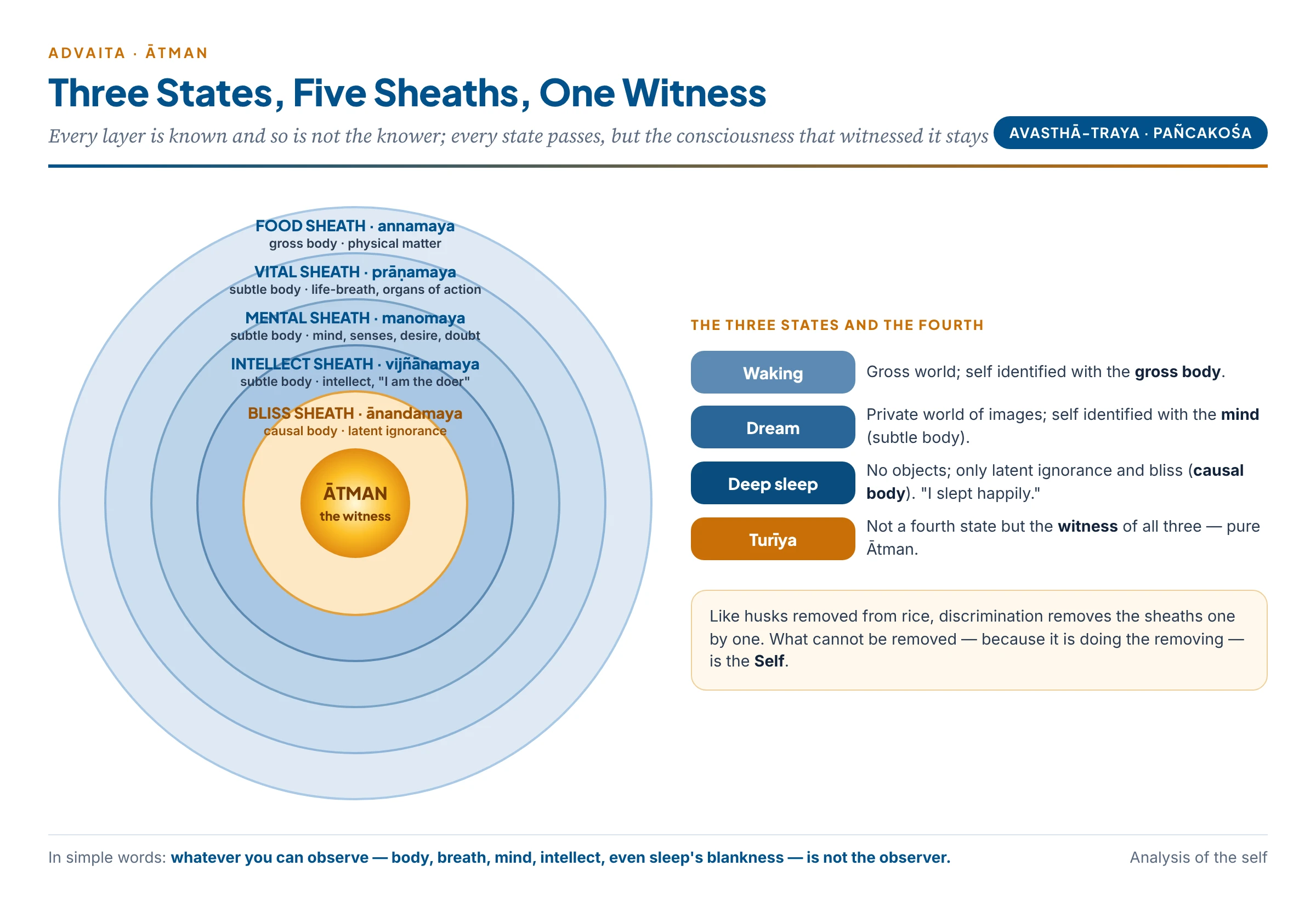
Advaita analyses experience through the three states every person passes through daily.
| State | What is experienced | Who experiences it | What it shows |
|---|---|---|---|
| Waking (jāgrat) | The public world of gross objects | The self identified with the gross body | Objects are many and changing |
| Dream (svapna) | A private world of subtle images | The self identified with the mind | The mind can create a whole world; dream objects are real while the dream lasts — dream water quenches dream thirst |
| Deep sleep (suṣupti) | No objects, no thoughts | The self with only latent ignorance | Consciousness remains without objects; on waking one says “I slept happily; I knew nothing” — an experience of bliss and of ignorance |
| Turīya (“the fourth”) | Not a fourth state beside the others but their ground | Pure Ātman | The witness of all three, untouched by them |
- The witness runs through all three. Waking objects vanish in dream, dream objects in sleep — but the consciousness that witnessed each does not vanish. That which persists through all states is the real; what comes and goes is appearance.
- The falsity of dream objects is known on waking, but the consciousness that had the dream is never sublated — even the waking person remembers that he dreamt. Consciousness is therefore eternal.
In simple words
Think of a film projector’s light. During a war film the screen shows fire; during a romance it shows flowers; during the interval it shows nothing at all. The pictures change completely, but the light that made each of them visible never changed and never left. Waking, dream and deep sleep are like three films; the witnessing Self is the light that shows all three — including the “blank” of deep sleep.
Three Bodies and Five Sheaths
The Upaniṣads describe the self as covered by layers, which the seeker learns to see through.
| Body (śarīra) | Sheath (kośa) | Made of | Linked to |
|---|---|---|---|
| Gross body (sthūla) | Food sheath (annamaya) | Physical matter | Waking |
| Subtle body (sūkṣma) | Vital sheath (prāṇamaya) | Life-breath and organs of action | Waking and dream |
| Mental sheath (manomaya) | Mind with organs of sense — doubt, desire | Dream | |
| Intellect sheath (vijñānamaya) | Intellect — decision, the sense of “I am the doer” | Dream | |
| Causal body (kāraṇa) | Bliss sheath (ānandamaya) | Latent ignorance; the joy of deep sleep | Deep sleep |
- The Ātman is none of the sheaths. Each sheath is known and therefore an object; the Self is their witness. As one removes the husks of rice to reach the grain, discrimination removes the sheaths to reach the Self.
The Jīva: Consciousness Plus the Internal Organ
- A composite. The jīva is a mixture of self and not-self, subject and object. Its subject element is pure consciousness — the witness (sākṣī); its object element is the internal organ (antaḥkaraṇa) — mind, intellect, ego — which is a product of avidyā.
- Limited by the body. Pure consciousness, limited by the conditions of the body, works through the senses and the internal organ. These become instruments of finite, empirical knowledge. That is why Advaita, like the Bhāṭṭa Mīmāṃsā, accepts six means of knowledge at the empirical level — perception, inference, testimony, postulation (arthāpatti), comparison (upamāna) and non-cognition (anupalabdhi).
- Real at its level. The jīva is an empirical reality; at the empirical level the plurality of jīvas is accepted. Each jīva is the agent, the enjoyer, the bearer of merit and demerit, the one who is born again.
- Essentially Brahman. It suffers the miseries of empirical life because it fails to discriminate between self and not-self. When the knowledge of its non-difference from Brahman dawns, its divine nature is manifest.
- Śaṅkara’s own images. The non-dual Self is wrongly imagined as the empirical self, just as:
- a pure white crystal looks red because a red flower is near it;
- the colourless sky looks dirty or blue to the ignorant;
- a rope is taken for a snake in twilight; a shell for silver.
- No real birth or bondage. “Even the statement that the jīva becomes Brahman is only a manner of speaking; it always was Brahman.” Śaṅkara calls the one who teaches that the jīva is not really Brahman — in order to keep bondage and liberation ultimately real — “the lowest of the learned“.
The Ego (Ahaṅkāra) and Its Role
- What the ego is. Through avidyā, the self identifies with the body and mind and thinks “I am stout“, “I am lame“, “I am ignorant“, “I am happy“. Thus arises the sense of “I” as a limited individual — the ego (ahaṅkāra) — which sets itself against the rest of existence. Alongside it arises the sense of “mine” (mamakāra): “this is my pen, that is not mine”.
- The ego is not the real self. It is an apparent limitation of the self — consciousness confused with the internal organ. It is the knot (granthi) that ties consciousness to the body–mind, “the main pillar of this world-theatre”.
- Its role in the doctrine of Vedānta.
- Root of bondage. From the ego come doership (“I act”), enjoyership (“I suffer and enjoy”) and, through karma, rebirth.
- Locus of the “I”-notion that points to the Self. The ego is not wholly unreal: in “I am”, the “am” belongs to pure consciousness, the “I” as a limited person to the internal organ. Self-inquiry follows the “I” back to its source.
- The thing to be dissolved. Liberation is not the destruction of consciousness but of the false identification that the ego embodies.
- The ego in other Vedāntas. For Rāmānuja, the true self is the self-conscious “I” (aham), distinct from the empirical ego that wrongly identifies with body and senses; liberation removes egoity, not individuality. For Advaita, even the sense of being an individual “I” belongs to the not-self.
In simple words
When you say “I am tired”, whose tiredness is it? The body is tired; the mind feels it; and “I” put my name on it. When you say “I see the tiredness”, something stands back and watches. Advaita says the one who stands back — the watcher — is the real you; the “I” that grabs every feeling and says “mine!” is the ego.
The Witness (Sākṣī) and the Jīva
- Sākṣī is consciousness as the unchanging witness of the mind and its states — of pleasure and pain, waking and dream, presence and absence of knowledge. It does not act, enjoy or suffer; it only illumines.
- Jīva-sākṣī is this witness as associated with an individual mind — “the jīva’s witness”. It is the conscious core of each person, distinct from the mind it illumines.
- Relationship. The jīva is the witness plus the mind with which it is confused. The jīva is agent and enjoyer; the jīva-sākṣī is neither. In ignorance, the jīva claims the witness’s light as its own; in knowledge, it recognises that its real self is the witness — and that the witness is Brahman.
- Why it matters. The witness explains:
- how one knows one’s own ignorance (“I do not know this”) — ignorance itself is lit up by the witness;
- how deep sleep is remembered as blissful;
- why the self is never an object yet always evident.
How Does the One Brahman Appear as Many Jīvas? Three Theories
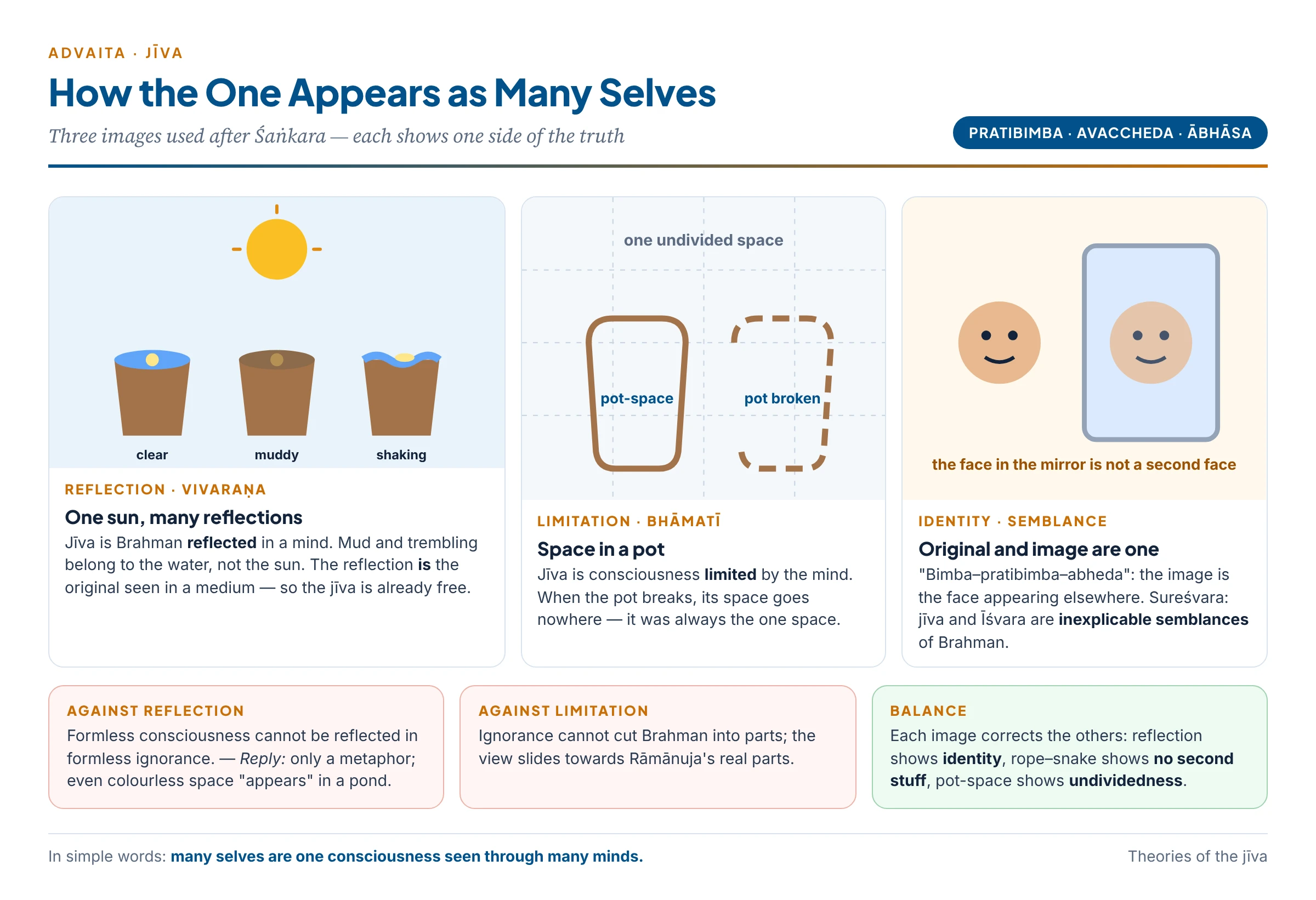
Śaṅkara used images freely; after him, Advaita teachers built them into theories.
1. Reflection theory (Pratibimba-vāda) — the Vivaraṇa school (Padmapāda, Prakāśātman).
- Brahman is the original (bimba); the jīva is its reflection (pratibimba) in the mirror of ignorance as particularised in each mind (antaḥkaraṇa).
- Analogy. One sun, reflected in many vessels of water, appears many, moving or muddy. The reflections differ because the water differs; the sun is untouched.
- The reflection is identical with the original (bimba–pratibimba–abheda). A face seen in a mirror is not another face; it is the same face appearing in a medium. Prakāśātman stresses that the reflected image is as real as the original — because it is the original.
- Īśvara and jīva. For Prakāśātman’s followers, Īśvara is the original conditioned by the one cosmic ignorance, and the jīvas are reflections in many minds; for Sarvajñātman, both Īśvara and jīva are reflections, and only pure Brahman is the original.
- Soteriological significance (why it matters for liberation).
- The jīva is already Brahman. Since a reflection is the original appearing elsewhere, liberation is not becoming something new but recognising what one is. The Vivaraṇa school holds that the great saying “That thou art” is enough to give liberating knowledge.
- Removing the medium. Defects of the reflection — trembling, dimness, limitation — belong to the mirror (the mind), not to the face. Purifying the mind (ethics, devotion, meditation) makes the reflection clearer; knowledge removes the identification with the mirror altogether.
- Bondage is not real in the self. Suffering and doership belong to the reflecting medium; the original is ever free. This grounds the Advaita claim that the self is “ever liberated” (nitya-mukta).
- Grace and devotion find a place. Since Īśvara is the original of which the jīva is a reflection, turning towards Īśvara is turning towards one’s own source.
- Objection. Formless consciousness cannot be reflected — only things with form and colour cast reflections; and formless ignorance cannot serve as a mirror. Reply: reflection is only a metaphor; even space, which has no colour, appears reflected in water as the “depth” of a pond; the image is used for its suggestive value.
2. Limitation theory (Avaccheda-vāda) — the Bhāmatī school (Vācaspati Miśra).
- The jīva is consciousness limited (avacchinna) by its adjunct (upādhi), the internal organ, as universal space appears limited as pot-space or room-space.
- When the pot breaks, the pot-space does not go anywhere or merge into anything — it was always one with the universal space.
- Locus of ignorance. For the Bhāmatī, the jīva is the seat of ignorance and Brahman its object; Īśvara is Brahman as the object of ignorance.
- Advantage. Avoids the problem of reflecting the formless.
- Objection. How can ignorance limit Brahman? And if jīvas are limited portions of Brahman, the view slides towards Rāmānuja’s jīvas as real parts of God.
3. Semblance theory (Ābhāsa-vāda) — Sureśvara.
- Īśvara and the jīvas are inexplicable semblances (ābhāsa) of Brahman due to māyā; a semblance is not real, so both are unreal as such.
- One influential reading holds that Śaṅkara himself favours this view: for him, Īśvara and jīva are inexplicable appearances (vivarta) of Brahman, and “why” and “how” questions about avidyā are illegitimate.
- Objection. Merely calling something “inexplicable” does not solve the philosophical problem.
| Reflection (Vivaraṇa) | Limitation (Bhāmatī) | Semblance (Sureśvara) | |
|---|---|---|---|
| Image | Sun in water; face in mirror | Space in a pot | A mere seeming |
| Jīva is | Reflection of Brahman in the mind | Consciousness limited by the mind | An inexplicable appearance |
| Status of jīva | Real — the reflection is the original | Real as consciousness, limited only seemingly | Unreal as such |
| Seat of ignorance | Brahman | The jīva | — |
| Main objection | Formless cannot be reflected | Ignorance cannot cut Brahman into parts | “Inexplicable” explains nothing |
| Stress | Non-difference (abheda) | Difference created by adjuncts | Appearance |
- A note of balance. These theories are aids, not rival dogmas. Padmapāda himself uses both reflection and pot-space; later Advaita texts say that the division into jīva and Lord, though taught by scripture, is “a product of the human intellect, alluded to because it helps lead us to the truth“. Each image corrects the others: the reflection shows identity, the rope–snake shows that no second substance is needed, the pot-space shows that the self is undivided.
Common confusion
Is “Vivaraṇa = reflection, Bhāmatī = limitation” a rigid rule? Only roughly. The labels come from later summaries; Padmapāda (Vivaraṇa) also uses the pot-space image, and the description of the Bhāmatī view differs between later texts. The firmer difference between the two schools is about the locus of ignorance: Brahman for Vivaraṇa, the jīva for Bhāmatī.
One Jīva or Many?
- Many jīvas (aneka-jīva-vāda). The common view: there are as many jīvas as minds; one may be liberated while others remain bound.
- One jīva (eka-jīva-vāda) and “seeing is creating” (dṛṣṭi-sṛṣṭi-vāda). Some later Advaitins (following Maṇḍana’s view that the jīva is the seat of ignorance) held that there is only one ignorant jīva whose ignorance projects the whole world, like a dreamer projecting dream-characters; the world exists only while perceived.
- Śaṅkara’s balance. At the empirical level, many jīvas, a public world and liberation of individuals are accepted; at the highest level, there is neither one jīva nor many, only Brahman.
“That Thou Art” (Tat Tvam Asi): The Advaita Reading
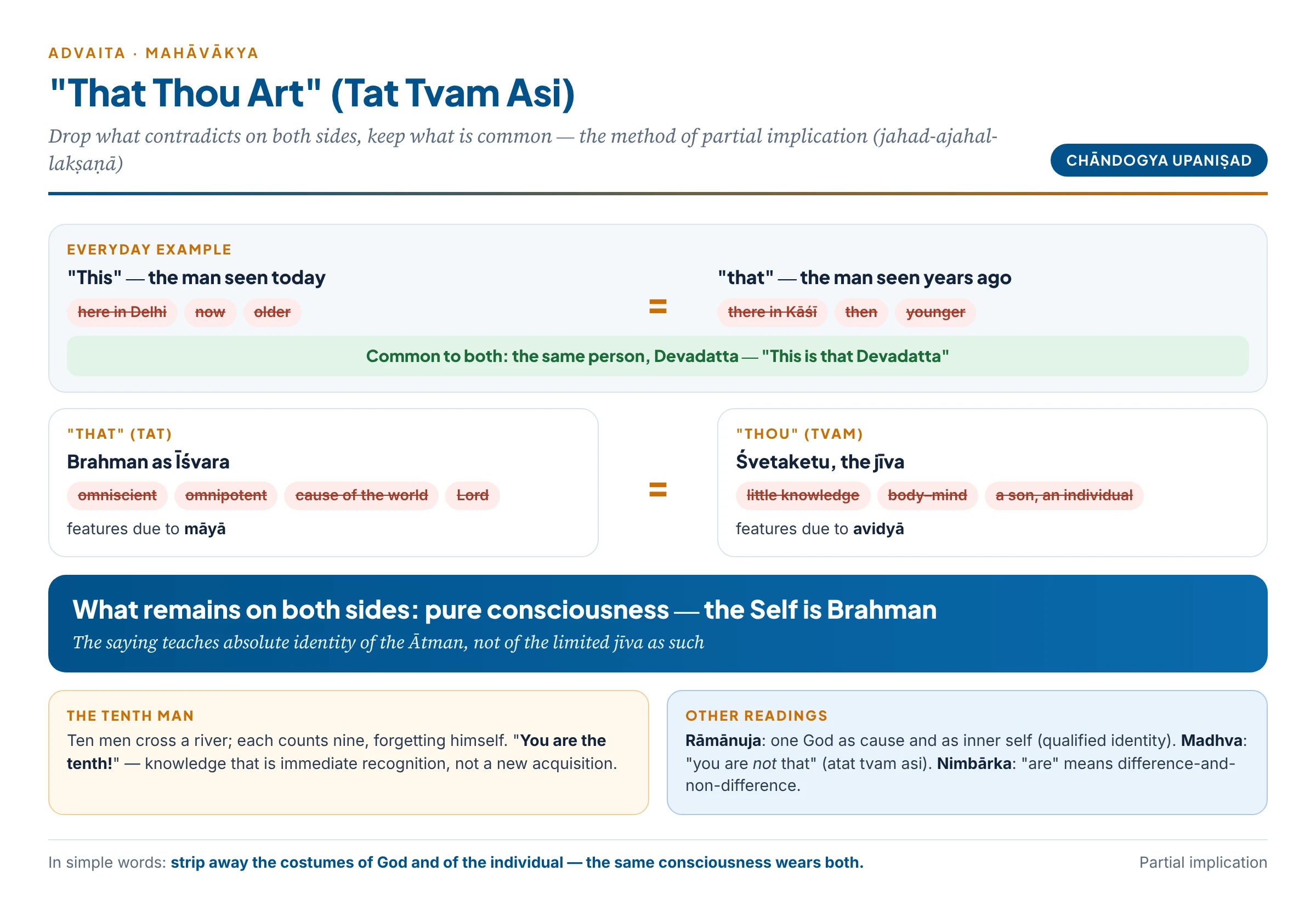
The Chāndogya Upaniṣad repeats nine times to Śvetaketu: “That which is the subtle essence — this whole world has it as its self. That is the real. That is the self. That thou art, Śvetaketu.“
- The problem. “That” (tat) refers to Brahman — omniscient, omnipotent, the cause of the world. “Thou” (tvam) refers to Śvetaketu — the jīva, limited, ignorant, a son. Taken literally, the two are contradictory; no identity is possible between an omniscient cause and an ignorant individual.
- The method of partial implication (jahad-ajahal-lakṣaṇā, also called bhāga-tyāga-lakṣaṇā). When a sentence cannot be taken literally, we drop the contradictory parts of the meanings and keep the common part.
- The everyday example: “This is that Devadatta.” Seeing Devadatta today in Delhi, I say “This is that Devadatta whom I saw years ago in Kāśī.” “This” carries here, now, older; “that” carries there, then, younger. These cannot be identical. I drop the contradictory features of time and place and identify the person common to both.
- Applied to “That thou art.”
- From “That” drop omniscience, lordship, cause-of-the-world — features due to māyā.
- From “thou” drop limited knowledge, the body–mind, individuality — features due to avidyā.
- What remains on both sides is pure consciousness. The saying teaches absolute identity of the Self and Brahman.
- Whom it applies to. The identity holds for the Ātman, not for the jīva as limited: “thou” points to the pure consciousness underlying the jīva.
- The tenth man. Ten men cross a river and count themselves; each counts nine, forgetting himself, and they mourn the lost tenth. A passer-by says “You are the tenth.” The knowledge is immediate — not a new acquisition but recognition. Sureśvara uses this to show that the great saying itself gives direct, liberating knowledge, against Maṇḍana’s view that it gives only indirect knowledge which must be turned into direct realisation by meditation (prasaṅkhyāna).
- Other readings.
- Rāmānuja: “That” = God as cause of the universe, “thou” = God as the inner self of the jīva; the identity is of one substance in two modes — a qualified identity.
- Madhva: reads the text as “you are not that” (atat tvam asi) by joining the last syllable of the preceding word, or as teaching similarity and dependence, not identity.
- Nimbārka: “asi” (are) expresses difference-cum-non-difference.
Svarūpa-jñāna and Dharmabhūta-jñāna
| Śaṅkara — svarūpa-jñāna (knowledge as the self’s nature) | Rāmānuja — dharmabhūta-jñāna (knowledge as the self’s attribute) | |
|---|---|---|
| What consciousness is | The very nature of the self — the self is consciousness | An attribute belonging to the self, though also essential to it |
| Subject–object | Pure consciousness is without subject–object duality | Knowledge always belongs to a subject and points to an object |
| Change | Changeless; no expansion or contraction | Expands and contracts — obstructed by karma, all-pervasive in liberation |
| Formula | “I am consciousness“ | “I am conscious” — nobody says “I am consciousness” |
| Image | The light is the lamp | The lamp (self), its light (essence) and its rays (attributive knowledge) |
| In deep sleep | Pure consciousness shines without objects | Attributive knowledge is present but unmanifest — no objects to reveal |
| In liberation | Self-knowledge: identity with Brahman | Knowledge becomes all-pervading; the soul becomes omniscient like God |
(Rāmānuja’s view is explained fully in the article on Viśiṣṭādvaita.)
Critical Evaluation
Objections to Śaṅkara’s Account of the Jīva
- Rāmānuja.
- There is no pure, objectless consciousness: consciousness always belongs to someone and is of something. “I am conscious”, not “I am consciousness”.
- The soul’s individuality is real and survives liberation; identity would destroy the worshipper and leave no one to enjoy bliss.
- Madhva. Experience shows that the jīva is not omniscient or omnipotent; to call it Brahman contradicts perception, which is valid.
- Moral and logical difficulties.
- If the self is one, how is it that one is liberated and another bound? Why does one person’s realisation not liberate all?
- Moral responsibility seems to belong to an unreal agent.
- The theories of reflection and limitation carry an incipient dualism — a mirror or a pot over against Brahman.
- Is the justification rational? Critics say Śaṅkara’s account of the jīva finally rests on scripture and on the “inexplicable” avidyā.
Advaitin Replies
- The self-evidence argument is rational, not scriptural. That the knower cannot be an object, that consciousness is presupposed by every doubt, and that something persists through waking, dream and sleep are arguments from experience and reason.
- Bondage and liberation are empirical. Plurality of jīvas, and the liberation of one while others are bound, belong to the empirical level, where Advaita accepts many minds. Ultimately “there is none bound, none striving, none liberated”.
- Responsibility is real where action is real. The jīva is a real agent at the level where karma operates.
- The images are metaphors. Reflection, limitation and semblance are used together for their suggestive value; none is to be “stressed beyond the breaking point”.
- Against Rāmānuja. If the soul is “essentially changeless and untouched by births and deaths”, as Rāmānuja himself says, then it is really the transcendental Self, not a finite, plural empirical ego — Advaita’s point exactly.
Critics and Defenders
Criticism — Critics
- Rāmānuja: there is no pure consciousness; the self is a conscious subject with attributive knowledge; identity destroys the devotee.
- Madhva: perception shows the jīva is not God; “That thou art” teaches difference.
- Logicians: one self cannot be both bound and free; reflection and limitation smuggle in dualism.
- Moralists: an unreal agent cannot bear real responsibility.
Defence — Defenders and strengths
- Śaṅkara: the self is self-evident; the knower can never be known as an object.
- Three states: the witness persists through waking, dream and sleep.
- Vivaraṇa: the reflection is the original; “That thou art” alone gives liberating knowledge.
- Strength: gives a rational, experience-based analysis of the self that anticipates phenomenology.
- Strength: the method of partial implication gives a precise reading of the identity texts.
Cross-Tradition Comparison
The Self in Advaita, Western Philosophy and Buddhism
| Thinker | Self is | Like Advaita | Unlike Advaita |
|---|---|---|---|
| Descartes | A thinking substance | Self-certainty of the subject | The self is thought, and one among many substances |
| Kant | Transcendental unity of apperception — the “I think” that accompanies all representations | A pure subject presupposed by all experience, never an object | Formal and unknowable; not identical with an Absolute |
| Husserl | Transcendental ego | The pure subject behind experience | One ego among others, with intersubjectivity |
| Hume | A bundle of perceptions — “I never catch myself without a perception” | — | Denies a witness behind perceptions |
| Buddhism | No-self (anātman); a stream of aggregates | — | Śaṅkara: a flux cannot remember or synthesise; the witness is needed |
| Spinoza | A mode of the one Substance | One reality underlies individuals | Individuals are real modes, not appearances |
Indian Connect — Key takeaways
- Kant’s “I think” and Advaita’s sākṣī both name a pure subject that is never an object; Advaita goes further and identifies it with Brahman.
- Hume and the Buddhists look for the self among perceptions and find none; Advaita answers that the self is the looker, not one of the things looked at.
- The reflection image is shared with Sāṃkhya–Yoga (consciousness reflected in the intellect); Advaita turns it into a doctrine of identity.
Synthesis (Siddhānta)
- Ātman is pure, self-luminous consciousness — eternal, changeless, the witness of all experience — and identical with Brahman. Its existence is self-evident: every doubt presupposes it, and the knower can never be known as an object.
- Śaṅkara’s rational case — illumination, permanence, the witness, neti neti, personal identity, refutation of rivals, the epistemological argument — shows the self is consciousness itself, not body, flux or substance-with-a-quality.
- Against Descartes, the self is not thinking but the witness of thinking, present even in deep sleep.
- The three states and turīya, and the three bodies and five sheaths, map the self’s apparent coverings; the witness runs through all.
- The jīva is consciousness confused with the internal organ — agent, enjoyer, many at the empirical level, essentially Brahman. The ego (ahaṅkāra) — “I” and “mine” — is the knot of this confusion and the root of bondage; the sākṣī is the jīva’s untouched conscious core.
- Reflection, limitation and semblance are three images of how one appears as many; the reflection theory’s soteriological point is that the jīva, being the original in a medium, is already free and needs only to recognise it.
- “That thou art”, read by partial implication like “this is that Devadatta”, teaches the absolute identity of pure consciousness in “that” and “thou”; Rāmānuja, Madhva and Nimbārka read it otherwise.
- Contemporary relevance.
- Consciousness studies. The distinction between the contents of experience and the witnessing awareness is now discussed as “pure awareness” or “minimal self” in philosophy of mind and meditation research.
- Psychology. The ego’s identification with roles and feelings, and the freedom of stepping back to “witness”, inform mindfulness-based therapies.
- Ethics. Seeing the same Self in all grounds compassion and the Gītā’s ideal of equal vision (sama-darśitva).
“He who would refute the Self is himself that Self.” — Śaṅkara
Previous Year Questions
- 2025Discuss the idea of Bimba-pratibimbavāda as presented in Vedānta philosophy along with its soteriological significance.
- 2023What is Advaitin interpretation of the great sentence (mahāvākya) ‘Thou art that’ (tattvamasi)? Briefly discuss.
- 2022‘Brahma satyam jaganmithyā, jīvo brahmaiva nāparaḥ’. In the light of this statement explain the ontological status of Īśvara, Jīva and Sākṣī as elucidated in Advaita Vedānta.
- 2020Discuss the nature and relationship of Jīva and Jīva-Sākṣī according to non-dualism.
- 2012Explain the notion of ego or ahaṅkāra and its role in the doctrine of Vedānta.
- 2010How is Rāmānuja’s concept of dharmabhūtajñāna different from Śaṅkara’s concept of svarūpajñāna? Explain.
- 2003Describe Śaṅkara’s explanation of jīva. Is the justification offered rational? Explain.