

- The interior of the Earth, 6,371 km from surface to centre, lies almost entirely beyond direct observation, yet the endogenetic forces that raise mountains and volcanoes originate there.
- It can be divided in two ways:
- Chemically (by composition) into the crust, mantle and core.
- Mechanically (by how the material deforms) into the lithosphere, asthenosphere, mesosphere, outer core and inner core.
- Knowledge of the deep interior comes from indirect evidence, above all seismology.
Sources of Knowledge about the Interior
| Direct sources | Indirect sources |
|---|---|
| Surface rocks | Density, pressure and gravity |
| Mines and boreholes | Temperature with depth |
| Ocean-floor drilling | Meteorites |
| Volcanic material | Theories of the origin of the Earth |
| Magnetic field and seismic waves |
Direct Sources
- Surface rocks show the upper crust, including deep rocks exposed by folding, faulting and erosion.
- Mines and boreholes sample only the outermost few kilometres, but all confirm that temperature, pressure and density rise with depth.
- The Kola Superdeep Borehole (Russia) reached 12,262 m in 1989, still the deepest hole, yet only about 0.2% of the Earth’s radius.
- Ocean drilling samples the thin oceanic crust; in 2023 a 1,268 m core of mantle peridotite was recovered from the Mid-Atlantic Ridge, where mantle rock is exposed on the sea floor.
- Volcanoes erupt lava and carry xenoliths (fragments of deep rock); kimberlite pipes bring up diamonds from more than 150 km down, as at Majhgawan near Panna (Madhya Pradesh).
- The limitation: the exact depth of origin of volcanic material cannot be fixed.
Indirect Sources
Density, Pressure and Gravity
- The average density of the Earth is about 5.5 g/cm³ (first estimated by Henry Cavendish, 1798), while surface rocks average only 2.6–3.0 g/cm³, so the interior must be far denser.
- Early workers explained this by the pressure of the overlying load (superincumbent load), but every rock has a limit beyond which pressure cannot raise its density.
- Hence the core must be made of intrinsically heavy metal, mainly iron and nickel, a view supported by the Earth’s magnetic field and by iron meteorites.
- Gravity anomalies reveal uneven distribution of mass below, as in the Indian Ocean Geoid Low, where sea level is depressed by more than 100 m over hot mantle rising from beneath Africa.
Temperature with Depth
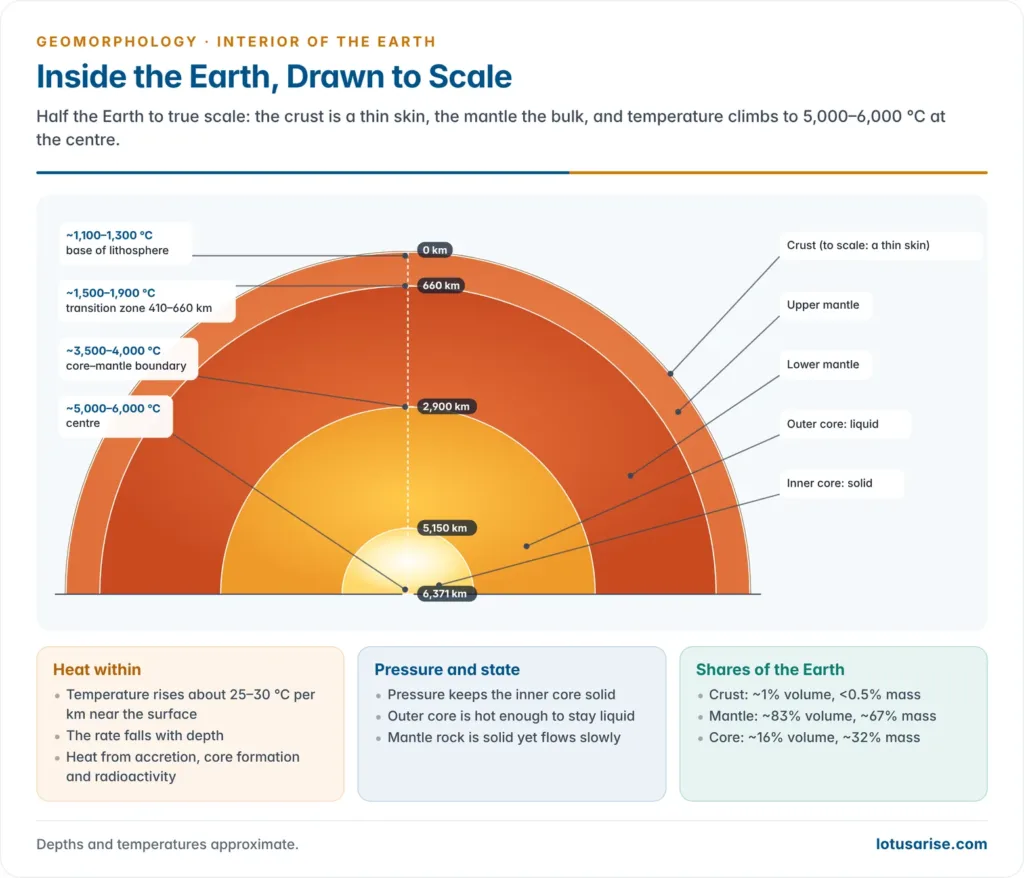
- Mines and boreholes show temperature rising by about 2–3 °C per 100 m (20–30 °C per km) near the surface: the geothermal gradient.
- It is steeper in tectonically active areas than in stable shields.
- The gradient cannot continue unchanged: extended to the core it would give tens of thousands of degrees, and most of the Earth would be molten.
- It falls off with depth because radioactive elements are concentrated in the crust.
- Pressure raises the melting point, so most of the hot interior stays solid; magma forms only where pressure is released, along faults or at spreading ridges (decompression melting).
- Sources of internal heat: radioactive decay of uranium, thorium and potassium, and primordial heat from accretion and the sinking of molten iron into the core, in roughly equal shares.
- Transfer of heat: conduction is too slow and radiation ineffective, so convection of hot, slowly creeping solid mantle carries the heat and drives plate motion.
| Depth | Boundary or zone | Approximate temperature |
|---|---|---|
| 0–40 km | Continental crust | Surface to 500–1,000 °C |
| ~100 km | Base of lithosphere | ~1,100–1,300 °C |
| 410–660 km | Mantle transition zone | ~1,500–1,900 °C |
| 2,900 km | Core–mantle boundary | ~3,500–4,000 °C |
| 6,371 km | Centre | ~5,000–6,000 °C |
Meteorites
- Meteorites formed from the same solar nebula as the Earth, so they indicate its bulk composition.
- Stony chondrites resemble the silicate mantle; iron meteorites (iron–nickel) resemble the core.
Theories of the Origin of the Earth
- Each origin theory implies a different state for the interior: the planetesimal hypothesis a solid core, the tidal hypothesis a liquid core and the nebular hypothesis of Pierre-Simon Laplace (1796) a gaseous core.
- The gaseous core is rejected; the question of solid versus liquid was settled only by seismology.
Seismology
- Seismology is the only source of authentic evidence on the deep interior: earthquake waves recorded by seismographs change speed and direction wherever density and rigidity change.
- P waves (compressional) pass through solids and liquids; S waves (shear) cannot pass through liquids; surface (L) waves stay near the surface.
- Earthquake foci lie at most about 700 km deep, and controlled explosions add artificial waves for the crust.
- Curved paths: waves follow paths concave towards the surface, which shows that wave velocity, and with it the rigidity of rock, increases with depth, so the Earth is not homogeneous.
- Shadow zones: S waves vanish beyond about 103° from the epicentre, and P waves are bent to leave a gap between about 103° and 142°.
- Richard Dixon Oldham (1906) read this as evidence of a core; its liquid outer part follows from the missing S waves.
- Wave sets: early seismologists separated three sets of waves of different speeds, revealing layers in the crust and the top of the mantle.
| Wave set | P / S velocity (km/s) | Identified by | Layer inferred |
|---|---|---|---|
| Pg–Sg | ~5.4 / 3.3 | Andrija Mohorovičić, 1909 Kupa Valley (Croatia) earthquake | Upper granitic crust, density ~2.7 |
| P*–S* | ~6–7 / 3–4 | Victor Conrad, 1923 Tauern (Austria) earthquake | Intermediate (basaltic) layer, density ~3.0 |
| Pn–Sn | ~7.8–8.1 / 4.5 | Mohorovičić, 1909 | Upper mantle (peridotite, dunite) |
- Seismic tomography, built from millions of travel times, now maps the interior in three dimensions, showing cold subducted slabs, rising plumes and two huge low-velocity regions at the base of the mantle beneath Africa and the Pacific.
Classical Views on the Layering of the Earth
Eduard Suess: Sial, Sima and Nife
- Eduard Suess divided the Earth below a thin sedimentary cover into three chemical zones:
- Sial (silica + aluminium): granitic, acidic, density about 2.7–2.9; forms the continents.
- Sima (silica + magnesium): basaltic, basic, rich in silicates of magnesium, calcium and iron, density about 2.9–4.7; underlies the oceans and was thought to supply magma.
- Nife (nickel + iron, ferrum): the heavy metallic core, density about 11.
- Evaluation: the terms survive as shorthand for felsic continental and mafic oceanic crust, but the scheme is obsolete: its thicknesses were guesses, and the mantle is solid peridotite, unlike Suess’s molten basaltic sima.
Other Classical Schemes
| Scheme | Layers |
|---|---|
| Reginald Aldworth Daly | Outer silicate zone; intermediate iron–silicate zone; central iron zone (solid) |
| Harold Jeffreys | Sedimentary layer; granite; tachylyte (glassy basalt) or diorite; dunite, peridotite or eclogite |
| Arthur Holmes | Crust (all of sial + upper sima); substratum (lower sima) |
| W. A. J. M. van Waterschoot van der Gracht | Outer sialic crust (thin under the Atlantic, absent under the Pacific); inner silicate mantle; mixed metal–silicate zone; metallic nucleus |
| Generalised classical view | Lithosphere; pyrosphere; barysphere |
- Evaluation: these schemes disagree on the number, depth and density of layers because they rested on few seismic records; Holmes’s thin sial and van der Gracht’s missing sial under the Pacific came closest to today’s thin, patchy continental crust.
Modern Structure of the Earth’s Interior
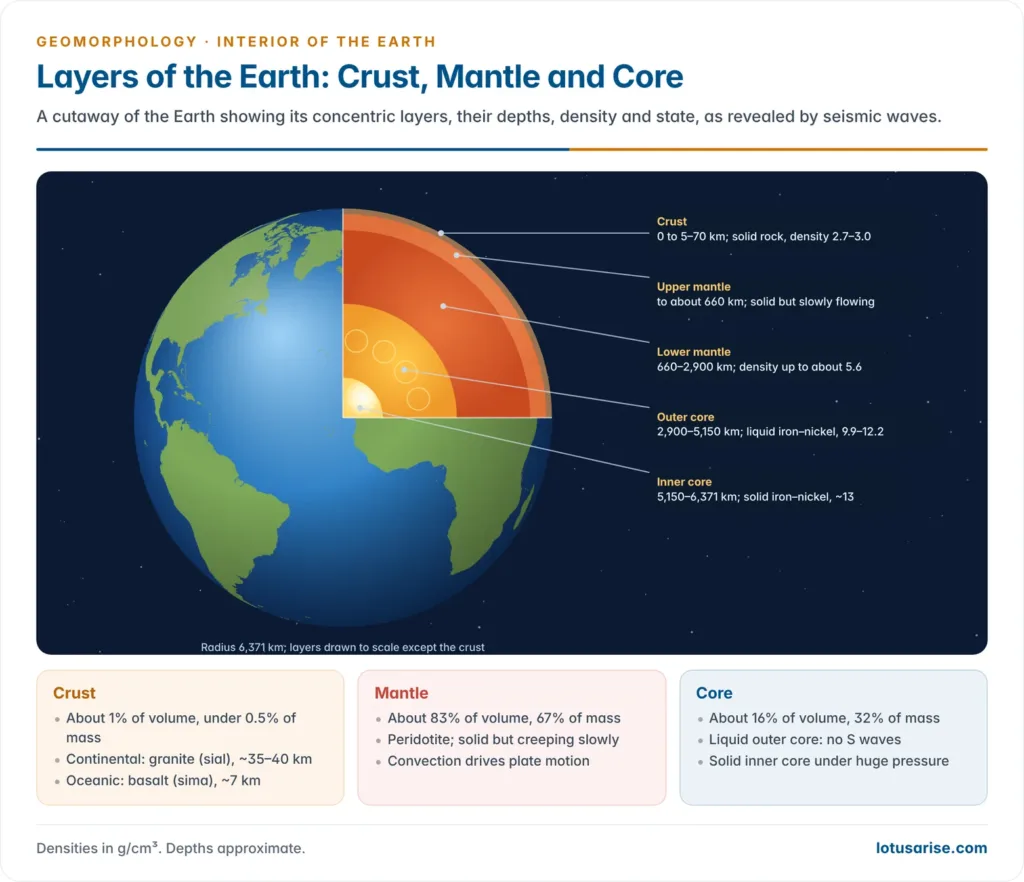
- Wave velocities and travel paths from earthquakes and explosions reveal three concentric zones, crust, mantle and core, separated by sharp boundaries called discontinuities.
| Layer | Depth (km) | Density (g/cm³) | State | Share of volume / mass |
|---|---|---|---|---|
| Crust | 0 to 5–70 | 2.7–3.0 | Solid | ~1% / <0.5% |
| Mantle | Moho to 2,900 | 3.3 to ~5.6 | Solid, slowly flowing | ~83% / ~67% |
| Outer core | 2,900–5,150 | ~9.9–12.2 | Liquid | Core together: ~16% / ~32% |
| Inner core | 5,150–6,371 | ~12.8–13.1 | Solid |
Crust
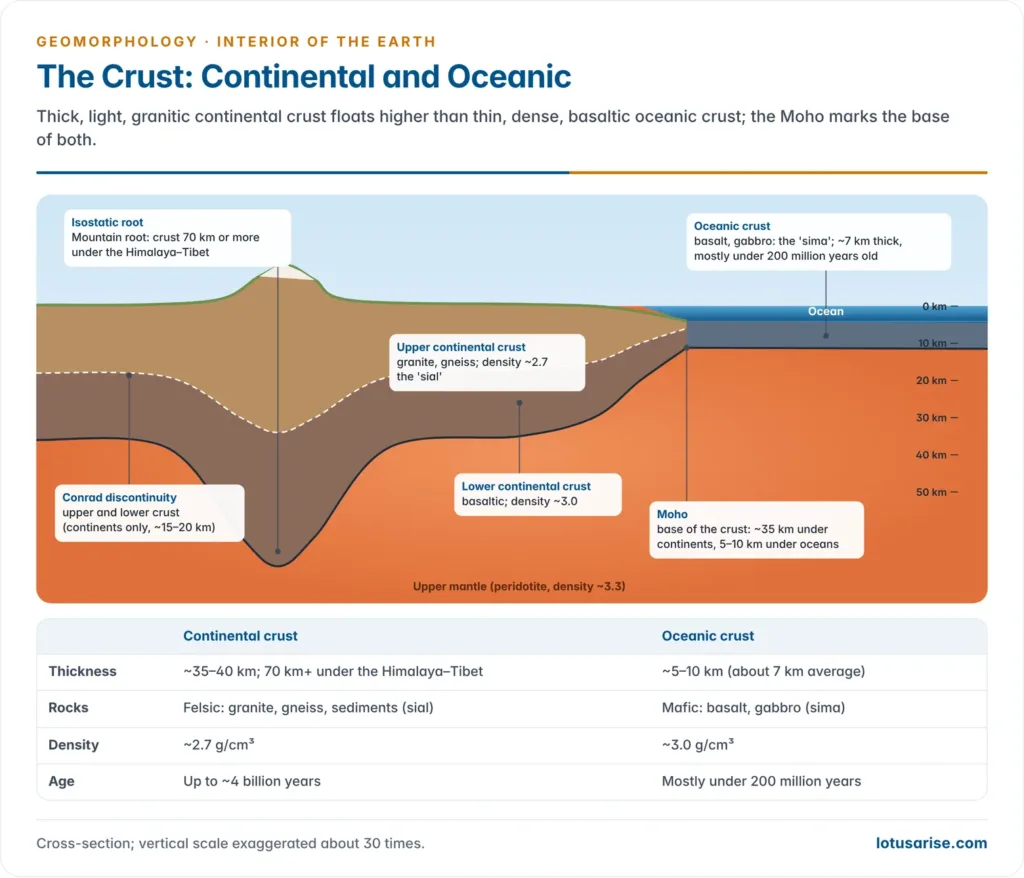
- The crust is the thin, rigid outer shell, with thickness varying sharply between continents and oceans.
| Feature | Continental crust | Oceanic crust |
|---|---|---|
| Thickness | ~35–40 km average; 70 km or more under the Himalaya–Tibet | ~5–10 km (about 7 km average) |
| Rocks | Felsic: granite, gneiss, sediments (sial) | Mafic: basalt, gabbro (sima) |
| Density | ~2.7 | ~3.0 |
| Age | Up to ~4 billion years | Mostly under 200 million years |
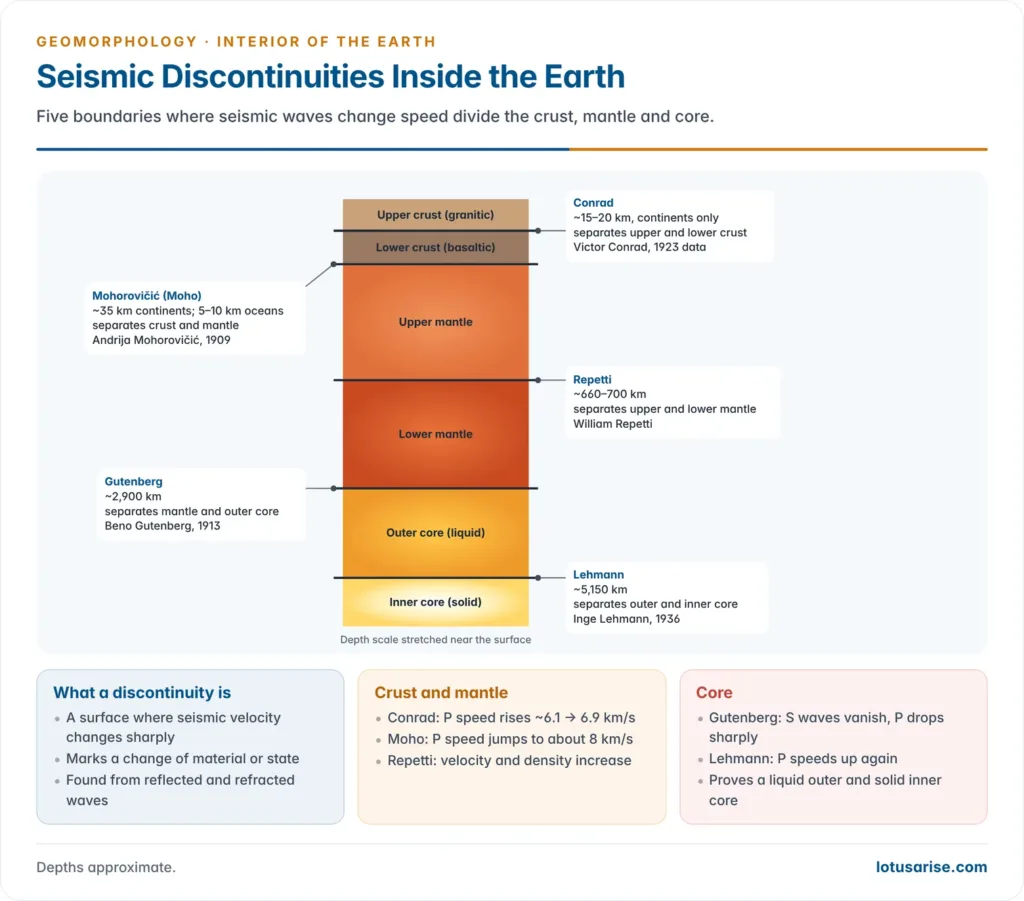
- Upper and lower crust: P waves average about 6.1 km/s in the upper crust and 6.9 km/s in the lower, where density rises from about 2.8 to 3.0; the boundary between them, the Conrad discontinuity, is not found everywhere.
- The Mohorovičić (Moho) discontinuity marks the base of the crust: P-wave speed jumps from about 6.9 to 7.9–8.1 km/s, first recognised by Andrija Mohorovičić (1909).
| Element | Share of crust by weight (%) |
|---|---|
| Oxygen | 46.6 |
| Silicon | 27.7 |
| Aluminium | 8.1 |
| Iron | 5.0 |
| Calcium | 3.6 |
| Sodium | 2.8 |
| Potassium | 2.6 |
| Magnesium | 2.1 |
Mantle
- The mantle extends from the Moho to about 2,900 km, less than half the Earth’s radius but most of its volume.
- Composition: iron- and magnesium-rich silicate rock, chiefly peridotite (olivine and pyroxene).
- It is commonly divided into three zones:
- Moho to about 200 km, including the low-velocity zone (about 100–200 km), where seismic waves slow because rock is partially molten.
- 200–700 km, containing the transition zone (410–660 km), where olivine changes to denser crystal forms.
- 700–2,900 km, the lower mantle; the boundary near 700 km is often called the Repetti discontinuity.
- At the base, the D″ layer and two continent-sized large low-shear-velocity provinces beneath Africa and the Pacific are thought to feed mantle plumes, such as the Réunion plume that built the Deccan Traps.
- The mantle is solid but hot enough to creep and convect, which is expressed at the surface as plate motion; earthquakes as deep as about 700 km occur only in cold subducting slabs.
Lithosphere, Asthenosphere and Mesosphere
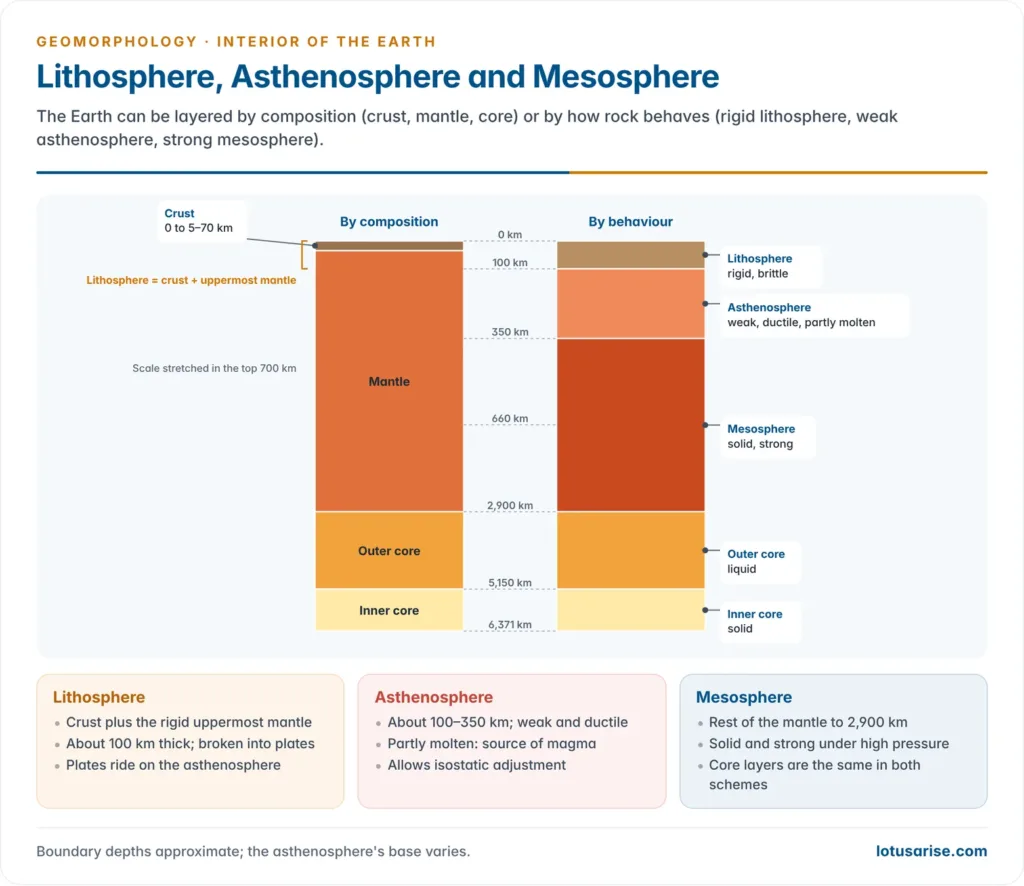
- These are the mechanical layers, defined by strength instead of composition.
- Lithosphere: the crust plus the uppermost mantle, rigid, about 10–200 km thick (thin under mid-ocean ridges, thick under old shields), broken into the plates of plate tectonics.
- Indian example: the Indian lithosphere is only about 100 km thick, against 180–300 km under other Gondwana fragments, which helps explain India’s fast drift (18–20 cm a year) in the Late Cretaceous.
- Asthenosphere: below the lithosphere, to about 350–400 km, weak and ductile, with a small fraction of melt; the plates glide over it, it allows isostatic adjustment, and partial melting here supplies much basaltic magma.
- Mesosphere: the lower, stronger mantle below the asthenosphere to 2,900 km, stiffened by pressure.
| Chemical layer | Mechanical layer | Nature |
|---|---|---|
| Crust + uppermost mantle | Lithosphere | Rigid, brittle |
| Upper mantle | Asthenosphere | Weak, ductile, partly molten |
| Rest of mantle | Mesosphere | Solid, strong |
| Outer core | Outer core | Liquid |
| Inner core | Inner core | Solid |
Core
- The core extends from 2,900 km to the centre (6,371 km).
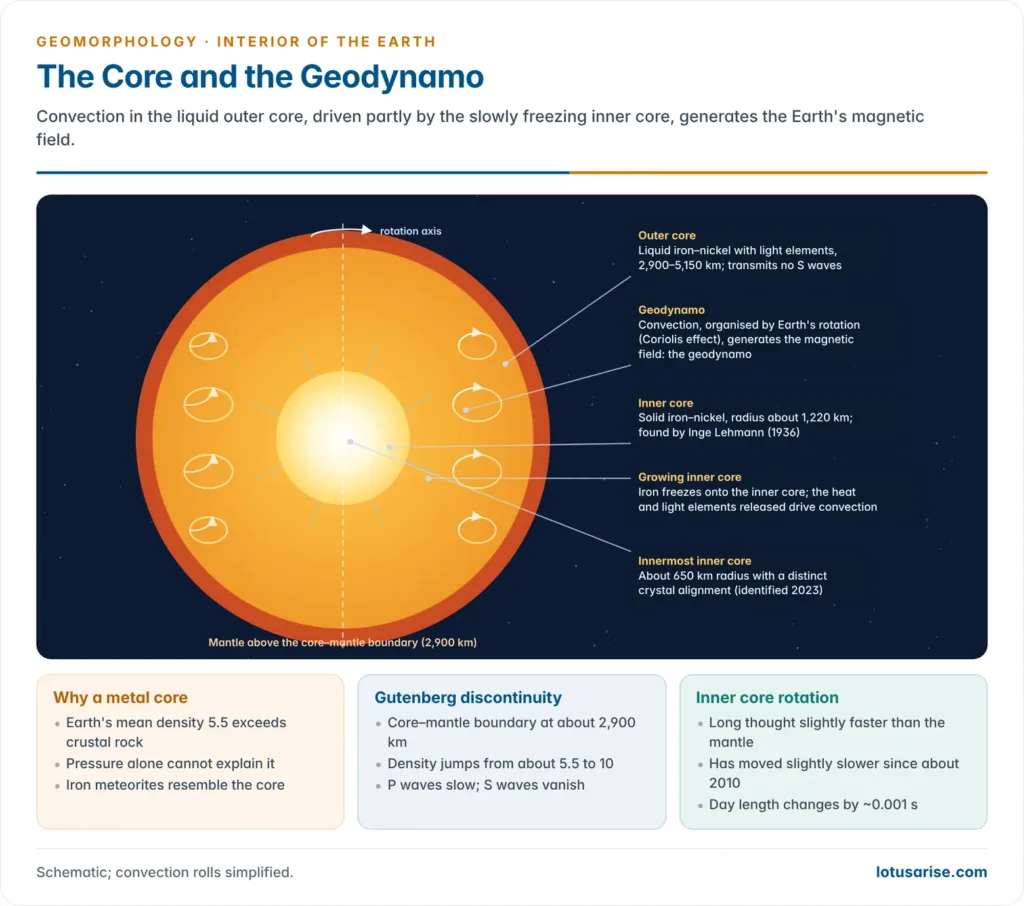
- At the core–mantle boundary, the Gutenberg (Wiechert–Gutenberg) discontinuity, located by Beno Gutenberg (1913), density jumps from about 5.5 to 10 g/cm³, P waves slow abruptly and S waves disappear.
- Composition: mainly iron with nickel (hence NIFE), plus about 10% lighter elements such as sulphur, oxygen, silicon and hydrogen, needed to explain its density.
Outer Core
- The outer core (about 2,900–5,150 km) is liquid iron–nickel with lighter elements: it does not transmit S waves.
- Its composition is close to the inner core’s, but the pressure is not high enough to keep it solid at its temperature.
- Convection in this liquid metal, organised by the Earth’s rotation (Coriolis effect), generates the magnetic field through the geodynamo.
Inner Core
- The inner core (about 5,150–6,371 km, radius about 1,220 km) is solid, discovered by Inge Lehmann (1936) from P waves reflected at its boundary.
- It stays solid because a pressure of about 3.3–3.6 million atmospheres raises the melting point above its temperature of roughly 5,000–6,000 °C.
- P waves converted into S waves at its boundary confirm its rigidity.
- It grows slowly as iron freezes out, releasing heat and light elements that help drive outer-core convection.
- Recent findings: an innermost inner core of about 650 km radius with a distinct crystal alignment was identified in 2023, and the inner core, long thought to rotate slightly faster than the mantle, has moved slightly slower since about 2010.
Seismic Discontinuities
- A discontinuity is a sharp boundary where seismic waves change speed and direction.
| Discontinuity | Depth | Separates |
|---|---|---|
| Conrad | ~15–20 km (continents only) | Upper and lower crust |
| Mohorovičić (Moho) | ~5–10 km (oceans), ~35 km (continents), 70 km+ (Himalaya) | Crust and mantle |
| Repetti | ~700 km | Upper and lower mantle |
| Gutenberg | ~2,900 km | Mantle and outer core |
| Lehmann | ~5,150 km | Outer and inner core |
Chemical Composition of the Earth
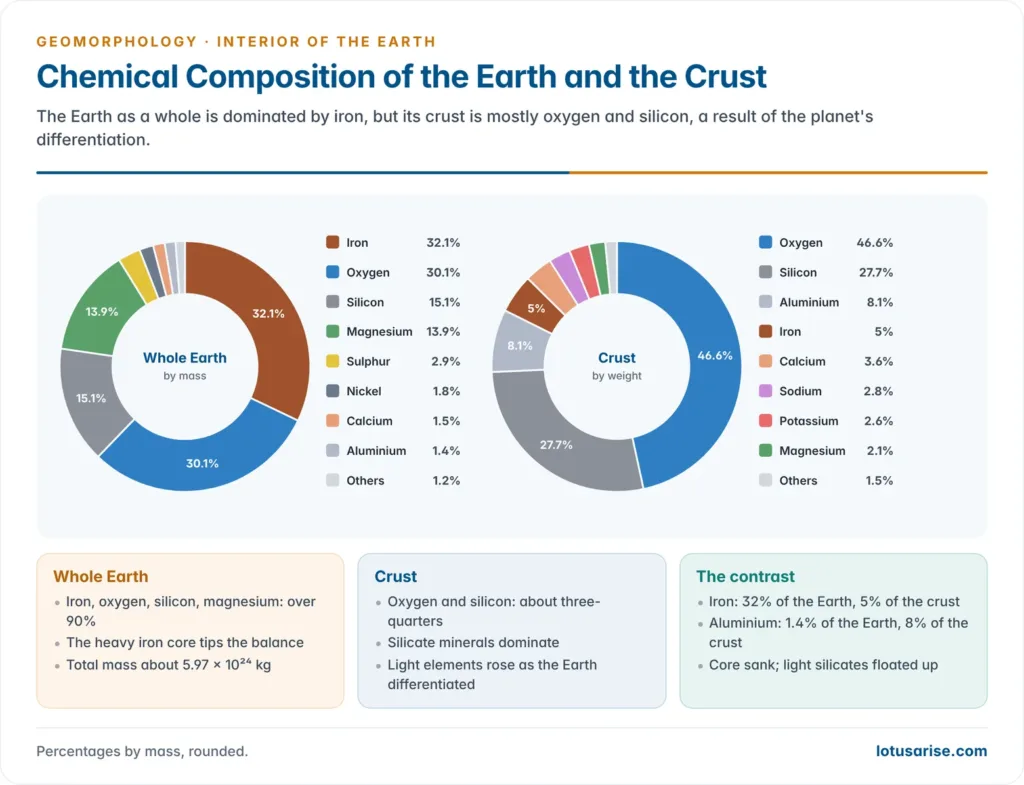
- As a whole the Earth (mass about 5.97 × 10²⁴ kg) is dominated by iron, oxygen, silicon and magnesium, over 90% of its mass, because the iron-rich core is so heavy; the crust, by contrast, is mostly oxygen and silicon.
| Element | Share of the whole Earth by mass (%) |
|---|---|
| Iron | 32.1 |
| Oxygen | 30.1 |
| Silicon | 15.1 |
| Magnesium | 13.9 |
| Sulphur | 2.9 |
| Nickel | 1.8 |
| Calcium | 1.5 |
| Aluminium | 1.4 |
| Others | 1.2 |
Previous Year Questions
2010Bring out the relevance of seismic study in determining the structure of the interior of the earth.2005Write short note: Role of seismic waves in the study of earth’s interior.





Very helpful for aspirants. Thank you sir…🙏
Sir is this sufficient for GS 1 for geography part
It’s more than enough for static portion keep adding your ca with this and booomm your GS 1 geography covered
Ha
Can after studying your notes is it necessary to read ncert
I would suggest to make the diagrams more legible.
Okay, done
Is it enough notes for geography optional?
A convective material circulation occurs in the mantle as a result of the temperature differential (although solid, the high temperatures within the mantle cause the silicate material to be sufficiently ductile).
can u explain what this line means
A convective material circulation occurs in the mantle as a result of the temperature differential (although solid, the high temperatures within the mantle cause the silicate material to be sufficiently ductile).
The motions of tectonic plates represent the mantle’s convection at the surface.
It is a type of cycle occurring inside in which hotter magma rises up and goes down after cooling in form of cycle
very helpful contents thanks lotus arise team for providing such a splended contents
Thankyou So Much For These Information , It will Help Other Students Also.
Thank you Very helpful