

Olive Ridley Turtles
- The Olive Ridley Turtles, also known commonly as the Pacific ridley sea turtle, are the smallest and most abundant of all sea turtles found in the world.
- These turtles are carnivores and get their name from their olive-coloured carapace.
- Olive Ridley Turtles and the related Kemp’s ridley sea turtle are best known for their unique synchronised mass nestings called ‘Arribadas‘, where thousands of females come together on the same beach to lay eggs.
- Habitat:
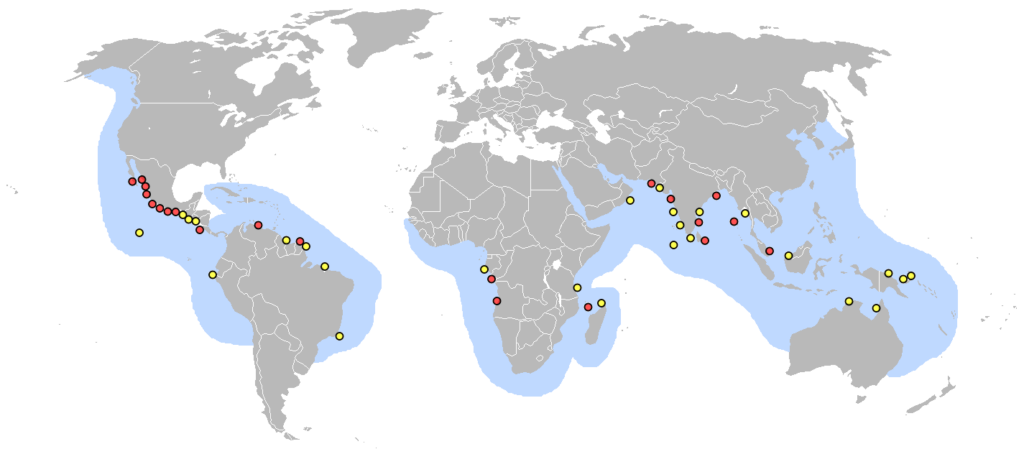
- The Olive ridley sea turtle is found in warm and tropical waters, primarily in the Pacific and Indian Oceans, but also in the warm waters of the Atlantic Ocean.
- The olive ridley turtle has a circumtropical distribution, living in tropical and warm waters of the Pacific and Indian Oceans from India, Arabia, Japan, and Micronesia south to southern Africa, Australia, and New Zealand.
- In the Atlantic Ocean, it has been observed off the western coast of Africa and the coasts of northern Brazil, Suriname, Guyana, French Guiana, and Venezuela.
- Additionally, the olive ridley has been recorded in the Caribbean Sea as far north as Puerto Rico.
- The Odisha’s Gahirmatha Marine Sanctuary is known as the world’s largest rookery (colony of breeding animals) of sea turtles.
- The Olive ridley sea turtle is found in warm and tropical waters, primarily in the Pacific and Indian Oceans, but also in the warm waters of the Atlantic Ocean.
- Protection Status:
- The olive ridley sea turtle has been listed on Schedule – I of the Indian Wildlife (Protection) Act, 1972.
- The species is listed as Vulnerable under IUCN.
- Olive ridley sea turtles are considered the most abundant, yet globally they have declined by more than 30% from historic levels.
- These turtles are considered endangered because of their few remaining nesting sites in the world.
- The sea turtles are protected under the ‘Migratory Species Convention’ and Convention of International Trade on Wildlife Flora and Fauna (CITES).
- CITES: Appendix I

Nesting grounds in Indian Ocean
- Olive ridley turtles exhibit two different nesting behaviours, the most prevalent solitary nesting, but also the behaviour they are best known for, the synchronized mass nesting, termed arribadas.
- Females return to the same beach from where they hatched, to lay their eggs. They lay their eggs in conical nests about 1.5 ft deep, which they laboriously dig with their hind flippers.
- In the Indian Ocean, Arabian Sea near Honavar in Karnataka, the majority of olive ridleys nest in two or three large assemblies near Gahirmatha in Odisha. The coast of Odisha in India is one of the largest mass nesting sites for the olive ridley, along with the coasts of Mexico and Costa Rica.
- In 1991, over 600,000 turtles nested along the coast of Odisha in one week.
- The Gahirmatha Beach in Kendrapara district of Odisha (India), which is now a part of the Bhitarkanika Wildlife Sanctuary, is the largest breeding ground for these turtles.
- Apart from Gahirmatha rookery, two other mass nesting beaches have been located, which are on the mouth of rivers Rushikulya and Devi.
- Recently, a new mass nesting site has been discovered in the Andaman and Nicobar Islands. As per reports, it has more than 5,000 nests in a season.
- Solitary nesting also occurs in Lothian Island Wildlife Sanctuary in West Bengal & along the Coromandel Coast and Sri Lanka, but in scattered locations.
- However, olive ridleys are considered a rarity in most areas of the Indian Ocean. Some nesting populations exist in islands of Bangladesh near Cox’s Bazar.

Threats:
- Predators:
- Known predators of olive ridley eggs include raccoons, coyotes, feral dogs and pigs, opossums, coatimundi, caimans, ghost crabs, and the sunbeam snake.
- Hatchlings are preyed upon as they travel across the beach to the water by vultures, frigate birds, crabs, raccoons, coyotes, iguanas, and snakes.
- In the water, hatchling predators most likely include oceanic fishes, sharks, and crocodiles. Adults have relatively few known predators, other than sharks and crocodiles, and killer whales are responsible for occasional attacks.
- On land, nesting females may be attacked by jaguars.
- Human Consumption: They are extensively poached for their meat, shell and leather, and eggs.
- Marine Pollution and Waste: An ever-increasing debris of plastics, fishing nets, discarded nets, polythene and other garbage dumped by tourists and fishing workers threaten all sea turtles and degrades their habitats.
- Human Activities:
- Fishing Trawlers – Overexploitation of marine resources by use of trawlers often violates the rule to not fish 20 kilometers within a marine sanctuary.
- Major threats include mortality associated with boat collisions, and incidental takes in fisheries. Trawling, gill nets, ghost nests, longline fishing, and pot fishing have significantly affected olive ridley populations, as well as other species of marine turtles.
- There were injury marks on many dead turtles indicating they could have been trapped under trawls or gill nets.
- Light Pollution: Artificial lights from nearby towns and industries can disorient hatchlings, causing them to move away from the sea and towards nearby villages.
- Coastal development, natural disasters, climate change, and other sources of beach erosion have also been cited as potential threats to nesting grounds.
Initiatives to Protect Olive Ridley Turtles:
- Operation Olivia:
- Every year, the Indian Coast Guard’s “Operation Olivia”, initiated in the early 1980s, helps protect Olive Ridley turtles as they congregate along the Odisha coast for breeding and nesting from November to December.
- It also intercepts unlawful trawling activities.
- Every year, the Indian Coast Guard’s “Operation Olivia”, initiated in the early 1980s, helps protect Olive Ridley turtles as they congregate along the Odisha coast for breeding and nesting from November to December.
- Mandatory use of Turtle Excluder Devices (TEDs):
- To reduce accidental killing in India, the Odisha government has made it mandatory for trawls to use Turtle Excluder Devices (TEDs), a net specially designed with an exit cover which allows the turtles to escape while retaining the catch.
- Tagging:
- The tagging of the endangered Olive Ridley turtles using non-corrosive metal tags is done to enable scientists to chart their movements and also know the areas they visit in order to protect the species and their habitats.
Note:
- Behler Turtle Conservation Award, established in 2006, is a major annual international award honoring excellence in the field of tortoise and freshwater turtle conservation. It is considered the “Nobel Prize” of Turtle Conservation.
- It is presented annually by the Turtle Survival Alliance, IUCN Tortoise and Freshwater Turtle Specialist Group, Turtle Conservancy, and Turtle Conservation Fund.
Gahirmatha Beach
- Gahirmatha Beach is in the Kendrapara district of Odisha.
- The beach separates the Bhitarkanika Mangroves from the Bay of Bengal and is the world’s most important nesting beach for olive ridley sea turtles.
- The beach is part of Gahirmatha Marine Wildlife Sanctuary, which also includes the adjacent portion of the Bay of Bengal.
- There are 3 protected areas that represent the Gahirmatha wetland:
- Bhitarkanika National Park
- Bhitarkanika Wildlife Sanctuary
- Gahirmatha Marine Sanctuary
Bhitarkanika National Park, Wildlife Sanctuary, Ramsar Site
- Bhitarkanika National Park is located in the estuarial region of Brahmani-Baitarani, in northeast Kendrapara district in Odisha.
- It is the second Ramsar Site of Odisha after Chilika Lake.
- It is surrounded by Bhitarkanika Wildlife Sanctuary.
- Gahirmatha Marine Sanctuary separates the National Park from the Bay of Bengal. It is inundated by the rivers Brahmani, Baitarani & Dhamra.
- It hosts many mangrove species and is the second-largest mangrove ecosystem in India.
- The national park is home to Saltwater crocodile, Indian python, king cobra, black ibis, darters and many other species of flora and fauna.
Rushikulya River
- The Rushikulya River is one of the major rivers in Odisha and covers the entire catchment area in the districts of Kandhamal and Ganjam.
- The Rushikulya originates at an elevation of about 1000 meters from Rushimala Hills part of Daringbadi hills of the Eastern Ghats.
- The place from where the river originates, Daringbadi is called the ‘ Kashmir of Odisha ‘.
- The tributaries of the Rushikulya River are Dhanei, Badanadi, and Baghua.
- It does not have any delta in its mouth region.
- This river is extremely rich in mineral wealth and some of the prime ones include-Lime stone, sand talc, grinding materials, black sand, and clay.
- This is one of the remote areas for mass nesting and is regarded as a site of Ridley Olive sea turtles.