

Official syllabusPaper II · Unit 3 · Therapeutic Approaches
Indigenous therapies (Yoga, Meditation).
Definition
“Indigenous healing can be defined as helping beliefs and practices that originate within the culture or society. It is not transported from other regions, and it is designed for treating the inhabitants of the given group.”
Sue and Sue (2008)
Yoga and meditation are the indigenous therapies India gave the world, and both began as disciplines of liberation rather than treatments for disorder. Their therapeutic standing therefore rests on two separate questions: whether a culturally rooted practice fits its users better than an imported one, and whether it still works when tested against an active control.
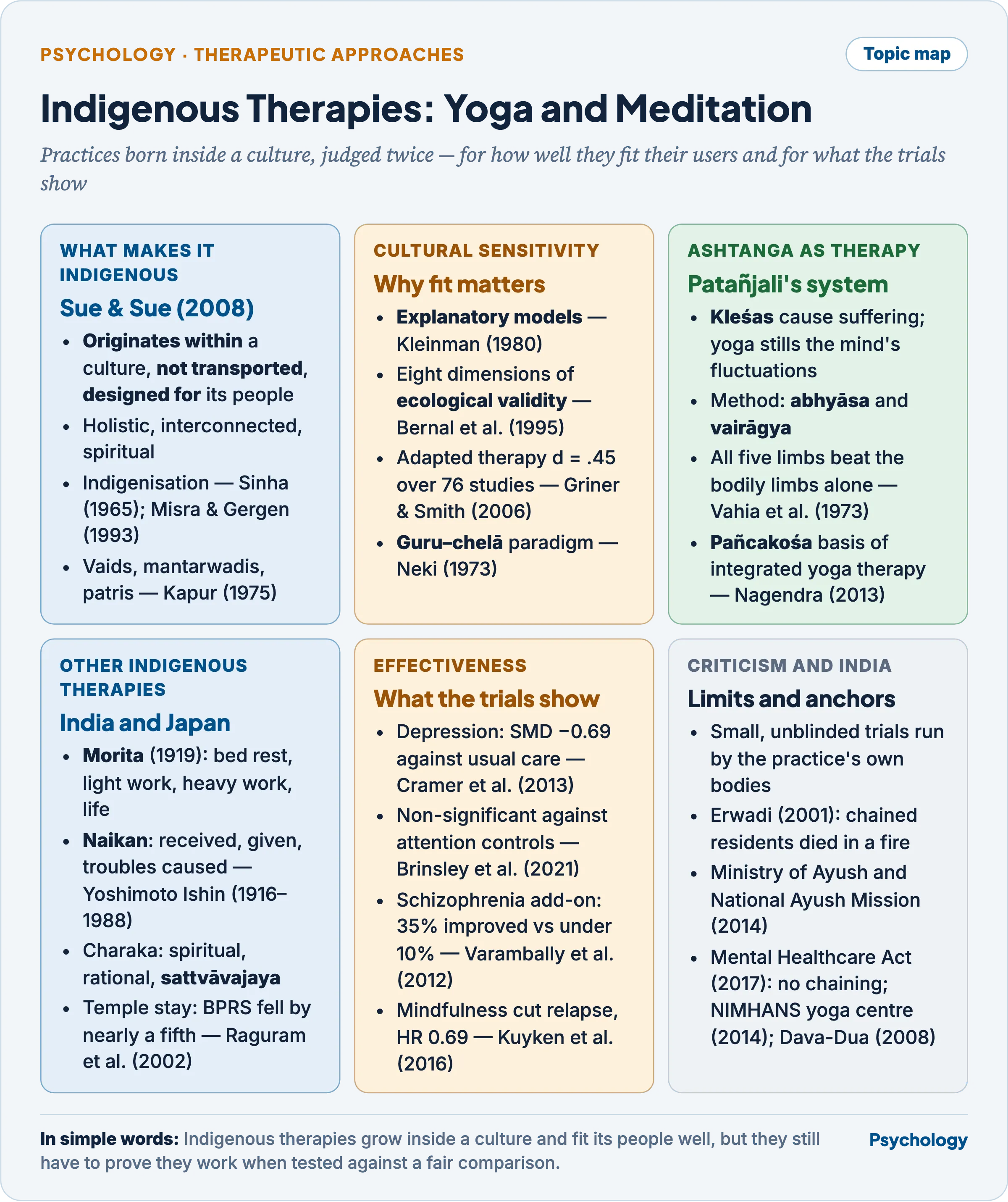
Fit to culture and proof of effect are separate tests, and the map keeps them in separate boxes.
What makes a therapy indigenous
- Three features follow from the definition: the practice originates within the culture, is not transported from elsewhere, and is designed for that culture’s members (Sue and Sue, 2008).
- Sue and Sue (2008) name its shared principles: a holistic outlook joining mind, body and spirit; interconnectedness with family, community and cosmos; belief in metaphysical levels of existence; and spirituality in life and the cosmos.
- Western therapy instead assumes separate units (therapist and client), a reality the senses measure, and culture-free principles.
- The Indian case for such therapies is indigenisation: Durganand Sinha (1965) called for integrating modern psychology with Indian thought, and Misra and Gergen (1993) criticised psychology’s acultural, decontextualised individual (The Indian Approach to Personality, Paper I).
- India’s indigenous therapies form five families — yogic (Patañjali’s aṣṭāṅga), meditative (Vipassana, mantra), Ayurvedic (Charaka’s three therapies), devotional (temples, dargahs) and relational (the guru–chelā bond, the Gītā); Japan’s Morita and Naikan therapies are the classic cases outside India.
- R. L. Kapur (1975), surveying help-seeking in an Indian village, found three traditional healers beside modern doctors — vaids (indigenous medicine), mantarwadis (astrology and charms) and patris (mediums for spirits).
- Most who sought help consulted both kinds despite their contradictory theories, so Kapur (1975) urged rural psychiatry to work through the popular healers.
Therapeutic approaches must be culturally sensitive
- Every therapy carries a theory of illness. Kleinman (1980) called these explanatory models — patient’s and healer’s answers on cause, onset, mechanism, course and treatment — and held that a clash between them impedes care.
- Bernal, Bonilla and Bellido (1995) set out the ecological validity model: eight dimensions on which a treatment can be made culturally congruent — language, persons, metaphors, content, concepts, goals, methods and context.
- Indigenous therapies are congruent on these by construction:
- Language and metaphor — prāṇa, karma and doṣa are the client’s own idiom.
- Persons — guru, vaid, priest or Naikan interviewer are culturally sanctioned helpers.
- Concepts and goals — equanimity and duty rather than self-assertion; the family stays with the patient.
- Methods and context — breath, posture, ritual, residence in a sacred place.
- Adaptation measurably helps.
- Griner and Smith (2006) pooled 76 studies (25,225 participants): adapted interventions gave d = .45, those built for one cultural group were four times as effective as mixed-group ones, and native-language therapy twice as effective.
- Benish, Quintana and Wampold (2011) compared adapted with unadapted bona fide therapy directly: adaptation added d = .32, and adapting the illness myth — the explanation of distress — was the only moderator.
- The increment is real but modest: an unadapted therapy still works, so sensitivity improves treatment rather than deciding it.
- Neki (1973) proposed the guru–chelā (master–disciple) bond as a therapeutic paradigm for India: the guru guides directly and accepts the disciple’s dependence, suiting a culture that values self-discipline over self-expression, where Western therapy aims at independence.
- Sensitivity is not deference: a sanctioned practice that coerces — chaining, beating, prolonged confinement — fails the “goals” dimension, and the Mental Healthcare Act forbids chaining.
Ashtanga Yoga as a therapeutic system
- The eight limbs are set out in Meditation and Its Effects (Paper I); here the system is read as therapy.
- Aetiology — Patañjali’s Yoga Sūtra (2.3–2.4) traces suffering to five kleśas (afflictions): avidyā (ignorance, misapprehension of the real; the field of the rest), asmitā (egoism), rāga (attachment), dveṣa (aversion) and abhiniveśa (clinging to life).
- Mechanism — yoga is citta-vṛtti-nirodha (1.2), the stilling of the mind’s fluctuations; the twin method is abhyāsa (sustained practice) and vairāgya (non-attachment) (1.12).
- Clinically, these become tools.
- Vairāgya — staying with a feared sensation without approach or escape, the stance later named acceptance; applied in exposure for panic and obsessions.
- Viveka (discrimination) — testing a perception for error; the analogue of cognitive reappraisal.
- Prāṇāyāma — slow, even diaphragmatic breathing to damp the over-breathing of a panic attack.
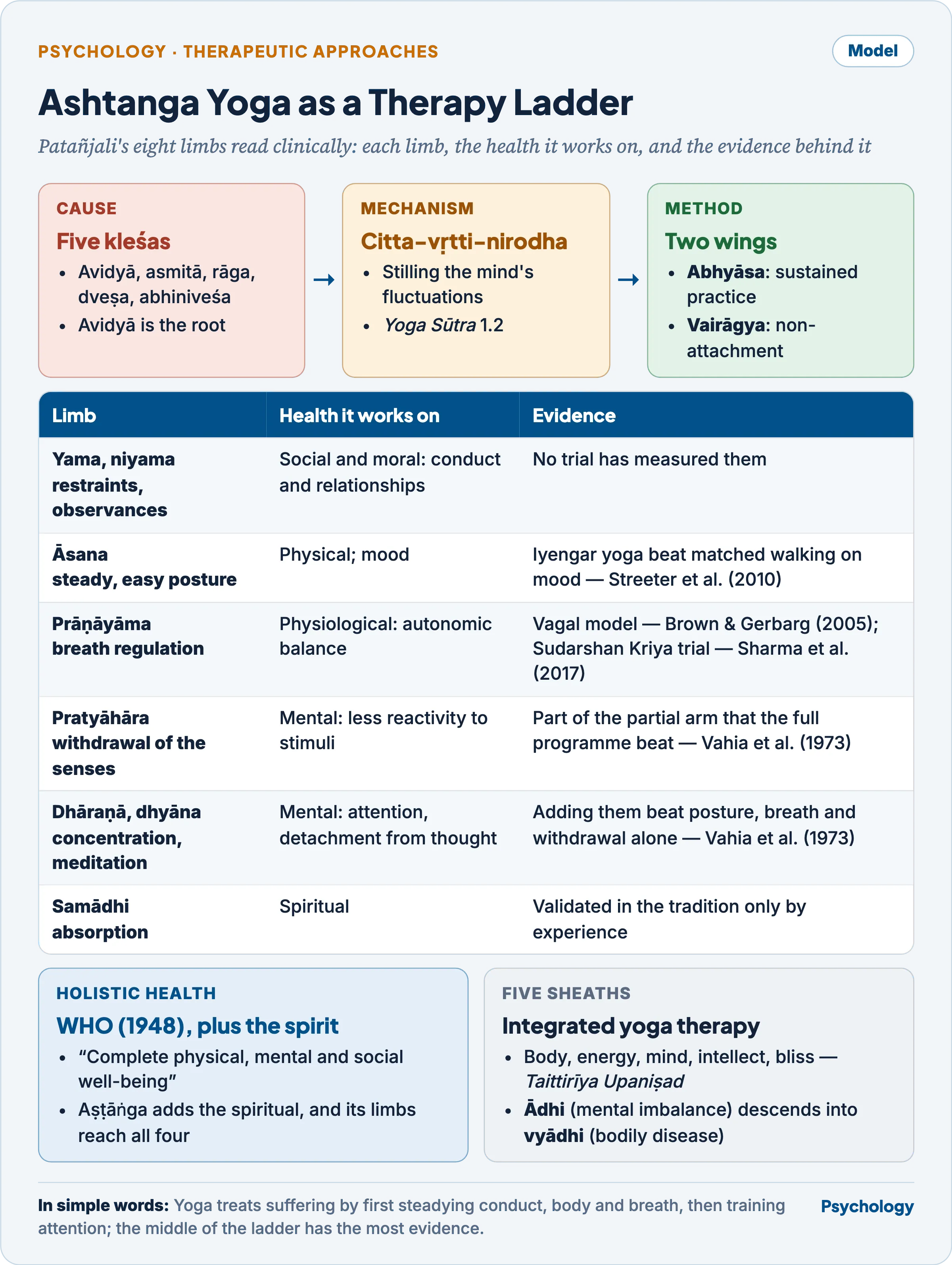
The limbs climb from conduct to body to breath to attention, and the trials cluster on the middle rungs.
Patañjali-based psychophysiological therapy
- Vahia, Vinekar and Doongaji (1966), at K.E.M. Hospital, Bombay, built a clinical programme on the Yoga Sūtra for neurotic and psychosomatic disorders.
- Rationale: disorder grows from the kleśas — faulty self-perception, undue attachment, and hatred born of frustration — so therapy works to weaken them (Vahia and colleagues, 1973).
- Method: five limbs — āsana, prāṇāyāma, pratyāhāra, dhāraṇā and dhyāna — practised daily.
- Design: a double-blind trial of 27 patients against pseudo-yoga — relaxation with postures and breathing that merely resembled āsana and prāṇāyāma, both groups taking placebo tablets (Vahia and colleagues, 1973).
- Findings: anxiety fell more with genuine yoga; the full five limbs beat āsana, prāṇāyāma and pratyāhāra alone; and a non-randomised comparison of 39 patients favoured yoga over amitriptyline and chlordiazepoxide (Vahia and colleagues, 1973).
- Limitation: small samples, unreported randomisation, and a diagnosis (psychoneurosis) since abandoned; still, the dismantling result is rare evidence on components.
How Ashtanga Yoga fosters holistic health
- Health, for the World Health Organization (1948), is “a state of complete physical, mental and social well-being and not merely the absence of disease or infirmity”; aṣṭāṅga adds the spiritual and works on all four.
- Social and moral — yama (restraints such as non-violence and truthfulness) and niyama (observances such as contentment and self-study) regulate conduct.
- Physical — āsana, held sthira and sukha, steady and easy.
- Physiological — prāṇāyāma; Brown and Gerbarg (2005) modelled slow yogic breathing as shifting autonomic balance towards vagal, parasympathetic dominance.
- Mental — pratyāhāra, dhāraṇā and dhyāna train attention and detachment from thought.
- Spiritual — samādhi, validated in the tradition only by experience.
- The pañcakośa (five sheaths) of the Taittirīya Upaniṣad underlies Nagarathna and Nagendra’s integrated approach of yoga therapy at S-VYASA, Bengaluru (Nagendra, 2013): disease begins as ādhi (mental imbalance) and descends into vyādhi (bodily disease), so each sheath gets its practice.
- The sheaths are in The Indian Approach to Personality (Paper I); its trials, in Stress, Psychosomatic Disorders and Stress Management (Unit 2).
- Streeter and colleagues (2010) randomised healthy adults to Iyengar yoga (19) or matched walking (15) for 12 weeks: yoga improved mood and anxiety more, tracking thalamic GABA. Limitation: small, healthy sample.
- No trial has measured the moral limbs.
Other indigenous therapies
Morita therapy
- Shoma Morita (1919) designed it for shinkeishitsu, a nervous, anxiously self-focused temperament.
- Theory: symptoms persist through toraware, attention trapped on them; the goal is arugamama, accepting feelings as they are while doing what the situation requires.
- Four residential stages: about a week of isolated bed rest, then light work, heavy work and complex activity in preparation for ordinary life, with a diary the therapist annotates.
- Evidence: a Cochrane review (Wu and colleagues, 2015) found only seven small Chinese trials (449 participants), with considerable risk of bias, and could draw no conclusion.
Naikan therapy
- Yoshimoto Ishin (1916–1988) had its prototype by 1941, adapted from mishirabe, an ascetic Jōdo Shinshū self-examination; from 1955 to 1964 he spread it through Japanese prisons and reformatories, and psychotherapy took it up later.
- Method: a week behind a folding screen, about fifteen hours a day, recalling each significant person in turn, beginning with the mother, through three questions:
- What have I received from this person?
- What have I given in return?
- What troubles and difficulties have I caused?
- A brief interview every one to two hours turns grievance into recognised indebtedness; it is used for alcoholism and family conflict.
- Its premise is culture-bound: in a guilt-prone, depressed client the third question can deepen self-blame.
Ayurvedic psychiatry: Charaka’s three therapies
- The Charaka Saṃhitā (Sūtrasthāna 11.54) names three kinds of therapy:
- Daivavyapāśraya — spiritual: mantra, gems, offerings, fasting, pilgrimage.
- Yuktivyapāśraya — rational: planned diet and drugs.
- Sattvāvajaya — psychological: restraint of the mind from unwholesome objects, Ayurveda’s own psychotherapy.
- Disorder follows prajñāparādha, a failure of intellect — doing what one knows is harmful — which sattvāvajaya corrects.
Temple and faith healing
- Raguram, Venkateswaran, Ramakrishna and Weiss (2002) studied everyone who stayed at the Muthuswamy temple, Tamil Nadu, from June to August 2000.
- Sample: 31 people — 23 with paranoid schizophrenia, six with delusional disorder, two with bipolar disorder; mean stay six weeks.
- Setting: no medication and no special healing ritual — a 15-minute morning prayer, routine temple chores, and usually a relative in attendance.
- Finding: Brief Psychiatric Rating Scale scores fell from 52.9 to 42.9, nearly 20 per cent (Raguram and colleagues, 2002), a gain the authors likened to that of many psychotropic drugs.
- Limitation: no comparison group, so the authors called the findings suggestive; the likely agent is a supportive, non-threatening setting.
- Faith healers are widely used: Campion and Bhugra (1997) found that 89 (45 per cent) of 198 consecutive psychiatric patients at a Tamil Nadu hospital had consulted Hindu, Muslim or Christian healers.
- The danger is the custodial version. At Erwadi (6 August 2001), 28 chained residents of the Moideen Badusha home, a faith-healing asylum in Ramanathapuram district, died in a fire; the next day the Supreme Court took suo motu notice.
Indigenous therapies as an alternative to classical insight therapies
- Classical insight therapies — psychoanalysis, psychodynamic therapy and client-centred therapy — change a person through understanding: making the unconscious conscious, or experiencing the self accurately (Psychodynamic Therapies; Client-Centred Therapy).
| Dimension | Classical insight therapies | Indigenous therapies |
|---|---|---|
| Route to change | Verbal understanding of conflict or self | Practice: posture, breath, attention, ritual, work |
| Mind and body | Mind reached through talk | Psychophysical; the body is the point of entry |
| The self | Strengthen the ego, individuate | Loosen identification with the ego |
| Relationship | Neutral or empathic professional | Guru, priest or interviewer; family present |
| Frame | Secular, intrapsychic | Spiritual and cosmological |
| Agency | Therapist interprets | Client practises daily, often for life |
| Reach | Long, individual, scarce professionals | Group-based, cheap, lay teachers |
| Evidence | Decades of controlled trials | Small, unblinded trials; few active controls |
- They are an alternative where insight therapy fits poorly: clients who expect directive guidance (Neki, 1973), express distress somatically, or cannot afford long individual treatment.
- Morita and Naikan reverse the insight assumption: action precedes feeling, and dwelling on symptoms is forbidden rather than explored.
- The alternative has become a complement: dialectical behaviour therapy (Linehan, 1993) borrowed Zen acceptance, and mindfulness programmes borrowed Vipassana (Meditation and Its Effects, Paper I).
- It stops at severe illness: the schizophrenia and depression trials below test yoga as an add-on to medication, not a replacement.
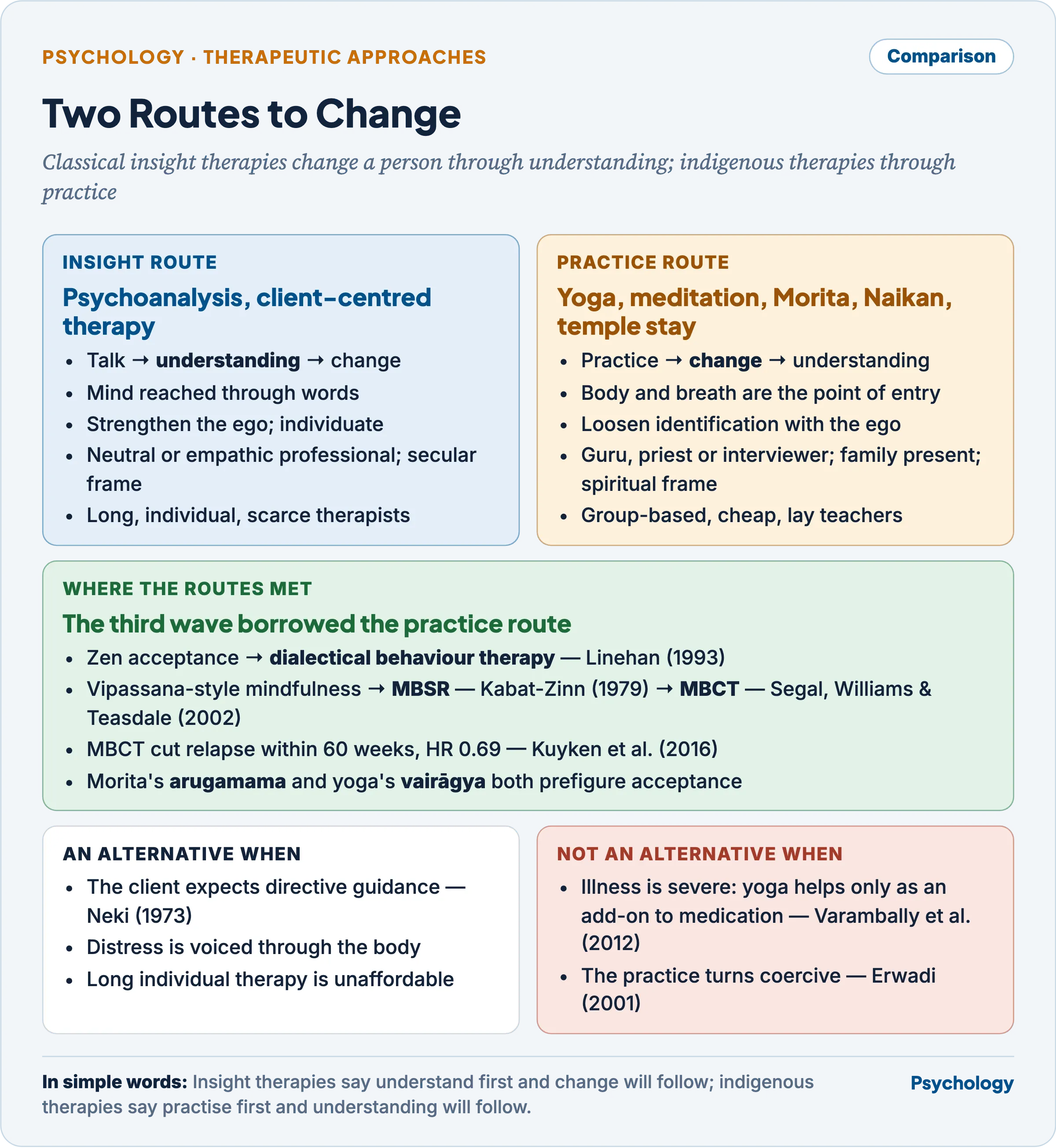
Insight therapies work from understanding towards change; indigenous therapies work from practice towards understanding, and the third wave borrowed the second route.
Yoga and meditation as therapies: significance and effectiveness
- Significance: low cost, group delivery, self-administration after training, physical benefit alongside mental, little stigma, and cultural acceptability in India.
- Depression.
- Cramer, Lauche, Langhorst and Dobos (2013) pooled 12 trials (619 participants): moderate evidence of short-term benefit against usual care (SMD −0.69), limited evidence against relaxation and exercise; three trials had low risk of bias.
- Brinsley and colleagues (2021) pooled 13 trials in diagnosed disorders: SMD −0.41 overall, but a non-significant −0.21 against attention controls; more weekly sessions gave larger effects.
- Sharma and colleagues (2017) randomised 25 antidepressant non-responders to Sudarshan Kriya yoga or waitlist for eight weeks: Hamilton scores fell 9.8 points against a 0.5-point rise. Limitation: tiny, waitlist-controlled, Art of Living instructors.
- The NIMHANS Sudarshan Kriya trial against ECT and imipramine, and meditation’s evidence on anxiety and pain, are in Meditation and Its Effects (Paper I).
- Schizophrenia — Varambally and colleagues (2012), NIMHANS, randomised 120 stabilised outpatients to add-on yogāsana, exercise or waitlist.
- Design: a month of supervised sessions, three months of home practice, a blind rater at four months.
- Finding: about 35 per cent improved with yoga against under 10 per cent in the other arms (Varambally and colleagues, 2012); negative symptoms and social functioning improved, positive symptoms did not.
- Limitation: small absolute change; 14 of 37 left the exercise arm.
- Relapse prevention — Kuyken and colleagues (2016) pooled individual data from nine trials (1,258 patients): mindfulness-based cognitive therapy cut relapse within 60 weeks (hazard ratio 0.69; 0.79 against active treatments).
- Safety — Cramer and colleagues (2015) found yoga as safe as usual care or exercise, but only 94 of 301 yoga trials reported adverse events at all.
Vipassana at Tihar Jail
- Kiran Bedi, then Inspector-General of Prisons, brought Vipassana into Tihar: a first course in late November 1993 (96 prisoners, 23 staff), then 1,003 prisoners on 4 April 1994, and a permanent centre.
- Chandiramani, Verma and Dhar (1995) ran two studies. In the first, 120 volunteers without controls showed less hostility and helplessness and more well-being and hope.
- The second compared 85 course participants with 65 non-attenders: among prisoners with psychiatric illness, anxiety and depression fell significantly in the Vipassana group only.
- Limitation: volunteers, incomplete randomisation, and publication by the movement’s own institute; the gains in hope and hostility were not sustained at follow-up.
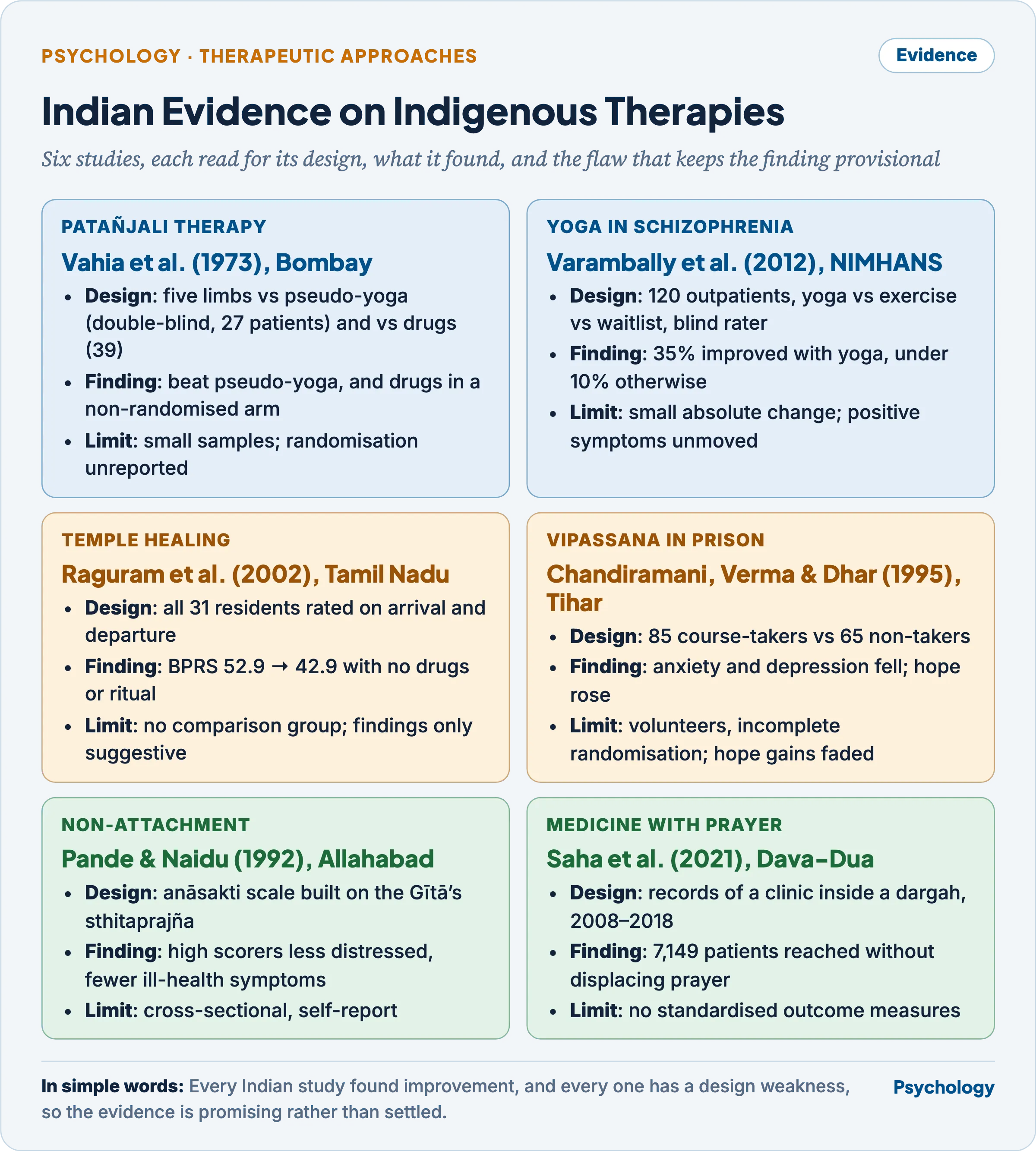
Every Indian study here found improvement, and every one carries a design flaw that keeps the finding provisional.
Eastern traditional wisdom and psychological illness
- Buddhism reads suffering clinically: the Four Noble Truths name the condition, its cause in craving, its cessation and the path — a diagnosis, aetiology, prognosis and treatment.
- Its practice of sati (mindfulness) reached psychiatry through mindfulness-based stress reduction (Kabat-Zinn, 1979) and its descendants, set out in Meditation and Its Effects (Paper I).
- Yoga supplied the kleśa account of suffering, the stance of vairāgya and a staged training of attention, now tested as add-on therapy (Varambally and colleagues, 2012).
- The Bhagavad Gītā is a counselling dialogue: Arjuna’s despair (viṣāda) before battle is met by Krishna’s reframing of duty, loss and action.
- Bhatia and colleagues (2013) traced its parallels with psychodynamic, cognitive-behavioural, grief, role-transition and motivation-enhancement work.
- Pande and Naidu (1992), at Allahabad, built an anāsakti (non-attachment) scale on the Gītā’s sthitaprajña, the person of steady wisdom: high scorers were less distressed and showed fewer symptoms of ill health. Limitation: cross-sectional, self-report.
- Ayurveda contributed sattvāvajaya as psychotherapy; Zen shaped Morita therapy, and Pure Land (Jōdo Shinshū) Buddhism gave Naikan.
Fostering positive mental health through indigenous therapies and cultural practices
- Positive mental health criteria are in Fostering Mental Health; the indigenous route reaches them through practice.
- Evidence in non-clinical people: healthy adults’ mood and anxiety improved with yoga (Streeter and colleagues, 2010); prisoners’ well-being and hope rose after Vipassana (Chandiramani and colleagues, 1995); anāsakti went with less distress (Pande and Naidu, 1992).
- Cultural practices carry the same mechanisms, though rarely studied as interventions:
- Bhajan, kīrtan and satsaṅg — group singing and belonging, the mechanism of social support.
- Sevā and dāna — service and giving, the mechanism of altruism and meaning.
- Pilgrimage and temple stay — refuge and hope in a community that accepts the ill person, as at Muthuswamy.
- Fasting and vows (vrata) — practice in self-regulation.
- Mourning rites such as śrāddha — structured grief and social reintegration.
- Conditions: participation voluntary and non-coercive, and combined with medical care where illness is severe.
- The possibility is real but unproven at scale: the evidence concerns individuals in trials and prisons, not communities.
- Indian techniques for stress management — prāṇāyāma, yoga nidrā, the integrated approach of yoga therapy — with their trials are in Stress, Psychosomatic Disorders and Stress Management (Unit 2).
Criticisms and limitations
- The effect shrinks as the control improves: yoga beats usual care, but evidence against relaxation and exercise is limited (Cramer and colleagues, 2013) and against attention controls non-significant (Brinsley and colleagues, 2021).
- Trials are small, unblinded, often waitlist-controlled, and frequently run by the practice’s own organisations — Art of Living instructors, the Vipassana institute, the yoga university behind the integrated approach.
- Which component works is rarely tested; Vahia’s dismantling comparison is the exception.
- Harms are under-recorded (Cramer and colleagues, 2015); meditation’s adverse effects are in Meditation and Its Effects (Paper I).
- Faith healing can delay treatment and slide into custody — the lesson of Erwadi — and Kalantri (2002) warned that healing temples may breed superstition.
- Constructs such as prāṇa, the kośas and kuṇḍalinī are not testable as stated, so mechanism claims outrun evidence.
- Exportability is limited: Morita’s randomised evidence is wholly Chinese (Wu and colleagues, 2015), and Naikan’s premise of indebtedness is culture-bound.
- Secularised versions strip the ethical frame, while religious versions can exclude clients of other faiths or none.
Indian context
- Ministry of Ayush (Government of India, 9 November 2014) — governs Ayurveda, Yoga and Naturopathy, Unani, Siddha, Sowa-Rigpa and Homoeopathy; it operationalises cultural congruence by giving indigenous systems state standing.
- National Ayush Mission (Ministry of Ayush, September 2014; ₹1,300 crore in the Union Budget 2026–27) — co-locates Ayush care in public health centres and has upgraded 12,500 dispensaries and sub-centres into Ayushman Arogya Mandir (Ayush) (Rajya Sabha, August 2026); it operationalises accessible self-care.
- Mental Healthcare Act, 2017 (Ministry of Health and Family Welfare) — counts Ayush establishments and Ayush psychiatry postgraduates as mental health establishments and professionals (section 2(1)(p), (r)), yet bans chaining “in any manner or form whatsoever” (section 95); it operationalises pluralism within rights.
- NIMHANS Integrated Centre for Yoga (clinical yoga from 2007; named 2014; Department of Integrative Medicine 2019 — Bhargav and colleagues, 2022) — disorder-specific add-on modules, with 3,290 referrals in September 2017–August 2019 (Arasappa and colleagues, 2021); it operationalises integration without substitution.
- Dava-Dua (Government of Gujarat, 2008) — a psychiatric clinic inside the Mira Datar dargah, Mehsana, which registered 7,149 patients from July 2008 to March 2018 (Saha and colleagues, 2021); it operationalises collaboration with healers, as Kapur (1975) urged. Limitation: no standardised outcomes.
- The International Day of Yoga and the Common Yoga Protocol are in Meditation and Its Effects (Paper I).
Previous Year Questions
- 2026“Therapeutic approaches must be culturally sensitive” — Discuss with examples from indigenous therapies.
- 2020How are indigenous therapies an alternative to classical insight therapies? Discuss.
- 2015How can ‘Ashtanga Yoga’ help in fostering holistic health? Support your answer with research evidence.
- 2013Comment on: Reflect on the possibility of fostering positive mental health through indigenous therapies along with cultural practices.
- 2010In which way, the ‘eastern traditional wisdom’ has contributed to dealing with psychological illnesses?
- 2004Write a short note on: Any two indigenous therapies.
- 2003Examine the significance of indigenous therapies like Yoga and meditation. How effective they are?
- 2000What is stress? Can you suggest some Indian techniques for stress management? Elaborate.