

Official syllabusPaper II · Unit 3 · Therapeutic Approaches
Cognitive therapies – rational emotive behaviour therapy.
Definition
“Rational emotive behavior therapy (REBT) is one of the main humanistic psychotherapies. It shows how people, in an all-too-human manner, create a large part of their emotional disturbances and also have the ability to uncreate them.”
Albert Ellis (1996)
REBT was the first of the cognitive therapies. It holds that people are disturbed less by what happens to them than by the rigid demands they make about it, and it treats those demands by disputing them directly. Its theory is unusually specific about which beliefs disturb and which emotions are healthy, and that specificity is both what separates it from Beck’s cognitive therapy and what its evidence has struggled to confirm.
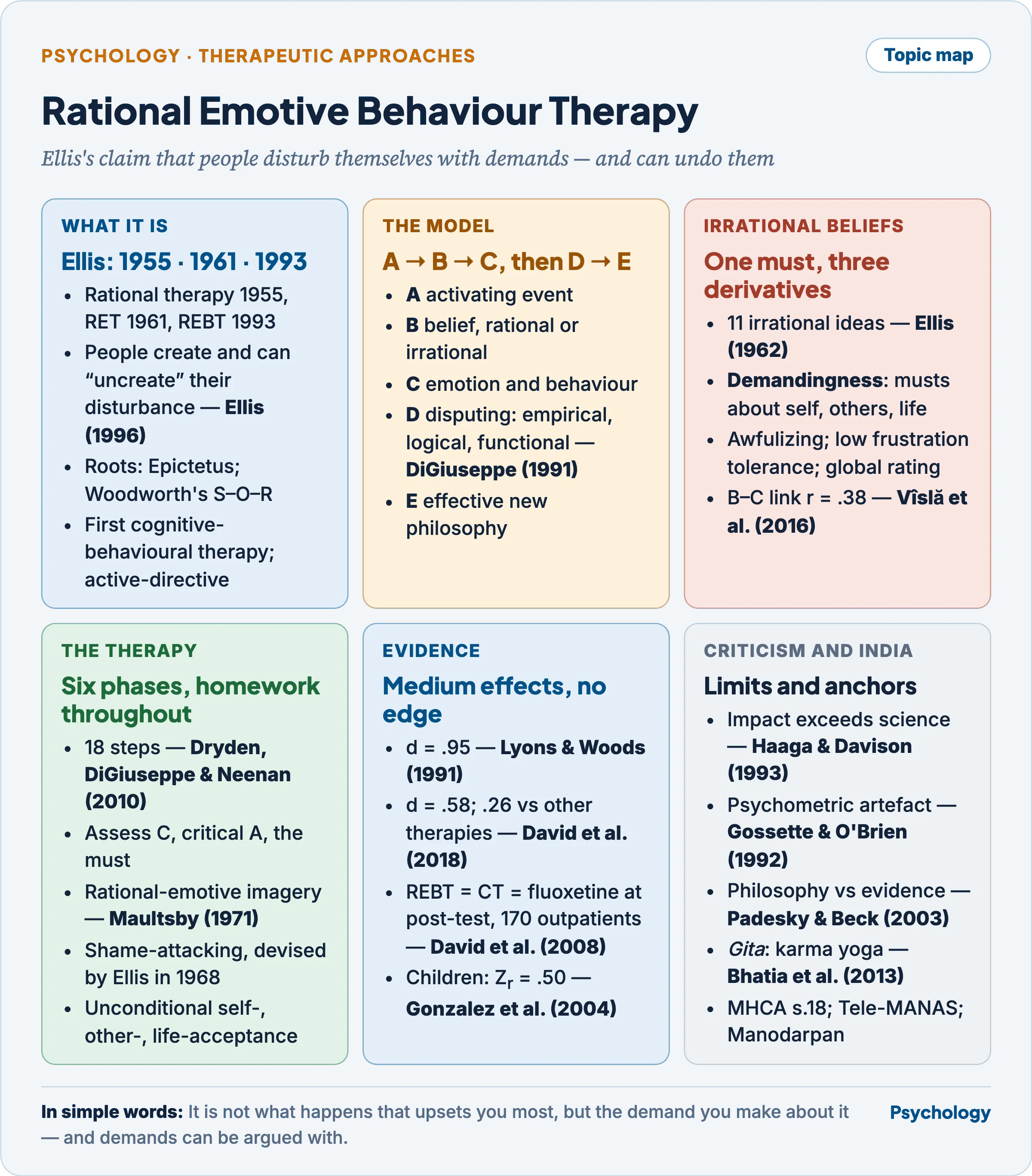
Every box hangs on B: the theory places disturbance in demands, and the therapy, the evidence and the criticism all turn on whether changing B is what does the work.
Cognitive therapies: Ellis and the origins of rational emotive behaviour therapy
- Albert Ellis (1913–2007) broke with psychoanalysis in 1953, finding it slow and often ineffective, and by 1955 was practising rational therapy, first presented at the American Psychological Association convention in Chicago in August 1956 (Ellis, 1991).
- In 1961 Ellis renamed it rational-emotive therapy (RET), answering critics who said it neglected emotion; Reason and Emotion in Psychotherapy (Ellis, 1962) gave the first full statement.
- In 1993, at Raymond Corsini’s urging, Ellis adopted rational emotive behaviour therapy (REBT) to correct the view that the method was too cognitive and ignored its behavioural side (Ellis, 1993).
- Roots: the Stoic Epictetus, whose Enchiridion taught that people are troubled not by things but by their judgements about things, and Marcus Aurelius; in psychology, Woodworth’s stimulus–organism–response scheme (Ellis, 1991).
- REBT is usually counted the first cognitive-behavioural therapy, preceding Beck’s cognitive therapy of the 1960s; a survey of 422 American clinical and counselling psychologists ranked Ellis the second most influential psychotherapist, after Rogers and ahead of Freud (Smith, 1982).
- Three working assumptions:
- humans are biologically prone to irrational as well as rational thinking (Ellis, 1976);
- thought, feeling and action inevitably include and interact with each other (Ellis, 1991);
- disturbance is kept alive by rehearsing the same beliefs, so insight without practice changes little.
Important concepts of rational emotive behaviour therapy
The ABC model and its extension to ABCDE
- A — activating event, or adversity: whatever the person reacts to — a mock-test score, a remark, a memory, a prediction.
- B — beliefs about A. B, not A, largely creates the consequence.
- Ellis’s revised statement: “Activating Events (As) in people’s lives contribute to their emotional and behavioral disturbances or Consequences (Cs), largely because they are intermingled with or acted upon by people’s Beliefs (Bs) about these Activating Events (As)” (Ellis, 1991).
- C — consequences: emotion (anxiety, rage, depression), behaviour (avoidance, procrastination, drinking) and further thought.
- Irrational beliefs are rigid demands that are unrealistic, illogical and self-defeating; rational beliefs are flexible preferences that are realistic, logical and goal-serving (Ellis, 1991).
- D — disputing: actively questioning the irrational belief until it is given up.
- E — effective new philosophy: the rational belief that replaces it, with the healthier emotions and behaviours that follow, which some presentations label F, new feelings.
- Secondary disturbance: people disturb themselves about being disturbed — anxiety about anxiety, shame about depression — and this second problem is often treated first (Ellis, 1979).
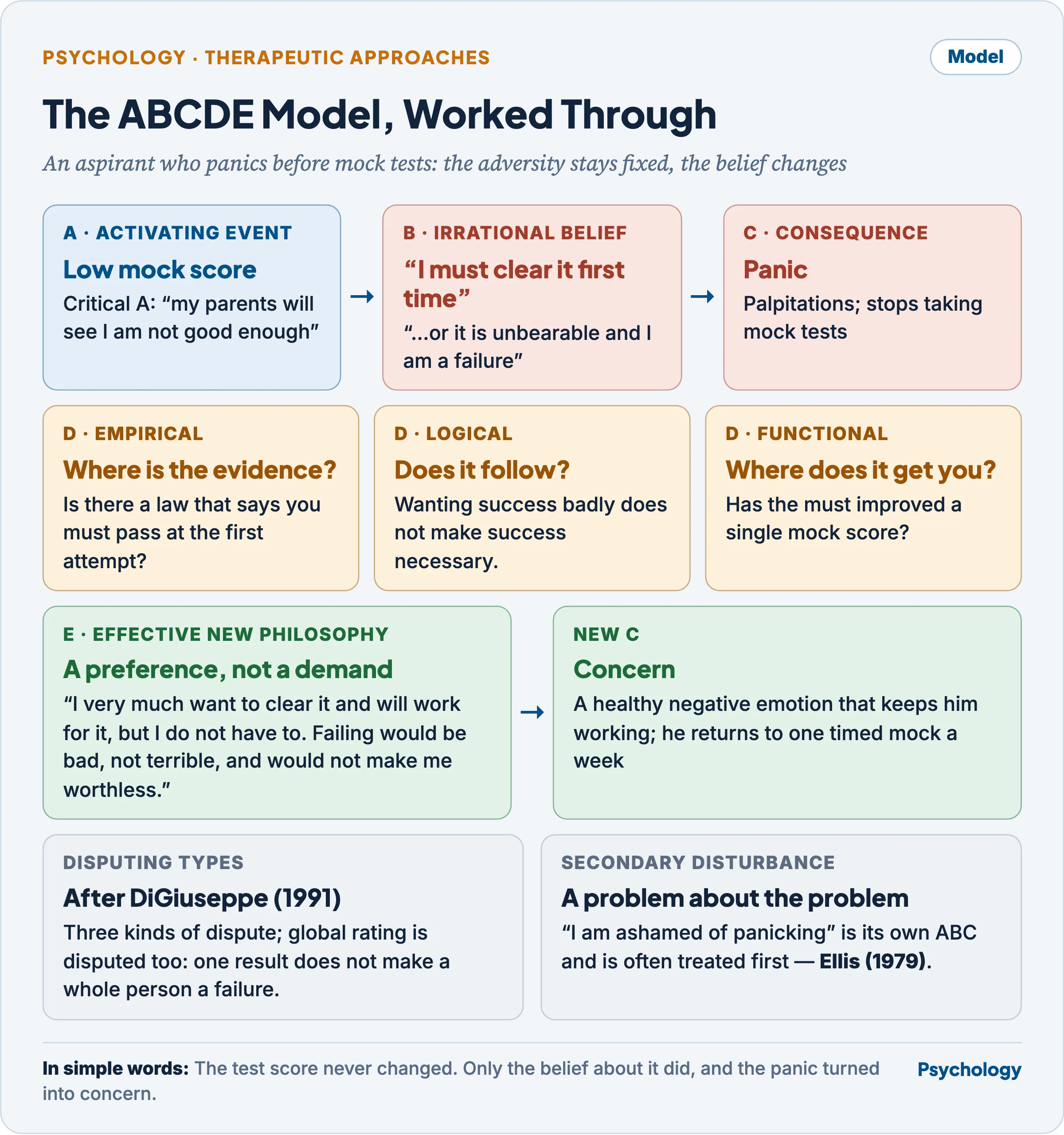
Disputing works on B alone: the adversity at A stays exactly as it was, and the change at C comes from the new belief at E.
Irrational beliefs: the musts and their derivatives
- Ellis (1962) listed eleven irrational ideas: among them, that one must be loved or approved by virtually every significant person; must be thoroughly competent to be worthwhile; that it is easier to avoid than face difficulties; that every problem has a perfect solution.
- He later reduced them to one core, demandingness — absolute musts, which he called musturbation — in three forms (Ellis, 1979):
- self: I must succeed and win approval, or I am worthless;
- others: others must treat me kindly and fairly, or they are rotten;
- life conditions: life must be easy and give me what I want, or it is terrible.
- Three derivatives follow from a must:
- Awfulizing — rating a bad event as the worst thing possible, beyond merely bad.
- Low frustration tolerance — “I can’t stand it”, which Ellis called I-can’t-stand-it-itis.
- Global rating — damning a whole person (self-downing, other-downing) or the world from one act or event.
- Two families of disturbance result, first named ego anxiety and discomfort anxiety (Ellis, 1979): ego disturbance, from demands about one’s worth and performance, and discomfort disturbance, from demands for comfort, which drives procrastination, addiction and anxiety about anxiety.
- The rational alternatives: preferences (“I want to succeed, but I need not”), anti-awfulizing (“bad, not terrible”), high frustration tolerance (“hard, but bearable”) and acceptance of oneself and others as fallible.
- The B–C link — Vîslă, Flückiger, Grosse Holtforth and David (2016):
- Meta-analysis of 83 studies (100 samples, 16,110 participants; Vîslă and colleagues, 2016) relating irrational beliefs to distress.
- Irrational beliefs correlated r = 0.38 with distress overall, highest with anxiety; low frustration tolerance had the strongest link of the four belief types.
- Limitation: beliefs were manipulated in only five of the 100 samples and nearly all measures were self-report, so the evidence is of association, not of B causing C.
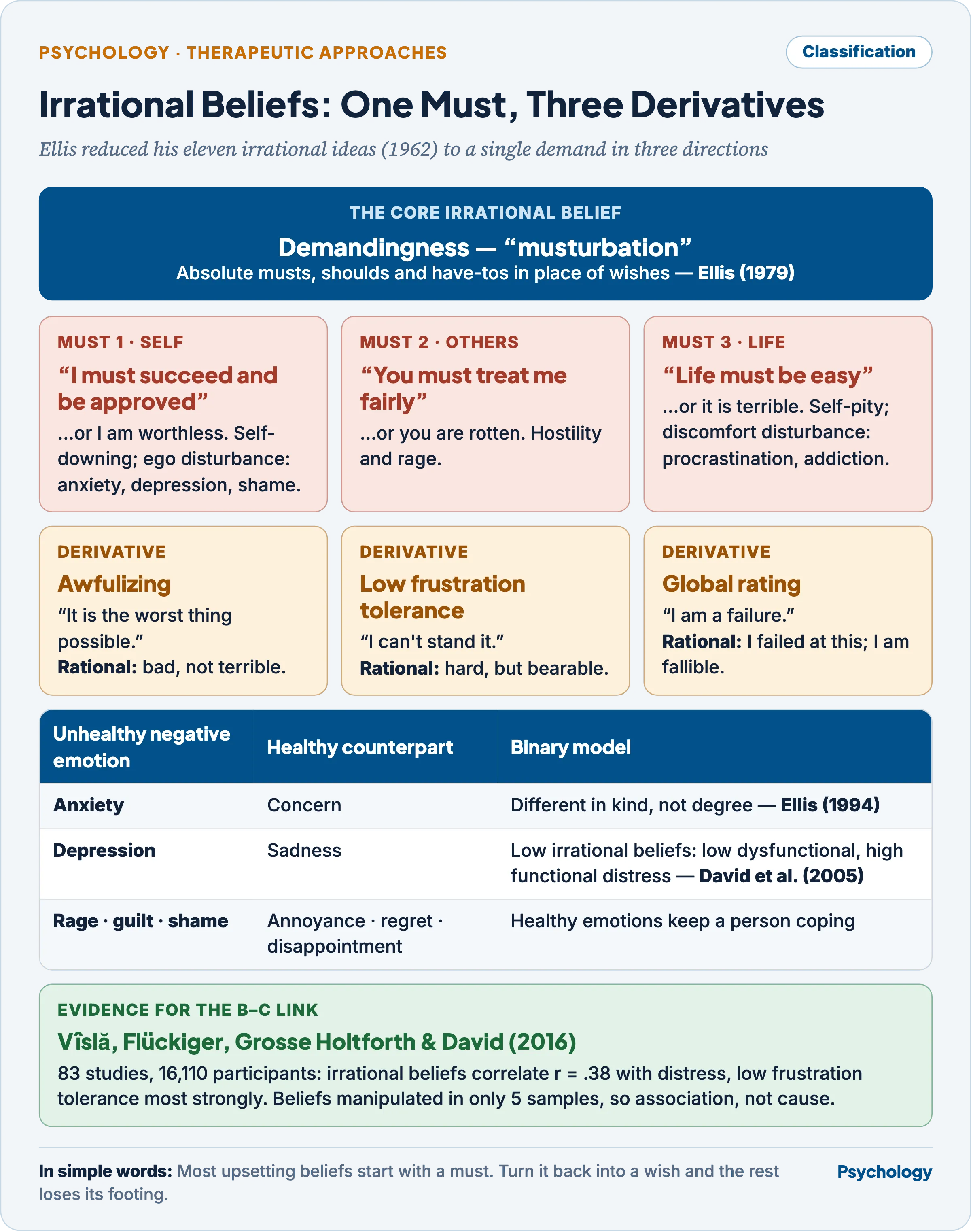
One demand generates the rest: remove the must and awfulizing, low frustration tolerance and self-damning lose their premise.
Healthy and unhealthy negative emotions
- REBT does not aim at calm. Unhealthy negative emotions — anxiety, depression, rage, guilt, shame, hurt — are distinguished from healthy negative emotions — concern, sadness, annoyance, regret, disappointment — which keep a person coping.
- In the binary model of distress the two differ in kind, not degree: concern is not mild anxiety, because each comes from a different belief (Ellis, 1994). Cognitive therapy treats distress as one continuum of intensity (Hyland and Boduszek, 2012).
- David, Montgomery, Macavei and Bovbjerg (2005) tested it:
- 55 American and 45 Romanian women awaiting breast-cancer surgery rated their irrational beliefs and their functional and dysfunctional negative feelings.
- Low irrational beliefs went with low dysfunctional but high functional distress — the pattern expected under the binary model and not under a single intensity scale.
- Limitation: correlational, one stressor, small samples.
Unconditional self-, other- and life-acceptance
- REBT rejects conditional self-esteem, since rating oneself by performance sets up self-downing after every failure. It teaches unconditional self-acceptance (USA): rate acts, never the self (Ellis, 1996).
- With unconditional other-acceptance and unconditional life-acceptance it forms REBT’s three basic philosophies (Ellis and Joffe Ellis, 2019).
- USA is a philosophy the client learns to apply to himself; unconditional positive regard is a condition the therapist provides, set out in Client-Centred Therapy.
Steps of the therapy: Ellis’s behavioural cognitive therapy
- The therapist is an active-directive teacher who accepts the client unconditionally but does not wait for insight, and avoids fostering dependence: the aim is a client who disputes alone.
- Dryden, DiGiuseppe and Neenan (2010) set out an 18-step treatment sequence, which falls into six phases:
- Problem and goal — ask for a problem, agree the target problem and a goal, and get one specific example.
- Assessment — assess C (an unhealthy emotion, not a practical problem), then the critical A, the aspect the client is most disturbed about, and any secondary problem.
- Teaching the B–C connection — assess the irrational belief, both the must and its derivative, and link it to C.
- Disputing — question the belief with three kinds of dispute (DiGiuseppe, 1991): empirical (where is the evidence that you must?), logical (does wanting it make it necessary?) and functional (where does this belief get you?).
- Deepening conviction — turn intellectual into emotional insight with the methods below, and only then check whether A itself was accurate.
- Homework and working through — negotiate homework, review it next session, and vary assignments until the rational belief is held with conviction.
- Cognitive methods: disputing, rational coping statements, written disputing forms, reading, and teaching the model to others.
- Emotive methods: rational-emotive imagery, introduced by Maultsby (1971) and reworked by Ellis — the client vividly imagines the adversity, lets the unhealthy emotion rise, then changes it to a healthy one by changing the belief, not the image; forceful self-dialogue; humour.
- Behavioural methods: shame-attacking exercises, which Ellis devised in 1968 (Ellis and MacLaren, 2005) — doing something harmless but “shameful” in public, such as calling out the time in a crowded store (Dryden and Ellis, 2001), to practise self-acceptance under disapproval.
- Also risk-taking, staying in feared situations, and self-set rewards and penalties.
A worked session: examination anxiety
- Client: a 24-year-old civil-services aspirant who panics before mock tests and has stopped taking them.
- C: panic, palpitations and avoidance. Critical A, reached by asking “and what would be worst about that?”: not the low score but “my parents will see I am not good enough”.
- iB: “I must clear the examination at the first attempt; if I don’t, it is unbearable and I am a failure who has wasted my family’s sacrifice.”
- D: empirical — where is the law that you must pass? Logical — does wanting success make it necessary? Functional — has the must improved one mock score? Global rating — does one result make a whole person a failure?
- E: “I very much want to clear it and will work for it, but I do not have to; failing would be bad, not terrible, and would not make me worthless.” C moves from panic to concern.
- Homework: one timed mock a week with anxiety rated before and after; daily rational-emotive imagery; as a shame-attack, answering aloud in a study group while unsure of the answer.
Applications of rational emotive behaviour therapy
- Clinical: trials support it for depression (David, Szentagotai, Lupu and Cosman, 2008), obsessive-compulsive disorder, where it equalled exposure (Emmelkamp and Beens, 1991), and social phobia, where it equalled social skills training (Mersch, Emmelkamp, Bögels and van der Sleen, 1989).
- The disorders’ causal models sit in Anxiety Disorders: Types and Causal Factors and Mood Disorders: Depression and Bipolar Disorder.
- Education — rational-emotive education (REE), REBT taught to whole classes as prevention:
- Trip, Vernon and McMahon (2007), 26 studies: d = 0.73 on irrational beliefs, 0.85 on dysfunctional behaviour, 0.60 on negative emotions, larger in children and adolescents than in young adults.
- Gonzalez, Nelson, Gutkin, Saunders, Galloway and Shwery (2004), 19 child and adolescent studies: weighted mean effect (Zr) 0.50, largest on disruptive behaviour (1.15); all were school-based, with equal effects for pupils with and without identified problems.
- Organisations: REBT stress counselling (Ellis, Gordon, Neenan and Palmer, 1997), rational-emotive coaching and rational effectiveness training (David, Cotet, Matu, Mogoase and Stefan, 2018) apply it to workplace stress and performance.
- Sport and performance — Turner and Barker (2013):
- Four elite youth cricketers had three REBT sessions and two homework tasks in a single-case multiple-baseline design.
- Irrational beliefs and cognitive anxiety fell in all four. Limitation: four participants, no control group.
- Couples and families: disputing each member’s rigid demands of the others.
Effectiveness of the ABCD model in treating psychological disorders
| Review | Studies | Main result | Caveat |
|---|---|---|---|
| Lyons and Woods (1991) | 70 studies, 236 comparisons | d = 0.95 overall, 1.37 against baseline; small edges over cognitive-behaviour modification (0.14) and behaviour therapy (0.30) | little follow-up or attrition data |
| Engels, Garnefski and Diekstra (1993) | 28 controlled studies | better than placebo and no treatment; equal to systematic desensitization and combined treatments | heterogeneous, small set |
| Gonzalez and colleagues (2004) | 19 child and adolescent studies | Zr 0.50 overall; 1.15 on disruptive behaviour | all school-based |
| David and colleagues (2018) | 84 articles, 68 controlled | d = 0.58 on outcomes, 0.70 on beliefs; 0.88 against waiting list, 0.26 against other therapies | higher-quality studies gave smaller effects |
- The canonical trial — David, Szentagotai, Lupu and Cosman (2008):
- 170 outpatients with non-psychotic major depression were randomised to 14 weeks of REBT, Beck’s cognitive therapy or fluoxetine, and rated on the Hamilton and Beck depression scales.
- No differences at the end of treatment; at six months REBT, and cognitive therapy non-significantly, beat medication on the Hamilton scale only.
- Limitation: one site, one favourable follow-up outcome, and investigators from an REBT research group, so allegiance cannot be excluded.
- Szentagotai, David, Lupu and Cosman (2008) analysed the same trial: all three treatments changed automatic thoughts, dysfunctional attitudes and irrational beliefs indiscriminately, though change in implicit demandingness tracked lower depression and relapse at follow-up.
- Evaluation:
- The ABCD model works: it reliably beats no treatment, placebo and usual care with medium effects, in adults and children, for anxiety, depression, anger and adjustment problems.
- It has not been shown to beat other cognitive therapies (d = 0.08; David and colleagues, 2018), and its distinctive mechanism, giving up demands, is only partly supported. The cross-school comparison is set out in Psychotherapy: Effectiveness, Common Factors and Eclecticism.
- It suits clients who can reason about their own thinking, and is less suited to acute psychosis or severe intellectual disability.
Rational emotive behaviour therapy and Beck’s cognitive therapy
| Dimension | REBT (Ellis) | Cognitive therapy (Beck) |
|---|---|---|
| Foundation | philosophical, Stoic | empirical, disorder-specific models |
| Cognition targeted | evaluative beliefs: musts, awfulizing, global rating | mainly inferences (automatic thoughts, distortions), then core beliefs |
| Label | “irrational” beliefs | dysfunctional, unhelpful thoughts |
| Method | forceful disputing, persuasion, teaching | collaborative empiricism, guided discovery, behavioural experiments |
| Emotion | binary: healthy versus unhealthy negative emotions | one continuum of distress |
| Self-worth | unconditional self-acceptance, no self-rating | a more balanced self-view |
- Padesky and Beck (2003) stated the central difference: cognitive therapy is empirically based and REBT philosophically based; they contrasted the two on attitudes to client beliefs, guided discovery, the cognition targeted and the relationship.
- David and colleagues (2018) locate the working difference in the target: REBT changes evaluations, cognitive therapy mainly inferences and descriptions.
- Ellis (2003) replied that the two are alike in most respects, REBT grounding its aims more in philosophy and humanism, cognitive therapy in outcome studies.
- In one trial the two produced equal outcomes and the same cognitive change (Szentagotai and colleagues, 2008). Beck’s model and its evidence are set out in Cognitive Therapies: Beck and Cognitive-Behavioural Therapy.
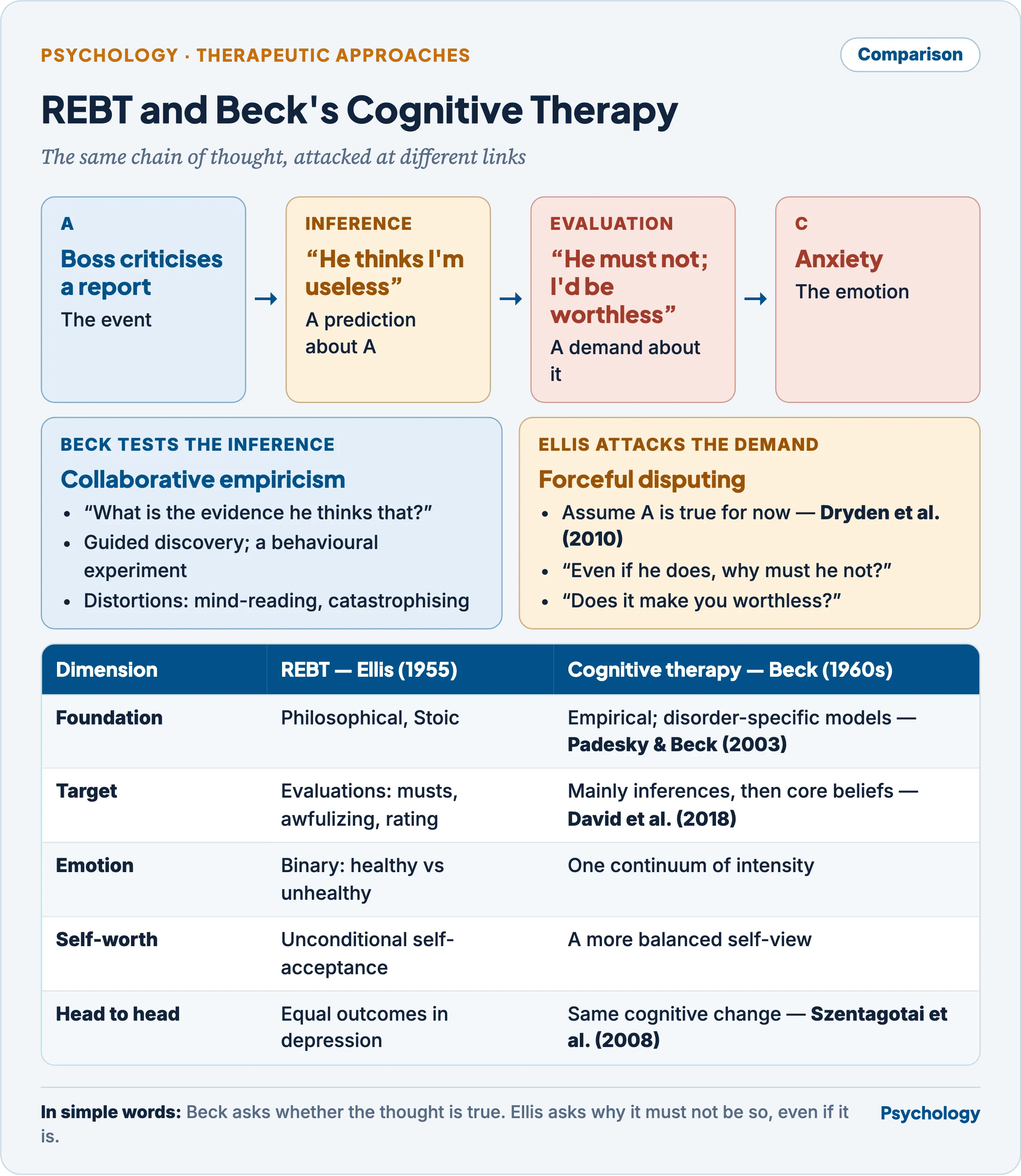
The two therapies meet the same chain of thought at different links: Beck tests the prediction, Ellis attacks the demand behind it.
Criticisms and limitations
- Haaga and Davison (1993): “Its professional impact thus far exceeds its scientific status.” Opinion varied even on how to define an irrational belief, so measurement was weak and process studies were missing.
- Gossette and O’Brien (1992) reviewed 75 adult outcome reports: RET was effective in only about a quarter of comparisons, mainly on self-reported irrationality and dysphoria, with little behavioural change; the few favourable comparisons they attributed to psychometric artefact rather than to reduced irrational beliefs.
- With children, Gossette and O’Brien (1993) reviewed 33 dissertations and four published reports: RET helped in about 25% of comparisons, changing self-reported irrational beliefs more than distress and behaviour hardly at all.
- Specificity: better-designed studies give smaller effects and REBT does not beat other cognitive-behavioural therapies (David and colleagues, 2018), so its unique claims — the primacy of musts, the value of self-acceptance — remain largely untested apart from the package.
- Directness: forceful disputing and the label “irrational” risk the alliance and invite resistance; Padesky and Beck (2003) contrast it with cognitive therapy’s guided discovery and collaborative relationship.
- Neglect of the environment: placing disturbance in B drew the charge of ignoring real adversity; the revised ABCs made A and B interactive (Ellis, 1991), and REBT also solves practical problems at A.
- Cultural fit: duty-based “shoulds” — a son should care for his parents — are moral preferences, not musts; disputing a value as if it were a demand alienates duty-centred clients, and the B–C evidence comes mostly from Western samples (Vîslă and colleagues, 2016).
Indian context
- The Bhagavad Gita parallel, which scholars draw explicitly:
- Reddy (2012) reads Krishna’s dialogue with the despairing Arjuna as a cognitive and rational-emotive approach — correcting misinterpretation, removing guilt, restoring action.
- Bhatia, Madabushi, Kolli, Bhatia and Madaan (2013) link karma yoga, action without attachment to its fruits (Gita 2.47), to cognitive-behavioural therapy: detachment from consequences relieves distress and guilt, and Krishna discourages dwelling on imagined results.
- In REBT terms nishkama karma is a strong preference with no demand about the outcome. The parallel is interpretive, not evidence.
- Indian studies:
- Sud and Sharma (1990): with ninth-grade girls, a 50-minute systematic rational restructuring, an RET-derived technique, did not reduce test anxiety, while attentional skills training did; neither improved performance on difficult tasks.
- Kannan, Kannan, Selvaraj and Manikandan (2017): 150 patients with chronic musculoskeletal pain or primary headache at a south Indian teaching hospital’s neurology clinic; pharmacotherapy combined with REBT was compared with psychoeducation and with pharmacotherapy alone.
- Drugs plus REBT gave significant gains on pain ratings and on depression, anxiety and stress scores (Kannan and colleagues, 2017). Limitation: quasi-experimental, convenience sample, one site.
- Mental Healthcare Act, 2017, Section 18 (Ministry of Health and Family Welfare) — every person has a right to access mental health care from services run or funded by the government; psychological treatment in public services becomes an entitlement rather than a private purchase.
- Tele-MANAS (Ministry of Health and Family Welfare, launched 10 October 2022; helpline 14416) — 53 cells in all 36 states and union territories, 47,75,644 calls by October 2026 (PIB, 9 October 2026); anonymous first contact lowers the threshold for brief counselling.
- Manodarpan (Ministry of Human Resource Development, now Education, 21 July 2020, under the Atmanirbhar Bharat Abhiyan) — student tele-counselling helpline (8448440632), counsellor directory and life-skills handbook; it operationalises rational-emotive education’s preventive logic of teaching coping before disturbance.
- Sukdeb Saha v. State of Andhra Pradesh (Supreme Court, 25 July 2025) — holds mental health part of the right to life under Article 21 and issues fifteen binding guidelines; institutions with 100 or more students must engage a qualified counsellor.
- Examination patterns are to be reviewed “to cultivate a broader sense of identity among students beyond test scores and ranks” — REBT’s principle that a person is not his performance.
Previous Year Questions
- 2024Evaluate effectiveness of ABCD Model in the treatment of psychological disorders.
- 2022Discuss important concepts of Rational Emotive Behaviour Therapy along with its applications.
- 2017Explain the behavioural cognitive therapy by Ellis with the steps involved in it.