

Official syllabusPaper II · Unit 3 · Therapeutic Approaches
Bio-feedback therapy.
Definition
“Biofeedback is a process that enables an individual to learn how to change physiological activity for the purposes of improving health and performance. Precise instruments measure physiological activity such as brainwaves, heart function, breathing, muscle activity, and skin temperature. These instruments rapidly and accurately “feed back” information to the user.”
AAPB, BCIA and ISNR (2008)
Biofeedback therapy makes visible a bodily process that a person cannot normally perceive — muscle tension, finger temperature, sweat-gland activity, heart or brain rhythm — so that it can be brought under voluntary control by ordinary learning. It moved from a promise of “visceral learning”, through a failed replication, to a narrower, well-evidenced role in headache, stress and anxiety, with a live dispute over whether the instrument or the confidence it builds does the work.
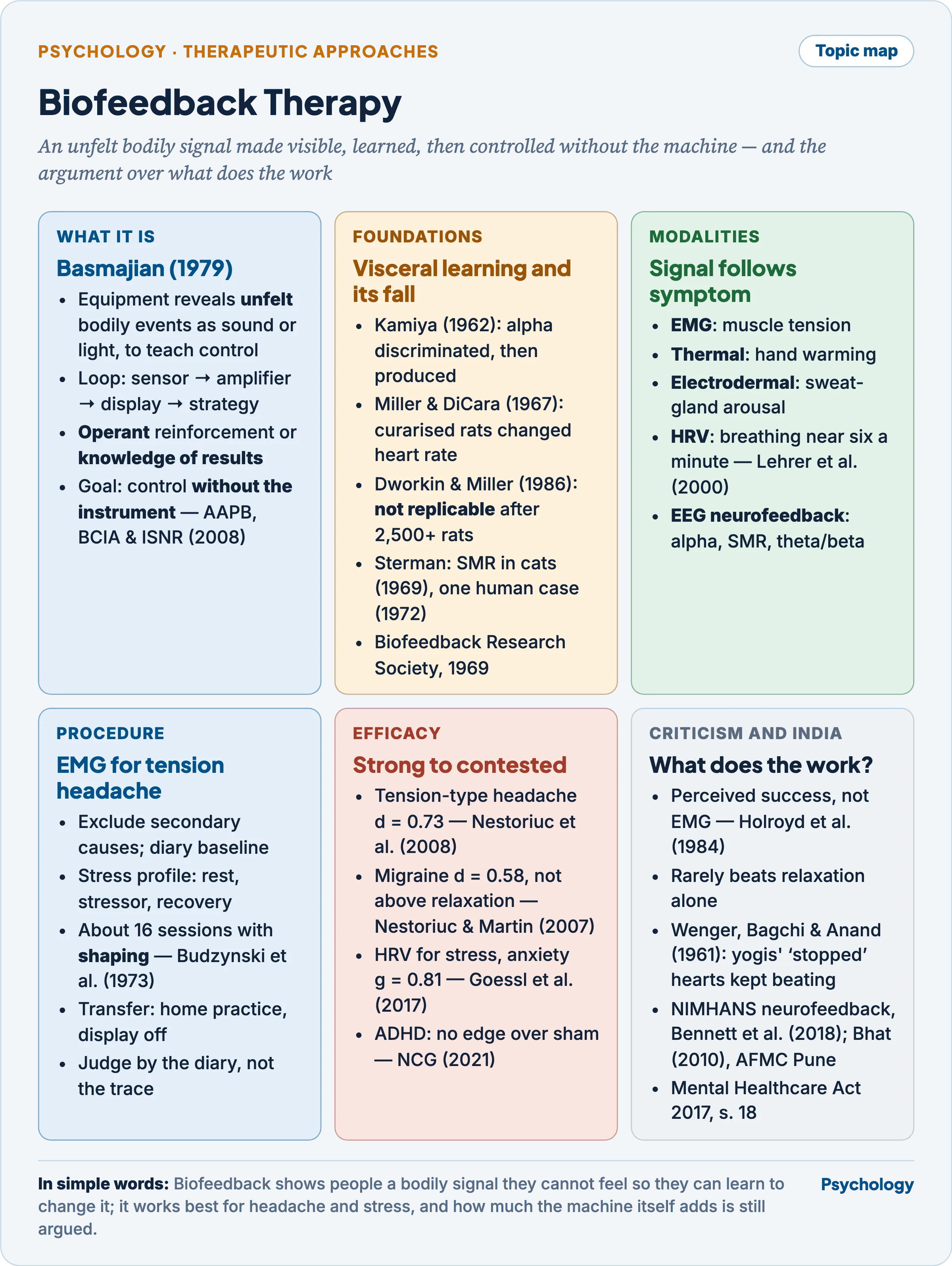
Read left to right, the six parts make one argument: a feedback loop, the experiments behind it, its signals, its session, its evidence, and what remains in doubt.
The nature of biofeedback therapy
- Biofeedback closes an external feedback loop around a physiological process: a sensor picks up the signal, an amplifier processes it, and a display returns it at once as a tone, light or graph, so the person can see which strategies move it.
- Every procedure monitors a process, converts it into a signal and feeds it back.
- Basmajian (1979) defined it as using, usually electronic, equipment to show unfelt physiological events as visual or auditory signals, teaching control through the signals.
- The goal is control without the machine; the consensus definition ends: “Over time, these changes can endure without continued use of an instrument.”
- Basmajian (1963), in Science, showed the principle at its finest grain: with auditory and visual cues, subjects learned to fire single motor units at will while neighbouring units stayed silent.
- Two learning accounts explain how the loop teaches.
- The operant account treats each change in the signal as a reinforced response — Skinnerian conditioning extended to autonomic activity, set out in Reinforcement, its Types and Schedules (Paper I).
- The information or skill account treats the display as knowledge of results, as in learning to putt a golf ball.
- The premise is the psychophysiological principle of Green, Green and Walters (1970), framed at the Menninger Foundation:
- “Every change in the physiological state is accompanied by an appropriate change in the mental-emotional state, conscious or unconscious; and conversely, every change in the mental-emotional state, conscious or unconscious, is accompanied by an appropriate change in the physiological state.”
- Like physical therapy it is training, needing active participation and practice between sessions (Frank and colleagues, 2010); home practice adds to the effect (Nestoriuc and Martin, 2007).
- The loop is the cybernetic model of a sensed error and a correcting act, treated in Psychocybernetics and the Cybernetic Model of Behaviour (Paper I).
Origins: operant control of autonomic responses
- Forerunners fed back single signals: Jacobson (1938) monitored tension with crude electromyography, and the perineometer of Kegel (1947) displayed pelvic-floor contraction.
- Miller (1969), in Science, attacked the received view that autonomic (“involuntary”) responses could be conditioned only classically and skeletal ones only operantly.
- Kamiya (1962) — at the University of Chicago, a bell sounded at random during EEG recording and subjects guessed whether they were in an alpha state, told only “correct” or not.
- Six subjects reached nearly perfect accuracy within 50 to 500 trials and could then produce alpha on command (Kamiya, 1962).
- Limitation: enthusiasm outran evidence. Ancoli and Kamiya (1978) traced conflicting alpha results to method, chiefly too few and too short training sessions, and Basmajian (1983) judged that alpha feedback had “virtually dried up as a scientifically defensible clinical tool”.
- Miller and DiCara (1967) — rats paralysed with curare, so that no muscle could produce the change, and kept on artificial respiration, were rewarded by brain stimulation for raising or lowering heart rate.
- Shaping produced change in the rewarded direction; the programme later reported learned control of intestinal contraction, urine formation, blood pressure and blood flow in one ear rather than the other (Miller, 1969).
- Limitation: difficulties mounted as the work continued (Miller and Dworkin, 1974), and after more than 2,500 rats Dworkin and Miller (1986) concluded that the original experiments “are not replicable” and that visceral learning “remains unproven”.
- Clinical biofeedback therefore rests on human outcome trials, not on proof of direct visceral conditioning.
- Wyrwicka and Sterman (1968) trained cats to produce a 12–16 Hz sensorimotor rhythm (SMR). Exposed later to the rocket-fuel convulsant monomethylhydrazine, the trained cats had their convulsions delayed or prevented (Sterman, LoPresti and Fairchild, 1969).
- Sterman and Friar (1972) then suppressed seizures in one patient with epilepsy — a single case, and the start of clinical neurofeedback.
- The field took its name in October 1969, when the Biofeedback Research Society, founded at Santa Monica with Barbara Brown as first president, chose “biofeedback” over “self-regulation” and “auto-regulation”.
- Clinical protocols followed within four years: frontalis EMG for tension headache (Budzynski, Stoyva and Adler, 1970) and “autogenic feedback training” — autogenic phrases with finger-temperature feedback to warm the hands — for migraine (Sargent, Green and Walters, 1973).
Modalities of biofeedback
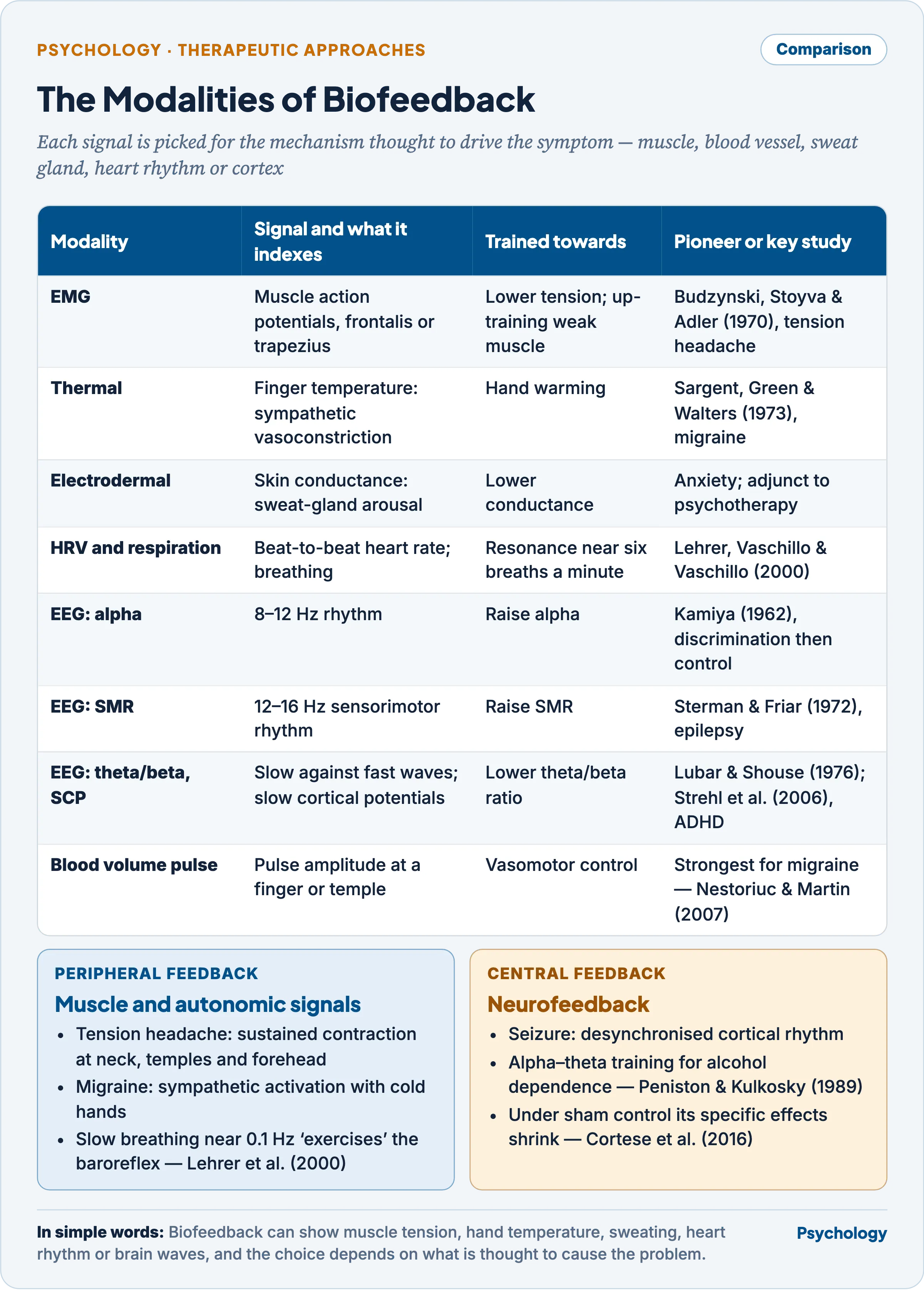
Each modality pairs a signal with the symptom mechanism it is thought to drive, which is why the choice of signal follows the diagnosis.
| Modality | Signal and what it indexes | Trained towards | Main uses |
|---|---|---|---|
| EMG (surface electromyography) | Muscle action potentials at frontalis or trapezius | Lower tension; up-training weak muscles | Tension-type headache, chronic pain, stroke and incontinence rehabilitation |
| Thermal | Finger skin temperature, an index of sympathetic vasoconstriction | Hand warming | Migraine, Raynaud’s phenomenon, general relaxation |
| Electrodermal (skin conductance, GSR) | Sweat-gland activity, a marker of sympathetic arousal | Lower conductance | Anxiety; an adjunct to psychotherapy |
| Heart rate variability, respiration | Beat-to-beat heart rate; breathing rate and carbon dioxide | Slow breathing near six a minute | Stress, anxiety, panic, asthma |
| EEG neurofeedback | Alpha, SMR, theta/beta ratio, slow cortical potentials | Raise or lower a band | Epilepsy, ADHD, alcohol dependence, PTSD, brain injury |
| Blood volume pulse | Pulse amplitude at a fingertip or temple | Vasomotor control | Migraine |
- Each signal targets a symptom mechanism: sustained pericranial contraction in tension-type headache, sympathetic activation in migraine, desynchronised cortical rhythm in seizures.
- Lehrer, Vaschillo and Vaschillo (2000) described how heart-rate oscillations peak when breathing slows to about 0.1 Hz, the resonance frequency near six breaths a minute, where respiratory sinus arrhythmia and baroreflex rhythms reinforce one another; training is held to “exercise” the baroreflex.
- Neurofeedback protocols descend from named studies: SMR training in a hyperkinetic child (Lubar and Shouse, 1976), alpha–theta training in alcohol dependence (Peniston and Kulkosky, 1989), and slow-cortical-potential training for ADHD (Strehl and colleagues, 2006).
Procedure of a biofeedback session
A worked example: an office worker with band-like headaches on most days, treated with EMG biofeedback.
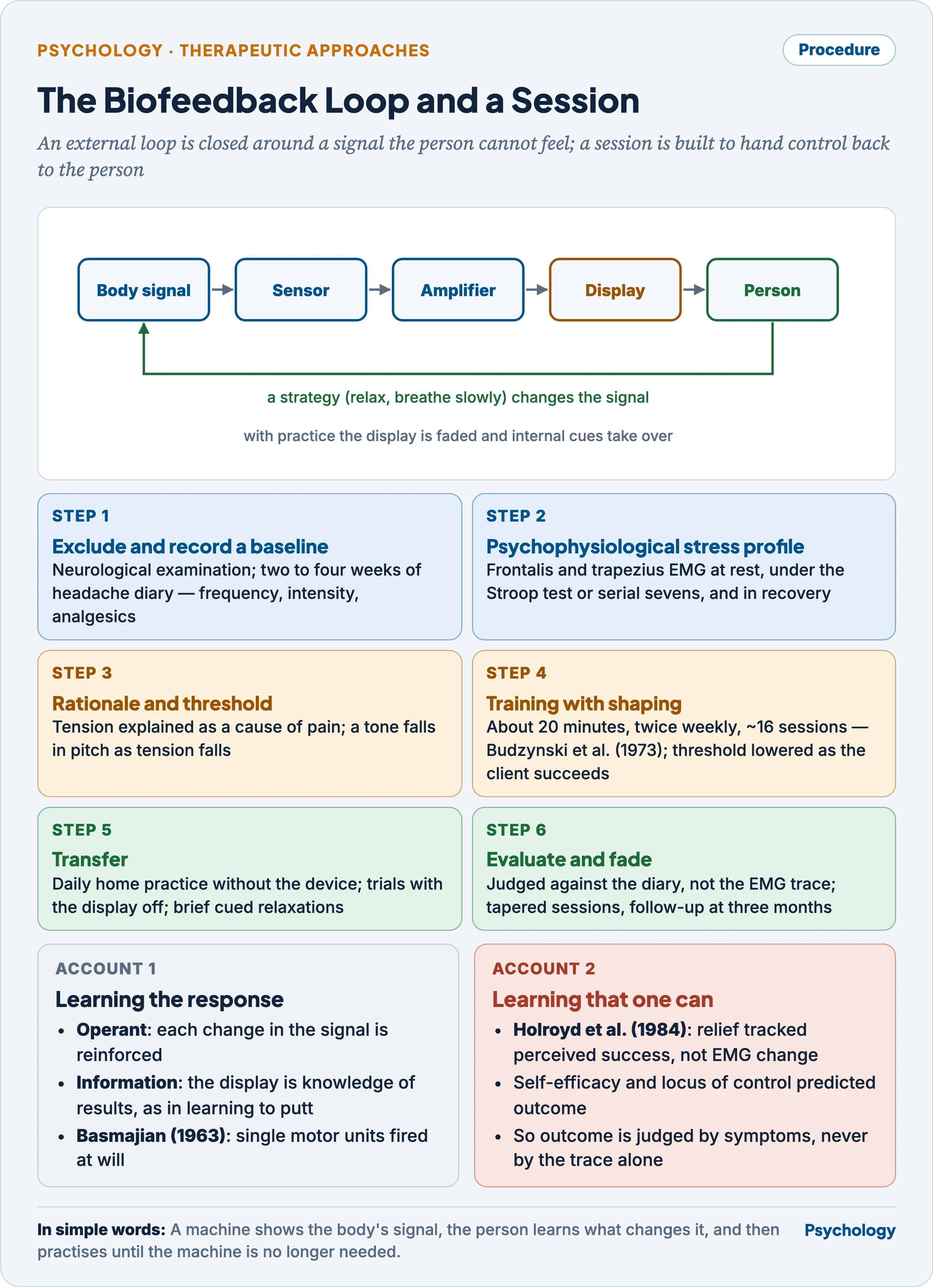
The loop teaches only while the display is on; the last three steps exist to move control from the screen to the person.
- Referral and exclusion: a neurological examination rules out a secondary cause, and analgesic overuse, itself a cause of headache, is checked.
- Baseline: a two-to-four-week diary of headache frequency, intensity, duration and analgesic use, which becomes the outcome measure.
- Psychophysiological stress profile: frontalis and trapezius EMG at rest, during a stressor such as the Stroop test or serial sevens, and in recovery; the client sees tension rise with mental effort and fall only slowly.
- Rationale and target: the therapist explains how sustained contraction maintains pain and sets a threshold just below resting level; a tone falls in pitch as tension falls.
- Training: sessions of about 20 minutes, twice a week, for about 16 sessions, as in Budzynski and colleagues (1973); the threshold is lowered as the client succeeds (shaping), and diaphragmatic breathing or progressive relaxation supplies the strategy.
- Transfer: daily home practice without the instrument, trials with the display switched off, and brief relaxations cued by everyday events.
- Evaluation and fading: progress is judged against the baseline diary, not the EMG trace, because Holroyd and colleagues (1984) showed that headache relief and EMG change can come apart; sessions taper, with follow-up at three months.
Significance and efficacy in the management of mental health
- La Vaque and colleagues (2002) set the field’s five efficacy levels: not empirically supported, possibly efficacious, probably efficacious, efficacious, and efficacious and specific — superior to a credible sham or a bona fide alternative in two independent settings.
- Yucha and Montgomery (2008) applied them: female urinary incontinence alone reached level 5; anxiety, ADHD, chronic pain, epilepsy, adult headache and hypertension level 4; insomnia, alcohol and substance abuse and brain injury level 3; depressive disorders and PTSD level 2.
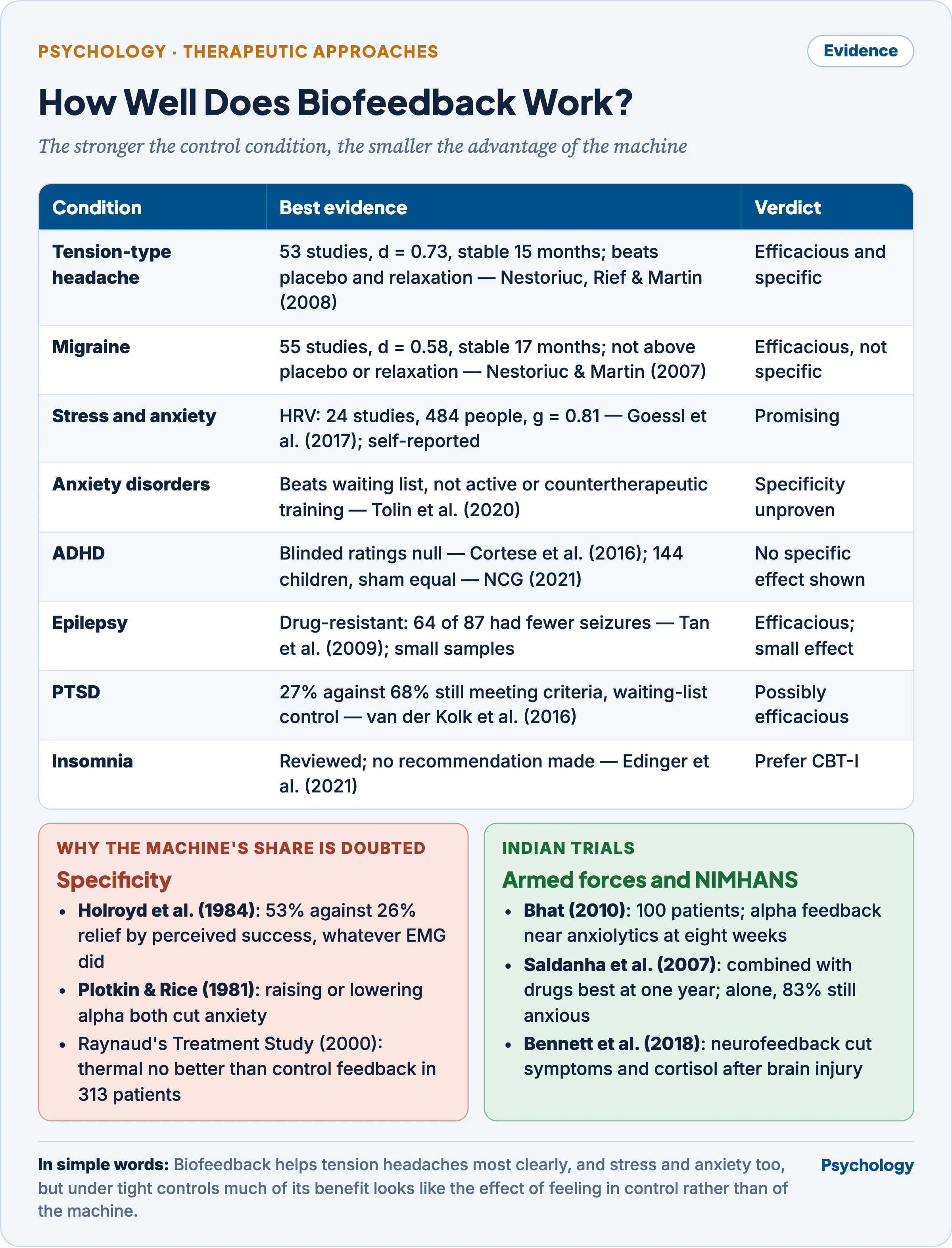
The stronger the control condition, the smaller the advantage of the machine — strongest for headache, weakest under sham control in ADHD.
Headache, pain and stress-related disorders
- Budzynski, Stoyva, Adler and Mullaney (1973) gave tension-headache patients 16 twice-weekly frontalis EMG sessions with home practice, against pseudofeedback and no-treatment groups.
- Only true feedback reduced headache activity, and medication use had fallen sharply at three-month follow-up.
- Limitation: six patients per group (Budzynski and colleagues, 1973).
- Nestoriuc, Rief and Martin (2008) pooled 53 studies of tension-type headache: d = 0.73, stable over 15 months, better than headache monitoring, placebo and relaxation, and largest when combined with relaxation and in children and adolescents.
- A companion review rated EMG feedback for tension-type headache efficacious and specific (level 5), and migraine feedback efficacious (level 4) (Nestoriuc, Martin, Rief and Andrasik, 2008).
- Nestoriuc and Martin (2007) pooled 55 studies of migraine: d = 0.58, stable over 17 months, with blood-volume-pulse feedback strongest — but not significantly better than placebo, relaxation or ergotamine comparisons.
Stress and anxiety
- Goessl, Curtiss and Hofmann (2017) pooled 24 studies (484 participants) of heart-rate-variability biofeedback for stress and anxiety: g = 0.81 before against after, 0.83 against controls — though outcomes were self-reported and the authors called for better-controlled studies.
- Hardt and Kamiya (1978), in Science, found that alpha enhancement lowered state anxiety only in high-anxiety subjects — benefit depends on who is trained.
- Tolin, Davies, Moskow and Hofmann (2020) reviewed randomised trials in anxiety disorders: biofeedback beat waiting list but not active treatment, nor training in the countertherapeutic direction, so its specific effects “cannot be distinguished from nonspecific effects of treatment”.
Neurofeedback: ADHD, epilepsy, PTSD and insomnia
- Cortese and colleagues (2016) pooled 13 trials (520 young people with ADHD): symptoms improved on ratings by those closest to treatment (SMD 0.35), but not on probably blinded ratings or against sham and active controls.
- Neurofeedback Collaborative Group (2021) randomised 144 children aged 7–10, 3:2, to up to 38 sessions of theta/beta downtraining or a sham replaying pre-recorded EEG.
- Both groups improved greatly in inattention (d = 1.5); neurofeedback was no better at the end (d = 0.01) or at 13 months (d = 0.23).
- Limitation: one protocol tested; the neurofeedback group did need less medication at follow-up (Neurofeedback Collaborative Group, 2021).
- Tan and colleagues (2009) found 63 studies of neurofeedback for epilepsy, only 10 usable: 64 of 87 patients whose seizures had resisted drugs (74 per cent) had fewer seizures a week, but the pooled effect, though significant, was small.
- Van der Kolk and colleagues (2016) gave 24 sessions to adults with chronic PTSD unhelped by six months of therapy: afterwards 27.3 per cent still met criteria against 68.2 per cent on a waiting list — a waiting list, not a sham.
- For insomnia the American Academy of Sleep Medicine (Edinger and colleagues, 2021) reviewed biofeedback but made no recommendation on it, while strongly recommending cognitive behavioural therapy for insomnia.
Significance beyond symptom relief
- Self-efficacy: making a symptom measurable makes it controllable; in Holroyd and colleagues (1984) gains in self-efficacy and internal locus of control, not muscle change, tracked relief.
- A non-drug option where medicine is unsuitable, refused or poorly tolerated; in headache its outcomes “rival outcomes with medication therapy”, and combining the two can enhance them (Andrasik, 2010).
- Objective assessment: the stress profile documents reactivity and slow recovery, letting a patient with physical complaints see the mind–body link instead of being told of it.
- Prevention and rehabilitation: self-regulation skills enter workplace wellness programmes, and EMG and EEG feedback are used in retraining after stroke and brain injury (Unit 7 treats rehabilitation).
Criticisms and limitations
- Specificity: biofeedback rarely beats relaxation without the machine — the question Silver and Blanchard (1978) posed as “are the machines really necessary?”, borne out for migraine (Nestoriuc and Martin, 2007) and anxiety (Tolin and colleagues, 2020).
- Holroyd, Penzien and colleagues (1984) told 43 students with tension headache they were learning to lower frontal EMG; half were in fact rewarded for raising it, and bogus displays told half of each group they were highly successful.
- Headaches fell 53 per cent with high-success feedback and 26 per cent with moderate-success feedback, whatever the EMG did (Holroyd and colleagues, 1984).
- Limitation: a student sample, not a clinical one — yet the result moves the active ingredient from the muscle to the person’s sense of control.
- Plotkin and Rice (1981) trained 10 high-anxiety students to raise or to lower alpha; both groups became less anxious, in proportion to perceived success, not to the direction or size of alpha change — biofeedback “as a placebo”.
- Blinding: neurofeedback’s advantage vanishes under sham control (Cortese and colleagues, 2016; Neurofeedback Collaborative Group, 2021); expectation, practice and an encouraging trainer remain the likeliest active ingredients.
- Non-response and maintenance: biofeedback “fails to bring significant relief to a sizeable number of headache patients” (Andrasik, 2010), and 82.6 per cent of those given biofeedback alone were still anxious at one year (Saldanha and colleagues, 2007).
- Ratings against trials: Raynaud’s phenomenon was rated efficacious (Yucha and Montgomery, 2008), yet the largest trial, of 313 patients, found thermal biofeedback no better than control EMG feedback and inferior to nifedipine (Raynaud’s Treatment Study Investigators, 2000).
- Cost and access: equipment, trained clinicians and twice-weekly attendance limit reach.
Biofeedback, yoga and meditation as self-regulation therapies
- All the self-regulation therapies lower sympathetic arousal through the relaxation response (Benson, 1975); biofeedback adds measurement and moment-to-moment reinforcement, while yoga and meditation add an ethical frame and need no instrument.
- Yoga and meditation as therapies are treated in Indigenous Therapies: Yoga and Meditation, and the meditation evidence in Meditation and Its Effects (Paper I).
- Bernardi and colleagues (2001), in the BMJ, found that in 23 healthy adults reciting the Ave Maria or a yoga mantra slowed breathing to about six a minute and raised baroreflex sensitivity — the resonance that heart-rate-variability feedback trains with a screen.
- Patel (1973), in The Lancet, combined yogic relaxation with biofeedback for hypertension; in her randomised trial of 34 patients blood pressure fell from 168/100 to 141/84 mm Hg, against 169/101 to 160/96 with general relaxation (Patel and North, 1975).
- Progressive relaxation and autogenic training are set out in Systematic Desensitization and Exposure Therapies and Stress, Psychosomatic Disorders and Stress Management (Unit 2).
Indian context
- Wenger, Bagchi and Anand (1961), in Circulation, recorded yogis who claimed to stop or slow the heart, among them Shri Ramananda Yogi and T. Krishnamacharya, following up claims recorded in India in 1935 by the French cardiologist Thérèse Brosse.
- Breath held against a closed glottis with the muscles tensed, a Valsalva-like manoeuvre that cuts venous return, made heart sounds and radial pulse fade, yet the electrocardiogram showed the heart beating throughout (Wenger and colleagues, 1961).
- The one practitioner who claimed only to slow his heart did slow it markedly, through a strong rise in vagal tone.
- Lesson: the “stopped” heart was produced by breathing and skeletal-muscle manoeuvres — the mediation question that later undid the curarised-rat work.
- In March 1970 the Greens recorded Swami Rama at the Menninger Foundation making two points on one palm 11°F apart, and producing 16.2 seconds of atrial flutter at about 306 beats a minute (Green and Green, 1977).
- Limitation: single, uncontrolled demonstrations.
- At NIMHANS, Bengaluru, the Department of Clinical Neuropsychology and Cognitive Neuroscience Centre, headed by Jamuna Rajeswaran, offers EEG neurofeedback in courses of twenty sessions, notably after brain injury (reported 2019).
- Bennett and colleagues (2018) at NIMHANS gave 30 patients with traumatic brain injury 20 sessions of alpha–theta neurofeedback, against 30 on usual treatment, recruiting half within six months of injury to separate spontaneous recovery.
- Symptoms, perceived stress and serum cortisol improved more with neurofeedback (Bennett and colleagues, 2018).
- Limitation: the control was treatment as usual, not a sham.
- Bhat (2010), of the Armed Forces Medical College, Pune, allocated 100 anxious patients alternately to alpha EEG biofeedback five times a week for eight weeks without benzodiazepines, or to anxiolytics.
- Biofeedback was almost as effective in the short term, better in women and in generalised anxiety and OCD, poorer in mixed anxiety–depression (Bhat, 2010); most armed-forces psychiatric centres had the facility.
- Limitation: alternate rather than random allocation, and no follow-up beyond eight weeks.
- Saldanha and colleagues (2007) treated 78 patients with neurotic and psychosomatic disorders for 12 weeks with drugs (28), biofeedback (23) or both (27), and followed them for a year.
- At one year 66.7 per cent of the combined group needed no further treatment, against 21.4 per cent on drugs and 17.4 per cent on biofeedback alone (Saldanha and colleagues, 2007).
- Limitation: small groups and no relaxation-only or placebo control.
- At AIIMS, New Delhi, the Department of Physiology, founded under B. K. Anand in 1956, joined Wenger and Bagchi’s 1957 recordings and tested Shri Ramananda Yogi in an airtight box (Anand, Chhina and Singh, 1961).
- Mental Healthcare Act, 2017 (Ministry of Health and Family Welfare; in force 29 May 2018) — Section 18 gives every person a right to “mental healthcare and treatment from mental health services run or funded by the appropriate Government”.
- Such care must be affordable and acceptable to persons with mental illness and their families (Section 18(2)).
- Section 2(1)(g) defines a “clinical psychologist” by a qualification recognised by the Rehabilitation Council of India.
- Psychological principle: care chosen for acceptability as well as efficacy, which favours skills-based non-drug options such as biofeedback where evidence supports them, given by trained clinicians.
Previous Year Questions
- 2023Explain the nature and significance of biofeedback therapy.
- 2011Discuss the efficacy of biofeedback therapy in the management of mental health.