

Official syllabusPaper II · Unit 3 · Therapeutic Approaches
Prevention and rehabilitation of the mentally ill.
Definition
“the term ‘preventive psychiatry’ refers to the body of professional knowledge, both theoretical and practical, which may be utilized to plan and carry out programs for reducing (1) the incidence of mental disorders of all types in a community (‘primary prevention’), (2) the duration of a significant number of those disorders which do occur (‘secondary prevention’), and (3) the impairment which may result from those disorders (‘tertiary prevention’).”
Caplan (1964)
Here prevention and rehabilitation form one continuum: the logic that lowers new cases also shortens episodes and limits the disability left behind. The field has had to show that prevention works, and why emptying mental hospitals did not by itself return patients to the community.
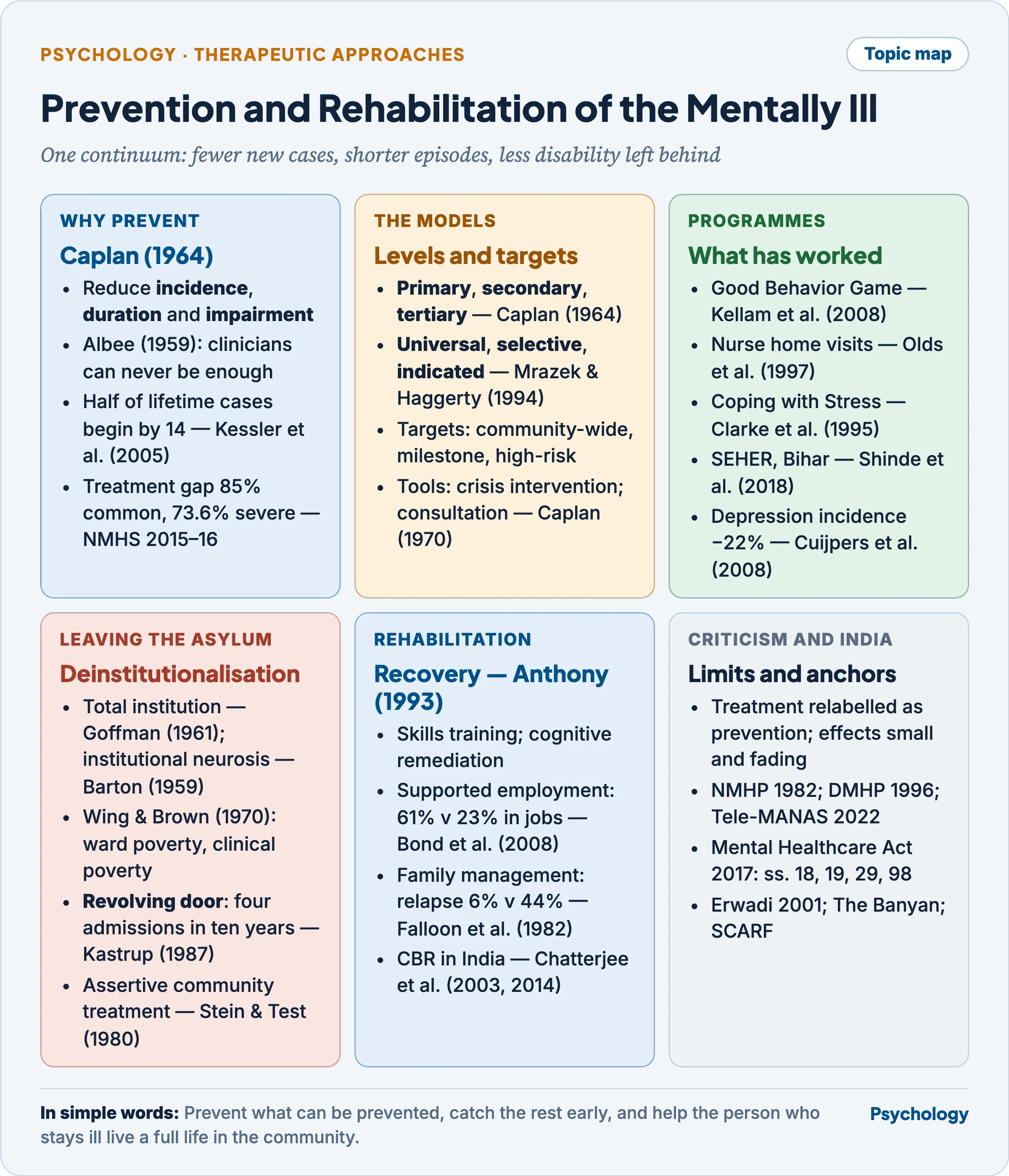
Prevention acts before and early in illness, rehabilitation after it, and the same programmes recur on both sides of onset.
The need for prevention in the mental health system
- Albee (1959) set the number of Americans needing help against the clinicians the country could ever train, and concluded that one-to-one treatment could never meet the demand.
- Albee (1983) made it a principle: “no mass disorder afflicting mankind is ever brought under control or eliminated by attempts at treating the individual”.
- Onset is early: half of lifetime cases begin by age 14 and three-quarters by 24 (Kessler and colleagues, 2005), so intervening in youth meets disorder before it sets.
- India’s National Mental Health Survey 2015–16 found a treatment gap of 85 per cent for common and 73.6 per cent for severe mental disorders (NIMHANS, 2016).
- Prevalence is the product of incidence (new cases) and duration, so it falls only if cases are prevented or shortened.
- Early intervention began with Lindemann (1944): studying 101 bereaved patients, including Cocoanut Grove fire victims and their relatives, he found that managing grief “may prevent prolonged and serious alterations in the patient’s social adjustment”.
Caplan’s three-fold model of prevention
- Primary prevention lowers incidence by counteracting harmful circumstances before illness appears. Caplan (1964) treated it as a community concept: the aim is not to keep a particular person well but to lower the risk for a whole population.
- Examples: infant home visiting, school social-emotional programmes, restricting means of suicide, crisis support for the bereaved.
- Programmes may reach a whole community, everyone passing a milestone (school entry, adolescence, retirement) or high-risk groups.
- Secondary prevention lowers prevalence by shortening disorder through early detection and prompt treatment: screening, helplines, crisis intervention, early-psychosis services.
- Tertiary prevention limits the impairment a disorder leaves; applied to individuals it is rehabilitation — aftercare, halfway homes, relapse prevention, vocational training.
- Caplan’s two preventive tools:
- Crisis intervention: brief help at a point of loss, threat or challenge, when a person may either grow or break down.
- Mental health consultation (Caplan, 1970): an indirect service in which a specialist helps a consultee (teacher, nurse, community worker) handle clients, in four types — client-centred case, consultee-centred case, programme-centred administrative and consultee-centred administrative.
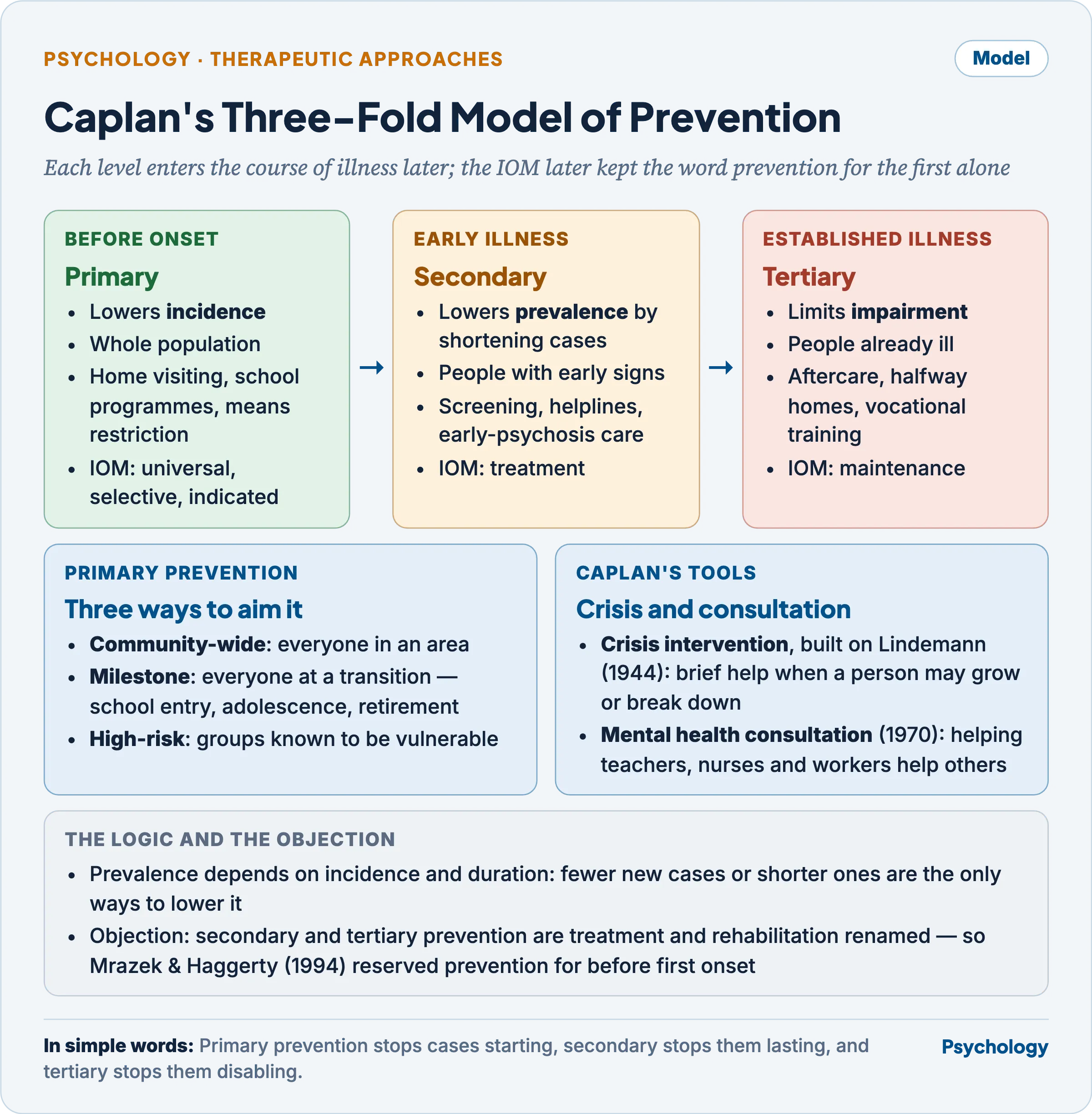
Each level enters the course of illness later, and its target narrows from a whole population to one person.
The IOM scheme: universal, selective and indicated
- Gordon (1983) classified preventive measures by who receives them; the Institute of Medicine committee (Mrazek and Haggerty, 1994) adapted it for mental disorders, dropping Caplan’s terms.
- Universal: the general public or a whole group not identified by individual risk.
- Selective: subgroups whose risk is significantly above average on biological, psychological or social grounds.
- Indicated: individuals with minimal but detectable signs who do not yet meet diagnostic criteria.
- Prevention is reserved for before first onset. Treatment (case identification and standard treatment) and maintenance (adherence to reduce relapse, and aftercare including rehabilitation) complete the intervention spectrum.
| Dimension | Caplan (1964) | Mrazek and Haggerty (1994) |
|---|---|---|
| Basis of classification | Stage of illness | Population targeted |
| “Prevention” covers | Before onset, early illness, established disability | Only before first onset |
| Place of rehabilitation | Tertiary prevention | Maintenance, outside prevention |
| Strength | One frame for the whole system | Precise, testable targets |
| Weakness | Treatment relabelled as prevention | Indicated blurs into early treatment |
Prevention is better than cure: a model and the role of quality of life
- The public-health model supports the claim: with clinicians too few (Albee, 1959), only fewer and shorter cases lower the burden.
- Cuijpers and colleagues (2008) pooled 19 randomised trials: psychological prevention cut the incidence of depressive disorder by 22 per cent (incidence rate ratio 0.78), with 22 people treated to prevent one case.
- Limitation: follow-up periods varied widely, so whether onset was averted or only delayed is unsettled.
- In the RAISE trial (Kane and colleagues, 2016), 34 US clinics treating 404 first-episode patients were randomised to team-based or usual care.
- Quality of life improved more with team care (effect size 0.31), and far more when psychosis had gone untreated 74 weeks or less (0.54 against 0.07).
- Cure keeps its place, since severe disorders recur and need treatment and tertiary care.
- Quality of life links the levels: it is the yardstick of promotion, and in chronic illness it replaces cure as the goal — recovery is “a way of living a satisfying, hopeful, and contributing life even with limitations caused by illness” (Anthony, 1993).
- Quality-of-life determinants are in Factors Influencing Positive Health, Well-Being, Lifestyle and Quality of Life.
Programmes for prevention of mental disorders in society
- Universal — the Good Behavior Game. Kellam and colleagues (2008) assigned first-grade classrooms in 19 Baltimore schools (1985–86) to a team behaviour-management game or standard practice.
- At 19–21, lifetime drug abuse or dependence was 19 against 38 per cent in boys, and 29 against 83 per cent in the most aggressive boys (Kellam and colleagues, 2008); antisocial personality disorder also fell.
- Limitation: effects were confined to males, and a replication with less teacher support was weaker.
- Selective — nurse home visiting. Olds and colleagues (1997) followed 324 of 400 first-time mothers, many poor and unmarried, in Elmira, New York, randomised to nurse visits (about 32 by the child’s second birthday) or comparison.
- Over 15 years visited mothers had 0.29 against 0.54 verified reports of child maltreatment (Olds and colleagues, 1997). Limitation: one semi-rural site.
- Indicated — the Coping with Stress course. Clarke and colleagues (1995) screened 1,652 high-school students and randomised 150 with elevated depressive symptoms to 15 cognitive group sessions or usual care: 12-month incidence was 14.5 against 25.7 per cent.
- India — SEHER. Shinde and colleagues (2018) randomised 75 government secondary schools in Nalanda, Bihar, to a whole-school programme run by a lay counsellor, the same run by a teacher, or the state life-skills curriculum.
- The lay-counsellor arm improved school climate (effect size 1.88) and reduced depression, bullying and violence; the teacher arm had no effect.
- Limitation: of four schools followed after the trial, none kept the programme as delivered (Shinde and colleagues, 2023).
- Implementation decides results: Derzon and colleagues (2005) found a mean effect size of 0.02 across 46 US drug-prevention sites, projected at 0.24 with consistent, intensive delivery.
- Across nearly 500 studies, careful implementation went with mean effects at least two to three times higher (Durlak and DuPre, 2008).
The role of psychodynamic and behaviour therapies in prevention
- Psychodynamic therapies trace disorder to unconscious conflict rooted in early relationships and work through transference, interpretation and insight; Caplan built crisis theory on Lindemann’s work.
- Fraiberg, Adelson and Shapiro (1975) developed home-based infant–parent psychotherapy, interpreting how a mother’s own past — the “ghosts in the nursery” — is replayed with her baby.
- Cicchetti, Rogosch and Toth (2006) randomised 137 maltreated one-year-olds: with infant–parent psychotherapy disorganised attachment fell from 87.5 to 32 per cent by 26 months; parenting education helped briefly, but only psychotherapy’s gains lasted a further year (Stronach and colleagues, 2013).
- Limits: few prevention trials, long and costly treatment, outcomes rarely followed to adult disorder, and unconscious conflict offers no measurable target; the therapies are in Psychodynamic Therapies.
- Behaviour therapies have the stronger preventive record, because their targets are observable and teachable.
- Universal and indicated: the Good Behavior Game and Coping with Stress.
- Tertiary: behavioural family management and token-economy social learning, and relapse prevention (Marlatt and Gordon, 1985), which rehearses coping in high-risk situations.
- Limits: effects fade when delivery loosens; the techniques are in Behaviour Therapies.
Rehabilitation of the mentally ill
Deinstitutionalisation and its problems
- Deinstitutionalisation replaces long-stay psychiatric hospitals with community services. US state hospitals held 558,239 patients in 1955 and 71,619 in 1994 (Torrey, 1997).
- The case against the asylum:
- Goffman (1961) described the mental hospital as a total institution that strips inmates of their former roles.
- Barton (1959) named institutional neurosis — apathy, lack of initiative, submissiveness and loss of interest produced by hospital life.
- Wing and Brown (1970) followed long-stay schizophrenia patients in three British hospitals, 1960–68: clinical poverty (blunted affect, poverty of speech, withdrawal) tracked the ward’s social poverty and eased as wards improved. Limitation: observational, in three hospitals.
- The problems: homelessness, family burden, the revolving door and transinstitutionalisation. Penrose (1939) proposed that psychiatric beds and prison numbers vary inversely; in England, 1960–2019, beds fell 93 per cent as prisoners rose 208 per cent (Wild and colleagues, 2021).
- Limitation: the link is correlational, not proof of cause.
The revolving door phenomenon in community-based services
- The revolving door phenomenon is a cycle of brief admission, early discharge, relapse in the community and readmission, visible once long stays gave way to short ones.
- Kastrup (1987) defined it as at least four admissions in ten years with no interval over 2.5 years, or four within 2.5 years of the first.
- In one Italian ward, those admitted three or more times a year were 5.7 per cent of patients but 25 per cent of admissions (di Lorenzo and colleagues, 2016).
- Causes, from 12 studies (Fonseca Barbosa and Gama Marques, 2023): youth, single status, unemployment, schizophrenia, substance use, suicidality and non-adherence.
- India: readmissions were 21.6 per cent of one NIMHANS unit’s admissions in 1984–85, commonest after stays of 20–40 days (Fernandez and colleagues, 1987); a 2010–11 re-study there tied readmission to female sex, poverty and higher education (Singh and colleagues, 2013).
- Remedies close the service gaps — premature discharge, absent aftercare, no housing — through discharge planning, one continuing team, family psychoeducation, supported housing and assertive outreach.
- Stein and Test (1980) — Training in Community Living, the origin of assertive community treatment:
- 130 adults seeking admission to Mendota Mental Health Institute, Madison, were randomised to 14 months of community teaching in daily living, work and leisure, or short hospitalisation with aftercare.
- Hospital use fell sharply, and employment, symptoms and life satisfaction improved without added family burden.
- Limitation: when the programme was withdrawn most gains eroded and admissions rose, so support must be ongoing.
Psychosocial rehabilitation and the recovery model
- Psychiatric rehabilitation targets the consequences of illness — impairment, dysfunction, disability and disadvantage — not only symptoms (Anthony, Cohen and Farkas, 1990).
- Anthony (1993) defined recovery as “a deeply personal, unique process of changing one’s attitudes, values, feelings, goals, skills, and/or roles”; its principles are hope, choice, strengths, community integration, the least restrictive setting and continuity.
- The components and their evidence:
- Social skills training: across 22 trials (1,521 clients), d = 0.52 on community functioning and 0.23 on relapse (Kurtz and Mueser, 2008).
- Cognitive remediation: across 40 studies (2,104 participants), d = 0.45 on global cognition, with durable gains in functioning that were larger alongside other rehabilitation (Wykes and colleagues, 2011).
- Supported employment (individual placement and support): across 11 trials 61 per cent obtained competitive jobs against 23 per cent in other vocational services (Bond, Drake and Becker, 2008).
- Family psychoeducation: Falloon and colleagues (1982) randomised 36 patients to home-based behavioural family management or individual clinic care; nine-month relapse was 6 against 44 per cent.
- Social learning: Paul and Lentz (1977) compared a token-economy programme, milieu therapy and routine care for long-stay inpatients: over 97 per cent of the social-learning group were released, mostly to sheltered care, against 71 per cent with milieu therapy and about half with routine care.
- Settings: day care, clubhouses, halfway homes and supported housing.
- Community-based rehabilitation (CBR), a WHO strategy for poorer countries, trains local workers and families:
- Chatterjee, Patel, Chatterjee and Weiss (2003) compared CBR with out-patient care for 207 people with chronic schizophrenia in Barwani, Madhya Pradesh: CBR reduced disability more among adherent patients and retained more in treatment. Limitation: not randomised.
- COPSI (Chatterjee and colleagues, 2014) randomised 282 patients in Tamil Nadu, Goa and Satara: supervised community health workers reduced disability modestly, symptoms not significantly, most at the rural Tamil Nadu site.
- Riessman (1965) named the helper-therapy principle: helpers gain from helping, so peer workers benefit too.
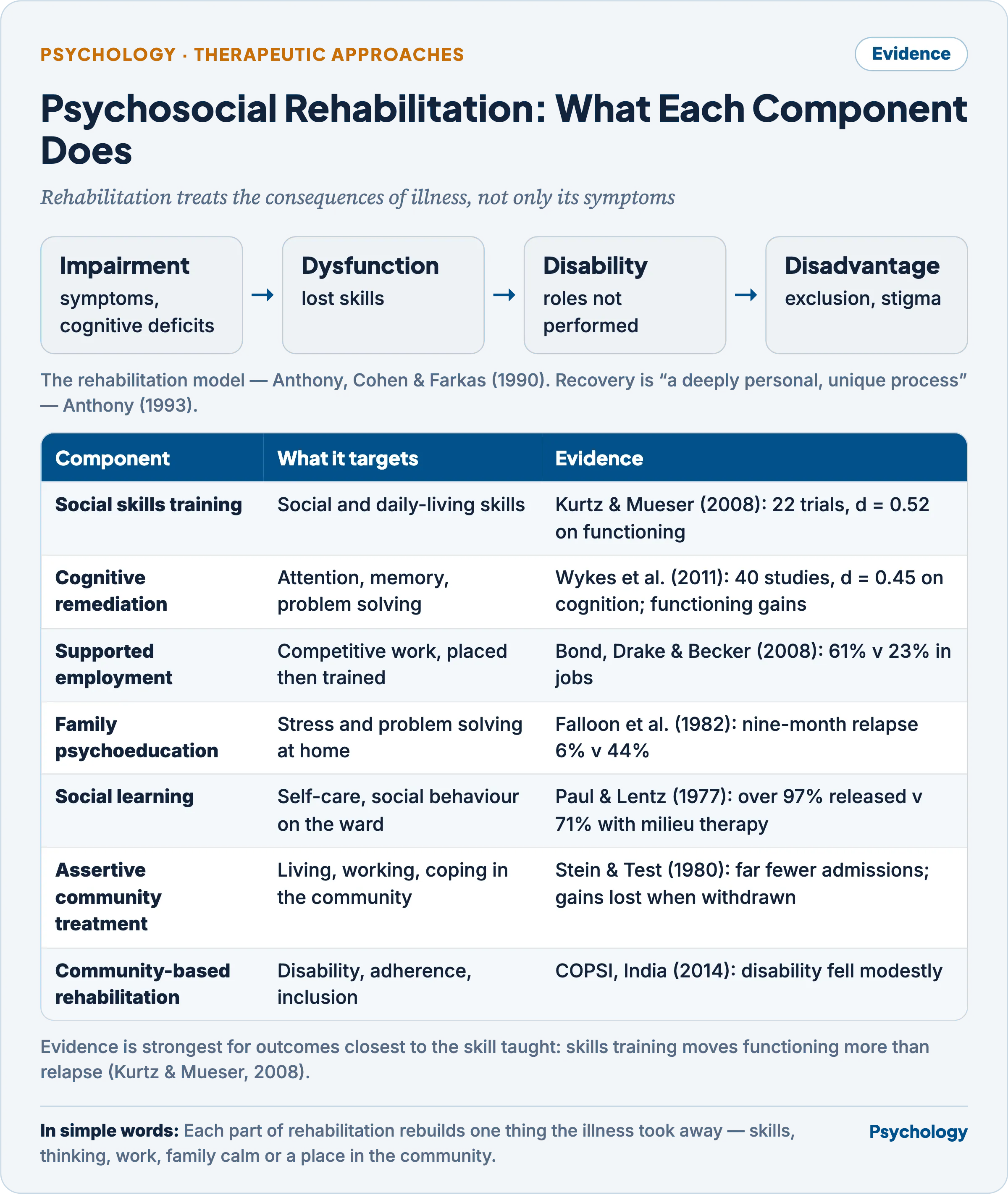
Each component targets a different consequence of illness, and the evidence is strongest for those closest to daily functioning.
The role of psychologists in rehabilitation
- Assessment: functional, cognitive and neuropsychological testing, and disability rating on the Indian Disability Evaluation and Assessment Scale (IDEAS), gazetted in 2002 and retained in the 2018 certification guidelines.
- Intervention: skills training, cognitive-behavioural therapy, cognitive remediation, family psychoeducation.
- Vocational rehabilitation: aptitude assessment, placement and coaching on the job.
- Training and supervision of CBR paraprofessionals, as in Barwani and COPSI, and mental health consultation to teachers, nurses and police (Caplan, 1970).
- Programme evaluation — fidelity, reach, outcome — and advocacy against stigma.
- Clinical and rehabilitation psychologists must enrol on the Central Rehabilitation Register (Rehabilitation Council of India Act, 1992).
Strategies for rehabilitating mentally ill Indian youth
- The need: in a four-state pilot, 7.3 per cent of 13–17-year-olds had a mental disorder, 13.5 per cent in urban metros (NIMHANS, 2016).
- Early detection and intervention through school counsellors and Tele-MANAS (2022), since untreated duration shapes how much care helps (Kane and colleagues, 2016).
- Michelson and colleagues (2020) randomised 250 students with elevated symptoms in six New Delhi government schools: brief problem-solving from lay counsellors improved self-chosen problems (effect size 0.36), sustained at 12 months (Malik and colleagues, 2021).
- Family psychoeducation suited to joint families, drawing in the relatives who decide on treatment.
- Supported education and employment, with IDEAS certification and the RPwD Act’s reservation (section 34, 2016: 1 per cent of government vacancies shared by autism, intellectual disability, specific learning disability, mental illness and multiple disabilities).
- Life skills through peer educators of the Rashtriya Kishor Swasthya Karyakram (Ministry of Health and Family Welfare, 7 January 2014), and integrated treatment of substance use, a correlate of the revolving door.
- Community and peer support — CBR with lay workers, peer groups, anti-stigma work — and transitional housing where families cannot take the young person back.
- Youth mental health challenges and promotion are in Fostering Mental Health.
Criticisms and limitations
- Conceptual: secondary and tertiary prevention are treatment and rehabilitation renamed, which is why the IOM abandoned the scheme (Mrazek and Haggerty, 1994); primary prevention is hard where causes are unknown.
- Labelling: selecting people “at risk” can stigmatise those who would never have fallen ill.
- Small, uncertain effects: one case prevented per 22 treated, perhaps only delayed (Cuijpers and colleagues, 2008).
- Implementation: effects vanish when delivery loosens (SEHER’s teacher arm), and trial programmes rarely outlive their funding.
- Rehabilitation evidence: gains last only as long as support (Stein and Test, 1980), and much Indian evidence is non-randomised (Barwani, Home Again) or modest (COPSI).
Indian context
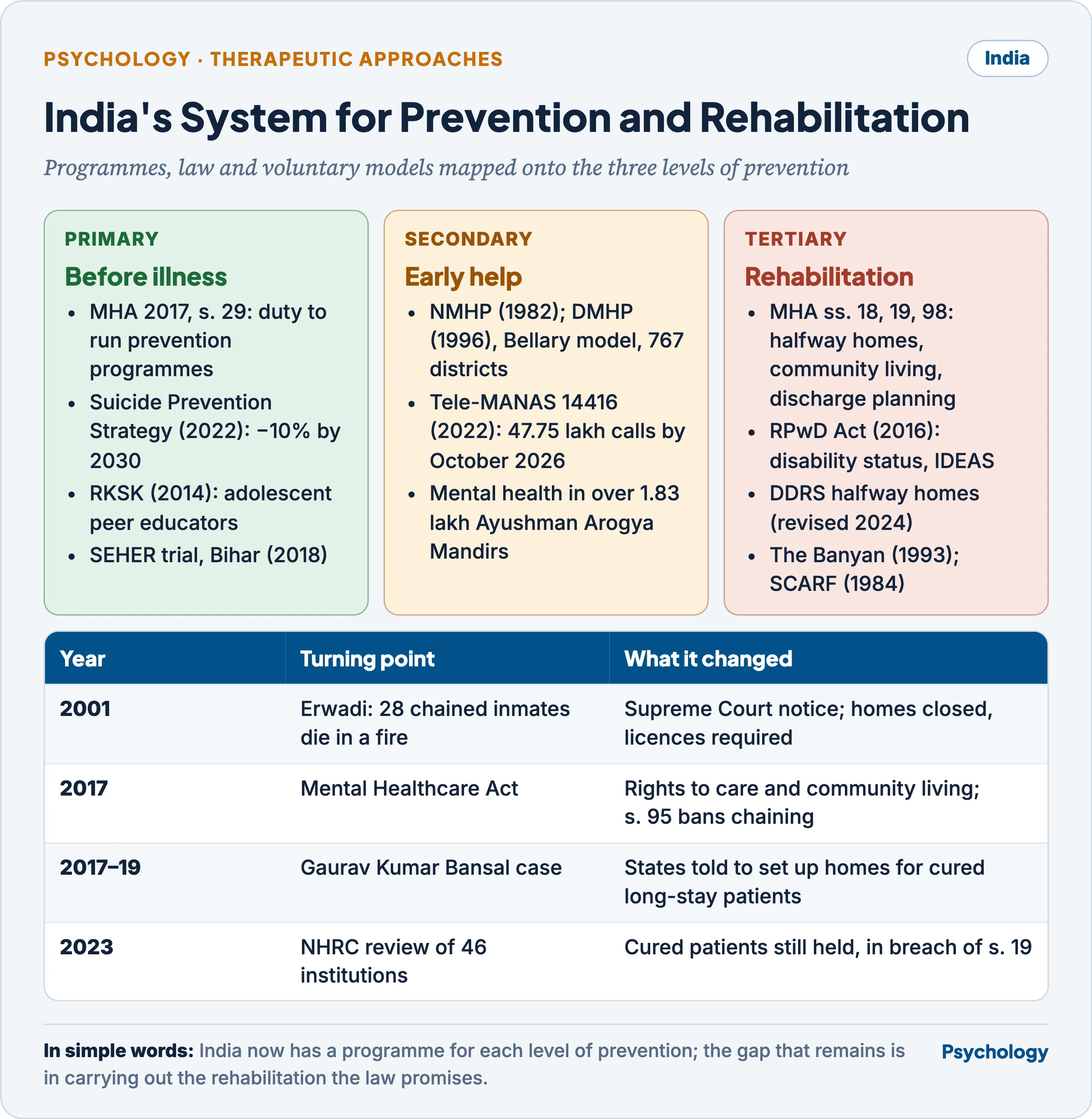
Each tier of the Indian system answers one level of Caplan’s model, and the law now obliges the tiers that were missing.
- National Mental Health Programme, 1982 (Ministry of Health and Family Welfare) — minimum mental healthcare for all, “particularly to the most vulnerable and underprivileged sections”, through general health care and community participation. Principle: task-sharing.
- District Mental Health Programme, 1996 — built on the Bellary model, begun in four districts, sanctioned in 767, with outpatient care, follow-up, outreach and a 10-bed unit. Principle: continuity of care, against the revolving door.
- Tele-MANAS (health ministry, 10 October 2022) — toll-free 14416; 53 cells across 36 states and union territories, 47,75,644 calls by October 2026 (PIB, 9 October 2026). Principle: low-cost early help-seeking.
- Mental Healthcare Act, 2017 (Ministry of Health and Family Welfare):
- Section 18 makes access to care a right, including halfway homes and community rehabilitation; section 19 grants community living and bars keeping anyone in hospital for want of family or home.
- Section 29 obliges promotion, prevention and suicide-reduction programmes; section 98 requires discharge planning; section 95 bans chaining “in any manner or form whatsoever”. Principle: the least restrictive setting.
- Rights of Persons with Disabilities Act, 2016 (Ministry of Social Justice and Empowerment) — mental illness is a specified disability with reserved posts. Principle: disability as restricted participation.
- Deendayal Divyangjan Rehabilitation Scheme (same ministry; revised guidelines from 1 October 2024) — funds NGO halfway homes for the psychosocial rehabilitation of “treated and controlled” persons with mental illness. Principle: graded transition.
- National Suicide Prevention Strategy (health ministry, 21 November 2022) — a 10 per cent cut in suicide mortality by 2030 through surveillance, district suicide-prevention clinics and school well-being curricula. Principle: universal and selective prevention.
- Erwadi (6 August 2001): 28 chained inmates of a faith-based asylum in Ramanathapuram, Tamil Nadu, died in a fire; the homes were closed, and the Supreme Court, acting suo motu, ordered states to survey and license mental health facilities.
- Gaurav Kumar Bansal v. State of Uttar Pradesh (Supreme Court, 10 July 2017; 2019) ordered homes for cured long-stay patients; in 2023 the National Human Rights Commission found all 46 government mental health institutions deplorable, holding cured patients in breach of section 19.
- The Banyan (Chennai, 1993; Vandana Gopikumar and Vaishnavi Jayakumar) — Home Again houses four or five former long-stay residents in rented homes with personal assistants.
- In 214 participants at ten sites, disability, symptoms and quality of life improved over 12 months (Gopikumar and colleagues, 2025). Limitation: no control group.
- SCARF (Chennai, 1984; Sarada Menon, R. Thara, R. Rajkumar) — day care, residential rehabilitation and the 25-year Madras Longitudinal Study of 90 first-episode patients: 27.7 per cent of the 47 assessed had a good outcome (Thara, 2012).
Previous Year Questions
- 2026Discuss the role of prevention and rehabilitation in mental health care.
- 2024Describe ‘revolving door phenomenon’ in the context of community based mental health services.
- 2022Discuss the various strategies necessary for rehabilitation of mentally ill Indian youth.
- 2016Discuss the salient features of psychodynamic therapies and evaluate their role in the prevention of mental illnesses.
- 2016Discuss the efficacy of behaviour therapies in the prevention of mental illnesses.
- 2003Sustaining positive and effective mental health is more dependent on prevention than cure. Do you agree with this statement? Answer with the help of a relevant model and highlight the role of quality of life.
- 2002Discussing the various programme towards prevention of mental disorders in the society, present in detail the role of psychologists in rehabilitating the mentally ill persons.
- 2001Explain the need of prevention in mental health system. Describe Caplan’s three-fold model of prevention.