

Notions of God: Attributes; Relation to Man and the World (Indian and Western).
Official Syllabus: Paper II, Section B, Unit 1
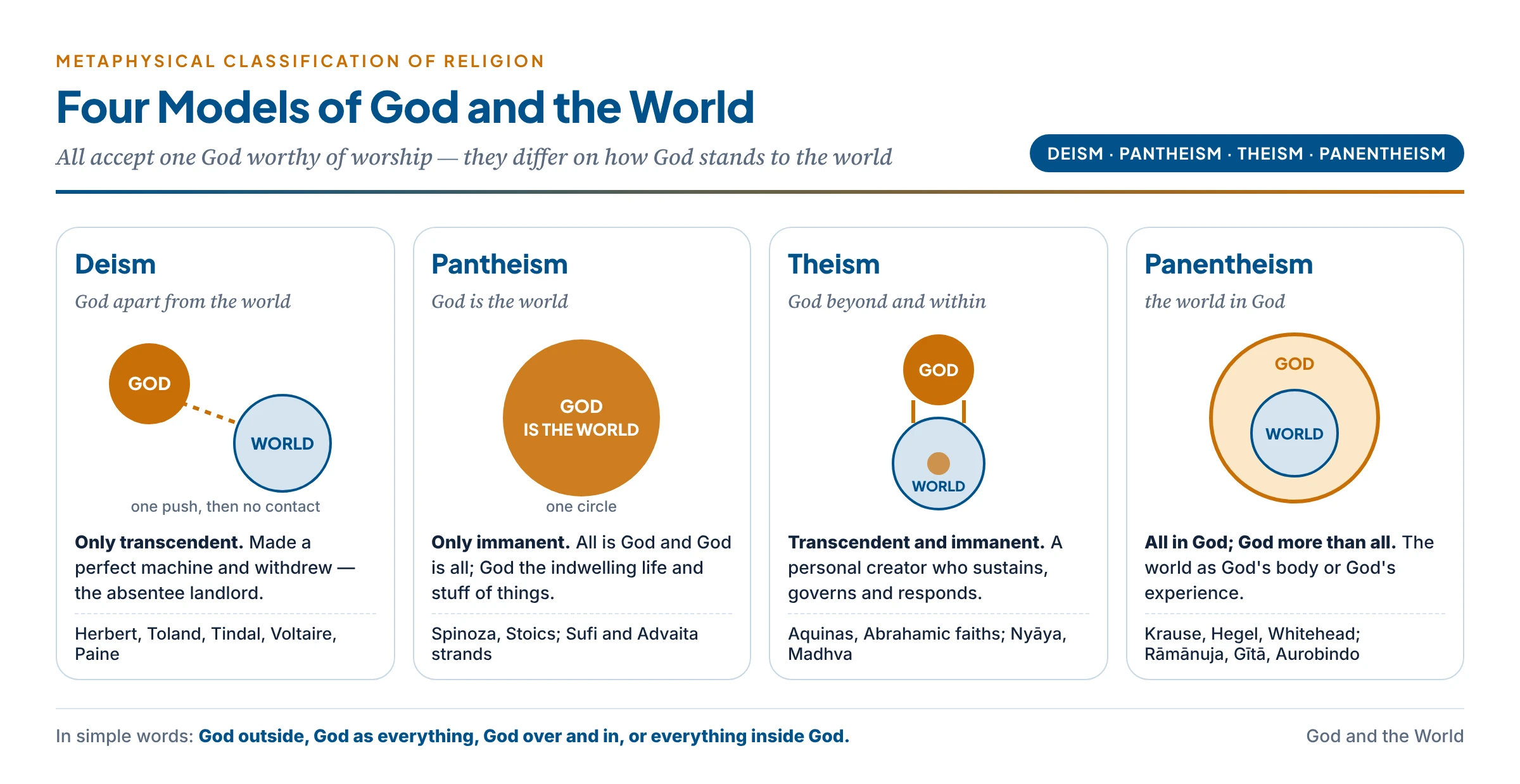
How is God related to the world? Is God outside it, like a watchmaker who made a clock and walked away? Identical with it, so that God is nature? Inside it as its sustaining life while also beyond it? Or does the world exist within God, who is more than the world? Philosophers of religion classify religions metaphysically by their answer, giving four classical models: deism, pantheism, theism (monotheism) and panentheism. All four accept one God as an adequate object of worship; they differ on the relation in which God stands to the world. This article explains each model with its attributes, strengths and difficulties, gives a full account of Spinoza’s God of substance and attributes, the process theism of Whitehead and Hartshorne, Rāmānuja’s body–soul model, and places Advaita correctly on the map.
In simple words
Think of four ways an author might relate to a story. A deist author writes the story, prints it and never looks at it again. A pantheist author is the story — there is no author apart from its pages. A theist author writes the story, stays involved with every chapter, yet remains a separate person outside it. A panentheist author holds the whole story inside his imagination, which is far larger than any story.
Context & Problem
Why the God–World Relation Is a Problem
- If God is only the first (efficient) cause, the materials of the world must exist outside God. Then there are two realities — God and matter — a dualism, and we must explain how they are related.
- If God is the material cause, creating the world out of himself, then God must take into himself the world’s physical nature, its lack of harmony, its absence of uniformity — and its evils.
- If God exists outside the world, the problem of duality returns; and God’s omnipresence becomes doubtful.
- Religion adds a demand: God must be a person, to answer prayer and reward faith and devotion.
- Philosophers have tried the possible alternatives to find a theory that can satisfy all these demands at once.
Four Metaphysical Theories
- The long tradition of Western religious philosophy has been metaphysical; it classifies religions by the relation of God to the world.
- Deism — God transcendent, world self-running.
- Pantheism — God immanent, identical with the world.
- Theism (monotheism) — God both transcendent and immanent, a personal creator and sustainer.
- Panentheism — the world exists in God, but God is more than the world.
Core Doctrine
Deism: The Absentee Craftsman
- Origin and spirit. Deism arose in seventeenth- and eighteenth-century Europe as a philosophical form of theism that used reason as its source of knowledge of God. It was the predominant religious philosophy of British thinking. Its names include Lord Herbert of Cherbury (often called the father of deism), John Toland, Matthew Tindal, Voltaire, Thomas Paine and Thomas Jefferson. The discoveries of Copernicus, Kepler and Newton gave it impetus: the universe looked like a perfectly ordered machine.
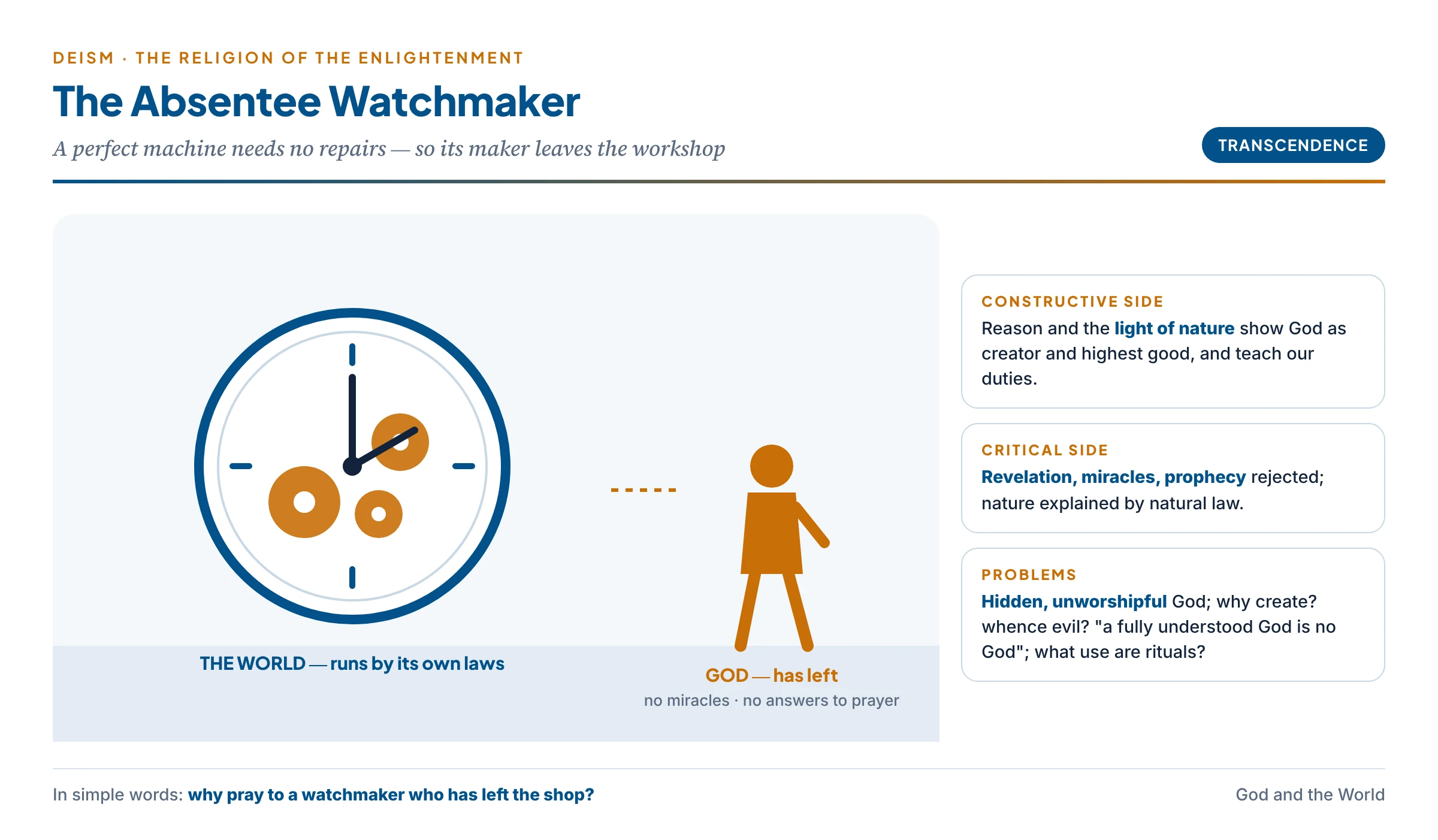
- Core thesis. God caused the universe but does not interfere with it thereafter. Prayer and miracles are unnecessary because of God’s superior engineering.
- Two aspects of deism.
- Constructive — reason and the “light of nature” are enough to know God as creator and the highest good, and to know our moral duties.
- Critical — revelation, miracles, prophecy and priestly dogma are rejected; everything is explained by natural law.
- The deist picture.
- God is perfect, infinite, eternal, omnipotent, omniscient, personal and the absolute reality.
- A perfect God makes the world as a perfect machine; a perfect machine needs no supervision; so God has retired from the world like an absentee landlord.
- God created man with free will and the natural light of reason by which he can determine his moral duties.
- Varieties. Christian deists like Tindal saw Jesus as a moral teacher, not the Son of God, and rejected theories of atonement. On the afterlife there was no agreement: Herbert and largely Franklin accepted it, Paine was sceptical, Anthony Collins denied it. Some later forms even admitted a kind of providence, close to occasionalism.
- Deism is not atheism. The atheist denies God; the deist affirms God as creator and highest good, while denying God’s intervention.
The Attributes of the Deist God and Their Problems
- Transcendence. God is beyond the world and has no logical relation with its ongoing events. Since the world is a perfect machine, it needs no divine supervision, and consistently miracles cannot be allowed. Two implications follow:
- A hidden God. Being transcendent and unconcerned with human affairs, God becomes a “hidden God” — beyond worship and beyond knowledge.
- Dualism. God and world are mutually exclusive; the world depends on God only in the sense of being created. This kind of dualism is found in Descartes. (Transcendence is an important theme in Christian theology; Aquinas especially stressed it — though, unlike the deists, he also affirmed God’s continual sustaining presence.)
- The absentee landlord. God owns the estate but no longer lives on it.
- Personality and its problem. A wholly transcendent God would be unworthy of worship, so deism ascribes personality to God. But personality tends to make God finite, not infinite — an inner struggle between God’s infinity and his personality.
- Reason versus revelation. Deism’s great strength is its trust in the natural light of reason as the sole authority in religion and morality; it is a “religious theory of the Enlightenment“. Problem: if God is wholly transcendent, God is unknowable, and revelation comes in by the backdoor to make God known. Yet revelation does not solve the problem: if God is unknowable, how can any revelation make the unknowable intelligible?
Deism and Science
- Achievements. By insisting on reason, deism purified religion of many superstitions; it made a truce between religion and science by giving science unfettered freedom. Since the universe was created by an infinite intellect, it is fully intelligible — and whatever reason reveals is sacred.
- Legacy. The light of reason as the final court of appeal paved the way for rationalism, scientism, the Enlightenment and humanism.
- The price. In the end, the truce with science was made “at the cost of religion“. Agnosticism, naturalism and materialism explained the world by natural laws alone, and humanists grounded morality without transcendental beings — and these replaced deism, which had kept God only as the first cause.
Problems of Deism
- Creation. Deism accepts creation but cannot answer: what was God’s purpose in creating? How did God create — out of himself, or out of pre-existing matter? Did God create in empty time, or create time along with the world?
- Evil. If God made a perfect machine, where does evil come from? Did God create it?
- Only a concept of God. Deism claims to be wholly rational, but “a fully understood God is no God at all” — it becomes a mere concept of the human intellect.
- Ritual and worship. If God never responds, what is the use of rituals, prayer and worship?
- Critique from classical theism.
- Deism cannot create conditions for devotion; rejecting miracles and prophecy limits God’s omnipotence.
- Finite reason can play only a subsidiary role beside faith and revelation in understanding the mysteries of the universe.
- The “absentee landlord” is least interested in his creation and cannot stir religious fervour; a devotee connects with a God who responds to prayer and bonds with those who surrender.
- Kant’s critique. Kant denied that pure reason can establish God; he placed God in the noumenal realm of faith — in sharp contrast with deism’s confidence in reason.
- Determinism. If everything — including human action — follows mechanical laws, our apparent freedom collapses into determinism; freedom must then be presupposed as a matter of faith, as in Kant.
In simple words
A watchmaker builds a perfect watch, winds it and leaves the shop. The watch keeps perfect time without him; he never repairs it, and it cannot speak to him. The deist God is this watchmaker. The question believers ask is simple: why pray to a watchmaker who has left the shop?
Can Deism Satisfy the God of Grace and Devotion?
- What grace and devotion require. Grace is God’s free, active love reaching into a person’s life — forgiving, helping, saving. Devotion (bhakti) is a loving relationship in which the devotee surrenders and God responds.
- Why deism fails here.
- Its God does not intervene — no answered prayer, no forgiveness that changes anything, no saving act.
- Its God is known by reason, not met in love; devotion needs a Thou, not a first cause.
- Rejecting revelation and incarnation removes the historical acts (covenant, Christ, avatāra) through which grace is believed to come.
- Partial defences. Some deists kept prayer as gratitude and believed in afterlife and judgment; one may love God as the source of all good even without intervention — rather like Spinoza’s selfless intellectual love. But this is admiration, not the mutual relationship of grace.
- Verdict. Deism cannot satisfactorily support a God of grace and devotion. Its historical role was to purify religion of superstition and to defend reason, but the religious consciousness turned to theism, where God is both transcendent and active.
Theism (Monotheism): The Creator Who Sustains
- Definition. Theism is that form of religious belief in which God is taken to be a supernatural person and the creator of a value-evolving world. God is transcendent as well as immanent.
- God and the world. God creates, sustains and governs the world. The world depends on God both for its being and for its qualities. The world is affected by God, but God is not affected by the world.
- Proponents. Aquinas and Abrahamic orthodoxy; in India, the theistic schools — Nyāya, and the Vedāntins Rāmānuja, Madhva, Nimbārka and Caitanya.
- Theism and monotheism.
- In theism, there is a supreme personal God, but he may not be the Absolute. In the Indian system, Īśvara is the supreme God who created this value-evolving world, but above Īśvara stands the higher reality of nirguṇa Brahman (in Advaita).
- In the West, theism takes the form of monotheism, in which the worship of any other god is considered aberrant — leading to an exclusivist view of the truth about God.
- For theism, God is both a person and an infinite being who necessarily exists.
- Distinctiveness. Theism preserves an ontological distinction between creator and creature, while allowing communion between God and human beings through grace, love and providence.
| Deism | Theism | |
|---|---|---|
| Transcendence and immanence | God is only transcendent | God is both transcendent and immanent |
| The Absolute | One absolute God | A personal God, supreme but not necessarily the Absolute |
| The world | A perfect machine | A value-evolving world |
| Relation | No logical relation with the world — absentee landlord | God is the sustaining power of the world |
| Worship | Consistently, worship is not possible | Worship is central |
| Source of knowledge | Reason is the ultimate court of appeal | Reason, faith, experience and revelation together |
Pantheism: All Is God, God Is All
- Meaning. From Greek pan (all) and theos (God): seeing all things in God and God in all things. The Gītā says: “One who sees Me everywhere and sees everything in Me — I am never lost to him, and he is never lost to Me.“
- Character. Unlike deism, pantheism is very old, found clearly in both East and West, and closely tied to mystical experience — it should not be treated as a merely intellectual system. It is close to Sufism and Advaita (“He is in every particle — kaṇ-kaṇ meṁ“). It rejects the anthropomorphic God — and so rejects theism, and vice versa.
- Types of pantheism.
- Impersonal — Spinoza, Śaṅkara’s Vedānta.
- Super-personal — Bradley, Radhakrishnan and other idealists.
- Personal — Sufism and Christian mysticism.
- Key concept: immanence. As transcendence is the key concept of deism, immanence is the key concept of pantheism. “Immanence” means that which occupies every fibre of the thing in which it is immanent — indwelling and all-pervasive, but without also being transcendent. Immanence is not mere omnipresence (as a “Big Brother” may watch everywhere without dwelling in things). It has two senses:
- The vitalising power — God as the indwelling, sustaining, moulding power of the world, as the vital impetus in an egg transforms the egg into a chick. Spinoza’s natura naturans (“nature naturing”) expresses this.
- The primordial stuff — God as the stuff out of which everything comes and of which everything is a modification. Spinoza’s natura naturata (“nature natured”) expresses this. For Spinoza the sum total of all that exists is God.
In simple words
In the Chāndogya Upaniṣad, Uddālaka asks his son to drop salt into water overnight. Next morning the salt cannot be seen, yet every sip — from the top, the middle, the bottom — tastes salty. Immanence is like that salt: not sitting in one place like a watcher, but pervading every drop.
- Not naturalism. In religious pantheism there is no room for naturalism, in which God is swallowed up in the world. Though Spinoza equated God with Nature, in him nature ceases to be nature and appears divine — the object of “amor intellectualis Dei“.
- The intellectual love of pantheism. It is neither selfish nor unselfish but selfless — far more than the moth’s instinctive love of the flame; a love that does not need to be returned or rewarded, fully compatible with an impersonal Absolute, and comparable to Buddhist compassion for the whole world (the Bodhisattva). For Śaṅkara too, realising Brahman means reaching a state where the narrow boundary of the ego dissolves in the expansion of the whole personality, beyond customary morality of good and evil.
- Open morality. Pantheism teaches duties not only to human beings but to the sun, the moon and all things.
Objections to Pantheism and the Replies
- Objections.
- The world becomes illusory. If God is all and all is God, the world (the “all”) becomes illusory. But the world is our starting premise; if the premise is illusory, so is the conclusion (whether Brahman or Spinoza’s substance).
- An unworshipful God. Worship requires the deity to be distinct from — transcendent to — the worshipper; in pantheism the deity is the immanent principle of the worshipper, and the two coalesce. No worship is possible.
- No freedom of will. If God is the indwelling spirit “that rolls through all things” and makes even our innermost decisions, there is no real freedom, and so no true morality.
- No fire of devotion. Pantheism cannot sustain the fire of religious devotion and experience.
- Further critiques. If modern cosmology treats the world as finite, a God identical with it becomes limited — a contradiction; and the world’s imperfections and evils become part of God, against the idea of a most perfect being.
- Replies. The objections are “pointless but not valueless” — they deepen our notion of religion.
- A theist says God must be transcendent to be worshipful — but the transcendent God of deism proved unworshipful too.
- Worship is not the only way of being religious. In the nirvāṇist form of religion one realises the indwelling reality through meditation or samādhi; meditation takes the place of worship.
- Open versus closed morality. Theism preaches a closed morality, however enlightened — as John Dewey said, the distinction of the “sheep and the goats” is essential to supernatural theism. Pantheism teaches an open morality towards all things, purged of narrowness.
Personalistic Pantheism, or Mystic Theism
- Strictly, pantheism must be impersonal: a personal God cannot be the indwelling spirit of the world or its underlying stuff. But because pantheism is allied to mysticism, in mystic trance all things may appear pervaded by a personal God.
- Tulsīdās sees the whole world filled with Rāma and Sītā.
- Muslim and Christian mystics declare that in the trance God alone is felt as the essence of everything; al-Ghazālī says the mystic becomes so absorbed in the Beloved that he perceives nothing else.
- Distinct yet absorbed. The theistic mystic remains existentially distinct from God; the absorption is psychological, not ontological. It is the state of fanā’ (passing away), the “oceanic feeling” (as Freud called it), in which the mystic’s whole personality is overwhelmed by the majesty of the Most High but not annihilated.
Spinoza’s God: Substance, Attributes and Modes
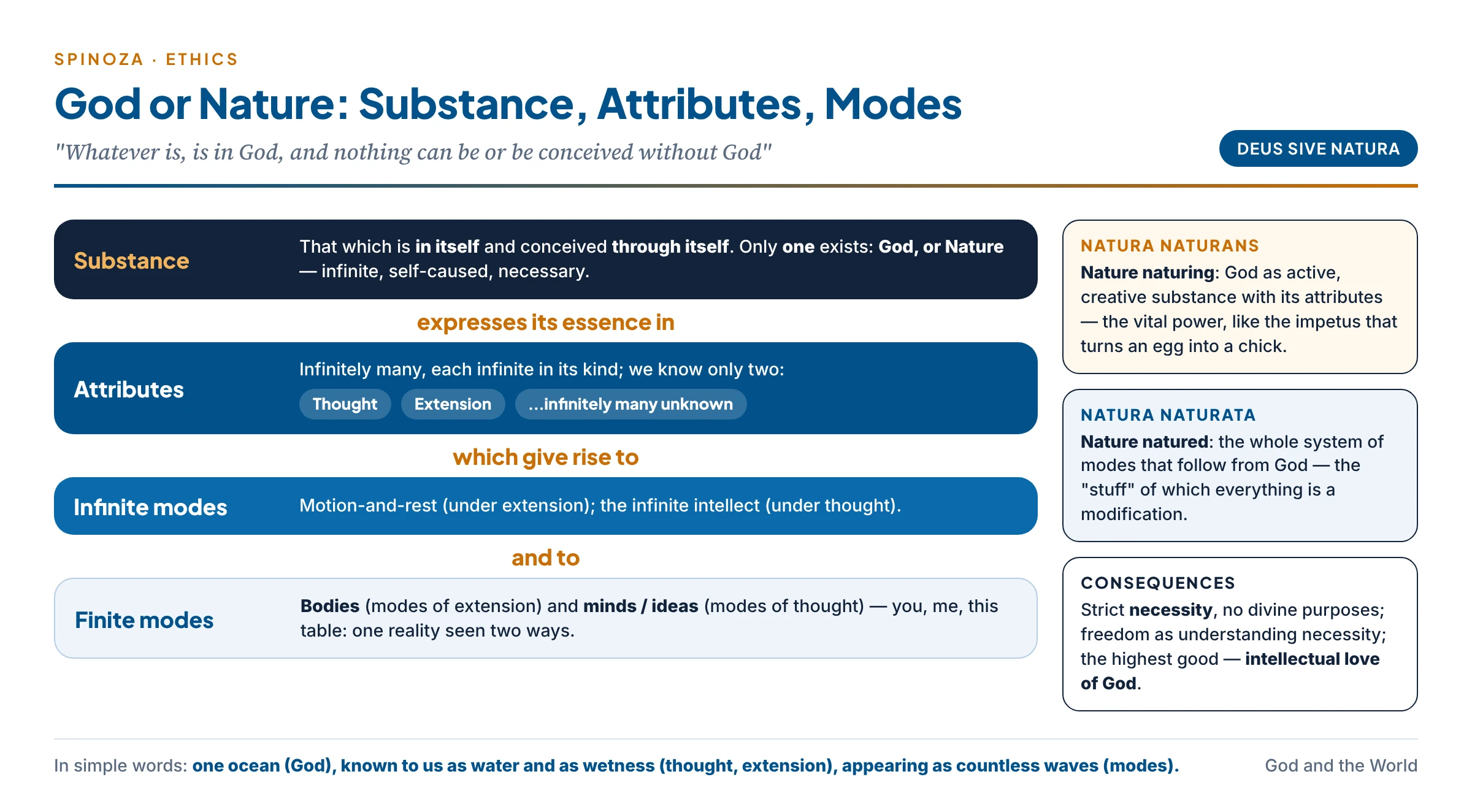
- Substance. “That which is in itself and is conceived through itself” — needing nothing else to exist or to be understood. There can be only one such substance, for two substances would either share attributes (and so be identical) or differ wholly (and so could not limit or cause each other). This one substance is God, or Nature (Deus sive Natura): “Whatever is, is in God, and nothing can be or be conceived without God.“
- Attributes. “That which the intellect perceives of substance as constituting its essence.” God has infinitely many attributes, each infinite in its kind; human beings know only two — Thought and Extension. Mind and body are not two substances but the same reality expressed under two attributes (the basis of Spinoza’s parallelism).
- Modes. “Affections of substance” — that which exists in another and is conceived through another. Infinite modes (such as motion-and-rest, and the infinite intellect) and finite modes — individual bodies (modes of extension) and minds/ideas (modes of thought). You, I, this table — all are modes of God.
- Natura naturans and natura naturata. God as active, creative substance with its attributes is “nature naturing“; the totality of modes flowing from it is “nature natured“.
- Necessity and determinism. All things follow from God’s nature as the properties of a triangle follow from its definition. God acts by necessity of his own nature, not by free choice or purpose; Spinoza calls belief in final causes (God acting for ends) a prejudice. Human freedom is the understanding of necessity.
- “All determination is negation.” To ascribe a definite quality (love, anger, will) to the infinite would limit it; so Spinoza’s God has no human emotions — “he who loves God cannot endeavour that God should love him in return“.
- The intellectual love of God (amor intellectualis Dei). The highest good of the mind is to know God; this knowledge gives a calm, eternal joy, and the mind’s intellectual love of God is “part of the infinite love with which God loves himself“.
- Pantheism or panentheism? Spinoza is usually called a pantheist — God is identical with Nature. But since God has infinitely many attributes of which the world we know shows only two, some read him as a panentheist: the known world is in God, but God exceeds it.
- Atheist or God-intoxicated? Contemporaries called him an atheist (a God without will, purpose or love is no God of religion); Novalis called him “the God-intoxicated man“; Hegel said Spinozism is not atheism but “acosmism” — so much God that the world loses independent reality.
- Evaluation.
- Strengths — a rigorous, consistent monism; no gap between God and world; overcomes Cartesian dualism; an ethic of understanding and serenity; inspires modern scientific reverence (Einstein).
- Weaknesses — strict determinism endangers moral responsibility; God without will or love cannot be worshipped; evil becomes part of God’s necessary nature; the leap from “two known attributes” to “infinitely many” is unexplained; the individual seems swallowed in substance.
Panentheism: All in God, God More than All
- Meaning. “Everything-in-God-ism” (the term was coined by K.C.F. Krause in the nineteenth century). The world exists in God but is not identical with God. The world is a part of God, with no independent existence of its own; God is not limited to or by the world, since God is much more than the world.
- The poet analogy. A poet creates many poems out of his own consciousness but does not exhaust his being in them; God makes the world out of himself yet remains above and beyond it. The world does not exhaust God’s creativity.
In simple words
Augustine pictured creation as a sponge floating in a boundless sea: the sea fills every pore of the sponge, yet the sea is infinitely larger than the sponge. Panentheism sees the world like the sponge — soaked through with God, existing in God — while God remains immeasurably more.
- God as material and efficient cause. God is the first (efficient) cause and the material cause of the world. God is omnipresent in the world as its material cause and above it as its first cause — the highest personality, creator, supporter and defender of the world, infinite, without beginning, and omnipresent.
- Western examples.
- Hegel — God is omnipresent in the world, yet absolute, perfect and transcendental; it is in God’s nature to express himself in the world.
- Neo-Platonism — the world as an emanation from the One through Nous (Intellect).
- Process theism — Whitehead and Hartshorne (below).
- Indian examples.
- Rāmānuja’s Viśiṣṭādvaita — the classic Indian panentheism. God is related to the world as the soul to its body. Bodies are ontologically and epistemologically dependent on their souls; so the world, as God’s body, is wholly dependent on God, while God does not need the world. God is the soul of nature and the inner controller (antaryāmin); the relation is apṛthak-siddhi — an inner, inseparable, vital and organic relation. God is both the material and the instrumental cause: immanent in the world as inner controller, yet in essence transcending it.
- The Bhagavad Gītā — “By Me, in My unmanifest form, this whole universe is pervaded; all beings abide in Me, but I do not abide in them“; and in the cosmic form (viśvarūpa) Arjuna sees the whole world within God.
- Sri Aurobindo’s Integral Advaita (Pūrṇādvaita) — the world is a real manifestation of Saccidānanda, who exceeds it.
Process Theism: Whitehead and Hartshorne
- God as becoming. For process thinkers reality is made of events and processes, not static substances — and God too is in process.
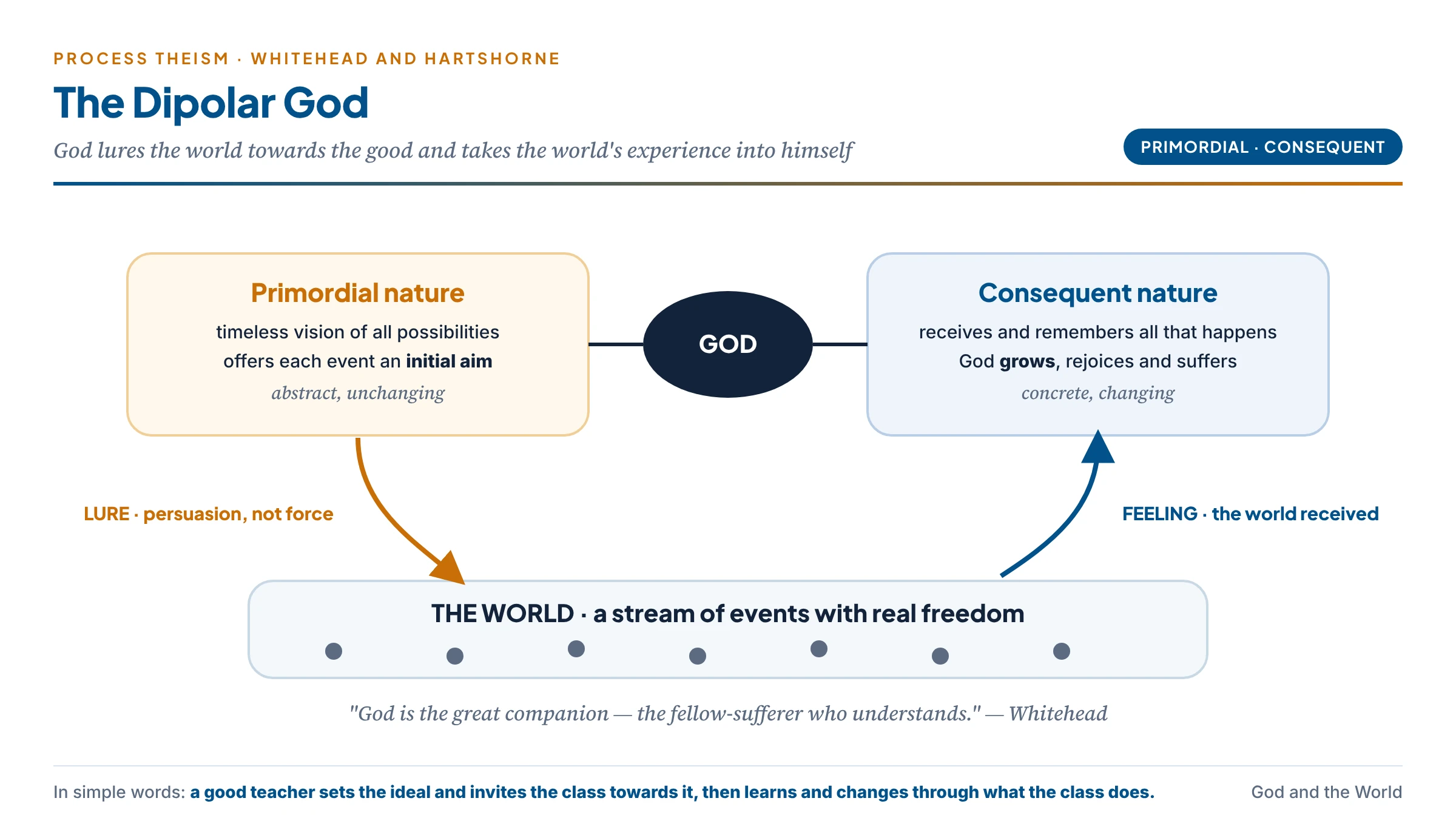
- Whitehead’s dipolar God.
- Primordial nature — God’s timeless envisagement of all possibilities; through it God offers each event an “initial aim“, a lure towards the best possible outcome.
- Consequent nature — God’s temporal, responsive experience of the actual world: God receives everything that happens, saves what is of value, and grows. “God is the great companion — the fellow-sufferer who understands.”
- Mutuality. “It is as true to say that God creates the World, as that the World creates God.“
- Hartshorne’s panentheism. God is the “most and best moved mover”: God has an abstract essence that never changes (perfect goodness and wisdom) and a concrete actuality that grows with each new event. God is surpassable only by himself.
- Strengths. A God who suffers with creatures and responds to them fits the biblical and bhakti picture better than an impassible God; the problem of evil is eased because God’s power is persuasive, not coercive.
- Criticisms. It limits omnipotence; makes God dependent on the world for full self-realisation; and contradicts classical aseity and immutability.
Can Panentheism Solve the Problems of Pantheism?
- What it solves.
- If the world is finite, a God identical with it is limited; panentheism places a finite world within an infinite God, so God is not limited — as in Viśiṣṭādvaita.
- Devotion becomes possible: some bhakti verses of the Gītā accept a personal God within a panentheistic framework.
- What it does not solve.
- Freedom — if God is the ultimate controller of everything, God seems responsible for all human actions.
- Evil — the world’s imperfections and evils become part of God’s “body”, though God should be free of all imperfection.
- Attempts to meet these two difficulties rest more on faith than on reason.
- Further criticisms. Panentheism shares pantheism’s difficulties; it can seem defeatist and dogmatic and may not satisfy man’s moral conscience. Religiously, it does not fully reward devotional labour; some adherents say the world is false and God has two forms — without qualities and with qualities — which immediately raises the question of the relation between the qualified and the unqualified, the transcendent and the worldly.
Where Does Advaita Fit?
- Not deism, not simple pantheism. Advaita says everything is Brahman in substance — as clay is the one reality behind all pots — and everything stripped of name and form (nāma-rūpa) is Brahman. But the world as world, with its names, forms, places, times and events, is appearance (vivarta), not real transformation: the things of the world are “ever-vanishing waves that never are” (as Spinoza also said of modes).
- Brahman is not, ultimately, creator or ruler. Real causal relations hold between two real things; since the space-time world is not ultimately real, Brahman is neither its creator nor its ruler from the highest standpoint.
- Yet theism at the empirical level. As Īśvara, Brahman is creator, sustainer and lord — the God of worship.
- Best label. Advaita is acosmic monism (the One alone is real, the world an appearance) combined with empirical theism — closer to “God is all, the world is not” than to pantheism’s “God is the world“.
Common confusion
Is Advaita Vedānta simply pantheism? Not quite. Pantheism says God and the world are identical — the world is real and is God. Advaita says only Brahman is real; the world is neither real nor unreal (anirvacanīya) — an appearance on Brahman, like the snake on the rope. So Advaita is better called monism or acosmism (“God without a world”). It is pantheistic only in the limited sense that the substance of everything is Brahman.
Common confusion
Was Aquinas a deist because he stressed God’s transcendence? No. Aquinas held that God is wholly other than creatures, but also that God continually sustains every creature in being, is present in all things by power, presence and essence, works miracles and gives grace. Deism keeps only the creation and rejects the sustaining and intervening — Aquinas is a classical theist.
Indian Connect — Indian models of the God–world relation
- Nyāya — a theist dualism: God is the efficient cause shaping eternal atoms; the world’s material is not God.
- Rāmānuja — panentheism: world and souls as God’s body (apṛthak-siddhi).
- Madhva — theist dualism: God the independent efficient cause, prakṛti the material cause; eternal difference.
- Śaṅkara — monism with empirical theism: Brahman alone real, Īśvara the Lord of the world-appearance.
- Aurobindo — integral panentheism: the world a real, evolving self-manifestation of Saccidānanda.
Critical Evaluation
Comparing the Four Models
- Deism — strength: rational, science-friendly, free of superstition; weakness: unworshipful, no grace, cannot explain creation’s purpose or evil.
- Pantheism — strength: mystical depth, unity of all, open morality; weakness: no worship, no freedom, evil within God, the world illusory or God limited.
- Theism — strength: balances transcendence and immanence, supports worship, grace and moral life; weakness: the problem of evil, of two realities (dualism), and of how an immutable God acts.
- Panentheism — strength: keeps God infinite while intimately present; supports devotion; process forms offer a responsive God; weakness: freedom and evil problems remain; God may become dependent on the world.
Critics and Defenders
Criticism — Critics
- Classical theists — deism makes God an absentee landlord; pantheism makes worship impossible.
- Kant — reason cannot know God (against deism); freedom is endangered by mechanism.
- Bayle and early critics — Spinoza’s God is atheism in disguise.
- Hegel — Spinozism is acosmism: the world loses its reality.
- Classical theists against process theism — a growing, dependent God lacks aseity and omnipotence.
- Rāmānuja — Advaita’s unreal world makes God and devotion unreal.
Defence — Defenders and strengths
- Deists — reason purifies religion; a truce with science.
- Spinoza, Śaṅkara, Sufis — immanence, unity, selfless intellectual love, open morality.
- Aquinas, Rāmānuja — God both beyond and within; creation and sustenance.
- Whitehead, Hartshorne — the fellow-sufferer God; persuasive power eases evil.
- The Gītā — “all beings abide in Me” — a panentheistic vision that supports bhakti.
Cross-Tradition Comparison
| Deism | Pantheism | Theism | Panentheism | |
|---|---|---|---|---|
| God’s relation | Transcendent only | Immanent only | Transcendent and immanent | World in God; God exceeds it |
| Western examples | Herbert, Toland, Tindal, Voltaire, Paine | Spinoza, Stoics, (Hegel in part) | Aquinas, Abrahamic orthodoxy | Krause, Hegel, Whitehead, Hartshorne |
| Indian examples | — (no true parallel) | Advaita in part; “kaṇ-kaṇ meṁ” | Nyāya, Madhva, Śaiva Siddhānta | Rāmānuja, Gītā, Aurobindo |
| Worship | Not consistently possible | Replaced by meditation | Central | Possible (bhakti) |
| Freedom | Natural light of reason | Endangered (necessity) | Affirmed | Problematic |
| Evil | Unexplained | Part of God | Problem of evil | Part of God’s “body” |
Indian Connect — Key takeaways
- India has no real deism: its theisms always keep God as the inner controller and dispenser of karma.
- Rāmānuja’s body–soul model is the most developed panentheism in any tradition and is often compared with Hegel and Whitehead.
- Advaita must not be labelled pantheism without qualification — its “God is all, the world is appearance” differs from Spinoza’s “God is Nature“.
Synthesis (Siddhānta)
- Each model protects one truth. Deism protects God’s transcendence and the autonomy of nature; pantheism protects God’s immanence and the unity of all things; theism protects the personal God who is both beyond and within; panentheism protects God’s infinity together with His intimate presence.
- The extremes fail religion. A God only beyond (deism) cannot be loved; a God only within (pantheism) cannot be worshipped. Theism and panentheism try to hold both poles and are therefore the dominant religious views.
- Spinoza is the great test case. His rigorous monism shows the power and the cost of identifying God with Nature — serenity and unity at the price of freedom, purpose and personal love.
- Process thought and Rāmānuja show that God can be conceived as including the world without being reduced to it — a responsive, suffering, gracious God.
- Contemporary relevance. Ecological thinking draws on pantheistic and panentheistic reverence for nature (open morality towards “the sun and the moon”); science-and-religion dialogue favours models where God works through natural law rather than against it; and interfaith dialogue benefits from seeing these models as complementary emphases rather than rival creeds.
“By Me, in My unmanifest form, this whole universe is pervaded; all beings abide in Me.” — Bhagavad Gītā
Previous Year Questions
- 2024How does the notion of God in Spinoza’s philosophy embedded in his metaphysics of substance and attributes? Critically discuss.
- 2024How does Spinoza establish that God alone is absolutely real with his statement — “Whatever is, is in God”? Critically discuss.
- 2022Write an essay on Spinoza’s notion of God and His attributes.
- 2012Explain the distinction between deism and theism.
- 2008Can deism be satisfactory theory in the context of God of grace and devotion? Discuss.