

Notions of God: Attributes; Relation to Man and the World (Indian and Western).
Official Syllabus: Paper II, Section B, Unit 1
Is God a Someone or a Something — a loving Lord who hears prayer, or an infinite Ground, Substance or Absolute that is beyond all personality? Almost every religious tradition has wrestled with this question. The personalistic notion conceives God as creator, moral governor and object of devotion, with knowledge, will and love; the impersonalistic notion conceives the Ultimate as Substance (Spinoza), Absolute Spirit (Hegel), the Absolute (Bradley), Being-itself (Tillich) or nirguṇa Brahman (Śaṅkara). This article explains both notions, the logical difficulties each faces, the difference between an impersonal and a naturalistic God, which notion suits devotion, whether Śaṅkara’s Brahman leaves room for theism, and the main attempts to reconcile the two — Śaṅkara’s two standpoints, Radhakrishnan’s Absolute and God, the Gītā’s two paths, and Hick’s “personae and impersonae” of the Real.
In simple words
Think of the sun. To a farmer it is “the sun-god who blesses my crop”, greeted every morning with folded hands — a personal presence. To an astrophysicist it is a vast, impersonal furnace of hydrogen. Both speak of the same sun from different standpoints. The debate on God asks: is the Ultimate more like the friend the farmer greets, or more like the furnace the scientist studies — or is it more than both?
Context & Problem
Two Ways of Conceiving the Supreme Being
- A common core. Most major traditions place an Absolute or Supreme Being at the centre. Behind the differences of name and doctrine, their conceptions fall broadly under two heads: the personalistic and the impersonalistic notion of God.
- Why the question matters.
- For religion — worship, prayer, grace and surrender seem to need a personal God who can hear and respond.
- For reason — infinity, perfection and changelessness seem to require an impersonal Absolute free of human limitations.
- For dialogue between religions — conflicts often arise over the names and attributes of a personal God; an impersonal Ultimate seems more inclusive.
What Makes God “Personal”?
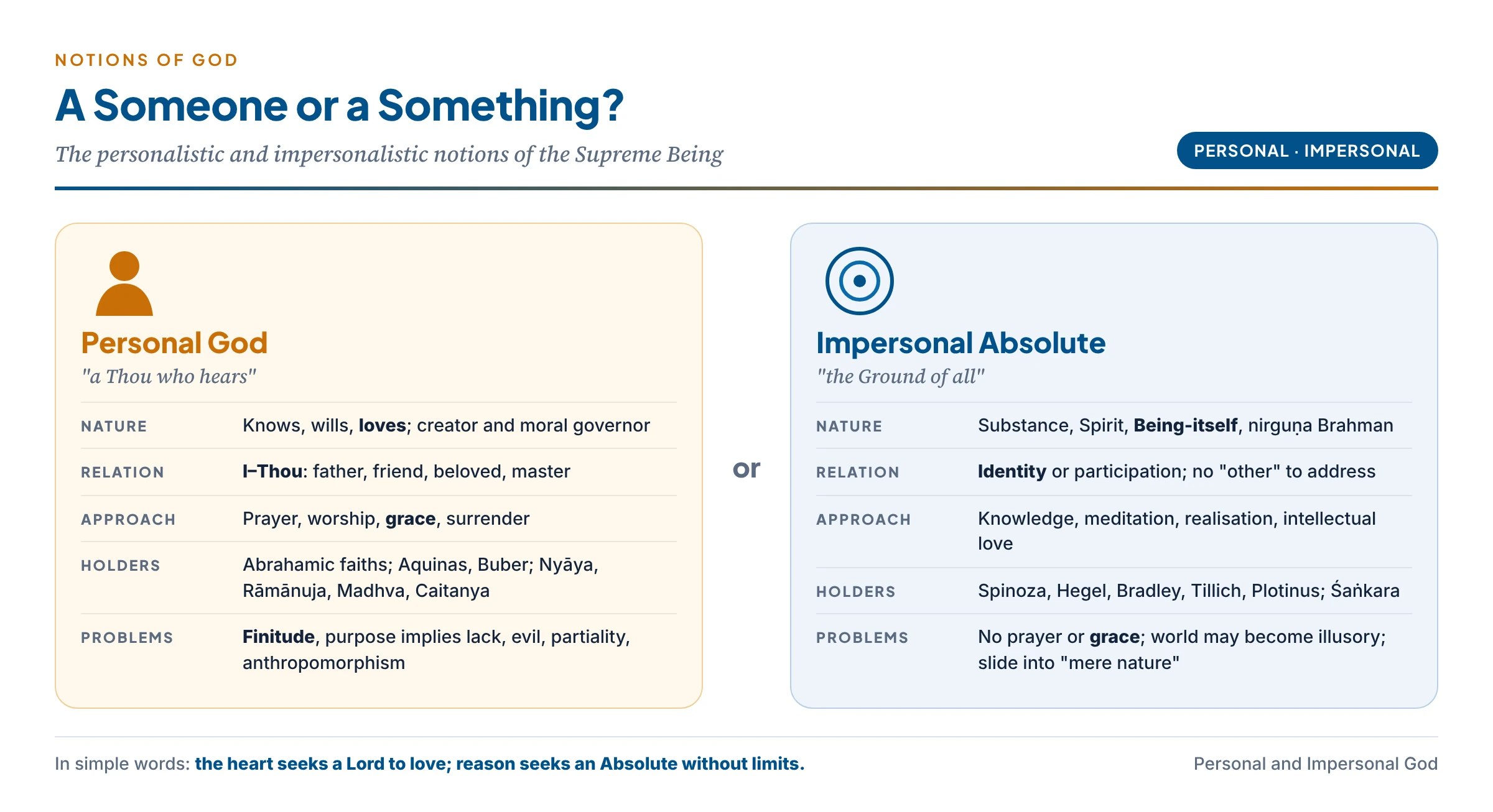
- Marks of personality. Self-consciousness, knowledge, will and purpose, love and moral concern, and the capacity for relationship — to address and be addressed.
- “Personal”, not “a person”. Theologians usually say God is personal rather than “a Person“, because “a person” suggests a magnified human individual (anthropomorphism). Saying God is personal means God is “at least personal” — whatever God is beyond our understanding, God is not less than personal, not a mere It.
- Buber’s I–Thou. Martin Buber distinguished two relations: I–It (we use, measure and study objects) and I–Thou (we meet another as a whole person, in mutual presence). God is the eternal Thou — never an object we can observe, but One we can only address.
- Thou-hood in scripture. “I am the God of Abraham, the God of Isaac and the God of Jacob”; “Hear my cry, O God”; Jesus’ constant image of God as Father.
Core Doctrine
The Personalistic Notion of God
- Definition. The personalistic notion conceives God as the creator of the world, the governor of morality, possessing infinite power, knowledge, goodness, kindness and freedom, and as the ultimate object of devotion who alone can liberate human beings from suffering.
- In the Abrahamic religions. God is the creator, with infinite omniscience, omnipotence and benevolence, which are not comparable to the finite love, will and intelligence of human beings. This infinite nature makes God an object of devotion for finite, fallible humans.
- Forms of the God–devotee relation.
- Father and child — the Christian relation of God and humanity.
- Divine friendship — Kṛṣṇa and Arjuna in the Bhagavad Gītā; the friend of God in Sufi poetry.
- Beloved and lover — the bhakti saints Āṇḍāḷ and Mīrābāī love God as their bridegroom.
- Master and servant — Hanumān’s devotion to Rāma (dāsya).
- Slayer of evil and giver of reward — God destroys evil forces and rewards the good with eternal life in God’s abode (some Christian and Vaiṣṇava sects).
- Thinkers. Aquinas (God as pure act of knowing and willing), Berkeley (God as the infinite Spirit), the personalists (Lotze, Bowne, Brightman), Kierkegaard, Buber, Hick; in India Nyāya, Rāmānuja, Madhva, Nimbārka, Vallabha, Caitanya, Śaiva Siddhānta and the bhakti poets.
Logical Difficulties of the Personalistic Notion
- It contradicts the idea of the most perfect being. Spinoza: if we ascribe an attribute to the infinite Substance, we deny it every opposite attribute — “all determination is negation“. Saying “God is love” deprives God of everything incompatible with love, so the most perfect being would lack something. Śaṅkara’s “neti, neti” makes the same point: the Supreme must be free of determinate attributes.
- Personality implies finitude. Personality involves distinction from others, change of mental states, desires and purposes — all marks of a finite being. Even deism ran into this: it ascribed personality to God to keep God worshipful, but “personality is a finite aspect“, introducing an inner struggle between God’s infinity and his personality.
- God cannot have a purpose. A personal God has a good will, and good will implies purpose. But purpose arises only where something is lacking; lack implies finiteness and imperfection. The same objection strikes God’s purpose in creating the world.
- The problem of evil. It is very hard to reconcile the world’s moral and natural evils with a personal God of infinite power and love — “a bitter pill which no theist can swallow“.
- Religious morality limits God’s benevolence. In organised religions, those who break God’s commandments are punished; this seems to limit God’s infinitely forgiving nature, and makes God partial to those who worship him.
- Anthropomorphism. From Xenophanes (if horses had hands they would draw gods like horses) to Feuerbach (God as the projected essence of man) and Freud (God as an exalted father), critics see the personal God as a figment of human imagination.
- Bradley’s dilemma. “God is not God till he has become all in all, and a God which is all in all is not the God of religion.” A God who is truly infinite cannot stand over against us as another person; a God who stands over against us is not infinite.
Theist Replies to These Difficulties
- Personality without limitation. Finitude belongs to human personality (a body, changing moods, dependence), not to personality as such. Knowing, willing and loving are perfections that can exist in an infinite way. Lotze argued that perfect personality is found only in God; ours is an imperfect copy.
- Purpose from fullness, not lack. A purpose need not come from need. The Vedānta calls creation līlā — the spontaneous play of a being already complete, “as a king who has everything still plays games”; Plotinus speaks of the One overflowing like a fountain. Love creates not to get but to give.
- Analogy, not anthropomorphism. God is personal analogically (Aquinas): the words “knows”, “wills” and “loves” point to a higher reality than in us. Saying God is “at least personal” is a safeguard against making God less than us.
- Grace and justice. Punishment in religious morality can be understood as the inner working of the moral order (the “wrath” as the law of consequences), not as partiality; the bhakti traditions stress that God’s grace is offered to all, even the worst sinner.
- Evil remains the hardest case, but it troubles every conception that calls the Ultimate good — impersonal Absolutes too must explain why the world contains suffering.
In simple words
A famous musician does not compose because she lacks music; she composes because music overflows in her. Theists say the same of God: a personal God can act with purpose and joy out of fullness, not out of need — like the musician’s song or a child’s play.
The Impersonalistic Notion of God
- How it arises. One reaches an impersonal notion by logically analysing the idea of the Absolute: if the Ultimate is infinite and perfect, ascribing personal attributes to it would limit it.
- Main forms.
- Spinoza — God is Substance, “God or Nature (Deus sive Natura)“, with infinite attributes of which we know thought and extension. God acts from the necessity of his nature, has no purposes, and does not love or hate as we do — “he who loves God cannot endeavour that God should love him in return“. Einstein declared his belief in “Spinoza’s God, who reveals himself in the orderly harmony of what exists, not in a God who concerns himself with the fates and actions of human beings”.
- Hegel — the whole universe is the self-expression of Absolute Spirit (Geist); religion grasps it in pictures, philosophy in concepts. This Spirit is not an object of devotion as the personal God of religion is.
- Bradley — the Absolute is one, all-inclusive, harmonious experience; God, as an object of worship distinct from the worshipper, is only an appearance of the Absolute.
- Śaṅkara (from the highest standpoint) — nirguṇa Brahman, sat–cit–ānanda, devoid of all attributes, beyond the subject–predicate form; it cannot be described, only realised.
- Tillich — God is being-itself, the ground of being, not a being; we must go to “the God above the God of theism“.
- Plotinus — the One, beyond thought and being, from which all things emanate.
- Kinds of non-personal Absolute. It helps to distinguish:
- Impersonal — the Absolute without personality (Spinoza; Śaṅkara’s Brahman as pure Being-consciousness).
- Super-personal (supra-personal) — the Absolute above personality, including and transcending it rather than falling below it (Bradley, Radhakrishnan and other idealists).
- Personal pantheism — a personal God who pervades everything, as in Sufism and Christian mysticism.
In simple words
Electricity runs a fan, lights a bulb and heats an iron — it has no likes or dislikes, yet everything depends on it. An impersonal Absolute is a little like this: the power and ground of everything, not a person with moods. A super-personal Absolute is different again: like an ocean that contains countless waves — personal beings — it is not less than personal but more.
Impersonalistic versus Naturalistic Conceptions of God
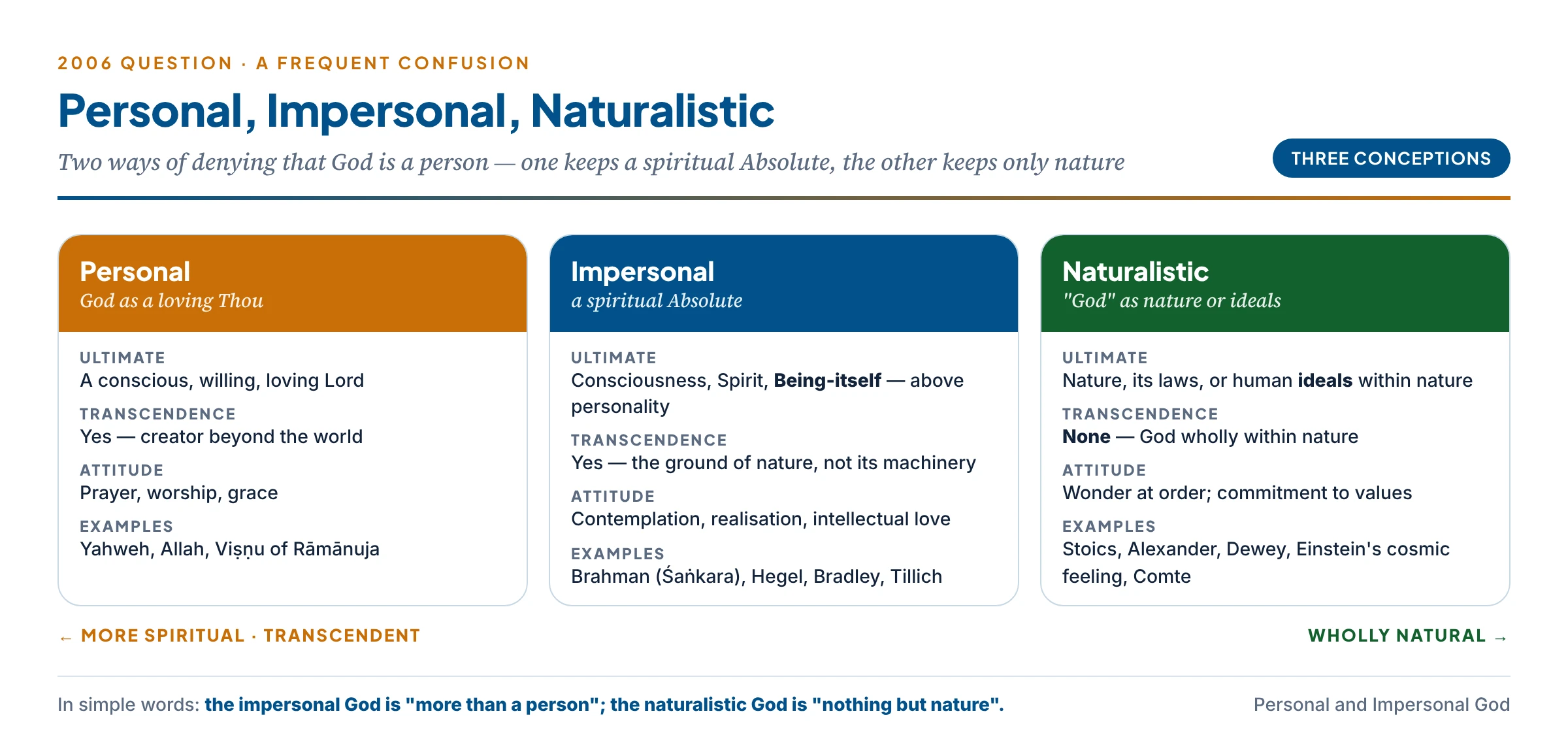
- The naturalistic conception identifies “God” with nature itself, with natural forces, or with the ideal values that arise within natural and social life — without any transcendent or spiritual reality beyond nature.
- The Stoics — God as the rational fire or law (logos) of the cosmos.
- Samuel Alexander — “deity” as the next emergent quality towards which nature is evolving.
- John Dewey — God as the active union of the ideal and the actual.
- Einstein’s “cosmic religious feeling” — awe before the order of nature; Comte’s Religion of Humanity.
- The impersonalistic conception denies personality but affirms a spiritual Absolute — consciousness, Spirit, Being-itself — that is the ground of nature, not identical with its physical processes.
- Key differences.
| Impersonalistic | Naturalistic | |
|---|---|---|
| Ultimate is | Spiritual: consciousness, Spirit, Being-itself, Brahman | Nature itself, its laws, or human ideals within nature |
| Transcendence | Transcends the world (often also immanent) | None — God is wholly within nature |
| Personality | Above or without personality | No personality; often no “divinity” except as a name for value |
| Knowledge of it | Intuition, realisation, philosophical reason | Science, experience, moral and aesthetic appreciation |
| Religious attitude | Contemplation, intellectual love, realisation of identity | Wonder, reverence for order, commitment to ideals |
| Examples | Śaṅkara, Spinoza (as read by idealists), Hegel, Bradley, Tillich | Stoics, Alexander, Dewey, Einstein’s cosmic religion, Comte |
- Spinoza between the two. Spinoza equated God with Nature, but in his religious pantheism nature “ceases to be nature and appears divine” — the object of an intellectual love of God (amor intellectualis Dei). So “in religious pantheism there is no room for naturalism, in which God is swallowed up in the world”. Later naturalists read Spinoza the other way — as making “God” just a name for nature.
- Critical note. Naturalism keeps religion scientifically respectable but risks making “God” an empty honorific; impersonalism keeps the spiritual depth of the Absolute but, like naturalism, struggles to support prayer and grace.
Which Notion Is Better?
- The case for the impersonal notion.
- Logically cleaner — it avoids the problems of purpose, partiality, evil and anthropomorphism.
- More inclusive — when God is the indeterminate Absolute, there are no conflicts over the name and attributes of God. In his later years Gandhi said “Truth is God” rather than “God is Truth”, since truth is something “even an atheist cannot deny”.
- Closer to science — ideas like the “singularity” of the Big Bang cosmology sit more easily with an impersonal Ground than with a God who acts by will.
- The case for the personal notion.
- Religion needs it. Most living traditions hold that God plays a central role in liberating human beings from suffering; divine grace and surrender to the Supreme are indispensable in the Abrahamic religions and in Vaiṣṇavism.
- Morality draws strength from it. Without a benevolent God as moral governor, many people find little incentive to lead an ethical life.
- Logic of the infinite. For the theist there is no fallacy in ascribing infinite omniscience, omnipotence and goodness to God; problems like evil arise because we apply finite logic to the infinite God, who remains indeterminate to the finite intellect. So there is no need to accept an impersonal Absolute merely for consistency.
- Reconciliation in Advaita. Even though the impersonal Brahman is the supreme reality from the transcendental standpoint, it is conceived as Īśvara — the personal God — from the empirical level. Śaṅkara, though an advocate of the path of knowledge, gives due importance to bhakti as a means of inner purification, making room for devotion within a monistic framework.
Personal and Impersonal God in the Context of Devotion
- Devotion seems to need two. Worship requires a deity distinct from the worshipper. In a strictly impersonal view “the deity and the worshipper coalesce“, so worship seems impossible. A saint’s famous line puts the devotee’s preference vividly: “I want to taste sugar, not to become sugar.“
- The personal God as the natural object of bhakti.
- Rāmānuja: the soul is the śeṣa (dependent, servant) of God the śeṣī (master); liberation is eternal loving service in God’s presence, attained by bhakti and self-surrender (prapatti) with God’s grace.
- Madhva: devotion grounded in the eternal difference between soul and God.
- Caitanya: the highest devotion is prema — love of Kṛṣṇa tasted in its sweetness (rasa).
- But devotion to the impersonal is also found.
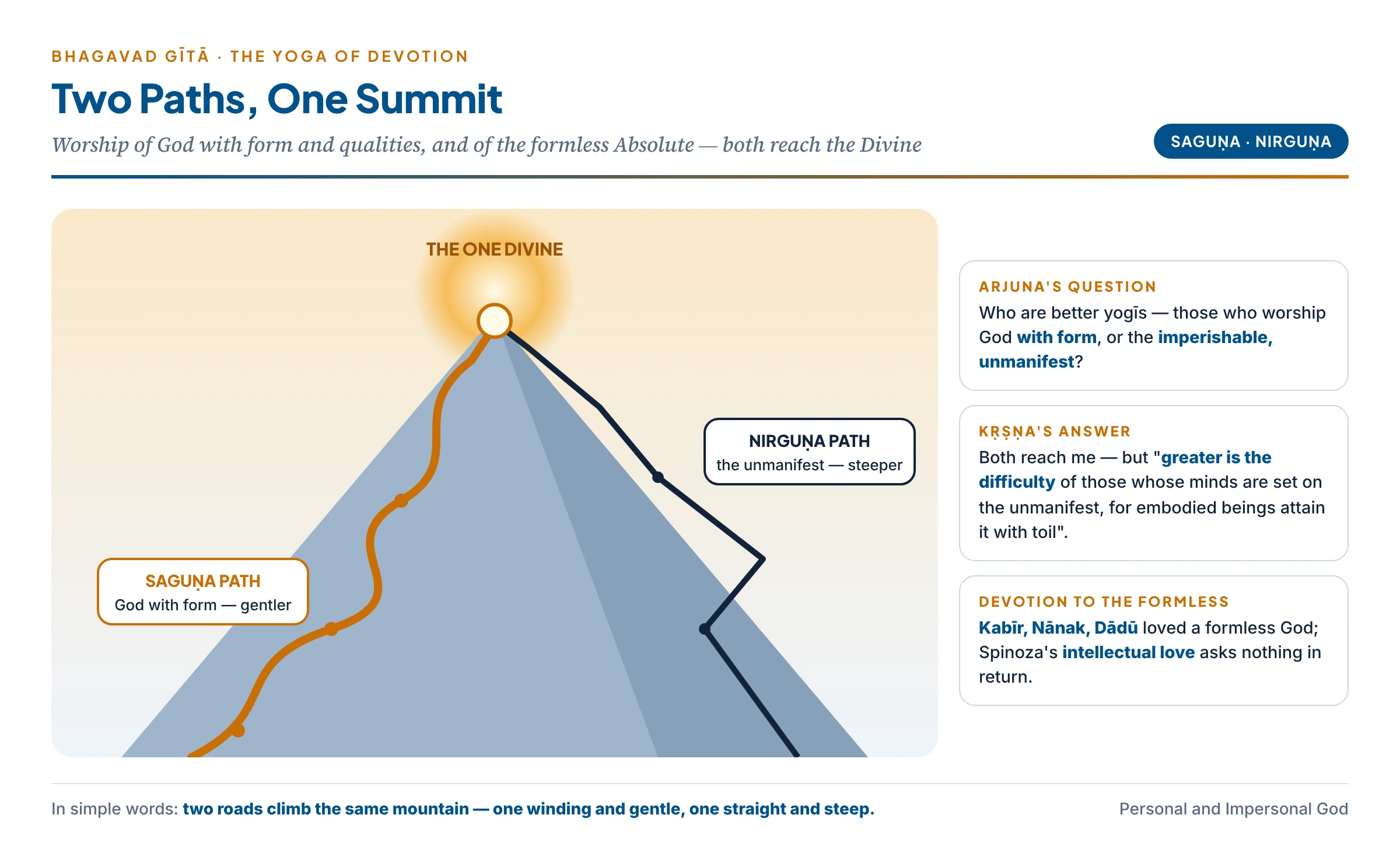
- The Gītā’s two paths. Arjuna asks: who are the better yogīs — those who worship God with form and qualities, or those who worship the imperishable, unmanifest Absolute? Kṛṣṇa answers that both reach him, but “greater is the difficulty of those whose minds are set on the unmanifest, for the unmanifest path is hard for embodied beings to attain“.
- Nirguṇa bhakti. Kabīr, Guru Nānak and Dādū loved a formless (nirguṇa) God, refusing images and incarnations — yet addressed him with intense love as Rām, Hari or the True Name. Their God is formless but not unloving.
- Spinoza’s intellectual love of God — neither selfish nor unselfish but selfless, a love that does not ask to be returned, compatible with the impersonal Absolute; it resembles the Buddhist compassion for the whole world.
- Meditation instead of worship. In “nirvāṇist” religion one realises the indwelling reality through meditation or samādhi; meditation takes the place of worship.
- Balanced view. The personal notion makes devotion natural and warm; the impersonal makes it disciplined and universal. Many traditions treat saguṇa bhakti as the easier, earlier path and nirguṇa realisation as the culmination — or, like Rāmānuja and Madhva, hold the personal God to be the final truth.
Indian Connect — Devotion to the formless
- Kabīr: “Where do you search for me? I am beside you” — a formless God who is nearer than breath.
- Guru Nānak begins the Japjī with Ik Oṅkār — “One Reality” — the Nirankār (formless), Akāl Mūrat (timeless), yet the Sat Nām (True Name) remembered with love (nām simran).
- Advaita’s own bhakti: hymns traditionally ascribed to Śaṅkara (such as Bhaja Govindam) urge devotion to Govinda as the way to purify the mind for knowledge.
In simple words
A child loves her mother as a person — her face, her voice, her lap. As she grows, she may come to see her mother’s love as part of a vast, nameless love of life that runs through everything. The face is not denied; it is seen as a window onto something larger. Śaṅkara’s Īśvara is like the face; Brahman is like the boundless love behind it.
Does Śaṅkara’s Brahman Leave Room for Theism?
- The difficulty. For Śaṅkara, Brahman alone is real; it is nirguṇa (without qualities), niṣkriya (actionless), beyond the subject–object relation. A God who creates, rules and loves seems to belong only to māyā. Critics (Rāmānuja, Madhva) say this makes God unreal and devotion a preparatory illusion.
- The room Śaṅkara makes.
- Two standpoints. From the empirical (vyāvahārika) standpoint, Īśvara — Brahman associated with māyā — is fully real: omniscient, omnipotent, creator, sustainer, destroyer, inner ruler, dispenser of karma. For all who live in the world, Īśvara is “all in all“.
- All talk of Brahman is talk of Īśvara. The moment we think or speak of Brahman, it becomes conditioned — that is, Īśvara. So theology, prayer and ethics are never empty.
- Worship (upāsanā) and bhakti purify the mind and prepare it for knowledge; the grace of Īśvara helps the seeker.
- The limits. Theism is true but not final: at liberation, God, soul and world “vanish together”. Theism is a ladder, not the summit.
- Verdict. Śaṅkara’s system leaves ample room for theism at the empirical level and treats it with seriousness; but it does not make the personal God the ultimate reality. Whether this counts as “room for theism” depends on whether one demands that the personal God be ultimately real (Rāmānuja) or only really operative in our world (Śaṅkara).
Common confusion
Does “impersonal” mean “less than personal” — a blind force? Not in the major traditions. Śaṅkara’s Brahman is pure consciousness (cit) and bliss (ānanda); Bradley’s Absolute is experience; Tillich’s God is the ground of all personality. Such an Absolute is “impersonal” only in the sense that it is not one individual among others — it is super-personal, not sub-personal. Many notes equate “impersonal God” with a mechanical force; that fits naturalism, not Advaita, Bradley or Tillich.
Common confusion
Does “nirguṇa” (without qualities) mean devotion is impossible? No. The nirguṇa bhakti of Kabīr, Nānak and Dādū shows intense devotion to a God without form or image. And for Advaita, “without qualities” means without limiting qualities — Brahman is the fullness of being, consciousness and bliss. What becomes difficult is devotion as a relation between two separate beings; love itself is not excluded.
Reconciling the Personal and the Impersonal
- Śaṅkara: one reality, two standpoints — nirguṇa Brahman and saguṇa Īśvara.
- Radhakrishnan: “The Absolute is the pre-cosmic nature of God, and God is the Absolute from the cosmic point of view.” The Absolute and God are not two realities but one Reality seen in itself and in relation to the world. The Absolute is super-personal, and God is its personal face.
- Rāmānuja’s alternative: the Absolute is personal — Brahman is saviśeṣa, with real qualities; impersonal language describes only God’s transcendence of finite limits.
- Tillich: the personal God of theism is a symbol of the “God above God”, the ground of being; symbols are necessary for religion but must not be taken literally.
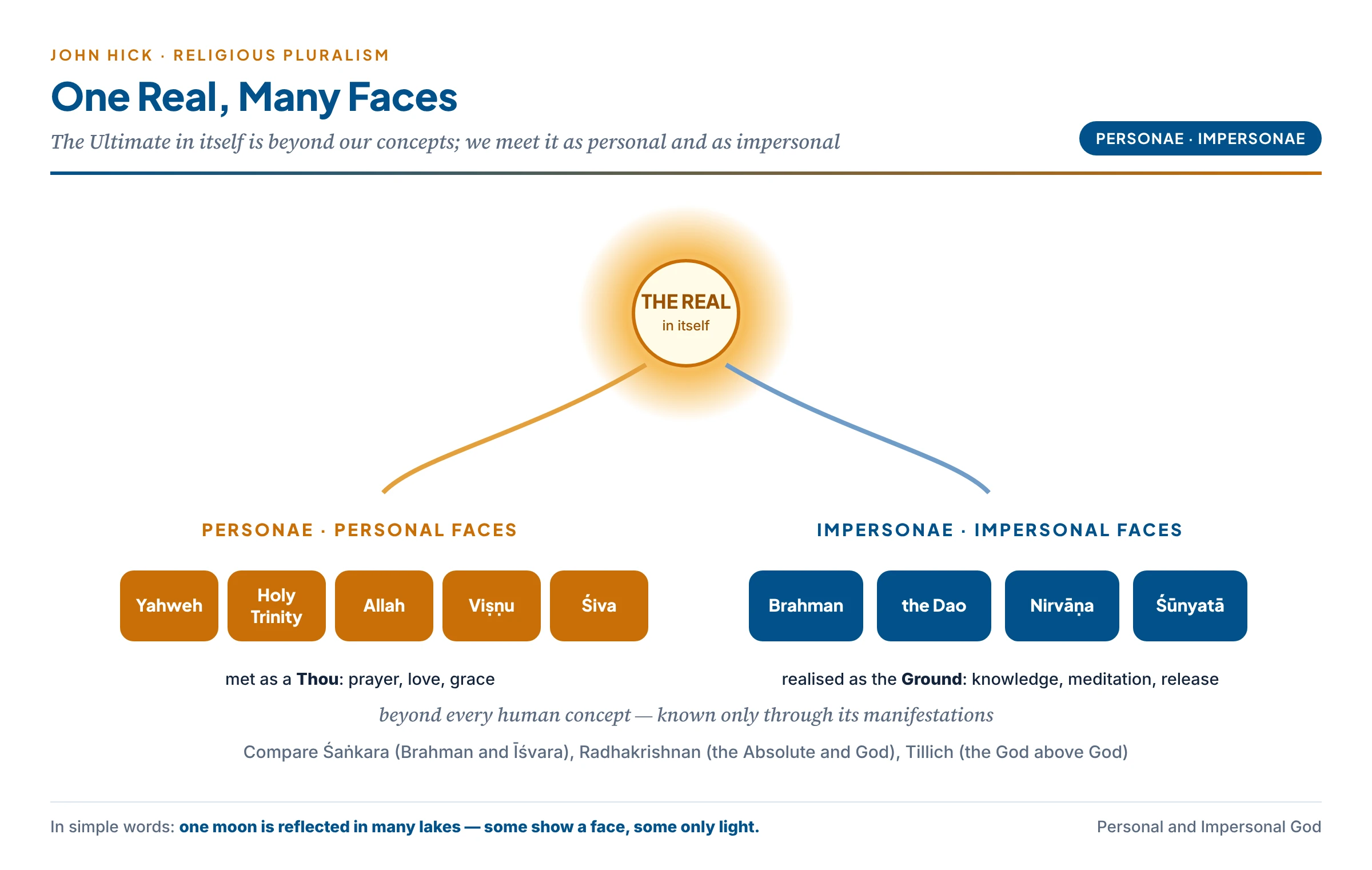
- John Hick’s pluralism: the one ultimate Real in itself is beyond all human concepts; it is experienced through personae — Yahweh, the Holy Trinity, Allah, Viṣṇu, Śiva — and through impersonae — Brahman, the Dao, Nirvāṇa, Śūnyatā. Personal and impersonal are both authentic responses to the same Real.
Critical Evaluation
Objections to the Personal God (Pūrva-pakṣa)
- Spinoza: determination is negation — personality limits the infinite.
- Bradley: the God of religion cannot be the all-inclusive Absolute.
- Feuerbach, Freud, Xenophanes: personal God is a projection.
- Problem of evil, purposelessness, partiality — as above.
- Buddhist and Jaina critics: a personal creator is incoherent; liberation needs no Lord.
Objections to the Impersonal God (Uttara-pakṣa)
- No worship, no grace. An impersonal Absolute cannot hear prayer, forgive or save; it cannot be the object of love.
- Moral emptiness. A God “beyond good and evil” seems to undercut the moral life of religion — though pantheists reply that it teaches an open morality towards all beings.
- The world becomes illusory. If the impersonal One alone is real, the world — our starting point — becomes appearance, and so do our moral struggles.
- Rāmānuja’s critique of nirguṇa Brahman: there is no means of knowing a reality without qualities; every pramāṇa reveals something qualified.
- Naturalistic slide. An impersonal God can easily become merely “nature” — and then why call it God?
Critics and Defenders
Criticism — Critics of the personal notion
- Spinoza — determination is negation; God has no purposes.
- Bradley — the God of religion is only an appearance.
- Śaṅkara — personal qualities belong to māyā.
- Feuerbach, Freud — the personal God is a projection.
- Einstein — believes in Spinoza’s impersonal God, not a God who rewards and punishes.
Defence — Defenders of the personal notion
- Rāmānuja, Madhva, Caitanya — the Supreme is personal; bhakti and grace are ultimate.
- Buber — God as the eternal Thou, met only in relation.
- Hick — God is “at least personal”; agape is God’s nature.
- Theists — finite logic cannot judge the infinite; evil and purpose are mysteries, not contradictions.
- The bhakti tradition — “I want to taste sugar, not become sugar”.
Cross-Tradition Comparison
| Personal God | Impersonal / super-personal Absolute | |
|---|---|---|
| Western | Yahweh, the Trinity, Allah; Aquinas, Berkeley, Kierkegaard, Buber, the personalists | Plotinus’ One, Spinoza’s Substance, Hegel’s Spirit, Bradley’s Absolute, Tillich’s Being-itself |
| Indian | Nyāya’s Īśvara; Viṣṇu of Rāmānuja, Madhva, Caitanya; Śiva of Śaiva Siddhānta | Advaita’s nirguṇa Brahman; the formless God of nirguṇa bhakti (as formless); Buddhist Dharmakāya and Śūnyatā |
| Way of approach | Prayer, worship, love, surrender, grace | Knowledge, meditation, realisation, intellectual love |
| Strength | Supports devotion, grace and moral life | Logically consistent with infinity; inclusive across religions |
| Weakness | Anthropomorphism, purpose, evil, partiality | Cannot answer prayer; risks making the world unreal or God “mere nature” |
| Reconciliation | Rāmānuja: the Absolute is personal | Śaṅkara: Īśvara is the Absolute seen through māyā; Radhakrishnan; Hick |
Indian Connect — Key takeaways
- India offers the richest range of positions: personal (Rāmānuja, Madhva), impersonal (Śaṅkara), formless-yet-loving (Kabīr, Nānak) and the “two paths” of the Gītā.
- Radhakrishnan’s formula — the Absolute is God’s pre-cosmic nature, God is the Absolute in relation to the world — is a modern Indian synthesis often compared with Tillich and Bradley.
- The devotional test used in the 2026 question is central in Indian thought: the bhakti schools judged theories of God by whether they make loving surrender possible.
Synthesis (Siddhānta)
- Both notions answer real needs. The personal God answers the heart’s need for a Thou — someone to love, trust and obey. The impersonal Absolute answers reason’s need for an infinite, unconditioned ground free of human limitation.
- The best views are not “either–or”. Śaṅkara’s two standpoints, Radhakrishnan’s Absolute and God, Tillich’s “God above God” and Hick’s personae and impersonae all hold that the Ultimate is super-personal — more than personal, not less — and appears as personal to the devotee.
- Devotion favours the personal, but is not confined to it. The Gītā admits both paths; nirguṇa bhakti and Spinoza’s intellectual love show that love can be directed to the formless. Yet for most believers the personal form is the easier and warmer way.
- Naturalism is a different option. It shares the impersonal view’s rejection of a personal God but also rejects transcendence; it is closer to humanism than to mysticism.
- Contemporary relevance. In a plural world, the impersonal or super-personal conception helps inter-religious understanding (Gandhi’s “Truth is God”; Hick’s pluralism), while the personal conception continues to sustain prayer, hope and moral commitment for millions. A mature religious philosophy keeps both — the transcendence of the Absolute and the nearness of the Lord.
“The Absolute is the pre-cosmic nature of God, and God is the Absolute from the cosmic point of view.” — S. Radhakrishnan
Previous Year Questions
- 2026Discuss the difference between personalistic and impersonalistic notions of God in the context of devotion.
- 2023Elucidate the personalistic and impersonalistic aspects of God.
- 2022Critically examine the idea of Brahman in Advaita philosophy of Śaṅkara. Does Śaṅkara’s conception of Brahman leave room for theism? Discuss.
- 2019State and evaluate the personalistic and impersonalistic aspects of God.
- 2016Evaluate Śaṅkara’s position on Īśvara.
- 2013How can Īśvara (God) be distinguished from Brahman (Absolute)? Which of the two concepts are philosophically better?
- 2006The difference between impersonalistic and naturalistic conception of God. Critical notes.