

Notions of God: Attributes; Relation to Man and the World (Indian and Western).
Official Syllabus: Paper II, Section B, Unit 1
If God is related to the world, how does God bring it about? Does God shape a material that already exists, like a potter? Produce it out of himself, like a spider spinning its web? Make it appear, like a magician? Emanate it, like light from the sun? Or create it out of nothing by a free act of will? And must the cause of a physical world itself have some physical form — a body, an incarnation, a world that is God’s body? This article sets out the main Western theories of creation (Plato’s Demiurge, Aristotle’s Unmoved Mover, Plotinus’ emanation, creation out of nothing, Spinoza’s necessity, Hegel and process thought), the Indian theories built on the distinction between material and efficient cause (Nyāya, Sāṃkhya–Yoga, Mīmāṃsā, Śaṅkara, Rāmānuja, Madhva, Nimbārka, Vallabha, Caitanya, Aurobindo, and the non-theists), a full account of God in Nyāya and God in Viśiṣṭādvaita, the old objections to a creator God, and the 2024 question: must God have a physical manifestation to be the ultimate cause of the world?
In simple words
The Upaniṣads give four pictures of how the One makes the many. A potter makes pots from clay that is not himself. A spider spins its web from its own body and draws it back. A magician makes elephants appear that are not really there. A dancer is never separate from her dance, which she performs for joy. Every Indian theory of creation is one of these pictures worked out with great care.
Context & Problem
Two Kinds of Cause
- Material cause (upādāna-kāraṇa) — the stuff out of which a thing is made: the clay of the pot.
- Efficient cause (nimitta-kāraṇa) — the agent who makes it: the potter. (Nyāya adds the non-inherent cause (asamavāyi-kāraṇa) — the conjunction of the two halves of the pot.)
- The theological question. Is God only the efficient cause, with the world’s material existing alongside God (dualism)? Or both efficient and material cause, so that the world comes from God (monism or panentheism)? Or neither — is the world uncaused?
Why Creation Is Hard to Explain
- Dependence. If God shapes a material that already exists, God depends on something other than himself and is not the sole ultimate reality.
- Desire implies lack. A desire to create seems to show that God was incomplete without the world — yet God is held to be complete and perfect.
- Time. If God created space and time with the world, then there was a time when there was no time — a contradiction; if space and time already existed, they were co-eternal with God, which limits God’s completeness and infinity.
- The deist’s unanswered questions. What was God’s purpose? How did God create — out of himself or out of pre-existing matter? In empty time, or with time?
- The non-theist’s challenge (Aśvaghoṣa). A perfect God has no motive of its own; if creation is purposeless, God is unintelligent; if it is for the good of beings, it is self-contradictory, since beings are themselves the result of creation.
Core Doctrine
Western Theories of How God Makes the World
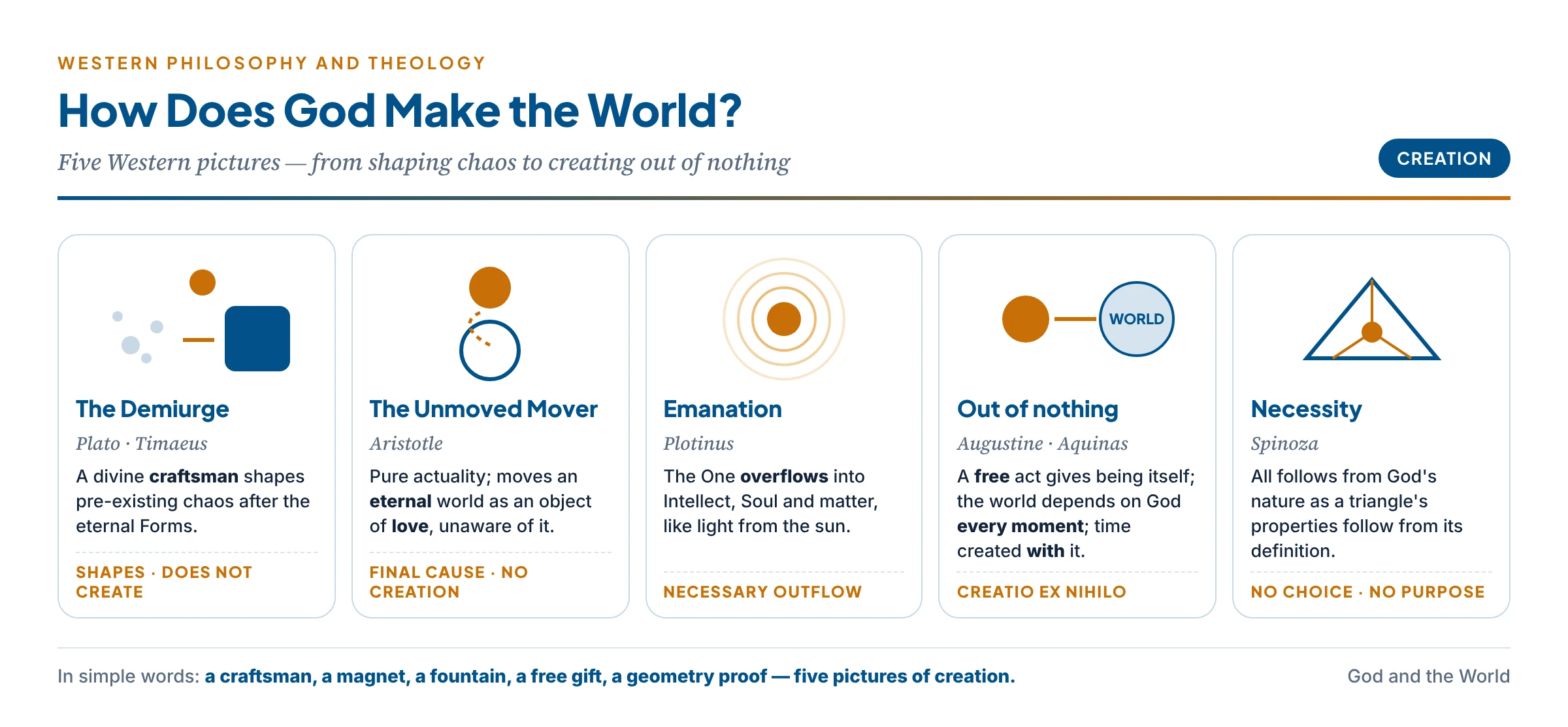
- Plato’s Demiurge (craftsman). In the Timaeus, a divine craftsman, looking to the eternal Forms as his pattern, brings order to a pre-existing chaos (the “receptacle”), making the world as good as possible because he is good and “free from jealousy”. He shapes; he does not create from nothing. Kant later said the design argument can prove at most such an architect working on given matter, not a creator.
- Aristotle’s Unmoved Mover. The world is eternal; God is pure actuality, “thought thinking itself“, who moves the heavens not by pushing but as a final cause — as an object of love and desire moves the lover. This God does not create the world and is not even aware of it.
- Plotinus’ emanation. From the One — beyond being and thought — flows Intellect (Nous), from Intellect the World-Soul, and finally matter, the dimmest edge of the outflow, as light radiates from the sun or water overflows a full fountain. Emanation is necessary, not a free choice, and the One loses nothing in giving.
- Creation out of nothing (creatio ex nihilo). In Judaism, Christianity and Islam, God summons the universe into existence where otherwise there was only God — not from any pre-existing stuff and not from God’s own substance. Two consequences follow:
- Absolute distinction. “The creature is creature and the Creator is Creator” for ever; no creature can become God.
- Absolute dependence. The world depends on God from moment to moment; creation includes conservation — God keeps things in being, as a singer keeps a song going. Hence in prayer the believer feels that “each day is a gift”.
In simple words
A song exists only while the singer sings; the moment she stops, the song is gone. Creation out of nothing pictures the world like that song — not a house that stands after the builder leaves, but a melody that depends on the singer at every moment.
- Creation and time.
- Augustine: the world was made with time, not in time — time itself is a feature of the created world. To the question “What was God doing before he made heaven and earth?” he reported the joke answer “preparing hell for those who pry into such things”, and gave the serious one: there was no “before”, since time began with creation.
- Aquinas: creation means dependence in being, which does not by itself imply a beginning; an eternal created world is logically possible, but revelation teaches a beginning.
- Modern cosmology is neutral: the religious doctrine says the space-time universe as a whole exists in virtue of its relation to God, whatever its scientific history.
- The Genesis story is read by responsible thinkers not as science but as myth expressing that nature is God’s creation — as Origen already argued.
- Why does God create? The classical answer: not from need but from goodness, which by nature spreads itself (bonum diffusivum sui) — out of love, to share being and joy with creatures.
- Spinoza’s necessity. The world follows from God’s nature as the properties of a triangle follow from its definition — not by choice or for a purpose (natura naturans and natura naturata).
- Leibniz’s choice of the best. Among infinitely many possible worlds, a perfectly good and wise God chooses and creates the best.
- Hegel. Nature is the Absolute Idea going out of itself — “Spirit in its otherness” — on the way back to itself as Spirit.
- Process thought. God is not the sole creator but the lure for the world’s own creativity; “it is as true to say that God creates the World, as that the World creates God”.
Indian Theories: Material and Efficient Cause
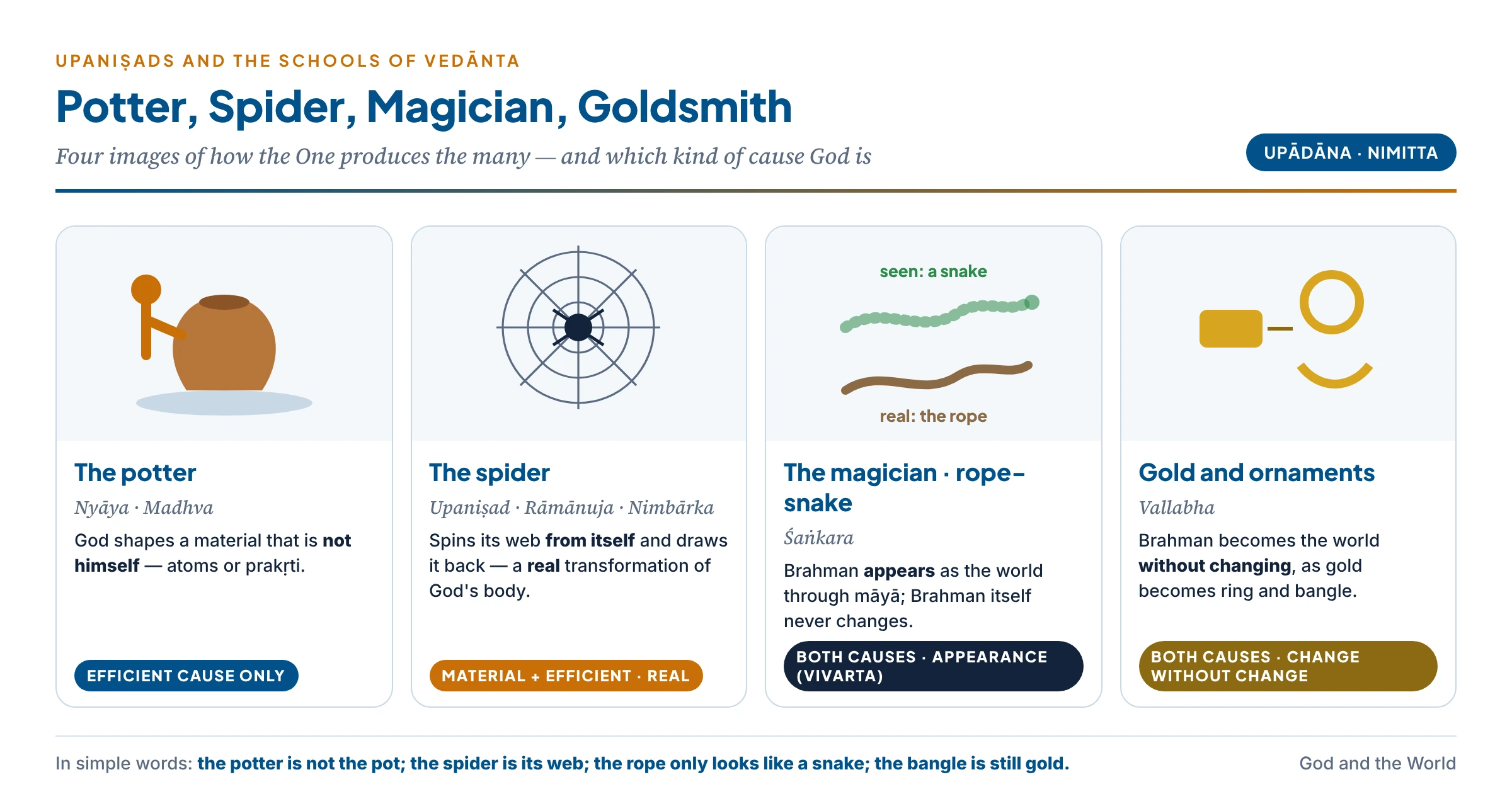
- Nyāya–Vaiśeṣika: God as efficient cause only (ārambhavāda). The world is a new beginning produced from eternal atoms of earth, water, fire and air. The atoms are the material cause; God is the efficient cause who, according to the unseen merit and demerit (adṛṣṭa) of souls, sets the atoms in motion, joins them into dyads and triads, sustains the world and dissolves it in cycles of creation and dissolution (sṛṣṭi and pralaya). Like a potter, God shapes a material that is not himself. Souls, atoms, space, time, mind and ether are co-eternal with God.
- Sāṃkhya: creation without God. Prakṛti (primal matter with its three guṇas) evolves by itself for the sake of puruṣa, like unconscious milk flowing for the calf. No God is needed. (Classical Sāṃkhya is therefore called non-theistic.)
- Yoga: God removes obstacles. Īśvara is not the creator; he helps evolution as a farmer removes the dam so that water flows into the field by itself, and he helps souls towards liberation.
- Mīmāṃsā: no creation, no dissolution. The world is beginningless and endless; there was no first creation. The Veda is eternal, and karma works through apūrva (unseen potency) without a God.
- Advaita (Śaṅkara): Brahman as both causes, by appearance (vivartavāda). Brahman is both the material and the efficient cause (abhinna-nimitta-upādāna) of the world — but through māyā: the world is an apparent transformation of Brahman, as the snake is an appearance on the rope, or as a magician’s show. Brahman itself does not change. Creation is Brahman’s play (līlā): “as in the world, it is mere sport” — like a king who has everything yet plays, or like breathing, which goes on spontaneously without purpose.
- Viśiṣṭādvaita (Rāmānuja): real transformation of God’s body (Brahma-pariṇāmavāda). God is both the material cause — through his body of souls and matter (cit and acit), which pass from a subtle state (in dissolution) to a gross state (in creation) — and the efficient cause through his will. God’s essence does not change; only his body changes, as a person remains the same through childhood and old age. The Upaniṣadic image is the spider, which sends forth its thread from itself and draws it back.
- Dvaita (Madhva): God as efficient cause, prakṛti as material. God (Viṣṇu) is the only independent (svatantra) reality; prakṛti and souls are dependent (paratantra) but eternal and really different from God. God shapes prakṛti into the world, like a potter; he does not transform himself, and the world is real.
- Dvaitādvaita (Nimbārka). Souls and matter are both different and non-different from God — different as dependent, non-different as having no independent existence; God is both material and efficient cause, transforming his power into the world.
- Śuddhādvaita (Vallabha): transformation without change (avikṛta-pariṇāmavāda). Brahman itself becomes the world without undergoing any change, as gold becomes ornaments and remains gold. The world is real and pure; it is Brahman’s līlā, and māyā is not illusion but God’s power.
- Acintya-bhedābheda (Caitanya). The world is a real transformation of God’s energy (śakti), not of God’s essence; God and world are “inconceivably” both different and non-different.
- Integral Advaita (Aurobindo): involution and evolution. Saccidānanda first involves (hides) itself in matter, then evolves back through life, mind and supermind — creation is a real self-manifestation of the Divine.
- The non-theists. Jainas: the universe is uncreated and eternal, governed by the nature of substances and karma. Buddhists: everything arises by dependent origination (pratītyasamutpāda); an uncaused creator contradicts it. Cārvākas: things arise by their own nature (svabhāva) — “who paints the peacock?”
| School | Efficient cause | Material cause | Status of the world |
|---|---|---|---|
| Nyāya–Vaiśeṣika | God (Īśvara) | Eternal atoms | Real; new product (ārambha) |
| Sāṃkhya | — (no God) | Prakṛti | Real evolution (pariṇāma) |
| Yoga | Īśvara removes obstacles | Prakṛti | Real evolution |
| Mīmāṃsā | — | — (beginningless) | Real, uncreated, eternal |
| Advaita | Brahman (as Īśvara) | Brahman through māyā | Apparent (vivarta) |
| Viśiṣṭādvaita | Brahman’s will | Brahman’s body (cit–acit) | Real transformation of God’s body |
| Dvaita | Viṣṇu | Prakṛti | Real; eternally different from God |
| Śuddhādvaita | Brahman | Brahman itself, unchanged | Real (avikṛta-pariṇāma) |
| Jaina, Buddhist, Cārvāka | — (no creator) | — | Uncreated; dependent origination; svabhāva |
The Nature of God in Nyāya Philosophy
- A special self. God (Īśvara, Maheśvara) is the Supreme Self (Paramātman) — a self like ours in kind, but unique: never bound, never born, free from merit and demerit, pleasure and pain.
- One, eternal, all-pervading.
- Eternal knowledge, desire and effort. God possesses cognition (jñāna), desire (icchā) and effort (prayatna) eternally — the three a maker needs. God is omniscient: eternal, direct knowledge of all things, past, present and future, gross and atomic.
- Efficient, not material, cause. God orders the co-eternal atoms, souls, space, time and minds into a moral world; he does not create out of nothing or out of himself.
- Creator, sustainer and destroyer, creating and dissolving the world in cycles as the moral needs of beings require.
- Moral governor, not a tyrant. God dispenses the fruits of action according to adṛṣṭa; he does not override karma. Gautama argues that God is a cause because human efforts are sometimes fruitless, yet God does not act without human action.
- Author of the Veda. The Veda is authoritative because it is the word of an omniscient, trustworthy speaker; God also establishes the meaning of words.
- Giver of liberation. Later Nyāya holds that true knowledge and liberation come only by God’s grace.
- God is known by inference, not perception — hence Udayana’s famous proofs (treated under Proofs for the Existence of God).
- Does God need a body? Opponents argue that every maker has a body, so a bodiless God cannot act. Naiyāyikas reply that our will moves our own body without a further body, so a will need not act through a body; God’s will acts directly on the atoms. (Some later thinkers allowed that God may assume a body when needed.)
- Evaluation. Nyāya gives the most rational Indian theism; critics (Mīmāṃsā, Buddhists, Jainas, Cārvāka, Advaita) object that the proofs are inconclusive, that a God limited by co-eternal atoms and karma is not supreme, and that a bodiless maker is unintelligible.
The Nature of God in Viśiṣṭādvaita
- Brahman with qualities (saviśeṣa). The Supreme is not an attributeless Absolute but the personal God — Viṣṇu–Nārāyaṇa — possessing real qualities. Rāmānuja argues that every pramāṇa reveals something qualified; an attributeless reality could not be known at all.
- Twofold mark (ubhaya-liṅga). God is free from all defects and full of infinite auspicious qualities — knowledge, strength, lordship, energy, power and splendour, and compassion, accessibility, gentleness and motherly love.
- Three reals in one organic unity (tattva-traya). Cit (souls), acit (matter) and Īśvara (God). Souls and matter are real and eternal but dependent; only God is independent. Hence “qualified non-dualism“: one Brahman qualified by cit and acit.
- The body–soul relation (śarīra–śarīrī). Souls and matter are God’s body; God is their soul. A body is that which a soul supports, controls and uses for its own purposes; so the world is wholly dependent on God, while God does not depend on the world. Other images: substance–mode (prakāra–prakārī), part–whole (aṃśa–aṃśī), master–servant (śeṣī–śeṣa).
- Inseparability (apṛthak-siddhi). The relation between God and his body is inseparable — like the blue of a blue lotus and the lotus: distinguishable, never separable.
- Inner controller (antaryāmin). God dwells in every soul and every particle of matter as its inner ruler, yet his essence transcends them — immanent and transcendent at once.
- Material and efficient cause. In dissolution, God exists with his body in a subtle state (kāraṇa-brahman); in creation, with his body in a gross, manifest state (kārya-brahman). The world is a real transformation of God’s body.
- Five forms of God. God makes himself accessible in five ways:
- Para — the supreme form in his transcendent abode (Vaikuṇṭha).
- Vyūha — cosmic emanations for the work of creation, maintenance and dissolution.
- Vibhava — incarnations (avatāras) such as Rāma and Kṛṣṇa.
- Antaryāmin — the indweller in the heart of every being.
- Arcā — the consecrated image in temple and home, in which God accepts worship.
- Grace and surrender. God, accompanied by Śrī (Lakṣmī) who intercedes for souls, saves through bhakti and self-surrender (prapatti); liberation is eternal loving service in God’s presence, not merger.
- Difficulties. If souls and matter are God’s body, do their imperfections and sufferings touch God? Rāmānuja answers that the soul is untouched by the body’s defects (as one remains the same through the body’s illness). Critics also ask how a real change in God’s body leaves God unchanged, and whether souls are free if God is their inner controller.
In simple words
Your hand changes all the time — it grows, gets scratched, heals — yet you remain you, and your hand cannot exist apart from you. For Rāmānuja the whole world is God’s “hand”: always changing, wholly dependent on God, yet never touching God’s own perfect self. That is the body–soul relation.
Objections to a Creator God and Theistic Replies
- The objections.
- Dependence. A designer or creator working on matter depends on it and is not supreme.
- Desire implies incompleteness. Wanting to create shows that God lacked something.
- Space and time. Either God created time (a “time when there was no time”) or time is co-eternal with God.
- Motive (Aśvaghoṣa, Jainas). No motive fits a perfect being: not need, not compassion (then why misery?), not play (then God is like a child).
- Body (Mīmāṃsā, Buddhists). Every maker has a body; a bodiless creator is unknown.
- Karma makes God redundant. If the world’s diversity comes from karma, God adds nothing.
- The replies.
- Creation out of nothing removes dependence on matter; panentheism and Advaita make God the material cause too.
- Creation from fullness, not lack — līlā (play), goodness that spreads itself, love that gives.
- Augustine: time is created with the world; there is no “before”.
- God as the impartial dispenser of karma (the rain analogy); karma is unconscious and needs an intelligent administrator.
- Will without a body — as our will moves our body directly.
Must God Have a Physical Manifestation to Be the Ultimate Cause?
- The case for “Yes”.
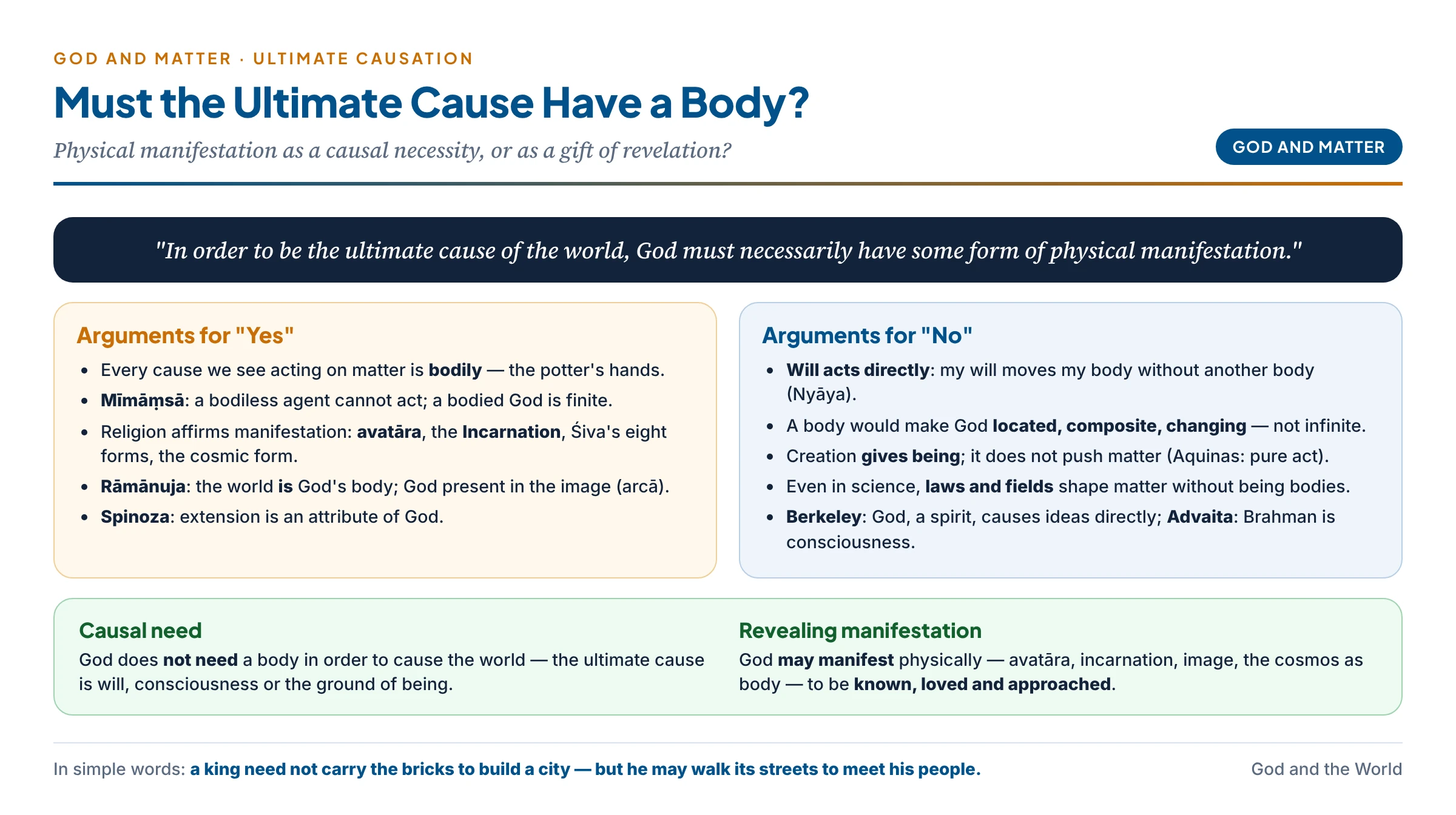
- Experience. Every cause we observe acting on matter is bodily: the potter’s hands, the carpenter’s tools. A bodiless cause acting on matter seems as puzzling as Descartes’ interaction of an unextended mind with an extended body.
- The Mīmāṃsā objection to Nyāya: an agent without a body cannot act; so either God has a body (and is then finite, composite and perishable) or God cannot create.
- Religion often affirms manifestation. God descends as avatāra (Kṛṣṇa: “whenever righteousness declines, I manifest myself”); Christianity teaches the Incarnation (“the Word became flesh”); Rāmānuja makes the whole world God’s body and holds that God is present in the arcā (image); Śaivism speaks of Śiva’s eight forms (aṣṭamūrti) — earth, water, fire, air, ether, sun, moon and the sacrificer; the Gītā’s cosmic form (viśvarūpa).
- Spinoza: extension is an attribute of God — God is in a sense physical as well as mental.
- The case for “No”.
- Will can act directly. Our will moves our body without another body in between; an infinite will can act directly on matter (Nyāya’s reply).
- A body would limit God. A body is located, composite and changing — incompatible with God’s infinity, simplicity and immutability.
- Creation is not rearrangement. In creation out of nothing, God does not push pre-existing things; God gives being itself. Pushing needs a body; giving being does not (Aquinas: God is pure act).
- Causes need not be bodies even in science — fields, laws and information shape physical events.
- Berkeley: God, an infinite spirit, causes our ideas of the physical world directly; matter is not needed as a cause at all.
- Advaita: Brahman is pure consciousness; the world arises through māyā, and manifestation belongs to appearance, not to Brahman’s causal power.
- Making the distinction. One must separate causal necessity from religious manifestation. God does not need a body in order to cause the world; but God may manifest in physical forms — avatāra, incarnation, image, the cosmos as God’s “body” — in order to be known, loved and approached. Even in Rāmānuja, the world is God’s body because God controls it, not because God needs it to act.
In simple words
A novelist creates a whole world of characters without stepping into the book — her imagination is the cause. Yet she may also write herself into the story as a character so that the others can meet her. God’s causing the world is like the first; avatāra and incarnation are like the second.
- Verdict. The view in the question confuses the mode of human causation with ultimate causation. The ultimate cause need not be physical; physical manifestation is a matter of grace and revelation, not of causal necessity.
Common confusion
Does “God is the material cause of the world” mean the same thing in Advaita, Viśiṣṭādvaita and Śuddhādvaita? No. In Advaita, Brahman is the material cause by appearance — the world is an apparent transformation (vivarta), like the snake on the rope. In Viśiṣṭādvaita, God’s body (souls and matter) really transforms, while God’s essence stays the same (Brahma-pariṇāma). In Śuddhādvaita, Brahman itself becomes the world without changing (avikṛta-pariṇāma), like gold in ornaments. Many notes treat these as one doctrine; their theories of causation are quite different.
Common confusion
Did Plato and Aristotle believe in a creator God? Not in the sense of creation out of nothing. Plato’s Demiurge shapes a pre-existing chaos after the Forms; Aristotle’s Unmoved Mover moves an eternal world as an object of love, without making it or even knowing it. Creation ex nihilo is a doctrine of Judaism, Christianity and Islam, later defended philosophically by Augustine and Aquinas.
Indian Connect — Indian key points
- Indian thought builds its theories of God on its theories of causation: ārambha (Nyāya), pariṇāma (Sāṃkhya, Rāmānuja, Vallabha), vivarta (Śaṅkara).
- The five forms of God in Viśiṣṭādvaita — para, vyūha, vibhava, antaryāmin, arcā — show how a theist system makes the transcendent God physically accessible without reducing him to matter.
- Līlā answers the motive objection: creation is the overflow of a complete being, not the act of a needy one.
Critical Evaluation
Comparing the Theories
- Efficient-cause-only theories (Plato, Nyāya, Madhva) keep God distinct from an imperfect world but leave a second reality beside God and make God dependent on material.
- Material-and-efficient theories (Rāmānuja, Vallabha, Aurobindo, panentheism) remove dualism but risk making God share the world’s imperfection and change.
- Appearance theories (Śaṅkara) keep Brahman unchanged and alone, but make the world and its history less than fully real.
- Creation out of nothing keeps God independent and the world real and distinct, but faces the puzzles of motive, time and evil.
- Necessity theories (Plotinus, Spinoza) avoid arbitrary will but lose freedom and grace.
- No-creator theories (Sāṃkhya, Mīmāṃsā, Jaina, Buddhist) avoid all these puzzles but must explain order and the moral law without intelligence.
Critics and Defenders
Criticism — Critics of a creator God
- Aśvaghoṣa, Dharmakīrti — no motive fits a perfect creator; an eternal cause should produce all effects at once.
- Kumārila (Mīmāṃsā) — no creation or dissolution; a bodiless creator cannot act.
- Jaina critics — the universe is uncreated; a creator would be cruel or childish.
- Sāṃkhya — prakṛti evolves for puruṣa without any God.
- Kant — the design argument proves at most an architect, not a creator.
- Hume — from a finite world we cannot infer an infinite creator.
Defence — Defenders of a creator God
- Augustine, Aquinas — creation out of nothing; time created with the world; continual dependence.
- Udayana and Nyāya — order and karma need an intelligent efficient cause; will needs no body.
- Śaṅkara — creation as līlā; God impartial like rain.
- Rāmānuja — the world as God’s body; God both material and efficient cause.
- Vallabha, Aurobindo — real manifestation of the Divine for joy.
Cross-Tradition Comparison
| Model | Western | Indian |
|---|---|---|
| Craftsman shaping material | Plato’s Demiurge | Nyāya’s Īśvara with atoms; Madhva’s Viṣṇu with prakṛti |
| Self-manifestation from God | Plotinus’ emanation; Hegel; process thought | Rāmānuja’s spider; Vallabha’s gold; Aurobindo’s involution–evolution |
| Appearance | (Parmenides; Bradley’s appearance) | Śaṅkara’s vivarta, māyā and the rope-snake |
| Free creation from nothing | Augustine, Aquinas, Abrahamic faiths | — (rare; Indian theists accept co-eternal souls or matter) |
| Necessity | Spinoza’s natura naturans | Sāṃkhya’s spontaneous evolution of prakṛti |
| Motive | Goodness spreads itself; love | Līlā — divine play; compassion; the moral needs of souls |
| No creator | Aristotle’s eternal world (no creation) | Mīmāṃsā, Jaina, Buddhist, Cārvāka, Sāṃkhya |
Synthesis (Siddhānta)
- How God causes the world depends on how one understands causation. The West’s distinctive idea is creation out of nothing; India’s distinctive contribution is the careful distinction of material and efficient cause, with three models — new production, real transformation and apparent transformation.
- No theory is free of cost. Keeping God distinct risks dualism; making God the material cause risks sharing the world’s imperfection; making the world appearance risks unreality. Rāmānuja’s body–soul model and Augustine’s continual dependence are two of the most balanced attempts.
- Motive is best understood as overflow. Both līlā and “goodness spreads itself” answer the objection that desire implies lack: a complete being may create out of joy and love.
- The ultimate cause need not be physical. God’s causality — whether as will, consciousness or ground of being — does not need a body; but manifestation in avatāra, incarnation, image and cosmos serves religion, making the transcendent approachable.
- Contemporary relevance. Big Bang cosmology, multiverse theories and the question “why is there something rather than nothing?” keep the debate alive; theologians increasingly speak of God as the ground of being and the source of natural law, not as one more physical cause among others — a view close to both Aquinas and the Upaniṣads.
“As a spider sends forth and draws in its thread … so from the Imperishable arises this universe.” — Muṇḍaka Upaniṣad
Previous Year Questions
- 2026Critically explain Rāmānuja’s conception of Brahman with special reference to the difficulties in explaining the relation of Brahman to Spirit (Cit) and Matter (Acit).
- 2026Do you agree with Nimbārka’s explanation of the nature of God, Souls and Matter? Justify your answer.
- 2025How is Brahman conceptualised in Advaita philosophy as both Nimitta and Upādāna Kāraṇa of the world? Discuss with suitable examples.
- 2024“In order to be conceived as the ultimate cause of the world, God must necessarily have some form of physical manifestation.” Do you agree with this view? Give reasons and justifications for your answer.
- 2021Discuss the nature of God as propounded in Nyāya philosophy.
- 2020Discuss the nature of God in Hinduism with special reference to Vishishtadvaita (Qualified non-dualism).