

measurement of multiple intelligence.
Official Syllabus: Paper I · Unit 10 Intelligence and Aptitude
“An intelligence is the ability to solve problems, or to fashion products, that are valued within one or more cultural or community settings.”
— Gardner (1983), Frames of Mind
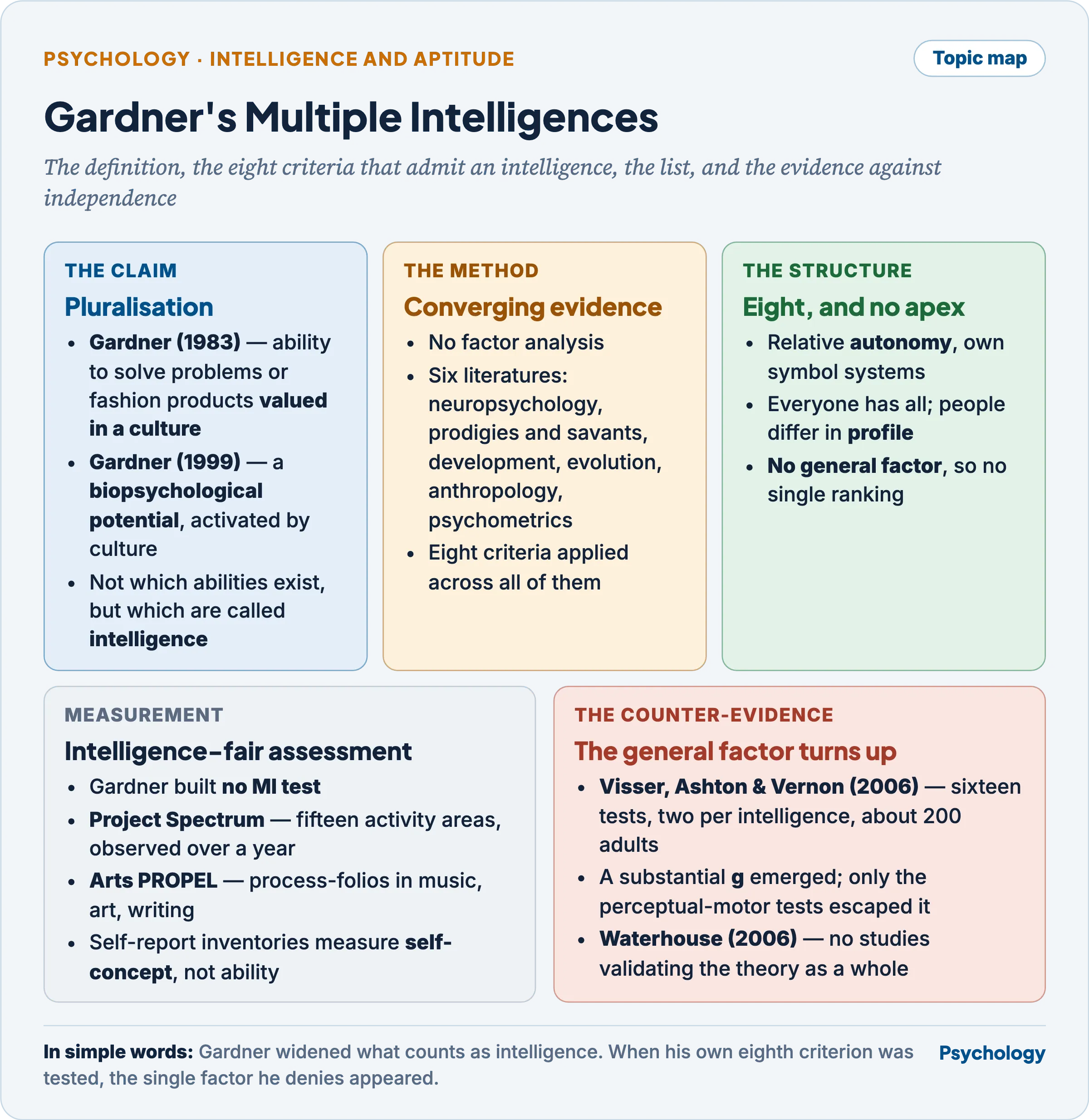
Gardner’s theory is an argument about pluralisation, not about which abilities exist. Nobody disputes that people differ in musical, spatial or interpersonal skill; what Gardner disputed is that those differences should be called talents while only the school-like abilities are called intelligence. His claim is that the word “intelligence” names a set of relatively autonomous computational capacities, that there are several of them, and that they therefore cannot be summed into a single rank.
The claim and the definition
- The definition has two versions, and the second is the more defensible one.
- Gardner (1983) defined an intelligence as the ability to solve problems or fashion products valued within a cultural setting. This makes culture constitutive: a capacity counts as an intelligence only where a community values what it produces.
- Gardner (1999), in Intelligence Reframed, revised it to a biopsychological potential to process information that can be activated in a cultural setting to solve problems or create products of value in a culture. The revision separates the potential, which is biological, from its activation, which is cultural — answering the complaint that the first version made intelligence a social judgement rather than a psychological property.
- The method is the radical part. Gardner did not factor-analyse test scores. He surveyed several literatures — neuropsychology of focal brain damage, studies of prodigies and savants, developmental psychology, animal and evolutionary biology, cross-cultural anthropology, psychometrics — and asked which candidate capacities satisfied a set of criteria across all of them. The claim is that converging evidence from independent disciplines is stronger than internal evidence from one correlational method.
- Why the method matters to the conclusion. Factor analysis can only recover abilities that the test battery samples, and standard batteries sample what schools teach. Gardner’s objection is therefore not that the factor analyses are wrong but that they are answers to a question posed by the tests — if musical and bodily-kinaesthetic performance are never in the battery, no rotation will discover them.
The eight criteria for admitting an intelligence
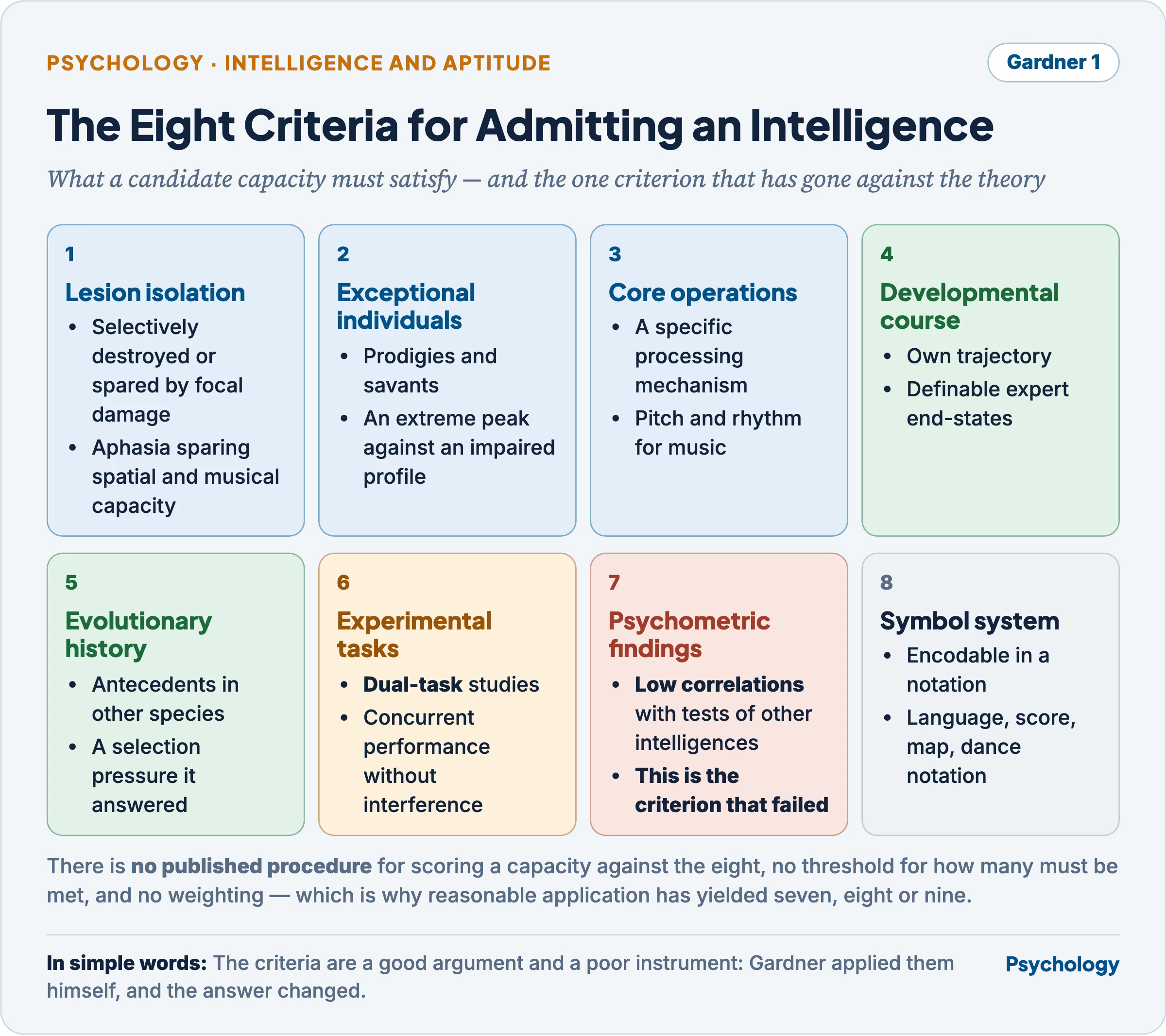
- Potential isolation by brain damage. A capacity that can be selectively destroyed or selectively spared by focal lesion is a candidate for an independent system. The paradigm cases are aphasia, which impairs language while leaving spatial and musical capacity intact, and the reverse dissociations after right-hemisphere damage.
- The existence of exceptional individuals — prodigies, savants and others with an extreme peak against an otherwise flat or impaired profile. A calendrical or musical savant with severe general impairment is unintelligible if there is one ability; it is expected if there are several.
- An identifiable core operation — a specific information-processing mechanism the intelligence runs on, such as sensitivity to pitch and rhythmic structure for musical intelligence, or the capacity to perceive and transform the visual-spatial world.
- A distinctive developmental history and a definable set of expert end-states. Each intelligence should have its own trajectory and recognisable expert performance — the mathematician, the dancer, the clinician — rather than simply more of a general quantity.
- An evolutionary history and evolutionary plausibility — antecedents in other species and an account of the selection pressure the capacity answered.
- Support from experimental psychological tasks, particularly dual-task studies: if two activities can be performed concurrently without interference, they plausibly draw on separate resources. Transfer and interference patterns are the evidence here.
- Support from psychometric findings, including low correlations between tests of the candidate intelligence and tests of others. This criterion is the one that works least well in Gardner’s favour, as the data below show.
- Susceptibility to encoding in a symbol system — language, musical notation, mathematical notation, maps, dance notation. Gardner treats the human invention of a notation for a domain as evidence that the domain is a distinct channel of meaning.
The intelligences
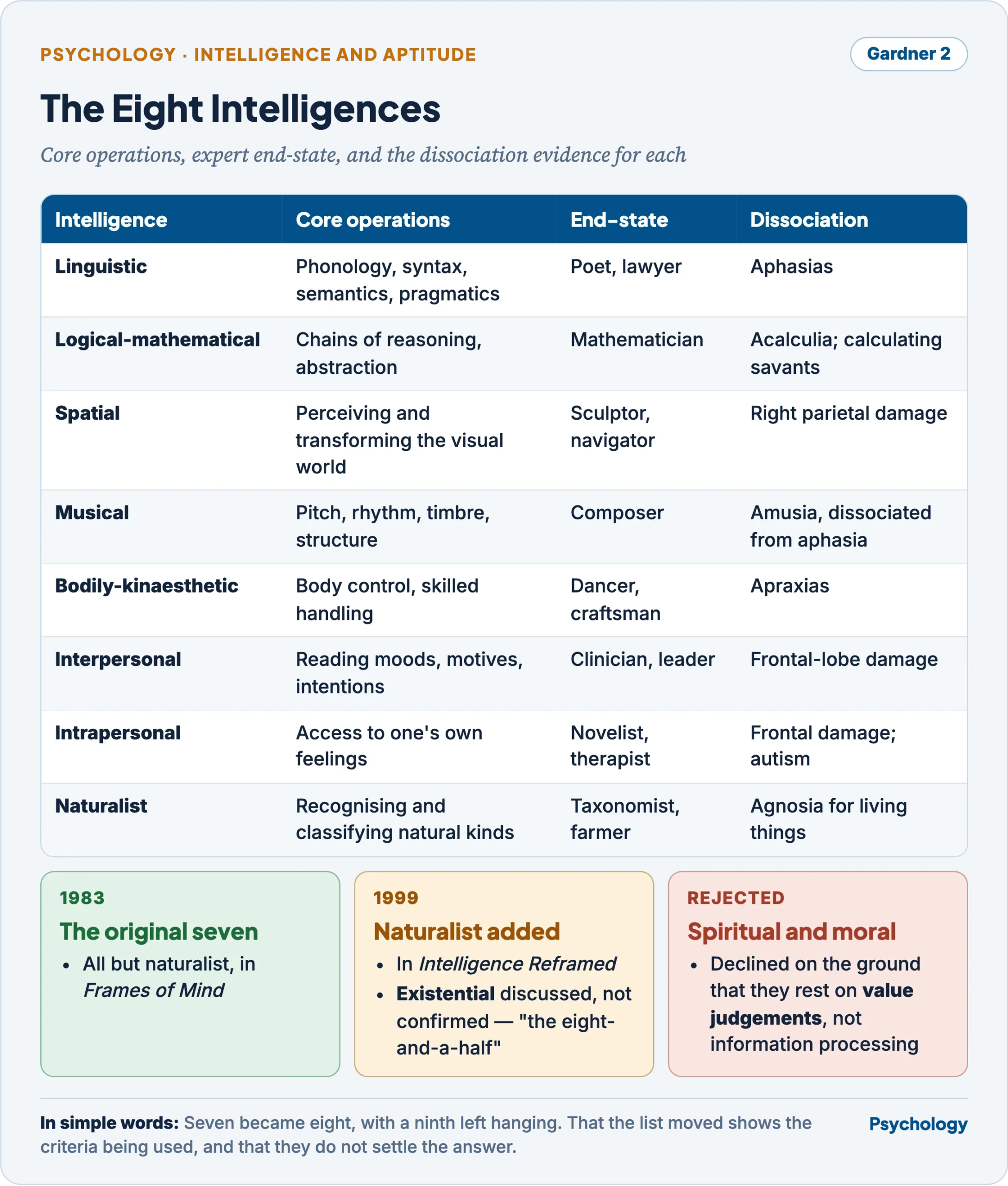
| Intelligence | Core operations | End-state | Dissociation evidence |
|---|---|---|---|
| Linguistic | Sensitivity to phonology, syntax, semantics, pragmatics | Poet, lawyer, orator | Aphasias; spared language in severe retardation |
| Logical-mathematical | Chains of reasoning, abstraction, pattern among abstractions | Mathematician, scientist | Acalculia; calculating savants |
| Spatial | Accurate perception and mental transformation of the visual world | Sculptor, navigator, surgeon | Right parietal damage; preserved in blind navigators |
| Musical | Pitch, rhythm, timbre, musical structure | Composer, performer | Amusia dissociated from aphasia |
| Bodily-kinaesthetic | Control of body motion, skilled handling of objects | Dancer, athlete, craftsman | Apraxias |
| Interpersonal | Discriminating moods, motives and intentions of others | Clinician, teacher, political leader | Frontal-lobe damage, Pick’s disease |
| Intrapersonal | Access to one’s own feelings, discriminating among them | Novelist, therapist, anyone self-directing | Frontal damage; autism as selective impairment |
| Naturalist | Recognising and classifying flora, fauna and natural kinds | Biologist, taxonomist, farmer | Category-specific agnosias for living things |
- The list was seven, then eight. Frames of Mind (1983) proposed the first seven; naturalist intelligence was added in 1999. Existential intelligence — the capacity for questions about ultimate meaning — Gardner discussed but declined to confirm, calling it “the eight-and-a-half intelligence” because the criteria were only partly met. Spiritual and moral intelligences he considered and rejected, on the ground that they involve value judgements rather than information-processing capacities.
- That the list changed is both a defence and a charge. It shows criteria being applied rather than a fixed doctrine; it also shows that the criteria do not determine an answer, since reasonable application yields seven, eight or nine depending on who applies them.
The characteristics of the theory
- Relative autonomy. The intelligences are held to be independent systems with their own neural substrates, symbol systems and developmental courses. Strength in one predicts little about strength in another. Gardner’s word is relative — he does not claim complete independence.
- Universality with individual profiles. Everyone possesses all the intelligences; people differ in the profile — the relative strengths across them — and in how the intelligences are combined. The profile, not a level, is the description of a person.
- The intelligences work in combination. Almost no real role draws on one alone: a surgeon needs spatial and bodily-kinaesthetic intelligence together, a teacher linguistic and interpersonal. Gardner’s analytic separation is not a claim that behaviour comes separated.
- Each is a potential that culture activates. Whether a potential develops depends on whether the culture provides domains, materials, instruction and rewards for it — so the same biological potential yields different competences in different societies.
- Culture-relative valuation. What counts as intelligent behaviour is settled partly by what a community values. Navigational and naturalist intelligence are central in some societies and marginal in others, and Gardner holds that any single ranking imports the valuations of one kind of society.
- No hierarchy among the intelligences. None is prior, and none is a general factor the others depend on. This is the structural claim that separates him most sharply from the factor tradition.
- An educational corollary, drawn by Gardner himself: teaching should offer multiple entry points into a topic and assess in the medium of the material rather than through language and logic alone — not, as he has repeatedly insisted, that each child should be taught through “their” intelligence.
Why there is no single ranking of individuals
- The argument is structural, running from autonomy to incommensurability. If the intelligences are separate information-processing systems with distinct neural substrates, there is no common unit in which they can be added. A single rank order requires commensurability — one scale on which all the abilities register. Gardner denies that such a scale exists, so the rank is not merely unhelpful but ill-defined.
- The dissociation evidence is what carries it, and it is the strongest leg of the argument. A savant with extraordinary calculating or musical capacity and severe general impairment cannot be placed on a single scale without the placement being false in one direction or the other. The same holds in the ordinary range for the profile with sharp peaks and troughs.
- The second argument is from cultural relativity. Any single score weights the abilities, and the weights come from somewhere. Standard tests weight linguistic and logical-mathematical ability heavily because the societies that built them value those abilities. A ranking is therefore a ranking on the valuations embedded in the instrument, presented as a ranking of persons.
- The third argument is from use. Gardner’s objection to IQ is substantially an objection to labelling — a single number assigned to a child, which then organises expectations and opportunities. His positive proposal is a profile that identifies where a person’s strengths lie, which cannot be used to rank because it has no total.
- What the argument does not establish. That a single ranking is conceptually ill-defined does not show that a single score fails to predict. The psychometric literature’s strongest reply is that g-loaded composites do predict educational and occupational outcomes, and that the prediction is not refuted by the observation that the construct is narrow.
How Gardner differs from Spearman
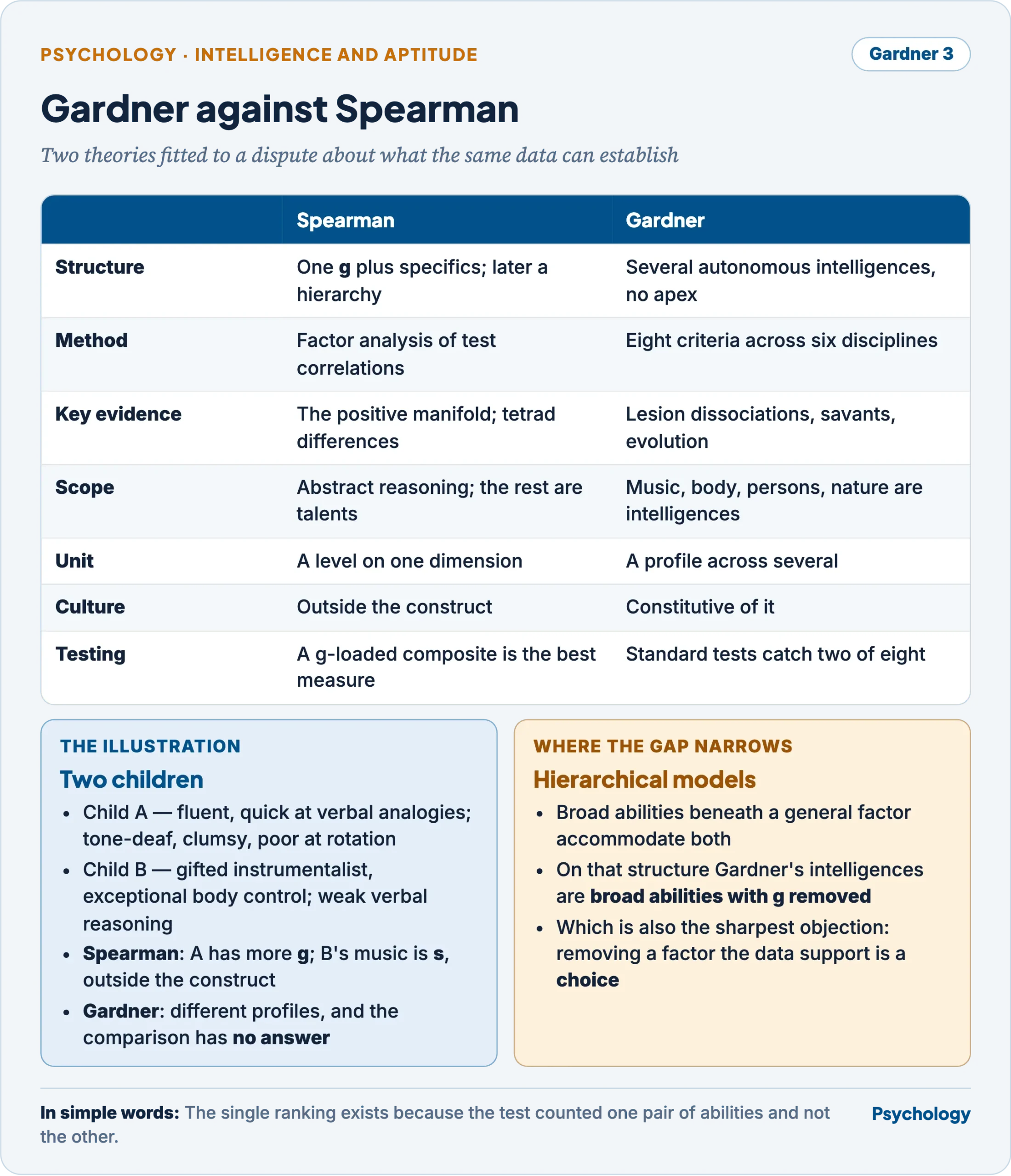
| Spearman | Gardner | |
|---|---|---|
| Structure | One general factor g plus specifics; later a hierarchy | Several autonomous intelligences, no hierarchy, no general factor |
| Method | Factor analysis of correlations among test scores | Converging evidence across eight criteria from six disciplines |
| Key evidence | The positive manifold; the tetrad-difference criterion | Lesion dissociations, prodigies and savants, evolutionary and cross-cultural data |
| Scope of “intelligence” | Abstract reasoning; the rest are talents | Musical, bodily, interpersonal and naturalist capacities are intelligences |
| Unit of description | A level on one dimension | A profile across several |
| Culture | Not part of the construct | Constitutive of what counts as intelligence |
| Implication for testing | A g-loaded composite is the best single measure | Standard tests measure two intelligences and miss the rest |
- The disagreement is not about the data but about what the data can establish. Spearman’s positive manifold is not in dispute; Gardner’s reply is that it holds among tests drawn from a narrow band of capacities, so it cannot license a claim about intelligence in general.
- An illustration. Take a child who is fluent, articulate and quick with verbal analogies but poor at spatial rotation, tone-deaf and physically clumsy, and a second child who is a gifted instrumentalist with exceptional bodily control and weak verbal reasoning. On Spearman’s account the first child has more g; the second’s music and movement are s factors or talents outside the construct, and a g-loaded test will rank the first child higher — correctly, on that theory, because what is being measured is the general factor. On Gardner’s account the two have different profiles and the comparison has no answer: the first is strong in linguistic intelligence, the second in musical and bodily-kinaesthetic, and the single ranking exists only because the instrument counted one pair of abilities and not the other.
- Where the gap narrows. Hierarchical factor models with broad abilities beneath a general factor accommodate domain-specific strengths without abandoning g. On that structure Gardner’s intelligences look like broad abilities with the general factor removed — which is also the sharpest version of the objection to him, since removing a factor the data support is a choice, not a finding.
The measurement of multiple intelligences
- Gardner’s own position is that standard testing cannot do it, and he has declined to produce an MI test. A paper-and-pencil instrument assesses bodily-kinaesthetic or musical intelligence through language and logic, which measures the wrong capacity. His requirement is intelligence-fair assessment: evaluate each intelligence in its own medium, by observing performance with the materials of the domain.
- Project Spectrum is the serious attempt. Developed by Gardner, Feldman and Krechevsky for preschool and early primary children, it placed fifteen activity areas in a classroom — a storytelling board, a music area with bells, a naturalist’s corner, a mechanical-assembly station, a social-interaction task — and assessed children through structured observation of what they did with them over a year, yielding a Spectrum profile rather than a score. The design question it answers is how to assess without testing.
- Arts PROPEL, developed with a school district and an assessment agency, applied the same logic to adolescents in music, visual arts and writing through process-folios: collections documenting drafts, revisions and reflections, assessed on the development visible across them rather than on a final product. The assessment target is the course of work, which is where Gardner holds an intelligence is visible.
- Self-report inventories exist but measure something else. The MIDAS scales (Shearer, 1996), the Teele Inventory and the various classroom checklists ask people to report their own strengths across the eight domains. They are quick and have been used widely, but a self-report of perceived strength is a measure of self-concept, not of ability — the respondent is the instrument, and inventories of this kind correlate with each other partly because people have a general view of their own competence.
- The psychometric test of the independence claim went against the theory. Visser, Ashton and Vernon (2006) assembled sixteen tests, two for each of eight intelligences, and administered them to around two hundred adults. A substantial general factor emerged, with most tests loading on it; the clear exceptions were those with heavy perceptual or motor content, notably the bodily-kinaesthetic measures. Their conclusion was that the abilities Gardner identifies are largely manifestations of g in different content domains rather than independent systems — the strongest single piece of counter-evidence, because it tests exactly the claim at issue using the criterion Gardner himself listed eighth.
- Confirmatory analyses point the same way. Studies fitting competing models to MI-domain batteries have generally found hierarchical models with a general factor at the apex fitting better than models of independent intelligences, with the domain factors retained beneath it.
- Where the measurement problem is genuinely unresolved is the one the critique does not reach: if the only instruments available for a domain are paper-and-pencil tests, then finding g in them is partly a property of the format. Gardner’s reply has been that intelligence-fair assessment has rarely been attempted at the scale needed to test him, and that is a fair description of the literature.
The narrowness of IQ, and the second line of attack
- Gardner and Sternberg both argue that IQ tests are too narrow, and they argue it incompatibly. Gardner multiplies intelligences and denies a common metric. Sternberg keeps one construct and widens it, holding that intelligence comprises analytical, creative and practical abilities of which conventional tests measure only the first, and that practical intelligence — tacit knowledge of how to operate in real settings — predicts outcomes that IQ misses.
- The consequence of that difference. Sternberg’s position is testable with correlations and incremental validity, and he has tried to test it; Gardner’s rejection of commensurability makes his position harder to test by the methods psychometrics has. Each diagnoses the same narrowness and prescribes a different cure: a longer list, or a broader single construct.
- The common ground is substantive and survives both critiques. Conventional tests sample linguistic and logical-mathematical material and little else; they are administered in a decontextualised format on well-structured problems with single answers; and the competences that distinguish adult performance in most work — judgement under ambiguity, handling people, skilled physical practice, generating options — are either unsampled or sampled badly. That criticism stands independently of whether the remedy is Gardner’s or Sternberg’s.
The Indian context
- The policy direction is consonant with the pluralist case without resting on it. The National Education Policy, 2020 commits to holistic and multidisciplinary education, removes the hard separation between arts, sciences, vocational and academic streams, and proposes competency-based assessment in place of rote recall, with vocational exposure from the middle stage. The structural claim shared with Gardner is that an education system which recognises one kind of ability wastes the others.
- The Indian argument against single-score ranking is concrete. In a system where a single aggregate decides stream, institution and occupation, the distributional consequences of a one-dimensional measure are large and early. The pluralist case is not that the aggregate fails to predict but that it allocates opportunity to one ability while most work requires several.
- The caution is equally concrete. MI has been widely absorbed into Indian teacher-training and school marketing as a licence for “learning styles” — matching instruction to a child’s dominant intelligence. Gardner has rejected this explicitly: intelligences are content capacities, not preferred modalities, and the proposal is multiple entry points to a subject for all learners, not different channels for different children. The learning-styles literature has not found the matching effect it predicts.
Criticisms and limitations
- “Talents, not intelligences.” The most common objection, pressed by Eysenck and others, is that Gardner has relabelled abilities everyone already recognised. Gardner’s reply is that the label is the argument — calling musical capacity a talent and verbal capacity an intelligence is the unexamined valuation he set out to expose. The exchange is partly definitional, which is itself a limitation of the theory.
- The criteria are not independently operationalised. There is no published procedure for scoring a candidate capacity against the eight criteria, no threshold for how many must be met, and no weighting. Gardner applied them himself, and the shifting list shows the result is not determinate.
- Confirmatory evidence is thin, and the contrary evidence is direct. Waterhouse (2006), reviewing the literature two decades after Frames of Mind, found no published studies validating the theory as a whole, and Visser, Ashton and Vernon (2006) found the general factor the theory denies. A theory this influential has been tested remarkably little, and where it has, the eighth criterion has failed.
- Autonomy is asserted more strongly than the data support. Lesion dissociations establish that some capacities can be separately impaired, which is compatible with hierarchical models in which broad abilities sit beneath a general factor. Dissociation shows separability of systems, not absence of a common factor in the normal range.
- The theory under-weights the predictive record of g. Whatever the construct’s narrowness, g-loaded composites predict educational attainment and job performance, and no MI-based measure has demonstrated comparable or incremental prediction. For selection and placement this is decisive, and the theory has no answer to it.
- The boundary of “intelligence” is left undefined. If a culturally valued problem-solving capacity with a neural substrate qualifies, it is unclear what excludes cooking, humour or chess, and Gardner’s rejection of moral and spiritual intelligence on the ground that they involve values sits awkwardly with a definition in which cultural valuation is constitutive.
- The educational claims outran the evidence. The curricular influence has been very large and the supporting outcome data very small; most classroom MI practice, including the learning-styles version, has no empirical support, a gap Gardner has acknowledged.
Previous Year Questions
- 2025“IQ tests are too narrow in focus.” Evaluate the statement from the perspectives of Sternberg and Gardner’s theories of intelligence.
- 2023Describe multiple intelligence theory and its measurement.
- 2019How is Gardner’s theory of intelligence distinct from Spearman’s theory? Illustrate.
- 2017According to Gardner’s theory, there is no one kind of general intelligence for ranking individuals. Explain.
- 2016Describe the characteristics of Gardner’s theory of intelligence.
- 2010Critically assess Gardner’s theory of multiple intelligence.