

Nature and theories of intelligence – Spearman, Thurstone, Gullford Vernon; Fluid intelligence and crystallized intelligence.
Official Syllabus: Paper I · Unit 10 Intelligence and Aptitude
“All branches of intellectual activity have in common one fundamental function (or group of functions).”
— Spearman (1904)
The factor theories all begin from one observation and disagree about what it means. Scores on almost any two mental tests correlate positively — the positive manifold — and the question is whether that reflects a single underlying ability, several, or many. Every answer in this tradition is produced by factor analysis, and the disagreements are substantially disagreements about how the mathematics is run.
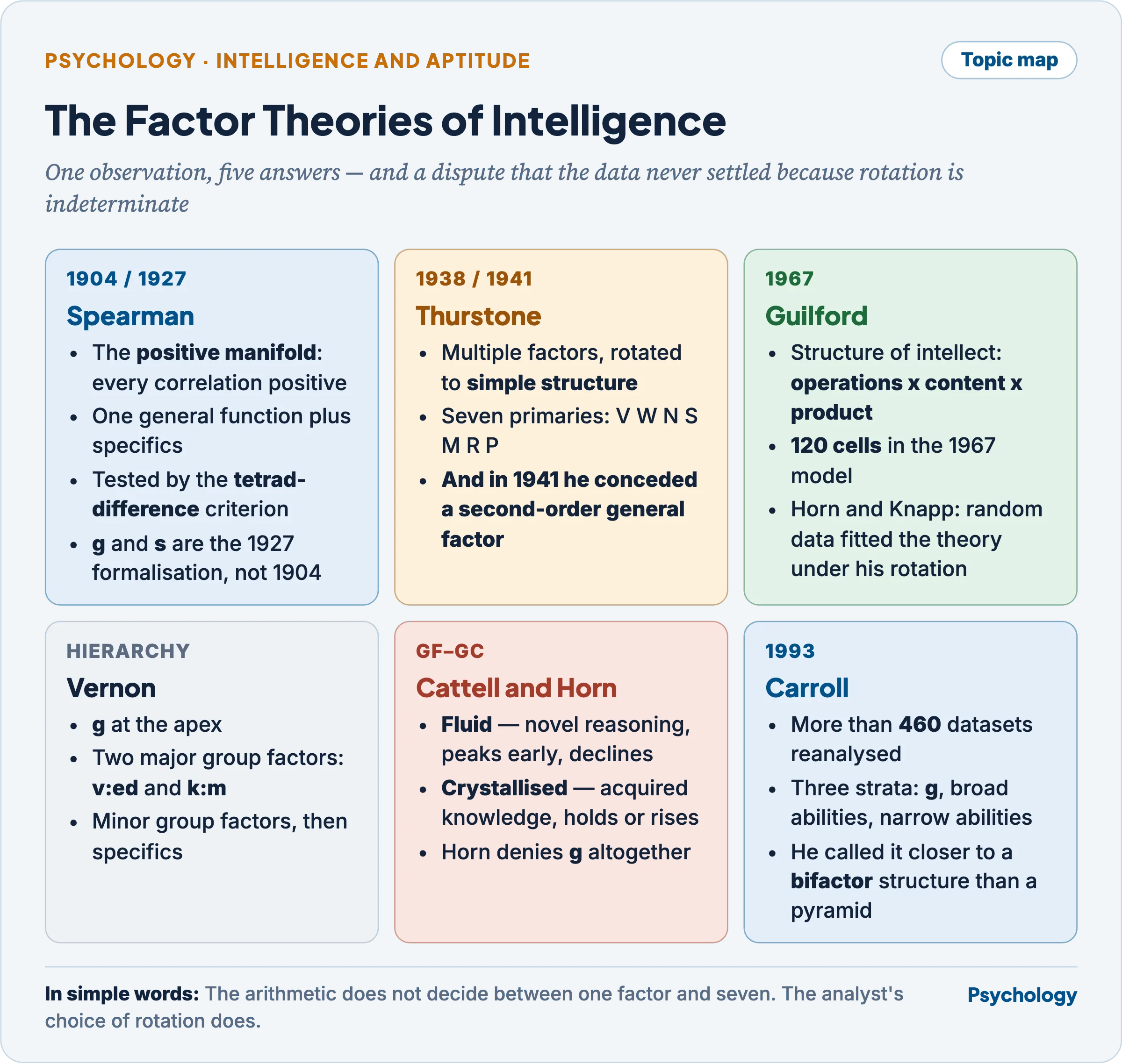
Spearman’s two-factor theory
- The finding. Spearman (1904) correlated children’s performance across school subjects and sensory discrimination tasks and found every correlation positive. His conclusion was headed Universal Unity of the Intellective Function: correlations between dissimilar activities arise because each is saturated with a shared function, while the specific element of each “seems in every instance new and wholly different” from the others. He reported the general-to-specific weighting varying across his ten “departments” from about 15:1 to 1:4.
- A correction. Spearman did not use the symbols g and s in 1904, nor the phrase “two-factor theory”. His 1904 text speaks of “General Intelligence” and “the central Function”; the lettered formalisation belongs to Spearman (1927), The Abilities of Man. Writing that Spearman proposed g and s in 1904 is a textbook compression of two separate works.
- The theory. Every performance is determined by two factors: g, a general factor entering every intellectual activity, and s, a specific factor unique to that activity. g was conceived as mental energy available to the whole cortex, with s the efficiency of the particular engine that energy drives. Tests differ in their g loading — their saturation with the general factor.
- The tetrad difference, which is how Spearman (1927) tested the theory. The criterion predicts that if a single common factor plus uncorrelated specifics accounts for a correlation matrix, then tetrad differences vanish within sampling error. A tetrad that does not vanish implies at least one group factor. This was a genuine, falsifiable prediction rather than a definition, which is what distinguishes Spearman’s claim from mere description.
- The cognitive content. In The Nature of Intelligence (1923) Spearman gave g a psychological interpretation in three noegenetic principles: the apprehension of experience, the eduction of relations (two items presented together tend to evoke the relation between them), and the eduction of correlates (an item plus a relation tends to evoke the item that completes it). This is why matrix-type items are held to be the purest measures of g — they are eduction of relations and correlates with almost nothing else.
- Objections. The tetrad criterion is sensitive to test selection: a narrowly chosen battery manufactures a clean g. Thurstone showed that rotated multiple-factor solutions fit the same matrices without a single general factor. Spearman himself conceded group factors in later work, which the original criterion cannot accommodate. And Horn later argued that g is an artefact of the positive manifold and of factor analysis rather than a discovered entity.
Thurstone’s primary mental abilities — and his concession
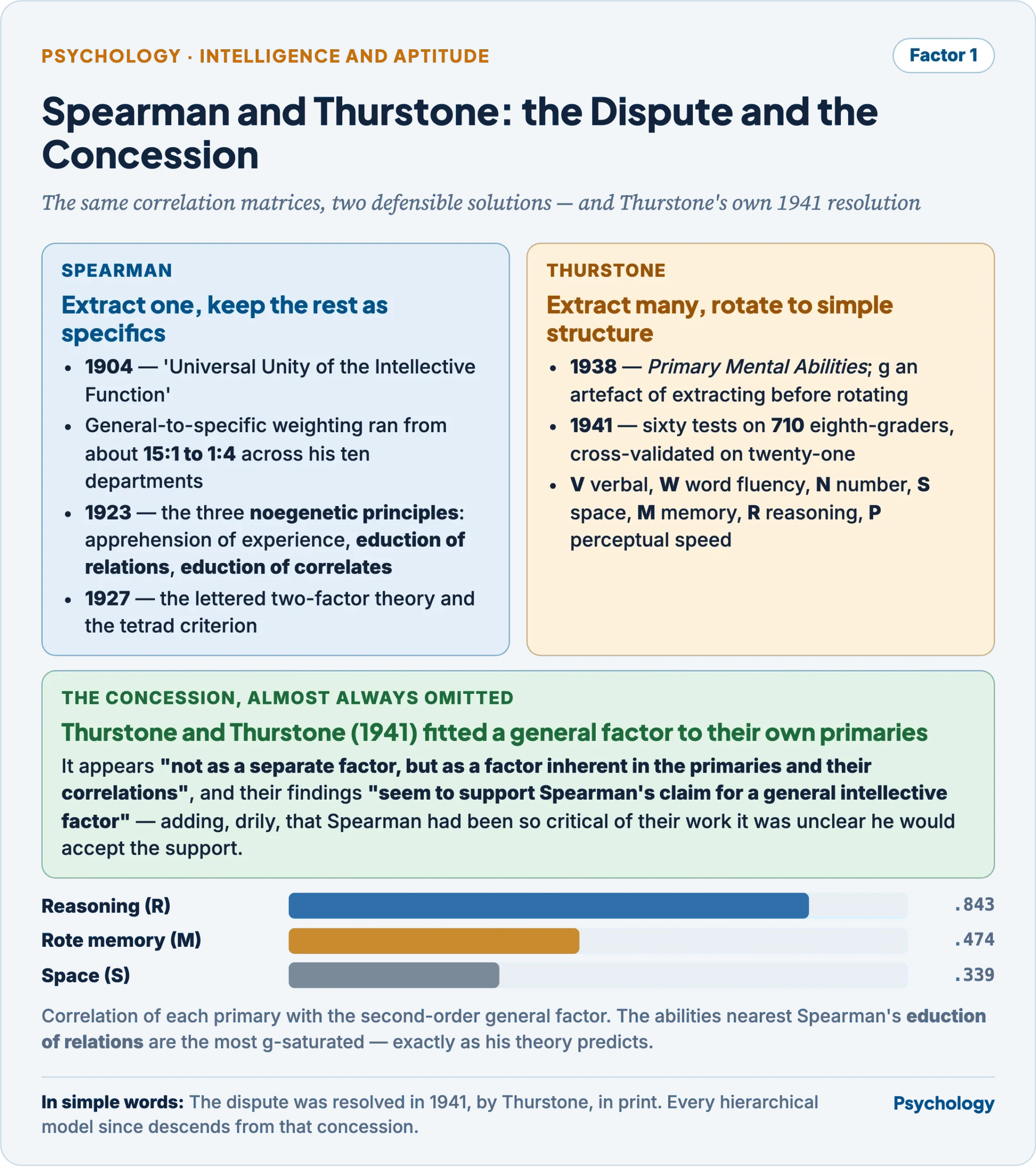
- The claim. Thurstone (1938), in Primary Mental Abilities, argued that intelligence is not one thing but a set of independent primary mental abilities, and that Spearman’s g was an artefact of extracting a single factor before rotating.
- The method is the real disagreement. Spearman extracted one common factor and treated the remainder as specifics. Thurstone extracted multiple common factors and rotated them to simple structure, which redistributes the shared variance across group factors instead of concentrating it in one. The data are not in dispute; the rotational indeterminacy is. Two defensible solutions can be fitted to the same matrix, and neither is more “correct” mathematically.
- The abilities. The study usually cited is the fuller Thurstone and Thurstone (1941), Factorial Studies of Intelligence: sixty tests on 710 eighth-graders with complete records, cross-validated on a twenty-one-test battery. The interpretable factors were V verbal comprehension, W word fluency, N number, S space, M rote memory, R reasoning or induction, and P perceptual speed — the canonical seven, with an eighth verbal factor left uninterpreted.
- The concession, which resolves the dispute and is almost always omitted. In the same monograph Thurstone and Thurstone (1941) found the primaries correlated with each other, and fitted a single factor to the matrix of primaries. Their own words: this general factor “makes its appearance, not as a separate factor, but as a factor inherent in the primaries and their correlations”, and “our findings seem to support Spearman’s claim for a general intellective factor”. They added, drily, that Spearman had been so critical of their work that it was uncertain whether he would accept their support for it.
- They called it a second-order general factor: each primary is a composite of an independent primary and a general factor shared with the others.
- In their figures reasoning (R) correlated most strongly with it, at .843, against .474 for rote memory and .339 for space — so the abilities nearest to Spearman’s eduction of relations are the most g-saturated, exactly as his theory predicts.
- Intercorrelations among the primaries were higher in children than in adults, which is why the dispute looked different depending on whose sample was analysed.
- Why it matters. The Spearman–Thurstone quarrel is usually presented as unresolved. It was resolved by Thurstone, in print, in 1941, and the resolution — a general factor operating through differentiated abilities — is the direct ancestor of every hierarchical model that follows.
Guilford’s structure of intellect
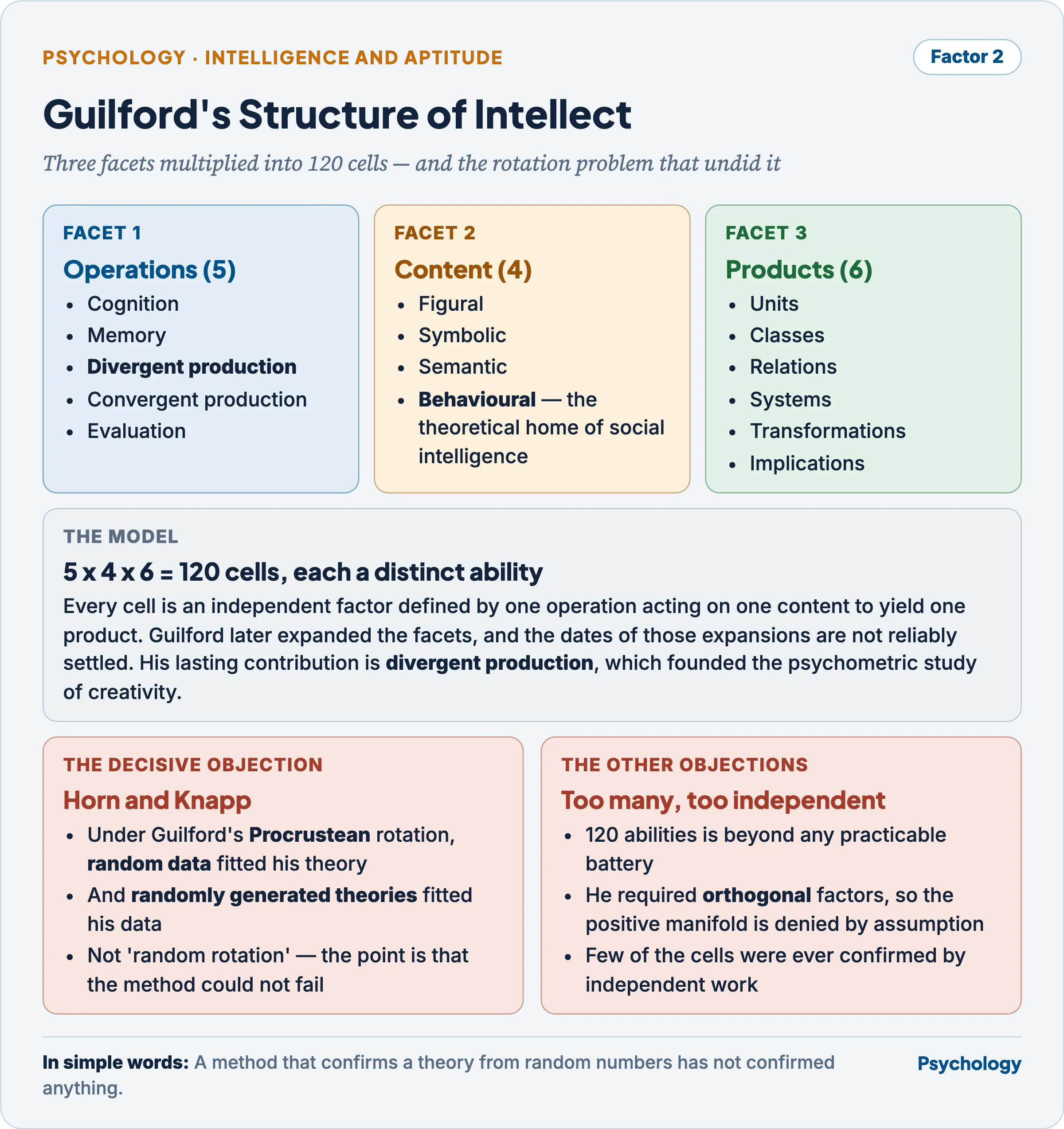
- The model. Guilford (1967) rejected g entirely and classified abilities along three independent dimensions, each ability being one cell of the resulting cube:
- Operations — what the mind does: cognition, memory, divergent production, convergent production, evaluation.
- Contents — what it operates on: figural, symbolic, semantic, behavioural.
- Products — the form of the result: units, classes, relations, systems, transformations, implications.
- The arithmetic. Five operations × four contents × six products gives 120 distinct abilities. Guilford later split figural content into visual and auditory, giving 150, and then split the memory operation into memory recording and memory retention, giving 180 (Guilford, 1988).
- Divergent production is the model’s most durable contribution. In his 1950 presidential address, Guilford argued that creativity is not the same thing as intelligence, that divergent thinking — generating many varied responses to one cue — is central to it, and that it can be measured by paper-and-pencil tests. Every divergent-thinking creativity test descends from that claim.
- Behavioural content was Guilford’s placeholder for what would now be called social intelligence. He never researched it fully, which is one reason the cell counts are reported inconsistently.
- Objections, and they are severe:
- Implausibility by proliferation. A theory of 180 statistically independent abilities is not a theory anybody can use, and the independence was never demonstrated.
- The decisive methodological critique. Horn and Knapp (1973) showed that under the Procrustean rotation Guilford used, random data produced a good fit to Guilford’s theory, and random theories produced an equally good fit to Guilford’s data. The careful statement of what this establishes is Sternberg’s: it did not show the theory to be false, but showed that what had looked like empirical support was far weaker than it appeared.
- Artefactual zero correlations. Guilford’s rejection of g rested largely on near-zero correlations in US Air Force aircrew data, a severely range-restricted pre-selected sample; reanalysis with better methods returns positive correlations.
- Carroll’s verdict on the model was that it is “a somewhat eccentric aberration in the history of intelligence models”.
Vernon’s hierarchical model
- The structure. Vernon (1950), in The Structure of Human Abilities, arranged abilities in four levels, which is the natural home for Thurstone’s second-order factor:
- g at the apex.
- Two major group factors: v:ed, verbal–educational, and k:m, spatial–mechanical.
- Minor group factors — verbal, numerical, creative and scholastic under v:ed; spatial, manual, mechanical, perceptual and psychomotor under k:m.
- Specific factors at the base.
- The rationale. The two major group factors are read as reflecting different sources of learning: v:ed gathers abilities built through schooling, k:m those built outside it. The split therefore carries an educational and cultural claim rather than a purely statistical one.
- Evidence. Humphreys (1962) found that v:ed and k:m added significantly to the prediction of work performance beyond g, while the narrower minor factors did not — which is the most useful single result for this model, since it says the major group factors earn their place and the minor ones largely do not.
- Objection. The two-major-factor split reflects the British test batteries of the period; wider surveys of the factor-analytic literature recover more than two broad factors.
Fluid and crystallised intelligence
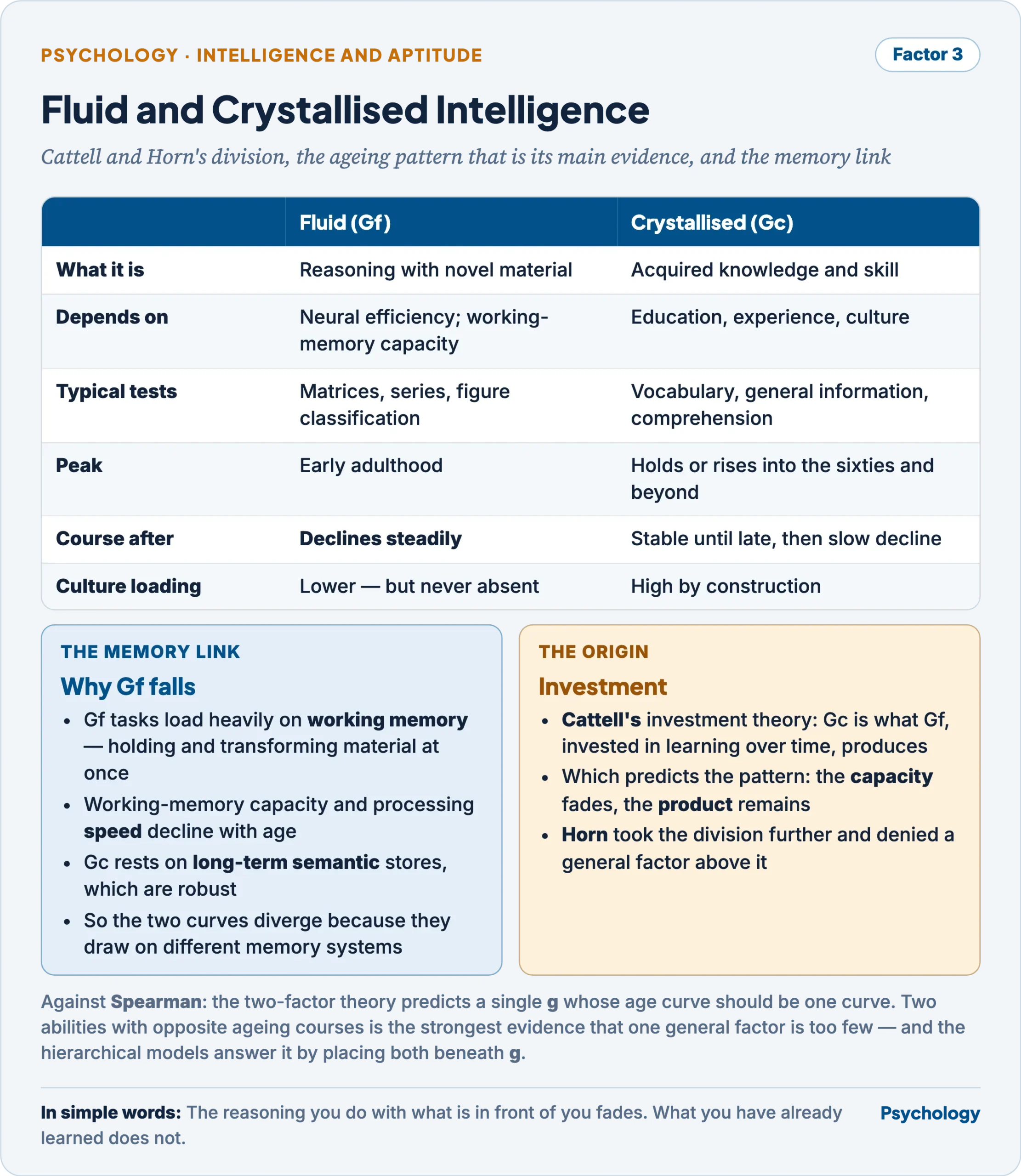
- The distinction. Cattell (1943) divided general ability in two, and his own definitions are worth keeping: fluid ability (Gf) “has the character of a purely general ability to discriminate and perceive relations between any fundaments, new or old”, while crystallised ability (Gc) “consists of discriminatory habits long established in a particular field” which no longer require insightful perception to operate. Gf is reasoning with novel material; Gc is the knowledge and judgement a culture has deposited in a person.
- The critical experiment. Cattell (1963) tested the distinction on 277 seventh- and eighth-grade children and recovered two factors: one matching the crystallised ability that conventional intelligence tests measure, the other a fluid general ability measured by culture-fair tests.
- The developmental claim. Horn and Cattell (1967) reported that Gf rises through adolescence and then declines with age, while Gc is maintained or continues to rise, so that peak test performance in later adulthood is carried increasingly by crystallised ability. This is the answer to how the two relate to ageing.
- How this connects to memory. The machinery Gf depends on is what declines: processing speed, for which Salthouse (1996) proposed a theory of adult cognitive ageing operating through a limited time mechanism and a simultaneity mechanism; and working memory, whose age-related reduction is substantially mediated by that slowing. What is preserved is semantic knowledge and vocabulary, which is Gc. The dissociation is therefore not mysterious: age erodes the capacity to hold and manipulate novel material, and leaves largely intact what has already been stored.
- The longitudinal correction. The clean “fluid falls, crystallised rises” curve comes mostly from cross-sectional comparisons, which confound age with cohort. Schaie’s Seattle Longitudinal Study, following the same individuals from 1956, showed conclusively that cross-sectional age differences cannot be used to estimate longitudinal change within individuals. Following people rather than comparing age groups, the picture changes: abilities reach a peak plateau in midlife, from the forties to the early sixties; decline is not reliably observed before sixty and is reliably observed by seventy-four; and while fluid abilities begin declining earlier, crystallised abilities show the steeper fall once the late seventies are reached. The textbook curve exaggerates both the earliness and the steepness of fluid decline.
- Objection. Gf and Gc correlate substantially, so the separation is one of degree; “culture-fair” tests of Gf turn out not to be culture-free; and Horn, who did most to extend the model, denied g altogether, which makes the Gf–Gc tradition a rival to the hierarchical tradition rather than a part of it.
Carroll’s three-stratum theory and CHC
- The survey. Carroll (1993), in Human Cognitive Abilities, reanalysed more than 460 datasets spanning seventy years of factor-analytic research — the largest such undertaking attempted — and recovered a consistent three-level structure:
- Stratum I — narrow abilities, dozens of them.
- Stratum II — about eight to ten broad abilities, including fluid reasoning, comprehension-knowledge, visual processing, auditory processing, short-term memory, long-term retrieval and processing speed.
- Stratum III — g.
- A nuance textbook diagrams get wrong: Carroll described his model as largely an extension of Spearman’s, and closer to a bifactor structure in which g and the broad abilities influence tasks directly and simultaneously, rather than the higher-order pyramid in which g acts only through the broad abilities. Most published diagrams of Carroll show the pyramid he did not propose.
- CHC theory merged the Cattell–Horn and Carroll models — first integrated by McGrew (1997) and named in McGrew and Woodcock (2001). It classically recognises ten broad abilities, with later revisions extending and relabelling them. It is the framework modern test batteries are built on.
- The objection to the merger, and it is a real one. The two parent theories are opposed on their central commitment: Horn denied g, Carroll made it the apex. Critics describe the union as “strange bedfellows and a mighty uncomfortable arranged marriage”, and note that the genuine agreement between them is only about how subtests get classified. Carroll himself, writing in 2003, said of the naming that he was “still not quite sure what caused or motivated it”.
- A measurement problem follows. In real batteries the broad-ability composite scores contain substantially more g variance than variance from the ability they are named after, which makes them hard to interpret as measures of that ability — and confirmatory analyses of the batteries purpose-built to instantiate CHC have repeatedly failed to fit it well.
The Flynn effect
- The finding. Flynn (1984, 1987), examining test standardisation data across many nations, found that raw performance on intelligence tests had risen steadily throughout the twentieth century — roughly three IQ points per decade — so that each new standardisation had to reset the mean back to 100.
- Which tests gained. The gains were largest on culture-reduced, fluid-type tests, Raven’s Progressive Matrices above all, and smallest on verbal and crystallised measures. Flynn’s own reading was that what had risen was an abstract problem-solving disposition rather than intelligence itself — which is why the effect is not treated as a rise in g.
- The reversal, and what it rules out. Bratsberg and Rogeberg (2018) analysed Norwegian conscription cognitive-ability scores for male birth cohorts from 1962 to 1991, linked to family records, and recovered the rise, its turning point and the subsequent decline entirely from variation between siblings within the same family. That finding rules out the explanations that operate between families — dysgenic fertility, immigration, compositional change — and locates the cause in the environment, although the authors are explicit that their data do not say which environmental cause.
- Why it belongs here. A large secular rise, concentrated in fluid tests, is hard to reconcile with g as a fixed biological capacity, and it is the same cross-sectional-versus-longitudinal confound that distorts the ageing curve — a cohort difference read as a difference between people.
Measuring the general and the specific
- Raven’s Progressive Matrices is the standard illustration of a test built to measure g. It was designed to operationalise Spearman’s eduction of relations and correlates, carries almost no verbal, numerical or acquired-knowledge content, has among the highest g loadings of any test, and is distinctive less for its high g loading than for its low loadings on everything else.
- A specific or group factor is tested by a task whose variance is dominated by one narrow ability once g is removed — digit span for short-term memory, coding or symbol search for processing speed, paper-folding or form-board tasks for spatial ability, category fluency for word fluency.
- The practical difficulty: no commonly used composite is a pure measure of a specific factor, for the reason given above: most broad-ability scores carry more g than group-factor variance. Thurstone’s own figures make the point in reverse — rote memory correlated only .474 with the second-order general factor, and space .339, so those are the nearest things in his battery to tests of something other than g.
- Raven’s is not uncontested as a g marker: it carries a significant visuospatial component, and the easier items load on a perceptual factor distinct from the analytic one.
The Indian evidence
- Bhatia’s Battery of Performance Tests of Intelligence is the substantial Indian contribution to this tradition. C. M. Bhatia developed it in doctoral work at Edinburgh completed in 1951 and published it in 1955, to make intelligence assessable in India without literacy. Its five subtests are the Koh’s Block Design, the Alexander Pass-Along, Pattern Drawing, Immediate Memory and Picture Construction.
- Its own standardisation is the interesting part here. Bhatia factor-analysed the battery together with the Stanford-Binet using Thurstone’s centroid method, and recovered at least two factors — a general factor, probably g, and a memory factor. An Indian performance battery built for illiterate testees independently reproduced the structure the British and American data had produced, which is as close to a cross-cultural replication of the factor-analytic finding as this literature offers. He standardised it separately for literates and illiterates, whose means differed while their standard deviations were nearly identical.
- The culture-fairness problem has recent Indian evidence. Vogelzang, Wigdorowitz and Tsimpli, testing a large sample of government-school children aged eight to eleven in Delhi, Hyderabad and Patna, found that when scored against the existing Indian norms for Raven’s Coloured Progressive Matrices the great majority of the sample fell at or below the tenth percentile. They argue the original Indian norm sample was far smaller and drawn disproportionately from higher-income private schools, and publish new norms. Taken at face value the result does not show that Indian children are impaired; it shows that norms are a property of the sample that produced them, which is the sharpest available objection to treating any test as culture-fair.
Criticisms and limitations
- Factor analysis cannot settle the question it is used on. Rotation is mathematically indeterminate, so the number of factors recovered depends on choices the analyst makes. Spearman’s one factor and Thurstone’s seven were fitted to the same kind of data.
- The battery determines the answer. A narrow set of tests produces a strong g; a deliberately diverse one produces group factors. No factor theory can recover an ability its tests do not sample.
- Factors are descriptions, not mechanisms. g names the common variance; it does not say what produces it, and the candidates — processing speed, working memory capacity, neural efficiency — remain disputed.
- The tradition is built on school-like tests. Abilities that schooling does not reward are systematically under-represented. This is the opening that Gardner and the information-processing theorists exploit.
- Cross-cultural validity is weak. The construct, the item types and the norms all come from a narrow range of societies, and the Indian norming evidence shows how badly transplanted norms can mislead.
- The dispute is partly verbal. Once Thurstone conceded a second-order factor and Carroll placed g above the broad abilities, the surviving disagreement is about emphasis and level of description rather than about the structure of the data — except for the Horn tradition, which genuinely denies g.
Previous Year Questions
- 2026How is crystallized intelligence different from fluid intelligence? Discuss their relation to ageing and memory.
- 2015Discuss briefly the evolution of factor theory of intelligence in the works of Spearman, Thurstone and Guilford.
- 2012Compare ‘multi-factor’ theory of intelligence with that of theory of ‘multiple intelligences’.
- 2011Compare the model of fluid and crystallized intelligence with the two factor theory of Spearman.
- 1995Explain the G and the S factors in intelligence. Describe one test each known to you for measuring the G factor and the S factor.