

Nature and theories of intelligence – Spearman, Thurstone, Gullford Vernon, Sternberg and J.P; Das.
Official Syllabus: Paper I · Unit 10 Intelligence and Aptitude
“The triarchic theory of successful intelligence defines successful intelligence in terms of one’s ability to succeed according to what one values in life, within one’s sociocultural context.”
— Sternberg (2003)
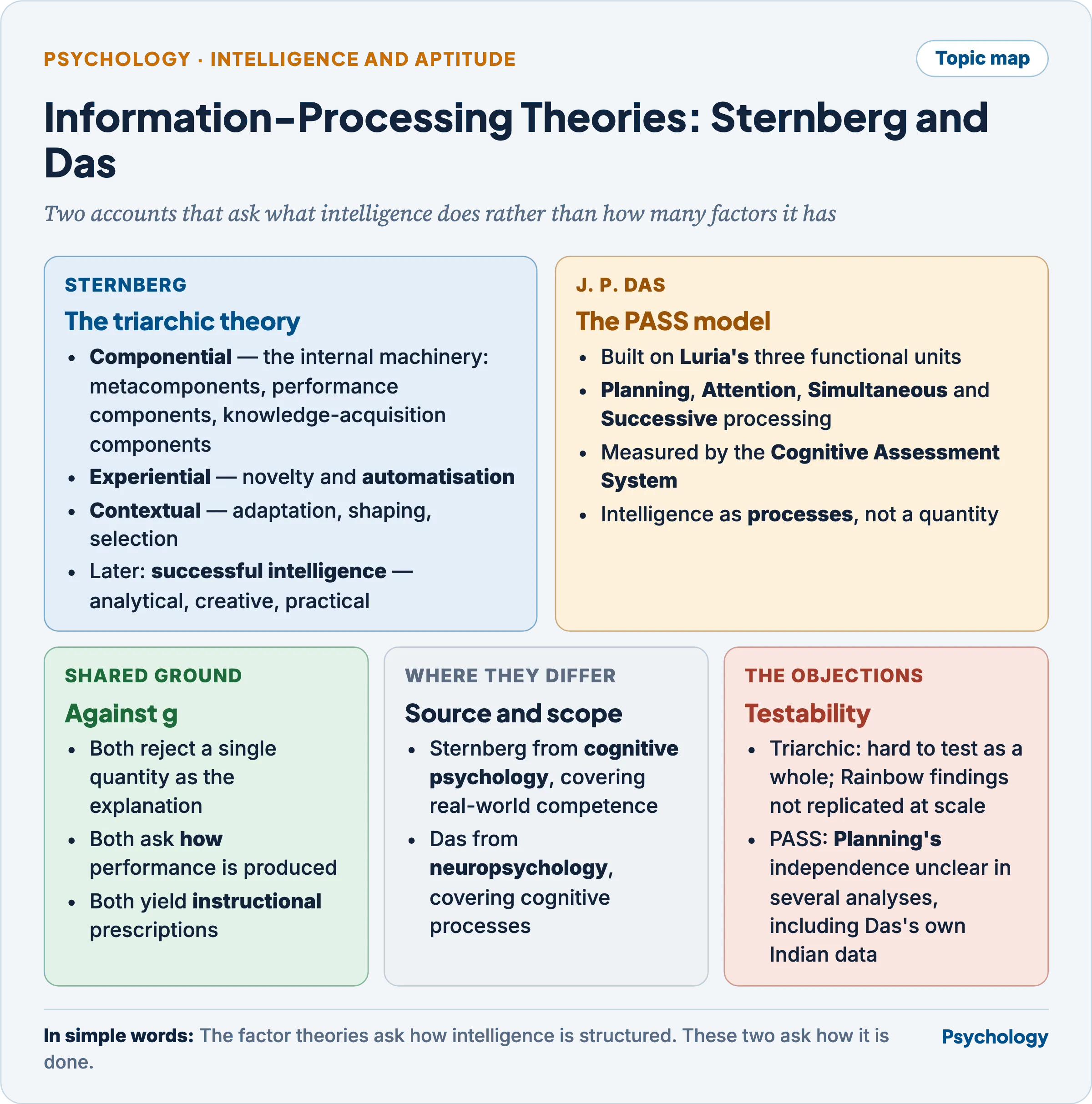
The factor theories ask how many abilities there are and answer by partitioning the covariance among test scores. Sternberg and Das ask a different question — what processes produce intelligent behaviour — and both built a test from the theory rather than fitting a theory to an existing battery. They arrived from opposite directions: Sternberg from the experimental psychology of information processing, Das from Luria’s neuropsychology.
Sternberg’s triarchic theory
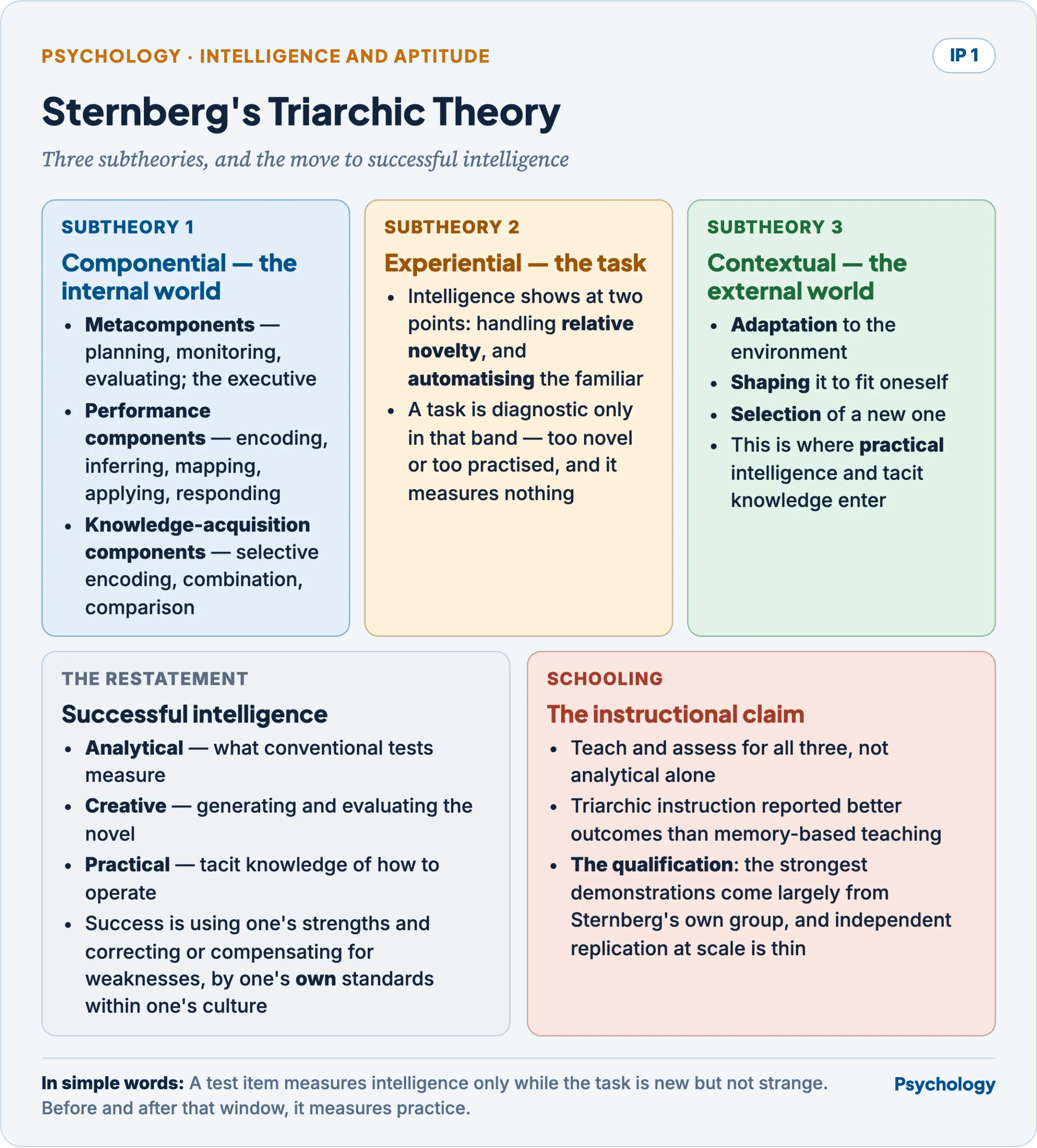
Sternberg (1984, 1985) proposed that a complete account of intelligence must relate it to three things at once: the individual’s internal world, their experience, and their external world. Each gets a subtheory.
The componential subtheory — the internal world
Intelligence consists of information-processing components, of three kinds, and the architecture matters as much as the list.
- Metacomponents — the executive processes: recognising that a problem exists, defining its nature, deciding on a strategy, allocating mental resources, representing the information, and monitoring the solution. These govern the others.
- Performance components — the processes that execute the metacomponents’ instructions: inference of relations, mapping of higher-order relations, and application of a relation to a new case.
- Knowledge-acquisition components — the processes by which one learns to solve the problem in the first place: selective encoding (separating relevant from irrelevant information), selective comparison (relating new information to what is already known), and selective combination (assembling encoded information into a whole).
- The architecture. Metacomponents activate performance and knowledge-acquisition components, which in turn feed information back to the metacomponents. Intelligence differences are therefore differences in executive control as much as in processing speed.
- The evidence is the method’s strength. Sternberg and Gardner (1983) decomposed total response time on an analogy into encoding, inference, mapping, application, comparison, justification and response, and found these component models predicting response times and error rates with R² from the low .80s to the high .90s, and the same performance components generalising from analogies to classification and series completion.
The experiential subtheory — the role of experience
- Intelligence is best displayed at two points on the experience continuum: in coping with relative novelty, and in automatising information processing that has become familiar.
- The two are connected, not merely parallel: efficient automatisation frees resources for the processing of novelty. This is the subtheory’s real claim, and it explains why a task is most diagnostic of intelligence when it is neither wholly new nor wholly routine.
- A terminological point: in the original statement this was the two-facet subtheory; experiential is Sternberg’s later name for it.
The contextual subtheory — the external world
- Intelligence is purposive adaptation to, shaping of, and selection of real-world environments relevant to one’s life. One adapts to the environment, or changes it to suit oneself, or leaves it for a better-fitting one.
- This is where practical intelligence lives — what Sternberg calls common sense — and its vehicle is tacit knowledge: procedural knowledge learnt in everyday life, usually not taught and often never verbalised, “knowing what to say to whom, knowing when to say it, and knowing how to say it for maximum effect”.
- Tacit knowledge has three defining features: it is procedural, it is acquired with little environmental support, and it is instrumental to goals the person personally values. It is measured by inventories of workplace scenarios, each with candidate actions rated for quality and scored against expert profiles rather than against an objective key.
Successful intelligence
Sternberg (1996, 1999) reframed the theory as successful intelligence: the ability to succeed in life by one’s own standards, within one’s sociocultural context, by capitalising on strengths and compensating for weaknesses, through a balance of analytical, creative and practical abilities. The three map onto the subtheories — componential to analytical, experiential to creative, contextual to practical.
It is an extension rather than a rename, and the change is not cosmetic: success becomes relative to the person’s own values, and the three subtheories are converted from process domains into three broad abilities used as units of measurement. Critics note that the relation between the subtheories and the three abilities is never made entirely clear.
The evidence, and the objections
- The STAT, the Sternberg Triarchic Abilities Test, measures analytical, creative and practical ability in verbal, quantitative, figural and essay formats. Sternberg reports factor studies generally conforming to the theory “although not perfectly”.
- The Rainbow Project added creative and practical measures to the SAT across fifteen institutions and reported that doing so doubled the prediction of first-year grades relative to the SAT alone while reducing ethnic-group differences. Two qualifications belong with it: Sternberg himself notes that the paper-and-pencil tests clustered into one factor, with separate creative and practical factors emerging only for the elaborate rater-scored performance tasks; and no independent replication has been published.
- Brody’s reanalysis is the most damaging single critique. Disattenuated correlations of the STAT scales with a conventional fluid-intelligence test were .69 for analytical, .73 for creative and .44 for practical — all substantial. Worse for the theory, the conventional measure correlated more highly with the creative scale than with the analytical one, which is the wrong way round. After Sternberg’s correction for “method variance” — which Brody reads as removing g variance — multiple-choice and essay measures of the same ability correlated near zero for two of three abilities, so the method-reduced scores lack construct validity. Brody’s conclusion: “the evidence indicates that our initial effort to develop a test of construct valid indices of triarchic abilities was unsuccessful.”
- Chooi and colleagues (2014) found the STAT Total loading .98 on g — a higher loading than standard scholastic aptitude tests achieve.
- Gottfredson (2003) examined the practical-intelligence claims at book length and concluded that the “six key empirical claims rest primarily on the illusion of evidence, which is enhanced by the selective reporting of results”. Her two strongest arguments are substantive rather than statistical:
- The academic/practical dichotomy does not hold. Many conventional IQ subtests — Vocabulary, Comprehension — are tacit-knowledge tests by Sternberg’s own definition, and she quotes him against himself: vocabulary is a good measure of intelligence precisely because it indirectly measures the ability to acquire information from everyday context rather than direct instruction.
- The real distinction is breadth, not domain. Tacit-knowledge tests assess highly domain-specific knowledge that few people have had the chance to acquire; conventional tests are deliberately domain-general. On Carroll’s model this places tacit knowledge near Stratum I, among narrow abilities, not alongside g at Stratum III.
- Sternberg’s defence is that the theory holds conventional accounts to be incomplete rather than wrong — “we believe we are building on the work of Spearman” — and that factor analyses support g for the narrow range of tasks conventional batteries sample and support it less when the range is broadened. He also concedes, disarmingly, that “the triarchic theory is just wrong… In my view, all current psychological theories are likely to be wrong.”
Implications for schooling
Two distinct claims, which should not be run together.
- The matching hypothesis — students taught in a way that matches their triarchic ability profile outperform those taught in a way that matches it poorly. This is an aptitude-by-treatment interaction.
- Teaching triarchically for everyone — students taught with analytical, creative and practical instruction infused throughout outperform those taught for memory or for critical thinking alone. Sternberg, Torff and Grigorenko (1998) reported this in Grade 3 and Grade 8 samples, with the triarchic group superior even on multiple-choice memory items, and later work found the advantage largest in reading.
- The objection to the first claim is decisive. Brody (2003) records that the predicted interaction became significant only after “the somewhat unorthodox (and statistically impermissible) procedure of removing over one third of the subjects” from the analysis. He adds that the achievement measures failed a multitrait–multimethod test, and that the group never compared prediction from the STAT against prediction from a conventional intelligence test — the comparison that would settle the matter.
- Brody’s closing assessment is the fair one: Sternberg’s conclusions “would be more acceptable to scholars in the field of intelligence if the rigour of his data analyses matched the originality of his theoretical insights”.
The PASS theory of J. P. Das
Jagannath Prasad Das is the Indian psychologist whose work is named in the syllabus. He took his first degree at Utkal University, Cuttack and his master’s at Patna, completed a doctorate at the Institute of Psychiatry in London, taught at Utkal as Reader, and from 1968 worked at the University of Alberta, directing its Developmental Disabilities Centre from 1972 to 1994. The centre now carries his name. He was elected a Fellow of the Royal Society of Canada in 1999 and died in October 2025.
- The origin. Das, Kirby and Jarman (1975), in Psychological Bulletin, argued that the existing structure-of-abilities theories were inadequate and offered Luria’s account of simultaneous and successive syntheses as an alternative. The full model was set out in Das, Kirby and Jarman (1979) and completed as a theory of intelligence in Das, Naglieri and Kirby (1994).
- The distinguishing claim. Intelligence should be defined by a theory of brain function, not by the historical accident of which items happened to survive from Binet’s scale onward. The PASS processes are proposed as the units of cognition, and g has no place in the theory.
The four processes
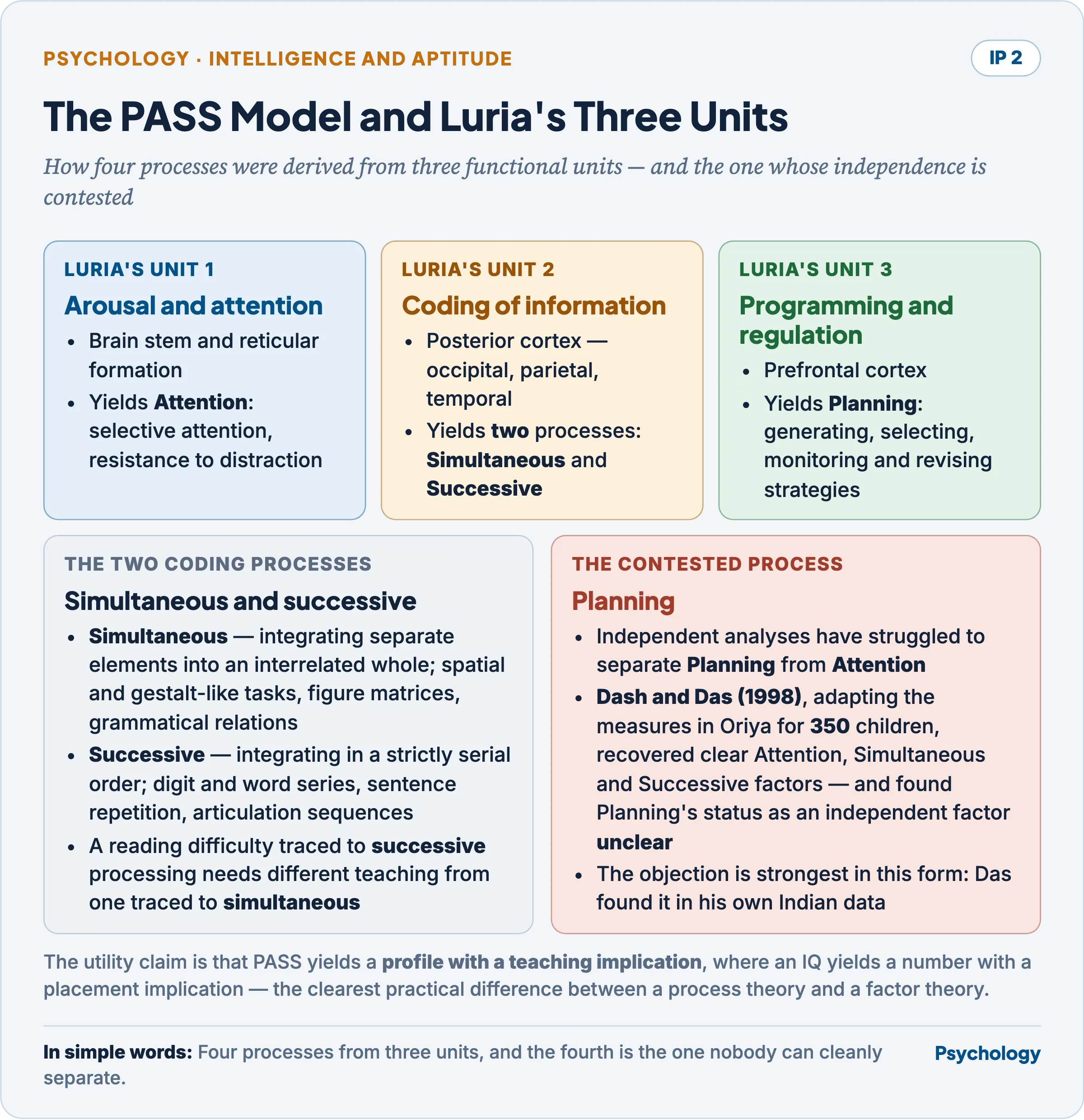
- Planning — deciding how to do a task: generating a strategy, self-monitoring while executing it, self-correcting when it fails, and reflecting afterwards on what worked. Most important in novel situations. Measured by tasks like Planned Codes and Planned Connections, all of which are solved far more efficiently with a strategy than without one.
- Attention — selectively focusing on one stimulus while inhibiting responses to others, together with the cortical arousal that makes any processing possible. Measured by Stroop-type tasks such as Expressive Attention, and by Number Detection.
- Simultaneous processing — integrating separate stimuli into a single whole or interrelated group. It has a spatial aspect, seeing elements and their relations at once, and a grammatical aspect, integrating words into a single idea through prepositions and inflections — so it is not a nonverbal process, which is the detail most often got wrong. Measured by Matrices, Figure Memory and Verbal–Spatial Relations.
- Successive processing — handling information arranged in a strictly defined serial order, each element following the one before. It underlies serial recall, syntax, phonological analysis and decoding. Measured by Word Series, Sentence Repetition and Visual Digit Span.
- A working constellation, in Luria’s term: the same task can be done with different combinations of processes depending on how it was learnt, so arithmetic may be planning-dominated in one child and successive-dominated in another.
The Luria basis
- Luria (1966, 1973) divided the brain into three functional units which work in concert:
- The first unit regulates cortical tone, arousal and waking, in the brainstem and reticular formation.
- The second unit receives, codes and stores information, in the posterior cortex at the junction of the occipital, parietal and temporal lobes.
- The third unit programmes, regulates and verifies activity, in the frontal lobes.
- Three units yield four processes, and the asymmetry is the key conceptual point: the second unit produces two processes, simultaneous and successive coding, because information can be organised either all-at-once or in series. The first unit gives attention and arousal, the third gives planning. A diagram implying a one-to-one mapping is wrong.
- Luria insisted the units are not confined to single areas but work in harmonic conjunction; modern restatements treat them as large-scale functional networks rather than regions.
Measurement: the Cognitive Assessment System
- Naglieri and Das (1997) built the CAS to measure the four processes directly; Naglieri, Das and Goldstein (2014) produced the CAS2 for ages five to eighteen, with twelve subtests in the extended battery and eight in the core, standardised on 1,342 children. Full Scale reliability is .95 and the PASS scale reliabilities run from .86 to .93.
- Its distinctive design feature — what it leaves out: the CAS contains no vocabulary, general-information or arithmetic items. The argument is that conventional IQ–achievement correlations are inflated because the test and the criterion share content, so a knowledge-free processing battery is the fairer and more informative instrument.
- The claimed clinical payoff is differential profiles: in reading-disability samples the PASS profile is reported to dip on Successive processing, in ADHD samples on Planning, while conventional batteries show much flatter profiles. The proponents themselves caution that these samples were not demographically matched, that diagnostic accuracy was not always verified, and that some samples were small.
How PASS challenges ‘g’, and the counter-evidence
This is a live two-sided dispute and should be presented as one.
- The PASS argument. A general factor is an artefact of the content of conventional batteries, not a discovered ability; the Full Scale score is a regulatory convenience. Supporters point to analyses of the CAS2 standardisation sample in which a correlated four-factor PASS model fits better than a unitary or bifactor model — though these are reported chiefly by the test’s own authors.
- The independent analyses go the other way, and they are the strongest evidence here. Kranzler and Keith (1999) found that the hierarchical model the CAS implies fitted the data poorly; that the Planning and Attention factors correlated above .90, making them virtually indistinguishable; that three of the four factors lacked the specificity to be interpreted in isolation; and that the best-fitting model placed psychometric g at the apex. They concluded that the Planning and Attention tests are primarily measures of processing speed.
- Keith, Kranzler and Flanagan (2001) then analysed the CAS jointly with an established battery and reported the decisive numbers: Planning correlated .98 with processing speed and Attention .88; Successive was statistically indistinguishable from short-term memory span; Simultaneous was best modelled as broad visualisation; and the CAS general factor correlated .98 with the other battery’s general factor. Their conclusion was that the CAS “appears to require the same general intelligence as do all other cognitive test batteries”, and that “the PASS model appears untenable as a theory of individual differences in intelligence”.
- The honest summary is that the CAS is a well-built test whose scores can be interpreted, but that the four processes have not been shown to be the four independent things the theory requires — and that Planning in particular keeps dissolving into processing speed.
The Indian evidence, including an inconvenient one
- Dash and Das (1998) produced an Oriya-language adaptation of the PASS measures and administered it to 350 children from Grades 1 to 11, publishing developmental norms. It is the substantial Indian test of the model.
- Its result cuts both ways, which is what makes it worth knowing. Dash and Das (1998) recovered clear Attention, Simultaneous and Successive factors — a genuine cross-linguistic replication of three of the four. But the status of Planning as an independent factor remained unclear. An Indian study by Das himself therefore ran into the same difficulty with Planning that the independent North American analyses later reported, which is a stronger form of the objection than either body of work is alone.
- Das’s earliest Indian work examined caste and class as determinants of cognitive competence and the processing of Adivasi children in Orissa, bringing the social structure of Indian society into a cognitive-processing framework at a time when little such work existed.
- Remediation. The PREP programme, built on the model, has been used with Indian schoolchildren to improve decoding and comprehension, with reported gains — but the Indian studies are small or single-group pre-post designs without controls, so they indicate promise rather than establishing efficacy.
Comparing the two models
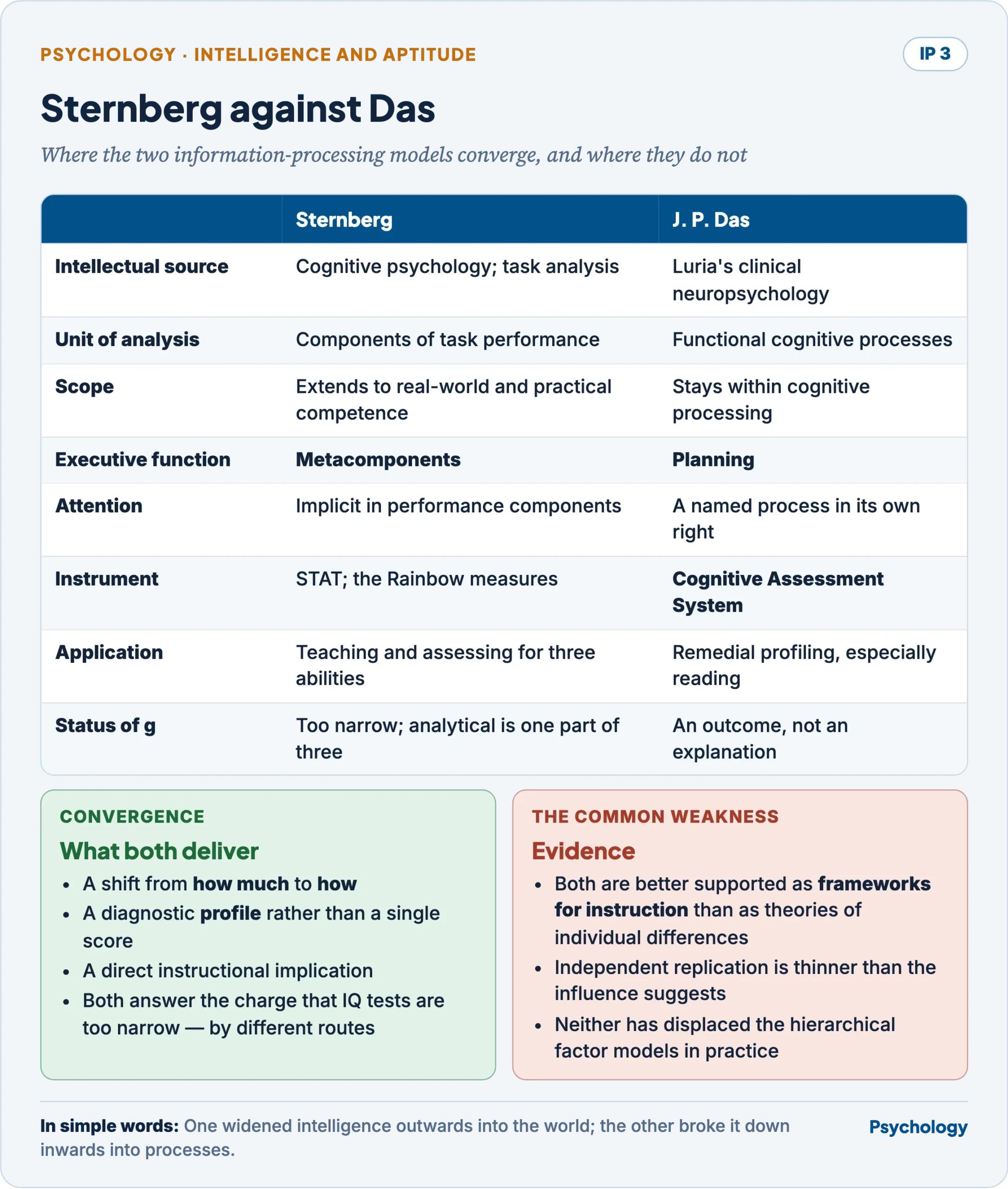
| Sternberg — triarchic | Das — PASS | |
|---|---|---|
| Intellectual origin | Experimental cognitive psychology: componential analysis of response times | Neuropsychology: Luria’s three functional units |
| Unit of analysis | Information-processing components, applied in three contexts | Four neurocognitive processes tied to brain systems |
| What it adds to g | Creative and practical abilities conventional tests ignore | A process account of what conventional tests measure indirectly |
| Role of culture | Constitutive — intelligence is defined relative to one’s own values and context | Universalist — the processes are held to be culture-general |
| Measurement | STAT, tacit-knowledge inventories, rater-scored performance tasks | CAS/CAS2, objectively scored, with no vocabulary or arithmetic content |
| Stance on g | Conventional theories are incomplete, not wrong | g has no place in the theory — the stronger claim |
| Chief application | Admissions, selection, curriculum design | Diagnosis and remediation of learning difficulties |
| Evidential weakness | Largely in-house evidence; selective reporting alleged | Independent factor analyses collapse its factors onto g and speed |
- Where they genuinely agree. Both are process theories arising from the information-processing turn of the 1970s; both deny that a single general factor is the right unit of explanation; both built a test from the theory rather than the reverse; and both carry a fairness argument — that conventional tests penalise competence lying outside the academic-verbal band.
- The parallel that matters most is in how they have fared: each faces the same objection from the same quarter, that independent confirmatory analyses collapse their scales onto g or onto long-established broad abilities — the STAT total loading .98 on g, the CAS general factor correlating .98 with another battery’s.
- The one-line contrast. Sternberg widens the definition of intelligence outward into context and life success; Das pushes it downward into brain function. Both end up confronting the positive manifold.
Criticisms and limitations
- Neither theory has displaced the psychometric account. Both set out to show that g is not the whole story and both produced instruments whose variance is dominated by g.
- Theory-first tests invite confirmation. When the same group writes the theory, builds the test, collects the standardisation data and performs the factor analysis, independent replication carries disproportionate weight — and in both cases the independent analyses have been the least favourable.
- The process constructs are under-identified. Sternberg’s components are inferred from response-time decomposition on a narrow class of tasks; PASS’s Planning repeatedly fails to separate from Attention and from processing speed.
- Practical intelligence has a measurement problem. Scoring against expert profiles rather than an objective key makes the construct partly a matter of resemblance to incumbents, which is not obviously a measure of ability.
- Both work better as frameworks for instruction than as theories of individual differences. Triarchic teaching and PREP have produced real if modest classroom gains, and those gains do not depend on the factor structures being correct.
- Indian evidence is thin on both. The Oriya adaptation is the one substantial Indian test of PASS, and there is essentially no Indian work on the triarchic theory, which is a gap given how much the contextual subtheory stakes on culture.
Previous Year Questions
- 2022Is intelligence a univariate or multivariate concept? Discuss in the light of Spearman’s and J. P. Das’s theories of intelligence.
- 2018Describe how J. P. Das’ theory is distinct from other theories of intelligence.
- 2016Give a comparative account of information processing models of intelligence proposed by Sternberg and J. P. Das.
- 2015Evaluate the utility of J. P. Das’ model in understanding the concept of intelligence.
- 2013Comment on: Explicate Sternberg’s view of intelligence and bring out its implications for schooling.
- 2011Describe and evaluate the model of intelligence proposed by J. P. Das.
- 2008Describe the PASS model of intelligence and show the grounds on which it has challenged the ‘g’ theory.