

Official syllabusPaper I · Unit 12 · Attitudes, Values and Interests
Formation and maintenance of attitudes.
Definition
“A learned predisposition to respond in a consistently favourable or unfavourable manner with respect to a given object.”
Fishbein and Ajzen (1975)
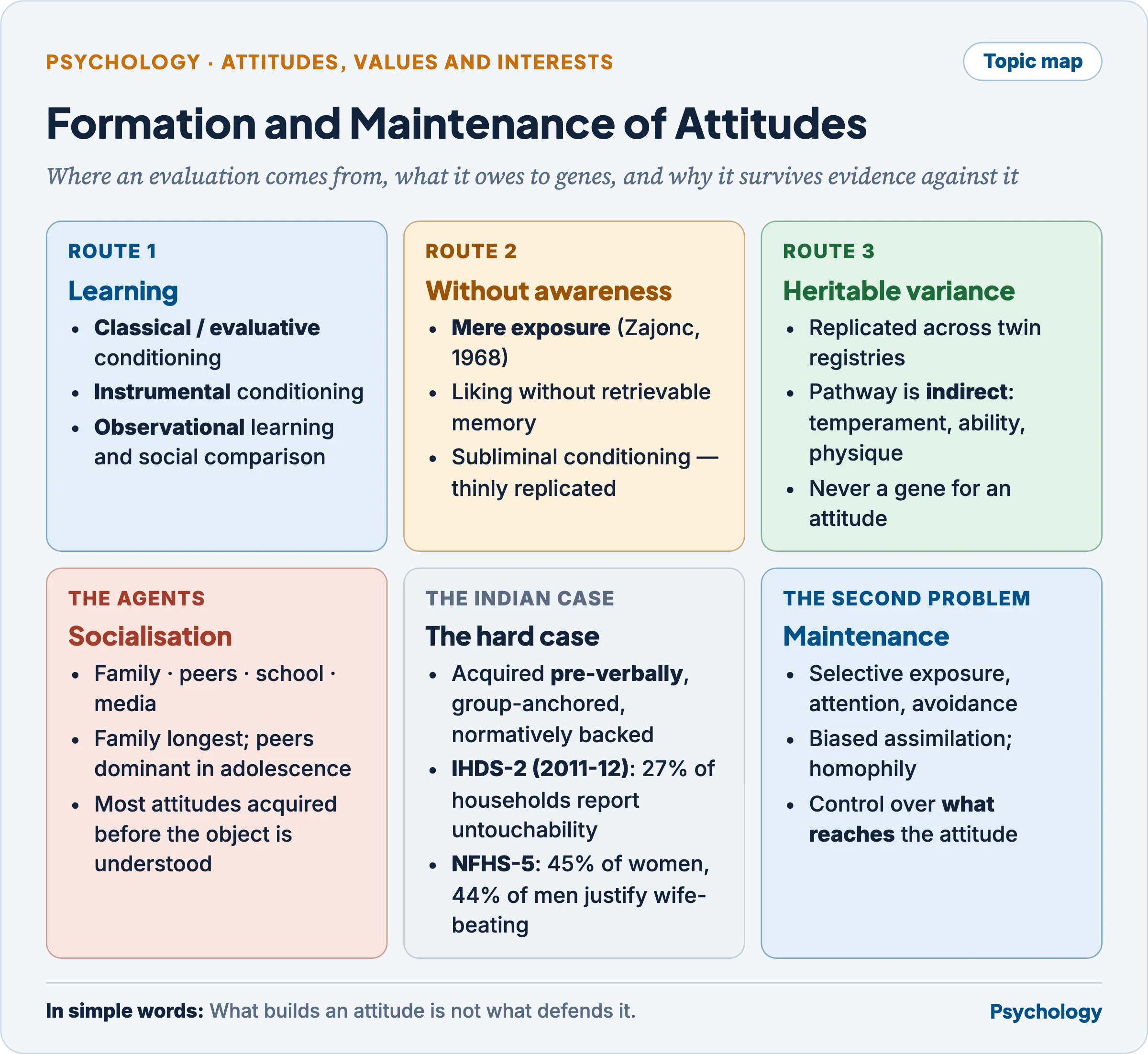
The word carrying the weight is learned. An evaluation is acquired, so it has a history traceable to particular experiences and could have been acquired differently. Formation asks where the evaluation came from; maintenance asks why it survives information that should have unseated it. These are two problems with different mechanisms — what builds an attitude is not what defends it.
The three learning routes
Classical conditioning and evaluative conditioning
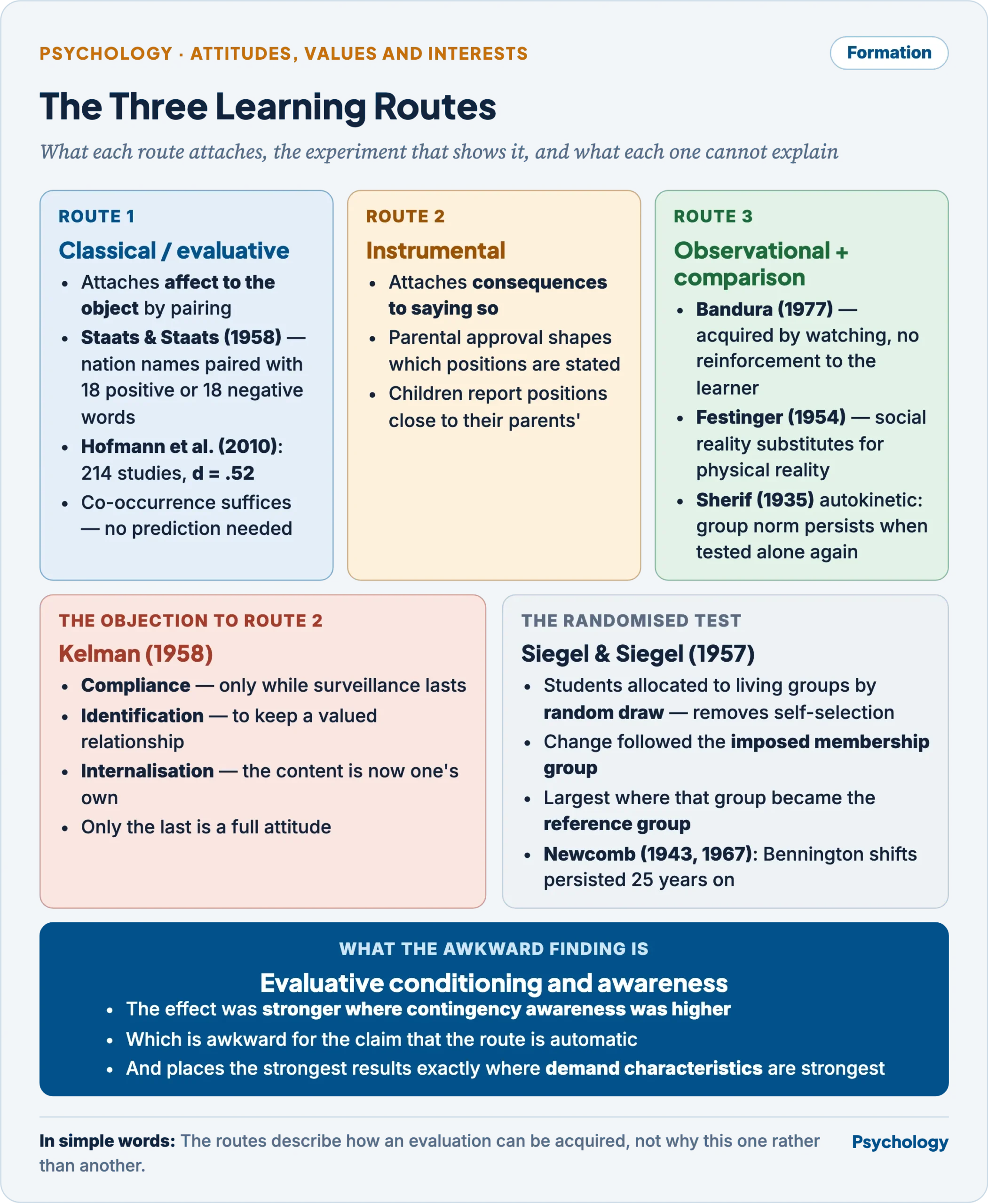
- Classical conditioning of an attitude: a neutral attitude object acquires an evaluation by being paired repeatedly with a stimulus that already carries one. A child with no reaction to a group acquires one by hearing the group’s name alongside a parent’s disgust.
- Staats and Staats (1958) — the national names Swedish and Dutch appeared on a screen while the experimenter read aloud either eighteen positive or eighteen negative words.
- The nation paired with positive words was afterwards rated more favourably — attitude acquisition without argument, information or reward.
- Limitation: the pairing was poorly concealed, so demand characteristics — participants inferring and obliging the hypothesis — remain a live alternative.
- Evaluative conditioning is the broader modern term: a change in liking for a stimulus produced by pairing it with liked or disliked stimuli. Unlike Pavlovian conditioning it does not require the first stimulus to predict the second — co-occurrence suffices.
- Hofmann, De Houwer, Perugini, Baeyens and Crombez (2010) pooled 214 studies and found a moderate overall effect, d = .52.
- The effect was stronger where contingency awareness was higher, which is awkward for the claim that the route is automatic.
- Outside the laboratory the route runs through advertising that pairs a product with music and attractive faces, through political imagery, and through the casual pairing of a caste name with contempt in household speech.
Instrumental conditioning
- Instrumental conditioning of attitudes: the expression of an evaluation is rewarded or punished, and the evaluation follows the reinforcement. Parental smiles and approval shape which positions a child states.
- The routes differ in what is learnt: classical conditioning attaches affect to the object, instrumental conditioning attaches consequences to saying so.
- Hence most children report religious, political and social positions close to their parents’. In adolescence the reinforcing agent changes rather than disappears.
- The standing objection: reinforcement produces public agreement more reliably than private evaluation. Kelman (1958) separates the outcomes — compliance while surveillance lasts, identification to keep a valued relationship, internalisation because the content is now one’s own. Only the last is a full attitude.
Observational learning and social comparison
- Bandura (1977) — evaluations are acquired by watching a model’s evaluative reactions, with no reinforcement to the learner. The learner also acquires the expectation of what following the model will cost or yield.
- Social comparison is the mechanism beneath observational learning of opinions. Festinger (1954) argued that where no objective standard exists, people establish an opinion’s correctness by comparing it with those of similar others: social reality substitutes for physical reality.
- Sherif (1935) gave the route its cleanest experiment, the autokinetic effect. Individual judgements of how far a stationary point of light appeared to move varied wildly; in groups they converged on a shared estimate, and the norm persisted when members were tested alone again.
- The persistence is the finding. A frame of reference built by comparison is carried away as one’s own.
- Newcomb (1943) followed cohorts at Bennington College: attitudes shifted towards the community’s prevailing position in proportion to length of stay and participation. Newcomb (1967), revisiting the alumnae after twenty-five years, found the acquired attitudes largely persisted.
- Siegel and Siegel (1957) supplied the randomised version. Women students at a large private coeducational university were allocated to living groups by a random draw, which removes self-selection.
- Attitude change followed the norms of the imposed membership group, and was largest among students who went on to adopt that initially less-preferred group as their reference group.
Mere exposure and formation without awareness
- The mere exposure effect — Zajonc (1968) — is that repeated exposure alone increases liking, with no reinforcement, information or argument. His materials were nonsense words, Chinese-like characters his American students could not read, and yearbook photographs.
- Bornstein (1989) pooled 208 experiments and found the effect robust, r = .26, strongest for briefly presented and unrecognised stimuli and weaker where the category is already familiar.
- Kunst-Wilson and Zajonc (1980) showed shapes too degraded to recognise, then offered a choice: recognition was at chance while preference for the shown shape was above it. Liking can form without any retrievable memory of the object.
- Krosnick, Betz, Jussim and Lynn (1992) demonstrated subliminal conditioning: affectively positive or negative photographs presented below awareness shifted both evaluations of a target person and beliefs about her traits, with participants unaware of the cause.
- The replication record is thin. The authors direct readers to other work that failed to reproduce it, and the subliminal subset of the evaluative-conditioning literature rests on a handful of studies.
- The theoretical consequence is often missed: an attitude need not be deduced from beliefs about its object, which contradicts the expectancy-value account on which an attitude is the sum of beliefs weighted by their evaluations.
The genetic contribution
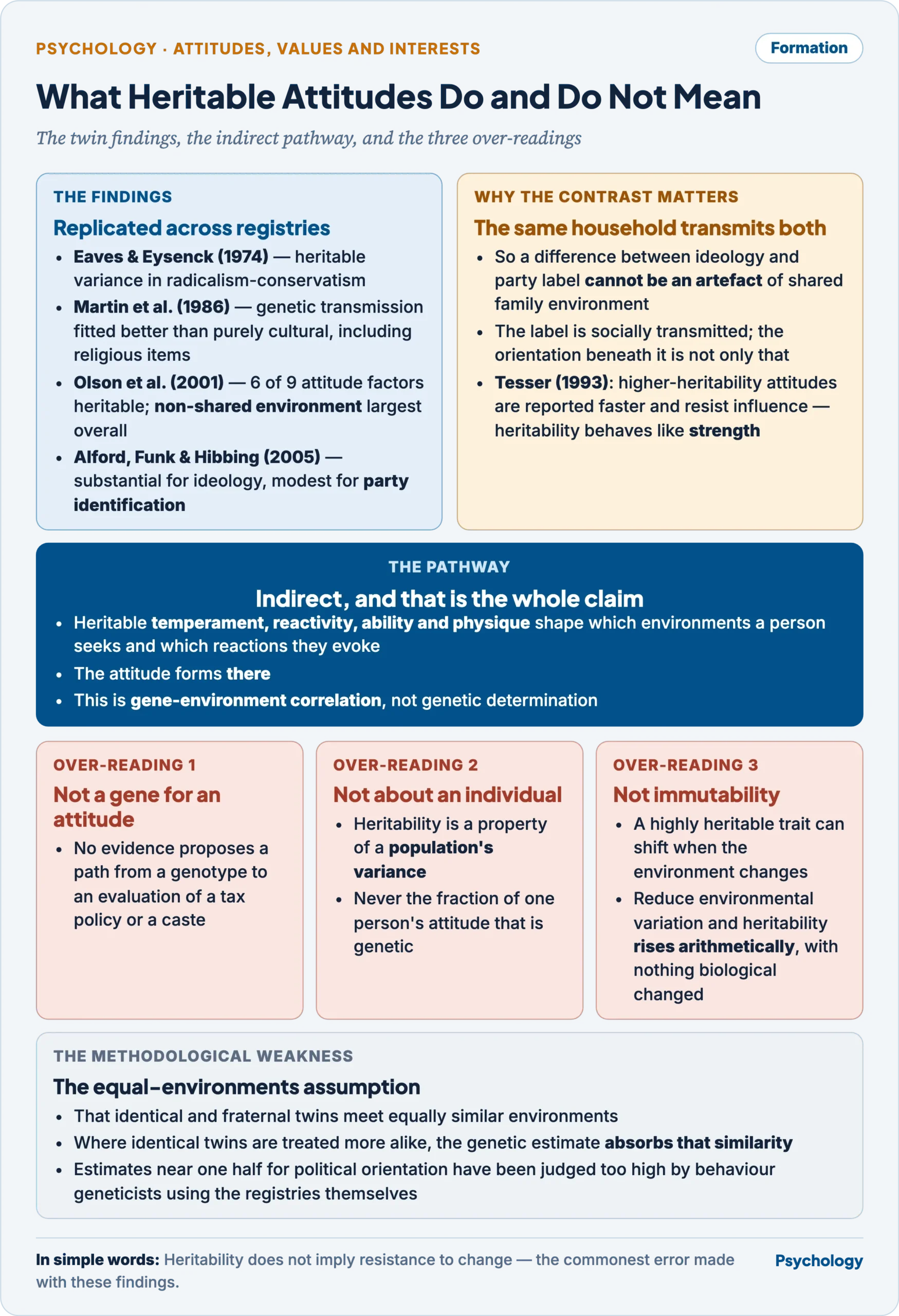
- Eaves and Eysenck (1974) first reported heritable variance in self-reported radicalism-conservatism from twin data.
- Martin, Eaves, Heath, Jardine, Feingold and Eysenck (1986) analysed twins and their spouses in Australia and England. Family resemblance in social attitudes fitted a model with genetic transmission better than one of purely cultural transmission, and religious items — Sabbath observance, church authority, the truthfulness of the Bible — carried heritable variance.
- Olson, Vernon, Harris and Jang (2001) studied 195 monozygotic and 141 same-sex dizygotic twin pairs in Canada on thirty attitude items reduced to nine factors.
- Six of the nine factors showed significant heritability, while non-shared environment took the largest share of variance overall.
- Personality, physique and academic ability correlated genetically with the heritable attitude factors, which names a pathway rather than leaving the result mysterious.
- Tesser (1993) found that higher-heritability attitudes were reported more quickly and were more resistant to social influence. Heritability therefore behaves like an index of attitude strength, which connects the genetic finding to the rest of the field.
- Alford, Funk and Hibbing (2005), working with a large twin registry, found substantial genetic influence on political attitudes and ideology but a much more modest one on party identification.
- The contrast does the work: the same household transmits both, so a difference between them cannot be an artefact of shared family environment. The party label is socially transmitted; the orientation beneath it is not only that.
What heritability of an attitude can and cannot mean
- It can mean one thing: in this population, some variation between people’s attitudes tracks genetic variation between them.
- It cannot mean there is a gene for an attitude. No evidence proposes a path from a genotype to an evaluation of a tax policy or a caste.
- The defensible pathway is indirect. Heritable temperament, physiological reactivity, cognitive ability and physique shape which environments a person seeks and which reactions they evoke, and the attitude forms there. This is gene-environment correlation, not genetic determination.
- Heritability is a property of a population’s variance, never of an individual. It cannot be read as the fraction of one person’s attitude that is genetic.
- Heritability does not imply immutability, and that inference is the commonest error made with these findings. A highly heritable characteristic can shift completely when the environment changes; a wholly environmental one can be immovable. The estimate is also local — reduce environmental variation in a sample and heritability rises arithmetically, with nothing biological having changed.
- The methodological objection is the equal-environments assumption — that identical and fraternal twins meet equally similar environments. Where identical twins are treated more alike, the genetic estimate absorbs that similarity; estimates near one half for political orientation have been judged too high by behaviour geneticists working with the registries themselves.
Socialisation: family, peers, school and media
- Socialisation is the systematic training of a person into the norms of a culture. It begins before birth with the expectations families project onto an expected child, and most consequential attitudes are acquired through it before the holder can appraise the object.
- Family is the first and longest exposure, and works through all three routes at once — approval and disapproval, parents as models, and parental affect paired with the object.
- Parenting style shapes what is acquired. The autocratic style secures adherence without explanation and tends to produce compliance; the permissive style supplies no code; the democratic style explains positions and permits questioning, producing children who can defend an evaluation as their own.
- Parents also model negatively: children raised amid domestic violence disproportionately reproduce the pattern, having learnt the arrangement as normal rather than been taught it.
- The limit comes from the twin literature. Outside politics and religion, shared environment explains little attitude variance, so the picture of parents stamping attitudes onto children overstates the case.
- Peers become the dominant agent in adolescence. Rules here are made by members rather than handed down, and feedback is immediate.
- Cohesion rests on a normative code whose breach costs membership, which is the source of peer influence’s force. The same mechanism carries academic and prosocial norms, so the influence is not only negative.
- Peers shape short-term preferences and identity-displaying attitudes; the family holds longer-run influence over religion, politics and family practice.
- School transmits a syllabus and, alongside it, evaluations — of nation, of work, of other groups. The teacher is an attitude model whom students treat as one.
- Schools sustain what the society marks as significant: gender-divided play, gender-differentiated skill learning and exposure to inequality through bullying and exclusion occur whether taught or not.
- A child in India may be continuously schooled for well over a decade, making the school the principal site at which caste and gender attitudes are reproduced or interrupted.
- Media supplies models the child will never meet, working by observational learning and by repetition, which is mere exposure at scale.
- Face-to-face influence generally outperforms mass media at changing an existing attitude; what media does more powerfully is set which objects are available to have attitudes about.
The Indian evidence on caste, community and gender attitudes
- India Human Development Survey (2011-12) — 27 per cent of households reported that someone in the family practises untouchability, with the highest reported rates among Brahmin households and a clear decline as the household’s education rose.
- National Family Health Survey-5 (2019-21) — 45 per cent of women and 44 per cent of men aged 15-49 agreed a husband is justified in beating his wife for at least one of seven listed reasons; among women this fell from 52 per cent in the previous round, among men it rose.
- That women endorse the norm at least as readily as men rules out a simple perpetrator-victim account of how it is transmitted.
- Three features make the Indian case the hard case for the Western literature.
- Caste and community attitudes are acquired before the attitude object is understood — through endogamy, separate utensils and water sources, commensality rules, surnames that announce caste at introduction. There is no stage at which the evaluation was appraised and adopted.
- The attitude is group-anchored and normatively supported, so holding the contrary one costs standing in family and neighbourhood. Private doubt with public conformity is the expected pattern, and self-report will not separate them.
- Gender attitudes are transmitted through what the child observes — the division of domestic labour, differential investment in sons’ schooling and nutrition, the expectations set off by the announcement of a baby’s sex.
- What changes them, by evidence rather than assertion.
- Beaman, Chattopadhyay, Duflo, Pande and Topalova (2009) used the random rotation of village council leadership reserved for women in West Bengal. Prior exposure to a woman leader improved male villagers’ perceptions of female leaders’ effectiveness and weakened gender-role stereotypes, while leaving their stated preference for male leaders intact.
- The split is the result worth carrying: experience moved the cognitive component without moving the affective preference — an attitude’s components coming apart.
- Rao (2019) exploited a 2007 rule requiring Delhi private schools to admit poor children, producing adjacent cohorts with and without poor classmates. Rich students with poor classmates discriminated less when choosing relay-race teammates and were more generous, at a small cost to their own test scores.
- This is contact under institutional compulsion, sustained and status-equalised inside the classroom, approximating the conditions Allport (1954) specified and that voluntary contact rarely supplies.
- Hoff and Pandey (2006) had junior high school boys in rural India solve mazes for money. There was no caste gap in performance when caste was unrevealed, and a large gap once each boy’s caste was announced publicly.
- The attitude at work need not be the subject’s own: an expectation of being judged prejudicially suffices, which is how a maintained social attitude reproduces the inequality that appears to justify it.
- Beaman, Chattopadhyay, Duflo, Pande and Topalova (2009) used the random rotation of village council leadership reserved for women in West Bengal. Prior exposure to a woman leader improved male villagers’ perceptions of female leaders’ effectiveness and weakened gender-role stereotypes, while leaving their stated preference for male leaders intact.
Maintenance: why an attitude survives disconfirming information
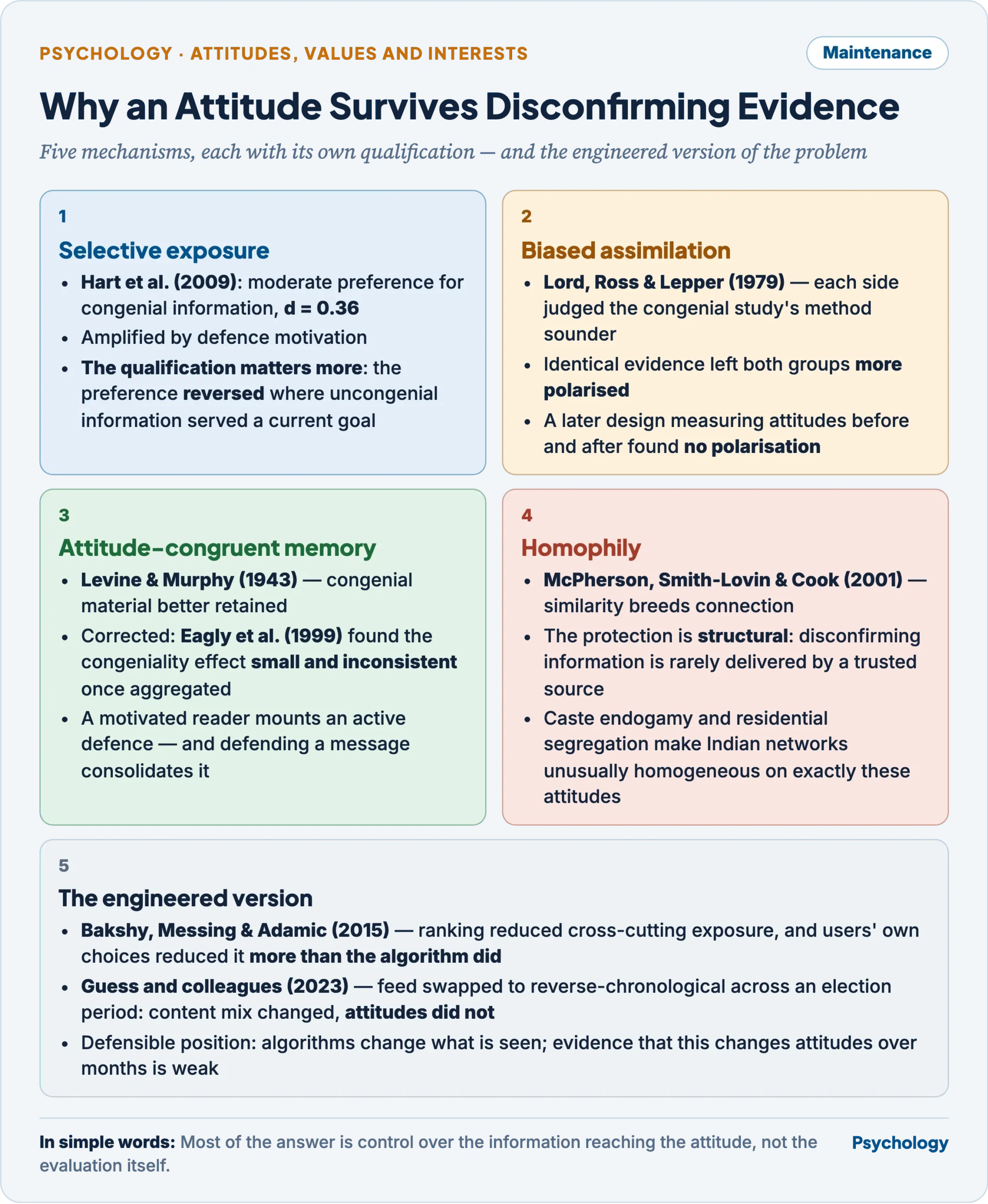
- Maintenance asks why an evaluation is not revised when the world supplies contrary evidence. Most of the answer concerns control over the information that reaches the attitude, not the evaluation itself.
- Selective exposure — preferring information that agrees with one’s position. Hart, Albarracín, Eagly, Brechan, Lindberg and Merrill (2009) pooled the literature and found a moderate preference for congenial over uncongenial information, d = 0.36, amplified by defence motivation.
- The qualification matters more than the headline: the preference reversed where uncongenial information served a current goal. Selective exposure is a motivated preference, not a reflex, and accuracy incentives switch it off.
- Selective attention and selective avoidance work on information that does arrive: the congenial gets attention, the uncongenial is muted, skipped or discounted as biased at source.
- Biased assimilation — Lord, Ross and Lepper (1979) gave proponents and opponents of capital punishment one study supporting and one undermining its deterrent effect. Each side judged the congenial study’s method sounder and shifted in its own direction, so identical evidence left both groups more polarised.
- Limitation: a later design measuring attitudes before and after found no polarisation, and the pattern is partly explicable as rational updating by people with different priors about study quality.
- Attitude-congruent memory — Levine and Murphy (1943) found pro- and anti-Soviet participants learnt and retained congenial material better than uncongenial material.
- The current statement corrects the version usually repeated. Eagly, Chen, Chaiken and Shaw-Barnes (1999) found the congeniality effect small and inconsistent once aggregated, and stronger in older studies with weaker methods; their later experiments found both kinds of message remembered about equally well, because a motivated reader mounts an active defence and defending a message consolidates it.
- Social-network homophily — McPherson, Smith-Lovin and Cook (2001) established that similarity breeds connection, so personal networks are homogeneous on demographic and attitudinal dimensions alike. The consequence is structural: disconfirming information is rarely delivered by a trusted source.
- Caste endogamy, residential segregation by community and linguistic boundaries make Indian networks unusually homogeneous on exactly the attitudes at issue, so the structural protection is stronger here than where the finding originated.
- Social support feeds back into attitude strength, so maintenance is partly self-reinforcing rather than merely defensive.
- The engineered version of the same problem.
- Bakshy, Messing and Adamic (2015) found in platform data that ranking reduced exposure to cross-cutting political content — and that users’ own choice of friends and of which links to open reduced it more than the algorithm did.
- Guess and colleagues (2023) replaced the algorithmic feed with a reverse-chronological one across a national election period. Time on platform fell and the content mix changed, yet issue polarisation, affective polarisation and political attitudes did not shift measurably over three months. A companion experiment removing reshared content cut exposure to political news without moving attitudes.
- The defensible position is narrow: algorithms change what is seen, and the evidence that this changes attitudes over months is weak. Maintenance is a live question because the architecture of exposure is now engineered rather than incidental.
Criticisms and limitations
- The learning account describes routes rather than causes. It says how an evaluation can be acquired, not why this evaluation rather than another, and the same reinforcement history yields different attitudes in different children.
- Conditioning demonstrations are vulnerable to demand characteristics. The pairing is often transparent, and the finding that evaluative conditioning is largest where contingency awareness is highest places the strongest results exactly where demand is strongest.
- Formation without awareness is oversold. Published subliminal demonstrations are few and patchily replicated, and the popular claim that subliminal advertising shapes consumer or voter attitudes has no adequate support.
- Mere exposure has a boundary the summaries omit. Exposure raises liking from a neutral or mildly positive start; where the initial reaction is negative, repetition can entrench the dislike. It is not a general technology of change.
- Heritability findings are over-read in the three ways set out above — as a gene for an attitude, as a statement about an individual, and as implying resistance to change. The equal-environments assumption remains the unresolved methodological weakness.
- The socialisation and behaviour-genetic literatures do not speak to each other. One attributes attitudes largely to family transmission; the other finds shared environment doing little outside politics and religion. The obvious reconciliation — parents supply the content, heritable dispositions the readiness — is untested.
- Maintenance research is built on laboratory sessions. One counter-attitudinal message read in a single sitting is a poor model of an attitude sustained for decades by a family, a neighbourhood and a marriage market.
- The core evidence is overwhelmingly Western, mostly student samples on objects with low personal stakes. Caste, community and gender attitudes in India are acquired pre-verbally, held by whole groups and socially sanctioned — the hardest case for such a literature.
- What survives is substantial. The three routes are demonstrated and distinguishable; mere exposure and evaluative conditioning are among the best-replicated effects in the field; heritable variance in social attitudes has replicated across registries and countries; and selective exposure and homophily are independently established.
Previous Year Questions
- 2025Why do human beings form attitudes and prejudices? Discuss the role of psychosocial factors in bringing the change in them, in the present Indian socio-cultural context.
- 2016Explain the components of attitude and examine the methods of attitude formation.
- 2003How attitudes are formed? Discuss its various components.
- 2001Citing experimental evidences discuss how social learning, social comparison and genetic factors influence formation of attitudes. Also explain how trivialisation reduces cognitive dissonance.