

Official syllabusPaper I · Unit 12 · Attitudes, Values and Interests
Definition of attitudes, values and interests; Components of attitudes.
Definition
“A psychological tendency that is expressed by evaluating a particular entity with some degree of favor or disfavor.”
Eagly and Chaiken (1993)
Allport (1935) had already called the concept “probably the most distinctive and indispensable concept in contemporary American social psychology” — the qualifier is his, and is usually dropped when the line is quoted.
Two things in the Eagly and Chaiken definition carry the whole subject. An attitude is a tendency, not a response — something inside the person that persists between occasions, which is why it can be measured today and predict something next month. And it is evaluative: its content is favour or disfavour, not truth or falsity. A belief can be wrong; an attitude can only be held.
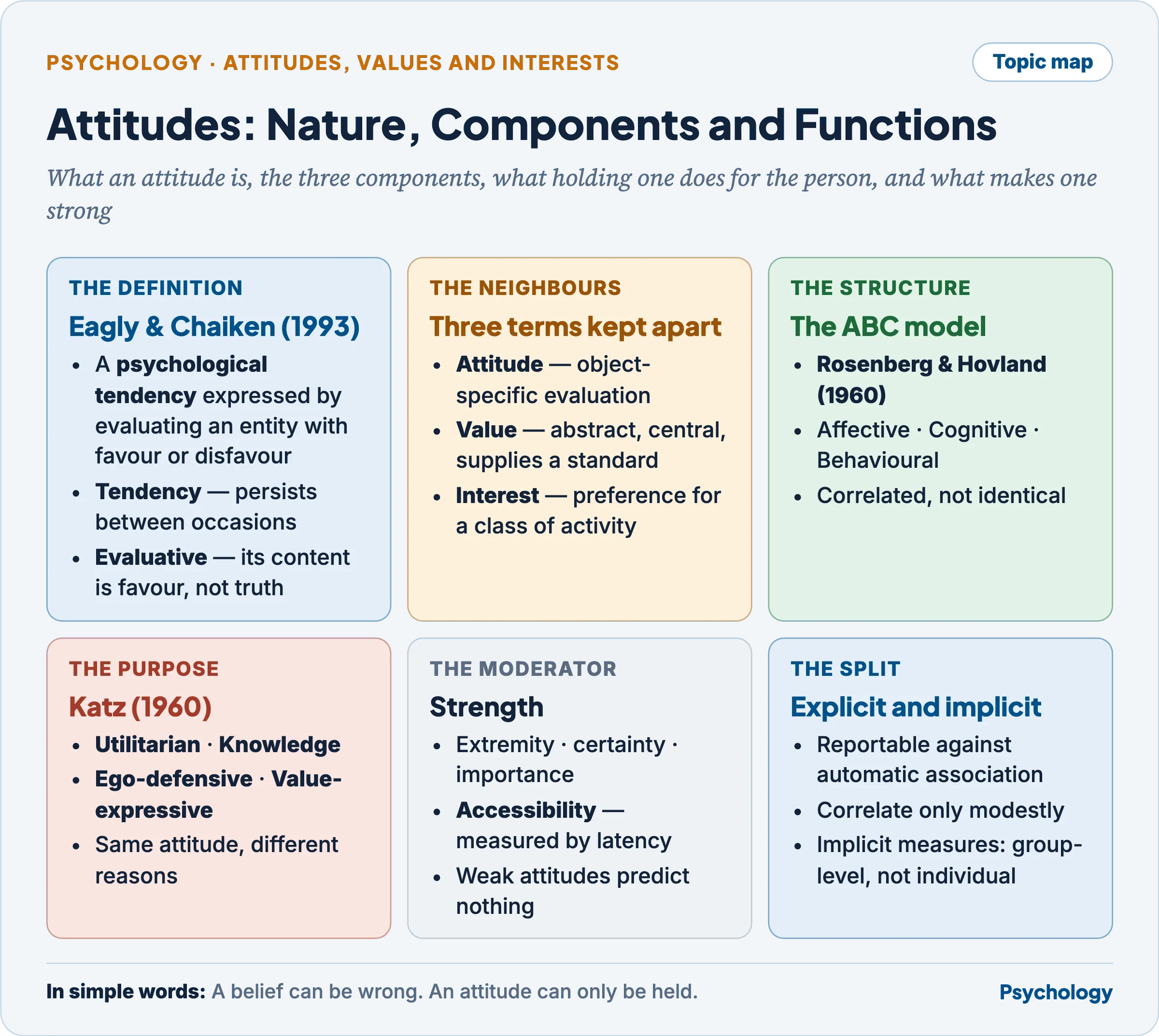
What an attitude is, and what it is not
- The attitude object can be anything — a person, a group, an institution, a policy, an abstract idea, oneself. The concept’s reach is what made it central to social psychology, and also what makes it hard to pin down.
- An attitude is learned, not innate. It is acquired through experience with the object, or through others’ reports of it, and it can therefore be unlearned. This is the premise on which every attitude-change technology rests.
- It is an inferred construct, not an observation. Nobody sees an attitude. It is inferred from what a person says, feels or does, which means every measurement of an attitude is a measurement of its expression — the fact behind most of the measurement problems that follow.
- Three constructs are routinely confused with it, and the distinction is itself examinable.
| Attitude | Value | Interest | |
|---|---|---|---|
| Object | A specific entity | No specific object — a desirable end-state or conduct | A class of activities |
| Content | Favour or disfavour | What ought to be | What one prefers to engage in |
| Number held | Thousands | Dozens | Tens |
| Abstractness | Low | High | Moderate |
| Centrality to the self | Varies, mostly peripheral | Central | Moderate |
| Standard of judgement | Does not supply one | Supplies one — a value is a criterion | Does not supply one |
- The relation is hierarchical, not parallel. On Rokeach’s account a value is more central and more abstract than an attitude, and a single value underlies many attitudes — a value placed on equality organises attitudes to reservation, to gender quotas and to inherited privilege at once. This is the answer to the question of how the two rank in motivational properties: values have the greater motivational force, because they are fewer, more central, supply the standard against which objects are judged, and are not tied to any one object, so they can direct behaviour in situations the person has never met. An attitude moves behaviour towards or away from its object; a value moves behaviour across a whole class of objects.
- Beliefs, opinions and attitudes are distinguished by what they contain: a belief is a proposition about what is the case, an opinion is a belief stated verbally, and an attitude adds evaluation to belief. One can believe that a policy will raise prices without being against it.
- Attitudes are not the same as behaviour, and the gap between them is the oldest problem in the field; it has its own article.
The ABC model, and the evidence for it
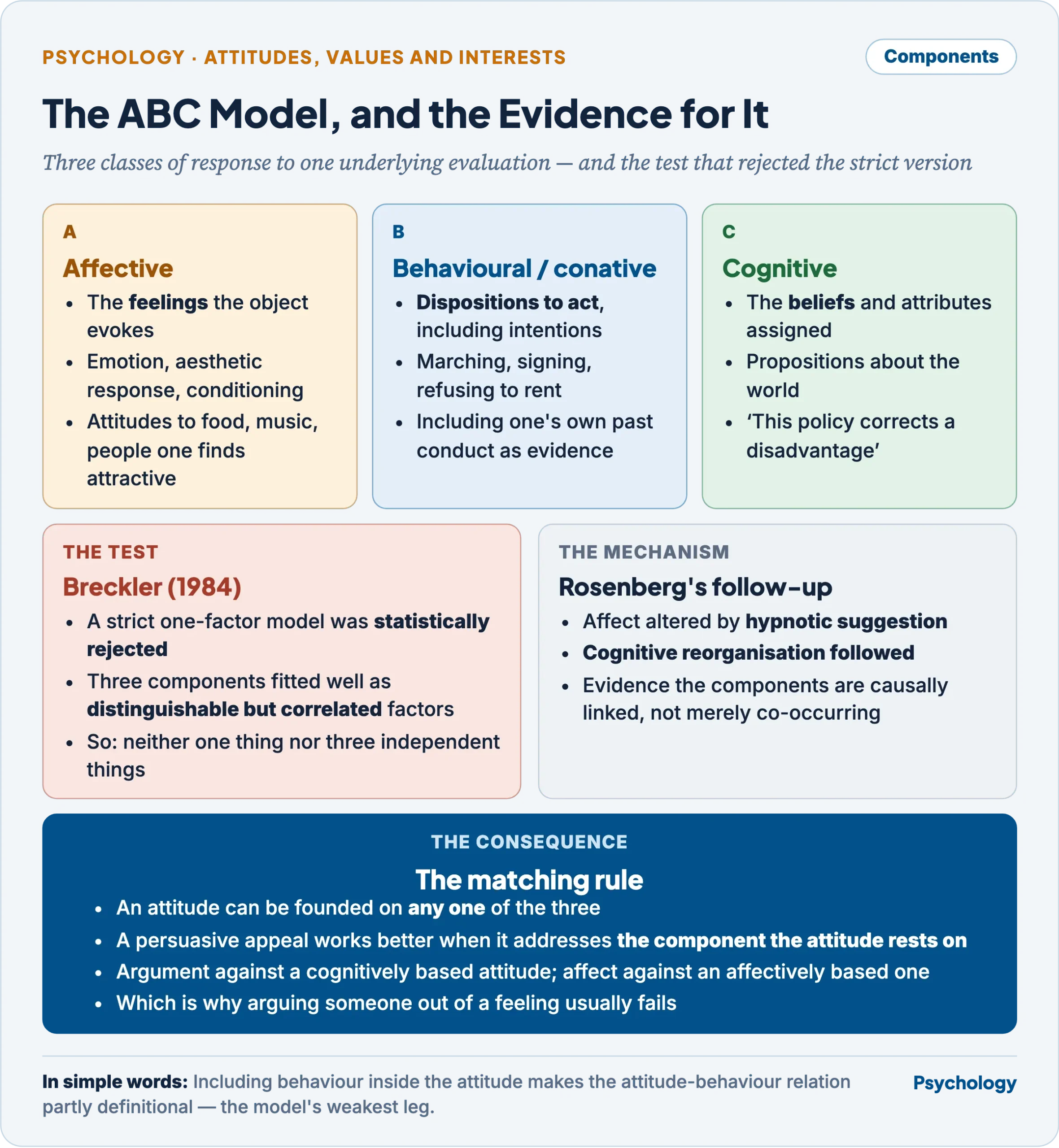
- The tripartite or ABC model is credited to Rosenberg and Hovland (1960), from the Yale programme on persuasion, though the three-way division had been in circulation for over a decade. Its claim is that an attitude is a single underlying evaluation which expresses itself in three classes of response.
- The affective component — the feelings the object evokes. Dalits in my village deserve better said with indignation is affect, not argument.
- The cognitive component — the beliefs and attributes assigned to the object. Reservation corrects a historical disadvantage is a proposition about the world.
- The behavioural or conative component — the dispositions to act, including intentions. Joining a march, signing a petition, declining to rent to someone.
- The components are correlated, not identical, and that is the model’s actual empirical content. Breckler (1984) tested it directly and the result is more interesting than either camp claimed: a strict one-factor model was statistically rejected, while the three components showed a good relative fit as distinguishable but correlated factors. So the three are neither one thing nor three independent things.
- An attitude can be founded on any one of the three, and which one matters.
- Affectively based attitudes come from emotion, aesthetic response or conditioning — attitudes to food, to music, to people one finds attractive.
- Cognitively based attitudes come from an appraisal of the object’s attributes — attitudes to a washing machine, to a tax proposal.
- Behaviourally based attitudes are inferred from one’s own conduct, which is Bem’s (1967) self-perception theory: lacking a clear internal signal, a person reads their behaviour as evidence of what they must think.
- The practical consequence is a matching rule. A persuasive appeal works better when it addresses the component the attitude actually rests on — argument against a cognitively based attitude, affect against an affectively based one. An attempt to argue someone out of a feeling usually fails, and this is why.
- Rosenberg’s own follow-up matters because it tested the interrelation rather than asserting it: affect was altered by hypnotic suggestion, and cognitive reorganisation followed, which is evidence that the components are not merely co-occurring but causally linked.
Attitude strength, and the structure beneath it
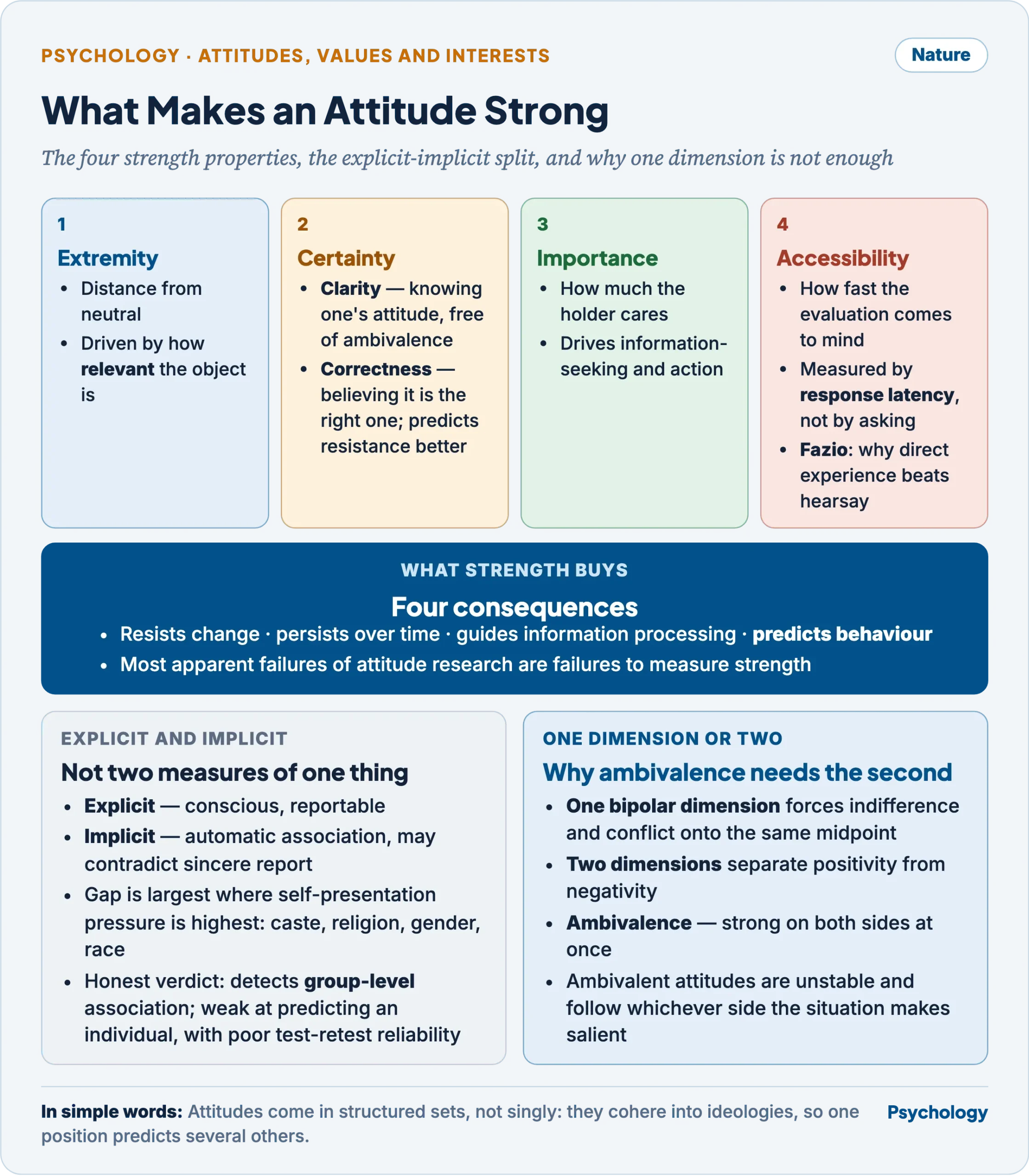
- Not all attitudes are equal, and strength is what separates them. A strong attitude resists change, persists over time, guides information processing and predicts behaviour; a weak one does none of these. Strength is the most useful moderator in the field, and most apparent failures of attitude research are failures to measure it.
- Four properties are distinguished, and they separate empirically rather than merely conceptually.
- Extremity — how far from neutral the evaluation sits. Largely a function of how relevant the object is to the holder.
- Certainty, which itself has two parts: clarity (knowing what one’s attitude is, and being free of ambivalence) and correctness (believing one’s attitude is the right one to hold). The second predicts resistance to counter-argument better than the first.
- Importance — how much the person cares, which drives whether they seek information and act.
- Accessibility — how quickly the evaluation comes to mind, measured by response latency rather than by asking. This is Fazio’s contribution, and it is the mechanism by which an attitude formed through direct experience outperforms one formed from hearsay: direct experience makes the evaluation retrievable, and a retrievable attitude is available to guide action before deliberation begins.
- Explicit and implicit attitudes are not two measurements of one thing. An explicit attitude is consciously held and reportable; an implicit attitude is an automatic evaluative association that may be inaccessible to report and may contradict what the person sincerely says. The two correlate only modestly, and the gap is largest exactly where self-presentation pressures are strongest — on race, caste, gender and religion.
- The honest statement of the evidence is that implicit measures reliably detect group-level associations and are weak predictors of an individual’s behaviour, with poor test-retest reliability. They establish that an association exists, not that a given person will discriminate.
- One dimension or two? The classical model treats evaluation as a single bipolar dimension from negative to positive, which forces indifference and conflict onto the same midpoint. The two-dimensional alternative treats positivity and negativity as separable, which allows ambivalence — a genuinely strong attitude on both sides at once — to be distinguished from mere neutrality. Ambivalent attitudes are unstable, slow to act on, and highly susceptible to whichever side the situation makes salient.
- Attitudes come in structured sets, not singly. They cohere into ideologies, so knowing a person’s position on one issue predicts several others; and an attitude is embedded in a network of related memories, so activating one part activates the rest.
What attitudes are for: the functional approach
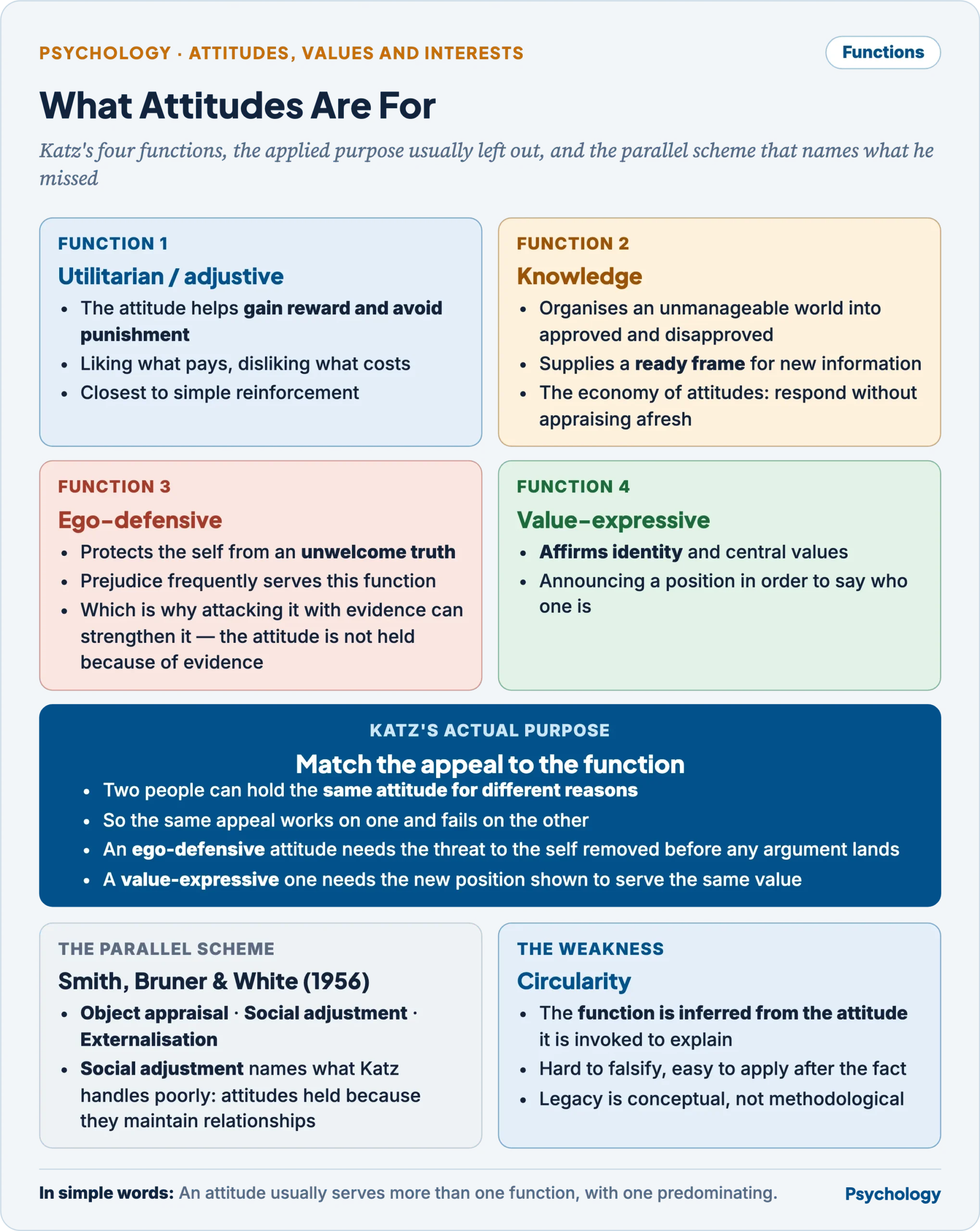
- Katz (1960) asked a question the descriptive tradition had not: not what an attitude is, but what holding it does for the person. His answer is four functions, and the framework’s point is that two people can hold the same attitude for different reasons — which means the same persuasive appeal will work on one and fail on the other.
- Utilitarian (or adjustive) — the attitude helps gain reward and avoid punishment. Liking what pays and disliking what costs. The simplest function and the one closest to reinforcement.
- Knowledge — the attitude organises an otherwise unmanageable world into the approved and the disapproved, giving a ready frame for new information. This is the economy of attitudes: they let a person respond to a novel object without appraising it afresh.
- Ego-defensive — the attitude protects the self from an unwelcome truth. Prejudice frequently serves this function, which is why attacking it with evidence tends to strengthen rather than weaken it; the attitude is not held because of the evidence.
- Value-expressive — the attitude affirms the holder’s identity and central values. Announcing a position to say who one is.
- Katz’s purpose was applied, and it is usually left out. He framed the functional approach as a way to make persuasion work, by matching the appeal to the function the attitude serves. An ego-defensive attitude needs the threat to the self removed before any argument can land; a value-expressive one needs the new position shown to serve the same value.
- An attitude usually serves more than one function, with one predominating. The framework’s weakness follows directly: the function is inferred from the attitude it is invoked to explain, which makes it hard to falsify and easy to apply after the fact.
- The parallel scheme of Smith, Bruner and White (1956) reached three functions independently — object appraisal, social adjustment and externalisation — and its social adjustment function names something Katz’s list handles poorly: attitudes held because they maintain relationships with people who matter.
- The matching claim has been demonstrated, not merely asserted, which is what rescues the approach from pure circularity.
- Snyder and DeBono (1985) used self-monitoring as an independent index of which function a person’s attitudes tend to serve, measured before any appeal was made — so the function was not read off the attitude it was meant to explain.
- High self-monitors, oriented to social image, were willing to pay more for products advertised by image appeals; low self-monitors, oriented to inner dispositions, paid more for products advertised by quality claims. Each group also rated the product higher, and later recognised the advertisements better, after its own matching appeal.
- The design is the point. An independent measure of the function, taken first, predicts which appeal works — which is the falsifiable version of Katz’s claim and the strongest evidence the functional approach has.
How attitudes are organised
- An attitude is not a free-standing item in memory. It sits in two kinds of structure, and both matter for whether it changes.
- Intra-attitudinal structure — the organisation within a single attitude.
- The evaluation is linked to a set of beliefs about the object’s attributes, to affective associations, and to memories of past behaviour towards it. Activating one element tends to activate the rest.
- Consistency among these elements is itself a strength property: an attitude whose beliefs, feelings and recalled conduct all point the same way is held more confidently and resists counter-argument better than one whose elements conflict.
- Embeddedness — the sheer number of linked beliefs — predicts resistance independently. An attitude supported by many considerations cannot be dislodged by refuting one of them.
- Inter-attitudinal structure — the organisation among attitudes.
- Attitudes cluster into ideologies: knowing a person’s position on one issue predicts their position on several others that share no logical connection, because the connection is social and learnt rather than deductive.
- A value sits above a cluster and organises it, which is why value-level change propagates to many attitudes at once while attitude-level change usually does not propagate at all.
- The practical consequence: an attitude tightly linked to others is defended by the whole cluster, so arguments against it are met with resources drawn from positions the argument never addressed.
Why the concept carries its weight
- Attitudes organise an impossible amount of information. A person meets more objects than they can appraise. A stored evaluation is a decision already taken, and the cognitive saving is the concept’s first justification.
- They predict behaviour under specified conditions — strong, accessible, specific, directly experienced attitudes predict it well, and the conditions are now well mapped rather than being a standing embarrassment.
- They are the mechanism of social influence. Persuasion, propaganda, advertising, public-health messaging and political campaigning all work, when they work, by changing evaluations.
- They are where a social problem becomes psychologically tractable. Prejudice, communal suspicion, resistance to sanitation, vaccine refusal and corruption tolerance are all attitudes before they are behaviours, which is what makes a psychological account of them useful to anyone who has to change them.
- They are the unit on which policy acts when behaviour cannot be compelled. Sanitation, immunisation, family size, road safety, organ donation and tax compliance are all domains where the state can build the facility and still fail, because what it needs is a changed evaluation rather than a changed opportunity.
- In the Indian context the concept has to carry more than the Western literature asks of it. Attitudes to caste, to religious community, to gender roles and to language are strong, early-acquired, group-anchored and normatively supported — a combination that makes them exactly the kind the literature says will be most resistant to change, and that makes the standard individual-level persuasion findings a poor guide on their own.
- Each of those four properties is independently a predictor of resistance, and they arrive together. An attitude acquired before the object could be appraised has no reasoning behind it to be argued with; one held by everyone a person depends on cannot be revised without social cost.
- The measurement consequence is severe. Where the honest answer carries a penalty, self-report records the norm rather than the attitude, so the gap between explicit and implicit measures is widest on exactly the topics that matter most here.
- The useful implication is not despair but redirection: where an attitude is sustained by a group, interventions that change what the group is seen to expect have more purchase than interventions aimed at the individual holder.
Criticisms and limitations
- The construct is too inclusive to be sharp. If anything can be an attitude object and any evaluative response an expression, the concept risks explaining everything and predicting little. Eagly and Chaiken have defended the breadth deliberately, as an umbrella term, which concedes the point while arguing it is a price worth paying.
- The ABC model does not survive as a strict structure. Breckler’s test rejected the clean three-factor account, and the components’ separability varies by attitude object. It survives as a useful classification of responses, not as a demonstrated architecture.
- The behavioural component is the weakest leg. Including behaviour inside the attitude makes the attitude–behaviour relation partly definitional, and so unfalsifiable; treating it as a separate outcome is cleaner but abandons the tripartite model’s symmetry.
- The functional approach has a circularity problem, noted above, and its legacy has been conceptual rather than methodological: it gave the field a vocabulary and very little in the way of a procedure for identifying which function an attitude serves independently of the attitude.
- Everything rests on self-report, which carries social desirability, acquiescence and the possibility that the respondent has no pre-formed attitude at all and is constructing one for the questionnaire. Implicit measures were introduced to escape this and brought reliability problems of their own.
- The literature is overwhelmingly Western and individual. Attitudes are treated as personal possessions of an autonomous holder; where evaluation is substantially a matter of group position, as caste and community attitudes in India often are, an account pitched entirely at the individual measures the wrong unit.
- What stands up is substantial. The evaluative core, the strength moderators, the distinction between explicit and automatic evaluation, and the functional insight that the same attitude can serve different ends are all established and all load-bearing in the rest of this unit.
Previous Year Questions
- 2026Discuss the nature and functions of attitudes and values with reference to development of human behaviour. Suggest relevant strategies for attitude change and development.
- 2022Explain the nature of human attitudes. How is the knowledge of attitude change process helpful in bringing religious harmony in the Indian context? Discuss.
- 2016Explain the components of attitude and examine the methods of attitude formation.
- 2012Discuss A-B-C components of attitude. Describe the procedure of development of a tool for measurement of attitude.
- 2009Discuss nature, formation and measurement of attitude. Can attitude be changed? Substantiate your answer citing research finding.
- 2004Discuss the significance of attitudes, interests and values in human life. Explain the usefulness of different procedures of attitude measurement.
- 2003How attitudes are formed? Discuss its various components.
- 1997In terms of motivational properties how would you rank attitudes and values?
- 1995What are attitudes? Can they be changed? Explain the characteristics of the source of message which strongly affect one’s response to any attempt at changing attitudes.