

The notion of self in different traditions.
Official Syllabus: Paper I · Unit 11 Personality
“The I which knows them cannot itself be an aggregate… it is a Thought, at each moment different from that of the last moment, but appropriative of the latter.”
— James (1890), on the self as knower
James made the division everything since has worked within: the self as knower, the “I” that is doing the experiencing, and the self as known, the “Me” that is among the things experienced. Psychology has studied the second extensively and the first barely at all, because the Me can be measured and the I cannot be made an object without ceasing to be what it is.
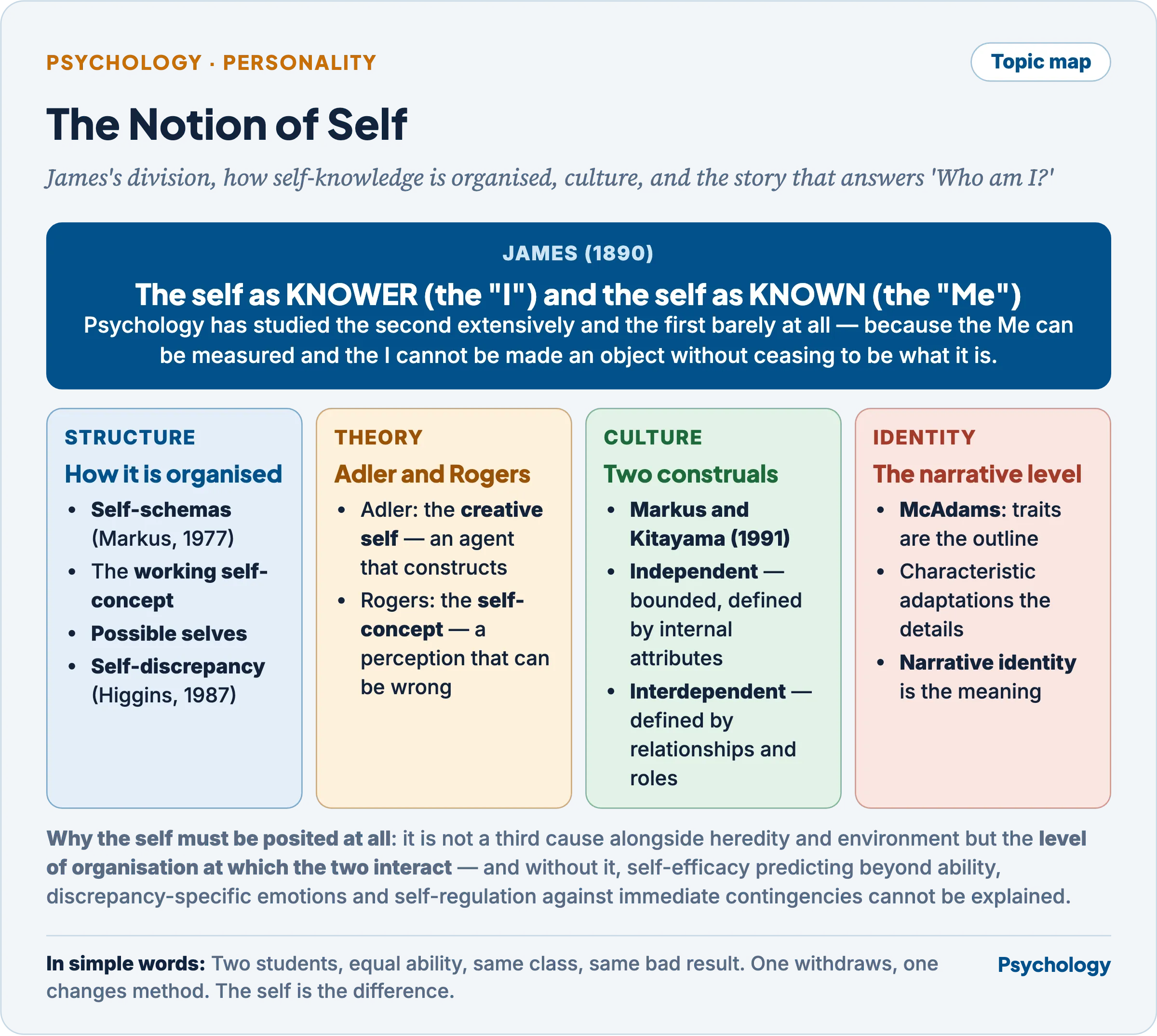
The self as a psychological construct
- James’s empirical Me has three components, and the division is still serviceable. The material self — body, possessions, the things a person counts as theirs; the social self — the recognition one gets from others, of which he said a person has as many as there are people who carry an image of them; and the spiritual self — the inner dispositions, the sense of being a conscious agent.
- His formula for self-esteem was the first quantitative proposal in the field: self-esteem as the ratio of successes to pretensions. It carries a practical implication he drew himself — that esteem can be raised as readily by abandoning a pretension as by achieving a success.
- Cooley’s looking-glass self supplied the social mechanism: we imagine how we appear to another, imagine their judgement of that appearance, and feel pride or mortification accordingly. The self-concept is thus assembled from inferred appraisals rather than from direct observation.
- Mead turned this into a developmental account. The “Me” is the organised set of attitudes of others that the person has internalised; the “I” is the spontaneous response to that Me. Children acquire the Me through play, taking one role at a time, and then through games, which require coordinating the perspectives of several others at once — arriving at the generalised other, the standpoint of the community as a whole.
How self-knowledge is organised
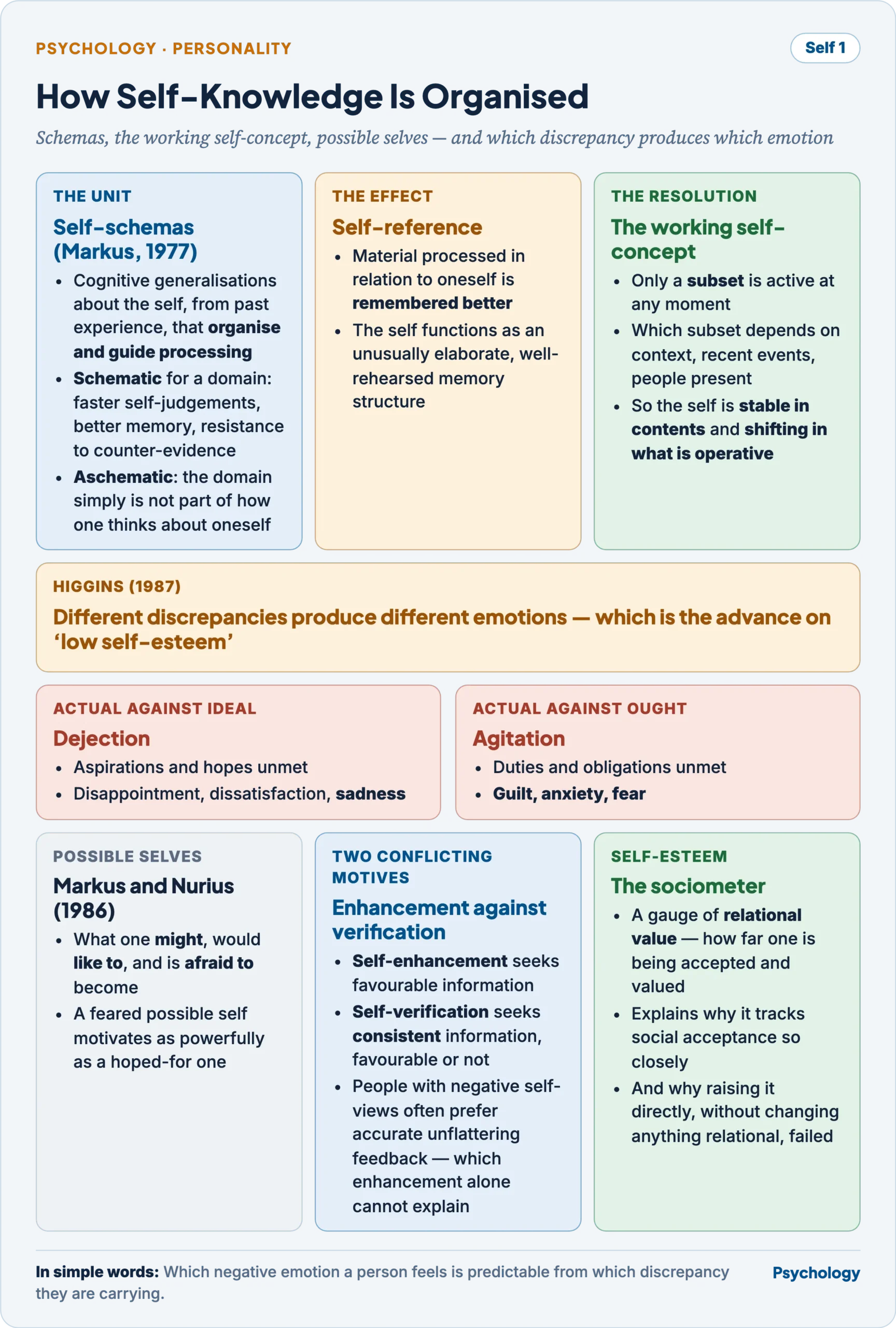
- Self-schemas are the organising unit. Markus (1977) defined them as cognitive generalisations about the self, derived from past experience, that organise and guide the processing of self-related information.
- A person is schematic for a domain if they regard it as highly self-descriptive and important, and aschematic if the domain is simply not part of how they think about themselves.
- Being schematic has measurable consequences: faster judgements about oneself on that dimension, better memory for relevant information, greater resistance to counter-evidence, and more confident prediction of one’s own future behaviour.
- The self-reference effect is the best-replicated finding here: material processed in relation to oneself is remembered better than material processed for meaning alone. The self functions as an unusually elaborate and well-rehearsed memory structure.
- The working self-concept resolves the puzzle of how a self can be both stable and variable. Only a subset of self-knowledge is active at any moment, and which subset is activated depends on context, recent events and the people present — so the self-concept is stable in its total contents and shifting in what is currently operative.
- Possible selves (Markus and Nurius, 1986) extend the structure into the future: representations of what one might become, would like to become and is afraid of becoming. They function as motivation — a feared possible self can drive behaviour as powerfully as a hoped-for one — and they link self-concept to goals.
- Self-discrepancy theory (Higgins, 1987) specifies what follows from mismatches, and its distinctive claim is that different discrepancies produce different emotions.
- The actual self, the ideal self (aspirations, hopes) and the ought self (duties, obligations), each held from one’s own standpoint or from that of a significant other.
- A gap between actual and ideal produces dejection-related emotions — disappointment, dissatisfaction, sadness.
- A gap between actual and ought produces agitation-related emotions — guilt, anxiety, fear.
- This is a genuine advance on a general notion of low self-esteem, because it predicts which negative emotion a particular person will experience.
- Two motives govern self-relevant information, and they conflict. Self-enhancement seeks favourable information; self-verification seeks information consistent with the existing self-concept, favourable or not. People with negative self-views often prefer accurate unflattering feedback to inaccurate flattering feedback, which self-enhancement alone cannot explain.
- Self-esteem is best understood through sociometer theory: self-esteem functions as an internal gauge of one’s relational value — the degree to which one is being accepted and valued by others. It explains why self-esteem tracks social acceptance so closely, and why attempts to raise it directly, without changing anything relational, have failed.
Adler and Rogers on the self
| Adler: the creative self | Rogers: the self-concept | |
|---|---|---|
| What the self is | An agent that constructs the personality | A perception — the organised set of views of I and me |
| Its role | Creator: it makes a style of life from heredity and experience | Object: it is what experience is matched against |
| Can it be wrong? | It is a construction, not a report, so accuracy is not the issue | Yes — it can misrepresent the organism, and that is the problem |
| What drives development | Striving to overcome inferiority, towards a fictional final goal | The actualising tendency, guided by organismic valuing |
| Where it goes wrong | Discouragement; a style of life without social interest | Incongruence, from internalised conditions of worth |
| The healthy outcome | A useful style of life, socially embedded | Congruence, and the fully functioning person |
| Unit of analysis | The style of life — a unified plan | The relation between self-concept and experience |
- What they share is substantial and often missed. Both make the self the central construct where Freud had made it derivative. Both are teleological — Adler’s fictional finalism and Rogers’ actualising tendency both pull from the future rather than pushing from the past. Both are phenomenological, holding that behaviour follows from the person’s own construction of their situation. Both are optimistic about growth and both locate difficulty in a relation to others rather than in instinct.
- The difference that matters is agency. For Adler the self does something — it creates. For Rogers the self is something held, which may be accurate or distorted, and therapy works by letting it be revised. Adler’s problem is a mistaken plan; Rogers’ is a mistaken picture.
- A consequence for practice: Adler’s therapy is re-educative, examining the style of life and early recollections and encouraging social interest; Rogers’ is relational, supplying conditions under which the picture can safely change.
Self and culture
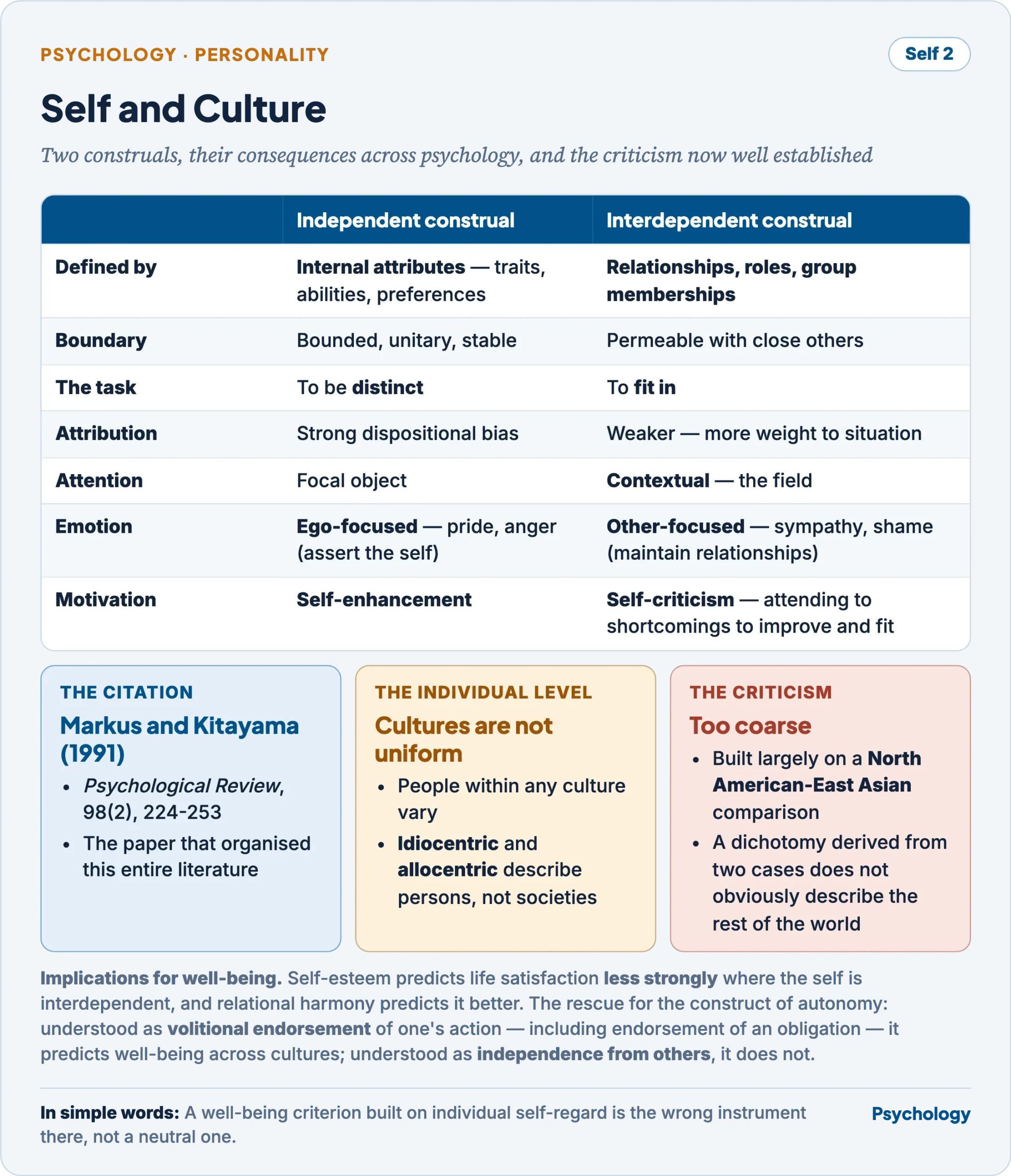
- Markus and Kitayama (1991), in Psychological Review, proposed the distinction that organised this entire literature: cultures differ in whether the self is construed as independent or interdependent.
- The independent self is bounded, unitary and stable, defined by internal attributes — traits, abilities, preferences — which are expressed and validated by being made public. The task is to be distinct.
- The interdependent self is defined by relationships, roles and group memberships, with the boundary between self and close others permeable. The task is to fit in, and behaviour is organised around the expectations of relevant others.
- The consequences run through every area of psychology, which is why the paper mattered.
- Cognition: the tendency to explain behaviour by disposition rather than situation is weaker where the self is interdependent, and attention is more contextual — people attend to the field, not only the focal object.
- Emotion: ego-focused emotions such as pride and anger, which assert the self, are experienced and expressed more in independent settings; other-focused emotions such as sympathy and shame, which maintain relationships, more in interdependent ones.
- Motivation: the self-enhancement bias so robust in Western samples is weak or absent in several East Asian ones, where self-criticism — attending to shortcomings in order to improve and fit in — appears to serve the equivalent function.
- The individual-level version is necessary because cultures are not uniform: people within any culture vary, and the terms idiocentric and allocentric describe persons rather than societies.
- The criticism is now well established and should be carried: the simple independent-interdependent contrast is too coarse to capture the diversity of selfhood across world regions. It was built largely on a North American–East Asian comparison, and a dichotomy derived from two cases does not obviously describe the rest.
Indian and Western constructions of self
- The Indian self is relational and contextual on the account that has dominated Indian psychology. The person is constituted by their place in a web of obligations — family, community, stage of life — and acts from position rather than from preference. The familial self is the term used for a self whose boundaries include close kin, and in which what Western psychology would call enmeshment is the normal condition.
- There is a layer Western psychology has no category for. The Vedantic distinction between the empirical self — the ego-sense, the ahamkara, which is a product of nature — and Atman, the witnessing consciousness that is not an object at all, adds a level above the self-concept. Western psychology studies James’s Me and has quietly abandoned the I; the Indian traditions make the I the principal subject.
- The Buddhist position denies the construct outright. Anatta holds that there is no permanent self: what is taken for one is a changing aggregation, and the belief in its permanence is itself a cause of suffering. A psychology whose central construct is the self-concept is, on this view, systematising an error — a more radical objection than any within the Western literature.
- Implications for well-being, which is where the comparison does its real work.
- Self-esteem predicts life satisfaction less strongly where the self is interdependent, and measures of relational harmony and of meeting one’s obligations predict it better. A well-being criterion built on individual self-regard is therefore the wrong instrument in such settings rather than a neutral one.
- Self-enhancement is not universally protective. Where self-criticism is the normative route to improvement and belonging, its absence is not necessarily healthier.
- Autonomy means something different. In self-determination research, autonomy understood as volitional endorsement of one’s action — including endorsement of an obligation — predicts well-being across cultures, whereas autonomy understood as independence from others does not. The distinction rescues the construct from the charge of cultural imposition, and it is the most useful single point in this debate.
- The practical implication is that interventions imported wholesale — self-esteem programmes, assertiveness training, individual goal-setting — may miss or misfire, and that the criterion of a good outcome has to be examined rather than assumed.
The emergence of self-concept
- The developmental sequence is well established in outline.
- Self-recognition appears between about eighteen and twenty-four months, demonstrated by the mirror-mark task, in which a child who touches their own face rather than the mirror has a representation of their own appearance.
- The categorical self follows: the child classifies themselves by age, sex and simple attributes.
- Early self-descriptions are concrete — possessions, physical features, what one can do — and unrealistically positive.
- Middle to late childhood brings the decisive shift: self-descriptions become psychological and trait-like, they become comparative, and they begin to be organised into domains.
- Late childhood specifically has three features worth naming.
- Social comparison becomes the main source of self-evaluation. Younger children evaluate themselves against their own past; from around this age they evaluate themselves against peers, which is why self-ratings typically become more modest and more accurate.
- The self-concept differentiates into domains — academic, athletic, social acceptance, physical appearance, conduct — which can be independently high or low.
- Global self-worth emerges as a separable construct, measurable as more than the sum of the domains, and children become able to report it directly. It is not reliably measurable in younger children, which is itself a finding about when the structure forms.
- The Indian evidence on child-rearing and self-concept is the applied part.
- Multiple caregivers in an extended household mean the attachment and socialising field is wider than the mother-child dyad on which Western accounts are built.
- Interdependence is cultivated rather than outgrown. Where Western developmental norms treat increasing autonomy as the index of healthy development, the Indian pattern encourages continued connection, obedience and deference to elders well into adulthood — so the same behaviour is a developmental achievement in one frame and a delay in the other.
- Prolonged indulgence in infancy followed by firmer demands as the child enters the household hierarchy is the pattern Kakar described, with consequences he traced into adult personality.
- Caste, gender and schooling differentiate the picture sharply, and self-concept research in India has repeatedly found domain differences by these variables.
- The honest caveat: much of this literature is small-sample, cross-sectional and dated, and the strong claims are theoretical rather than demonstrated.
Is the self necessary as a determinant of behaviour?
- The issue is whether self needs to be posited at all, given heredity and environment. The answer is yes, and the precise form of the answer matters: the self is not a third cause alongside the other two but a mediating structure through which both operate.
- Bandura’s reciprocal determinism gives the formal statement: person (including self-beliefs), behaviour and environment determine one another continuously. The person is not an additional external force but one of three mutually influencing terms.
- Five lines of evidence show that self-constructs add prediction beyond disposition and situation.
- Self-efficacy predicts performance and persistence over and above actual ability — two people of equal competence behave differently according to what they believe they can do.
- Self-schemas change information processing measurably, in speed, memory and resistance to disconfirmation.
- Possible selves motivate behaviour towards futures that do not yet exist and therefore cannot be in the environment.
- Self-discrepancies predict which emotion a person will feel, which neither heredity nor situation specifies.
- Self-regulation allows behaviour to persist against immediate contingencies — the person forgoes present reward for a standard they have set themselves, which is precisely what an account using only environment cannot explain.
- A concrete illustration. Two students of equal ability, in the same class, with the same teacher, meet the same poor result. One treats it as evidence of a fixed deficiency and withdraws; the other treats it as evidence that the method needs changing and works differently. Heredity and environment are matched; what differs is the self-construal, and it determines the behaviour and, through it, the subsequent environment.
- The qualification that keeps this honest: self-constructs are themselves products of heredity and environment, so positing the self does not introduce an uncaused cause. It introduces a level of organisation at which the two interact, and without which their joint effect cannot be predicted.
The narrative approach: answering “Who am I?”
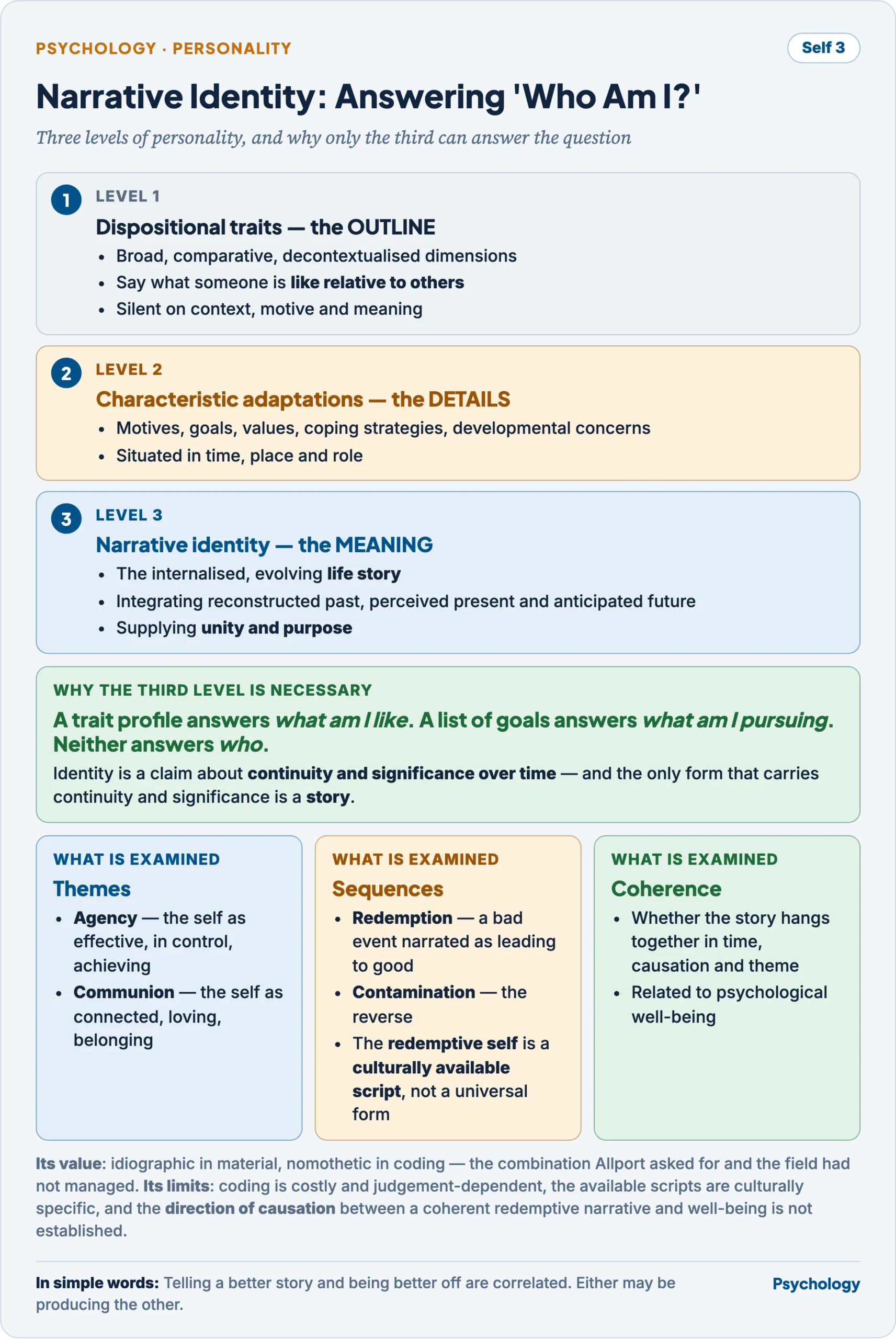
- McAdams’s three levels organise the field and explain why a narrative is needed at all.
- Level 1 — dispositional traits. The broad, comparative, decontextualised dimensions. They are the outline of a person: they say what someone is like relative to others, and they are silent on context, motive and meaning.
- Level 2 — characteristic adaptations. Motives, goals, values, coping strategies, developmental concerns, situated in time, place and role. They are the details.
- Level 3 — narrative identity. The internalised, evolving life story that integrates the reconstructed past, perceived present and anticipated future into a whole that supplies unity and purpose. It is the overall meaning.
- “Who am I?” can only be answered at the third level, and this is the force of the approach. A trait profile answers what am I like; a list of goals answers what am I pursuing; neither answers who, because identity is a claim about continuity and significance over time — and the only form that carries continuity and significance is a story.
- What is examined in a life story.
- Themes, of which the principal pair are agency — the self as effective, in control, achieving — and communion — the self as connected, loving, belonging.
- Redemption sequences, in which a bad event is narrated as leading to a good outcome, and contamination sequences, the reverse. Redemptive narration is associated with better well-being and with generativity, and the redemptive self has been identified as a culturally available script rather than a universal form — which is itself an important finding, since it shows the stories people tell are drawn from what their culture makes available.
- Coherence — whether the story hangs together in time, causation and theme — which relates to psychological well-being.
- The method is the life-story interview, in which a person recounts chapters, high points, low points, turning points and imagined future, coded systematically. It is labour-intensive, which is why the approach has less data behind it than the trait tradition.
- Its value is that it recovers the individual case without abandoning method. It is idiographic in material and nomothetic in coding, which is the combination Allport asked for and the field had not managed.
- Its limitations are real: coding is costly and judgement-dependent; the scripts available are culturally specific, so findings may not transfer; and the direction of causation between a coherent, redemptive narrative and well-being is not established — telling a better story and being better off are correlated, and either may produce the other.
Criticisms and limitations
- The self as knower has been abandoned rather than solved. Psychology studies the Me and has no account of the I, which the Indian traditions treat as the principal subject.
- Self-report is the dominant method for a construct defined as the person’s own view, which makes the circularity hard to escape.
- The independent-interdependent dichotomy is too coarse, built on a two-culture comparison and applied to the world.
- Self-esteem proved a disappointing construct, with weak causal effects on outcomes once prior achievement is controlled, and the programmes built on it did not work.
- Cross-cultural comparison of means is undermined by the reference-group effect, since respondents judge themselves against local standards.
- The Indian literature is theoretically rich and empirically thin, with the strong claims about the relational self better supported by ethnography and clinical work than by measurement.
- Narrative research has a causation problem and a cultural-specificity problem, and its coding demands have kept its samples small.
- And the construct survives all of it, because the alternatives are worse: without a self, there is no way to explain self-regulation, the self-reference effect, discrepancy-specific emotions, or why two people in the same situation with the same capacities behave differently.
Previous Year Questions
- 2025Discuss how the narrative approach to personality hinges on answering the question, ‘Who am I?’
- 2014How is self related to culture? Discuss in the light of studies on self-construal and individualism-collectivism.
- 2011Compare the Indian and western constructions of ‘Self’ with reference to cross-cultural studies and bring out their implication for well-being.
- 2011How is the information we hold about ourselves organized and interpreted?
- 2008Give a comparative account of ‘Self’ as conceived by Adler and Rogers.
- 2001Describe the process of emergence of self-concept during late childhood. Citing suitable illustrations from Indian social milieu explain the impact of child rearing practices on the emergence of self-concept.
- 1999Is it necessary to conceptualize self as a determinant of behaviour besides heredity and environment? Give real life examples to support your contention.